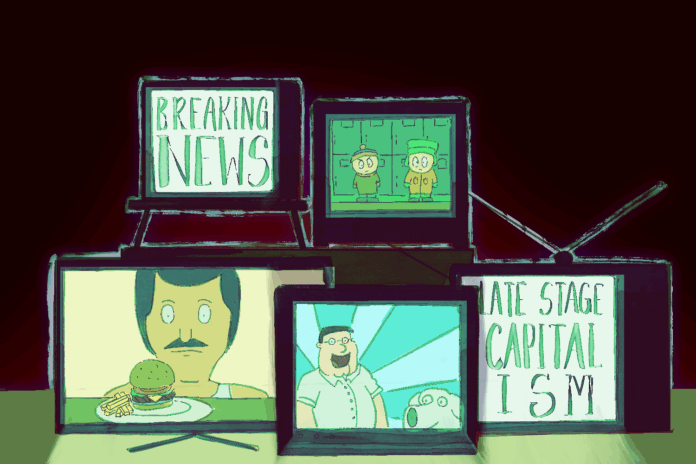
How cartoons satirize the current social, political and economic state of the world
By ABHINAYA KASAGANI — akasagani@ucdavis.edu
To preface this article, let me start by saying that I would not question it if it turned out that my first words were, in fact, “TV;” I might as well be making my way through life with a shirt that reads “I Heart TV” or with a tattoo of the aforementioned on my forehead. Still, for years I was vehemently against anything animated — regardless of the audience it was geared toward. Animation simply felt too uninspired and obtuse. It wasn’t until the season finale of “Bojack Horseman” in 2019 that I became enthused with animated satires, believing them to be a worthwhile undertaking.
The resurgence of adult animated television shows markets itself as one of the more truthful mediums we have today, working to satirize the current social, political and economic state of our world by dissecting truths that most television obscures. These shows reveal to us what we have previously failed to notice. Adult animation does this in a way only satire can — by exposing, for instance, the absurdities of national inequality and division through gross exaggeration. In doing so, it manages to defamiliarize its audience from blindly believing what they have become accustomed to.
“The Simpsons” is possibly the earliest instance of satirical adult animation, and was thought of as a contributor to the “Golden Age” of television. The rise in popularity of “South Park” pointed towards “a huge change in viewer habits and appetites in the late 1990s.” While “The Simpsons” has always been around, adult animation today has transformed into more of a mainstream venture.
The resurgence of adult animation can be attributed to a variety of things. Hannah Myers, producer on the Netflix show “Big Mouth,” examines how the COVID-19 pandemic affected the TV industry: having to “move everything remote because of the pandemic … help[ed] everyone figure out how to make television from home.” The production techniques through which many adult animated films are conceived are fairly simple to carry out, making this an opportunity for up-and-coming writers and animators to break into the field.
The truth of the matter is that animation gives showrunners autonomy over their work. The surge in production of animated satire was capitalized by streaming platforms like Netflix, Hulu and Amazon Prime Video, allowing them to profit off of the showrunners’ desire to be free from the constraints of network television. Given that animated satire can be sufficiently inexpensive to make, showrunners were exempt from catering to anyone but themselves. The medium by which this satirical animation is delivered to its audience allows for a substantial degree of auteurship; One can immediately claim to know that a show is run by Dan Harmon or Trey Parker and Matt Stone well before being briefed on the matter. This autonomy allows showrunners to create work that is unrestricted by a larger network’s desire to propagate certain ideologies, and is more truthfully and adequately able to reflect the present instability of the world.
Adult animated TV is made in an attempt to disrupt — to ask you to think. The medium allows for one to reconsider the idea of active and passive viewership, re-evaluate how their media is consumed and remind the audience of their capability for critical thought. Colin Macgillivray, Arts Editor for “The Reflector,” reminds us that “just because an animated television show deals with themes of existentialism or addiction, it doesn’t mean you’re inherently clever for watching that show.”
All this self-indulgence tells you is that you are missing the point. Satire only works when one is ultimately exposed; The audience is made uncomfortable enough that they are forced to confront the reality of the situation with no escape.
Animated satire has proven itself to be quite effective and versatile in its ability to speak to varied experiences, somehow managing to grasp the sentiments of the collective consciousness. Myers describes her journey of incorporating female stories into this medium, noting how animation has previously primarily served young men. She also references how “Big Mouth [does] a really good job of incorporating… all genders, all identities.” The mode of satire endeavors to consider earlier debates about sexual orientation, gender binaries, class differences or cultural dissonances, inviting philosophical, moral and political inquiries on the matter at hand.
Adult animation speaks to its youth in the same tone that it speaks to its adults; never quite letting either one off the hook. Most of these shows attempt to satirize the social politics embedded into our current world, imploring their audiences to think critically and repeatedly. Some jokes don’t require you to be in on them or have any skin in the game; They do, however, always require you to care about what is being said.
Written by: Abhinaya Kasagani— akasagani@ucdavis.edu
Disclaimer: The views and opinions expressed by individual columnists belong to the columnists alone and do not necessarily indicate the views and opinions held by The California Aggie.