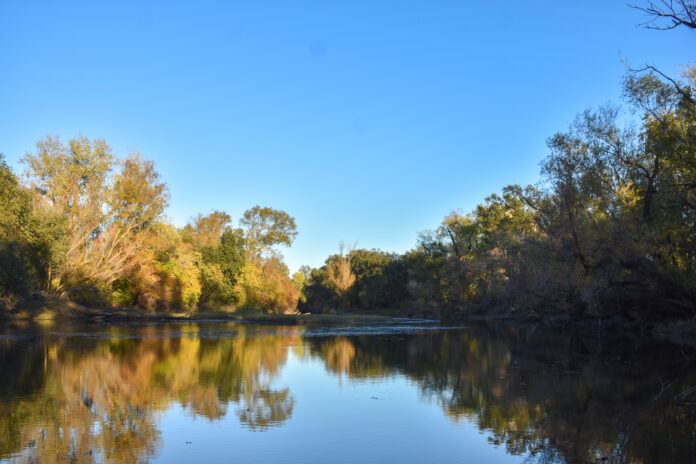
The aim of the event was to address the rise in non-native plant species in the area
By YUENJO FAN — city@theaggie.org
On Jan. 24, Putah Creek Council hosted the Putah Creek Parkway Beautification event from 9 a.m to 12 p.m. in partnership with the City of Davis Open Space Program and UC Davis American Academy of Environmental Engineers and Scientists (AAEES).
Putah Creek Council is a Davis-based nonprofit focused on environmental stewardship, education and advocacy of ecological protection. Founded in 1988, the organization was originally focused on the renewal of water flow into Putah Creek following a two-year drought. Now, the organization has expanded to ecological protection throughout Southern Yolo County and Northern Solano County. Saturday’s cleanup event concentrated on removing non-native plants in the Putah Creek area stretching from the Arboretum GATEway Garden to West Chiles Road.
Maddie Galal, the stewardship coordinator for Putah Creek Council, expanded on the cleanup objectives.
“Some of the species we worked on [preserving] were California Poppy, California Pipeline, Deer Grass and Lipine, so we weeded around them,” Galal said. “Then, what we did at the very end was add some fresh wood chips. The wood chips help us keep the weeds from growing back up, and it also controls temperature and moisture.”
Pulling the non-native weeds provides the native plant species with more room for growth, while the wood chips help water slowly trickle down, preventing moisture accumulation in the soil, according to Galal.
Furthermore, this cleanup was aided by a combination of UC Davis students and Davis community members, totaling 17 volunteers.
Peyton Goodwin, Putah Creek Council’s community engagement & outreach coordinator, touched on the importance of Putah Creek Council’s engagement with the local community.
“That’s been one of the great ways that we’ve been able to build event volunteers, when a group reaches out,” Goodwin said. “They’re a really joyful, community-based time, [especially] when UC Davis kids come. It feels fun, uplifting and a really powerful antidote to all the doom and gloom these days. I have never been to one of these and not come out with a better attitude and feel like I’m part of something.”
Goodwin further explained how partnerships with UC Davis student organizations are the backbone of the Putah Creek Council’s community engagement, and she encouraged more UC Davis student organizations to reach out.
Peihong Long, a third-year environmental science and management major, attended the cleanup with the Davis AAEES chapter and cited the importance and satisfaction of contributing.
“I signed up because I thought it was a good opportunity,” Long said. “It’s important to consider that when we have these native spaces or natural preserves, management and preservation is a big part of that. […] I think [Putah Creek Council] organized it really well, and I would definitely do it again.”
In accordance with the organization’s mission, Putah Creek Council has also kept a keen eye on issues that the local environment faces. When asked about the most significant hurdle to ecological health, Galal noted invasive plant species as a major issue.
“The biggest challenge is invasive plant removal,” Galal said. “The way that the California hills turn green for just a few months and then turn brown — that’s all non-native grasses. Unfortunately, when you go out into the landscape, most of what you’re seeing is non-natives and it’s actually harder to find a native species. [The non-native species] come in and they outcompete the native [species] really quickly.”
Goodwin characterized historical factors as a major catalyst for the increased amount of non-native plant species.
“There’s a ton of eucalyptus trees that you’ll notice around here, and those were all planted through colonization for paper and wood,” Goodwin said.
Whereas native plants once dominated California’s ecosystem, invasive species have begun to overwhelm the natural landscape. Largely brought by foreign settlers, these invasive species ultimately compromise ecological health by degrading biodiversity and harming native habitats that were previously unexposed to non-native species. Thus, cleanup events like the one held by Putah Creek Council on Saturday help combat these non-native plants and restore a balanced and healthy ecosystem.
Galal also highlighted government resources, namely the Environmental Quality Incentives Program (EQIP), which incentivizes applicable residents to aid ecological health.
“What those grants do is fund landowners, usually with a Resource Conservation District — which there’s usually one in every county — to plant a native hedgerow on the border of their property,” Galal said. “What that does is it increases diversity for the overall health of the wildlife and invites the wildlife and pollinators to the agricultural sites for the benefit of agriculture.”
Currently, Putah Creek Council has a Memorandum of Understanding (MOU) work order contract with the City of Davis to host five community stewardship events through July 2026. Saturday’s event was the first of these five cleanups, with the next event scheduled for Saturday, Feb. 14, at Mockingbird Park. More information about Putah Creek Council can be found on their website or through their social media.
Written by: Yuenjo Fan — city@theaggie.org