55.1 F
Davis

Davis, California

Saturday, December 20, 2025
Home Blog Page 142

Women’s Resources and Research Center presents 18th annual Feminist Film Festival

The festival featured 24 short films centered around the theme of solidarity


By KAYA DO-KHANH — campus@theaggie.org


On May 18 and 19 from 6-10 p.m., a number of students and local community members gathered in the Student Community Center (SCC) multipurpose room to view a selection of 24 short films that were curated by eight undergraduate interns for the Davis Feminist Film Festival. 

Put on by the UC Davis Women’s Resources and Research Center (WRRC), the theme for the 18th annual festival was “solidarity,” with sub-themes of survival, resistance, motherhood and intergenerational struggles. The event was free to all, and attendees enjoyed short films from around the world with snacks and drinks provided. The event also featured a photobooth and raffle prizes including gift bags filled with film posters, a t-shirt designed by one of the interns, a gift card to the CoHo and other goodies from the WRRC. 

The annual grassroots event seeks to link art to social issues, as the festival screens independent films in the experimental, narrative and documentary genres that highlight perspectives that might be missing from more mainstream media. The festival accepts local, national and international submissions from professionals, students and community members, with the goal of creating a public space for filmmakers with marginalized racial and gender identities to showcase their art on the topic of social inequalities. 

Third-year international relations major and Film Curation and Lineup Co-Chair Erika Au said that there were around 700 film submissions this year, which were narrowed down to a select 24 films by the interns. Each intern pair screened about three hours of films a week for a few months leading up to the festival. 

“We didn’t think it was a good idea to ignore stories that were difficult to talk about, so we included those, but we also wanted some that brought light and hope into their stories,” third-year Asian American studies and cognitive science double major and Technology and Logistics Chair Mia Chi said. “We talked a lot about what feminism is when we were planning this festival [
] thinking about all of those things and how [feminism] looks in different ways and in different places and circumstances.” 

At the end of the festival, audiences voted on their favorite films for each day of the event. The audience’s award selection for day one of the festival was a film from Germany called “Matapacos,” by directors Karla Riebartsch and Lion Durst. “Matapacos” is based on the famous Chilean “riot dog” Negro Matapacos, a stray dog who gets to know Maria, a young protester. The audience’s favorite from day two of the festival was “El-Halabiyeh” by Palestinian director Rana Abushkhaidem. “El Halabiyeh” is personal film to Abushkhaidem, as it is a story about her grandmother the night before her heart surgery opening the doors to the memories of her life in Aleppo, Jaffa and Hebron. 

“I worked on this film with all my heart,” Abushkhaidem said via email. “When I started submitting it to film festivals, I was somehow picky where to send it. I always tried to find something warm and familiar in each film festival I sent my film to. When I read about Davis Feminist Film Festival, I felt it.” 

She said that having her film screened around the globe is a “pleaser,” and when she got the news that her film was chosen as one of the audience favorites, she was proud and happy. She said that she immediately called her grandmother to tell her the news.

“El-Halabiyeh fits into the theme of the feminist film festival because it tells the story of a woman who struggled and fought for her and her thirteen daughters’ lives in a complicated community and cruel political situation,” Abushkhaidem said. 

On the first day of the festival, some people stumbled upon the festival while walking by the SCC, and ended up joining the event at the last minute. On the second day of the festival, several organizations that were in attendance, such as individuals associated with the WRRC and Students for Reproductive Justice, tabled at the event.

“I hope that audiences learn that there are so many different types of ways that feminism can be viewed in different cultural contexts,” third-year sociology major and Audience Engagement Chair Sara Tareen said. “Watching the films that I screened and then watching them again at the festival, I learned so much about so many different cultures and so many different types of people. When screening the films, that’s what I had in mind, I wanted the audience to be able to learn from these films […] It’s so important to learn other stories and other perspectives, and I feel like we did a really good job of doing that this year.”

Written by: Kaya Do-Khanh — campus@theaggie.org

Capsule invented to learn more about the human digestive system

The CapScan capsule passes through the small intestine to provide information about gut microbiomes and how diet affects health


By KATIE HELLMAN — science@theaggie.org 


According to a recent publication in Nature, researchers have designed a capsule called CapScan to collect data about healthy human digestive systems. The project was conducted by researchers at UC Davis, Stanford University and Envivo Bio Inc.

During the study, researchers analyzed the digestion process in 15 healthy individuals and found significant correlations between diet and metabolites, the result of metabolic processes. 

“To sample from four distinct regions of the intestinal tract, four devices were ingested as a set after an individual ate a meal of their choosing, wherein different device types in a set were designed to open at different, progressively higher pH levels,” the study reads.

Typically, digestion takes place when enzymes in the small intestine break down food, which is then absorbed into the bloodstream so nutrients can be dispersed throughout the body. However, the specific functions of different parts along the intestinal tract remain largely unknown.

Oliver Fiehn, a senior author of the study and director of the West Coast Metabolomics Center at UC Davis, provided insight into how CapScan could shed light on the digestive process.

“We can look into how nutrition is altered,” Fiehn said. “We can give people specific foods and use these devices to see what happens in different parts of the small intestine while they ingest them.”

The CapScan is coated with a pH-sensitive layer, which makes it so that researchers can choose which part of the intestinal tract to sample. The capsule is later recovered in the stool of participants for analysis.

“All of this information can be used for intervention,” Fiehn said. “Once we know what happens to nutrition and which microbes are responsible, and also maybe which drugs and other compounds interfere with microbial properties, then we can intervene appropriately. Instead of targeting human genes, we would target microbial species to improve health.”

CapScan also hopes to provide a much more thorough analysis of the gut metabolome (the small molecules involved in metabolism) and information about the gut microbiome.

Jacob Folz, first author on the study and postdoctoral researcher in Fiehn’s lab at UC Davis, commented on how CapScan overcomes the drawbacks of other methods used to study digestion.

“This study and new technology open the door to freely research what is happening in the gut,” Folz said via email. “This has previously been barred by physically invasive sampling procedures and radical diet control. Now researchers will be able to address serious questions related to intestinal health and disease, or simply look at how the digestion of a tomato compares to the digestion of an olive.”

So far, the small intestine has only been studied in individuals under sedation or through invasive but controlled procedures since digestion is difficult to research in humans. Part of this difficulty is due to limitations in clinical exams like endoscopy and colonoscopy, which can only scan up to certain parts of the digestive tract. 

However, the invention of CapScan will be able to provide more comprehensive information about processes that have never been studied before, as it can travel through and survey the entire digestive tract without disrupting or contaminating an individual’s gut microbiome. In addition, clinical trials testing gut health and funcion will no longer have to consider requesting participants to undergo extreme procedures or diets that may be detrimental.

“[This project] is really the exploration of the unknown,” Fiehn said. “People think about the next frontier being Mars or being the bottom of the ocean, but there’s another frontier. We think it’s absolutely essential to understand human disease but also how microbes interact with human physiology.”

Written by: Katie Hellman — science@theaggie.org

Back-up commencement speakers

Help, I’m being replaced


By ANNABEL MARSHALL — almarshall@ucdavis.edu 


When I heard that comedian and UC Davis alum Hasan Minhaj had been formally invited to speak at the 2023 commencement, I just assumed he had already said yes. But, no (the opposite of yes). They were “just asking.” I didn’t realize that UC Davis inviting someone to speak at graduation was the equivalent of me tweeting at Nicki Minaj. I got so much second-hand embarrassment from UCD begging our only mildly famous alumni to repeat some fortune cookie sayings that I made a list of people we should have at commencement instead.


George, my English TA: George is many things. Soft-spoken, kind, tall-ish. A harsh grader for grammar but basically a nice dude. He’ll probably show up about 20 minutes late and read off his slides which he will not connect to any big screen but instead show by turning his laptop around. Your mom will have a crush on him.

Piers Morgan: I’ve always wanted to throw something at a British person, but usually they’re out of range.

Someone’s mom: I’m sure any mom in the audience is going to give a more heartwarming, down-to-earth and entertaining speech than anyone currently on the roster. I do not want to hear from an advisor in the Chemistry Department, respectfully. You didn’t even go to school here.

Ben Shapiro: I’m sure he’s available. God knows he’s not busy having sex with his wife.

Matt Bennett: Originally made famous by his iconic role on Victorious as Robert “Robbie” Shapiro (no relation to Ben, I think?), Bennett now moonlights as a DJ, playing sets as near as Sacramento. Look me in the eyes and tell me you wouldn’t prefer that to a member of the UC Davis staff that you never knew existed skirting around the fact that you’re graduating into a recession.

Me: Welcome, graduates of 2023. I have a lot to say. First of all, did y’all know you could go on the roof of the Memorial Union? I did not. I think if I had known this sooner I would have done a lot better in college, but also in life, long-term. This charming anecdote shows how, had we known more, we would have lived our lives differently and better. Now, however, it is too late to lead a better life. As you move forward in life, try to remember that there is nothing you can do that will allow you to achieve that supposedly perfect life you could have had if you had just known at the time what you know now. It’s too late, probably.

Steven Luck, Ph.D.: Commonly known as the professor of PSC 001 and head of his own psychology lab, Dr. Luck is actually speaking at commencement. However, instead of giving his best wishes to the seniors, I think he should tell us about all the crazy experiments he would do if he had no regard for basic ethics or the law. If we start collectively pretending Gary May is invisible, what will that do to his psyche? What combination of illegal drugs makes the human body perform the best in a game of Valorant? If I start tasing my housemates every time they don’t wash the dishes, how fast will it start working?

Paris Hilton: Do not allow anyone to write anything for her or give her any notes. I want to hear it straight from the heart. For 10 American minutes. I will hang onto every word.  

Literally anyone, but the screen behind them is playing Subway Surfers: That’s the only way you’re going to get a photo of everyone in the audience looking in the right direction. 

Taylor Swift: No? You’re saying that NYU is better than us? 


Written by: Annabel Marshall — almarshall@ucdavis.edu 

Disclaimer: (This article is humor and/or satire, and its content is purely fictional. The story and the names of “sources” are fictionalized.)

City of Davis partners with Perennial Grazing to use sheep to restore habitats

Davis to use sheep to control plant growth in Open Space Program habitats


By ALMA CULVERWELL — city@theaggie.org 

Lea este artículo en español.


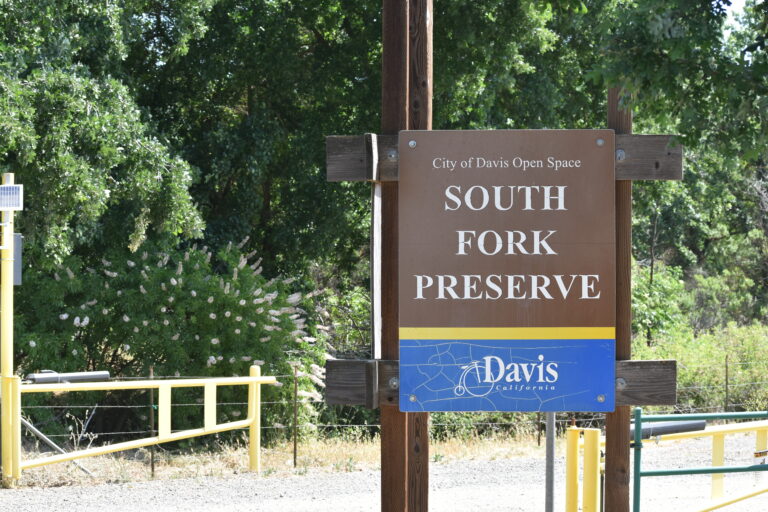
The city of Davis recently began using sheep from Perennial Grazing to combat weeds and other unwanted plant growth in their 60-acre Oak Savannah habitat at the South Fork Preserve, which is part of their Open Space Program.

The Open Space Program was created in 1990 to address the need for more adequate policies to protect local farmland and habitat areas around Davis. The program has since evolved to both acquire and preserve open space around Davis. 

The program was made possible due to funding from Measure O, a parcel tax dedicated to open space preservation that was passed in 2000. Measure O, which expires in 2030, has allowed the city of Davis to protect over 2,800 acres of land and secure millions in state and federal open space acquisition grants.  

Tracie Reynolds, the open space manager for the city, explained the decision to work with Perennial Grazing and its sheep to help with the Open Space Program. 

 “We’ve had some issues in the past with just how the sheep were grazing and that it wasn’t really benefiting the habitat the way we wanted because we primarily manage that property for habitat reasons,” Reynolds said. “And then secondarily it’s for the recreational value of it, for people that take hikes and things like that.” 

Reynolds explained how Perennial Grazing’s sheep are helping the habitats. 

“Perennial Grazing 
 has more of an emphasis on doing the grazing in a way that also helps the habitat,” Reynolds said. “What we’re trying to do there is really stimulate the growth of the native grasses as opposed to the weeds.”

Perennial Grazing is a group of ranchers and custom grazers based in the Capay Valley. The company has been in business for the past five years and works to salvage native plants by using grazing as opposed to using herbicides, tilling or irrigation to keep open spaces clean.

Shannon Waldron, a shepherd for Perennial Grazing, shared how sheep grazing works.

“We bring the sheep in once a year and we do what we call ‘mob grazing’ where we build temporary pens — these ones are about two acres — and we bring the sheep in there,” Waldron said. “What the sheep are doing is they’re eating and pooping and trampling on grass and then that leaves […] a fresh layer.”

The city is currently working on several projects as part of the Open Space Program, including the wetlands habitat restoration with UC Davis as well as other habitat restoration projects along the South Fork of Putah Creek. Measure O will be up for renewal in 2030, which Reynolds encouraged community members to vote in favor of.


Written By: Alma Culverwell — city@theaggie.org 

Camp Kesem positively impacts the children it serves and the student who volunteer

Kesem provides community and support to camp attendees and students who are connected to the club


By AMBER WARNKE — features@theaggie.org 


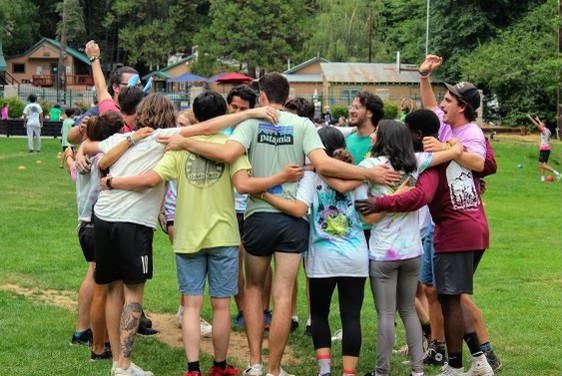
Camp Kesem is a national nonprofit organization that was founded in 2000 and provides free week-long overnight summer camps for children six to 18 who are impacted by a parent’s cancer diagnosis. The organization collaborates with over 130 college chapters in 44 states, which staff and fundraise for the camps. In 2021, Kesem served nearly 7,000 children with over 5,000 student volunteers.

Asher Rose, a first-year political science and sociology double major at UCSB, attended the UC Davis-run Kesem camp as a child. He grew up in Davis and was familiar with Kesem from the organization’s mural downtown. When his mom was diagnosed with cancer, he asked her to send him to the camp just four months later. 

“I’m really glad I got to go that summer because I don’t know what I would have done without it,” Rose said.

Rose said the camp helped him accept his mom’s diagnosis and find a community that understood how he was feeling. 

“The support system is the biggest thing that I would say that I’ve gotten from camp,” Rose said. “It’s very alienating, I would say, to be a kid and have a parent who has cancer. It’s hard, and you feel like not a lot of people really understand what you’re going through because a lot of people don’t. But Kesem really gives you that space to have that shared community to rely on. I wasn’t totally alone. I had a group of people I could really talk to, […] who would really understand what I was talking about.”

Second-year design and English double major Faith Arnett has been a general member in Kesem at UC Davis for two years. She said she decided to join after seeing a flier for the club in Wellman Hall. Arnett shared that her mom was diagnosed with cancer when she was young. 

“Now, I wish I had Kesem when I was a kid,” Arnett said. “It would have been great just to meet other kids whose parents also had cancer because it’s kind of hard to bring that up in school.” 

According to Arnett, not everyone knows how to react when kids say their parents have cancer, but Kesem provides a space where kids can be supported.

“You’ll get a lot of pity, […] It’s coming from a good place, but at the end of the day, that’s not what a child needs at that age,” Arnett said. “They don’t need pity, they need support. They need companionship. They need to know that there are other people who are also going through the same thing they are, and that’s exactly what Kesem does for these kids. It gives them a sense of community rather than being ‘the kid with a parent who has cancer.’”

Arnett attended Kesem for the first time as a counselor in summer 2022 and found that the camp does a good job balancing traditional camp activities with activities designed to give kids a space to process their parents’ diagnoses.

“We have a day in the week called ‘Empowerment,’ where we get a little bit more serious,” Arnett said. “This is where they talk about the family members they’re here for. We all sit there and listen, as we all support them. There’s a lot of tears on that day and a lot of crying, but at the end of it, I think we just all feel so immensely close to each other, and it’s just such an incredible feeling seeing those kids being so vulnerable with each other.”

Fourth-year music and sociocultural anthropology double major and UC Davis Kesem Chapter Co-Director Cloe DeBarros has been involved in Kesem for over 13 years, having attended camp since the age of 10. 

“[Kesem] definitely changed my coping skills, my perspective [and] my understanding of things,” DeBarros said. “Honestly, for the most part, it just told me that I wasn’t alone in how I was feeling.”

DeBarros’s mom is a cancer survivor. When she was diagnosed, DeBarros was only six, but as the oldest sibling, she took responsibility for the family. DeBarros said that at the time, she often felt guilty after her mom’s diagnosis. However, at Kesem, she was able to focus on her own needs.

“A lot of the time I blamed myself for the things that were going on in my family and what my mom was going through,” DeBarros said. “I kind of just put it on myself because I was the older child, and I was like, ‘Oh I have to take care of my family.’ I took the step up to be the more mature child because I have a younger brother, and I didn’t really want to focus on my own childhood, being a kid. So when I got to camp, it was that chance for me to just have fun [and] enjoy myself.”

Fourth-year human development major Jenna Larson said she didn’t want to go to camp when her mom initially suggested it after her dad passed away from cancer. 

“I was super anti-Kesem when my mom presented it to me when I was 13, and I had a terrible attitude,” Larson said. “I just didn’t want to do anything. I was very against it, going to what I saw as ‘cancer camp.’ But it ended up playing such a huge role in my life, and as much as I wanted to hate it, I loved it, and I met so many amazing people, and now I don’t know what I’m going to do without it after I graduate.”

Arnett has also made many close friends through her participation in Kesem in college. 

“Kesem is one of the most amazing things in college that I didn’t think was going to happen,” Arnett said. “It brings together so many good people.”

Larson feels similarly.

“I would not be anywhere without Kesem in my college experience,” Larson said. “All of my best friends are from Kesem. My friends outside of Kesem are like, ‘Oh my God, Kesem is your whole personality,’ but it is; it’s totally shaped who I am.” 

When asked to describe what Kesem represents in one sentence, Larson responded, “Resilience.”

Written by: Amber Warnke — features@theaggie.org

Attend local live music events

Show your support for Davis’s music scene that showcases a diverse range of up-and-coming artists 


By THE EDITORIAL BOARD


With mainstream artists like K-pop group BTS and Drake and large concerts like Coachella and Rolling Loud, many are ready to drop hundreds (or dare we say, thousands of dollars for resold tickets) to see musicians of their choice. While the temptation to splurge and set your sights high to hear Taylor Swift sing [insert favorite song here] is almost too common in this day and age, it’s worth looking closer to home to support local artists, one of which might become your new favorite band.

Davis has a long-standing history of fostering rich live music. From cozy coffee shops to bustling outdoor venues, the city offers a diverse array of spaces that accommodate both intimate performances from student bands like MONDAIJI and larger-scale concerts like the Zero Waste Concert in Central Park. The city’s music scene caters to all tastes, embracing everything from jazz, funk and R&B to indie pop, folk, rock, hip-hop and electronic music. This eclectic range ensures that there is something for everyone, making Davis a community that celebrates all genres of music.

The COVID-19 pandemic had an especially detrimental impact on the live music industry, so we should share our support to local artists and spaces whenever we can. This includes something as simple as streaming their songs on Spotify to help them gain traction. When attending free concerts or performances, some artists may ask for donations — we strongly encourage everyone to offer this support. If you are unable to make a donation, showing up to their events, posting on social media or promoting them through word of mouth are also great ways to endorse growing artists.

Local shows, for example, are a great way for students to engage with small traveling artists and local musicians, many of whom are students. Turtle House, the highly adored blue house on Second St., has been a hub for entertainment and creativity for many years, serving as a platform for musicians from all backgrounds to perform. In fact, Turtle House, in collaboration with The California Aggie’s Arts Desk, will be hosting a Couch Concert later this evening that includes a talented lineup of bands, consisting of Agraria, Mom Cars and Godfuck!. This is a great opportunity to not only support the venue and these groups, but also to enjoy a Friday night out while exploring new music.

Even if going out solely to watch local artists and bands play does not interest you, the farmers market in downtown Davis has been hosting their seasonal Picnic in the Park series every Wednesday from 4-8 p.m. until Sept. 13. It will feature live music from a local band, a wide variety of food vendors and local farm-grown produce and ingredients to purchase. It’s the perfect spot to knockout some grocery shopping, grab a hearty meal and have an evening picnic with family and friends all while enjoying live music in the background.

Attending these performances is a great alternative — often cheaper or even free — to mainstream concerts. Because they are smaller, audience participation is more intimate and integrated into the experience. Additionally, the plethora of live local events in Davis year round allows everyone to get involved in subcultures within the community and find people who listen to or play the same genres of music as them.

In a small college town like Davis, the vibrant music scene can sometimes go unnoticed or unheard of. But it serves as a nurturing ground for emerging local talent. With its proximity to the university, the city attracts a diverse pool of young musicians eager to showcase their skills and creativity. Local venues like Turtle House, Central Park and the Quad often provide a platform for these aspiring artists to perform, helping them gain exposure and build their fan base. So it’s important that we give them that recognition and support to ensure that live music, a very special and intricate part of the cultural tapestry and student life here in Davis, can continue to flourish.


Listen to our playlist of local bands here.


Written by: The Editorial Board

Dogs of Davis

Meet the canine companions of students across campus

By MIA BALTIERRA — features@theaggie.org


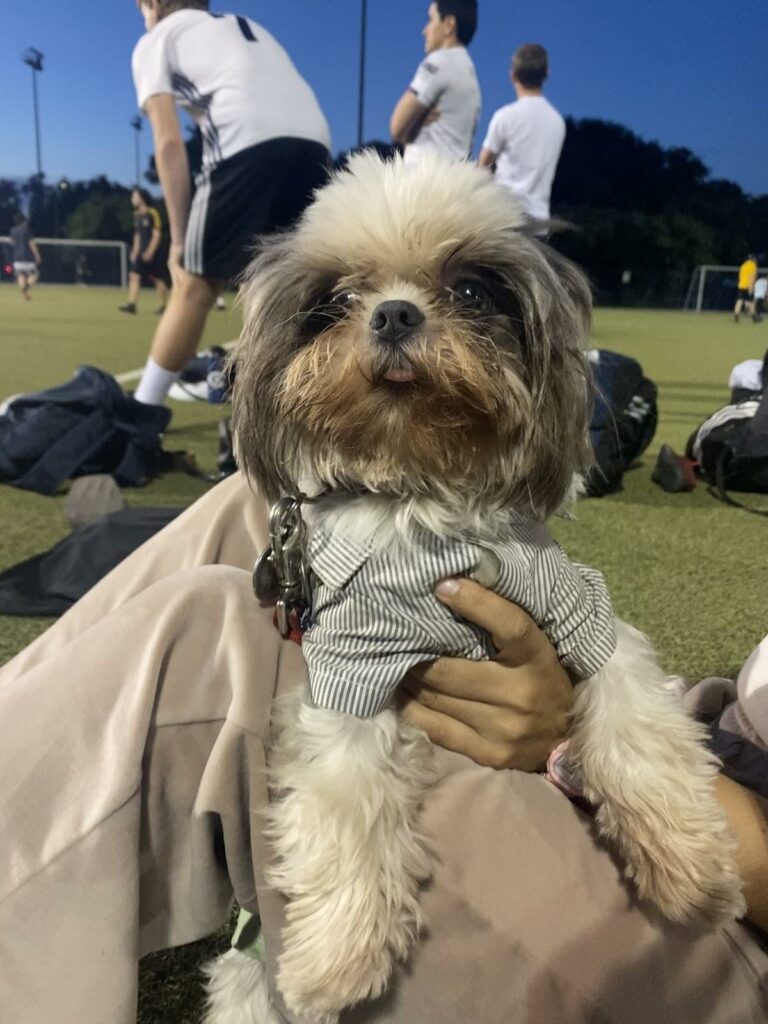
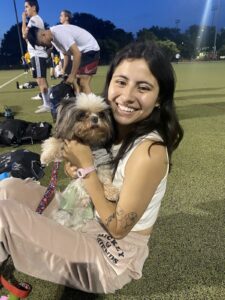
Second-year animal science major Ashley Cabrera and Louie, her five-year-old shih tzu

Q: Tell me about your dog.

A: He has a closet. He has an Instagram and everything, @louie_the_pawteenth.

Q: When did you get your dog?

A: Last year. He was a stray. I’m from SoCal, so he actually went to our house and stayed at our door so my brother decided to keep him. At the time, I had wanted to have an emotional support animal […] so I drove him up here, and now he’s mine.

Q: What’s it like having a dog at college?

A: It’s been interesting. He comes to class with me sometimes. He’s the calmest dog ever, he doesn’t bark at anything. He’s very loving, and he’s helped me deal with stress. He loves people, so it’s great to have him on campus.

Q: What can you tell me about his personality?

A: He’s loving. He’s also very sassy. He loves water a little too much; he’s obsessed with water. He’s very well-mannered.

Q: Can you share any interesting or funny stories about him being on campus or in general?

A: I used to live at the dairy facility as a resident, and he tried to play with the cows because he thought they were big dogs. They would come up to him and stuff. I wouldn’t let him [get too close], but they would both pay attention to each other.

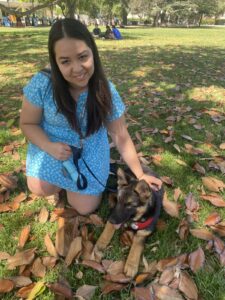
Elizabeth Hernandez, a third-year design major, and her four-month-old German shepherd, Luna

Q: Tell me about your dog.

A: She’s a puppy; she just turned four months old last week.

Q: When did you get your dog?

A: About a month ago, we got her about half an hour away in Vacaville — me and my partner. We got her the day after Picnic Day. After the [Doxie] Derby, we were like, ‘We want a puppy,’ so we were looking around, and we got Luna.

Q: What’s it like having a dog at college?

A: In terms of productivity, it’s a bit better, just because I have to wake up so early every day. Normally, I’m used to waking up a little bit later — aside from when I have to go to work — but with her, I’m basically up at seven every day because she wakes me up. I take her on campus once a week typically. When I have more time, I’ll bring her in during the middle of the day to get her used to people.

Q: What can you tell me about her personality?

A: She’s a little scared of dogs, but she’s great with people. She’s very playful; she likes playing with literally anything. Especially after she eats, she gets a burst of energy.

Q:  Can you share any interesting or funny stories about her being on campus or in general?

A: [On] Saturday, I helped volunteer at a model UN conference they do here for high schoolers, and we had her in one of the skits. She was one of those villains in the Justice League skit that they were performing. Whenever I can, I bring her with me, and she just socializes with other people.

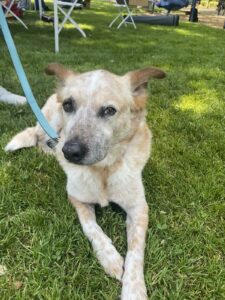
Scout, a 10-year-old Australian cattle dog (red heeler). Parker Flickinger, a graduate student in community and regional development.

Q: Tell me about your dog.

A: [It’s a] long story, but Scout isn’t my personal dog. He’s owned by my pastor, actually. My pastor runs a little chapel off campus [called The Belfry]. It’s a student chapel. I volunteer there, and I take him on therapy walks, so he can be pet and play with other students.

Q: What’s it like having a dog at college?

A: I take him out with the chapel and with my own personnel volunteering as well, to be out there, be friendly and help students feel safe and comfortable here on campus. I walk him around and the students can come say hello and play with him, and he can make them feel safe and happy. It’s just letting students know they are not alone, and I just happened to find a dog that could help with that.

Q: What can you tell me about his personality?

A: Scout is definitely a people[’s] dog. He’s definitely quiet and mellow. He’s in his retirement because he’s an older dog. [Australian cattle dogs] are often very high energy because they are bred to chase cattle. He isn’t super keen on other animals, but he loves people of all ages.

Q: Can you share any interesting or funny stories about him being on campus or in general?

A: We were just doing a therapy session with ASUCD. He has also done sessions at the Hillel House, [which is] the Jewish community center on campus. I need to take a full tally, but he has played with over a thousand students on campus.

Yogi, a six-year-old American cocker spaniel. Natalie Jean, a recent master’s graduate in earth and planetary sciences.

Q: When did you get your dog?

A: I adopted him when he was about two years old. My sister had two other dogs with her boyfriend, so she had too many dogs on hand and she was working a busy job in a tiny little apartment, so I would dogsit for them all the time, and I saw him and realized, ‘Okay, maybe if I take one of your dogs off your hands, you can be a little more relaxed at home,’ and I decided to adopt him. She was totally okay with that, so that’s how I got him, but he’s originally from Kingman, Arizona. I adopted him in Louisiana, and now he’s in California.


Q: What’s it like having a dog at college?

A: I think it’s helped with my anxiety with college classes and just deadlines. [
] When I go home and pet him, it’s an easy way to get your mind off of things. It forces me to exercise. It’s really easy to stay home and work on your computer the entire time, but it was a way for me to take a step back and not be so anxious all the time. It’s helped my mental health a lot.

Q: What can you tell me about his personality?

A: He’s definitely a people’s dog. He likes to meet other students. He’s very shy but friendly. With other animals, he’ll be talkative, but with people, he’ll just give you body language, so I think it’s just a shy demeanor. He’s not a cuddle bug, but he’s lovable. His favorite things are balls; he just likes to roll on them.

Q:  Can you share any interesting or funny stories about him being on campus or in general?

A: He’s very familiar with the squirrels that live by our house. One time, when he had the chance to go outside, the squirrel was caught off guard, and Yogi just kind of snuck up behind him. The squirrel didn’t have the chance to run up the tree, so Yogi had grabbed him by the tail by then. I was screaming, ‘No, don’t hurt him!’ but he didn’t know what to do. He just had him by the tail and the squirrel was trying to leave, but he let go when I said, ‘Yogi, let him go!’ He still wanted to play with him. He wasn’t aggressive; he has no killer instinct.


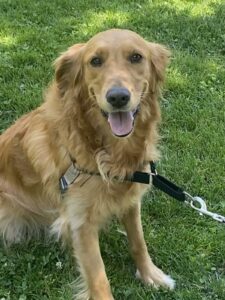
Three-year-old field golden retriever, Riley. Paige Karpinen, a fourth-year neurobiology, physiology and behavior major.

Q: Tell me about your dog.

A: It’s my boyfriend’s dog, she’s a field golden [retriever].

Q: When did you get your dog?

A: My boyfriend moved here a year ago, and he had her before, so he didn’t get her anywhere local.

Q: What’s it like having a dog at college?

A: I live walking distance from campus, so we walk here a lot. I think it’s nice because it’s an excuse to get out of the apartment. We have to take her out two to three times a day to go on walks. Campus is very dog friendly and I always see other people with dogs. My boyfriend goes on bike rides and she’ll run alongside him.

Q: What can you tell me about her personality?

A: She’s very energetic, she’s very loving, she’s very well-behaved. My boyfriend took a long time to train her, so she listens. She loves people.

Q: Can you share any interesting or funny stories about her being on campus or in general?

A: She loves the Arboretum. When we walk her there, she loves chasing the ducks, but she doesn’t try to catch them. She just wants to chase them enough that they run away from her. It’s like a little game she plays.

Written by: Mia Baltierra — features@theaggie.org

Abandoned offshore oil wells in the Gulf of Mexico could cost $30 billion to clean up

Study finds that plugging shallower wells first would be more cost-effective 


By LILLY ACKERMAN — science@theaggie.org 


A recent paper by researchers at UC Davis and Louisiana State University estimated that it would cost around $30 billion to plug and abandon all inactive offshore oil wells in the Gulf of Mexico. It also informs where budget money for cleanup might most effectively be spent for maximum environmental benefit. 

According to the paper, as 2021’s top producer of oil and gas in the world, the United States is home to over 4.4 million oil and gas wells. Offshore wells make up only 2.5% of this total, but they are responsible for 15% of all oil and gas production. Of these offshore wells, 14% are inactive and eligible for plugging and abandoning in the Gulf of Mexico, the epicenter of the U.S.’s offshore gas and oil operations. 

Plugging and abandoning oil and gas wells that are no longer in use is crucial to avoid methane gas leaks, chronic oil leaks and other pollution that could result from a lack of monitoring and repairs. These leaks impact global climate change as well as the health of local ecosystems, and with the historical prevalence of using oil and gas for energy, there are plenty of wells that need to be plugged. 

“[Plugging and abandoning] wells prevents underground saltwater from polluting fresh groundwater reservoirs, and it prevents leakage of hydrocarbons or other substances from the well,” the paper reads. 

According to Dr. Mark Agerton, the lead author of the paper and an assistant professor in the Department of Agricultural and Resource Economics, no prior studies have focused specifically on these offshore wells, which are different in many ways to the wells on land.

“We thought it was important to specifically focus on the offshore wells because they tend to be bigger, the environmental risks are different and they’re more expensive to clean up,” Agerton said. 

The authors found that plugging and abandoning all inactive offshore wells in the Gulf of Mexico would cost around $30 billion. Notably, wells in shallow water account for over 90% of these inactive wells, and plugging them would only cost about $7 billion of the $30 billion total. 

This finding has important implications for prioritizing well clean up, especially since such a large proportion of these inactive wells can be plugged at a relatively small cost. 

Compounding these implications is the finding that shallower wells also pose more of an environmental threat than deep water wells. For example, pollutants like methane emitted by deep water wells often dissolve in water and do not reach the surface, which means they don’t all enter the atmosphere and contribute to global warming. 

“We also found that the environmental risks are much higher closer to shore in shallower waters,” Agerton said. “Spilling oil really far away from shore is not as much of a problem as spilling oil in the middle of a marsh, where it can quickly smother plants and wildlife.”

Liability for cleaning wells in federal waters falls on either the current owner of the well, or, if they have gone bankrupt, any of its previous owners. In the case of state waters, the liability falls on the state if the company that owns a well has gone bankrupt. Therefore, the authors also suggest that wells in state waters be prioritized to prevent as much of the financial burden from falling upon taxpayers as possible. 

Ultimately, this paper can inform policymakers and the federal government about where to focus plugging and abandoning efforts to have the most positive impacts while minimizing expenses in the government’s budget. 

According to Agerton, $4.7 billion is put aside to clean up idle and abandoned wells. Instead of trying to plug all of the wells that are eligible, the authors identified a solid starting place that can optimize this budget while minimizing environmental damage. The authors also suggest complimenting this budget with regulations that would further incentivize oil and gas companies to clean their wells themselves.  

Written by: Lilly Ackerman — science@theaggie.org

Senate hears from ASUCD Units who oppose recent budget decisions

They also heard quarterly reports from Aggie Reuse, Whole Earth Festival


By RACHEL GAUER— campus@theaggie.org


Vice President JT Eden called the meeting to order at 6:12 p.m. on Thursday, May 25. Eden then recited the UC Davis Land Acknowledgement. 

First, the Senate moved into the confirmation of the Interim International Student Representative (ISR) Noah Shrestha, a second-year international relations major. Shrestha will serve for the remainder of the academic year. 

The Judicial Council (JC) recently ruled that the ISR and Transfer Student Representative (TSR) positions now have voting power in the Senate. Senator Fujimoto expressed his concern in swearing in the new candidate under these new conditions.

“I think as members of the table we should be in the mentality that we are confirming an interim senator,” said Fujimoto. “I argued in front of JC that I think it’s very problematic and concerning that an executive branch member has […] legislative authority in the Senate. […]  I don’t think I will be voting in favor of this candidate tonight.” 

After several other comments and questions from other members of the Senate table, they moved into a roll call vote for Shrestha’s confirmation, and with a 8-3-2 vote, the vote passed and Shrestha was confirmed as the interim ISR. 

Next, the Senate heard a presentation from Alex Lee, a UC Davis alumnus who currently serves as a state assemblymember for California’s 24th District. Lee served as ASUCD President during the 2016-2017 academic year and graduated with a double major in political science and communication. 

“I think this experience really prepared me to become a state legislator,” said Lee. “I have never been elected to any other ‘real office’ before. I was an [ASUCD] senator, then president, and then elected as a state assemblymember.” 

Lee, who is 25 years old, also spoke about his experience as a particularly young member of the state assembly. 

“The fact of the matter is, I serve with people who I am the same age as their grandchildren or children,” said Lee. “But the reality as young people is that we are judged by a different metric, especially when you are queer or a person of color, as I am. You must work 100 times harder to just be equal.” 

Following the presentation, the Senate moved into public comments. Members in support of a greater budget for the Entertainment Council (EC) and other ASUCD units after the recent budget hearings for the 2023-2024 academic year attended and spoke about their disappointment regarding the recent budget decreases for the council.  

Keegan Thompson, a second-year communication major and a representative of Entertainment Council, spoke in support of EC.

 “I’m not here to say, ‘Just give us more money,’ because I understand that’s what everyone wants,” Thompson said. “But I want to just spread awareness that people like what we do and I think we’re doing it really like it as well. We just want to be able to keep doing that.” 

Kaya Kurtz, a third-year sustainable environmental design major who is one of the satellite operations managers for the ASUCD Pantry, expressed her concern regarding the summer budget for the unit.  

“With the current ASUCD budget, the managers won’t be able to get paid for either of the summer terms, which means that the Pantry most likely will not be able to run,” Kurtz said. “This is an issue because the Pantry is a huge resource for students to be able to have food and the managers are really who make this happen”

After hearing the budget concerns from the individuals representing ASUCD units, the senators heard Aggie Reuse’s quarterly report. Victoria Mattsson, a third-year environmental science and management major and the unit director for Aggie Reuse, gave the brief  presentation via Zoom in which she described the the store and updated the Senate on its operations.

“For those of you who don’t know, Aggie Reuse was known as the on-campus thrift store, but recently this whole year it has been functioning as a mutual-aid model where all of the items in our store are free for students and non-students,” Mattsson said. “Everything in our inventory is donated to us by community members and students. Most of our expenses and most of our budget really just goes to paying seven of us and our normal expenses are very low. It really runs beautifully, and I’d like to thank you all for supporting it.” 

Following the presentation, the senate entered a 30-minute break and resumed the meeting again at 9:10 p.m. Senator Stephen Fujimoto presented the president pro tem quarterly report in which he outlined an extensive list of duties to the Senate table. 

In response to Fujimoto’s presentation, TSR Logan Ueno suggested that Fujimoto receive extra help from other senators or volunteers. 

“That list is like 15+ things to do and you are only allocated a certain number of hours,” Ueno said.  “I think that’s a lot, that’s too much for someone to do on top of being a student. People say during public comment that we should prioritize being a student and that rings true here. Yes, we are elected officials but we have to remind ourselves that we are students too and we don’t want our academics to slip.” 

Next, the Senate heard the quarterly report from the Whole Earth Festival (WEF). Senator Zeki Xu, a fourth-year design major and publicity director for WEF, gave the report, which focused on the successes of the event and the large turnout for volunteers.   

The Senate moved into brief officer reports and then began with the status of previous legislation. SR #6, SB #102 and SB #105 all passed.  

Next, the Senate discussed new legislation. Vice President Eden read the summary of SR #7 and assigned it to External Affairs Comission and The Ethnic and Cultural Affairs Commission. 

“This is a resolution to support the mission of National Gun Violence Awareness Day on the first Friday in June to honor and remember all victims and survivors of gun violence, and to declare that we, as a country, must do more to end this public health crisis,” Eden said. 

CA #85, SR #9, SB #115 and SB #116 were also introduced. 

Next, the consent calendar passed unanimously. 

The table then moved into “budget amendment” which was added to the agenda prior to the meeting. However, budget amendments were unable to be made after the hearings on May 20-21. 

“This was on the agenda originally, because I thought we could actually do it, but we can’t,” Eden said. “We can’t bend the budget in this meeting. The bylaws outline a pretty detailed and lengthy procedure for how the Senate can amend the budget.” 

After this, Eden adjourned the meeting at 11:28 p.m.

UC Davis women’s equestrian team members reflect on how their sport has impacted their lives

Riders say the equestrian community has provided them with social and emotional benefits 


By AMBER WARNKE — features@theaggie.org 


The riders of the UC Davis women’s equestrian team, established in 2018, compete in Western and English competitions across the country and practice three times a week at the Davis Equestrian Center.

The team has had a successful spring season, with a “dominant victory

against the Minnesota Crookston Golden Eagles,” scoring 15-0 and recording 1,161 points,

which marks UC Davis’s “most lopsided win in program history,” according to the UC Davis Equestrian website.

“This program has done some incredible things in the short span that it’s been

organized,” second-year history major Marin Gilliland said. “We went from having a really small team to winning our conference championships this year, which is a really big deal, and now we’re trying to go to Nationals next year.”

The team practices for two hours three times a week in addition to pre- and post-practice horse care, according to fourth-year history major Macey Newkirk. 

“We have an hour to get ready for practice,” Newkirk said. “And then it’s about an hour to take our horse out of practice, which means taking all the tack [gear] off and unsaddling and washing our horses after practice, so it’s a big deal.”

Though this is already a significant time commitment, Gilliland explained that the team would actually practice more if they had the funding to do so.

“We can’t afford any more horses,” Newkirk said. “If the university gave us more money, we’d be allowed to practice more, but that sadly has not been the case, so we’re only allowed to practice three days a week.”

While the team mostly takes care of and practices with the horses housed at the UC Davis Equestrian Center, when riders compete at other schools, they have to ride that school’s horses, which is an added difficulty, according to Gilliland. 

“When you go away to other schools, [
] you only have four minutes to learn the horse before you have to do your event,” Gilliland said.

Despite the challenges of growing a young program, members of the team say the camaraderie between the riders is worth the difficulties, and being on the team has shaped their experiences at UC Davis. 

“As a person, it kind of shaped who I am today,” Newkirk said. “It allowed me to get to UC Davis [and] gave me every opportunity I’ve had. The Davis team is genuinely a big family. This team is absolutely everything you could wish for to welcome you into this town as a student-athlete.”

Many of the team members grew up riding horses before coming to UC Davis. Gilliland was introduced to riding around the age of nine by her mom and grandmother, who both grew up participating in the sport. 

“My grandmother always rode because a lot of people rode at that time,” Gilliland said. “They rode Holo Lio [which means “horse riding” in Hawaiian] […] and then because my grandmother rode, my mom got into riding, and then so on — I got into riding. The whole community in Hawaii, where I grew up riding, everyone knew everyone, and it was a really nice community to grow up in and learn my sport in.”

For Gilliland, growing up in Hawaii impacted her equestrian opportunities. 

“Not a lot of people, at least in my disciple, which is show jumping, have the opportunities to be able to ride on the mainland, or at a higher level because we’re on an island in the middle of the ocean, so it’s a little harder to get the supplies and scholarships over there,” Gilliland said. “You have to work extra hard to be able to get […] recruited to a college, which requires a lot of work and a lot of time.”

Gilliland is proud of her background as a horseback rider from Hawaii and hopes that more opportunities will open up for Pacific Islander riders in the future. 

“For me, the value of riding is proving that people from Hawaii, Pacific Islanders,

anybody, can make it to a college team and ride at this high level,” Gilliland said. “It’s all possible; we just need the opportunities to do it. Because we’re so small, we all have to stick together and work hard to enjoy our sport and make it possible for up-and-coming generations to have access to opportunities that maybe we didn’t have when we began riding. The road is being paved, and people are getting the opportunities that they deserve because there are some really talented riders over there. It’s an ocean away!”

Second-year communication major Kendall Lance is also a member of the team. She explained that she was introduced to the sport when her mom found a Groupon for a horse riding camp. 

“I had always begged her to ride horses, and she let me go and it just went on from there,” Lance said. “I started doing more regular lessons and then leasing a horse and then owning a horse, and now I’m here.”

Lance has thus far enjoyed her experience as an equestrian at UC Davis, and said she loves striving towards winning competitions as a team.

“I love it here,” Lance said. “The team’s really awesome; we have a really great team culture. I think because it is a newer team still — I think this was the fifth year of competitions — so everyone is still hunting for those big goals. It’s really awesome being a part of a group of girls where we all have the same values.”

Written by: Amber Warnke — features@theaggie.org

Davis City Council officially recognizes June as Pride Month, sparking debate

City council passed an item that would officially denote June as Pride Month at May 26 meeting


By HANNAH SCHRADER —  city@theaggie.org


Content Warning: this article contains discussions of transphobia.


On May 26, the Davis City Council met to address both the new agenda items and the previously scheduled agenda items that were rescheduled in order to prioritize the investigation into the recent stabbings. One of the items on the agenda was to pass an item to officially recognize June as Pride Month in Davis, which sparked controversy during the public opinion section of the meeting.

A Davis resident talked about their trans identity and the importance of supporting LGBTQIA+ youth in Davis during the public comment section. 

“If I had never come out of the closet as a trans boy, I would have been dead by last year,” the speaker said. “I understand that some of you are here due to the misconception that we are predators and we sexualize everything that moves, but I’m here to tell you that sickens us to the bone, we are sad that you think that. Queer people have simply existed and love who they love, and you feel threatened? I personally have witnessed the community be nothing but gentle and caring to kids.”

Another concerned Davis resident, who said they spoke on behalf of a friend during the public comment section, criticized the city’s recognition of Pride Month and involvement with the Davis Phoenix Coalition (DPC). 

“Who has given the Davis Phoenix Coalition the authority to sexually emancipate a minor child?” the resident said. “If any adult or teen in attendance [of the Davis pride event] is possibly sexually aroused during the drag show, resulting in a sexual assault of a minor or adult, are there legal implications for the sponsors of this event?”

The DPC is an organization that aims to eliminate intolerance through the cultivation of a more accepting environment and provide Davis with more resources for the LGBTQIA+ community. The director of Yolo Rainbow Families (a DPC program), Anoosh Jorjorian, who also spoke during the recent city council meeting, talked about the tension in Davis surrounding LGBTQIA+ rights at the moment and pointed to Yolo County Moms for Liberty, the group Jorjorian believes is responsible for many anti-trans protests in Davis. 

“So the group that currently is using the Moms for Liberty banner, […] we first found out about them in December at one of the board of education meetings,” Jorjorian said. “But it seems like they’ve settled on Moms for Liberty as the organization that, you know, they’re using that umbrella to advance their anti-trans policies.”

Jorjorian discussed the opposition the DPC has received lately amid the ongoing wave of anti-trans rhetoric around the country. 

“We certainly have this national movement against trans rights,” Jorjorian said. “There have been several articles that have come out about how the GOP selected trans rights as the issue, as […] what are the main issues that they would be targeting for the 2024 election. So this is a very top-down strategic movement that dovetails with a kind of national GOP agenda.”

The DPC’s presence at the most recent city council meeting was also accredited to showing up for council member Gloria Partida, who is also the chair of the Davis Phoenix Coalition.

“[The DPC has] been focusing a lot of our actions on the school board meetings because that is, you know, where policy about children is decided and things like that,” Jorjorian said. “But poor Gloria had been targeted during these city council meetings for months.”

During the public comment section of the meeting, another resident spoke critically about the announcement and criticized the DPC for their support of trans youth in the community. 

“Why is the Davis Phoenix Coalition, an organization founded to counter bigotry toward the lesbian-gay community, completely oblivious to the profound homophobia underpinning gender ideology?” the resident said. “Why are they ignoring the systematic sterilization of gender nonconforming children, who if left to develop naturally, would likely grow up to be happy, healthy homosexuals?”

A young trans kid came up to speak during the public comment, with their parent by their side, to thank the city for its support for the LGBTQIA+ community. 

“I’m mostly here to say keep supporting us and thank you for all the support Davis has given us,” the speaker said. 

Their parent followed and talked about their experience in Davis. 

“I wanted to say thank you for declaring [June as] Pride Month,” their parent said. “I remember back in the ‘90s this being the place where I felt safe enough to explore and come out and [Davis] being a great place to raise a kid [because] it’s a safe and supportive community.”

Jorjorian was also at the city council meeting and talked about the DPC and the hate they are working to eliminate in Davis. 

“We were founded on an anti-gay hate crime,” Jorjorian said. “Therefore, our mission has been to stand up for the marginalized, to end hate in Davis and in our region and to bring marginalized voices forward. We would really prefer to not to have to keep coming to these forums, to say that hate is wrong and that discriminating against any community in Davis is wrong and that hate is not an opinion: it is a position that people take. People claim they are ‘progressive liberals’ and they support the LGBTQIA+ community, [but] when they partner with right-wing media, when they dox our members, when they take photos of trans members of our community and put it public on Twitter with an anti-trans slur — that is hate.”


Written by: Hannah Schrader —  city@theaggie.org


Pride Festival comes to campus June 2

The second annual event will feature drag performances, student clubs and vendors


By SYDNEY AMESTOY — campus@theaggie.org 
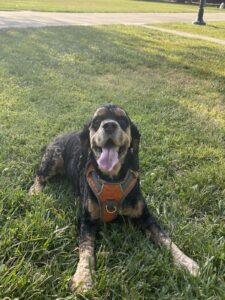
 

ASUCD’s second annual Pride Festival is returning to the Memorial Union Quad on June 2 from 3-8 p.m.

The event will feature numerous vendors selling crafts and food, along with a performance by the student pole dancing club and shows from local drag queens, according to fourth-year American studies and neurobiology, physiology and behavior double major Emma Bishoff.

Bishoff, along with second-year communication major Hallie Wong, are this year’s ASUCD Pride Festival co-chairs. The two have been working throughout the year to organize June’s event, which is new to UC Davis as of last year.

Some of the tasks that went into organizing this year’s festival included gathering student volunteers to help table and run the event, as well as bringing in new vendors and entertainment not featured at the inaugural event. 

“This year, it’s bigger,” Bishoff said. “I would say [there are] aspects of the festival that are unique to the queer and trans community like drag performance. We’re also having tarot readers come, and we’re having a Henna artist. So we’re having a lot of activities.”

Many of the vendors being brought in are local, according to Wong.

“This event also provides a platform for local businesses and small businesses owned by queer and trans individuals,” Wong said.

The Pride Festival was recently designated an ASUCD unit. Last year, it was organized by the ASUCD Gender and Sexuality Commission with a relatively small budget, but this year, it was granted a budget of $10,000.

“[The budget] definitely alleviated a lot of the stress, because last year, we didn’t have [much] funding, and nobody believed in the event because it had never happened,” Bishoff said. “[Now] it was like people had confidence in us, which was nice. We could take a little bit of a deep breath.”

Pride Month at UC Davis is celebrated throughout the month of May, rather than the nationally recognized month of June, because of the fact that many students aren’t in Davis over the summer. ASUCD and the LGBTQIA+ Resource Center have been putting on numerous events throughout the month so far. 

The LGBTQIA+ Resource Center’s events were themed around ‘Rage and Resilience,’ which Bishoff said was inspired by the 1969 Stonewall Riots in New York City.

The festival is not a part of the LGBTQIA+ Resource Center’s May Pride Month events, but according to Bishoff, it shares the same themes of resilience.

“Right now, in our country, we’re at a very important moment,” Bishoff said. “The people who are standing up and saying we are proud of this community, and we are here to support it, I think that every chance we have to do that, we must. This event is not just to be fun and celebratory. It’s also a protest [to say], ‘We are we are here, we are we exist, we matter and we’re going to take up space.’”

Both Wong and Bishoff emphasized what they see as the importance of an event like this, both for the LGBTQIA+ community on campus and individually. According to Wong, her attendance at last year’s Pride as a freshman was one of the main factors that encouraged her to take on the co-chair position. 

“Celebrating and uplifting the queer and trans community and just knowing that I can contribute or help contribute this year, I’m incredibly honored to be a part of this new tradition,” Bishoff said. “I’m super excited and proud of this event and I hope it carries on forever.”


Written by: Sydney Amestoy — campus@theaggie.org 

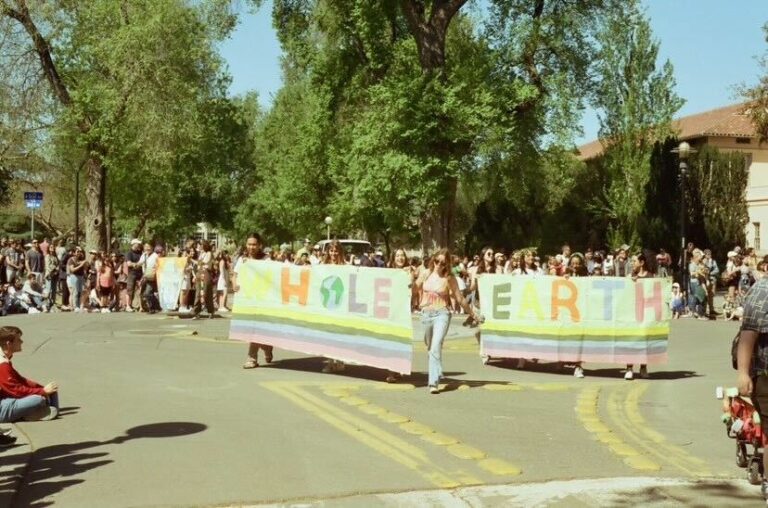
Volunteers at the Whole Earth Festival weave together community, sustainability and memorable experiences

Dedicated members reflect on the essence of the Whole Earth Festival


By FAITH DEMEULENAERE — features@theaggie.org
Lea este artículo en español.


Nestled within the vibrant grounds of the University of California, Davis, the Whole Earth Festival is an annual celebration of music, art and sustainable living. 

While the festival attracts thousands of visitors each year, it is the dedicated volunteers who are the backbone of the event. For enthusiastic newcomers like Eva Jabbari, a first-year environmental policy analysis and planning and international relations double major, and returning volunteers like Josh Winter, a recent alum who majored in computer science, the festival is a transformative experience that fosters a sense of unity and purpose.

The Whole Earth Festival, which began in 1969, is hosted on the Memorial Union Quad during spring quarter. Throughout the three-day event. artists and vendors set up booths and various bands perform for the crowd. In 2022, Winter joined the Quad stage crew. This role demanded physical stamina and a keen eye for swift stage changes. However, it was the strong sense of camaraderie that struck Winter the most. 

“Many of the people I worked alongside have been Quad stage volunteers for over a decade,” Winter said. “I met a lot of great people that weekend, many of whom I got to see again this year.”

Many volunteers like Winter and Jabbari are familiar with the volunteer saying “WEF love,” which, according to Winter, portrays the “special sort of connection formed between everyone involved in making the festival happen.”

“There’s a feeling of belonging, acceptance and duty when working together to create the event,” Winter said.

WEF is a zero-waste event, which the volunteers agree can be quite exhausting at times.

“In an effort for the festival to be a zero-waste event, all food vendors are supplied with reusable cups, plates and utensils,” Winter said. “There is a never-ending supply of dirty dishes throughout the entire festival. Somebody has to collect, transport, wash, dry and distribute the dishes — and that somebody is the staff and volunteers of the Whole Earth Recycling Committee.”

According to Winter, dishwashing facilities at the Segundo Dining Commons and the CoHo are set up during the festival. Volunteers also sort waste in accordance with Whole Earth’s sustainability goals.

“At ‘Compost & Recycling,’ a team of eight volunteers and I got to sort compostables from recyclables [and] landfillables in the festival’s trash,” Winter said. “It got gross, but I was in good company throughout it all.”

Jabbari said it was empowering to participate in a zero-waste effort. 

“I volunteered at the dish return for a bit and while it was a bit hectic at times, given the amount of traffic we got, […] it was awesome to be a part of,” Jabbari said.

According to Winter, Whole Earth is an opportunity to be “a part of something bigger” and continue a tradition in the community.

“The Whole Earth Festival fosters a sense of community and helps welcome the spring and the hotter weather because it gets people out and about on campus in a fun and rather historic manner,” Jabbari said. “I couldn’t believe how old the festival was until I went to the volunteer non-violence training and heard some stories from people who’ve been attending Whole Earth since the 1970s.”


Written By: Faith DeMeulenaere — features@theaggie.org

Davis is the perfect summer vacation spot if you’re an imp from the underworld

“It reminds me of the weather back home,” Satan said


By OWEN RUDERMAN — opinion@theaggie.org
 

“Summer vacation destination” isn’t usually the first thing that comes to mind when thinking of Davis, CA. Most people get out of the Central Valley during the hotter months, visiting family, taking a trip to the Bay Area or perhaps even traveling below the equator. But for immortal beings damned for their sin, Davis is the perfect location for a summer getaway.

“It’s a really nice way to transition from the flames of the depths, as it’s not too much cooler,” Barbas, a minion of the underworld, said. “If we were to vacation in San Francisco, for example, I think we would just shrivel up.”

As many of us well know, Davis is something of a hellscape during the summer. From around 5 a.m.-10 p.m., it feels like you’re turning into a puddle, which makes the small college town a perfect place for the gathering of the servants of the Father of Lies.

It turns out that every summer, Satan, Prince of Darkness, takes his coworkers and staff for a week-long vacation in Davis to unwind from all the torturing. Some of their favorite activities include visiting Davis Creamery, seeing the cows and strolling through the Arboretum.

“This is all a part of the new team-building initiative the Big Guy Upstairs put into place,” Satan said. “He said that the last report He received from HR reported extremely low morale.”

Unfortunately, this isn’t great news for the residents of Davis. 

One student, who asked to remain anonymous, said, “Yeah, last summer I was taking some summer session classes that I needed for my major. But halfway through the quarter, I just
 stopped showing up to my classes. I became super prideful and envious. I was eating all the time. It’s like I was possessed or something. Maybe it was the heat.”

On the other hand, Chris Bacon, the mayor of Davis, is thankful for the added tourism income for the city. When most of the college students leave for the summer, Davis becomes much less active.

 “If [the Demons] want to roam around Davis and inflict unimaginable suffering amongst the locals, I say let them,” Bacon said. “They spend an absurd amount at the Farmers Market.”

The California Aggie asked God, King of Kings, for a comment, but received no response.


Written By: Owen Ruderman — opinion@theaggie.org


Disclaimer: The views and opinions expressed by individual columnists belong to the columnists alone and do not necessarily indicate the views and opinions held by The California Aggie.

Aggies honor seniors in final home game against UC Irvine Anteaters

Aggies lose on Senior Day, 2-9  


By PATRICK FIGUEROA — sports@theaggie.org


On Sunday afternoon, the UC Davis Aggies prepared for their final home game of the season against the UC Irvine Anteaters. Most teams consider the last home game of the season “Senior Day,” a day to bid a final farewell to all of the departing seniors on the team. This year, the Aggies honored catcher James Williams III and pitchers Nate Freeman and Nathan Peng. 

With the game slated to begin at 1 p.m., UC Davis began its ceremony at 12:50 p.m. Each player walked onto Phil Swimley Field for one last time with their loved ones by their sides to receive acknowledgement and cheers from both teams’ fans. UC Davis Athletics had even painted their numbers on the field behind home plate to honor each player. 

The Aggies then faced off against the Anteaters for the final game of their three-game series. They lost the prior two games 5-10 and 2-13, and unfortunately for the Aggies, the Anteaters completed the sweep, winning the third game 9-2. 

UC Davis’s starting pitcher was graduating senior Nate Freeman. Entering this game, Freeman had pitched in 165 innings for the Aggies, racking up 121 strikeouts. He was also a two-time Big West Conference All-Academic Team representative.

“He’s been a leader in the two years I’ve been here,” said UC Davis Head Coach Tommy Nicholson. “Just the way he goes about his business, [he’s] really good on the field [and] off the field. [He’s] a really hard worker [and] just a professional. [He’s] a model teammate, and I can’t say enough about his work ethic.”

In the top of the first inning, Freeman gave up a leadoff triple to Anteaters’ third-year infielder Jo Oyama. However, he maintained his composure on the mound, forcing the next batter to ground out to second base and then striking out one of the Big West’s best hitters, Anteaters’ first-year first baseman Anthony Martinez. With a runner on third base and two outs, Freeman got Anteaters’ second-year shortstop Dub Gleeb to hit a ground ball, but third-year third baseman Nick Iverson mishandled the ball, resulting in an error and a run. 

Freeman would pitch for two more innings, allowing two runs in the third inning. With two outs and runners on first and third bases in the third inning, Freeman got out of the jam with a strikeout against Anteaters’ second-year outfielder Myles Smith. 

Entering the bottom of the fourth inning, the Aggies were down 4-0. With two outs, UC Davis had runners on first and third base when Williams III came up to the plate. With one ball and one strike, he ripped a single right past a diving second baseman, driving in the first run for the Aggies. 

Williams III finished the day with an impressive three-hit performance. Since transferring from Santa Ana Community College, he has accumulated 76 hits, 48 RBI and two home runs in his two-year Aggie career. According to Nicholson, he has been a strong leader as one of the captains of the team this season. 

With two runners on base in the top of the sixth inning, Peng entered the game with one out. The Aggies were only down 4-2 after third-year outfielder Damian Stone drove in a run on a double in the prior inning. Alas, the Anteaters scored two runs in this inning, but neither would be accredited to Peng. 

Peng continued pitching in the top of the seventh inning. While he did give up a run, he also struck out two batters and stranded one runner on base after the final batter flew out to left field. Peng finished his day with 1.2 innings and two strikeouts. 

Before becoming a full-time pitcher for his final season, Peng was a two-way player for three seasons as an Aggie. He accumulated 76 innings, 68 strikeouts, 17 hits and one home run in his Aggie career. In addition, Peng was a two-time Big West Conference All-Academic Team representative. 

Coach Nicholson spoke about how Peng battled back from adversity this season when asked about him.
“In my mind, I wasn’t sure where he was at [mentally because] he struggled last year,” said Nicholson. “I was like ‘Gosh, is he going to be the same guy [this year]?’ Being a senior, he actually graduated after the winter quarter. In my mind, I was [wondering] if he is just coasting through his last year? To his credit, he worked his butt off and I think he has the second-[best] ERA on our team. He’s been one of our most valuable pitchers. It’s a testament to his character.” 

The Anteaters would add two runs in the final two innings, while the Aggies struggled to come back from behind. The game ended after Aggies’ second-year outfielder Mark Wolbert hit a hard ground ball that the Anteaters’ second baseman, redshirt second-year Will Bermudez, snagged on a diving grab before recording the final out at first base. The Anteaters improved their overall record to 35-17. 

In his press conference, Nicholson described how Williams III, Freeman and Peng have all been a part of changing the team culture. 

“Those guys are a big reason why our culture is trending in the right direction,” said Nicholson. “I think the culture of our team is guys that work hard; they play hard; they do the right thing off the field [and] they’re respectful. When we go on the road, we haven’t had any issues. We’ve got guys that do things the right way. They’re good on campus, and those three really have been a positive influence on their teammates and the whole team.” 

The Aggies have demonstrated significant improvement this year after only winning six games last season. UC Davis finished their season on the road against Long Beach State in a three-game series from May 25 to May 27 — the Aggies lost all three games and finished with a 17-37 overall record along with a 7-23 record in conference play. 


Written by: Patrick Figueroa — sports@theaggie.org