55.7 F
Davis

Davis, California

Saturday, December 20, 2025
Home Blog Page 141

New carbon farming techniques can help mitigate climate change

City-owned farm Howat Ranch sets precedent in Yolo County area for offsetting carbon emissions 


By ZOE SMITH — city@theaggie.org


In collaboration with Yolo County Resource Conservation District, the city of Davis’s Community Development and Sustainability department is working to implement carbon farming techniques that will enhance the local habitat while also drawing as much carbon from the air. Chris Gardner, the city’s open space lands manager, and Tracie Reynolds, the manager of the leases and the open space program, are heading the project for the city.

This is all happening on one specific farm: Howat Ranch, a 760-acre city-owned agricultural property that is the first of its kind in Davis. In 2019, the city of Davis began to use carbon farming techniques on Howat Ranch after they were approached by the Carbon Cycle Institute, a group that uses and promotes farming practices that create increased carbon capture in hopes of combating climate change. 

Pelayo Alvarez worked for the Carbon Cycle Institute for over seven years and said that his team initially brought the idea of carbon farming to the city of Davis. The Carbon Cycle Institute partners with resource conservation districts, such as the Yolo County RCD, as well as landowners, farmers and forest owners to implement conservation practices using certain funding programs.

“Most of the funding is from federal programs, like Natural Resources Conservation Service, EQIP Program or Conservation Stewardship Program,” Alvarez said. “We help the landowners find the funding and then help them with technical assistance. We’re trying to promote carbon farming across the state.”

On Howat Ranch, the city is using a two-prong approach to mitigate climate change by reducing tillage and planting hedgerows in farming practices.

 One of these habitat-enhancing techniques is called “hedgerows,” which are strips of densely planted trees or shrubs that provide wind breaks on the farm. This creates better conditions for healthy soil and provides biodiversity on the farm.  

Reynolds and Gardner’s team has already planted 200 trees and shrubs on Howat Ranch and plan to plant more. The city is also working on a plan to turn 200 acres of Howat’s farmland into a wetland. 

To increase carbon capture, the farmers who rent Howat Ranch also uses crop rotation, which means over the span of four or five years, he plants different crops to keep the soul healthy. The crops in the rotation are alfalfa, winter wheat and either sunflowers or safflower. He has also converted all his farm equipment to Tier 4 engines, which are the cleanest in terms of emissions, and practices reduced tilling.

This means that “He tries to pass over the land once and he only goes down about six inches,” according to Reynolds.

All of these practices help to keep the carbon that’s already in the ground there while improving soil composition and health. Together, these actions limit the amount of carbon emitted from producing crops.

“The city just recently approved the climate action and adaptation plan called the CAP update,” Reynolds said. “One of the many action items is to do carbon farm plans for the other city agricultural properties. So we’ll be looking into doing a couple more in the next year or so, but right now, this is the only one that we have.”

The California Healthy Soil Program is a statewide program created by the California State Department of Food and Agriculture that will continue to fund writing these plans so that more private- and city-owned farms can implement carbon farming. Funding is also available through the Federal Department of Agriculture, called the National Resource Conservation Service, so that growers who don’t have a carbon farm plan with their cities can still use the grants to implement these practices. 

“We are kind of special here in the city, having a carbon farm plan,” Gardner said. “We’re happy to help fund the writing of this plan and to use our publicly owned property as almost a demonstration piece where we can figure out some of the logistics of how to implement these things in partnership with the growers that farm the city-owned property, and then they can see benefits happening on our ranch and hopefully spread that throughout the community.”


Written By: Zoe Smith city@theaggie.org

Annual Vietnamese Mini Medical School hosted at UC Davis Health

The conference presented a series of speakers to medically inform the underserved Vietnamese community in Sacramento on mental health, healthy aging and diabetes


By BRANDON NGUYEN — science@theaggie.org 


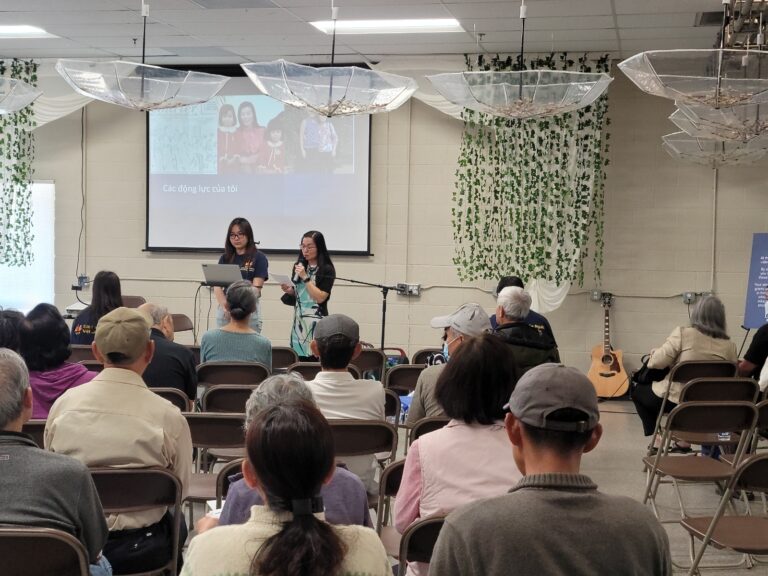
On May 13, UC Davis Health hosted its third annual Vietnamese Mini Medical School (VMMS), open for the Vietnamese immigrant and refugee community in Sacramento to attend. 

For almost 20 years, UC Davis School of Medicine has been offering an annual highly acclaimed mini medical school program, featuring faculty who volunteer to teach free classes to the public. 

In partnership with the Asian Resources Inc. (ARI), Oanh Meyer, an assistant professor of neurology at UC Davis Health and a social psychologist by training, started the VMMS back in 2021, in the thick of the pandemic. For three years now, the program has expanded to address the unique needs of Sacramento’s Vietnamese population during May annually, coinciding with Asian American and Pacific Islander Heritage Month.

“For many years, UC Davis Health had an annual mini medical school for the general community, targeting older individuals with informative presentations on cardiovascular health, brain health and so forth,” Meyer said. “Neighborhoods immediately adjacent to and south of the UC Davis Health campus are home to a large population of Vietnamese origin. Many Vietnamese Americans in Sacramento are foreign-born, lack access to culturally appropriate care and are medically underserved. So I thought of catering the MMS toward the Vietnamese community here.” 

VMMS has come a long way, beginning virtually during the pandemic to now a full-blown annual conference and social event with presentations in Vietnamese. With the help of Hoa Ly, clinical research supervisor for the Alzheimer’s Disease Research Center, Meyer selected speakers, most of whom were healthcare workers and doctors whom she knew, to discuss diseases that Vietnamese individuals are more predisposed to and inform the community about preventative healthcare.

“The motivation for this is to reach out to the Vietnamese community and offer an educational day, where we go over different, selected topics on medical health,” Ly said. “This year, we had speakers discuss mental health and Alzheimer’s Disease, colon and stomach cancer screening, normal and abnormal aging and Type II Diabetes, all of which become increasingly relevant and important to the health of older Vietnamese individuals.”

Both Meyer and Ly hope that the VMMS can continue to be an accessible and reliable source of medical information that is culturally and linguistically adapted for all Vietnamese individuals in the Sacramento area.

“The event totally exceeded my expectations, with a great number of people who showed up — around 120 individuals,” Meyer said. “I always get these older Vietnamese people who come up afterward who tell me that they’re grateful that we do this for the community, and it’s very heartwarming.”

Upon reflection, Meyer hoped to expand the VMMS to include more socially interactive sections in the annual program to bring the community closer together.

“Next year, I think we might have a little bit more entertainment and fun because one of my staff, which I didn’t know he was going to do, brought a guitar during our intermission time and started playing and singing,” Meyer said. “It was amazing to see everyone getting into it, clapping, smiling and trying to sing along. So we’ll make sure to have some entertainment, so the program can be more interactive.”

According to Meyer, medically informing the public can help bridge gaps in health disparities that often arise in underserved communities, and VMMS has become just one effort to do so.

“I just think if we continue the momentum of bringing education and research to underserved communities, we can reduce the disproportionate health disparities that we often observe in specific populations and communities,” Meyer said. “That can be through the VMMS, research in different labs, like my lab which focuses on mental health and Alzheimer’s Disease in Vietnamese individuals, or just going into the community to serve and inform individuals.” 

Written by: Brandon Nguyen — science@theaggie.org

How to hype up future Aggies

Incoming freshmen are the future of America. Hoorah!


By CARMEL RAVIV — craviv@ucdavis.edu


As this tumultuous school year comes to a close and we shed our prolific senior class, it is time to welcome an exciting new generation of Aggies. They will carry the torch of this great institution’s legacy and relish in the opportunities that Davis has to offer. 

But no one tell them about the TA strike, the atmospheric floods or days-long power outages. Or the cow smell. But hey, other than that UC Davis is top-notch! 

Here is a short list of tips and fun facts to mention when you encounter a future Aggie to get them hyped and keep them informed for the 2023-24 school year:


  1. The MU is pronounced “The Moo.”
  2. Make sure to buy the nicest, most expensive bike and always wear a helmet.
  3. Text your potential roommates on Instagram that you are a direct descendant of Gary May and you can get into the best dorm building. 
  4. Cheeto is the name of the hottest girl on campus, so let everyone know you have a crush on Cheeto and they will relate!
  5. Hasbullah studied the philosophy of thermodynamics at UC Davis and worked at the Student Farm. You are walking the hallowed halls of greatness. 
  6. UC Davis is in California, so we are really close to LA!
  7. There are crocodiles in the creek running through the Arboretum, and late at night they emerge and sing “Going Down the Bayou” and “Rap God.” They can also scat so don’t get spooked. 
  8. You may have heard of the super cool coffee-brewing class, but there is also a cough-knee pooing class in the School of Biological Sciences. And a toffee-chewing class. And concepts of nutrition!
  9. At the beginning of every school year, we have a tradition called “Running of the Freshmen,” which is when upperclassmen select freshmen on the first day of school and ride their backs as the freshmen run to their first class. The fastest freshman wins a squirrel!
  10. To pass your finals, it is Davis’s superstition to go to the egghead statues and drop your best pickup line. The student with the most seductive line will get a B+.


Written by: Carmel Raviv — craviv@ucdavis.edu

Disclaimer: (This article is humor and/or satire, and its content is purely fictional. The story and the names of “sources” are fictionalized.

ASUCD 2023-2024 budget hearings result in major cuts to Entertainment Council, Creative Media budgets2

The hearings that took place on May 20 and 21 also resulted in increased funding for the creation of paid student positions 


By LILY FREEMAN — campus@theaggie.org 


The ASUCD 2023-2024 budget was debated and finalized over the weekend of May 20-21 during the annual budget hearings process. The $19 million budget was allocated to various sectors and organizations at UC Davis, according to the ASUCD Budget website, and the Senate had the final say in its distribution. 

Senator Jacob Klein explained the initial steps in the budget hearing process. He said that first, each unit and committee funded by ASUCD submits its proposed budget. The ASUCD President then creates an ASUCD-wide proposed budget to be presented based on the budgets proposed by unit and committee directors and their own judgment, and then this budget is deliberated and voted on by the ASUCD Senate. 

Senator Stephen Fujimoto explained the next steps in the hearing process, noting that the twelve senators have the final say in the budget under the ASUCD constitution. 

“Over the weekend of budget hearings, the Senate looks at the proposed budget of each unit, office, commission and committee and is able to make amendments before voting to adopt that budget,” Fujimoto said. “I think that is the biggest role a senator plays.” 

Senator Francisco Ojeda further outlined the hearings’ procedure. 

“During the weekend, senators have a chance to listen and ask questions to representatives from the inner ASUCD bodies,” Ojeda said. “Senators follow a procedure to then vote and close the budget for the specific inner body.” 

According to Fujimoto, eight of the 12 senators are required to approve any change to the budget. Senator Jacob Klein said that during these hearings, nearly every group seeks more funding than the initial proposed budget allots them. 

“Since the budget is perfectly balanced, for the Senate to allocate even one dollar more, we have to take one dollar from somewhere else,” Klein said. “That’s why it’s so important that we listen to each unit and committee in budget hearings so that we can provide money for the things we care about most.” 

Ojeda went on to explain the factors that went into his votes on the budget. 

“When it comes to considering changes to the budget, it is great to be shown how the unit is currently using its money,” Ojeda said. “How do students benefit from this? We also consider how much extra money they are looking for, and […] we need to have a plan of how much is feasible to relocate and where the money would come from.”  

Fujimoto also talked about the factors that he placed more weight on during these hearings.

“Personally, I weighed heavily the amount of students I believed would benefit from one allocation versus another,” Fujimoto said. “This meant I prioritized basic needs as well as funding for disability accessibility upgrades. Any student can benefit from increased ASUCD support for basic needs.” 

Klein detailed the major changes made to the budget — namely, a $180,000 cut to the budget for the Entertainment Council.

“Many senators were against this large of a cut, but since there was no room in the balanced budget, we voted to cut funds from Creative Media,” Klein said. “Additionally, more than $100,000 was allocated to Aggie Aid in the President’s proposed budget. This is a grant that gives emergency funding to students who have already exhausted all other aid and are at risk of things like eviction.” 

Fujimoto said that the cuts to Creative Media were used to fund more paid hours for ASUCD positions and the marketing budgets of other units. He went on to outline two new units that were incorporated into the 2023-2024 budget. 

“The ASUCD Senate recently established two new units, both of which I have had an opportunity to help create: the Innovation and Research Lab and the Pride Festival,” Fujimoto said. “The former received a final allocation of around $53,000 and the latter received an allocation of around $30,000. The Senate voted to increase both of these units’ budgets from the President’s proposed allocations.”

Senator Ojeda said that the Senate also voted for the budget to allow various previously volunteer or stipend-funded positions to become hourly-paid positions during the next academic year.

“ASUCD [is moving] away from stipend positions,” Ojeda said. “I’m happy to share that a large number of ASUCD student workers are now paid hourly. This is one step closer to achieving living wages for all ASUCD workers.” 

Klein concluded by highlighting how students are able to have a voice in the allocation of the budget each year. 

“Each budget meeting is open to the public, so students can advocate for changes in proposed budgets,” Klein said. “Additionally, students should talk to senators individually about prioritizing certain budgets.” 

The finalized budget for the 2023-2024 school year can be found on the ASUCD budget website. 


Written by: Lily Freeman — campus@theaggie.org

UC Davis’s first-ever Punjabi Week celebrated all the culture has to offer

The activities, coordinated by the UC Davis Punjabi Club, connected students to their heritage and spread cultural awareness 


By RUMA POUDELL — arts@theaggie.org


Davis is situated in the heart of the first South Asian community in the United States. Most of the South Asian migrants who came to the Sacramento Valley area came from Punjab, a region in northwest India, and the community developed there in the late nineteenth century due to an abundant agricultural background, 

This year, Punjab took center stage during Davis’ first-ever Punjabi Week, showcasing the region’s vibrant tradition and rich heritage. Each day of Punjabi Week brought together students, connecting them to and teaching them about Punjabi culture through art, music, dancing, food and meaningful discussion.

To kick off the week, students and faculty met under a decorated canopy on the Quad, where they were served jalebi, a traditional sweet snack, and various other treats. Punjabi music was blasting, dholis were smacking their dhols and bhangra dancers were dancing. The event was lively and had a great turnout. 

Amandeep Kaur Dhaliwal, a first-year English and international relations double major, spoke about the connections Punjabi Week created.

 “As a freshman who didn’t really know many other people who were Punjabi, I personally got to know so many people,” Dhaliwal said. “I think it creates this sense of family and community with people who are similar to you and share the same values.” 

A Gurbani Sangeet (the classical Sikh music style) concert was held on the second day. The event was led by undergraduate instrumental musicians and singers. Students like Rasleen Kaur believe in their culture and faith despite unbelievable hardship, which is a feature of Punjabi culture that was displayed through the selected songs performed. 

The next event was a webinar hosted by women in the Punjabi community, during which they discussed the heritage of their food, different recipes and Punjab’s culture of hospitality that has carried over into the United States.

Nicole Ranganath, a member of UC Davis’s Middle East/South Asia studies (ME/SA) faculty, as well as the filmmaker and curator of the Pioneering Punjabis Digital Archive, touched on her experience with this facet of the culture. 

“As a recipient of Punjabi hospitality, it is extremely humbling,” Ranganath said. “One of the core features of Punjabi culture is generosity and sharing your time, your wealth and your energy with other people. [Guests] come to your home and you give the best of everything you have.” 

On Thursday, a documentary by Harleen Kaur Bal, a UC Davis Ph.D. student studying sociocultural anthropology, was screened for the community to learn about the challenges that working-class Punjabi immigrants face today in California. The documentary focused on Punjabi immigrants who work in dangerous conditions in the meat-packing industry due to limited job options.

Lastly, on Friday, Professor Gurdev S. Khush was honored by Chancellor Gary May and Dr. Estella Atekwana, who is the Dean of the College of Letters and Sciences, for donating his personal and research papers to the university library. Professor Khush is one of the most distinguished faculty at UC Davis, and his research efforts have led to an astounding advancement in increasing the world’s supply of rice. The night was filled with rich discussion reflecting on Professor Khush’s life and his legacy, as well as food and socializing. 

Punjabi Week was a success as a result of hard work and support from the Interim Director of the Davis Humanities Institute, Archana Venkatesan and the ME/SA program, along with many dedicated student leaders. The ME/SA program began 20 years ago and has been growing ever since.

ME/SA’s role is to offer classes and major and minor programs that connect students to the history and contemporary issues in countries in South Asia, the Middle East and North Africa, including Punjab. Through classes and student-led activities, students can learn about the cultures and languages of these countries.

“There was never a platform distinctively dedicated to the Punjabi community as a whole without boundaries dividing by religion or geographic boundary,” Prabhjot Singh, a third-year biological sciences major and co-founder of Punjabi Club on campus, said. “So for this first-ever Punjabi Week, everyone came out and showed so much enthusiasm and got things started off on a strong note.”

While a few days cannot encapsulate all of Punjabi culture, Punjabi Week is part of a long-term effort to do so. The week brought community members together with a cohesive vision of how to serve students as well as the greater community.

Everyone is welcome to get involved in the events organized by the Punjabi Club, which include movie nights, language tutoring sessions and cultural festivities. UC Davis will begin offering elementary and intermediate Punjabi language classes in fall quarter 2024.  Dr. Kuldeep Singh will teach Elementary Punjabi (CRN 53009) and Intermediate Punjabi (CRN 52464). During the fall, Professor Ranganath will also be teaching two classes — Social Justice in the Middle East and South Asia (CRN 41436) and the South Asian Diaspora (CRN 41438). 

Written by: Ruma Poudell — arts@theaggie.org


UC Davis researchers use artificial intelligence to accelerate wildfire vegetation redevelopment

Researchers are developing a toolkit that can efficiently help farmers rehabilitate land lost in wildfires 


By ARYAMAN BHATIA — science@theaggie.org 


Researchers at UC Davis are developing an artificial intelligence-based toolkit that can assess damages caused by wildfires to vegetated areas and accelerate the recuperation process for landowners. 

With the rising temperatures caused due to global warming, wildfire risks have increased substantially. The aftermath of a wildfire is often unpredictable, making it difficult for landowners to know the exact severity of the damages that can occur. 

In an effort to combat this, UC Davis researchers are using artificial intelligence to analyze wildfire repercussions and develop an online toolkit that can be accessed by anyone. With the help of the toolkit, landowners can project how vegetation in the area is growing and its susceptibility to wildfire damages, helping the user effectively intervene in the case of wildfire.

The project involves two main steps: data collection and classification. For data collection, the team collects large numbers of forested area images before and after the area has been affected by wildfire. To do this, the project uses a dataset from the NRS’s California Heartbeat Initiative. The team also conducts drone flyovers over wildfire-affected areas to gain a better understanding of how wildfire has affected various vegetation types and areas over time. 

Derek Young, an assistant professional researcher for the Forest Change Analysis Lab at UC Davis and co-lead for the project, explained the benefits of using drones to survey land after wildfires. 

“The benefit of using drones is that many objects on the ground, say a rock or a shrub or a tree, show up in many different images,” Young said. “So by using a program called ‘Motion for Capture,’ you can triangulate the structure and height.”

This helps the team get accurately measured data, which allows them to classify vegetation down to the pixel. The images are then hand-labeled individually according to their vegetation type in the form of a large data structure. 

Once the data has been collected, it is split into a training set, which refers to the images that will be used to train the machine-learning algorithm, and testing sets, to see how correctly the algorithm classifies the images. 

The machine-learning algorithm divides each image input by the user into sections and characterizes images based on the training set. By identifying pixel groups within the image as certain vegetation types, such as shrubs or trees, the model can identify differences between images of different timelines. 

“We might, in our pre-wildfire image, see a lot of green in, say, a slope of chaparral, and in the immediate post-wildfire image, that might become red, like bare ground,” Young said. “And then in another few years, it might be back to green, as the chaparral resprouted and started to recover.”

In this way, one can track how ecosystems recover from the aftermath of a wildfire, which is important for learning how to best manage resources. 

“The areas in need of post-fire reforestation far exceed the resources managers have for planting,” the Forest Change Analysis Lab’s website reads. “It is critical to understand where tree planting is most likely to be effective at achieving restoration goals so that limited resources can be put to use most effectively.”

The end goal is to develop a toolkit that allows anyone with access to a drone to input overhead shots of their own land and understand which areas are at high risk for wildfire damage. This would allow owners to know where exactly they must devote resources to their land. 

Young said that this project showcases the benefits of adopting a multidisciplinary approach by combining ecology and artificial intelligence. 

 “There’s been some huge advances in the machine learning and computer vision community,” Young said. “Some of those are accessible to specialists in other disciplines, like ecologists, but others require collaboration with computer scientists. So I think there is a huge potential for the ecological insights we can gain from our data, using both the current tools and the tools that are just becoming available.”

Written by: Aryaman Bhatia — science@theaggie.org

Color psychology and its functions in society

How you can utilize knowledge of color for your benefit


By MAYA KORNYEYEVA — mkornyeyeva@ucdavis.edu


     Colors are all around you. From the blue of the sky to the green of the trees to the beige gray of the asphalt, your eyes perceive millions of colors in every moment. However, colors are not just something to look at — they can also have a substantial impact on emotion and mood. 

Color psychology is a field of research that is widely studied by a variety of departments, including design, marketing, film, psychology, architecture and more. Whether it is deciding what color to paint the walls in a restaurant or which shade of red to use for a new line of shoes, color choice and its effects have the potential to greatly impact daily life. 

Interior decorating is one of the most recognizable uses of color. According to research published in the National Center of Biotechnology Information, each color has a distinct effect on mood and behavior. Red is associated with anger, passion and love, yellow symbolizes joy and hope, while blue represents both calmness and sadness. Lavender shades of purple are soothing and gentle and are often chosen for home spaces or businesses that specialize in products for sleep and self-care. White walls are chosen to make a space appear brighter and larger, while black is used to do the opposite. 

Have you ever noticed that fast-food restaurants use bold colors and logos? The reason has to do with the way certain colors attract our attention or influence our actions. Warm reds, oranges and yellows often stimulate our senses and draw our eyes, while also increasing our productivity and speed. In this way, fast food places draw us in and encourage us to grab our food and go, or otherwise eat fast and leave. 

Cinematography also often uses color strategically to make us feel different emotions. Consider the classic Pixar movie “Up.” At the beginning of the film, the main character, Carl Fredrickson, spends a happy life with his wife, Ellie, before her untimely death. The animators chose a set of bright pastel pinks, greens, blues and yellows to depict Carl and Ellie’s adventures and fond memories, then abruptly switch to dark grays and blacks when the story takes a turn, following Ellie’s hospitalization and later, Carl’s grief after losing his wife. Such a drastic tone switch corresponds directly with the feelings of sadness, pity and empathy the animators hope the story will evoke for viewers — watching that section of “Up” always brings tears to my eyes. 

So why does understanding and recognizing color psychology matter? As a college student, there are a few areas where color theory can prove useful. 

For one, clothing is a means of expression that relies heavily on color and can be used to strategically present yourself to a target audience. When going in for a job interview, colors that are proven to present best are black, gray, blue and white. These all act as neutral colors that paint the wearer as someone that is trustworthy, organized and analytical. Also, not wearing too many colors can help your interviewer maintain focus. Red is a color that can make someone appear more attractive or romantic on a date, but it can be jarring or over-energetic in a professional setting. 

From an academic perspective, color coding is a great study tool that can be used to organize and remember various concepts. Highlighting in bright colors puts emphasis on key phrases while organizing chapters or topics by color can make it easier to find specific details.

Finally, as college students, studying and preparing for exams is a large part of our lives. Choosing study spaces with certain colors like green — which represents life and energy — and blue can help you stay focused and productive. Pink has also been proven as a calming color, so studying in a space with pink walls or decor can potentially ease feelings of frustration.

With all these in mind, being a color-theory wizard is not such a distant dream. Paying attention to the slight subtleties of the color schemes you encounter in your day-to-day life can serve to benefit your understanding of the world around you and the way color performs certain essential functions within it. 


Written by: Maya Kornyeyeva — mkornyeyeva@ucdavis.edu


Disclaimer: The views and opinions expressed by individual columnists belong to the columnists alone and do not necessarily indicate the views and opinions held by The California Aggie.


Water ski club shines in local tournament

UC Davis’s Juraski Park team earns second place  


By MEGAN JOSEPH — sports@theaggie.org


Extreme heat this past week did not stop the UC Davis water ski team from snagging second place in their tournament over the May 12-14 weekend. There were some outstanding performances by team members that led the UC Davis men’s water ski A and B teams to victory; the entire water ski team also placed second overall.  

With nine other schools competing, the men’s A team won first place overall in three events: trick, jump and slalom. UC Davis received 625 points in trick and 510 points in jump. In the slalom event, the team earned 710 points, putting them in second place behind Western Washington University; nonetheless, all three categories combined to 1,845 points, earning the men’s A team first place. 

Some of the best performances of the tournament came from fourth-year Noah Gaffney and second-year Connor Johnson. In the slalom event, Gaffney cleared 4.5 buoys while going 32 miles per hour on the 18.25 rope. Gaffney scored 64.50 and earned 220 points which put him in fourth place for the event. 

Johnson also put up a noteworthy performance, falling not far behind Gaffney and earning sixth place in slalom. Johnson cleared three buoys on the 18.25 rope going 32 miles per hour. He received a score of 63 and earned 200 points. Together, Gaffney and Johnson’s combined effort catapulted the team to victory in the men’s events against their strongest competition, Western Washington University. 

Gaffney also showed his abilities in the jump event where he jumped 20.4 meters (67 feet), earning 190 points for the team and third place in the jump category. His performance in all three categories put him in second place for the men’s overall skier category with 550 points. 

Additionally, fourth-year Ian Crone had a strong performance in the jump event, placing seventh. Crone jumped 14.7 meters (48 feet), adding 140 points for the team. Crone also earned the team points in the trick category of the tournament. He scored a 200, which translated to 160 points for the team. Individually, he tied for eighth place with two other competitors from Western Washington University in the event. Overall, Crone placed seventh for men’s overall skier with 460 points. 

Fourth-year Jason Vaccarezza also competed in the men’s trick category and earned a score of 340. With such a high score, Vaccarezza gained 210 points for the team and placed fourth in the event. 

The men’s A team was a tough act to follow but the men’s B team kept the pace, also winning first overall. Fourth-year Bryson Dort won first place in the men’s B team slalom and fourth-year Seth Gach won first place in the trick category of the competition.

The women’s A team also showed a lot of skill in their performances in all three categories. First-year Ashley Carroll jumped 10.5 meters (35 feet), earning the team 150 points. This jump also put Carroll in third place for the jump category which was the best UC Davis women’s performance of the weekend. 

Her other teammates, third-year Allison Veiga, fourth-year Taylor Lewis, and UC Davis alum Renee Torree all placed sixth in their respective events. Together, they earned a total of 1,205 points: 375 points in slalom, 450 in trick and 380 in jump. After tying for first place in the jump category and taking third place in the trick and slalom categories, the women’s A team finished in third place overall.

The women’s B team earned second place overall and 510 points in total. While many members of the women’s B team were still perfecting their tricks and jumps, some had admirable performances, like Torre, who placed second in the trick competition, earning 90 points. Carroll and first-year Riley Rodriguez tied for first in slalom. 

Overall, the men’s and women’s water ski teams earned a total of 3,050 points, falling just short of first place against Western Washington’s 3,275 points. 

Written by: Megan Joseph — sports@theaggie.org

UC Davis honors Aggie military veterans at Memorial Day service

The event featured Xóchitl Rodriguez Murillo as the keynote speaker, as well as remarks from Chancellor Gary May


By JADE BELL — campus@theaggie.org

Lea este artículo en español.


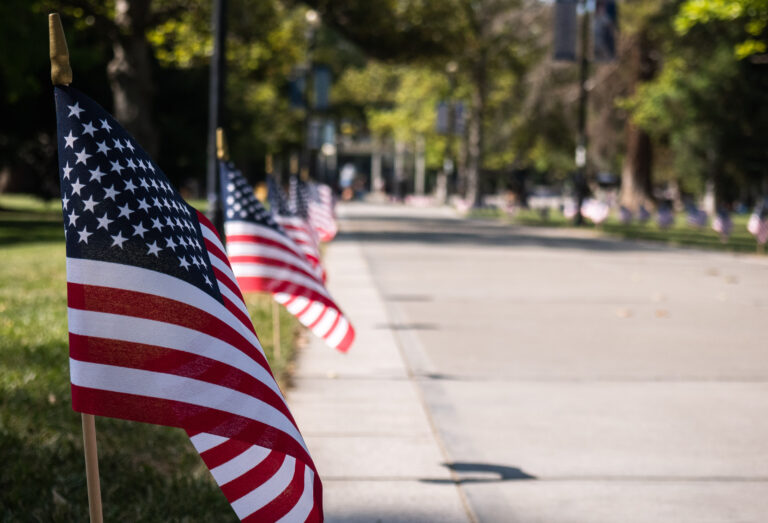
On May 25 at 4 p.m., UC Davis honored Aggie military veterans during the 2023 annual Memorial Day ceremony at the Memorial Union’s (MU) North Courtyard. This event commemorated the 136 Gold Star Aggies, or fallen soldiers who were previously enrolled at UC Davis. 

The service began with a reading of California Governor Gavin Newsom’s Memorial Day proclamation by the Undersecretary for Minority and Underrepresented Veterans Russell Atterberry.

“On Memorial Day, we remember and honor the courageous men and women who laid down their lives to protect our cherished freedoms and way of life,” Atterberry read. “Upholding a solemn tradition that dates back to Decoration Day in 1868, communities across the country will gather to pay tribute to the selfless heroes: our friends, family and ancestors who made the ultimate sacrifice in service to our nation.”

After the reading, Chancellor Gary May provided his statement. This year marked the first time he has spoken at the event since becoming chancellor in 2017. 

“It’s an honor to be here to pay my respects and honor the courageous Americans who have died in war while defending our nation and our best ideals,” May said. “I also like to acknowledge those who came home with scars, both physical and mental, and those who never came home and whose fates are still unknown. [On] Memorial Day, we have an opportunity to echo the significance of this important day to our country, our state and our campus.”

May went on to introduce keynote speaker Xóchitl Rodriguez Murillo, the Deputy Secretary for Minority and Underrepresented Veterans and a veteran of the Army Reserve. She shared what Memorial Day means to her and the purpose of recognizing military veterans.

“I’m honored to be here with you today,” Rodriguez Murillo said. “I address you not only as a representative of Cal Vet but also as a veteran of the United States Army [and] an active member of the Army Reserve. I am a proud graduate of this wonderful university, class of 2008. We, all of us, are here because we know the real meaning of Memorial Day. It’s about remembrance, reverence and respect.”

After the memorial service, a reception for attendees was provided. During this transition period, military veteran Cecil Frank shared what this Memorial Day service meant to him.

“The experience took me back to remembering a lot of the other comrades that were not as lucky to come home as I was, or some of the other folks that came back with me,” Frank said. “I think it’s a good event to remember those that are gone and acknowledge their sacrifice.”

Written by: Jade Bell – campus@theaggie.org

UC Davis honra a los veteranos militares de Aggie en el servicio del Día de los Caídos

El evento presentó a Xóchitl Rodriguez Murillo como oradora principal, así como comentarios del canciller Gary May


Por JADE BELL — campus@theaggie.org

Traducido por JOSÉ HERNANDEZ

Read this article in English.


El 25 de mayo a las 4 de la tarde UC Davis honró a los veteranos militares de Aggie durante la ceremonia del Día de los Caídos en el patio norte del Memorial Union. Este evento conmemoró el 136 de estrellas doradas de Aggies, o soldados caídos que estuvieron inscritos previamente en UC Davis. 

El servicio comenzó con una lectura de la proclamación del Día de los Caídos del gobernador de California, Gavin Newsom, por parte del Subsecretario para Minorías y Veteranos Subrepresentados, Russell Atterberry. 

“En el Día de los Caídos, recordamos y honramos a los valientes hombres y mujeres que dieron su vida para proteger nuestras preciadas libertades y forma de vida”, Atterberry leyó. “Manteniendo una solemne tradición que se remonta al Día de la Decoración en 1868, comunidades alrededor del país se juntaran para pagar tributo a los desinteresados héroes: nuestros amigos, familiares y ancestros que hicieron el último sacrificio en servicio de nuestra nación”.

Después de la lectura, el canciller Gary May dió su declaración. Este año marcó la primera vez que él ha hablado en el evento desde que se convirtió en canciller en el 2017. 

“Es un honor estar aquí para presentar mis respetos y honrar a los valientes Americanos que han muerto en la guerra mientras defienden nuestra nación y nuestros mejores ideales”. May dijo. “También quiero reconocer a esos que vinieron a casa con cicatrices, tanto físicas como mentales, y a esos que nunca regresaron a casa cuyos destinos todavía se desconocen. El Día de los Caídos, tenemos una oportunidad de hacer eco de este importante día a nuestro país, nuestro estado y nuestro campus”. 

May procedió a introducir a la oradora principal Xóchitl Rodriguez Murillo, la Subsecretaria de Minorías y Veteranos Subrepresentados y una veterana de la reserva del ejército. Ella compartió lo que significa el Día de los Caídos para ella y el propósito de reconocer a los veteranos militares. 

“Estoy honrada de estar aquí contigo hoy”, dijo Rodriguez Murillo. “Me dirijo a ti no solo como una representante de los veteranos en California pero también como una veterana del ejército de los Estados Unidos [y] miembra activa de la reserva del ejército. Soy graduada de esta maravillosa universidad, en la clase del 2008. Todos nosotros, estamos aquí porque sabemos el significado real del Día de los Caídos. Se trata de recuerdo, reverencia y respeto”. 

Después del servicio conmemorativo, una recepción para los asistentes fue proveída. Durante este periodo de transición, el militar veterano Cecil Frank compartió lo que este servicio del Día de los Caídos significó para él. 

“La experiencia me llevó de regreso a recordar muchos de los otros camaradas, que no tuvieron tanta suerte en regresar a casa como yo, o algunas de las otras personas que regresaron conmigo”, Frank dijo. “Pienso que es un buen evento para recordar a esos que se fueron y reconocer su sacrificio”.


Escrito por: Jade Bell — campus@theaggie.org   

Traducido por: José Hernandez

Voluntarios del Festival Whole Earth entrelazan la comunidad, la sostenibilidad y experiencias memorables

Miembros dedicados reflexionan sobre la esencia del Festival Whole Earth


Por FAITH DEMEULENAERE — features@theaggie.org

Traducido por GENNI SHANE y LENNYN MORALES

Read this article in English.


Desde los vibrantes terrenos de la Universidad de California, Davis, el Festival Whole Earth (WEF) es una celebración de la música, el arte y la vida sostenible. 

En este festival que atrae a miles de visitantes cada año, los voluntarios dedicados son la verdadera columna vertebral. Tanto para los principiantes entusiastas –como Eva Jabbari, una estudiante de primer año con doble especialidad en Política Ambiental y Relaciones Internacionales– como para los voluntarios con experiencia –como Josh Winter, exalumno de la especialización en Informática–, el festival se convierte en una experiencia transformadora que fomenta un sentido de unidad y propósito. 

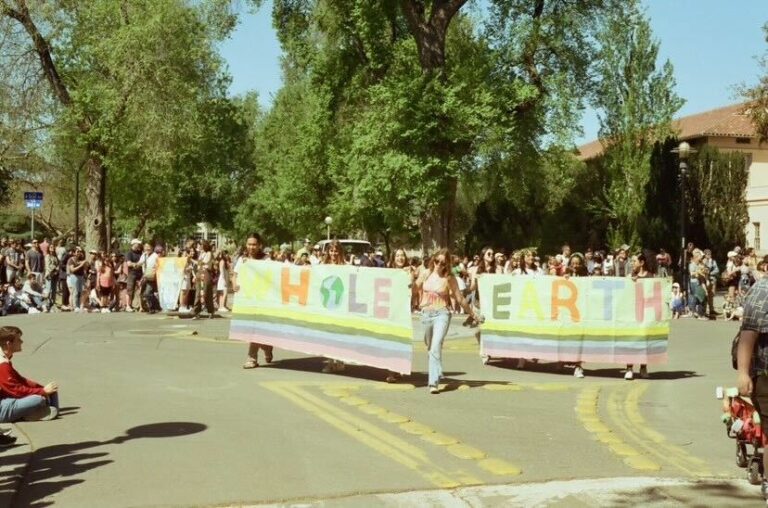
El Festival Whole Earth, que comenzó en 1969, se lleva a cabo en Memorial Union Quad, donde los artistas y los vendedores establecen sus puestos y varias bandas se presentan para la multitud. En 2022, Winter se unió al equipo de Quad Stage. Este puesto exigía resistencia física y buen ojo para los cambios rápidos en el escenario. Sin embargo, fue el fuerte sentido de camaradería lo que más impactó a Winter. 

“Muchas de las personas con las que trabajé mano a mano han sido voluntarias de Quad Stage durante más de una década”, dijo Winter. “Conocí mucha gente genial ese fin de semana, y a muchas de ellas las volveré a ver este año”.

Muchos voluntarios, como Winter y Jabbari, están familiarizados con el dicho de los voluntarios: “Amor WEF”, que representa “la conexión especial que se forma entre todos los involucrados en llevar adelante el festival”, según Winter. 

“Hay un sentido de pertenencia, aceptación y deber cuando se trabaja en conjunto para crear el evento”, dijo Winter. 

WEF es un evento de basura-cero, y los voluntarios están de acuerdo en que puede ser bastante agotador a veces.

“En un esfuerzo por hacer del festival un evento de basura cero, todos los vendedores de comidas son abastecidos de vasos, platos y utensilios reutilizables”, dijo Winter. “Hay una entrada interminable de platos sucios durante todo el festival. Alguien tiene que recoger, transportar, lavar, secar y distribuir los platos, y ese alguien es el personal y los voluntarios del Comité de Reciclaje de Whole Earth.”

Según Winter, las instalaciones para lavar los platos de Segundo Dining Commons y CoHo se montan durante el festival. También los voluntarios ayudan a clasificar la basura de acuerdo con los objetivos de sostenibilidad de Whole Earth.

“En Compost & Recycling, un equipo de ocho voluntarios y yo pudimos clasificar los compostables de los reciclables hacia los vertederos de basura del festival”, dijo Winter. “Se puso asqueroso, pero estuve en buena compañía durante todo el proceso”.

Jabbari dijo que fue empoderador participar en una iniciativa de basura-cero.

“Me ofrecí como voluntaria en la distribución de platos por un rato”, dijo Jabbari, “y aunque fue un poco agitado por momentos, dada la cantidad de tráfico que teníamos, cambiar los cubos y tal, fue increíble ser parte de esto”.

Según Winter, el Festival Whole Earth es una oportunidad para “ser parte de algo más grande” y continuar una tradición en la comunidad.

“El Festival Whole Earth fomenta un sentido de comunidad y ayuda a dar la bienvenida a la primavera y el clima cada vez más acalorado porque lleva a la gente al campus de una manera divertida y bastante histórica”, dijo Jabbari. “No podía creer lo antiguo que era el festival hasta que fui a la formación voluntaria en no-violencia y escuché algunas historias de personas que han estado asistiendo a Whole Earth desde la década de 1970”.


Escrito por: Faith DeMeulenaere — features@theaggie.org

Traducido por: Genni Shane y Lennyn Morales

La ciudad de Davis se asocia con Perennial Grazing para utilizar ovejas en la restauración de hábitats

Davis utilizará ovejas para controlar el crecimiento de plantas en hábitats del programa Open Space


Por ALMA CULVERWELL city@theaggie.org 

Traducido por SOFIA BIREN y CHRISTOPHER MCKERRACHER

Read this article in English. 


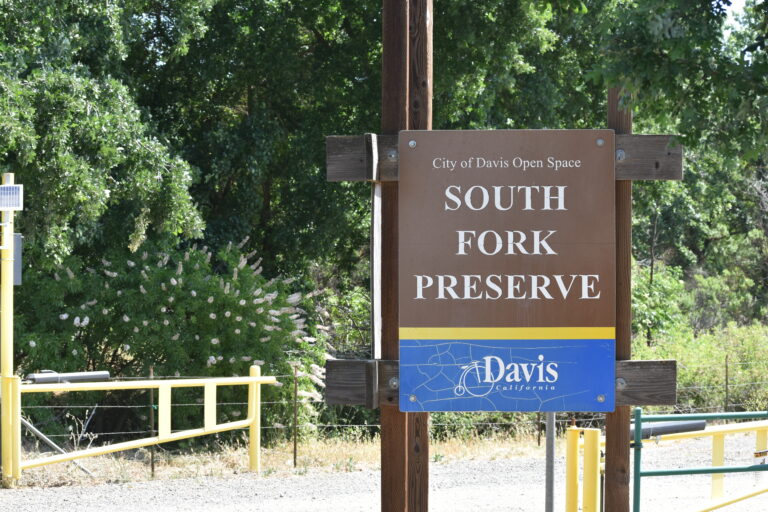
Recientemente, la ciudad de Davis empezó a utilizar ovejas de Perennial Grazing para combatir la maleza y otras plantas no deseadas en su hábitat de 60 acres (24 hectáreas) de Oak Savannah en la reserva South Fork Preserve, que forma parte del programa Open Space (Espacios abiertos).

El programa Open Space se creó en 1990 para responder a la necesidad de contar con políticas más adecuadas en cuanto a la protección de tierras agrícolas locales y zonas de hábitat alrededor de Davis. Desde entonces, el programa ha evolucionado para adquirir y conservar espacios abiertos alrededor de Davis.

El programa fue posible gracias a la financiación de Measure O, un impuesto sobre las parcelas dedicado a la preservación de espacios abiertos que se aprobó en el año 2000. Measure O, que caduca en 2030, ha permitido a la ciudad de Davis proteger más de 2.800 acres de terreno y conseguir millones en subvenciones estatales y federales para la adquisición de espacios abiertos.  

Tracie Reynolds, administradora de espacios abiertos de la ciudad, explicó la decisión de trabajar con Perennial Grazing y sus ovejas para ayudar con el programa Open Space.

“En el pasado habíamos tenido algunos problemas con el pastoreo de las ovejas, que no beneficiaba realmente al hábitat como queríamos, ya que gestionamos esa propiedad principalmente por razones de hábitat”, dijo Reynolds. “Y, en segundo lugar, por su valor recreativo, para la gente que hace senderismo y cosas así”.

Reynolds explicó cómo las ovejas de Perennial Grazing ayudan al hábitat.

“Las ovejas de Perennial Grazing son capaces de pastar de una manera que también ayuda al hábitat”, dijo Reynolds. “Lo que estamos tratando hacer es estimular el crecimiento de pastos nativos en lugar de malezas”.

Perennial Grazing es un grupo de rancheros y animales que pastan, ubicado en Capay Valley. La compañía ha estado activa por los últimos cinco años y su propósito es salvar plantas nativas a través de métodos de pastoreo, en contraposición al empleo de herbicidas, labranzas o irrigación para limpiar espacios abiertos. 

Shannon Waldron, una pastora de Perennial Grazing, compartió cómo funciona el pastoreo con ovejas. 

“Llevamos las ovejas una vez por año y hacemos lo que llamamos ‘mob grazing’ (pastoreo en turba) donde construimos rediles temporales —estos son de aproximadamente dos acres— y llevamos las ovejas allí”, dijo Waldron. “Lo que hacen las ovejas allá dentro es comer, excretar materia fecal y pisar el pasto, y luego eso deja una capa fresca”.

Actualmente, la ciudad está trabajando en varios proyectos como parte del programa Open Space, incluida la restauración de hábitat de los humedales con UC Davis y en otros proyectos de restauración a lo largo de South Fork de Putah Creek. Measure O estará listo para renovarse en 2030, y Reynolds animó a los miembros de la comunidad a votar a favor de la medida. 


Escrito por: Alma Culverwell — city@theaggie.org

Traducido por: Sofia Biren y Christopher McKerracher

Take advantage of intramural sports at UC Davis

Reduced anxiety and new friendships are some of the advantages to getting active


By AUDREY BOYCE — afboyce@ucdavis.edu


It is no secret that college provides a lot of new stressors for students. Living away from home for the first time, navigating new social situations and an uptick in academic responsibilities are all possible reasons why anxiety rates among college students are so high. At UC Davis, 40.7% of undergraduate students reported feelings of anxiety.

Although I am an advocate of seeking therapy or professional help if you are feeling high levels of anxiety, exercise can be one of the easiest ways to help improve mental health. It produces endorphins that assist our ability to sleep, helps to stabilize our mood, decreases tension and increases self-esteem. 

I am part of the significant minority of students at UC Davis who experience anxiety, and for a large portion of my first year at college, I had no outlet to deal with it. That was until I got a text message from a friend asking my roommates and me to join his intramural soccer team. I reluctantly agreed, worried I would be judged since I had not played soccer in five years. 

To my surprise, although the game was set up in a professional manner, with referees enforcing typical soccer rules, the environment felt relaxed, enjoyable and easy-going. Players could either take it seriously or just play for fun. The rec team provided me with an outlet for my anxiety every Sunday evening and even inspired me to begin exercising more regularly to stay in shape for games.

There are two ways to get involved in intramural sports at UC Davis. The first is to find a group of friends or peers who are interested and register as a team for a league of choice. However, if you do not know people who would be interested in joining an intramural team, there are teams called “free agent teams.” You can request to join these and meet a new group of people to play a sport with. Both ways require purchasing a “Rec Sports One Pass” for $20. For first years, residence halls provide promotional codes that make this pass free. 

Intramural sports also provide opportunities for those who did not get the opportunity to play a sport growing up. While many high school teams require a certain level of skill, these teams simply require that you desire to play. From my experience playing soccer, while the league only coordinates games, many teams take advantage of Dairy Field to host practices, which allows less experienced players to improve their skills.

In addition to helping me deal with anxiety, the people I met on the soccer team became the friend group I have to this day. One of the biggest challenges I had with the large student population at UC Davis is that finding a group of friends felt impossible, especially amid COVID-19 restrictions that greatly impacted social interactions earlier on in my time at Davis. 

From my experience, most people find their group of friends on their residence hall floor, so when that did not work out for me, I had no hope of a “college group of friends” until I joined my soccer team. Soccer games led to team dinners which led to almost-daily get-togethers, eventually creating a tight-knit friend group. 

Any student who is physically capable should take this opportunity to relieve stress, find or improve on a sport of interest or create new connections. It really is a unique opportunity that may be more challenging to find later in life.


Written by: Audrey Boyce — afboyce@ucdavis.edu

Disclaimer: The views and opinions expressed by individual columnists belong to the columnists alone and do not necessarily indicate the views and opinions held by The California Aggie.

Crumbl Cookies-inspired recipes to get you through the end of the quarter

While the dessert franchise has locations nearby, recreating their treats at home can be a fun study break 


By LORENA ALVAREZ — arts@theaggie.org


Crumbl Cookies is a dessert franchise well-known for its weekly flavor rotation that was established at the end of 2018 by Jason McGowan and Sawyer Hemsley. According to the Crumbl Cookies’ website, the two spent thousands of dollars trying to find the best chocolate chip cookie recipe, eventually turning to public surveys on cookie preferences for guidance. 

While the company rotates and introduces new flavors weekly, they have their classic chocolate chip and pink sugar cookies year-round. The changing menu allows the company to experiment with different flavors and create unique “classics” as well as seasonal favorites. The downside with this rotation is that flavors are not repeated often, leaving customers longing for their favorite cookie and attempting to recreate it at home. The following are some Crumbl-inspired cookie recipes and my reviews of the “Copycat Crumbl Raspberry Cheesecake Cookie” recipe.

Customers who enjoy Crumbl’s lemon glaze cookies may be pleasantly surprised by “Easy Crumbl Lemon Glaze Cookies.”. Like Crumbl’s version, this cookie’s lemon frosting hardens, leaving a zesty and sour aftertaste, which is a shift from their usual creamy frosting. Unlike Crumbl’s cookies, which average 700 calories per cookie, this recipe’s cookies are each 408 calories, suggesting that while the cookies may be similar in taste, they will not be identical. 

Brownie lovers can indulge in chocolate bliss when eating Crumbl’s Cosmic Brownie

Cookies. Their chocolate ganache covered in rainbow sprinkles is similar in appearance to Little Debbie Cosmic Brownies and might remind customers of their childhoods and times free of adult responsibilities. When this cookie is not available at Crumbl, bakers can try to recreate the beloved treat using Chahinez’s ​​“Better than Crumbl Cosmic Brownie Cookies” recipe. 

Another recipe worth trying is Lifestyle of a Foodie’s Crumbl-inspired “Pink Velvet Cookies with Cream Cheese Frosting.” Unlike red velvet cookies made with cocoa powder, these cookies are made with vanilla and almond extract. While Crumbl’s version is usually sold around Mother’s Day, this cookie’s vibrant pink color and creamy cheesecake frosting is something you can recreate at home for any occasion. And, a great thing about remaking cookies is that you can add your own twist to each recipe. Bakers willing to stray from the recipe can try using strawberries to make their frosting pink, transforming the recipe into a strawberry pink velvet cookie. 

A signature of Crumbl is its creamy cream cheese frosting. Bakers at home cannot go wrong with these Snickerdoodle cream cheese sugar cookies, or as the recipe calls them, “Snickerdoodle Cupcake Cookies.” This sugar cookie is made with cinnamon and vanilla cream cheese frosting. For this recipe, the most important step is setting up a timer, so your cookies do not overbake and lose their crumble. 

Last but not least is my personal favorite, “Copycat Crumbl Raspberry Cheesecake Cookies.” The cookie features crushed graham crackers, cream cheese and fresh raspberry jam, effectively making it taste like a cheesecake. 

I recreated this cookie after loving Crumbl’s version and realizing that I would not be able to enjoy this treat on a regular basis. While my attempt at recreating one of Crumbl’s savory cream cheese cookies did not exactly meet my very high expectations, they were nonetheless a delicious way to tide me over until the original rotates back into the weekly menu. 

Having tried one of these recipes, I have a couple of suggestions for those recreating the cookies. To achieve Crumbl’s texture, take the cookies out of the oven as soon as the cookies no longer appear wet or raw to maintain a soft texture. 

“The heat from the cookies, as well as the heat from the baking sheet, will continue baking them,” Lifestyle of a Foodie noted.

I would also suggest that new bakers try to make smaller cookies than the size many copycat recipes call for because the recipes are trying to achieve Crumbl’s signature large cookies. Making smaller cookies may be a wise alternative because the larger the cookies, the more likely they are to turn into a single sheet cookie rather than individual desserts.

For those looking to enjoy a dessert similar to the cookie franchise’s without making the trek to a nearby location, there are plenty of copycat instructions out there that allow you to do so. Even better, following these recipes is a great excuse for taking a finals week study break.  

Written by: Lorena Alvarez — arts@theaggie.org

The UC Davis softball team loses both games at the National Invitational Softball Championship

The Aggies’ championship aspirations come to an end in the postseason after a historic season


By ELOISE ENGS — sports@theaggie.org


On May 18 and 19, UC Davis women’s softball (29-22 overall, 15-12 in conference play) made a postseason appearance in the National Invitational Softball Championship (NISC) in Fort Collins, Colorado. After a strong season, the Aggies lost to the University of Iowa, 3-6, and Tarleton State University, 4-10.

The regional and final rounds of the tournament started on May 19 and ended May 20, when the University of Iowa won the tournament. The other teams in the tournament were Tarleton (30-27, 13-11), South Dakota State (37-17, 17-0), Maryland (36-17, 11-11), CSUN (28-22, 19-8), San Jose State (26-28, 11-11) and Brigham Young University (32-16, 11-4).

This eight-team championship was the fifth edition of the NISC, which is a great opportunity for deserving teams who desire to compete in the postseason. The tournament is played on two fields in a double-elimination format throughout the first round of the Super Regionals. Once the competition gets down to four teams, the tournament proceeds in a single-elimination style bracket.

The Aggies have had an outstanding and record-breaking season this year, as they finished with a 15-12 conference record. They secured their first winning season this year since the 2020 pandemic season when it was significantly shortened.

UC Davis won their last Big West Conference series after defeating the University of Hawaii in two out of three games. They lost the first game 2-3, but in the next two games, they came back with two wins (6-1 and 5-2).

Third-year catcher and outfielder Anna Dethlefson was named the Big West Conference Player of the Year. Dethlefson was the first Aggie in program history to earn Player of the Year honors from the Big West. Throughout the season, Dethlefson tallied an impressive slugging percentage (.618), doubles (15) and stolen bases (42). She ranks second in batting average (.408), OPS (1.096), runs (46) and hits (64). Dethlefson also broke a single-season record with most stolen bases in the regular season as well.

UC Davis took on Iowa for their first series of the NISC on May 18. The game started off with third-year Kenedi Brown on the pitching mound, who kept the opposing team from scoring in the first inning. An inning later, the Hawkeyes scored three runs to end the second inning, making it 3-0. The Aggies were playing catch-up in the third inning as they punched in two runs to decrease the lead down to one. 

Both teams displayed high-level defense as they kept the offense scoreless in the fourth inning, but Iowa managed to score two runs in the fifth inning, making it 5-2. This gave the Aggies two more innings to either tie the score or possibly one-up the Hawkeyes.

The sixth inning looked promising for UC Davis when they got another run on the board, making the score 5-3, but Iowa quickly responded with a run at the bottom of the sixth inning.

UC Davis had one more opportunity to put at least three runs on the board to extend the game to extra innings. However, the Aggies were shut out and could not score another run, which ultimately ended the game. The Hawkeyes defeated the Aggies 6-3.

Third-year first baseman Sarah Starks was a standout in this game, as she broke the Division I program record for tallying two runs batted in (RBI), which ultimately moved her to 92 total RBIs in her three seasons. Another standout was Dethlefson, who went two for four in runs scored in this game.

In their next game, Brown took the mound again to start, and UC Davis was in a must-win situation in order to remain alive in the tournament. Their next competitor was Tarleton State, a school located near Fort Worth, Texas.

The game started off slow, as the first and second innings remained scoreless for both sides. The Aggies managed to put a run on the board in the third inning when Starks hit a single, giving Dethlefson the chance to cross home plate. The Texans were unable to put points on the board at this time, but they responded with a run at the bottom of the fourth inning which tied the game, 1-1. 

The fifth inning went scoreless as the pitching was outstanding from both teams, but the sixth inning is where Tarletons’ offense started to fire up;  they managed to score three runs. UC Davis failed to emulate the offensive firepower. The Aggies did manage to muster up one run to end the inning, but they trailed behind 4-2 late in the game.

With one inning left, the Aggies needed to play catch-up in the seventh inning of a possible season-ending game in Fort Worth.

Tarleton State had an amazing last inning, which made it very difficult for UC Davis; they scored six runs, making it 10-2 on the score sheet. At the bottom of the seventh inning, the Aggies had one last chance to win the game. However, it was highly unlikely that the offense could produce eight runs this late in the game. As predicted, UC Davis was not able to achieve that many runs in just one inning.

Even though they fought hard in the last inning and managed to score two more runs, the Aggies fell to the Texans. Their season ended with a final score of 10-4 in this double-elimination series.

Brown pitched six of those innings and managed to strike out nine hitters while allowing four runs on six hits.

Star player Dethlefson batted one for three in runs scored, and both fourth-year outfielder Delaney Diaz and third-year outfielder Sarah Nakahara went one for two, each getting crucial RBIs. Third-year infielder Bella Pahulu stood out when she hit a two-run home run in the seventh inning.

The Aggies’ season came to an end with a 29-22 overall record. Even though the NISC did not go as planned, they had their first winning overall record since 2020, which was outstanding considering the 2020 season was shortened due to the pandemic.

The UC Davis Aggies closed the season on a high note, finishing fourth in the Big West standings and earning a berth in the postseason. Players on the roster have tremendously grown, and the overall team chemistry was evident on the field. Standout players include Dethlefson who got the nod for Big West Player of The Year and All-Big West First Team along with Brown. Dethlefson and Brown also garnered 2023 NFCA Division I All-Region honors. Another notable player who produced on offense, Starks earned All-Big West Second Team honors. In addition, first-year utility player Gia Felice and first-year pitcher and first baseman Caroline Grimes earned All-Freshman Team honors.  

With remarkable players on the roster, UC Davis will go into an offseason with high expectations as they prepare for the 2024 season.  


Written by: Eloise Engs — sports@theaggie.org