57.9 F
Davis

Davis, California

Monday, December 22, 2025
Home Blog Page 145

UC Davis merch needs an overhaul

Aggies deserve classic and creative official merchandise 


By OWEN RUDERMAN — opinion@theaggie.org


Regrettably, my time in Davis is approaching its end. And even though I’ve only been here for a couple of years, it’s come to feel like my home. I’ve cherished (almost) every moment here, and, as a result, it’s only natural that I would want to snag some UC Davis merchandise from the campus store before I’m no longer a student. Unfortunately, I’ve found that the merch selection is not particularly compelling or representative of the school. It just feels bland.

And it doesn’t seem like I’m the only one who holds this opinion. Recently, a TikTok on UC Davis’s disappointing merch went viral. In the video, a UC Davis alumnus returned to campus to try to replace the hoodie he purchased when he graduated eight years ago, but was disappointed to find that all the designs had been updated. He proceeded to use AI-generated art to make his own hoodie design.

Let me be the first to say that the AI design in said TikTok is… horrendous, to say the least. The new hoodie features a “cow who is also a student, riding a bike,” and it looks like it crawled straight out of the uncanny valley. But the TikToker’s main point still stands — UC Davis needs to overhaul its merch. 

In the video, the alumnus showed off his original hoodie, and the design is, in my opinion, much better than anything we have now. In fact, even a quick Google search for “UC Davis 90s sweatshirts” brings up images of tons of different pieces of clothing that I wish we had at the official UC Davis store.

I think that the reason why this current iteration of the merchandise rubs me the wrong way is because it doesn’t seem to have any soul. Sure, it features the school colors (which are nearly identical to every other UC, by the way), but the chosen logo communicates almost nothing. All that most of the clothing says is “UCD” in big capital letters. If you look at some of the older designs, you see a design that screams “Davis,” a design that seems more classically college-y or both. I think we should return to our funky design roots and move away from the boring, minimalist merchandise that lines the walls of the campus bookstore.

UC Davis needs to address its bland merchandise options, and quickly. But in the meantime, perhaps it’s a good idea to pick up some Davis-themed clothing from the local Art Market, or maybe get a shirt from the club you’re in. The students here at UC Davis have a lot of creativity, and the Davis-themed clothes you can get from them are pretty cool. If you want my advice, though, stay away from the campus store unless it’s your last resort, at least until UC Davis gets some better merch.


Written By: Owen Ruderman — opinion@theaggie.org

Disclaimer: The views and opinions expressed by individual columnists belong to the columnists alone and do not necessarily indicate the views and opinions held by The California Aggie.


From holistic healing practices to jewelry

What crystals mean for people, from healing properties to beauty


By KACEY CHAN — features@theaggie.org 


Crystals are seen in jewelry from online brands like Enroute Jewelry, sold at events like Whole Earth Festival and even infused into skincare services like facials. However, despite their ubiquity, people are often unclear as to what they actually accomplish. Some enjoy crystals because they are beautiful to look at or have as decoration, but there is also a community of people who utilize them as a part of a greater practice of holistic healing. 

“Crystals are usually semi-precious gems or gemstones that are believed to possess metaphysical properties,” Samantha Tang, a crystals small business owner, wrote in an Instagram direct message. 

According to Tang, each type of crystal has its own distinct set of healing abilities. 

Tang first became interested in crystals as a child after seeing them sold in gift shops. 

“My first ‘crystal’ was a pink-dyed agate slice from a road trip to Arizona,” Tang wrote.

She became particularly interested in healing during the pandemic through social media, which reignited her childhood enjoyment of crystals. 

“Beyond any metaphysical properties and spiritual background, I just think they’re such pretty and unique items to collect,” she wrote. 

Tang runs a small business on Instagram called @crystalclarity, which sells crystal-related products, such as carvings and crystal jewelry.

“At my in-person set-ups, beaded bracelets, rings and necklaces are the items I sell the most,” Tang wrote. “Crystals can simply be worn or placed around someone’s home or workspace to provide healing energy.”

Crystals can also provide comfort and solace to some. This was the case for Stephanie Wellman, another small business owner who sells crystals on her Instagram @stephsearthcandy, and sold in person at the recent Whole Earth Festival in Davis. 

“During the pandemic, my hobby of collecting crystals was a way to bring the beauty of the outdoors inside,” Wellman said in an Instagram direct message.

For her, collecting crystals is a way of connecting with the outside world through a stunning piece of nature.

“I have always loved the science and the chemistry that takes place over millions of years to result in a unique crystal,” Wellman wrote. “It’s amazing that the Earth naturally makes many beautiful things.”

Different crystals are said to each have their own purposes, according to an article from crystal jewelry brand Energy Muse. Agate, for example, is the “stabilizer to call on for support when you need grounding in your life,” according to their website. Rose quartz is for “anyone seeking to bring [in] more love,” and Selenite is described as a “liquid light” which can be used to refresh the energy of crystals that used to be more vibrant.

Crystals and their metaphysical capabilities are also used as tools of a practice called holistic healing. 

“Holistic healing just seeks balance,” said Vita Quintanilla, a holistic healer and tarot reader who runs the Instagram account @revitalizedlotus. “It is the practice of healing by looking at the whole person — looking at the mind, the body, the spirit — and bringing these elements into harmony, [allowing] the person to become more comfortable with themselves and their surroundings. It refers to any kind of healing or medicine that looks at the whole person and looks to address the cause rather than to suppress symptoms.”

Crystals are not part of a specific faith, and Quintanilla believes that a key draw of holistic healing and its practices, such as using crystals, is its lack of framework and organization. Unlike organized religion, there is no dogma to follow, which allows the individual to customize it to whatever way they find achieves balance in their life. 

“There is this desire amongst people to connect with something higher than oneself and spirituality,” Quintanilla said. “But people are also turning away from organized religion because they see it as constraining and limiting.”
The healer emphasizes that holistic healing is an inclusive practice without any strict rules or instructions, which, therefore, allows individuals to navigate themselves and their perceptions of reality to self-actualize. 

“Crystals are, in their very nature, stones from the Earth that contain a crystal lattice in their physical structure,” Quintanilla said. “I personally believe that this particular crystal lattice allows them to transmute and channel energy in a specific direction for a specific purpose.”

Quintanilla emphasizes that holistic healing is something everyone can employ in their daily lives, and is also something that anyone can benefit from. She gave an example of how she uses crystals in her own life. After having a really challenging day, she brought her crystals, wore a cute outfit and had a picnic in the park near her house. 

“I set everything up and then I just sat there for a moment,” Quintanilla said. “And then, I pulled out my notebook and started brain-vomiting and came up with these affirmations of things I wanted to see in my life.” 

Quintanilla then started reading them out loud to herself, moving her body where she felt stiff and had energy blockages and an hour later felt completely recharged. According to Quintanilla, there are so many ways to incorporate holistic healing in your life because it is ultimately about achieving harmony and balance.

“Whether it be through reducing pharmaceuticals in favor of herbal remedies if that is safe for you, cultivating mental awareness, manifestation techniques, divination like tarot reading and even physical exercise, all of these can be considered holistic healing because they are about bringing mind, body and spirit together,” Quintanilla said. 

Quintanilla says that while holistic healing often refers to alternative medicine colloquially, it is not limited to that, and can still include pharmaceutical medicine if that is a necessary tool in improving an individual’s quality of life.

“Personally, I became interested in crystals and holistic healing when my personal disability started to flare up and become really strong,” Quintanilla said. “And even after I got medical help, for a long time, I was not treated appropriately because of a series of mixed diagnoses, and I had to learn how to make myself feel better. I sometimes don’t have any real choice other than to take my pharmaceuticals when I really rather would not. But when I have a cold, I don’t reach for Nyquil, and I instead opt for my elderberry syrup.”

Quintanilla notes that, for holistic healing and crystals to work, it takes an active drive in the individual’s life. A lot of individuals falter because they believe that, by simply putting the crystal in their room, there will be some immediate healing effect in their life. Quintanilla maintains that, with this effort, holistic healing has absolutely worked. 

“There are a lot of things where metrics and measurements are really helpful, but for a lot of other things they aren’t, and all we’re left to go off of is our perception of our reality,” Quintanilla said.

Quintanilla said that the practice can help invigorate and uplift a person’s outlook on life. It greatly helped improve her quality of life and allowed her to continue moving forward. It is with this capacity that healing crystals, as a part of a wider practice, can be hugely impactful for the individual, according to Quintanilla. 

“This isn’t a cult, so there are no rules,” Quintanilla said. “Holistic healing can help you on the journey, which is basically self-discovery.”

At the end of the day, crystals can be used by everyone for a variety of reasons. 

“For me, collecting crystals will never get old,” Wellman wrote. “Crystals are a spiritual experience. I believe that they bring people hope, positivity and inspire their imaginations and creativity.”

Written by: Kacey Chan — features@theaggie.org 


The best baseball players you don’t know about

Vinny Pasquantino, Yandy Diaz, Mitch Keller and others among the most underrated baseball players in MLB


By PATRICK FIGUEROA — sports@theaggie.org


Each MLB season, there are a few players who perform exceptionally well, but baseball fans do not realize who they are. A quarter of the way through the 2023 season, this remains true. These under-the-radar gems have not only done well thus far, but their advanced numbers suggest that they will continue to produce throughout the season. 


Vinnie Pasquantino, first baseman, Kansas City Royals

The Royals are off to a slow start to the 2023 season — they have only won 12 of their 42 games. Yet, Vinnie Pasquantino, also known as “The Pasquatch,” has been a lone bright spot for the young team. Since his call up to the majors in 2022, Pasquantino has been an offensive asset with a good on-base percentage and great bat-to-ball skills. 

Through 41 games this season, Pasquantino has seven home runs, 19 RBI and 42 hits. He walks more than he strikes out with an 11.4% walk rate (BB%) and 10.2% strikeout rate (K%), according to Fangraphs. He sits at a 0.848 on-base-plus-slugging (OPS) and 134 weighted runs created plus (wRC+). When examining Statcast, he ranks 80th percentile or better in the following categories: hard-hit percentage, expected weighted on-base average (xwOBA), expected batting average (xBA), expected slugging percentage (xSLG), K% and whiff percentage.


Yandy Diaz, first baseman, Tampa Bay Rays 

While the Rays do have widely-recognized stars like shortstop Wander Franco and outfielder Randy Arozarena, Yandy Diaz has been a major contributor to the team that has the most wins in baseball (31) so far this year. The once mildly powerful third baseman has already hit 10 home runs through 39 games this season. The most home runs he had in a single season prior to this year was 14 home runs in 2019. 

Diaz is striking out at a higher rate than last season (10.8% last year compared to 14.9% this year), but he is producing the most he has in his entire career, according to Fangraphs. So far, Diaz has had 45 hits, 24 RBI and 1.021 OPS. He currently ranks 80th percentile in barrel percentage after ranking 20th percentile last year. His soft-contact percentage decreased from 14% in 2022 to 8.6%, while his hard-contact percentage increased from 35.5% to 44%. 


Mitch Keller, starting pitcher, Pittsburgh Pirates

The Pirates had a strong start to their season after finishing April with a record of 20-9. Despite the team cooling down, Keller continues to build on his breakout season. Through nine starts, Keller has a 2.38 earned run average (ERA), 69 strikeouts and 1.024 walks-plus-hits-per-inning (WHIP). His strikeout total currently ranks fourth among active starters in MLB. 

Previously ranked among the worst starting pitchers in MLB in 2021, Keller turned his career around by improving in some major statistical categories. He improved his K% from 20.1% in 2022 to 30.1% this season. Additionally, two of his most-used pitches, the four-seam fastball and sinker, have more vertical and horizontal movement than last year, generating negative run value on these pitches.


Adolis Garcia, outfielder, Texas Rangers

Coming into this season, the Rangers had high expectations for improvement after finishing last season 68-94. They revamped their entire roster in the off-season, expecting their free-agent signings to improve the team’s success. They might not have expected Garcia, who was already on the team for the previous three seasons, to be as major a contributor for the Rangers this year as he has been though. The team currently has the best record in the American League (AL) West through 43 games (26-17).

 Garcia has 13 home runs, 46 RBI and 0.861 OPS through 42 games this season. One area of growth most notable for Garcia is that he is making better swing decisions. He is swinging less and making more contact than during previous seasons. As a result, he is also striking out less than in prior seasons. Ranking 94th percentile in average exit velocity and 92nd percentile in barrel percentage, he has the third most home runs in MLB this season. 


Yennier Cano, relief pitcher, Baltimore Orioles 

The Orioles improved immensely last season, narrowly missing the playoffs with a record of 83-79. They have continued to build upon their success with the second-best record in MLB (28-15) this year. Their bullpen has the best ERA in MLB, yet Cano stands out the most, having not given up a single run through 21.2 innings. Of the 67 batters he’s faced, only five of them have managed to reach base. 

Cano struggled with a 11.50 ERA last season. However, with some mechanical adjustments, he transformed his sinker into one of the best pitches in MLB, adding an extra six inches of vertical movement from last season. As a result, his sinker has -10 run value, and he is striking out 37.3% of batters faced. With such success, Cano leads all relief pitchers in Fangraph’s Wins Above Replacement (fWAR). 


Alex Verdugo, outfielder, Boston Red Sox 

The former Dodgers’ top-prospect Alex Verdugo, who was traded to the Red Sox for star outfielder Mookie Betts, is beginning to reach his potential. Through 43 games, he has 51 hits, five home runs, 18 RBI and 0.877 OPS. Red Sox fans have been waiting for this type of production since he last flashed his potential in 2019 and 2020. 

Verdugo has significantly improved his on-base percentage (OBP) from 0.328 in 2022 to 0.380 this season. He has also improved his defense in right field. Last season, he ranked 13th percentile in outs above average (OAA) and 43rd percentile in outfielder jump. This year, he ranks 86th percentile in OAA and 91st percentile in outfielder jump. The Red Sox needs Verdugo to continue performing at this level in a competitive AL East. 


It’s been a strong start for each of these under-the-radar players. If they continue to perform as expected, they can gain the recognition that they deserve as star players and lose the “underrated” label.

Written by: Patrick Figueroa — sports@theaggie.org

Regal Cinema 5, one of three movie theaters in Davis, closes its doors

Earlier this month, the Regal location on G Street unexpectedly closed


By HANNAH SCHRADER city@theaggie.org

Lea este artículo en español.


The Regal Cinema 5 at 420 G St. closed on May 4 with little notice to patrons. Regal announced the closing of the theater on their website, and a note was left on the door.

“Thank you! It has been our pleasure to serve you at this theater. Regal Davis is now closed,” the note read. “We invite you to visit Regal Davis Holiday or any of our other area locations.” 

The now unoccupied building is left vacant with no update on what is going to replace the Regal 5. According to Eric Lee, the senior planner at the Davis Department of Community Development and Sustainability, it was confirmed the department does not have any application or request related to this site at the time. 

Regal 5 is one of three movie theaters in Davis, and since 2020, the COVID-19 pandemic has had lasting effects on all locations. During the pandemic, the city of Davis offered financial assistance, but this predominantly went to small businesses that were most in threat of closure. Davis Varsity Theatre received assistance from the city and residents of Davis alike during the pandemic, but due to the larger scale of operations of Regal Cinemas, the Regal theaters did not.

One of the managers at Varsity Theatre, Whitney Martinez, talked about the effects of the recent closure on the business.

“So we’re definitely slowly getting back to where we were; we’re not quite there yet,” Martinez said. “But the city was super helpful while we were shut down in making sure that we were ready to reopen safely when possible. We’re just slowly trying to build back that customer base to make sure people feel comfortable coming in.”

Martinez said that Varsity Theatre has not yet seen an increase in customers since the closing of the Regal Theater. But Martinez stated that due to the closure, Varsity will be showing the latest “Fast and Furious” movie, which is a larger-budget film that the location normally wouldn’t feature.

“[‘Fast and Furious’ is] normally something we wouldn’t play, but with Regal being closed, we figured we would scoop it up and see what business we could get out of it,” Martinez said.

Martinez also talked about future procedures being considered to maintain business in uncertain times for movie theaters at large.

“I feel like we’re lucky here with the community that we have,” Martinez said. “We have our core supporters of customers that come in. People feel comfortable in there. You’re not forced to sit next to anyone, […] so that we feel as comfortable as possible so we can get back to where we were before COVID.”

Regal closed down all of their theaters for a period of four months during the pandemic. Despite having re-opened quickly though, they have still struggled financially, leading to the closure of 39 theaters since the start of 2023.

With this trend, Regal Unlimited Subscription Program members are uncertain about the future of their memberships. The Regal Unlimited Subscription is the member program Regal offers for anywhere from $227.88 to $287.88 a year, contingent on how many locations members wish to access. For this fee, members can see unlimited movies at Regal locations.

Regal does not offer refunds on their unlimited subscription program, which has an annual fee, so if a customer were to cancel, they would still be required to pay for the time period originally agreed upon when the subscription was purchased.

Now, Davis residents still have a few movie theater options; The Regal Davis Holiday located at 101 F St. as well as the Davis Varsity Theatre located at 616 2nd St. are still open for operation.


Written by: Hannah Schrader  city@theaggie.org

ASUCD hosts do-over ‘Whole Earth-er Festival’

The event invites students to open their hearts, mind and wallets (but mostly their wallets)


By CARMEL RAVIV — craviv@ucdavis.edu


If you came by the MU Quad a week ago, then you must have experienced the toe ring booth, soothing sounds of the wind catchers, tie-dye everything and a bunch of walking advertisements for Depop as part of the annual Whole Earth Festival.

What was supposed to be the pinnacle of UC Davis’s indie-granola lifestyle, unfortunately, fell short, according to the report given at a recent ASUCD Senate meeting. They described the Whole Earth Festival as just not “Earthy” enough. “We were smelling too much deodorant,” one senator said.

That is why ASUCD is hosting the “Whole Earth-er Festival,” a do-over festival that seeks to delve deeper into the Earth. This festival will even feature a 10-foot pit dug in the middle of the Quad to host the event.

Shoes will be banned from the festival (even Birkenstocks!), and so will plastic cups. In order to reduce waste, people can drink out of their bare hands or old bike helmets. Attendees are also encouraged to refrain from using their bikes to travel to the event, as bikes themselves eventually create waste. UCD will provide an organic, sustainable and biodegradable alternative by renting the dairy cows to be ridden through campus.

New vendors will be in attendance, such as a friendship-bracelet-making booth that makes bracelets out of hair. There will also be a medium that will tell you how you die based on the cake you ate on your birthday.

There will also be new musical entertainment, such as a Stockholm-based ska band that sings about geo-political conflicts. They’re a riot!

So don’t miss out, come to the Whole Earth-er Festival next weekend, but look where you’re going and don’t fall face first into the 10-foot pit. We will have healing crystals, two shamans and a vegan to heal whoever does.


Written by: Carmel Raviv — craviv@ucdavis.edu

Disclaimer: (This article is humor and/or satire, and its content is purely fictional. The story and the names of “sources” are fictionalized.)

Sold Out to Love: This year’s Whole Earth Festival highlighted art and community

The annual event transformed the UC Davis Quad into a joyful gathering place


By ANA BACH and CLARA FISCHER — arts@theaggie.org 


From May 12 to May 14, the Whole Earth Festival took place on the UC Davis Quad. Nicknamed “WEF,” the annual event has been happening over Mother’s Day Weekend for more than fifty years, though only making the change from a “small art class project” to the WEF of today when the United Nations formally recognized Earth Day in 1970.

The theme of this year’s festival was “Sell Out to Love” — a perfect fit for the event, as it strives to be 100% waste-free and centers around sustainability, acceptance, expression and community. WEF is run entirely by students, from the organization to the volunteers cleaning dishes during the festival. 

There was high energy from attendees for the extent of WEF. Along with plenty of food and vendor booths to explore, the event featured many entertainment acts, including musicians and dancers. Each day had something unique for visitors of all ages, so there was no chance of getting bored. 

Along with the numerous vendors selling handmade woodwork, bracelets, tie-dye and more, WEF also had tents with activities specially catered to younger guests. These included face-painting booths and other hands-on activities, and though presumably intended for children, guests of all ages participated in the crafting. 

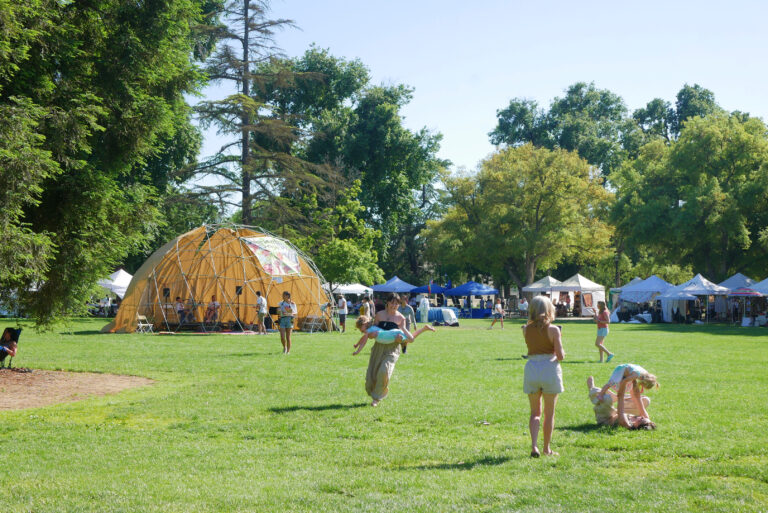
Other features of the festival included information booths manned by various campus organizations and a “Festival Dome” that served as an information booth located in the middle of the action. The dome has been a longstanding emblem of WEF that serves as a definite sign that the festival is up and running.

There was a wide variety of food served throughout the weekend, including Davis favorites like Dumpling House and Niknek Lemonade, which offered a wide selection of vegetarian snacks, meals and drinks at varied price points.

Brianna, a third-year psychology major, was one of the vendors at WEF. She is an owner of and maker for the Davis-based clothing brand we2cow, which offers custom embroidered apparel. She noted that some of the food she tried was on the more affordable side, especially for vendors who were stationed on the Quad for the entirety of the weekend. 

“We got street corn, which was reasonably priced and really good, but that was [about] all the food we got here,” she said. “We either brought food from home or [got food from] downtown.”  

An installation new to WEF was the multi-sided bulletin board structure that had prompts surrounding compassion — an unmistakable tribute to the late David Henry Breaux, otherwise known as “Compassion Guy.” Each side of the 3D board had a piece of paper with different prompts on it, such as “What does compassion mean to you?” There were dozens of responses taped up around the central paper, as anyone passing by could use the markers, paper and tape provided to write and post their own thoughts on the matter. 

The closing ceremony featured remarks from some of the volunteers and facilitators that made WEF happen, including a shoutout to past staff and — in true WEF fashion — a call for any help from the crowd to clean the last of the dishes and pick up any leftover trash. 

WEF embodies the best of UC Davis, from its conception to its core values, and the turnout from students, alumni and community members alike attests to its place as a staple in our campus culture. 

Written by: Ana Bach and Clara Fischer — arts@theaggie.org

UC Davis Health study finds that more bone breakdown predicts shorter lifespan in patients

UC Davis Health study finds that more bone breakdown predicts shorter lifespan in patients


By LILLY ACKERMAN — science@theaggie.org 


A new study from researchers at the UC Davis Comprehensive Cancer Center has shown that increased bone biomarkers are significantly associated with lowered survival for patients with hormone-sensitive prostate cancer (HSPC). 

Bone biomarkers are substances that can be seen in urine or blood that indicate the health and activity of bone cells. In the case of prostate cancer, biomarkers can also show signs that the cancer is disrupting bone mass — a common feature of advanced prostate cancer — or that it has spread into a patient’s bones. This makes them a promising area of study within prostate cancer treatment research. 

Dr. Primo “Lucky” Lara Jr., the director of the UC Davis Comprehensive Cancer Center and lead author on the study, said that the prevalence and deadliness of prostate cancer is high compared to other cancer types for males in the United States.

“Prostate cancer is the most common cancer diagnosed in men in the United States, accounting for over 288,000 incident cases per year,” Lara Jr. said via email. “It is also the second most common cause of cancer death in men, estimated to account for over 34,000 deaths in the U.S. in 2023.”

Due to the impact that this cancer can have on a patient’s bones, biomarkers for bone breakdown have been previously studied for their ability to assess prognosis (a disease’s likely progression and outcome), and they have been examined in correlation with responses to therapy. 

“Bone metastasis is an extremely common event in patients with advanced prostate cancer,” Lara Jr. said. “More than 90% of patients with metastatic prostate cancer will have evidence of skeletal involvement.”

This study focused specifically on biomarkers for bone formation and resorption in advanced or metastatic HSPC patients, looking to see a potential association between disrupted bone turnover and patients’ lifespan.

The HSPC cancer type refers specifically to patients who have recently been diagnosed with advanced or metastatic prostate cancer but have not yet begun treatment. This is an important classification because further bone imbalances are often caused by the typical treatment for HSPC patients, androgen deprivation therapy (ADT).

HSPC survival had not been previously researched for a link with bone biomarkers, unlike castration-resistant prostate cancer (CRPC), for which an association has already been found. CRPC is a form of prostate cancer that continues progressing even after treatment with ADT. 

The study analyzed results from a phase III clinical trial for ADT. The researchers looked for four different biomarkers in the HSPC patients: two biomarkers for bone loss, and two for bone formation. 

The researchers found that higher levels of the four circulating bone turnover biomarkers were associated with lowered survival rates in the patients they studied. 

“Elevated levels of each of the four bone biomarkers […] showed statistically significant association with worse survival outcomes, independent of traditional clinical risk factors,” the study reads. 

Due to this strong association between a shorter lifespan and high levels of bone biomarkers in HSPC patients, it could be helpful to know the number of biomarkers in patients. Lara Jr. thinks this knowledge might enhance prognosis and counseling during patient visits, as well as offer important value for future trials. If a patient shows more bone biomarker activity, for instance, they can be prioritized so that a trial is completed faster or so they are treated more effectively for their needs. 

“In the future, clinicians and researchers could use bone biomarkers to guide patient counseling and direct future research efforts,” Lara Jr. said. “For example, future early-phase clinical trials can employ this information to identify high-risk groups to screen for new drugs by identifying those with worse prognosis in order to increase the pace of the trial and complete study accrual sooner.” 

Written by: Lilly Ackerman — science@theaggie.org

Senate answers questions at quarterly Town Hall, passes resolution against new PepsiCo contract at May 18 meeting

The Aggie Compass Basic Needs presented the new AggieEats food truck and the Environmental Policy Planning Commission shared the results of the Cool Campus Challenge


By LILY FREEMAN — campus@theaggie.org 


Vice President JT Eden called the May 18 town hall meeting to order at 6:20 p.m. in the CoHo. He read the UC Davis Land Acknowledgement.

The town hall meeting provided members of the public with the opportunity to ask the Senate questions and senators volunteered to answer them. 

Several people asked about the senators’ thoughts regarding the upcoming 2023 ASUCD budget hearings, which were set to take place the weekend of May 20 to 21. 

Another question referenced a disconnect between the student body and ASUCD, highlighting the low voter turnouts in recent elections and asking the senators about how they plan to alleviate this issue. 

Senator Jacob Klein responded. 

“That is a really great question and is a project that I have been working on with Senator Alamilla and a few others,” Klein said. “We are working on proposing a bill that will create a requirement for senators to table in person, on the ground. My goal is to have this bill passed by the end of this quarter so that students have this in-person outreach for students to learn more about ASUCD.”

Following the town hall, the senators moved to the Mee Room inside of the Memorial Union to have their Senate meeting. After roll call, Leslie Kemp, the director of the Aggie Compass Basic Needs Center, gave a presentation outlining the organization’s accomplishments and goals for the future. 

Kemp specifically discussed a new program created by the organization: the AggieEats food truck.

“It is a pay-what-you-can food truck, where the food comes from the dining commons fresh; students come up to the truck, scan the QR code and decide what they are going to pay,” Kemp said. “Nobody sees what you pay. Once you pay, go up to the window, and show them that you paid, and tell them what you want. They’ll give you as much as you want, regardless of how much you were able to pay.” 

Kemp explained that the truck is available to all students.

“If you have money today, pay,” Kemp said. “If you don’t have money next week, don’t pay.” 

They went on to explain their goals of partnering with organizations around campus to include the AggieEats food truck in on-campus events. The senators then discussed the potential for partnerships between ASUCD and the food truck in the future. 

Following this presentation, Daphne Crother, a third-year political science major, was confirmed as the vice chair of the Environmental Policy and Planning Commission. 

Next, Senator Erek Leshyn presented the Aggie Mentors Committee (AMC) quarterly report. 

Leshyn highlighted recent accomplishments of the AMC, such as hiring four new staff members to the committee. Leshyn also said that their primary goal for the upcoming year is increasing membership in the AggieMentors program through improving its social media strategies. 

Annette Gutierrez, the unit director of the Housing Advising for Undergraduate Students Committee (HAUS), then presented the committee’s quarterly report. 

Gutierrez first outlined recent HAUS accomplishments, such as a successful Housing Week, Housing Fair and increase of its social media presence. She then went on to discuss goals for HAUS in the future, such as improving their Housing Week, in terms of student involvement and creating regular workshops and social events throughout the year. 

Following HAUS, Ashley Chan, the chair of the Gender and Sexuality Commission (GASC), presented the GASC quarterly report. 

Chan said that recent accomplishments of GASC include its recently held “Know Your Rights and Options: Title IX and Sexual Violence,” event, explaining the success of the panels and activities that were involved. Chan said that one challenge GASC faces is a lack of senator involvement with the committee, emphasizing that there is still time this quarter for the senators to attend a GASC meeting. 

The Environmental Policy and Planning Commission (EPPC) gave the final quarterly report of the meeting. Kelly Abey, the chair of the committee, presented it. 

A recent accomplishment of the EPPC was the Cool Campus Challenge, which Abey said was a sustainability challenge between UC Davis and UC Berkeley. 

“UC Davis won by an absolute landslide,” Abey said. “We had 145 participants on the UC Davis side and 40 participants on the UC Berkeley side.” 

Following quarterly reports, the Senate moved on to consider legislation. 

Emergency SB #108, which allocates $9,950 to the Aggie Aid program for grants and housing subsidies, was passed unanimously. 

Emergency SB #109, which allocates $1,700 to the ASUCD Senate for purchasing food for the 2023 budget hearings and week eight to 10 meetings, was passed with 10 voting in favor, one voting in opposition and one abstaining. 

SB #107, which allocates $349.50 to the Office of ASUCD Senator Gaius Ilupeju for the purchase of 30 pepper spray armband alarms that will be donated to the Davis Community Meals and Housing, was tabled.

Senate Resolution #6, which is a resolution to oppose UC Davis signing a new pouring rights contract with PepsiCo, was passed unanimously.

The senators then approved past meeting minutes, and Eden adjourned the meeting at 11:23 p.m.

Written by: Lily Freeman — campus@theaggie.org

UC students fight to reduce barriers to accessing care for sexual assault survivors

AB 1138 would provide free and safe transportation to and from sexual assault forensic exams at California colleges and universities


By KAYA DO-KHANH — campus@theaggie.org


Assemblymember Akilah Weber (D-La Mesa) and undergraduate students from across the University of California wrote AB 1138, which would require UCs and California State Universities (CSUs) to provide free and safe transportation in a way that protects student anonymity to and from sexual assault forensic exams. The organization that created the bill is Generation Up (GENup), a student-led social justice organization and student-activist coalition. According to fourth-year UCLA student and GENup’s Collegiate Chief of Staff Allyson Chan, GENup came up with the idea for the bill because of the limited access to forensic exams that it saw on its members’ own college campuses. 

“You’re just surviving one of the most traumatic things that can happen to a person, and you’re being met with logistical and administrative issues,” Julianne Lempert, a UCLA student and policy chair for Ignite National, a young women’s political leadership organization, told the Los Angeles Times. “It discourages survivors from starting their healing journey.” 

Chan said that due to the distance most UC or CSU campuses are from sexual assault forensic examination kit locations, the services are often difficult or impossible to get to via public transportation. In addition, not all students have access to safe personal vehicles, which affects the safety of survivors and restricts reporting options.

“To reduce barriers to receiving care, AB 1138 would mandate that all students have equal access to forensic services, thus increasing the reporting options of sexual assaults and fostering an environment of support for survivors,” Chan said via email.

On April 17, GENup representatives partnered with Ignite National at the Capitol to lobby for AB 1138. There were a number of student speakers from both organizations, and Assemblymember Weber’s legislative staffer Trent Garrett spoke alongside them. 

“The press conference was truly powerful to see students mobilized in solidarity for survivors of sexual assault,” Chan said via email. 

The bill was introduced by Assemblymember Weber on Feb. 15 and passed through the Assembly’s Higher Education Committee with a unanimous 12-0 vote. The bill is currently in the Appropriations Committee’s suspense file. GENup is working to get the bill out of suspense and heard in the committee for a vote by gathering additional support. There is an AB 1138 letter of support template for organizational support, and individuals or organizations can join the Sexual Assault Forensic Exam Transportation for Youth Coalition with this link: http://tinyurl.com/AB1138SAFETYCoalition

Fourth-year economics major and chairperson of the ASUCD Student Health and Wellness Committee Hibah Shafi said that the committee, which promotes and advocates for student health and wellness, including mental, physical and sexual health, is working on several projects that pertain to the topic of the bill. 

One of the projects that it is working on is an attempt to combat electronic stalking through air tagging on campus. 

“It has happened to a lot of people on campus, including me,” Shafi said. “I heard that a lot of people, including my own friends, had air tags slipped into their bags at the library. Even under cars — that’s where mine was, right on the bumper of my car. It’s so scary to have your sense of safety and security be stripped from you, and unfortunately, the police are not really equipped to deal with this new form of electronic stalking.”

Shafi said the committee is working on speaking with the city council, and they have obtained stalking data from UC police departments. The committee wants to work more with city officials to create a safer space for students, and it hopes to create a city ordinance. 

It is also working on launching a project this fall quarter that communicates and educates students attending organizational events about the three pillars of consent. The committee specifically wants to work with fraternities, and the end goal is that at any fraternity event, students are told the three pillars of consent before entrance. 

On April 26, the committee helped the Sexual Assault Awareness Advocacy Committee with their Denim Day painting event and had a bystander intervention training that was presented by the UCD Center for Advocacy, Resources and Education. 

Written by: Kaya Do-Khanh — campus@theaggie.org

UC Davis gets swept by UC Irvine in the series

UC Davis was unable to figure out a consistent rhythm during Saturday’s game, resulting in a 13-2 loss 


By CAROLYN (CARI) FENN — sports@theaggie.org


After a tough loss of 5-10 the day prior at Phil Swimley Field at Dobbins Stadium on Saturday, May 20, the Aggies once again could not outscore UC Irvine, losing the game 13-2. Saturday’s loss marks their seventh consecutive loss, with their last win being May 7 against Cal Poly

Right off the bat, the Aggies began to struggle offensively, as many of UC Davis’s pitchers were unable to find a consistent rhythm on the mound. Starting the game was third-year pitcher Kaden Hogan, who could not finish out the first inning after allowing two runs, hitting two batters and throwing a wild pitch that unfortunately caused the second of the two runs scored against him. This was the third time that Hogan started the game for the Aggies, with the first resulting in an 8-0 shutout against Cal Poly and the second resulting in a 3-11 loss against the University of Hawai’i. By the end of the first inning, the Aggies had given up five runs to the Anteaters, making it a rough start to the matchup.

Taking over for Hogan on the mound was first-year pitcher Alejandro Huezo. Pitching the most innings in the game out of all the Aggie pitchers, he pitched from the first through the fourth inning where he allowed three more runs in the first inning and two in the second but then only allowed a single hit in the third and fourth inning combined. 

Following Huezo, the Aggies began to switch out their pitchers every inning, sometimes even twice in one inning, for the rest of the game. The Aggies’ pitching was able to finish off strong, with third-year pitcher Andrew LaCour only allowing one walk in the eighth inning and third-year pitcher Ian Torpey allowing one hit in the ninth inning. Torpey had the strongest pitching performance out of all the Aggies on Saturday, only allowing one hit, zero runs and striking out two batters. 

Their unfortunate inability to find a rhythm is shown when looking at the teams’ overall defensive stats. The UC Davis pitchers combined to throw a total of 198 pitches with 106 of those being strikes and 92 of those being balls. With all these stats, their strike-out percentage came to be a low 53.5%, compared to the Anteaters 75%. Considering these stats with the 16 hits and 13 runs by UC Irvine, it’s clear UC Davis was struggling to figure out how to beat UC Irvine’s offense, which is ranked second in the Big West for batting.

Unfortunately, for the Aggies, they were unable to compensate for their challenges defensively, as they struggled to hit against the Anteaters’ pitching duo, third-year Nick Pinto and second-year Davis Vizcaino. Pinto pitched seven innings against the Aggies, allowing six hits, two runs and throwing six strikeouts. Vizcaino then came in and finished off the game for UC Irvine, not allowing UC Davis to try and shorten the massive lead they had, as he allowed zero runs and hits.

The Aggies’ first run of the game came in the bottom of the fifth inning after third-year infielder/outfielder Nick Iverson was walked and then able to get to third base, following first-year infielder Joey Wright single to right field. Then, despite no hit after Wright for the rest of the inning, Iverson was able to use his speed to get home after a wild pitch was thrown.

The best offensive performance by the Aggies came in the bottom of the sixth inning, where the Aggies scored their second and final run. Starting it off was third-year infielder/catcher Jack Gallagher, who singled to left field. Then, directly following, second-year infielder Nick Leehey singled to third, giving the Aggies two runners on base. After Gallagher was able to advance to third following a flyout by fourth-year infielder James Williams III, first-year outfielder Leighton Helfrick was able to bring Gallagher home with his hit down the middle of the field. 

Out of the entire team, Helfrick was the best offensive player for the Aggies, going two-for-four with an RBI. 

Unfortunately for the Aggies, the reason why UC Irvine is ranked second and UC Davis is ranked last in batting in the Big West became prevalent on Saturday. When comparing the offensive stats alone, the Aggies had an overall hitting average of 0.171, while the Anteaters had an overall hitting average of 0.410. Very few Aggies were able to make connections with the ball, leading to fewer chances on-base when compared to the Anteaters which was a major cause of their 13-2 loss. 

The following day UC Davis fell to the Anteaters 2-9 as UC Irvine completed the sweep. The Aggies were unable to figure out a way to hit or pitch against the Anteaters, resulting in their biggest loss in the conference yet. The Aggies now sit at a 17-34 record for the season and have a 7-20 conference record.

On Sunday, at their last home game of the season at Dobbins Stadium, the Aggies celebrated their three graduating seniors: infielder/catcher James Williams III, pitcher Nate Freeman and pitcher/catcher Nathan Peng.


Written by: Carolyn (Cari) Fenn — sports@theaggie.org


Culture Corner

The Art Desk’s weekly picks for music, movies and more


By ANNE THISELTON-DYER  — arts@theaggie.org


Song: “Pool” by Samia (2020)

“Sami, Sami, Sam-Soumi…” A recording of indie-pop singer Samia’s grandmother singing in Lebanese Arabic plays over the slowly expanding first notes of “Pool.” This sets a sweet and nostalgic tone for the opening track of Samia’s debut album “The Baby,” which explores the experience of clinging to a temporary relationship with the knowledge that it is fleeting. Samia’s smooth, piercing vocals are the real star of this track, allowed to shine over stripped-back instrumentals. The song seems to suspend time; as it progresses, that suspension snaps and lets loose an outward ripple of emotion that builds and gains structure, growing increasingly powerful. “How long do you think we can sit here / Before we have to move?” Samia questions. “Pool” confronts the reality of endings, fitting for the nostalgia of college graduation season or just the bittersweet tone of growing up.


Book: “The Curious Thing: Poems” by Sandra Lim (2021)

I was originally assigned to read “The Curious Thing” in a poetry workshop last spring, but this volume is one that I’ve revisited several times since and recommended to my friends, even the ones who “aren’t poetry people.” The third volume from the Korean-American poet and professor is both witty and profound; it has a dry sense of humor that breaks up its more emotional moments. Its domestic setting and fascination with mundane, lonely moments provide an almost uncomfortably personal perspective on desire and solitude. Lim is an incredible writer, and this collection proves it with beautiful poems that remain grounded and strikingly emotionally aware.


TV Show: “Killing Eve” (2018-2022)

In this thriller-comedy show, MI5 agent Eve, played by Sandra Oh, is tasked with tracking down the charismatic yet psychopathic assassin Villanelle, played by Jodie Comer. As their lives become increasingly intertwined, the two women develop a mutual obsession with each other and chaos ensues. The chemistry between Oh and Comer is what makes this show, and specifically the first two seasons, great and differentiates it from any other spy thriller. It’s a masterfully written will-they, won’t-they, and you’re never fully sure whether Eve and Villanelle are going to kiss or kill each other. Bonus points for Villanelle’s outfits — she’s a style icon.


Podcast: “Alice isn’t Dead” (2016)

This serial fiction podcast follows Keisha, a truck driver searching across America for her wife Alice, who she previously thought was dead. Framed as a series of audio recordings and radio broadcasts, “Alice isn’t Dead” shows Keisha repeatedly brought face to face with the supernatural: a reappearing town that reflects the stages of grief, a factory run by a man who ages in a day, highway stops haunted by flesh-eating creatures and a conspiracy that might just connect them all to Alice’s mysterious disappearance. This podcast is inventive, thoughtful and always surprising, and even though it is horror heavy, the narrator’s voice is so relaxing that I sometimes listen to it when I can’t sleep. “Alice isn’t Dead” is genuinely so weird, but also provides an extraordinarily insightful exploration of the psychic life of America’s in-between spaces.

Written by: Anne Thiselton-Dyer — arts@theaggie.org

UC Davis students serving in the Military Reserve describe their experiences

According to students, serving in the military can have financial and social benefits 


By AMBER WARNKE — features@theaggie.org 


Serving in the military is often presented as an alternative path to college, but some students choose to pursue both. The Military Reserve is a route many college students take, in which they only serve for one weekend a month following their military training. This allows them to pursue other career or education options, including college, simultaneously. As of 2021, UC Davis hosted 9% of all military-affiliated students in the UC System, which supports 250 Reservists.

According to Dylan Bear, a second-year political science major currently serving in the U.S. Marine Corps Reserve as a heavy equipment operator, military training often translates to one’s career and college journey. 

“The military isn’t just the weekends; it’s a way of living,” Bear said. “You build that from basic training or boot camp, […] and you just have to have that discipline to do what you need to do for the military, pursue that future, as well as your school work.”

Bear said it is important to manage your time and energy effectively in the Reserve.

“If you decide to do this path, you need to know that there is a balance that you need to find personally,” Bear said. “It’s a give or take — What do you want more, your future or your present?” 

John Por, a fourth-year psychology major and sergeant combat medic for the U.S. Army Reserve, said this balance can often be difficult.
“The switch between being a civilian for 28 days a month, and then [having] to be all ‘soldiery’ for two days a month, is a bit rough,” Por said.

Many Reservists benefit from the social aspect of the military when on duty. 

“It’s a culture […] you’re not going to find anywhere else,” Bear said. “You’re with a group of people 24/7 […] and you’re just doing what you want to do and half of it is just screwing around, having fun.”

For Angelee Rivera, a second-year human development major serving as a combat medic, the Reserve has had a similar impact. 

“I drill here in Sacramento, so I have met a lot of people in my unit, and a lot of us are the same age, and kind of have the same career aspirations,” Rivera said. “It’s a nice sense of community and after I joined, I also decided to do ROTC here at the school, so that impacted me a lot as well just because I feel like it expanded my social circle. We have to do a bunch of stuff together like exercise at six in the morning or lab activities.”

Rivera went to basic training at the age of 17, opting to defer from college for a year to make time for her military training. 

“It was kind of hard because I was super young,” Rivera said. “But it definitely gave me a taste of the real world and how to be self-sufficient on my own, so when I came to college, I felt more prepared.” 

In addition to the social benefits, Rivera said the military has helped her financially.

“The financial backing is, to be honest, great,” Rivera said. “Now, [my parents] don’t need to worry about funding my college. I think about it like a part-time job where I only work two days a month, so it’s pretty worth it for me.”

When Rivera first tells people she’s in the Army Reserve, she is often met with surprise. 

“A lot of times, they […] come across as shocked and that’s because I don’t give off the energy, I guess, of someone who’s in the military because I’m a little smaller, and I’m a female especially,” Rivera said. “I’m definitely aware that I’m in the minority. I feel like in every military setting I’ve been in, […] I always notice, like, for every female there’s like three males, so it’s a little tough because I feel like I have to work harder to prove myself.”

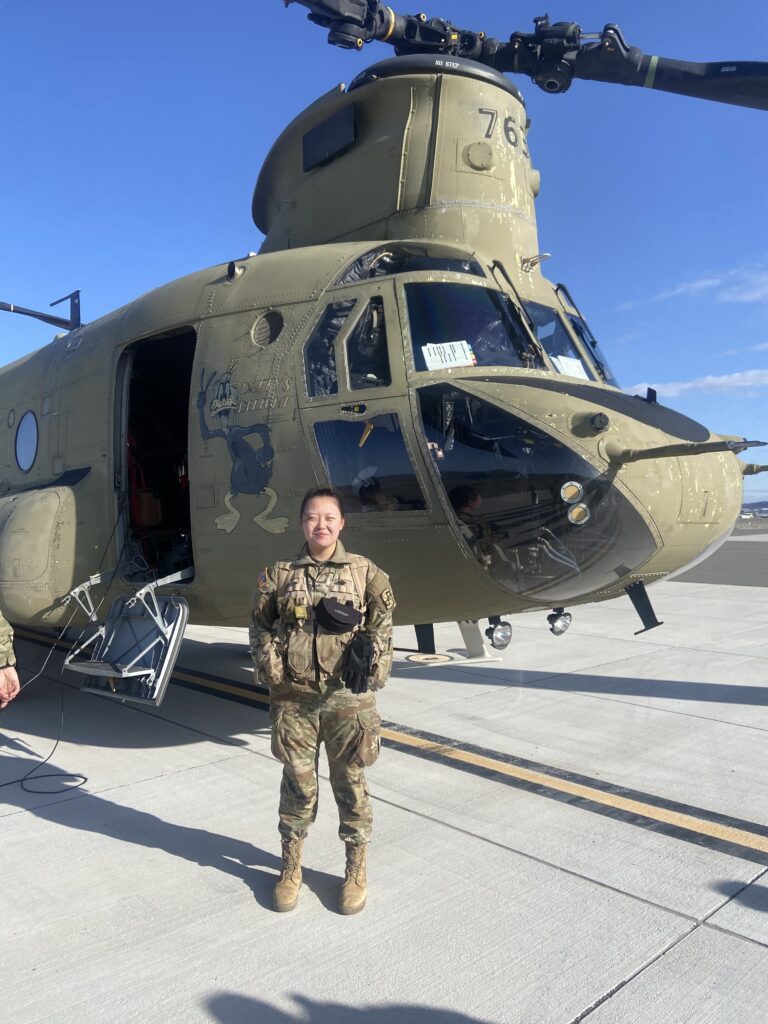
Yim Jinyoung, a first-year data science major in the Reserve Officers’ Training Corp (ROTC) who serves as a transportation management coordinator in the U.S. Army Reserve, has faced a similar response. 

“I feel like a lot of people are surprised because they don’t really expect someone like me, an Asian young woman, to be in the Army,” Jinyoung said. “But once you’re in the Army, you do see a lot of different kinds of people. There are a lot of young women like me and also people who fit in the stereotypical ‘Army man’ kind-of vibe, but then, there are also people that you would not expect to be in the military.”

When she first joined the military, which she had been considering since middle school, Jinyoung’s parents were curious about what it would entail. 

Once she got to basic training, Jinyoung faced the stress of being away from home. 

“I didn’t want to look like a coward, you know?” Jinyoung said. “I was honestly a little bit scared, but I didn’t really want to show it because I didn’t want to make other people get nervous with me, and I wanted to ease their minds, so I was like, ‘I’m not scared at all.’”

Samatha Gonzolaz, a second-year human biology major, is a cadet in ROTC and serves in the Reserve as a mortuary affairs specialist. Similar to Jinyoung, Gonzolaz also learned to take on a different mindset in basic training. 

“That military bearing was instilled in me in basic training, so I feel like that’ll never go away,” Gonzolaz said. “I actually still do utilize the stuff I learned in basic. Even when I […] fold my clothes, I fold it the same way; it’s called a Ranger Role. The mentality that I had in basic is still here as a civilian. I would honestly say that the military mentality definitely takes over my civilian life more than my civilian life takes over my military life. When I go to drill, it’s like, ‘All right, I’m not a civilian.’ I know that I have to have that switch.”

She also has experienced strong social benefits from her training. 

“The friendships that I make over time, […] we do share the same hardships, so we do create different bonds than most people do in the civilian life,” Gonzolaz said. “We go through lots of events — I don’t want to say traumatizing events — but they are pretty hard. But the fact that we go through them together, it makes our bond stronger. The people that I have met in the Reserve, they’re like my best friends up until now. I honestly see them being in my life forever.” 

One downside for Gonzolaz is that she had to miss two quarters at UC Davis for her training, which was difficult to navigate. However, the military has allowed her to fund her college degree. 

“I would definitely say if you’re willing to pause your college and come back to it later, it is 100% beneficial,” Gonzolaz said. 

Rivera said joining the U.S. Reserve is worth it, especially if you know you need financial aid to go through college. 

“Life is short, have as many experiences as you can, and the military is a great way to do that,” Rivera said. “I really like the experiences, I really like adventure, I suppose. So it just seemed super exciting to do something that I never thought I would do, and you know, something that was scary and physically and mentally challenging. You get to meet a whole bunch of other people. It’s just honestly fun; I try to think of it like summer camp.” 

Written by: Amber Warnke — features@theaggie.org

Is small crime in Davis going unchecked?

Davis residents share their perspectives about small crime in Davis


By ZOE SMITH — city@theaggie.org


Content Warning: This article contains discussions on sexual harassment.


On April 29, local bystander Steve Greco witnessed threats of kidnapping and sexual assault yelled from a moving vehicle at a woman walking her dog at the corner of 7th and D Streets. According to Greco, the perpetrator of this crime was a young man in the passenger seat of a dark blue Ford truck. 

Greco took a picture of the moving vehicle and attempted to use the AI technology AVCLabs Video Enhancer to identify the license plate, but the results were inconclusive. He made a police report to Officer Griffin at the Davis Police Department. 

Lieutenant Dan Beckwith has been with the Davis Police Department for 16 years. Beckwith said that this particular incident would fall under California Penal Code 422, a statute that makes it illegal to communicate a threat to someone who could cause bodily harm. Beckwith talked about the investigation process that goes into incidents like these. 

“When we get calls from services like that we tend to do an investigation, go out, take a statement from the person that called us to determine if what they say happened meets the elements for a crime in the state of California,” Beckwith said. “I wouldn’t say that it happens very often in town.”

Greco posted the details of the harassment he witnessed along with a picture of the truck on Nextdoor, an app that connects residents of local areas to spread awareness about current events in the area. Many community members commented on Greco’s post voicing their reaction to the incident, using the comment section to share similar experiences.

One community member, who wishes to remain anonymous, commented on Greco’s post, trying to ID the make and model of the truck. The individual said they have witnessed and experienced this particular type of street harassment countless times. Since moving to Davis in 2016, the individual has reported seeing multiple instances of men catcalling female pedestrians and yelling slurs at people who are part of the LBTQIA+ community. The resident described one of their personal experiences with drive-by street harassment in Davis. 

“There were a bunch of guys, and they had their windows down,” the anonymous person said. “I was with a group of my friends who were also queer […] and a few of them were women. And they were catcalled, someone yelled a slur.”

Lieutenant Beckwith talked about how the police department takes harassment like this seriously as it can lead to more crime. 

 “We document those incidents,” Beckwith said. “Not specific to just queer people, but any incident that falls under any group, protected group. So if it’s a racial thing, perceived sexual bias, religious bias, anything like that, we do document that. It’s not necessarily a crime. We like to keep track of it because a lot of times that kind of stuff could lead to a crime. Which is something we take very seriously.”

Davis RIMS is an interactive tool that allows the public to access local crime data. Davis RIMS shows that the most common type of reported crime in Davis is vandalism, another commonly reported crime is sexual assault/harassment. The anonymous community member talked about whether police take small crimes seriously in Davis.

“That’s hard to say,” they said. “For this example, we have a truck, color [and] a year range — […] it’s all very circumstantial. And then there’s a lot of property crime in Davis, there’s not really anything they (the police) can do about it. Because, simply put, there’s just so much of it.”  

Beckwith talked about the different types of daily reports the Davis Police Department receives.

“We get reports through various means on a daily basis,” Beckwith said. “Some come in through phone calls. Some come in through our online reporting system, with different means of entry. Some are cold, meaning they’ve occurred sometime in the past […] a few hours prior or even days, weeks or months prior people are late to the game reporting. And some are actively occurring. I can tell you that the most common call type is theft, but there are various types, there’s a whole myriad of different types of stuff that we get.”

Jeremy Taylor, a Davis resident, commented on Greco’s initial post that he believes the Davis Police Department puts very little effort into solving small crimes. 

“I once connected the dots of a crime committed against a friend using neighbors’ cameras, wrapped it in a bow and handed it to the police,” Taylor commented on the post. “Don’t assume they’ll do the work on their own.”

When asked further about his opinion of the Davis Police Department, Taylor talked about his concern with small crime in Davis. 

“Every day we hear of a new theft or terrible driving all over Davis,” Taylor said. “The police don’t do traffic enforcement or work to stop small crimes, so it continues.”


Written By: Zoe Smith city@theaggie.org


Self-reflection is the greatest gift you can give yourself

Try the VIA Character Strengths Survey


By YASMEEN O’BRIEN — yjobrien@ucdavis.edu


I have found self-reflection to be one of the secrets to my happiness. For some, it’s exercise, nature, music, meditation, friends or sunshine. It can take some time to figure out what your secret is, but regardless, I believe self-reflection is helpful for everyone.

The Berkeley Well-Being Institute describes self-reflection as a mental process you can use to grow your understanding of who you are, what your values are and why you think, feel and act the way you do. When we self-reflect and become more conscious of what drives us, we can more easily make changes that help us develop or improve our lives.

Last year, I took a class called Health Psychology (PSC 126) with Professor Kelly King (which I highly recommend) where we were assigned to take the VIA Character Strengths Survey. I thought it was just another personality quiz and didn’t think I’d have to take the assignment too seriously, but I was wrong. It ended up being an educational and worthwhile experience.

The survey encourages genuine self-reflection rather than giving the quiz-taker passive praise. It asks you questions about how you see the world, how you see yourself, how you believe others see you and how you treat others.

This survey is a frequently utilized tool in the field of positive psychology that assesses the character strengths of an individual. The VIA Institute on Character talks about how knowing the strengths of your students, clients or employees allows you to guide them more effectively and authentically. It can help you bring out the best in others.

But the survey isn’t just useful for guiding others — you can also use it to bring out the best in yourself. Both the questions and the results inspire self-reflection, which I think is always a good exercise. Sometimes it can be hard to see our flaws or give ourselves credit for our strengths. But taking this survey, interpreting the results and reflecting on them are some great first steps.

Similarly, self-reflection can seem abstract, and it can be hard to know where to start. This survey is a quick and easy way to get into it and is one tangible example of self-reflection that can lead us to understanding and developing ourselves. 

Some other forms I have found to be therapeutic are journaling, listening to music, going on walks outside, talking to my close friends, meditating and reading meaningful books. 

Self-reflection has helped me feel more connected to myself and be more in touch with my boundaries, which is something I have struggled with (and sometimes still struggle with). As a young person, it can feel difficult to create and respect my own boundaries, which is one way to gain self-respect and feel self-confident. 

But the beauty in self-reflection is that it can help you, no matter what your struggles are or where you are in life. And this survey is a great way to start. Self-reflection has helped me, and I hope it will help you too.


Written by: Yasmeen O’Brien — yjobrien@ucdavis.edu

Disclaimer: The views and opinions expressed by individual columnists belong to the columnists alone and do not necessarily indicate the views and opinions held by The California Aggie.

Commentary: Consider community building as an alternative to networking

The importance of making meaningful connections, not just seeking out opportunities from others


By RUMA POUDELL — arts@theaggie.org


Networking and building communities are important parts of interacting with the world, establishing a support system and forming fruitful connections. As college students, we’re in a unique environment with the opportunity to engage in these activities on a daily basis. While the two are similar, prioritizing community building may be beneficial — here’s why.

Networking is a widespread concept. On any given day, there may be numerous networking events held for the sole purpose of getting together and meeting new people in a field or activity. Networking typically includes exchanging LinkedIn profiles and phone numbers and seeking out opportunities from one another. 

Community building parallels networking, but the approach is slightly different. While the ultimate goal of community building is also to seek out opportunities, it’s not done with an approach that is so direct and straightforward.

Networking is typically done with the intention to extract opportunities from one another, whereas community building first establishes a genuine connection and reaps additional benefits later. 

If you’ve never gone to networking events before, they can be kind of awkward. Everyone there knows that other attendees are also looking to get a job, internship or even a mentorship. Personally, having that in mind convolutes the process of getting to know someone for me, because right off the bat you are coming in with an extremely formal attitude.

Some questions you might find yourself being asked at a networking event include, “What are your past work experiences? What do you hope to accomplish in the future? What are you currently working on as a passion project?”
Don’t get me wrong, you can definitely form relationships from these types of interactions. But it can also feel awkward and sometimes even forced. 

When I think of community building, however, I think of approaching people with a sense of curiosity about their character as a whole, not just their professional life. Community building can also happen anywhere — not just at specified events. It’s like making friends and turning those friendships into partnerships of support to eventually form a complex support system. 

Imagine meeting someone at a coffee shop, deciding to have a conversation and, as you start talking, learning more about this person’s life. Whether or not you get something out of it in terms of job opportunities, you have potentially formed a new friendship or connection. That person offers an opportunity to learn and grow. 

Another aspect of community building that’s different from networking is the maintenance these relationships require. In community building, you maintain contact every so often. You keep in touch and update each other on your journeys. You can even connect each other to more friends and opportunities as well.

Relationships formed through community building require more effort. I think the perfect example of this is my connection with my mentor. I met him through applying for an internship, asking questions, hopping on a phone call and simply talking about things I was curious about, as he was someone who was achieving the things I wanted to as well. 

Since then, I’ve changed career trajectory and we no longer share the same ambitions — yet we still stay in contact. We update each other on life and I’ve met additional friends and mentors through this one contact who have been of immense help. This is only one example of how focusing on community building rather than networking helps foster genuine connections rather than mere Linkedin followers.


Written by: Ruma Poudell — arts@theaggie.org