55.5 F
Davis

Davis, California

Tuesday, December 23, 2025
Home Blog Page 15

Dear freshman me: please take care of yourself

0

Learning from hindsight

By MOLLY THOMPSON – mmtthompson@ucdavis.edu 

As I enter my third year at UC Davis, I can’t help but return to the memories of the early days of my first year; In fall of 2023, I fell victim to the plight of many young adults living away from home for the first time and got myself into a pretty deep eating disorder. 

While this wasn’t the first time that I’d found myself in this particular state (I was diagnosed with anorexia nervosa when I was 16 years old and spent my third year of high school in recovery), I started my collegiate career extremely confident that I was beyond that part of my life and that I was no longer susceptible to the destructive habits of my high school years. Reader, I was quickly humbled. 

College can be incredibly stressful: that doesn’t come as a surprise to anyone. Between fast-paced, demanding classes, a new environment, the loss of our support systems and a rapid transition to complete independence from our families, it’s inevitable that we’re all going to need some solid coping mechanisms to deal with the pressure. And, with everything being so new all at once, it’s easy to feel lost and out of control. 

Food is something that is really easy to control when everything else is out of your hands. It’s a place you can direct your attention to when your brain is overwhelmed by responsibilities. Manipulating your body and your food feels like a tangible, accessible goal when everything else feels too vast or unattainable. Especially if it’s something you’ve dealt with in the past, eating feels like a familiar, reliable routine that you can rely on in the face of so much uncertainty — unlike everything else, it makes sense. 

Anorexia, in particular, is especially enticing because it has the additional symptom of numbing you to the harshness of the world around you and the turmoil inside your head. When you deprive yourself of sustenance, your body shuts down a lot of its nonessential functions. Your metabolism slows down (which has a lot of side effects of its own), your reproductive system might suffer, your mental cognition wanes and your emotions become subdued — you just feel less of everything. This numbness might not be something you’re aware of, but in a time of so much overwhelming anxiety and stimulation, it can feel like relief. 

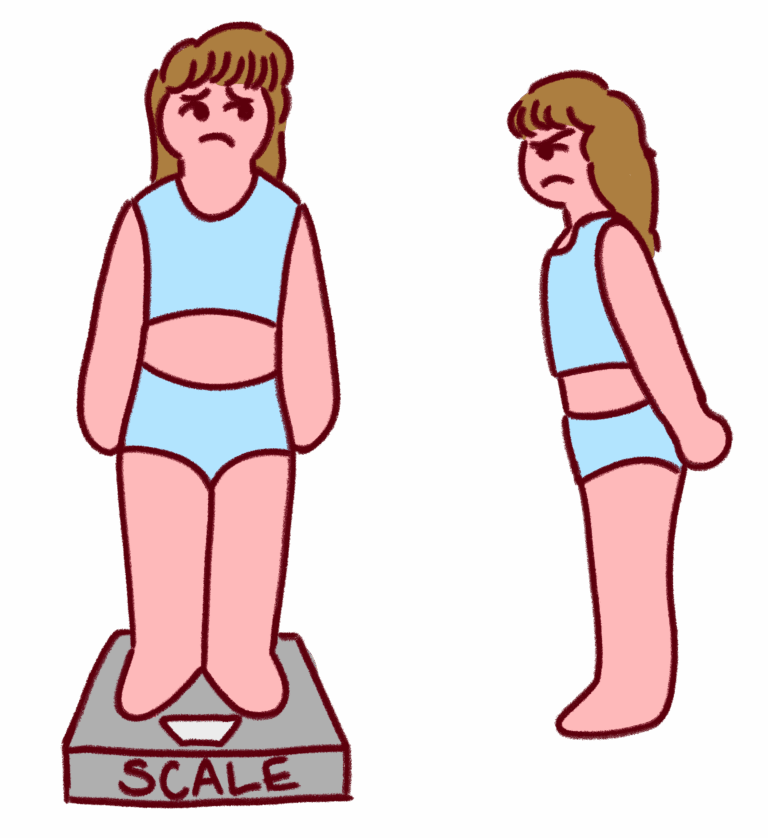
Please, under no circumstances, take this as an endorsement of eating disorders. I can confidently say that the deepest points of my eating disorder were the worst times of my life. Even though I was numbing myself from other anxieties, even though I felt a sense of success from manipulating the shape of my body or the number on the scale and even though it gave me control over a small aspect of my life, it deprived me of far more than I ever gained from it. 

It took me years to relearn what my body needs and how to take care of it, skills that I was supposed to have mastered in elementary school (I’m still working on it). I permanently messed up my body in ways that I’ll never be able to fully recuperate (my metabolism will never be the same). I broke my parents’ sense of trust in me to a point that I may not be able to heal, though I’ll continue to work on it (I lied a lot). And the worst part is that I wasted so much time (days on end, if you add up all the hours) at doctors’ appointments getting my weight and vitals checked, therapy sessions recounting everything I’d eaten in a day and sitting at home, banned from exercise, while my dance teammates practiced in the studio without me. To this day I have to report my weight to my therapist every month. While it hasn’t completely stopped me from accomplishing things I’m proud of or having incredible experiences, it feels like it’s taken over the past four years of my life. 

That is my biggest regret. Anorexia plagues some of my best memories; I can look at photos from February of my third year of high school or December of my first year of college and just see this gaunt, lifeless exhaustion in my eyes. Even if it’s not visible to the people around me, it haunts those pictures (and the memories behind them) to the point where I’m not thinking of all my incredible experiences and adventures, but rather how I let food define my entire life. 

If I could change anything about my first-year experience — if I could give myself one piece of advice — I wouldn’t let myself become anorexic again. It was so hard because I felt like I was doing a good job. My therapist would call me and tell me I was still below my healthy weight baseline, and even though I would say, “Oh no, that’s not good, I’ll try harder,” it still felt like a win. 

But hindsight is 20/20, and it just wasn’t worth it. That sense of accomplishment was short-lived and inconsequential compared to the consequences (physical health, mental health, time, opportunities). Beyond that, focusing on food or body image doesn’t actually relieve any anxieties: it simply replaces them. It’s not an outlet for stress: it’s simply a redirection. It’s not a coping mechanism: it’s just a cover — the same anxiety in masquerade. It doesn’t solve anything.

I know that now. I thought I knew it then, too, but I didn’t. Even though it’s still in my head, I understand now that it’s just not worth it. It’s tempting, sometimes, to go back there. It would be so easy to slip back into those behaviors for the instant gratification of success and numbness. But I understand now that it does far more harm than good. 

College is a proverbial breeding ground for disordered eating. It’s inherently competitive, it’s overwhelming and it’s stressful — a perfect storm for unhealthy coping mechanisms. But if you take away anything from this, please learn from my mistakes. I promise you that it will cause you far more trouble than it’s worth. It’s a slippery slope — so please be careful. 

Written by: Molly Thompson — mmtthompson@ucdavis.edu 

Disclaimer: The views and opinions expressed by individual columnists belong to the columnists alone and do not necessarily indicate the views and opinions held by The California Aggie

The ‘performative male’ stereotype might mean more than we think

At what point does it stop calling out odd behavior and start reinforcing gender stereotypes?

By SABRINA FIGUEROA — sfigueroaavila@ucdavis.edu 

“I’m not going to tell you guys to vote for me because I don’t think men should tell women what to do,” a man in his 20s, holding a Bell Hooks novel and bright-green matcha latte, announced to an audience of women gathered at a “performative male” contest in San Francisco. When I attended this contest back in August, I wasn’t expecting such a strong sense of whimsy and community from men with glued-on mustaches, already loosening from their faces due to sweat. 

Obviously, I dabble in meme culture. Otherwise I would not have entertained the idea of going to a “performative male” contest in the first place. But, after attending, it struck me how easily this new trend can be misinterpreted or misconstrued in ways that have a larger effect than we may realize. After all, our perceptions of reality are framed by the media we consume: no matter how ridiculous or inconsequential it may seem.

In focusing on men’s behavior — specifically their strategic, often deceptive adoption of symbols stereotypically associated with femininity — this archetype inherently involves gender. 

In the early days of the meme’s popularity, it focused more on the power disparity between men and women. Women have been exploited by men for years as a consequence of our patriarchal societies, institutions and histories. Though there have been efforts to undo the damage done by this system, (note feminist movements all throughout history) the work is not yet done: Trauma from past generations leaves a scar. In the current political climate, where reproductive and transgender rights are being attacked and the rise of conservatism is returning to the rhetoric that women should value marriage and having kids more than anything else, it’s difficult for women to know who to trust.

The “performative male” trend is an opportunity to analyze and correct harmful and dishonest behavior from straight men that continues the streak of power disparities, both in society at large and in individual heterosexual relationships. Instead of men preaching to the choir that they love women, they should show it with their actions — it’s as simple as that: or it should be. 

As a means of communication, memes and trends have unique interpretations. The “performative male” meme has transitioned from holding men accountable to focusing on the aesthetic. That is, when we think of what it means to be a “performative man,” we conjure a specific image in our heads: a man drinking matcha, reading feminist literature, wearing a tote bag and listening to Clairo. 

It’s become less about the inappropriate, deceptive behavior and more about the symbols we use to make up our identities. Combining that with the gender aspect of the trend, we get a new murky archetype in which we could eventually find ourselves reinforcing the gender stereotypes and roles we have been fighting to dismantle.

For example, the catchphrase, “boy turn that Clairo off and grab you a beer,” has gone viral. And although it’s mainly been used as a joke, I can’t help but wonder if people notice the deeper implications of it. It implies that Clairo’s music (may she be released from the shackles of this meme) is odd for men to be listening to because it’s feminine, and, since beer is typically a symbol associated with masculinity, they should prioritize it instead.

Of course, the messaging behind it is subtle; as most of the media messages we learn our societal norms and behaviors from are. Although Gen Z wants to see big changes and indeed do the work for it, we sometimes don’t see how our trends, memes, jokes and use of language have power in spreading harmful rhetoric and norms. In other words, we discredit the power of words, language and media — we should be more careful about our tendency to play subtle things off as “not that deep.” 

The messages don’t have to be obvious or overt to create an impact; In fact, the more subtle, the more open we will be to accepting everything as is. This has created problems for us before, and if we allow it to keep happening, we are bound to keep creating them.

We passively put ourselves in boxes while trying to liberate ourselves. The memes, trends, videos and jokes we consume about this “performative male” archetype can simply be one ripple in continually perpetuating regressive gender norms. We like to think we have progressed far in society, but we should really be asking ourselves what our own perceptions of men and women are. Only then will we realize just how far we actually have progressed and how far we are actually willing to go. 

The enjoyment of things from food to music to books should be allowed to transcend the boundaries of the social constructs we have made up. With that in mind, however, inappropriate and deceptive behavior from anyone should still be called out and corrected. So long as you are not doing it just to get attention, buy that Labubu, enjoy that matcha latte and listen to Clairo…“whatever that means.” 

Written by: Sabrina Figueroa — sfigueroaavila@ucdavis.edu 

Disclaimer: The views and opinions expressed by individual columnists belong to the columnists alone and do not necessarily indicate the views and opinions held by The California Aggie.

The more you fear, the more you know, the better you fare, the more you grow

0

Exploring self-awareness as a critical, underrated form of intelligence built from challenging oneself and calculating risk

By VIOLET ZANZOT— vmzanzot@ucdavis.edu

On my flight to London this past Saturday, I watched two movies, slept awkwardly and sat with my headphones on, staring at the flight tracker in an attempt to settle my nerves and ease my anticipation. About halfway through “Eat, Pray, Love,” I realized that Julia Roberts’ character and I are a lot alike: We both appreciate good food, are too pretty for our own good and are on journeys with ourselves which are motivated mainly by exposure therapy.

As a quintessential creature of habit who often finds herself in unknown environments, I have found that the juxtaposition of my comfort zone and lifestyle qualifies me to speak on the importance of trying new things.

Testing our limits every day is how we learn about ourselves and the world around us. Fears and discomforts, though often common between people, are defined only by our individual sentiments and should be explored. To avoid experiences out of fear of failure or embarrassment is to shortchange ourselves of valuable knowledge. 

Self-awareness is one of the most underrated forms of intelligence; it is to recognize the nuances, subtleties and complexities of the relationships we have with ourselves. In this way, self-awareness is an ongoing process to understand why we are the way we are, how we operate in response to the world and how we can appreciate that the definitions and identities of things are ever-changing.

In challenging ourselves, we force confrontations — with ourselves. Choosing to embrace what we learn connects us to a deeper understanding of ourselves. For instance, I had a friend recently tell me she knew some of her feelings were irrational, and thus her boyfriend’s response to an argument was justifiable. She went on to explain that her prior life experiences had led her to have a tendency to overreact to things. 

As I told her (and now you, with my only credentials being earned through lived experience and a few years studying social science), her awareness of herself not only allowed her to control her response to the situation, but to understand the issue from his perspective. Self-awareness and the power to control one’s own mind provides not only protection from the outside world, but also an ability to empathize and sympathize with others — a trait that is often lost when one can not even understand themselves. 

Self-awareness, like many others, is a skill that is built on numerous encounters with cold, hard truths and often troubling realities. We can learn from the team that’s down in a match — the loser has several options: hail mary, play simple, accept defeat or strategize. When the final whistle blows, they’ll have learned something. 

When we touch a hot stove, we learn it burns. When we face challenges, we learn how we react to them. We gain this invaluable skill — self-awareness — by consciously working our way through life and letting its challenges be lessons.

Moving to a school so far from home was terribly hard for me. I didn’t see the struggle coming, but apparently it’s not always easy to cope with being so far from everything I’ve ever known. I learned very quickly that the one person you can never escape is yourself. I learned a whole lot of other stuff too, but only because I first realized the most important relationship I needed to foster was the one I had with little old me. We are stuck together. 

Often, I wondered why my life felt like nothing more than a never-ending series of exposure therapy sessions. Only from learning to appreciate the importance of this process did that pain alleviate. To know oneself is to understand the world — to calculate risks, to empathize, to understand one’s own position in a vast world and, of course, to be one’s own dinner date.

Written by: Violet Zanzot— vmzanzot@ucdavis.edu

Disclaimer: The views and opinions expressed by individual columnists belong to the columnists alone and do not necessarily indicate the views and opinions held by The California Aggie.

How I love being a woman

0

The paradoxical burden and beauty of femininity

By NEVAEH KARRAKER — nakarraker@ucdavis.edu

Approximately one in three women globally have experienced some form of sexual assault or abuse in their lifetime (not including sexual harassment), according to the World Health Organization and the United Nations Women. Women make up the majority of the population of domestic violence or rape victims, while men are usually the perpetrators. 

For years, the fact that women have been reduced to sexual objects or profitable entities has been glossed over by culture. It’s a luxury for us to feel safe walking alone at night — to be unconcerned for our well-being when choosing a romantic partner and to make platonic male friends with ease.

While it is the 21st century and women have the right to vote, the institutional framework of society has hardly progressed when it comes to earning an education and avoiding being scorned if marriage and childbirth is not our top priority.

The odds seem to always be stacked against women when it comes to clothing, education, relationships and even basic health. There are isolating standards, like the lack of pockets in women’s clothing — omitted in order to accentuate their silhouettes and simultaneously encourage the purchase of accessories beginning in the 1950s — and the shaving expectations created as a Gillette marketing strategy. In terms of health, examples include the “pink tax” for essential feminine hygiene products, car safety features based on typical male anatomy, physicians repeatedly ignoring serious symptoms and more research being conducted on male baldness (an inconsequential condition in men) than endometriosis (a highly serious condition in women): These are just a few of the many shocking instances of this double standard. 

A huge contribution to this undermining of feminine issues is the societal emphasis on gender roles, which is imparted on most of us from childhood. In an attempt to implement equality, oftentimes extremes are taken. There has yet to be a balance for healthy patriarchy and humble femininity, which has resulted in a surge of toxic masculinity, the coddling of violent young men and the normalization of women overly-sexualizing themselves. 

Femininity is not just about being delicate and pretty, but the personhood bestowed to women. It is believed that Eve was created from Adam’s rib, implying that despite the beautiful distinctions between men and women, they both have equal value, as value is not determined by order of creation. The divine beauty of women points beyond themselves instead of towards themselves; it is not vanity or pride, but an effortless display of nurturing and powerful compassion. 

It’s these inherent qualities that make a traditional family flourish. Choosing such a life is not oppressive; In fact, true feminism is about the freedom to decide whether or not to pursue it. This design demonstrates a deep harmony between the sexes. Women embody immanence — flipping the ordinary with newfound love and passion — while men embody transcendence through ambitious pursuit and leadership. This does not mean one sex can’t harbor characteristics of the other — women can also be zealous and men can also be tender — but the neurological components are sacredly complimentary. 

This is often reflected in the relationships we have with one another — platonic and romantic. There is one main thing that we desire to fulfill in our lifetimes: connection with others. Women do not need men, but it is a blessing to have a partner and an even greater blessing to have a friend. 

When you’re young and have a crush, as a girl you would usually speak to your girl friends, as they understand and can give you advice. As you age, it’s important to maintain friendships like that with the same sex so you can continue to guide and support each other.

Now, this does not mean men and women are incapable of having healthy friendships. But the needs of each other don’t always overlap outside of intimacy; love is expressed in different ways. As a result, the contrasting displays of affection and the way it’s perceived clashes, leading to unfavorable misunderstandings about intentions. Women are affectionate with one another in a way that men often are not, and men are valiant in a way that women often are not. This diversity should be accepted and praised, as it allows for profound bonds.

Overall, even with so much oppression against women, there is something so alluring and special about femininity. We are generous yet self-sufficient, delicate yet voracious, graceful yet demanding, passionate yet regulated and the faintest things unspoken — it can only be experienced and described as “girlhood.”
I implore you to fully embrace your masculinity or femininity. It is not something to be ashamed of or concealed, it is certainly not just a reflection of objectified genitals; Rather, it’s a precious quality that should be handled with such care, as it adds to the intricate, colorful mosaic of life.

Written by: Nevaeh Karraker—nakarraker@ucdavis.edu

Disclaimer: The views and opinions expressed by individual columnists belong to the columnists alone and do not necessarily indicate the views and opinions held by The California Aggie.

Former Sacramento Mayor Darrell Steinberg attended Pi Sigma Alpha fireside chat

Steinberg discussed his career and reflection on public service, leadership and the future of local governance

By KATYA OKS — city@theaggie.org

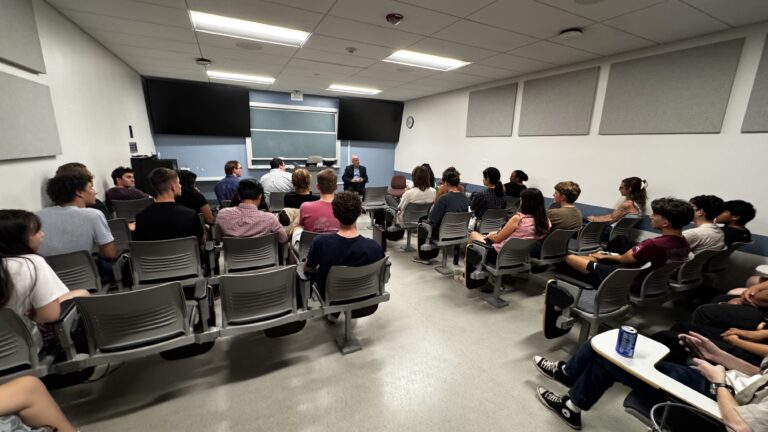
On Sept. 22, Pi Sigma Alpha — the National Political Science Honor Society at UC Davis — hosted a fireside chat with former Sacramento Mayor and State Senate President pro Tempore, Darrell Steinberg. The event was open to all students, faculty and community members. 

Throughout his political career, Steinberg passed the Mental Health Services Act which provides $3 billion a year to mental health services in California and worked with state leaders to pull California out of economic crisis, according to the California Department of Corrections and Rehabilitation website He served as Sacramento’s mayor from 2016 to 2024.  

The fireside chat with Steinberg was the second installment of the Pi Sigma Alpha speaker series, according to their Instagram page. The first event featured a conversation with the current Davis Mayor Bapu Vaitla, in which Vaitla reflected on his experiences as a mayor and answered questions from the audience. 

Pi Sigma Alpha, formally chartered in 1920, has inducted over 300,000 members — with chapters at nearly 850 campuses. The national honor society “feature[s] national, state, and local political leaders including one president, three Supreme Court justices, and dozens of members of Congress,” their official website reads.

The event began with Steinberg’s own personal reflection on his career in public service, sharing personal stories, anecdotes and advice with his audience. 

Steinberg first shared the story of how he found his spark for public service during his third year at the UC Davis Law School. During his time there, he met many individuals with physical disabilities. 

“The [UC Davis] Law School should be commended for admitting people with very diverse backgrounds, but there was one problem: The[ir] new courtroom was not accessible,” Steinberg said. 

Steinberg then explained how he, alongside his peers, asked the Dean of UC Davis School of Law to build a lift so that people with disabilities could also participate in the courtroom. They were met with a lack of enthusiasm; Steinberg recalled being told that a lift would ruin the “aesthetic look of the courtroom.” 

Steinberg then shared the law school’s response with various reporters and newspapers, which created public pressure for the law school to build a lift. 

“That was my first taste of seeing the impact of my own power,” Steinberg said. “I didn’t have a title, but my power — my willingness to advocate and make a social change — was tangible. And it actually helped people.”

Steinberg then shared his own political philosophy. 

“Most importantly, [the government] needs to be for the people who don’t have a voice,” Steinberg said. “The people who do have a voice, generally, can find their way through the halls of power and influence decisions. But people who are really down and out — whether they’re poor, whether they’re people with severe disabilities, […] they don’t generally have a voice. So I’ve always believed my job is to fight for those who are deemed lesser.” 

Steinberg then discussed some of the people who influenced him — such as Phillip Isenberg, Sacramento’s mayor from 1975 to 1982 — on his political philosophy and goals. 

“‘The real key to success is to pick one issue: one issue that is really important to the quality of life of your constituents and the state and that no one else is working on,” Steinberg said.

Steinberg then reflected on the challenges he faced in his role during the 2009 financial crisis, as he worked with members across parties to help end the state budget crisis.

“People were losing their homes, people lost their jobs, […] but the state going bankrupt would have made a terrible situation that much worse,” Steinberg said. “I had to […] convince my colleagues — Democratic colleagues — to cut things that they swore they would never cut, and to convince enough Republicans to vote for taxes so that we could minimize, or at least mitigate, the level of cuts.” 

Steinberg told the story of how he, alongside other members of both Republican and Democratic parties, created a plan.

“We had literally four weeks to meet in secret, […] and we reached an agreement of more cuts than taxes, but enough taxes to mitigate the cuts,” Steinberg said. 

Throughout the talk, Steinberg also shared many other stories and various accomplishments, including his mental health work, his mediation between opposing parties and more. 

Pi Sigma Alpha is set to host many more events — from speaker series to movie nights — for students interested in political science or public service. More information can be found on their Instagram page.   

Written By: Katya Oks — city@theaggie.org

National Hispanic Heritage Month met with silence from Trump administration

Davis community reflects on the celebration of the month while acknowledging current political climate

By KATYA OKS — city@theaggie.org

Sept. 15 marked the first day of National Hispanic Heritage Month. The month stands as a national acknowledgement of Hispanic and Latino communities and serves to “give extra recognition to the many contributions made to the history and culture of the United States,” according to the National Museum of the American Latino.

Currently, the Latino population in the United States is over 65 million, making up almost 20% of the total population according to the U.S. Census Bureau. 

Associated Students, UC Davis (ASUCD) Senator Luis Leonardo Garcia, a third-year political science and Chicano studies double major, shared what National Hispanic Heritage Month means to him. 

“Despite our community endur[ing] so much discrimination, underrepresentation and many more systemic barriers, […] we’re still thriving,” Garcia said. “Regardless of whatever barriers are put in front of us, we’ve always found a way to go around them and figure out other ways to continue being present in our community. So, celebrating this month shows that despite everything, we bring so much beauty, strength and excellence.” 

National Hispanic Heritage Month calls for not only acknowledgement, but also celebration of the achievements, impacts and individuals of the Hispanic community. However, neither President Donald Trump, nor any other members of the current presidential administration, have issued a proclamation or mentioned the month on any official White House social media pages.  

Garcia shares what a lack of acknowledgement communicates to individuals of the Hispanic community.

“[Trump] not acknowledging [National] Hispanic Heritage Month communicates to us that our achievements don’t matter — that’s the kind of message he’s putting forward,” Garcia said. “But, for me personally, him not recognizing us […] leads me to wanting to do more. He might not recognize our accomplishment[s], but we’re still working each day. We’re still doing all these great things.”

This lack of acknowledgement differs from President Trump’s first term in the Oval Office, during which “he issued a proclamation recognizing Hispanic Heritage Month at least one day in advance of Sept. 15 for each of his four years in office,” according to Forbes

In Trump’s 2020 proclamation of National Hispanic Heritage Month, which was his last acknowledgement of National Hispanic Heritage Month, he stated that “Hispanic Americans embody the best of our American values, including commitment to faith, family, and country” and called “on public officials, educators, librarians, and all Americans to observe this month with appropriate ceremonies, activities, and programs.”

The silence from the Trump administration this year follows its immigration policies, including Immigration and Customs Enforcement (ICE) raids and mass deportations.

Bradford Jones is a UC Davis political science professor whose work focuses on perception of Latinos in the U.S., specifically focusing on issues such as immigration, voting rights and discrimination, according to the UC Davis Global Migration Center website

Professor Jones shared his thoughts on relations between the current presidential administration and the Hispanic community. 

“The Latino community is under siege,” Jones said. “We’re seeing unprecedented immigration enforcement that’s almost exclusively targeting Latino communities — and not just undocumented immigrants, [but also] naturalized citizens, including U.S. citizens.” 

On Sept. 8, the Supreme Court ruled 6-3 in a case known as Vasquez Perdomo v. Noem. Their ruling allows immigration officers to detain individuals “based on the following factors or combination of factors: (i) presence at particular locations as bus stops, car washes, day laborer pickup sites, agricultural sites, and the like; (ii) the type of work one does; (iii) speaking Spanish or speaking English with an accent; and (iv) apparent race or ethnicity,” according to the official Supreme Court website.

Professor Jones reflected on the outcome of such a ruling. 

“What the court decided in this unprecedented case is that racial profiling is absolutely permitted,” Jones said. “I know from personal experience, a lot of Latino [community members and students] are very worried about their family and friends, and so a court case like this does nothing but exacerbate that fear.”

Garcia also shared his own thoughts on possible consequences and his own experiences. 

“Not everyone’s parents had the privilege or time to learn the [English] language,” Garcia said. “I know many parents who are scared of getting groceries [due to having Spanish accents]. And that’s something that’s so simple to do, but this [ruling] adds another level of insecurity and fear.”

Jones also spoke about how the recent ruling will impact celebrations that might take place to commemorate National Hispanic Heritage Month. 

“One thing that we see over and over, all across the country, in locations where there are large Latino populations, is that […] cultural celebrations have been canceled,” Jones said.
And they’ve been canceled because of the fear that ICE may use them to target [Latinx individuals.] […] What the Supreme Court did has a chilling effect on these kinds of celebrations.”

Garcia also explained how it is important to still celebrate Hispanic and Latino achievements despite the current political climate.

“Celebration of our accomplishments is active resistance,” Garcia said. “Hispanic Heritage Month isn’t just about celebration, it’s about recognition, resilience and responsibility. It is [important to] just keep pushing for that justice and visibility, long after the month ends or the year ends.”

Written By: Katya Oks — city@theaggie.org

Food Packs for Kids Campaign expands to reach more Yolo County students

STEAC partners with school, volunteers and local sponsors to address food insecurity

By ALMA CULVERWELL city@theaggie.org 

The Short Term Emergency Action Committee (STEAC) launched its annual Food Packs for Kids Campaign this fall, which ran from Aug. 18 to Sept. 19. The initiative provides healthy, non-perishable food items on weekends, when school meals are unavailable to children in Yolo County who face food insecurity. 

STEAC began the program in 2016 in partnership with the Davis Joint Unified School District (DJUSD), initially distributing about 25 food packs per week. Today, the program has expanded dramatically, providing more than 400 packs each week across Yolo County. 

According to STEAC Food Program Coordinator Hana King, the need for this type of program remains urgent. 

“People may not realize the level of food insecurity that Yolo County residents are facing,” King said. “An extensive report completed by Yolo Food Bank found that around 40% of households in the county with children face food insecurity.”

Each pack is designed with children in mind, filled with shelf-stable and easy-to-eat items such as macaroni and cheese, canned tuna or chicken, oatmeal, granola bars and applesauce. King further explained the thought process that goes into creating the food packs for children. 

“The food bags are packed assembly-line style with a group of volunteers,” King said. “They are then delivered by another team of volunteers who drop off the packs to the various receiving sites. We’ve heard from volunteer groups that the packing events are great for team building and engage group members with being invested in their local community.”

For King and the STEAC team, the campaign is not only about providing food, but creating a sense of unity. 

“Food brings us together, which is shown through the several stages that lead to a food pack finally coming home with a child in need,” King said. “We are grateful and honored to have the past, present and future support for the Food Packs for Kids Program.”

Local businesses and organizations are also supporting the campaign through sponsorships and donations. This year’s contributors include Davis Odd Fellows and Davis Rebekah Lodge, Travis Credit Union, Upper Crust Baking, Nugget Markets and UC Davis Health. Additionally, Davis Ace Hardware is hosting STEAC as part of its September Round Up program, inviting customers to round up their purchases at the register to benefit the campaign. 

Through these combined efforts, STEAC hopes to continue building a stronger net for children in Yolo County. 

By Alma Culverwell— city@theaggie.org 

Aggie Compass expands footprint, office space

Basic Needs Center now houses private spaces for students to meet with case management coordinators

By AALIYAH ESPAÑOL-RIVAS — campus@aggie.org 

In time for the start of the new school year, the Aggie Compass Basic Needs Center (ACBNC) has reopened for students, expanding into the old ASUCD Pantry room located in the Memorial Union (MU).

The center, which was first introduced to campus in 2018 and whose expansion was completed in late August, aims to provide students with resources including housing, finances, food security and mental health. 

The expansion began after the ASUCD Pantry relocated from the main MU concourse into the space on the building’s west perimeter, across from the campus bookstore and the ATM wall, in 2024, according to Leslie Kemp, the director of the Basic Needs Initiative at UC Davis and Aggie Compass.

 “We’ve made some physical changes in the way the center is set up, and we’re able to help support students more efficiently,” Kemp said. “So I’m hoping students coming in will see that change.”

Lorena Alvarez Flores, a third-year political science major and special project lead at ACBNC, explained that prior to the expansion, the staff of ACBNC were split across campus at offices in Dutton Hall and Lower Freeborn.

 “We were spread out everywhere,” Alvarez Flores said. “We’re hoping we feel less like separate teams and instead [like] a whole team now that we’re all in the same place.”

“We knocked down the door and wall between the two centers so it feels more like a walk-through between the two offices,” Kemp said of the expansion. “Now all of us can sit together — our students and [professional career] staff — which I’m so glad could happen.”

Aside from repainting and refurbishing the office space, Kemp explained the expansion has allowed a restructuring of the center to more adequately assist students.

“Some of the things we do need administration, like [professional career] staff, to sit and run the back end of the program,” Kemp said. “Other students may need coordinators who do case management work that need private spaces. And most of all, these programs need students, our peer navigators, to provide mentorship and guidance.” 

One side of the office now houses their coordinators and private meeting cubicles, while the other side houses peer navigators who work the front desk, with other administrative staff in the back.

Additionally, the expansion has allowed for ACBNC’s storage of basic needs supplies to be centralized in their office, including their diaper closet and essentials pantry.

“Students get a more in-person experience instead of a remote or distant one because now everything and everyone is all in one place,” Alvarez Flores said.

Kemp believes there is still an opportunity for an even bigger expansion in the future, but is hopeful that the current changes will prove to be in service to the students.

“I think in terms of the renovation, it’s still too small,” Kemp said. “The most important takeaway is that [the expansion is] not just this exciting thing — it’s that the expansion brought changes to how we do business that is more supportive to our mission and our goals.”

The center is slated to host their Basic Needs Fair on Oct. 17 on the MU Quad where students can find resources for housing, food, clothing and CalFresh applications. Students can locate ACBNC’s resources and the basic needs assistance request form on their official website.

Written by: Aaliyah Español-Rivascampus@theaggie.org

Davis-Berkeley shuttle ends service

The shutdown of the line, which traveled between the two University of California campuses daily, was prompted by low ridership

By ROBIN FRANKLIN — campus@theaggie.org

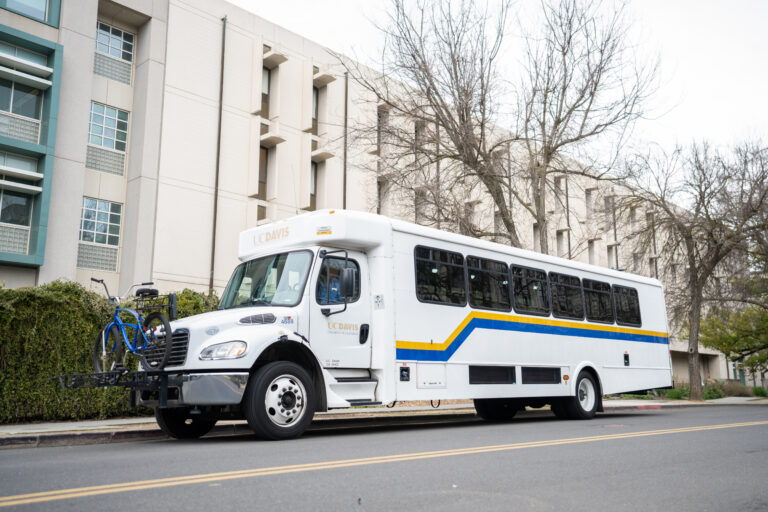
The Davis-Berkeley shuttle, a popular option for those looking to travel between the UC Davis and UC Berkeley campuses, ended operation on Sept. 2 due to declining ridership. The decision leaves students at both campuses now looking for other options to travel between the two universities.

An announcement by UC Davis Fleet Services explained that the service was regularly operating below capacity and running at a financial deficit. The cost of maintenance and fuel for the buses, combined with a post-pandemic decline in use, were listed as main causes of these conditions.

By the time it ended service, the shuttle ran daily between the two campuses for a $15 one-way fare. 

In an email to The California Aggie, Director of UC Davis Fleet Services Michelle Simmer said that an average of 850 tickets were sold monthly, with the line operating at just 52% capacity overall. She also notes that the fare of a one-way ticket on the shuttle was comparable to the cost of an Amtrak ticket to the Bay Area.

The service’s end has proved an inconvenience for Berkeley and Davis students alike, who previously used the service to visit family and friends.

Daphne Boyd, a fourth-year cognitive science major, shared that she and her friends used the shuttle service often. 

“I used the shuttle [in] spring quarter [2025] with a few friends to visit some people at UC Berkeley for a night,” Boyd wrote in a text message. “I only knew to use it because our friend and her boyfriend used to take it every weekend to visit each other. He graduated in the spring but we’re all still disappointed, it was always a fun option to have.”

Remaining alternative public transit options include Greyhound buses and Amtrak mixed train and bus services. However, as of time of publication, there is no public transit option to travel directly between the two campuses.

Jacob Klein, a fourth-year political science major, also expressed his disappointment about the discontinuation of the shuttle line.

“It’s definitely unfortunate because, without sufficient mass transit options, people are more encouraged to drive,” Klein wrote in an Instagram direct message. “But I’m grateful that we still have Amtrak which does offer student discounts.”

Aside from transporting students, the shuttle was used by university departments for mail delivery and book transfers, as well as event tours.

Rayna Prasad, a fourth-year community and regional development major, pointed out the loss of potential career opportunities for students because of the route’s end.

“One of my housemates used it to go back home [and] another friend considered using it to get to her internship,” Prasad said. “I had no idea [of the end of shuttle service]. It’s very unfortunate.”


Written by: Robin Franklin — campus@theaggie.org

OSSJA, university entity responsible for overseeing student misconduct, splits into two departments

The division of the Office of Student Support and Judicial Affairs separates plagiarism investigations from support services

By VINCE BASADA — campus@theaggie.org

The UC Davis Office of Student Support and Judicial Affairs (OSSJA), responsible for administering and writing student conduct policies and reviewing cases of academic and student misconduct, has divided into two new entities to allow better focus on separate aspects of student life.

The newly formed Student Conduct and Integrity will retain the disciplinary functions of OSSJA, including overseeing policies and procedures relating to student misconduct and alleged artificial intelligence (AI) use and plagiarism. Meanwhile, the Office of Student Support will take on OSSJA’s case management services and work connecting students to resources.

The university said the change was made “to reduce stigma in seeking assistance, clarify roles, ease student access to resources and simplify the referral process,” according to an announcement on the dissolvement of OSSJA.

The two departments have since launched new websites, separate office phones and have more clearly delineated the roles of staffers.

Stacy Vander Velde, the former head of OSSJA who now serves as the director of both Student Conduct and Integrity and the Office of Student Support, says the change was also made to move away from the negative connotations of the old title.

“Judicial Affairs is a very outdated, antiquated name, and it doesn’t really reflect what we do,” Vander Velde said. “It’s nice moving forward.”

Discussions began in winter 2025, with student focus groups indicating a desire to have support services be more independent, according to Vander Velde. Some expressed concerns that support advising and disciplinary oversight was being administered by the same office.

“I’ve been doing this work for a long time, but it’s exciting to see some change and evolution based on what the community wants,” Vander Velde said.

As of time of publication, both new departments will remain in the space formerly occupied by OSSJA on the third floor of Dutton Hall, though this may change in the future. Vander Velde also shared that the two organizations will likely go through further structural changes, including the possibility of getting two independent directors in the next year. 

ASUCD Student Advocate Inbar Schwartz, a fourth-year international relations and economics double major, leads a team of students who help guide their peers through the disciplinary hearing process. Schwartz says she has not yet been able to meet with the leaders of OSSJA’s successors, but thinks the development will serve in students’ benefit.

“I hope this split opens up an opportunity for the former OSSJA to expand its’ student support services and provides more clarity for students,” Schwartz said in an Instagram direct message.

Schwartz also reiterated the continued importance of the Student Advocate Office continuing to provide their own independent and private conduct case advising throughout this transition.

The university is required to provide their own advisors for students accused of misconduct, and those services will now be coordinated within the Office of Student Support. However, they can also provide guidance for students requesting welfare checks or filing referrals.

“When I first got here, it was mostly faculty and staff referring students who might be distressed about something or need some assistance,” Vander Velde said. “Over the past year and a half or so, we’re seeing more students take initiative to refer to themselves.” 

More changes to the student conduct process are coming; The results of a UC-wide conduct review enacted in April by then-UC President Michael Drake are expected to result in a new conduct policy outright. Those new adjudication frameworks and sanction guidelines will be released soon, according to Vander Velde.


Written by: Vince Basadacampus@theaggie.org


Sunset Fest 2025: What you need to know

The fall concert returns to campus on Oct. 4

By AALIYAH ESPAÑOL-RIVAS and VINCE BASADA — campus@theaggie.org

Sunset Fest, the annual free “welcome back” concert, is set to return this Saturday, Oct. 4 to the UC Davis Health Stadium. Hosted by the ASUCD Entertainment Council (EC), a student-run unit that plans concerts and events throughout the year, the 2025 show is set to feature headliner Blxst and supporting artist Lyn Lapid.

“Sunset Fest is EC’s way of kicking off Fall Quarter with a free concert that welcomes both new and returning students to campus,” EC Unit Director Eddie Kim, a fourth-year human biology major, told The California Aggie in an emailed statement. “Think of it as a quintessential college experience and an opportunity to connect with friends while enjoying live performances from your favorite artists.”

The artists

Blxst, whose real name is Matthew Dean Burdette, is a hip-hop artist from Los Angeles who began releasing music in 2018. After his 2020 extended play (EP) “No Love Lost” garnered popularity, he soon after entered mainstream media with a deluxe version of the album and an accompanying sold out tour. Blxst currently has over 6.2 million monthly listeners on Spotify, with his hit song “Overrated” at nearly 98 million listens as of time of publication. 

Andrea Ngo, a second-year human biology major, is a fan of Blxst and is excited for the concert after not being able to buy tickets to one of his shows last November. 

“One of my friends sent me the headliner post and I was literally jaw dropped, checked my schedule and was like ‘oh my god, I’m 100% going to this,’” Ngo said. “I wanted to see Blxst in Sacramento last year, but I wasn’t able to get tickets for financial reasons. It’s kind of expensive to go see concerts right now. Being a college student and having this event for free, where I get to see my favorite artist, is so exciting! I genuinely can’t wait.”

Lyn Lapid, a Filipina-American singer from Maryland, started her music career at 17, blowing up on TikTok with her indie-pop original songs, including 2020’s “Producer Man.” She released her first EP, titled “The Outsider,” in 2022. It included the song “In My Mind,” which has 207 million listens on Spotify. She recently released her first album “Buzzkill” in April of this year, with over 20 million listens on the same music platform.

Sarah King, a fourth-year psychology major, is a longtime listener of Lapid and is excited to see her in performance.

“I found her on TikTok after her biggest song, ‘In My Mind,’ so I’ve been listening to her for four years now,” King said. “I like her chill, R&B, slow kind of music. I’m excited to be at a free concert and just sway on the football field to her very nice, calm music.”

Additionally, the concert will feature two student openers: Thai T. and DJ Ami. The former, whose real name is Trevor Thai, is a fourth-year global disease biology major from Sacramento who makes West Coast R&B music. Amadeus Alcala, who performs under the stage name DJ Ami, is a third-year environmental engineering major who specializes in electronic dance music (EDM).

What attendees should know

Entry is restricted to currently enrolled UC Davis undergraduates, and attendees will be required to show their physical Aggie Card, have completed the pre-registration on Aggie Life and have received a ticket to the event. Neither photos of Aggie Cards nor OASIS student account pages will be accepted as valid forms of identification. Doors open at the stadium’s Gate 1 at 6 p.m.; Re-entry will not be allowed.

Water will be provided, though organizers recommend attendees bring empty, non-glass reusable water bottles. Vendors will include food and dessert trucks — which will accept Aggie Cash — though food and non-water drinks are not allowed on the field, where the main stage will be set-up.

Prohibited items include: outside food and drink, bottles, cans, glass, alcohol, poles, sticks, signs, flags, drugs and drug paraphernalia, unmarked and mixed substances, smoking and vaping products, weapons of all kind — including pepper spray and sharp objects — bicycles, skateboards, scooters and other related transportation devices and animals (except service animals). Additionally, bags must be clear and no larger than 8 by 6 inches.

Attendees are recommended to make plans to get home in advance. Unitrans will be operating extended weekend services on the day of the concert, with the G, K, M, O, P and Q lines operating every 60 minutes from 6 to 10:10 p.m. Additionally, a special line, the V-MU, will run between the Memorial Union Bus Terminal, the UC Davis Health Stadium and West Village every 20 minutes from 4:50 to 10:10 p.m. 

A full schedule of the added trips across all bus lines is now available on the Unitrans website.

Full information on Sunset Fest, including frequently asked questions, can be found on the Entertainment Council’s official website and on their Instagram page, @asucdec. Registration is open now on the Aggie Life website.

Written by: Aaliyah Español-Rivas and Vince Basada campus@theaggie.org

Click here to read our coverage of Sunset Fest 2024.

UC Davis excels at Kim Duyst Twilight Cross Country Invitational

Victory captured by the men’s team, while the women’s team grabs a competitive fourth place


By THEO KAYSER — sports@theaggie.org


On Sept. 13, the UC Davis men’s and women’s cross country teams traveled to River Oaks Golf Course for the Kim Duyst Twilight Cross Country Invitational.

Two weeks earlier, the men’s team took second place and the womens team took fifth place at the University of San Francisco Invitational to kick off their seasons. In this second meet, both teams improved upon their placement, as the women took fourth place and the men claimed victory over their interstate rival UC Berkeley. 

The Aggies’ men’s team was led by third-year Donavan Cheruiyot, who placed third overall with a time of 23:31.2, a career best. Joining Cheruiyot in setting a personal record was fourth-year Muhammed Ahmed, who finished shortly behind in fourth place with a time of 23:33.5. 

Scoring depth proved crucial for the Aggies’ victory, as the squad’s third and fourth place runners also finished in the top ten. Fourth-year Ethan Brooks placed seventh with a time of 23:38.4, just ahead of Chris Coles, a fourth-year biochemistry major, whose time of 23:47.3 netted him an eighth-place finish. The Aggies’ final scorer was Frank Ramisch, a fifth-year cognitive science major, who placed 36th with a time of 24:58.5.

The race’s final team scores placed all three schools on the podium within a few points of one another, with the Aggies’ hardly edging out UC Berkeley and Chico State University. The Aggies’ top five runners combined for 54 points compared with UC Berkeley’s 61 and Chico State’s 64. 

In addition to their formal placement victory, the group also recorded the fastest total time, running 1:59:28. 

On the women’s side, the team’s strong performance was led by Fiona McGrath, a second-year biochemistry and molecular biology major, who finished in fourth place with a time of 21:03.4. Behind McGrath was Stormy Wallace, a third-year biomedical engineering major, who came in 12th place, running 21:26.8. 

The remaining scorers were Shae Hill, a fourth-year biochemistry and molecular biology major in 20th place, Kayla Ruiz, a fourth-year managerial economics major in 30th place and Cassidy Kajita, a second-year environmental science and management major, in 36th place. 

Those five combined for a team score of 97, which placed them within range of the podium. The race was won by Stanislaus State University, which just edged out Sacramento State University by a score of 75-76. Again, depth proved paramount for the group’s success, as all five scorers finished in the top third of the race. 

After a successful start to the season, the Aggies will hope to continue their momentum heading through a month-long break before their next meet. This meet will be held at the University of Oregon on Oct. 10: a tough test for the group against one of the nation’s top schools. The Aggies will have two other meets, also in the month of October, as they enter the main stretch of their season. 


Written by: Theo Kayser — sports@theaggie.org

Men’s soccer is yet to gain its first win in this season’s matchups

Despite creating many chances to score, the Aggies struggle to hit the mark


By COLINA HARVEY— sports@theaggie.org


UC Davis men’s soccer entered the 2025 season as reigning conference champions. Last season, they defeated UC Santa Barbara in the Big West final to claim the trophy and qualify for the National Collegiate Athletic Association (NCAA) tournament — the team is hoping to replicate its past success this season.

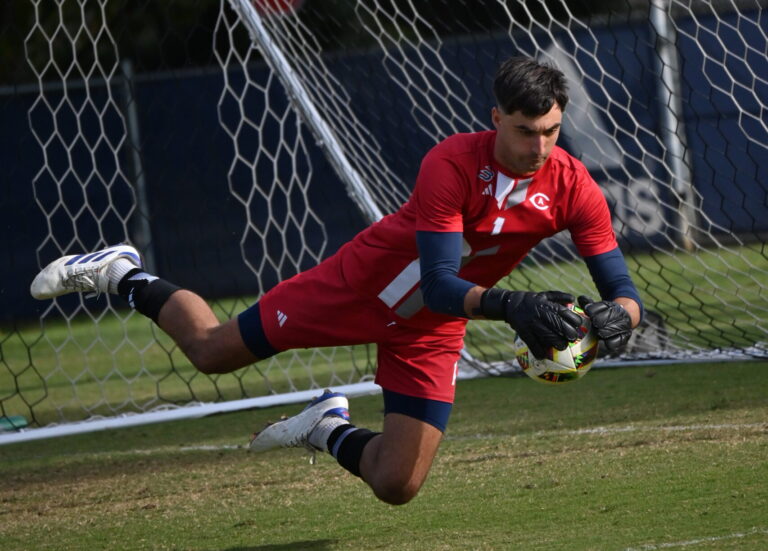
However, the Aggies have played seven games this season thus far, and are still chasing their first win. 

Their season opened on Aug. 21 against the University of San Francisco (USF) Dons. USF outshot the Aggies, leading to the lone goal being scored by the Dons early in the second half. 

In their next game, Davis nearly secured a win against Santa Clara University (SCU). A perfectly placed shot in the first half by Cason Goodman, a fourth-year communication major,  put the Aggies ahead for the majority of the game. However, an 89th-minute goal by Santa Clara turned what would’ve been an Aggie win into a draw.

On Aug. 24, their game against the University of Washington Huskies yielded a similar result. The Aggies took the lead early in the second half with a goal from second-year Zachary Neuls. The Huskies responded with a goal in the 76th minute, once again leaving the Aggies winless. 

In the Aggies’ Aug. 31 game against Stanford University, they were well-matched with their highly-ranked opponent. The game remained scoreless until the 76th minute, when Stanford found an opening and scored, beating the Aggies 1-0. 

Neuls explained that, while their results so far this season are not as positive as they may have hoped, the outcomes do not always match their quality of play. 

“We’re doing the right things, but we’re just not getting the end result […] We’re just missing that final step,” Neuls said.

The team’s home opener against Saint Mary’s College on Sept. 3 was another example of the mismatch between results and level of play. UC Davis outshot Saint Mary’s 24-7 and had 14 shots on goal, compared to only three by their opponent. However, they only netted one goal, which was scored by fourth-year international relations major Zack Lillington in the 66th minute. 

Despite the fact that the Aggies had many more chances to score against Saint Mary’s, the game ended in another draw. 

“Our defense is the same, if not stronger [than] last year,” Neuls said. “But the thing that we need to work on is probably scoring goals, cause I feel like that’s what’s holding us back from winning games and replicating our success from last year.”

Their recent 4-0 loss against Seattle University (SU) at home told the same story. Seattle scored in the fourth minute, putting the Aggies behind early. Although Davis went on to outshoot the SU Redhawks significantly, they could not convert any of their shots and ended the game scoreless. 

On Sept. 18, the Aggies played the University of the Pacific at home. They took the lead early on with a goal from fourth-year Chase Tanon in the seventh minute. Despite the strong start, Pacific was able to equalize by the 22nd minute and scored the game-winner in the 59th minute. 

The team is looking to improve their game luck, starting with weaknesses from the past season.

“I think last season, we had some early success, but […] towards the beginning of [the] conference, we struggled a lot like midseason. I think this year we want to be more consistent, but that also starts with winning,” Neuls said. 

The Aggies are aiming to repeat last year’s achievements and become Big West champions once again, hopefully going as far into the NCAA tournament as possible. Although they’re not seeing the early success that they saw last year, there’s still time to turn the season around.

“Our big goal is to obviously qualify for the NCAA tournament. That either means ranking high, which might be tough now that we haven’t gotten the results that we want, or winning the Big West — which is definitely our goal to win the Big West again,” Neuls said. “If we can replicate the success from last year, we want to go even above and beyond, like getting further into the NCAA, and you know, trying to win a national title is ultimately […] the final goal.”

On Oct. 1, the team will travel to San Luis Obispo to take on California Polytechnic State University in their first Big West matchup. 


Written by: (Colina Harvey) — sports@theaggie.org

Culture Corner

 The Arts Desk’s weekly picks for television, movies, music and more


By IQRA AHMAD — arts@theaggie.org  

Song: “Man I Need” by Olivia Dean (2025)


Some songs politely ask for your attention — “Man I Need” demands it in the smoothest way possible. Built on a laid-back groove with a hint of bossa-nova, the track feels like warm summer air drifting through an open window; It’s intimate and irresistible. This song is about wanting someone to show up, speak up and not be afraid of asking someone to be the person you need them to be. Lines like “I kinda like it when you call me wonderful” balance sweetness with a playful confidence, while the repeated refrain of “Talk to me” becomes both plea and command. It teeters between flirtation and urgency. This song pulls you in with its catchy vocals, and is great for anyone with a sweet spot for pop and classic melodies.  


Books: The “Mara Dyer” trilogy by Michelle Hodkin (2011)


A series as eerie as it is addictive, Michelle Hodkin’s “Mara Dyer” trilogy has it all: psychological suspense, supernatural twists and a swoon-worthy romance in its midst. It all begins when Mara wakes up in a hospital bed, unable to remember the tragic accident that killed her friends and left her the sole survivor. After being diagnosed with post-traumatic stress disorder (PTSD), she moves with her family to a new town in hopes of starting fresh; However, trauma continues to follow her. Strange visions blur the line between reality and hallucination, leaving both Mara and the readers questioning what’s real. Hodkin’s writing thrives in that tension, slowly unspooling the mystery piece by piece. 


What makes the trilogy stand out are its characters. Mara is both flawed and defiant, which is what makes her so compelling. Enter Noah Shaw: dark, witty, compassionate and hands-down one of the most beloved young adult love interests out there. Rounding out the cast is Jamie, the sarcastic, steadfast best friend every heroine deserves, whose humor and loyalty shine through the darker moments. With creepy scenes and unsettling side characters, this series is perfect for readers who want all the chills without any of the nightmares. Whether you’re drawn in by the psychological mystery or the unforgettable romance, the “Mara Dyer” trilogy delivers a wild, engrossing ride.


Movie: “Drive Me Crazy” dir. John Schultz (1999)


Remember when all a teen romantic comedy needed was a scheme, a makeover and a Britney Spears song to seal the deal? “Drive Me Crazy” is that late 90’s teen rom-com that is charmingly predictable. Based on Todd Strasser’s novel “How I Created My Perfect Prom Date,” the film pairs Nicole Maris (played by Melissa Joan Hart), an A+ student and dance committee chair, with Chase Hammond (played by Adrian Grenier), the too-cool prankster next door. Once childhood besties — now sworn opposites — they hatch a fake-dating plot to make their exes jealous. Cue the inevitable: messy feelings, stolen kisses and the shocking realization that, “gasp,” opposites attract. The plot is straight out of the rom-com starter pack, where a preppy girl meets a rebel boy, jealous exes stir the pot and someone learns that true love looks better without an “easy out clause.” 


TV Show: “My Lady Jane” dir. Jamie Babbit and Stefan Schwartz (2024)


“Was that a withering look? Consider me withered.” If you love witty banter, historical fantasy with bouts of romance and a little bit of magic, “My Lady Jane” is the perfect, binge-worthy show for you. This one-season wonder reimagines the story of Lady Jane Grey, who finds herself married off to the dashing Lord Guildford Dudley after her father’s death leaves the family in need of security. But Guildford isn’t just a pretty face with a quick wit; He’s hiding a secret. He’s an Ethian, a human who can turn into an animal — in his case, a horse. Meanwhile, Jane herself is secretly named heir to her cousin King Edward VI’s throne, who soon vanishes under mysterious circumstances. Suddenly, she’s thrust into queenhood. But what happens when you have to navigate treacherous politics, dangerous plots and a marriage complicated by an unbreakable enchantment? A clever, must-watch twist on history that asks what might have happened if fate — and a little magic — intervened: “My Lady Jane” has all the answers. 


Written by: Iqra Ahmad — arts@theaggie.org 

Beth Bourne undressed to bikini at Davis school board meeting

The Yolo County Chapter Chair of Moms for Liberty removed clothing to protest locker room policies at Davis middle schools


By JORDAN POLTORAK — city@theaggie.org


At the Sept. 18 Davis Joint Unified School District (DJUSD) school board meeting, Yolo County Chapter Chair of Moms for Liberty Beth Bourne removed her clothing and undressed to a bikini. She did so in order to express her thoughts about the policies around locker rooms at Davis middle schools.

The policy she was protesting at the latest school board meeting is regarding “CA’s insane self-ID gender identity policies,” according to Bourne’s post on X.

“Right now we require our students to undress for [physical education] class,” Bourne said. “I’m just going to give you an idea of what that looks like when I undress.”

Bourne then proceeded to remove her top and pants, revealing a bikini underneath.

“Right now, this school district says [that] depending on a child’s transgender identity, they can pick which bathroom they want,” Bourne said. 

At which point Elizabeth Moon, a trustee, told Bourne this was not allowed.

The board decided to take a recess upon which Bourne claimed they had violated her First Amendment rights by not allowing her to finish her public comment. 

After the initial recess, Bourne returned with her clothes back on. 

“May I ask what I did to disrupt the meeting?” Bourne said. 

School Board Vice President Hiram Jackson did not answer and continued the meeting.

“You can start your public comment,” Jackson said.

Once again, Bourne removed her shirt and revealed her bathing suit top, to which the board called another recess and got up from their seats. After this recess, the board returned, and Bourne was no longer standing at the podium.

Bourne currently serves as the chapter chair for Moms for Liberty in Yolo County. This organization is “dedicated to the survival of America by unifying, educating and empowering parents to defend their parental rights at all levels of government,” according to their website

This is not the first time that Bourne has expressed her views about LGBTQ+ policies within DJUSD. In October 2023, a temporary restraining order was filed against her by the district for targeting teachers that displayed Pride flags in their classrooms, according to the article.

DJUSD has yet to respond when asked for comment on the events at the latest school board meeting. 


Written By: Jordan Poltorak — city@theaggie.org