58.6 F
Davis

Davis, California

Monday, December 22, 2025
Home Blog Page 231

Super Bowl LVI preview

A recap of the championship round and a preview of the biggest matchups to look for in this year’s Super Bowl

By GABRIEL CARABALLO — sports@theaggie.org

After an epic few weeks of NFL playoffs, it’s finally time for the Super Bowl. This year’s playoffs showed just how competitive these teams were. It was a divisional round unlike any other, in which all games ending regulation on a field goal attempt gave high hopes to football fans for the upcoming conference championships. They delivered with two spectacular playoff games. 

Starting off Conference Championship Sunday were the Kansas City Chiefs and Cincinnati Bengals in the AFC Championship Game. It seemed as though the Chiefs had control of the game, leading 21-13. Until late in the third quarter, the Bengals defense stepped up and forced a crucial interception. The Bengals’ pass rush was too much for the Chiefs’ star quarterback Patrick Mahomes. 

Mahomes threw the interception to defensive tackle B.J. Hill — Mahomes’ first pick in an AFC Championship Game. Unfortunately, it was a turnover that eventually led the Bengals to the end zone. After a successful two-point conversion, the Bengals tied up the contest at 21-21. By the end of regulation, it was tied 24-24, where only overtime would settle this match. The Chiefs won the coin toss and the Bengals felt a wave of despair. 

“Yeah, I mean, usually when you lose a coin flip to those guys, you’re going home,” Joe Burrow, the Bengals quarterback, said in a postgame interview. 

However when confronting an animal, never put it in a corner. The Bengals were able to lock up the Chiefs’ offense and secure another interception almost immediately after overtime began. Cincinnati won the game 27-24 with a field goal and secured their place in the Super Bowl — their first appearance since 1989. 

Following this emotionally swaying event was the NFC Championship Game between the Los Angeles Rams and San Francisco 49ers. A close game throughout the entire contest, the 49ers led late into the second half but were only able to score once more against the Rams’ tough defense, making the score 17-7.

The Rams added veteran quarterback Matthew Stafford from the Detroit Lions almost immediately after their season ended last year. The Rams needed him to pull off a comeback to make their second trip to the Super Bowl in four years. He did just that, by moving the chains and passing for a touchdown, making the score 17-14. The 49ers were unable to score for the remainder of the game, courtesy of the Rams’ defense forcing punts. Stafford got the Rams to get in field goal position twice and were able to capitalize on the moment, making both attempts as the Rams now led 20-17

In a last-ditch effort to win the game, 49ers quarterback Jimmy Garoppolo took a snap and was immediately swarmed by blue uniforms. Rams star defensive end Aaron Donald almost came up with a sack but Garoppolo was able to get rid of it. However, he threw it to the wrong side as the ball was thrown to Rams linebacker Trayvon Howard, sealing the game for the Rams and sending them to the promised land. 

“Long time coming, you know? Spent a lot of years in this league and I’ve loved every minute of it,” Stafford said after the game. Solemn words for someone who’s spent the last 12 seasons playing for the Detroit Lions. An experience he’s been chasing since he was first drafted into the league now became a reality. 

With both conference championship games done and both won by one possession, they are set and anchored with some of the best players in the sport. For starters, each team’s starting quarterback is a former first overall pick. The Bengals with second-year quarterback Joe Burrow, who threw for 4,611 yards and 34 touchdowns during the regular season. Burrow seems to be immune to the sophomore slump and has played well throughout the playoffs, gallantly leading his team from the wild card round to the Super Bowl. 

Their opposition, the Rams, have a different story with Matthew Stafford. A veteran in the league and one-time pro bowler, he threw for 4,886 yards and 41 touchdowns this past year. Stafford has remained consistent throughout his career and is finally in a winning position. These two quarterbacks should showcase an offensive battle like a cage match between wild animals, especially with their weapons on the offensive side. 

Each team has a star wide receiver running routes for them: the Bengals with rookie sensation Ja’Marr Chase and the Rams with the league’s best receiver Cooper Kupp. Chase grabbed 13 touchdown passes and racked up 1,455 yards. These are great stats especially for a rookie. Kupp on the other hand snagged 16 touchdowns and received for 1,947 yards — almost breaking the single season record. These two receiving giants are the main weapons for their respective quarterbacks. 

Although offense is quite prevalent in today’s game, defense is what wins championships. The Rams’ defense is stacked with the likes of defensive end Aaron Donald, cornerback Jalen Ramsey and veteran safety Eric Weddle, who came back to the NFL after being retired for two years and provided a spark at safety — all of which make their presence known on the field. 

The Rams’ pass rush is one of the best in the league and the Bengals’ offensive line has struggled to keep Burrow protected, even giving up nine sacks in their playoff game against the Titans. The Rams’ defense brought down opposing quarterbacks 50 times during the regular season. With pressure like that and a shaky offensive line, the Rams’ strength will surely be a key factor in the overall outcome. 

Then even if the Bengals can control the pass rush, there’s still the passing defense. With stars like Jalen Ramsey and Eric Weddle patrolling the lines, it can be tough to find open receivers, so the Bengals’ second and third best receivers might be key here. 

It seems like the Bengals have the worst of it, but the Rams aren’t out of the woods yet. The Bengals may not have household names on their defense, but they’re made up of some key players. Veteran safeties Jessie Bates III and Vonn Bell have been great this year, with good cornerbacks Eli Apple and Tre Flowers also defending the passing zones. Then with a pass rush of B.J. Hill and Trey Hendrickson, who have been playing great this postseason to add consistent pressure on Stafford, the Bengals have a defense that has rocked the playoffs by forcing the most turnovers

As it stands now, the Vegas Insider’s Super Bowl odds have the Rams favored at roughly -200 and the Bengals at +165. It seems Vegas is counting the Bengals out after probably making a lot off them post-conference championship. The Rams will have home field advantage since the Super Bowl is being hosted at SoFi Stadium. Either way, football is an unpredictable sport in which anything can happen. Especially when the biggest game is a cage match between two beastly clubs, this one is setting up to be a great matchup.

Written by: Gabriel Caraballo — sports@theaggie.org 
Shagufta Fatema on the struggles, triumphs of immigrating to the U.S.

0

The UC Davis lecturer discusses the effects of Trump-era politics and COVID-19 on her work and life in California

By ADAM KIRCHOFF — features@theaggie.org

Taking out the trash — an unappealing, albeit necessary job for virtually all of us. We’re forced to complete the chore without much attention, other than perhaps the thought of the garbage stench that often floods our olfactory system while doing so. But for UC Davis professor Shagufta Fatema, this menial task represents major strides in her independence.

Professor Fatema, a UC Davis lecturer in Middle East & South Asian Studies, traveled to the U.S. from India to pursue the aspiration of an established career and family in the Western world.

When she arrived in 2011 as a young Muslim woman, Fatema found herself having the freedom, and need, to be self-reliant, which she had previously only associated with men in her native society.

“[Women] often don’t go to the markets, we don’t drive, even if I have to go to my school, my father or brother will drop me off,” Fatema said. “So taking out the trash for the first time […] it was a hectic job for me. I remember I clicked a picture of it and sent it to my mom, saying ‘look what I’m doing.’”

While she did have a lot of new freedom, Fatema encountered obstacles in American culture — not only concerning standard societal disparities, but also ones brought on both by discriminatory Trump-era policies and the COVID-19 pandemic.

“There was a culture shock,” Fatema said. “But it made me realize that you have to be dependent on yourself.”

When she first arrived at UC Davis in 2011, where she’d accepted a position as a  teaching assistant in the Fulbright Visiting Scholar Program, Fatema remembers feeling welcomed by American life. After teaching for just two quarters at UC Davis, she said that she embraced Northern California as her second home.

In Davis, Fatema felt like she could express her cultural identity — in some ways even more so than she could back home in India. By getting involved with the Muslim Student Association and International House Davis, she bonded with a cohort of diverse individuals with similar experiences. She felt as if — for the first time — the way she practiced her faith was driven entirely by her own volition.

However, despite the comfort she felt in her new hometown, Fatema felt alienated by the U.S. federal government’s executive leadership.

In June of 2020, former President Donald Trump signed an executive order that froze access to new H-1B visas — which are temporary employment-based visas that permitted Fatema and many other foreign national professionals to reside in the U.S. while working. Trump’s administration justified the order as a necessary response to high unemployment rates during the pandemic, which reached 14.7% in April 2020, a level not seen since the Great Depression.

Although the order could be interpreted as a prioritization of American workers, it also carried xenophobic connotations, given the administration’s inflammatory history with immigration policy. Notoriously, former President Trump cemented his political legacy around anti-immigrant sentiment and 2016 campaign promises that ostracized people of Muslim faith.

“It was injustice,” Fatema said. “I learned from my [Human Resources Department] that our visas could not be processed. The universities had no choices. Even if the university wanted us, [Trump] was stopping us.”

Fatema continued teaching her Hindi/Urdu courses from across the world via Zoom. This carried its own distinct set of challenges — including a nearly 14-hour time difference between her and her students.

The block on these visas has since been lifted, since President Joe Biden opted to not renew the ban after taking office in early 2021. Although Fatema’s chances of reuniting with California seemed increasingly promising in the wake of this policy shift, her home life took a tragic turn last summer as the catastrophic COVID-19 Delta variant surged through India.

In June, Fatema lost her mother to COVID-19 complications. Without her mother, Fatema explained that though she still values and loves her family, she no longer feels the same strong connection to her first home. Without feeling as anchored to her hometown and amidst this devastating loss, Fatema decided to leave India and settle overseas more permanently. 

“He is excited for our travels tomorrow,” Fatema said over the phone of her young son Zohan, as he squealed in the background with pure excitement. In preparation for teaching in person again in spring 2022, Fatema is journeying back to the U.S. with her son — and her husband — for the first time since the outbreak of the COVID-19 pandemic.

“I wanted my son to be educated here in the States, so he is not dependent like many of us [in India],” Fatema said. “I am preparing this for my nuclear family, so I do want some distance [from home].”

Fatema is looking forward to reuniting with her students in person, which she said allows her to maximize the liveliness and energy of her courses. From holding class meetings in coffee shops to organizing picnics and basketball games for her students, fostering a dynamic learning environment is Professor Fatema’s “unique selling proposition.”

“Language cannot be learned in isolation, that is the one rule,” Fatema said. “My classes are energetic when I organize these things. When my students are involved completely, they love it.”

Written by: Adam Kirchoff — features@theaggie.org

In Mitski’s ‘Laurel Hell,’ we are burning along with her

A track-by-track analysis of Mitski’s latest album, “Laurel Hell,” an emotional exploration of our most nuanced emotions, backed by a deeply ‘80s sound

By ANGIE CUMMINGS — arts@theaggie.org

It has been over three years since the world was blessed with a new album from the highly elusive and profound indie-rock artist, Mitski. Since her last album, “Be the Cowboy” (2018), we have gone through not only life’s usual changes and milestones but also some of the hardest things we’ve ever had to face (i.e. a global pandemic, late-stage capitalism, the climate crisis, Zoom university, etc.). Mitski fans (myself included) have been surviving off of crumbs for the past few years — delicious crumbs albeit — and with the Feb. 4 release of Mitski’s sixth studio album, “Laurel Hell,” we feasted. 

“Valentine, Texas”

Kicking things right off, we enter a dark and synthy ‘80s melodrama. As the opener of the album, and in true Mitski fashion, this song eases us into the deep feelings of the whole album. Just barely going over 2 minutes and 30 seconds, she essentially gives listeners an opening poem steeped in existential dread, asking “Who will I be tonight? Who will I become tonight?” As we continue through the 11 songs of “Laurel Hell,” we are able to hear and feel Mitski’s pain, yearning and deep anguish. 

“Working for the Knife”

I personally already know this song like a close friend, as it was released as the first single off the album way back in October 2021, but it still hits just as hard with every listen. The song has a rough industrial feel to it from the first second, just as the song revolves around facing the bleak reality of adult life. Over the course of the track, you are confronted with the loss of a dream to create and achieve things as a child by the reality of working simply to make a living for the rest of your life. There is no discussion of a Mitski song without its accompanying music video, and this first visual introduction into Mitski’s album did not disappoint. While it is perhaps the most paired-down video of the album, it is still filled with symbolism, her signature form of interpretive dance and an entirely cinematic feel. 

“Stay Soft”

This song is pure poetry, plain and simple — except it’s actually full of depth and nuance, just like everything Mitski produces. This is one of her songs that is a beautiful and melodic experience from the beginning, but the darker meaning might not be revealed until a few listens later. “Stay Soft” possesses a perfect balance of tragedy and eroticism (as many Mitski songs do), painting a picture of the harmful cycle of hurt people searching for connection just to get hurt again, and subsequently hurt others. Yet again, the music video for this song cannot go unnoticed, as it is a work of art in every way, from the eerie and beautifully constructed narrative to the wholly visually appealing set design and costumes. 

“Everyone”

Admittedly, this song did not stand out alongside all the powerful ballads of the rest of the album, but that in no way means it is not good. With a simple, steady beat backing Mitski’s slow-paced lyrics, the song does sort of function as a little resting point within the album. Considering it’s the longest song on the whole album, there are astonishingly few lyrics (with no chorus or bridges), almost making you impatient for the next song to start — perhaps this was intentional?

“Heat Lightning”

When this song (and music video) was released in December 2021, so was the announcement and entire tracklist of the album, only adding fire to the bright, burning excitement that came with listening to it. Even though this song is relatively subdued as you listen to it, this does not make it any less cathartic to passionately sing along to. Some have felt the song is about relinquishing your power to insomnia, while others see it as a surrender to forgiveness directed at either a lover or oneself. Either way you hear it, there is no denying the anxious and despondent abandonment of control. 

“The Only Heartbreaker”

Here is a perfect song for power walking, passionate lip-syncing and spinning around alone in your room. Yet another amazing single from this album that came out last year, with a beautiful yet sorrowful horror-inspired music video. While seemingly slightly contradictory yet resonating with so many, Mitski embraces being at the end of a relationship. In the opening line she admits, “If you would just make one mistake, What a relief that would be,” but then goes on to accept her inevitable role of “heartbreaker” due to the unbalance of passion in the relationship — something all too easy to relate to whether it be from platonic or romantic relationships. Once we’ve made it to this point, what else can we do but fully embrace the role assigned, and the sound of this song does just that. 

“Love Me More”

Even though this song was written before the COVID-19 pandemic even started, Mitski made a song eerily akin to what so many have felt over the past two years. “Love Me More” deals with feelings of isolation and complete disconnect from the world around her, longing for someone or something to fulfill and even distract her. The music video adds new layers to the song, with eerie themes of voyeurism, showing Mitski watch a toy version of herself and anxiously attempt to match images of herself. Much like “Working for the Knife,” this song reflects her conflicting feelings about being an artist and the industry she works for, which leaves her feeling empty but she keeps going back — much like any unhealthy relationship.

“There’s Nothing Left Here for You”

This song definitely feels like a mixture of “Everyone” (in terms of tempo) and “Love Me More” (in terms of themes). Admittedly, this is also not one of the top tracks of the album, but still possesses that perfect “Mitskian” existentialist melancholy and sincerity. Whether this one is about having nothing left for herself in relation to her job, a past lover or life in general, the feeling is real and fairly gut-wrenching. 

“Should’ve Been Me”

I am simply unable to do an unbiased review of this song; it is easily one of the best songs from the whole album. From the first four seconds you should feel an overwhelming urge to get up and walk along a dark road and snap your fingers to the beat like the Jets (yes, the gang from “West Side Story”). While the song might be about witnessing yourself slipping away from someone you love, feelings of utter loneliness and mourning of what once was, it is an absolutely bumpin’ track. There’s not much else to say about this one, it really transcends any one description — go listen to it. 

“I Guess”

This song is one of Mitski’s ethereal-sounding yet extraordinary melancholic songs about identity and connection. Yet again, it has an incredibly low number of lyrics (just two verses), but she still manages to really hit where it hurts in those two minutes. In the first verse she laments on the end of a relationship, saying “Without you, I don’t yet know quite how to live,” saying what many feel yet are often too afraid to admit when they lose someone that was their everything.

“That’s Our Lamp”

Even though this song might be slightly overshadowed by ones that come before it in monumentality, this nostalgic track is the perfect way to close out the album. Yet again, the sound is light and airy, with ‘80s undertones all around, while the subject matter is oh-so bleak. Unlike other Mitski songs, this one seems to tell an almost anecdotal short story; a lover fades out of love, the fighting builds up, but they can’t seem to admit it’s the end, and Mitski clings onto a memory of their real love. 

Written by: Angie Cummings — arts@theaggie.org


Humor: Five types of drunk people you meet at your friend’s boyfriend’s frat party

POV: You’re getting hit on by an econ major in wine-stained chinos

BY ANNABEL MARSHALL — almarshall@ucdavis.edu 

School has opened up, but you probably should hold off from attending a massive gathering in the poorly-ventilated, pathogenic-mold-breeding hellscape that is a frat house. Here’s a walk-through of what it’s like to hold you over:

Enter. There’s a girl in the doorway. Eighty percent of her body weight is being held up by two friends, and the other 20% is on a pair of heels that are as structurally sound as a card tower. She “loooooovvveeesss” your hair, which is really nice until you realize she’s been complimenting everyone’s hair with the same reverent enthusiasm. 

Move through micro-atmospheres of weed smoke, Bath & Body Works perfume and vomit fumes. Pass a horde of applied chemistry majors seriously discussing how they could take a bear in a fight. They all think they could.

Make it to the drinks table, which is about eight miles away from the front door. If you drink, take a cup of what scientists would typically term “​​virulent,” “polluting” and “gross af.” 

Venture onto the dance floor with your friends. Someone in the crowd has a computer and is typing an essay over their head. Everything is sticky. Pretend not to notice the guy from your engineering class. Have some fun.

Now you will meet five different types of drunks in relatively quick succession. The order may vary, but you will not be granted escape until you have defeated them all.

One. The girl who predicts the date and method of your death with 100% confidence. Try not to let it get to your head next time you take the bus. Use a laugh/back away combo. 

Two. Guy who is clearly a grad student trying to blend in. The full beard and correct use of Latin locutions are giving you away, dude. Put down the off-brand White Claw and go write your thesis. Cheat code: mention that you were born in 2001 and he’ll find a reason to leave.

Three. The DJ. Yeah, they got an aspiring DJ, and he’s just taking a break to get a drink. He’ll offer you his vape, which is Rainbow Marshmello Key Lime Pie flavor. He’s the cousin of a friend of someone in the frat. He’s drenched in sweat. Which is crazy because all he did was put his Spotify on shuffle. He doesn’t even have Premium. Every four minutes or so the crowd has to vibe to a commercial for Popeyes. He can only be appeased with a fake Snapchat exchange.

Four. The guy who clearly has never been to a frat party in his life. Be excited for him. He’s living out some high school fantasy, and his ghastly hangover will be something akin to a religious experience that will convince him to switch his major to art history and finally be happy. 

Five. Someone who is dressed exactly like you. You two turn to look at each other at the same time and sheepishly smile. You step right to pass them, but they step left at the same time. You both try to speak at the same time, but neither of you can hear the other. It’ll be about 40 more seconds before you realize you’re talking to a mirror in the hallway.

Have your friend group decide to leave and then stay for another hour. Repeat twice. 

Oh, and you should probably say goodbye to the guy who invited you. Try an apathetic wave into the palpitating mass of arms and legs. That’ll do. Your Uber will be $40.

Written by: Annabel Marshall — almarshall@ucdavis.edu 

Disclaimer: (This article is humor and/or satire, and its content is purely fictional. The story and the names of “sources” are fictionalized.)

Column: Eating dates gives me superpowers

A column on why you should start loving dates

By NADIA ANEES — nsanees@ucdavis.edu 

Dates, a superfood that have grown in popularity amongst the food and wellness community within the last year or two, are a food I have been well-acquainted with since my youth. Every year during the holy month of Ramadan, the Medjool date and I would reunite every day at sunset during Iftar, the time at which my family and I would break our fasts. I did not understand how my parents could happily break their fast with a date and water when I’d much rather have broken mine with a giant rainbow sprinkle donut. Dates just did not taste or sound appealing to me. 

Yet, my parents would teach me about the sacredness of the date and the significance it holds in my faith. Until I was about 17, I still couldn’t get myself to find joy and fulfillment in them – I hadn’t quite felt their powers yet.

In high school, I joined the cross country team and I noticed my energy levels dropping very low during and after practices. At the time I noticed health and superfood trends surfacing on social media and on ads in my favorite grocery stores. I was being “influenced” to be healthier and choose the more “whole” options with food. 

Then one day I got the idea to transform the dates my parents would always have in our kitchen into mini energy balls. Finally, I had a method to benefit from these powerhouses of energy and nutrition. The energy balls worked out perfectly. I would bring a few energy balls with me to track meets and practices and they kept me feeling energized and ready to go throughout the day. Eventually I readied myself to try whole dates again, and I’m not sure what changed in me but I found a liking for dates! 

Medjool dates are a popular variety of dates and are tender and naturally sweet, slightly resembling caramel in texture and flavor – for this reason these dried fruits have been deemed “nature’s candy.” They are high in fiber, potassium and antioxidants, providing you with many essential nutrients while you indulge in them. For those who are trying to steer away from desserts with a high sugar content, they’re a perfect addition to your food palette. Personally, I like the freedom of being able to choose between gorgeous Tillamook Mudslide ice cream or plant-based candy (a.k.a the Medjool date). They’re certainly not for everyone, but I highly recommend giving these versatile, wholesome and energy-providing fruits a try. 

Eating dates changed my life and bestowed upon me the superpowers I needed to fulfill my role as a decently hard-working college student. Today you can find me throwing a handful of dates in a container before I rush off to class, stuffing one or two with peanut butter and dark chocolate for my nightly treat or using them to add sweetness to my baked goods. They’re my ready-to-go fuel when I’m feeling depleted from class and work, sweet-tooth satisfier and rich baking ingredient! 

Throughout the years, I’ve tried and tasted hundreds of different date brands. My favorite are the Medjool dates fresh from Coachella Valley by Nature’s Anthem. Give them a try, and let me know if you can also feel their magic. 

Written by: Nadia Anees — nsanees@ucdavis.edu

Disclaimer: The views and opinions expressed by individual columnists belong to the columnists alone and do not necessarily indicate the views and opinions held by The California Aggie. 

Column: Do alternative sleep cycles actually work?

The science behind alternative sleep cycles

BY ALEX MOTAWI — almotawi@ucdavis.edu 

Welcome to college and the real world. As growing humans with growing responsibilities, the days suddenly get a lot shorter. Getting adequate sleep used to feel inevitable, and boy, is that different now. Now sleep is at a premium, making the required eight hours for functioning at full capacity feel like a dream. Instead of just choosing to live life in a constant state of sleep deprivation (like one-third of the world), is there a way to get eight hours worth of sleep in less than eight hours? Are the stories of famous sleepers from times past myths or realities? There is only one way to find out.

First, a crash course on sleep: Sleep is divided into five cycles. The first four are called NREM (non-REM cycles), while the last is called REM (rapid eye movement) sleep. The body fluctuates between these four stages throughout the night, following what is around a 90-minute cycle. Sleep experts place non-REM stages three and four and REM sleep as the most important of the stages. (You go through one and two in the process of falling asleep.) 

Non-REM stages three and four are deep sleep and are responsible for muscle recovery and general growth. REM sleep (light sleep along with non-REM stages one and two) is accepted as when your brain commits activities to memory and refreshes itself; REM sleep is also the stage in which we experience dreams. In theory, REM sleep takes up 20 to 25% of the night, with the goal being to experience 90 to 120 minutes of REM sleep every evening. We spend little time in non-REM stages one and two while the remainder is deep sleep.

To simplify, our body wants two hours of REM sleep so the brain can handle responsibilities that come with being a brain, and then our body dedicates all the remaining possible sleep time to non-REM stages three and four in order to heal for the next day of activities. The foundation of these alternative sleep cycles is finding a way to achieve 90 to 120 minutes of REM sleep while minimizing the other stages. This is done by taking naps throughout the day in exchange for less sleep at night.

The most talked-about alternatives are called the Uberman and the Everyman. They are polyphasic cycles, meaning that they revolve around lots of napping. The Uberman requires six naps of 30 minutes each day, while the Everyman consists of a three-hour “sleep” and three 20-minute naps. In theory, these cycles train your body to jump into REM sleep almost instantly, allowing you to get adequate REM sleep through mostly napping. These are the cycles that random celebrities swear by, but they are extremely strict. Because of how little sleep they consist of, the naps have to be timed immaculately, and missing just one can ruin a whole day or two of wakefulness. These are the glorious dreams of “would-be” sleep hackers, but in reality, they don’t work for most humans. Current studies show they offer no benefit, so I would avoid these ones unless science changes its mind as we learn more over the next few years. 

The other common alternative sleep cycle is a bi-phasic cycle called the Siesta sleep cycle. It consists of sleeping for five hours and then taking a 90-minute “siesta” in the afternoon and is theoretically just as effective as sleeping for 8 hours. This cycle is the norm in many countries like Italy and Spain. If you want to try a new sleep schedule, this is the one. It works. The 90-minute nap follows natural sleep cycles, allowing the body a quality break, and the five-hour sleep cycle gives enough time for recovery. Like the others, however, the cycle does require keeping consistent hours of sleep (really all sleep should be consistent) to be effective. If you can find time for a daily nap in the early afternoon, this is a good way to save time and still stay awake. However, finding a gap in the day to nap isn’t that easy; countries like Spain and Italy culturally acknowledge their “siesta” or “riposo,” making it easier there than it is here.

One more thing to consider — naps are incredible. Whatever sleep you currently get, tossing in a nap during the day could be beneficial. Naps under 15 minutes will be easy to wake from and will keep you more alert for one to three hours. Naps over 30 minutes require a bit of a wake-up period but often keep you more alert into the evening. Studies also say the more you nap, the easier it is to benefit from them — so have at it!

Overall, these alternative sleep cycles preach quality over quantity, but in reality, we need both. There is no magic life hack to beat the need for sleep, but if you want to experiment, trying the Siesta method for a few weeks may leave you with some extra time in the day. Happy napping!

Written by: Alex Motawi — almotawi@ucdavis.edu 

Disclaimer: The views and opinions expressed by individual columnists belong to the columnists alone and do not necessarily indicate the views and opinions held by The California Aggie.

New mosaic bench built to commemorate Bob Bowen

0

The bench is positioned at G Street Plaza: the historic starting point of Davis

By RACHEL SHEY city@theaggie.org

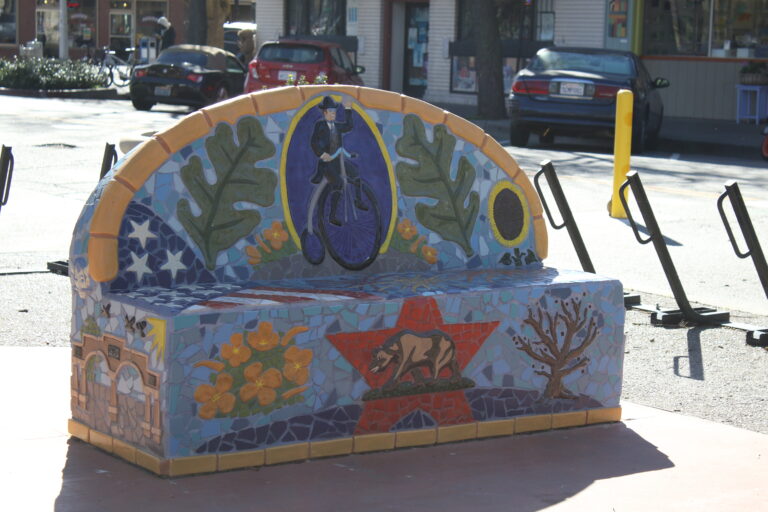
Local sculptor Wes Horn has created a new mosaic bench at G Street Plaza to honor Citizen of the Year Bob Bowen. The bench depicts Bowen riding a high wheel bicycle as well as some iconic Davis sights like red double-decker Unitrans buses and scads of bicyclists zooming by on a road. 

Horn has worked on such projects before and mentioned that he aimed to bring a story to life visually through his mosaic work.  

“I’ve done a number of pieces memorializing some members of Davis and others around the state, and that’s really rewarding when you have a person to base a piece of art off of and a life of contributions to the town in Bob’s case,” Horn said. “Generally, my goal in a project like this is to both memorialize but also tell some kind of story about that person.” 

Bowen has his fingerprints on so many parts of Davis, so it was no challenge for Horn to think of appropriate images to put on the many sides of the bench. 

“Because he had such an impact around town, it was really easy for people who knew [Bob] around town to bring me a list of images, like the city flower and the light trees that Bob headed up every holiday,” Horn said. 

The bench is “upcycled,” according to Horn, as the base was originally made out of bricks and was part of another structure that has since been removed. It is now fully covered and resurfaced. 

“The bench was originally the base foundation of what was the Davis Ace Hardware sign,” Horn said. “That was a brick foundation with signage advertising Davis Ace Hardware. We took off the top steel signage part and reutilized the brick foundation and built a frame and cast concrete to construct the backrest and raise it up to a comfortable sitting height.” 

Bowen came to Davis in high school and thoroughly enjoyed the town, contributing to it ever since. When he first arrived in Davis, it was a much smaller town, with far fewer houses and a smaller population. 

“I was going to high school in Fresno, and my dad, who was involved in retail, was transferred to become a district or regional manager for a retail chain,” Bowen said. “We moved from Fresno to Davis in 1968, and the reason we ended up in Davis, thank goodness, was that my mom was doing doctorate-level work in Spanish Literature.”

Bowen eventually attended UC Davis and was in charge of organizing Picnic Day, beginning his long career in event planning. Organizing parties for thousands of people was one of his special skills. One of Bowen’s favorite events was the Children’s Nutcracker, which he started in 1977. 

“The event that provided the most satisfaction is creating what is now called the Davis Children’s Nutcracker,” Bowen said. “I thought maybe we could do something to get involved in community theater, and we had the Veterans Memorial Theater that was underused in December, and we had recreation staff that worked in the traditional summer program. We adapted a draft of a classroom play based on the Nutcracker and put anyone who showed up in the show.”

The Nutcracker continues to this day. Some of the children who first participated in the play are now seeing their grandkids in the play, according to Bowen. 

“Now all these years later, it’s still going,” Bowen marveled. “The fact that it’s had an impact on several generations of kids, it’s probably the event that I’ve become most closely identified with over the years, and it’s probably impacted the lives of thousands of families over the years.”

City Councilman Dan Carson commented that Bowen was a great contributor to the city of Davis during his 43-year career as city event planner. 

“Bob Bowen greatly deserves this recognition,” Carson said. “He was a jack-of-all-trades for our city government, helping to coordinate important celebrations like the Fourth of July in Community Park and endlessly volunteering for tasks like researching and sharing Davis’ history in full costume for our centennial celebration. He really is our Citizen of the Year.”

Even though Bowen has retired, Carson expects to see him around quite a bit more in the future. 

​​”I would say we will miss him, but I ran into him recently helping out at a charity food distribution event and fully expect to see him around on a regular basis,” Carson said.

Bowen plans on remaining active in the community, still volunteering at the Bicycling Hall of Fame. He will also be riding a high wheel bike on Picnic Day.

Written by: Rachel Shey — city@theaggie.org

UC Davis student granted political asylum after a 20-year wait

If she had not received asylum, the student would have had to pay over $12,000 in tuition

By CAROLINE VAN ZANT — campus@theaggie.org

On Jan. 21, a UC Davis student and her family were granted asylum in the U.S., bringing an end to a 20-year struggle which put her family in immigration limbo and left her education uncertain. According to third-year political science major Shugufa, who requested that her last name be omitted due to the threat her family faces from the Taliban, if she had not been granted asylum, she would have been ineligible for financial aid and would have had to pay over $12,000 in tuition.

Shugufa arrived in the U.S. in August 2001 when she was two years old. According to her, she and her family were forced to leave Afghanistan because her parents spoke out against the Taliban’s regime.

“My parents always stood up against injustices that they would see,” Shugufa said.

Eventually, staying in Afghanistan became too risky for her family, and they had to leave the country. 

“At some point, when you’re in a backward country like that when the majority is not educated in regards to Islam and the rules of Islam, it’s kind of hard to [… ] try to get them to see things in a more humane way because they’re just set in their ways,” Shugufa said.

In the U.S., the family’s lack of an official immigration status prevented them from doing everyday things: Shugufa noted that she could not acquire a driver’s license, open a bank account or join a gym.

“It felt like I couldn’t truly be a part of society,” Shugufa said. 

Shugufa also could not receive financial aid from UC Davis without asylum. As a junior, she transferred from Sacramento City College, where her tuition was covered by a Pell Grant, and found out in November that she did not qualify for aid. 

“I didn’t know whether to focus on my studies or come up with the $12,000, almost $13,000, by Dec. 15,” Shugufa said.

Her professor helped her get in touch with administrators who set up a $7,000 emergency fund for her and extended her payment date to January after considering her circumstances.

“At that point, if we hadn’t gotten asylum, I would’ve had to drop out of winter quarter,” Shugufa said. 

With her status as an asylee, Shugufa will now be eligible for financial aid from the school. Her family will be given permanent resident cards, or green cards, in one year

 “I can’t even begin to describe how much of a relief it is; it feels like this huge weight got lifted off my chest,” Shugufa said.

According to Bradford Jones, a UC Davis professor of political science and an expert on immigration policy in the U.S., though 20 years may seem like an extraordinarily long time to wait for a decision regarding asylum, it is not unusual.

“The immigration system is so heavily backlogged, so that kind of waiting time does not come as a surprise to me,” Jones said.

There are almost 1.6 million people like Shugufa waiting for their cases to be heard by U.S. courts. Waiting times are often longer for people from Mexico and other Central and Latin American countries from which the U.S. receives many immigrants

Professor Gabriel Chin of the UC Davis School of Law focuses his research heavily on immigration law. According to Chin, although immigration law has ceased to be “explicitly political,” the immigration system at large is affected by who is in the White House. 

“It still makes a great deal of difference who administers the law,” Chin said. “The officers who apply it can be instructed to apply it leniently or stringently.”

 According to Chin, the U.S.’ ties to a particular country can influence whether a person from that country is granted asylum, regardless of whether they meet the legal standards. 

Now that she no longer has to worry about her immigration status, Shugufa can focus on the future. She plans to go to medical school after she finishes her undergraduate degree. 

“I’m really passionate about becoming a radiologist,” Shugufa said. “I also want to change healthcare policies because I feel like some of them are just so unfair and they put so many communities at a disadvantage.”

Written by: Caroline Van Zant — campus@theaggie.org

52: A Yearlong Reading Journey’: Yolo County’s 52-week reading program

0

The program is aimed at encouraging participation in reading, which has numerous benefits 

By SHRADDHA JHINGAN city@theaggie.org

Recently, the Yolo County Library launched a program called “52: A Yearlong Reading Journey.” This program encourages people to read more and offers a space for people to get book recommendations and to connect with other readers.

According to the website, “52 is different from other reading programs: It lasts all year long, offers loads of reading suggestions through prompts, and provides a space for you to share favorite books with your community.”

Steve Klein, the library assistant II for the Mary L. Stephens Davis Branch, explained how the idea for the program originated.

“The program is really a successor to our Winter Reading Program,” Klein said via email. “While we were brainstorming we got really excited about the idea of a yearlong program, like GoodReads or Bookriot. ’52: A Yearlong Reading Journey’ came about from an examination of our goals, and this program is all about reading for the love of reading.”

To participate in the program, people can pick up a reading journal at their local Yolo County Library branch. 

“You can pick one [reading journal] up at any of our Yolo County Library Branches,” Klein said via email. “We noticed an immediate interest in the journals sitting on the front desk. You can write down prompts (new prompts are revealed at the beginning of each month), log your books, rate them, and give a short description, all in one place. We’re happy to see so many book suggestions the community has shared on 52 displays.”

Alternatively, instead of picking up a reading journal at one of the preceding Yolo County Library branches, participants can also use the app Beanstack, the link for which can be found on the program’s website

The objective of the program is to “read as many books as you can in 2022” by using the weekly prompts or by reading books of the participants’ own choice. In order to get monthly prompts, participants can email yolocountylibrary@gmail.com “with the subject heading: 52.”

Klein explained that rather than meeting a “concrete goal,” the program is designed to be a personal experience for each reader. 

“We’ve created weekly prompts, which range from as simple as ‘Read a comic book’ to prompts that tie in with our existing programming,” Klein said via email. “But 52 is personal for each[…] reader. It’s your journey. You can follow our prompts, suggest your own, or just do your own thing. While the goal of the program is to read 52 books a year, you also have the option to throw that goal entirely.”

After books have been read, they can be logged in the Beanstack app or in the reading journal. On the app, readers can choose to do the prompts or not and to share if they did something different. Participants can also share their “favorite books” with others by posting the titles at any of the libraries’ displays. 

The Yolo County Library also holds other reading programs throughout the year. One of these is the summer reading program, which is held from June to August every year and is open to people of all ages. Participants can track what they read and can earn prizes. 

“Research indicates that summer reading programs help children and teens retain and enhance their reading skills over the summer, provide a haven for community readers, and develop reading enthusiasm,” the program’s description reads. 

In 2021, 2,668 people participated in the Summer Reading Program. A total of 22,008 books were read for a total of 15,517 hours.

Such programs help to encourage participation in reading for children and adults alike, which has numerous benefits. 

Klein explained that such a program mostly gets attention from parents who want to help their children read more, which he said can be obtained by modeling “the reading habits you want your children to have, as you are their first role model, and children naturally want to mock what their parents are doing.”

Melissa Hossteter, a seventh-grade language arts teacher in Springfield, IL and a graduate student at the University of Illinois Springfield, highlighted in a TED Talk the importance of reading and discussed new and more efficient ways to teach children to read effectively.

“Yes, children need to read in order to learn, but adults need to read in order to live, to participate in society, to be a citizen,” Hossteter said.

Similarly, in another TED Talk, Lisa Bu, a speaker at TED explained how, when she was unable to pursue her first career choice, books helped her access a myriad of other information.

“I turned to books,” Bu said in the TED Talk. “I satisfied my hunger for parental advice[…], I found my role model of an independent woman[…] and I learned to be efficient.”

Ultimately, such reading programs help children and adults alike become more invested in reading and explore the benefits of reading that Wu and Hossteter discussed.

In addition, Klein explained that recently the library has discussed “reading and equity.”

“Having the ability, mental capacity, and time to read a print book is a privilege,” Klein said via email. “How is reading important to a struggling parent whose priority is doing all that they can to put food on the table? That parent is looking at their child to have that ability for them to live and be accepted and have a better future.”

However, Klein clarified that storytelling is not only limited to print books but can also be experienced through talking and listening.

“There is a rich history of oral storytelling that many cultures value as a way to share knowledge, and because it is connected to tradition and brings people closer to their heritage, it could be better to change the way we think about what counts as reading,” Klein said via email.

Written by: Shraddha Jhingan — city@theaggie.org

Fourth-year, 15-year-old Tiara Abraham receives YoungArts Award

1

Abraham discusses her college experience, YoungArts honor and her next career steps

By ANNE SALTEL — features@theaggie.org

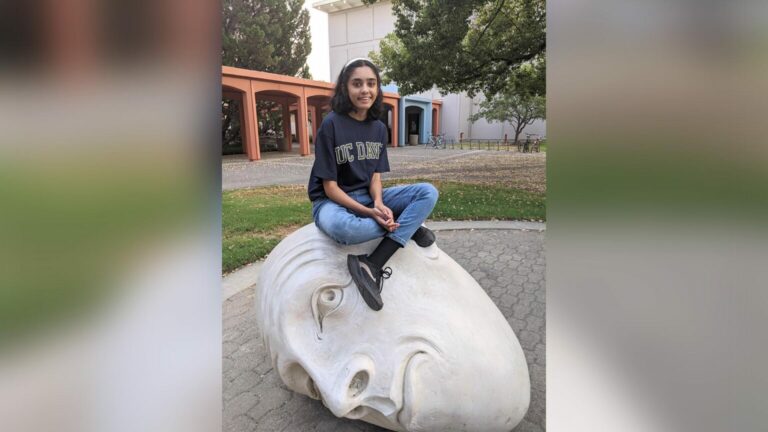
Tiara Abraham, a fourth-year vocal performance major, was named a 2022 YoungArts award winner in the category of Classical Voice. An impressive feat at any age — actors Viola Davis and Timothée Chalamet are a few past recipients — Abraham has won it, while completing her final year of college, at just 15 years old.

YoungArts is an annual contest for 15- to 18-year-old artists in many mediums, from dance to design arts. There are over 7,000 applications between the various categories, but only approximately 700 artists are awarded and accepted to the program. 

With acceptance, artists don’t just get an award, but also gain access to both creative and professional opportunities as their careers grow. These include fellowships, financial aid awards and access to a platform for artists to connect called YoungArts Post. Abraham said that these resources open up many opportunities. 

“To be able to have a platform exclusive for YoungArts award winners where we can contact and collaborate with each other from different fields, not just music, I think is definitely cool,” Abraham said. “Using the platform to collaborate with other musicians, or even non-musicians will be really nice.” 

The program, established in 1981, has an extensive list of notable alumni, like Hunter Schafer, known for playing Jules in the HBO’s hit show Euphoria, and Kerry Washington, who has most notably played Olivia Pope on the ABC series Scandal. Abraham said having such noteworthy alumni is definitely a perk of the award. 

“I haven’t really applied to something like this; it is a really unique program,” Abraham said. “It’s really exciting to be a part of this program because of some famous alumni also.” 

Abraham said that in addition to using YoungArts Post, she also makes use of the collaborative community of musicians in the music department at UC Davis. She entered UC Davis last year as a vocal performance major at 14 and plans to graduate in June 2022. During her time at Davis, Abraham said that she has been able to work closely with faculty and develop skills outside of vocal performance, like composing, music history and conducting. 

“As a musician, all lessons are really helpful,” Abraham said. “I’m a vocal performance major, but it’s nice to be a well-rounded musician […]. You never know where you might end up later down the path.”

As she prepares to audition for graduate programs, Abraham said that the close-knit music community’s support has been integral. 

“I really like that it’s a small environment,” Abraham said. “We’re very supportive of each other, and it’s an intimate environment.”

Written by: Anne Saltel — features@theaggie.org

Correction: An earlier version of this article incorrectly stated that Abraham received the YoungArts award in 2021. The article has been updated to correct the error.

Aggie House serves students facing housing insecurity

0

The organization creates a network of staff, volunteers and students working to provide housing for Davis students

By ANNE SALTEL — features@theaggie.org

Housing insecurity as a systemic problem impacts all communities — including the UC Davis community. Aggie House, a student-led shelter that provides housing for students experiencing homelessness, is working to combat this problem. 

Aggie House provides residents with resources using a four-pronged approach; they offer shelter, food, case management and community. Students at Aggie House get a place to sleep, have breakfast and dinner, receive aid in finding long-term housing and other targeted assistance — and a community within the house. Amrit Chauhan, a fourth-year psychology major and the publicity director of Aggie House, said that helping fulfill these community needs is essential and empowering.

“Right now, almost one in five UC Davis students are experiencing housing insecurity or homelessness, or they [will have] at one point in their time at UC Davis,” Chauhan said. “It’s crazy to think about how students have to go through that on top of academic stress or maybe stress from their family and a pandemic. I think this was a perfect time to remind people that […] there’s opportunities at Davis where you can get help.”

Aggie House’s staff is made up of student volunteers and a student-led board of directors. The board oversees the organization while volunteers spend time in the house keeping the space clean, cooking dinner for residents and hanging out with them. Fourth-year human biology major and Aggie House staff manager Hannah Jenevein explained that these activities are crucial to the residents’ safety and success. 

“There’s an aspect to running a safe space and making sure that all of the members in the house as well as volunteers are keeping this basic level of mutual respect,” Jenevein said. “The volunteers sort of act as the third-party mediator if there is roommate disagreement in any way.”

Because of the crucial role volunteers play in running the physical house and creating a welcoming environment, volunteers must be trained in mediation, CPR and diversity training.  Fifth-year neurobiology, physiology and behavior major Cesar Trejo said that strong personal values and humility are also essential when hiring Aggie House volunteers. 

“We really seek passionate people,” Trejo said. “[…] We need people to understand that we are no better than the residents we are serving. The thing is, any student, any individual can easily fall under housing insecurities if a medical emergency were to happen. A lot of students, while they may not be facing housing insecurities, are living paycheck to paycheck.”

Because Aggie House was founded in May 2020 during the COVID-19 pandemic, much of the development process happened remotely, and most of the back-end administrative work is still remote. Despite this physical barrier, which can make it challenging to form a community, Trejo still feels a connection and mutual passion among the volunteers and staff. 

“A lot of us share very similar goals and ambitions in terms of [fighting] housing insecurities or wanting to serve a marginalized community,” Trejo said.

Aggie House is partnered with Students 4 Students, a nonprofit that works with multiple other similar organizations on college campuses, like the Bruin Shelter at UCLA and the Trojan Shelter at the University of Southern California. Trejo hopes that Aggie House’s steps to serve students facing housing insecurity will create a community in which this issue is less widespread among students. 

“We strive to hopefully impact the systemic issue of housing insecurity in Davis and at the national level as well,” Trejo said. “That’s not something that we can really tackle by ourselves or right now because we’re just starting off, but we hope to be an evolving organization that can tackle this systemic issue with not only the people from Davis but people from anywhere around the country.”

Written by: Anne Saltel — features@theaggie.org

To combat health disparities experienced by Black individuals, increased diversity in healthcare is necessary

This Black History Month, the Editorial Board commends the many Black physicians leading more equitable healthcare 

The theme of Black History Month this year is “Black Health and Wellness,” which invites us to recognize and celebrate the many distinguished Black physicians, scholars and leaders in the healthcare and wellness industries — but also to recognize and begin to redress the many ways in which the U.S. health system still fails Black populations. 

The Centers for Disease Control and Prevention data shows that Black Americans are more likely than white Americans to face health disparities, and studies show that unconscious racial biases are linked to lower quality medical care. This can be seen especially clearly in pre and postnatal care. Black women are less likely to be recommended treatments and medical advice for prenatal symptoms, and they are more likely to develop prenatal hypertension disorders, theoretically in part due to “unmeasured comorbidities” that could be a result of poorer health care. 

Black women are almost four times more likely to die during childbirth than white women, a stark disparity that has not decreased in over a decade. According to the BBC, this can be attributed in part to healthcare providers making microaggressions against and disregarding concerns of Black patients, as well as higher percentages of Black patients feeling unsafe and being denied pain relief while receiving prenatal care. We recognize that not all people who give birth identify as women, but it is unclear whether people who do not identify as women were included in the above studies.

Racial bias is also seen in medical training and research. Graphics in medical textbooks often show predominantly lighter skin tones and underrepresent darker skin tones. A 2018 study of four major human anatomy textbooks found that only 4.5% of images showed dark skin tones, based on tone parameters coded by the researchers. When healthcare professionals are trained based on these textbooks, they might recognize certain physical symptoms only on specific skin tones, leading to racial bias when treating patients. Additionally, certain physical symptoms that signal the need for further workup or diagnosis manifest differently across skin tones. Since most of the images showed lighter skin tones, patients with darker skin tones might be put at higher risk for late diagnosis and poor outcomes, specifically in colon, breast, skin and cervical cancers. 

Lack of race-related health research and diversity in clinical trial participants might also contribute to the disproportionate rate of health disparities between Black and white populations in the U.S. UC Davis just completed a study on the differences in gut microbiomes of white and Black women and how those differences can be linked to differing rates of diabetes — the first of its kind. Such knowledge about how race can impact health is important, as it helps healthcare professionals better understand what issues might be more prevalent in their patients and adjust their care accordingly. Especially because of the existing disparity between quality of healthcare services that white and Black populations receive, more studies like this, which assess the ways race intersects with likelihood of certain medical conditions, are imperative to better treatment for Black patients. 

Both more targeted trials that might help identify differing rates of health disparities between Black and white individuals, like the UC Davis study mentioned above, and more diverse representation in all clinical trials, are crucial to improve healthcare for Black people. The combination of systemic racial bias in the medical field and a lack of diversity in training materials and clinical trial representation needs to be addressed further. 

While UC Davis researchers are making strides to improve these issues through their research and course offerings — like SPH 113 (Health Disparities in the U.S.) — a lot more work is needed. More courses should discuss equity and care disparities in the medical field, more diverse textbooks need to be created and utilized and more research needs to prioritize proportional representation. 

It is necessary to take time during Black History Month to examine where we are still falling short, but it is also vital to recognize Black excellence and the massive strides that Black communities have made in medicine. As of this January, the rate of Black first-year medical students is up 21% from 2020 levels, a record increase. Additionally, many Black physicians are leading important fields of research and study, like UC Davis Health’s Dr. David Cooke, whose research focuses on diversity and representation in cardiothoracic care, and Dr. Candace Price, whose most recent work identified the differences in Black and white womens’ gut microbiome.  

Written by: The Editorial Board

UC Davis scientists, clinicians work to optimize smart prosthetics, improve quality of life for patients with upper limb amputations

A combination of surgical Targeted Muscle Reinnervation and machine learning helps patients make more complex upper limb prosthetic movements

By BRANDON NGUYEN — science@theaggie.org 

A team of UC Davis scientists and reconstructive surgeons is collaborating to improve the quality of life for patients with upper limb amputations. Through a novel surgical procedure called Targeted Muscle Reinnervation, surgeons can rewire residual nerves surrounding a patient’s amputations to reduce nerve ending pains. 

Dr. Clifford Pereira, an associate professor in the Plastic Surgery Division at the UC Davis Medical Center, described the pains that patients with amputations typically accumulate. 

“When amputations are done, the main nerves going into the muscles in the part that has been amputated, those nerves are traditionally either dumped into bone or muscle,” Pereira said. “If you leave the nerves where they are, they try to regenerate and find a partner on the other side. And because the other end is not available to connect, they end up forming these live fibers that are right under the skin that can be very painful.”

Nerve ending pains, or neuromas, are just one of the two main pains that can develop into large lumps, according to Pereira. 

“The second thing is the same nerves give the sensation to the brain that the missing hand or foot is still present,” Pereira said. “This is called a phantom pain, so people still feel pain in the foot, although the foot is not present anymore, and they also feel like they’re still attached to the foot.”

Targeted Muscle Reinnervation is a surgical procedure that reroutes these nerve endings to a nearby muscle to reduce these two primary types of pain, which can become unbearable. As a result, patients often undergo prosthesis abandonment, leading to a reversion back to the old hook and cable system that does not require the use of a smart device.

“I recently worked on this patient that had an arm amputation, and when I went into the operating room, he had four neuromas that were almost the size of golf balls,” Pereira said. “He was on chronic pain medication for the last four or five years with very high  doses of opioids. As soon as we did the surgery [Targeted Muscle Reinnervation], he no longer needed the medication, no longer felt any discomfort, and it changed his life.” 

Dr. Andrew Li, another reconstructionist surgeon working alongside Pereira at the UC Davis Medical Center, explained how this surgical procedure is crucial not only for resolving pains from amputations but also for improving the patient’s quality of life.

“It has become increasingly apparent that restoring the muscles to their normal physiology has benefits not only for prosthetic control, but also for a patient’s day-to-day mental well-being,” Li said.

In addition to surgical reassignment of nerves, surgeons are working with mechanical engineers and neurologists to improve patient control of complex upper limb prostheses movements. 

Dr. Jonathon Schofield, an assistant professor at UC Davis’ Department of Mechanical and Aerospace Engineering, is working with Dr. Wilsaan Joiner, a UC Davis neurologist, to optimize smart prosthetic devices to better predict the movements of patients with upper limb amputations.

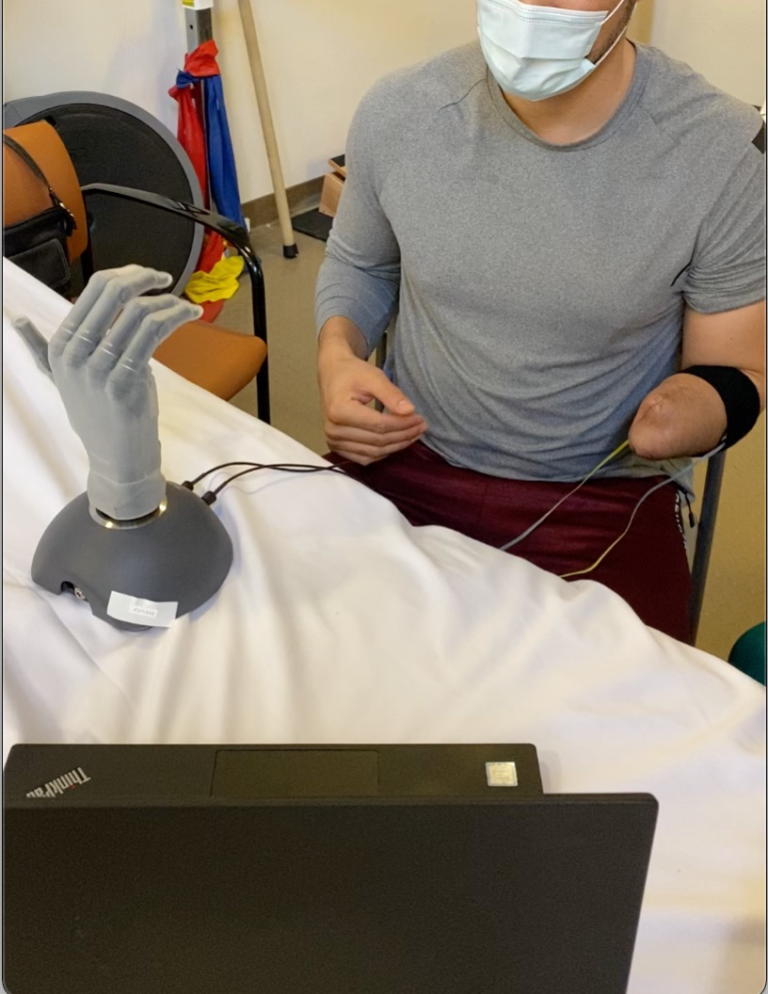
“We’re measuring movements using what we call EMG, or electromyography, and what we do is, we put a bunch of electrodes around the muscles that have been reinnervated surgically,” Schofield said. “And we can see that that measures the electrical activity of the muscles underneath the skin, and so anytime they think about doing a different hand movement, we can actually see different patterns of electrical activity.” 

Using EMG has been the standard for smart devices worn by patients with amputations, but what Schofield and Joiner have been working on is a combination of EMG, ultrasound imaging and machine learning. Old prostheses movements used to require patients to contract their muscles in a specific pattern or a certain number of times, in order for the prosthetic limb to complete the patient’s intended movement. However, with Schofield and Joiner’s smart prosthetic device, these devices adapt to the patients, rather than forcing the patients to do the learning and adapting.

“What we do is, we put a small ultrasound transducer, like an ultrasound probe, on top of the reinnervation area, and what we can see is we can actually literally see the muscles underneath the skin moving in unique patterns depending on what the patient intends to do with their prosthetic limb,” Schofield said. “Using machine learning algorithms, the smart prosthetic device can actually pick out those patterns and predict what the users are trying to do.”

Schofield described the importance of tackling clinical progress of patients from a multidisciplinary approach as he looks to the hopeful advancement of prosthetic technology.

“As we look forward into the future, I think we’re going to continue to see technology advance, being more reliable in reading user intentions with more unique ways to communicate with the remaining neural anatomy after amputation,” Schofield said. “But even if we have the most advanced system that’s able to communicate perfectly with the user, if it’s not comfortable [for the patient], it’s not practical. So I see us having to apply these interdisciplinary, multi-disciplinary approaches in the future in which we’re working with prosthetists, we’re working with clinicians and we’re working with the patients as a collaborative team.”

Written by: Brandon Nguyen — science@theaggie.org

The femme fatale: an empowering badass or an extension of the male gaze?

Students share thoughts on the historically controversial character trope through a modern lens

By SIERRA JIMENEZ — arts@theaggie.org

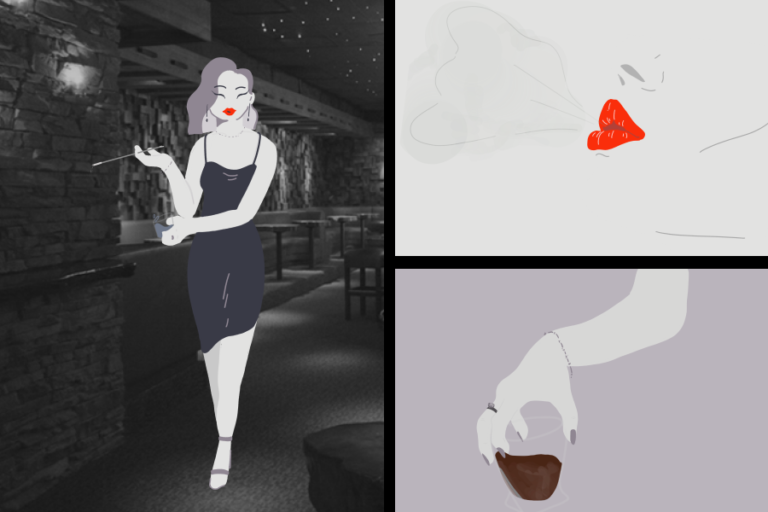
Provocative body, luscious, silky hair and radiant red lips that whisper seductive words as she struts through the sea of men hypnotized by her sexual allure — this is the stereotypical depiction of the femme fatale in film noirs from the 1920s to ‘50s, who uses her sexuality as a tool to achieve an underlying or hidden agenda. 

While men are often applauded for their sexual conquests, the femme fatale is often viewed negatively for abusing her feminine charm and sexuality. From a young age, women are dissuaded from embracing their sexuality, but the femme fatale counteracts these societal expectations of the submissive woman and encourages her primordial sexuality. 

Is the femme fatale an empowering character trope who rises from the ashes of the patriarchy, or does she “air on the side of a tragic hero?” asked Sophie Adriasola, a Davis graduate in neurobiology, physiology and behavior whose view of the femme fatale stems from 1950s classic noirs like the film “Gilda.”

“She wants sex, she wants money, she wants power. These are things men are supposed to want, but here she is. She’s going to ruin everything,” said Adriasola. “Everything that the femme fatale does is centered around the worst nightmares of a man,” she added with a smirk. 

Her ability to enchant her victim with her charm gives the femme fatale a supernatural aura. Referred to as the enchantress, witch, vampire or siren, these terms have one trait in common — sex. French for “fatal woman,” the femme fatale quite literally brings out the destruction of men in her story, oftentimes from her seductive nature. 

Early versions of this trope, such as the biblical Eve or Circe from Greek mythology, are depicted as cautionary tales to warn against the risks of unchecked female sexuality and empowerment. She is the epitome of female power and sexual liberation, yet she is villainized for it.  

As Adriasola pondered this double standard, she asked, “What is this expectation that women have to be so moral? That’s an issue too, nobody expects a man to have perfect morality,” she said. Rather, men tend to be quickly excused for their faults. 

The core of the femme fatale exposes the cultural anxieties of female empowerment. Rooted in post-World War II culture, the trope was created to counteract the male discomfort and fear of women gaining too much autonomy when called away from traditional domestic roles to work men’s jobs during the war. 

Janek Kindel, a fourth-year German exchange student majoring in studio art, communicated his thoughts on the femme fatale through his perspective as a man. “[The femme fatale is] a woman who is hard to reach and who is met with either disdain or disrespect,” he said. “The masculinity of the man is hurt by that because the man cannot conquer her.”

“The femme fatale challenges the male ego, giving her power, and therefore creates this idea that the sexual woman must be discriminated against,” he continued. “The independent woman is frowned upon because she doesn’t adhere to the man, she does not follow his orders, she has her own line and all of a sudden, the man is not in control anymore. And so, the femme fatale is a derogatory term made by men.”

Kindel goes as far to say that the femme fatale could be a “highbrow” way of calling a woman “slutty” in the antiquated postwar era. Adriasola also considers this idea: “What if she just wants sex but not money, does that make her just a slut?” By using her feminine charm, she hurts the male ego and in effect, takes away the perceived right of men to control female sexuality.

Is [the femme fatale] solely about sex appeal?” Adriasola questioned. The conundrum here is that she is villainized for her sexuality when her male counterparts are idolized. 

If the femme fatale was historically created by men for men, her mere presence creates a pseudo illusion of feminism. She may come off as a strong independent trope, but is then romanticized, then besmirched, by the male gaze. 

Correspondingly, Kindel refers to the classic French film, “Love in the Afternoon,” to reveal “how powerful the male gaze is and how much power [men] have in the world,” in which he sadly admits is “always present.” 

The notion of the femme fatale is a double-edged sword: “Is it empowering or is it just sad?” Adriasola asked. 

In the face of a dominantly patriarchal world, she also contemplated if utilizing one’s sexuality is actually the only way for women to achieve their goals: “Can women do things based on their own merit, or will they always have to go the extra mile?”

On the flip side, utilizing what society already views about the sexual woman and using it to her advantage is, in its own way, empowering. By recognizing the blatant sexism weaved into the fabric of societal norms, she can utilize that reality to take back her power. 

“Women understanding that males are inherently sexual creatures with one brain cell, and taking advantage of that in an [empowering] way” is in itself powerful, said Juan Nava, a fourth-year history major.

This angle of the femme fatale breaking the cycle of the antiquated notion of the feminine mystique is a byproduct of the evolution of the archetype throughout history.

“Archetypes should be able to evolve over time,” Adriasola said. “The femme fatale reflects different struggles of womanhood throughout the decades.” 

Recently, the “femme fatale is being reclaimed by women” in contemporary popular culture through various outlets of expression, according to Adriasola. Lana Del Rey’s song “F*cked My Way Up To The Top” is an example of this artistic expression of this renewed version of the femme fatale using her sexuality for personal gain.

By having agency, the femme fatale has evolved from “sexpionage” to a “bad-asssery character,” explained Kyle Anderson, a third-year managerial economics and accounting major whose fondness of reading sparked interest in sharing his thoughts on the literary female character trope. 

From the prior manipulation of female sexuality portraying her as an unsuitable woman to a more recent embrace of her sexuality as a strength, the femme fatale is now perceived as a “women empower women” scenario, according to Nava. 

“It’s not the switch from villainization to empowerment that I find most empowering, it’s what you do with that concept of the femme fatale,” said Adriasola, who finds the modern femme fatale influential.

There may be different perceptions of this character trope depending on your perspective. Is she simply a creation to feed into the male gaze? Or is the femme fatale set free by her sexuality, perhaps even a mockery of female expectations?

Anderson concluded that his view on the controversial archetype is empowering: “this woman is empowered. She’s not empowered because she’s a woman, she’s empowered because she’s a human, she’s a person.” 

Written by: Sierra Jimenez — arts@theaggie.org

UC Davis researchers become the first to link insulin sensitivity in Black and white women to differences in the gut microbiome

This study was the first to focus on the racial and sex differences in the gut microbiome, highlighting the possible effects of various environmental and socioeconomic factors on gut health

By MONICA MANMADKAR — science@theaggie.org

A study led by UC Davis researchers showed significant differences in insulin sensitivity between Black and white women. This study is the first to conduct research on insulin sensitivity in premenopausal women. 

According to the Centers for Disease Control and Prevention, insulin is a hormone that helps regulate blood sugar levels and allows cells to use sugars as energy. The hormone also signals the liver to store extra sugar for later use. Accordingly, insulin sensitivity describes how cells may become resistant to insulin over time, which can be a precursor to type 2 diabetes. 

The study showed that insulin sensitivity is more widespread in Black women than white women. Hence, type 2 diabetes is disproportionately more common in Black women than white women. 

The study examined a dataset detailing the difference in the gut microbiomes of Black and white women. The gut microbiome refers to the set of microorganisms that live in the intestinal tract. 

“By looking at the data set, [the researchers] were able to look into the differences between Black and white women’s profiles and how racial differences continue in insulin sensitivity,” Dr. Candice Price, an assistant adjunct professor and cardiometabolic researcher at the Department of Molecular Biosciences in the UC Davis School of Veterinary Medicine and the lead author on the study, said. 

The study was able to find differences in the microbial communities in the different sexes and racial populations. Thirty percent of white women had insulin resistance compared to almost half of the Black women in the study.  

Firmicutes and Bacteriodetes are the most present bacterial types in the gut which make up about 90% of the total bacteria in all of the samples. However, the study did not find any notable differences in the ratio of these types of bacteria between the races. The study did find that Black women have a greater abundance of Actinobacteria, which is related to elevated inflammation and reduced insulin sensitivity. 

“[Actinobacteria] being more abundant in Black women was one of the key findings of our study, and we may believe that insulin resistance may be more dominant in Black women due to this greater proportion of Actinobacteria,” Price said. 

Price also described how differences in the gut microbiome may have a possible effect on cardiovascular metabolism in Black women, hence showing the effects of the environment and social circumstances. 

Price detailed how this study was the first to look at race and sex differences in the gut microbiome, specifically focusing on insulin sensitivity. She hopes that delving into racial and sex differences can help shed light on health disparities in the development of diseases in the population. 

“There has been an enormous amount of research conducted about the gut microbiome, but the focus of the research is usually not very diverse in terms of race, sex and socioeconomic factors,” Johnathan Eisen, a professor in the Department of Evolution and Ecology and the Department of  Medical Microbiology and Immunology, and a co-author on this study, said

Eisen said how this study highlights how some groups tend to be more studied than others and how that focus ignores the possible needs of understudied populations. Possible explanations for the differences in health need to be studied through extensive conditions, including a study of the diet, historical health conditions and other controls. 

Dr. Price will be discussing this study as a part of Black History Month at UC Davis Health on Feb. 10 at 1 p.m. For information on how to join, search UC Davis Health’s Black History Month events.

Written by: Monica Manmadkar — science@theaggie.org