

By AILI KOGA— aakoga@ucdavis.edu
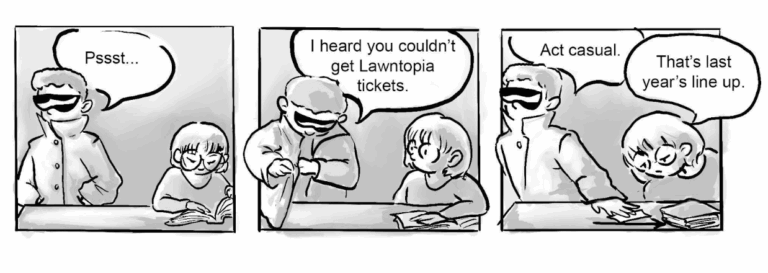
Disclaimer: (This cartoon is humor and/or satire, and its content is purely fictional. The story and names of “sources” are fictionalized.)
By AILI KOGA— aakoga@ucdavis.edu
Disclaimer: (This cartoon is humor and/or satire, and its content is purely fictional. The story and names of “sources” are fictionalized.)
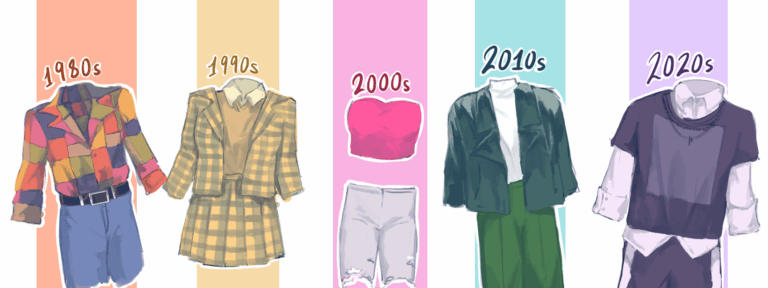
Are hemlines and holdings directly proportional?
By ABHINAYA KASAGANI— akasagani@ucdavis.edu
The resurgence in popularity of low-rise jeans and skirts with shorter hemlines may signal the onset of a recession. Much of the conversation online has reframed this trend as a nostalgia-driven revival of Y2K or a rebellion against the body-negativity of the 2010s. Beneath this discourse also lies the economic theory of the “Hemline Index,” which suggests that the lengths of women’s skirts “correlate with the economic conditions [of the time].”
This theory of the Hemline Index was first proposed by economist and Wharton Business School professor George Taylor in 1926, during a time period commonly known as the Roaring ‘20s. His theory suggested that women’s skirt lengths fluctuated in tandem with the stock market. The onset of the Great Depression resulted in skirt lengths that brushed against the floor. Flapper dresses, in all their pomp, glory and circumstance, morphed into longer, conservative pieces during the Great Depression. Although the basis of this theory was regarded as flimsy, financial data has admittedly backed this phenomenon throughout the years.
In support of the Hemline Index, hemlines grew shorter in the mid-1930s and stayed knee-length during the wartime economic boom of the 1940s. Dior’s release of full, voluminous skirts heralded the recession of 1949. The market then moved toward the minis of the 1960s, into the boom of the 1980s (until the stock market crashed in 1987).
In the wake of the 2008 global financial crisis, the market also pivoted toward longer silhouettes — maxi skirts, high-waisted pants, floor-grazing dresses — with Vogue issues littered with hemlines that reflected caution and conservatism. Retail data suggests that shoppers were spending less on fast fashion, favoring articles of clothing that were thought to be long-term investments with less risky and more palatable styles.
However, the Hemline Index is but one theory about consumer fashion trends being reflective of our ever-changing economic atmosphere. Today, shorter hemlines are regaining their popularity, despite the current uncertain economic conditions in the United States. In contrast to the Hemline Index, which claims that shorter skirts signify booming markets, the trend toward mini-skirts seems to reflect the financial instability of this age. Inflation remains obnoxiously high, and major retailers like Target and Macy’s have begun to underperform.
Fashion theorists suggest that shorter hemlines say less about prosperity and communicate more about the psychological urge to lean into maximalism as a form of resistance. Rather than having to relinquish control, wherein one attempts to shield their bodies from policing and guarantees compensation for their work, Americans seem to be embracing shorter skirts in an act of rebellion, contradictory to the predictions of the Hemline Index. Instead of turning to longer, more modest skirt lengths, the resurgence of shorter hemlines symbolizes a desire for unbridled expression.
The 2020s reading of the Hemline Index did not reflect wealth as much as it suggested the anxieties of financial precarity, which was further accelerated by the presence of social media platforms like Instagram and TikTok that rewarded attention-grabbing outfits that led to the rise of “micro” clothing. The conversation surrounding this phenomenon was framed largely around aesthetics, empowerment and Y2K or retro revivals, failing to consider the broader financial factors driving this shift.
The resurgence of low-rise jeans and shorter skirts as indicative of a potential economic recession is a phenomenon that needs to be distinguished from other forms of online discourse. It needs to take into consideration the financial data and theory that have reflected how these instances correlate with measurable shifts in fashion silhouettes — namely, the 1929 stock market crash, the 1973 oil and 1979 energy crisis, the early-1990s recession and the 2008 recession.
Recently, there seems to be a surge in online searches for the sale of micro-skirts and low-rise pants, coinciding with alarming economic forecasts that predict tightening financial conditions. Ultimately, while one should not rely on the Hemline Index as a strict economic indicator, it is an intriguing framework that can offer chances for other fashion theories to take light — namely the one touting mini-skirts as a symbol of the embodied desire for freedom and rebellion — and demonstrate the ways in which fashion and finance work concurrently to reflect the collective economic atmosphere.
Written by: Abhinaya Kasagani— akasagani@ucdavis.edu
Disclaimer: The views and opinions expressed by individual columnists belong to the
columnists alone and do not necessarily indicate the views and opinions held by The California Aggie.

We should simplify healthy eating by cutting out chemically processed foods
By VIOLET ZANZOT— vmzanzot@ucdavis.edu
One of the best ways to test your knowledge is to try to teach someone else what you know. The idea, while seemingly ordinary, is tied to a significant lesson: Simplicity is key. In order to explain a subject to a person who knows nothing about it, the best strategy is to start small and build upward. Pick only the necessary details. Elaborate just enough.
I find that this method helps you to teach yourself as well. Start simple, add where you can and then digest the easy information to prepare yourself to take on the harder material.
People seem to have lost a love for the simple things, or at least lost an appreciation for them. One of the easiest examples can be found in the ways we choose and consume food.
Please turn your attention to the back of a protein bar. Now, please read off the ingredients. If you could explain to me what at least five of the ingredients are, I would be deeply impressed. If you could explain what five of the ingredients are to a five-year-old without using the word “chemical,” I would be astonished.
The thing about teaching someone something complicated is that, even as the material gets more advanced, simplicity remains crucial to understanding. Hard concepts make the most sense if we reduce them to what they really are.
When it comes to health, we can explain to a five-year-old that our bodies need protein for certain functions. We can say that protein bars have protein in them, as is meant to be their nature. But it becomes hard to explain in simple terms how certain chemicals are synthetically created to make protein bars last longer or taste a certain way. So, why would we put food into our bodies if we could not explain where the contents of that food came from to a five-year-old?
While I can tell you that ultra-processed foods are chemically produced using synthetic ingredients and additives, I honestly could not break down what any of that means scientifically. To be fair, I suck at chemistry. But if I can understand how naturally processed foods are grown and then operate in our bodies, then perhaps the issue is not my failure to understand chemistry, but rather that manufacturers have unnecessarily over-complicated food to maximize their profit.
There is a tendency to assume things have always been the way they are now. I have this issue myself, so I can’t blame anyone else. The real truth is that foods have not always been made in a lab — there was a time when they were grown and prepared. These foods tasted good because they were simple, not super-saturated. And when we consumed simple foods, they made us feel good.
Beyond the complex, often synthetic ingredients used to make them, ultra-processed foods also contribute to the rise in obesity rates as well as mental health problems. People eat chemicals, then take pills that are made of chemicals, all to be “skinnier” and “happier.” We have created a system that is 15 steps longer, with 40 million extra chemicals to make our bodies look and feel a certain way.
If you look at the back of a bag of broccoli, there is one ingredient listed. You may be shocked to find out that that ingredient is broccoli. Same with chicken, whose one ingredient is chicken, or tofu, which is just soybeans.
Our aim as a society should be to try and simplify healthy eating. Ultra-processed foods have not always existed, and while they are not a necessary evil, they are not making us feel better. They are not making us look better. They are making us feel like we need to continue to eat them, so put them down. You do not need the potato chip made of 1% real potato! If you want to eat a potato, eat a potato. Don’t be an ultra-processed person.
Written by: Violet Zanzot— vmzanzot@ucdavis.edu
Disclaimer: The views and opinions expressed by individual columnists belong to the columnists alone and do not necessarily indicate the views and opinions held by The California Aggie.

In a time of normalized apathy, it is crucial to stay engaged with media surrounding global issues
By THE EDITORIAL BOARD
As the year continues on, headlines about Palestine seem to grow more and more devastating while empathy toward Palestinians seems to stay stagnant or even decrease. As of March 2025, the conflict has resulted in at least 48,981 Palestinians being killed, at least 112,603 combatants wounded and 90% of the population — up to 1.9 million people — being displaced from their homes at the conflict’s peak.
Pro-Palestinian student activism
University students who speak up have become subject to criticism or even university-sponsored consequences, including recent New York University graduate Logan Rozos, who used his platform as the prestigious university’s student commencement speaker to denounce the school’s contribution to the ongoing conflict in Gaza. His diploma has since been withheld. At George Washington University, graduating Cecilia Culver also spoke advocating for university divestment, after which a statement was released barring her from the university’s campus and any events held there indefinitely.
While college universities have historically been celebrated as sanctuaries for political advocacy, protesting instances of occupation and apartheid have gained increased opposition in recent years. This advocacy has historically been protected by university jurisdiction and bylaws, but attitudes toward student protesting have changed drastically in the face of the pro-Palestine movement.
For example, during the height of opposition to South African apartheid in the 1980s, the mass movement for Boycott, Divestment and Sanctions (BDS) was advocated for at over 150 universities nationwide. A similar number of encampments were erected over the last year at American universities, including one on the UC Davis campus — a practice that has since been banned at many universities.
More student groups have found new forms of protest to engage in following the banning of encampments. Many students are participating in hunger strikes at universities like UC Los Angeles, Stanford University and multiple state universities including San José State, Sacramento State, San Francisco State and California State University Long Beach.
The reaction to contemporary protests for the freedom of Palestine seem to have been met with a very different attitude in opposition to them. Students are being punished by their universities, who are meant to protect their freedom of speech and right to protest, and a widespread attitude calling these student movements radicalized or ‘woke’ seem to be at an all-time high. It is a true shame that so many of these student protesters have been equated with terrorist organizations or groups, when in reality their advocacy intends to call out the very same.
The Editorial Board commends these students for taking advantage of their platforms to advocate for humanitarian causes, especially in the face of so much systemic backlash. Student activism is more important than ever in the face of a presidential administration that is so keen on censoring student opinions — those who speak up for the rights of others at the risk of their own access to education are beyond admirable.
Ongoing escalation in Gaza
These strikes are in solidarity with Palestinians in Gaza currently experiencing borderline famine after Israel instated an 11-week blockade of all food, water and humanitarian aid from entering the region — which was only slightly amended to allow some aid to enter after Israel received harsh criticism from its supporters.
Despite the allowance of some aid trucks to re-enter the territory, aid has not yet been distributed, according to the United Nations.
“Since the beginning of the war, we said that in order to achieve victory — to defeat Hamas and to free all our hostages, two missions that are intertwined — there is one necessary condition: We must not reach a situation of famine, both from a practical and a diplomatic standpoint,” Israel’s Prime Minister Benjamin Netanyahu said.
Netanyahu’s point is clear: Their government intends to provide the bare minimum amount of aid to enter the Gaza Strip so that the situation cannot technically be called a famine, thus preventing their allies from intervening. Netanyahu has made the Israeli Defense Force (IDF)’s goals abundantly evident — there is no concern for any loss of human life, only for absolute control over the Gaza territory.
“In order to achieve victory, we must somehow solve this problem,” Netanyahu said. “Until we establish those distribution points, and until we build a sterile area under IDF control for distributing food and medicine, we need to provide a minimal, basic bridge — just enough to prevent hunger.”
Accountability
International accountability is another aspect being frequently discussed as the situation continues. The question must be asked: How long must these events continue before they are publicly labeled as a genocide? The United Nations has thus far refused to label the conflict between Israel and Hamas a genocide, despite the fact that Israeli officials are more on-the-record than ever about their intentions for the Palestinian people: to eradicate them from the territory completely. Calling it a genocide would call for mandatory intervention by many states, which would effectively elevate the situation — something that is very blatantly being avoided by international institutions.
A jarring new interview from Middle East Eye depicted an Israeli activist spreading the sentiment that regardless of one’s enemy in a war, all of those involved in the enemy group should be destroyed.
“When there is a war, it doesn’t matter who your enemy is,” Israeli activist Sofia Emuna said in the interview. “You need to destroy their offspring to prevent them from creating more offspring.”
This attitude embodies what a genocide truly is: an attempt to completely eradicate a group of people from existence. There does seem to be a special exception granted to the actions carried out by Israel that no other country has been able to get away with. United Nations experts, including Special Rapporteur on the occupied Palestinian territory Francesca Albanese, have continually advocated for Israel to be held accountable for continuing to commit such atrocities against Palestinians, citing that “it is important to call a genocide a genocide.”
As the conflict in Gaza continues on, the attitude prioritizing the removal of all Palestinians from the territory is becoming increasingly normalized in the eyes of the public. It is crucial to remember that acts of intentional displacement, or the intentional eradication of a group of people, should not be tolerated or considered “normal” on the global stage.
This is a particularly brutal stage of Israel’s ongoing siege of the Gaza strip that does not seem to be lessening; Netanyahu, who at one point claimed that a ceasefire deal would hold if all Israeli hostages were returned, outlined the end goal himself in a quote just earlier this month.
“[Retrieving the hostages is] a very important goal,” Netanyahu said. “The war has a supreme goal, and the supreme goal is victory over our enemies, and this we will achieve.”
Take his words at face value: This “supreme goal” of “victory” does not include allowing Palestinians to remain in their homeland. In the face of such complicated ongoing conflict, ask yourself whether you can continue to justify ignoring this global crisis. It’s time to recognize the hypocrisy within the words and to address the devastating reality millions of people are facing every day.
Written by: The Editorial Board

Not all monsters are metal
By NADIA IWACH — nmiwach@ucdavis.edu
The days of a taxi-cab industry with robust unions and reasonably predictable pricing are long-gone, with Uber as the undertaker. What began as a promise to revolutionize transit devolved into something much less noble — in its wake, an exploitative platform emerged, cannibalizing transportation entirely, gutting a once-stable labor system and obscuring its ethical shortcomings with sleek user experience masqueraded as innovation.
Uber markets a pipe dream of convenience, promising cheaper and faster service where mediocrity was once the norm. However, profit-hungry practices soon bastardized this initial vision, leaving its thousands of drivers to fend for themselves. As its shiny newness wore off, Uber’s antidote to antiquation remains bleak.
In the background of this slow unraveling, a new figure materialized: Waymo. In its early days, I ogled at their cylindrical tops, struggling to understand what the cars even were. Watching tech fanatics flaunt the Google Glass and litter cityscapes with Tesla Cybertrucks, I had yet to discern whether these cars were just another Silicon Valley status symbol or one step closer to flying cars.
I particularly remember the juxtaposition of Waymos moving through the city that surrounded them: the visual of a technologically retrofitted luxury car slinking through San Francisco’s increasingly dilapidated and dangerous streets felt dystopian in a way only movies could depict. Like a band-aid over a bullet hole, I became pessimistic about technology’s role in reinforcing the deepening political, economic and social crises in the city I loved. In other words, San Francisco and its citizens appeared to be casualties of the latest “killer robot.”
Still, I brushed it off and continued to frequently use Uber without much afterthought or question — whether it was an early-morning airport ride or late-night retreat, it fit into the rhythm of my daily life. However, like many users, I began to notice a nearly imperceptible erosion of the experience. Rides were more expensive and less reliable, with drivers cancelling mid-route, arriving visibly exhausted or agitated altogether. On countless late-night rides, the tension in my chest hummed as innocuous questions about my major blurred into inquiries about who I lived with, if I had a boyfriend and whether he was waiting for me at home.
More troublingly, the gig economy had unraveled drivers’ autonomy and well-being in well-documented labor and ethical violations, widening the rift between San Francisco’s tech-fueled bourgeoisie and those sacrificing for their convenience. The human cost of comfort was now baked into the system; With Uber’s promise to eliminate inefficiencies, it only stealthily redistributed it. With drivers, users and the city they inhabit suffering, I began to wonder — was Uber’s engineered indifference the killer robot we should have feared all along?
The question and its reverberation made my recent experience with Waymo all the more jarring. After struggling to secure an Uber over spring break, a friend and I decided to roll the dice and try Waymo on our trip through San Francisco.
After years of hyper-vigilance and back-pocket exit strategies, Waymo lifted that weight completely. Without a driver, I did no mental gymnastics over whether the route would end in my destination or whether anxiety had crossed the threshold of paranoia into genuine threat.
After verifying my identity, the vehicle prompted us to use seatbelts and chirped away its automated safety spiel. Settling in, we marveled at the encoded safety mechanisms — where an emergency stop was just a click away — and relished our ability to customize the rider experience from music to cabin temperature. As Future’s latest album scored our journey, we giggled and wondered aloud if this was the future the suffragettes envisioned.
For the first time, I was not a data point or a liability. I was just a passenger.
If accustomed to systems rooted in exploitation and human error, automation and the “killer robot” may offer the most pragmatic alternative in an inevitably digital future. Without absolving it of its ethical, environmental and economic implications, integrating emerging technology eliminates the detriment we’ve failed to wrangle, regulate or remove altogether.
Waymo and its contemporaries remain far from solving everything — automation should never be an inoculation to criticism. While the ride felt safer, the system behind it is far from foolproof: the vehicles have yet to master unpredictable braking, jaywalking pedestrians and misread construction zones. With their limited geographic reach, largely piloting in wealthy cities, accessibility and equity concerns linger; Who benefits from this safety, and who is left behind?
Aggregating Artificial Intelligence’s environmental footprint — with murky data practices and long-term effects yet to unfold — it’s clear that exchanging one broken system with an untempered one won’t save us. The answer to our technological dilemma may not lie in aggressive development or nostalgic devolution, but in a lateral move — one that integrates the two, using further research to prioritize safety, transparency and nuance alongside innovation.
Before we ostracize new innovation and emerging technology, it’s worth examining systems we’ve accepted: flawed and corrosive in their own right. What do we really demand from technology? What kinds of harm can we bear, and when does digitization reduce it?
So, fear not the “killer robots.” They might just save us all.
Written by: Nadia Iwach— nmiwach@ucdavis.edu
Disclaimer: The views and opinions expressed by individual columnists belong to the columnists alone and do not necessarily indicate the views and opinions held by The California Aggie.

The people aren’t ready for spray-on shoes yet
By ALLISON KELEHER — adkeleher@ucdavis.edu
There was once a little engineer who loved math so much that he committed to UC Davis with hopes and dreams of all the math he would be doing in his engineering classes. In the beginning, he excelled in all of his classes, and all of the other engineers watched in awe as he messed up the curve for every exam that they took. Most engineers dislike these prerequisites for the very reason that this little engineer loved them — math. Even worse, this little engineer loved math and chemistry theory so much that he was the perfect candidate for the chemical engineering major.
This little engineer was at the top of his game, watching all of his classmates fall behind relative to him in their classes. Everyone envied how quickly he was able to learn the theory without sacrificing his personal hygiene. He would waltz into lecture, freshly showered, and show everyone up every single day. To make matters worse, this little engineer had a social life, too. There wasn’t anything that he couldn’t do.
That is, until he made it to his more advanced engineering classes. As he progressed in the major, the classes started to become less theoretical and more hands-on. This is when he hit that metaphorical bump in the road. All of his engineering friends were excited to experiment with different creations, such as a new toothpaste. Exciting stuff.
However, the little engineer fell short. He could never come up with any ideas like his classmates could. His projects became stale and boring, and he slowly started to succumb to the idea that he wasn’t going to be a record-breaking chemical engineer. None of his friends would say it, but the little engineer could feel their judgemental stares in the lab.
So, this little engineer decided that he was going to take matters into his own hands. He pulled several all-nighters — forgoing the showering — to reach his ideological potential. Several equations were written down and scratched out, and chemicals were in all sorts of places. However, it was all worth it, because he knew that his new project would shock the world. And if not the world, then maybe his classmates.
The little engineer made a plan to break into the lab late at night (while the idea was still fresh) and complete the project by moonlight. The devious nature of this plan made him all the more excited to complete his project. When it was done, the little engineer was ecstatic to try it out, since he had never created something so cool before. What could be cooler than spray-on shoes?
He pointed that bad boy at his grimy, little unshowered toes and suddenly, shoes took form around his feet. A wave of happiness washed over him as he began to stumble around in his new shoes. This little engineer normally preferred his running shoes with sweet arch support, but he was warming up to the spray-on shoes. Unfortunately, this wasn’t a good sign, because that meant that the chemicals were seeping into his skin, and he was having a negative reaction.
At first, it felt like a manageable burning sensation — just mildly concerning. However, he held off from calling for help because he didn’t want to get into any trouble. This seemed like a good plan at the time, because the burning sensation wore off, and he started to feel fine. That is, until he started feeling the mental effects of the chemicals. Suddenly, he was really dizzy and seeing stars everywhere he looked. At first, he attributed the stars to the night sky, but after a while, it became apparent that there was a serious problem.
The little engineer spent the night roaming the UC Davis campus, looking for a way out of this predicament. However, there was no solution to be found. The little engineer found comfort in running and screaming into the darkness, since he knew that no one could hear him.
There was a loud thud as the little engineer hit the ground. Next to his head was the legendary food hole on Mrak Hall lawn. So, when he crashed, the little engineer dreamt of large chickens and all of the food he could ever imagine. At one point (he thought he was still dreaming), he saw Chancellor Gary May running full force at him from Mrak Hall.
Later, the little engineer would learn that it was, in fact, Gary May running at him — he was the one who called the paramedics. Once the little engineer was feeling okay again, he was required to formally apologize to the university and promise to never create experimental chemicals ever again.
Written by: Allison Keleher — adkeleher@ucdavis.edu
Disclaimer: (This article is humor and/or satire, and its content is purely fictional. The story and the names of “sources” are fictionalized.)
International House teams up with local artist Jesikah Maria Ross for community-building events
By KATYA OKS — city@theaggie.org
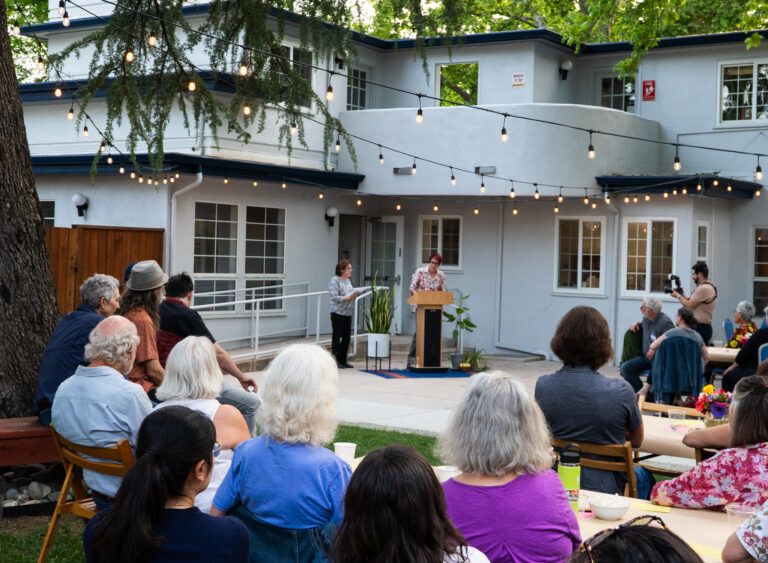
International House hosted the first of a two-part series of Hope Café: Music, Conversation and Inspiration on April 29, from 6:30 to 8:30 p.m.
The Hope Café is defined as a “community experiment in joy, connection, and resilience” at a time when many feel “overwhelmed by the news cycle,” according to a description of the event found on their Instagram.
To make this event possible, International House partnered with Jesikah Maria Ross, a local artist who has focused her efforts on creating projects which “share the stories of our communities” and illustrate communal resilience and strength throughout hard times.
“I love to create beautiful events that bring people together; that is my art,” Ross said. “My art form is these kinds of beautiful events that have what I call ‘radical hospitality,’ so from the moment you walk in, you feel that this has been designed for you and that you feel cared for, nourished and supported.”
The idea of the Hope Café came to Ross from her own observations of the community’s emotional response to the changing political climate in the United States.
“A lot of people [are in] despair because there’s so many changes that are happening right now in the world, and here, in the U.S., especially,” Ross said. “I really believe that, when people are struggling, the answer is community.”
The backyard of the International House was then transformed into the Hope Café; fairy lights overlooked tables decorated with fresh flowers, and snacks and drinks were provided at each table. As guests were welcomed into the event, Cedar Cady, a Davis musician, played the violin. Before the event officially started, attendees were invited to participate in a “What brings you hope?” mural by filling out sticky notes with their answers and populating the mural.
Ross wanted to implement art into the community building event and let it guide the progression of various activities hosted at the event.
“In any kind of difficult time, culture, art, music, dancing [and] poetry are some of the best tools [to address struggle],” Ross said. “Poetry, [for example], expands us and it invites us to be more open and inquisitive and [to] experience wonder and awe.”
Ross then introduced the first community-building activity: Acts of Kindness. Guests were asked to have table conversations surrounding the prompt of retelling an act of kindness that they experienced. The activity transitioned into a community mixer, inviting attendees to talk with two other people at the event and share takeaways from their table conversations.
Many attendees noted that a lot of the acts described were small; They felt reminded that kindness exists everywhere. In trios, they were then asked to come up with one to two words to describe their conversations.
As guests returned to their tables, they were asked to participate in the activity, Weaving Experiences, a collaborative form of poetry. Each table was given the prompt “We imagine…,” and each individual wrote a line of their shared poem, using the words they came up with in their previous trios.
Ross later reflected on the moment, observing that the activity became one of her highlights of the first Hope Café.
“My favorite [moment] was when everybody made a poem together, and they just had fun,” Ross said. “You could hear the laughter, you could hear the delight. […] The connection and community [are] contagious.”
The event then concluded with a community choir led by the Free Range Singers, a local choir group. Laura Sandage, one of the leaders of the choir group, shared some musings from other members and the impact and hope they experience from singing.
“Even when we need to express sadness or sorrow, singing is a way to release what is burdening us,” Sandage said. “Right now is a time when it’s easy to feel voiceless, like a lot of voices are being ignored. Singing is a way to put our voices out into the world. We’re not being silenced when we sing together.”
Although the April 29 Hope Café was an experimental event, Ross believes it to be successful from her observations of guest participation and conversations.
“When [guests] were in table conversations, they were leaning in and they were moving towards each other,” Ross said. “They were open; All of their body language was completely signaling connection.”
Ross also shared her hopes that future iterations of Hope Café will attract younger audiences, such as students from UC Davis, and connect with the broader Davis community.
“We’d really love to see more students and folks who could use a dose of belonging, care and community,” Ross said.
Ross also sees Hope Cafés evolving into quarterly events, which will aim to provide frequent opportunities for the community to come together and strengthen the bonds.
“These two events are like pilots to see if there’s an interest and if it works,” Ross said. “But if it does [pick up in interest], I think [Hope Cafés] will be quarterly, and I think each one will be totally different. […] That’s my vision: that we do it every quarter and all the prompts, artists, activities are different. So that if you want to come every time, it’s always [a] different [experience].”
The most recent installment of the Hope Café was held on May 20, with more details on future events on their official website and Instagram.
Written By: Katya Oks — city@theaggie.org

As spring is in full bloom, enjoy the season with a playlist to match
By NATALIE SALTER—arts@theaggie.org
Springtime brings a whole new feeling to the world each time it arrives. Nature is reborn in a whorl of green leaves and iridescent flowers as sunshine bursts through rain clouds. The season is at once a moment of refreshing novelty and an opportunity for introspection, as you find yourself changing with the weather. Next time you wander around campus with your headphones on, you might want to try matching the loveliness and emotion of the season with a playlist just as bright and sweet.
“Glue Song (ft. Clairo)” by Beabadoobee (2023)
Springtime is often associated with blossoming love, long hailed in poetry and song as a time of flirtation and fluttering hearts. Whether or not you have someone in your life to give you butterflies, this adorable track featuring vocals from Beabadoobee and Clairo is a delightful pick for your playlist. The song plays into the idea of being “stuck forever” to a lover over an undeniably cute instrumental. It’s a delightfully innocent and hopeful track worthy of spring’s flowering gardens and sunny days.
“Falling Behind” by Laufey (2022)
If you’re not so lucky in love, you might find a little more to relate to in Laufey’s beloved song “Falling Behind,” a tribute to that feeling of watching everyone else fall in love while you’re left yearning. Laufey draws upon images of June in a seaside city as a backdrop for her musical story, making it a perfect piece for the late end of spring. Likewise, the song’s melody dances and soars playfully, befitting the lighthearted feel of the season. Though the message is a little sad, the song is so catchy that you’ll at least be yearning with a skip in your step.
“Spring Into Summer” by Lizzy McAlpine (2024)
Lizzy McAlpine’s sensational “Spring Into Summer” declares where it belongs right in its title — that hazy, sunlit transitional period between springtime’s bloom and summer’s heat. Just like the setting, McAlpine herself is caught in the midst of indistinction, looking back at a long-gone past love. However, unlike other songs devoted to ex-loves, McAlpine’s piece is comfortingly cathartic. As the seasons change, she accepts that she can change and let go of the past over a soothing guitar melody. Listening to “Spring Into Summer” is both transcendent and healing.
“Ruthless” by The Marías (2018)
Los Angeles-based band The Marías have risen in popularity thanks to atmospheric hits like “No One Noticed” and “Heavy,” but their discography also offers more sunny tracks to add to your list. “Ruthless” in particular begins with a floating melody and gentle vocals, before it brings in a warm, swelling symphony of jazz instrumentation near its end. It balances serenity and joyfulness masterfully in one delightful song, belonging in the background of Arboretum walks and matcha cafe dates.
“At the End of the Day” by Wallows (2022)
With infectious hits like “Are You Bored Yet? (feat. Clairo)” and “Calling After Me,” the musical trio Wallows might seem like a better fit for the energy and excitement of summertime. But their song “At the End of the Day” steers their sound in a different direction, albeit still a very catchy one. With an incandescent synth backdrop and a gradual build into its vibrant chorus, the track feels like bright spring sunshine and has a comfortingly nostalgic feel. It’s a wonderful fit for driving with friends and making new memories that will last a lifetime.
Written by: Natalie Salter—arts@theaggie.org
Davis kicked off May is Bike Month with the annual city-wide bike ride
By OLIVIA HOKR — city@theaggie.org
May is Bike Month is a campaign throughout the country that encourages individuals to ride their bikes and promote sustainable transportation. In Davis, two of the main events held to promote active forms of transportation are Bike and Roll to School Day and Loopalooza.
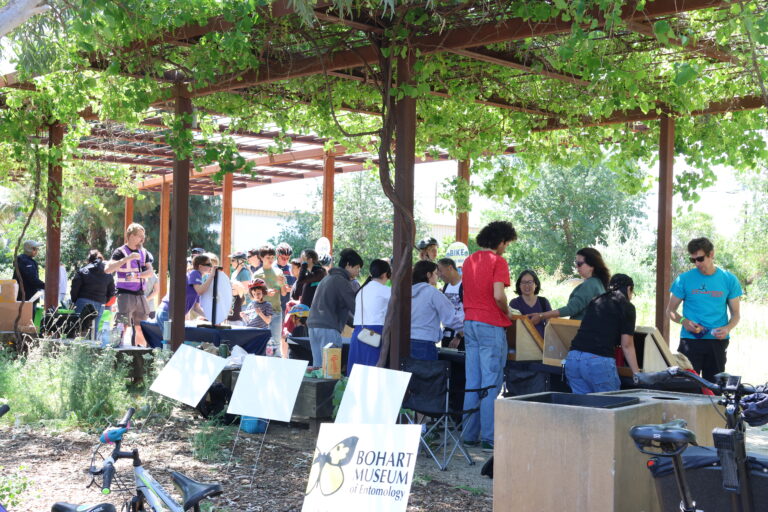
Loopalooza is an annual community-wide day of bicycling through the 12-mile bike loop in Davis. On May 4, families, students and community members were invited to start biking through the greenbelt at any spot along the route. Different organizations participated in the 10 stations along the route to educate riders with informational posters as well as hands-on learning experiences.
The event is hosted by the city of Davis in collaboration with Bike Davis and other community organizations. The President of Bike Davis, Trish Price, shared more about Bike Davis’ role in the community.
“Bike Davis is a non-profit advocacy group that works to promote bicycling in and around Davis by providing expertise in infrastructure design and policy to city staff and leadership and bringing people together to celebrate and enjoy bicycling in Davis,” Price said. “We’ve been involved with many construction and engineering projects in Davis, including designing and paving the Davis Bike Loop. Some more recent projects we’ve been involved with include the road closure on G Street and the redesign of Third Street between University and A Streets to make those streets more friendly to bicyclists and pedestrians.”
The annual bicycling event brings around 200 to 300 participants and continues to grow in popularity. Price shared further remarks about the aim of hosting the educational and engaging event.
“Loopalooza started in 2011 and was always envisioned as an annual event,” Price said. “We didn’t realize it would become such a popular event, but we’re very pleased that it has. The main goal of the Loopalooza is to bring the community together to enjoy a fun bike ride around the city’s parks. Other goals include introducing families to the possibility of riding a bike to their school rather than driving and dropping off, and to show off the beautiful Davis Bike Loop.”
Loopalooza was originally developed and hosted by Bike Davis, but the city of Davis took over the organizing role in 2017. Lindsay Terry, the safe routes to school coordinator for the city, explained why it’s important to promote bicycling, especially in Davis.
“Davis is fortunate to have a 12-mile bike loop that is truly unique and sets us apart as a bike-friendly community,” Terry said. “In addition to biking, we encourage walking, riding scooters and taking public transportation whenever possible. Loopalooza itself originated as a way to highlight safe routes to schools in Davis and has expanded over the last 15 years to include partners from throughout the Sacramento region.”
Among the 10 stations were organizations and businesses such as Davis Bike Park Alliance, Explorit Science Center, Spin Shared Micromobility, Sacramento Area Bicycle Advocates, ASUCD Bike Barn and many more. They each offered a different experience for participants riding along the loop.
“Every station will host educational, hands-on and or food opportunities,” Terry said. “For example, participants who visit Patwin Elementary School will have the opportunity to create bike-powered spin art thanks to [Daivs] Oddfellows, learn about bike helmet safety from Yolo County [Health and Human Services Agency] (HHSA) Public Health and enjoy farm-to-fork gourmet African-inspired food from ZimCuisine. We have something for everyone.”
Promoting sustainable transportation is a way to simultaneously advocate for the environment and stay active. UC Davis Health takes part in the competition for May is Bike Month and encourages students and community members to register for the competition, providing a month-long celebration for the joy of bicycling.
Written By: Olivia Hokr — city@theaggie.org

Organizers and attendees protested the detention of Mahmoud Kahil, Gary May’s involvement in Leidos and Kovet University’s involvement in the UC Davis School of Veterinary Medicine
By KHADEEJAH KHAN, JORDAN POLTORAK, JESSICA YUNG & RIVERS STOUT — campus@theaggie.org
Davis for Palestine, a loose coalition of undergraduate students, graduate students and community members, held several sit-ins across the UC Davis campus the week of April 27. Protesters gathered at the UC Davis School of Law, the School of Veterinary Medicine and at the Memorial Union Coffee House (CoHo).
Protesters demand reinstatement of UC Davis’ Law Student Association, which was suspended after passing a Boycott, Divestment and Sanctions (BDS) resolution and an end to UC Davis’ exchange program with the Hebrew University for its role in Israeli occupation in Palestine, among other grievances.
Day 1
On Tuesday, April 29, some 40 protesters participated in a sit-in at King Hall, home to the UC Davis School of Law, in solidarity with Palestine and to demand the reinstatement of the Law Student Association (LSA). Demonstrators read letters and statements sharing their experiences with repression at Davis as well as creating chalk art in front of King Hall.
“We want to talk about repression both at the law school and nationwide,” an anonymous organizer said, referring to the UC Davis’ suspension of the LSA alongside the nationwide repression of pro-Palestinian activists.
The sit-in also included a teach-in where organizers spoke on the symbolism of the school’s naming after Martin Luther King Jr., and the detainment of pro-Palestine student activists, such as Mahmoud Khalil and Rümeysa Öztürk. Organizers called on attendees to read “Letter from Birmingham Jail” by King and “Letter from a Palestinian Political Prisoner in Louisiana” by Khalil.
As of the time of the sit-in, the university has not updated their stance on the suspension of the law school since March 24, according to a UC Davis spokesperson.
Protesters put a keffiyeh, a traditional Palestinian scarf, on the statue of Martin Luther King Jr. inside King Hall to symbolize the parallels between both of the letters and movements.
“Listen up Dean [Jessica] Berg, Palestine is here to stay,” protesters said in a chant. “UC Davis, you can’t hide, our movement is going UC-wide.”
In addition to the suspension of the LSA, organizers referenced UC Davis’ interference with student petitions, targeting of Arab and Muslim students and mischaracterization of student activism in UC Davis communications as acts of repression by the university.
“When Palestine is under attack, what do we do? Stand up, fight back,” protesters said in a chant. “When people are occupied, resistance is justified.”
Organizers also protested Chancellor Gary May’s position on the board of Leidos, a defense contractor that has supplied surveillance, biometric and screening systems to airports and to Israel. Organizers highlighted shared struggles with surveillance and screening systems both in Palestine and around the world.
“From Palestine to Mexico, these border walls have got to go,” protesters said in a chant. “From Palestine to the Philippines, stop the U.S. war machine. From Kashmir to Palestine, occupation is a crime. From South Africa to Palestine, apartheid is a crime.”
Protesters marched inside King Hall and its courtyard, making their way outside King Hall’s entrance where protesters created chalk art in front of the building.
Day 2
On Wednesday, April 30, nearly 30 protesters participated in a sit-in at Valley Hall, the educational center for the UC Davis School of Veterinary Medicine (SVM), over its exchange program with the Koret School of Veterinary Medicine at the Hebrew University and alleged acts of repression.
“Koret School of Veterinary Medicine at the Hebrew University was constructed on stolen land and is used to actively cooperate with Israeli occupation forces,” an organizer said. “The exchange program normalizes collaboration with apartheid Israel and contributes to a hostile, anti-Palestinian atmosphere at the veterinary school.”
Protesters sat in groups to read and discuss articles about decolonizing medicine, including one written by UC San Francisco Professor of Medicine Rupa Marya, M.D., who had been placed on leave for her advocacy for Palestine.
“How can medical institutions, like the SVM, better teach students about oppressive systems in the field of medicine and foster an environment where we radically imagine these systems of health care?” an organizer said to attendees.
Organizers then read statements about the SVM’s repression of pro-Palestine students, stating that Palestine has become the exception to the school’s commitment to diversity, equity and inclusion. In November 2023, veterinary students held a vigil to honor Palestinians killed by Israeli Occupation Forces — faculty objected to the vigil, claiming it was antisemitic.
“In a profession that has been referred to as the whitest job in America, UC Davis claims that it stands above the rest in vet med as a space for students of different racial, ethnic groups and religious groups to flourish,” an organizer said. “Unfortunately, at UC Davis SVM, diversity, equity and inclusion begin and end with recruiting a diverse student body. When it comes to allowing Arab and Muslim students to host events, providing space for processing collective trauma, or protecting [Black, Indigenous and People of Color] (BIPOC) students from the violent harassment of tenured faculty members and community members, the SVM has fallen pathetically short.”
In an emailed statement to The California Aggie, a UC Davis spokesperson said these limitations were protected under the university’s time, place and manner policy.
Following statements by veterinary students in solidarity with Palestine, another organizer read testimonials from doctors in Gaza, which were met with many tears from attendees.
“I have to live with the decision of which children I left to bleed to death and which I try to save,” one student said from a testimonial. “These are the decisions you have to make in Gaza every day.”
A Palestinian student also shared their experiences visiting family in the West Bank under Israeli occupation. They spoke about the lack of electricity, food and water, all while not being able to travel freely due Israeli checkpoints. As of the week prior, Israeli forces demolished the village in which their family lived.
“That [village] was the home I had sleepovers with my cousins in,” the student said. “That was the home that my grandma would make me sandwiches in. That was where all of my relatives would hang out, laughing and drinking tea until three in the morning. Is this not enough for people to realize their complicity?”
Day 3
On Friday, May 2, around 50 protesters participated in a sit-in at ASUCD’s Coffee House, calling on the University of California to divest from weapons manufacturers and UC Davis’ repression of pro-Palestine activists.
Organizers also criticized acts of repression across other university campuses in California; On April 30 at UC Los Angeles, three students were arrested by the UC Police Department for attending a film screening of “The Encampments.”
Organizers again called for May to step down from his membership in Leidos.
“Despite their continuous human rights violations, our Chancellor Gary May, whose pockets are lined with our tuition money, claims he is disheartened by the situation,” an anonymous organizer said. “Yet every time he receives a paycheck from Leidos, Gazan men, women and children die. If you are so sympathetic, Gary May, step down from your position on the board of Leidos.”
In addition to protesting administrative complicity amid Israel’s genocide in Palestine, as described by both Amnesty International and the United Nations. Organizers called out the ways students can be complicit, both within student organizations and individually.
“I see student organizations who have expressed their support to us privately, but pack up their tables and run when they see people protesting or gathering for Palestine,” the same organizer said. “You should be boycotting, you should be showing up to any event that you can, and you should be advocating in any way that you can. This doesn’t just go for Palestine. Any movement requires commitment to action, like we are demonstrating today.”
Organizers then read from a website, gazamonologues.com, where Gazans have written about their experiences.
“The war against us is a genocide,” one organizer said when reading from a monologue. “It is a merciless war that kills every one of us, and it doesn’t differentiate between anyone. Our house was bombed. We moved to another house and that house was bombed, too, and then we lived in a tent. Can you imagine how one could live under the threat of death 24 hours a day?”
As monologues were being read, one organizer was physically attacked as they attempted to block a recording of the sit-in by a member of the Davis October 7th Coalition, a local Christian organization composed of both university and Davis community members.
“[UC Davis] admin were just sitting and talking,” the organizer said as this occurred.
Several members of the university administration approached organizers multiple times throughout the sit-in. During one of these encounters, Associate Vice Chancellor Cheri Atksinon said to organizers, “If you don’t identify yourself, that’ll be another violation.”
A protester responded, “Don’t you feel ashamed?”
Soon after, the administrators ceased attempts to speak to organizers.
In a statement to The Aggie, UC Davis spokesperson James Nash said university policy requires protesters to have a permit for using amplified sound and restricts protesters from concealing their identity.
“I would reiterate that UC Davis is committed to supporting free expression and open dialogue on our campus,” Nash said. “But acts of violence against anyone are unacceptable and will be met with the appropriate response.”
After a series of chants, organizers then provided attendees materials for tatreez, a traditional form of Palestinian embroidery.
“Within the last year, especially the last three months, we have seen an extreme uptick in repression of students by institutions like […] UC Davis for fighting for Palestinian liberation and divestment,” an anonymous organizer said.
Written By: Khadeejah Khan, Jordan Poltorak, Jessica Yung, & Rivers Stout — campus@theaggie.org
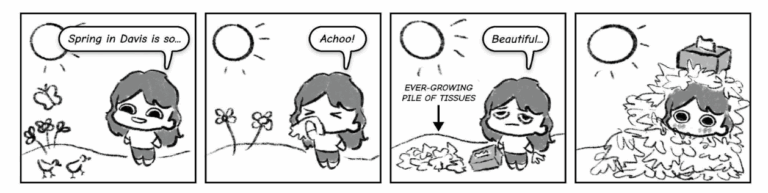
Drawn by: Katherine Ong–– keong@ucdavis.edu
Disclaimer: This cartoon is humor and/or satire, and its content is purely fictional. The story and names of “sources” are fictionalized.
The Trump administration’s withholding of billions of dollars from colleges is unconstitutional and strips them of their autonomy
By THE EDITORIAL BOARD
Harvard University is facing severe budget cuts and the withholding of funds following a publicized battle with President Donald Trump’s administration. Beginning in March, the Trump administration sent a series of letters to universities across the country expressing concerns about antisemitism on university campuses following an increased presence of pro-Palestine protests. Then, on April 3 and 11, the Trump administration issued a series of harsh demands to Harvard, outlining changes to their Diversity, Equity and Inclusion programs, hiring processes and international student programs.
Three days later, on April 14, Harvard responded with their own letter stating that they would not relinquish their constitutional rights and comply with the administration’s unlawful demands. Later that day, the Trump administration announced it was freezing $2.2 billion in research funding and $60 million in contracts with Harvard. This number has grown even more following the creation of a federal Task Force to Combat Anti-Semitism Task Force, announcing that Harvard will lose another $450 million in grants from eight federal agencies on May 13.
In an April Truth Social post, the Trump administration threatened Harvard University’s tax-exempt status.
“Perhaps Harvard should lose its Tax Exempt Status and be Taxed as a Political Entity if it keeps pushing political, ideological, and terrorist inspired/supporting “Sickness?,” the post reads.
This attack on higher education is unprecedented, as most colleges are tax-exempt organizations with non-profit status. This attack on Harvard is just the beginning of a campaign to limit all academic freedom and institutional autonomy.
These demands and withholding of funds reflect the Trump administration’s commitment to limiting university student activism. This escalating tension between the federal government and Harvard represents a broader fundamental conflict over democratic values and the American education system.
To counter these allegations and monetary withholdings, Harvard University filed a lawsuit against the federal government on April 21, arguing that freezing billions in funding violates the First Amendment right to free speech and protest. A hearing for the case has been scheduled for July.
Just last week, yet another lawsuit arose in the battle between the White House and Harvard. The administration, in addition to threatening the school’s tax-exempt status, also revoked the school’s power to admit international students, with the Department of Homeland Security informing current visa holders that “they must transfer to another university to maintain their nonimmigrant status.” As of the time of publication, Harvard has won an initial court case to keep their ability to enroll international students.
The outcome of these lawsuits and conflicts will likely set a precedent for how American universities navigate relations with the new administration and its growing authoritarian oversight of educational proceedings. This political assault is likely just the beginning, as the Trump administration has issued other warnings to educational institutions, including the University of California system.
Senior Counsel at the Department of Justice and Head of the Task Force to Combat Anti-Semitism Leo Terrell spoke out this past Tuesday, issuing yet another threat to universities across the U.S. Terrell told Fox News to “expect massive lawsuits against the UC system” and “hate crime charges filed by the federal government.”
This is undoubtedly a threat to all universities and the American education system. These unlawful and aggressive actions by the federal government — which attempt to force schools to uphold their unconstitutional demands — have crossed a previously untouched line.
Some universities have found other ways to support their community education, both abroad and within the country. Amid the legal battle, Harvard has started offering free courses for students worldwide, with classes ranging from “American Government” to “Constitutional Foundations.” This openness by one of the most prestigious schools in the U.S. is just one of the many steps by universities to safeguard their autonomy.
With these extreme funding cuts, programs are in jeopardy everywhere. If Trump succeeds in these changes, universities across the country will be altered, shaping our higher education and academic institutions for generations to come. As students here at UC Davis, we should appreciate our privileged access to high-quality education and resources. Education should be considered a fundamental right — we must defend and uplift academic institutions amidst their persecution in order to safeguard our democracy.
Written by: The Editorial Board

Translating language is not the same as translating meaning
By VIOLET ZANZOT— vmzanzot@ucdavis.edu
Language is so funny to me, because it operates in such an all-consuming way, and yet most people ignore its nuances. If you really think about it, our very conception of thought is rooted in language. So much of the way we see the world is limited by the way we can explain it. The way we can explain it is largely through the ways in which we conceptualize and rationalize it, and there you have it: language has weaseled its way into all the nooks and crannies of our funky brains.
I think it would be a reasonable assumption to say that communication is complicated, given how intricate language is. Next time you fight with your mom, brother, girlfriend or boyfriend — just blame it on the frustrations of language because language’s relationship with meaning is not universal. That is to say, our words don’t always relay what we truly mean.
Just for the sake of making things more complicated, let’s now think about language translation. First, we have to translate our thoughts and feelings into words, but then we have to make those words make sense to someone who doesn’t speak our language. It’s an awful lot of work and it tends to get messed up along the way — therefore, meaning gets lost in the translation of language.
Now I am going to take it one more step further to say that globalization causes inaccurate translations of culture. I want to push the bounds of language to say that meaning is lost or miscalculated as it moves through temporal and spatial planes.
Unfortunately, I feel like this may sound convoluted; I tend to hate when people use big words just to sound smart, so I promise that’s not what I’m doing. I want to say that language builds culture. When language gets translated, often the words may be equal, but the meanings are not always the same. As the world becomes more interconnected and we share not just words but practices and ideas, sometimes we lose meaning in the process — or better yet, meaning changes in the process.
Let’s take Cinco de Mayo for instance, one of America’s favorite drinking holidays. It’s a great day to make fast friends with salt and lime. But what does it mean to people today, and what did it mean when it became a holiday? Who is allowed to celebrate, and does it mean different things to the different people who do so?
Let’s start with what I’ve learned Cinco de Mayo is not. It is not the “Mexican Fourth of July.” It is not necessarily a day deeply ingrained in the culture of the Mexican people. I certainly cannot speak for the importance of a cultural holiday of a culture I am not a part of.
The most I can say is that in my research I have learned that the day is an “American” holiday created by Latinos in California in the mid-19th century, in order to celebrate the fight against France and the Confederacy. These battles represented a struggle for democratic and social freedom against oppression and slavery. Over time, for many people, Cinco de Mayo has instead become a day to eat tacos and drink margaritas.
Personally, I have never aspired to be the dictator of fun — I have no intention of saying people can not celebrate the day. I do think it serves as a timely demonstration of the point I am trying to make; As cultures move about the globe and across time, things can get lost in translation.
We may not know why people celebrate holidays. In fact, we may celebrate them for our very own reasons all together. This is because holidays and traditions no longer look the way they did. The people at the parties may not dance the same way. They become evolutions, adaptations or variants of what existed or may even still exist. As we live in an ever-mixing amalgamation of people, our cultures mix in suit.
Written by: Violet Zanzot— vmzanzot@ucdavis.edu
Disclaimer: The views and opinions expressed by individual columnists belong to the columnists alone and do not necessarily indicate the views and opinions held by The California Aggie.
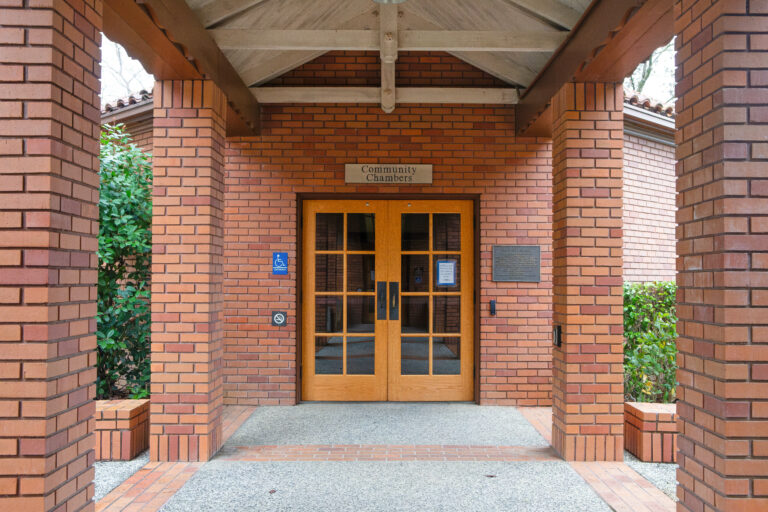
Police Chief Todd Henry and public commenters spoke about the April 12 shooting
By KATYA OKS — city@theaggie.org
The Davis City Council met on April 15 to discuss updates concerning the April 12 Community Park shooting.
Todd Henry, the chief of the Davis Police Department (DPD), briefly recounted Saturday’s events, the police response and investigation.
“About three o’clock in the afternoon, officers were near F Street and Community Park where they heard shots come out,” Henry said. “[Police officers] obviously immediately responded. There were three individuals who were injured by gunfire. They had to triage the event; There [were] several hundred people involved in the event that was inside the park. Most of these individuals had no idea that the shooting had occurred. The officers quickly were able to bring in medical aid — Davis Fire Department and paramedics arrived on scene [and] were able to treat those individuals and transport them immediately.”
Henry then transitioned into reiterating that the investigation of the shooting remains a top priority for the police department. Henry explained how the Davis police force has collaborated with regional forces to do so.
“We are really utilizing a lot of regional sources, agencies in our immediate area, Department of Justice [and the Federal Bureau of Investigation] (FBI),” Henry said. “We are absolutely capitalizing on all those relationships to ensure that we bring to bear any possible resources that’s going to help us with this investigation.”
Henry described the progression of the case, emphasizing that the nature of the incident has made it more difficult.
“This investigation is complex because [of] the dynamic of it being in the park, because there was music there, because there were so many people,” Henry said. “We have very few people who were able to provide information as to who was actually involved in the shooting.”
Henry provided a reason as to why the identity has not been released yet.
“Obviously, there are individuals that we believe are probably involved, but it is critical for this investigation — the integrity of this investigation — that we validate that information to some degree, that we feel confident in it,” Henry said. “Additionally, we do not want to put out information that somebody may be involved when, in fact, they were not. So, we are delicately trying to navigate that as we provide information to the community, and in a fashion that is timely without jeopardizing the investigation itself.”
The floor then opened for public comment concerning the shooting. One individual in particular who spoke is the mother of a child who was at the Davis Little League game on the day of the shooting, which was happening right across Community Park during the shooting.
“I dropped [my son] off at two o’clock for his game,” the mother said. “He has a broken foot, [he is] 11 years old, […] he wanted to cheer on his team. […] [I] got a phone call from his coach saying, ‘Your child is fine, there was a shooting across the street. I’m taking him to my house.’”
The mother then talked about the prevalence of unsanctioned events during the day and the importance of security during days such as Picnic Day.
“This fraternity started promoting this event on February 25, if not before,” the mother said. “They had already promoted who the performer was going to be on that Instagram post. […] Haiti Babii, he has over 726,000 listeners a month for a free concert in our town of Davis. I’m not quite sure how that should even be allowed, considering we are stretched in between Picnic Day […] and a huge party that’s going to be happening at that park.”
The mother concluded by urging the city to take preventive measures in order for such incidents not to happen again.
“There was a shooting across the street from the Davis Little League field, where tons of kids were at and are still very traumatized,” the mother said. “Ask any of the teachers at the school. It is not okay at all, so I’m hoping that the city does something to protect these kids in years to come.”
In addition, Beth Bourne, a UC Davis employee, spoke at the public comment for the discussion of the Community Park shooting. Bourne expressed her concerns over the violence in the town and believes that the leadership is responsible.
“Our mayor actually said, just a few weeks ago, […] at a big rally in Sacramento, and there were children there, and he was saying, ‘Fuck you President Trump,’ setting an example of what it means to be a good person and to respect democracy,” Bourne said. “And there was a shooting, I believe, partly because we have leadership that doesn’t recognize that people should be treated kindly.”
Bourne also reflected on an earlier incident that occurred on the UC Davis campus between students and Turning Point USA organizers.
“I was assaulted on the UC Davis campus by people holding signs that said [‘all cops are bastards,’] and ‘cops off campus,’” Bourne said. “You had a chance to make a statement, Mayor, and instead you did nothing, and you’re getting what you deserve.”
Mayor Bapu Vaitla addressed the concerns that were brought forth by community members, specifically concerns with permitting events happening on Picnic Day.
“It can’t stop [shootings and other incidents by] just figuring out permitting procedures,” Vaitla said. “It’s got to be a conversation with the university about what we do about the fact that our population effectively doubles, and even if we had many, many more officers, we couldn’t clear the unsanctioned events that are happening all over town on Picnic Day. […] We got to sit down with all of our partners who are involved in Picnic Day and figure out how to make this event something different than what it is.”
Vaitla concluded the section by reiterating the importance of moving forward from this incident.
“I know that there’s a lot of very justified fear and anger in the community,” Vaitla said. “You’re right to come with your questions and your comments, and like my colleagues said, we’re all up here pledged to serve you […] we’ve got to figure out how to serve you better, and especially the children of the city.”
Written By: Katya Oks — city@theaggie.org

Why blind boxes, bag charms and everything in between have taken the world by storm
By NATALIE SALTER—arts@theaggie.org
There’s an inexplicable pleasure in the opening of a blind boxes. You inspect the bag’s possible contents and point out which ones you desperately hope are inside, tear it open with a delightful thrill and react accordingly to whatever falls into your hand. There’s no losing, really — does it matter if the little cat figurine you acquired is wearing the green or pink dress? It is simply pure exhilaration as you land yourself another adorable trinket for your growing collection.
These sorts of trinkets, whether obtained through a surprise system or not, are not new products and have been gaining a notable surge in popularity over the past few years. Think of Calico Critters, Jellycat bag charms, Smiskis, Sonny Angels (which, perhaps more than any of their shelf-mates, have an incredible ability to sell out immediately upon restocking) — all desirable, beloved acquisitions for college students everywhere. The question is: why?
One explanation is that for an era in which self-expression often goes hand in hand with one’s outward appearance — whether through fashion or room ornamentation — these collectibles make for cute and complementary bits of decor. Many Sonny Angels are designed to stick to the back of laptops or phone cases, and Jellycat bag charms are meant to adorn your favorite bag. One might select their favorite animal, such as a bunny with fur of their favorite color, as a nifty little way of signaling a tidbit of information about themselves.
These trinkets, more often than not, also have something of an adorable flair. The chubby-cheeked cherubs of Sonny Angel gaze up at you with huge eyes and innocent smiles. The variety of tiny animals that make up the Calico Critters catalogue don aproned dresses and floral skirts.
Jellycat bag charms are just smaller versions of the beloved stuffed animals the company is so well known for, with their fluffy fur and friendly shapes. There are also Smiskis, small, glow-in-the-dark stick figures that come in a variety of quirky and whimsical poses.
This cuteness factor aligns well with the aesthetic interests of today’s generation. Trends like the catchphrase “I’m just a girl” and the popularization of adorable cartoon characters like Snoopy, Miffy and the Sanrio entourage have taken over the Internet. It’s the perfect cultural climate for a fixation on cute collectibles to arise.
The appeal of the blind boxes in particular cannot be understated either. Technically, buying a blind boxes is a bit of a gamble — you might not get the little critter you want most — but it’s a safe bet, because every available prize is adorable. You may have wanted the Smiski that was reading a book, but the one holding a flower is equally valuable. There’s no real “losing” when you rip open the package.
Most of all, however, these tiny little trophies can be carriers of bigger feelings and memories. You may have a Calico Critter family sitting on your shelf that your sibling bought for your birthday or a blind bag Smiski acquisition that reminds you of a day you spent mall shopping with your friends. A Sonny Angel peeking over a laptop screen or a Jellycat bunny dangling from a purse can be an easy conversation starter, a compliment that leads into a friendship.
In an age of fast fashion and online microtrends that cycle in and out of style within mere months, the tiny trinket has marvelously stood the test of time. Whether it will continue to endure in popularity is yet to be seen, but as of today, it’s a very sweet cultural phenomenon — and there’s something touching about a thing so tiny bringing joy to so many people.
Written by: Natalie Salter—arts@theaggie.org

©2021, ASUCD. Designed by Creative Media.