58.4 F
Davis

Davis, California

Tuesday, December 23, 2025
Home Blog Page 29

Severely misinformed student breaks into the dairy farm in search of an oat milk cow

Which came first, the oat or the milk?


By ALLISON KELEHER — adkeleher@ucdavis.edu


Early one morning, dawn broke over the UC Davis Tercero dorms. At about the same time, Jonathan heard the shrieking cry of his iPhone alarm from his bedside table. When he attempted to turn off the alarm, he missed, making him all the more angry. Once Jonathan finally turned off his alarm, he let out a loud groan of frustration at the morning light streaming in through his bedroom window. This was much to the dismay of Jonathan’s roommate, who rolled over and shoved his pillow over his head (Jonathan is not a good roommate).

Unfortunately, this was the morning routine for Jonathan, ever since he decided it was a good idea to take an 8 a.m. class in his first year. He would wake up, slam the alarm, make loud man noises and eventually get on with his day.

However, before he could leave the room, Jonathan needed his daily iced oat milk latte. Jonathan was a barista prior to beginning his education here at UC Davis, so he became accustomed to his daily coffee. His espresso machine was a high school graduation gift from his parents — it was the gift that kept on giving, as he could wake up every morning to the sweet notes of Colombian coffee beans.

This specific morning, Jonathan was in for a surprise: He was about to discover that he didn’t have any oatmilk. Unfortunately, this was because his roommate had used it all up during a late-night cereal excursion (Jonathan’s roommate wasn’t a good roommate, either).

Jonathan crushed his oat milk carton in anger, and a scowl erupted on his face. He was not going to have a good day. Jonathan refused to drink anything from Peet’s Coffee because he deemed it unworthy compared to his homemade lattes.

There were still 45 minutes until his class was set to start, so Jonathan began plotting his coffee plans. There was no time to go downtown for coffee, since Jonathan didn’t have a bike. Likewise, there was no time to purchase oat milk. Jonathan was overwhelmed with stress until he realized a perfect alternative right in his neighborhood — the dairy cows.

Jonathan refused to drink cow’s milk because it gave him unbelievable stomach problems, and yet, he still thought this was a good idea. In a frenzy, Jonathan threw on his robe and rushed out of his dorm toward the dairy cows.

When he arrived, he started screaming: “Which one is the oat cow!?”

Every employee was confused about who he was and what he was asking for. They tried to ask for more details when Jonathan barged into a cow stall and started to attempt to milk the cow.

“WHY ARE YOU KEEPING ME AWAY FROM MY OAT MILK?” Jonathan screamed in anger. This was when the authorities stepped in and restrained Jonathan. He resisted their attempts to restrain him — he seemingly was not okay in the head.

The authorities gave Jonathan some time to cool off before questioning him. However, that’s when they found out that a UC Davis student genuinely thought oat milk came from an oat cow.

“I thought it was like a GMO or something,” Jonathan reasoned. He then explained that, as a barista, you don’t need to know where the milk comes from, just where it’s going.

I think the moral of this story is that we need to check on our baristas to make sure they are okay. Clearly, they are arms-deep in their barista duties and don’t realize that alternative milks are plant-based. We must educate them, and if not for the baristas, do it for the dairy cows. Only you can prevent dairy farm break-ins.


Written by: Allison Keleher — adkeleher@ucdavis.edu

Disclaimer: (This article is humor and/or satire, and its content is purely fictional. The story and the names of “sources” are fictionalized.)
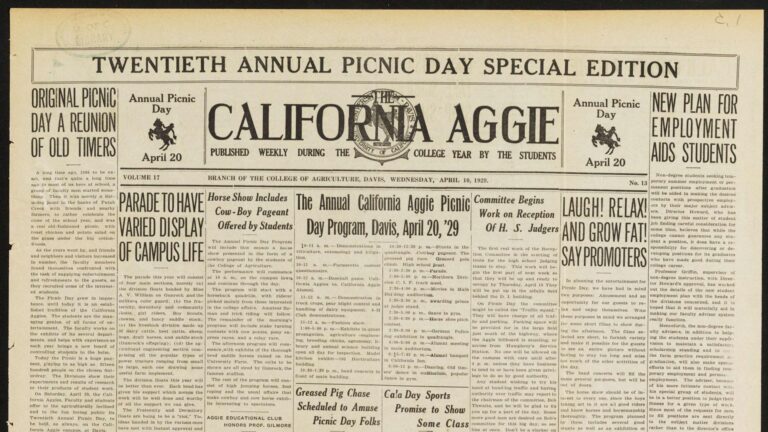

California Aggie to remain in print: 2025-26 budget approved by ASUCD

Paper to continue publishing weekly physical edition after student officials previously raised concerns over sustainability, fiscal impact


By VINCE BASADA — campus@theaggie.org


The ASUCD Senate passed The California Aggie’s 2025-26 annual budget on May 7, allowing the paper to maintain its weekly print operations after previously indicating desires to see its physical circulation greatly reduced or eliminated.

The decision, made during the Senate’s weekly meeting, means the student-run newspaper will continue printing issues weekly. In return, the paper’s leadership offered to give up $10,000 reserved from its services rendered budget line, which includes print operations and special editions, among other expenditures. The Aggie also completely cut its publicity budget — with the promise of working with Creative Media for publicity goals next year.

The approved budget also reduces advertising goals to $22,000 down from this year’s current goal of $45,000, compensating for the change in print expenditures. Pay for all existing positions will be retained through the end of next school year.

Unlike most entities that rely on student funds, The Aggie is not subject to individual line item revisions and unadulterated fiscal scrutiny by the ASUCD Senate. Instead, it is overseen by the Campus Media Board, composed of university and student representatives, and only requires a final yes-no vote from the Senate.

ASUCD units and committees across the board faced cuts going into next school year, part of larger austerity measures to address a decrease in allocation from student services to ASUCD, according to Controller Mostafa Rasheed.

Additionally, several ASUCD officials and entities expressed concerns over the sustainability of print operations and excess copies left in distribution racks, as well as the paper’s projected inability to meet advertising revenue goals. The Senate initially rejected The Aggie’s proposed budget in late March over these issues.

The newspaper’s leadership has maintained that the print edition is essential to its mission of disseminating accessible and free information.

In an internal message to staffers, Editor-in-Chief Chris Ponce asserted that the resolution allows The Aggie to retain its scale and staff while also helping address larger fiscal issues.

“We had serious concerns leading up to our initial budget hearing, especially given alarming comments made to us by ASUCD leadership prior to that first budget hearing,” Ponce said. “We met with the ASUCD executive team to negotiate the status of next year’s budget. There are minor cuts throughout The Aggie’s upcoming budget, but I am proud to say we have walked away with something we can be proud of.”

Ponce also announced that the paper will be reintroducing/creating new jobs for the 2025-26 year, including paid assistant editor and new media manager positions.

The budget of KDVS, which is also overseen by the Campus Media Board, was approved at the same meeting without issue.


The California Aggie maintains editorial and operational independence from the ASUCD student government. Advances of this article were not made available to ASUCD officials prior to publication.


Written by: Vince Basadacampus@theaggie.org

Culture Corner

Books for channeling your inner whimsy, embracing escapism and staving off the summer heat 


By ALYSSA CREVOISERAT — arts@theaggie.org


As spring turns into summer, the outside temperature climbs and the urge to abandon coursework and commitments for an early start to summer break begins. The prelude to summer, spring is a pleasant chill — foggy, misty mornings and daytime weather just warm enough to take up residence on a park bench. 

A certified lover of spring at heart, I feel qualified to recommend books where magical realism and fantasy take center stage. For those of you trying to latch onto the essence of spring before summer’s inevitable approach, here are some reading recommendations for all things atmospheric, mysterious and whimsical. 


“Spells for Forgetting” by Adrienne Young (2022) 


Adrienne Young is one of my most trustworthy sources of magical realism. Her three adult fiction novels — “Spells for Forgetting,” “The Unmaking of June Farrow” and “A Sea of Unspoken Things — are if magical realism, mystery and romance were standalone fantasy fiction babies. My pick for spring, however, is going to go to my favorite of the three. “Spells for Forgetting” takes place on the sentient Saoirse Island, where the leaves on trees change color overnight and the murder of a teenage girl puts a stain on the town’s residents. It follows Emery Blackwood — who runs Blackwood’s Tea Shoppe Herbal Tonics & Tea Leaf Readings — and August Salt — a man accused of killing Lily Morgan who has returned to the island after 14 years. 


While my description may not seem like it, Young creates an undercurrent of romance that haunts the narrative. Emery and August, after over a decade of separation, together uncover the island’s secrets and unravel generations of lies and greed. Young’s prose and imagery define her novels, and to read “Spells for Forgetting” is to feel as though you’ve taken the ferry from Seattle to Saoirse Island yourself. 


“Elements of Cadence” duology by Rebecca Ross (2022) 


“A River Enchanted” and “A Fire Endless” make up the “Elements of Cadence” duology by Rebecca Ross. Both released in the same year, the series is set on the Scottish folklore-inspired island of Cadence — a land split into two clans: the East of the Tamerlaine’s and the West of the Breccan’s. A magic system of enchantments and elemental spirits that alter the very fabric of the natural world, Ross’ atmospheric worldbuilding allows the reader to feel the island’s wind on their cheeks, the fabric on enchanted plaid on their hands and the grass of the ever-changing terrain on their feet.


The island is split into two clans, each with their own distinct balance of magic and prosperity, in constant conflict. Jack Tamerlaine — a bard whose skill lies in his ability to connect with spirits via the harp —  has returned to Cadence after attending university on the mainland following the disappearance of the island’s children. Adaira, the heiress of the East, joins Jack as he works to find the missing girls and bring them home. While sometimes marketed as a lighthearted, whimsical tale, the mystery element takes “A River Enchanted” from a simple story of an enchanted island to one of political tension, thriller-esque suspense and fate-intervened romance. 


“Half a Soul” by Olivia Atwater (2020)  


For those looking for something a bit less intense, but still checks all of the arbitrary boxes of my spring reading list, “Half a Soul” by Olivia Atwater may be the pick for you. Sitting at around 250 pages, “Half a Soul” follows Theodora Ettings — who was cursed by a faerie as a girl, leaving her with only half of a soul — as she handles her inability to feel fear or embarrassment during London’s courting season. Elias Wilder, also known as Lord Sorcier, is a renowned magician and the center of high-society gossip. 


Well-versed in faerie affairs, he learns of Dora’s plight and becomes dedicated to the cause. In addition to solving Dora’s crisis of the soul, children from a workhouse are falling under a sleeping curse. As the line between London and the faerie realm is blurred, Elias and Dora grow closer, and it seems that having half of a soul doesn’t mean the inability to love. “Half a Soul” has endearing characters, an intriguing plot line and unique blend of genres that make for a light, spring read. 


Psst. Follow me on Goodreads, @alyssacrevoiserat. 

Culture Corner

The Arts Desk’s weekly picks for television, movies, music and more


By IQRA AHMAD — arts@theaggie.org

Song: “Lady Love” by Thee Sacred Souls (2022) 


This gorgeous song is a soulful melody that captures the deep longing and desire for a second chance at love. With a smooth, vintage-inspired sound, characteristic of Thee Sacred Souls’ style, it evokes a timeless feeling, resonating with the yearning to reunite with an irreplaceable love. The lyrics reflect the narrator’s profound remorse over losing his “one true love” through his own missteps, admitting he clumsily mishandled her heart and broke it. The music beautifully complements his regret and enduring devotion as he hopes, waits and prays for her return.


Book: The “Sands of Arawiya” Duology by Hafsah Faizal (2019)


One hides behind a mask to save her people; the other buries his heart to serve a tyrant. But destiny doesn’t care who they pretend to be. This fantasy duology lies in the magical lands of Arawiya, following Zafira, a girl disguised as a man to hunt in a cursed forest, and Nasir, the assassin prince known as the “Prince of Death.” Their paths intertwine as they both set on a quest to recover a lost artifact that could restore magic to their world, and possibly even save it. Through detailed storytelling, a slow-burn romance and characters learning about their identity and duty, this is a must-read for fans of epic fantasy with heart.


Album: “The Secret of Us” by Gracie Abrams (2024)


Gracie Abrams has always had a gift for illustrating the beauty of vulnerability, but “The Secret of Us” takes that emotional intimacy to a whole new level. This album feels like reading a diary you weren’t meant to find; it’s quietly confessional and bold. With aching lyrics, Abrams captures the confusion, ache and hope that come with navigating relationships in your 20s. Every track pulses with quiet urgency, but there’s growth here, too, a sense that she’s stepping into her voice more fully, even as she admits she’s still figuring things out. So, whether you’re nursing a heartbreak or just trying to understand yourself a little better, “The Secret of Us” is the kind of album that meets you where you are.


TV Show: “Wayne” (2019)


If you missed “Wayne” the first time around, now’s the perfect time to watch this gritty, surprisingly heartfelt gem. This series follows Wayne, a tough, quietly principled teenager from Brockton, Massachusetts who sets off on a cross-country road trip with his crush, Del, to retrieve his late father’s stolen car. What starts as a violent, fast-paced quest quickly reveals layers of vulnerability and emotion. What really sets “Wayne” apart is its balance of chaotic and tender, absurd and sincere. It delivers explosive action and biting one-liners, but never loses sight of its relatable characters. “Wayne” is the kind of show that punches you in the gut and makes you care deeply while doing it.


Written by: Iqra Ahmad — arts@theaggie.org 

Illuminating the UC Davis men’s soccer team one step at a time

The start of night games for the men’s team for the first time in Aggie history


By MEGAN JOSEPH — sports@theaggie.org


This year’s men’s spring soccer season brought not only tough competition but also a new-and-improved schedule featuring night games. Throughout this past year, UC Davis Athletics Department finalized and completed a $4.4 million lighting project, marking the end of a lightless era for the Aggie Soccer Field and Ann and James Dobbins Baseball Complex. The joint project involved the installation of four 100-foot poles for the soccer field and eight 80-foot poles for the baseball field.

This much-awaited upgrade has led to new excitement by fans and players alike, hopefully adding to the growth in game attendance in the future.

“Just being able to have a more comfortable experience for people coming to it, to bring in more people,” Luke Goodman, a third-year psychology major, said. “Part of what makes soccer fun is having people come out to support you. It would give more availability for people to come watch us play. Wednesday at 3 p.m. is just a really bad time to have a game. People have class, it’s hot, people don’t want to come to a soccer game to sweat.”

Goodman has been a strong member of the team as a key player in the backline for the last three seasons, giving him team expertise. Goodman unfortunately suffered an injury this past 2024 season, but he has just recently made his debut back on the field during the recent night game against California State University, Chico on May 3.

The start of the night games was on April 19, when the UC Davis men’s soccer team hosted its first game under the stars against Saint Mary’s College of California. The Aggies started off the season strong with a win against Saint Mary’s, sending the Gaels home winless on Easter weekend. With a later start time for the game, more students were able to attend games to cheer on the Aggies, all while avoiding the blaring heat.

“People were scattered across the benches, which is kind of rare,” Goodman said. “In the sun, there are only a few spots of shade, so it was good to see more of the bleachers being used. It was awesome.”

Along with growth in attendance, the lights also brought a positive change for the players. Having night games allows them to have more time to prepare for the game and avoid playing in the daytime Davis heat.

“Night games usually make you feel like you have more energy,” Goodman said. “I personally feel like I can run for longer and at faster speeds than in the middle of the day. Just something about the sun not being there, beaming down on you. I think it’s gonna increase the intensity of the soccer games here at UC Davis. And hopefully it means more wins for us.”

The shift seems to have worked, as the team has had more wins than losses so far this spring season. Hopefully, they can carry this momentum into the regular season, which starts this fall. The exact schedule has not been released, but it will most likely feature many more night games.

“There’s just some kind of magic about playing into the evening under the lights,” Goodman said. “I like that feeling of ‘this is the only thing going on.’ So for me, it’s always awesome to play under the lights. I look forward to every game we play. It’s a performer’s dream.”

The men’s soccer team has one last spring season night game against Stanford University on May 17 at 7 p.m. For those interested in supporting the team and experiencing the excitement of being under the lights, check out the upcoming game.


Written by: Megan Joseph — sports@theaggie.org


Abigail DeSa contributed reporting to this piece. 

Jewish Voice for Peace hold Passover Seder in solidarity with Palestine

Demonstrators, attendees called on UC Davis to reinstate the Law Student Association, rejecting the ‘weaponization of antisemitism’


By KHADEEJAH KHAN — campus@theaggie.org


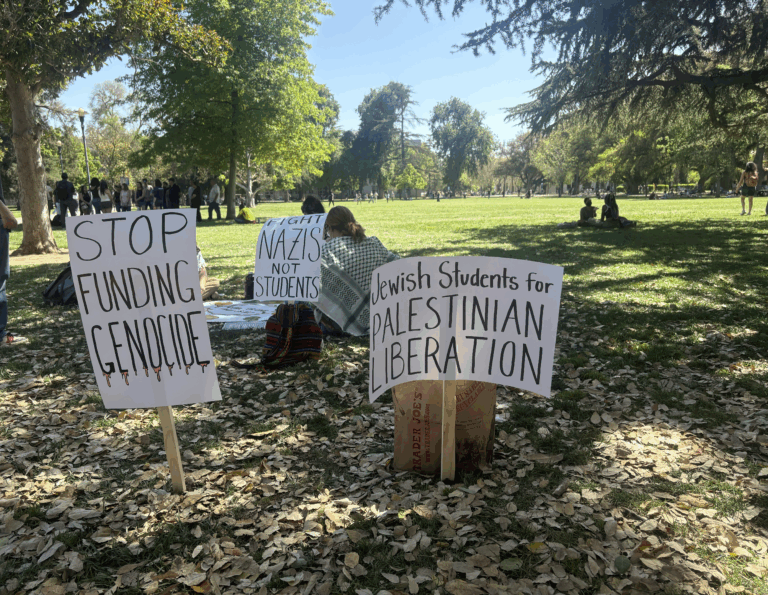
In a public Passover Seder on April 14, Jewish Voice Peace (JVP) called on UC Davis to reinstate the Law Student Association (LSA) and demonstrate Jewish student support for the Boycott, Divestment and Sanctions movement (BDS). 

The event started at 3 p.m. with roughly 10 students in attendance. Organizers held signs that read “Jewish Students for Palestinian Liberation” and “Stop Funding Genocide.”

“We’re here today because the University of California made the decision to suspend the Law Student Association after a Democratic vote to pass Boycott, Divestment and Sanctions,” JVP organizer Jillian March said. “This [decision] was predicated on the notion that anti-Zionism is antisemitism, so we’re here to show the university that we absolutely reject that idea and we as Jewish students stand with Palestine and we stand with the LSA.”

Passover is a Jewish celebration of Jews’ exodus from ancient Egypt and is observed through Seder, or a symbolic meal accompanied by prayer, storytelling and songs. JVP noted that their celebration does not conflate modern day Egypt with the Pharaoh who appears in the Passover story and expressed concern over anti-Arab racism and Islamophobia that “saturate our media and culture,” as March described. 

For JVP members, Passover is a celebration of freedom, while also being a commitment to justice amidst Israel’s genocide in Palestine.

“We recognize that oppression everywhere is related and we cannot celebrate Jewish freedom without acknowledging that Palestinian freedom is still being suppressed in the name of Jewish safety,” March said. “We’re here honoring Jewish tradition of opposing fascism and standing up for human rights.”

Part of the Seder includes drinking four glasses of wine, each carrying its own significance. JVP served students in attendance grape juice, with their first glass symbolizing solidarity with the student movement. Students raised their glasses and said “L’Chaim,” the Hebrew phrase for “to life.”

Seder typically includes participants washing their hands to symbolize the mutual dependence that water creates, but March expressed solidarity with Gazans amid the Israeli government using “starvation and thirst as a weapon of war.”

“As we symbolically wash our hands, we reaffirm the right to water as a human right,” March said.

The next practice observed in the Seder was the breaking of the middle Matzvah, a metaphor for systems of oppression that shatter the world. Students rejected complicity in systems of oppression described amidst Israeli occupation and genocide in Palestine.

Organizers then spoke on the significance of the olive in Palestine as a symbol of peace, hope and livelihood for Palestinian farmers. By reflecting on the significance of the olive, organizers chose to add it to their Seder plate.

“As we eat now, we ask one another, how will we as Jews bear witness to the unjust actions committed in our name?” March said. “Will these olives inspire us to be the bearers of peace and hope for Palestinians, and for all who are oppressed?”

Organizers then poured a second cup of grape juice to symbolize a commitment to ending arms with Israel and building solidarity with Palestine. Organizers raised glasses and said, “L’Chaim” and “free Palestine.”

For their third glass of grape juice, students raised their glasses in solidarity with the BDS movement and LSA. Students rejected the university’s “weaponization of antisemitism and Jewish students.”

Their last glass was dedicated to community and a vision of the world in which people and communities have the right to self determination, as well as personal, physical and emotional space. 

Following a recitation of a prayer, organizers read a written statement addressed to UC Davis on the suspension of LSA following their BDS vote. They rejected the university’s claims that the BDS movement is antisemitic and wanted to demonstrate Jewish students’ support for both LSA and the BDS movement. 

“We recognize the hypocrisy and injustice in weaponizing one marginalized group to silence another,” JVP organizers’ letter reads. “As Jews of conscience, we reject this weaponization of Jewish students and antisemitism to block the political action and free speech of a student org. We disagree with the university speaking on behalf of Jewish students and the Jewish people without consultation.”

Students called for the university to reinstate the LSA and return the $40,000 in student fees now controlled by administrators back to the students, describing the “dangers” of the university’s conflation of anti-Zionism with antisemtism.

Students then marched to Mrak Hall, office of many of the university’s top leadership to post their letter at its door. Members of the Oct. 7 coalition ripped the letter from the door. 


Written by: Khadeejah Khan — campus@theaggie.org


Singer-songwriter Alix Page plays Rickshaw Stop in San Francisco

The budding indie-pop artist kicks off her second headline tour following the release of new EP, “Bug” 


By SAVANNAH ANNO — arts@theaggie.org


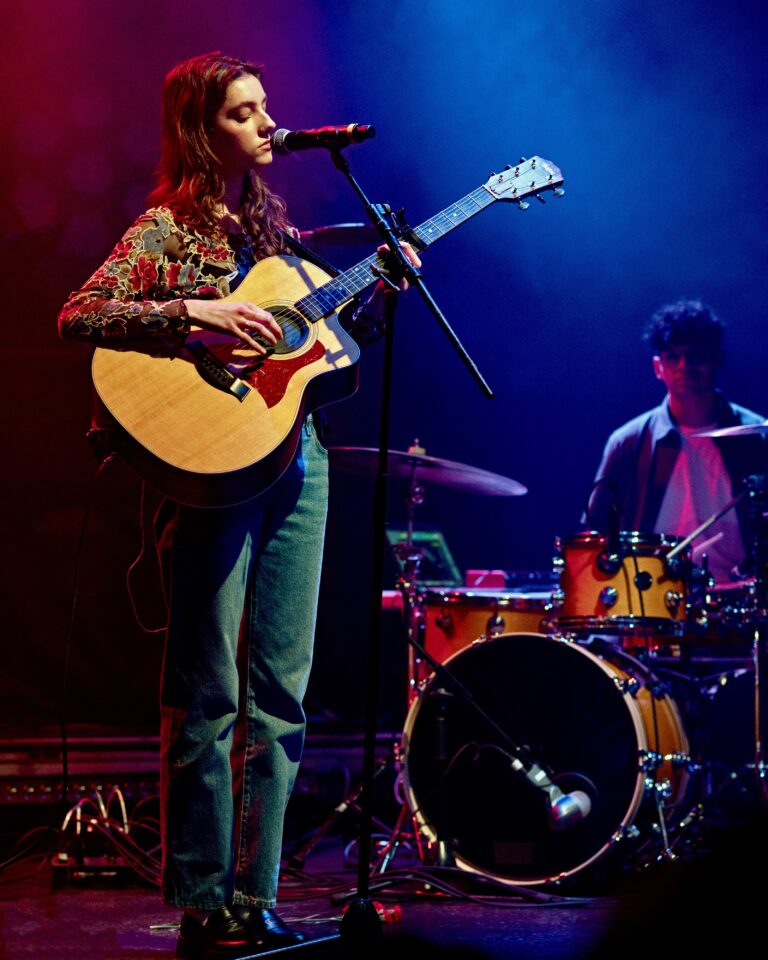
On May 1, musical artist Alix Page arrived in San Francisco to perform at Rickshaw Stop, a 4,000-square-foot venue that has hosted artists like Billie Eilish, The 1975 and Charli XCX early on in their careers. Following back-to-back shows in San Diego and Los Angeles, Page kicked off her second headline tour by celebrating her largely Californian fanbase.

Born in Orange County and attending the University of Southern California Thornton School of Music, Page has spent the last five years gaining traction as an indie singer-songwriter, releasing her first song, “Stripes,” in 2020. Page solidified herself as a strong lyricist with the acoustic track, using anecdotal details to flesh out the story of a breakup.

A past opener for Gracie Abrams’ “This Is What It Feels Like” tour in 2022 and more recently Sarah Kinsley’s “The Escaper Tour,” Page has gone from supporting shows at venues like New York City’s Bowery Ballroom to serving as their main act.

In a recent interview with The Luna Collective, Page discussed the impact of her time as a tour opener.

“The tour with [Abrams] was my first ever, so it was really special,” Page said. “The biggest takeaway was seeing how kind and generous she is with her fans. She treats them like friends and family, which was incredible to witness.”

At her show this past weekend, Page spoke to the intimately sized crowd between songs as much as possible. Explaining that she wanted to return to her roots of playing shows with just herself and her guitar, her band left the stage for a portion of the concert and Page played a handful of songs acoustically.

Leading her band through an almost hour-long setlist at Rickshaw Stop, Page performed both new and old tracks, the most recent being from her newly released EP, “Bug.” “Bug,” which was released on all platforms on March 14, is an exploration of Page’s perspectives as she reflects on romantic relationships, her family and band.

“I originally considered calling the EP ‘Girlfriend,’” Page said in the interview with The Luna Collective. “But my boyfriend pointed out, ‘how many of these songs are actually about you being a girlfriend, and how many are just about you?’ and I realized he was right. So when we ended up with ‘Bug,’ it felt like a more fitting title.”

Songs like “Girlfriend” and “Break the Band Up” highlight the indie-pop-rock side of Page’s discography with building guitar tracks and catchy melodies, while “Bb” and “Prank Call” use more simple instrumentals and express a diary-like level of yearning.

The EP’s title track, “Bug,” refers to Page’s nickname given to her by her romantic partner. Written from the perspective of a loved one trying to figure out how she’s feeling, the soft song quieted the crowd as everyone’s full attention turned toward Page’s display of vulnerability.

Page also played older pop-rock, fan-favorite tracks like “4Runner” and “25,” the latter of which sits at the top of her discography with over one million plays on Spotify. Using the hit single to end the night, the crowd filled the small venue with a loud chorus of voices. Leaving fans buzzing, Page and her band filed off stage while tossing small plastic bugs out into the audience.

With two EPs and a handful of singles now under her belt, moving to larger venues for her second headline tour and gaining almost 50,000 monthly listeners on Spotify, Page has solidified her fanbase and a name for herself in the indie-pop scene. A discography filled with songs perfect for channeling your nostalgia, reflecting on a breakup or dreaming about your current crush, Page’s sound is appealing to any and every ear.


Written by: Savannah Anno — arts@theaggie.org 

UC Davis’ student farm hosts the 2025 Semillas y Culturas Summit

Seeds & Cultures Summit, a fully booked event, highlighted Mesoamerican foodways 


By PIPER AWEEKA — city@theaggie.org


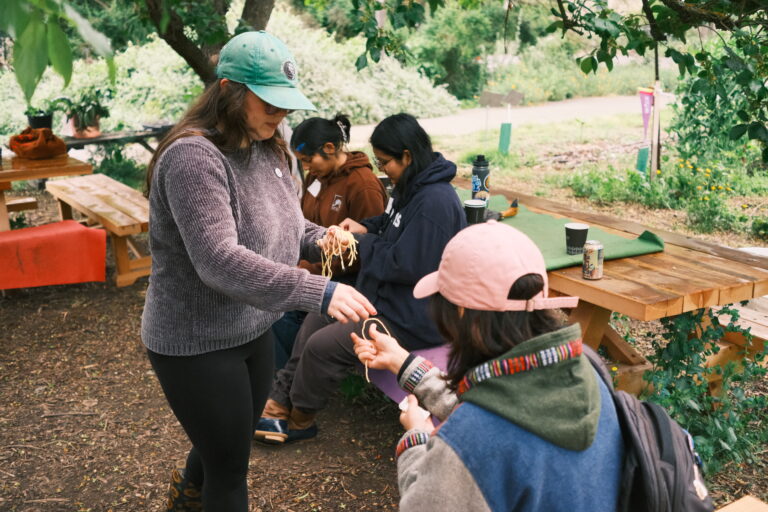
On Sunday, April 27, the UC Davis Student Farm was abuzz with people attending this year’s Semillas y Culturas, translated to Seeds & Cultures, Summit. Born from a desire to raise awareness around the sustainable agriculture of Indigenous Mesoamerican communities, 2025 marks the seventh year the event has been held at UC Davis.

Through workshops, presentations and speeches, attendees learned about what sustaining native foodways means in a world rapidly feeling the effects of climate change and cultural interconnection.

Tiffany Herrera, a fourth-year English and Chicana/o studies double major, highlighted the community’s excitement surrounding the event.

“This is my fourth time at Semillas y Culturas; I really love it,” Herrera said. “I first got introduced to the summit through one of my [Chicana/o studies] professors. After a food justice course, I find it really valuable.”

In sharing her admiration for the annual seminar, Herrera also honed in on its collaboration with the university.

“It’s a lot of people’s first introduction to the student farm and ecological garden,” Herrera said. “It gets people on campus, and more importantly, it gets people to engage with native foodways.”

Located at the edge of the UC Davis campus off of Hutchison Drive, the student farm is directed by Colin Dixon. Dixon elaborated on how the farm connects to the summit’s objectives.

“We do a lot of work here around food production [and] crop production but also food sovereignty,” Dixon said. “It’s the aspect of what it means to not just eat food, not just grow food sustainably, but also how to sustain cultures through making and sharing food. That’s definitely a big emphasis of this event.”

Dixon further described how the farm’s sustainability values align with those of the event.

“Bringing people together to talk about the knowledge, some of the traditions that are of California and of Mesoamerica, of the place where we are, and be able to highlight the homeland we’re on,” Dixon said. “Another important aspect of this event is bringing campus communities together. Bringing these different stories, different kinds of expertise together so that we can learn across communities and across generations.”

Melissa Moreno, the director of the Semillas y Culturas Summit, shared how integrated seeds and culture really are.

“This is an interdisciplinary collaboration,” Moreno said. “My training is in ethnic studies, native Chicano studies, but we also have farming [and] agriculture, as well as culinary knowledge. Bringing these worlds together is the exciting part.”

The food, catered by Savory Café, is one of the main components Moreno sees as helping to share the Indigenous knowledge the event is all about.

“We started with trying to raise awareness about the Mesoamerican Southwest and California regional foodways,” Moreno said. “Every year, the major food item is the cactus. This year, it’s made by Savory Café, all from scratch.”

Moreno concluded by emphasizing the summit’s growth in popularity after the effects of COVID-19.

“This has been a beautiful seventh summit in collaboration with [Dixon] [and] Jacqueline Ross [co-organizer], as well as Juan [Barajas], the owner of Savory Café,” Moreno said. “When we started the event, we had 50, 100 and, at some point before COVID, we had 200 attendees. Now, we’re building up again. Today we even have a couple of people from UC Santa Cruz, all the way here just to check this out.”


Written By: Piper Aweeka — city@theaggie.org


UC Davis men’s baseball faces tough losses against CSU Fullerton

The Aggies fought hard in match against CSUF


By DANIELLE WIRNOWSKI— sports@theaggie.org


The UC Davis men’s baseball team welcomed California State University, Fullerton (CSUF) to Dobbins Stadium for a three-game series from April 25 to 27.

Coming off of a win against Washington State University, the UC Davis Aggies were ready to continue that energy at home, facing CSUF. The Aggies, despite dealing with the losses of the weekend, put up a strong fight against Fullerton.

The Aggies started the three-game series strong against CSUF, preventing them from hitting more than two home runs.

Bryan Green, a fourth-year human development major, pitched for six innings, only allowing two runs, six hits, one walk and a total of four strikeouts against CSUF. Mason Lerma, a second-year human development major, continued Green’s work, only allowing CSUF to get one hit and three strikeouts in the three innings after.

While CSUF scored a home run at the top of the second inning, the Aggies secured a home run at the bottom of the third, as Tyler Howard, a second-year managerial economics major, led the offense for the Aggies. But it was Braydon Wooldridge, a third-year human development major, who was able to score the home run for the Aggies.

However, the tie did not last long, as CSUF scored their final run for the game at the top of the sixth inning. This ended the first game with a score of 2-1 in favor of CSUF.

The Aggies followed up in the second game of the series, stopping CSUF from scoring more than two home runs, just as in the previous game. Unfortunately, the Aggies were unable to get any runs on the board, despite the effort they put into the game.

Tyler Wood, a second-year managerial economics major, pitched for five innings, allowing just one hit with no walks and six strikeouts against CSUF.

Alex Gouveia, a fourth-year human development major, led the Aggies at the plate, going two-for-three with a double throughout all nine innings.

The Aggies hit three doubles with fewer than two outs in the fifth, sixth and ninth innings. However, they were unable to convert into points. This ended the second game of the series with a 2-0 score for CSUF.

Despite the weekend’s second game ending unfavorably for UC Davis, the Aggies went into the third and final game of the series with a strong strategy and the desire to earn a win.

At the bottom of the first inning, the Aggies scored two home runs, one by Howard and the second by Gouveia. The Aggies secured another home run via Evan Gentil, a first-year human development major, at the bottom of the second inning.

The Aggies prevented CSUF from scoring any home runs until the top of the third, when they scored five home runs before the end of the third. CSUF prevented the Aggies from scoring again until the bottom of the seventh inning, where they secured two more runs against the Aggies.

Gentil secured his second run for the Aggies during the seventh inning, with two players still on the bases at the end of the inning, bringing the score to 7-4.

The Aggies prevented CSUF from scoring during the eighth inning, while scoring another run at the bottom of the eighth. Jason Hanson, a fourth-year history major, secured the final home run for the Aggies during the game, trimming the lead to 5-7.

Ultimately, CSUF scored their final run at the top of the ninth inning against the Aggies, finalizing the score of 8-5 for CSUF.  Overall, it was an exciting game series with both teams fighting for a spot in the Big West Championships. The Aggies will return to their home stadium to host Utah Tech University on May 13 at 6 p.m.


Written by: (Danielle Wirnowski) — sports@theaggie.org

Is theater etiquette dead?

Reflecting back upon past years where box office success coincided with disruptive audiences


By BELLA PETERSON — arts@theaggie.org


Box office hits aren’t a new thing for theaters. Success for movies, however, has recently changed meanings and now represents its presence online more than anything else. With our pop culture being determined predominantly by social media, it’s no surprise that present-day movies’ online reception can be make or break. It seems, lately, that social media hasn’t just affected these movies online but has now evolved to feature viewer reactions in theaters.

Back in 2021 with the release of “Spider-Man: No Way Home,” the theaters were filled to the brim with audiences eager to see this newest installment. The film gained most of its exposure from the rumors and leaks that had spread online like wildfire — excitement was erupting from the fans as they realized that some of their favorite past portrayals of “Spider-Man” characters would be making a return. Initially wholesome, the amount of fans that were joining together for this pivotal moment in “multiverse” history quickly turned obnoxious.

The first days of the film’s release saw dozens of theaters packed with fans reacting — to put it lightly — inappropriately to the screening. Clips went viral on social media platforms of fans erupting in cheers in their screenings of the movie. But this isn’t just about cheering fans; some screenings also saw fans throwing their popcorn, jumping up from their seats, doing backflips in front of the screens and even breaking out into fights. Fans’ reception to this movie was clearly positive — but was it okay?

The issue of theater etiquette boils down to one main thing: What is the purpose of going to see a movie in theaters? No one is forced to view a movie in theaters; The option of waiting until the film is released on streaming services — which is usually only a month or so — is always available.

However, the experience of going to the theater to see a movie doesn’t just come down to watching a film — it’s the feeling of being fully immersed into a project that so many people poured their heart into. Live reacting alongside strangers to unexpected twists and turns that the movie makes, whether it be crying together or laughing together, is a shared moment meant to foster a sense of community.

There was a similar situation with the newly released “A Minecraft Movie.” Even before the release of the movie, many users flocked to social media as early as the movie’s first trailer to tease it; in a way, making their own inside jokes on the platform. Similar to the uproar that “Spider-Man: No Way Home” caused, “A Minecraft Movie” had cultivated a very unique impression by audiences before it hit the theaters.

The movie climbed its way to a very impressive position on the opening weekends’ ranking. Along with this success came a closely related audience reaction to “Spider-Man: No Way Home” — with loud reactions in the theater of clapping, yelling and cheering, to name a few. One theater even had its very own live chicken brought to the cinematic experience.

What matters is: Does this affect the cinema going experience? If a person finds themself in the same boat as most of the online population of being excited for a movie, do they have to worry about that experience being tarnished by a disruptive audience? Do people even care?

It seems that online reactions are mixed when it comes to this issue: some finding the feeling of community in being able to react alongside other people in a loud manner while others find it annoying to have to pay for an experience where they might not be able to fully enjoy the film.

The concept of “theater etiquette” isn’t as commonly talked about as related topics like “concert etiquette,” but it is something that does exist — or rather “should” exist. Most movies feature a disclaimer before the screening that highlights behavioral expectations, requesting that the audience silence their devices and remain quiet during the movie. Spoiler alert, this isn’t present for no reason. The audience is told this for a purpose: to preserve the movie-watching experience.

Whatever displeasure anyone may express regarding this issue seems to go unheard; this isn’t an isolated event and it will keep happening. And these aren’t the only issues that theater etiquette faces. Is theater etiquette dead? It just may be on its last legs; It’s hard to solve something that not everyone can agree is a problem.

All that can be done for now is to remain considerate. If someone chose to view a movie in their local theater, they might want to first consider the other theater-goers in the audience who have paid for the same experience, along with the theater’s employees who will have to pick up after whatever mess gets left behind.

Going to the theater to see a movie you have been waiting for is a truly special thing and is honoring the practice of viewing a movie in its truest form — maybe it’s something more people should consider before they take it for granted.

Written by: Bella Peterson — arts@theaggie.org

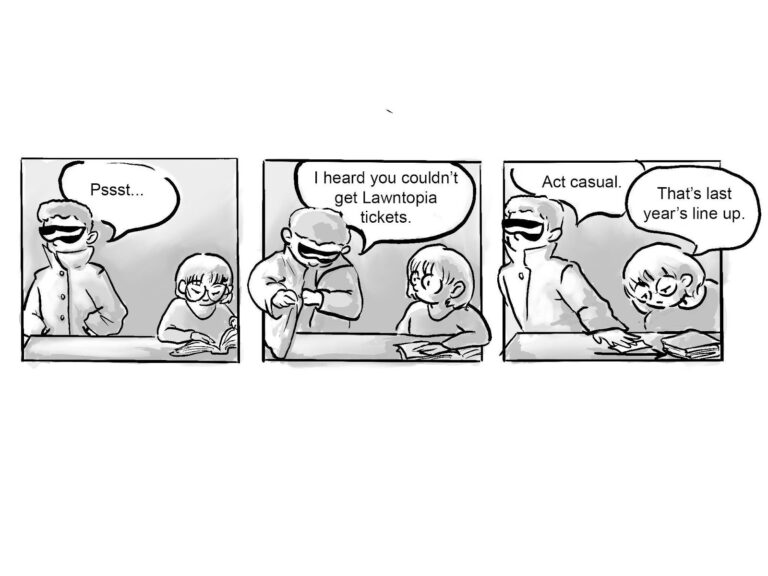
Lawntopia hustle

By AILI KOGA— aakoga@ucdavis.edu

Disclaimer: (This cartoon is humor and/or satire, and its content is purely fictional. The story and names of “sources” are fictionalized.)
Entertainment Council hosts 2025 Lawntopia event

The event featured artists Don Toliver, Umi and DJ Odd Mob 


By AALIYAH ESPAÑOL-RIVAS — campus@theaggie.org


On May 8, the ASUCD Entertainment Council (EC) held its annual Lawntopia concert for UC Davis students, with singer-songwriter and rapper Don Toliver headlining. The event, which had some 5,500 attendees, was marked by new changes in venue and ticketing.

The event was held at the University Credit Union Center, a change from the usual location of the Quad. Jonathan Ng, a third-year political science major and the EC unit director, expressed the difficulties finding a venue to accommodate all students.

“We wish there was a capacity on campus that could fit 38,000 undergrad students, but there isn’t,” Ng said. “We tried to accommodate every student given the limitations we had. There are positives and drawbacks to every location on campus.”

Unlike previous years, this year’s Lawntopia was not a free event for students. Beginning on April 14 for 48 hours, students could buy presale tickets for both general admission floor and the upper level at a lower price. On April 18, students could buy general sale tickets that had an increased price of five dollars more than presale.

The new system was a seeming lottery for some students, with many not being able to get a ticket either round. Jordan Zamora, a third-year psychology major, was one of them.

“I kept refreshing and refreshing when it hit 10 a.m.,” Zamora said. “The minute I was let into the website, it was completely sold out — both times I tried to get tickets. Some of my friends got it immediately on the first day of presale, I don’t know why I didn’t.”

However, for others, the new ticket system was viewed as an even playing field, providing an equal chance for all attendees to purchase a ticket. Lauren Prum, a first-year biological sciences major, thought the ticket-buying process was simple.

“I had no issues getting tickets,” Prum said. “It was a quick and easy process; I thought the website would crash, but it didn’t. It was like buying actual concert tickets, but less competitive.”

The event began at 6 p.m. with student openers Nineteenth Operator and DJ Harry. The latter, real name Harrison Tann, was chosen to open after EC’s Battle of the DJs, a free event held prior to Lawntopia for students to vote who they wanted to open the event.

“Getting the student body more engaged with who they wanted to perform is something I hope I implemented with the Lawntopia line-up,” Ng said. “The event was the first time that students had a say in who was performing, and it was a success.”

After student openers, R&B artist Umi opened the main performances of the night. Lorena Alvarez, a second-year political science and Spanish double major and a fan of Umi’s music, was excited to see her as an opener given her rising popularity.

“The one thing I love about Lawntopia is that students get introduced to new artists from different genres,” Alvarez said. “Although Umi is not a small artist, she’s still building her career and now more students are exposed to her music, which is amazing.”

Following Umi, Brisbane-native DJ Odd Mob performed a set of electronic music before headliner Don Toliver took the stage. His set introduced new pyrotechnics and special effects, a first in Lawntopia history.

Melissa Eaglehouse, a second-year animal science major and fan of Don Toliver, said she lined up at 1 p.m. to be near the front of the stage when doors opened at 6 p.m.

“I love his music,” Eaglehouse said. “When I found out he was headlining, I told all my friends we had to be barricade. I got in line around 1 p.m., and it was so worth it — I was so close. It was so hype.”

Looking to the future, Ng hopes to continue serving students and being transparent about where their money goes.

“We want to continue to serve the students, continue to represent their needs, while also working with the realities of our budget,” Ng said. “Our team is genuinely trying to maximize every student dollar to ensure students are ending up getting what they are paying for when it comes to their fees.”


Written by: Aaliyah Español-Rivascampus@theaggie.org

UC Davis Feed the Future Innovation Labs to close due to funding cuts

The labs relied on support from USAID, which has had its operations significantly reduced


By RIVERS STOUT— campus@theaggie.org


The College of Agricultural and Environmental Sciences announced on April 3 that UC Davis was closing the Feed the Future Innovation Labs. The research labs, whose funding primarily came from the federal government, were part of a United States Agency for International Development (USAID) initiative to reduce global hunger and secure U.S. fruit and vegetable supplies. 

The larger Feed the Future Innovation Labs initiative, which funded labs across the country and abroad, included a Davis branch. Here, the program was composed of two parts: the Horticulture Innovation Lab and the Lab for Markets, Risk and Resilience (MRR). Both were told independently that they would stop receiving funding before the end of their contract with USAID, according to an announcement from the College of Agricultural and Environmental Sciences. Other labs in the program have also had their funding cut.

USAID has faced significant staffing and budget cuts since the inauguration of President Donald Trump, including cuts to many of its foreign aid and research programs. In total, the labs received about $36 million, according to usaspending.gov.

“[It was] really chaotic and discombobulating,” Erin McGuire, the director of the UC Davis Horticulture Innovation Lab, said. “We first knew something was amiss when the executive order to shut down foreign assistance while assessments [were going] through was a red flag, but we weren’t impacted because we were awarded funding for five years.”

Both the Feed the Future Innovation Lab for Markets, Risk and Resilience (MRR) and the Horticulture Innovation Lab, along with several other international projects, received stop-work orders from the federal administration in January, according to a UC Davis press statement on the issue. MRR was formally terminated in February. Nearly 95% of the allocated funds had already been spent on research projects.

McGuire described the immediate impacts of the loss of funding.

“We are in the middle of our grant cycle,” McGuire said. “All research is in the middle of the research cycle. Field trials are in the middle of data collection, and all of that is gone. Everyone is mid-stride, and we have to figure out how to stop that. We had 170 scientists that work on our research globally, and all of the sudden they didn’t have funding.”

The justification for shutting down the lab was that “the program wasn’t in the interest of the United States government anymore,” according to McGuire. 

The labs primarily worked on “integrated pest management strategies, soil health, increased production, and postharvest loss,” according to its 2023-24 annual report. Though these research projects were largely conducted abroad, the implications the research held and effects it had on foreign populations may ultimately affect the United States’ own food chain.

“We had consistent food supplies because we invest in research and understanding crop diversity,” McGuire said. “If we stop doing that, we will not be able to feed ourselves in the way we’re used to feeding ourselves. We also have long-term established relationships that the U.S. deeply benefits from. Without access to this information, we’re trying to drive our food system blind.”

A university spokesperson said that UC Davis had received several dozen notices from federal agencies relating to specific grants or projects since the start of the current Trump administration. 

“The affected grants cover a wide range of areas, including research related to cancer and Alzheimer’s disease, food production and safety, renewable energy, basic science and a great deal more,” the spokesperson said.

The loss of international research is likely to limit the U.S.’ power internationally, allowing other countries to fill the void.

In our absence, other countries will step in,” McGuire said. “I don’t think Americans realize the strong presence the USA has in West and East Africa. […] The second we’re gone, other countries will step in because they’ll want that soft power, [it’s] hugely powerful. People don’t realise how powerful that is internationally, and other countries are chomping at the bit to have that power.” 

The Feed The Future Innovation Labs are not the only UC Davis research programs to face possible budget cuts due to changes at the federal level. UC Davis administration and leadership are working on a case-by-case basis with researchers regarding federal notices, according to the university spokesperson.

“In each case, the Office of Research is working directly with the principal investigator and campus leadership to determine the appropriate course of action,” the spokesperson said.  “In the case of research terminations, this may include filing an appeal directly with the agency, litigating matters in court and negotiating a financial settlement prior to winding down the research. These processes can take months and prevent us from sharing information publicly until complete. ”


Written by: Rivers Stoutcampus@theaggie.org


Review: Season two of ‘The Last of Us’ has strong acting performances, new characters and bold narrative choices

Halfway through its sophomore season, “The Last of Us” receives high ratings and a renewal for a third season


By ELIZABETH BUNT — arts@theaggie.org 


“The Last of Us” an adaptation of a hit video game, burst onto the scene in 2023. Set in a post-apocalyptic world decimated by a virus that effectively turns its victims into zombies, it follows the relationship and journey of Joel and Ellie, an unlikely duo who are searching for safety in this new world. It became one of the highest rated drama series in HBO history in its first season, earning 24 Primetime Emmy Award nominations. Stars Pedro Pascal and Bella Ramsey returned for season two along with a host of new characters. 

The first season of “The Last of Us” ends with Joel (Pedro Pascal) and Ellie (Bella Ramsey)’s arrival in Jackson, Wyoming, a safe town, after traversing the country. Unbeknownst to Ellie, Joel is hiding the fact that he murdered a group of liberation fighters to keep them from performing a fatal surgery on her. This provides the foundation for the next season, which is set five years later. 

Season two picks up with Joel and Ellie settled in Jackson. The town has grown exponentially since its first appearance. Joel has become a leader in the community and Ellie, now in her late teens, is a member of the town’s infected patrol squad. Their relationship is struggling through a period of teenage angst. 

At the same time, they are unknowingly being hunted by a member of the Washington Liberation Front (WLF), played by Kaitlyn Dever, who is seeking retribution for Joel’s actions at the hospital. The outcome of their eventual confrontation propels Ellie and her partner Dina (Isabela Merced) on a quest for vengeance, leading them into the heart of Seattle’s dangerous and morally ambiguous landscape.

Season two greatly expands the show’s universe by introducing new characters and exploring the dynamics of the growing Jackson community. One notable new addition to the series is the psychiatrist, Gail, who is played by Catherine O’Hara. Her performance adds another layer of emotional depth to the show as her sessions with Joel peel back his layers. 

On some fronts, season two has met with positive reviews. Critics and fans alike continue to praise the show’s ability to blend heart-wrenching emotion with gritty realism. Reviewers have commented on the season’s bold narrative choices, while still remaining true to the video game’s original storyline. The performances of the cast, including Ramsey’s performance in episode three, have also garnered immense praise. However, certain factors like casting decisions, particularly Dever’s portrayal of Abby, have been a source of divide for the fanbase of “The Last of Us.”


Currently, the second season holds a 95% approval rating on Rotten Tomatoes and an 81% score on Metacritic. With four episodes still to be released, “The Last of Us” is already being hailed as one of the strongest sophomore seasons in TV history.

For anyone who has been on the fence about watching season two, take this as your sign to catch up. It will not disappoint and with season three already confirmed, “The Last of Us” is going to be around for a long time yet.  


Written by: Elizabeth Bunt — arts@theaggie.org 

Cold water, hot topic

Did I really just get nominated for this challenge?


By NEVAEH KARRAKER— nakarraker@ucdavis.edu


We’ve all seen videos of the Ice Bucket Challenge by now — either done by a celebrity or peers. It’s no surprise that another 2010s trend has resurfaced; In fact, it may stimulate nostalgia for many who partook in the challenge during middle school.

The 2014 Ice Bucket Challenge was a way to garner awareness for amyotrophic lateral sclerosis (ALS), and this fundraising campaign raised millions for research on this chronic, life-altering disease. While a cure has yet to be discovered, these donations helped in the development and testing of a medication called RELYVRIO. This medication has been transformative in improving the quality of life of impacted individuals, significantly slowing ALS symptoms  like muscle weakness and poor motor control.

The University of South Carolina (USC) “#SpeakYourMIND” Ice Bucket Challenge is a similar campaign to raise awareness for mental health and suicide. It’s made its way across the country, with individuals of all ages hopping onto the trend — including UC Davis students. As of now, the challenge has raised almost $250,000 for the non-profit organization Active Minds. This organization is focused on transforming the lives of youth who have been affected by poor mental health.

While many people remain enthusiastic about participating in the challenge and in its message, others expressed their vexation on social media by the implication of the Ice Bucket Challenge as a sensory representation of the symptoms experienced by those battling ALS. Yet, the purpose of this new campaign is not to minimize the seriousness of ALS but rather to shed light on another issue.

It is crucial to note that the individuals leading the campaign had no expectation of it going viral. The USC challenge was started by a small club at USC and piloted on Instagram, with the goal of raising only a few hundred dollars. These were students who took inspiration from a previously successful event with good intent — what student can’t relate to that effort?

However, instead of an awareness campaign, many saw it as an opportunity to gain popularity, have fun with friends and make jokes. While most of these are wholesome effects, it is undeniable that actions without purpose, especially when influenced by conformity, are ultimately meaningless.

On the other hand, these side effects also contribute to the appeal. They reveal that the ice bucket challenge isn’t just a fleeting trend, but rather a symbolic and intentional act. The first step toward improving mental health is to find resources and build community. In the challenge, participants tag their friends to join — creating social connections that link one person to another. It mimics the ways in which health advocacy can stem from one person and reach many people.

I doubt that many participants actually wanted a cold bucket of ice water poured on their heads and soaking their clothes. It looks miserable. Yet, that’s how degrading mental health can feel — overwhelming, abrupt and isolating. By voluntarily taking on brief, somewhat similar discomfort, participants act in solidarity and recognition, broadcasting a couple of things.

The first is solidarity — the idea that the source of any recovery is community: a reminder that we are not as alone as we may think. Mental health struggles are often hidden and suffered in silence, which frequently worsens conditions. The Ice Bucket Challenge forces visible, physical discomfort, illustrating the importance of exposing internal struggles for health-centered conversations.

The second is vulnerability — some of the most meaningful moments come from being transparent about your thoughts and emotions. I, for one, have experienced countless times that a lot of my “core memories” are rooted in sadness. These memories stick with me, not because of the negative correlations, but because of the bonds that have been formed through this grief — like receiving a sense of strength and support from late night talks with the homies. At some point in our lives, we have all endured the relief of vulnerability, and thus can relate to it.

The Ice Bucket Challenge allows us to break the stigma surrounding mental health. Getting drenched and squealing with shock on camera resembles the courage and vulnerability it takes to openly talk about mental health issues. In the end, it calls for action. Similar to the 2014 campaign demonstrating commitment to ALS awareness, the 2025 Ice Bucket Challenge demonstrates the responsibility we all have to help others heal — oftentimes through sparking conversations.


Written by: Nevaeh Karraker—nakarraker@ucdavis.edu


Disclaimer: The views and opinions expressed by individual columnists belong to the columnists alone and do not necessarily indicate the views and opinions held by The California Aggie.