58.4 F
Davis

Davis, California

Tuesday, December 23, 2025
Home Blog Page 28

No instruments, just heart

The power of “cold-blooded a cappella”


By MOLLY THOMPSON – mmtthompson@ucdavis.edu


Founded in 1995, the UC Davis Lounge Lizards celebrated their 30th anniversary showcase from May 3 to 4, 2025. The Lounge Lizards are one of the most talented a cappella groups in California, coming in second only to Furmata from the University of Washington at the West Coast International Championship of Collegiate A Cappella (ICCA) semi-finals in March, after taking home gold at the Northern California quarter-finals in February.

Each group is allotted 10 minutes at the competition to perform their prepared set, using only their voices. They prepare for months ahead of the show — choosing their songs, arranging the music to fit the format of a cappella, honing their techniques and practicing choreography to accompany and complement their vocals.

As someone on the outside of the a cappella scene, I was absolutely blown away the first time I saw a live performance. My roommate is in her second year as part of the Lounge Lizards, and I attended their annual showcase, “No Instruments Attached,” for the first time last May. I knew she was talented and the group was good, but the descriptions I’d heard were inconsequential compared to the grandeur and majesty of the show itself.

The people who create and perform a cappella possess incredible musical skill, are wholly dedicated to their craft and are creative beyond belief. They’re masters of what they do, which allows them to play with the music and mold it into something astonishing.

While the Lounge Lizards consist of six vocal parts (soprano, mezzo-soprano, alto, tenor, baritone, bass) and a vocal percussionist, what this particular group of 16 singers produces is far greater than the sum of its parts. The performance took place at Khaira Hall, which was filled with deep, resonant and layered sounds as the Lounge Lizards built their chords. It was truly transcendent.

Beyond the objective talent of the singers, what makes a cappella so incredible is the sheer depth of passion that viscerally emanates from each member of the Lounge Lizards as they perform — amplified tenfold by the impenetrable bond they share. There are moments — in all of their songs, but especially in the set they prepared for the ICCA competition — where they came together and created sounds almost impossible to believe were coming from 16 voices and nothing more. Yes, it comes from the expert creation of the arrangement itself, but beyond that, it’s born out of their shared love for each other and of the art itself.

Emily Chung, a third-year plant sciences major and co-publicity and co-production chair of the Lounge Lizards, spoke with me about what makes their a cappella group so special.

“What makes […] us [so] attached to this community is that we are working towards a common goal, like [the] competition, but also that we’re really tight on a personal level as well. We know so much about each other, and that’s what makes us a family,” Chung said.

The vocal percussionist for the Lounge Lizards, a second-year biotechnology major, Joey Park, agreed with this notion.

“One thing I really like about being a part of this group is just how much passion and drive each individual has. Even if we have different majors [and] different interests, we can just share a love for music — a love for a cappella,” Park said.

This kind of camaraderie is tangible; it’s impossible to create something as positive and as beautiful as their music if you don’t actually care. The fact that they’re all so personally invested in each other, in a cappella and in performing makes them so special.

“You don’t realize there’s nothing wrong with you until you find a group that lets you be yourself,” Matthew Fajardo, a fourth-year human biology major and the assistant music director of the Lounge Lizards, said. “When I’m with [the Lounge] Lizards, I can just be as energetic and happy as I want.”

This immense level of respect is not only a key reason for their success but also a powerful testament to the mutual admiration and love between the group’s members. Art doesn’t come from skill alone — it must be interlaced with passion to have a true impact on its audience. The Lounge Lizards are a beautiful example of that; they’re skilled beyond belief and overflowing with devotion to the craft, which has allowed them to flourish for 30 years. Dedication, talent, knowledge, leadership, care and above all, community, are what make art truly great — the Lounge Lizards show us just that.

Getting involved in community groups like the Lounge Lizards is a great way to enrich your college experience, grow your skills and gain a strong support system of camaraderie. They show us how we can all make the most of our college years and what passion and skill can combine to create.


Written by: Molly Thompson — mmtthompson@ucdavis.edu 


Disclaimer: The views and opinions expressed by individual columnists belong to the columnists alone and do not necessarily indicate the views and opinions held by The California Aggie


 

The Madigan squeeze procedure helps foals recover from maladjustment syndrome, mimicking the process of being born

For the maladjusted “dummy” foals, there are big risks to their immune system but a simple procedure that can be learned and applied by anyone helps to speed up recovery


By KATELYN BURNS— science@theaggie.org


With foal season underway, foals have been popping up all over social media — including the UC Davis Horse Barn’s Instagram, a good space to see some of these adorable foals.

Often the general guideline used for assessing new foals is the one-two-three rule, which suggests that foals should stand within one hour, nurse within two hours and the mare should pass the placenta within three hours. Nursing is particularly important for the foal’s immune system.

Foals don’t receive immunity through the placenta, leaving them with no immunity upon birth. With bacteria everywhere, it can be increasingly risky the longer foals go without any immunity. Foals can get immunity from colostrum, the early milk produced by the mare which is nutrient-dense and full of antibodies. Nursing early enough to get that immunity is important.

Dr. John Madigan, a globally renowned veterinarian and a professor emeritus at the UC Davis School of Veterinary Medicine, commented on foal health.

“If your foal doesn’t reach that benchmark, then you have to milk the mare out, tube the foal, give it plasma or put it on treatment or glucose,” Madigan said via email. “There’s such a shortage of equine veterinarians to be able to make that call, get there and do that in a timely fashion.”

When new foals aren’t meeting those benchmarks, it could mean they have maladjustment syndrome. Maladjustment syndrome has long been considered a symptom of hypoxia, a lack of oxygen. While this is a part of it, maladjustment syndrome is now being looked at as a failure to transition out of their in-utero consciousness and physiology. This includes foals’ ability to thermoregulate, metabolize energy and maintain other systems they weren’t responsible for while in-utero. These foals, called “dummy” foals, are notably disoriented, unable to recognize their mother, nor suckle or swallow, ultimately failing to demonstrate the expected behaviors of a healthy new foal.

Madigan developed a procedure, dubbed the Madigan squeeze procedure, for foals with maladjustment syndrome that could be learned and applied by anyone — not just veterinarians. The procedure is praised for its simplicity and accessibility, as it doesn’t require any special training or tools. All you need for the procedure is a rope and the instructions, which can be found for free online. Ultimately, a rope is wrapped around the foals and squeezes them into a slow wave sleep for 20 minutes. When they wake up, in the majority of cases, foals completely recover.

Madigan’s research group is currently conducting a worldwide survey of anyone with experience using the Madigan squeeze procedure.

“The reasons for the survey were several fold,” Madigan said. “We wanted to know the extent of use of the procedure worldwide.”

So far, they have results from over 35 countries supporting that the procedure has improved the survival of newborn animals worldwide.

“We [also] wanted to know other details like how effective it has been when used by veterinarians and when non-veterinarians do the procedure, and if there are any side effects or problems,” Madigan said.

While the survey is still active, Madigan noted that so far an overwhelming majority of respondents saw no adverse effects from the procedure. Furthermore, regarding the success of the procedure, in a study published in 2017, they found that 37% of foals that received the squeeze were nursing within an hour whereas only 4% of foals that received conventional treatment were nursing within an hour. Despite the successes and few adverse effects, many veterinary hospitals still use conventional ways of treating the maladjustment syndrome.

“People don’t like putting rope on things, they don’t like tying knots,” Madigan said. “They would rather put an IV catheter or nasal catheter and treat them the way that we used to.”

That’s not to say that there isn’t widespread use — and not just amongst equines. Besides equines, the procedure has found success in calves, lambs and more. There continues to be research on the Madigan squeeze procedure and its broader implications for consciousness and health.

Written by: Katelyn Burns— science@theaggie.org


Have books been reduced to an aesthetic?

The 2011 novel, “The Night Circus,” raises the time-old question: Do you judge a book by its cover?


By BELLA PETERSON — arts@theaggie.org


The classic dilemma of judging a book by its cover — a tale as old as time. Although the saying as it stands isn’t always targeted toward books, it still can be applicable to just about any book you come across. In today’s age, there are a multitude of cover designs that decorate the shelves of your local bookstore, whether it be a cartoon-style romance novel or a collage of flowers, snakes and other things surrounding the title of a fantasy novel.

It’s something readers can’t really help. When looking for a fresh new novel to crack open, the first thing that’s usually considered is its appearance. With a pretty title and an even prettier cover it’s hard to say no to a book. But sometimes, or maybe even most times, looks can be deceiving.

With the uproar of BookTok constantly throwing suggestions at you, it can be difficult to decipher what books are actually as good as they say. One such novel is called “The Night Circus” by Erin Morgenstern.

Described as being a novel that employs the genres of fantasy, romance and historical fantasy set against the backdrop of a Victorian era London, it definitely seemed like this novel had everything going for it. And yet, by the time the last page was read, all that was left was a feeling of dissatisfaction and disbelief that this novel was so highly praised.

Now, of course, everyone has their preferences when it comes to reading. So, naturally, if someone recommends a book, there isn’t a surefire chance that it’s going to meet the same standards that you hold. That’s the beauty of books after all; being able to find something that meets exactly what you’re looking for as a reader.

However, the reasoning for the dissatisfaction found with “The Night Circus” wasn’t because it was a bad novel. If it were that simple, one could simply say, “It just wasn’t my cup of tea,” and move on. The issue with this novel goes far deeper than just preferences. The book itself had some very decorated writing, if the title and the cover weren’t enough, then the writing itself was certainly aesthetically convincing.

The content itself just felt hollow in comparison to the pretty forefront it held. Deeper and deeper into the novel it became glaringly obvious that there wasn’t much substance to this story — the characters not really showing anything to be impressed by and simply just going through the motions as any other easy read. It’s a hard thing to admit a novel is just a pretty face, because who’s allowed to even declare such a thing?

Some negative reviews of the novel found on Goodreads had similar things to say: Sunny said, “NOTHING HAPPENED,” and Dana said, “Did not finish. I tried. Too much pretty writing and too little actual plot.”

Now this may not be the majority opinion, but finding that others agreed with the impression that this novel only left its reader with beautiful writing and no substance, then maybe it isn’t totally outlandish to think there may be a bigger issue at hand.

This isn’t meant to be a critique of “The Night Circus” alone, but rather a better look at what books are starting to evolve into as a whole. If a book sounds good, looks good and even reads good, then what’s the issue? Supposedly, it might all actually dilute down into a preference thing, but how can a reader actually tell? When looking for a good book to read, you don’t want to have to worry about being fooled into reading something that isn’t simply bad, but empty, too.

If this was an individual event for this one novel, then this issue would be localized and easily forgettable — sadly, that’s just not the case. It feels as if more and more books that are popping out either feel like empty carbon copies of the overdone tropes we have had for so long.

Now, when looking through the shelves of these bookstores and a nice title and cover catches your eye, you might have to question what actually lies between those pages deep within the deceiving cover.

No one is the ultimate judge of whether this can be applied, because maybe it does come down to personal preference. At the end of the day, everyone should consider the total application of what issues may come with books being diluted down to an aesthetic first, rather than content being the priority.

The overconsumption of books through the lens of social media is a whole other can of worms that doesn’t need opening just yet, but there’s something to be said for the constant flow of recommendations not really having a solid filter. There’s no actual way for audiences to sniff out when a book is more than a good-looking cover. Maybe now’s the time to start deconstructing what books readers are actually looking for rather than just the nicest looking cover of the bunch.

Written by: Bella Peterson — arts@theaggie.org

When extremism becomes the weapon, both sides suffer

The India-Pakistan division and the current rhetoric surrounding the violence exemplify how conversations about extremism are highly unproductive


By GEETIKA MAHAJAN — giamahajan@ucdavis.edu


When the British left South Asia in 1947, they left a tangible legacy of colonialism behind. The following partition of India into India and Pakistan was one of the most violent conflicts of the 20th century, and its consequences are still impacting people on both sides to this day. Tensions between the countries manifest in bursts of violence that fuel political campaigns, debates and hatred on both sides of the border. Throughout the Hindu-Muslim diaspora, the rhetoric surrounding these events only further reinforces division and ensures that though the original colonists may have left, their legacy of violence continues to destabilize both nations.

In India, a movement of retributive violence against Muslims, referred to as “bulldozer justice,” started out on the fringes of the right-wing and crept its way into the speeches of Prime Minister Narendra Modi. The purpose — to punish any violations of land regulators in India by bulldozing their property — has disproportionately affected Muslin farms, houses and places of worship. Around 70% of targeted properties between the years of 2021 and 2023 belonged to Muslims, according to Human Rights Watch. The strategy itself is not effective at anything besides further reinforcing anti-Muslim sentiment in India and anti-Indian sentiment in Pakistan.

Across the border, Pakistan engages in its own kind of othering. The seemingly omnipresent “Indian threat” has granted the Pakistani military a disproportionate role in Pakistan’s fragile democracy. By leveraging constant threats of an attack from India, the government enables military coups, military governance and a bloated defense budget. In 2024, Pakistan scored 35 out of 100 on Freedom House’s Global Freedom Index, wherein “interference by the military in civilian institutions” was cited as a major factor for the country’s low score.

The most recent pattern of escalating violence centers around an attack in India-administered Kashmir, where 26 Hindus were killed. The Indian government blamed Pakistan for the attack and retaliated, targeting parts of Pakistan and Pakistan-administered Kashmir, leaving 26 dead and 46 injured. Both governments have invoked discussions of extremism to justify their actions, preceding and postceding these attacks.

The two ever-competing nationalist voices leave no room for nuance within discussions centering on the religious and political conflict. Constantly ignoring the issues within their own country, while characterising the other as the looming threat, has allowed internal mismanagement to go unchecked. Furthermore, it silences those caught in the crosshairs of the conflict itself.

“The competing narratives of India and Pakistan leave no room for the Kashmiri voice, which is silenced even in the global imagination,” author Ather Zia said in her book, “Resisting Disappearance: Military Occupation and Women’s Activism in Kashmir.”

Conversations surrounding the division between the two nations center around extremism in a way that turns religious groups into symbols. Politicians create stories about victims and the “dangerous radicals” targeting them, turning a nuanced history into a means to an ideological end and achieving no meaningful resolution in favor of stoking animosity. The discourse favors caricatures, and, consequently, the rhetoric and violence on both sides grows more extreme, more bloody and more harmful to the nations’ citizens.


Written by: Geetika Mahajan — giamahajan@ucdavis.edu


Disclaimer: The views and opinions expressed by individual columnists belong to the columnists alone and do not necessarily indicate the views and opinions held by The California Aggie.

I have no summer internship, am I cooked?

Exploring other ways to spend our time this summer 


By SABRINA FIGUEROA — sfigueroaavila@ucdavis.edu


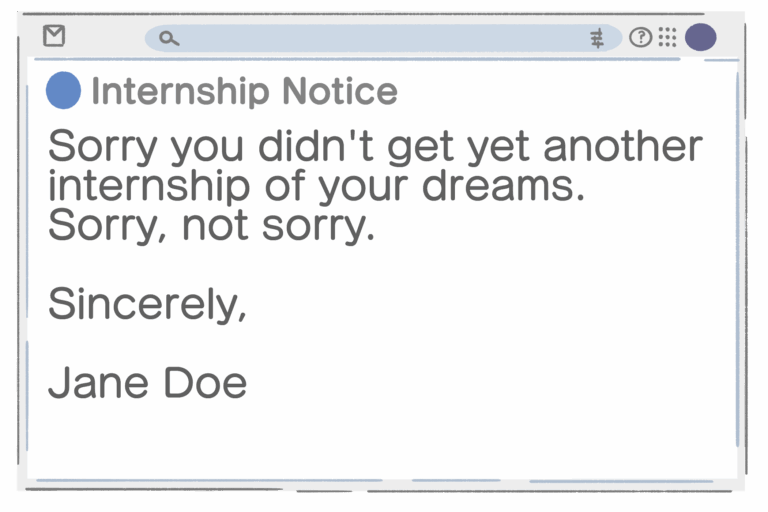
When I started my third year at UC Davis, I told myself I’d grind to get an internship for summer 2025. It’s May, spring quarter is over in a month and all I’ve gotten are numerous rejection emails. Nothing is more dreadful than opening email after email to see the words  “Thank you for your application! Unfortunately….”

Though the internship application season is not fully over yet (yes, there’s still time), many may be wondering if their lives and careers are over. I had the same thought, and it’s not worth panicking over. Summer is just time waiting to be filled — internships are not the only way to do that, nor are they the only ways to further your career, skills and experiences!

One obvious alternative is to take courses during the summer. Kill time by simply working on your degree, and maybe you can graduate early or take lighter course loads during upcoming quarters. UC Davis has both in-person and online options, and, if you’ve ever wondered what summer looks like in Davis, well…it’s hot. But on the bright side, the campus isn’t as plagued with bikers and pedestrians.

You can also just take classes for fun and try something new. Classes teach soft and hard skills that you can put on your resume, applications or apply to personal projects. Which, speaking of, are all great ways to fill your time as well.

Personal projects — like writing stories, making marketing campaigns for fake clients, creating zines and coding websites — help you build up your portfolio if you need it for your aspiring career. Most of the time, these projects are the easiest and cheapest ways to spend your time, and the best part is that they can be about anything you want.

After you build a good, lengthy portfolio, you can try freelancing to make a little money. It’s a great way to display your talent when bigger companies don’t give you the opportunity to, and you can put all of this experience on your resume for later jobs or internships. Or, you might like it so much that you decide to continue freelancing.
Another way to gain skills is by pursuing a certification. They range from Excel to data analytics to project management. If you think you can benefit from learning any of these skills that aren’t typically taught in your UC Davis courses, it could be a great use of your time this summer. It’s even better if you then apply these skills to a personal project to show employers in the future.

As a final option, you could get a local job or volunteer opportunity. It may not be directly applicable to your career path, but it can still offer you experiences and skills you could use in the future. And, it’s a great way to network with people. Any connection can lead you to your dream job — never say never.

Maybe none of this sounds appealing to you, and that’s okay. You can also just take a break this summer. The point is to spend your time doing what you want to do, whether it’s traveling, spending time with friends or prepping for the next internship application season. Don’t waste your time worrying about that internship you didn’t get — that’s already in the past. Once you’re in the summer and your time is free, simply enjoy it.


Written by: Sabrina Figueroa — sfigueroaavila@ucdavis.edu

Disclaimer: The views and opinions expressed by individual columnists belong to the columnists alone and do not necessarily indicate the views and opinions held by The California Aggie.

Only survivor of the Carlos Dominguez stabbing spree testifies in the murder trial

After a two-year break, Dominguez’s trial begins to determine his guilt and sanity for the stabbing of three victims in 2023


By GIA LOOMIS — city@theaggie.com


After a two-year hiatus, the trial of Carlos Dominguez began on May 5 with opening statements. Former UC Davis student Carlos Dominguez will be tried over an estimated 10-week period on murder and attempted murder charges for the 2023 Davis stabbing spree that left two dead and one injured.

Debates regarding Dominguez’s mental state caused this lengthy break in the case. In July 2023, three months after the stabbings, Dominguez underwent a competency trial to determine if he was mentally fit to face charges.

Following the opening statements, several witnesses were called to the stand to give more details on the case. Kimberlee Guillory, the only surviving victim, testified.

“Somebody came up […] behind me, where I was sitting outside, and they came down with a knife and cut my tent,” Guillory said. “And at the time I wasn’t sure I was getting stabbed, I thought somebody was punching me at first.”

When examined, Guillory then described the attack in more detail when asked how many times she was stabbed.

“Three, [the] first time it took my breath away and then it just continued,” Guillory said. “I started screaming [“help”] very loudly and then I laid down, because I guess Larry and Isaac […], they came running towards me, and that’s when they grabbed him and started fighting with him.”

Witnesses included victim David Breaux’s sister, Anne Maria Breaux, who testified for her brother explaining how he was known as the “Compassion Guy.”

“[David] realized that he would devote the rest of his life to raising awareness of compassion,” Breaux said. “He had a notebook and a pen, and he would ask people to write their definition of compassion, and so he did that from June 3, 2009 until his passing, and that’s how he got to be called ‘Compassion Guy.’”

Then, ornithologist and previous UC Davis graduate student Ian Haliburton and Aiden Reynolds, a current UC Davis student, were both called to the stand to explain how they found Breaux after the stabbing.

“I saw someone sitting on one of the benches,” Reynolds said. “But it was only when we approached the area, about 10 to 15 yards away, where [Haliburton] noticed that he was in a really, really bad state. I remember he said, ‘That man is dead.’”

After several months of treatment, Dominguez was ruled mentally fit in January 2024, and the case was put back into motion. This led to the preliminary trial beginning on Feb. 26 of that year, which led Judge Samuel McAdam to order a trial for two homicides and one attempted homicide for which Dominguez was arraigned.

Now, the trial is officially proceeding with jurors having been selected last week and trial beginning last Monday, May 5. The trial will involve both a guilt phase and a sanity phase considering Dominguez’s dual not guilty and not guilty by reason of insanity pleas which were taken in October.

On Monday, the defense and prosecution each began with opening statements. The prosecution’s opening statement began by recounting the time leading up to and the nights of the stabbings, in doing so, they emphasized that these attacks by Dominguez were premeditated.

Yolo County Deputy District Attorney Frits Van der Hoek led the prosecution’s opening statement. He explained to the jury that the premeditation of these attacks began in December of 2022 when Dominguez went on Amazon and purchased the knife for the attacks.

“We’re gonna go down to the kind of 100-foot level as to what’s going on,” Van der Hoek said. “What is the evidence that you’re gonna expect in this case? And understand the evidence, to understand why this is going to be proven to be a deliberate, willful and premeditated murder, you’re gonna need to go back further than when this kind of first comes to light, before [Breaux] is found in the park. We’re gonna go back to December 5 of 2022.”

The prosecution’s statement continued by explaining the logistics and facts of the attacks in 2023. The first victim, David Breaux, was stabbed 31 times sometime on the night between April 26 and 27. Most of his stab wounds were in the back, yet he was found sitting up on a bench, which makes the wounds and position found incompatible.

The prosecution then explained more about the second victim, UC Davis student Karim Abou Najm. He was stabbed 52 times in vital positions on the body on April 29, while biking home through Sycamore Park.

The final victim, Kimberlee Guillory, was stabbed through her tent on L Street on May 1. Guillory sustained two stab wounds but survived. Dominguez was caught several days later when a Davis resident recognized him from witness statements and reported him to law enforcement.

After recounting the details of the case, the prosecution finished by explaining the broad goal of their case. Van der Hoek concluded his opening statement with the prosecution’s case.

“The evidence is going to be that the defendant not only stabbed David Breaux, not only did he stab [Abou Najm], not only did he stab [Guillory], but for each of those, he did so willfully, deliberately and with premeditation, and I’ll ask you to find him guilty,” Van der Hoek said.

Following the prosecution, the defense then gave their opening statement. They took a fairly different approach; rather than focusing on the physical details of the case, they highlighted Dominguez’s mental state during the crimes.

Public defender Dan Hutchinson delivered the defense’s opening statement.

“What is not in dispute is that Carlos Reales Dominguez did the physical acts that caused the deaths of David Breaux, Karim Abou Najm and injured Kimberly Guillory,” Hutchinson said. “The question that will be presented to you is, what was Carlos Reales Dominguez’s specific intent and mental state when he did those physical acts, and what was happening in his mind? The evidence will show that it was a mind that had been devastated by severe and debilitating mental disease. Mr. Reales Dominguez has schizophrenia.”

The defense’s opening statement focused heavily on Dominguez’s mental state during the crimes in order to prove that he was not in sound mind.

Following the opening statements, several witnesses were called to the stand to give more details on the case. These witnesses included Anne Maria Breaux, Ian Haliburton and Aiden Reynolds.

In his competency trial, Dominguez was evaluated by forensic neuropsychologist Dr. Dale Watson, who was hired by the defense. While Watson could not fully determine Dominguez’s mental capacity as he eventually refused to continue meeting with him, Watson testified his professional opinion to the court.

“My opinion is that he is most likely schizophrenic,” Watson said. “That this is a ‘first break’ of schizophrenia and that he’s suffering both of the psychiatric illness and the neurocognitive deficits that are often associated with an illness like schizophrenia.”

Dominguez was also evaluated by a court-appointed psychologist Dr. Juliana Rohrer, who gave a congruent opinion as Watson that Dominguez was not mentally competent for trial at that time. Eventually, the prosecution found Dominguez mentally unfit for trial, and having been diagnosed with schizophrenia, he was sent to Atascadero State Hospital for treatment.

Finally, the court heard from several law enforcement officers who were on scene when Breaux’s body was found.


This is a developing case; the trial will continue and The Aggie’s coverage will be updated in the following weeks. 


Written By: Gia Loomis — city@theaggie.org

Davis Anime Club to host convention May 17

DAiCon 2025 is set to feature anime-related panels, cosplay contest and voice actor guest speakers

By SAIRAKSHA THIRUNAVUKKARASU — campus@theaggie.org

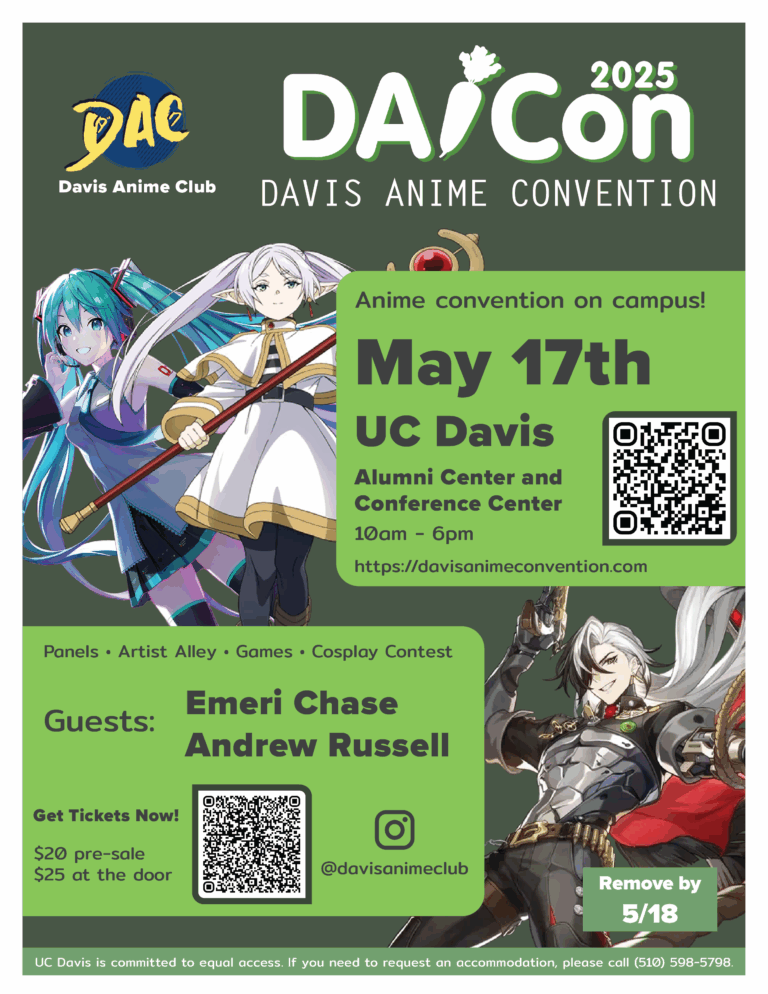
On Saturday, May 17, the Davis Anime Club is holding DAiCon, the Davis Anime Convention, at the UC Davis Alumni Center and Conference Center. The event takes place from 10 a.m. to 6 p.m. with ticketing costing $25 at the door. 

“It’s a great way for individuals to gather in a community and express cosplay,” Chloe Yee, a third-year nutrition science major and the Davis Anime Club’s vice president of public relations, said in an interview with The California Aggie.

A cosplay contest will be held at the patio stage of the Alumni Center with prizes for the winner including either a gift card or Raising Cane’s basket. The winner will be chosen by an audience-based voting process. 

There will be many cosplay gatherings, including one for the Japanese animated series “Jojo’s Bizarre Adventure” as well as the video game “Honkai: Star Rail.” 

“These gatherings are a chance to meet other people dressed up from these communities,” Yee said. 

There will also be an Artist Alley, involving 48 local artists selling anime-based art and merchandise. Vendors from local businesses in the Davis area will also be present selling apparel and other products and panels will be hosted on topics from Japanese fashion to Lolita culture.

Two prominent voice actors will be present at the panels as guests of honor: Emeri Chase, known for her role as Aurora in the “League of Legends” online game, and Andrew Russell, who plays Luka in the animated series “Miraculous: Tales of Ladybug and Cat Noir.”

“This is a great way for fans to interact with them and get an autograph or hear about their journey,” Yee said. 

Alongside the guest speakers, there will be a Games Area in Conference Room B for online and video game enthusiasts. There will also be performances from the Video Game Orchestra and anime cover band Otaku Ongaku. 

Anime lovers and enthusiasts of all ages are encouraged to attend the convention. Those interested can find more information on the DAiCon website, davisanimeconvention.com.

Written by: Sairaksha Thirunavukkarasu — campus@theaggie.org

LGBTQIA+ students reflect on the impact of queer stereotypes

UC Davis students discuss misconceptions and stereotypes surrounding the LGBTQIA+ community


By GRACIELA TIU — features@theaggie.org


Although the LGBTQIA+ community has been increasingly growing in visibility over the past several years, many queer students at UC Davis say they still encounter frustrating stereotypes — whether about their physical appearance, how they should act or even just portrayals of queerness in different forms of media.
One student, who wishes to remain anonymous, described some common assumptions she experienced due to her identity as a bisexual woman.

“Some common stereotypes I have encountered as a bisexual female include commentary on and sexualization of female and female sexual activities, asking whether I prefer men or women and consistently asking what gender is a better kisser,” the student said.

She explained how she herself has not felt any significant pressure to conform to any stereotypes, in part due to her perspective on her identity.

“I am a female who does not necessarily ‘look’ bisexual, and I have honestly not faced a lot of pressure or negative occurrences in relation to my bisexuality,” the student said. “I think that sexuality is a spectrum, and to me, being bisexual has not really changed or pressured me into becoming a specific person, since I do not view it as something that differentiates me from others.”

The student added how certain representations of the LGBTQIA+ community within varying types of media can also work to promote or defy common stereotypes.

“I think that queer representation in pop culture both reinforces and challenges stereotypes,” the student said. “For example, I believe that celebrities such as Megan Fox and Drew Barrymore challenge stereotypes about bisexual individuals. In contrast, stereotypical and exaggerated portrayals of homosexual men, such as Matthew in ‘Big Mouth,’ reinforce stereotypes and cause others to have an exaggerated view and a sort of ‘character’ that they associate with men who are homosexual.”

Stereotypes about those with LGBTQIA+ identities can also come from within the community itself, as another student, who also wishes to remain anonymous, added.

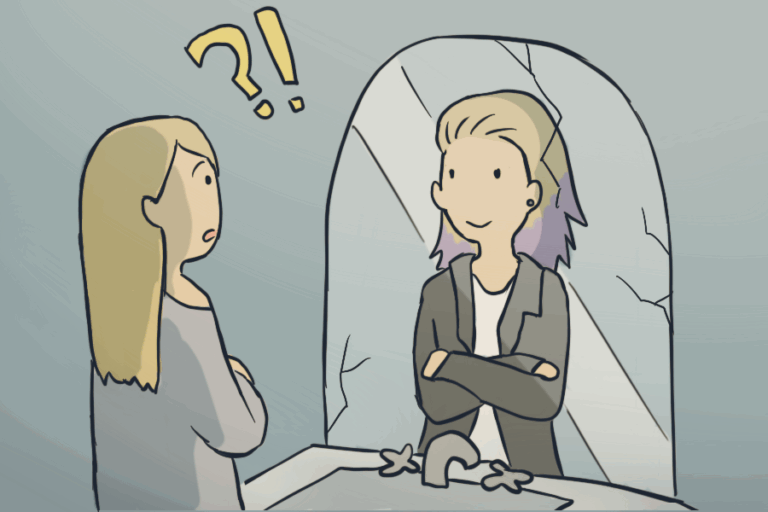
“In my community, I’ve often been called straight because of how I present myself,” the student said. “Initially, I felt as though I had to change my appearance to match my identity, but after discovering some TikTok creators, I realized that there was nothing wrong with my appearance and the way that I present myself.”

She also mentioned how stereotypes about different queer identities can sometimes revolve around gender expression, particularly the gender binary.

“I think the stereotypes of ‘femme’ and ‘masc’ are very much reinforced, but I also think it’s getting better,” the student said.

Another anonymous student relayed the stereotypes he has dealt with due to his identity as a gay man.

“One stereotype I’ve encountered is that when I hang out with guys, they often think I have a crush on them,” the student said. “Another stereotype is the assumption that being gay means dressing like a girl and liking ‘girl stuff.’ I haven’t been personally targeted, but I’ve heard people say things like this at school. They don’t really know what being gay actually means — they think all gay people love girly things, which isn’t true.”

He also discussed how pressure, from within or outside of the queer community, to perform his identity in a certain way can affect how others perceive him.

“People often assume I must act ‘obviously gay’ to be gay, and if I don’t, then I must not be gay,” the student said. “I’ve experienced people saying, ‘Oh, you’re not gay because you’re not showing it.’”

An additional misconception he mentioned about LGBTQIA+ individuals that feels especially harmful is the oversexualization of queer community.

“When it comes to media representation, I’ve noticed that pride festivals and the queer community are often oversexualized,” the student said. “A lot of people think being gay is just about sex, and that leads to misunderstanding[s]. Yes, at pride, people may dress boldly, but it’s usually to send a message — to express themselves in a society that doesn’t always let them.”

He wishes that more people would look beyond the oversexualization and be able to see the true beauty of the community.

“Sometimes I think the media focuses too much on sexuality instead of the broader message of acceptance and freedom,” the student said. “Being gay is about love, identity and being yourself — not just about sex.”

To him, stereotypes can often promote an unproductive and harmful culture leading to pressure and conformity, rather than freedom and self-expression.

“I believe the LGBTQ+ community is about being able to express yourself freely without judgment,” the student said. “If someone is pressuring others to conform, that’s not in line with what I believe the community should be about.”

Written by: Graciela Tiu — features@theaggie.org

Annual Psychology Conference provides an opportunity for students to present research

The event, to be held on May 16, follows the Undergraduate Research Conference


By NOAH HARRIS — features@theaggie.org


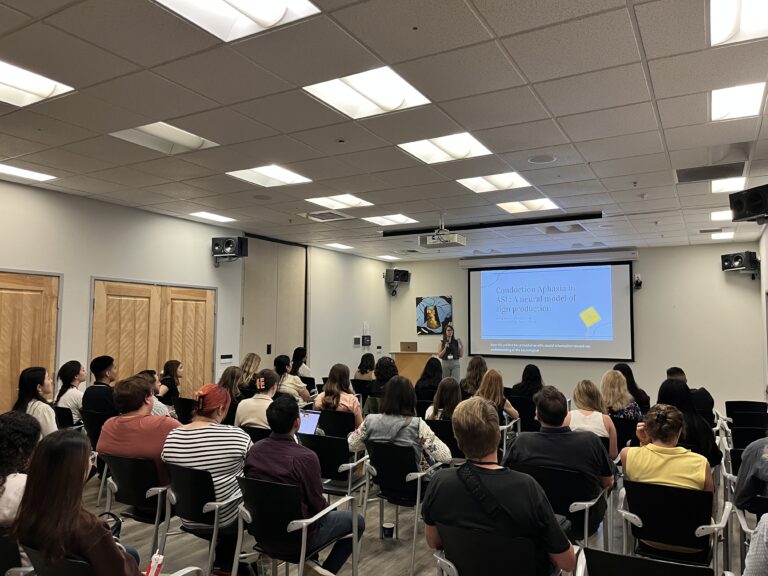
On Friday, May 16, UC Davis’ Department of Psychology will be hosting their annual Spring Psychology Conference at the Center for Mind and Brain in East Davis. From 8 a.m. to 5 p.m., the conference will be an opportunity for psychology undergraduates, graduate students and postdoctorates to showcase work they have been doing.

Posters will be put out in the hallways of the building’s first floor and there will be three different times for them to be shown. In between, student speeches will be given, followed by an award ceremony at the end of the event.

In total, 38 different groups will be presenting their work, which will be shown primarily through posters. The event is similar to the Undergraduate Research Conference (URC) that took place at the University Credit Union Center a few weeks ago, where over 1,000 students presented their research. 

The event is hosted by the Psychology Student Association and is an inclusive and cost-free conference — as Lucy Stowe, the president of the Psychology Student Association, explained.

“It’s open for undergrads, [graduate] students and even [post-doctorates] sometimes in the Psychology Department,” Stowe said. “Anybody who has a mentor in the Psychology Department or the Center of Mind and Brain [are] invited to submit work to present.”

For those interested in presenting next year, there are very few barriers in the way.

“We try to be as inclusive as possible,” Stowe said. “One of our main requirements though is to require them to have a faculty mentor, which is important just so that they’re connected to the department in some way.”

Jenna Distefano, the vice president of the Psychology Student Association, described the difference between this event and the URC.

“It’s such a unique opportunity, because people know about the URC, right?” Distefano said. “Everyone knows about the URC, but even people within [psychology] don’t know as much about this spring conference. I think if you are dedicated to research, it’s such a good opportunity to just get feedback or to get practice talking to a psychology audience.”

Stowe mentioned that the conference was welcome to both finished and unfinished research.

“We [accept] presentations of research at all stages, so it can be like a project proposal or like a scoping review or data collection, like preliminary data analysis, final data analysis,” Stowe said.

While the conference primarily caters to those interested in psychology, all are welcome to come and interact with those presenting.

“It’s definitely geared towards a psychology audience,” Stowe said. “That being said, a lot of the presenters that are giving talks like, or they’re all grad students or undergrads, they’re all students presenting. If you’re an undergrad curious about [a presentation], you can go and just talk to other undergrads and they’ll talk to you like an undergrad.”

While the conference is similar to past years, there is one change regarding the speeches segment, which had previously only been given by graduate students and postdoctoral scholars.

“The poster session was mainly for undergraduates, the talk sessions [were] like 15 minute[s] [and] were for the graduate students mostly,” Distefano said. This year, we opened up the talk sessions to undergrads because we had a few undergraduates who were interested in giving talks instead of posters.”

Sophie Lance, a recent UC Davis alumna with a Bachelor of Science in psychology who is presenting at the conference, described the atmosphere that one might observe if they attend.

“The first floor of one of the main buildings [at the center for Mind and Brain] is just everyone lined up in the hallways,” Lance said. “You stand next to your poster board and people come around and ask questions and whatnot.”

Lance also spoke about the differences between this conference and the URC from a presenter’s perspective.

“It’s really crowded and hard to hear [at URC],” Lance said. “Even though it’s supposed to be formal, it’s almost informal. But with this one, it’s more intimate. Since it is only psych people, the questions that we would get asked might be a little more advanced about the topic.”

Stowe summed up the benefits of presenting for the event.

“This is a really great initial opportunity to kind of dip your toes in the water and get a sense for what it’s like,” Stowe said. “It’s really a nice friendly environment, and you’ll get a lot of one-on-one time with your peers and with faculty.”

With its taking place just a couple of weeks after the Undergraduate Research Conference, the annual Spring Psychology Conference can go under the radar of many students and staff at UC Davis. However, it can serve as an invaluable experience for those attending and sharing their work at the conference.


Written by: Noah Harris — features@theaggie.org

UC Davis women’s lacrosse finishes season with a loss to University of Florida

The Aggies finish fourth in Big West Standings


By DANIELLE WIRNOWSKI— sports@theaggie.org


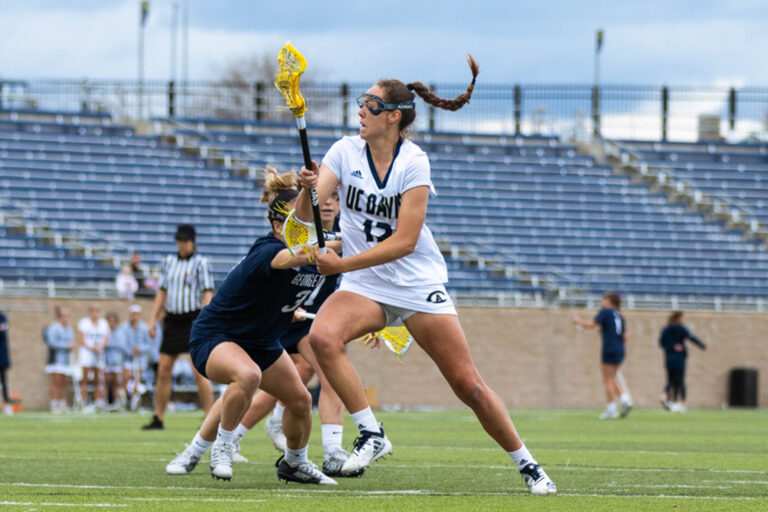
The UC Davis women’s lacrosse team traveled to Boulder, Colorado to face the University of Florida (UF) on May 1 for the Big 12 Conference Semifinals.

Coming off a win against San Diego State University, the UC Davis Aggies were ready to bring that same winning energy to the semifinals of the Big 12 against the UF Gators.

The Aggies, with a record of 6-9 prior to this game, started off strong with draw control by Annie Cimperman, a third-year communications and design double major. Despite this, UF picked up the ball after a shot attempt taken by the Aggies’ Alex Agnew, a cognitive science graduate student.

UF proceeded to go on a 4-0 run within the first six minutes of the game. They were also able to maintain control of the ball after each score, with the exception of the first goal they scored, in which the Aggies were able to gain control and attempt another shot.

Lauren Picardi, a fourth-year human development major, scored the first goal for the Aggies in the ninth minute of the game. After Picardi secured this goal, Cimperman regained possession of the ball for the Aggies in the following two minutes, only until the Gators gained control through a ground ball pickup.

Unfortunately, UF shut down any chance of the Aggies scoring more goals in the first quarter, with UF being able to score four additional goals.

Ally Richardson-Pepper, a fourth-year managerial economics major, secured a ground ball pick-up for the Aggies and attempted to convert this into an offensive play within the last 12 seconds of the first period. However, the attempt was stopped by UF’s strong defense.

UF’s momentum did not end in the first quarter either, with the Gators scoring five more goals against the Aggies in the second quarter. Nonetheless, the Aggies ensured that the Gators would have to fight for the chance to score a goal again.

In the last minute of the second quarter, the Aggies were able to secure a turnover, which led to the second and final goal for the season by Jane Fox, a first-year undeclared major. This brought the score to 13-2 in favor of the Gators at the end of the first half of the game.

Going into the second half of the game, the Aggies were ready to put up a vicious fight against the Gators and attempt to stop them from securing any more points on the board. UF started the third period with possession of the ball, but the Aggies attempted to gain control of the ball as much as possible during this period, resulting in plenty of attempted shots taken and draw controls.

Despite their efforts in the third period, the Aggies were unable to score more goals, while the Gators ended the period with four additional goals, bringing the score to 18-2 in favor of the Gators.

The Aggies employed the same strategy they used in the third period in the final period of the game, attempting to gain possession of the ball for as many minutes as possible through ground ball picks, turnovers and draw controls.

Unfortunately, the Aggies were unable to convert these possessions into successful shots on the Gators. UF was able to secure four more goals against the Aggies, despite the Aggies’ efforts, finalizing the score at 22-2 in favor of the Gators. The Aggies put up a strong fight against UF, but were unable to convert any goal attempts and secure the win for the semifinals, ending their season in Colorado.

The Aggies end their 2024-2025 season with a standing of No. 4 in the Big 12 Conference and a record of 6-10.


Written by: (Danielle Wirnowski) — sports@theaggie.org

Where is the good Mexican food?

UC Davis students and alumni discuss the lack of good Mexican and Latino food in Davis


By EVELYN SANCHEZ — features@theaggie.org


Davis has a wide array of cultural food that reflects the diverse population of the city. From sushi to bingsu to birria to prosciutto, both the savory and sweet tooth have options for students and community members alike to gravitate toward.

For the Hispanic community, however, this might be harder than it seems. With so many promising stores and restaurants lining downtown advertising quesadillas and tacos, it would be difficult to say that Davis has a lack of Mexican food. However, Davis does have a lack of good Mexican food, according to some members of the community.

Janet Ramos-Ambriz, a UC Davis alumna with a Bachelor of Arts in psychology and Chicana/o studies, has been living in Davis ever since her undergraduate years and offered her thoughts on the food scene.

“Apart from obviously Taqueria Guadalajara — that’s the only decent place,” Ramos-Ambriz said. “North Guads is the way to go.”

Despite not being associated with the downtown branch of Guads, Taqueria Guadalajara has been widely referred to as the “North Guads” by some students and community members. The Mexican restaurant, located at 640 W Covell Blvd., has an overall 4.6-star rating on Google Reviews, where people’s largest complaint is the line being out the door too often.

Natalie Chrisman, a fourth-year human biology major and Chicana/o studies minor, described Davis’ Mexican food scene as subpar.

“I think it’s not so good,” Chrisman said. “I feel like I’ve never wanted to go to the Mexican restaurants in Davis. If I want to go out to eat, [Mexican restaurants] are not at the top of my list. I’m not gonna pick Mexican food here, because most of the time I’ll be disappointed.”

As a Sacramento native, Chrisman would rather travel out of Davis than spend money on what she considers to be low-quality food.

Cris Lima, a fourth-year physics major, is also not a Northern California native, but is relatively satisfied with the food selection offered in Davis.

“I think for a town like Davis, it’s pretty good,” Lima said. “I’m from [Southern California] where there is a much larger Hispanic population, so it’s kind of a no-brainer that the food up here isn’t going to be as good. But you’d be surprised with what you can find here.”

Lima’s favorite Mexican cuisine is also Taqueria Guadalajara, as well as the Westlake Market on Lake Boulevard.

“There is a poor selection of [Mexican] restaurants,” Bryan Lopez, a Davis alum with a Bachelor of Arts in philosophy and political science, said. “Specifically, the lack of street tacos and street vendors is sad.”

Street vendors have faced multiple struggles in selling their wares and snacks in Davis’ downtown. Despite being protected by the Safe Sidewalk Vending Act, vendors often still face harassment and intimidation by police enforcement, making it harder to bring authentic cuisine to Davis.

While there are many Mexican and Latino restaurants in the Davis area, many students feel as if they are not on par with other dining establishments. Many cite a lack of authenticity as the problem.

With a student population of 25.1% and a city population of 15.2%, Hispanic and Latino students will continue searching for good cultural food.

Money is also an important factor in the equation for many students. Chrisman shared that she carefully weighs the financial value alongside the quality of the food she is purchasing.

“My other problem is that everything in Davis is rather expensive,” Chrisman said. “If I’m going to spend so much on food, then why would I spend it on Mexican food?”

Lopez’s family comes from Guatemala, and searching for Guatemalan food has proven to be even more difficult for him.

“There is none,” Lopez said. “There is absolutely zero Guatemalan food, but there are Guatemalan people. I can’t find Guatemalan food basically anywhere.”

Another hurdle for the Hispanic community is being able to make the food in the first place. Without the resources, the possibilities of feeling at home become even more scarce.

“It is nice that they’re opening a [Guatemalan] grocery store,” Lopez said. “Just because if I want to make my own Guatemalan food, getting the ingredients here is also a nightmare.”

With UC Davis officially declaring itself a Hispanic Serving Institution (HSI) in 2024, the campus community struggles with having their taste buds feel at home. Food is a central element of culture, and despite the lack of Mexican and Latino restaurants claiming to serve authentic cuisine, students at UC Davis will continue their fruitless search for something that tastes like home.

Written by: Evelyn Sanchez  — features@theaggie.org

‘In a rich man’s world’

Exploring whether or not capitalism is the root of all our woes


By VIOLET ZANZOT— vmzanzotl@ucdavis.edu


There’s this guy, let’s call him Karl Marx, who talked a lot about what he called “the base” of a society. Society’s system of production dictates pretty much everything else, acting as a base, according to Marx’s musings about historical materialism in his work “The German Ideology.” He referred to that “pretty much everything else” as the superstructure, which is the ideology of a society.

This framework is particularly notable because of its implication that everything we do in our society is caused by our economic system. Think of the work week, for example. It was built to give people five days of labor, thereby separating the idea of performing labor from subsistence. If we worked for the sake of survival, there would be no days off. In our society, work and survival are separated by a moderator; money is the middleman between labor and needs (it is also no coincidence that money pays for wants).

The complete interconnectedness of production and social living is not happenstance — at least, that is what Marx predicates. His theory has led me to wonder: Is the problem with American society today the base of capitalism? In other words, was Marx right about the relationship between economic system and social system, and is the turmoil in our country today caused by our economic mode of production?

It is no secret that we live in an anxious and turbulent world today. Politically, consensus feels lost. Technologically, progress seems to be leaving many people behind. Creatively, the struggle to be original and unique feels breathless. Even in love, we have turned to apps to introduce ourselves, when a generation ago, a bar was as good a place as any to meet people. Why? For Marx, the base develops everything else, and the superstructure’s purpose is simply to reinforce the base.

Capitalism has created a society built on consumption. Over time, we have seen that consumption has changed what the idea of “goods” means and, in turn, what people want. Rather than being just physical objects or services, goods are symbols. We don’t want shoes, we want Nikes. We don’t want sunglasses, we want Ray-Bans. We use things to define ourselves and express ourselves, and because of this, goods exist in a world of meaning.

This system of consumption has shaped the way we want to exist in the world, given that we’re all implicated by a world of symbolic things. The way we perceive ourselves and other people is through the lens of goods that represent bigger ideas. A Gucci belt is success. A Louis Vuitton purse is status.

Even a choice between restaurants is more than a choice between a burger or pizza; you must be able to afford a choice, and you are likely deciding within the context of a group of people. A burger or pizza is a symbol of a social strata, made of people with a common willingness to spend and socialize. The goods are symbolic.

Given that consumption has changed how we see people and the world, it feels very easy to blame differences between people on these goods. Can we boil down all of our issues to the fact that if you have nicer shoes, people will think differently of you? Is there a divide between Republicans and Democrats because they shop in different stores? Capitalism has turned people into deeply symbolic creatures that no longer exist in a simple reality of objects.

In the end, capitalism has incentivized people to utilize goods as symbols. This representative behavior has created barriers between people, pushing them apart. The more layers of symbolism, the more manufactured the separation between people.

That being said, if the different aspects of our social system were under arrest for the turmoil in our country, capitalism would very likely be the gun held by the perp — it is a tool that can be used for evil, but which cannot operate alone. I do not villainize capitalism as a theoretical framework. Rather, I find that it has added a layer of complexity through symbolism that has changed the name of the game altogether. We have institutionalized symbolism through consumption and the layers of nuance have created more room for trouble. If capitalism is not the whole problem, what is the solution?


Written by: Violet Zanzot— vmzanzot@ucdavis.edu


Disclaimer: The views and opinions expressed by individual columnists belong to the columnists alone and do not necessarily indicate the views and opinions held by The California Aggie.


The resurgence of the ‘R-word’

Why this slur needs to be left behind


By TARA ROMERO — tcrome@ucdavis.edu


I can’t believe I even have to write this article, and yet, here we are. My argument here is pretty straightforward: Stop using the R-slur.

You’d think saying something like “Don’t say slurs” isn’t necessary in 2025, but there’s been a particularly strong resurgence of this slur both online and in daily life in the past few years. Under nearly any slightly polarizing post online, the comments are full of the R-slur. I’ve seen the slur edited into the Charli XCX “Brat” logo and in every possible meme format. At the workplace and in the classroom, I’ve heard the word thrown around in casual conversation. It feels like, all of a sudden, everyone is okay with bringing this word back.

The R-slur was originally used in the early 20th century to refer to intellectually disabled people. Being labeled “mentally r*tarded” served as justified reasoning to place people into health institutions with harmful living conditions, mistreatment and abuse. During this same time, eugenics movements for “selective breeding” and “involuntary sterilization” of disabled people used this word to classify people who should be barred from reproduction — as seen with the Buck versus Bell 1927 Supreme Court case which upheld that states have the right to forcibly sterilize someone deemed “unfit to procreate” due to “mental deficiency.”

This word has consistently been used in laws to justify limitations on the rights of disabled people, enforced through marriage laws, guardian and conservatorship laws, inheritance laws and voting laws.

In 2010, Rosa’s Law replaced the word “mental r*tardation” with “intellectually disabled” in federal law. Let’s be clear: This switch does not undo the abhorrent government restrictions on disabled peoples’ rights. There are still many limitations in regards to social security, marriage and conservatorships. However, a study from Ohio State University tested college students’ tolerance of intellectually disabled people simply based on word choice — “mental r*tardation” compared to “intellectual disability.” The study found that students were more likely to endorse negative views of intellectually disabled people when they were referred to with the old term. The R-slur perpetuates long-standing prejudices against intellectually disabled people, and changing the phrasing actually impacts how neurodivergent people are viewed.

However, the word is not limited to directly discussing neurodivergent people. Instead, the word only implies disability when used in casual conversation. Through the 1980s, 1990s and early 2000s (and seen again now), the word has been used casually as a way to denounce someone’s intelligence. While not directly discussing or being used against a disabled person, the word implies the disabled label.

“Whenever we decide we want to insult somebody or throw hate to somebody, we attach them to a disability regardless of whether or not they have one,” Imani Barbarin, a disability advocate, said.

The R-slur operates in a way that can be applied to anybody — disabled or not. The word is always used with the intent to degrade the recipient of the word by associating them with disability, therefore perpetuating the ableist idea that neurodivergent people are “lesser” than others.

Some people grew up using this word their entire lives. Others learned it was wrong, but decided it was “cool” and “edgy” to bring it back. For many, this word has a layered and hurtful meaning that reminds them that the world sees them as lesser than, simply for who they are.

While the word’s history and intent give reasoning to refrain from its use, I don’t believe that is the main reason why the R-slur needs to be left in the past. It shouldn’t be said, because many neurodivergent people have spoken out and asked for neurotypical people to not use the word — that reason alone should be more than enough.

“We are a group of people willing to have a conversation, rather than everybody talking around us in this fraternalistic manner, telling us what we should and shouldn’t want for ourselves,” Barbarin said. “And so, when we talk about the R-word, do they trust us enough to say that this is something we don’t want to hear?”


Written by: Tara Romero— tcrome@ucdavis.edu

Disclaimer: The views and opinions expressed by individual columnists belong to the columnists alone and do not necessarily indicate the views and opinions held by The California Aggie.

Asian and Pacific Islander Queers’ annual Queer Prom 2025 brings celebration, drag to Davis LGBTQ+ community

The community event, themed to starry night, underscored the importance of queer joy on campus


By ROBIN FRANKLIN — campus@theaggie.org


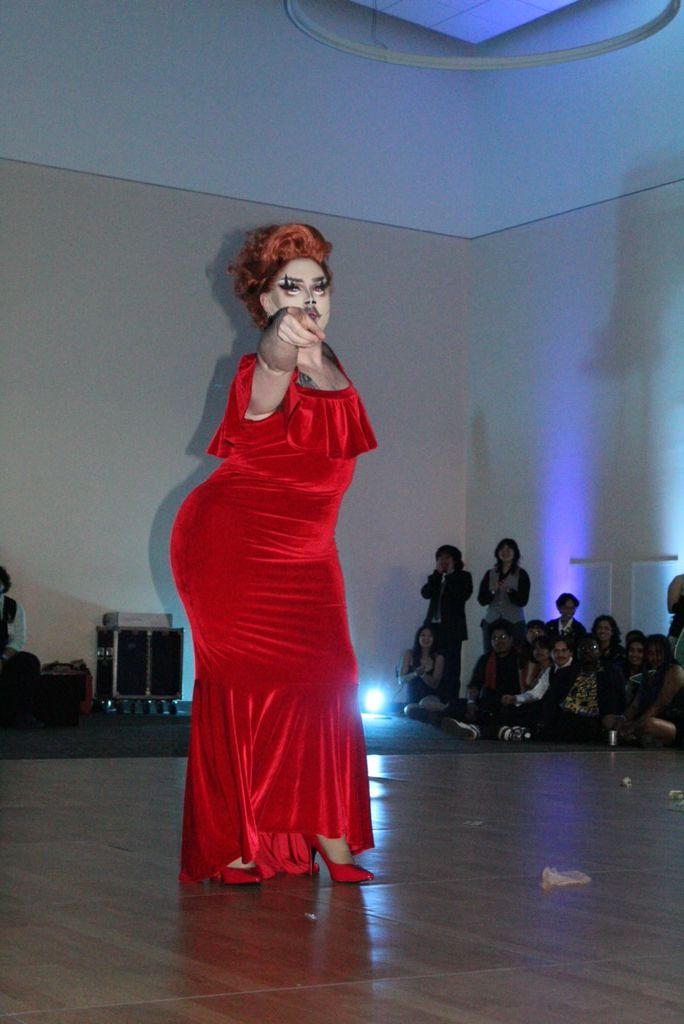
As the sun set, students in formal wear filed into the Asian and Pacific Islander Queers (APIQ) annual Queer Prom on Friday, May 9 at the UC Davis Conference Center, where they enjoyed music, dancing, drag, games and even complimentary catered dinner.

The free event, open to students of all backgrounds, was attended by around 250 people, according to organizers. The non-profit student organization has put on the event for over 10 years; It is the sole queer prom organized on campus and required some four months of planning.

Funding for the event, according to APIQ, was derived from the LGBTQ+ Center and a Club Finance Council grant. The dinner catering was funded by Wendy Moore, a parent to an APIQ member.

For many of those who couldn’t attend their high school prom, were unable to afford a ticket or just felt too unsafe to go, APIQ’s Queer Prom became a safe haven. That has been the longtime goal of Senior APIQ Advisor and Head of the Queer Prom board Nid Lefkoff, a third-year anthropology major, who has been organizing community events like this for years.

“I hope people who didn’t get to go to their high school prom because they are queer felt seen and felt valued going to an event that’s made for them,” Lefkoff said.

The glittering navy and silver decorations proudly displayed this year’s theme, “A Transcendent Celebration: To the Moon and Back.” Additionally, drag performances from artists Smokey, Ellis Dee, Lotus and Srobin took center stage with their elegant moves and costumes.

Repeat attendee Olivia Guerrero, a fourth-year English major, said that it has been incredibly rewarding to see the prom evolve over time.

“This has been my second time coming to this event,” Guerrero said. “It was really beautiful to see how far [it] has come.”

Another attendee, Keira Swihart, a third-year international relations major, felt free to fully express themselves in the hosted space and among other dance-goers. Even though she enjoyed her high school prom, she believes even the best of what regular proms offer can’t cater to the queer community in quite the same way.

“With queer friends and peers around, you can authentically dress how you want,” Swihart said.

Lefkoff felt a similar way and described the necessity of holding welcoming, inclusive events.

“Queer community is everywhere, but it especially thrives when there is a space where we can be unapologetically ourselves,” Lefkoff said. “That’s why having events like this is so important.”

The Asian & Pacific Islander Queers meet every other Monday in the LGBTIA Resource Center in the Student Community Center at 6:30 p.m. More information about the organization can be found on their Instagram page, @apiq.at.ucd, and website. Access to a membership form, an events list and an option to submit art and poetry to their newsletter are available, as well as LGBTQIA+ crisis resources.


Written by: Robin Franklin — campus@theaggie.org

Declining literacy rates in the United States reflect in other nationwide trends

Students reflect on causes, both short- and long-term effects of low literacy rates 


By ZOEY MORTAZAVI  — features@theaggie.org


As of January 2025, 54% of adult Americans read under a 6th grade level, according to the National Center for Education Statistics (NCES). That percentage, over half of the country’s population, is reflective of over 130 million people nationwide. Declining literacy rates can signal a lot of things about a country, including its overall well-being, its democracy levels and a myriad of other elements. UC Davis students shared insights into what these declining rates might be reflective of on a national level, as well as their thoughts on what factors might be primarily contributing.

Vedika Iyer, a second-year civil engineering major, expressed concern that declining literacy rates can not only be reflective of broader societal patterns — they can further exacerbate the problem.

“The literacy rates our country is displaying right now are what the future generations will be capable of, and it’s really concerning,” Iyer said. “So many kids can’t consistently read the news or couldn’t read a book about current events. […] Conservatism does not prioritize public education and access. By not banning books, by funding public programs like NPR and CBS — this is a conservative agenda, and it’s going to severely impact this country’s youth.”

The question of how far this de-prioritization of free and fair access to education and resources will impact the United States’ future is one that can only be answered as time passes. Ongoing efforts by the Donald Trump administration to gradually dissolve the Department of Education would significantly cut back on funding to countless educational and support-based programs for students in addition to deregulating the nation’s schooling system, defunding thousands of need- and merit-based scholarships and loans and generally decreasing improvements to school programs.

Many studies have found that the COVID-19 pandemic deprived many children of crucial years of schooling in person, likely stunting some growth significantly. This is well reflected in numbers; The NCES conducted a study that showed that among 13-year-olds across the U.S., reading and mathematics scores have dropped to the lowest levels seen in decades — similarly to scores from the 1970s.

There has undoubtedly been a massive educational expansion since that time, but much else has changed. Studies including that of the NCES are indicating that factors like mental health play a larger role in today’s world, with online platforms increasing cyberbullying and other external factors that impact general students’ performances.

Social media, short-form content consumption and digestible forms of entertainment and media have also likely exacerbated the decline of literacy rates across the board. Recent studies have reported that short-form content addiction and academic procrastination are inextricably linked — thus marking a connection between students’ inability to consume long-form content as effectively.

Elementary education is another important factor in trends surrounding declining literacy rates. A classically utilized teaching style among elementary educators is what is known as the “whole language” strategy. This method focuses strongly on the meaning of words and recognition; It commonly utilized books like the popular “Dick and Jane” series, which used word repetition as a tool for teaching.

Debates starting as early as the 1950s known as the “reading wars” resulted in the widespread implementation of learning through phonics, which follows a more bottom-up approach and focuses on letter and sound groupings over whole words.

Contemporary statistics have led to the newest approach, known largely as the “Science of Reading.” This approach combines elements of both strategies, implementing scientific research to fuel reading education based on what has empirically been proven to work. Without an overarching branch keeping a standard or method for teaching in mind, it is possible that further regressions or inconsistencies in these teaching methods will follow suit.

Many priorities in the United States are undergoing a tangible shift, as students like Iyer are discussing. Under the Trump administration, a resurgence in conservatism and more traditional values have emphasized privatized schooling and a re-implementation of older methods and traditions, including a currently in-progress Texas bill attempting to display the 10 Commandments in public classrooms throughout the state.

Without delving into the more secular side of this pending legislation, some American elementary school districts still utilize elements of whole language instruction over phonics instruction, sometimes not providing funding to phonics-based reading programs after earlier grades. Whole language instruction offers challenges where students are expected to be able to guess based on context clues, whereas phonic-based learning provides more of a basis into understanding patterns and nuances within the language being taught.

Many educators believe that a balanced approach is the key for students to truly learn to be good and well-rounded readers — but there is still much to explore in terms of their effectiveness.

In an overall sense, there has been an observed stagnation in students’ literacy improvements, according to recent studies. These conflicting methods may see even less resolve with educational funding being cut. Across the board, elementary teaching methods have seen a decline in their improvement, with scholars particularly noting that there has not yet been a rebound from COVID-19’s impacts on youth education.

Cooper Cook, a fourth-year mechanical engineering and aerospace engineering double major, said that this decline in improvement was most likely unavoidable.

“Regardless of the improvement in our elementary-level teaching styles, a decline in the improvement was inevitable, because we can only do so much to increase literacy rates across the entire United States,” Cook said.

Beyond just how student literacy is being handled inside the classroom and on a national level, students are weighing in on the implications of a country that is observing a decline in literacy rates. These patterns can often signal societal shifts, not just in terms of economic or social disparities but also in terms of democracy levels.

Clover Sutton, a second-year international agricultural development major, commented on declining literacy rates being a common sign that fascism is on the rise.

“Declining literacy rates are a sign that fascism is on the rise because the more we become complicit and unable to question those in power, the more likely [those powers] are to get away with more atrocities,” Sutton said.

Sutton continued by describing how fast-form content through social media platforms has contributed to these shifts.

“We live in a society where content is constantly being pumped out,” Sutton said. “Everything’s a trend. There are so many fast things. No one can read a book anymore, and it’s because we depend on such short-lived trends and we’re constantly scrolling. We don’t read anything longer than two paragraphs — [‘too long; didn’t read’] (TL;DR) and all of that — read it!”

Regardless of the countless contributors to this systemic issue, students at UC Davis have noticed patterns both leading to the rise and spread of illiteracy in the United States. This general decline can be attributed to many factors and could lead to a number of outcomes. As these UC Davis students have expressed, it seems that the time is now to stay civically engaged and continue to read — not only within the classroom, but in our everyday lives.


Written by: Zoey Mortazavi — features@theaggie.org