55.9 F
Davis

Davis, California

Tuesday, December 23, 2025
Home Blog Page 293

Succeeding in asynchronous classes: Professors and tutoring service staff offer tips and tricks

0

Professors and tutoring administration share the behind-the-scenes work of asynchronous classes and tips for students’ success

As asynchronous classes are becoming increasingly encouraged universitywide, students and teachers have had to pivot to new educational practices. 

Gregory Dobbins, an English professor, outlined the difficulties behind conducting asynchronous classes. Dobbins said that they are hard to take and even more difficult to prepare for. He often spends three hours producing a 30-minute lecture, and when COVID-19 first broke out, he estimated that he was on his laptop for 14 hours a day trying to conduct and redirect plans for his courses.  

Ethan Scheiner, a political science professor, stated that he has experienced the same issue. Normally, Scheiner would prepare for classes by reviewing past notes, however, now he needs to construct more distinct plans to make his videos as succinct and clear as possible, making the process more time consuming.

“It took me close to a full day to do any given lecture,” Scheiner said. “I probably put six to seven hours [in] per lecture.” 

Dobbins believes that students retain maximum information and focus when there are quick breaks every 10 minutes during class. With online classes, this practice is difficult because he wants to keep videos concise. Thus, he is experimenting with taking pauses when lecturing to keep students engaged. 

Global situations have made it increasingly difficult for professors to maintain their original plans overall. In addition to the pandemic, Dobbins noted that since transitioning to online classes last winter, a large scale event has periodically occurred around week seven or eight of each quarter that impacted lesson plans. 

He referenced the Black Lives Matter protests as a reaction to the death of George Floyd that happened near the end of Spring Quarter. During summer session, week seven marked times of displacement and power outages as California communities were ravaged by wildfires. Finally, Dobbins said that this past fall, the university and professors were prepared for the worst as the elections approached. 

With all of the circumstances students and professors have to adjust to, Dobbins and Scheiner shared their tips for staying focused. 

As the days pass by, Dobbins suggested that students add structure to their lives by forming new habits. Beginning March 14, the day of the statewide stay-at-home order, he began to listen to a different underground rock-n-roll album every day, which soon became an important part of his routine. This scheduled event gave him structure and new discoveries within his otherwise monotonous day.  

“If you can somehow register and mark how time passes, [then] it’s not just all this undifferentiated mess but there’s one thing that makes this day different than the next day,” Dobbins said. 

Similarly, Scheiner encouraged students to implement structure throughout their day. Though his lectures take hours to complete, he combats procrastination by ensuring videos are produced every Thursday. He sympathized with students and examined his own past as a “flaky college student.” He said that he eventually broke his cycle of procrastination because he hated the anxiety of finishing his work at the last minute.    

“At a certain point I internalized and kept that voice inside of me and just said to myself, that feeling is too horrible and makes me feel so awful,” Scheiner said. “The fear of that voice and that horrible stressed out feeling […] made me internalize deadlines.” 

Beyond personal projects and creating a routine, students can utilize campus resources such as the Academic Assistance and Tutoring Center (AATC) for direct academic support. 

During COVID-19, the AATC has rapidly shifted its services online to safely accommodate students. In fact, Carol Hunter, the executive director of AATC, believes that their services are more advantageous now than they were during in-person sessions. Previously, she mentioned that drop-in rooms had 50-75 students all seeking help at once. Now, students can sign up for individual remote appointments and get free one-on-one tutoring. 

Inez Anders, the director of AATC tutoring services, also gave tips to help students remain focused and diligent with their work. 

“Form studying groups with peers […], find time to watch class together for that built-in accountability,” Anders said. 

She also recommended forming Zoom study or silent groups that would mimic the space of being in the library with your classmates or friends and watching videos put out by the AATC for help on topics from math to writing.  

For videos on developing better mindsets, Hunter recommended the Office of Educational Opportunities and Enrichment Services (OEOES), which she said provides workshops that help students delve into subjects ranging from positive thinking, time management and grit.

Both Hunter and Anders encouraged students to begin tutoring or seeking help early on in the term before major issues can arise. Furthermore, Hunter said, students should try not to be intimidated by the prospect of seeking help.

“We try to meet the student where they’re at,” Hunter said. “We don’t have expectations of all the material that you should know when you’re coming in for tutoring because that’s what tutoring does, it fills in that gap for you.” 
Written by: Farrah Ballou — features@theaggie.org
Our empathy towards the mental health struggles of reality TV stars should not be conditional

0

How discourse around the mental health of reality stars shapes the way we handle stigma

The birth of a reality TV star begins and ends in a limbo ripe with contradictions. 

They are cogs in the machine of reality television: necessary for our entertainment, but so plentiful that when they are churned out, they are met with a level of fame that is not quite a celebrity, and not quite respectable. Unlike the god-like adoration and idolization we grant to actors and musicians, reality TV stars are much closer to the mortal viewer. They land in our watch parties, tweets and discussion threads to be dissected: their angry outbursts vilified, rejections cringed at and the amalgamation of carefully edited scenes is taken at face value. 

It is no secret that reality TV portrays anything but reality, yet we fervently hold reality TV stars to their edited realities

The basis of reality TV fame—that their lives become their livelihood—leave contestants at the mercy of producers. In shows like “The Bachelor” franchise, the edited realities of contestants are later served to the public for scrutiny. One contract from a contestant reads: “[I] acknowledge and agree that producers may use or reveal personal information which may be embarrassing […] humiliating […] and may portray me in a false light.” Breakdowns may be marketable for good television, but leave the mental healths of contestants at stake.

Tamar Braxton, of “Braxton Family Values,” describes how the manipulation of her portrayal deteriorated her sense of self, feeling as though she was no longer living but “existing for a corporation’s gains and ratings.” According to a report from 2019, at least 38 celebrities worldwide are suspected to have died by suicide following links to reality TV shows. Former “Love Island” contestants have criticized the show for failing to provide mental health aftercare, with some contestants suffering from increased anxiety and depression after the show. Following the death by suicide of “Love Island” star Mike Thalassitis, the unsavory nickname given to him during his time on the show—“Muggy Mike”—began trending on Twitter

Despite the clear mental health struggles of contestants, the vitriol of online abuse has yet to cease. I’ve seen some online wonder: Isn’t this to be expected when participating in a reality show? After all, contestants are diving into the belly of the beast by their own volition.

This kind of dehumanizing discourse around reality TV stars underlies a serious issue in the way we approach mental health and handling the stigma attached to it. Individuals with mental health issues deal with an internal stigma that makes them hesitant to relay their struggles and seek help. When reality TV stars brave the stigma and open up about their struggles, they are met with dismissal. How can we expect to remove the stigma surrounding mental health when we are so free to attach an additional stigma to reality stars? This type of dialogue perpetuates the dismissive attitude of faulting individuals for their mental health struggles.

The conditions of reality TV—glamorizing talentless individuals and superficiality—may make it hard for the general public to find empathy. Perhaps we judge them for their blatant chase for stardom—but their participation on a reality show does not mean they deserve to suffer nor does it lessen the mental health toll of them as individuals. The fact that the struggles of reality stars are quickly invalidated highlights how much mental health continues to be dismissed in society.

If we want to undo the stigmas associated with mental health, there cannot be double standards when it comes to the treatment of reality TV stars. We cannot dismiss the mental health struggles of one group and cater to another. This sets a precedent where we pick and choose whose mental health struggles to validate, steering us further away from creating an environment where individuals who come forward about their mental health are met with support and not dismissal.

At the end of the day, the empathy we give to others should not be on a conditional basis.

Written by: Renee Wang — reswang@ucdavis.edu 

Disclaimer: The views and opinions expressed by individual columnists belong to the columnists alone and do not necessarily indicate the views and opinions held by The California Aggie.

Chancellor Gary May was named one of 1,000 inspiring Black scientists in America

0

May speaks about leadership in 2020 and the importance of diversity in higher education

As a year marked by the COVID-19 pandemic, the resurgence of the Black Lives Matter (BLM) movement and a historic election, 2020 has called for a greater recognition of leadership within the Black community, which has been disproportionately affected by these events.

Within our UC Davis community, Chancellor Gary May has been recognized as part of Cell Mentor’s “1,000 Inspiring Black Scientists in America.” When UC Davis decided to transition to remote instruction in March, he began his weekly “Checking in With Chancellor May” emails to the community, used his “Thursday Thoughts” Instagram stories to bring awareness to issues facing Davis students and made swift statements regarding the social justice movements taking place.

Tatiana Perkins, a fourth-year political science and African American and African studies double major, stated that May’s presence in the community made her and fellow Black students feel supported throughout the challenging year.

“I personally have never had a visible figure in a staff position in school, in K through 12 or at community college; I have never seen a Black person that high up,” Perkins said. “After the murder of Ahmaud Arbery last February, Chancellor May and his wife immediately made a statement […] and with the Black Lives Matter protests he was always saying something, so I felt that […] Black students felt represented and supported by them. It definitely made being at Davis feel more comfortable.”

Although he is now a prominent figure at UC Davis, May did not always intend to become a university chancellor. After graduating from Georgia Tech in 1985 with a B.E.E in engineering and earning an M.S. and PhD in electrical engineering and computer science from UC Berkeley, he returned to Georgia Tech as executive assistant to the then-Georgia Tech President Wayne Clough, where he built a strong foundation in leadership, inspired by his years at Berkeley.

“Those years were also a time when I got deeper into advocating for graduate students,” May said via email. “I helped form the Black Graduate Engineering and Science Students not long after I entered UC Berkeley. During that time, I also served as [the] national chairperson for the National Society of Black Engineers.”

Upon his return to Georgia Tech in 1991, where he would eventually become the Dean of the College of Engineering in 2011, May’s interest in advocating for graduate students and leadership was guided by one of his mentors, Wayne Clough.

“I started my career in administration as executive assistant to then Georgia Tech President Wayne Clough,” May said via email. “He was one of my mentors and encouraged me to learn about and pursue broader leadership opportunities. He taught me about statesmanship and effective leadership.”

During his time at Georgia Tech, May said that he focused his leadership on improving diversity and access to higher education by helping the university create two programs that aimed to increase the number of underrepresented students in their graduate school. He created the Summer Undergraduate Research in Engineering/Science program (SURE), which allows minority students to conduct research at Georgia Tech during the summer. According to SURE’s website, 75% of students in the program choose to attend a graduate school after completion. May also helped create Facilitating Academic Careers in Engineering and Science (FACES), which allowed 433 minority students to get PhDs at Georgia Tech.

In 2017, May became the first African American chancellor of UC Davis and only the second ever at a UC school. May explained that being the first African American chancellor has been challenging, including the need to set boundaries with whom he represents and what he chooses to speak out about.

“I’ve had quite a few requests over the past year to speak about diversity and inclusion to campus groups, external partners and businesses,” May said via email. “People are seeking to understand the issues and find solutions. However, I often remind people that I am the chancellor of UC Davis, not the chancellor of “BIPOC” [Black, Indigenous and People of Color] UC Davis. It is a balancing act.”

In addition to these pre-existing challenges, 2020 has called on leaders at many levels to take stances on issues that were sometimes previously overlooked, such as politics. 

“In times of uncertainty, especially, people look to leadership,” May said via email. “The COVID-19 pandemic—and the civil unrest we’ve seen following the murder of George Floyd—impact our most vulnerable students. These events exacerbate the issues facing underrepresented students due to lack of resources, support and additional responsibilities placed on them in settings away from campus. I want them to know [that] their UC Davis community stands with them.”

  May said via email that he is flattered to be included in the list of inspiring Black scientists, especially among colleagues Renetta Garrison Tull, the vice chancellor for Diversity, Equity and Inclusion, and Devin Horton, the graduate diversity officer for STEM disciplines and a number of faculty from the UC Davis College of Biological Sciences. 

“It’s an honor to receive recognition like this and to see so many of our UC Davis colleagues on the list as well,” May said via email. “A lack of diversity in STEM has been an intractable problem for many years. I’ve spent much of my career working to change that, because diversity helps drive innovation and technological advancement.”

He shared that in 2020, he’s learned that higher education can help be the solution for many problems we are facing today.

 “We’re preparing the next generation to tackle some of the world’s greatest challenges—whether that’s climate change, the next pandemic or social justice,” May said via email. “We need to help them understand these challenges and inequalities so they can become change makers.”

Written by: Katie DeBenedetti — features@theaggie.org

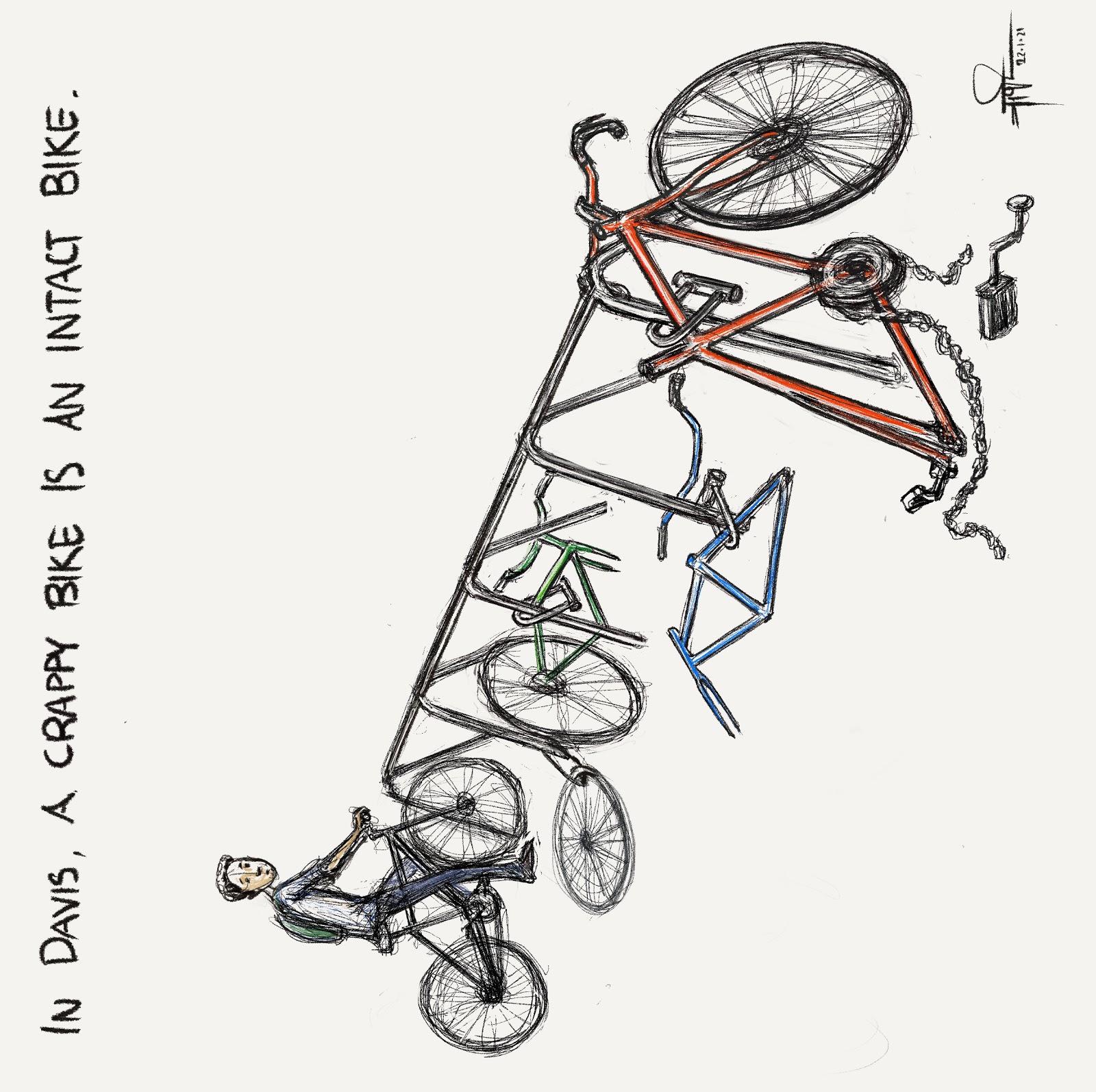
The advantage of owning a piece of sh*t bike

0

Drawn by: Rushi Tawade –– rntawade@ucdavis.edu 

Disclaimer: (This cartoon is humor and/or satire, and its content is purely fictional. The story and names of “sources” are fictionalized.)

Review: ‘Small Steps’

0

UC Davis Department of Theatre and Dance and Catalyst present a charming comedy about a gay astronaut

From Jan. 21-23, Catalyst: A Theatre Think Tank presented “Small Steps,” a comedy about a lonely gay guy sent on a one-man mission to Mars, through the UC Davis Department of Theatre and Dance in collaboration with Bike City Theatre Company.

Before the show began (over Zoom conferencing), Mindy Cooper, a professor of Theatre and Dance at UC Davis and the cofounder of Catalyst: A Theatre Think Tank, took the screen to give a few brief words about the show. Owing to the pandemic, the actors of “Small Steps” recorded their performances separately, with just a few scenes including more than one actor in the same physical space.

Charlie Lavaroni offers a convincing performance as Skip Powers, chronic “heartbreakee” and terminally awkward loner, who finds himself as the lone astronaut on a one-way trip to Mars despite his complete lack of applicable skills or experience. The show’s first half is dedicated to scenes establishing Powers’ loneliness and the preparation he must undergo for his interstellar trip—including a hot-headed “abstinence coach,” who Powers doesn’t really seem to need, and a deadpan doctor that Powers slowly befriends.

The cast of characters is wacky and diverse, but each retains the same snappy humor for the whole show, full of comebacks and snide derision. Some actors play multiple characters, though they’re able to distinguish between each sufficiently.

Throughout the barrage of comedic dialogue, it’s sometimes difficult to pick apart what’s happening spatially; though some scenes are clearly meant to be video calls between characters, there’s little besides dialogue clues to indicate when they’re supposed to be in the same location, and few steps are taken to mitigate this confusion. The result is that there’s not much for the audience to latch onto and use to form a complete mental image of these scenes, giving “Small Steps” a feel at times closer to a reading than a proper performance.

The writing is frequently engaging and often goes in unexpected directions, though the tone remains more-or-less constant throughout. The character Skip Powers is regularly entertaining, if a bit simple, and pulls the show through its two hours with his self-deprecation and romantic angst. 

Despite some confusing production choices, “Small Steps” manages to be charming and consistent throughout its runtime and showcases local talent in a unique way—nothing to sneeze at under these current circumstances. Parties involved in the production have plans to put on more remote performances this year, undeterred by the pandemic: Catalyst, in collaboration with the UC Davis Department of Theatre and Dance and the Jan Shrem and Maria Manetti Shrem Museum of Art, will be performing “Perfect,” directed by JanLee Marshall, on Feb. 17.

Written by: Jacob Anderson — arts@theaggie.org

ASUCD Senate passes five bills unanimously at January 14 meeting, but tabled DREAM Committees proposal for pandemic fund again

0

Senate Bill #47, an ASUCD senate bill introduced to provide $9,800 to the Dream Committee for a pandemic relief fund for Dreamers, was once again tabled

At the Jan. 14 meeting, ASUCD Senate passed Bills #51, #50, #48, #49 and #42 unanimously, which serve to structure the bylaws, get a handle on the budget and provide clarification on the senate’s commitment to following state and federal laws.

Senate Bill #47, a Senate bill introduced to provide $9,800 to the Dream Committee in a relief fund due to pandemic hardships, was also brought up during old legislation discussion but was tabled by author Senator Rodriguez-Ibarra due to lack of structure, according to Senator Maahum Shahab. 

Bill #47 is a way to bring back accountability after funds that had been promised to undocumented students in the beginning of the pandemic were not distributed, Shahab said. The Controller sought changes for more accountability, and asked with whom they had talked. 

 “After that, there weren’t many concrete answers,” Shahab said. “This table saw there was no new process; there was a lot of fear that the same thing would happen again. Everyone voted to table it until we properly go back and find a new structure.” 

Vice President Emily Barneond introduced two nominees for associate vice president: Juliana Hernandez for associate vice president of internal communications and Vinal Chand for associate vice presidents of external communications. In unanimous consent, the motion passed. 

For the weekly reports, President Kyle Krueger mentioned meeting with administrators and students regarding Physical Education and attending Academic Senate to speak with individuals regarding Equitable Access concerns.

Vice President Emily Barneond reported on working to integrate the Senate and Executive members more by creating a new committee and amending ASUCD bylaws for administrators to come to committee meetings. 

Senator Amanjot Gandhoke reported meeting with Pantry Director Ryan Choi to discuss the functionality of The Pantry moving forward, and met with Maya Llamas, the executive director of the Community Resource and Retention Centers, to discuss KDVS’s strategic planning meeting. 

Senator Lucas Fong met with the Entertainment Council to discuss upcoming quarterly events and plans, and suggested adding Saturday Trivia Nights to the calendar. 

Senator Kristin Mifsud sat in on a meeting for a new Athletics Director along with President Krueger. 

Senator Shahab discussed the City of Davis’s public meeting which considered better options for affordable housing and provided a statement in support.

Senator Tenzin Youedon met with representatives from the Committee on Student Affairs and Fees to discuss student fees and attended a meeting to discuss the Campus Expansion Initiative. 

Written by: Annette Campos — campus@theaggie.org 

How the UC Davis community celebrated Martin Luther King Jr. Day this year

0

Students and faculty reflect on Martin Luther King Jr.’s legacy

Over the years, UC Davis students and faculty have taken part in many celebrations and dedications honoring Martin Luther King Jr.’s legacy. King’s assassination on April 4, 1968, had such an emotional impact on the UC Davis School of Law students, many of whom were active supporters of his mission, that they endeavored to have the law building named in his honor. About a year later, on April 12, 1969, King Hall was given its official name. King’s wife, Coretta Scott King, spoke at the UC Davis School of Law’s commencement a little over a decade later in 1981. Every year, the UC Davis School of Law holds the Martin Luther King Jr. Day of Service and Celebration around the community and at King Hall. 

This year, although no events were held in King Hall, law students, faculty and community members spent the day in service by participating in a blood drive at the King Hall parking lot and donating essentials that went toward Saint John’s Program for Real Change. Some participants also received training a few days in advance so they could inform community members in webinars where they provided information on CalFresh, housing evictions and how to determine eligibility for government benefits on the 18th.

Kevin Johnson, the dean of the UC Davis School of Law, helped plan this year’s service day with King’s values in mind. 

“The UC Davis School of Law community will help people in our community who are in need,” Johnson said via email. “Helping others is what Dr. King stood for.”

Elisa White, an associate professor of African American and African studies spent time in past years, before Martin Luther King Jr. Day was a federal holiday, working with organizations who were pushing for the holiday to be nationally recognized. This year, White said she spent the day in quiet reflection.

“After four years of the Trump administration and the larger administrative initiatives that were mostly antithetical to anything King would have advanced in terms of equality and rights in the U.S. and globally, it’s nice to step back and see what has happened in the past four years and reflect on why we still consider these same issues and have to every day,” White said. 

Isabel Nelson, a second-year international relations major and African Diaspora Student Success Center assistant, was the president of her high school’s Black Student Union and celebrated the day in past years by attending a walk with her family down Martin Luther King street in her hometown of Riverside, CA. As an artist, she created a digital portrait of King this year in celebration of his legacy. Nelson said that he thinks if King were alive to witness the storming of the Capitol on Jan. 6, he would have responded with dismay. 

“I know he’d be out there as the voice of our black community saying something about, ‘If those people were Black people, they would not have reached anywhere where they reached when they rioted,’” Nelson said. “Because if they were Black people, they wouldn’t have even gotten up the gate, they would have been shot dead, and I know he would have made that known and verbalized that to everyone.”

Armani Peterson, a senior career advisor for the Internship and Career Center, celebrated Martin Luther King Jr. Day by participating in walks that supported charities with his family and watching documentaries on the civil rights movement. Peterson believes that Americans can refer to King’s values when practicing patriotism.  

“What we can learn [from King] is that we can still care deeply about this country and still recognize the downfalls,” Peterson said via email. “We can be grateful to be an American but acknowledge the flaws in its execution of the laws. In order for us to be patriotic is to ensure that every person has an opportunity to pursue the best this country has to offer.”
Written by: Lyra Farrell — features@theaggie.org

UC Davis students reflect on the Disney Pixar film, ‘Soul’

0

Students discuss the portrayal of people of color in Disney movies and the overall message that they took from the film

Near the end of last December, Disney Pixar released a new animated film, “Soul.” The film explores what it means to have a purpose in life. One of the main characters, a middle school band teacher Joe Gardener (voiced by Jamie Foxx), finally gets his big break as a Jazz musician, stumbles into a sewer hole on the streets of New York City and travels to the “Great Before.” It is here where Joe is tasked to help a stubborn soul, known as 22, find a way to gain interest in the human experience. Throughout the movie, the characters explore the idea of what it means to be alive. 

Fourth-year English and neurobiology, physiology and behaviour double major Taylor Silva discussed the most important takeaways for her from the Disney Pixar film. 

“I think the moral of the movie was to slow down and take a step back from your own life and analyze what you consider priorities,” Silva said. “We get wrapped up into things like our jobs or school and there’s this general feeling like we have to have some great purpose and that our life has value because of what we do or where we work.”

Silva further explained how “Soul” was a reminder of the simple pleasures in life. 

“The daily interactions that we usually disregard are important and beautiful in their own way and we don’t appreciate them enough,” Silva said. “Instead we get wrapped up in who we need to be or who we want to become.” 

As a pre-med student, Silva found the movie to be particularly reflective of her own struggles to complete the rigorous medical school requirements. 

“I feel like, as someone who hopes to enter the medical field, there is a lot of pressure to be someone who is super driven and outperforms others,” Silva said. “I think ‘Soul’ emphasized the idea that your purpose is not equivalent to your profession; there is no such thing as having a single purpose, and the purpose of life is just living itself.” 

Silva noted that the film had a profound message that could be applied to her life. 

“Don’t get caught up in the race of life,” Silva said. “It’s okay to not always be the best or be productive 24/7. The theme of the movie kind of reminded me of the quote ‘stop and smell the roses.’” 

When the film was released, Pixar faced some backlash because the main character, Joe Garderner, who is a person of color (POC), was transformed into a non-human form. This theme has been seen in other Disney movies, with main characters who are people of color, such as “The Princess and the Frog” and “Spies in Disguise.” UC Davis 2020 graduate, Tobi Ayo-Ajibola, discussed these concerns in greater detail. 

“My main gripe with the movie and with other Disney movies with a Black lead is that the main character is almost immediately transformed into a non-human lifeform,” Ayo-Ajibola said. “While this movie is spun to have the main Black lead as the center of the narrative, a character voiced by Tina Fey, a white identifying comic, quickly racks up screen time, and, in my opinion, steals a lot of the spotlight.” 

Ayo-Ajibola noted that although the film employed a message that spoke to the trying times everyone has been facing over the past year, the motif of transformation of POC characters was a bit disappointing. 

“They settled into this habit of setting up a story [of a POC], but then settling upon their continued success found with non-POC characters,” Ayo-Ajibola said. “Don’t get me wrong, I love waiting for how quickly Disney will introduce a character of color and then turn them into an inanimate object or a non-human life form, it’s actually comedy. But I’d venture to say that because of this trope, there have been very few true Disney stories centered around the narrative of a POC.”

Fourth-year neurobiology, physiology and behavior major Alyssa Ghose noted how unlike “The Princess and the Frog” and “Spies in Disguise,” the use of non-human forms was necessary in the context of the movie plot.

“I read an article about the transformation of POC characters before I had seen the movie, so while I was watching ‘Soul,’ I had those comments in the back of my mind, but I thought this movie was a little different,” Ghose said. “I agree that transforming the characters into a frog in ‘The Princess and the Frog’ and a pigeon [in] ‘Spies in Disguise’ was unnecessary for the plot of those movies. But in ‘Soul,’ Joe changing into a blue soul creature did not feel like it was undermining his identity and who [he was] as a person, and I think it would have been difficult to have the concept executed if he stayed a human throughout the whole movie.” 

Disney Pixar movies are known for plot lines that have deeper thematic meanings regarding existential issues. In the movie “Soul,” the overarching motif was about understanding the purpose of life. Ghose detailed how the movie helped her reflect on her own life. 

“I kind of got the message that there is not one sole thing that gives you a purpose in life but rather a collection of your experiences, and the idea of actually making the most of your life gives it purpose,” Ghose said. “I do think there is such a thing as finding your purpose, but I think oftentimes people put a lot of pressure on themselves and think that their career is their purpose and I think that is the wrong way to go about it. I’m not sure if I can confidently say that I have found my purpose in life, but I am excited to keep living and having new memories and experiences to find out.”

COVID-19 has taken a toll on everyone, but according to Ghose the movie “Soul” delivered an important message for the audience to take away. 

“Life is about the little moments, especially during times like these,” Ghose said. “I want to make the most of this year and try to not to take those little moments for granted.”

Written by: Sneha Ramachandran — features@theaggie.org

UC Davis students highlight their favorite quarantine recipes

0

With limited dining out and takeout options, students find new inspiration for cooking

While quarantine during the COVID-19 pandemic limits many of life’s once-normal activities, it allows time to master skills that can be done from home. One such skill is cooking, providing students with the opportunity to explore new recipes and hone their techniques. From cheesecake to frozen foods, students shared how quarantine has impacted their cooking habits. 

Ananya Narasimhan—a fourth-year genetics and genomics major and a board member of UC Davis’ cooking club, Food for Thought—has developed a new approach to cooking due to the confines of quarantine. 

“Taking care of my health has been difficult with not being able to be outside and work out as much, so I try to stick with fresh ingredients and really keep an eye out for unhealthy ones,” Narasimhan said via email. “I put more time into my cooking than when I cooked before quarantine, and as a result, I enjoy the process and the meal much more.”

As Narasimhan continues to develop her cooking abilities, she said that flautas de pollo (chicken taquitos) was her favorite quarantine recipe. 

She also said that for college students, learning how to cook is essential as it is both necessary for self care and something that can improve everyday life. For students who are not passionate about cooking, Narasimhan shared the importance of starting with familiar recipes and gradually building skills to tackle more difficult dishes. 

“My advice to a student who isn’t too keen on cooking is—start with what you know,” Narasimhan said via email. “Just like any other hobby, skill or extracurricular, it will take time to explore your palate and cook recipes that you’ll like. Food can improve your relationship with your health and wellness, as well as provide a break from a hectic day. All you need to do is pick a starting point, and it’s all uphill from there.”

Devon Spina, a second-year civil engineering major, prefers her cooking to be as fast and easy as possible. While Spina stated that cooking is a refreshing break from school, her cooking habits in quarantine have mostly remained consistent with previous years.  

“It hasn’t changed too much since I was younger,” Spina said. “It’s been mostly just frozen meals: easy, quick, nothing too complicated.”

Spina’s favorite quarantine dish is pesto pasta. As her pesto recipe came from her grandmother, the meal is close to her heart. Despite her current familiar cooking patterns, Spina hopes to try out new recipes and expand on her meals in the future. 

One cooking tradition that she has developed over quarantine is baking with her roommates. Whether she’s baking cookies or muffins, Spina shared that it is always a fun and relaxing experience.

“It’s a de-stresser,” Spina said. “Because with cooking, it doesn’t require a whole lot of brain power, but it’s enjoyable. We tend to do it together, and then you get a nice treat afterwards.”

Dayton Harvey, a second-year computer engineering major, has broadened his cooking abilities this quarantine. Because restaurants have been subject to closing and ordering takeout is pricey, Harvey has realized the value in cooking at home and taken the time to learn more. 

He shared that his go-to quarantine cooking technique is creating recipes centered around a crock pot.  

“It’s a lot easier to throw chicken or pork or whatever you choose in the crock pot, let it cook for six hours, come back and saute some onions or throw potatoes on, and you have a meal,” Harvey said.

Another of his favorite techniques is using marination when cooking things like salmon or chicken, as it allows the food to fully absorb the flavor overnight. 

Beyond developing his cooking skills during quarantine, Harvey shared that it is generally important for him to cook for himself due to his many allergies and dietary restrictions. 

“A lot of meals my family would cook I wouldn’t be able to eat,” Harvey said. “So people with dietary restrictions: it’s very important to know how to cook on your own.”

He encouraged everyone to develop cooking skills, mentioning the potentially exploratory experience that awaits. 

“Cooking can be fun and enjoyable if you mess around with different recipes, different flavors, different spices and kind of tune it to what you like,” Harvey said.

Written by: Nora Farahdel — features@theaggie.org

Yolo County Board of Supervisors begin new term after being sworn-in virtually

0

Board members to focus COVID-19 crisis, homelessness and climate action in the new term

On Jan. 4, all Yolo County officials elected in the 2020 election cycle were sworn in during a virtual ceremony held via Zoom. 

Among those sworn in were Yolo County Supervisors Oscar Villegas, Jim Provenza and Angel Barajas from Districts 1, 4 and 5 respectively. This marks Barajas’ first term on Yolo County’s Board of Supervisors after having served as a member of Woodland’s City Council. Barajas is the only new board member elected in 2020. 

Angel Barajas talked about his recent appointment to the Board at the Jan. 12 Board of Supervisors meeting

“I want to thank everyone that was able to participate in me getting this position back in March, and I want to thank everybody in the transition staff who filled me in so I can hit the ground running,” Barajas said. “I know that there are a lot of issues we need to continue to tackle, and I look forward to working in a collaborative manner with everybody to get things done.” 

Beginning his third term, Yolo County Supervisor Oscar Villegas expressed gratitude for his reelection to the Board of Supervisors.

“[I am] honored to have the opportunity to continue to serve the residents of West Sacramento and Clarksburg,” Villegas said via email. “Their trust in electing me to continue to serve as their representative on the Yolo County Board of Supervisors is something I really take to heart.”

Going into the new term, Villegas explained that adressising the COVID-19 pandemic will take precedence. 

“This public health issue has adversely impacted segments of society and although we are on the road to recovery, this matter will remain prominent before every state and local jurisdiction,” Villegas said via email. “I will continue to focus on [reinforcing] and/or rebuilding our health care delivery system to respond to this crisis and to manage our budget accordingly.”

At the Jan. 12 meeting, Supervisor Jim Provenza also talked about the COVID-19 crisis and described an upcoming summit where community members will be able to discuss the many impacts of the COVID-19 pandemic. 

“[The summit is] different from what we do normally,” Provenza said. “We will have a number of panels and hear from others in the community like health providers, businesses, union representatives, community organizations and others who we don’t usually hear directly from. I think it will be very informative and allow us to be informed on different viewpoints.”

Villegas explained that despite the extraordinary circumstances under which the new term has begun, new and returning board members must continue to address other pressing issues as well. 

“There remain many other serious matters that require our attention,” Villegas said via email. “[This includes] housing and homelesness issues, preservation of wildlife and agricultural land, transportation and road infrastructure, climate action plans, juvenile justice restructuring and a comprehensive water solution for the state.” 

Villegas explained that citizen participation in policy matters that will be brought to their elected officials is crucial.

 “If recent events have taught us anything, it should be that the government is designed to work in the interest of the people,” Villegas said via email. “Local government is participatory and works at its highest level with community engagement. I encourage everyone to minimally provide public comments in areas of interest or to volunteer to serve on a city/county committee or commission.” 

The Board of Supervisors typically meet on Tuesdays at 9 a.m. Residents are encouraged to participate either by attending a meeting or submitting a statement. Information can be found on Yolo County’s website along with a list of upcoming meetings and recordings of previous meetings.Written by: Yan Yan Hustis Hayes — city@theaggie.org

The UC Davis Patio app aims to help students stay connected during the pandemic

0

The student who assisted in launch of UC Davis Patio reflects on how the app allows new students to connect with one another

During the pandemic, students have found it difficult to establish connections with their fellow Aggies. One way that new UC Davis students are connecting with each other online is through an app called Patio.

Patio is an app designed for college students to form groups based on their shared interests. In order to make an account, a user must be a verified student with a college email address from one of the select campuses recognized by Patio. After making an account, students can choose groups that they would like to join based on their interests, clubs or classes.

Ray Huerta, a first-year environmental toxicology major, helped coordinate the launch for the UC Davis Patio. Huerta met with one of the founders of the app, Andrew Martin, who was looking for university students to assist in introducing the app to the UC system. This past September, the UC Davis Patio app was put into effect and began allowing students to join.

Upon making an account, UC Davis students are added to a central group chat for all Aggies. From there, they can join groups that are catered towards their interests or create their own.

“We have over 200 groups on the UC Davis Patio that can range from sports to music to Aggies who are passionate about movie-watching or finding new places to eat in Davis,” Huerta said. “It makes it very easy to find people that go to your college and have similar interests as you. If you don’t find a group that you like or you fit into, you can even make your own.”

While students were able to successfully connect with other students and establish new social circles on Patio, Huerta states that there is still room for improvement. Huerta noted that students do not use Patio as frequently as they did when it was first launched. In addition to this, not many students on campus are aware of the app or interested in utilizing it.

“I think the app would have been a bigger success if it launched way before instruction started,” Huerta said. “The app is also very difficult to promote to Aggies that already have experience at UC Davis because they have formed their own groups and friendships. Hence, they are not looking for new people to meet as much as incoming first-year students and transfer students. Also, this pandemic has not made it any easier for anyone and many people that were introduced to each other on the app could not meet up in person.”

One way that Patio is planning to expand its reach is by creating platforms for seniors in high school who have been accepted to college. This would enable them to connect with other students who got accepted to the same school well in advance of the beginning of instruction.

“I think this will definitely attract more people to the Patio app because the priority of incoming freshmen is finding new people to build friendships with and Patio does just that,” Huerta said. “I remember as a senior in high school, joining the Facebook group chat for my class was a great way to connect with people, but Patio makes it easier to connect with other admits one-on-one.” 

While UC acceptance letters have not been released yet, Huerta is working with other UC Davis students to introduce the next class of freshmen to Patio ahead of time.

“My partner and I are very excited to get the class of 2025 on the app as soon as possible,” Huerta said. “I think introducing Patio to incoming freshmen early on is going to be

essential in the success of the app. I think Patio will become the new app that college students use as the years go on.” 

Huerta made note of the way the pandemic has been a large obstacle to developing strong social networks on campus. 

“Socially, I wish I had more friends at Davis and connected with them more because there is only so much you can learn about someone online,” Huerta said. “I have never met any of my UC Davis friends in person besides one of them so it is very hard for me to call it a friendship.”

Despite the added difficulty brought by the pandemic, Huerta encourages students to step out of their comfort zones and reach out to others with confidence.

“At first it was very difficult to meet people and make friends at Davis, but I put my nervousness and pride aside and just addressed the people I wanted with confidence,” Huerta said. “My advice is to never be afraid to talk to anyone, because at the end of the day, we’re all just human with the same flaws and problems. Things that make you uncomfortable or scared will only help you grow in the long run, so why not just do those things while you can?”
Written by: Liana Mae Atizado— features@theaggie.org

Reconstruction on La Rue Road Bridge is now complete

0

The bridge is now seismically sound and safe

Visitors of the UC Davis Arboretum and Public Garden can stroll through the seismically sound completed La Rue Road Bridge, which includes two protected sidewalks, dedicated bike lanes and wider lanes for car traffic. 

According to the Interactive Map on the UC Davis Design and Consideration Management website, the project cost of the La Rue Road Replacement Bridge was approximately $12.8 million. 

CH2M Hill Inc., now acquired by Jacobs Engineering Group, is listed as the designer. 

Specializing in earthwork grading, damage, repair and restoration, Gordon N. Ball Inc., a company from Alamo, CA became the contractor for this project, with a bid of $6,755,000, according to their website

“The bridge also features an artistic steel arch that smooths out the more vertical and horizontal lines of the bridge, forming a graceful visual connection between both banks,” said Andrew Fulks, the assistant director of the Arboretum and Public Garden, via email. 

This arch, constructed from COR-TEN steel, was designed by Landscape Architect Christina DeMartini Reyes. 

According to an article published by UC Davis, Reyes remained cognizant of an old concrete bridge—commonly referred to as the “old Putah Creek bridge” or “old A Street bridge”—when conceptualizing the redesign and reconstruction of the La Rue Road bridge. 

“Our campus landscape architect had the idea of the steel arches as an accent and it was approved by all,” said Kurt Wengler, the associate director of engineering at UC Davis design and construction management, via email. “The gentle arch of the bridge itself was chosen to help break up the straight lines of the bridge deck, and the monument columns announce the entry points to the bridge without taking away from the clean lines of the deck.” 

Wengler also said that simplicity of the new design was intended to augment the scenic landscape of the Arboretum. The selection of pathway paving and finishes, choice of railings on the bridge and pathways and treatment of slopes and waterway banks were an effort to amplify the natural beauty of the space. 

“Maintaining the ‘Arboretum Experience’ was paramount in our designs,” Wengler said.

Katie Hetrick, a senior communications manager of finance, operations, and administration, said via email that landscape features have not yet been completed.  

“Landscape features […] will begin soon and further enhance the Arboretum’s collections on either side of the bridge which include the campus’ conifer collection, rebud collection, and California Foothills collection,” Hetrick said. “Planting is planned to take place this spring.”

Associate Vice Chancellor and University Architect Jim Carroll said via email that the project endured significant obstacles. 

“Most of the complex issues arose in response to the project site itself,” Carroll said. “California has stringent requirements for construction work within a wildlife zone, and the University’s goals for the continuity of the Arboretum operations were important and well-documented, with safety and environmental considerations being paramount.”

Wengler noted one specific instance when a black phoebe bird laid an egg under the bridge, during which work had to be halted for about six weeks. 

“I can personally say that my favorite part of working on this project was seeing the new Arboretum paths completed,” said Emily Griswold, the director of GATEways horticulture and teaching gardens at the UC Davis Arboretum and Public Garden, via email. “After years of planning and then enduring the trauma of major construction, seeing the quality of improvements is tremendously gratifying.” 
Written by: Aarya Gupta — campus@theaggie.org

Sierra Club Christmas Bird Count reveals bird ranges shifting north due to warmer year-round temperatures

0

Fires, heat and drought pose key threat to bird populations, which can result in an overall loss of range

Every year for the past 50 years, the Yolo Audubon Society has run a Christmas Bird Count in the Putah Creek area. Data from these bird counts provide information about trends in avian diversity. On Jan. 14, the Sierra Club gave an online presentation analyzing this data, titled “Avian Responses to Rapid Climate Change: Examples from the Putah Creek Christmas Bird Count.”  

Webinar presenter Steve Hampton described Christmas Bird Counts as “a huge citizen science data collection effort.”  

“In the 1800s, there was a tradition on Christmas Day for the men in the family to go out and have a contest to see how many birds they could shoot with a gun,” Hampton said. “Some conservationists in 1900 got together and said ‘We’re not going to do that, we’re going to count birds.’ And they created the Christmas bird count circle; it’s a 15-mile diameter circle, which adds up to around 200 square miles. Inside that circle, they’ll have teams of people go out, and they’ll count all the birds they can find and do a survey.” 
One of the most marked changes over time is a northward shift in bird ranges, which is a result of food sources becoming more available year-round.  

“Increasingly, we’re finding birds that normally winter in Mexico, or Central America—birds that we expect to see in the summer, but not in the winter,” Hampton said. “The western tanager is a bird that was never recorded on the Christmas Bird Count until 1996, and now we expect to see one or two every year, which would have been a huge rarity in the past, but it’s not a rarity anymore.”  

Western tanagers are not the only birds which have increased their range, according to Hampton.  

“The other bird that has really increased on the Christmas bird count is the turkey vulture,” Hampton said. “We used to have zero to five turkey vultures on the Christmas Bird Count, and now we have 200 to 300, because we don’t have fog that much anymore. They don’t like fog; they like to soar on the thermals, on warm air, and now that our winters are warmer, the turkey vultures are just here, all year long.”

This quantitative increase in birds may seem like a good thing, but Hampton stated that this northward shift can also result in an overall loss of range.  

“There’s winners and losers,” Hampton said. “Right now, in winter in Davis, we have a lot more birds because we don’t have freezes anymore. In Southern California deserts, they’ve seen a collapse of their bird communities, because it’s too hot and dry in the summer.”  

Fires also decrease the diversity of birds seen during the Christmas Bird Count, according to UC Davis Department of Wildlife, Fish and Conservation Biology Assistant Professor of Teaching Robert Furrow.  

“The area that I covered is a UC Davis reserve—Stebbins Cold Canyon Reserve—and it was completely burned over the last summer,” Furrow said. “The most common thing we found was the wrentit—that’s a species that’s highly localized to these kinds of habitat[s] in California: chaparral, dry scrubby habitat[s]. We saw a pair of golden eagles, but in general we had really low diversity and really low numbers this year, because this is the first year after a fire.” 

Some birds, such as the wrentit, are unwilling or unlikely to adapt to climate change, according to Furrow.  

“[Wrentits] really do not like to fly,” Furrow said. “They do fly regularly, but they don’t fly long distances. They only fly small jumps of a few feet. If their habitat is being lost, they often behaviorally aren’t comfortable flying to new areas, or if the fire becomes more frequent, and they need to leave the chaparral to find other habitats, they might just end up being too afraid to fly and literally burn up in fires.”

Hampton described birds as a canary in the coal mine for what humans will face as climate change worsens. 

“What’s happening with birds is happening fast—it’s happening faster than people realize, and that’s probably because birds are so incredibly mobile, so it’s just kind of a symbol of what humans are facing,” Hampton said.  

Hampton stated that the changes in climate are “exactly what happened 55 million years ago, with the Paleocene-Eocene Thermal Maximum, which was this massive global warming event. The problem now is that the climate is warming at 10 to 20 times the rate of that change.”  

Furrow also emphasized the concerning speed of climate change.  

“Evolution is on a timescale of generation time for organisms,” Furrow said. “So for birds or mammals, that’s many years. Evolution needs to occur over thousands of generations, that’s thousands of years, whereas the changes we’re making are over decades or centuries, which is much faster.” 

Written by: Rachel Shey — city@theaggie.org

Discord use prevalent on campus through rise of UC Davis-related servers

0

Students join servers to connect with peers, ask questions and stay up-to-date

The beginning of a new quarter entails a wave of social media posts emerging across a variety of online platforms. Platforms like Facebook are littered with screenshots of Schedule Builder from students who are eager to compare courses with their peers. The comment sections of these posts include requests from students to be added to group chats with their classmates. 

Oftentimes, students inquire about Discord, asking for an invitation to join specific servers and connect with individuals. According to its website, Discord is a “voice, video and text communication service used by over a hundred million people to hang out and talk with their friends and communities.” 

In addition to the over 200 colleges and universities that have turned to Discord, according to their website, UC Davis students are actively integrating Discord into their daily methods of communication. 

Professor and Chair of the Department of Communication Laramie Taylor said that autonomy and connectivity are fundamental factors that contribute to Discord’s appeal. 

“I think that there is certainly a role for anonymity or maybe it is the lack of institutional affiliation,” Taylor said. “[With] Piazza, your professor sets it up and is monitoring it, there are some things you won’t talk about. That’s not just about academic dishonesty, that’s things that are personal or just that sense of […] ‘How can we connect with others while still having a sense of autonomy?’”

Undeclared first-year student Justin Ding said via Discord Direct Message that Discord is the platform he primarily uses to communicate with other students, especially since he is currently living at home. 

“The app has also presented me the opportunity to meet people and form friendships that I would not have been able to with COVID-19,” Ding said via Discord Direct Message. 

Second-year student Ravneet Rajasansi, majoring in global disease biology, echoed similar sentiments via Discord Direct Message. 

“Discord has tremendously helped to bridge the gap of social interaction within virtual classes,” Rajasansi said via Discord Direct Message. “With hundreds of students on some of these servers, it is really easy to have your questions answered. Students are also willing to host study sessions or explain complicated concepts or problems to each other.” 

Discord servers can grow quickly. One server titled “UCD Club/Server Directory” has already accumulated 4,647 members as of Jan. 14. This server provides designated spaces accessible to students who are looking to build connections over similarities.

 According to the “#info” channel within the server, user @Sammy said that official UC Davis affiliated servers for clubs and organizations recognized by the university and Center of Student Involvement, community servers, dorm hall servers and course servers can all be found within the “UCD Club/Server Directory.”

This quarter, Denis Tran-Le, a first-year majoring in the biological sciences, created a course-specific Discord server for BIS 2C: “Introduction to Biology,” currently taught by professors Joel Ledford, Jason Bond and Jorge Rodrigues. Over 717 members have joined Tran-Le’s server as of Jan. 12. 

“I created this server for everyone to help each other in the course as I sometimes struggle understanding a concept,” Tran-Le said via Discord Direct Message. “With the server, people can ask a question without being scrutinized and someone can answer, providing a solution as well.” 

Taylor said that as an instructor, he had encouraged student-to-student interactions long before the pandemic. 

“Students have done just what we were hoping they would do all along, which is reach out in a very open way to each other, share information across lots of their peers and do this virtually,” Taylor said.

But, Taylor cautions that such collaborative spaces can also warrant academic misconduct. According to an article published by Student Affairs, since the beginning of the COVID-19 pandemic, the number of students referred to the Office of Student Support and Judicial Affairs (OSSJA) has been twice the amount prior to COVID-19. 

“It’s also become clear that Discord and other platforms or sites [can lead to] academic dishonesty, where people organize cheating at least time-to-time,” Taylor said. 

However, Taylor recognizes the benefits of using platforms like Discord, especially with unidirectional communication through online learning. 

“In a face-to-face classroom […] a lot of the communication is reciprocal,” Taylor said. “The instructor talks or presents, but the students—through their body language, through their expressions, through their fidgeting—communicate a lot about how effectively they are learning. It is much more difficult to get that two-way form of communication with Zoom or with any other online instructional community.” 

Online communities, like servers on Discord, allow for students to reach out and ask questions and for students to advocate for themselves and for each other to their professors. 

“If the Discord conversation skews towards ‘Does anybody have any idea what [the professor] was saying?’ […] hopefully someone—even if they did understand—will reach out and say, ‘Hey, people were not understanding this, can you clarify?” Taylor said.

Second-year neurobiology, physiology and behavior major Emma Proctor said via Discord Direct Message that, though she personally has not connected with any classmates via Discord, it has helped her stay up-to-date with her classes. 

“Without in-person classes, I always feel like I’m missing something, didn’t read an announcement, or forgot about an assignment,” Proctor said via Discord Direct Message. “People are constantly talking in Discord about what’s going on in the class. So, by checking Discord everyday, I don’t have that feeling of, ‘What am I forgetting?’” 

Isabella Boren, a second-year psychology major, said via Discord Direct Message that Discord helps her identify and compartmentalize important points within an influx of information. 

“I tend to get overwhelmed really easily, so large group chats can be difficult to navigate because everything is one thread, and oftentimes it can feel like too much,” Boren said via Discord Direct Message. “But with Discord it’s so easy to locate information you need with the search tab, or to organize your class needs into categories, such as general, homework help, and more.” 

First-year cell biology major Mahboba Ansari said via Discord Direct Message that she is still getting used to the server and prefers other applications. 

“I prefer Instagram or GroupMe, which is designed for things like these,” Ansari said via Discord Direct Message. “People already have Instagram, and there is no need to download an extra app. So, we usually go for Instagram.”  

Although Ansari said it hasn’t helped her that often, she still feels that she can use the platform to get her peers to answer her questions. 

“Twenty years ago, when the World Wide Web was young, there was a lot of utopian discourse around the Internet,” Taylor said. “This idea that future communication would shift being online and school would be online and work would be online, […] it’s all here. It’s really remarkable that we have the ability to continue to work and conduct school as normally as we have with these communications tools.” Written by: Aarya Gupta — campus@theaggie.org

Oh no! What to do when you’ve been caught buying dog food

0

The beginner’s guide on how to get away with buying dog food when you don’t own a dog

We’ve all been there: caught red-handed buying dog food by someone who knows that you don’t own a dog. Or maybe the Trader Joe’s cashier asks what kind of dog you have after noticing the dog treat advent calendar in your basket and you foolishly tell them you don’t own a dog. Whatever the reason may be, you probably don’t want people remembering you as the dog food-dunce. Unless, of course, you’re a proud dry food junkie—then good for you, read no further. But here are some excuses I’ve created for those closeted kibble cretins.

It’s for someone else’s dog 

We’ve all made this excuse. It’s boring, but it can be effective. The trick is always to lie simply. Too many details will definitely make it look like you are trying to convince the world that you don’t eat dog food, which of course you do, but we can’t have that. You can’t fool everyone with this one though, so you might have to get a little more creative.

I’m a dog trapped in a human’s body

This is a little more creative. Sure, it’s kind of derived from the premise of the hit film “The Shaggy Dog,” its sequel “The Shaggy D.A.” and if you are really shag-crazy the two-part made-for-television comedy film “The Return of the Shaggy Dog,” but it just might work. You might have to pee on something or get fleas to sell it. The only problem is that you might just seem more insane than if you just admitted you eat dog food.

It’s over, just admit it

Let’s face it: there aren’t a lot of ways to get out of this one. The gig’s over at some point—just confess. There’s nothing wrong with eating dog food. Dogs eat our food sometimes, so it’s kind of messed up that we can’t get a bite of theirs from time to time. I mean, we’ve all enjoyed a nibble of kibble. It’s pretty much just dog granola.

Wait did you actually admit it? I can’t believe you actually did that. Seriously, you eat dog food? Wow, I didn’t think anyone reading this actually ate dog food. You are a very strange person. Just eat normal food like a normal person. Good lord, what a freak.

Written By: Ean Kimura — etkimura@ucdavis.edu
Disclaimer: (This article is humor and/or satire, and it’s content is purely fictional. The story and or names of “sources” are fictionalized.)