53.3 F
Davis

Davis, California

Thursday, December 25, 2025
Home Blog Page 330

Asian Pacific Islander Americans are an integral part of our campus, community

May should serve as a month to honor API Americans, not disparage them

Each May marks Asian Pacific American Heritage Month, in honor of the checkered history of Asian Pacific Islander (API) Americans who helped to shape the U.S. This month serves as a reminder of API Americans’ profound impact on American history and continued contributions to this country as one of the fastest-growing ethnic minorities. Though a growing population, they have become even more vulnerable. Xenophobic attitudes toward the API community during the COVID-19 pandemic have perpetuated systemic racism, despite the community’s diverse backgrounds and experiences. In light of present-day racism, it is important to acknowledge and understand the history of API Americans to better educate one another moving forward. 

The API American story is everyone’s story — race is an intricate, interwoven subject that affects all who set foot in the U.S. With the same goals of advancing the American Dream, API Americans have a tenacity that is no different from all who look to have a better life in the U.S. Their experiences have contributed to American values and laws today, going back to Wong Kim Ark, who was born in America yet was denied entry back into the U.S. after a trip abroad. He took his case up to the Supreme Court, where the court ruled that all who are born in the U.S. will automatically be considered a citizen. The racist experiences that API Americans faced allow people to have protected citizenship today. 

President Donald Trump frequently calls COVID-19 the “Chinese virus” and has spoken on behalf of all API Americans, claiming that they are “angry at what China has done to our Country, and the World.” This ignorant rhetoric only exacerbates the effects of racism on the API community. Trump’s words spurred hatred because of the historical “othering” of API Americans, due to the variant cultures and genetic makeup that prevented people like Wong Kim Ark from setting foot back into the U.S. While Trump specifically targeted Chinese people, other API Americans are rendered vulnerable too, facing threats because bigotry cannot decipher a difference amongst a diverse group of people. 

Rhetoric has powerful impacts on others, even when there is no malintent. It is especially important to be mindful of tone, given the current circumstances. For instance, Gov. Gavin Newsom specified that the first community spread in California allegedly came from a nail salon, many of which are owned by Vietnamese Americans. 

While he did not explicitly target API Americans, Newsom’s decision to publicly speculate as to where the spread might have started can have an incredibly harmful effect on people, especially during a heightened time when many are looking for any reason to assert hate or blame on others. If individual consumers make choices to not go to nail salons or eat food from restaurants run by API Americans — based on nothing but unfounded prejudices and biases — they fail to support businesses that are the cornerstones of families and communities. Consumers must make their choices based on public health guidance, not horribly misplaced fears.

The Editorial Board recognizes the contributions of API Americans to our country, many of whom are at the frontlines of this pandemic. Nearly 20% of registered nurses in California are Filipinos. API Americans are also our classmates, as they made up 32% of UC Davis’ undergraduate population in fall of 2019.

It is crucial to remain cognizant of one’s words now more than ever. Students are dealing with the implications of the virus, on top of the added weight that racism against API individuals bears. It is imperative to be kind to one another during these difficult times. 

Written by: The Editorial Board
Pay attention to mental health resources when picking a college

The best college experiences come with the best support systems

There’s nothing more exciting than receiving an acceptance letter from your top college. Choosing which school to attend can be a difficult process and is a decision that shouldn’t be made lightly. The logical way to choose would be to evaluate the practical aspects of each school –– cost, location, size, campus environment, resources and academics, among other factors.  

We are only human, however, and we are often blinded by the flashiness of most schools. Well-known sports teams, party reputations and fancy gyms tend to catch our eye before anything else does. Eventually, we make our decision and wait in anticipation until we can start our new lives come fall. 

College is life-changing. We finally get to have the freedom of being on our own (sorry, mom). We are able to meet new people and have the true “college experience” which we always dreamed of. But sometimes college can be one big reality check. Being away from our family and in an unfamiliar place is not always as glorious as we thought it would be. Navigating new situations and environments while trying to balance school and a social life can be overwhelming. 

For that reason, and many others, college students face new obstacles when it comes to mental health, which they may be unprepared to handle. Sporting events, parties and exercise are not much of a priority when anxiety and depression begin to take over your life. Instead, finding help is more essential. 

Under these circumstances, and even outside of them, it is important to be at a school that prioritizes mental health and has adequate, comprehensive resources that meet students’ needs. But if you’re like me, this thought didn’t cross your mind as you were signing your letter of intent. Most of the time, we are so eager to jump right into the fun of college that we forget to pay attention to the more important details. When the not-so-fun parts of college come around, we are unaware of the resources available to us –– leaving us feeling lost and unprepared. 

Mental health resources are not limited to counseling services. Crisis hotlines, educational programs, seminars and self-help libraries are also important and an effective means of navigating and coping with the challenges we face. It’s important that students have different options available to them as not everyone will feel comfortable with the same resources. It is equally important that students are aware of these services and how to access them. If students don’t know they have options, they won’t look for the help they need. 

Don’t get me wrong, college is just as great as it seems. But most people forget to mention how difficult and overwhelming it can also be. When we are bombarded with school work, stressed out by bills and even fight with our roommates, it’s hard to deal with it on our own. In order to thrive during good and bad times, we need to choose a college with the resources to support us academically, physically and most importantly, mentally. 

Written by: Kacey Cain — klcain@ucdavis.edu

Disclaimer: The views and opinions expressed by individual columnists belong to the columnists alone and do not necessarily indicate the views and opinions held by The California Aggie

How meditation calmed my mind and changed my mind

Focus your breath to focus your life

“To think we are too stressed to train the mind, is like thinking that our head hurts too much to take an aspirin” (Headspace).

When this was said to me during a guided meditation from the wellness app Headspace recently, it moved me for the first time in my journey with the mind-calming practice.

A couple of weeks ago, I decided to try meditating daily to see how my life changed, or didn’t change. I was curious to discover how my constantly churning, overthinking and stressed-out brain would react to some stillness. 

If you’re anything like me, you would agree that eradicating all thoughts and simultaneously remaining motionless is impossible. But that’s where you — and I — are wrong, both in the plausibility of that happening, and in that being the goal. 

Meditation, in its simplest form, is focusing your mind for a period of time, often using your breath as a guide. It takes a lot of training to have the capacity to clear your mind absolutely without exercise or some other form of dopamine-inducing distraction (meditation itself actually releases dopamine). While some reach that point, what many achieve through meditation is simply a tranquil moment amid the hustle-bustle of life, meant to recollect and reframe your thoughts and emotions.

Doesn’t that sound nice?

I think so, but it wasn’t so simple at first. Even with about a year of yoga under my belt, where controlled breathing is the name of the game, focusing on my breath with the goal of clearing my head seemed to induce just the opposite. The first time the relaxed voice coming from my phone told me to sit still and take a breath, my mind went straight to something I hadn’t had the time to think about yet, be it an assignment, person or idea — I was thinking. 

But then the gentle voice returned, reminding me to not be hard on myself for getting distracted, to just notice that I had gone off track and return to my breath. Still, I wouldn’t call it effortless. But it does get easier. 

Several days into waking up and meditating in front of a window, guided by an app, I heard the quote at the beginning of this article and I realized how perfectly it described my experience up to that point. I had always thought I was too impatient for meditation — remember my churning mind? — but after a few tries, I felt more at ease. I was more productive, less stressed and in a better mood. Being “too stressed” to meditate indeed doesn’t make sense because that stress is exactly what meditation combats, as aspirin does a headache, and that’s when I realized how effective this process had been for my mind.

As highly cognizant beings, we are pretty much in overdrive all the time. Meditation offers a way to turn off the hyper-processing in our heads, at least to the high-level knowledge we’re constantly inputting. Even when we think our mind is relaxed, doing something like reading fiction, we are still intaking and processing heaps of information. Think about it — even knowing your mind is relaxed requires some complex analysis of the thinking you are or are not doing. 

This was my second realization. It’s not just about following your breath to clear your mind. It’s about taking a step back from the constant movement of life and recentering yourself. Even with all of those high-level processes going on, we often don’t give ourselves the time to stop and think about who we are, what we want and why we want it. This practice makes way for reflection and a deeper understanding of ourselves. 

Pushing away thoughts that we usually have — what work do I have, what should I eat, when can I do this — leaves room for the thoughts we don’t always entertain. I have found that while meditating, thoughts come about my life or personal goals, and I welcome them. It’s your time at the end of the day, and I say if you are given the chance to take a deeper look within yourself for five minutes, it would be a disservice to yourself and to your mindfulness not to. 

And last, my final point: Meditation is practiced by you, for you. Just like with any hobby or pastime, you get to shape your experience. You’re doing it for you, so you make the rules. Meditation isn’t so different. It is a learning opportunity, a process of growth and reflection, and it should be pursued in any way it will benefit you. 

At the end of the day, I think the goal is inner peace and happiness. Throughout the past few weeks of training my mind to be calm and clear, I have come away with not only an improved ability to be still-minded (this is cool!), but a heightened sense of self and productivity driven by motivation rather than by stress. This may or may not be your goal, and it wasn’t necessarily mine, but I went in with an open (and moving) mind, and I am continuing to see the benefits of slowing down, if only for a few minutes, with that much more peace as I go. 

Written by: Allie Bailey — arts@theaggie.org

Guest: How UC Davis can reduce the risk of diabetes on campus

UC Davis should lead by example of UCSF, UCLA and reduce sale of sugary drinks while providing healthier alternatives 

One in three Americans will get diabetes in their lifetimes, and one in four young adults are already prediabetic. Drinking just one to two sugary drinks a day increases the risk of developing diabetes by 26%. Not only is type 2 diabetes a serious condition itself, but it’s also a risk factor for severe illness from COVID-19. Now more than ever, there is a lot that universities can and should do to mitigate the growing diabetes epidemic, and the UCs are taking the lead. 

A recent study done at UCSF was published in the prestigious journal JAMA Internal Medicine. The study found that eliminating the sale of sugary drinks lowered the consumption of these products by nearly 50% and reduced waist circumferences in employees within 10 months. Half the participants also engaged in a motivational intervention to increase health knowledge, and this intervention led to additional health improvements. Although UCSF no longer sells sugary drinks, staff, students and visitors can still bring in those beverages from home or purchase a wide variety of them on campus, such as fruit and vegetable juices, teas and coffees, smoothies, sparkling waters and diet sodas. 

Another UC trailblazer is UCLA. Nutritious food plays a central role in its mission to provide healthy choices to its community. The initiative began with dining commons and vending machines. Now, sugary drinks make up 22% of all available beverages on campus. 

In the most popular dining hall, UCLA replaced sugary drinks with a variety of appealing, healthier options — from sparkling and fruit-infused waters to teas and coffees to fruit and vegetable juices. It still remains the most popular dining common on campus. 

In vending machines, they made minimally sweetened and unsweetened drinks cheaper than sugar-sweetened drinks. Speaking as a student, cost is a barrier to healthy choices. UCLA is tackling this issue by making healthier choices more financially accessible. By boosting health and nutrition knowledge through signage and awareness campaigns, healthy retail environments can be even more effective.

“I’d love to see another UC try it and see what the results [are],” said Pete Angelis, the assistant vice chancellor of Housing and Hospitality at UCLA.

I think UC Davis is up for the challenge.

UC Davis has taken important measures to prioritize the health of its community, including the Nourish Program launched across campus as a local implementation of the Healthy Campus Network. Nourish labels identify and promote nutrient-dense foods, including fruits and vegetables, whole grains, healthy fats and items containing minimal or no added sugars, sodium and saturated fats. Nourish-recommended foods and beverages are labeled with an orange slice logo in the CoHo, markets, dining commons and vending machines. Beverages that meet Nourish standards include unsweetened still and sparkling waters, 100% coffees and teas, 100% fruit and vegetable juices (low sodium) and unflavored dairy and non-dairy milk. UC Davis dining has also expanded sparkling water options in dining halls. Furthermore, UC Davis is participating in the UC-wide Healthy Beverage Initiative, which is expanding water stations on campus and using a student-designed campaign to promote the new water stations. 

“We are excited to install these water stations in areas that we found to be ‘water deserts’ on the Davis and Sacramento campuses and hope that it will encourage everyone to drink the healthiest, free-of-cost resource we have to offer — water,” said Stacey Brezing, the director of Staff and Faculty Health and Well Being at UC Davis, in an email. 

UC Davis, UCLA and the other eight UCs have also prioritized the health of staff by offering the Diabetes Prevention Program, created by the Centers for Disease Control and Prevention. The year-long program provides participants with education, encouragement and counseling to prevent type 2 diabetes.

“If we can reduce the number of [at-diabetic-risk] team members in half, then we’re gonna do that,” Angelis said.

The UC system is in good company. Like UCSF, the University of Michigan, Baylor University and Cleveland Clinic have eliminated the sale of sugary beverages. Like UCLA, institutions such as Cornell and Stanford have removed sugary drinks from their dining halls and replaced them with a variety of other options.

UC Davis has great examples to build on, and could create an even better initiative to truly make UC Davis “the healthiest place to work, learn, and live.” 

Written by: Laurel Denyer 

Laurel Denyer is a third-year undergraduate at UC Davis majoring in Global Disease Biology. Denyer is also a research assistant in a public health lab on campus, where she focuses on sugar-sweetened beverages and healthy retail. 

To submit a guest opinion, please email opinion@theaggie.org

We can still dress up even though we’re stuck at home

Keeping up with a routine can still be meaningful during quarantine  

When schools announced temporary remote instruction due to the coronavirus, millions of students across the country had to adapt to a different lifestyle, one that involved spending all of their time in their homes. There are many new things to consider, among them: To wear pants or not to wear pants?

The highlight of my regular school day happens at around 11 p.m. every night. I stop whatever work I’m doing and watch 20 minutes of Gilmore Girls while I braid my hair and choose my outfit for the next morning. As someone with really long hair, doing intricate braids is exactly the kind of cathartic activity I need before ending the day. I then use the last bit of my remaining brain power to pick out a new outfit and scrounge through jewelry boxes for the best matching earrings. 

There’s something relaxing and reassuring about the mechanical steps of getting ready for classes every morning. I’m no fashionista, but picking out the next day’s outfit is about the most fun thing that I can get done. I like feeling confident and put together. So when California announced a shutdown and universities switched to remote learning, I knew I had to keep my routine even with stay at home orders.

Quarantine is hard and can be burdensome on our mental health. In a matter of days, bustling cities became ghost towns. Even though we can’t go about our usual routines, there are many self-care strategies that can help us cope with quarantine. Activities such as plentiful sleep, physical activity and keeping up a usual routine can provide a sense of stability and normalcy. I thought I would miss the daily thrum of morning activity, but quarantine didn’t mean this had completely come to an end. 

I’ve loved seeing how certain parts of fashion responded and changed to the coronavirus, from silly ideas like the social distancing disc to people showing off glamorous shelter in place outfits on social media. But my favorite has to be The New Yorker’s Rachel Syme kicking off the “#distancebutmakeitfashion” trend. The point is to spend every Sunday scraping together the most stylish outfit to wear at home. 

We might all be confined to our homes, but this doesn’t mean we can’t flaunt marvelous evening dresses and share pictures of our outfits with a “capelet or perhaps a jaunty silk scarf.” If anything, this is the perfect time to put together an outfit that otherwise might have seemed ridiculous and outlandish, but screams “you.”

And then of course, there’s the emergence of face masks as not just a public health provision but as a popular trend gaining traction in fashion. From supermodel Cindy Crawford to House Speaker Nancy Pelosi, face masks have become a wider and more popular fashion accessory. When many countries across Africa enforced a policy of compulsory facemasks, fashion designers and fashionistas used this as an opportunity to craft the perfect masks that would match their style.

“When you come out in a stylish mask or with an accessory such as this, it doesn’t seem as though we’re fighting a war. It seems more fun,” said Nigerian fashion designer Sefiya Diejomaoh in an interview with Reuters.

Even for the most resolute of us, quarantine and social distancing is challenging. I miss being able to do basic activities, like doing my homework in the CoHo or going downtown to my favorite bookstore. I also miss being in my apartment in the afternoon when my roommates are out, and belting Taylor Swift while getting dressed. But every night now before I go to sleep, I still watch a bit of Gilmore Girls or the Great British Bake Off while braiding my hair. Instead of walking 30 minutes to campus in the morning, I walk for 30 minutes around the neighborhood with my dog. 

Two months ago, our current situation was unfathomable to many of us, and still is today, even as we live through it. In such difficult times, our foremost priority should be taking care of ourselves and those around us in what ways we can. For some, that might mean creating a routine — that kind of a constant can be an enormous help. But that also doesn’t mean it’s the best option for everyone. This isn’t a call to get out of your sweats and wear your favorite outfit, but don’t let quarantine stop you from strutting around in that cute dress you’ve been dying to wear.

Written by: Simran Kalkat — skkalkat@ucdavis.edu 

Disclaimer: The views and opinions expressed by individual columnists belong to the columnists alone and do not necessarily indicate the views and opinions held by The California Aggie

Police logs

You still have to social distance when riding roller skis!

May 7

“Male walking down the middle of the roadway carrying a marijuana plant.”
“Male approaching people in close proximity while exercising with roller skis.”

“Loud miscellaneous beeping sound daily in the afternoons.”

May 8

“Riding on motorized skateboard in the roadway.”

“Bees swarming in a tree.”

“Noise complaint. Loud laughing.”

May 11

“Awoke to find her bathroom door locked.”

“Respondent’s stolen Macbook Pro just went online and is currently mapping to Woodland.”

May 12

“Chicken screeching all day long.”

May 13

“Subjects soliciting in the area and not wearing masks.”
“Loud music. Possibly all minors, all are playing drinking games.”

COVID-19 state testing available in Yolo County

California expands COVID-19 testing to reduce higher deaths, especially among underserved communities 

Yolo County now includes state testing for COVID-19 as of May 5, according to a press release. The decision to open new testing sites came after Gov. Gavin Newsom made an announcement regarding making “more than 80 community testing sites across the state focused on underserved communities.” 

Community testing is available from 7 a.m. to 7 p.m. Tuesday through Saturday. One testing site, in Woodland, will be operational May 5 to May 30 and the second site, in West Sacramento, will be operational June 2 to June 20. 

Jenny Tan, the public information officer at Yolo County’s Public Information Office, discussed the impact that the testing has had so far in Yolo County.

“Last week was the first week that COVID-19 testing was available through the state (OptumServe) and more than 500 people were tested; averaging about 100 people a day,” Tan said via email. 

No test results, however, have been received yet, as of May 11, Tan said. 

“There may be a delay as the amount of testing ramped up considerably in California last week,” Tan said via email. 

According to the press release from Yolo County, testing can only be booked through an appointment by calling the number stated on the press release or through an online application

Up to 135 people are able to get tested daily by OptumServe, and the results of the tests will be available within 48 to 72 hours, according to the press release. 

The testing is not antibody testing, it only tests whether an individual has COVID-19.

“This is not drive-thru so people will need to park and then walk to the building (at the Yolo County Fairgrounds in Woodland),” Tan said via email. “People will also need to wear a face covering.”

Those who have medical insurance will have the cost of the test billed to their medical insurance company, and those without medical insurance will have to pay for the test.

The 80 testing sites — such as the one in Yolo County — were “provided by the State of California Testing Task Force in conjunction with OptumServe,” according to the press release. To decide where these testing sites would be located, the State of California examined urban and rural areas in which residents would have to travel between half an hour to one hour in order to reach a hospital or an existing COVID-19 testing sites. 

“That information was then evaluated based on underserved populations, to address known disparities, and median income, so residents have access to testing regardless of socioeconomic status,” the press release read.

In addition to working with OptumServe to create 80 new testing sites, the state will also be “contracting with Verily […], in partnership with Community Organized Relief Effort (CORE) and with support from Rockefeller Foundation and an anonymous donor, to establish six new community testing sites focused on underserved communities such as farmworkers and communities of color,” according to an announcement from Newsom.

“We know that communities of color are disproportionately affected by COVID-19,” Newsom said. “We must ensure that we are deploying testing equitably in an effort to reduce the higher death rates we are seeing in African American and Latino communities.”

Tan also noted that to mitigate an incline in coronavirus cases, people need to continue following social distance guidelines and wearing facial coverings. 

“I think as businesses start to reopen and activities resume that people need to practice social distancing and wear a face covering,” Tan said via email. “One does not substitute the other. Also remembering that you can still get other people sick if you are not showing symptoms and that it is in the best interest of everyone’s health to still stay home as much as possible.”

Written by: Shraddha Jhingan — city@theaggie.org 

UC Davis Law student wins international competition for app that assists domestic abuse survivors

Alison Corn’s “Next Steps Advisor” app highlights UC Davis Law School’s emphasis on equal access to justice 

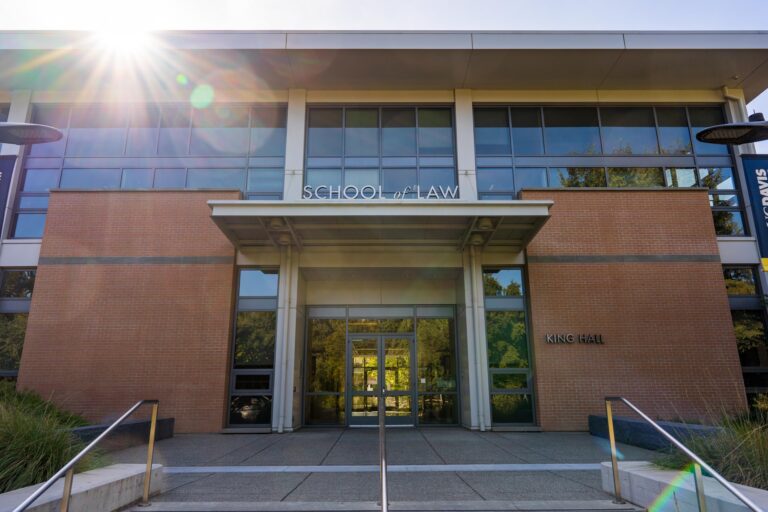
UC Davis Law Student Alison Corn was recently awarded a second place prize at the International Iron Tech Lawyer Invitational for her innovative app assisting domestic abuse survivors, according to the UC Davis School of Law.

Corn’s experience in legal clinics and access to justice courses provided through the UC Davis Law School paired with her graphic design background served as the inspiration for her web application. She specifically mentioned her work with the UC Davis Law School’s Family Violence Prevention Clinic.

“My second year of law school, we worked at a clinic in the self help clinic at the Yolo County Superior Courthouse,” Corn said. “People come in when they need help with something, but don’t have a lawyer. Specifically, we worked with people who wanted to file a domestic violence restraining order.”

The “Next Steps Advisor” web application is designed to provide step-by-step instructions for clients at the Yolo County Superior Court filing domestic violence claims and restraining orders. With such a complicated process, a case-specific app may prevent clients from feeling lost and confused during an already stressful situation, Corn explained.

“It is just insanely difficult for folks who are in stressful, often intense and dangerous situations to not only have to complete this packet of information on their own, but complete them under their circumstances,” she said. “I saw this need for an app or resource to tell people exactly what their next steps were, specific to their case, not just a generic handout.”

The information on the Next Steps Advisor app is specific to Yolo County. For example, one procedural step in filing a restraining order is using the Sheriff’s department to deliver the restraining order. Corn’s app provides detailed directions to the Yolo County Sheriff’s Office and clarifies the process for the user.

The Next Steps Advisor app can be translated into Spanish to accommodate a wider range of users. 

“It can be super intimidating, especially for people who come from vulnerable situations or even vulnerable communities themselves,” Corn said. “A lot of the clients that we worked with, English was not their first language.” 

Diana Glick, a law adjunct professor at UC Davis, helped Corn translate the app into Spanish so that it became “a tool that reaches out to more people in Yolo County,” she explained.

Glick also served as Corn’s academic mentor for the Iron Tech Lawyer Invitational competition.

“My role as an academic mentor in Alison’s project was to serve as a sounding board for her project,” Glick said. 

She offered legal and procedural accuracy to Corn’s app based on experiences that both she and Corn observed in the Yolo County courts. 

Glick teaches a course at the law school that focuses on access to justice and barriers to legal representation such as financial, language, disability and more —  topics all addressed through Corn’s project.

“UC Davis law school is very committed to access to justice issues, evidenced by their support for this class and their support for Alison’s project,” Glick said. “The students who I’ve interacted with have really inspired me.”

The Iron Tech Lawyer Invitational is an international competition highlighting law students’ efforts to address justice accessibility through technological solutions. Corn’s “Next Steps Advisor” app was the only U.S. finalist.

Corn’s second place award in the Iron Tech Lawyer Invitational included $2,500 to be donated to the Yolo County Court, according to the UC Davis Law School Website. With these funds, Corn expects the app to be expanded to other court cases and users. 

Written by: Hannah Blome — campus@theaggie.org

How are students adjusting in the pandemic era?

Class, social networks during COVID-19

In-person classes and campus buildings have been closed for more than half of Spring Quarter. Some students stayed in Davis while others packed up and headed home. Either way, students’ lifestyles have drastically changed, and they’re trying to adjust to modified social networks and classroom experiences. 

Sally Ellberg, a fourth-year biology major, shared her frustrations of trying to stay focused and find motivation to work while at home. 

“Moving home has been hard for me because not only do I miss my friends, but also it is challenging for me to do school work when I am not in that academic environment at school,” Ellberg said. “Oftentimes, when I finally get in the zone, one of my parents will come into my bedroom and distract me.”

Few students have participated in fully-online classes at UC Davis in the past, and most still had in-person discussion sessions to seek help. 

“With classes online, I feel like I am always missing something,” Ellberg said. “Even if I stay organized and on top of things, it can feel like there are assignments hiding in certain tabs on Canvas you weren’t aware about.”

Cynthia Adkisson, a fourth-year animal science major, and Marina Fernandez-Fretzel, a fourth-year neurology, physiology and behavior major, have both remained in Davis for the duration of the shelter-in-place orders. Both shared how even a familiar environment has its challenges.  

“It’s been super hard for me because I did all of my studying in the library and went seven days a week, so now I have to figure out how to focus at home,” Adkisson said.

Adkisson and Fernadez-Fretzel explained that the human interaction and study mindset are hindering their ability to focus. The inability to study around other students has made it difficult to focus. 

“I miss being in the classroom,” Fernadez-Fretzel said. “I feel like I actually pay attention better in class now since online lectures are often at the student’s own pace, but I miss getting ready and putting on normal clothes and asking another human being, ‘Is anyone sitting there?’”

Collaborative environments are also becoming more difficult to work in with online-only communication. 

“Group work has also been somewhat of a struggle,” Fernandez-Fretzel said. “I think it’s harder to feel a sense of accountability with a group of people whose faces you’ve never seen or spoken with in person.”

Friends are the people who students look to for support during midterm season, and personal conflict has also been forced behind a screen. Stil, it’s something to look forward to.

“Not being able to carry out all the Spring Quarter plans I had with my friends is tough, but we’ve been finding other ways to keep in touch,” Fernandez-Fretzel said. “I’ve done social-distancing Arboretum workouts with friends and even went for sprints on the track, which is shocking because I don’t run.”

Of course, sometimes a bit of nostalgia sets in for a year that ended much earlier than expected, especially for graduating seniors that are missing graduation.

“Some days I bike through campus to get to work and that’s when a little wave of sadness will come over me,” Fernandez-Frentzel said. “Seeing the bike circles empty and no lines at the food trucks kind of feels like an old western film where the tumbleweeds blow through a ghost town.”

Graduating seniors can participate in the spring 2020 virtual celebration on Friday, June 12 to get a bit of closure before they take their first steps into a socially distant society. 

“I feel like I am lacking closure because I did not realize my last lecture was my last, or my last time walking on campus as a student was my last,” Ellberg said. “It is all just very anticlimactic as a senior during this time.”

Written by: Josh Madrid — arts@theaggie.org

Glee Cast version vs. original song

It must be said.

Disclaimer: Before you disagree or get upset, I have, like, really incredible taste in music. Also, I took a class called “Intro To World Music” so, yeah… I know what I’m talking about. Plus my Glee playlist has 12 followers.

“Forget You (Glee Cast Version)” vs. “Forget You” by CeeLo Green

Am I saying Gwyneth Paltrow is a better musical artist than CeeLo Green? No. Does she absolutely body “Forget You”? Yes! We learn that Paltrow is a triple threat (acting, singing, dancing) seconds into her performance as Holly Holiday, the Spanish teacher who liberates the Glee Club from the chokehold of Mr. Schue. The original “Forget You” is a beloved classic, but it does not have Santana Lopez belting over the last few notes — which, honestly, is enough to make any song better than the original. Also, Paltrow won an Emmy for her performance so… I’m sorry, but maybe when CeeLo gets his Emmy, we can talk. It is very subtle, but if you really understand music and the lyrics, you undertand that Paltrow is singing from a feminist standpoint by switching to he/him pronouns (queen behavior).

Winner: Glee Cast

“Don’t Rain On My Parade (Glee Cast Version)” vs “Don’t Rain On My Parade” performed by Barbra Streisand

I’m sorry, but Ms. Streisand was just not hitting those notes like Rachel Berry! The original is retro, I suppose, but it’s honestly kind of hard to listen to Streisand’s version because the Glee Cast version is burned into my brain. It is a heightened, emotional experience. The stakes are high (sectionals), the outfits are to die for (big red bow on the back) and Rachel is giving it her all. When she sings “I’ll march my band out” and the rest of the Glee club walks out? Yeah, that’s history. They’re gonna teach that in schools. In the end, both #Jewishgirlsslay.

Winner: I mean, twist my arm…Glee Cast

Any Cover Sung by Will Schuester vs. The Original Song

By now, everyone knows Will Schuester is a freak who should not be allowed near children, but I don’t think we, as a generation, bully him enough for his musical flaws. He has the unique ability to make every song bad and every scene boring. His performances instill debilitating physical discomfort in viewers forced to watch him strain his voice to a Journey song while writhing on the floor. His disgusting rendition of “Gold Digger” should have been banned from national television and made me stop liking music for a while. Will Schuester, trust you will be dealt with.

Winner: Nobody. We all lose when Will Schuester is allowed to perform. #lockhimup

“The Rocky Horror Glee Show” vs “The Rocky Horror Picture Show” (Soundtrack)

The first time I watched “The Rocky Horror Picture Show” was jarring. I expected the fun songs I knew from Glee, but instead I was met with terrible voices and an incomprehensible plot. Now, I know the girlies who went to the midnight showings every Saturday are going to be mad, but hats off to Glee for taking only the good parts, because that movie is a mess. That said, every song on the Glee album is an incredible serve. “Damn it, Janet” is the best song Finn has ever performed; we get to hear Kurt’s weird little voice singing nonsense on “Science Fiction Double Feature” and “Time Warp” creates instant euphoria. It really is musically better in every possible way.

Winner: Glee Cast

“Girls Just Wanna Have Fun (Glee Cast Version)” vs “Girls Just Wanna Have Fun” by Cyndi Lauper

This cover is a disgusting travesty. It’s like Ryan Murphy was given a direct order to completely butcher Lauper’s version beyond salvation. The original is something fun for the girls to get ready and party to. The Glee version is Finn (a man) singing a slowed, acoustic ballad rendition to Santana after outing her to the whole school. If the musical aspect weren’t enough, the presentation of homophobic beast Finn as a hero is. Quite possibly the worst Glee cover of all time. Definitely in the top five at least. 

Winner: Cyndi Lauper

“Poker Face (Glee Cast Version)” vs “Poker Face” by Lady Gaga

It’s hard to compare anything to the cultural revolution that is “Poker Face.” Glee knew this and switched it up. Unlike “Girls Just Wanna Have Fun,” the rearranging of “Poker Face” makes the original almost unrecognizable but keeps the good parts. In the show, it is a mother-daughter duet, which is great because they are both amazing singers but also because it makes you really contemplate how two non-blood related women can share one bone structure. It may take six to 12 listens to enjoy, but once it clicks, whew! True musical rebirth.

Winner: Tie

Honorable Mentions for the Glee Cast: Any Madonna song, “Survivor/I Will Survive,” “Bust Your Windows,” “Don’t You Want Me,” all songs performed by the Warblers, “Run Joey Run,” “Landslide,” “Thriller/Heads Will Roll,” “Edge of Glory,” “Valerie,” “I’m Still Standing” (which, way better than Elton John, but not better than the “Sing” (2016) version) and “Blame It on the Alcohol.”

Honorable Mentions for the Original Artists: None. Two-hundred and seven Glee songs charted on The Billboard Hot 100. Take notes.

Written by: Livvy Mullen — arts@theaggie.org

Humor: MU preacher still preaching at the MU

Should I even talk to him?

I walked by the Memorial Union last week and it was completely different. COVID-19 cleared out the campus. Except for one guy. 

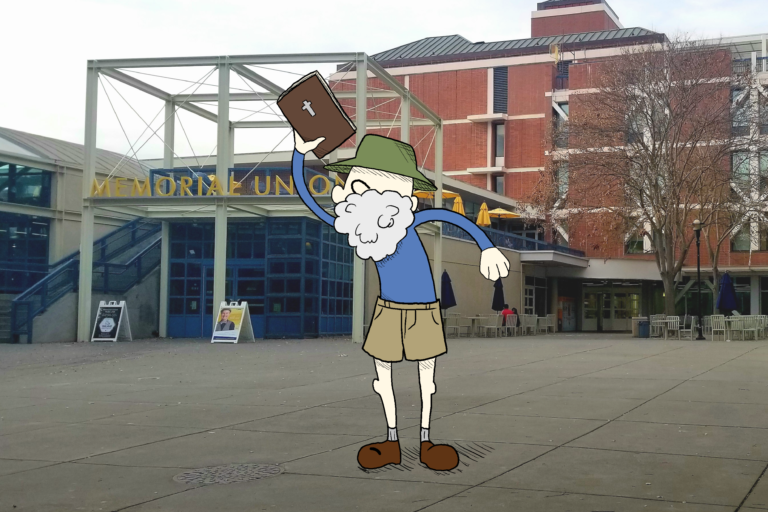
I walked past with my groceries, and the MU Preacher was still there — an icon of UC Davis. He held a bible in his left hand. His right hand alternated between jabbing at the sky and stroking his beard. His voice echoed unchallenged across the Quad. He really didn’t know the campus was empty.

“And from on high, the wicked shall receive their just rewards! In college, you must think of life and its values. These values you sow now will be those you reap later!” He shouted.

As I approached, his shouting got louder. 

“You there! What will you do when your groceries cannot fill you any longer? When you cannot quench your soul’s hunger with an apple or a pear?” 

I mumbled something under my breath. His eyes narrowed and his head snapped in my direction.

“WHAT WAS THAT, YOUNG MAN?” I bit my tongue. I don’t wanna get in a fight. What if he beat me up?

“OUT WITH IT, CHILD,” he roared at me and my bag of produce. I lost my cool.

“NO ONE IS HERE ON CAMPUS OLD MAN.” S**t. I’m really gonna get it now. I gripped my bag of groceries closer to me. If I’m going to get my a*s beat, I can still save a pear or two from bruising. I brace for impact.

But no strike comes. No yelling. I look up to see his glassy stare is gone. He’s looking around the Quad.

“Everyone’s…” His eyes dart back and forth across campus. “Gone…” From deep within his chest, he starts shaking. “Everyone’s gone! Everyone’s GONE! EVERYONE’S GONE!” His head tilts downward.

“I’m FREE!” he shouts. His signature hat explodes into stardust. His clothes change color. What were once a grey coat and blue jeans have become bright red, orange and yellow swirls in a cloak he now wears. His long beard is still intact.

“You’ve set me free, boy!” he says, slapping me on the back. His eyes are wild with happiness. 

“Because of a curse, I was doomed to preach here as long as there were students to hassle! Now, with no students on campus, I’m free!” He lights a cigar and inhales deeply.

“H-hey,” I stutter. “Aren’t preachers not supposed to s-smoke?”

“That preacher s**t was all part of the curse, my boy!” He produces a flask from his cloak and begins drinking heavily. He offers it to me and I nervously decline.

“Say, you wanna hit up a casino? A young man like yourself has gotta know where we can hit a place like that!”

“I don’t think that I—”

“Better yet, we’ll just fly there ourselves!” He bends his legs and straightens his hips.

“E-X-C-E-L-S-I-O-R!” he cries, and he explodes into the sky toward Sacramento, leaving a rainbow in his wake.

I sat there, gazing in awe. Then, one by one I picked up my fruits and put them in my bag. I walked home.

That week, I wrote my column at the Aggie on grain subsidies in South Africa. I mean, c’mon. Who would believe this other s**t?

Written by: Matthew Simons — mrsimons@ucdavis.edu 

(This article is humor and/or satire, and its content is purely fictional. The story and the names of “sources” are fictionalized.)

Press conferences are not political rallies

Turning COVID-19 briefings into tools of political campaigning are not beneficial to nation or president 

The 2020 presidential election is like none before it.

The fallout from the COVID-19 pandemic has left the two remaining major candidates scrambling for ways to appeal to the public. Both campaigns have moved online. Both use media surrogates. But one truly misses the prospects of in-person rallies.

President Donald Trump’s inability to host his infamous public rallies has led to a level of worsened frustration by increasingly troubling polling numbers. Absent the ability to reach a widespread audience in his traditional format, he has moved to a familiar medium: television.

Per his own words, President Trump enjoys the highly publicized nature of nationally televised press conferences. In an interview with The New York Post, he reignited a familiar talking point when he touted the strong television ratings his briefings generated. Seemingly aware of the potentially off-putting nature of these press conferences with older voters, Trump merely doubled down on his showman status. He emphasized that his combative demeanor was superior because it had the potential to be more entertaining than simply answering questions.

If nothing else, Trump is a master brander. Former President Bill Clinton admitted as much himself as early as 2015. Irrespective of your opinion of Trump, he possesses a degree of media savviness that many politicians lack. If you try to conjure up an image of Trump before his ascent to the presidency — as difficult as that now may be — you will probably recall him as the businessman face of “The Apprentice” or as a pop-culture figure synonymous with wealth and luxury. He had cameo appearances in everything from Home Alone 2 to The Fresh Prince of Bel Air. And years before YG’s “FDT,” he was iconized in rap songs.

This obsession with ratings and infatuation with media recognition has never left the president’s psyche. Trump’s compulsive attention to TV ratings is well documented and doesn’t appear to be waning anytime soon, even as his own campaign team pleads with him to do otherwise. And as The New York Times discussed just before the 2016 election, the president seems most deeply fearful of one single thing: being forgotten.

Aside from rudimentary psychoanalysis, there are other motivating factors that explain his desire for press coverage. The briefings give the president the ability to address his supporters and detractors alike with his signature flair. Absent rallies and with an American population increasingly confined to their homes, it provides an opportune chance to broadcast himself to a nationwide audience.

While admittedly some questions from reporters go unanswered during a time of crisis, these briefings give Trump the chance to rail against the establishment media. This tactic has become a trademark component of his reelection campaign with the potential to energize disaffected populists from the left and right.  

It is abundantly obvious that the president misses his rallies. And can you really blame him? From the perspective of his reelection campaign, the mass gatherings were a show of force. They were a morale-boosting demonstration that allowed a voting bloc that constantly sees itself as under attack — from the hostile media, from a rapidly changing world — to energize itself in a way few political campaigns can. They also served as a valuable source for the campaign’s data harvesting efforts. Indeed, these rallies were so crucial to Trump’s movement that they began almost immediately after his election and have continued well into his presidency. Now they have evaporated almost instantly.

In its place are press conferences and coronavirus briefings, both of which may not be intended for use as reelection platforms but have become so. Unfortunately for the Trump campaign, this mechanism may not be working in their favor. According to CNN, while President Trump’s approval rating remains near all-time highs, some six out of ten Americans still do not trust what he says regarding the pandemic. This is despite overwhelmingly trustworthy views of the medical experts that often appear alongside him, with one Quinnipiac poll showing 78% approval for Dr. Anthony Fauci.  

Virtually each and every American is suffering in some way due to this crisis. It has reshaped daily life for the vast majority of us, frustrating individuals from every walk of life. We all have to cope by finding new ways to work and communicate. This struggle even extends to the president. But it’s time to realize that press briefings are best for a quality distribution of information about the pandemic, not for a theater of reelection campaign antics. The president and his advisors should realize this, if not for the good of America, then for the prospects of their own reelection hopes. It will matter in November. 

Written by: Brandon Jetter — brjetter@ucdavis.edu

Disclaimer: The views and opinions expressed by individual columnists belong to the columnists alone and do not necessarily indicate the views and opinions held by The California Aggie

Yolo County extends shelter-in-place order until May 31, businesses fear economic effects

Downtown Davis businesses, public entities face further economic uncertainty

On April 30, Yolo County extended its shelter-in-place order from May 1 to May 31. The shelter-in-place order was originally supposed to last until April 7. It was later extended to May 1, and it has now been extended again until the end of May, according to a public press release. 

“The health order is intended to continue to slow the spread of novel coronavirus,” the press release stated. “While the State Order to stay at home is still in effect, counties may only permit activities to resume that are not prohibited by the State Order.”

Derar Zawaydeh, the co-owner of Crepeville and Burgers & Brew, said this extension was disappointing for his businesses but necessary for public health.

“The idea is just to stay afloat until this thing blows over,” Zawaydeh said. “I just hope that people will comply with the regulations so that we can put this on the back burner and move on.” 

Zawaydeh further emphasized the importance of community involvement in helping struggling businesses and expressed gratitude for those who are still working during this critical time.

“All these businesses really need your support,” Zawaydeh said. “You’re an asset toward expediting the normalcy of it all — of going back to a normal routine.”

Jennifer Schmidt, the owner of Davis Creamery, said small businesses struggle even without a public health crisis. 

“It’s hard for small businesses just in general when things are really good in Davis,” Schmidt said. “We’re not even able to break even right now. I think we’re just trying to survive and get through this so that we can keep our doors open.” 

Schmidt commended the Davis community for following safety protocol guidelines and supporting local businesses. 

“I appreciate the support that we’re getting from the community and the people who are trying to help the downtown businesses,” Schmidt said. “I think the community is rallying behind us businesses, so we’re really lucky to live in a town like Davis.”

Lee Pflugrath, the owner of YoloBerry Yogurt, also commented on the challenges facing local businesses.

“The students are gone, and they bring a lot of business to downtown,” Pflugrath said. “But we have a lot of support from locals now, too. Everybody’s just trying to help the best they can.” 

Pflugrath urged people to be more aware of their surroundings and to be conscious of practicing public health measures. 

“There’s just so much unknown with this virus,” Pflugrath said. “No one was prepared for it because it totally came out of nowhere. Anything can happen these days to people. I think you just got to be aware.”

Yelena Ivashchenko, the owner of Bohème Used Clothing & Gifts, explained via email how retail businesses are still suffering, despite the recent implementation of curbside pick-up. 

“Curbside pickup only doesn’t help our sales much at all as people would like to come in and see what we have and of course want to try things on before purchasing,” Ivashchenko said via email. “We’re hoping that we can open our doors for customers (with safe guidelines and regulations) no later than June 1st. But we don’t control that. We also hope to launch our online store within a month.” 

Ivashchenko is a volunteer member of the Board of Directors of the Davis Downtown Business Association (DDBA). She addressed the financial dilemma faced by the City of Davis during these challenging times.

“I believe that the City of Davis is capable of doing more to help businesses during this situation, but I know they are also financially strapped and they have to be careful in their use of public funds,” Ivashchenko said via email. “The future is very unclear and frankly scary especially for the businesses geared towards students, as we don’t know when in-class sessions will resume. It is pretty safe to say that not all businesses will be coming back, but I hope most do.”  

Businesses are not the only ones facing uncertainty due to the COVID-19 pandemic.  Davis City Councilmember Dan Carson explained that if this situation continues for an extended period of time it will pose difficult financial challenges to public schools, the city government and the state government. 

“There are all these uncertainties in terms of how this will play out, but we’re hopeful in the City of Davis,” Carson said. “I think all of us will change the way we behave to some degree. We’ve seen our Davis community come together to help each other.”

Carson further assured that locals should have confidence in their city government, which has been hard at work looking out for the needs of the Davis community.

“We’re listening to our county public health experts and following their directions on how to implement shelter-in-place orders,” Carson said. “We’re doing everything we can to ensure the continuity of basic public services.” 

Written By: Jelena Lapuz — city@theaggie.org

Undergraduate Research Conference goes virtual for first time in 31-year history

Undergraduate Research Scholarship and Creative Activities Conference held online

The Undergraduate Research Center (URC) held the 31st annual Undergraduate Research Scholarship and Creative Activities Conference from May 7–8, albeit in a new way: It was entirely online.

Every year, the conference gives undergraduate students in all academic fields the chance to get acquainted with the process and the academic rigors of presenting research in a scholarly manner.

This year, over 600 students presented at a virtual conference hosted through GoReact, an online sharing service that allows for feedback. The conference drew over 1,000 unique attendees. In previous years, the conference is expected to attract 6,000–7,000 attendees and over 800 student presenters. Attendees included faculty, staff, other students, family members and other conference participants.

At the beginning, it wasn’t clear that the conference would be held this year, as the prospect of completely restructuring a university-wide conference left many questions unanswered. The URC quickly sent out a survey to the 800 students originally scheduled to present at the conference to gauge interest for some form of the conference. Organizers found overwhelming support for moving forward with an online platform.

The URC immediately sprung into action, searching for a platform that would support a dialogue between presenters and attendees and allow for the classic experience of presenting at a collegiate research conference. The creation of this atmosphere was incredibly important for the many students hoping to present and graduate this spring.

“I hoped to polish my presentation and public speaking skills as well as develop [the skills] to share a complex topic in a relatively easy to understand visual and graphic format,” said Taryn Lausch, a fourth-year geology major who presented her research regarding deep earthquakes in the Mt. Diablo region at the conference. 

This sentiment was echoed by Isaiah Ornelas, a fourth-year biochemistry and molecular biology major and member of the conference organizing committee. Ornelas, who also presented at the Undergraduate Research Conference last year, was surprised by the engagement with his research.

“People who I have previously met before actually commented on my videos so I could reconnect with them for a little bit, thank them for watching my video and just see how they were doing,” Ornelas said. 

Pulling off the conference was rewarding for everyone involved, but it wasn’t without challenges. 

“Our team was learning the platform at the same time our students were learning the platform,” said E. Nuñez, associate director of the URC. “Obviously, we were under a time crunch. We [transferred everything to GoReact] in a little under a month.”

While having to restructure the entire conference in a month with the added uncertainties related to COVID-19, organizers also had to maintain communication with student presenters. 

“Communication was a challenge because, following the theme during this pandemic, there were a lot of unknowns and as we learned information, we needed to gather it and then communicate it out to students,” Nuñez said.

In a time with so much uncertainty, the necessary rush of organizing the conference did not go unnoticed by students.

“Honestly, it kind of stressed me out that it was going to be placed online,” said Brittany Baikie, a third-year neurobiology, physiology and behavior major. “Some of the undergraduates decided to drop out because of overwhelming class schedules and whatnot.”

Nuñez hopes to incorporate the most successful parts of this year’s virtual conference into future in-person conferences.

“One thing that we’re continuing to think about is how can we expand the reach of our conference outside of Davis, outside of Sacramento, outside of even California maybe,” Nuñez said. “And I think when we do that, we include more people that support our students and when we can include more people, that’s always a positive.”

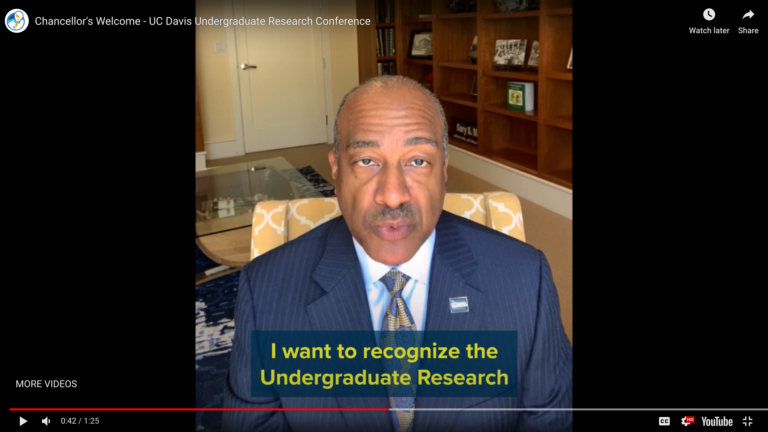
 Although the research conference was harder to organize than ever before, it has also never been more relevant, as highlighted in Chancellor Gary May’s Undergraduate Research Conference welcoming statement. 

“Our scholarship addresses some of society’s most critical challenges, including climate change, feeding the world, and the sustained the health of all living beings,” May said. “We’re living through extraordinary times, the need for research collaboration and innovation couldn’t be greater.”

Written by: Jessica Baggott — campus@theaggie.org

UC Davis student-run clinics transition to telehealth for duration of pandemic

Undergraduate, medical students aim to provide care beyond medicine

UC Davis medical students, physicians and undergraduates are using telehealth to continue providing primary care services to patients through the seven student-run clinics amid the COVID-19 pandemic.

Telehealth has become critical in ensuring that patients continue receiving care during the pandemic, while also keeping physicians and their staff safe. 

Prior to the pandemic, UC San Diego Health — which already had an established telehealth system —  used telehealth for around 1% of their outpatient visits. Three weeks after a national emergency was declared, UC San Diego Health’s telehealth visits went from 6% to over 60%, according to a CalMatters infographic.

For student-run clinics, the switch to telehealth began after March 10, when Dr. Mark Service, vice dean for Medical Education at the UC Davis School of Medicine, sent an email urging clinics to consider suspending all clinic activities. 

Alfredo Lopez Aguirre, the executive administrator for Clínica Tepati, said the clinic was ready to operate remotely at the beginning of Spring Quarter. 

During the first weeks of the quarter, however, he said the clinic only focused on medicine refills and urgent questions.

“At the end of finals, we practically had to move everything online before the quarter started,” he said. “It’s been hard advocating for the patient right now because, with the pandemic, we had to literally close our doors and establish a whole new protocol.”

Now, the clinic is offering its usual services, excluding those offered by its specialty clinics. Undergraduate students who are still in the area help out with delivering medicine refills to patients.

Since Tepati doesn’t have access to its facility and equipment, volunteers aren’t taking new patients, instead directing their efforts toward providing additional resources for their existing patients. 

“We’ve rolled out a resource guide where we collect resources from around the community and Sacramento area,” Aguirre said. “It’s another way we can advocate for the patients and the resources we need. Since many of our patients are uninsured and undocumented, we’re rolling out a Visa gift card program for patients so they aren’t worried about paying for medicines.” 

Other clinics, like Bayanihan Clinic, were already thinking about providing services through telehealth before the pandemic. 

Ivy Yuson, the clinical affairs coordinator for Bayanihan, called the time the pandemic created for them a “blessing in disguise.”

“We’ve been working on ways to contact people through telehealth platforms prior to the pandemic, but it never came to fruition because we used the clinic’s past experience seeing patients in-person to continue doing what we were doing,” she said. “Now, we can bring it back to the clinic in case patients aren’t able to make it in.” 

Bayanihan, according to Yuson, isn’t currently accepting new patients. Every Saturday, they’re refining gaps in their knowledge and improving their telehealth procedures, continuing to stay in contact with the UC Davis School of Medicine. Undergraduate volunteers are setting up a dental clinic and improved diabetic counseling as part of additional services offered remotely. Psychiatric, wellness and primary care services are still offered by medical students, physicians and physician’s assistants.

While Bayanihan had been developing telehealth protocols before the pandemic, Yuson said implementing those protocols was still a stressful process.

“At the very beginning, I was just very overwhelmed by how much autonomy students had in discussing [student-run clinic] protocols,” she said. “I didn’t know where to focus my attention. From a student perspective, I had to continue finals week. But from a clinic standpoint, patients need healthcare services and that can’t always wait.” 

Joan Viteri Memorial Clinic, which aims to provide health care for sex workers, intravenous drug users and other high-risk populations, is the lone student clinic remaining physically open to patients. Both its main clinic and outreach clinic, which goes to Sacramento encampments and offers medical services, continue to operate. 

Jasmine Daragahi, co-director of Joan Viteri, said though the main clinic isn’t taking patients with respiratory issues due to a lack of COVID-19 tests, the outreach clinic was just given 200 COVID-19 tests to use on people experiencing homelessness. 

Daragahi said it was important that the clinic remained open because not all services can be administered remotely.

“One service we continue to offer is abscess draining, because abscesses can be deadly if left untreated,” she said. “The clinic was named after a woman who passed away from a treatable abscess. We take those services really seriously and a lot of our patients choose not to go to other providers because they get mistreated. We want to serve them.”

Undergraduate volunteers, however, are not involved in the clinic’s in-person work given health restrictions and patient safety, she said. They are working to make face coverings and will be inputting patient records when COVID-19 tests get administered through the outreach clinic.

Barriers to accessing telehealth

The decision to keep Joan Viteri open for accessibility reasons addresses a major shortcoming with telehealth: Technological barriers can prevent prospective and current patients from receiving care. 

CalMatters’ Ana B. Ibarra and Elizabeth Aguilera said telehealth was initially meant for inner-city and rural communities, where access to a clinic is less guaranteed.

Those communities are where student-run clinics operate and serve. Video visits bypass one barrier to accessing healthcare: transportation.

Still, not everyone in those communities has ready access to the Internet, phones or computers. Informing patients about changing services has been one challenge for student-run clinics. Though clinics have been advertising changes to their schedule and updates to services on social media, Aguirre said the clinic has seen a reduction in current patients. 

“We see up to 25 to 35 patients during our normal Saturday clinics — now it’s anywhere between 10 to 20,” he said. “Technology isn’t always our patients’ forte because a lot of them are on the spectrum and older. While we have a sign at our physical location, only a few patients will see our clinic number and information when they drive by.” 

He said volunteers have started calling patients who hadn’t come in recently to both check-in and update them on the clinic’s services. 

Language can also be a barrier to helping patients. Paul Hom Asian Clinic, Shifa Clinic, Bayanihan and Clínica Tepati are geared toward helping the Asian and Pacific Islander, South Asian and Muslim, Filipino and Latino populations specifically.

Hannah Pan, one of the undergraduate co-directors at Paul Hom, said she began volunteering at Paul Hom because she was excited to use the language she grew up speaking at home to break down linguistic barriers to care. 

“I think a lot of us take for granted the fact that we can walk into a doctor’s office and immediately address our health concerns,” she said via email. “For a lot of our patients, language and culture […] prevent them from being able to communicate effectively with their doctors.”

The clinic offers services in six languages: Cantonese, Mandarin, Korean, Taishanese, Vietnamese and Hmong. 

Patient advocates — undergraduate volunteers — at Paul Hom are providing translation services, getting on three-way calls with a patient and a medical student or preceptor during health consultations, the only service the clinic is currently providing beyond medicine refills.

Daragahi said that in the process of transitioning to telehealth, not having undergraduates coming into Joan Viteri created a linguistic gap in care.

“A lot of our patients are Spanish-speaking and a lot of our undergraduates provided translational services,” she said. “Our medical students [working] right now don’t speak Spanish, but we’ve had some of our undergraduate volunteers sign up to provide those services in the future, so hopefully that gap will be remedied soon.” 

While Joan Viteri’s outreach clinic remains open to serve the unsheltered population, Willow Clinic, which primarily serves people experiencing homelessness, has partnered with several Sacramento organizations to ensure patients are aware of the service changes.

Jeremy Hockenberry, who leads the Smoking Cessation Committee with Willow, said their organizational partners, such as Sacramento Street Medicine, have been delivering care kits with flyers informing the unsheltered about the recent change in services. 

“Within the last week, our preceptor has allowed us to have new patients, but it was at first difficult for patients to understand we wouldn’t be at Salvation Army [where we currently give services],” he said. 

To ensure patients can get connected to resources or make it to local pharmacies, Willow volunteers have been organizing rideshares to take patients to those locations. They currently offer medicine refills, referrals for social services and COVID-19 patient education through the technology at the Salvation Army. 

Patient reaction, looking ahead

Hockenberry said that recently, more patients have been understanding the telehealth protocol shift. 

“They’re excited we’re still here to support them and that they get to have their meds refilled,” he said. “Some of them haven’t been able to make it to the clinic in months or used their meds consistently.”

Positive patient reactions to student-run clinics’ shift toward telehealth have been common. 

Pan said via email that Paul Hom’s patients seem very receptive toward the novelty of telehealth.

“Patients are very comfortable with addressing their concerns over the phone and still talk to us in the same way they would normally do in an in-person visit,” she said. 

And Yuson said Bayanihan’s patients have been responding similarly. 

“When I called patients to check up on them and see if they wanted to reschedule, they were so understanding of the situation — they even checked up on me,” she said. “It was a humanizing experience that really broke the barrier between being a coordinator to the clinic community and being a person.” 

She said Bayanihan volunteers also provide healthcare services and entertainment to Filipino veterans, who she referred to as veteranos, and in lieu of monthly visits to the Filipino War Veteran Legion’s events, volunteers continue to contact veteranos.

“It’s not necessarily anything specific on the healthcare end,” she said. “We just wanted to make sure they had all the info and resources they needed, but also to check up on them and ask about their families, their work, anything they want to talk about.” 

Whether or not the clinics must continue telehealth during Fall Quarter, Aguirre said it was important for volunteers to remember their respective clinic’s mission and why they continue to provide service.

“Something I always tell folks at Tepati is that we should work within a community framework and that Tepati was built on the foundations of helping the Latino community — that’s the mission that really set this clinic, to fill this gap in healthcare,” he said. “Tepati belongs to everybody. Everybody puts in their effort.”

Written by: Janelle Marie Salanga — campus@theaggie.org