57.9 F
Davis

Davis, California

Monday, December 22, 2025
Home Blog Page 411

We’ve never seen a show like “Game of Thrones” and we never will again

No show will ever attain the same cultural, critical acclaim

As “Game of Thrones” finally came to an end this season, I realized just how much of a monocultural phenomenon the show was — the likes of which we’ve never seen on television. The show is also a phenomenon we may never see again, thanks to a remarkable culmination of a perfect storm of factors. “Game of Thrones” is single-handedly the most tweeted about, most pirated and second most expensive show in the history of television.

With countless conventions around the globe from “Ice and Fire Con” to the 1.2 million square foot exhibition, “Con of Thrones,” “Game of Thrones” created a fandom on the same level as “Harry Potter” or “Star Wars.” It was a gossipy drama to some, a high fantasy adventure to others and a fine piece of art to even more — subjective to all. It’s the pinnacle of prestige television, with a combination of critical and cultural acclaim never seen before.  

“Game of Thrones” may be the last piece of television to hold our collective attention. As more and more entertainment players try to mimic the success of “Thrones,” they split the attention of viewers.

***

“Game of Thrones” epitomizes prestige television — it is television at its peak. With prolific stars, a massive budget and high production values, few shows can match the prestige HBO built with “Thrones.”

“[With prestige TV] you have the people who are the most celebrated in the culture working in the [TV] medium,” said Jaimey Fisher, the director of the UC Davis Humanities Institute and a German and Cinema and Digital Media professor. “And then you have, additionally, the money. Which is, of course, not a coincidence.”

Shows like “Game of Thrones” and “Westworld” resemble the overall production quality of movies now more than ever. With a budget of over $90 million, the final season of “Game of Thrones” cost more than the budget of “A Star is Born,” “The Favourite,” “BlacKkKlansman” and “Roma” combined — all 2019 Academy Awards-nominated movies.

As the biggest event television show of our time, “Game of Thrones” was the Superbowl of Sunday night entertainment. Collective live reactions on Twitter and instant coverage after every episode were finally not limited to live sports. Whether it was a fear of social media spoilers or just because the show was so good, “Game of Thrones” made people block out time each Sunday night to watch it — it became an event. An estimated 10.7 million Americans skipped work in post-Superbowl fashion the day after the series finale, with an estimated productivity loss of $3.3 billion. HBO owned entertainment on Sunday nights the way “Seinfeld” owned Thursday nights in the 90s.   

Discussion of who would sit on the Iron Throne was an equal water-cooler common denominator to the discussion of who would make it out alive after “Infinity War.” And now that “Game of Thrones” is gone, we’re already seeing major entertainment providers try to use any oxygen that “Thrones” left behind. Amazon is working on a $250 million plus “Lord of the Rings” prequel series, Disney is launching Disney Plus this fall with a $100 million “Mandalorian” series headed by the MCU’s first director and HBO is trying to stay relevant by remaining in Westeros some 6,000 years earlier. It’s going to be a bloodbath.

But why was “Game of Thrones” so big, and how did it become the biggest show on television? In addition to telling a great story, “Thrones” was situated in the perfect storm of social media growth, starpower and the overall takeover of nerd culture.

***

The cultural ascension of “Thrones” came in parallel with the rise of Twitter and digital coverage culture. Premiering in April of 2011, “Thrones” came to life on our screens just as Twitter became the third most popular social media platform. As the show caught steam, Twitter doubled its user base in just over two years. And as Twitter became the dominant platform to immediately discuss and share cultural moments, “Thrones” had all the ingredients to thrive on the hot-take nature of Twitter: massive battles, incredible surprises, fantasy elements, politics, deaths of main characters and thematic arcs to keep it all meaningful. Not surprisingly, episode two of season eight, “The Battle of Winterfell,” was the most Tweeted about episode of scripted television ever with nearly 8 million tweets. For shows like “Lost” or “The Sopranos,” this amount of social media engagement wasn’t plausible.

“Game of Thrones” also began with just enough star power to lift off and break through to a wide audience. Every poster and commercial for the first season features Sean Bean and Peter Dinklage, and their marketability propelled the show to initial success. “Casting is crucial,” Fisher said. “Gandolfini was crucial to ‘Sopranos,’ Cranston was crucial to ‘Breaking Bad’ […] and Peter Dinklage —  who plays Tyrion –– was probably the person with the biggest career and crucial to ‘Game of Thrones.’”

Additionally, the cultural power of “Game of Thrones” created breakout stars of its own for countless of its leading actors. Appearing in “Thrones” made young stars (for many of whom “Thrones” was their first real job) like Richard Madden, Sophie Turner and Emilia Clarke marketable commodities who instantly attracted viewers to new projects. Richard Madden is now a Golden Globe winner, Sophie Turner stars in a major superhero film and Emilia Clarke landed leading roles in the “Terminator” and “Star Wars” franchises. These actors became ticket-sellers for any project attached to their names, all because “Thrones” became such a powerhouse.

With the ability to binge episodes of “Game of Thrones” through HBO GO and HBO NOW, countless viewers could jump on the “Thrones” bandwagon and catch up before the next episode or season. For my generation of television consumers, binging was already an accustomed method of watching TV thanks to Netflix. And if you weren’t watching since the beginning, it didn’t matter — the power of streaming allowed you to catch up. I was only 12 years old when the show premiered, so streaming past episodes was crucial to join the hype. I remember how much of a hassle it was to try and catch up on old episodes of “Lost” at a time when you could only stream via ABC’s website and people barely had smartphones. Streaming changed all of that.

In many ways, “Game of Thrones” is the television parallel to the “Lord of the Rings” trilogy. Putting aside Sean Bean’s stellar appearances in both, “Thrones” made us believe in dragons and the White Walkers with ease. It made us forget that these worlds don’t exist or aren’t possible. “Thrones” entranced us and won 47 Emmy Awards to date.

“It is hard to imagine the show would have succeeded anywhere near the degree that it has without CGI,” Fisher added. “And Peter Jackson really helped pioneer that. And noticeably made it really legitimate in a way.“

“Lord of the Rings” made the fantasy genre a mainstream reality for viewers everywhere. Winning 17 out of 30 Academy Awards nominations, Jackson proved genre doesn’t have to restrict prestigious acclaim and CGI could elevate storytelling on-screen.

Plenty of shows are critically acclaimed. And plenty of shows are commercial and ratings successes. But rarely do the two crossover with such high critical acclaim and record-breaking ratings. “Thrones” managed to do both. The show currently sits at a 93% overall score on Rotten Tomatoes according to critics, with seven of the eight seasons ranging in the mid-to-high 90s. Commercially, “Thrones” was one of the most dominant shows in history with an estimated cumulative viewer count of over 44 million per episode in its final season. To put that number in perspective, last year’s NBA Finals peaked at 18.47 million viewers on ABC (a free channel). By every metric it was a historical and record-breaking success.

Of course, “Thrones” is adapted from George R.R. Martin’s New York Times best-selling books. And intentional or not, Martin certainly built an exorbitant amount of anticipation between releases. As a result, the story already had a lively, dedicated and cult-like following when the show was released in 2011. Casting leaks and full cast lists led to much anticipation with hardcore fans and even spilled over into the mainstream.

But more than just a hit, “Thrones” was a cultural phenomenon –– a weekly event letting everyone experience it together. On the after-show “Talk the Thrones,” Mallory Rubin put it best: “The digital age can be very isolating, you can feel very alone and a great story can really bring people together. And ‘Game of Thrones’ did that for a lot of people for a long time.”

“Game of Thrones” is the zeitgeist of the old way of watching television, and at the same time, a trailblazer for the new way of watching and experiencing it. It became such a success, by cultural standards, because of the technological capabilities of our time. We are able to connect with people watching the show all over the world thanks to platforms like Twitter and Reddit. And it can make a world that often feels so large and isolating feel just a little bit smaller.

***

So what is the next epic piece of television? I’m not sure. Maybe it’s “The Mandalorian” or some other big budget show trying to fill the void left by “Game of Thrones.” But I doubt anything will be as culturally dominant as “Thrones.” Nothing will ever reach the popular culture success of “Thrones” because these monocultural shows are going extinct. In its place won’t be one other massive show, but probably half a dozen smaller ones as new platforms of entertainment are splitting viewers’ attention.

Television simply isn’t experienced in the same way it used to be. “M.A.S.H.” had 100 million viewers for its finale on CBS in 1983. “Seinfeld” had 76.3 million viewers in 1998 on NBC. And “Friends” had 52.5 million viewers on NBC in 2004. “Game of Thrones” getting “only” 19.3 million live viewers obviously seems small in comparison, but these decreasing numbers represent the larger point that the collective attention of television viewers has been dwindling for decades –– almost exponentially –– because of more and more entertainment options. But, looking at the titlewave of television titles and streaming services trying to vye for our attention in the wake of “Thrones,” that number will likely never be reached again. For a show to reach those numbers, not on a free channel like NBC or CBS, but on a premium subscription service like HBO is remarkable.

Now that we have endless modes of entertainment at our fingertips (Youtube, Netflix, Hulu, Amazon Video and soon Disney Plus), there is no possible way we will all watch the same programs to the level we did with “Game of Thrones” or shows like “Seinfeld.” We are in a new era of television. The immediacy of streaming is just another development in the long history of the expansion of home entertainment that splinters our attention. With an average of 1.2 million concurrent viewers on Twitch this year and over one billion users on Youtube, the immediacy of online entertainment is already encroaching on our attention. When “M.A.S.H.” and “Seinfeld” were airing, the internet was a sliver of what it is today and TV was the primary form of entertainment in the home — which it no longer is. There are too many compelling entertainment options for another show to dominate our culture in the way that “Game of Thrones” had.

It would be amazing to have a show like “Game of Thrones” that I could talk about with anyone at any time. But I find myself loving the experiences I have with smaller, niche shows too. If television isn’t capable of having another massive hit like “Thrones,” let’s embrace all the great smaller ones out there. I truly wish more people would watch great shows that don’t get enough cultural recognition, such as “Killing Eve,” “Atlanta,” “Bodyguard” and “Sex Education,” if only for the joy of watching them.

“We live in a popular culture time of almost unlimited possibility,” said Andy Greenwald, the long-time television critic and screenwriter of “Legion” and “Briarpatch.” “Popular culture gives people a canvas to tell incredibly ambitious and long running stories in a way that wasn’t previously possible.” Let’s go hear those stories.

“Game of Thrones” was the wall that garnered all of our attention, the wall to guard against the other TV shows that are about to fight it out in a battle royale for our attention. And now the wall has come down, and thousands of attention-seeking properties spill out in its vacancy.

The impact and cultural dominance of “Game of Thrones” will have countless ripple effects throughout the entire future of the entertainment industry. Nobody would have expected an IP about bastards, dragons and bloody politics to be a massive hit, but it did just that, becoming the most culturally dominant show of our time. So bring on the prequels, the sequels and new shows alike, because nothing will ever be as big as “Game of Thrones.”

Written by: Calvin Coffee — cscoffee@ucdavis.edu

Disclaimer: The views and opinions expressed by individual columnists belong to the columnists alone and do not necessarily indicate the views and opinions held by The California Aggie.

#Vanlife

Another BS travel blog phenomenon?

“#Vanlife” turns up over five million results on Instagram, the majority of which are posed, pleasantly tan, often filtered, classicly athletic young people poking legs out of open van doors. A subgenre of travel blogging, van life posts represent a growing trend of people living out of their vehicles by choice for anywhere between a few days to a few years. The “van life” movement has drawn in quite a few people and given rise to something of a community, making vans a staple at every national park campsite and BLM back road.

The draw is different for different people. For a lot of folks, it’s an affordable way to travel and be outside, allowing them to ditch rent and devote themselves to a romantic, very American idea of freedom upgraded for the 21st century. It also reflects the rising rents, increasing job turnover and the drive to get out of the isolated bubble of modern life. And of course, there’s an eco-conscious aspect to it — for many, the small carbon footprint is a major draw.

There’s something seductive about the whole thing. The aesthetic beauty of van life — of living small, traveling between beautiful places and not having a job — is ripe for the kind of “travel blog” category of internet content. It supports a lifestyle that allows every post to be from a new, dramatically beautiful place, creating the illusion that every day of the blogger’s life happens in an exciting new venue. It’s the kind of internet fakery that makes me simultaneously mad, sad and jealous, but it only gets under my skin because I’m a little seduced.

The van life aspect of travel blogging really bugs me, though. I know a lot of people who live out of vans either part or full time so they can do more climbing, skiing, rafting or whatever else they’re into. But I also know a couple people who live out of their cars or vans because they have to. It’s a big psychological difference. While it can be incredibly fun, living out of a car or van is hard work. There’s a lot of stuff that’s easy to take for granted when you live in a house: the ability to cook food when it’s raining, for example, or not getting woken up by a flashlight in your face at 3 a.m.

If it’s a choice, it can be fun. Last summer, I lived out of my family car for a few weeks road-tripping and climbing in Canada. There was a night on a back road in Squamish when a friend and I were huddled under a tree in the rain, trying to get our stove to light and laughing harder than I can remember.

But there was a night a few days later when I was woken up in my dirty, trashed car by a lady deeply furious I had parked in front of her neighborhood park. At the time it irked me — what did it matter to her if some 18-year-old kid slept in their car in front of a park? But I was a few hours from my house and days away from starting college, and my parents had enough money to rent a hotel for a night if I needed to. I think it would have felt really different if that wasn’t my situation.

Adapting road tripping and van camping into a lifestyle is an awesome way of breaking out of the monotony and loneliness that’s so common these days. In the age of the so-called “digital nomad,” I think it’s ridiculous not to take advantage of technology and changing culture. But I also think that the Instagram brand of van life comes from a place of selling lifestyle for personal gain.

It’s worth questioning what van life says about rent and stability in modern America. It’s also worth questioning why so many of the people who are able to sustain this lifestyle, which rests heavily on the kindness of strangers and skirting the law, are white.

Van life is cool, undoubtedly. If it appeals to you, go do it — it’s pretty much my entire plan after I graduate. But it’s way too interesting and complicated to sell out to Instagram models and advertising.  

Written by: Anna Kristina Moseidjord — akmoseid@ucdavis.edu

Disclaimer: The views and opinions expressed by individual columnists belong to the columnists alone and do not necessarily indicate the views and opinions held by The California Aggie.

Cuenin leaves her mark on UC Davis

Three-year captain wraps up her UC Davis women’s lacrosse career

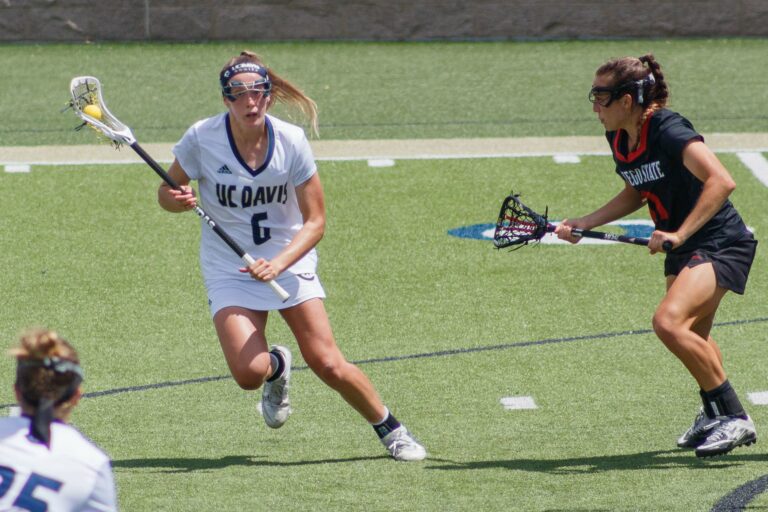
The UC Davis women’s lacrosse team concluded its 2018-19 season with a Mountain Pacific Sports Federation (MPSF) championship game appearance and a 9-8 overall record, including a 4-2 record at home. Despite losing in the final match and finishing on a not-so-pleasant note, the team was not without its bright spots.

Perhaps the team’s best story coming out of this season was senior attacker Taylor Cuenin. The Danville, CA native and three-year captain for the Aggies was named MPSF Player of the Year for the second straight season. Cuenin was not only a force on offense who led the team in goals (48), but she also led the conference in caused turnovers per game (1.27). She also ranked third in points per game (3.40) and ninth in ground balls per game (1.87). Her versatility allowed her to be a major threat on both ends of the field.

“It is really exciting, and it has been a great four years,” Cuenin said. “I have been super lucky to have such a successful career, and I think a lot of it came from how I was coached the past two years and changed a lot of the way I played this past year.”

Cuenin started playing lacrosse more heavily her freshman year at San Ramon Valley High School where her experience on the junior varsity team helped her grow more as a player. Cuenin emphasized how her time on the JV squad helped her realize her love for the game. She honed her lacrosse skills for the remainder of her high school years, playing and serving as captain for her school’s varsity team, as well as playing on a local travel club team, competing across the country in numerous tournaments.

Despite the extent of playing experience, Cuenin was not highly recruited out of high school, so she said she made a point to attend UC Davis’ off-season lacrosse camp.

“I started a little later and wasn’t heavily recruited anywhere,” she said. “I didn’t really know how to do the recruiting process itself, and as far as going to camps, I wasn’t sure where I wanted to go.”

Luckily for the Aggies, Cuenin had a friend who attended UC Davis and who played a large role in influencing Cuenin’s decision to ultimately choose to become an Aggie. Cuenin also noted that the university’s reputation for academic success was a main factor in her decision. UC Davis, therefore, was her top choice both academically and for lacrosse.

As a neurobiology, physiology and behavior major, finding a balance between working hard in the classroom and on the lacrosse field was important to Cuenin from the outset of her time at UC Davis. She not only found a balance, but she excelled at both endeavors. Cuenin was recently inducted into the Phi Beta Kappa Honors Society this Spring, thanking lacrosse for being a big release from her intense academic coursework.

“I think because I never had to do school without lacrosse, it was a good thing because it structured my life so much and made me really disciplined in my school and knowing that I always have to be a week ahead for everything.”

In 2016, Cuenin was awarded all-MPSF second team and became the first UC Davis lacrosse player since 2013 to earn all-conference honors as a freshman. During that season, Cuenin was also awarded MPSF Rookie of the Week and led the Aggies with 19 caused turnovers.

The following season, Cuenin earned an upgrade to the all-MPSF first team and led the Aggies in goals (42), total points (53), ground balls (52) and caused turnovers (51). She also ranked second in the nation with 3.4 caused turnovers per game.  

After leading the team in goals (38), points (41) and caused turnovers (23) for the second straight season during her junior year, Cuenin earned multiple MPSF Player of the Week honors and secured her first MPSF Player of the Year award

Entering this season, Cuenin was a player on the radar of every team that competed against the Aggies. She was also on pace to finish in the top three in program history in goals. But after she suffered a serious ankle injury at the beginning of senior year, Cuenin was forced to make some unforeseen changes to her game.

“I had to learn how to adjust my play,” Cuenin said. “I got moved from being a midfielder — which I was my whole career — to an attacker, which was pretty different because it is hard for me to not want to run everywhere on the field. But everyone was so supportive and so awesome. We all kind of worked through it together.”

In lacrosse, attackers can only play one third of the field, while midfielders are allowed to run up and down the entire length of the field. When she moved to an attacking role, Cuenin was able to capitalize on her scoring abilities without needing to cover as much ground and exacerbate her injury. The senior attacker shifted her play to a more two-dimensional game, thanks in part to her Head Coach Suzanne Isidor, who Cuenin believes taught her how to work more closely with her teammates. This directly resulted in more of her goals coming off of assists from her teammates, as opposed to goals that she scored via her own attacking runs.

This change, however, did not set her back. Cuenin led the conference and finished 29th nationally in goals per game, with 3.2. Switching her position meant learning how to change her style, and she thanks Isidor for her guidance in this process.

“For me, [Isidor] helped me change my level of play and made me progress as a player and [become] more diverse and play selflessly and work with my teammates,” Cuenin said.  

Isidor took over the program in the 2017-18 season during Cuenin’s junior year.

“The level of maturity [Isidor] brought to the program was huge, [as was] her ability to recognize and care for each player on a personal level as well as athletically.”

Along with praising Isidor, Cuenin thanked her teammates and believed much of her team’s success was due to the fact that the members were so close with one another.

“A lot of teams don’t have the bonds we do on our team,” Cuenin explained. “That has made it really fun. It’s a good mixture of working hard and getting to have fun.”

Cuenin capped off her UC Davis career tied for second in school history in goals (151), tied for sixth in points (171), and alone at second in caused turnovers (112).

After graduation, Cuenin plans to work toward becoming a Physician’s Assistant and attending PA school. She is grateful to continue her studies nearby at Sacramento State this summer because it means that she will still be close to the people that matter to her most: her UC Davis women’s lacrosse teammates.

Written by: Frankie Veverka — sports@theaggie.org

Review: IGOR

The Arts Desk reviews Tyler, the Creator’s fifth studio album

Clay Allen Rogers:

“IGOR” is a gift from the soul of Tyler, the Creator — an art piece unlike anything that has ever been released by Tyler, or any other musician for that matter. Each song is a deliberately placed brushstroke that contributes to the whole of the piece. Press play on the album; listen to it frontwards, backwards or on shuffle and it will cut through to the heart all the same. Think of a theme that reflects the turmoil of planet earth and, most likely, Tyler has filtered that message into one of his songs within the album.

“A BOY IS A GUN” was my favorite track. I imagine the line “When the time is right (a boy is a gun) / No, don’t shoot me down” is an ode to the 48 black young adults and children who’ve been killed by police in the last five months of 2019 alone. “IGOR” is more than just an album — it’s a story and a lesson sung to its listeners with the utmost passion and commitment.

Rosie Schwarz:

“IGOR” dropped the night of a Mac DeMarco concert I was at and, after such an incredible experience, I went home and immediately listened to “IGOR” and haven’t stopped since. For most people, watching Tyler, the Creator’s progression from his early Odd Future days to “Flower Boy” to “IGOR” debuting at No. 1 on the Billboard 200 Albums Chart has been really exciting. Like most artists who have been in the limelight since they were younger, watching Tyler mature and change with his music seems to match our own progression and maturity perfectly.

The more I listen to “IGOR,” the more I continue to find new songs or moments on the album that stick out to me, but my personal favorites are “EARFQUAKE” and “GONE, GONE / THANK YOU.”

Andrew Williams:

IGOR,” with heavy synthesizer production and deeply introspective lyrics, supplements Tyler, the Creator’s new artistic trajectory. Following “Flower Boy,” the album is a step away from his blunt and shocking lyrical trademarks. The album’s sound is relatively consistent throughout, using similar production tools and melancholic undertones. Despite general uniformity, the album manages to avoid stagnation, compelling the listener to tune in for the full 40 minutes.

The opener and my personal favorite track, “IGOR’s Theme,” strikes energy into the record. The majority of the song is composed of a subtle layering process. Hymn-like lyrics are weaved into its instrumental of both heavy and delicate synths. Around the 2:30 mark, it lulls into a moment of anticipation before roaring back into life in a wall of electrifying sound.

Written by: Clay Allen Rogers, Rosie Schwarz and Andrew Willliams — arts@theaggie.org

Commentary: the Anatomy of the Hollywood Female Sex Icon

Does the sex icon title exist in contemporary Hollywood?

I first learned who Farrah Fawcett was when I was in the fifth grade. My mom took me to a cafe that used classic photographs as the number cards placed on each table to have orders delivered. Our card had the famous “Charlie’s Angels” photo with Fawcett centered in the middle. She’s objectively physically stunning and, of course, her hair is what drew my attention.

“That’s Farrah Fawcett,” my mom said. “She was a sex icon from the ’70s. I still remember watching that show back then.”

The idea of sexuality was not avoided in my childhood; my mom did not want me to think this integral part of our existence was something embarrassing or that it should be hidden. While my mom included a healthy feminist contextualization to the situation, I was introduced to the concept that some people are deemed famous predominantly due to their physical sex appeal.

Think of others like Pamela Anderson, Elizabeth Taylor, Megan Fox and, of course, Marilyn Monroe. Even the recently deceased Doris Day, under her innocent virginal appeal, was a cloaked sex icon. Each embodied the total collection of beauty standards of the time, deemed the apple of the generation’s eye.

It’s important to note that these beauty standards do not include women of color or any sexuality besides the heterosexual norm. Of course it’s wrong, but not terribly surprising given the time. These ideas of beauty standards and which groups occupy them, while vitally important to recognize, are not revolutionary. Beauty standards are and have always been strict, and the fame associated with immense physical beauty of a select few women set these standards. I’m curious, however, how much these standards have held themselves together in present-day Hollywood? Are we still in the era of the sex icon?

My initial answer to this question is no. Although tabloid magazines might still publish their “Sexiest Man/Woman of the Year” cover spread, I cannot pinpoint a single person our decade has deemed “the sex icon” of the era. Progressive ideology and the emphasis on representation in the media has made its way onto the mainstage and established new standards in how we view the actors we see in the limelight. It’s not that we don’t view certain celebrities as sexy or attempt to replicate their appearances (think Kardashians). But the same awe communally associated with one person, I believe, has been foregone. Our society would instantly reject the occurrence of such a universal notion — and what a good thing that is.

Omitting the title of sex icon from our everyday vernacular when speaking of celebrities is a significant indicator of our collective values. We expect more than attractiveness in our standards of fame. Although the Kardashians may still fiscally benefit, their vanity and vapidness is often the butt of the joke. There has been a clear moral shift.

I am concerned, though, when people look at the surface to assess progress. Take for example “Crazy Rich Asians,” which was praised for its all-Asian cast. Yet, under deeper analysis, the film ultimately belittles traditional cultures and favors their Western representations.

Similarly, just because we have rid Hollywood of the sex icon title and included more representations of beauty on screen does not mean we genuinely rid such a mindset from our psyche — Lady Gaga has still been told to get a nose job and Meryl Streep was once told she was too ugly for a role. Who we put on screen is still under intense scrutiny by the Hollywood machine. While some can slip through the cracks, high beauty standards are simultaneously alive and well. Although we may not have the title of sex icon out in the open, this does not mean the same scrutiny associated with it is gone.

I must also note my fear in completely ridding the notion of sexuality and sex appeal from mainstream Hollywood. Similar to my mom introducing me to the idea of sexuality at a young age, I fear consequences from limitations on the space for female sexaulity. The representation and purpose of this sexuality, of course, must be reevaluated — not for the male gaze.

The appeal of the woman should not be evaluated in a surface-level vacuum, but the images of Farrah Fawcett smoothly skating on a cruiser and Pamela Anderson in a high-cut red swimsuit should not be destroyed either. Who is allowed to pose in these photos must be opened up to more definitions of beauty. They can serve as a vital mechanism in expressing womanhood, if the woman chooses to express herself in such a way. The fundamental essence of the sex icon must live beyond the title, and sexuality can be used as a tool for female empowerment.

Written by: Caroline Rutten — arts@theaggie.org

Grad cap design contest begins June 19

Prizes include Amazon gift cards, HydroFlasks, alumni gear

It’s the time of the year again: graduating students are bringing out their creative sides for the UC Davis Grad Cap Design contest. The deadline to enter the contest is Monday, June 17 at 11:59 p.m., after which students can vote for their favorite decorated grad cap between June 19 and June 27. Winners of the competition will be announced on June 28.

The contest has been consistently popular with all community members, which is why the university is expanding it for the first time ever. Sallie Poggi, the director of social media for Strategic Communications Office, has led the team that manages the Grad Cap Design contest for the past four years.

“This year we wanted to make sure to extend it to as many graduating students as possible, so we ran the contest for fall graduates as well,” Poggi said. “It was a big success, and as a result we will be offering it for fall and spring commencements going forward.”

The winners of last year’s contest were Ashley Kim, an animal biology major, Kelsey Sloan, a biological sciences major and Dikshya Dhugana, an English major.

Designs are judged through Facebook the entry with the highest combined reactions will take first place, the second-most reactions will win second place and so on.

The Grand Prize Winner will receive a $300 Amazon gift card, a Recent Grad Annual Alumni Membership from California Aggie Alumni Association (CAAA), UC Davis Alumni apparel, one HydroFlask and many more UC Davis-decorated accessories.

The second place winner will receive a $200 Amazon gift card, UC Davis Alumni apparel, one Hydro Flask and additional UC Davis accessories.

Finally, the third place winner will receive a $100 Amazon gift card, a UC Davis hat, a UC Davis license plate, a UC Davis mug, a UC Davis Alumni decal and a tote bag.

“This year, we are also introducing an ‘Editor’s Choice’ where our social team will select a fourth winner we feel used extra creativity or whose story really stands out, but didn’t make it into the top three,” Poggi said.

The Editor’s Choice winner will receive a $100 Amazon gift card, a UC Davis hat, a UC Davis license plate, a UC Davis mug, UC Davis Alumni decal and a tote bag.

The funding for the program comes from university operating funds. No student fees go toward the program. Each year, the university puts money into the contest as a way to engage with students and celebrate creativity, according to Poggi.

When asked about previous winners, Poggi noted that the winning designs are usually ones that speak truth about the UC Davis experience. She added that it helps having a network of friends and family that will vote on Facebook.

As far as advice to students goes, she advised to put out an honest message.

“First and foremost, use this as an opportunity to say what you want to say,” Poggi said. “This is your big day and it should have meaning for you, no matter what. Put some thought into your story about why you designed the cap the way you did.”

Past designs have included quotes, paintings, flowers, cows, flags and even a remake of a monopoly board. Caps can range from being two-dimensional to three-dimensional.

Nicole Chin, a fourth-year psychology major, has past experience with decorating her friend’s graduation cap. Art is one of her passions, and Chin says she really enjoyed using her skills to create her friend’s design.

“I just used acrylic paint to decorate her cap, and it took about 18-20 hours,” she said. “Depending on your design, it could take shorter or longer.”

Sometimes it isn’t only about the visual — messages behind the cap also play an important role in the contest.

“Some of the best entries we see are ones that show the triumph of making it to graduation day and thanking family and friends along the way,” Poggi said. “Our team reads all of the entries and we have been known to shed a tear or two because some of the stories are so incredible and inspiring.”

Such stories include that of Naleili Reyes-Rivera, a political science major who graduated in fall 2018. As a first-generation college student, she wanted to decorate her graduation cap to thank her parents for the sacrifices they’ve made and portray a message of gratitude.

“I was inspired by my parents and their journey and how that, in turn, allowed me to pursue higher education, increase my social consciousness, and walk across the stage at graduation,” Reyes-Rivera said. “With that in mind, my grad cap design included a raised fist with a desert in the background.”

To enter this year’s Grad Cap Design contest, students must submit a photo of their design to socialmedia@ucdavis.edu using their UC Davis email. Entries must include the student’s first and last name, major or program and a 280-character description of the design.

Written by: Sierra Burgueno — features@theaggie.org

City of Davis is home for over 150 species of birds, among other wildlife

Davis students, community members can appreciate native wildlife, nature right outside their doors

Besides the students, professors and faculty who can be seen on campus, there are also fox squirrels, yellow-billed magpies, gopher snakes, burrowing owls and more that can also be spotted around UC Davis. Over 150 animals call this campus their home, just as any student might.

Spanning over 5,300 acres, the Davis campus contains a diverse wildlife population in varying locations, according to Assistant Director of the UC Davis Arboretum Andrew Fulks who noted that in the core campus area alone, one may find squirrels, turkeys, ducks, crows, scrub jays and mockingbirds. In the more rural parts, however, like west and south campus, owls, yellow-billed magpies, lizards, frogs and bobcats can be observed.

Additionally, in the arboretum, mallards, wood ducks, mergansers and foxes can be seen at different times of year.

Most of the plants and animals living on campus can also be found throughout the city of Davis. The areas with more wide open spaces and fewer buildings have more wildlife, according to Fulks.

John McNerney, a wildlife resource specialist for the City of Davis, said these species were able to adjust to city living over time.

“Within the City of Davis limits we find many common native species that have adapted well to the urban landscape and human activity,” McNerney said. “I’d estimate the City of Davis hosts over 150 species of birds, around 20 mammalian species, at least seven species of reptiles and about five amphibians […] There are also hundreds, if not thousands of invertebrate species.”

He explained that most plants found in Davis are typical of urban landscaping found across the Central Valley ecotype, but this area in particular also has a high density of native species supporting other urban wildlife. Species living in urban environments will often utilize a variety of food and shelter resources, thus benefiting from human activity.

Living on the UC Davis campus is thought to be relatively easy for most organisms, Fulks said. Plants receive regular watering, trees get structural pruning, and animals have abundant food and shelter, as well as few predators.

“The lack of major predators also allows some species, like the ducks, to be more abundant than they would be in more wild areas,” Fulks said.

This doesn’t mean Davis animals live worry-free lives, however. Habitat destruction, as well as disturbances caused by cars, bikes, feral cats and domestic pets all pose threats to wildlife, according to Fulks.

The City of Davis tries to reduce these challenges by fully adopting and upholding state and federal regulations related to the protection of wildlife. The city also provides education to residents about how to protect nature.

Laci Gerhart-Barley, a lecturer in the department of evolution and ecology, explained why the arboretum allows for a unique nature experience.

“One thing that is really cool about campus is that you have the arboretum, which is this less human-managed, slightly more natural area right next to campus that we can interact with and see totally different stuff there than you would see in town,” Gerhart-Barley said.

Gerhart-Barley teaches a new course offered every spring called Evolution and Ecology 16: Wild Davis, or EVE 16. The class focuses on urban ecology and nature that can been seen in human-driven systems. Since the class serves as a California naturalism training course, students learn about components of geology, history, social dynamics, how scientists study concepts and what it means to be an environmentalist or naturalist.

In the class, Gerhart-Barley and her students visit various parts of campus and observe different ecological questions, such as pollinator interactions between some of the flower gardens on campus, or take surveys of ants in the arboretum.

“A big thing I am trying to instill in the students in the class is that nature isn’t something that is somewhere else,” Gerhart-Barley said. “You can be in an urban setting and still be interacting with nature. There are still ecological interactions and organisms around you. There’s more going on than you realize.”

Written by: Margo Rosenbaum — features@theaggie.org

Solar Panels pushing City of Davis toward a greener future

City’s goal is to draw more of its energy from renewable sources

The City of Davis will put up a new set of solar panels as part of an effort to help Davis gather more of its energy from a renewable source. UC Davis helped achieve this effort by launching an initiative to have the campus draw 50% of its energy from renewable sources by 2025.

The Environmental Club at UC Davis works to support and protect the environment. The club’s president, Caroline Newell, a fifth-year fish and wildlife conservation major, emphasized the club’s support for solar panels and addressed ways to eliminate waste.

“Solar panels are better than using fossil fuels for energy since the sun does not run out like fossil fuels,” Newell said. “When thinking about switching to solar power, think about reducing. The best thing to reduce your impact is to reduce the things you use like food, water and power — don’t waste, essentially. Also, look to cleaner alternatives for the things [you use].”

Solar panels are not the only solution for renewable energy.

“Solar panels are not a go-to solution,” Newell said. “Solar panels degrade habitat when they are put in, and the land can’t be used for anything else. The soil and water become toxic because of the toxic materials used to make them, which also affects the people that make the solar panels. They also end up in e-waste dumps in third-world countries and become toxic to the people there.”

Linda Katehi, a distinguished electrical engineering professor and former UC Davis chancellor, provided further information about solar panel technology.

“There are two different types of solar panels,” Katehi said. “The foldable type takes sunlight and transforms this light into currents for power. The other type takes the heat of the sun and turns the heat into power. The foldable type needs direct sunlight in order [to] operate and thus does not work in conditions where there is little sunlight. The other type of solar panel can operate in many kinds of environmental conditions since it relies only on heat.”

The solar panels planned to be put up in town are the foldable type. The annual supply of sunlight received in Davis will be able to provide power to the community once the panels are placed.

“Solar panels save households money and are the perfect technology to combat climate change,” Katehi said. “Currently, the main problem the technology faces is the cost of technology, since some households are not able to afford solar panels right now. I would say that there needs to be some more investment from the state and government to make the technology more affordable to those who can’t afford it.”

Many organizations on campus and in the community, such as the Environmental Club and CalPirg, are working to accomplish the goal of making renewable energy more affordable. Information about these organizations and programs can be found online.

Charles Hunt, an electrical engineering professor at UC Davis, discussed the uses of  solar energy.

“In the world of solar power, there are two camps: residential use and solar farms,” Hunt said. “In local or residential use, the power from the technology is used for local homes and businesses. This would include places like Aggie Village and some farms in town.”

Solar farms, on the other hand, are “owned and leased by solar companies who take the power and put it into the power grid.” These farms are typical in the southwestern region of the United States and current developments are intended to increase the efficiency of the technology, according to Hunt.

Solar farms also require a specific plot of land to supply renewable energy.

“A 100 kilometer by plot with the current technology could provide all the energy currently needed by the entire United States,” Hunt said. “This could be done by distributing the panels into 400-mile patches and scattering it around the country. Political will is the only thing preventing the use of renewable power.”

Written by: Taylor Martinez— city@theaggie.org

Ethnic studies push for a seat at the table

Call for DJUSD to give attention to Davis’ multicultural background

Community members pushed for the implementation of an ethnic studies program in the K-12 system at the Davis Joint Unified School District (DJUSD), which currently does not offer a course dedicated to ethnic studies.

This proposal comes after legislative action in an amended version of Assembly Bill 331, which would require California high school students to take a semester of ethnic studies as a graduation requirement. The bill would go into effect for the 2024-25 school year and allow for local school districts to customize the length and ways of incorporating such courses into the curriculum.

On May 16, the ethnic studies curriculum was discussed at the Davis school board meeting by residents, educators and students. Blair Howard, a history teacher at Martin Luther King High School, said in an email that his support for the bill is influenced by interactions with students who feel history is unimportant to them.

“As a teacher of US history for the past 10 years, I have seen students come into my class completely disinterested in history, when I ask them why they often tell me they don’t see why it matters to them,” Howard said. “I see it as a possible solution to diversifying history so that all students can see themselves in history and why they and their families matter.”

With the pressures of predetermined class time and a wide range of topics to cover, Howard found value in customizing his classes to the backgrounds of his students.

“It was only [in] working with a diverse set of students [that I] was spurred to find history that they could relate to, whether that was Filipino farmworkers in Gilroy, the history of Vietnamese Independence or the history of slavery in Brazil,” Howard said. “It will take some work but I know it will be worth it.”

Creating Inclusive Davis Schools (CIDS) voiced its support for integrating ethnic studies into the DJUSD curriculum. The organization’s members cited personal experiences as motivation for this integration.

“Throughout the time that I’ve been [in Davis] and talking with other parents of color, we’ve talked about ways that our children haven’t felt included or weren’t getting information from the curriculum that we thought they should have,” said Anoosh Jorjorian, a founding member of CIDS.

Ethnic and cultural studies courses and majors are offered at UC Davis, and they continue to grow in size and quality. David Michalski, a UC Davis Social and Cultural Studies Librarian, remarked that it would be effective to introduce ethnic studies at younger ages.

“[There] is a way to do it for kindergarteners, and there’s a way to do it for people going into college,” Michalski said.

Michalski added that ethnic studies goes beyond teaching about other cultures — the programs can touch on empathy as well.

“There’s a lot of empathy that has to be taught, and I think that is what ethnic studies teaches,” Michalski said. “Putting the United States in the global world is more important […] than ever, because people don’t live in a monocultural society. Books that present the culture like that are either trying to make a monocultural society or just being ignorant about the way the world is.”

CIDS encourages community members to write to the DJUSD school board and publicly educate others on the significance of ethnic studies for both marginalized and non-marginalized students. Jorjorian emphasized the importance of a culturally competent society, from kindergarteners to teachers, to reflect the diversity present in the Davis community.

Written by: Renee Hoh — city@theaggie.org

UC Regents approve the addition of Lassen Field Station to UC Davis Natural Reserve System

Lassen marks the first addition to the reserve system since 1999

A field station in Lassen National Park was added to the UC Natural Reserve System and marks the sixth reserve for UC Davis. The approval came during a meeting of the Board of Regents on May 16.

The Lassen field station will be the first in the system to be located in the northeastern region of California, an area referred to as “underserved” by the UC system. The region’s volcanic landscape is unique compared to the rest of the reserves in the system.

Jeffrey Clary, associate director of the UC Davis Natural Reserve System, explained that the process of selecting a site has to do with the extent of campus interest.

“If faculty aren’t interested in a site and wouldn’t use it, there’s no point in going there,” Clary said.

Once interest is determined, the UC Office of the President puts together a three-campus review committee to make recommendations about going forward with the process. A statewide committee then votes on a recommendation that is presented to the Board of Regents. The long process is meant to ensure the success of the natural reserve.

Previous UC Davis reserves, such as the Bodega Marine Bay Reserve and the Stebbins Cold Canyon Reserve, were not partnerships with existing organizations, so the university was in charge of building facilities. In this case, UC Davis will partner with the National Park Service.

With this partnership, UC Davis researchers will have access to meeting and classroom space, campsites and waived park entrance fees. Clary explained that another goal is to expedite research permits, so graduate students with a short window of time can more easily complete their research.

Undergraduate students are also involved with the natural reserves through internships and senior projects. One group comprised of students Adam Strauss, Henry Jue, Josephine Situ and Kavitha Dhanukodi completed their senior design project for computer science by working with the administration of Stebbins Cold Canyon Reserve. The team created an app allowing visitors to see a live map of where they are and showing them points of interest in the reserve.

“It was a great learning experience,” the team said in an email. “It’s clear that the reserve provides great educational experiences for students both on-site and off.”

Class field trips and field classes are another possibility for the future of the Lassen field station.

Academic activities in the natural reserves are not limited to STEM fields. Andrew Latimer, Faculty Director of the UC Davis Natural Reserve System explained that art classes have also gone out to use the reserves. One of the goals of the UC Davis Natural Reserve System for the next five years is to increase opportunities for undergraduates, according to Latimer.

“Our faculty and staff and students [will have the potential] to be interacting with communities and visitors to this area that has been off the map as far as UC Davis and the UC system is concerned,” Clary said.

A field station in Point Reyes was also approved at the Regent’s Meeting and will be administered by UC Berkeley.

Written by: Andrea Esquetini— campus@theaggie.org

ASUCD could “financially collapse” in the next three years if measures are not taken

Potential student base fee increase in the works to tackle $545,000 budget deficit

Over the past few years, ASUCD has accumulated a budget deficit of about $545,000. The deficit was exacerbated by income losses from the Camp Fire, policy decisions made by past Senate tables and executive officers, new fees imposed by the university and a statewide mandate to increase the minimum wage and stipend positions.

Labor costs funded by ASUCD increased by about $200,000 due to a California-mandated yearly dollar increase to all minimum wage workers as well as an increase for positions with stipends.

According to a 2015 bylaw passed by the ASUCD Senate, stipend positions will increase by 12.5% every year going forward for the next 10 years, a stressor adding to the deficit.

This current Senate table and executive board were forced to address the growing deficit following the Camp Fire in Northern California that impacted UC Davis during Fall Quarter 2018. While the school was closed in response to poor air quality, ASUCD employees were still required to be paid, despite the units not generating any new income. The brief university closure further contributed to the current deficit, which grew by around $200,000.

Senator Maya Barak, a third-year international relations major, spoke more about the drastic deficit increase from the fires.

“Because we took on a large amount of debt just from about a week, it opened all our eyes to just put a stop to an issue that’s getting skirted around for a long time,” Barak said.

ASUCD’s compliance with the university’s Department of Environmental Health and Safety to cover the costs of food-related health inspections for the upcoming fiscal school year added $30,000 to the deficit.

While a large percentage resulted from unavoidable costs, like the minimum wage increases, the deficit has been accumulating over years of neglect.

Noam Marcus, a third-year managerial economics major, served as Interim Business and Finance Chair during Spring Quarter. Before his appointment, Marcus has served on the Business and Finance commission since his second year.

“It is no secret that associations of the past have essentially pushed this deficit on the next term’s board year after year, and this is essentially why it has gotten so bad,” Marcus said. “Senators and executive boards would basically just kick the can down the road assuming future boards would deal with the issue.”

Two ASUCD units, the Experimental College and Student Transportation Services/Tipsy Taxi, were recently dissolved as a result of the budget deficit.

STS/Tipsy Taxi was allotted $88,996 to fund operations for the 2018-2019 school year and generated a projected income of $91,650, according to the ASUCD Budget website. Despite recent improvements made to the unit, senators judged it too costly to continue funding in light of the deficit.

Students currently employed by Tipsy Taxi were offered positions by Unitrans. Previous STS/Tipsy Taxi student employees declined to comment on the unit’s dissolution.

ASUCD Controller Kevin Rotenkolber spoke more about the current Senate’s goal to minimize the number of student jobs lost as a result of unit cuts.

“In addition to other cuts — despite cutting more than 2.5 times more than ever needed before — we only needed to cut five total jobs: three paid positions that Aggie Reuse voluntarily gave up and made volunteer positions and the two paid positions at the Experimental College,” Rotenkolber said.

Because budget changes will not go into effect until July, current employees of the Experimental College will complete their term of employment, effectively bringing the number of student jobs lost down to three.

Going forward, Rotenkolber sees more changes that need to be made to not only address the current deficit, but in order to also address the root cause of the issue.

“The only realistic option to save ASUCD as a whole is to pass the base fee increase,” Rotenkolber said. “In the absence of this base fee increase in the next three years, ASUCD will either financially collapse or be absorbed by the university unless […] another form of drastic financial change occurs. From the conversations I have had with other members of student government, we are all aware of the gravity of our financial situation longterm and the importance of passing this base fee increase in Winter Quarter 2020.”

The current base fee was established in 1979, when it was set at $8 per quarter, according to Rotenkolber. Since then, there have been no adjustments to the fee, including adjusting for inflation, which is why some in the association think it is time for a change.

“We have yet to calculate an exact number [for the fee increase],” Rotenkolber said via email.  “But very preliminary estimates are between $20 to $30, but again these are just estimates because 25% will immediately go to scholarships, and a certain percentage will go to our net, capital, and tech reserves.”

Written by: Ally Russell — campus@theaggie.org

Editor’s note: A previous version of this article stated that a bylaw passed by the ASUCD Senate was new, when it was actually from 2015. It also stated that the current base fee was established in 1960, when it was actually established in 1979. STS/Tipsy Taxi was said to have generated an income of $91,650, although this was a projected, not an actual, income. The article has been updated to reflect these changes. The Aggie regrets the error.

Student clubs with purpose, passion and parties

Members of SOS, KASA may have other aims

UC Davis offers a wide variety of clubs and organizations which promote making connections with other students or helping students pursue a specific interest or extracurricular. While some of these organizations are intended to encourage student involvement, some are better known for their parties.

The Ski or Snowboard Club, better known as SOS, claims to be the largest social club at UC Davis. Their primary goal is to “get you up to the snow in the cheapest, most exciting way possible,” according to their website.

Popular social events hosted by SOS include a Halloween Crawl, Jello Wrestling and a Welcome Week event. These events are free for members, but non-members are charged $5 for entry.

Second-year genetics and genomics major and SOS member Mari Hoffman said that the club has not only given her some of her best friends, but also once-in-a-lifetime access to different mountains.

“I love how the club gives any student at Davis the opportunity to get to the mountains and meet all different types of people,” Hoffman said.

When asked about the balance between snow activities and partying, Hoffman said that although the club is intended for winter activities, it’s still a year-round organization and members enjoy each other’s company on a continuing basis.

“I would say we have the best of both worlds,” Hoffman said. “We are college kids who love to ski and get outside, but are also in college and enjoy partying […]. During Winter Quarter the primary focus is skiing, but we like to have fun all year-round, so [we] have events in the fall and spring.”

Another student organization at UC Davis known for their parties is the Korean American Student Association, known as KASA. KASA hosts many social events throughout the year, charging non-members $5 for entry.

A non-member who once attended a KASA social event and who asked to remain anonymous due to a fear of being blacklisted from future KASA social events discussed a friend’s experience with the club.

“My friend told me that at a KASA party, she was socializing with one of their members [and] that member was encouraging her to join the club,” they said. “My friend told her that she doesn’t have enough time to join a club and the member told her that all they care about is partying.”

The source said that, as an outsider to the organization, they are unaware of what else KASA does aside from hosting social events. The organization, however, does hold other events with the goal of building a family and foundation for club members.

“I, personally, don’t mind that their club runs this way, but I guess I can see how it might be a problem because it’s not very professional,” the source said.

The Center for Student Involvement, an on-campus resource meant to engage students in extracurriculars, addressed its involvement level in regards to regulating student organizations.

“Anything that happens off campus, CSI doesn’t observe,” said CSI Director Kristin Dees said. “Registered student organizations are actually not heavily connected to the campus — they are affiliated. We don’t have any policies that say that this is how the organization should run, this is how an organization should conduct their business.”

When students want to create an organization, they need the CSI’s approval. One requirement is that the organization’s purpose is “consistent with the educational nature of the University,” according to the CSI’s website.

“When we register an organization, we look at the purpose statement that they submit through the registration process,” Dees said. “We don’t evaluate if their activities live up to that purpose statement. That’s not something that, as an office, we do because they are their own student-run, student-led organizations. That is why we never see the phrase ‘UC Davis’ in that name, except to describe the location.”

CSI is, however, able to investigate club activities if someone files a complaint or reports that the organization is violating the terms and policies.

“If a student on-campus has a problem, … we definitely want to hear feedback and we talk to organizations saying, ‘Hey, we got this complaint’ or ‘We got this report. Can you talk more about this and what it looks like?’” Dees explained. “At this point, we haven’t received complaints or reports saying that clubs aren’t upholding, or consistent with the purpose that is communicated through the AggieLife website.”

Written by: Linh Nguyen  — features@theaggie.org

Artificial Intelligence Augments Analysis of Alzheimer’s Disease

New machine learning tool could aid Alzheimer’s research

In an effort to speed up Alzheimer’s research, researchers at UCSF, UC Davis and Tsinghua University in Beijing have found a way to apply machine learning techniques to accurately find two hallmarks of Alzheimer’s disease in human brain tissue: amyloid plaques and blood vessel abnormalities.

“One of the major challenges is that by the time people have clinical symptoms, there is a great deal of brain damage,” said Laurel Beckett, professor and chief of the Division of Biostatistics in the Department of Public Health Sciences at UC Davis. “So we need to start treating people earlier – but how do you know if people are “at risk” or developing damage, or if treatment is helping if you can’t see symptoms? This motivated the use of biomarkers: brain imaging, and analysis of fluid samples such as cerebrospinal fluid or blood samples, combined with genetics.”

The tool works by studying an image, splitting it into different parts and comparing those parts to a labeled dataset that contains thousands of images. This analysis provides predictions for each part based on what the tool has already seen. The predictions can then be converted to a count, which is used to identify different kinds of brain changes.

The algorithm can process a whole-brain slice with an accuracy of 98.7%. Using the algorithm requires multiple disciplines to come together.

“A computer engineer is typically needed to implement the algorithm,” said Brittany Dugger, an assistant professor in the UC Davis School of Medicine. “These projects are phenomenal examples of cross-disciplinary translational science: neuropathologists, a statistician, a clinician, and engineers [come] together, [form] a dialogue and [work] together to solve a problem.”

The immediate benefit of this tool is that it vastly increases the number of slides that can be analyzed at once relative to how many would have been analyzed by just an expert neuropathologist.

“This makes it possible to look at many more brain tissue slides than before, and maybe eventually even at slides of tissue outside the brain, in case there are plaque locations that we’ve been missing but would be easier to test for early Alzheimer’s diagnoses,” said Michael Keiser, assistant professor in the Institute for Neurodegenerative Diseases and the Department of Pharmaceutical Chemistry at UC Davis.

Written by: Kriti Varghese — science@theaggie.org

Liverpool Football Club crowned champions of Europe

Liverpool beats Tottenham 2-0 in uneventful final

For the sixth time in club history, Liverpool Football Club was crowned the champion of European soccer last Saturday after defeating Tottenham Hotspur 2-0 in the 2019 Champions League Final. The win in Madrid was the culmination of an outstanding season and the deliverance of a well-deserved piece of silverware to cap it all off for Liverpool, who fell painstakingly short of capturing the Premier League title from Manchester City despite finishing with the third-most points in league history.

For the team’s manager, Jurgen Klopp, winning the Champions League finally validates him as one of the top coaches in the sport. Coming into the game, Klopp had lost six consecutive major cup finals, including two in the Champions League, and was desperate to produce Liverpool’s first trophy of any kind since the 2012 League Cup.

Saturday’s match was one of the more mundane Champions League finals in recent memory, with virtually no memorable or iconic moments typically found in a game of this magnitude. There were few legitimate scoring chances for either side and the dozens of individual mistakes resulted in a sloppy style of play, partly attributed to the three-week break before the game and an exhausting 10-month season.

A controversial handball called on Tottenham midfielder Moussa Sissoko during the first 30 seconds of action allowed Liverpool forward Mohamed Salah to convert a penalty kick, setting the stage for an uneventful first half of play in which Liverpool was content to sit back and defend its early 1-0 lead. With the exception of a couple close Liverpool misses on long shots from outside the box, the opening 45 minutes were, frankly, a snooze fest.

Tottenham threatened to net the equalizer on several occasions in the second half, but clutch defending from Virgil Van Dijk, Liverpool center back and Man of the Match, coupled with some phenomenal saves by goalkeeper Alisson Becker kept Spurs off the scoresheet.

Tottenham forward Heung-min Son had a breakaway chance in the 75th minute, but Van Dijk hustled back and poked the ball away just as Son was winding up to shoot in front of the net. Ten minutes later, Alisson made a headlong, diving save on midfielder Christian Eriksen’s free kick from just outside the box, but the momentum was firmly on Tottenham’s side and an inevitable equalizer seemed imminent.

Liverpool forward Divock Origi, the man who scored two goals in the team’s unbelievable 4-0 victory over Barcelona in the semifinals, came on as a substitute early in the second half with an intention to make his presence felt again. As Liverpool was clinging to the one-goal advantage in the closing stages, Origi scored a magnificent, championship-sealing goal in the 87th minute, firing a well-placed, weak-footed strike to the bottom corner of the net.

As the full-time whistle sounded, Liverpool players and coaches rushed the field to celebrate in a display of emotion. The team spent an extended amount of time embracing the thousands of traveling fans in the crowd with another tear-jerking rendition of “You’ll Never Walk Alone” before lifting the Champions League trophy and celebrating late into the night in Madrid.

Hundreds of Liverpool fans in the Sacramento area packed de Vere’s Irish Pub in downtown Sacramento creating an unbelievable atmosphere to take in the match. As fans sang famous club songs like “Allez Allez Allez” and serenaded beloved players like Salah and Van Dijk throughout the afternoon, it almost seemed like they were watching the game from somewhere in England or Madrid. When Liverpool finally hoisted the trophy, local fans were lighting off flares of red smoke outside the pub, making L Street in Sacramento feel like Anfield Road. It was a truly special moment for everyone in attendance, as complete strangers embraced each other and shared tears of joy as they watched their club win the Champions League for the first time in 14 years.

For fans of European soccer in the United States, moments like these are especially hard to come by because of the 6,000 miles that remove fans from the real deal. There are significant cultural differences between the U.S. and European countries, even when it comes to sports, so it’s extremely rare to come across a gathering of fans so passionate about cheering on their favorite club in the same manner. For many of us, it is the bittersweet reality that moments like these are the closest we’ll ever get to truly experiencing the beautiful game of soccer like the locals across the pond do. So for a few hours on Saturday afternoon, American Liverpool fans got a chance to live out that dream and celebrate an inspirational accomplishment.

As soccer continues to grow and gain popularity in the United States, there is hope that one day Americans will be able to cherish and revere the sport as much as fans in other continents do.

The Reds returned home to Liverpool on Sunday afternoon, where they were greeted by over half a million fans who watched as the team triumphantly paraded through the streets of the city center on double-decker buses. It was a glorious site for anyone affiliated with the club around the world, as scenes of falling confetti and clouds of red smoke filled the city streets down to the waterfront of the River Mersey.

After a long and grueling season, the summer break for soccer has finally arrived. Besides a few international friendlies and the Copa America tournament in South America, the next two months are a time for players to rest their bodies and minds before the grind of a new season begins in August. In the meantime, team rosters will be shaken up during the summer transfer window, which promises drama and the likely movement of superstar players to new teams.

Chelsea forward Eden Hazard is expected to make the move to Real Madrid in the coming days, marking the end of an eight-year run as one of the best players in the Premier League. In addition, Atletico Madrid superstar Antoine Griezmann has already announced his departure from the club and has been linked to teams like Barcelona and Paris Saint-Germain.

Some other top names to keep an eye on include Barcelona winger Philippe Coutinho, Manchester City striker Leroy Sane, Real Madrid forwards Gareth Bale and Isco, Manchester United midfielder Paul Pogba and Paris Saint-Germain superstar Neymar.

Written by: Brendan Ogburn — sports@theaggie.org

Letter to the Editor

Should students pay more for parking?

To the Editor:

Re: TAPS to increase parking permit rates starting July 1 (news story, May. 27):

Students who live in-town should be charged more for parking passes or not even be able to acquire one at all depending on where they live in relation to campus. Davis understandably wants to limit vehicle traffic and has one of the best transit systems in the state — so why not charge locals more to buy a parking permit and promote more use of Unitrans?  

A faculty acquaintance of mine said that TAPS wouldn’t even sell him a parking permit because he lives in West Village — wouldn’t you think the same rule should apply to students who live within a certain vicinity to campus?

I myself cannot even afford a parking pass at UCD as a staff member because they don’t pay us enough. I commute from Placer County and park off-campus in an unregulated area and walk/bike/scooter onto campus because as a staff member I don’t even get to ride Unitrans without paying. I’m an UPTE union member and with the lack of contract and no raise for the last couple years, an increase in parking fees is essentially a PAY CUT to my colleagues who pay these ridiculous prices to park at work. They often find all the spots are filled by local students who are too lazy to take the bus or maybe it’s that they decide to drive only because they need to get the most out of their investment since they paid so much for a parking permit.

BRIAN PERKINS

Davis, CA

To the Editor:

I heard about the parking permits raise and while I myself don’t drive it seems very unfair to those who commute. I know people who come from Sacramento and it sucks that they are raising the price to “support alternative modes for transportation” when those who commute cannot really switch! Maybe if they used price based incentives that would work. For example, those who live farther and need to commute get cheaper parking passes, while those who live in the immediate Davis area pay more since alternative modes of travel are easier. This is just an idea! I’m hoping that this raise doesn’t happen and students fight against this for an alternative way to make this work.

KATHY GUTIERREZ

Davis, CA