55.4 F
Davis

Davis, California

Monday, December 22, 2025
Home Blog Page 421

Best of Davis: Late Night Snack

Winner: In-n-Out

It’s 2 a.m. You’ve been eating salad all day and you’re lying awake in bed thinking about spread, grilled onions and American cheese. You have been trying to eat healthy, but In-n-Out calls. Next thing you know you’re in the drive-thru, burger in hand, happy.

In-n-Out has been widely acclaimed for its quality food combinations, classic menu and affordable prices; therefore, it comes as no shock that it has been named best late night snack in Davis. The Davis community, especially students, rely heavily on double-doubles and animal fries to get them through stressful times and satisfy their late night cravings.

Fourth-year sociology major Justin Kern — whose In-n-Out order is a triple-triple with pickles, grilled onions and a side of animal fries — feels In-n-Out is set apart from other late night fast food restaurants due to the higher quality experience.

“What makes In-n-Out better than a lot of other places is its consistency, friendly staff and quality of food,” Kern said.

The famous fast food restaurant has also caught widespread online attention due to its signature look. The simple yet visually pleasing packaging has made it a staple on the Instagram feeds of many — there is nothing a millennial loves more than a burger, a solid aesthetic and a great photo-op.

“I think the reason so many people love In-n-Out is its overall look and aesthetic,” Kern said.

Third-year cognitive science major Daniel De la Calle — whose order is a triple-triple protein-style with extra spread — has turned to In-n-Out in times of need. He feels comforted by the always reliable food as it brings back some of his most cherished late night memories and most shameful cheat meals.

“In-n-Out had been there for me when others haven’t, late at night, after prom,” De la Calle said. “It’s my dirty food.”

De la Calle believes In-n-Out is so popular amongst college students because it is one of the few places with decent food that is open later at night.

“They make a good midnight snack because there are not a lot of options out there that are open late,” De la Calle said. “In-n-out is better and healthier than many other fast food places.”

Second-year global disease biology major Tishtar Daruwalla — whose order is two hamburgers with grilled onions and regular fries — has been going to In-n-Out since she was a little kid. As a California native, In-n-Out has always been a staple in her life, accounting for some of her favorite food-related memories.

“Growing up as a kid in California, In-n-Out is your life sustenance,” Daruwalla said. “One time after a concert I forgot to bring my lactaid pills, and I cried because I wanted an In-n-out milkshake so bad.”

Now, as a college student, Daruwalla has a new-found appreciation for the affordability of In-n-Out’s food and believes this is the reason it is so popular amongst the student population.

“As college students we spend so much money on our education and other outside expenses that we really need to keep our budget tight, especially with food,” Daruwalla said. “When you’re really craving that late night snack and the grocery store isn’t open, you can always go to In-n-Out and get a burger for $3.50.”

Kern feels that while juggling many responsibilities and commitments, the convenience and cost of eating at In-n-Out relieves some of the pressures associated with collegiate life.

“The price and quality of food is unparalleled for college students who need something on the go,” Kern said.

Consistency is key with any popular food item and the harmony of flavors which In-n-Out achieves never fails to impress. While its menu is limited, the famous flavor patterns make it stand out.

“In-n-out is the best because of the combination of flavors. I don’t really see that thousand islands inspired flavor at any other fast food restaurants,” De la Calle said. “I also love how juicy everything is.”

The best food places have not only maintained their status on the basis of quality of flavor, but on quality of experience. In-n-out is no exception. The red-cushioned benches are always lined with smiling faces and the positive atmosphere is unparalleled. Because the In-n-Out in Davis borders the university, it has become a central part of Davis restaurant culture and is always a place to see a friendly, familiar face.

“I think it really brings people together,” Daruwalla said. “The Davis In-n-Out is always packed with students so anytime I go there in the middle of the night I know I will see a friend or two.”

Written by: Miki Wayne –– features@theaggie.org

Humor: An investigation into the vast and extremely successful conspiracy to cover-up Amish cybercrime

Exposing possibly the biggest ruse in history

For the better part of the last decade, The California Aggie has been carrying out a highly sensitive investigation into one of the largest conspiracies ever. For years, the Amish people have managed to maintain the image that they do not use any of the conveniences of modern technology.

However, we have obtained records that show that they in fact have an extensive network of computer hackers, running an international cybercrime syndicate. The main goal of this scheme has been to pay for mechanized farming equipment and vaccines with money that has been electronically stolen so it would be more difficult to trace. Using these conveniences goes against their traditional practices, so revealing this information would destroy their carefully-crafted mystique.

Additionally, the knowledge that the Amish have actually been using vaccines to protect against recent measles outbreaks would make their public anti-vaccine stance seem very hypocritical. We have reason to believe that the Amish have been manipulating the anti-vaxxer community for PR purposes. This line of reporting is spotty, however, because we have lost contact with over a dozen reporters who have gone to Amish colonies to investigate. It is believed that they joined the Amish to become “seekers,” or converted outsiders who have become part of the electronic money stealing scheme. This would be a 100000110000000000000011101010100101010010100101001010010101010101001010010 10010101010100101001010010011010100111111111111111101101010010100101010010100100101011011001010100010110110111010101111101001111100100100101011111010010101010101010100110100100101010

To continue reading, please let us know you’re a human by retyping the message below:

110000000100000000000001001010010111111111111101001011001101010101010010010010101001100110010101000101010101110011010101010101010101100101010101010010101011

The Amish are a peaceful and pastoral people. We have no knowledge whatsoever of a computer-hacking and cybercrime conspiracy. We do not use computers. This is a carefully-orchestrated smear campaign from bigoted writers at The Aggie, like Nick Irvin, intended to sully our reputation. Please read this excerpt from an informational webpage called Wikipedia that we frequently update:

The Amish (/ˈɑːmɪʃ/; Pennsylvania German: Amisch, German: Amische) are a group of traditionalist Christian church fellowships with Swiss German Anabaptist origins. They are closely related to, but distinct from, Mennonite churches. The Amish are known for simple living, plain dress, and reluctance to adopt many conveniences of modern technology.

If you wish to join or visit an Amish colony, please email our representatives at Expedia.

Written by: Benjamin Porter — bbporter@ucdavis.edu

(This article is humor and/or satire, and its content is purely fictional. The story and the names of “sources” are fictionalized.)

Club Penguin is the original Fortnite

Club Penguin established the social foundation on which the social, multiplayer games of today are built

We’re living in the era of the digital world as an always online, dominant social space. Intimate moments are shared through an iMessage or DM. Close friends can be made through random matchmaking in a standard game of “Fortnite.” Our video games are as social a space as any gathering or party. Video games are now more than just games — they’re a place where players can socialize in the digital world.

Games like “Fortnite” and “Destiny” are not just battle royales or looter shooters — they are places where friends, new and old, can come together, hang out and chat, like they would in the traditional sense. And the predecessor to the success of these games as a place for socializing was “Club Penguin.”

A lot of people tend to think of gaming as an isolating, lonely experience. But, if “Club Penguin” taught us (and game developers) anything, it is that meaningful socialization is just as possible in the online gaming world as well.

“Club Penguin” paved the way for games as a space for a generation of players. It gave friends a sense of community that they could bring home with them and into the online world. “Club Penguin” is a great indicator of the ability of digital games and worlds to extend social connections for kids beyond the playground.

Developed by New Horizon Entertainment, “Club Penguin” allowed kids from any background to be whatever penguin they wanted –– without worrying about traditional social anxieties, the clothes they wore or what they looked like. It is the defining theme of multiplayer games as a whole — you can be whoever you want — and it welcomed a generation of people into the brilliance and level playing field that virtual worlds can provide.

What separated “Club Penguin” from other online social platforms was that it was a completely ad-free and safe online space for kids to hang out. The game was able to run on almost all computers, new or old. More importantly, it was free. The game was built for success.

At its peak, “Club Penguin” encompassed more than 200 million penguins (accounts) across 190 countries. That’s over half of the population of the United States and more than the total amount of Netflix users.

The paid membership model used by “Club Penguin” introduced a generation of players to the concept of monthly or annual passes. Offering cosmetics and various other player enhancements, New Horizon Interactive (later known as Disney Canada) made subscriptions a new option for free-to-play games — something we see so often in games like “Fortnite” today.

The problem with games today — like “Club Penguin” — is the cosmetic hierarchy that is established with the purchase of a monthly subscription, also known as “battle passes.” And so, in this escape from the pressures of reality a new class system was born and a stark divide was  — again — struck between the virtually rich and everyone else. I can vividly remember the introduction of puffles, new color schemes, igloo upgrades and overpowered Card-Jitsu cards. And the reaction I shared with my online friends was largely the same: “These stupid subscriber rich kids are paying to win!”

Our experience with “Club Penguin” did not have to do with fancy cosmetics. Instead, it had always been just a place to hang out and make new online friends — which is the fundamental part of any great online game.

“Club Penguin” was a space where my friends and I could grow up together. It was a place where I spent multiple New Year’s Eves sliding on tubes and throwing snowballs at strangers. It was a place where you could try to push the limits of swear-censoring until you got banned and had to switch to a backup account. And it dominated conversations on the playground at school, the same way “Fortnite” does today.

For me, “Club Penguin” was the social media before social media. It was a social media without incessant advertisements, data harvesting, or social pressures. It felt like an infinitely vast world where players could just make a candy pizza. It was a remarkable place throughout its lifetime, and it paved the way for massive hits like “Fortnite” and “Minecraft” to find success because of the social space they provide.

When “Club Penguin” was shut down in 2017, the final words on the screen perfectly encapsulated the experience of online gaming:

“Together, we can build an island, create a community, change the world . . . even tip an iceberg. Waddle on.”

Written by: Calvin Coffee —  cscoffee@ucdavis.edu

Disclaimer: The views and opinions expressed by individual columnists belong to the columnists alone and do not necessarily indicate the views and opinions held by The California Aggie.

Redefining “badass”

The success of women is often judged on sexist terms

I’ve had the privilege of being called “badass” a few times. Usually coming with an eyebrow raise or a nod of approval, it’s an expression of someone impressed, a compliment. And it’s sexist.

Ubiquitously used to describe women who succeed, “badass” concentrates all the stupidity of the “girls can be just like boys” brand of feminism into a word. “Badass” praises women for being tough, unemotional do-ers — in short, for acting traditionally masculine — and its ubiquity reveals how uncomfortable we really are with femininity, how much the measuring stick for success as a woman is aligned with masculinity.

As someone who a) really loves outdoor sports and b) cries a lot, I have a complicated personal relationship with the word badass. “Badass” is applied to women in sports like climbing, skiing and rafting with even more zeal and frequency than most realms, I think because of both the nature of what we’re doing and the way that outdoor people tend to talk in dialect. It’s become not only the catch-all word for female success but an aspiration, a bar toward which a woman should reach. In sports that center around facing fear, being strong and (at least historically) presenting macho-ness, it makes sense that a word that so succinctly acknowledges these qualities would become high praise.

But it’s a word I’ve never heard used to describe a man, and more often than not it’s doled out like a gold star to women who impress dudes aspiring to the same things. That’s not to say that women don’t call each other badass all the time — we do. But it’s inherently praise for succeeding on traditionally masculine terms and for a kind of unemotional, deal-with-it attitude.

Like I said, I cry a lot. I’m really good at crying and multi-tasking: I cry through the hard parts of climbs, I cry through writing papers I’m stressed about, I cry when I’m angry with someone and talking it out. It doesn’t stop me from doing hard things or make me any less capable of doing them well — it’s just how I express emotion. And it’s not particularly badass, because it doesn’t fit into the “kicking ass and taking names” kind of cool that “badass” implies.  

Culturally, we freak out about crying. It makes people uncomfortable, even when tears make sense and are simply an expression of feelings deeply felt. We are, generally, uncomfortable both with feelings and with vulnerability, and tears seem to express both. We call crying feminine and use that designation to dismiss it.

I hate to imply that crying is feminine, or that emotion is feminine, because everyone with two brain cells knows (at least intellectually) that both are just inescapable parts of being human. But it’s worth asking what it means to succeed not just as a woman, but in a feminine way. For me, part of that is accepting expression of emotion far more than we currently do in traditionally masculine fields.

Recently, I cried my way through a rock climbing route that was challenging for me. I literally sobbed, shaking hard enough that my belay partner could feel it on the other end of the rope. When I made it back down, I got a high five and a “hell yeah, that was awesome.” My partner, a guy I’ve known since I was a little kid, was nothing but kind and positive, rejecting my apologies for taking too long, for crying. His acceptance made me realize how unusual it is for me to feel okay expressing what I feel in any situation where I have to prove myself. It’s so easy to just be unfazed by expressions of feelings, give the same enthusiasm you’d give if they weren’t expressing emotion or even offer to talk if you’re worried about someone. It’s not a scary thing to feel emotion, and, for someone like me who cries at everything, it’s incredibly helpful to not feel judged or “lesser” because of a couple tears.

Written by: Anna Kristina Moseidjord — akmoseid@ucdavis.edu

Disclaimer: The views and opinions expressed by individual columnists belong to the columnists alone and do not necessarily indicate the views and opinions held by The California Aggie.

California experiences largest quarantine in state history

Health advisories warn students, community members of measles outbreaks

For weeks now, health advisories have popped up at universities and schools across the state of California warning people about measle outbreaks. Students at UC Davis can click on an informative page directly connected to the school’s Student Health and Counseling Services website to receive more information on the infectious disease. The common questions now arising are why and how is this happening?

“Measles is spread by coughing or sneezing,” said Dean Blumberg, the chief of pediatric infectious disease at UC Davis. “It can remain infectious in droplets that are so small that they may remain suspended in the air for up to two hours after an infectious person leaves a room. So there doesn’t need to be person-to-person contact for a susceptible person to be infected. Measles can be prevented by immunization. It also helps to isolate any potentially infectious cases so that further spread does not occur.”

The viral disease was recently discovered to be present in Los Angeles and is spreading throughout the surrounding areas. Two more cases were confirmed and added to the growing list of patients on May 5.

Across two Los Angeles campuses — UCLA and California State University, Los Angeles — hundreds have been quarantined, and thousands have been alerted of the outbreak and spread.

Beginning on April 11, the first exposure that may have led to the alarmingly fast spread of measles was assumed to have happened at the the Cal State LA library between 11 a.m. and 3 p.m. Friday of that week, over 550 students and 106 staff members were told to stay home and avoid those under quarantine.

This one case then led to UCLA notifying its campus that the student claimed to have attended classes in two separate buildings on campus. This allowed the university to conclude that potentially 500 students and staff may have been exposed to measles. With measles being one of the fastest spreading and most contagious diseases, officials and public health advisors advised students and faculty to avoid the campuses.

“There are those freak incidents we hear about on the news every day,” said Asher Kraut, a second-year economics major at UCLA. “A shooting in Texas, a shooting in California or even H1N1 in Mexico — we all think there are those things that can never possibly happen to us, until they do. Unfortunately for that was the spring 2019 measles outbreak in Los Angeles. Due to the decisions of a select few, whom likely did not receive the vaccine as infants, I was placed at risk. There was a few students actually in my economics classroom whom were carriers of the disease, and the university was not made aware until much later on.”

The quarantine was predicted to last 21 days and was declared the largest quarantine in state history, according to the Los Angeles Times. The number of those quarantined has been dropping daily, but has nonetheless forced schools to require immunization records.

“The measles vaccine is safe and effective,” Blumberg said. “It’s the best way to be protected against measles. Measles is one of the most infectious diseases known to humankind — that’s why even one case is a cause for public health to be concerned. Before widespread measles immunization, about 2.5 million people died every year worldwide from measles.”

After nearly 400 people came down with measles in New York City, health officials implicated a $1,000 fine for those unvaccinated, leaving California officials to begin questioning what their next move should be to make sure individuals will not have to experience something like this again.

“Vaccination is the only way to ensure you and your family members will not get measles,” said Karen Smith, the director of the California Department of Public Health, to CNN. “Many countries are currently experiencing widespread measles activity. Make sure you and your family are fully vaccinated before traveling internationally.”

UCLA is currently offering free vaccinations. Kraut further described his experience with the alert from the Dean of Students at UCLA.

“Certainly, I was emotionally distraught for the next seven to 10 days as I anxiously awaited to find — or luckily not find — any symptoms on my body,” Kraut said. “I would wake up every morning wondering when my signs would show. Sure, I had the vaccine, but it’s 2019, diseases change [and] adapt, and I had no idea if I would be the next victim. To say completing schoolwork was impossible would be an understatement. The last thing I wanted to do was go to class and put others at risk as well, let alone have to sit there and listen to lectures that took a back seat in my brain. All in all, this was [and] is certainly an experience I will never forget, and hopefully will never have to experience again.”

Written by: Lauren Tropio — city@theaggie.org

Steps toward equality

Soroptimist International of Davis provides grants to various organizations

Soroptimist International of Davis, a service club, focuses on improvement for gender equality. It awarded $5,000 to community nonprofits on April 24 at the Davis Odd Fellows Hall for its annual Community Grants Luncheon.

Wendy Weitzel, the president of Soroptimist International of Davis, explained the club’s background.

“Soroptimist International of Davis is a service club chartered on May 1, 1954,” Weitzel said via email. “We celebrated our 65th anniversary on May 1! We’re part of Soroptimist International, which was chartered in Oakland in 1921, and is now all over the world. Our members volunteer to improve the lives of women and girls, through programs leading to social and economic empowerment.”

In addition to its focus on service, Soroptimist International is part of a global organization, seeking to provide equality for women and girls in particular.

“Soroptimist International is a global women’s organization whose members volunteer to improve the lives of women and girls. It was founded in Oakland, Calif. in 1921 by a group of 80 women who were denied access to a male service club. The founding members coined the organization’s name from two Latin words, meaning ‘best for women,’” according to Soroptimist International’s website.

​ Liane Moody, the executive director of Short-Term Emergency Aid Committee, noted how it was able to receive one of the Soroptimist International grants.

“They have an online grant proposal, and we were able to talk to members of the committee and create a proposal, and it was actually very simple and we had really quick feedback,” Moody said.

Weitzel expressed that three organizations were able to garner grants that Soroptimist International of Davis provided.

“Short-Term Emergency Aid Committee, which provides immediate assistance to individuals and families below the poverty level in Yolo County,” Weitzel said via email. “The $2,000 goes toward STEAC’s Suit Up for Success Program for women seeking employment. Yolo County Court-Appointed Special Advocates, which advocates for abused and neglected children in the foster system. The $1,500 grant will provide materials to train 15 new CASA volunteers. Yolo Crisis Nursery, which provides qualified emergency child care for female heads of household in Yolo County. The $1,500 grant will support emergency respite child care staffing and related services.”

As one of the recipients, STEAC’s mission underlies support for the community whenever there is a need.

“Our mission supports families and individuals in Yolo County who have incomes that are below the poverty level,” Moody said. “We’re supporting them with basic necessities — we run the food closet in Davis that provides emergency food for those in need, [and] we also have homelessness prevention programs where we help people who are facing an eviction.”

The Soroptimist International grant will specifically assist with STEAC’s Suit Up for Success Program, which has been around for 20 years and has recently come back from a hiatus. Moody explained that the program has been sustained for about four years now, and will continue with the help of the grant.

“We also have our programs that help people on the road to independence, and that is where our Suit Up for Success Program is — the one that the Soroptimist grant is helping to get people with interview clothes so that they can get a job and have the appropriate clothing,” Moody said.

As for future goals for the Soroptimist International of Davis, Weitzel indicated that its overarching goal centers around equality.

“Our goal is gender equality, and to make an impact on the women and girls who need it most,” Weitzel said via email. “We do that through our programs. The Community Grants and high school scholarships are two of our longtime programs.”

Currently, the Soroptimist International of Davis is mainly focusing on its programming.

“The majority of our club’s funding goes into our two signature Dream programs, Live Your Dream: Education and Training Awards for Women, and Dream It, Be It: Career Support for Girls,” Weitzel said via email. “Those are where we’re giving our funds and time directly to women and girls in our community. We’ve won awards for our mentorship program at King High School, the local alternative high school. We offer monthly workshops where girls hear from strong female role models, learn to set achievable goals, and boost their confidence.”

Written by: Stella Tran — city@theaggie.org

UC Davis student receives $15,000 to conduct community service project

Student was one of 12 to be selected for scholarship

Jonathan Ho, a third-year biochemistry and molecular biology double major, was selected to receive the Strauss Scholarship, which will provide him with $15,000 to conduct a community service project in Knights Landing throughout the 2019–20 school year. The scholarship is given to students from a group of 14 pre-selected California colleges by the Donald A. Strauss Scholarship Foundation.

Ho and his team plan to use the money to create a community garden in Knights Landing, an unincorporated agricultural community about 20 miles north of Davis.

Pueblo Unido, a youth group in Knight’s Landing, originally came up with the idea of a community garden in back in 2013, but a lack of resources and funding prevented them from creating it. The need for a community garden comes from the lack of access to healthy food that the community faces.

“The closest grocery store […] is in Woodland, Calif., so that’s about a 10 to 15 minute drive from Knight’s Landing,” said Luis Garcia, a third-year biochemistry and molecular biology double major, who is also involved in the project.

In 2017, the youth group’s idea was revived by the Knights Landing Environmental Health Project, a research project started by UC Davis graduate students Jacklyn Kelty and Alfonso Aranda.

Ho, who has volunteered for the Knights Landing One Health Clinic for about a year, connected with Kelty and began to work on a pilot garden after speaking with members of the community about their needs. Their first garden was successful, but the team wanted to do more.

They worked with the UC Davis Student Farm and the Woodland Community Garden to plan a bigger garden, which the Knights Landing Methodist Church offered a plot of land for. To make the plans for this garden a reality, Ho and other undergraduates including Luis Garcia, Harrison Jow and Rebecca Luna began applying for grants. Last year, they applied for the Strauss Scholarship and did not receive it.

“I learned not to give up and to really work with the community and the rest of my team on this project,” Ho said.

More prepared for this year’s application, the team tried one more time and was selected. According to the foundation, the fact that Ho was already involved with the community for months before submitting the application helped his chances.

“His background reflects a history of community and public service—including, crucially, at Knight’s Landing, where his proposed public service project is set, meaning he already has a demonstrated relationship there, and a base from which to proceed,” said Duncan Strauss, a Strauss Foundation trustee, via email.

Now that they have the funding, the team is working to plan the budget for the garden and Ho hopes to begin construction in June. The overall goal is not only to provide the community with access to fresh food but also to create nutritional programs for the youth of Knight’s Landing.

“All the hard work that everyone did is finally paying off,” said Rebecca Luna, a fourth-year community and regional development major.

Written by: Andrea Esquetini— campus@theaggie.org

WeHousing fails to pay April rent for around 100 UC Davis students

May rent payment looks doubtful, Yolo County District Attorney’s Office, city of Davis police department looking into legalities

WeHousing, a booking company that primarily focuses on helping international students find university housing, has neglected to pay April rent for about 100 UC Davis students.

The company uses master lease agreements, signing a large quantity of leases with different apartment complexes and subleasing these rented apartments to their customers. Apartment owners lease entire units out to WeHousing for a full year, and WeHousing furnishes these apartments and rents them out by room or by bed.

WeHousing’s business strategy was attractive to international students, who make up a large portion of the individuals affected by the company’s failure to pay rent. Wesley Young, the director of UC Davis’s Services for International Students and Scholars, explained that WeHousing’s marketing was primarily geared toward Chinese students and how its strategy made the housing search easier for international students.

“Most students, you’ve got to find roommates, then you go to the apartment complex and you rent the apartment,” Young said. “[WeHousing] finds you a bed, they find you a place that’s furnished, utilities are packaged, the internet connection is all part of the package and you just pay one price. I think that was the attraction for [international students].”

In the current 2018-2019 leasing year, however, WeHousing found itself losing money each month due to a 30% vacancy rate. It signed too many leases in the beginning of the year and was unable to find tenants to fill all of its rented-out units.

Alan Gao, the founder and managing director of WeHousing, opened up about the financial struggles his company was facing.

“Because we had a vacancy starting from last September, we borrowed loans from a few different sources — banks, all different sources — and unfortunately in April, a few big loans were due and we had to pay them back,” Gao said. “So, in April, we cannot afford to pay all apartments in full, on time.”

Gao explained his view on the legality on this issue, admitting his company was at fault.

“We are late in terms of the contract with apartment owners,” Gao said. “WeHousing is in default, and they have the right to plaque the late fee to keep our deposit […] [But] WeHousing still has the tenancy rights. So our residents can still stay in the unit. Meanwhile, because they’re residents, they have a contract with WeHousing and they are staying in the unit or rooms. So they have to pay Wehousing, so that they are not […] in default.”

Young stressed that the legalities of the problem were generating confusion within the affected population. Students are unsure whether or not they should keep paying WeHousing, pay the apartment complex or attempt to find alternative housing.

“Technically, [the students] rented the apartment from WeHousing, not from the apartment managers,” Young said. “So, students were unclear because many of them are still being asked to continue to pay rent, and yet they know the April rent wasn’t paid to the apartment. Students were wondering do they continue to pay WeHousing, or […] the apartment complexes that were wanting them to pay?”

When asked whether or not WeHousing will be able to pay rent for May, Gao sighed audibly.

“At this moment, we are in a very difficult situation,” Gao said. “Because of the confusion, many students are refusing to pay WeHousing, and some students, they are making payment[s] directly to the apartment owner — which they should not […] So, in May, the payment will be very complicated.”

Some apartment managers are attempting to break their leases with WeHousing while still keeping residents in the unit. This would allow the apartment company to create a new contract directly with its tenants, completely eliminating WeHousing from the exchange.

Gao says this scenario would be WeHousing’s “biggest hope,” for it would free them from financial responsibility for the remainder of the year.  

The university held two public meetings and a workshop to clarify things for students. They invited apartment managers, owners, the City of Davis Police Department, Yolo County Housing and the Yolo County District Attorney’s office to discuss the matter.

Emily Galindo, interim vice chancellor for student affairs, explained that even though UC Davis has no affiliation with WeHousing or involvement in the City of Davis’s housing matters, the university still felt it was necessary to provide support for affected students.

“It’s been wonderful to be able to work with the city — they’ve stepped up and they’ve been very helpful in terms of students,” Galindo said. “More than anything, we’re trying to provide a resource to the students to answer any questions that we can. We can’t answer all their questions — like I said, it’s not our property — but they are our students and we certainly want what’s best for them.”

She emphasized that although physical eviction was of initial concern, they do not expect any students will lose their housing. By gathering the apartment managers and owners together at the university-hosted meetings, they worked through concerns and developed a better understanding of the situation.

Gao ended his interview on an apologetic note.

“We are sorry to apartment landlords, because they are our [landlords] and we have failed and cannot afford to pay the full amount,” Gao said. “We are really deeply sorry. We thank the university and the apartments involved. They are really, from the bottom of their hearts, trying to help. And finally, we are sorry […] for the confusion we brought to the students and the residents.”

Written by: Claire Dodd — campus@theaggie.org

Best of Davis 2019, 5th Annual Davis Pride, A closer look into Asian Greek Life: Your Weekly Briefing

Happy Friday Aggies!

Just when we thought the weather was on a fast track to summer… what gives, Mother Nature?

The 2019 Best of Davis results are in! Pick up yesterday’s special print edition at a newstand on campus to see your votes and submissions.

The Aggie’s Spring Lit Mag deadline for submissions has been extended to May 20th. Poems, short stories, essays, memoirs, lit criticisms and cartoons, we want ‘em all! Come on you talented bunch, what’re you waiting for? Option to publish under an anonymous byline.

And now, for your news…

Campus:

CAITLYN SAMPLEY / AGGIE

Bye bye Tipsy Taxi — Senate Bill #77 dissolved Tipsy Taxi overwhelmingly in a 9-1 vote at Senate Meeting on May 2. The decision to defund the free late night, door-to-door service comes as a result of a growing budget deficit. Providing approximately 5,000 rides a year, they calculated that each ride costs $14.33 per person/ride — money that could allocated to better use. Senate also suggested allocating Tipsy Taxi funds to Safe Ride or working towards a partnership with Uber or Lyft. Read on.

City:

JAMIECHEN / AGGIE

5th Annual Davis Pride — this Sunday May 19 at Central Park. This year’s theme is #StonewallStrong in honor of the 50th anniversary of the 1969 event at the Stonewall Inn that sparked the modern-day gay rights movement. Hosted by the Davis Phoenix Coalition, the event will feature a Run/Walk for Equality (register here) and a free Music Festival and Community fair. Mayor Pro Tempore Gloria Partida and co-chair of the Davis Phoenix Coalition began the Run/Walk for Equality in honor of her son who was a victim of an anti-gay attack. Bay Area pop artist Xavier Toscano will headline a lineup of 25 artists: Cheer Sacramento, Josh Diamonds, Rebel of Oakland, Cathy Speck, the Badlands Sacramento Drag Revue led by “RuPaul’s Drag Race” and season three contestant of the show Mariah Paris Balenciaga, to name a few. Read on.

Features:

ALLYSON KO / AGGIE

A closer look into Asian Greek Life — two fraternities and four sororities make up UC Davis’ Asian Sorority and Fraternity Council (ASFC), these include fraternities Psi Chi Omega and Sigma Kappa Rho; and sororities Sigma Omicron Pi, Kappa Psi Epsilon, Chi Delta Theta and Alpha Kappa Delta Phi, but these aren’t open to just students of Asian ethnicities.

Alleged hazing is a common stereotype of Asian Greek life with students who have rushed reported having to endure physical tasks, including drinking and performing strenuous physical activities.

“It’s very difficult to combat these stereotypes or rumors because people like to believe what others tell them and it only makes it worse because these rumors instill fear in them,” said Esther Lim, a third-year pharmaceutical chemistry major and the chapter president of the Epsilon chapter of Chi Delta Theta. … “If these rumors and allegations of Asian Greek being scary and difficult are true, the Asian Greek community would not even exist at all.” Read on.

Arts & Culture:

ROSIE SCHWARZ / AGGIE

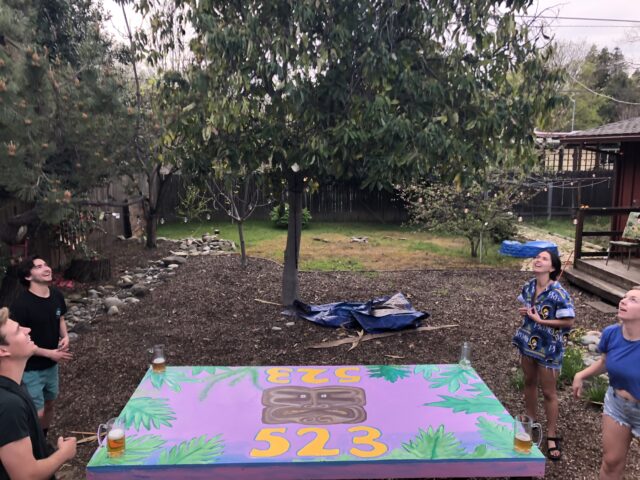
The art of beer die — a window into the culture of crafting beer die tables. “Most college-aged people have heard of the sport “beer die,” a drinking game involving four glass pints, two dice and a large table. Unlike many other drinking games, beer die revolves around culminating an atmosphere of relaxation and camaraderie through its dependance on good weather, the outdoors and team building,” writes Arts reporter Rosie Schwarz. She dives into the involved process that goes into constructing the table, but also the form of expression it demonstrates and the community it creates. Die up, read on.

Sports:

JUSTIN HAN / AGGIE

Aggie Baseball closed last home series against CSUN with a 11-4 victory on Sunday. “This Mother’s Day contest ended in a special win for the Aggies, not only because of Senior Day, but additionally because every starter got on base at least once. The Aggies, who honored their six graduating seniors — infielders Cameron Briggs and Caleb Van Blake, pitchers Blake Hannah, Chase Lyford and Chris Brown and outfielder Garret Kelly— shined in front of one of their biggest crowds this season, soaking in all the recognition and spring quarter sun.” Read on.

Culture Corner — Gabriela’s Weekly Picks

Television: “One Day at a Time”

Movie: “Instructions Not Included”

Book: “When Breath Becomes Air” by Paul Kalanithi

Album: “This Time” by Donna Missal

Read More.

Opinion:

Editorial — “SB 24 would secure access to abortion pills on California public university campuses

Humor —  “Humor: How to tell if your parents are addicted to Crepeville

Column — “Apple wants to protect your privacy and let you track your wife

That’s all for this week. Check back next Friday.

— Grace Simmons

Best of Davis: Coffee

Winner: Philz

Walking into the Philz in Downtown Davis, you’re immediately hit with the subtle smell of fresh coffee. This location opens at 6 a.m. and closes at 8 p.m. everyday, and throughout the day (as early as 8 a.m.) tables are packed. Most of these people have laptops and appear to be working, but there are a few people in serious discussions and others reading the newspaper or a magazine. There are even some who look like they’re on an awkward first date. They mostly appear to be students, but sometimes older people or young families walk in — they tend to stay for less time than the people intently working. Around the coffee shop, there are armchairs, sofas and a coffee bar, in addition to the many tables. The low strains of conversation are overpowered by the beats of contemporary R&B music from artists like Daniel Caesar, Frank Ocean and H.E.R.  

Philz Coffee was founded by Phil Jaber, who, according to the Philz website, wanted to “create a blend that was flavorful, complex, rich, smooth and low in acidity.” In pursuing this goal, Jaber traveled around the world and visited thousands of coffee shops. The first Philz opened in 2002 in the Mission district of San Francisco, starting its trend of personalized coffee. In 2005, Jaber’s son Jacob Jaber took over and became its CEO, leading expansion of the company, and Philz locations can now be found all over California as well as in Chicago and Washington D.C.

Paying attention to the little details of Philz makes it easy to realize how quintessentially Davis it is — with a bike and bike wheels prominently displayed on the walls along the E St. side and a wooden peg board with jars of spices, like cinnamon and cloves, sitting atop shelves on the opposite side of the shop. Along the coffee bar where baristas take orders, there are pride flags as well as stickers for sale that will benefit the Orphan Kitten Project. If a customer uses their own mug, they can get up to 24 ounces for the price of a small and there are mugs everywhere, so regular customers can leave one and use it when they go in.

“Our team personally changed [a lot of the decor],” said fourth-year landscape architecture major and Philz barista Hayley Chung. “It’s fun as a design student to get to do some stuff here and put some things up. Philz has a design team, and they try to get the essence of a place, so if you go to a different Philz anywhere else, it’s going to be a completely different aesthetic.”

There is a sign near the register that says that they have teamed up with local bakeries to “bring you the best.” They boast freshly made-to-order food and “wholesome (and delicious)” ingredients.

“We try to keep everything as local as possible,” Chung said. “It makes it fresher and also cheaper in terms of transportation costs and how much we’re impacting the environment. Most of these bakeries are Sacramento local bakeries […] it’s nice to keep it around here.”

According to Chung, about half of the baristas are students at UC Davis, and because of that and the age of people who generally come in, she’d describe the vibe as “young.”

“It’s laid-back, everyone who works here is pretty young,” Chung said. “I feel like we relate to our customers more, because we know [them] from classes and such.”

“If [Philz] were on campus, I’d be there all the time.” said first-year biological sciences major Anuprit Gill. “It’s a little bit of a bike, so I go at least every weekend. It’s the perfect place to study, because for me personally, I can’t sit in a dead-silent place. I can’t go to the library because there’s tension in the air. At Philz, there’s always music in the background [and] chatter. It’s just a nice vibe.”

Gill’s regular order is the iced Philtered Soul, sweet and creamy, and it’s her favorite because of its hazelnut flavor and because she finds it to be “refreshing” year round. Gill first tried Philz in Davis, because there wasn’t one where she grew up, and she strongly believes that Philz has the best coffee and is the best coffeehouse in Davis.

“Something about Philz, it’s just filled with love,” Gill said. “It feels like [that because] it’s hand-made. They make it in front of you. The vibe is [such that] you can go study there [or] just chill.”

Chung shared why she thinks that Philz is considered to be the best of Davis.

“I think Philz allows you to customize your coffee a lot more than other places do,” Chung said. “I think it has a younger feel than the other coffee shops. It has the convenience of a bigger chain, but it feels more Davis.”

Drinks at Philz can be ordered with differing sweetness and creaminess, and of all of the combinations, the Mint Mojito, sweet and creamy, and iced Philtered Soul, sweet and creamy, are the two most popular.

“Learning how to become a Philz customer is kind of intimidating, but we’re here to help people and it’s our whole job to do that,” Chung said. “So don’t be intimidated!”

Written by: Anjini Venugopal — features@theaggie.org  

Cartoon: Inner Superhero

ROSEY MOREARTY / AGGIE

Written by: Rosey Morearty — rosey@morearty.org

Apple wants to protect your privacy and let you track your wife

Apple removes screen-time restriction tools, citing privacy, while selling a wife-tracking app

The New York Times recently published an article on Apple’s year-long campaign of purging and restricting parental-control apps that allow users to restrict their children’s screen time. In defense of this move, Apple spokeswoman Tammy Levine cited privacy concerns, alleging that the apps gathered intimate data on users, including their location. Conceivably, given Apple’s professed devotion to user privacy and safety, the company would display more concern over Absher, a wife-tracking app, being sold on the App Store. It hasn’t.

Absher, launched in 2015 by the Saudi government, has been widely popular in Saudi Arabia, which governs its female citizens under guardianship laws that essentially demote the legal status of women to that of minors and wards. Under these laws, every Saudi woman has a male “guardian” who must give their consent in order for her to get a passport, have certain medical procedures or get married.

Absher helps enforce these laws by allowing “guardians” to restrict women’s travel, providing them a tool to track women through their national ID cards or passports. The app provides an alert function, notifying men any time a woman under their guardianship goes through an airport.

Feigning ignorance of the app’s enforcement of guardianship laws would be futile at this point, as Apple CEO Tim Cook has already been made aware of the app in an interview with NPR. Here, he stated he had never heard of Absher, “but obviously we’ll take a look at it if that’s the case.” Advertised in Apple and Google stores as affording users the ability to “safely browse your profile or your family members, or [laborers] working for you, and perform a wide range of eServices online,” this is plainly and painfully the case.  

A Saudi woman fleeing to Australia from her family was able to do so by discreetly giving herself permission to travel through her father’s phone. Without first secretly giving herself consent to travel and then turning off Absher’s notifications, she would not have been able to leave.

The fact that Absher serves as a real obstacle toward not only gender equality within Saudi Arabia, but also an obstacle for women attempting to flee abusive households makes Apple complicit in this oppression.

The mere existence of this app alone undermines any claim Apple can make about wanting to protect user privacy from screen-time and parental-control apps. But the lack of response from Apple following Cook’s interview obliterates an already-flawed, nonsensical attempt at reasoning.

Amidst the controversy sparked by the Times article, Apple has affirmed its commitment to fighting screen addiction with very little action toward that end. Apple has made it difficult to use even its own screen-time tools and enforce time restrictions on social media platforms. When users are notified that they’ve reached their time limit, they’re only given the option to click “Ignore Limit.”

Apple’s tool also only works for parents if all family members have an iPhone. Its new restrictions on screen-time and parental-control apps only allow for blocking adult content on its Safari web browser and some apps, but not on others like Twitter, Youtube and Instagram — the most popular and addicting. They’ve also restricted and removed apps allowing adults to fight their own iPhone addictions.

Apps like Freedom and OurPact, stripped from Apple’s app store, have reached out to the company in an attempt to comply with their guidelines and get their apps on the store again. Although developers have been more than willing to accomodate, Apple has been unwilling to instruct them on how to do so.

Despite its claims to the contrary, Apple clearly isn’t interested in fighting phone addiction, or ensuring privacy for that matter. In exacting sly methods to remove and restrict the functionality of screen-time apps and tools, Apple actively frustrates attempts at reducing addiction to tech in the youngest generation. Children are most susceptible to phone addiction — a fact that all, especially tech-giants, know well. If Apple can reach its market base at a younger age, it can instill both customer loyalty and addiction from the outset of a child’s technological experience.

In the face of its coercive activities and the sale of Absher, clearly violating the privacy guidelines that Apple values so highly, citing privacy protection is an absurd attempt at moral high ground. The moral rectitude Apple professes on this issue is not merely insulting to the public’s intelligence — it’s abhorrent.   

Written by: Hanadi Jordan — hajordan@ucdavis.edu

Disclaimer: The views and opinions expressed by individual columnists belong to the columnists alone and do not necessarily indicate the views and opinions held by The California Aggie.

Epic comebacks set stage for Champions League Final

Liverpool, Tottenham erase insurmountable semifinal deficits

Before the start of the semifinals, this year’s edition of the UEFA Champions League was already one of the greatest in the competition’s history. The tournament has been marked by an unprecedented amount of drama and unexpected developments, from shocking upsets and large comebacks to ridiculous goals and highly controversial officiating decisions.

Many of the biggest clubs in Europe, and those with the deepest pockets, have seen their hopes of winning this grand competition slip away at the expense of surprising underdogs. In addition, the introduction of VAR (Video Assistant Referee) at the start of the group stages has single handedly decided the outcomes of a few different matchups.

Needless to say, it would’ve been quite a memorable tournament regardless of what happened in the semifinals.

Instead, fans around the world were treated to two of the biggest comebacks in Champions League semi final history, as English sides Liverpool and Tottenham both overturned three-goal deficits in their second legs. Each comeback was equally as shocking and dramatic in its own right, setting up the first All-England Champions League Final. With Chelsea and Arsenal both advancing to the Europa League Final as well, this year marks the first time in history that all four teams in the two major European finals have come from the same country.

After dominating possession and putting constant pressure on Barcelona in the first leg, Liverpool was extremely unlucky to leave Camp Nou with a staggering 3-0 deficit. Both teams were at a relatively even level for the first half and Liverpool, despite trailing 1-0 from an early Luis Suarez goal, dominated the first 25 minutes of the second half. They seemed destined to break through and push across at least one or two pivotal away goals, but failed to convert on a plethora of prime scoring chances.

In the final 15 minutes of action, superstar Lionel Messi took matters into his own hands and punished the Reds with two late goals, including a jaw-dropping free kick that curled perfectly in the top left corner of the goal. Barcelona squandered a pair of late breakaway scoring opportunities, including a wide open miss by striker Ousmane Dembele in the final kick of the match. Those missed chances, which could’ve changed the entire complexion of the second leg, will surely haunt Barcelona for a long time.

Back home in front of a raucous crowd at Anfield, Liverpool thoroughly overwhelmed Barcelona all night, employing an aggressive, high-line press with a level of intensity that the visitors simply could not match. Barcelona had its chances in the first half, but several key saves by goalkeeper Alisson Becker kept Liverpool in front 1-0 at halftime. As the game wore on, the pressure on Barcelona continued to build in the midst of the thunderous and intimidating environment created by Liverpool supporters.

Following an injury to Liverpool left back Andrew Robertson, midfielder Georginio Wijnaldum came on as a substitute to start the second half and promptly scored twice in the span of two minutes to knot the score on aggregate at 3-3 with over a half hour remaining. In just 55 minutes, Liverpool completely wiped out all remnants of that nightmarish night at the Camp Nou.

In the 79th minute, a moment of genius from right back Trent Alexander-Arnold finished off this unimaginable comeback in fitting fashion. The 20-year old caught Barcelona completely asleep on a corner kick, quickly firing the ball into the box before the defense could get set up. Attacker Divock Origi, playing in place of injured star Mohamed Salah, was able to finish Alexander-Arnold’s cross with a beautiful tap-in goal to the top corner of the net.

The historic Anfield stadium has seen its share of extraordinary European nights over the years, often willing Liverpool to victory through the home fans’ sheer magnitude of passion and ferocity. Given the circumstances heading into this game, with Liverpool playing without lead forwards Salah and Roberto Firmino and facing one of the best teams in the world, the 4-0 victory over Barcelona undoubtedly ranks as one of the greatest nights that this fabled ground has ever seen in its 127-year history.

Just when soccer fans thought the action couldn’t get any more captivating, Tottenham Hotspur came right back the next night and pulled off an even more enthralling comeback over host Ajax.

Spurs had their struggles in the first leg, playing without suspended striker Heung-Min Son, and were lucky to escape the match with a 1-0 loss. Ajax will lament the multiple chances they missed to potentially put Tottenham’s hopes to bed before the second leg.

On Wednesday, Ajax came out firing once again with its aesthetically pleasing brand of attacking football and netted a pair of goals in the opening 35 minutes to take control. The second goal, a sensational, one-time screamer into the top corner by winger Hakim Ziyech, looked to be the nail in the coffin for a Tottenham side that appeared mentally and physically drained.

Nevertheless, things started to unravel for the Dutchmen early in the second half of play. Tottenham striker Lucas Moura scored a pair of goals just four minutes apart to suddenly bring Tottenham back from the dead. Then in stoppage time, with the referee’s final whistle just seconds away, Moura slotted a low shot into the bottom-right corner to propel Tottenham through to the final on away goals. Home fans at the Johan Cruyff Arena were completely stunned as they watched Ajax players collapse to the turf in despair, while Tottenham players and coaches rushed the field in delirium.

After their incredible run in the Champions League, advancing all the way from the second qualifying round and coming within seconds of reaching the final, Ajax will unfortunately see a large chunk of its core depart as early as this upcoming summer. Top players such as Ziyech, Matthijs de Ligt and Frenkie de Jong have already been rumored to join bigger clubs in the near future, as Ajax seeks to recoup a large sum of money in transfer fees and reinvest in more young talent.

Tottenham joined Liverpool in rare company, overturning a three-goal deficit at this stage of the Champions League, but pulled off the miracle in half the amount of time. Spurs have secured a fourth-place finish in the Premier League and will thoroughly enjoy the three-week break before the Champions League Final on June 1 at Atletico Madrid’s Wanda Metropolitano Stadium in the Spanish capital.

Tottenham is hopeful that star forward Harry Kane can make a full recovery from his ankle injury, which he sustained in the quarterfinals against Manchester City, and be fit enough to suit up for the final.

Liverpool will need the rest just as badly, after falling short in arguably the greatest title race in Premier League history. Despite finishing with the third most points ever in the league season and losing just a single match, the Reds could not prevail over two-time defending champion Manchester City.

Liverpool will hope that players such as Firmino and Robertson are able to rehab during these next few weeks and be available for team selection in Madrid.

Given all the victories Liverpool has piled up this season, there is a considerable amount of pressure on manager Jurgen Klopp and the rest of the team to come away from the season with at least one trophy to show for it. Even though the Reds fell agonizingly close to ending their 30-year domestic title drought, another European Cup wouldn’t be a bad consolation prize for a club that already has a rich history of success in this competition.  

Liverpool were victorious in both meetings against Tottenham this season, but were very lucky to come away with three points in their last meeting at the end of March. If not for a Spurs own goal in the 90th minute, Liverpool would’ve suffered a draw and a devastating blow to their title hopes at the time.

Both Klopp and Tottenham manager Mauricio Pochettino are highly regarded as tactical geniuses, and will definitely take these next three weeks to prepare intelligent and creative game plans to stop one another.

According to the bookies, Liverpool are considerable favorites to hoist the trophy next month in Madrid, with 1-2 odds offered at Bovada.

Elsewhere around Europe:

The Europa League Final, staged in Baku, Azerbaijan on May 29, should be an interesting battle between a pair of London rivals.

Chelsea has already secured a return to Champions League football for next season, having finished in the top four of the Premier League. The club will try to cherish what could be the last game from superstar forward Eden Hazard, before his impending summer transfer to Real Madrid.

Meanwhile, fifth-place Arsenal has everything to play for in this final, because a victory over the Blues would earn them automatic entry into next season’s Champions League — instead of a third straight year playing in Europe’s second-rate competition. Luckily for the Gunners, first-year manager Unai Emery is a master at winning the Europa League, coming up victorious in three straight finals for Sevilla from 2014-2016.

Written by: Brendan Ogburn — sports@theaggie.org

MOOving the “best animal on campus” vote

The UC Davis cows win the student vote for fourth year

Behind the Tercero first-year dorms, groups of dairy cows rest in the sun, watching as curious students bike along or pause for a short visit. UC Davis has several homes for cows across campus, leaving each group of cows with their own unique experiences to share with students.

Aside from the Tercero dorms, students can find over 300 UC Davis cows at the UC Davis Dairy Teaching and Research Facility, the UC Davis Beef Barn, range facilities in Folsom and Vacaville, the University of California Reserve Putah Creek Restoration site, Browns Valley and the Sierra Foothills Research and Extension Center. At each facility, UC Davis students are the problem-solvers, critical thinkers and researchers, learning real-world world applications to start their own careers.

“We have these facilities to solve problems, our students can apply their education and knowledge from their classes from birth to production,” said Donald Harper, the animal resource manager at the UC Davis Animal Science Beef Barn. “It’s rewarding to see their light bulbs go off. Most of our students come from an urban area, when we first meet them they come with tunnel vision, but then their vision becomes full view, like a panoramic. They become independent and proud of their success and accomplishments because they can see the full view and understand it.”

The Dairy Teaching and Research Facility teaches students to manage cow and calves, offering vaccinations for dry cows and cows that are close to having calves, sterilizing calf environments and caring for sick cows with gut microbiome imbalances.

“At the dairy farm, we’re not just treating a cow to survive, we’re also treating them to produce calves and milk,” said Sara Baker, a fourth-year animal science major and student herd manager at the UC Davis Dairy Teaching and Research Facility. “We are also looking at what factors into these decisions to maximize animal welfare.”

When Baker was growing up, she did not have agricultural experience. By taking a course in the ANS 49 series, she spent three hours a week working with fresh and sick cattle, realizing how much she could learn at the dairy farm. She hopes to become a veterinarian who thinks about both production and veterinary needs in order to create practical ideas that can be implemented for food production animals.

Students can watch newborn calves grew up, applying ideas from their classes to new lives. When calves are born, they are born without any adaptive immunity. Students can then help the calves learn how to drink from a bottle, building up their immunity with their first milk in sterilized environments.

“It’s a great feeling to teach them how to survive,” Baker said. “When you cradle a calf, they like to suck on your finger. The goal is to get them to suckle on the bottle. Sometimes, they’re not interested in the nipple on the bottle. One time, I was there for 45 minutes feeding a calf and I had class right after, I had to remind myself that there are other people who can also help support the calves.”

The UC Davis cows support local areas just by grazing.

Last year, Vacaville burned during the Solano Country fire. Groups of UC Davis cows come out to graze on the Vacaville open rangelands, preventing the spread of wildfires. Although the Solano County fire burned 25% of the range, the damage could have been more severe without the cows.

When cows dry graze, they prevent grass from spreading fires to trees. Even after the wildfire had passed, native wildlife seeds were grounded, ready to grow back and bring new life.

The UC Davis cows offer a similar effect with the UC Reserve’s Putah Creek Restoration efforts. Every spring, the cattle are brought to restore native species, like oak trees, in the area.

Although cattle are notoriously associated with high methane emissions contributing to climate change, California cattle industries are placing their hopes of reducing greenhouse emissions with new technologies produced with UC Davis’ cows.

“In 2014, the state of California mandated that cattle industries lower methane emissions by 40%, there was no way to do it, so they turn to universities to find solutions,” said Braden Wong, a fourth-year animal science major.

The UC Davis Animal Nutrition and Environmental Modeling Applications Laboratory investigates ways to lower methane emissions with seaweed. Certain species of seaweed have been shown to lower methane emissions by working in their digestive pathways.

Student researchers come by the UC Davis Beef Barn twice a day, during the early morning and early evening, mixing up seaweed feed.

Cows can be picky eaters too. They hate seaweed, and refuse to eat it when they spot large clumps of it in their food.

“We take ground up seaweed, alfalfa silage and mix it with molasses because cows love molasses and it gets rid of the seaweed smell,” said Anna Wilson, a second-year animal science major. “We analyze their feed samples, refusals or leftovers, fecal samples, ruminal fluid [fluid within a cow’s stomach carrying gut microbiota] and capture 24 hours of their gas emissions once a week.”

Each week, students budget time with their classes and lives, choosing to spend the rest with the cows.

“The evenings go by pretty quick,” said Cynthia Martinez, a fourth-year animal science major. “They’re part of our routine, our normal.”

These cows have been part of the study since they were nine months old, moving towards the second phase of their production life. UC Davis cows live through three phases. In the first phase, they are born, navigating their development as calves. The cows grow during the second phase, often near the freeway, grazing to significantly gain weight. In their third phase, they continue to gain weight, nearing food production.

The methane emissions research study investigates the cows during their third phase with preliminary findings showing approximately 60% of methane emissions reduced. Towards the end of the summer, UC Davis researchers hope to investigate how seaweed consumption impacts meat quality and internal systems.

“This experience amplifies what you have been learning in classes,” said Daisy Castro, a fourth-year animal science major. “You don’t retain a lot from a slide, but here you learn there is a lot of more work in research because a lot of changes could happen.”

Students from both animal science and non-majors can build experience in navigating memorable and unpredictable cattle behaviors at each site through the ANS 49 series.

“We have lab and discussion, where we talk about how productions work,” said Viviana Escobar, a second-year animal science major. “It opens up new windows by coming out here. It’s different than being in class and it’s important to get hands-on experience.”

Written by: Foxy Robinson — science@theaggie.org

The Art of Beer Die

Where creativity, drinking come together

Most college-aged people have heard of the sport “beer die,” a drinking game involving four glass pints, two dice and a large table. Unlike many other drinking games, beer die revolves around culminating an atmosphere of relaxation and camaraderie through its dependance on good weather, the outdoors and team building.

When walking through Davis, students can be seen outside throwing die. Most of the time, there is music playing, people watching and the expectation that many games will be played. Because of the specific dimensions of a beer die table (8-by-4 feet and at least ½ inch thick), many students build their own tables to customize their experience.

After embarking on a trip to Home Depot and participating in the group activity of building the table, many students decorate their tables. Often, they personalize the tables with the Greek letters of their organizations which serve as markers of friendship with whom they built it or to show their love for the game. This degree of personalization reflects the unique nature of beer die as a drinking game that centers around community and leisure.

Sally Ellberg, a third year biological sciences major, painted her table with a friend in tribute to their shared love of their hometown.

“I am from Ventura, Calif. where I grew up swimming in the ocean [and] bodysurfing,” Ellberg said. “One of my friends Joe Terre, who gave me the table, is also from my area so we brainstormed a design that was ocean inspired for the both of us. After brainstorming, we chose to mimic the common outdoor company called Patagonia. Patagonia started in my hometown and its logo embodies adventure and most importantly the ocean that I miss on a daily basis.”

The process is time-consuming, but worth it.

“I remember the first Thursday of Fall Quarter when I painted the table white first as a base coat and drew the design in pencil,” Ellberg said. “Friends kept stopping by to see the progress and help me color between the lines … Overall, the whole process of acquiring the table, deciding on designs, picking the colors and having people over to play die on it has been a way to bond with my friends and an excuse to have fun whenever we don’t have any class. It might be cheesy, but the table has totally brought us closer together.”

For Noah Yardeny, a second-year pharmaceutical chemistry major, the inspiration for his table centered around UC Davis pride in the style of one of his favorite artists.

“For our table my housemates and I really wanted to do something colorful, fun and for it to be bright because die is such a happy game,” Yardeny said. “We decided to go with gold and blue for UC Davis, and for the other side we chose green and purple because those colors create a nice contrast. We really like the artist Jackson Pollock so we were inspired to splatter paint [on] the table and the table came out all textured and organic and we were stoked.”

Spencer Katz, a fourth-year political science major, painted his table to mimic a classic ping-pong table.

“It was originally supposed to have a large Gunrock painted in the middle but once we got the line drawn we decided to take a tossing break and we’ve been playing ever since,” said Katz. “The table is a gathering place, a focal point to build community. We can all come together and debate which of the cheap beers are the worst — Rolling Rock — enjoy the outdoors, take the edge off and meet new people.”

Although beer die is a game often played on college lawns across America, it is customizable to each group of friends. For example, when it is played sitting down, it’s called snappa.

“I also love the house rules in beer die which allow each home to put their creative spin on the game and introduce new challenges which keep the game interesting and lead to a culture of idea exchange,” Katz said.

As each house or group of friends individualizes their table, they create a persona for their die table reflecting their shared interests. After graduating, seniors often pass down their table to a younger group of friends who are either moving into their house or share their love for the game. Although beer die is popular across the country, the welcoming and laid-back atmosphere of UC Davis fosters the perfect beer die environment for students to create something that is more than just a game.

Written By: Rosie Schwarz — arts@theaggie.org