53.5 F
Davis

Davis, California

Tuesday, December 23, 2025
Home Blog Page 461

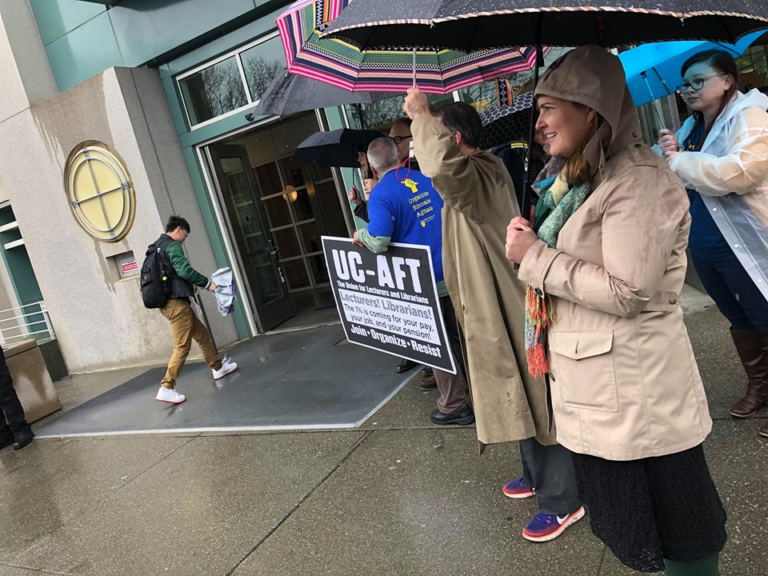
Librarians from several UCs rallied outside Shields during bargaining negotiations

Demands for competitive pay with CSU, CCC librarians

UC librarians, represented by the University Council-American Federation of Teachers Unit 17 (UC-AFT), a union that also represents UC lecturers, rallied outside of Shields Library during a break in their bargaining session with the UC’s bargaining team on Jan. 15. The negotiation process for the UC librarians’ contract has been ongoing for almost a year.

The main discussion points in the bargaining session include a salary dispute and an ongoing debate over whether UC librarians should have academic freedom, which would give them the right to pursue research.

Having just come from a morning bargaining session, Ken Lyons, a librarian at UC Santa Cruz and a member of the UC-AFT Unit 17 bargaining team, said that there were signs of some cooperation from both sides for the first time since bargaining started almost a year ago.

“On salary, [the UC] presented a counterproposal, but with no reasoning behind it that would give us a small pay increase per year [and it] doesn’t even keep with current inflation,” Lyons said. “Both sides need to do some research to see what their ideas actually mean in the long-term. It’s been a long and slow process with not much movement, but there is at least a glimmer of hope today.”

Claire Doan, the director of media relations for the UCOP, maintained via email that the UC has offered “a comprehensive, multi-year contract” including fair pay which “appropriately compensates librarians.”

The UC has offered a guaranteed prospective wage increase of 3 percent upon ratification of a new contract and annual 3 percent increases through the 2021–22 fiscal year, as well as enhancements to the wage structures for librarians, Doan said email. She said that the contract also includes “quality health care for librarians and their families [and] continued excellent retirement benefits.”

At the rally on campus, Lyons said that UC librarians haven’t had a contract since the end of last September. Several members of UC-AFT Unit 17 spoke about the union’s demand for salary increases, mentioning that librarians at California Community Colleges and California State Universities receive higher pay.

“We need to not only keep up with inflation or surpass it, we need to catch up with the other systems in the state,” Lyons said. “There’s a recruitment and retention problem, because we’re paid so low that if people do come to the UC — which is a problem in itself — then they leave to those other systems and make a lot more money. When there are vacancies that they recruit for, we have smaller pools of applicants. That’s a problem not only for us as librarians, but it’s a problem for the institution.”

Daniel Goldstein, a UC Davis librarian and subject specialist, echoed Lyons’ sentiment, explaining that there is a sense that the UC does not adequately value the services librarians provide for the university.

“Librarians’ salaries are at a point where it affects our ability to hire people — we have more and more failed searches throughout the system where we can’t get a proper person to come when they find out what they would be paid,” he said.

UC Davis Subject Specialist Librarian Adam Siegel addressed the crowd of people in attendance at the rally, stating that UC librarians make around 25 to 30 percent less than librarians at CCCs and CSUs.

“We call that the prestige penalty,” he said.

Lyons said that although UC librarians do the same work as librarians at CCCs and CSUs, librarians at these schools are considered tenure-track faculty while UC librarians are not.

“We are a small union — UC librarians are the smallest representative union in UC and that allows UC to get away with [this pay inequity],” Lyons said.

In addition to salary, UC-AFT Unit 17 is also concerned with securing the right to academic freedom.

“UC basically says we don’t have any of the rights that faculty have as academics, such as academic freedom and other associated things, like sabbatical,” Lyons said. “If we’re academics, what makes us academics if we don’t have any of what other academics have?”

According to Goldstein, UC librarians assumed they were guaranteed the right to academic freedom and were surprised to find out otherwise.

“That’s a really big deal because academic freedom underpins so much of what we do everyday,” he said.

In a statement sent to The California Aggie last November, Doan, the representative from UCOP, said that the UC is establishing a work group to analyze the UC policy on academic freedom. The group will make its recommendations this summer.

While both faculty and UC librarians are required to complete research, UC librarians do it while working full-time and cannot request a sabbatical. In addition to this lack of rights, such as academic freedom and the ability to take sabbaticals, UC librarians also aren’t eligible for the benefits faculty receive, such as the mortgage program.

Joaquin Chavez, the vice president of the University Professional and Technical Employees CWA 9119 (UPTE) union, also spoke to attendants of the rally, emphasizing UPTE CWA 9119’s support for UC-AFT Unit 17 and the importance of unions banding together.

“We are all in this struggle together: we serve in developing this institution,” Chavez said. “UPTE is here in solidarity with the librarians, we’re all in this fight together and we have a lot to win together.”

UPTE CWA 9119-represented UC staff have been out of a contract for over a year and a half.

“We can see the university management trying the same sort of tactics that they’re using on us against you and against other groups of workers at the University of California,” Chavez said to the crowd. “They don’t want to give us regular, decent cost of living allowances, they don’t want to give us step raises that incentivize us to actually stay here and show that we’re a valued part of the institution, and they want to take away all kinds of other forms of compensation.”

In Chavez’s view, UC workers are asking only for what they deserve based on the work they put in, and there is a fundamental conflict of interests between the UC and its workers.

“When we’re talking about a fair contract, we’re talking about our aspirations for a decent life, a better life — the kind of life that we deserve given the work that we do to build this university,” Chavez said. “The UC management isn’t concerned with developing that reputation or even continuing to earn it, they are concerned with driving down costs [and] with privatization.”

Written by: Sabrina Habchi — campus@theaggie.org
I had a shot at the military. Why shouldn’t a transgender person be able to?

The reality of recruitment means everyone deserves a chance to serve

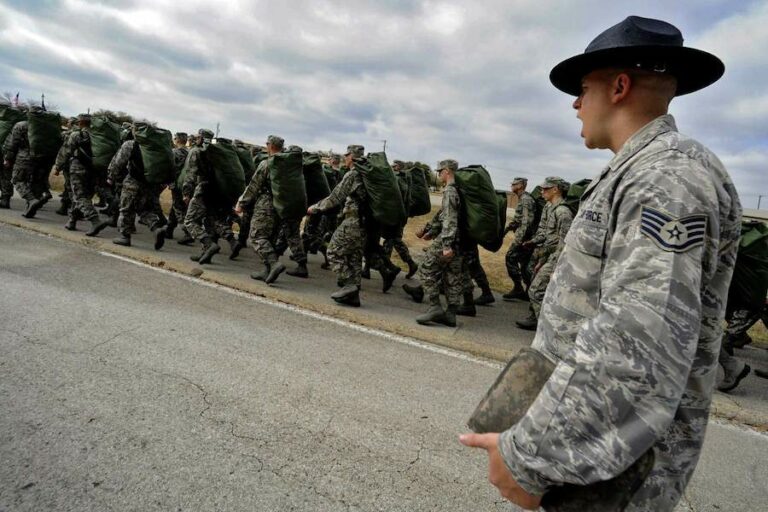
It wasn’t long after my freshman year of high school that I developed a plan that’s exceedingly common for young men trying to figure themselves out: I would join the military. There would be no question because it runs in the family. My great-grandfather fought in the Pacific in World War II, my grandfather served in Vietnam and my dad was a naval officer in the early ’90s. Uncles, cousins — it seemed like everyone had served, so why couldn’t I?

I was pumped-up on teenage testosterone. My preparation cycle would go something like this: adopt an all-too-advanced pull-up regimen from SEAL forums; rise at the crack of dawn every day and run a few miles; research military branches and gloss over everything besides the Navy, as was the general tradition in my family; fight the urge to listen to the infamous lies recruiters tell in order to meet unreachable quotas and invigorate my inner gung-ho to be the best recruit ever. I was going to fight bad guys from the deck of a destroyer or a carrier, or from inside a submarine — in hindsight, completely ignoring the realities of contemporary military service, and just life in general. It ain’t like the movies!

My dreams were squelched when I failed a medical screening. I had a “history of shoulder instability” stemming from a surgically-repaired labrum, and a degree of scoliosis that breached the acceptable limits. The risk of a recurring shoulder injury and the general uncertainty regarding a curved spine proved to be disqualifying. Perhaps it had to do with costs — the military has enough budgetary woes beyond fronting expensive treatments for already-unhealthy candidates. Or maybe it had to do with efficacy in the field. Who wants a guy with a shaky back watching his own?

It sucked, of course. I could have grinded out another application and hoped for a better result. But the denial served a crushing blow to my sense of self-worth. The U.S. Department of Defense is the largest employer on the planet. How do you win a second chance with those guys? It seemed impossible to simply serve my country. I imagine it’s the same with people entrenched in the transgender military ban. How do we express our love of our country when we’re disqualified for things outside our control?

In 2016, President Barack Obama revoked the long-standing ban on transgender people serving in the military. His congressional opponents quickly conflated the policy with the fight over transgender bathroom rights, lamenting the new practice of legislating by executive fiat. The fight continued when President Donald Trump reinstated the ban in 2017 — without the instinctual awareness to inform his own defense secretary. This ban was temporarily upheld by the Supreme Court on Jan. 22, while lower courts hear appeals cases.

Some claim that opening the military to transgender people will necessitate undue costs for hormonal therapy and surgery, while also affecting combat readiness. Others claim that the cost of surgery and hormones — which aren’t always undertaken by transgender people anyway — is negligible in a defense budget dwarfing that of other federal departments.

The case is clear, even among top military brass. All four service chiefs are on record saying there’s no problem with transgender troops for morale and unit efficiency. A RAND Corporation study found that the health cost of fielding transgender troops is “relatively low.” Eighteen countries currently allow transgender troops in combat roles, and there doesn’t seem to be a problem with reduced operational efficiency or cohesion.

In most respects, military screening makes sense, as much as it affects people who passionately want to serve their country. The afflictions run the gamut — a history of surgery, musculoskeletal problems, asthma and disease. The list is long. And while there was disappointment on my end, and no doubt for everyone else who fails to clear these hurdles, there’s a certain logic behind denying us.

But military recruitment is at an impasse. The Army fell 10,000 recruits short of its annual enrollment goal for the 2018 fiscal year. A report by the Office of People Analytics found that interest in joining the military among young people was at a ten-year low in 2017. With a strong economy, finding new recruits may become more difficult. Decade-long wars have jaded the American public. These new realities should encourage policy-makers to look at easing recruitment standards. Instead, Trump’s transgender ban only makes the problem worse.

Considering the fact that less than a third of young Americans are even qualified for military service, the ban also reeks of impracticalities. A nation’s military should have no qualms about strict discrimination on the basis of mental or physical readiness — except when recruitment numbers are low and American military power is facing questions over NATO alliances, Russian aggression and Chinese intransigence. In that case, initial recruiting standards should be eased to fulfill national defense requirements. And here we are, facing these exact issues and still arguing over nonsensical “bans.”

Staring rejection in the face isn’t fun. I tried to join the military, and I failed. We should give more opportunities to people who also want to try. Transgender people deserve a shot at joining a cause greater than themselves, just like anyone else. Taking that away only softens our claim to have the “greatest military in the world.” We don’t want to lose that distinction now, do we?

Written by: Nick Irvin — ntirvin@ucdavis.edu

Disclaimer: The views and opinions expressed by individual columnists belong to the columnists alone and do not necessarily indicate the views and opinions held by The California Aggie.

Winter gloom brings students down

0

The seasonal gloom surrounding winter quarter hits students in full force

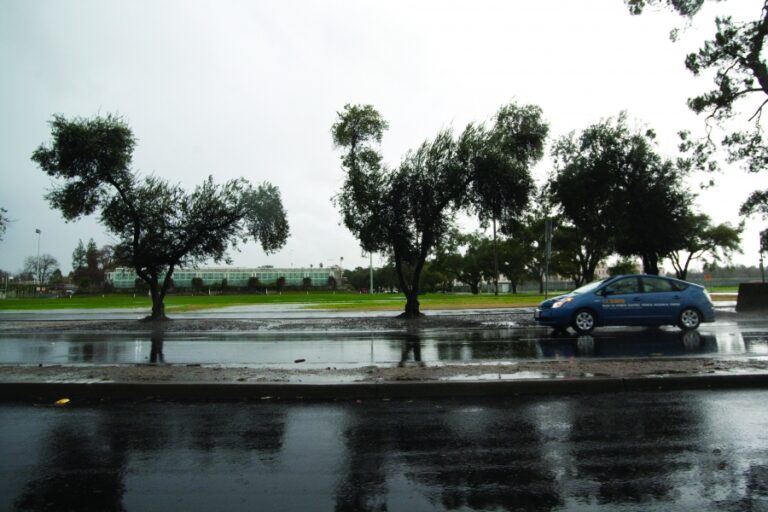
Winter Quarter tends to be an energy deficient quarter for students, coming one full quarter after the past summer and another full quarter away from the upcoming summer. Upon returning to Davis in January, students often find themselves less excited to socialize or participate in events in the area. Many factors play into this generalized apathy, as students note that their hesitancy to go out can be due to a multitude of reasons.

Brian Jahja, a third-year food science major, blames his hesitancy to go out to on the dreary weather that looms over campus throughout the quarter, noting that the general gloom of overcast weather can be the cause of students feeling less sociable.

“I think the atmosphere in Davis becomes extremely depressing during winter quarter since it rains nonstop on top of it being really cold,” Jahja said. “People are less willing to go out, and the whole vibe of the campus body is very antisocial since everyone just wants to bundle up indoors with a warm blanket. There’s also a lack of activities during the quarter, so it ends up being pretty dead socially for those few months.”

Scott Sanchez, a fourth year design major, agreed that the gloomy vibes of Winter Quarter tend to be mostly due to the gloom in the weather itself. He added that the bad weather can bring additional barriers that make socializing and enjoying Davis more difficult physically.

“Winter Quarter is definitely my least favorite quarter, just in terms of the weather and trying to get around to classes or places in general,” Sanchez said. “I feel like I have to get up earlier in Winter Quarter too. I like to maximize my sleep time as much as possible, but preparing for the rain means that I have to get up at least an hour earlier to get ready, and even then I’m sometimes late. I also haven’t heard of many cool events going on in Winter Quarter, probably because of the bad weather and the rain itself. It’s hard to find things to do for fun during Winter Quarter; you can only do so much in the city of Davis and most people have busy schedules too so it can be hard to plan around that.”

Zoe Marin, a fourth-year design major, noted how the bad weather has a domino effect on other aspects of Davis that further deteriorates the overall quality of the quarter.

“During Winter Quarter, I really dislike having to take the buses, but I have to because when it rains it means I can’t really bike,” Marin said. “I live in North Davis and when it comes to living there, the buses get really full because so many people live there. Because of that, the buses also get really musky and gross. Today, I was sitting in the corner of the bus and I felt like I was going to suffocate. I’ve actually seen people pass out on the bus during Winter Quarter because of how stuffy it gets.”

Most students agree that Davis’ bad winter weather is the main contributor to the dampened mood throughout the quarter, and while there may be a deficiency of scheduled events planned for the quarter, students should still attempt to find ways to enjoy themselves.

Written by: Alyssa Hada – features@theaggie.org

Manetti Shrem Holds Winter Season Celebration Opening

An opportunity to interact with both the art, the artists

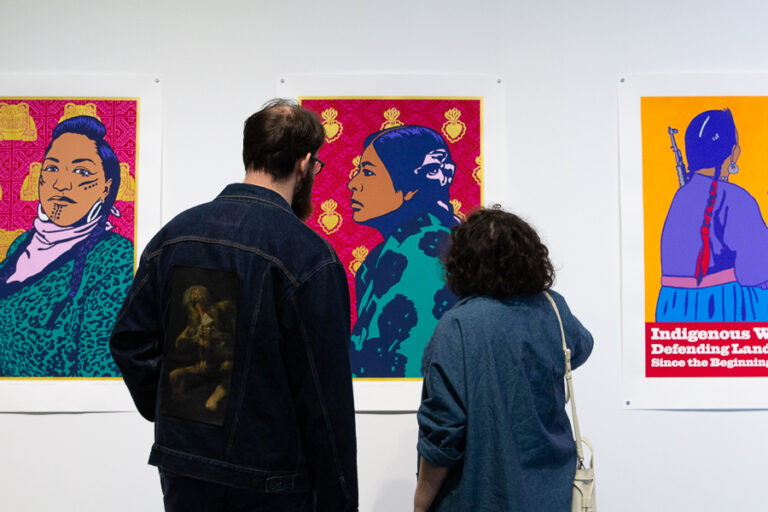
Usually on a Sunday afternoon going into the fourth week of the quarter, the Manetti Shrem is expected to be decently filled. On Sunday, however, it was filled to capacity with students, families and members of all ages coming to celebrate the new “Xicanx Futurity” exhibit’s opening.

The Winter Season Opening Celebration took place on Jan. 27 from 2 to 4 p.m. and reminded the Davis community how essential the Manetti Shrem is to it. The celebration offered attendees a chance to familiarize themselves with the current exhibits, hear from a panel of artists and engage with those around them over food and drink. As a museum that prides itself on its interactivity and accessibility, the Manetti Shrem’s Winter Celebration ensured that everyone at the event felt comfortable and listened to.

Outside of the museum before the event began, event goers were welcomed by concession stands serving tea and coffee and an outdoor printing booth that offered “Abolish Borders” signs in different shades of blue and green to all who were interested. As people stood outside with their signs and enjoyed their beverages, the Shrem’s emphasis on community and comfortable space was felt throughout.

The two-hour celebration included a welcome from Rachel Teagle, the museum’s founding director, along with a panel of the artists of the “Xicanx Futurity” exhibit, which was followed by a performance from the Xicana Collective, “In Lak Ech.” Inside, the exhibits offered a collection of art that spanned across all mediums as it displayed the work of six different Xicana artists.

Currently, the Manetti Shrem is hosting two exhibits: “Bruce Nauman: Blue and Yellow Corridor” which was recently extended until Apr. 14, and the “Xicanx Futurity.” While both exhibits drastically differ, they share similarities in level of engagement and participation that they require from observers. Beyond viewing the art, many of the pieces asked the audience to consider their active role as a participant in their surroundings.

Nauman’s exhibit “is a narrow passageway that wraps around an existing room, combining colored fluorescent light and closed-circuit video to manipulate the viewer’s perceptual experience.” The “Xicanx Futurity” exhibit includes many interactive elements such as La Botanica del Barrio, which is centered around a  “rolling Remedios Cart which is an alterNative mobile medicine cart that aims to educate, dialogue and document wellness remedies, recipes, herb and plants uses and Mexican traditional medicine.”

The new “Xicanx Futurity” exhibition includes art from from artists who might range in age, medium and background, but all focus on creating “an intergenerational dialogue that centers indigenous forms of communal and hemispheric ceremony, rooted in sacred relations.”

The Manetti Shrem opened in Nov. 2016 and has since grown into a popular and celebrated establishment of the UC Davis community as it offers free admission for all attendees, an exciting schedule of new exhibitions and a place for members of the community to engage with art. This accessibility is echoed in the Shrem’s mission statement which emphasizes “serving both the public and our university community with a dynamic artistic program…that presents exhibitions and events that advance students’ understanding of their place in the world; connects to faculty teaching and research; and creates a lively forum for community engagement and creative practice.”

This winter, the Shrem has many upcoming events including an Art Studio Visiting Artist Lecture Series on Jan. 31 from 4:30 to 6 p.m., a presentation from multidisciplinary author Mauro Aprile Zanetti on Feb. 6 from 4:30 to 6 p.m. and an event titled “Third Thursday: Explore Your Museum” from 5:30 to 9 p.m., which offers an additional celebration of the “Xicanx Futurity” exhibit and a chance to create one’s own prints, play games and further engage with all that the Manetti Shrem has to offer.

Written by: Rosie Schwarz — arts@theaggie.org

Dance for a Cause Competition

RCDC to host annual competition supporting Camp Kesem

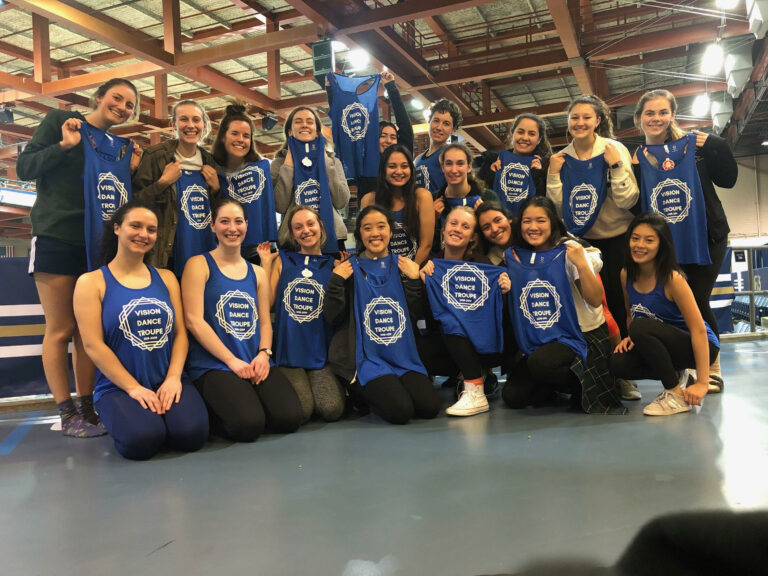
UC Davis dance group Released Contemporary Dance Company will host its annual competition Dance for a Cause on Feb. 3. Dance for a Cause brings together eight dance troops to compete, and whichever team wins based on fundraising and points earned during the event will receive $200 donated to a charity of their choice. Competing this year is Vision Dance Troupe, MOBility, Davis Ballet Company, Agape, SonNE1, Na Keiki ‘O Hawai’i, Unbound Progression Dance Company and Elite Dance Company.

Emily Clay, a fourth-year human development major and co-director of Vision Dance Troupe, spoke about her experience with Dance for a Cause.

“Coming together for a cause: the name says it all,” Clay said. “We are all doing it to raise money for kids in need and then for the charities that we choose so it’s uplifting that way, it’s a very positive atmosphere.”

Remaining funds earned from the event beyond the $200 for the winning team are donated to Camp Kesem, a student-run non-profit organization. Camp Kesem is a national organization that raises money to provide a weeklong free summer camps for kids whose parents either are or were affected by cancer. The camp counselors, who are UC Davis students, fundraise throughout the year in order to provide this experience for the kids.

“A lot of the counselors will also be people who have had similar experiences,” said Kate Stewart, a fourth-year clinical nutrition major and co-director of Vision Dance Troupe. “They just try to have a fun week for the kids … [it’s] free to the kids, so [the counselors] have to raise money throughout the year, so it’s cool that [Dance for a Cause] goes toward that.”

Dance for a Cause showcases a wide range of dance styles and chooses different groups to portray Davis’ diverse community of dance troupes and styles.

Ana Petraglia, a third-year design major and co-president of the Davis Ballet Company, addressed how her dance troupe might not be what is expected from a classical ballet dance routine.

“I feel like audiences are expecting classical ballet from us because of the name and their preconceptions of what ballet is,” Petraglia said. “But as a team we’ve always tried to use our ballet technique instead in more modern and contemporary styles, so you can still tell that we’re trained in classical ballet but we like to explore a more modern feel and style in our choreography.”

With the thought of winning in mind, a few dance troupes have already chosen a charity.

“If we win any prize money we are going to donate it to Shriners Hospitals for Children,” Clay said. “There’s one up in Sacramento […] it’s a hospital that treats kids regardless of cost but also race, religion, orientation, all of that and they have some specialties in burn victim care, spinal cord injuries, cleft palate and cleft lip.”

Shireen Kattemalvadi, a third-year neurobiology physiology and behavior major and co-president of the Davis Ballet Company, discussed why the group is focusing on a charity near Davis. While they did not have a specific charity in mind yet, the dance troupe did have a certain criteria that the charity had to meet.

“I feel like the people in this community can help other members of this community and it’s beneficial when you can see the effects,” Kattemalvadi said. “And if you don’t help your own community, who else is going to? I feel like all those donations do help and they are impactful, but it gets lost in the larger picture. By donating to something locally you might be making more of a difference than you would to a larger organization.”

Dance for a Cause takes a lot of organization and preparation. Dance troupes have to plan weeks in advance to decide their dance, rehearse the choreography and choose the music.

“We start preparing pretty early, we [thought] about ideas all of last quarter,” Kattemalvadi said. “And we actually started choreography last quarter as well … the board of the team usually has to prepare more for it, so [the co-presidents] and our artistic director collaborate and we try to have a solid idea of what the piece is going to look like — what song we’re going to use, the music, the choreography. So we have a solid starting place and we can really hit the ground running for this quarter.”

Dance for a Cause is an event that many of the dance troupes look forward to.

“It is easily the highlight of my year,” said Hannah Contois, a senior plant biology major and the director of Released Contemporary Dance Company. “I feel so grateful that I get to play a pivotal role in making it happen. Year after year, I am amazed at the sense of support and community that can be felt backstage and in the theater; being able to watch passionate dancers take to the stage is something I will never get tired of seeing.”

Admission to the competition is $15 at the door. Presale tickets cost $6 for students and ten dollars for non-students. T-shirts can also be purchased at the event. They plan on selling out again this year with an expected audience of 500 people.

Dance for a Cause will take place at Richard Brunelle Performance Hall on Feb. 3. Doors will open at 5:30 p.m. and the event will start at 6 p.m..

Written by: Itzelth Gamboa — arts@theaggie.org

Psychiatrist Amy Barnhorst speaks about mental health and gun violence

0

Faculty member of UC Davis Medical School recently featured on CNN

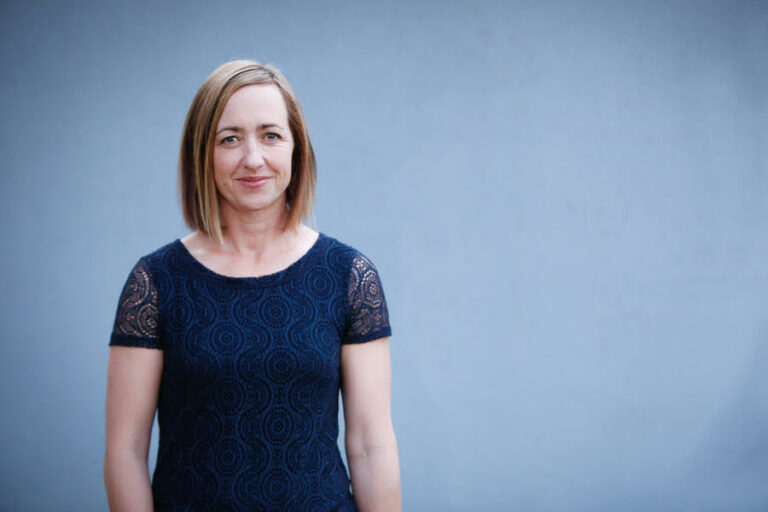
Amy Barnhorst, a psychiatrist at the UC Davis Medical School, appeared on CNN in late 2018 to discuss the relationship between gun violence and mental health. Barnhorst has dedicated much of her career to speaking out on the issue of gun violence, utilizing her extensive knowledge about psychiatry and mental health. Her efforts have not gone unnoticed.

It was Barnhorst’s commitment to her work and to understanding mental health which caused her to stand out. Barnhorst works in a crisis unit in the in-patient hospital where a main focus of her work is violence risk assessment. Therefore, she frequently deals with patients who have the potential to be a danger to themselves or others; the risk factor for these individuals is significantly heightened by the increased ability to access a gun, according to Barnhorst. Her fascination with the relationship between gun violence and mental health began in 2013 when the Sandy Hook Elementary School shooting occurred. The media and the general population were quick to point fingers at the failure of the mental health system, arguing that they could have intervened before this tragedy occurred. These accusations frustrated Barnhorst.

“It is so difficult for the mental health system to reach out and find these people, we have a hard enough time treating the people we already have,” Barnhorst said. “Our focus is on treating people who are mentally ill, not going out and rounding up potential mass shooters.”

Barnhorst’s frustrations prompted her to begin writing op-eds on this topic, expressing her point of view as a psychiatrist. She believed the conversation about gun violence and mental health was missing one very significant perspective, that of a mental health professional. Her first significant op-ed Barnhorst was published in the New York Times, which received a lot of attention. That, in addition to several radio show appearances, caused CNN to take notice of her work.

“CNN reached out to me and asked if I would be able to fly out to New York to film a segment discussing this issue,” Barnhorst said. “I was really nervous but I trusted that if CNN chose me to interview, I had the knowledge and perspective they were looking for.”

In the interview, Barnhorst argued that mass shootings and gun violence aren’t necessarily the result of untreated mental health issues or failures by the mental health system. Barnhorst believes that by making these accusations, legislators are largely overlooking the root of these issues: guns.

“Putting all that culpability on the mental health system to stop mass shootings is not going to be an effective strategy,” Barnhorst said. “We need to take a hard look at how much access people have to guns in this country.”

Not only does placing blame on mental health push issues of gun control to the wayside, but it also has a detrimental impact on individuals suffering from legitimate psychological health issues. According to Barnhorst, when the media groups perpetrators of gun violence with survivors of mental health issues it further stigmatizes mental health issues, therefore alienating these individuals.

“If you know an individual suffering from schizophrenia, bipolar disorder, depression etc., that does not mean they are more likely to shoot up a school,” Barnhorst said.

Barnhorst argues that perpetrators of gun violence often exhibit trends of narcissism and rage, potentially resulting from having been bullied, abused or neglected; depression is also not an uncommon side-effect of this kind of history. This is where the misconceived correlation between perpetrators of gun violence and mental health issues stems from.

According to Barnhorst, when there is a mass shooting incident, the majority of individuals are quick to assume that the shooter suffered from some kind of psychiatric disorder. Surveys have shown that following these incidences, people state they do not want to live next to, work with or go to school with mentally ill individuals.

“Work, housing and school are things that really help people with mental illness get better,” Barnhorst said. “So if the stigma that the media is putting out there about mental illness is preventing people who suffer from it from getting the very things they need, it is only making that problem worse without making the issue of mass shootings any better.”

Barnhorst feels that students have the power to combat the stigma surrounding mental health by being informed and making powerful impacts on legislation. By focusing on the root of the issue rather than on the misconception that our current political climate has created, Barnhorst believes students have the power to prevent gun violence and mass shootings from being a reality of society.

Written By: Miki Wayne — features@theaggie.org

UC Davis prepares for UC-wide payroll system despite issues at other UC campuses

Resources for students, staff to better transition to UCPath program

On April 1, UC Davis, Agriculture and Natural Resources and UC Berkeley will begin using UCPath, a new payroll system aimed at standardizing pay and benefits across the UC system. Four schools –– Riverside, Merced, Los Angeles and Santa Barbara –– have already converted, facing program and processing issues affecting student pay for a number of months. In preparation for the transition, UC Davis campus administrators recommended that employees review their personal information and utilize direct deposit to avert avoidable financial disruptions.

UC Davis is moving forward with the implementation of UCPath, hoping to learn from errors at other UC campuses and provide better support for student employees. The system will begin issuing paychecks on April 1, and UC Davis employees can choose to receive their paychecks through direct deposit or by mail to their listed home address; local paycheck pickup at each department will no longer be an option.

“An important thing students can do is to seriously consider moving to direct deposit,” said Kelly Ratliff, the Vice Chancellor at UC Davis. “In UCPath, all paychecks will be mailed out on payday, so we don’t want people to have that delay. If there is an error, we can resolve the error much more quickly if you have direct deposit –– days more quickly than if you don’t.”

At the time of publication, 2,577 students were still receiving paper paychecks, which constitutes 65 percent of all university employees receiving physical payment. To avoid some initial processing errors, employees can switch to direct deposit online, which will only begin three to four weeks after initial activation. On other campuses, delays in payment have risen due to such errors like late submission of timesheets, misreporting of bank information, incorrect mailing address and undocumented change in marital status, among others.

“We had a little bit more flexibility with the old system, but with the new system, those deadlines really matter,” Ratliff said. “We need people to have good practices about submitting time and recording their time in a timely manner.”

Matt Okamoto, the UC Davis controller, also attributed some of the issues at other campuses to inherent inaccuracies during data conversion from the old to the new system. Okamoto noted that converting student pay data is especially complex as students work variable hours and sometimes even multiple positions.

“As we are preparing to convert our data at Davis, we’re paying special attention to our student employees to try to make sure that we are catching any errors beforehand by doing special test runs just for our student employee population so that hopefully we can get in front of any conversion errors that come up,” Okamoto said.

Once UCPath is deployed, the school will provide a command center on campus with representatives from the central payroll office and the central human resources office to answer questions. However, all employees who encounter an issue with their paycheck should immediately contact their department to report the problem.

Some UCs with an earlier deployment date faced system problems, such as social security taxes being incorrectly withheld from some student employees. Since then, UCPath Center has reported that all program errors have been fixed; however, processing and conversion errors persist. Affected campuses have been utilizing loaded pay cards and same-day or overnight checks to compensate impacted students.

“Ninety-nine percent of UC employees have been paid accurately and on time,” said Claire Doan, the director of media relations for the California Office of the President, via email. “That said, we know this is very difficult for those impacted, and we empathize with students’ concerns and frustrations.”

Due to the UC system’s large population, the 1 percent of affected workers still amounts to a significant number of individuals working without pay. Student employees have been noticeably more affected than faculty members, who often have fixed salaries. Extreme cases include students dropped from their classes or unable to afford payments such as rent or mortgage, according to The Daily Bruin.

UCSB, which initiated UCPath in September of 2018, had particular problems with graduate students seeing more discrepancies in pay. The discrepancies ranged from missing paychecks to being paid three-to-four times the correct amount. Cierra Raine Sorin, the president of the UCSB Graduate Student Association, faced thousands of dollars in overpayment and described the situation as a “nightmare” despite campus administration’s best efforts.

“UCPath system was not designed for graduate student positions,” Sorin said. “Grad students have a lot of changeover in the jobs that they take because every quarter you are in a new position, even if it’s the same kind of job. Graduate students have been impacted much more heavily than any other community.”

The system deployed in UC Riverside in January of 2018, and processing errors as well as system errors plagued the campus. Despite resolving initial issues, more arose in May with the first paycheck of Spring Quarter, as the majority of graduate students shifted positions for the quarter. Sorin expressed her concerns for the upcoming February paycheck, the first payday of UCSB’s winter quarter.

Many of these observed issues may not occur at UC Davis, as they may be unique to each campus, but others are still unforeseen, in spite of the administration’s precautionary measures.

“[The campuses are] all running effectively different payroll systems even though they use the same program,” Okamoto said. “Each campus has customized it so the errors we’ve been seeing can very well be unique to the individual campus because their program might have been set up special, and when you run the conversion, it didn’t quite take appropriately.”

Errors during deployment are to be expected but need to be handled effectively and efficiently.

“We want folks to know that we’re going to work as hard as we can and have things as smoothly as possible,” Ratliff said. “If when we go live and folks notice an error, they need to notify us immediately.”

Written by: Renee Hoh — city@theaggie.org

Editor’s note: An earlier version of this article stated that UC Davis, UC Irvine and UC Berkeley will begin using UCPath on March 1. That is incorrect. UC Davis, Agriculture and Natural Resources and UC Berkeley will begin using UCPath on April 1. An earlier version also stated that Kelly Ratliff is the Senior Associate Vice Chancellor at UC Davis. That is incorrect. Ratliff is the Vice Chancellor. The article has been updated to reflect these changes. The Aggie regrets the error.

Third annual Mental Health Conference features 12 different workshops, 3 panels

Free event gathered around 1,000 registrants

The third annual Mental Health Conference took place on the weekend of Jan. 12 and 13 at the UC Davis Conference Center. This was the first year the event was completely free of charge for students and other attendees, and registration slots quickly filled up before the weekend events even began.

This event was hosted by the UC Davis Mental Health Initiative, an entirely student-run committee within ASUCD.

The two-day conference featured a number of workshops led by professors and professionals, panels hosted by students, discussion spaces, performances and a resource fair. There were two allotted workshop sessions on each day of the conference, during which student participants had the opportunity to choose between three different sessions, all pertaining to different topics.

Before entering the conference center, guests were encouraged to observe the community agreements set in place which were aimed at creating an inclusive environment. The agreements included using gender inclusive language, refraining from the overuse of technology, upholding a respect for confidentiality and using snapping as a sign of support.

Around 43.8 million adults experience some sort of mental illness in a given year, with nearly 60 percent of that population lacking any form of mental health services, such as counseling or medication, according to the National Alliance on Mental Illness. Survey data from UC Davis also supports these statistics, reporting that 64.8 percent of UC Davis undergraduate students felt overwhelming anxiety in 2017. Directors of the Mental Health Initiative felt that opening up a discussion around mental health on campus would help lower these numbers and help students feel more supported.

“The event is definitely about raising awareness, but I think it’s also about expanding people’s notions of what mental health really stands for,” said Katrina Manrique, a co-director of the UC Davis Mental Health Initiative. “A lot of people, when they think of mental health, […] think of it very much within a medical setting when in reality, it’s intersected with a ton of ideas, such as gender and race.”

Manrique believes the statistics on mental illnesses speak for themselves — even though someone personally may not struggle with mental health, chances are they know somebody who does.

Several attendees expressed their gratefulness to the Mental Health Initiative for hosting this event once again, expressing the sentiment that the event helps to both de-stigmatize mental illness and show how broad the term “mental health” really is.

“This event is really about raising awareness and support at school and around Davis,” said Cindy Ceja, a third-year communication and psychology double major. “We are on a college campus, so there’s always a need to talk about mental health. Everyone has their own experience with it, and we really should be recognizing how it means different things to different people.”

Ceja, an attendant of the event as well as a volunteer on the first day of the conference, said more than 1,000 individuals registered on the Eventbrite page, and by the first half of Saturday around 200 people had checked in.

The different presenters each chose to approach the subject of mental health in a way they felt was relevant to their own subject matter. For example, Dr. Cameron Carter and Tara Niendam, both from the UC Davis Health Department, focused their discussion on prevention and early intervention regarding youth mental health.

Carter founded the UC Davis Early Diagnosis and Preventive Treatment programs which focus on early-on psychosis care. Both Carter and Niendam addressed mental health in a more scientific way, detailing methods for stigma reduction and new techniques, such as brain imaging, to improve the early detection of mental health issues in teens and young adults.

Presenters such as Raul Hernandez Garcia and Celestina Pearl from the St. James Infirmary referred to mental health in a more socially constructed sense.

The St. James Infirmary is a health and safety clinic for sex workers and their families in San Francisco. Garcia and Pearl focused their discussion on biases against sex work and the decriminalization that they feel needs to take place.

They said it was critical that people understand how personal values may look different from person to person, and that using judgement and bias against those who participate in sex work can be damaging to their mental states.

“As long as individuals are making decisions for themselves, they should be free to go about their choices without judgement,” Pearl said.

“We put a lot of focus on supporting our participants, helping them live their best life on their own terms, and not using our own judgements or forcing how we think they should live their lives onto them,” Pearl said. “It turns out, when people feel supported, they’re able to reach their goals much easier.”

At the close of the conference, Manrique felt the event was a success and said she was grateful for everyone who helped to make the event possible. Her next goal for the initiative, before she graduates this spring, is to drive up participation and visibility for the upcoming Mental Health Awareness Month this May.

Written by: Claire Dodd — campus@theaggie.org

UC Regent Student Advisor position eliminated, only two student positions remaining

UC student leaders express concern over perceived lack of transparency in decision to eliminate position

The UC Regents recently decided to remove the UC Regents Student Advisor position, a role meant to give students a voice in UC governance.

The current student regent, Edward G. Huang, a student at UC Berkeley, expressed opposition to the removal of the position.

“Eliminating the Student Advisor position strips away essential student representation at the highest level of UC governance and rejects years of hard-fought work to bring the student voice into university governance,” Huang said via email. “This is an incredibly important issue for UC students to hear because the Board of Regents (and the students on the Board) decide on major student issues such as tuition, basic needs, and sexual assault.”

Now that the student advisor position has been terminated, only two other student positions are on the UC Board of Regents: student regent and student regent-designate, Huang said.

“Only these three students are allowed to sit at the table and fully contribute to public discussions with the Regents on crucial student issues,” Huang wrote.

The UC Regents, a body which functions as the board of trustees for the UC system, announced its plans to potentially eliminate the student advisor position last December.

A letter emphasizing a perceived lack of transparency about the decision was sent to the UC Regents on Dec. 28. It was co-signed by Huang, two former student advisors, the current student regent, the president of the UC Student Association (UCSA), individuals from the UC Council of Presidents and the UC Graduate Professional Council.

“We do not believe that students were consulted fairly on this issue,” the letter read. “The current and former Student Advisors were never brought into the conversation, and previous Regents meetings never discussed the issue. The topic was not discussed openly or transparently with students.”

According to Huang, eight of the 26 Regents abstained from voting on the elimination decision. The Student Advisor position was implemented as a pilot program in the summer of 2017.

The goal of the program was to “provide the Regents with a more comprehensive perspective on the student experience by appointing an advisor from the population not represented by the student Regent, given that the issues faced by undergraduate, graduate, and professional students vary tremendously,” according to an action statement addressed to the members of the Governance and Compensation Committee of the UC Office of the President on Jan. 16, 2019.

“The program has been in operation for 18 months, but it is not yet clear whether it has met its goals or potential,” the statement also said, adding the recommendation that the position be reviewed in Dec. 2019.

Caroline Siegel Singh, the president of UCSA, had voiced support for submitting the position for review.

“Since its inception two years ago, this position has lacked adequate consultation of students in the selection process and, resources to succeed in this role, which has led to a lack of accountability to the student community,” Siegel Singh wrote in a letter addressed to the UC community. “The UCSA believes that instead of renewing a position with limited success so far, the UC Board of Regents can instead increase genuine and effective communication with student representatives by expanding positions that have been more beneficial to students, including roles such as Committee Observers and Student Advocate to the Regents (StARs).”

In her letter, Siegel Singh proposed that the UCSA president could function as a permanent StAR for the UC Regents. She also said student observers could be appointed to every regental committee rather than solely the three committees they are currently permitted to work on.

This, she stated, would help “solidify the student voice on the Board of Regents and ensure that proper consultation takes place during major decisions at the University.”  

Written by: Rebecca Bihn-Wallace — campus@theaggie.org
Sacramento Sheriff’s Department should comply with records requests

Sacramento Bee, Los Angeles Times sue for records under SB 1421

The Sacramento Bee and the Los Angeles Times recently filed a joint lawsuit against the Sacramento Sheriff’s Department for refusing to follow a 2018 statute that requires the release of records on deputies who fired their weapons or engaged in misconduct on duty.

The statute, part of California State Senate Bill 1421, mandates that records of incidents involving the discharge of a firearm at a person by a peace officer or custodial officer be released to the public. It also stipulates incidents in which the use of force resulted in death or in great bodily injury be made available for public inspection, among other requirements.

Both The Bee and the L.A. Times filed public records requests that date back to 2014 in early January. Sacramento Sheriff Scott Jones denied the request under the argument that SB 1421 does not apply retroactively, a claim that the two newspapers are challenging.

As the bill states, the public has a right to know about all serious police misconduct. Without public accountability, the law enforcement system cannot improve. When officials protect law enforcement officers who engage in misconduct, especially that which results in death, it perpetuates a system of oppression against marginalized communities and individuals.  

In 2018, 115 people were shot and killed in California by police officers, according to a database curated by the Washington Post. Among those 115 was Stephon Clark, a black man from Sacramento. Two officers fired 20 rounds at Clark because of the alleged suspicion that he was carrying a handgun when he only had a cellphone. The two officers are still under investigation.

California Attorney General Xavier Becerra recently released a report that offers 49 recommendations for adopting changes concerning use of force training and other areas. But without access to records like those being requested by The Bee and the L.A. Times, the public has no way of knowing if these recommendations are being followed. Internal investigations are not enough to correct behavior and combat issues like aggressive force and racial profiling.

Public records are an integral part of responsible reporting. Without records requests being honored, journalists’ investigations are compromised. It was through the Freedom of Information Act that The California Aggie found out about two Title IX cases that were opened against UC Davis. Discoveries like these, as well as possible future discoveries that the release of records by the Sacramento Sheriff’s Department, are dependent on records being provided in a timely manner.

Even if the lawsuit determines that SB 1421 does not apply retroactively, the Sheriff’s Department has a responsibility to be transparent to the public. The refusal to release records not only compromises people’s faith in law enforcement, but also police officers’ ability to do their jobs well. The Editorial Board supports The Sacramento Bee and the Los Angeles Times in their efforts and demands that the Sacramento Sheriff’s Department comply with the records requests.  

Written by: The Editorial Board

Campus Community Book Project centers around “The Book of Joy”

The Book Project promotes dialogue, community building

The Campus Community Book Project, founded in 2002 as a response to the divisiveness caused by the 9/11 terrorist attacks, was established with the goal of promoting dialogue and community values among students, staff, faculty and community members of the Davis and Sacramento areas.

The Campus Community Book Project is composed of different committees and councils. The Campus Council for Community and Diversity, an on campus organization, chooses a theme every two years that tackles an idea they believe is relevant at the time. The Campus Community Book Project Selection Committee reviews multiple books and ultimately recommends one book that best represents that concept. The Program and Planning Committee then organizes events to reinforce the theme.

“Usually we have found that the theme is extremely relevant, and it’s almost like the council has a crystal ball,” said Megan Macklin, program manager at the Office of Community Relations.

The theme for this year is community building.

“[Community building] was selected in March or April 2017, a few months after the election, amidst a time of great division on campus, in our community, in our country,” Macklin said. “So the council, in selecting the theme of community building, really wanted an uplifting, positive, optimistic theme, and so that’s the one they came up with.”

This year’s book is “The Book of Joy” by Nobel Peace Prize Laureates Dalai Lama and Archbishop Desmond Tutu, along with Douglas Abrams.

“The Selection Committee, in recommending ‘The Book of Joy’ really felt strongly about the message of dialogue,” Macklin said.”[They felt strongly] about communication across difference, about realizing and celebrating shared humanity, about finding joy in that shared humanity.

“The Book of Joy” looks back on the long years that Dalai Lama and Archbishop Tutu endured in exile and the violence of oppression. They converse together about finding joy despite life’s suffering.

“I’m someone who likes to get concrete messages out of books and things that I can bear to my life,” Macklin said. “I think the most important message from this book that I got, and it’s a message you hear a lot and is certainly not unique to this book, but the fact that you really can only control how you react to things. And I think that that’s such an empowering statement, and there are specific practices that are shared in the book that are related to that lesson.”

Through the Programing Planning Committee, The Book Project hosts many events during the year, including workshops, lectures, film screenings, panel discussions, library exhibits, service opportunities, book discussions, art exhibits and performances. Several of the events are highly interactive. For example, a Tibetan meditation workshop was held in October, and a Yoga-Informed Career Exploration for Students will be held in April. Most events are free and open to the public, and the full schedule is available on the Book Project website.

On Feb. 4, Douglas Abrams, co-author of “The Book of Joy,” will speak at UC Davis in Jackson Hall. He will share insight from the weeklong conversation he facilitated between Dalai Lama and Archbishop Desmond Tutu as well as an exclusive video of the historical meeting. From 4 to 5 p.m., there will be a forum that is free and open to the public. The main event starts at 7:30 p.m. and tickets can be purchased on the Mondavi Center website.

Tenzing Thinley, a Davis community member, recently became involved with the Book Project.

“I used to be a student of Dalai Lama, I had been [for] many, many years,” Thinley said. “I also know about Desmond Tutu because he’s a very close friend with Dalai Lama, so that’s why I’m very interested in the Book Project.”

He has helped facilitate several events this year, including a film screening of “The Cup” (1999).

“This film [was] directed by a Tibetan monk,” Thinley said. “It’s really unusual, monks are more involved in the spiritual, but somehow [in] this modern time, the monks [are] taking advantage of modern technologies. It’s a really fun movie. It tells the story about Tibetan refugees in India.”

Karma Waltonen, a continuing lecturer at UC Davis, has been involved with the Book Project for about ten years. On Jan. 31, she will perform a stand-up routine called “Chronic Pain: A Comedy” at the UC Davis Comprehensive Cancer Center in Sacramento.

“[The routine] puts together a couple of different aspects of my identity, so [while] I am a stand-up comic, I’m also a chronic pain patient,” Waltonen said. “So this is literally my narrative about my pain but done in a comic way, so it brings all of those things together and is able to tell a particular story but in a way that isn’t depressing.”

Waltonen hopes more faculty will teach the Book Project’s chosen books as part of their curriculum, as she does in her workload writing classes. Students who are able to read the book and attend events find participation rewarding.

“The students who do get to go to those events and talk to the different speakers and authors, they always tell me it was such a valuable experience, and that they’re glad that I encouraged them to do it because they wouldn’t have gone if they had just seen a poster,” Waltonen said.

Besides participating in events, there are many ways for students to get involved in the Book Project. For starters, students are welcome to join the Program Planning and Selection Committees.

“The only caveat is that the bulk of their work is during the summer months, but we’ve been setting up phone calls during the meetings for people to call in,” Macklin said. “There’s an opportunity to contribute on a Google Doc. We really try to make remote participation available.”

Students can also volunteer as program contributors or presenters. Anyone interested in more information about getting involved can contact Macklin.

The theme for the 2019-20 Campus Community Book Project is violence, gun violence specifically. The featured book will be announced soon.

Written By: Cheyenne Wiseman —arts@theaggie.org
UC Davis tennis roundup

Men off to flawless start, women struggle to find footing

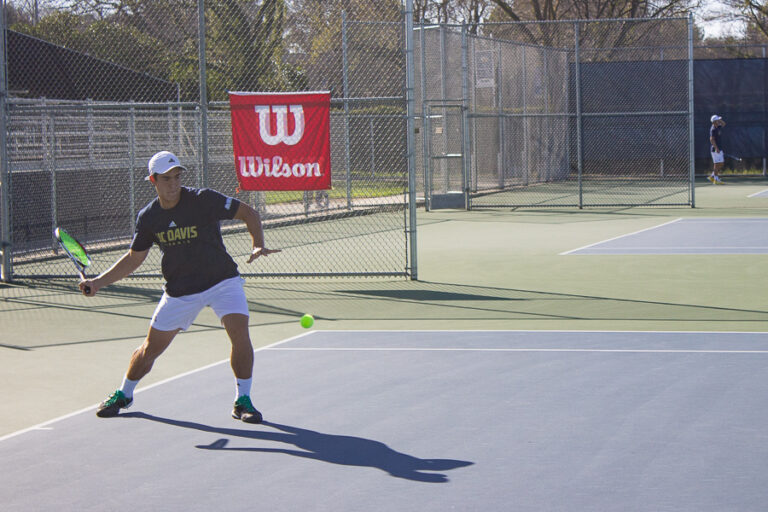
The UC Davis men’s tennis team hosted a double-header on Saturday in which it came out victorious in both matches, compiling a win against the University of Nevada, Reno with a score of 4-3, and against Sonoma State University by a 5-2 margin.

UC Davis’ women’s tennis team fought hard but ultimately lost a close, 4-3 match to the University of San Francisco.

In the men’s team’s early match against Nevada, junior David Goulak and freshman Nil Giraldez each won their singles matches in straight sets to help catapult the Aggies to their sixth consecutive victory to start the season.

“I think the start of this season is really important because last year we had a tough start,” Goulak said. “A lot of guys are playing with confidence, which is what we need.”

The Aggies lost two seniors to graduation last year, Tommy Lam and Everett Maltby.

“It’s tough because [those seniors] were really experienced and they know how our team works,” Goulak said. “I feel like this year all the new guys are really learning quick.”

Giraldez showed resilience with his defensive style of play. Early in his singles match, he lost his serve and found himself down 4-1. After some adjustments, he came back to win the set and match, 6-4, 6-4.

“I was a little bit nervous because I wanted to play good for the team,” Giraldez said. “I think I’m not on my best level. I fight, when I’m playing bad I just focus.”

Coming from Spain, where tennis is played more on clay courts, Giraldez has been forced to change up his style to adjust to the faster-paced, hard court game.The ball bounces higher and slower on a clay court as opposed to hard courts, the primary type of court in the U.S.

“I’m quite defensive,” Giraldez explained while pointing out that Goulak’s style is more offensive. “I have to adapt to this, I’m trying to be more aggressive.”

The slim 4-3 victory in the first match did not slow down the Aggies heading into their later match against Sonoma State. They again took the doubles point and this time cruised to take four of the six singles matches. The 5-2 team win was highlighted by another straight set singles triumph for Giraldez and straight set wins for sophomores Daniel Landa and Dariush Jalali.

In the women’s lone match of the day, things were much closer. The Aggies were able to secure the double’s point, but were met with stiff resistance from the Dons in singles play.

Junior Nikita Pradeep notched a straight set win at the singles one spot to put the Aggies in front 3-1, but USF was able to win at both the two and the four spots to even the match at three apiece. This set up a showdown at the three spot, with senior Isabella von Ebbe acting as the Aggies’ deciding factor.

After an intense final set in which both players were able to break the opponents’ serve, USF’s senior Margarita Treyes took the final set, 6-3.

This was the women’s third straight loss to open the season.

Two Aggies, Von Ebbe and junior Kristina Breisacher, are reportedly playing through injuries.

“Considering that we have our three and four injured, I think we still have a pretty good season ahead of us,” said sophomore Shirley Hall.

Men’s tennis will travel to Southern California to play the University of Southern California and International Hope on Friday.

Women’s tennis will travel to the South Bay to play Stanford on Saturday and Santa Clara University on Sunday.

Written by: Bobby John — sports@theaggie.org
The surprising simplicity of the jellyfish genome

Research gives rise to evidence suggestive of early cnidarian history

Jellyfish have a more complicated life cycle compared to their relatives, some of which include sea anemones and corals, so one may assume that they have a more complex genetic composition as well. Recent research, however, suggests that this may not be the case. The research, led by David Gold, an associate professor in the Department of Earth and Planetary Sciences at UC Davis, sequenced the genome of the jellyfish Aurelia, and found evidence that an increase in life history complexity in cnidarians does not necessarily correlate with an increase in gene number.

Before coming together to sequence its genome, Gold explained that the authors of the paper had been individually interested in the various aspects of the Aurelia, a genus of scyphozoan jellyfish.

Ralph Greenspan, the associate director of the Kavli for Brain and Mind at UC San Diego, wanted to study the function of the jellyfish’s nervous system in behavior using genetic manipulations. According to Rob Steele, a professor at UC Irvine, Greenspan reached out to Steele, due to his background in sequencing the hydra genome, along with Gold and David Jacobs, who were UCLA graduate students at the time studying the Aurelia. Gold stated that he was interested in the jellyfish’s ability to regenerate and grow new tissue.

Steele explained that Takeo Katsuki, a post doctorate at Greenspan’s lab, grew the Aurelia and made the DNA in order for it to be sequenced. This process took over six years to complete, explained Gold. Part of this was because the team was required to look through a lot of data since genome itself is about 700 megabases long. In addition, Steele said that when assembling the genome, sequences could potentially be too short to form continuous stretches of sequence, or heterozygosity in the genomes could differ and interfere with the assembling process.

“Assembling genomes is not as straightforward as some people might guess,” Steele said. “I think in general people think you get the sequences, you throw them into a computer, you push a button and out comes the assembled genome. And that’s not quite [the] way it is.”

Once the genome was sequenced and able to be analyzed, the researchers had expected to see DNA more complicated than that of sea anemones or corals, which are unable to swim around as a jellyfish does. However, they found that the medusa stage, where the jellyfish develop their ability to swim, does not require new genes. Instead, the stage is comprised with classes of genes already present in nematostella (a genus of sea anemones).

“We were surprised to find out that really wasn’t the case, that the jellyfish was able to keep its genome, keep its DNA very simple, very similar to its relatives, and still build a very different kind of animal with similar genes and similar types of DNA,” Gold said.

According to Gold, there are a couple ways that the researchers could interpret this data. One possibility would be that animals could evolve from being simple and sedentary, like a sea anemone, to an animal like a swimming jellyfish without large changes within the DNA. Alternatively, it could be argued that the cnidarian ancestors were originally more complicated and eventually simplified their DNA. Steele stated that there are many examples within biology of structures being lost, and the question comes down to whether complexity is built up or simplified over time.

“Humans tend to think ‘well of course you start simple and then you get more complex cause that’s how we view things usually.’ You start out with bicycles and you eventually end up with cars,” Steele said. “But biology doesn’t engineer the way we as humans do, so it’s perfectly reasonable to think that something started out, or at least early on, was more complex than it is now.”

He further suggested a potential experiment that could be done to test these hypotheses: taking genes from the Aurelia that could possibly contribute to the medusa stage and transferring them into a cnidarian that does not have a medusa stage to see its effects. In doing so, they could test what would happen if a gene were to be replaced in an animal that had potentially lost it. Gold added that more data of sequenced genomes of other species would help contribute to their understanding of cnidarian history.

Greenspan said that there is significant value in research that asks the basic questions of biology. Even if the research does not have any current, practical application, he believes that expanding the knowledge on genomes and evolutions is a value in and of itself. Steele commented that he calls themselves ‘knowledge creators’ who are motivated by curiosity and the will to understand something in greater detail.  

“This is not going to impact your health in any obvious way at this point. It’s not going to necessarily solve the climate change problem. But it’s something we’re curious about and we want to know the answer,” Steele said. “I think people don’t appreciate that a lot of science is just people asking interesting questions and trying to get the answer. Sometimes you get unexpected things that are useful or important, and I also tell people that all the stuff you read about in your textbooks in your biology class didn’t just fall out of the sky. Those facts in those textbooks came from people like us just asking questions and trying to get the answers.”

Written by: Michelle Wong — science@theaggie.org
Meaningful Memories

0

Aggie photographers write about the photos they’ve taken that mean the most to them.

During a trip to Iceland with some friends, we were driving down backcountry roads and ran into a group of horses grazing on a field nearby. As soon as they saw us, they took off and trotted down the road in same direction that we were headed. It was as if they wanted to guide us to this particular spot with a gorgeous mountainous backdrop just in the distance. As soon as we pulled over my instincts got me jumping out of the car, immediately snapping away. Before I knew it, I had captured a couple hundred frames of this particular herd of horses. Of all the images, this one stood out the most and encapsulated my experience in Iceland, a truly majestic place. (JUSTIN HAN)
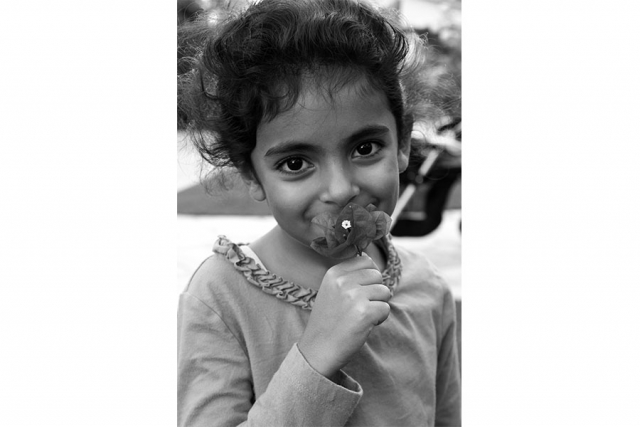
Being able to have furry friends around, while in a college setting, has been one of the best ways to cope with stress. I’m beyond thankful to have someone to hold and pet as I tackle the difficulties of being a graduating senior. (ALEXA FONTANILLA)
The first Women’s March was one of the most memorable events I’ve ever attended. Despite the brisk January temperatures, the crowd was warm, enthusiastic, and above all fiercely determined to foster inclusiveness and diversity on a national level. (DIANA LI)
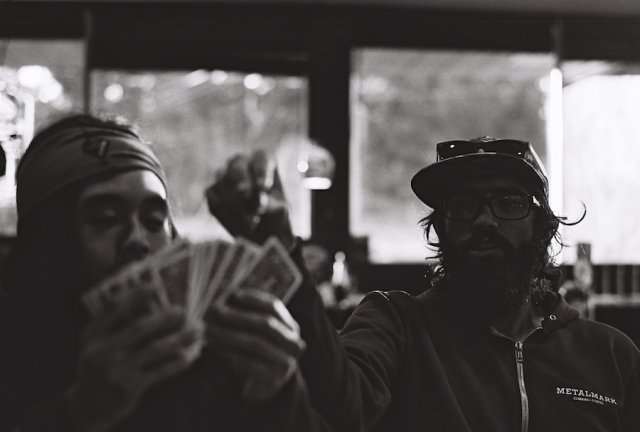
The most meaningful moments in life often come when taking breaks from the main objective, like playing cards in a Denny’s in Lake Tahoe with your closest friends. (IAN JONES)
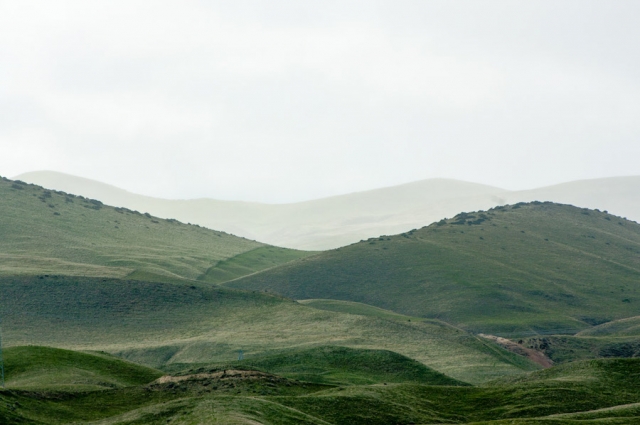
I had the chance to visit my family in Europe this summer, and I took this photo the morning after I arrived. I hadn’t been able to sleep from jet-lag, so I decided to get up and go for a hike and managed to make it to the top, just in time to catch golden hour. (JETT ALTENHOFEN)
This was from a spontaneous trip to the sunflower field in Dixon in the summer. The vastness of the flourishing yellow and green reminds me that beauty is all around you if you look for it. And it’s free. (JORDAN CHOW)
This picture means a lot to me because not only was it after I hadn’t seen my family in awhile, but I happened to get my brother and dog BOTH blinking. Like what are the odds. This just really shows anything is possible or can happen in photography. (JOSH MOY)
This was my first pride parade, June 2016. (JULI PEREZ)
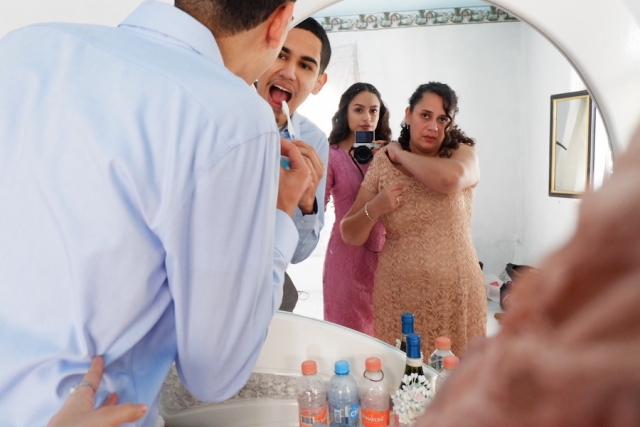
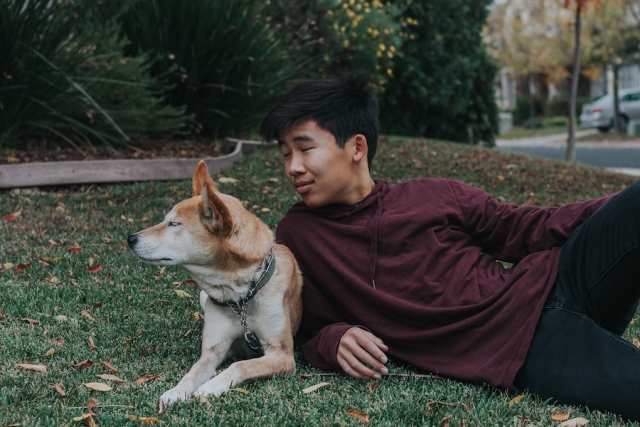
This photo is meaningful to me because it has two of the most meaningful people in my life in it. In this photo you can see the two most important ladies in my life, my sister and my mother. You can also see me preventing cavities, gingivitis, and various other oral diseases by practicing healthy oral hygiene. This photo was taken in Mexico, specifically in the house my father was raised in, and actually born in. This was my second time going to Mexico, the first being when I was three years old so I do not remember much. We were in Mexico for a family wedding. Coincidentally, it was the twenty-third anniversary of my parent’s wedding; however, this time it was my uncle’s wedding. The wedding was also in the same church that my parents had gotten married in. This trip was an amazing experience because I got to visit my parent’s childhood homes and experience what their youth was like. My mind greatly expanded from being immersed in a new culture. And yes, I also flossed. (LUIS LOPEZ)
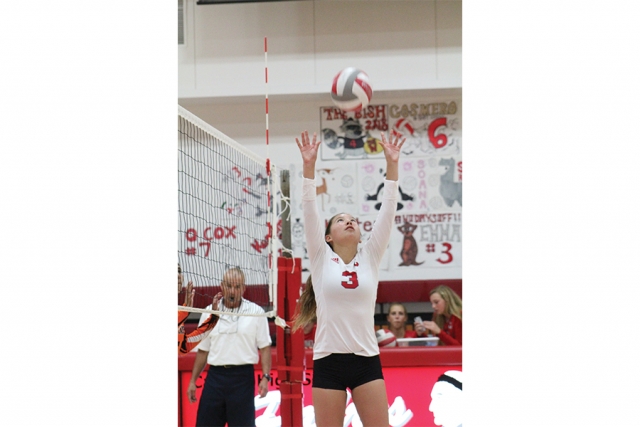
One of my favorite action shots from the record-breaking 2017-2018 Carmel High School girls’ volleyball season. I referenced this photo in one of my application essays to UC Davis as its background of the players’ posters makes it special from a lot of other sports photos. (QUINN SPOONER)
(REBECCA CAMPBELL)
2018 was a year of a lot of firsts, one of which included seeing the super blue blood moon in January. Regardless of how busy or stressed I am, looking up at the stars in the night sky really puts things into perspective for me and is a good reminder to be thankful for the small things in life. (TIMOTHY LI)
I hiked part of the John Muir Trail in the Ansel Adams Wilderness over summer with my dad. This photo was taken at sunrise after a windy and cold night in the tent. (TREVOR GOODMAN)
Now that I am a senior I am starting to miss my family, especially my little cousin, a lot more. Looking through old pictures that I would take of family makes me excited to be able to go home after graduation. (VENOOS MOSHAYEDI)
This photo was taken back in Spring 2018. It’s one of my more “artsy” photos but the best part of this was that the photo was taken while I was in a car. (ZACHARY LACSON)
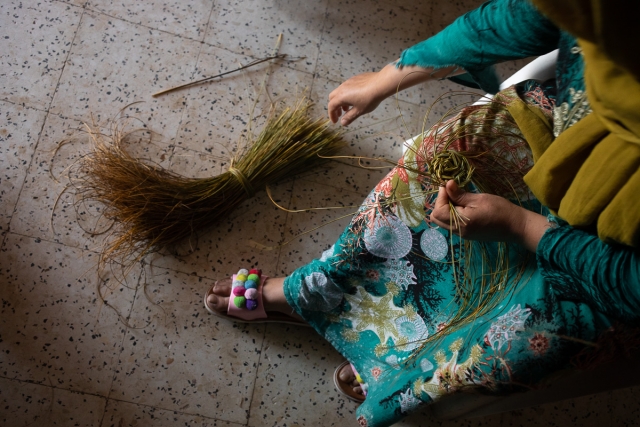
I was lucky enough to be able to capture a woman weaving a basket in Tunisia while visiting one of my good friends. It was great to experience another culture and I cannot wait to go back. (ZOË REINHARDT)

By: The California Aggie Photo Desk — photo@theaggie.org

Super Bowl gambling guide

Sunday’s Big Game illustrates the rapid growth of U.S. sports betting

When it comes to the Super Bowl, some things never change. The NFL’s annual end-of-season extravaganza provokes thoughts of big parties, family, friends, drinking, food, backyard football games and the must-watch TV commercials, among other things.

But one aspect of the Big Game that will step into the limelight this year is gambling. Americans have always bet on sports, especially football, but most of the money has always been wagered illegally — through informal bets with friends or offshore bookies found deep in the bowels of the internet.

This season was a landmark one in the gambling world. Sports betting was recently legalized in seven new states — New Jersey, Delaware, Mississippi, Pennsylvania, New Mexico, Rhode Island and West Virginia — in addition to Nevada, which has been in the business for many decades.

During last year’s Super Bowl, which resulted in a 41-33 victory for the Philadelphia Eagles over the New England Patriots, $4.76 billion was bet on the game, with a staggering $4.6 billion wagered illegally.

This year, with the expansion of betting in more than a half dozen states, an estimated $320 million in legal wagers is expected to be placed on the game. That figure is roughly double the amount that was bet legally in Super Bowl LII when Nevada was the only available state on the market.

The traditional betting lines for Super Bowl LIII have the Patriots favored to beat the Los Angeles Rams by three points, with the over/under on combined points scored at 57 (per Bovada). Each of these numbers will constantly fluctuate at any moment leading up to kickoff, as money comes in on both sides of the ledger.

One of the most popular types of bets, especially for enormous games like the Super Bowl, are known as proposition bets — wagers that depend on whether or not an event will occur, usually not relating to the outcome of a game.

The nature of these wagers is incredibly appealing for fans, especially casual supporters that don’t have a rooting interest in the game, a connection to either team or much knowledge of how the game of football is played.

There are prop bets for just about anything you can think of relating to the Super Bowl and its coverage around the country.

Some of the political prop bets involved the number of tweets President Donald Trump will post on game day, whether any players will take a knee or raise a fist during the National Anthem, whether the government shutdown will end before the game kicks off and whether the winning team will visit the White House.

The current bets for the National Anthem include the over/under on the length of time (107 seconds), what type of clothing singer Gladys Knight will wear (skirt, dress or gown) and whether or not she will forget any of the lyrics.

There are an assortment of wagers for the television broadcast on CBS, like the number of plays color analyst Tony Romo will correctly predict, the amount of times NFL commissioner Roger Goodell will be shown on camera or whether any of the broadcasters will incorrectly refer to the Rams former home in “St. Louis.” There are tons of additional options for the acclaimed television commercials, which are being sold for over $5 million for 30-second spots.

Some of the popular prop bets that get a lot of attention every year involve the color of Patriots Head Coach Bill Belichick’s jacket (blue, gray or red), the result of the coin toss and the color of the winning coach’s celebratory Gatorade bath (yellow, orange or blue).

Other prop bets that are typically offered for every game involve individual statistics for participating players on each team and choices regarding the total number of field goals and touchdowns scored.

Just last week, reports surfaced alleging that the NFL is unhappy with the growing popularity of prop bets due to the propensity for collusion between players and gamblers. Ultimately, the league would like to see these types of bets outlawed in the future.

Unfortunately for the NFL, if prop bets continue to make headlines and rake in large sums of money, they are unlikely to go away anytime soon.

No matter what happens on Sunday afternoon, there’s no doubting the ludicrous amounts of money that will be won and lost all across the globe. Fans will be riding on every single play, even if it seems insignificant in determining the victor. So when the degenerates at the family party start screaming at the TV when Rams running back Todd Gurley purposely avoids scoring a touchdown to keep the clock running, now you’ll know why.

Written by: Brendan Ogburn — sports@theaggie.org