52.4 F
Davis

Davis, California

Tuesday, December 23, 2025
Home Blog Page 462

Yolo Food Bank, CalFresh accommodated for federal government shutdown

Potential crisis of food insecurity arose due to frozen federal funds, missed paychecks

In response to the shutdown of the federal government, both local and federal programs dealing with food insecurity were modified in order to provide support to beneficiaries. The Yolo Food Bank hosted a weekly special food distribution for federal employees starting on Jan. 12. Additionally, CalFresh benefits for the month of February were issued early due to a freeze on federal Funds that began on Jan. 20.

The government shutdown started on Dec. 22, 2018 and ended on January 25, 2019. It was the longest shutdown in US history, surpassing the 21-day shutdown in the 1990’s. As a result, as many as 800,000 federal employees didn’t receive their paychecks. California has 250,000 federal employees — the most of any U.S. state. In particular, there is a USDA office based in Davis and other federal offices throughout Yolo County.

As a response to the government shutdown, the Yolo Food Bank offered a special distribution service to federal employees. Every Friday from 10 a.m. to 2 p.m., federal employees with an ID were able to take up to 30 pounds of food.

“We became aware of a need in the community,” said Joy Cohan, YFB’s director of philanthropic engagement. “Not only do a lot of federal workers live in Yolo County, but there are a lot of federal jobs in the county related to USDA, which of course has a location in Davis, as well as other locations throughout the county. This is contingent of the federal workers in the Winters area, for instance, as well.”

The first Friday of the food distribution took place on Jan 12. Cohan noted that there were about 40 federal employees that were present to receive food.

“We didn’t know what to expect so that was pretty amazing that we served 40 people,” Cohan said. “Because this is a special distribution where we count the food that each employee is able to take, it’s a little different from our usual distribution. We do ask for ID, which identifies them as a federal employee.”

Food recipients had to be Yolo County residents — either permanently or temporarily — even if their job location wasn’t in Yolo County. Cohan said that while food donations are always welcome by interested parties, cash donations have more flexibility.

“One of the things that really sets us apart from other food sources for the food insecure in the county is that we are offering nutritious fresh produce, dairy products, meat and other perishables,” Cohan said. “The only way we can do that efficiently and effectively is by having the resources to have access to those foods. Cash really gives us the greatest flexibility to do that.”

The YFB strives to help people who are facing short term crises. These people included the recently unemployed or federal workers who weren’t getting paid during the shutdown.

Additionally, due to the government shutdown, CalFresh funds were issued early for the month of February. On Jan. 14, the California Department of Social Services released a statement saying that the reason for the early issuance was due to the lack of future access to federal funds.

CalFresh is California’s iteration of the federal Supplemental Nutrition Assistance Program. It provides monthly food benefits for low income and food insecure individuals. Around four million residents in the state of California are eligible to apply for benefits.

“Because of available federal funds, we’d have to issue an early issuance in order to access our CalFresh benefits for the month of February,” said Michael Weston, the deputy director of CDSS. “The early issuance was necessary to access federal funds because those funds would no longer be available after Jan 20th — that’s what we were told by the government.”

CalFresh recipient and second-year computer science major Mirthala Lopez was more careful with her food budget in January.

“I realized that if there isn’t going to be a balance from March, then I might as well be careful with regards to how much I spend for the month,” Lopez said. “[$200] is a good amount but I don’t really know […] and until I know, I have to be cautious.”

More information on Yolo Food Bank distributions can be found on its website. Individuals wishing to apply to CalFresh can visit online resources for California benefits.

Written by: Hannan Waliullah — city@theaggie.org

Humor: Jeff Bezos looks to virtual assistant, Alexa, to fix his marriage

Can Alexa save this marriage?

Every day, more information about Jeff Bezos’ infamous affair with Lauren Sanchez hits the news cycle. However, what still remains a secret are the details of his divorce from his longtime wife, MacKenzie Bezos.

According to credible sources, Jeff Bezos has been putting all his trust in his virtual assistant, Alexa, to mediate their separation, which could lead to a loss of $70 billion for the Voldemort look-alike Amazon tycoon.  

Jeff has put Alexa into overdrive by asking the questions he should have asked MacKenzie before they tied the knot. Questions like, “Alexa, what’s MacKenzie’s favorite color?” “Alexa, what does MacKenzie like to eat?” and “Alexa, how old is my mistre — I mean wife, again?”

According to Alexa’s records, Jeff has not paid much attention to MacKenzie since she helped him build Amazon from a small online bookstore to the world’s most valuable company.

As Jeff continues to confide in Alexa, MacKenzie has been fooling around with Google Home behind Jeff’s back, and things have gotten steamy. To get back at Jeff, MacKenzie told Google Home that she’s willing to “risk it all” for their emotional connection.

Jeff has a long road ahead of him if he thinks he can win MacKenzie back through Alexa. Although this divorce has been extremely private, we now know that Amazon’s Alexa and Google Home are ready to “satisfy.”

Written By: Hilary Ojinnaka- hiojinnaka@ucdavis.edu

(This article is humor and/or satire, and its content is purely fictional. The story and the names of “sources” are fictionalized.)

Letter to the Editor: Alumni share their memories of Lower Freeborn

To the Editor:

Re “Eulogy for The California Aggie newsroom” by Eli Flesch (guest op-ed, Jan. 10):

Reading your column made me remember what a great experience it was to work on the paper, and it sounds like nothing has really changed.

Back when I was an Aggie reporter, I remember coming across an old UC Davis Magazine article about the staff of The Aggie and the history of the paper. There were several “alumni updates” describing the experiences of newspaper staffers from many decades ago — 60’s, 70’s, 80’s, etc. What struck me was that the experience working for the paper seemed universal. Even though they were on staff 40 years ago — and technology and actual newspaper production had changed — the overall experience of working there seemed to have remained pretty much the same. Their fondness for that time and place really shone through in their comments.

So it was good to read your column and see all the familiarity in it, now that I have graduated and become one of those “past staffers.” (Time flies, somehow.) And I also remember being down there sometimes wondering about what happened there years and years ago. There was a lot of history in that place.

The environment in the newsroom was fun and kind of addicting. In my time there, I made some great friends and learned a lot about writing, editing and managing content that ultimately helped me launch a career in communications. Wherever I was on campus, I couldn’t wait to ultimately get back down to talk to my friends in the newsroom and work on the next story.

I’m sad to see Freeborn go and, with it, all the history of the place. But hopefully the tradition will live on in some other location where new memories can be made.

ANNA OPALKA, SACRAMENTO, CA

The writer was The California Aggie features editor in 2009. She currently works in communications for the State of California.

To the Editor:

Your op-ed accurately depicts the strange yet inviting space that is the Aggie newsroom.

I will miss that room and the ancient equipment and cameras.

There’s a sweet nostalgia attached to that basement. So many long nights and relics of a staff that spanned far beyond us. Very bittersweet.

MISHA VELASQUEZ, SANTA CRUZ, CA

The writer was one of the California Aggie photo editors from 2014-15. She is now a media marketer and a professional photographer.  

To the Editor:

The Orgasmatron cracked me up. I wondered if they kept it when photographers went digital.

FRED HOUTS, MINNESOTA

The writer wrote a column called “Widening Gyre” at The Aggie from 1997-9. He is currently the director of addiction medicine for the state of Minnesota.  

To the Editor:

Your op-ed described the timelessness of that college newsroom experience. “A college newsroom is a place where people think with integrity about hard topics and respect different opinions.” True that. We had a lot of fun there, also.

One night, after I put the next morning’s paper to bed and was closing up the shop, Jefferson Starship was booked to play in Upper Freeborn. I apologetically asked two gentlemen talking at one of the desks to leave so I could lock up. I realized later that one of the men was Craig Chaquico, the Starship’s guitarist. Serendipitous moments such as that one seemed to occur frequently in Lower Freeborn.

So many of the good folks who worked with me there wound up as professional news people, a fact that always amazed me because UC Davis had no journalism education program (oh, occasional mass communication courses in the Rhetoric Department might have some relevance, but otherwise, none). Before The Aggie, I had been general manager of KDVS, before that I was news director, before that a general reporter and occasional DJ (“Radio Rob”).  So I spent a lot of time in Lower Freeborn.  

Those memories mean more to me than most anything else about going to school at Davis. The Shields Library used to do the coolest thing: present the departing editor-in-chief with a bound copy of all that year’s Aggies. I have two of them, of course, and I treasure them.

ROB PATTISON, WALNUT CREEK, CA

The writer served as The California Aggie’s editor-in-chief from 1976 to 1978, graduating from UC Davis in 1978 with a B.A. in history. He retired in 2018 after 36 years of practicing labor and employment law in San Francisco. He now lives in Walnut Creek with his wife, who also graduated from UC Davis in 1978 with a BS.. in applied behavioral sciences and in 1979 with a multi-subject teaching credential, near their two children and one grandchild.

To submit a letter to the editor, please email opinion@theaggie.org.

Utility companies spark California fires

Negligence at fault for lost lives, homes, land

The Camp Fire in Paradise, Calif. took 86 lives and scorched 153,336 acres last November. Many were displaced when 13,972 residences and 4,821 buildings were destroyed. To date, the Butte County fire is the deadliest wildfire in California. The causes of the fire, however, were not natural. This fire, along with several others, is said to be caused by utility companies.

“Cal Fire has determined that of the 21 major fires last fall in Northern California, at least 17 were caused by power lines, poles and other equipment owned by Pacific Gas and Electric Company,” according to The New York Times.

In 2018 alone, 100 lives were lost and over 1.6 million acres were burned. California’s three largest utility companies — PG&E, Southern California Edison and San Diego Gas & Electric — caused over 2,000 fires in the time span of approximately three and a half years, according to The Los Angeles Times. PG&E reported 1,152 equipment-related fires, Southern California Edison reported 347 and SDG&E reported 115. Altogether, these three companies control the gas and electricity down the coast of California from Eureka to the border with Mexico.

The California Public Utilities Commission has fined electrical utility companies for failing to meet safety standards only after fires have already occured. In December of 2011, the CPUC passed a resolution that permitted its staff to fine companies for violating state and federal natural gas safety rules. The CPUC issued several citations to PG&E in 2016 and 2017 for a natural gas leak that caused two injuries and an improperly constructed pipe that resulted in an explosion. Since then, PG&E has paid hundreds of thousands of dollars in safety code violations and $30 billion in wildfire claims. Additionally, several insurance companies — including Allstate, State Farm and USAA — filed lawsuits against PG&E for the Camp Fire. Some survivors of the fire also filed lawsuits for damages to their homes. Earlier this month, PG&E CEO Geisha Williams resigned and the company is under bankruptcy protection as of Jan. 29.

The irreversible damage of over 150,000 scorched acres negatively affects the environment. Fires caused by public utilities are nothing short of devastating, both to the people and to the land they live on. Many lives were lost and homes destroyed by the fires that spread through California. Thousands of firefighters, task force members and other rescue personnel had to aid in containment.

These companies have sparked some of the biggest fires in California history, and need to be properly reprimanded to ensure that this does not happen again. Of the most destructive California fires, 10 have occurred within the past five years. CPUC has only issued nine citations and fines, which is hardly anything compared to the many fires caused by safety code violations. Safety compliance is not an option — people’s lives are at stake and should not be put at risk for a utility monopoly’s short-term profits.

The Editorial Board demands stricter oversight of these companies along with proper inspection to ensure safety and prevent recurring situations from happening yet again. The negligence of PG&E and other electrical utility companies responsible for starting fires is appalling and needs to end now.

Written by: The Editorial Board

Police Logs

Where did the crowbar come from?

January 9

“Male versus female pulling each others clothes.”

January 10

“College students having loud party.”

January 11

“Unknown male asked reporting party to call his phone because he lost it in his car, male gave him the number in Spanish and then proceeded to tell him it was incorrect, said f you and left onto F Street […]”

January 12

“Small white German shepherd running in roadway.”

January 13

“Found a crowbar and wants to drop it off.”

January 14

“Loud videogames/yelling.”

January 15

“Dark grey Ford Focus with gas cap open and green hose hanging out.”

January 16

“Racoon hit in the head by a brick that fell from a ledge […]”

The problem with plastic roads

Counterintuitively, plastic roads increase our dependence on single-use plastics

As the global population increases, the production of plastic does as well, with an average increase of 8.4 percent per year. This has lead to an astonishing amount of garbage collected on land, along the coasts and in oceans — culminating into disasters like the Great Pacific Garbage Patch. Our high demand for plastics has lead to the production of 322 million tons of plastic in 2015. One solution to alleviate excess plastic trash is to recycle our plastic by reusing it to make plastic roads.

This idea promises more durable and environmentally friendly roads at a lower cost. However, plastic roads can end up being more expensive in the long run with hidden external costs; plastic is not found in nature and threatens the health of our planet by leaching harmful chemicals over time. We are becoming increasingly aware of our daily plastic use and its impact. If we accept plastic roads as a solution to the plastic crisis, we will be regressing on our path to a plastic-free society.

The main problem with plastic roads is the production of plastic that is needed to construct them. The town of Maraimalai Nagar in India adopted the idea of constructing plastic roads to make use of excess plastic, but initially struggled to find the manpower to collect enough plastic. As a solution, the town offered its residents a four-gram gold coin in exchange for collecting 500 kilograms of single-use plastics with a thickness of less than 40 microns. Ironically, Maraimalai Nagar had to abandon the plan a year later since they did not produce enough plastic to keep up with the road production. This plan was flawed from the start since the town was incentivizing the locals to keep producing the single-use plastic that they were originally trying to eliminate.

There is no safe way to handle or discard plastic once it is made. Once produced, plastics will stay on the planet long after we are gone. Plastic roads give the illusion that plastic use is justified. This faulty view will ultimately reverse any progress toward eliminating plastic and will likely increase its production.

The chemical composition of plastic has caused environmental problems long before the concept of plastic roads. Most plastic waste found in the world sheds small fragments through photodegradation—the breakdown of plastic from exposure to elements such as light and heat—eventually finding their way into the environment through soils and waterways. These microplastics act very similar to polychlorinated biphenyls (PCBs), which act like magnets and attract all pollutants around them. Microplastics eventually become more polluting and are easily transported throughout many kinds of environments. Organisms can confuse them for food and die from toxic build up.

With plastic roads being a fairly new idea, we don’t yet know how they will hold up to

Mother Nature. Even the process of making plastic roads is highly toxic; the heating of many polymers releases gases such as polypropylene, polystyrene and polyethylene polymers. To create the roads, plastic is mixed with chemical additives to add flexibility and delay degradation due to heat or sunlight, making the plastic fireproof. The workers making these plastic roads are directly at risk of inhaling these chemical toxins. Many developing countries have poor safety practices, and constructing plastic roads in large numbers might expose workers, particularly women, to cancer and hormonal problems.

The price of plastic roads is also a problem, since they can end up costing more than the

alternative, asphalt, especially when external costs are taken into account. The most

widely used material for plastic roads is styrene-butadiene-styrene, which can increase

the price of a road by 30 to 50 percent upfront. This price increase will demoralize many poor

towns that do not have the necessary funds to replace all their roads, and they will have to rely

on government assistance. Even if the price of hidden external costs—such as damage to soil, agriculture, biodiversity, bodies of water, air pollution and public health—was taken into account, no government would implement plastic roads because they aren’t economically feasible.

The solution to plastic pollution is in our hands. We need to reject plastic and start using alternative materials. Our first step must be to stop producing it. By demanding other materials to substitute plastic, the yearly production of plastic worldwide will eventually stop increasing and hopefully stop altogether. As mentioned before, there is no way to safely, inexpensively and sustainably dispose of any plastic. The world is already full of plastic in every ocean, and on every continent. Approximately 5.25 trillion units of plastic pollute us worldwide. We are planet Earth, not Planet Plastic.

Written by: Daniel Oropeza — daoropeza@ucdavis.edu

Disclaimer: The views and opinions expressed by individual columnists belong to the columnists alone and do not necessarily indicate the views and opinions held by The California Aggie.

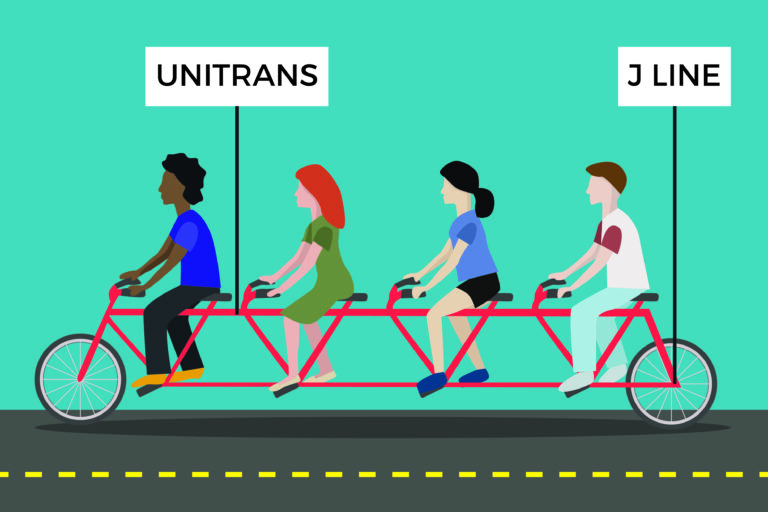
Humor: Unitrans switches to really long tandem bikes instead of buses

If Noah had used this bike during the flood, he could have fit three of every animal

After relentless harping by CALPIRG, Unitrans switched to using long tandem bicycles for transporting the good people of Davis.

This wheely large undertaking did hit some proverbial bumps in the road. The average Unitrans bus was able to fit 100 riders if they packed together sardine style. Mr. Otto Mobile, the head of Unitrans, spoke with The Aggie about the difficulty of creating a bike that could transport the same amount of commuters.

“They said it couldn’t be done,” Mobile admitted. “I called every major bike company to see if they could manufacture our Unitrans bikes, and they said that I’m ‘insane’ or, ‘It’s impossible to make a bike for 100 people,’ or ‘Sir, this is the number for Pizza Hut customer service.’ But I thought of my idol, Miranda Sings, and told my haterz to back off. We kept making calls ‘til we got to the very top. Yes, we called the President and asked him if we could get some military-grade, 100-person bikes. He said it was the best idea he had heard all day!”

And thus, the Bikehemoth was born.

We asked Bryce Sickle, an employee of Unitrans, for her opinion on the new mode of transportation.

“It’s been a little tough getting used to it,” Sickle said, shrugging. “I was a bus driver before, but now I’m a…uh…bike…driver? I sit in the very front seat and shout which direction we’re turning when we get to an intersection. You’d be surprised how hard it is to go right on a bike that’s the size of a football field. And during those pesky peak hours, we have passengers sit on the shoulders of someone else and pray to the bike gods that neither of them tip over. We have capsized a few times, but that’s what happens when there’s enough people to fill Wellman 2 on one bike.”

Most students are happy with the change.

“I feel like I’m really doing something for the environment here,” said one Unitrans patron. “Sure, my ride from West Village to campus takes, like, an hour now. But think of the future we’re creating for all those starving polar bears in Antarctica by getting rid of all those bus fumes.”

Written by: Madeline Kumagai — mskumagai@ucdavis.edu

(This article is humor and/or satire, and its content is purely fictional. The story and the names of “sources” are fictionalized.)

Review: Becoming Michelle Obama

New York Times Best Seller doesn’t disappoint

Michelle Obama’s memoir, “Becoming,” has remained at the top of bestseller lists since its publication in November of 2018. It’s currently number one on the New York Times Best Sellers list for nonfiction books.

Michelle Obama provides an in-depth look into her life, exploring her upbringing in Chicago, her career, her relationship with Barack Obama and finally her years living in the White House as First Lady.

Growing up, Obama lived in Chicago’s South Side with her mother, father and brother, in a one-bedroom apartment, where the bottom floor was occupied by her great aunt. Obama reveals that despite her family’s low socioeconomic standing and the fact that her parents worked full-time jobs, Obama and her brother had childhoods filled with love and mentors who fueled their ambitions.

Obama characterizes herself as a go-getter. As a young adult, she attended Princeton University and Harvard Law School and worked endless hours to achieve her position practicing corporate law in Chicago. It was there  she met Barack Obama, a passionate man with big dreams of his own.

Michelle and Barack Obama’s relationship is inspiring. They have maintained their love while braving long periods of separation due to school or work and managed to balance their demanding careers with the duties of marriage and parenthood. Left feeling unfulfilled by corporate law, Obama was motivated to “swerve” by her husband, to take a leap of faith and follow her heart, figuring out the rest along the way.

This is one of many messages or words of wisdom that Obama ingrains in her memoir. Following this advice, Obama leaves her comfortable position in corporate law to pursue a career in public service, with the goal of helping underprivileged communities like the one she grew up in.

“It was one thing to get yourself out of a stuck place, I realized,” Obama wrote. “It was another thing entirely to try and get the place itself unstuck.”
Obama details the joys of motherhood as well as its difficulties, a previously unseen glance into the interiority of the Obama family. With a refreshing vulnerability, she discusses the physical and emotional strain of her miscarriage and IVF treatments. Her efforts to push forward in her career and also be a caring, present mother is a familiar story — her relatability and candor helped her win the hearts of Americans everywhere. Later, she details her concerns for the safety of her children as they become recognized faces nationwide.

The memoir picks up speed with Barack Obama’s political career. Obama always has and will always hate politics, admitting that she resisted her husband’s decision to become involved.

“Coexisting with Barack’s strong sense of purpose — sleeping in the same bed with it, sitting at the breakfast table with it — was something to which I had to adjust,” she wrote.

While interesting, the telling of Barack Obama’s run for president delved into lengthy descriptions of the campaign, which slowed down the story. These sections read more like a textbook, though they may be appreciated by those intrigued with the inner workings of politics.

Obama writes with clarity of her past and present, discussing her role as First Lady and its implications. She redefined the role by focusing her attention on alleviating poverty, improving education and emphasizing habits of healthy living. She analyzes the evolution of her character in the face of adversity, writing of demoralizing racial comments and instances of hatred that accompany being married to the first black President of the United States. She writes of the intense pressure to represent her husband and family and watch every little thing she says, does and wears.

In “Becoming,” Obama doesn’t hold back. Her voice is honest and sometimes biting. She is unafraid to criticize President Trump and the tactics he used in attempts to undermine the integrity of the Obamas.

Overall, “Becoming” is well-written and its tone is inspirational. So far receiving positive reviews on Goodreads and other rating sites, the memoir continues to top the charts worldwide as a best seller. Michelle Obama has extended her book tour to include more stops in both the United States and abroad.

“Becoming” is available in most bookstores and on Amazon. An audiobook version read by Michelle Obama is also available for purchase through Audible.

Written by: Cheyenne Wiseman — arts@theaggie.org

Why farmers must use nitrogen fertilizers efficiently

California has the worst air quality in the nation — mostly due to nitrogen oxide emissions

Fertilizers for crops have been an achievement that has propelled society forward:  about half the population of Earth is currently fed by the innovation of crop fertilizers.

But the magnitude of this tool also has its implications. Plants can only take in so much nitrogen from the fertilizers, and when that plant reaches its maximum capacity intake for nitrogen, the rest stays in the soil, where it starts polluting our environment and contributing to climate change.

California’s Air Resource Board, the state’s voice on contributions to air pollution, estimates that about 4 percent of California’s nitrogen oxide emissions come from fertilizers. Our energies have been focused on what we thought was the leading cause of nitrogen oxide emissions to the atmosphere: transportation. California implemented the smog-check to control the amount of carbon dioxide coming from vehicles. Yet California has the nation’s worst air quality, according to a 2017 report from the Lung Association.

In 2018 it was discovered how grossly miscalculated the actual damage nitrogen oxide emissions from fertilizers actually contribute to air pollution. A recent study from UC Davis shows that up to 41 percent of nitrogen oxide emissions come from overused fertilizer in soils. The Central Valley, which produces one third of the country’s vegetables and two thirds of its fruits, has the highest amount of air pollution in all of California. Central Valley’s bowl-like topography along with its hot dry climate is a recipe for disaster for its residents. It’s no surprise that cities like Fresno have 70,000 residents with asthma.

The World Health Organization estimates that air pollution causes one in eight premature deaths and is associated with increased risk of asthma, cancer and birth defects. Unfortunately, nitrogen oxide emissions are not just detrimental to our health, but to climate change as well. Nitrogen oxide is a greenhouse gas, and like any other, it makes the Earth warmer and therefore causes climate change. Nitrogen oxide also reacts in the air to produce ozone pollution, another greenhouse gas that is toxic for humans and the environment.

The problem of nitrogen oxide can be easily solved now that we know where it really comes from. Just like we focused our attention on cars when we thought they were the leading cause of nitrogen oxide pollution, we must now turn our attention to farmers using nitrogen fertilizers. The good news is that this is a very easy fix. A simple program that incentivises farmers to use fertilizer more sustainably and efficiently will help them save money by using the right amount of fertilizer and it would help reduce pollution to the environment, thereby mitigating the effects of global warming.

Such a program will reward those farmers who use fertilizer most efficiently, thereby creating a healthy competition between farmers to apply fertilizer adequately. This will shape the culture of farming in a more sustainable way by instilling proper techniques and can create new jobs since farmers will need soil technicians to help them measure the right amounts of fertilizer needed for every crop.

By implementing these incentive programs, the free market could also jump in to develop new technologies that can help farmers use fertilizer more efficiently, such as controlled fertilizer drip irrigation systems like the ones currently used for watering crops. More controlled, natural depositions of fertilizer have proven to improve the intake of fertilizer from plants. Innovations can also come in the form of green infrastructure projects to prevent nitrogen runoff or catalytic converters that take out extra nitrogen from the soils. Currently, California loses tens of billions of dollars every year in health-related costs of air pollution. When this problem is resolved, California’s economy could be stronger than ever before.

Written by: Daniel Oropeza — daoropeza@ucdavis.edu

Disclaimer: The views and opinions expressed by individual columnists belong to the columnists alone and do not necessarily indicate the views and opinions held by The California Aggie.

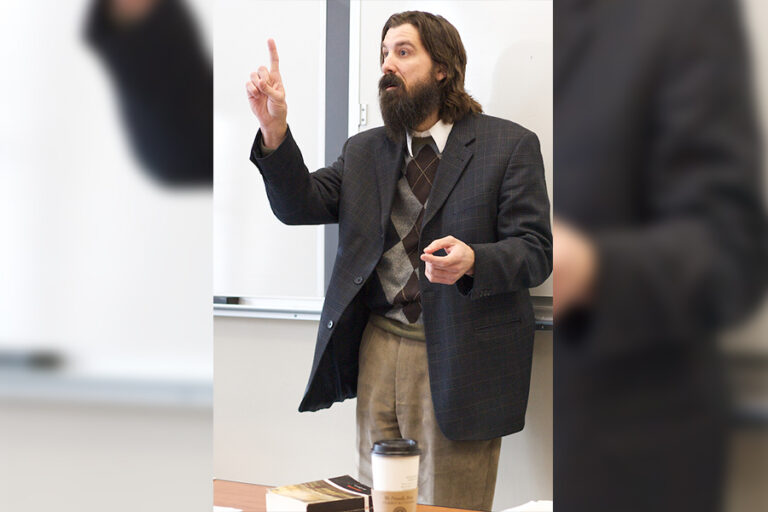
Humor: Professor’s classic rant about packing up early works for the first time ever

Students actually take notes until professor excuses them

A professor became enraged one day when his students began packing up when there were approximately three minutes of class left. He was getting to the most important part of an organic chemistry reaction when he heard a chorus of backpack zippers, shuffling papers and creaking desks.

“This is going to be on your midterm! This is important stuff!” he huffed at his pupils. The sounds of packing up subsided for about four seconds before crescendoing into a deafening roar. He couldn’t have told his students about aldehyde even if he had screamed the rest of the lesson. With his cheeks puffed out and his face as red as a Unitrans bus, the professor vowed to never let this happen again.

At the next lecture, when the disgruntled professor first heard the telltale thump! of a Macbook Pro being closed at 11:56 a.m., he cleared his throat and said, “Class is over when I say it’s over!”

The students looked around in shock. How bold! How daring! They slowly re-opened their laptops, put away their Hydroflasks and turned their attention towards their professor. It worked! thought the professor, rubbing his hands together like a cartoon villain. He resumed the lecture.

“So! If you want to get this Mannich reaction problem right on your midterm, you’ve gotta draw the arrow like so…” He finished writing out the solution, but to his pupils’ shock, he continued teaching.

“Now, I know you all want to leave, but there’s gonna be a lot of material on this upcoming midterm, and I just want to make sure we cover it all before next class.” He introduced a different problem. Soon the minute hand reached 12, but the professor kept going. His students, glued to their seats by his magic words, continued to take notes.

“…And that’s how you make a phenol,” he said. “Goodness gracious, look at the time! I seem to have gotten a little carried away there, my apologies. But please DO NOT pack up when I am teaching. It’s disrespectful.”

The students checked their phones, and to their horror, it was the year 2028.

“I know it took a little extra time to get through those last few topics, but I still expect you all to know how to solve these problems on next week’s exam,” the professor said. “Thank you for your patience.”

Written by: Madeline Kumagai — mskumagai@ucdavis.edu

(This article is humor and/or satire, and its content is purely fictional. The story and the names of “sources” are fictionalized.)

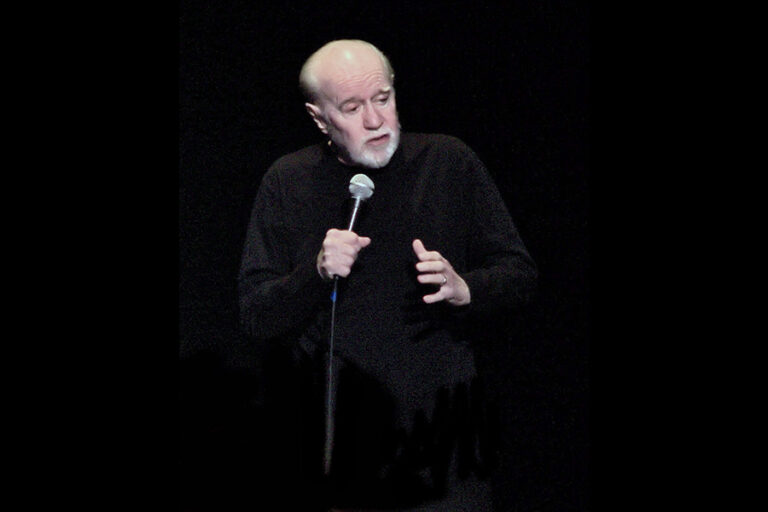
Revisiting the curmudgeonly anger and totally acceptable, politically-incorrect vlugarities of George Carlin

Why Carlin’s jokes work and why today’s PC police might crucify him regardless

Benjamin Porter — bbporter@ucdavis.edu

As one of my high school English teachers always said: “Technique is content.” For this reason, I think it’s essential for comedians to justify every stylistic choice they make. Too many comedians today are excessively profane, vulgar and mean-spirited for no reason whatsoever. Political incorrectness just for the sake of political incorrectness serves absolutely no purpose, and it’s not funny.

This is a symptom of how American culture has been dumbed-down to the point where some less-talented comedians who aren’t smart enough to write good material can get away with decorating their substandard ideas with flashy language. It’s analogous to how mediocre soccer players think that they can get away with playing poorly just because they have tattoos, neon pink boots and a blue stripe in their hair.

In his prime, legendary comedian George Carlin didn’t have much hair left, and his routines often were profane, vulgar and a bit mean-spirited. Yet Carlin is one of my all-time favorite comedians because his profane, politically-incorrect language is indeed a motivated aesthetic choice. My favorite Carlin routines can be boiled down to one main thing: calling out narcissism, hypocrisy, bullshit and people who are stuffed with all three. Frequently, his jokes are just factual descriptions of absurd, ludicrous or just flat-out stupid things that some group of people is doing, and the punchline is just some vulgar variation of Carlin telling them what they should do. You know what I mean.

But his style worked because his foul language is a technique that helped communicate his anger to the audience, who could share in his astonishment at absurd stupidities. The targets of his jokes were always obvious, and there was always an undeniable truth at the core of the joke. On rare occasions, his jokes could go too far, but Carlin was at his brilliant best when he was using “offensive” language and highly exaggerated premises to mercilessly eviscerate those who were begging for it.

For example, Carlin has a 20-minute routine called “a list of people who oughta be killed.” To assure those who can’t get past the potential poor taste of that premise, he is not literally advocating violence. This is just a technique for showing his disgust with various breeds of shallow narcissists and hypocrites. He begins each entry in the list with an absurd way in which “they should be killed.” In one entry, Carlin says:

“Here’s another pack of low-grade morons who oughta be locked in portable toilets and set on fire: These people with bumper stickers that say, ‘We are the proud parents of an honors student at the Franklin school’ — or the Midvale Academy or whatever other innocent sounding name has been assigned to the indoctrination center where their child has been sent to be stripped of his individuality and turned into an obedient, soul-dead conformist member of the American consumer culture.”

While there is no profanity in this rant, it is one of Carlin’s trademark uses of language  — long, rhythmic rhyming lists and endless progressions of “unnecessary” qualifiers. Jon Stewart told Carlin that his “fascination with language is so apparent” and that watching him “is almost like watching a musician, the way you weave words and use language for emphasis.” This is clearly evident in the bumper sticker rant, as well as in a bit called “advertising,” where he goes on a three-minute riff reciting dozens of meaningless marketing slogans to which our “consumer culture” has numbed us.

Carlin died in 2008, with a sharp rise in PC culture just around the corner. In a bit on politically correct language, Carlin discussed how terms like “shell shock” became grotesque, lifeless and “sanitized” jargon like “post-traumatic stress disorder.” He also explains how we’ve arrived at terms like “differently abled,” “minimally exceptional,” “physically challenged” and “handicapable.” The phrase “poor people live in slums” became “the economically disadvantaged occupy substandard housing in the inner cities.” Carlin says that all this ugly language makes him want to vomit, or in other words, “engage in an involuntary personal protein spill.”

Carlin’s goal here is to call out the ridiculousness of people who think that “by changing the name of the condition, you change the condition,” as well as those who try to police language by imparting a sense of shame on any words that might offend some subsection of some group. Had he lived to 2019, Carlin would have had a field day with the amount of new material on this subject, and it likely would have gotten him in much more trouble today.

I fear that even the routines in which he utilizes his techniques perfectly may not have made it past today’s more gung-ho PC police, as too many people would be unable to look past his irreverent style and see the substance of his jokes or artistic use of the English language. A 2015 Washington Post article suggested that even though Carlin loved working out material on college campuses, he wouldn’t even be welcome on them today. Can’t we make fun of people without worrying about the most sensitive person in the room?

Carlin was a proud, non-voting “spectator” of American society, “divested” from the outcome and resigned to the notion that we can’t solve environmental degradation or corruption in the mainstream political establishment. Because of this, I worry that pro-Trump Americans might have hijacked Carlin’s unique brand of cynicism and distrust in authority to fuel their own questionable narratives about Donald Trump being some sort of hero fighting against the “Deep State.” Carlin was not shy about sharing his view that U.S. elections are just a sham, a charade, an “illusion of choice.” It’s possible that today he and his fans would have enjoyed watching Trump shake things up, regardless of the consequences.

In Trump’s America, Carlin would have had difficulty reconciling his love of spectating with his hatred of bullshit. He might have loved Trump as an agent of chaos, or hated him as an agent of bullshit who disrespects the arts of rhetoric, language and logic that Carlin held in such esteem. I’d like to think the latter.

Written by: Benjamin Porter — bbporter@ucdavis.edu

Disclaimer: The views and opinions expressed by individual columnists belong to the columnists alone and do not necessarily indicate the views and opinions held by The California Aggie.

Yolo County Food Bank gets new paint job

OLIVIA KOTLAREK / AGGIE

Brooks Painting Charity redesigns Yolo Food Bank for annual charity painting

Last spring, the Yolo Food Bank was deemed the winner of the 12th Annual Brooks Painting Charity Paint Giveaway contest, which donates painting services to local community-oriented organizations. Since Jan. 19, the Food Bank neared its completion with the painting and labor for the interior of the warehouse. The new Food Bank headquarters is located at 233 Harter Avenue in Woodland, Calif.

In a press release by Yolo Food Bank, the president of Brooks Painting Charity Jeremy Brooks commented on the decision.

“We believe in giving back and supporting worthy causes, and the annual charity paint is one way we do that,” Brooks said. “The relationships we have built and the lives we have changed as a result of this program provides us with such deep satisfaction and an added sense of purpose to our work.”

The Yolo Food Bank now joins a long list of charities that Brooks has sponsored. These communities include Davis Little League, the Sharp family and Sexual Assault and Domestic Violence Center of Yolo County, also known as Empower Yolo, Empower Yolo Davis Summer House, Hillel at Davis and Sacramento, Yolo County Animal Shelter, Yolo County Care Continuum Safe Harbor House and many others.

As part of the “End Hunger Yolo” project, Yolo Food Bank’s new facility greatly expands the nonprofit’s ability to fulfill its goal of addressing hunger and malnutrition in Yolo County.

UC Davis students and many others in the community were happy with the new changes. Evan Dumas, a fourth-year biotechnology major at UC Davis, was one of many students excited about the expansion.

“The new facility is safer for volunteers to work and boosts morale,” Dumas said. “It also makes the facility more inviting so that more people are encouraged to volunteer there.”

The Food Bank’s new building is nearly four times the size of the current location. The 37,000 square-foot facility will ultimately allow for a 200 percent increase in the amount of food that can be accepted and distributed. Currently, the food bank issues more than four million pounds of food throughout the county each year, with 52,000 vulnerable individuals each month accepting services from the organization. This is facilitated by a network of 200 nonprofit organizations, both private and public sector agencies and service partners.

Yolo Food Bank hopes to move to its new location by the end of March, with the goal of making an even bigger impact on the community and continuing to serve the needy and poor. Michael Bisch, the Yolo Food Bank executive director, spoke on behalf of the organization.

“Despite being known for an abundant agricultural economy, food insecurity is an everyday concern for nearly 20 percent of Yolo County residences,” Bish said. “As many as one in four children do not have enough to eat, and senior citizens and rural residents are disproportionately impacted, as are the working poor and their families, the recently unemployed, veterans, students, homeless and migrant farm workers. This new building means the difference between surviving and thriving for these neighbors, and Brooks Painting is playing a key role in making this possible.”

Written by: John Regidor — city@theaggie.org  

Humor: Unitrans J Line skips Alvarado stop to avoid opening top floor of double decker

TESSA KOGA / AGGIE

“This bus is no longer in service. Have a good one!”

In a monumental decision by first-year bus driver Buster Buseman, the Unitrans J Line skipped the major Alvarado stop on Tuesday morning to avoid opening the top layer of the double decker bus. The decision was made with pressure from Buseman’s charlie at the time, Charlie Barkley.

“Well, it started off just like any other morning driving the J,” Buseman said. Barkley sat beside him, periodically meeting Buseman’s gaze intensely after insisting on being part of the interview process as Buseman’s “charlie, friend and lawyer.” The California Aggie is currently investigating whether this is grounds for intimidation. After one of these exchanges and a wide-eyed stare at the ground lasting at least 30 seconds, Buseman continued.

“The stop before North Sycamore, everyone got off the bus, and I thought maybe we could have an easy morning for once. But when we turned the corner for North Sycamore, that fledgeling hope was shattered. There were at least 20 people standing there waiting to get on the bus. Then 11 more at the next stop, and 13.5 at the next. By the time we got to Alvarado and Sycamore, people were already standing.”

At this point in the interview, Barkley handed Buseman a note. Buseman read it and began sweating beneath his shirt before tearing up the note and eating the pieces. He continued once again.

“And that’s all I have to say, other than I did what I had to in order to protect my fellow students and the integrity of Unitrans.” Both Buseman and Barkley refused to comment further.

Fortunately, The Aggie had two undercover journalists, one at the stop in question and one on the J at the time, conducting an unrelated investigation. Their testimony follows here:

“As we approached the Alvarado stop, several standing students asked the charlie (Barkley) if they could open the top deck, as the entire bus could see the crowd of students waiting at the next stop. The charlie refused to cooperate, screeching above the engine, ‘I’m sorry, but I’m not going to do that and you’re not the boss of me.’ The charlie then looked at the driver (Buseman) and whispered, ‘Do it’ menacingly. The driver then turned on the “Not In Service” sign and drove past the stop, leaving at least 40 students behind. There was no follow-up bus.”

We requested another interview with Buseman to clarify this report, but he denied our request, citing a “bus-related family emergency.” Barkley, although denying our request, gave a statement by email.

“Alright, listen here,” the email read. “You really don’t understand what you’re getting into here. First of all, the strap that holds back those beasts from entering the top deck is literally the most difficult thing to undo. It takes precise motor skills and my entire body’s strength every time. Would you want to tear your muscles every time a sweaty, unshowered second-year with earbuds blasting Juice Wrld asks if you can open the top deck? We don’t even like having people up there. Unitrans only has the double decker buses to look cool. They’re hardly functional as is. If you know what’s good for you, stop asking questions you don’t want to know the answer to. You’re on strike two already.”

Written by: Conner Shaw — cjshaw@ucdavis.edu

(This article is humor and/or satire, and its content is purely fictional. The story and the names of “sources” are fictionalized.)

The Death of the Campaign: Battle Royale

CAITLYN SAMPLEY / AGGIE

Narrative-based games falter in light of Battle Royale hype

In the world of gaming, it’s hard to avoid the words “battle royale.” As of the last two years, battle royale has become a monoculture in video games, replacing the hype for most online multiplayer modes as well as the necessity for story-driven campaign. Instead, a game type that poses one-hundred players against each other on a wartorn island in a life-or-death fight for a first place trophy has taken over.

Although the term battle royale may be somewhat of a mystery to those who don’t partake in online gaming, “Fortnite,” a battle royale game, is likely in the eyes and minds of many — gamers or not. The popular cartoon video game is almost impossible to ignore, as it has become a sort of milestone for the twenty-first century. Such a game delivers a form of entertainment that adheres to gamers’ competitive needs while maintaining a balance between cartoon nostalgia and combat savagery, not to mention Fortnite’s endless library of hip dance moves that young children and grandparents alike have mastered.

If you’re not one of the 200 plus million people who have engaged in the battle royale feature of “Fortnite” in 2018, it goes something like this: one hundred people are loaded onto an aircraft and are flown over a dystopian landscape to then parachute, land, collect weapons and fight enemies until one person ends up being the victor. There is no time clock to countdown the game’s end, but instead a deadly storm that brews on the edge of the map, slowly pushing the island warriors into a not-so-safe zone where they make their final stand.

It’s no easy feat to turn out on top of the one-hundred other players attempting to cull the herd. Most games will end with a short lived existence on the island while the 20 top players battle it out in a bloody showdown. But for those easy targets, it takes less than a minute to reload the main menu and respawn into another hundred players waiting to battle it out. This level of immediacy deserves attention because now, more than ever, the gaming masses are drawn to entertainment that chews them up and spits them out, rather than slower, campaign based games.

In light of these tendencies, “Call of Duty: Black Op 4” (CoD) has integrated, for the first time, the battle royale culture into their games by releasing a mode called “Blackout.” The game is much like Fortnite but with a CoD spin: more blood and more guns. However, the frustration among fans stems from CoD’s decision to replace their story mode with a battle royale feature.

Longtime fans can reminisce on what originally attracted them to the CoD franchise — the campaign option, never failing to provide a level of story depth that was once so essential to gamers. Playing a CoD story mode was similar to the likes of reading a book on trench or jungle warfare, as their campaigns were a mix of historic battles that their fans would get to play through with a controller in hand. Now, all that remains in place for CoD’s campaign is a baseless purgatory of isolated warfare, i.e. battle royale.  

But the numbers do not lie, people want battle royale. The proof is in the playtime and the dollar signs: Fortnite was ranked the #1 game of 2018 by Ranker.com, thus illustrating its rise to popularity above games like “Grand Theft Auto 5” and “World of Warcraft,” which were also ranked among the most popular of 2018.

At one time in history, games such as GTA5 and WoW dominated the field, requiring hundreds of millions of dollars to produce and costing gamers about sixty dollars to play. “Fortnite,” in comparison, is rumored to have cost anywhere between a one hundred thousand and a few million dollars to produce and is entirely free to play.

In 2018 alone, “Fortnite” earned 2.4 billion dollars just from in-game purchases of cosmetic items (outfits to dress their in-game characters), whereas GTA5 and WoW collect their billion dollar revenues from physical game purchases and monthly subscriptions over a number of years.

It would be foolish to compare games like these in a relative sense. GTA5, WoW and the battle royale juggernauts are two genres of a different breed. One provides story depth and character development, while the other provides an addictive hundred-player showdown.

However, herein lies the switch: upcoming and newly released video games cannot deny the power of battle royale. Pick an agency, name a game and there is a good chance their hands are in the culture, directing it toward their game release in hopes to attract this new breed of fans.

For example, GTA5 did not debut with a battle royale mode when it originally released for the Xbox 360, but as of late 2017 (shortly after the debut of Fortnite), an update with a battle royale modification became available through it’s downloadable content labeled, “Smuggler’s Run.” However, the update did not receive near as much popularity as other standalone games, such as Fortnite or Call of Duty: Blackout.

But the producers of GTA5 were sure to think ahead and include a battle royale mode, titled “Gun Rush,” in their most recent game release, “Red Dead Redemption 2.” Other games have followed suit: The Battlefield franchise, widely known for its powerful story modes and demanding online gameplay, chose to reduce their story option to a mere two-hour experience, while offering their battle royale feature, “Firestorm,” to pick up the slack.

These aren’t the only games to fall victim to the rising popularity of battle royale. An endless list could be comprised of upcoming video games that have forgone their need for a campaign in order to observe popular demand. All is to be expected with the rise of such technological advances that bring us super realistic video games with overwhelmingly intense multiplayer options.

Although single-player, story-driven video games may seem to be the less popular option among gamers in the twenty-first century, upcoming games like “Anthem,” “The Last of Us Part II” and “Cyberpunk 2077” keep the nails from the coffin with their highly anticipated narratives and hyper-realistic graphics.

As new-school gamers veer toward the battle royale option, so may the old-school ones, as its level of excitement is undeniably addictive. But a true gamer cannot refuse a well-developed story mode, nor can they deny its exhilaration.

Battle royale is not going anywhere, so taking a break from its perpetual warfare and indulging in a good single-player experience is recommended because, sadly, the same cannot be said for the life of the single-player video game.

Written By: Clay Allen Rogers –– arts@theaggie.org

The Life of a Kicker: Controversy and Catastrophe

0
JAMIE CHEN / AGGIE

UC Davis kickers Matt Blair and Max O’Rourke share thoughts on new rules, big misses

Kicking in the NFL has always been a difficult, high pressure job. As the league advances towards a future where player safety is the priority, many phases of football, specifically kicking, have become increasingly complex and difficult.

Prior to the beginning of this season, the NFL Competition Committee made two significant changes to the structure of an onside kick: “The kickoff team must have five players on each side of the ball and cannot line up more than one-yard from the restraining line.”

Previously, players attempting to recover the onside kick could start five yards away from the ball, allowing them to get a running start. These players often would be heavily overloaded to one side, sometimes even stacking one side of the field with eight players, which is now illegal as well.

Many fans and pundits poured on criticism when the rule was initially passed in May 2018, holding the notion that the onside kick, at least this season, would be “virtually dead.” But were they actually correct?

Ten years ago in the 2009 season, the onside kick recovery rate was 26 percent. Throughout the entire 2017 regular season and postseason, 13 of 60 onside kicks were recovered, equating to 21.7 percent.

Although that drop in recovery rate was not exactly appealing to fans who were looking for an exciting play, the plummet of recovery percentage this year will make football enthusiasts cringe. Through the divisional round, out of 53 onside kicks attempted this year, only four have been converted, or 7.5 percent. Lo and behold, critics of the rule change knew exactly what they were talking about, as the chance of the kicking team recovering an onside kick is now slim to none.

UC Davis punter and kicker Matt Blair feels as though the new rule changes take away the capability of a team to come back and win a game.

“I understand the players’ safety aspect of it,” Blair said. “You’re trying to reduce the concussions, but I honestly don’t think five yards makes a big difference whether someone is going to get a concussion or not, so I think they should move it back so teams are more successful getting onside kicks.”

Even once a team recovers an improbable onside kick at the end of the game, the kicker still has to make a field goal the majority of the time. No matter the distance, game-winning field goals always seem harder to make than regular ones. Chicago Bears kicker Cody Parkey became a victim of this cruel reality on Jan. 6, when he missed a potentially game-winning kick against the Philadelphia Eagles. Many blamed the entire loss solely on his miss, in spite of the fact that Eagles player Treyvon Hester tipped the ball.

UC Davis placekicker Max O’Rourke said he understood the immediate outcry of frustration and blame.

“As a kicker, you’re really only out there six or seven times in a whole game really, if even that many times might be a lot,” O’Rourke said. “But when you’re out there everything is highlighted, so your mistakes are way more highlighted than others.”

Some fans, however, let their anger spiral out of control. Cody Parkey received an onslaught of hate and even death threats.

“I don’t think the hate is totally warranted,” O’Rourke said. “Given that one, it was blocked, and also, that he had made three field goals and [the Bears] wouldn’t have even been in the game had it not been for him.”

O’Rourke also noted, however, that he understands the passion many fans have for their team.

Blair related the situation to the universal norms that kickers constantly live by.

“There’s a certain aspect of just being human where you can’t be perfect,” Blair said. “So [Parkey] doesn’t deserve all the hate, but he doesn’t deserve no hate either. If you miss a kick, there’s always going to be too much [hate], but when you make it, you get too much praise, so it goes both ways. People think you’re a superhero when you make the game-winning kick, but want to put you on the stake when you miss, so there’s a dichotomy there.”

Blair wrapped up his thoughts by saying that he believed Parkey handled the miss well, “He accepted the responsibility of the missed kick as well as he possibly could, which was impressive and is a good lesson for young people.”

Written by: AJ Seymour –– sports@theaggie.org