53.5 F
Davis

Davis, California

Tuesday, December 23, 2025
Home Blog Page 466

Unboxing Letterboxd

A social media for movie lovers

Whether on TV, in a theatre or most commonly through an online streaming service, watching movies is a favorite pastime for most people. Beyond watching the film itself, one of the most exciting aspects of watching a movie is finding someone else to discuss it with. It not only opens up a conversation about enjoyable scenes but also invites people to discuss the topic of film in general. “Have you seen (insert film)?” is usually followed by the statement “You have to watch it.” Often though these conversations go unheeded and are filed away with all the other movie recommendations. Letterboxd, a social media app for movie lovers, offers a solution to this problem.

While websites such as Rotten Tomatoes, IMDb and Roger Ebert offer film reviews, lists and interactive qualities, their focus is not on creating a community of discussion. Created in 2011 and available to the public since 2013, Letterboxd is a free social media app that allows users to mark every film they have seen through a simple and entertaining process; members are provided with lists and pictures of popular films that can be easily modified and organized. The app also allows members to make their own lists, write reviews, keep a film diary and continue to add to their watchlist of films that they have not yet seen.

Regarding the social media aspect, Letterboxd allows members to follow friends, granting them access to their friends’ profiles of films, reviews, lists, watchlists and likes. The accessible, simple and familiar design of this app adds to its appeal; every movie is displayed the way it would be when scrolling through sites like Netflix or Amazon Prime.

Upon clicking on a film, members are taken to the film’s info page that provides ratings, summaries, reviews and its appearance on various lists. In addition, the app provides a “watched by” or “wants to watch” section if a friend has seen or wants to see that same film. For people interested in Auteur cinema or in watching films featuring a specific actor, the app has a search section of “cast and crew” that pairs with IMDb.

On the app’s home page is a list of that week’s popular films, friends’ viewing activity, recent news and reviews, and trending film lists. Some examples of the entertaining and specific lists on the app include “Befriending the lyrical loneliness… essential movies for lonely people out there if you want to feel something in the big big world,” “Frank Ocean’s Favorite Movies,” and “Foreign Cinema: A Beginner’s Guide” that all offer educational and entertaining niche categories.

With the rise of movie accessibility through various streaming services, it’s often easy to feel overwhelmed with the amount of content being offered. While Apple Music, Spotify or Soundcloud serve as a synthesis of social media and music streaming, streaming apps for movie watchers don’t offer this same social perk.

In many ways this makes sense because it takes a lot longer to watch a movie that a friend recommended than a song, what Letterboxd offers is a mode of organization that isn’t as commonly found with films. Being able to document which films one has watched as well as mark certain movies as favorites to be displayed on their profile gives Letterboxd a more personal feel. In addition, the app has a growing database of over 200,000,000 films marked as watched.

Letterboxd continues to grow as members browse the app and find movies that they have seen or plan on seeing. In addition, Letterboxd has celebrity users such as Sean Baker, Director of “Starlet,” “Tangerine,” and “The Florida Project,” and Roger Avary, co-writer of “Pulp Fiction” and “Reservoir Dogs,” which suggests that eventually Letterboxd will grow to have more directors and actors involved.

What’s so enticing about this app is its appeal to a wide range of social media interests. In contrast to apps like Instagram and Facebook, Letterboxd doesn’t emphasize the amount of followers each profile has but instead allows members to comment on lists or write reviews that others can read. It serves as an interactive community rather than focusing on an aestheticized image or set of curated interests. Letterboxd relies on users to add all of the films they have seen, offering a chance to track one’s wide accumulation of films. Regardless of dedication to watching and documenting films, Letterboxd offers features for everyone with a user friendly interface on both the phone and computer. It’s exciting, fun and brings organization to the very overwhelming world of film and content.

Written by: Rosie Schwarz arts@theaggie.org

Profile: Molly Moritzburke

Student artist and Bike Barn mechanic finds ways to combine her passions

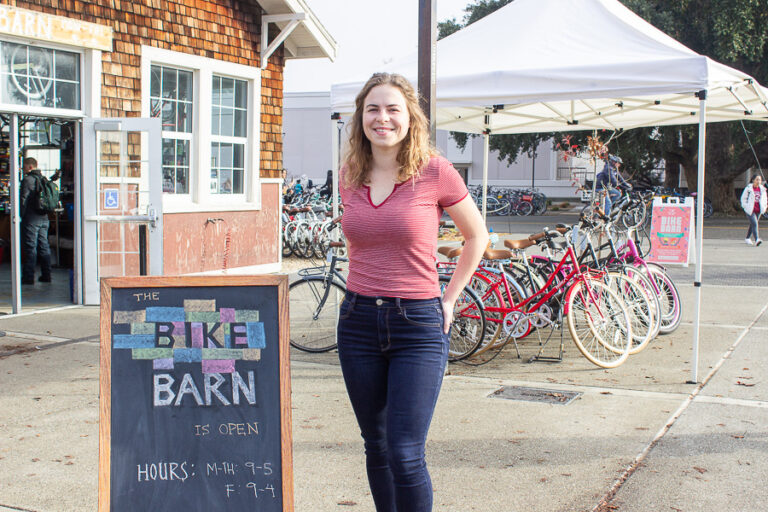
Molly Moritzburke, a fourth-year mechanical engineering major, might be a familiar face at the Bike Barn. As manager of the campus-favorite repair shop, she is either running the register, training new mechanics or getting her hands greasy in the workshop.

“I started working here when I was a sophomore,” Moritzburke said. “I have been into mountain biking for a really long time. When I got to Davis, I didn’t really have an outlet for that. I thought that working on bikes would be a good alternative to riding bikes.”

Moritzburke is not only mechanically minded in terms of academics and bikes, she’s also an artist by nature.

“I have always been really into art as a kid, and thought I wanted to be an artist and go into art as a major,” Moritzburke said. “I screen print T-shirts for myself and friends now, and I do mostly acrylic painting. After a certain point I became interested in science and engineering as well, and I decided that would be a more fitting career path for me. But I still keep art in my life.”

Specifically, she sustains her artistic talent through the art she does for the Bike Barn. Moritzburke illustrates the quirky promotional signs that decorate the repair shop, from aggressive turkeys to Freddie Mercury.

“I usually update them twice a quarter, following the seasons and what’s going on in the area,” Moritzburke said. “It’s fun for me to have an artistic outlet at work, but it also provides information and attracts customers. The Freddie Mercury one was on UC Davis Snaps, and I’ve had people comment on my signs in the store.”

Beyond illustration, Moritzburke has begun to paint bikes — her two seemingly-unrelated passions intertwining even more directly. Using acrylic paint and a clear coating to finish, Moritzburke creates intricate, abstract designs on various bikes for friends and family.

“When you paint a bike, you have to start from a blank slate,” Moritzburke said. “My aunt had this old bike that the paint was coming off of, so she had all the paint taken off and base coated blue. She told me to do whatever I wanted on it. I don’t usually have an idea before I start. I’ll paint just blocks of color on the bike and then it will develop from there.”

While her practice is unaffiliated with the Bike Barn, polishing her mechanical dexterity at work has aided the hands-on skills necessary in her personal artistic venture.

“Working [at the Bike Barn] gave me the skills to do a lot of things that are necessary to painting bikes — how to take apart bikes, what materials I need to use to make it possible to paint a bike,” Moritzburke said. “Usually you have to take apart the bike completely to paint it, because you don’t want to get paint on any of the threaded surfaces. To strip the paint off the bike, I use a drill with a steel-wool like material attachment or just hand scrub it.”

The Bike Barn then becomes a setting for repairs, tune ups and creativity alike.  

“I think the Bike Barn pulls on a lot of my interests: art, engineering and bikes,” Moritzburke said. “Those are the main things I think about on a daily basis. It’s been interesting to see how these things fit in together. The inspiring thing has been finding that meshing.”

Moritzburke isn’t the only employee who participates in the Bike Barn’s aesthetic possibilities. Other employees collectively contribute to the artistic energy of the shop, playing off the physical space that attracted them initially.

“There’s always good music playing, our space is really eclectic,” Moritzburke said. “You don’t come in here and think that it’s clean or organized. But it is a space that draws in a lot of creative employees. We have musicians and graphic designers and more. It makes it a really interesting place to work, and we try to hire people who would enjoy working in this environment. I think that draws in those types of people naturally.”

A long table lives within the mechanic-only area of the Bike Barn, where workers discuss and hangout to the tune of hammers, loud music and sparks flying. Creativity, in this case, finds a home in a rather unlikely space, yet simultaneously and ironically, without surprise. For Moritzburke, “it’s more than about working on bikes.”

Written by: Caroline Rutten — arts@theaggie.org

Draft Horse and Driving Club carts in members to learn about driving horses

0

UC Davis Draft Horse and Driving Club teaches horsemanship and driving skills to both experienced and inexperienced horsemen

Trotting past the sea of bikes, skateboards, walkers and buses are Olive and Dee, two Percheron mares, ages 10 and seven respectively. They traipse across the grassy Auad at peak commute time between classes pulling their wagon, which holds smiling members of the Draft Horse and Driving Club.

The Draft Horse and Driving Club, a student-run club that teaches its members how to drive draft horses in both team and single carts, has been a staple at UC Davis for 12 years. One of the past Horse Barn managers started the club when he was a student and continued it until he eventually became the barn manager.

The club meets at the Horse Barn and provides eight three-hour practice times: two on Tuesdays and one each day Monday through Saturday. The president of the club, third-year animal science major Christy Collins, said that members do not have to come to all of the drives; they have many options for involvement, so students have a lot of opportunities to come.

“Just the horses, getting to drive, getting to go out and about on campus — it has been a very fun, very cool experience,” said Keely Davies a fifth-year animal biology major and club member.

“Any student or anyone affiliated with UC Davis can join the club; there is no horse experience required,” Collins said.

“I didn’t have real horse experience before I joined, so I thought it was a different challenge,” said the Vice President of the club and fourth-year biological-sciences major Henrique Noro Frizzo. “And you have to learn how to deal with the horses, and since I have become an officer, the people too, and that’s really cool.”

Collins said that 270 people are signed up on the roster but closer to 40 to 50 actually show up to drives consistently. How many people come usually depends on the day of the week. During the week, usually around 4 to 7 people show up, but on Saturdays anywhere from 8 to 15 people will attend.

The club is hired for many events for different university departments like Horse Day or parades for Picnic Day. For some events, people just want the aesthetic look of the horses and wagon, and for others, they want rides. Even though the club is not paid for these events, Collins said that they like doing them because they enjoy it, in addition to receiving publicity and making connections with professors.

To join, Frizzo said that people should just show up to one of the drives at any point in the quarter. They can meet the club members at the back-east corner of the Horse Barn; the first drive for the club is free.

For new members, Collins said they start by driving in the arena. Once they learn how to drive, they work their way up to driving on a bike path in the arboretum or out west on the road by the Sheep Barn and Beef Facility. Once members are very comfortable driving, they go on campus in the quad.

“We teach them everything they need to know with handling draft horses, grooming them, driving them and all the steps in between,” Collins said. “We try to provide experience for people who do not necessarily have the opportunity to work with horses. This is purely for people who are interested in horses at all.”

All of the draft horses and most of the equipment, like harnesses and carts, have been donated. UC Davis funds the club and pays for the upkeep of the horses in exchange for one horse being used for breeding to make the school a profit. However, Collins said that since they only have two horses right now, none are used for breeding. Other funding for the club comes from selling t-shirts and member dues.

From donations, the team has a wagon for team driving, two single carts, a two-seater cart with two wheels and a four-seater cart with four wheels, Davies explained.

The horses that the team currently has, Olive and Dee, are both used for single and team driving. Collins said that the team has had Olive for about six years and Dee for about three. Dee was completely untrained when she was donated, so the team was in charge of teaching her how to drive.

“Dee is very cool because she had no training whatsoever,” Davies said. “I think they are both really great horses, and they are both very quiet, very mellow.”

Collins said that she joined the club as a first-year because she thought it was the easiest way for her to get horse experience. The only expenses for the club are team dues, which are $20 for the first quarter and $25 for the rest.

“Many of the other horse clubs and teams require a lot more expenses or a lot of experience or your own horse sometimes,” Collins said. “This club is solely [so] you come out and work with horses, which I really like.”

Since Davies has previous horse experience from being around horses her whole life and riding on the UC Davis Hunter-Jumper Team, she said joining this club and learning to drive horses was a novel experience for her. Davies explained that driving is similar to riding horses, but you cannot use your legs to make the horse go forward. Davies stated that team driving is hardest because one person must control two horses at once.

“There are more brains at work,” Davies said. “In riding, you’ve got yourself and your horse with its own mind, and now you’ve got two of them and a bunch of people sitting in the wagon.”

After joining the club and fulfilling her childhood dream of getting to drive horses, Davies said that she recommends others join the club.

“I met a lot of different people, made friends and felt like I am a part of something historical,” Davies said.

Written By: MARGO ROSENBAUM — features@theaggie.org

Indian Heritage Center to receive $100 million in funding

Indian Heritage Center received money from California to build a new cultural center

Through the opening weeks of 2019, the West Sacramento City Council voted unanimously to approve the transfer of funds to allow California to build a $100 million California Indian Heritage Center. They also agreed to allot 43 acres for the project on a riverfront campus in West Sacramento. Jakeclark Bennett, a first-year at San Francisco State University, was thrilled by the decision.

“I personally feel this grant will help Native Americans financially,” Bennett said. “After kicking them out of their grounds throughout history, I felt this is the right step in giving back to them.”

The project will cost about $200 million, so another $100 million will need to be raised through donations.

This new heritage center is expected to replace the State Museum at Sutter’s Fort State Historical Park in Sacramento. The proposed project will include approximately 120,000 square feet of building space “accommodating a wide range of programmatic areas, including but not limited to” an “orientation center, library, collection storage, public art, outdoor plaza, exhibits, and educational facilities.” In doing this, the California Indian Heritage Center hopes to honor the diversity and history of California Indians by preserving their culture and tribal traditions. It also hopes to facilitate research and education on Native Americans not only for the state, but for the world as well. Sebastian Fazio, a first-year at Saint Lawrence University, remained hopeful for the new grant and the extension of the center.

“I believe the center will improve people’s views on the Native Americans who lived and still live on their local region,” Fazio said. “The center will also clear up misconceptions about their people and culture.”

The 43-acre property has been under the control of the city’s Redevelopment Agency since 1997. Many other projects were considered in the region, including a private high school and Governor’s residence.

The guiding principles of the project are to “[c]reate a place that represents and celebrates all California Indian Cultures, while remaining nameless, faceless and neutral,” “[h]onor and respect local tribal protocols and traditions for welcoming other tribes,” and to “[e]ncourage understanding of Indian values through site design, reinforcing the message of California Indian Culture as a Living Culture.”

“As someone who has Native American relatives, I believe it will help modern day people understand that these people aren’t gone,” Fazio said. “They still live today and have a culture, but so many people act as if the Native Americans are gone. I believe the center will help to celebrate and remind people that Native Americans are still very much a part of California.”

Written by: John Regidor — city@theaggie.org

New health and community center coming to Esparto

Yocha Dehe Wintun Nation funds RISE Inc.’s community project

RISE Inc., a nonprofit organization with a mission of providing resources for the communities it serves, will be building a health and community center in Esparto. The project has been in the works for 15 years, and with the help of the Yocha Dehe Wintun Nation, the facility will become a reality, with hopes of completion in 2020.

Tico Zendejas, the executive director of RISE, explained how the organization started.

“RISE is a 501C3 nonprofit organization that was established in 1987, so we’ve been serving the rural communities of Yolo County for over 30 years,” Zendejas said. “RISE stands for rural, innovations and social economics. We have a wide range of programs, from a brand new preschool that we opened about a year and a half ago through a senior citizen recreation program and everywhere in between.”

Meanwhile, the health and community project has been on the back burner.

“It’s been an identified need for many many years,” Zendejas said. “I’ve been with RISE for 13 years, and it was already an established need then. We are a rural community where access to a health clinic is challenging for some. It has always been a need that several community members have been working on over the years — trying to bring and build a health clinic out here in Esparto.”

The project was made possible due in part to Yocha Dehe Wintun Nation’s funding. The tribe has been giving back to the community. In addition to the health center, it has worked on providing an Esparto park and aquatic center.

“The Yocha Dehe Wintun Nation is providing $1.5 million to complete the Esparto Community Park & Aquatic Center. This donation is the first from the ‘compact credits’ now available under Yocha Dehe’s 2016 gaming compact with the State of California,” according to Yocha Dehe Wintun Nation’s press release.

Duane Chamberlain, the Yolo County supervisor, represents the community and stated that the different projects in Esparto are just the start of what’s to come.

“With these land acquisitions, the tribe is empowering the community to enhance Esparto by bringing both the long-needed aquatic center and the community health center to reality, as well as paving the way for other desired developments in the future,” Chamberlain said to The Davis Enterprise.

Zendejas noted how the community considers the center to be a significant need in the area.

“Most recently, about a couple years ago, there was a large action plan where many community members came to talk about needs,” Zendejas said. “Number one was a health clinic. Close to that was more community services and youth or senior programs.”

He noted that the original proposal of a health clinic has developed and expanded over time. Now, the organization plans to build a space for the community’s social and health-related needs.

“Our organization has been working with other individuals to bring a health clinic, and there were always some roadblocks,” Zendejas said. “That’s when I really started doing research and coming up with this concept of a brand new facility that houses a full medical and dental clinic, but also provide a new facility for RISE and all our social services.”

The plan is to have many rooms providing necessities, as well as a place where the community can come together.

“We’ll have a food closet, a clothes closet, several counseling rooms, a large community space, community computers — we’re focusing on a connection center, where individuals feel connected to the community and connected to services,” Zendejas said. “They’re able to connect to physical, mental and social health. We also want this to be a place where people hang out too. So if someone walks through our building, they don’t necessarily know what someone’s doing. It’s just a place where people want to be to feel connected.”

One of the ways RISE is planning to build community connections includes cooking classes in a classroom kitchen.

“One of the big ones is that there will be a large classroom commercial kitchen,” Zendejas said. “We want people to come and prepare meals to teach other community members a recipe of the month. It’s a classroom-style kitchen, so people can go and learn. It’s going to be a transformational space building facility for our community.”

Overall, the community center will come at a steep price, and Zendejas expressed his gratitude for the Yocha Dehe Wintun Nation.

“None of this would be possible without the Yocha Dehe Wintun Nation supporting their community and willing to invest — still not sure how much this facility will cost, but it will be in the multi-millions,” Zendejas said. “For them to invest and give back to their community — words really can’t express the tremendous gift that they’re giving.”

Written by: Stella Tran — city@theaggie.org

Lawsuit alleges UC’s use of illegal racial bias in admissions

UCLA law professor, AACSC seek access to data showing whether UC system violated Proposition 209

Dr. Richard Sander, a law professor at UCLA, is accusing the UC system of illegally using race as a factor in admissions decisions.

Sander requested — and was subsequently denied — access to the UC’s admissions data. He, alongside the Asian American Community Services Center (AACSC), filed a lawsuit on Nov. 15, 2018 against the university system under California’s Public Records Act.

The petitioners claim this data is public information and feel that the UC’s unwillingness to hand it over proves that it has something to hide — namely, the usage of affirmative action tactics in its admissions processes.

Sander, who has studied racial preferences and their effects on student outcomes extensively, is pursuing this data not only for his own research but also because he feels individuals have a right to access this information, which is technically public.

The UC honored Sander’s requests years ago, giving him and many other scholars access to an extensive database that held information regarding admissions between 1992 and 2006. According to a press release Sander sent to The California Aggie, however, the university has “adamantly refused to provide the same data for admissions covering the years since 2007.”

The university claims it cannot honor Sander’s request because this would require it to create a specific type of report and would compromise applicants’ privacy.

“Creating a responsive report that would adequately protect the privacy of the individual applicants involved would impose an extensive burden on University resources,” said Claire Doan, the director of media relations for the UC Office of the President, via email. “UC personnel estimate that it would take us weeks of full-time work to create a specialized data set for Prof. Sander.”

In an interview with The California Aggie, Sander said he is more than willing to pay the fee to obtain such data, which would cost around $8,000. He stated that he also believes the university’s supposed concern over applicants’ privacy is irrelevant because the data from 1992 to 2006 has been analyzed for more than 10 years and nobody has been able to identify any of the applicants.

“The lawsuit is […] seeking the same type of information that the university willingly provided 10 years ago,” Sander said.

When asked what the best possible outcome of the lawsuit would be, Sander said that the UC should be consistent in its transparency policies.

“The last time we did this, it didn’t cost us very much and nobody’s personal information was jeopardized so there’s really no reason, now that we think about it, that we shouldn’t do this,” he said.

According to Doan, the university does not have to comply with the request even if Sander were to pay, citing recent court cases ruling that public agencies do not have to produce new records to fulfill a request akin to Sander’s.

“In November 2016, a San Francisco trial court confirmed that state law does not require public agencies to create new records in order to respond to a public records request,” Doan said. “In August of this year, the California Court of Appeal affirmed the trial court’s decision in a unanimous published decision.”

If the university makes this data available, Sander said he foresees it serving as a catalyst for conversation around the issue. If the data were to show that UC campuses are using racial preferences once again, Sander thinks California should explore different avenues to address the matter.

“It might be a hearing at the state legislature, there might be a lawsuit asking a judge ordering the university system to stop discriminating, it might lead to a new referendum on whether the university should be banned from using racial preferences,” Sander said. “There are a lot of possible outcomes, but I think they will all be furthered along by using accurate information on what’s happening.”

Though this lawsuit is only aiming to produce withheld admissions data, with it Sander and AACS President George Shen allege that the UC is breaking the law and factoring race into its admissions process.

UC Davis itself has an intimate history with affirmative action, dating back to the 1978 Regents of University of California v. Bakke Supreme Court case.

Allan Bakke, a white applicant to the UC Davis Medical School, was denied admissions twice, although his test scores and GPA exceeded those of minority students who had been admitted.

The Supreme Court ruled that a state may consider race as a factor in its admissions process, if other factors are taken into account as well. The case established that the use of affirmative action in admissions decisions was constitutional, while the use of racial quotas was not.

Years later, Proposition 209, appearing on California’s ballot in Nov. 1996, sought to eliminate affirmative action programs in areas such as public employment and education. This measure was passed, reversing the Bakke decision and making it effectively illegal for California public schools to consider race throughout the admissions process.

Over the past few months, however, there has been scrutiny over affirmative action’s role in the UC system, and questions have arisen regarding its alleged presence in the admissions process.

These accusations take place in the wake of the Harvard discrimination trial, which debates whether or not white and Asian American individuals were discriminated against in admissions decisions. A key difference between Harvard and the UC, however, is that the former is not subject to the standards that Proposition 209 set — therefore, it’s perfectly legal for Harvard to factor race into its admissions but illegal for the UC system to do so.

“[The Harvard trial] demonstrated real reason for concern about whether our most prestigious private universities are treating Asian-Americans fairly,” Shen wrote in an email forwarded by Sander to The California Aggie. “We believe there is just as much reason for concern about anti-Asian-American discrimination at our nation’s top public university system [the UC].”

Written by: Claire Dodd — campus@theaggie.org

ASUCD Senate to hold last-minute special session

Special Senate meeting will discuss legislation to honor slain Davis Police Officer Natalie Corona

The ASUCD Senate announced Thursday evening that it will conduct a special meeting at 6:10 p.m. on Friday, Jan. 18 to focus on a piece of emergency legislation honoring slain Davis Police Officer Natalie Corona. Association leadership announced the meeting via the official ASUCD Senate Facebook page at 5:29 p.m. on Thursday, stating that it was ordered by ASUCD President Michael Gofman.

The ASUCD Constitution requires that an “official meeting shall be one in which a quorum of the members of the Senate are present with at least twenty-four hours written notice in a public place on campus and contacting the campus news media.” The California Aggie was not contacted within this 24-hour timeframe and has still not been contacted as of the time of publication.

“Campus news media as a term is undefined, and probably written at a time when notices were posted on paper around campus,” Gofman said via email. “We determined that the publicity efforts that we went through sufficed, and social media qualified as campus news media.”

Gofman, who stated that he was against the decision to cancel this week’s regular Senate meeting, argued that there is “no question” about the constitutionality of Friday’s special meeting.

The meeting comes only a day after the ASUCD Senate unconstitutionally and un-bylawfully cancelled its regularly scheduled weekly meeting due to “safety concerns” after a controversial statement posted by the association’s Ethnic and Cultural Affairs Commission, on its since-deleted Facebook page, made national headlines.

The special meeting will take place at 6:10 p.m. tonight on the third floor of the Memorial Union in the Mee Room.

Written by: Kenton Goldsby — campus@theaggie.org

Mouse Biology Program discovers new genes associated with eye abnormalities

Rodent genome phenotyping may shed light on human ophthalmological diseases

Imagine an assembly line of 20,000 mice being individually examined from head to toe. This is the project the International Mouse Phenotyping Consortium is tackling as entities of this consortium all around the world, including the UC Davis Mouse Biology Program, are creating single knockout mice with one particular gene knocked out for every gene in the mouse genome.

According to Kent Lloyd, a professor in the Department of Surgery in the School of Medicine and the director of the UC Davis Mouse Biology Program, the Mouse Biology Program was established with the vision of creating a scientific program concerning the use of genetically-altered mice for biomedical research.

“There was no other thing like that in the world and we thought it would be good to be able to combine a number of different expertise and technologies and resources in one site to create an academic scientific program to foster, facilitate and help others use mutant mice for biomedical research,” Lloyd said.

Although the phenotyping of the entire mouse genome is yet to be completed, a team led by Ala Moshiri, an opthamologist at the UC Davis Eye Center, recently decided to examine the data collected so far to determine how many of the phenotyped mice had eye problems.

According to Bret Moore, a third-year ophthalmology resident in veterinary medicine, first-year residents are heavily involved with the eye portion of phenotyping mice in the Mouse Biology Program. After being trained to look for abnormalities in eye development his first year, he was encouraged by Christopher Murphy, a professor in the Department of Ophthalmology and Vision Science, to continue looking at the genes. Within the 4,364 examined mice, the team discovered that 347 genes were found to cause eye abnormalities and collated this data into a research paper. Through comparing these genes with medical literature, the genes were then organized into three categories: genes that were already known to cause ocular abnormalities, genes that had an implied function in the eye but were not associated with abnormalities and genes that were novel in terms of eye association. Once categorized, the results showed that 75 percent of these genes had not been previously known to be associated with eye abnormalities.

“I would have thought that we would of had basically most of them figured out already and that a smaller percentage of them would be new,” Moshiri said. “But you know biology is constantly surprising. That’s why it’s always so interesting because it’s full of surprises. As soon as you think you know something you realize, Mother Nature shows you that you didn’t know the whole picture.”

With these new genes known to influence ocular phenotypes in mice, Moshiri hopes that they can now serve as potential candidate genes for human researchers who have patients with presumed hereditary blindness which they can screen for, as there is almost a one-to-one relationship between each gene in the mouse genome and each gene in the human genome. Currently, even patients who go through the maximum genetic sequencing possible are not guaranteed a diagnosis since not all of the eye disease genes are known within the medical community.

In addition, the preserved knockout mice can potentially be revived for developing

treatments and therapies if a patient is found to have a ophthalmic disease associated with one of the new genes discovered.

“The mice themselves will serve as a testing ground for new treatments,” Moshiri said. “Not only will they be telling us new genes that are important for vision and the prevention of blindness, but they’ll serve as disease models for the testing of new therapies for those diseases.”

As for the project of phenotyping the entire mouse genome, Moore predicts that once all of the genes are phenotyped in roughly six to seven years, each one will be studied to understand the mechanism behind it and added to diagnostic panels to confirm that they can cause diseases in humans as well.

“It’s going to become the first catalogue of single gene mutations of the entire genome of a mammal and only by doing that are we going to be able to determine which genes can potentially cause problems from a global view,” Moore said. “Now we’re going to be able to look at everything and step back and look at the big picture and say during development, these are all the things that can contribute to problems, and not just for the eyes, but for really any organ system in the body.”

Lloyd said that all the work done at the Mouse Biology Program is working towards advancing human and animal health, and believes the mouse is an essential part of this research.

“The mouse is an extremely important model for doing that work and as we continue to work in the area, we’re going to be making transformative advances in medicine to be able to first help diagnose the disease, second to be able to treat the disease and hopefully to prevent the disease from happening in the first place,” Lloyd said.

Written by: Michelle Wong — science@theaggie.org

The science behind writing

UC Davis science faculty find incorporating writing into traditional science classes improves academic performance among students.

Writing may not be every scientist’s favorite subject. In order to change this, some UC Davis science professors are starting to incorporate writing into science coursework, from entry-level biological science courses to advanced, upper-division biochemistry and cell biology courses.

“Every discipline needs strong writing skills,” said Scott Dawson, a professor in the UC Davis Department of Microbiology and Molecular Genetics. “You are always teaching something in some way. As scientists, we have to convey something that we know to other people – other scientists, lab members or non-scientists. There’s jargon and concepts that might not be common knowledge.”

Students enrolled in Dawson’s BIS 10, biological sciences for non-Science majors, were tasked with drafting up public service announcements. Students wrote their own scripts detailing pressing public health concerns, including Human Papilloma Virus, and the scientific concepts involved, such as how viruses hijack human cells. The videos were then shared across campus, encouraging students to think of creative ways to reach each other through writing and video while building a foundation in science concepts.

“Writing takes scientific information and helps you understand it better,” Dawson said. “Science is a language — you need to go beyond the memorization part of learning science as [a] language to speaking it as a way of practicing your understanding.”

The goal of the course, according to Dawson, was to teach science literacy so students could make informed choices in the future, even if they choose non-science professions.

Mona Monfared, a professor in the UC Davis Department of Molecular and Cellular Biology, reached a similar conclusion in her BIS 102, Structure and Function of Biomolecules,  and BIS 103, Bioenergetics and Metabolism, courses.

Monfared surveyed students in BIS 102 courses with and without writing assignments over a period of several quarters. During the quarters with writing assignments, she included two 350-word assignments. Students explored a topic related to class and wrote about the biochemical concepts involved.

Monfared found students appreciated building their writing experience after completing the process in class. For students enrolled in BIS 102 courses who had little writing experience, 58 percent indicated a need for practicing their knowledge and reading through writing assignments. On average, over 60 percent of students appreciated the ability to write after completing the upper-division science course. Over 90 percent of students enjoyed the opportunity to select a course topic to write about.

Additionally, students saw the assignments as a way to apply their critical thinking skills. Over 60 percent of students indicated they were able to use their problem detection, diagnosis and solving skills.

“Students like to read each other’s writing and be able to give and receive feedback,” Monfared said. “However, they do not like being evaluated during the peer-review process.”

“Students in science classes encounter writing apprehension,” Monfared said. Writing apprehension refers to anxiety about writing which can lead to avoiding writing and evaluations based on writing.

To tackle this anxiety, Silvia Carrasco Garcia, a lecturer in the UC Davis Department of Molecular and Cellular Biology, applied collaborative writing to relieve academic pressure and encourage students to work together to build a stronger understanding of course materials.

Carrasco Garcia teaches BIS 104 Cell Biology. In the course, Carrasco Garcia assigned students into groups of three to complete writing assignments based on each model of cell biology. Students designed experiments to answer questions posed by primary literature, learning to deconstruct research articles.

One student wrote down the group’s answers, but only if the group came to a consensus on an answer. This left the other two group members with ample time to discuss their understanding of the concepts and receive immediate feedback, shaping their understanding and their ability to communicate with each other.

“After looking at the surveys, a majority of students say that the writing assignments helped them to review content for the class and know what I expect them to learn,” Carrasco Garcia said. “At the beginning of the course, students take a pre-assessment on their understanding of experimental design and concepts. At the final, you see the growth in their understanding. Over 70 percent achieve full marks for the experimental design component.”

Another benefit from encouraging students to collaborate in their writing has been the class dynamic. The environment becomes a welcoming space for students to learn from each other and help each other identify gaps in their knowledge and critical thinking skills. Students leave each class with stronger class relationships and collaborative study groups.

“For a school like UC Davis, the science classes are really large,” Dawson said. “A lot of the exams tend to be scantron-based or multiple-choice and not short answer or papers, to accommodate for 400 students.”

Although class sizes are large, perhaps a new method to engage student learning involves writing, encouraging students to learn from each other and leaving them with a written record of their academic growth and progress in becoming the next generation of scientists.

Written by: Foxy Robinson – science@theaggie.org

NFL Playoffs 2019

Only four remain in pursuit of Lombardi Trophy

The National Football League Playoffs have been nothing short of exhilarating, as many fans have experienced a rollercoaster of emotions. Between upsets, comebacks and last second heartbreaks, this year’s playoffs will surely be one to remember.

Starting in the AFC, Wild Card weekend kicked off with Andrew Luck leading the Indianapolis Colts to an upset win over the Houston Texans, 21-7. Although the Texans boasted the league’s second best defense heading into the opening round, they were trampled by Marlon Mack and the rest of the Colts backfield, which compiled 200 total rushing yards. Houston’s offense, led by quarterback Deshaun Watson, had no answer for the Colts’ smothering defense, either, as Indianapolis got out of Texas with its 10th win in its last 11 games.

The red-hot Colts then traveled to Kansas City where they took on the top-seeded Chiefs on Saturday night. The Chiefs went into the game with an extra week of rest and prep, and it was evident, as the Colts were steamrolled 31-13. Indianapolis Head Coach Frank Reich said in his post-game comments that his team was out-coached and outplayed.

Colts quarterback Andrew Luck was suffocated in the first quarter, failing to complete a single pass. The Chiefs defense, led by pass rusher Dee Ford, stepped up in the biggest game of the year. Their surging defense, complimented by a consistently dynamic offense, makes the Chiefs a force to be reckoned with on championship Sunday.

The other AFC wild card game featuring the Los Angeles Chargers and Baltimore Ravens was completely one-sided throughout almost the entirety of the game. The Chargers dominated both sides of the ball, holding Ravens rookie quarterback Lamar Jackson to 17 yards and an interception on two for eight passing in the first half. Chargers kicker Michael Badgley also set a franchise record for field goals made in a postseason game, tallying five on the afternoon. Jackson, however, was able to bounce back and almost amass a massive comeback, throwing two touchdown passed in the second half. But it ultimately proved to be a case of too little too late, as Los Angeles snuck away with a 23-17 victory.

This Chargers victory earned the team a trip to Massachusetts on Sunday, where just like the Colts, they were out-matched by the home team favorite. The Los Angeles offense punted four out of five of its possessions in the first half, while the Patriots offense amassed 35 points. The Chargers and quarterback Philip Rivers were able to score three times in the second half, but it was simply not enough, as the Patriots cruised to a 41-28 victory.

In the NFC, the Dallas Cowboys hosted the Seattle Seahawks in what many fans expected to be a thriller. The teams certainly did not disappoint, scoring back and forth until the Cowboys were able to score consecutively in the fourth quarter, sealing Seattle’s fate and punching them out of the postseason with a 24-22 win.

With his first playoff victory under his belt, the Cowboys and quarterback Dak Prescott took on a Jared Goff, a quarterback searching for a first postseason win of his own, on Saturday, when they battled the Los Angeles Rams. Although the Rams were well rested coming off a bye week, they came into the game with a 14-year playoff win drought. In the Wild Card round, the Cowboys held their ground against the league’s leading rush offense in Seattle but were unable to prevent the Rams from running the football. The Rams ran wild for a whopping 273 yards, which was the most yards ever recorded by the Rams in their franchise’s postseason history.

The final game of wild card weekend turned out to be an instant classic and was undeniably the most thrilling. The Philadelphia Eagles traveled to the frigid windy city to take on the Chicago Bears. Even in 38-degree weather, both teams turned away from the ground game and passed over 40 times, resulting in a career day for Bears wide receiver Allen Robinson II.

Robinson, who had his best game of the season with 11 catches for 143 yards, scored a touchdown with nine minutes left in the fourth quarter to put the Bears in the lead. But last year’s super bowl MVP, Eagles quarterback Nick Foles, was able to respond with a passing touchdown on fourth and a goal to put the Philadelphia in front by one. With less than a minute on the clock, Bears quarterback Mitchell Trubisky engineered a perfectly efficient drive down the field, setting up kicker Cody Parkey with a potentially game-winning field goal.

From 43 yards out, Parkey drilled the ball easily through the uprights on his first practice attempt after Eagles Head Coach Doug Pederson called a timeout, right before the play, to try and ice Parkey. After the brief timeout, Parkey lined up, just like his previous attempt, but this time, unbelievably clinked the ball off the upright and then the crossbar, where it ultimately landed in the endzone in front of the field goal posts. This heartbreaking, last-second miss, now named the double-doink, allowed the Eagles to advance, 16-15.

After surviving the wild card round, Philadelphia continued its title defense against the New Orleans Saints on Sunday afternoon. Nick Foles’ playoff dominance continued into the start of the game, accumulating two touchdowns in the first quarter and putting the Eagles up 14-0. The Saints were able to counter by controlling the ball and possession tim,e as numerous Eagles players went down with injuries.

Down six points on the final drive of the game, Nick Foles began to construct a game winning drive. Well-inside Saints territory, the Eagles threatened to score until wide receiver Alshon Jeffery let a pass from Foles bounce off his hands into the waiting arms of a New Orleans defender, sealing the comeback victory for the Saints.

With New Orleans grabbing the final spot for Championship Sunday, the matchups featured will be the New Orleans Saints hosting the Los Angeles Rams and the New England Patriots traveling to Kansas City to play the Chiefs. The most notable story line heading into the weekend is that for only the seventh time in his career, Patriots Head Coach Bill Belichick will be the underdog for a playoff game, having a 3-3 record in such past matchups.

Written by: AJ Seymour –– sports@theaggie.org

Solid start to women’s basketball Big West play

Bertsch and Aggies eager to make it to the Big Dance

The UC Davis women’s basketball team dominated opponents during the winter break, grabbing five wins before taking down its first Big West opponent, UC Riverside. The University of Hawai’i snapped the Aggies’ six-game winning streak on Saturday, however. With this loss, the Aggies and Rainbow Wahine are now 1-1 in Big West Play, and the Aggies hold a 9-6 record overall.

Throughout December matchups, the Aggies lost only once to the University of Montana in early December at the Lady Griz Classic. The Aggies pummeled Sacramento State, 109-60, behind a game in which senior forward Morgan Bertsch set a program single-game record by scoring 40 points.

The Aggies then cruised through the last of their non-conference schedule with games against Seattle University, University of San Francisco — in which sophomore forward Cierra Hall got her first double-double and junior forward Sophia Song scored 15 points to surpass her previous record of 13 — and Saint Mary’s. Bertsch launched a half-court shot with less than one second left to dash Saint Mary’s hopes of an overtime win. This led the Aggies to an easy win against Dominican and then a win against UC Riverside.

Bertsch has been shattering record after record in her last year with UC Davis women’s basketball. After etching her name into the UC Davis women’s basketball’s record books back in November against University of the Pacific, Bertsch realized the need to look at the bigger picture.

“I need to take time to think about how fun it’s been and how the past three years have gone and look forward to the future with this new team and the things we can accomplish,” Bertsch told The Aggie after becoming the women’s basketball’s all-time leading scorer.

She is leading the defending Big West champs into conference play with one goal in mind.

“Make it to the Big Dance in March,” Bertsch said. “It’s just something that I want so bad. That’s really what has been on the back of my mind.”

UC Davis will host the next two games against Cal State Fullerton on Thursday and a red hot UC Irvine on Saturday, a team that currently holds a 12-2 record and are undefeated so far in Big West play.

Written by: Bobby John — sports@theaggie.org

The history and flaws of New Year’s resolutions

How Aggies are keeping their resolutions from failing

New Year’s resolutions have become a tradition that many people look forward to, and much of their appeal stems from the new commitment to make a change in one’s life. Making resolutions may be part of the way people celebrate the New Year today, but this tradition actually has a history that started 4,000 years ago with the Babylonians.

For the Babylonians, the New Year began in mid-March and took place during the Akitu, a 12-day religious festival in which they decided to either name a new king or assure their king of their unwavering loyalty. During the New Year, the Babylonians would promise their gods that they would pay off their debts. If they did as promised, then the gods would reward them with another year.

Similar to the Babylonians, the Romans offered a sacrifice to their gods and would promise to be good-natured in the upcoming year. Emperor Julius Caesar changed the calendar and decided that January 1 would be the New Year for 46 B.C.

These traditions often meant self-preservation from the gods, but it also represented working toward being a better person. The New Year’s resolutions for the gods meant that people had to better themselves. While some may not relate their resolutions with a higher power as much now, they still craft resolutions to improve their lives.

Every year resolutions are made with hopeful intentions, but every year there are many people who can’t keep up with the demands of sticking to their resolutions. One common victim of this struggle is the getting-in-shape resolution. In January, there is a 12 percent increase in new gym memberships compared to the average 8.3 percent year round, according to USNEWS.

Lolita Ghadimian, a first-year pharmaceutical chemistry major, found a way to beat the statistics and continue going to the gym in order to accomplish her goals.

“One way I stick to [my resolution is that] I find out my friends’ schedules, and we figure out a time everyday to go,” Ghadimian said.

For some students, having to go to the gym an hour everyday when they are struggling to find time to go to classes, cook for themselves, go to work, study and sleep well can be difficult. With the added resolution of eating healthy, one must also go out of their way to find healthy recipes and learn how to cook them. Given all this, it can seem so much easier to just whip up some mac and cheese.

“I go to the [Dining Commons], and when I see the sweets bar, I just walk away,” Ghadimian said.

Emily Holt, a second-year civil engineering major, admitted that she doesn’t make any resolutions.

“I know I’m not going to stick to them, so I don’t even bother,” Holt said.

However, unlike Holt, there are still quite a few people that make resolutions, and a lot of them are long term goals. Long term goals are common, and it’s good to set them as life goals. Goals like being healthier, losing weight or exercising more often are all long term goals. Yet the effects of goals like these cannot happen overnight, nor can they happen without constant persistence. This makes long term goals the most difficult to keep, despite their benefits.

January is a time to reflect on how to improve oneself for a better year and a better life in general. New Year’s resolutions are little bits of hope that we keep within ourselves, hope that allows us to strive for a greater future.

Max Zielsdorf, a fourth-year materials science and engineering major, stated that his goal was to be more optimistic.

“It’s just generally one thought at a time,” Zielsdorf said. “You look into it and you see how can I make that a more positive thought? You can’t do that for every thought you just have to recognize when your thoughts are tending to go toward negative so you correct where you can.”

Keeping up with New Year’s resolutions is hard, and people may slip up from time to time, but it’s just a matter of commitment. When it comes to New Year’s resolutions, it’s important to recognize the progress being made and try not to focus on the fact that the goal has yet to be achieved. If it doesn’t go as planned, there’s always next year.

Written by: Itzelth Gamboa — arts@theaggie.org

Review: Bird Box

Netflix film challenges societal standards of motherhood, mental illness

On Dec. 13, Netflix released “Bird Box,” an original film that is both a thriller and an existential drama which digs into the presumptions society has about motherhood and those with severe mental illness. Malorie, played by Sandra Bullock, finds herself locked in a house with half a dozen strangers, unable to go outside or even look out a window. The consequence of doing either would result in an entity revealing something so despicable in their eyes that it causes them to commit suicide. To reach safety, Malorie and her two children risk their lives and row down a river blindfolded.

Malorie is pregnant at the beginning of the film, and it’s clear that she tries to avoid thinking about her impending role as a mother — who could blame her? Parenthood is the blind leading the blind, but in this case, it’s the blindfolded. Director Susanne Bier, well known for her ability to portray nuanced human emotions in the midst of chaos, draws out Malorie’s soft side as the movie progresses and pierces through her guarded front.

“Bird Box” is suspenseful from start to finish, and there’s little time devoted to character development in the first few scenes because of the apocalyptic mass suicides. This developmental delay is also present in Malorie’s decision to avoid giving her two children names; she simply calls them Boy and Girl. What seems like a harsh consequence of neglect can be viewed as a necessary survival tactic.

Olivia, played by Danielle Macdonald, represents the societal norm of what it means to be a good mother. The fact that her character ultimately doesn’t survive, however, suggests that being a nurturing mother is not appropriate for survival in their new world. Malorie is tough because that is what is necessary to survive. The role of a stone cold parent who disowns their emotions for the sake of the greater good is usually bestowed upon father figures. Malorie also suppresses the children’s dreams and sense of what could be. Tom, played by Trevante Rhodes, is in opposition to this approach because he feels that hope is what drives survival and emphasizes the difference between surviving and living — a perspective usually held by a nurturing motherly figure. This reversal of stereotypical gender norms defies the evaluation of parents based on their gender.

Ali Wong, a comedian and writer for “Fresh Off the Boat” on ABC, said in her latest stand-up on Netflix, “It takes so little to be called a really great dad, and it takes so little to be called a really shitty mom.” The standards placed upon women to act in a certain overly-affectionate manner is used as an evaluative tool to determine if a woman is a good or bad mother. “Bird Box,” however, challenges the valorization of affectionate mothers by making Malorie the protagonist, as opposed to Olivia.

The characters were blindfolded for a large portion of the movie, which left room for more creative techniques with the cinematography. Some of the scenes became increasingly more intense because the camera shot was from behind the blindfold — making the viewer feel a sensory deprivation that parallels the experiences of the characters themselves.

Bullock had to rely on her voice to express Malorie’s emotions while on the river to the safe place, which is an amazing feat considering that the eyes are often a focal point for cameras in an emotion-driven scene. The pace of Malorie’s intense breathing becomes the overpowering sound in a few scenes as a clever way to make up for the viewers’ lack of ability to see her eye expressions.

Gary, played by Tom Hollander, represents one of the “crazy” people in the movie. Not only can he look at the threat without committing suicide but he also invites — or rather, forces — others to look at the entity and see its “truth.” He disguises himself as a fellow survivor and manipulates his way into the house with Malorie and the others, but it is eventually revealed that his intention was to make them “see.” This portrayal of individuals with severe mental illness seems to distort the societal hierarchy that places “sane” people at the top and “crazy” people at the bottom. It flips the widely held idea that those with mental illness can’t be on the right side of the truth, and possibly, that everyone else can’t see what they see — the “truth.”

Birds are often used as a metaphor for freedom, and in the movie, following the sound of the birds is how Malorie and her children reach their freedom in the form of a shelter. They also serve as a warning signal for when the entity is near — letting people know their freedom is in danger.

For me, the film came to a screeching halt, and it felt as if there were avenues left unexplored. The movie could have answered a few logistical questions about the entity, which causes everyone to commit suicide, without making the viewers surrender their own theory as to what it could be representing.  

“Bird Box” is a true testament to the influence Netflix possesses because the popularity and accessibility of streaming helps encourage people like myself to explore a genre that they wouldn’t normally seek out. The scale has tipped in favor of streaming over going to the cinema, which arguably helped to foster more conversation about the film.

Bird Box is available for streaming on Netflix.

Written by: Josh Madrid – arts@theaggie.org

New Year, New Me: Students discuss new year’s resolutions

0

Students share why they make or don’t make resolutions at the start of a new year

The time leading up to each new year comes with an onslaught of talk about the things and people to be left behind, and 2018 was no different. Once the new year arrives, new year’s resolutions tend to be a huge topic of conversation. For some students, new year’s resolutions are a means to improve, whereas others see it as a social pressure that won’t result in lasting change.

First-year undeclared major C.C. Clark has made resolutions every year but only started actually following through on them last year, when she started making more impactful resolutions. She emphatically believes that resolutions are the best.

“[Resolutions] improve your life and the lives of those around [you],” Clark said. “I think that everybody should make resolutions — you don’t have to wait for the new year to make a change [either]. There is just one moment when you decide ‘this part of my life isn’t going well, I’m going to fix it’ — and that one decision is all that it takes.”

Clark has a list of resolutions for this year, including varying goals such as being timely, reducing her carbon footprint and giving back to the Davis community. It’s not just around New Year’s Day that she resolves to try to improve herself, however, but she acknowledged that the new year does offer a good opportunity to consider future change.

“The end of a year and the start of a new one is a time to really reflect on your life, what’s going well [and] what isn’t, and decide what big change you want to make,” Clark said, “Or decide on the positive parts of your life that you want to amplify.”

First-year microbiology major Jennifer Gomberg decided to focus on improving her sleep habits this year, but she acknowledged that there are some societal expectations to make a resolution for the new year and that it can be hard to follow through.

“As long as you’re motivated, and you have the determination, I think that’s what will propel you to actually complete the goal rather than saying ‘Oh, it’s New Year’s, I got to make a resolution,’” Gomberg said. “And that could be any time of the year rather than January.”

Gomberg believes that making goals for oneself, as opposed to following more generic trends or resolutions, increases motivation and discussed how the lack of follow-through that some people face can be avoided.

For other students like first-year pharmaceutical chemistry major Jennifer Tran, new year’s resolutions are too associated with short term goals. Tran believes that the pressure of creating resolutions makes people jump into things they aren’t necessarily ready for, leading them to inevitably stop trying to reach that goal later on.

“You just associate resolutions with [New Year’s] Day, and it’s short term,” Tran said. “The whole point of a resolution is for you to stick to it. If it’s really something you want to change, why would you wait till that specific time of the year when you could have done it sooner?”

Tran also believes that resolutions tend to set high expectations, which makes failing to meet them even worse. She thinks that society contributes to these high expectations by dictating what resolutions are most acceptable.

“A resolution should be just for the individual. It shouldn’t be based on just what society wants or what you want other people to think of you,” Tran said. “Even if you don’t meet [a resolution] at that time and you fail, you think to yourself, ‘I’ll put it off till the next year.’ What you’re doing is discouraging yourself, in the end making you feel guilty and imperfect. Everybody has their own pace of changing themselves.”

First-year communication major Ulises Castorena agreed with Tran in some regards, citing society’s role in individual’s new year’s resolution choices.

“As a society, when we do new year’s resolutions, we put these extravagant goals,” Castorena said, “We just idealize what we want, instead of putting more realistic goals […] In the end, we put a lot of pressure on ourselves to achieve them. And when we don’t achieve them, we just collapse under pressure, and I just feel like, in a way, it does more damage than good.”

Castorena understands why the new year is the time that many people choose for introspection but believes that it isn’t always necessary.

“Just make your resolutions more realistic and achievable,” Castorena said. “And if you don’t achieve them, don’t be too hard on yourself.”

Tran doesn’t think that new year’s resolutions are entirely bad. She said it’s fine whether or not someone sticks to their personal resolutions but thinks that people tend to use New Year’s as an excuse to make the same resolution over and over.

“If you honestly think you can stick to it, it’s fine. And if you can’t stick to it, that’s completely fine too,” Tran said. “But don’t just keep repeating the same resolution every year when you know you [won’t] do it. If it’s a resolution, make it count.”

Written By: Anhini Venugopal — features@theaggie.org

Life and Death in Trump Country

What “deaths of despair” can teach — and warn us — about America’s future

When Kate O’Neill wrote her sister’s obituary in October 2018, she never imagined that it would generate nationwide attention. In fact, she never thought she would ever be writing one to begin with.

Like so many other Americans, O’Neill’s sister, Madelyn Linsenmeir, had fallen victim to drug abuse.

Linsenmeir was just 30 years old when she died of a drug overdose. According to her family, Linsenmeir had first tried OxyContin at a party when she was 16 years old. Two years later, she was addicted to heroin. In and out of rehab, Linsenmeir struggled to stay sober. There were times she succeeded, such as after the birth of her son Ayden in 2011, but ultimately the addiction was too powerful, and she succumbed to her illness. It was in the following days that O’Neill’s remembrance of her sister went viral.

“It is impossible to capture a person in an obituary, and especially someone whose adult life was largely defined by drug addiction,” O’Neill wrote. “To some, Maddie was just a junkie — when they saw her addiction they stopped seeing her. And what a loss for them. Because Maddie was hilarious, and warm, and fearless, and resilient.”

Linsenmeir is yet another story in a long list of young, otherwise healthy Americans who have succumbed to drug addiction. Increasingly, the country seems to be struck by an epidemic of self-destruction, a wave of pain and misery that is sweeping across the nation.

***

After 11 continuous years of increase, America’s life expectancy decreased from 78.9 years in 2014 to 78.6 in 2017.

From 2006 to 2016, the age-adjusted death rate for drug overdoses in the United States increased by a startling 72 percent. Since 1999, the country’s suicide rate has increased by 33  percent. The CDC reports that in 2017 alone, 47,000 Americans committed suicide, while another 70,000 people died from drug overdoses, 80 percent of which were related to opioid abuse. For reference, this data reveals that annual drug-related deaths now exceed the death toll from the height of the AIDS epidemic in 1995.

America’s suicide rates are highest in the so-called “suicide belt,” starting in New Mexico and running all the way through Montana up to Alaska. Rates in the Midwest, particularly along the Rust Belt, are also exceptionally high. Unsurprisingly, deaths related to drug overdose in these states also exceed the national average; four of the five highest states for overdose deaths in 2016 were in the Midwest. In a region once regarded as the birthplace of the American dream, death and misery seems to be taking center stage. So what exactly is causing this sudden decline in the quality of life among these communities, and what can we learn from it?

***

Economics professors Anne Case and Angus Deaton first discovered a disturbing trend among non-college educated, working class, white Americans in 2015; they were dying prematurely at astonishing rates.

Case and Deaton, a pair of husband-and-wife Princeton professors, found that the death rate for non-Hispanic, white Americans had increased steadily since 1999 in contrast to gradually declining death rates among Hispanics, African-Americans and continental Europeans. They coined the term “deaths of despair” to describe the demographic’s rising death rate, attributing the increase in mortality to factors such as drug overdose, alcohol abuse and suicide. The duo identified these risk factors as proximate causes but believe more complex elements are also behind this group’s sudden stark decline in life expectancy.

Chiefly among these has been the dwindling prospects of economic opportunity for residents in the Rust Belt. While in previous generations, many non-college educated Americans found sustainable work in the region’s once-bustling steel and automotive industries, the collapse of these sectors has disenfranchised an entire generation. Between 1970 and 1990, the American worldwide share of steel production declined from 20 percent to 12 percent; American employment in this industry dropped from 400,000 to 120,000 in the same timespan. The reverberations have continued with no end in sight — since 1999, the Midwest has lost 30 percent of all manufacturing jobs.

Deaton argues that the effects of diminished financial security stretch well beyond the workplace. He notes that the region’s depressed economic opportunities have driven down its marriage rate, leading to high levels of unmarried cohabitation. Deaton believes this trend is particularly problematic as it eliminates the social support network of marriage and children once present in generations prior.

The pair also theorized that, although the region’s overall rate of religiosity has remained relatively stable, the migration toward Evangelical churches and away from community-oriented Catholic and mainline Protestant denominations has eliminated yet another form of communal identity and social capital. Evangelical Christianity’s emphasis on a personal relationship between man and God contrasts with the community-based identity traditionally found in other denominations.

Deaton calls today’s age cohort a “lost generation,” the first in which its social and economic prospects are significantly worse than their parents’. He also believes that this sort of economic disillusion was a key factor in fueling the populist primary campaigns of both Donald Trump and Bernie Sanders, whose insurgent messages against the political and financial establishment spoke to the region’s anxieties.

The pharmaceutical industry has also played a large role in driving opioid-related deaths. Consider drug giant Purdue Pharma, which first introduced the oxycodone-based drug OxyContin in 1996. Through an extensive marketing campaign targeted at the medical industry, Purdue Pharma saw OxyContin prescriptions surge from 670,000 in 1997 to 6.2 million in 2002. Overall, the annual number of opioid prescriptions rose from 76 million in 1991 to 207 million in 2013. Opioid-related death rates have rapidly escalated in correlation. The overdose rate in 2008 was nearly four times what it was in 1999; meanwhile, sales of prescription painkillers in 2010 were also four times what they were in 1998.

However, prescription drugs are not the only supply chain of narcotics fueling the opioid epidemic. Fentanyl, a highly potent opioid that is 50 to 100 times stronger than morphine, is responsible for a massive number of deaths annually in the U.S. In two years alone, nearly $800 million worth of fentanyl was sold illegally to the U.S. from China. Typically the drug is manufactured in China and shipped to Mexico, where it is smuggled across the U.S. border by drug cartels. These cartels are also responsible for the majority of heroin smuggling — levels of heroin abuse in the U.S. have correlated directly with the increase in opioid prescriptions. For many addicts, fentanyl and heroin offer cheaper and more potent substitutes to prescription drugs.

Often, the communities hit the hardest by opioid abuse have also been the ones most heavily flooded by the influx of prescription drugs. In many cases, pharmaceutical giants drowned entire communities with an unregulated supply of narcotics. When you start to dig, the numbers are startling. Over the course of six years, pharmaceutical suppliers flooded the state of West Virginia with over 780 million hydrocodone and oxycodone pills, reporters at the Charleston Gazette-Mail found. That’s over 430 pills for each person living in the state. In one particularly shocking case, the tiny town of Kermit, W.Va. (population: 392) was supplied 9.1 million pills over the course of two years.

The response of the pharmaceutical industry to accusations of its lead role in the opioid crisis has largely been one of public and political deflection. McKesson, the largest of America’s “big three” drug distributors and the fifth largest corporation in the country, responded to allegations of its complicity in the opioid crisis by fully denying any form of responsibility and blaming doctors and pharmacies for their role in prescribing its products. McKesson had previously been fined $150 million for failing to report suspicious orders to the DEA. So far in 2018 alone, pharmaceutical manufacturers have exhausted more than $133 million dollars in political lobbying efforts. For reference, gun rights lobbyists spent just over $9 million dollars in the same timespan.

Follow the money, and you will find a paper trail leading back to the financial and corporate elites who stand to benefit from overprescription — and, by extension, eradication — of America’s working poor. Alex Gorsky, the CEO of Johnson & Johnson, pocketed nearly $23 million dollars in 2017 — in spite of a series of lawsuits accusing the company of deliberately targeting the elderly with painkillers. The Sackler family, of Purdue Pharma fame, has a net worth of $13 billion. Wherever you look, it appears a group of uber-rich stands to benefit from America’s drug addiction. And the repercussions are apparent everywhere.

***

Undeniably, Donald Trump’s ascendancy to the presidency was launched off the backs of many of America’s working class, who felt increasingly disillusioned and abandoned both by a diversifying country and a globalizing economy. For many, Trump became a symbol of hope in a region tattered by the deterioration of community and disappearance of economic opportunity.

So when Trump harrowingly spoke of “American carnage” during his inaugural address, he targeted the plight of these communities. On the campaign trail, he gave special promise to these people by deviating from the standard Republican playbook and railing against globalization, decrying free trade agreements and promising to restore the Rust Belt economy. By spending the final days of his 2016 campaign rallying support in the states where these dilapidated communities lay, he built an untraditional coalition of white working class voters that would propel him to the presidency. And in doing so, Trump capitalized on a climate of misery that the Clinton campaign seemingly missed.

The data and demographics confirm it: the suffering and economic decline in these regions helped give way to Trump’s election, much as Case and Deaton theorized in 2016. One study by Penn State University found that Trump over-performed in the “counties with the highest drug, alcohol and suicide mortality rates.” Trump received 59.96 percent of the vote in the 693 counties with above-average opioid abuse, compared to just 38.67 percent in the 638 counties with opioid abuse rates below the national average, according to the Journal of the American Medical Association. All things considered, the same factors driving the rise in deaths of despair also gave way to the electoral path necessary for Trump’s election.

Case and Deaton suggest that, if left uncontrolled, the opioid epidemic could combine with other factors to transform American society even more drastically. In an interview with the Wall Street Journal, Case cautioned that the “250 year experiment we’ve had with democracy […] could be coming to an end.” Deaton supported Case’s warning, suggesting that a three-year decline in a modern country’s life expectancy was indicative of a fracturing society on the precipice of collapse. He suggested an event like a stock market crash or unexpected war with North Korea could ultimately combine with the opioid epidemic to destroy the final fabrics of American society.

***

America has tried — and failed — to combat drug epidemics in the past. When the crack/cocaine epidemic struck inner city communities in the 1980s and 90s, the U.S. government responded with a largely unsuccessful wave of tough-on-crime policies that devastated the black community and led to disproportionate rates of incarceration.

America’s failed War on Drugs merely increased the profitability of the drug trade, doing little to combat addiction. It provided traffickers with massive profit margin increases that were in turn used to further the effectiveness of their trade. Had America responded to the crack epidemic of the 80s and 90s with a more sympathetic and rehabilitative strategy, we may have been able to establish the infrastructure necessary to combat the drug problems of the present. But now we are left looking for a new set of answers.

One such solution is Medicaid expansion. The majority of nonelderly adults with opioid addiction are low income, with 28 percent living below the poverty line, according to a 2016 study by the Henry Kaiser Foundation. In 2016 those with Medicaid coverage (43 percent) were nearly twice as likely as those uninsured (23 percent) to receive addiction treatment.

The Kaiser study also found that those covered by Medicaid were nearly three times as likely as those uninsured to receive help at an outpatient rehabilitation or mental health center. This trend towards outpatient, community-based treatment is an intriguing prospect, one that has already been adopted by a number of states with a high degree of success.

Take, for example, Virginia’s Addiction and Recovery Treatment Services program, which is covered by the state’s Medicaid. Through the implementation of this program, Virginia has seen a reversal in deaths related to opioid overdose. From 2015 to 2017, opioid-related visits to Virginia emergency rooms increased by 25 percent. However, since implementing ARTS in 2017, the Department of Medical Assistance Services has reported a 34 percent reduction in opioid prescribing, a 40 percent increase in members receiving addiction treatment and a 31 percent decrease in drug abuse-related emergency room visits.

A departure from the standard procedure of free trade also provides new opportunity in combating the economic rationale behind increased deaths of despair. Already, the implications of a trade war with China have strong-armed Chinese President Xi into a stricter regulation of his country’s distribution of fentanyl — a deadly opioid which has been flooded into the U.S over the last decade. So although America will likely never be able to fully restore its once-bustling industrial base, the adoption of these policies of economic protectionism are, at the very least, likely to mitigate some of the effects that globalization has had upon manufacturing-dependent regions.

Luckily, in spite of the most polarized political climate in decades, there is still evidence that a bipartisanship approach to fighting the opioid epidemic can work. In October, President Trump signed into law the Support for Patients and Communities Act, which was passed by the Senate in a 98-1 vote. The legislation addresses a number of issues limiting the ability of local communities to fight the epidemic. For example, it reauthorizes more state-level flexibility for the Cures Act, which provides $500 million toward fighting the opioid epidemic. Other notable policy changes in the bill include better access to the anti-overdose drug naloxone for first responders and the creation of a new category of controlled substances.

While not a totally comprehensive, end-all solution to the opioid crisis, the bill provides hope that politicians can successfully cross party lines to address one of the great crises of our time. As Senator Rob Portman (R-OH) put it, the bill is a “glimmer of hope at the end of a dark tunnel.”

We can only hope that the light at the end of the tunnel is closer than it seems.

Written by: Brandon Jetter — brjetter@ucdavis.edu

Disclaimer: The views and opinions expressed by individual columnists belong to the columnists alone and do not necessarily indicate the views and opinions held by The California Aggie.