55.5 F
Davis

Davis, California

Tuesday, December 23, 2025
Home Blog Page 54

Manetti Shrem rings in the winter season with new exhibits

The museum hosted winter season celebration featuring artist Ruby Neri


By ALMA CULVERWELL and ELIZABETH BUNTcity@theaggie.org


The Jan Shrem and Maria Manetti Shrem Museum of Art welcomed visitors to a free community celebration on Sunday, Feb. 2, showcasing its winter season exhibitions. The event featured an artist talk with Ruby Neri, the debut of a new interactive gallery experience and a selection of contemporary and historical artworks.

The museum presented “Through Their Eyes: Selections from the Sandretto Re Rebaudengo Collection” and “Ruby Neri: Taking the Deep Dive.” In addition to these exhibitions, “Light into Density: Abstract Encounters 1920s-1960s,” an ongoing display from the collection by museum namesakes Jan Shrem and Maria Manetti Shrem was also included. 

Neri participated in an artist talk with curator Ginny Duncan, offering insights into her background and inspirations for the works on display. 

Born to artist parents, Neri has creativity in her blood. Her father, Manuel Neri, is a sculptor associated with the Bay Area Figurative Movement while her mother, Susan Neri, is a graphic designer. Her exposure to art came from all sides. 

In 1992, Neri began attending the San Francisco Art Institute to study painting while her father worked there as a professor. It was during this time in her career that Neri became associated with several other artists like Alicia McCarthy, Barry Mcgee and Margaret Kilgallen who would also become founding members of the “Mission School” art movement. 

The Mission School emerged in the early ‘90s and centered around the Mission District of San Francisco. The artists at the heart of this movement were in or around art school just before the digital age took off and while the San Francisco art scene was at the height of its bohemianism. Neri, along with several other artists of the period, often crossed over into the city’s vibrant graffiti and street mural scene. 

The aesthetic of the Mission School movement is very present in Neri’s work and is easily seen in her latest exhibition, “Taking the Deep Dive.” Despite switching her main medium to ceramics, Neri’s work still feels as if you could walk around a city block and see one of her pieces jumping off a wall at you. 

This latest series of sculptures depicts figures of women in states of ecstasy, destruction and despair, exploring the female body as a conduit of both pleasure and terror. The self-containing nature of humanity is mirrored in the ancient use of ceramics as vessels. Through her work, we get a glimpse at the artist’s view of what it means to be a woman in contemporary society. 

Jessica Perelman, a Davis community member, explained her reasoning behind attending the show.

“I came to the museum on Sunday because of the Ruby Neri show, ‘Taking the Deep Dive,’” Perelman said. “I like her sculptures a lot. And as an artist who works in clay, I never skip the chance to see ceramic art in person. I really appreciate Ginny Duncan’s curatorial work as well. Ruby Neri’s artistic talk was both enjoyable and inspiring. The whole of the day was fantastic.”

Perelman continued by discussing the importance of attending museums and viewing artwork in person. 

“I think that, especially now, it’s very important to see artwork from a wide range of women’s viewpoints,” Perelman said. “I would highly recommend visiting the museum for everyone. All of the current exhibitions were worthwhile in their own way. But altogether it gave me a lot to think about the way we create narratives in art and new ways to own that as artists.”

Attendees also engaged with “POUR ME,” a newly commissioned interactive piece by Danish artist and UC Davis Ph.D. student Dorte Bjerre Jensen, which explores art through relational presence and sensory engagement. The celebration highlighted the museum’s commitment to presenting diverse artistic perspectives and fostering community engagement through accessible programming. Attendees left with a deeper appreciation for contemporary art and the unique contributions of artists like Neri. 

For those who missed the event, the exhibitions will remain on view at the Manetti Shrem Museum through the spring. “Ruby Neri: Taking the Deep Dive” is open until May 5, 2025 and “Through Their Eyes: Selections from the Sandretto Re Rebaudengo Collection” runs until June 22, 2025. The museum encourages visitors to explore these compelling showcases of artistic expression.


Written by: Alma Culverwell and Elizabeth Bunt city@theaggie.org 

The secret to happiness

Mutual support sets the foundation for a healthy relationship 


By VIOLET ZANZOT— vmzanzot@ucdavis.edu


I think my list for a perfect partner, relationship or love story started when I was probably 12 years old — when my best friend and I danced in the kitchen at her mom’s house late one night. From there, my list grew and changed, taking on as many different lives as I did. 

Here’s about where it stands today: He must be my friend, swing dance with me as we cook dinner, there has to be chemistry, he has to be funny, he has to support my ambitions, I should never wonder how he feels about me, we have to have what I have called the “Obama factor” and timing — we have to have the timing right. Over the years, this semi-incoherent list of ingredients has come together to be the recipe for my perfect relationship: At least, I would imagine. 

Like I said, things have been crossed out, erased altogether, added, put back, highlighted, bolded, bent over backwards and underlined as I learned more and more about romantic relationships. By watching my parents divorce, my cousins marry (not each other), friends cry, strangers smile hand-in-hand and through experiencing my own trials and tribulations with matters of the heart, I have cultivated my list. Now that we have arrived to 

this point: Generally speaking, what makes a good relationship?

It is that time of the year again when it’s a little colder and chocolates look like they should be bought for you by someone else (they are heart shaped, after all), and everyone seems to be coupled up. But which of these couples are in “good” relationships and, more importantly, what makes them so? Is there a universal “something” that couples need to have in order to be in a healthy relationship? 

My answer: mutual support — “security in an insecure world.” 

In 2011, Congresswoman Gabrielle Giffords survived an assassination attempt. Mark Kelly, astronaut and now congressman, never left her side. Their story began as a friendship, with each bringing along their own complicated histories, as we all do. Over the years, they have stood by each other as strong as twin pillars. They have supported each other’s careers, their passions, their families — in sickness and in health. Even as their needs changed, they were there for each other. As Giffords’ health declined, Kelly nursed her; Their needs changed, but the effort never faltered. 

The moral of their story is this aspect of mutual support. In a world where everyone has their own lists of needs for romantic relationships, individual aspirations and life goals, a need for overall support is the constant. 

So, when you’re asking yourself if your partner is right for you, check in with yourself first. What do you need? Is your partner supporting that? 

Michelle Obama speaks to the challenges that come along with relationships — love is hard, after all. Her main points: Marriage is never 50-50, don’t quit too soon and be your authentic self. Relationships are not always easy, but the work is as much necessary as it is worth it. 

Because, when you put in the individual work and the teamwork, you get what I referred to as the “Obama factor.” When Michelle walks into a room, people take note. When Barack walks into a room, people take note. When they walk into a room together, people take note. They stand independently as amazing and successful people and together as the same — they only ever celebrate and amplify each other. They put in the individual work and the team work: that’s how power couples are born — all of the effort for all of the reward. 

I implore you now to go out and fall in love, with yourself or with someone else (hopefully both). Remember that beyond your chemistry in a relationship, you must put in the work to support one another. This Valentine’s Day, share the flowers and the chocolate with the one who tickles your fancy, and be there for each other a little more than usual.  


Written by: Violet Zanzot— vmzanzot@ucdavis.edu


Disclaimer: The views and opinions expressed by individual columnists belong to the columnists alone and do not necessarily indicate the views and opinions held by The California Aggie.

Hear me out: Valentine’s Day should be medieval

A heart that bows to no one but my love


By NEVAEH KARRAKER— nakarraker@ucdavis.edu


To all those weary of modern dating,


We, the hopeless romantics, pronounce that the world is in a state where chivalry is dead. Standards have been reduced so much that people accept the absolute bare minimum from their partner. Society today has normalized hookup culture, meaningless swipes and transient texts that strip away the profoundness of love. An act of courtesy — like opening a door — has become a delusion of genuine affection.

Although we hopeless romantics can agree that small gestures form healthy, strong relationships, modern portrayals lack these aspects. Too many new movies are structured entirely around whose house to sleep in; They preach the pursuit of instant gratification. In novels, slow-burn romance is gentle and intense — and it is even more so in real life.

This lack of chivalry has consequently distorted Valentine’s Day. While effort should come from both sides in a relationship, this holiday should not be founded in intimacy — love is not equivalent to lust.

Videos are floating around of people wishing that dating standards could revert to how they once were, back in the 20th century. Instead of dating apps, a touching phone call would lead to deep conversations and meaningful connections. Instead of a summer fling, a steadily blooming love story infused with patience and peace. A cheesy ‘90s romance movie rather than a Netflix single, where love is more than just physical attraction.

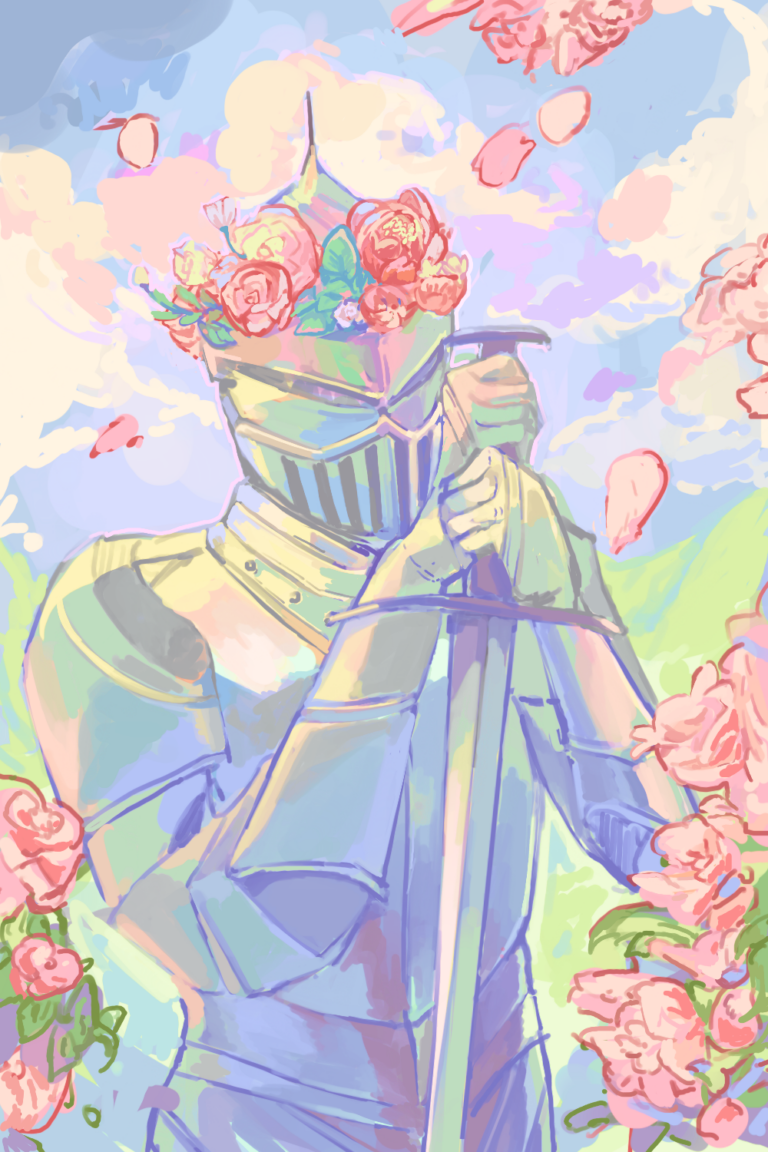
But why stop there? Let’s take it a step further: For those that yearn for grand gestures — a Jane Austen romance, a soft love worth fighting a war for, slaying dragons — the era of knights and poetry must return. Let’s expand Valentine’s Day beyond a short-lived, convenient indulgence to a lifelong, enduring love: a medieval romance.

Bring back courtship of gallant deeds, where knights prove their loyalty and affection through valor and honor. Bring back dances beneath moonlit rivers, where lovers’ feet leave a trail of their hushed promises in the soil like blooming flowers. Bring back poetic looks of love, those silent glances brimming with emotion. Bring back handwritten letters soaked in words of integrity and sealed with the warmth of a steadfast heart beating only to the rhythm of pure fondness and commitment.

There’s something incredibly intimate about those little moments, for love is not an irresolute, inconsistent feeling but a sincere action.

For the women, imagine being adorned in royal colors and elegant dresses and, for the men, suited in armor with a sword at their hip — a literal knight in shining armor, prepared to protect and provide with their undeviating devotion. A woman, capable of graceful strength and independence yet deserving of a man who makes her feel safe and cherished — who gives her a crown of reverence. They stand as equals, forming a covenant unbroken by evil or temptation.

If you want to help revive love to its true glory, please sign this document.


Yours faithfully,

All the hopeless romantics of the modern world


Written by: Nevaeh Karraker—nakarraker@ucdavis.edu


Disclaimer: The views and opinions expressed by individual columnists belong to the columnists alone and do not necessarily indicate the views and opinions held by The California Aggie.


A look into the only bike club at UC Davis: the Cycling Team

0

For everyone, at any level, on any day 


By (Abigail DeSa) — sports@theaggie.org


The UC Davis Cycling Team is a student-run, co-ed club sports team that provides a community to undergraduate and graduate student bike lovers. With 67 members, the team is full of bikers of all experience levels for mountain bike and road cycling. From competitive road races to coffee stops in Winters, the club hosts a myriad of events and provides a safe space to exercise and socialize.  

From the mountains to the sea, the club facilitates a variety of cycling and encourages its members to enter races no matter their level. 

“It’s one team with all the disciplines — we have no cuts for any races except for nationals,” Alden Hughes, a fourth-year environmental science and management major and public relations officer for the team, said. “And the collegiate leagues work so that every finisher gives us points no matter how slow they are, so there is no reason for us not to send as many people as possible.” 

Over the course of the year, the team partakes in a variety of competitions — competing in five mountain bike races in the fall and nine road races in the spring. To prepare for the road events, the team does 50-mile race rides once a week to improve endurance and mental strength. 

The club team competes in the Western Collegiate Cycling Conference (WCCC) and in USA Cycling’s regional and national competitions. With four national, three state and 15 conference championship wins under their belt, these Aggies have a legacy of victory. 

Some of the destinations that the club embarks on are the Sonoma Coast, North Bay, Mendocino, Humboldt County, Tahoe and UC Los Angeles, with nationals taking place in Minneapolis.  

“It’s really cool to go to the ocean and just be in the middle of nowhere with some friends on a bike,” Hughes said. “And it’s really pretty out there on Highway 1. It’s sort of a great way to explore where you live, because I bike to be outside, to spend time with people and for exercise.”

Hughes emphasized the value of community within the team and the supportive environment that elevated his college experience. 

“I feel like it is a great use of my time,” Hughes said. “I love getting outside with other people and, instead of going to the gym, we’d go outside for a ride to the next town over. It’s pretty great.”

Being on the cycling team has generated positive outcomes in both Hughes’ and the team’s lives, and they want to share the experience with more students in Davis. 

“I think that it’s fun to have people start out just milling around town on their bike and then get really, really fast,” Hughes said. “We have so many resources: we have bicycles, free clothing, we can pay for the races, get new uniforms. […] I’d just like to see as many people out racing in Davis.”

Davis’ expansive bike culture has made it easier than ever to dabble in the sport — whether it’s a trip to Trader Joe’s or rushing to Wellman Hall. The bike team offers a great opportunity for students to challenge themselves in a friendly and supportive environment. For more information on the UC Davis Cycling Team, check out their website and Instagram page


By (Abigail DeSa) — sports@theaggie.org

Love Advice Column

A heart-to-heart with the Editorial Board

By THE EDITORIAL BOARD

Roses are red, violets are blue, romance feeling dead? The Editorial Board can help you! You wrote to us with your deepest romantic problems, and we are here to give you all of the answers as certified love doctors. 


From Esther: 

Q: I just got rejected. How should I deal? I never really liked another girl before and I built up all this confidence to tell her and she said no because she doesn’t want to be my first.

Dear Esther,

First of all, I would like to commend your vulnerability and bravery in sharing your feelings with someone. There might not be anything scarier in the dating world than the awkward and sometimes heartbreaking courtship process, and to be honest and open is something to be proud of. I want to stress something to you: The self-confidence that you built is an achievement, and it does not need to disappear after rejection. Putting yourself out there is the scary part — even though your feelings aren’t reciprocated, it is not a reflection of you. 

I know it’s hard to believe, but when the inevitable feelings of insecurity after rejection settle in, it’s important to remember that you are not the thoughts and feelings of other people. Your self-worth is not dependent on someone’s affection, and you are already whole without the reciprocation of romantic feelings. That being said, wanting to experience love is part of human nature, and feeling sad and disappointed after a rejection is normal (and honestly expected). 

In terms of healing (or maybe a distraction), I would recommend taking some time to care for yourself: eat your comfort foods, watch your favorite movies and talk out your feelings with someone close to you. If you are still having trouble processing your feelings, you can always reach out to the girl you like if you feel you need more closure, but, once her feelings are clear, try not to push it further. It’s hard to keep your mind from spiraling, but the more time you spend focusing on yourself, the quicker you’ll heal. I know it sucks to hear it — believe me, I do — but the right person is out there. 


From Angelica S.: 

Q: I’ve had a crush on a family friend for years now, but I’ve always been too scared to tell him how I feel. Recently, my sister mentioned that he was cute and that she wanted to ask him out, but she doesn’t know I like him. What should I do? I’m too scared to make a move on the guy but I know I’ll regret it if they end up together. He’s coming up to Davis for the weekend to hangout, so it’s now or never. Help!

Dear Angelica S.,

That sounds like quite the predicament, but, as a potentially certified love doctor, I believe there is only one way to go about this. The first step is to talk to your sister since she is unaware of your feelings. There is nothing wrong with having feelings for someone, and as humans, we cannot control who we have feelings for. You should have an honest conversation with her in which you express that you have had feelings for him for a long time and are considering telling him. She will likely be understanding and supportive, especially since she only recently mentioned that she thought he was cute!

Upon a lot of group discussion, the eight members of the Editorial Board had a few conflicting ideas on how to sort through this situation. One option is to prioritize sisterly love and keep that relationship healthy first. Another option is to act on your emotions and finally confess how you feel when he comes to visit. Lastly, it could be best if neither of you acted on your feelings to avoid it causing strain on your relationship. Whatever you choose, finding the balance between respecting both yours and your sister’s feelings and well-being is the most important.

If you choose to confess and things go well, Valentine’s Day is the holiday for love and romance, and there’s no better time to put yourself out there. If he reciprocates your feelings, then great! If he doesn’t, then at least you won’t be wondering: what if? Also, chances are if he is coming up to spend the weekend with you, there could be something there. Good luck, I hope it goes well! 

P.S.: We would love it if you could give us an update at the end of the weekend to let us know what you decided/what happened 🙂 We are very invested!!!! Email editor@theaggie.org with the details.


From Jessica Rose:

Q: I’ve had a very hard time finding love in Davis, with dating apps, classes and clubs not working. I feel very insecure about this but I don’t know what to do. Any advice?

Dear Jessica,

Sorry to hear that things aren’t working out for you right now. Relationships take time; it might seem like a cliché (because it is), but the right person will eventually come along, and they will be worth the wait. You can’t force anything that isn’t meant to be — someone out there is waiting to meet someone like you, and you have to make sure that you can connect with them about your values, interests and opinions. All of the things that you’ve done to try to find love — dating apps, classes, clubs — are perfectly reasonable ways to meet people, so you can honestly just keep doing what you’ve been doing. 

Also, remember that you don’t have to necessarily show up somewhere with the intent of finding romantic love; Love comes in many forms, including the platonic kind. If you make an effort, you might end up meeting some nice friends (and if those friendships naturally turn into something more, then that’s a win-win for you). Keep an open mind! If you truly just want a romantic relationship and you’re not finding my optimism helpful, then I’ve still got you covered. Consider the following options: ask one of your friends to set you up with someone, study at busy locations on campus, strike up a conversation with literally everyone you sit next to, try a new non-academic hobby/class… the opportunities are endless. Don’t give up, and good luck!


From Fix-it Felix:

Q: How do I get someone from another school to notice me? We’re in competing clubs. 

Dear Fix-It Felix,

Trying to make a move on someone who you don’t see often can definitely be tricky. However, there is arguably nothing that sparks romance like a little competition — enemies to lovers is one of the most popular tropes in media for a reason! The next time your clubs face off, see if you can work a bit of a flirtation into your competitive banter. Hopefully your side wins, and you can have a competitive edge against them — everyone loves a winner, after all. 

I would recommend asking for their social media, if you don’t already have it — Instagram is usually a safe bet — so that when you aren’t able to see them, they can still be reminded that you’re out there and up to cool activities. It might be a good time to cultivate your Instagram Story-making skills to remind them that they’re missing out on your super cool vibes. If you feel up to it, hit them with a story like or even slide into their DMs: a classic and safe bet to establish a first conversation. It isn’t easy to create connections with people who don’t go to the same school as you, but in this age of social media, that’s likely the best way to stay connected. Remind that person that until your next competition when you meet again, you’re out there — and available — somewhere. 

I wish you the best of luck; I hope during your next competition, you catch a win — hopefully in more ways than one!


From Silk Moth: 

Q: How do you flirt (with social anxiety)?

Dear Silk Moth,

Striking the perfect balance between friendliness and something more is hard enough without social anxiety, so I think it’s important to first recognize that it’s okay not to have perfected your flirting skills. I don’t think many people flirt without flaw, so don’t expect that of yourself either. However, I think keeping two things in mind when approaching flirting could be very helpful. 

First, regardless of the nature of the relationship you are seeking, whether it’s an FWB or a life partner, it’s important to also like them overall as a person. This means you don’t have to dive off the deep end and initiate some scandalous conversation right off the bat (and I would recommend you don’t), so don’t put pressure on yourself to do so. 

Secondly, when you get to a stage where you are more comfortable with the person and it feels like an appropriate time to shoot your shot, just go for it. You miss 100% of the shots you don’t take, and nobody makes it to the NBA of flirting without firing off some airballs. 

Ultimately, the most important part of this process is showing yourself kindness when you eventually make a mistake — as is the price for all risks worth taking.


From Sophie: 

Q: How do I stay in a long-term relationship? I keep growing bored of partners who just seem like they can’t keep up with me and how often I like to change things up.

Dear Sophie,

Finding the “right” person is never an easy journey, it also doesn’t always have to be your end goal either. If you take one piece of advice from this non-perfect response, let it be this: Do not change who you are for anybody. I’m not saying you shouldn’t grow as a person or work on any issues that you may experience — we all have them. What I am trying to say is that you should not change the unique qualities that make you the person you are, because the right person will love every single one of those aspects. But enough of the platitudes, I’m sure you wanted more concrete advice. 

Getting bored of potential partners is normal; They likely weren’t the right person for you or it’s possible you weren’t the right person for them — and that is okay. There is nothing horrible about not being the right person for anybody, because you are most certainly the right person for somebody. My hope is that you will find someone who can keep up with you and match your energy. 

Be patient, don’t be afraid to give new people a chance and, most of all, trust your gut. 


From Introverted Romantic: 

Q: Hi Cal Aggie! Where should an introvert find love? 

Dear Introverted Romantic, 

As a certified introvert myself, I deeply empathize with this question. Introverts tend to enjoy keeping to themselves, taking things slowly and meeting someone with whom they can have great conversations. 

Therefore, (even though I am well aware that this may be an unpopular opinion), I would recommend a “friends first” dating app like Hinge or Bumble. Despite the stigma associated with finding love on dating apps, I find that, by maintaining clear and healthy boundaries and indicating that you are looking for a genuine connection before anything else, you can meet like-minded individuals with whom you can have wonderful conversations. Learning each other’s communication styles and common interests before meeting in person gives you a base from which to pursue deeper conversations, which I personally find more comfortable and rewarding than speed-dating in person. 

If you are avidly anti-dating apps, the easiest way to find love is just by putting yourself out there. While it is a lot more scary to do so as an introvert, small actions like sitting next to someone in class, taking that first step to compliment someone you find attractive or joining organizations that align with your personal interests will bring you in contact with similarly minded people. Davis is full of beauty and brimming with opportunity. Pursuing the things that you are passionate about are sure to bring you in contact with potential love —- so, don’t stress too much about finding romance, fellow introvert! Love exists in so many forms, and, as long as you focus on making yourself the best version that you can be, love will find you sure enough. 🙂

With love, 

The Editorial Board


How technology can help students stay on schedule

0

UC Davis students utilize calendar apps and digital notes to stay organized


By GRACIELA TIU — features@theaggie.org


Whether it be classes, homework, club meetings or jobs, college students are constantly carrying heavy schedules on their backs. Staying organized can feel difficult, but a common way students keep track of their schedules is through the use of calendars, both on paper and online. 

UC Davis students have shared that utilizing technology through calendar and reminder apps can help keep them on schedule and productive. Alex Monroy, a fourth-year aerospace science and engineering major, prefers a calendar app like Google Calendar when keeping track of academic and extracurricular schedules. 

“I use it all the time from scheduling my classes, clubs, setting time to study, going to the gym and organizing my work schedule for the upcoming week,” Monroy said.

Monroy then discussed why he prefers Google Calendar over other options for schedule building.

“I like the simplicity of it compared to other apps like Notion and Outlook,” Monroy said. “It’s reliable and doesn’t require you to spend much time organizing things throughout your day.”

Although Google Calendar may be a common app among college students, others on the market offer similar features.

“I use Timepage by Moleskine, because it seemed like it had the highest quality and the brand is good,” Mark Copple, a third-year managerial economics major, said.

An integral part of many students’ daily routines, calendar apps often feel like a big contributor to staying on top of responsibilities.

“I use it every day to schedule my meetings for work and all school assignments,” Copple said.

Recent years and a focus on technology have brought about many different scheduling apps, but some students prefer to write out a physical schedule every day. Trinity Salus, a third-year animal science major, discussed her notetaking routine. 

“I usually have like a little note page on my iPad and I’ll write down Monday, Tuesday, Wednesday and Thursday,” Salus said. “And I’ll write down different days of the week that I need to do different assignments and check them off as I go.”

A lot of calendar users utilize different features such as recurring events, syncing and even different design options.

“I enjoy color coding my different tasks throughout the day and Google Calendar provides a simple but timeless color palette,” Monroy said. “I enjoy how I can set reminders for classes and assignments and how early I like to be reminded, [all of which] can be set by the user.”

Salus described how utilizing specific pen colors and design features on an iPad can play an important role in keeping her schedule organized.

“Highlighting with different colors, so, [for example], if I write something in red that means that is a priority and that’s something that I have to pay attention to more,” Salus said. “If I write something in black, then that’s just something that I need to check off later on.” 

Some people who transitioned into using digital calendars recently noticed a change in their overall work experience.

“Since using Google Calendar, I’ve felt more relaxed and productive with my time as a student,” Monroy said. “It helps me stay on top of everything and remember important tasks.”

Regardless of your calendar preferences — whether you schedule your life by writing all of your tasks on paper or by utilizing a calendar app, keeping track of your schedule and upcoming tasks can be a very helpful way to stay organized and alleviate stress.

 These Davis students have offered many specific suggestions if you’re looking for a new app to get your upcoming events in order, as well as shared that utilizing apps to track your tasks, meetings and classes can be a game changer in day-to-day life. 


Written by: Graciela Tiu — features@theaggie.org


What just happened in AI?: a simplified report on DeepSeek

International AI company reveals a smarter challenger to ChatGPT and major AI corporations


By NAREN KRISHNA JEGAN — science@theaggie.org


Artificial Intelligence (AI) is defined as “technology that enables computers and machines to simulate human learning, comprehension, problem solving, decision making, creativity and autonomy.” From being a vision in the 1900s as a way to automate our human lives to now being integrated in everyday life as educational tools, such as Khan Academy and Google, AI has grown massively.


Part of the recent movement that spurred the interest in AI was a natural learning processing model called ChatGPT. From its inception by the company OpenAI, ChatGPT has quickly grown to popularize large-scale AI adoption, with sources currently estimating around 300 million users weekly across the globe. ChatGPT’s ability to process human inputs, compare it to an astronomical dataset that it was rigorously trained on and output a (mostly) accurate, relevant response caught on early with most users. As such, the field of AI has grown exponentially to include players such as Google’s Gemini, Microsoft’s Co-Pilot and even Facebook’s Meta.

Recently, a Chinese company called DeepSeek released a natural language processing model with responses rivaling those of GPT4, ChatGPT’s latest model. The kicker? They had a lower six-million-dollar budget in comparison to the $100 million dollar budget allocated for GPT4. Moreover, DeepSeek was able to produce a high-level product using lower-powered chips.


NVIDIA is one of the world’s leaders in producing high-level graphics processing units (GPU). These chips have various purposes such as gaming, data processing and AI. GPUs act as high-performance engines, accelerating AI computations by handling multiple tasks simultaneously. Unlike regular computer chips (CPUs) that do one task at a time, GPUs can handle many tasks at once, making them perfect for training AI models and making fast predictions. This speed boost is why AI, like chatbots and image recognition, runs much faster and more efficiently with GPUs. NVIDIA chips are used by a variety of AIs such as ChatGPT, Gemini and Meta’s Llama for these reasons. 

NVIDIA has developed various high-level chips such as the A100 and H100 that are currently used in the United States models. The U.S. government placed restrictions on the types of chips and their processing power that NVIDIA could export to China. To comply with U.S. regulations, NVIDIA developed modified versions — H800 and A800 — specifically for the Chinese market. These chips have reduced interconnect bandwidth, which slightly limits their performance in large-scale AI training but still makes them powerful for AI workloads.

The rise of DeepSeek and its ability to produce competitive AI models using lower-powered chips has raised concerns about the need for expensive, high-end GPUs. Additionally, increasing global competition and U.S. government regulations limiting NVIDIA’s ability to export its most powerful chips to China have also impacted investor confidence. As a result, NVIDIA’s stock has seen a drop of a staggering $600 billion as markets react to the shifting AI landscape. Analysts predict that while NVIDIA remains a leader in AI hardware, emerging players like DeepSeek may influence future chip demands, forcing the company to adapt its strategies. 

Memory efficiency plays a crucial role in AI development, as training and running large-scale models require vast amounts of memory storage. UC Davis Emeritus Professor of Computer Science Dr. Norman Matloff explained how DeepSeek was able to tactically optimize their performance using memory.


“Traditional AI models typically use a 32-bit floating-point (FP32) format, which allows for storing numbers between zero and four billion,” Matloff said. “DeepSeek has opted for an eight-bit floating-point (FP8) format, which only stores numbers between zero and 255. While this might seem like a limitation, it is actually a strategic advantage. FP8 reduces memory requirements by a factor of four, meaning that for the same AI application, only a quarter of the memory is needed. […] It is important to note that this does not impact processing power.” 

Let’s use an analogy. A 32-bit system is like using a large book for each piece of information, even if it’s just a short note. It takes up a lot of space but can hold a lot. An eight-bit system is like using a small notebook for each note. It holds less, but you can fit more of them on the shelf. Switching from large books (32-bit) to small notebooks (eight-bit) saves four times the space while preserving the same information.

DeepSeek AI does something similar — it finds ways to store and process information more efficiently, using smaller “notebooks” (lower-bit numbers) to save space and run faster. By leveraging FP8 precision, DeepSeek has demonstrated that high-performance AI can be achieved with significantly lower hardware demands, making AI development more cost-effective and accessible.

Why is this a game-changer? FP8 cuts down the cost of training and running AI models, making it easier for smaller companies to compete with giants like OpenAI and Meta. This shift makes AI more accessible and pushes the industry toward more innovation. DeepSeek’s R1 model combines FP8 with multi-token predictions, setting a new standard for speed. Whether it’s chatbots, voice assistants or search engines, users will get quicker responses without losing accuracy. With R1’s reasoning abilities, AI can take on more complex problems, explain its answers clearly and even double-check its own work. 

The significance of DeepSeek’s breakthrough cannot be overstated. By leveraging FP8 precision rather than the standard FP32, DeepSeek R1 has demonstrated that AI models can achieve high performance with significantly reduced computational costs.

WRITTEN BY: NAREN KRISHNA JEGAN — science@theaggie.org


The quest for a gift that keeps on giving

Didn’t I just spend my money on a million gifts?


By ABHINAYA KASAGANI — akasagani@ucdavis.edu

With Valentine’s Day around the bend, millions of shoppers hit the stores in full force, scouring the racks and searching frantically for the perfect gift. Store shelves are stocked with generic bearings and signs listing the wide range of discounts offered. This fine establishment is desperate for your services, but the department store will not be where you find the ultimate token of your affection. Oh well, try again next year.

Valentine’s Day has evolved from being a day to honor a martyr into one of grandiose romantic gestures that encourage material expressions of love. There is no shirking responsibility here — one must think of a gift, thoughtfully but quickly, to maintain eligibility. Excuse the cynicism. Sure, all holidays are reliant on gift giving to express feelings of love, but no, there are none like this one. 

It is the one occasion on which your gifts are weighed by how much thought went into them, how much time, how much money. What are you looking for? Luxury? Something high-end? Something utilitarian? Traditionally given gifts: jewelry, chocolate and the like raise several ethical concerns regarding consumerism and sustainability. They also ask the larger question of whether the holiday is about the act of buying or the act of giving. The pressure to both spend and perform lavishly robs the participant of any satisfaction.

Gift giving represents an objective waste of resources, according to a 1993 journal article by Joel Waldfogel. Research has found that people often find it difficult to account for others’ perspectives.

 “Their insights are subject to egocentrism, social projection and multiple attribution errors,” an article by ScienceDirect reads. 

Despite being well intentioned, these gifts raise the question of whether we are giving meaningfully: is it about consumerism, or is it an expression of love? Some say that the distinction is clear, and if so, would the average shopper be willing to entertain the idea of being eco-conscious about their gift giving if it doesn’t take away from the joy of the occasion? 

Sorry to make everything about a hot-button issue, but I promise this applies. While these gifts hold sentimental value, societal expectations often pressure individuals into making loud and expensive purchases. Many dread the idea of buying gifts, worrying that their purchase will disappoint the intended recipients. Others fail to calibrate their gift expenditures because they equate the amount spent with the appreciation the gift will receive.

This assumption, however, happens to be unfounded. Most mass-produced gifts contribute to environmental degradation and exploited labor or promote materialism and overconsumption. We must assess all ethical considerations and consumerist concerns to ensure that expressions of love do not contribute to social inequities or environmental degradation.

In order to do so, we must weigh the damage against a gift’s supposed value. Valentine’s Day cards are primarily made from virgin paper, resulting in more trees being felled to meet the high demand. This also destroys habitats, contributing to carbon emissions. Cocoa production for those heart-shaped chocolates involves the widespread use of child labor, and the floral industry relies heavily on pesticides and carbon-intensive transportation. Feel free to slap a price tag on a feeling and call it a day, if that works for you. However, shopping sustainably, with the intent to preserve the environment, is one of the best ways to consume more consciously. If you’re on board, here’s what you could do:

  1. Instead of defaulting to traditional and commercialized gifts, consider handmade ones. Personalized gifts reflect effort and intention and could be seen as more thoughtful and sincere. They also require fewer resources and reduce reliance on unsustainable production methods.
  2. To minimize harm, opt for digital greetings instead of paper cards. Or, make your own. If neither of these options interests you, buy a recyclable or fair trade card.
  3. Choose gifts made from recycled materials. Support local artisans and ethical businesses that prioritize sustainability.
  4. Utilitarian gifts are practical, durable and genuinely useful. What is important here is that you listened and considered what the recipient actually wanted. 
  5. Consider intangible gifts — taking a class together, focusing on a sport or any other preferential outing — to strengthen connection and help avoid contributing to material waste. One can never go wrong with quality time.
  6. If it is really important to you that your gift be either chocolates, flowers or jewelry (because why fix something that isn’t broken), consider the ecological footprint of the products you choose and choose sustainably. One way to do this is by looking for B Corp Certification (the B Lab has an entire online directory where you can browse certified companies in different industries). Ethically sourced chocolates, Fair Trade flowers and jewelry made from recycled or responsibly sourced materials are wonderful alternatives. Be intentional about supporting brands that prioritize sustainability and ethical production to ensure that your gifts are not byproducts of exploitation or environmental disregard. 

Considering the ethical dilemmas surrounding gift giving does not mean eliminating gifts altogether. By promoting a culture of ethical gifting, individuals can move toward a more compassionate and conscious world. Ultimately, rethinking the ways we love and appreciate one another helps to move away from the idea that Valentine’s Day is about fulfilling commercial quotas and toward the understanding that genuine affection can align with ethical values. This time around, find a gift that keeps on giving.


Written by: Abhinaya Kasagani— akasagani@ucdavis.edu

Disclaimer: The views and opinions expressed by individual columnists belong to the columnists alone and do not necessarily indicate the views and opinions held by The California Aggie.

Tracing the evolution of the vampire

An exploration of sexuality and romance portrayed in vampire media 


By JULIE HUANG – arts@theaggie.org


As the recent release of “Nosferatu” proves, the vampire continues to fascinate the human mind, whether onscreen for modern-day audiences or in pages thumbed through by 19th-century readers. Originating in Slavic folklore and made popular through gothic literature of the 1800s, centuries of portrayal have cultivated different interpretations of the vampire, but some core traits have shone through in each variation to be passed onto the next. 

Now, due to wildly popular teen franchises like “Twilight” and its slew of contemporaries, everyone knows vampires are supernatural monsters, dangerously alluring and if not good, at least interesting candidates for love interests. 

Although often mocked and derided, and equally celebrated and idealized, the association of vampirism with forbidden but sexy romance has its roots in the archetype’s gothic origins. The first few instances of the vampire as a literary character took place in the Victorian era, well known for its sexually repressive values. In those strict societal conditions, while simultaneously condemning social transgressions through the vampire’s otherworldly nature.

One of the first examples of literary vampires can be found in Joseph Sheridan le Fanu’s 1872 novella “Carmilla,” featuring the titular female vampire who reveals herself to be a beautiful yet dangerous predator of innocent young women. Portraying destructive passion alongside corruption of innocence, the descriptions of Carmilla feeding upon young women feature queer undertones, ultimately tying into the vampire’s overall reputation as associated with taboo notions of sexuality. 

At some point, Carmilla expresses something similar to regret for her need for blood, stating that she “cannot help it,” yet she remains a stark antagonist. She can only be an antagonist, as her plain existence is a threat to the dominant social order, perhaps shedding light on why vampirism remains an apt metaphor for non-conforming identity that transcends Victorian-era repression. 

Decades after “Carmilla” came out, Bram Stoker’s more well-known “Dracula” was published in 1897, gripping the public imagination and not letting go ever since. Count Dracula follows similar shades of characterization as Carmilla — an ancient vampire who derives strength and beauty from feeding on human beings, especially innocent and lovely young women. 

Interactions between Dracula and human women are similarly conspicuously sexualized, as sucking blood becomes a clear metaphor for intimacy. Women who initially possess the appropriate amount of purity and innocence lose these traits after unnatural encounters with Dracula and consequently being turned into vampires. All of the female vampires associated with Dracula in the novel are characterized as coquettish at best, and at worst — sexually deviant — an obvious warning on how overt female sexuality is unnatural and twisted. 

As two of the leading gothic examples of vampires, “Carmilla” and “Dracula” have aligned vampires with alluring passion, corruption, destruction and loss of innocence, inspiring a tradition of vampire stories with sexually and socially transgressive themes. 

Following in this vein, the 2024 release of “Nosferatu” is itself a remake of the earlier “Nosferatu” film released in 1922, which was intended as a film adaptation of “Dracula,” that was refused copyright and subsequently passed off as an “original story.” Thus, Dracula became “Orlok,” but the central plotline of preying on young women remains.

In the 2024 release, Orlok’s years-long obsession with Ellen Hutter and his unwelcome advances makes the traditional theme of sexuality as horrific more explicit. Rather than condemning raw sexuality itself, the nonconsensual aspect of the vampiric relationship is emphasized, highlighting the violation of Ellen’s physical boundaries as a personal tragedy that affects her for life. The remake translates the supernatural horror of the vampire into solemn commentary on the enduring struggle for bodily autonomy and the horror of having it ripped away — an issue that is far from otherworldly. 

The “Nosferatu” remake, leading back to the trope’s 19th-century origins, features a vampire so clearly villainous that it seems like a breath of fresh air, partially due to an influx of media in recent decades that have lightened the reputation of vampires. 

In particular, Anne Rice’s “The Vampire Chronicles” book series, beginning with “Interview with the Vampire” in 1976, left behind the heavy themes of nonconsensual sexual activity and predation previously associated with vampirism. Instead, the novel characterized its vampires through more straightforward sex appeal. This resulted in the now familiar depiction of vampires as tortured but beautiful, lonely but not beyond redemption.

Rice’s portrayal of vampires has massively influenced the modern-day conception of vampires in popular culture and media. The more palatable reworking of the archetype has led to vampires becoming a popular choice for romances and love stories that require a bit of an edge, but not too much. 

The most well-known and influential of these stories is, of course, Stephenie Meyer’s “Twilight” series, a collection of young adult novels as well as a billion-dollar film franchise featuring the romance between self-loathing but ultimately good vampire Edward Cullen and somewhat-normal human Bella Swan.

Meyer’s famous take on the vampire love story has become one of the hallmarks of 2010s pop culture, spawning waves of imitators in the forbidden love department. Yet, the element of alluring but dangerous love is a noticeably diluted variant of the vampire’s original alignment with taboo expressions of sexuality. 

Depictions of vampires have clearly evolved over time, building off of previous iterations. However, even when not explicitly discussed as such, the vampire persists as a haunting symbol of sexuality in its most challenging and dangerous forms. 

Written by: Julie Huang — arts@theaggie.org

Men’s basketball falls to UC Riverside in a heartbreaker

The UC Davis Aggies suffer last-second defeat after a game-winning three-pointer


By THEO KAYSER  — sports@theaggie.org


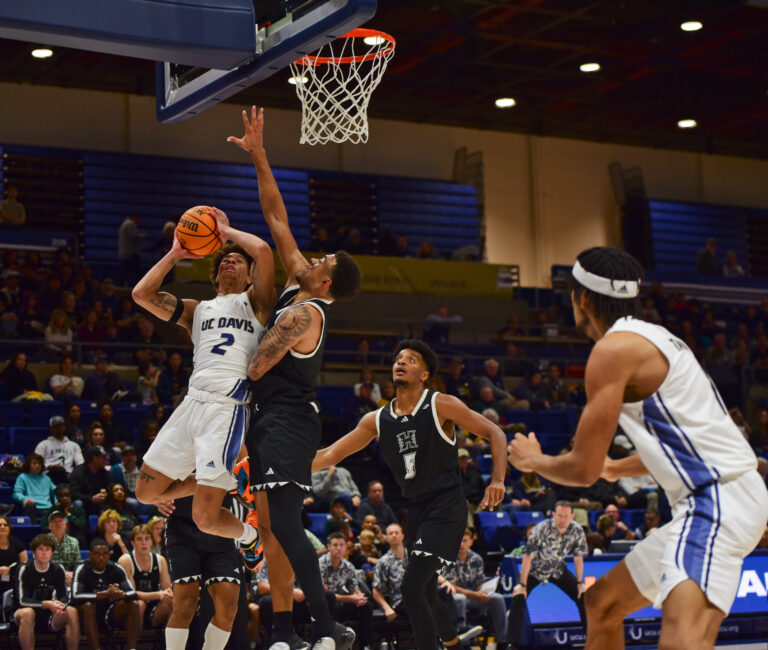
On Jan. 30, the UC Davis men’s basketball team visited one of their Big West Conference rivals, the UC Riverside Highlanders, for a late-season matchup. Coming off of three straight wins, the UC Davis Aggies looked to continue their streak with the season beginning to come to a close.

At the end of the game, the Aggies nearly accomplished their goal for victory — but it was thwarted after a last-second, game-winning three-pointer that secured UC Riverside’s victory, 60-58. 

The early moments of the game were dominated by the Aggies, holding an 8-1 score within the first five minutes of the game, later turning it into 14 points in the first 20 minutes. UC Davis reached this lead after back-to-back possessions, which led to the game only staying in the painted area of the court for the first 20 minutes of the game.

The momentum quickly changed, as the Highlanders responded with a run of their own, surging ahead 20-16. The final minutes of the opening half saw the teams trading baskets, with the Aggies retaking the lead to close the half after a three-pointer by TY Johnson, a fourth-year communications major and guard. 

The teams entered the break after trading possession for the last 20 minutes of the first half, the score being 26-24 in favor of UC Davis. Individually, Johnson played an impressive first half, accounting for over half of his team’s total points with 14 scored.

The second half began with UC Riverside immediately retaking the lead after a three-pointer by Highlander Kaleb Smith. This was the first of a series of three-pointers from Smith during the second half, as he went on to nail three more before the game concluded. Smith’s four-of-four shooting performance contributed to UC Riverside’s mark of 40% from beyond the arc throughout the night. 

The following few minutes saw both teams continuing stride for stride with one another. With just under 12 minutes remaining, the Aggies tied the score at 40, after Connor Sevilla, a second-year undeclared major and guard, scored back-to-back three-pointers. 

The remainder of the game followed a similar trend, with the lead never surpassing three points for either team. As four minutes remained, a mid-range jumper from Carl Daughtery Jr., a third-year human development major and guard, gave the Aggies a 56-55 lead. After that shot, both teams ran into a dry spell on offense, with the next three and a half minutes seeing both teams fail to score a single point. 

This drought was broken after Johnson hit a mid-range jump shot with just 30 seconds remaining. This basket extended the lead for UC Davis to 58-55, giving the Aggies the upper hand with the game entering its final moments. On the following possession, Smith made two free throws to minimize the deficit back to one point. 

With the game clock now at 16 seconds — below the shot clock timer of 30 seconds — the Aggies were faced with the opportunity to dribble the clock out and walk away with the win. In such situations, with a score as close as this, it is commonplace for the losing team to then intentionally foul to stop the clock and instead force their opponent to shoot free throws, before the ball then turns over. 

However, instead of this predicted series of events unfolding, the Aggies turned the ball over just three seconds into their possession, giving the Highlanders 13 seconds to score and seal a comeback win. With four seconds remaining, UC Riverside player Nate Pickens hit a dagger three-pointer, giving the Highlanders a 60-58 lead, one which they would not forfeit. 

In spite of the loss, the Aggies had several fantastic performances throughout the night. Johnson led the team in scoring, as has been the case throughout this season, with 20 points. Sevilla followed with a highly efficient 15 points, including an impressive three of five on three-pointers. Niko Rocak, a Master of Business Administration graduate student and forward, also finished with a near double-double, as his eight points were paired with 10 rebounds. 

With the loss, the Aggies fell to 12-9 on the season. With just 10 games remaining, they will look to return to their winning momentum against the UC Irvine Anteaters on Feb. 1.  


By (Theo Kayser) — sports@theaggie.org


I don’t understand the slang anymore

What is ‘the huzz?’ I’m too old for this


By MADISON SEEMAN — meseeman@ucdavis.edu

There comes a time in everyone’s life when they must realize their generation is no longer the baby of the family. For so long, Generation Z reigned supreme; We made the slang no one else understood and ruled apps like TikTok uncontested. But those days are over. 

Now, paying taxes is starting to make sense, an early bedtime sounds more appealing and, worst of all, I don’t understand the slang anymore. Generation Alpha has stolen our youth, and we’ve been forced to grow up.

We’re becoming what we feared most — those millennials who can’t stop talking about how confusing the words “slay” and “lit” are. We’re becoming the next generation baffled by the youths, the kids these days. In our confusion, we’re becoming the cliche, the next phase of an endless generational cycle. They always say maturity is a good thing, but if maturity turns me into a millennial, maybe life isn’t worth it anymore.

However much we may hate it, getting older and aging out of your subscription to understanding the monthly batch of new slang happens to everyone. For me, it was at 20 years old.

 I woke up one day and, when I looked in the mirror, I almost did the millennial pause. I felt myself maturing in the worst possible way, shedding the elasticity of my brain that was able to accommodate the mental gymnastics of new phrases like “the huzz” and “fine shyt.” Where I used to say “lit” — way too much for someone who had never been intoxicated — I now just say “awesome.” Or “slay,” which at least makes me feel younger.

The other day, my 17-year-old brother told me I was “geeked” during an argument over the phone. I had never heard that word used like that in my life, so I insulted his new dye job (it’s scary blonde!). After I won that argument, I couldn’t quite work up the courage to ask what it meant, and at this rate, I’m never going to know. 

That’s not the only word: “Chopped,” “Clapped,” “the huzz.” And don’t even get me started on the acronyms. In conversations with my brother and from flashes on social media, these words are cropping up at alarming rates.

I’m sorry to say, I may just be rizz-less. My brother told me I’m losing “aura points.” I know I’m not the first to lament getting older, but I thought I had at least until I graduated college. 

What was the turning point, the first trend I was late to? I blame the griddy. I’d never heard of it until I stumbled upon a video of Harry Styles “doing the griddy,” with 101.9K likes, and realized I’d fallen so far out of the loop I was behind even Harry Styles. I still haven’t been able to learn the move, but that may be more a side effect of my coordination than my age or maturity.

It’s not the fact that I’m not chronically online, because I totally am. But instead of tweets about Timothée Chalamet’s top clapped moments and skibidi toilet, my social media timelines are talking about yearning for sleepy time and listening to NPR. I’m officially out of the loop, tripping straight into “those darn kids” cliches at an alarming rate — repeating phrases I used to roll my eyes at.

I’m not completely irredeemable. I got in just before the cut on “rizz” and “opp,” and I think “slay” may permanently be a part of my vocabulary. I can still confuse my parents with talk about “crashing out” and “locking in.” Gen Z may have been usurped from our place on the throne of youth, but there’s proof I was young once.

Sometimes, I find myself staring out of the window during class, missing the days of “Merry Litmas” and “big mood.” Am I crazy for thinking our slang is better? I feel confident in saying that “skibidi toilet” would probably confuse me just as much if I was in the target age demographic. 

Maybe I’m just a bitter 20-something struggling to let go of my childhood. Maybe maturing is a good thing and not understanding slang is healthy. Maybe I’m just hopelessly rizz-less. All I know is — I’m too old for this.


Written by: Madison Seeman – meseeman@ucdavis.edu


Disclaimer: (This article is humor and/or satire, and its content is purely fictional. The story and the names of “sources” are fictionalized.)


The plight of the hopeless romantic

Sad, beautiful, tragic 


By MOLLY THOMPSON – mmtthompson@ucdavis.edu 


I am the poster child for a specific subset of my generation: those of us who grew up with our heads in the clouds. We spent our youth running through backyard fields — in our minds, frolicking through fairytale kingdoms. I worshipped the Pevensie kids in “The Chronicles of Narnia,” and I was wholly convinced that I would grow up to be Annabeth Chase from the “Percy Jackson and the Olympians” series. I spent my formative years immersing myself in Taylor Swift’s discography, meaning that the brain I grew into is practically forged from the lyrics “How You Get the Girl” and “Sparks Fly.” To my very core, I’m a hopeless romantic. 

I’m a daydreamer — I love grandeur, idealism and melancholia. I love riding the train just to stare out the window and lose myself with a carefully curated playlist. I love falling asleep to fictitious scenes of my own design, as I play them out in my mind. I love fantasy, glamour and revelry. Let’s call a spade a spade: I’m absolutely delusional. 

Modern collegiate culture, as much as I love it, decidedly does not cater to my illusory tendencies. Romance used to mean idealistic (of course, it still does in the literal sense), but now it seems to encompass flash-flood flings, petty games and the hellish fate of being left “on read.” 

Before I get too far into this, let me get off my high horse for a second; I’m not trying to place myself above all of this. I’ve spent as much time deep in the throes of timing my texts to save face as the next girl (reader, there was no face to be saved). But that doesn’t mean I don’t still yearn to experience the thrills that inspired the entire “Speak Now” album. Yes, yearn. It’s ostentatious, I know, but it’s true. C’est la vie. 

So, what’s a girl to do when current societal expectations don’t match her level of delusional fantasy? God only knows I’m less qualified to provide advice than commiseration, but I do have thoughts on the matter. 

Firstly, I think the biggest thing we all need to do is take a deep breath. There comes this fear of missing out (FOMO): of never being able to fulfill expectations. I get a periodic sensation of falling behind because I’m not as engaged in the contemporary (or any) dating scene as much as I perceive my peers to be. But even if that’s true, it’s not necessarily a bad thing. 

The way that I try to see it, not having a lot of romantic prospects or experience (even if it doesn’t feel like a choice) isn’t a reflection of one’s lack of value or desirability, but rather a result of having high standards and specific intentions. You’re not undateable, you’re choosy. And honestly, that’s a point in your favor. You’re not wasting your time or losing out on missed opportunities — it’s quite the opposite. You’re saving yourself from situations that aren’t actually what you long for while keeping yourself open to the opportunities that will fulfill your heart’s desires. After all, if you’re involved in a relationship — or even less dignifying, a situationship —  just for the sake of it, you’re going to miss out on the other shooting stars that could have swept you off your feet. 

The beauty of being a daydreamer is that no one else will appreciate the idealism of romance as deeply as we do. Details — as small as a poetic combination of words or eye contact with the perfect charge of lasciviousness — hold so much more weight when you’re afflicted by chronic flights of fancy. The thought “Why me?” (or maybe worse, the “Why not me?”) can be devastating, but the depth of it will be rivaled by the starburst of elation when your time finally comes. 

To love deeply is to wallow profoundly, but it takes a certain type of person to find so much joy in the first place. Most of the time, the experiences I feel like I’m missing out on don’t yield that — I’m just waiting for my moment. The best thing about being a hopeless romantic is that, when the hopelessness subsides, there’s so much space to be filled with rhapsody. 

I think there’s hope in the “not yet” of it all. No, I haven’t had a whole lot of romance in my life yet, but how exciting is it to think that it’s all still to come? There’s so much to look forward to, like a luminescent glow of the rising sun peeking over the horizon. 

A glass half empty is just as legitimate as a glass half full; A perceived lack of romantic attention can just as easily be the perfect canvas to be painted with the radiant purple pinks of future stories — a veritable cradle of endless possibility. 


Written by: Molly Thompson — mmtthompson@ucdavis.edu 


Disclaimer: The views and opinions expressed by individual columnists belong to the columnists alone and do not necessarily indicate the views and opinions held by The California Aggie 

A review of the 2025 men’s soccer team season

UC Davis secures a Big West Conference Championship, perseveres through ups and downs


By (Colina Harvey) — sports@theaggie.org


After letting the Big West Conference slip through their fingers last season, the UC Davis Aggies came into this season with a mission: securing the Men’s Big West Soccer Championship title. 

The championship game against the UC Irvine Anteaters in 2023 ended in a penalty kick shootout where the Anteaters came out on top, ending the Aggies’ hopes of making it to the National Collegiate Athletic Association (NCAA) tournament.

“[Last year] definitely gave us some [motivation],” Zack Lillington, a third-year international relations major and midfielder, said. “It proved to us that we could get to that point, that it’s only a small margin between us and everyone else.” 

Cason Goodman, a third-year communications major and forward, said the loss made them realize how close they were to greater success.

“We talked about [the loss] a lot when we first got back,” Goodman said. “That was our main thing. There’s one more step to climb here, and we’re more than capable.”

Coming into the season, it was clear that the Aggies had a mission. After losing to Pacific University and tying with Utah Valley University, UC Davis went on a four-game winning streak, beating Santa Clara University, Oregon State University, Saint Mary’s University and the University of San Francisco. 

A 1-0 loss against Stanford University ended the Aggies’ winning streak. Despite UC Davis being competitive throughout the game, Stanford scored a winning goal in the 85th minute. This loss for the Aggies was the start of a six-game winless streak, damaging the team’s chances of making it to postseason play.

“[The loss] against Stanford kind of put us in a spiral,” Keegan Walwyn-Bent, a fourth-year animal biology major and forward, said. ”We were really trying to figure out what was going on and what we could do to kind of pull us out of the rut that we were in.”

Goodman said this loss motivated their team to improve for future competitors.

“We were looking for answers,” Goodman said. “Some people thought we were done. The ones that really didn’t want it to be over — we locked in.” 

A 2-1 win against California State University, Fullerton on Oct. 12, 2024, on home turf helped the team gain confidence and momentum for the rest of the season. The Aggies finished the season strong with three wins in a row to top it off.

UC Davis secured a spot in the Big West playoffs as the fourth seed. However, all six teams in the tournament were very close in terms of points earned during the season, meaning that every competition was anyone’s game.

The Aggies first took on the California State University, Bakersfield Roadrunners, a team they had beaten just two weeks prior in the first round of the playoffs.

The Aggies dominated the first half, firing eight shots on goal while only allowing one from Bakersfield. A goal in the 69th minute from Zachary Neuls, a first-year undeclared major and midfielder, placed the Aggies in the lead after a scoreless first half. Less than two minutes later, a handball in the penalty box gave the Roadrunners a penalty kick, which they were able to score.

In the last few minutes of the game, Walwyn-Bent came off of the bench and managed to score in the 83rd minute off a cross from Goodman, sending UC Davis to the semifinals. For their semifinal matchup, the Aggies traveled to San Luis Obispo to take on California Polytechnic State University Mustangs, the first-seeded team. Although the Aggies had a loss against Cal Poly during the regular season, they outshot the Mustangs 10-5 in this game. 

The Mustangs scored first with a 25th-minute goal off a corner kick. However, Neuls kept the Aggies in the game with a header off a corner kick in the 52nd minute. After scoring only two goals throughout the season, Neuls showed up in the postseason, with two crucial goals in back-to-back games.

Despite outshooting Cal Poly 15-3 in the second half, the Aggies were unable to take the lead, sending the game to overtime. After 30 minutes of overtime, the score remained at 1-1, meaning the two teams would shoot penalties. After the penalty kick shootout loss in 2024’s Big West Championship game, this gave UC Davis a shot at redemption. 

Lillington said the opportunity of redemption added to the team’s nerves about the shootout. 

“Obviously, everyone had high nerves, because you never really know how the outcome could be,” Lillington said. “One thing can go right for one team, and one thing can go wrong. But I think everyone came out with a calm mentality.”

UC Davis made their first penalty kick while Cal Poly was unable to get it on target. The Aggies’ second attempt was saved and the Mustangs made their kick, tying the shootout at 1-1. After each team had taken their five shots, they were tied at 4-4. 

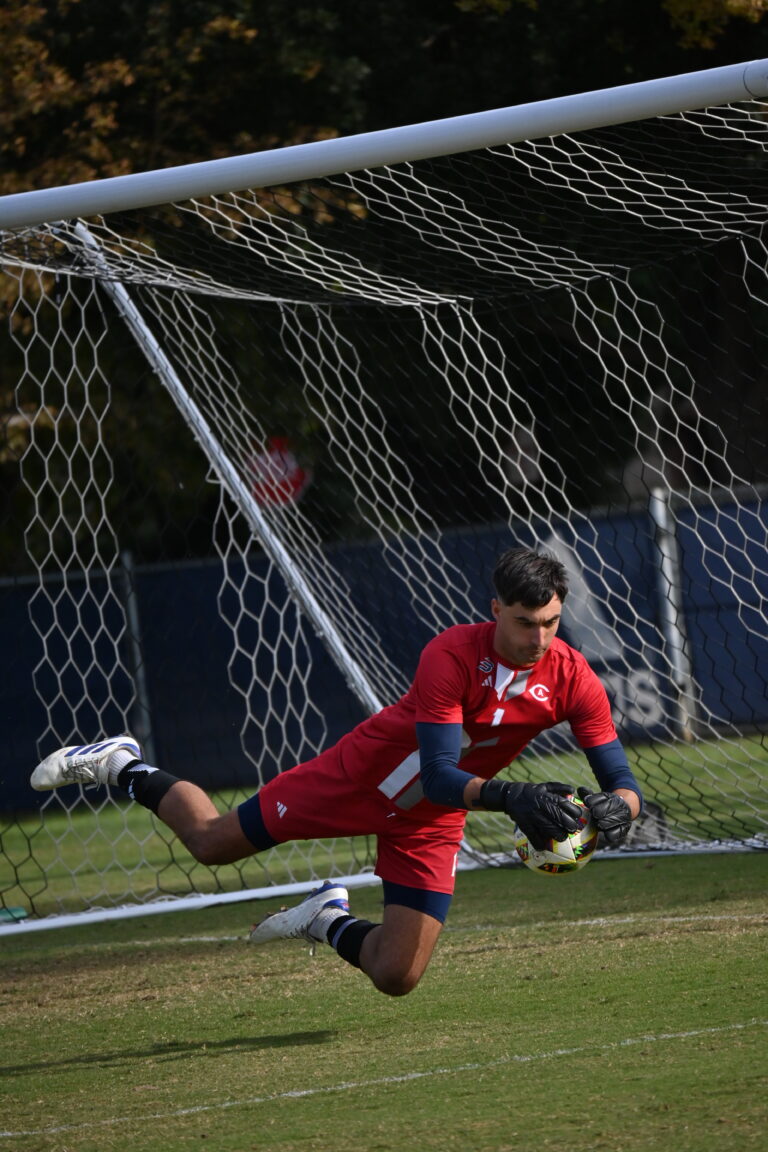
Lillington netted the sixth shot, forcing Cal Poly to make the next one in order to continue. Cal Poly’s shot was on target in the lower right corner but was saved by Mekhai Wilson, a second-year undeclared major and goalkeeper, sending UC Davis to the Big West Championships. 

Although the Aggies celebrated the win, a difficult task lay ahead: beating UC Santa Barbara Gauchos. Goodman said he was nervous about the final matchup.

“Cal Poly is a team that we normally feel like we play pretty well against, and Santa Barbara is kind of the opposite,” Goodman said. “It’s not a team that we normally do very well against.”

Walywn-Bent further described the energy of both teams going into the championship game. 

 “Santa Barbara [was] doing interviews, and they thought they were gonna steamroll us,” Walwyn-Bent said. “They thought they were gonna get into the NCAA [tournament] for free, like easy money.”

UC Davis’ underdog mentality is part of what motivated them throughout the season and postseason, according to Lillington. 

“The league kind of doubted us in the beginning of the year,” Lillington said. “[In the Big West Preseason Coaches’] poll that [came] out, […] I think we were ranked fourth, even [though we] finished in second place last year.”

Walwyn-Bent described the misconception surrounding the odds of winning against UC Davis’ soccer team. 

“I feel like people just think that once they’re playing Davis in the final they’re gonna catch a dub,” Walwyn-Bent said. “We gotta show them, we gotta let them know.” 

Lillington commented on the lack of recognition the team receives. 

“I think coaches and staff from the Big West may have overlooked the personnel we had and kind of overlooked our capabilities,” Lillington said.

The UC Davis Aggies went into the final determined to prove their worth. 

“When it comes to Santa Barbara, I honestly have never seen a team more charged and ready for a game,” Walwyn-Bent said. “We went into that game so ready to win.” 

In the first half, the Aggies got off to a quick lead with goals in the 19th and 43rd minutes. Both goals scored on the Gauchos’ home turf came from Goodman, a Santa Barbara native. These were his 10th and 11th goals this season, more than doubling the amount of goals scored by any other Aggie this season.

In the second half, UC Santa Barbara attacked viciously, getting 14 shots off. However, they were unable to connect with the net at any point.

“Towards the end of the game, we’re winning 2-0 in the second half, and Zack Lillington clears the ball off the line and he runs into the goal and he punches the net, because he’s so fired up,” Goodman said. “That’s when I knew we had them.”

When the final whistle blew, the Aggies led 2-0 — making them Big West Champions for the first time since 2019. 

“It was a great, great feeling,” Walwyn-Bent said. “It was euphoric. Everybody was just on cloud nine. Playoff soccer comes with a lot more weight and so going into it, you have to be so extremely hungry. You have to be so extremely motivated and driven to want to win the game, and I felt it from the whole team. The confidence in the locker room was just through the roof.”

Goodman described the team’s mentality going into the final matchup. 

“Once we were back in that final game, I don’t think any of us were gonna let [us lose] two years in a row,” Goodman said.

With the win, the Aggies automatically qualified for the NCAA tournament where they faced the University of San Diego in a first-round away game.

In the 35th minute of the match against San Diego, the Davis defense failed to control a long ball into their half from the San Diego backline. This gave San Diego’s Cesar Bahena enough space to get a strong shot from 40 feet out. It sailed above Noah Schwengeler, a  third-year undeclared major and goalkeeper, and met the back of the net.

Despite the loss, the Aggies had slightly more shots on goal than San Diego, proving their ability to compete at a high level. After a very successful season for the Aggies, the team is honing in on skills during their winter quarter offseason training before returning in the spring for more matches. Losing in the first round of the NCAA tournament only left the Aggies wanting to come back for more. 

“We lost 1-0 in San Diego kind of on a fluke goal,” Goodman said. “And it showed everyone that we’re more than capable of competing against anybody, and so now we should set our sights higher than the Big West. Let’s put UC Davis on the map a little bit here.” 


By (Colina Harvey) — sports@theaggie.org


Review: ‘One of Them Days’ is more than just a star-studded comedy

SZA and Keke Palmer navigate a hectic 24 hours trying to survive the everyday challenges of life 


By AALIYAH ESPAÑOL-RIVAS — arts@theaggie.org 


If you think you’re having a bad day, think again after watching “One of Them Days.” The film, starring actress Keke Palmer and singer-songwriter Solána Imani Rowe, also known as SZA, follows the story of two roommates, Dreux and Alyssa, as they try to get through the first day of the month.

Dreux, a hard-working waitress, has one objective for the first of the month: ace her job interview. Alyssa, a freelance artist, has a different task: turn in the rent to the landlord. As simple as it may seem, both goals are seemingly unachievable when they find out that Alyssa’s boyfriend Keshawn, who leeches off of the two, did not turn in that month’s rent. Instead, he pockets the money for his t-shirt business, “Cucci,” and escapes to live with another woman. 

Following the news, Dreux and Alyssa’s landlord alerts them they have eight hours to turn in the rent before they face eviction. Moving at hyperspeed, the film takes twists and turns as the two race against the clock to find money and turn in rent before 6 p.m. And if it wasn’t enough, the two are also getting chased by Bernice, Keshawn’s new woman, who Dreux and Alyssa had embarrassed in front of the entire neighborhood. 

Both Palmer and SZA gave an incredibly comedic experience, but the film also does a great job of making social commentary on the many challenges the Black community faces. Dreux and Alyssa live in “The Jungle,” a run-down apartment complex in Los Angeles, with a strict landlord who kicks out anyone and everyone. But when a younger, white woman moves in, their landlord makes renovations solely for her apartment, neglecting the other apartments with longtime residents that have fire hazards, holes in the ceiling and broken air conditioning. 

The film also highlights gentrification in many ways, showing the neglect both the Black and Hispanic communities in Los Angeles face as they are pushed out to make way for affluent communities through their homes, neighborhoods and stores. 

Moreover, throughout the entire journey of trying to obtain the rent money, Dreux and Alyssa are constantly denied opportunities due to their background. When they apply for a loan, the agent laughs in their face about their credit score, resulting in the two donating blood to make a few hundred dollars. And when the blood gets mishandled, the two eventually resort to selling a pair of shoes found on a powerline. 

In the climax of the movie, it seems all has worked out for the two, with Dreux doing well at her job interview and the two having obtained the rent money — but this is short lived. It all comes crashing down in a matter of seconds when Bernice finally catches the two and starts a fight in front of the Dreux’s job interviewers. Beaten up and robbed of both the rent money and the position, Dreux and Alyssa accept defeat and make their way home — or rather to their apartment belongings on the side of the street. 

While all hope may be lost, Dreux and Alyssa soon learn that although their background may hinder their opportunities at times, they are both strong individuals who can, and will, rise above it all, even if it means dodging a couple of bullets — literally. 

“One of Them Days” is more than just a fun, fast-paced comedy. It tells the story of two strong Black women who do more than just make space for themselves but also advocate for their community. If you’re interested in checking out the film, “One of Them Days” is available for viewing at the Davis Regal Holiday Theater, and you can access showtimes on their website. 

Written by: Aaliyah Español-Rivas — arts@theaggie.org

New research looks at the role of cnidocytes in ancient oceans

Cnidarians are well known for their “stinging cells” called cnidocytes


By KATELYN BURNS— science@theaggie.org


Cnidocytes are known as the “stinging cells” of Cnidarians, consisting of jellyfish, sea anemones and corals. If you have ever been stung by a jellyfish, that was a cnidocyte. All Cnidarians have cnidocytes, and these cells are incredibly complex.

Although cnidocytes are best known for ensnaring and/or envenomating prey, they come in a variety of forms with distinct functions,” a study published in the Evolution & Development journal reads. “This includes substrate attachment, construction of tube-dwellings, self-defense/intraspecific competition, and mating.”

David Gold is an associate professor in the UC Davis Department of Earth and Planetary Sciences with a lab specializing in animal geobiology, and his research focuses on using jellyfish as model organisms.

“[Jellyfish have] this capsule made out of a kind of collagen protein that we don’t find in any other group, then within that there’s a really pressurized structure with a harpoon and a thread within the harpoon,” Gold said.

These harpoons create the sticky feeling that comes from touching sea anemones. Gold further discussed the complex nature of the cnidocytes found within Cnidarians.

“There’s also typically really complex venoms in the cells,” Gold said. “The venoms are evolving extremely fast as each group specializes to different prey; There are venoms and counter-venoms.”

When you think of jellyfish, you might think of just the free-floating, reproductive stage found in various species called a medusa. However, not every jellyfish has a medusa stage. Hydra, a type of jellyfish, actually have no medusa stage and exist only in the polyp stage, where they remain attached to a surface.

Jasmine Mah, a postdoctoral scholar in the Juliano Lab studying Hydra, commented on the origins of cnidocytes.

“The first cnidocyte to evolve in Cnidaria was probably one called the isorhiza cnidocyte, the simplest type of cnidocyte,” Mah said. “It is hypothesized that the very first Cnidarians may have used these isorhiza cnidocytes to fight off competitors, adhere to the ground and maybe capture prey.”

The fossil record of jellyfish is heavily debated due to lack of definitive fossils, from jellyfish being soft-bodied. However, when combined with genetic data, researchers have been able to get a better understanding about the history of jellyfish.

As the temperature of the climate has increased, so has the temperature of the water. Nutrients from farming and agriculture have been pumped into the ocean, and as a result, blooms of bacteria have resulted in low oxygen levels that create more dead zones — an area of the ocean without oxygen levels high enough to sustain marine life. Where other animals   have failed, jellyfish have thrived in these environments, and there can be hundreds of thousands of jellyfish in one area.

Gold commented on the impact that jellyfish have on the ecosystem in these environments.

“They can cause all kinds of ecological havoc,” Gold said. “They eat larvae of other animals, making it harder for other animals to get reestablished […] and they clog up power plants.” 

Tracing the evolution of cnidocytes, the focus of the study in the Evolution & Development journal can help us better understand the role of Cnidarians in oceans over time. More information on the study’s details can be found in the research article online. 

Written by: Katelyn Burns— science@theaggie.org