59.1 F
Davis

Davis, California

Wednesday, December 24, 2025
Home Blog Page 67

John Natsoulas Gallery hosts poetry night reading with special guests

0

Award-winning poets Julia Levine and Murray Silverstein show off the power of poetry at the event


By YUENJO FAN — city@theaggie.org

 

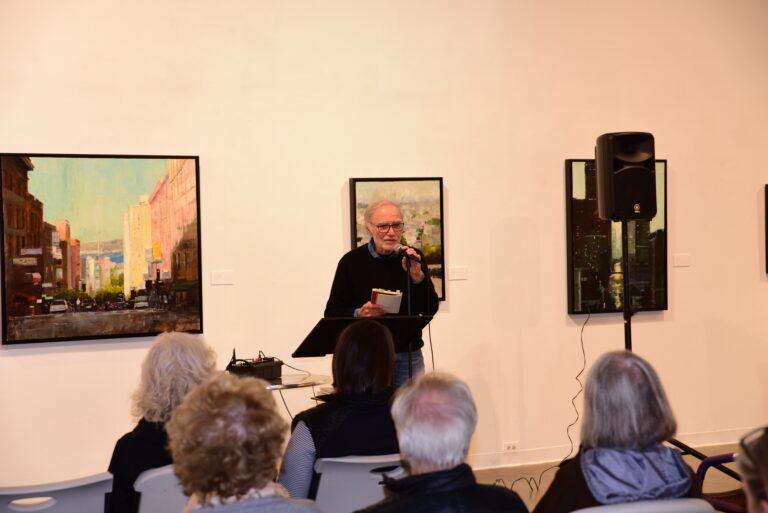
The John Natsoulas Gallery featured its Poetry Night Reading Series on Thursday, Nov. 7 with special guests Julia Levine and Murray Silverstein. 

An event for local poets hosted by Dr. Andy Jones, the Poetry Night Reading Series allows a platform for expression and creativity through poetry. Thursday’s reading commenced with the works of both Levine and Silverstein and ended with an open mic for audience members to share their poems. 

Levine, the poet laureate emerita of the city of Davis, and Silverstein, an Independent Publisher Bronze Medal for Poetry winner, both shared their works, providing a strong demonstration of poetry’s role in expressing oneself. 

“[Poetry] gives a home for people who are sort of on the march and don’t feel that anyone’s listening to them, and here’s a place where people listen,” Levine said. “For some people, this is one of the places where they might feel heard [when] they don’t otherwise.”

To a room full of avid listeners, Levine used her poetry to discuss passionate and personal topics like the painful cancer diagnosis of her infant grandson to broader topics such as the recent election results. 

Levine’s poem “The Dove” recalled her observations of a lone dove and drew metaphors from its characteristics and movements to life, its problems and her relationship with her father. Her poem “Variations on Rupture and Repair: Horse” drew on the importance of sticking to the feelings in one’s heart and embracing those emotions instead of running from them.  

“It’s a powerful tool for helping you make sense of painful, emotional realities, and that has a lot of beauty,” Levine said. “[There’s] a lot of beauty in poetry. The problem is, people don’t trust themselves. If you read something you don’t like, don’t read any more of it. Find something that speaks to you. I went through an entire high school education and college education and never wrote a poem […] When I graduated college, I was literally sweeping my porch and I heard Sylvia Plath on a radio station, and I felt like I was lifted out of my body. It was such a phenomenally powerful experience.”

For Silverstein, the road of a poet also presented itself later on in life. Only when he was in his 60s did Silverstein begin trying his hand at writing. Prior to this, it had never occurred to him that any serious attempt at literature would warrant success. 

“I turned to poetry after my career as an architect was pretty much coming to an end,” Silverstein said. “I started writing in my 60s, and I found my way into some writing groups where poets meet to sort of share their work and critique each other.”

While reading his notable poem “Any Old Wolf,” a piece partly inspired by the nursery rhyme “Old MacDonald Had a Farm,” the witty wordplay drew smiles from the audience and, eventually, a strong applause. Other poems from Silverstein drew a more melancholic tone such as a dream with his deceased father or love as a difficult instrument to learn, in need of constant practice.

Silverstein revealed how a large motivation for his poetry was to simply make his mother laugh as she suffered from lifelong depression. The other part of his motivation was writing his life’s story.

“When writing poems you find yourself writing about your own life story,” Silverstein said. “But you’re trying to find things that make you understand humanity better by plumbing your own life story. And actually, it’s taken me a long time to understand that.” 

The poems from the open mic followed suit with Silverstein’s observation. Audience members read poetry or haiku about past love, assimilation to a new country, generational curses or even frustration with the judicial branch. Each one drew from a unique life story, and each took a small step forward in understanding humanity better. 

Michael Gallowglas was an open mic speaker and emphasized the importance of writing poetry.

“Keep writing poems, because even if one person sees it, it can make the difference in believing that you can keep going on,” Gallowglas said.

The Poetry Night Reading Series is hosted biweekly at the John Natsoulas Gallery on the first and third Thursday of the month and starts at 7 p.m., beginning with the featured reader and closing with an open mic session. 


Written By Yuenjo Fan city@theaggie.org 


Davis Cemetery honors veterans at local celebration

0

Davis families gathered on Nov. 11 to recognize the service and sacrifices made by the veterans in their lives


By MATTHEW MCELDOWNEY — city@theaggie.org

 

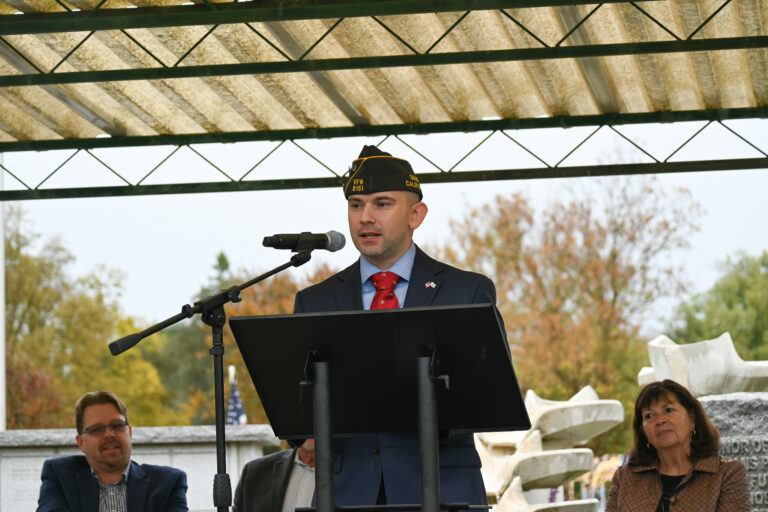
On the 11th hour of the 11th day of the 11th month, the Davis Cemetery District & Arboretum hosted the city’s annual Veterans Day celebration, featuring performances by the Davis Odd Fellows and Davis high school vocal groups — Davis Local Vocals and Davis Madrigals. 

To highlight the greater meaning of this holiday, the ceremony also had speakers reflecting on the personal and broader impact that United States military veterans have made in their lives. Many of those in attendance have loved ones who are serving or have served in the past, so the cemetery was an accommodating space for these individuals to honor family members and friends.

Kate Bowen, a member of the Davis Cemetery Board of Trustees as well as the daughter of a Marine Corps major and sister of a Marine Corps sergeant, shared the personal impact that the military had on her household.

“Veterans Day has special meaning for me,” Bowen said. “Our family would celebrate first on Nov. 10 — which is the Marine Corps birthday — with a nutritious breakfast of S.O.S.”

The Marine Corps dish Bowen refers to traces back to the first World War and was traditionally made with dried meat and a sauce of evaporated milk, butter, broth and flour, served on a slice of toast.

“I’m so happy to have had those experiences as a family, and I am so pleased to see so many families here today,” Bowen said.

During the ceremony, these shared experiences bonded the families in Davis as all had come to commemorate this personal side of their lives. Jessica Smithers, the district superintendent of the Davis Cemetery, organized and set up this year’s Veterans Day ceremony.

“What goes well about this event every year is just the amount of community that comes out and participates,” Smithers said. “So, you’ll notice people start helping us pick up the chairs and pull down the tents — it really is a community-driven event.”

Smithers hopes that this ceremony reminds the community that this holiday is more than a three-day weekend but a day for acknowledging the military.

“Because the military do what they do, we are able to hold events like this,” Smithers said.

For this reason, Smithers and the Davis Cemetery selected veterans who could intimately convey this meaning.

Secretary of Veteran Affairs for the California Department of Veteran Affairs and Director of Veteran Services for Solano County Ted Puntillo helped over 20,000 veterans in his 20 years as a veterans advocate. On this Veterans Day, Puntillo was the master of ceremonies.

Puntillo said that it is honorable to speak for Davis, a city whose rich history, commitment and support for its veterans is dearly felt. 

“It is deeply meaningful to be here with all of you as we gather to pay tribute to the brave men and women who served our country with unwavering courage and conviction,” Puntillo said.

Sterling Koliba is a Marine, Air Force and California National Guard veteran, a junior vice commander of the Dixon Veterans of Foreign Wars post and a founding member of the Yolo and Solano County chapter of the Veterans Beer Club. Koliba reaffirmed the sense of community felt by veterans who connected over their shared experiences — he described these personal bonds that he formed during his service.

“At boot camp, we would hydrate each night in preparation for the next day,” Koliba said. “What that meant was taking a 32 oz canteen and drinking it as fast as possible while the drill instructor counted down from 10 to zero […] and if any significant amount of water [was left], we would do it again.”

While Koliba reflected on his rackmate’s capability in other respects, such as disassembling and reassembling their service rifles blindfolded, this rackmate could not finish all that water quickly enough.

“So, every night, to protect the platoon and take that burden off his shoulders, I would finish mine, and we would swap canteens while the drill instructors weren’t paying attention,” Koliba said. “That’s where it begins — in basic training with the canteens [or] the helping hand to help a buddy study for a test the next day.”

From this story, Koliba described how this community starts early but never truly ends. After 10 years of service in the Marine Corps, he was in a position of uncertainty, but it was through veterans resources, such as the Student Veterans of America, that he could rekindle that network and gain the guidance to be the person he is today.

“What I learned then was that the call to serve does not simply leave because we no longer wear the uniform,” Koliba said. “It is for them and all those that have honorably served that we celebrate today. Because Veterans Day is about reminding the people of this great nation that this freedom isn’t free, and [it is important] to remind each other, to acknowledge and to show our support for all those, past and present, who have served this great nation and donned this uniform with the willingness to put themselves in harm’s way to protect others.”


Written by: Matthew Mceldowney city@theaggie.org

 

Celebrating ‘Tías and Primas’ with author Prisca Dorcas Mojica Rodríguez at The Avid Reader

The event highlighted the community-building quality of Mojica Rodríguez’s work, especially in its representation of Latina women and their experiences


By JULIE HUANG – arts@theaggie.org


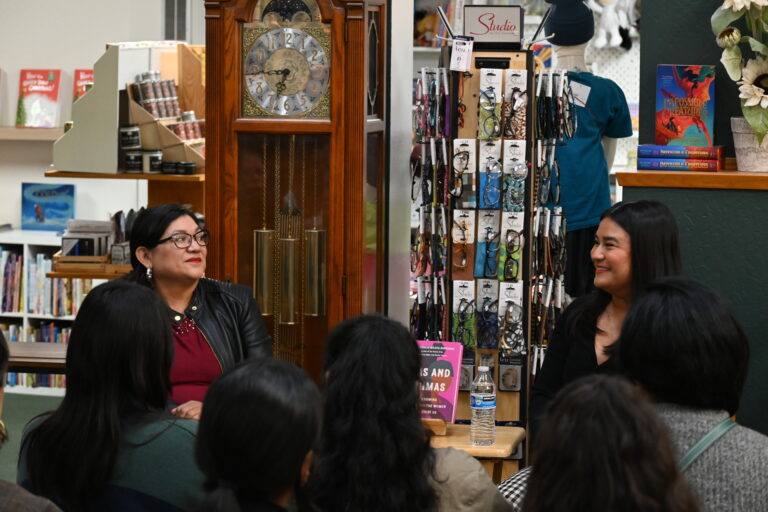
On Wednesday, Nov. 6, The Avid Reader invited Prisca Dorcas Mojica Rodríguez to speak in celebration of the release of her second book, “Tías and Primas,” a follow-up to her debut, “For Brown Girls With Sharp Edges and Tender Hearts.” 

As in her first release, Mojica Rodríguez continues to represent and uplift the Latinx community in her latest book, examining the pivotal roles that Latina women play in their communities and families, as well as the influence they have on girls in the process of developing their own worldviews.  

She was joined by Reyna Grande, an author from Woodland who has written memoirs like “The Distance Between Us” and “A Dream Called Home.” Grande began the conversation by asking about Mojica Rodríguez’s personal writing journey and how it eventually led to the publication of “Tías and Primas.”  

“I think mine has been really weird,” Mojica Rodríguez said. “I started out writing Instagram captions. After a few months the Huffington Post reached out, telling me I’m a beautiful writer, and I was like, ‘That’s a lie.’” 

Despite her disbelief, Mojica Rodríguez became a contributor for the Huffington Post in 2015. When one of her posts, “Dear Woke Brown Girl,” went viral, it sparked a wave of other publications reaching out, causing Mojica Rodríguez to enter a period of prolific writing.

Traditionally, writers may take months or even years to complete manuscripts to sell to publishers. Mojica Rodríguez followed a more unconventional path to authorhood due to her unusual beginning, unsure for a while that she even wanted the label. 

“My writing journey was all a surprise,” Mojica Rodríguez said. “It took me a while to even accept that I was a writer, and now I say I’m an author.” 

Before the publication of her first book, Mojica Rodríguez perceived writing as a highly personal and individual activity, using it to make sense of and process her own emotions. 

“I never thought people cared about what I wrote,” Mojica Rodríguez said. “I was writing just to piece myself together. I thought, ‘I’m writing, I’m writing, I’m writing for my life.’” 

When she started to garner a wider audience, Mojica Rodríguez realized that her writing held power outside of herself. As a Latina woman writing about her personal experiences within white patriarchal structures, Mojica Rodríguez’s writing resonated with other Latina women as well as people of different minority groups. 

“Writing can be very solitary, and it can be quite a lonely experience,” Grande said. “One of the beautiful things about it is when you get to interact with other writers and the literary community, and support one another.” 

As a fellow Latina author, Grande pointed out how for writers, sharing their writing becomes a way to connect with others and establish communities by finding those who feel recognized and represented by their work.

“We have to read each other, we have so much to learn from one another,” Grande said. “That’s the power of literature: it builds bridges between us.” 

In “Tías and Primas,” Mojica Rodríguez sought to break down two-dimensional stereotypes often foisted upon Latina women, instead offering complex portrayals of the women that she has known throughout her life, acknowledging their quirks and flaws without judgment. 

Naming her second book “Tías and Primas” was an intentional choice that Mojica Rodríguez made to shine the spotlight on Latina women and their stories, making it clear that she was specifically addressing them as an audience.

“For my first book, they didn’t want the title to be a ‘love letter to Latinas,’ because they didn’t think Latinas would buy the book,” Mojica Rodríguez said. “I had no say in the subtitle back then. It is a love letter to women of color, but I wrote it especially for Latinas.” 

When penning “Tías and Primas,” Mojica Rodríguez also wrote with her mother as an audience in her mind, although they are currently estranged in reality and have not spoken in a year.

“My parents don’t read my stuff or acknowledge my career,” Mojica Rodríguez said.  “I think they don’t want me to exist the way that I do, and instead be like them.”

Despite her parents’ complete lack of involvement with her writing, Mojica Rodríguez still views it as a way to connect to them emotionally. 

“I’ve spent years trying to make sense of our relationship and have found a lot of peace in it all,” Mojica Rodríguez said. “The book is meant to explain things [to my parents], but not to say that they are not accountable. Just because I have critiques doesn’t mean I think you’re a bad person.”

Mojica Rodríguez also hoped to explore how intergenerational trauma manifests within Latinx families and how it affects girls growing up in those families. 

“We talk about intergenerational trauma conceptually, but I wanted to give it bones,” Mojica Rodríguez said. “What does it look like, what does it feel like?” 

One of the observations that she made were that those existing under white, patriarchal structures can themselves support ideas that uphold those structures. 

“We know this about our [Latinx] communities, that colorism is a thing, and the girls seen as ‘pretty’ within our community tend to be whiter and look more European,” Mojica Rodríguez said. 

Issues like colorism had an adverse effect on Mojica Rodríguez when she was younger, and she used the process of writing “Tías and Primas” as a means of catharsis.   

“I had to feel grief for the little girl in me who never got to feel pretty because no one told her that Indigeneity is beautiful,” Mojica Rodríguez said. “Writing that chapter was hard because I could only get there if I felt all the anger, all the emotion.” 

As a Latina author that has now published two books specifically speaking on her experiences, Mojica Rodríguez said she is deeply aware of the impact that her work may have, especially on young Latina girls who may recognize pieces of their own lives in the pages of her books. 

“I’m not an author because I want to write books, but because I come from a context where I wished that I had access to the kind of books that I write,” Mojica Rodríguez said. “I donate my books to the local bookstores hoping some Latina will like the cover and pick it up and be radicalized.” 

Whether writing for herself or writing for a wider audience, Mojica Rodríguez fundamentally understands her writing as a way to explore and record the expansive range of human emotions. 

“We’re human beings and we’re going to feel very deeply about many different things,” Mojica Rodríguez said. “The healing begins when we start to understand why we feel those things.” 


Written by: Julie Huang — arts@theaggie.org 


UC Davis’ Outdoor Crew helps students explore the outdoors, get back into nature

0

The on and off-campus club gives students social and emotional benefits


By EMME DUNNING — features@theaggie.org


College provides many new and unexplored opportunities for undergraduate students. From dorm life to new classes to getting to know the layout of downtown, there are endless ways to immerse yourself into the UC Davis college experience. Despite these opportunities, finding ways to explore the outdoors, particularly in a small college town like ours, can feel daunting and inaccessible. 

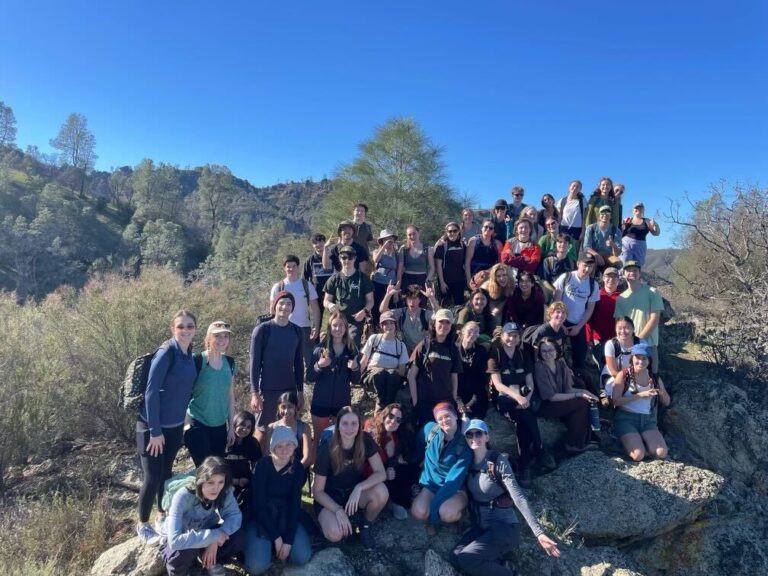
Outdoor Crew, commonly referred to as ODC, hopes to provide all students a solution to this lack of access. The student-run club aims to help foster an inclusive environment centered around outdoor activities through hikes, camping trips, socials and more for over 450 current members. 

Kelly Kankowski, a fourth-year design major and the current membership director of Outdoor Crew, believes that the club can help provide an accessible way to explore the outdoors. 

“I think it’s a really great way for people to get outside,” Kankowski said. “There’s so much in California and in our surrounding area that is so beautiful and wonderful and so different from Davis, and we really want to provide the opportunity for people to explore the outdoors.” 

Kankowski also stressed that all skill and experience levels are welcome in Outdoor Crew. 

“The club environment is very welcoming and open to anyone that has any sort of experience or just wants to be outdoors, whether they love camping and hiking or have never done it before,” Kankowski said. “[To] anyone that has any inkling to explore the outdoors, I would definitely recommend joining.” 

This sentiment is reflected in the club’s activities, which range in difficulty from beginner to advanced, and offer a wide variety of ways to explore the outdoors. 

Gina Stevens, a fourth-year clinical nutrition major, has always been a proponent of the outdoors. Growing up camping and hiking with family, joining Outdoor Crew was a natural next step for Stevens when she came to Davis. 

“Every time I went on a hike, I’d make a new friend,” Stevens said. “I get to meet people who are interested in the same thing I am, and it was just really fun and enriching.”

Stevens also understands that a large club like Outdoor Crew might feel intimidating but insists that there’s no need to worry.

“Joining a new club in a new school is always [going to] feel a little bit intimidating,” Stevens said. “Know that when you surround yourself with people who generally really like to go outside and experience nature and hike and be social, you’re probably gonna get a really good match of people. Everyone else who joined is also looking to make connections and make friends and meet people in that realm — you’re not the only one.”

Emmeline Thomsen, a fourth-year design and sociology major, has worked hard to ensure Outdoor Club is inclusive and fun for all. Thomsen is the co-president of Outdoor Crew along with Patrick Farrell and has been a member of Outdoor Crew since her first year at UC Davis.

“I’ve met some of my closest friends there,” Thomsen said. “We really want everyone to be able to hang out, be friends and promote inclusion.”

While exploring the outdoors, conditions can be unpredictable. Outdoor Crew experienced this unpredictability first hand last year when they faced unexpected snow on a  Yosemite camping trip. Despite the challenges it presented, Thomsen said that the situation brought the club closer together. 

“It was super challenging, but it was super cool to see how all the officers responded,” Thomsen said. “We all work together super well so it was really cool having a team all support each other. All the officers were just amazing and super considerate and on top of everything, and all the members were super understanding and open.”

In addition to providing social connection and physical activity, Outdoor Crew also strives to improve mental health through their activities. 

Harrison Oseguera, a fourth-year Chicano studies and psychology double major as well as the current planning officer for Outdoor Crew, said he felt his mentality change while in Outdoor Crew.

“My experience with Outdoor Crew has been very life changing,” Oseguera said. “It’s an environment of positivity.”

Oseguera also noted that going outdoors can teach students important lessons outside of the classroom. 

“It’s a great opportunity to ground yourself,” Oseguera said. “In an environment so consumed in academic growth, it’s important to check back in with yourself and grow as an individual and grow in your relationship with nature.”

Although new membership registration has ended for the fall quarter, it will reopen at the beginning of winter quarter — just in time for snowshoeing season. In the meantime, to stay updated about general meetings and membership information, feel free to follow Outdoor Crew on instagram, @outdoorcrewdavis.

Written by: Emme Dunning — features@theaggie.org

Delta of Venus provides a space for art exhibitions, live music and social gatherings

0

The café’s owner shares sentiments about love and fostering community


By RACHEL GAUER — features@theaggie.org


A typical college town café does not often include live music shows, funky wall colors and extensive art exhibitions. Downtown’s Delta of Venus, however, is far from typical. 

Situated just a short distance from campus at the intersection of Rice Lane and B Street, Delta of Venus appears to be a quaint, homey cafe with an abundance of outdoor seating for conversing with others or perhaps working in solitude.

 A step inside the space, however, reveals its uniqueness: brightly multi-colored walls are lined with various art installations from local artists, bringing an immediate feeling of being in someone’s carefully curated living room. It’s this very sentiment that owner Lee Walthall finds customers saying over and over. 

“I think a lot of people who say that this feels like home to them is not because their home has differently colored walls or because it has bamboo growing in the front — it’s more about a feeling,” Walthall said. “We sell food and coffee here, but what I am mostly interested in is people: how people feel and how people engage with each other.” 

Walthall, a Davis native, has owned Delta of Venus since 2001. He aimed to utilize the space to support the arts in Davis, a community he has been a part of since his youth. 

“I grew up in the arts community and was really fortunate to be able to play music for a living,” Walthall said. “It was very much supported by the Davis community — both by the people who live here and the city itself; Everyone was very embracing of me and my career. I wanted to do something as I got older that would allow me to provide the same support for the community that I received when I was younger.” 

In addition to installations by local artists, Delta of Venus hosts a variety of music events in the evenings, ranging from live music to DJ sets, as well as other arts and cultural-based events such as Paint and Sips and art receptions. A recent event, hosted at the cafe on Nov. 1, was “Bomba en Delta,” featuring local band Bomba Fried Rice and DJ Novela. 

Despite the array of activities that are hosted in the space, the food and coffee itself is not something to be overlooked. The café boasts an extensive breakfast menu featuring a variety of scrambles and breakfast burritos, as well as both brewed coffee and espresso. Frequenters of the business believe that the prices are reasonable compared to other local options.   

Katherine Krinsky, a fourth-year English major and a regular at Delta of Venus, highlighted how the pricing aligns with the café’s welcoming atmosphere. 

“I think it’s probably one of the most community-centered spaces that exist in Davis that’s open to the public,” Krinsky said. “It’s really decently priced, which reflects that they are not trying to rake in money; they just have a space where people can meet and eat and do whatever they need to do.”  

Beyond affordability, community is also fostered by the interactions between staff members and patrons. Walthall emphasized the importance of interacting with each customer on a more personal level. 

“We’re just trying to create something here that feels friendly and opening and that appreciates people for who they are,” Walthall said. “All of the staff here, we try to engage with the public on that level and let people know that we see them and that we care about them.” 

  The sentiment seems to be received well among customers; just spend a few minutes in the café on any weekday, and you will notice staff greeting patrons by name, asking if they will have “the regular” that morning. 

Jackie Allen, a fourth-year linguistics major, also highlighted the friendliness of the staff as one of the things that brings her continuously back to the café. 

“I go there for the company,” Allen said. “The baristas are so nice, and no stranger has ever made me feel so included in a space than Lee, the owner. He asks personal questions and cares about you as a human.” 

When asked about his favorite part of owning the café, Walthall did not select live music or even the ability to open doors for young artists. Instead, he highlighted something rather unexpected — love. 

“People fall in love here,” Walthall said. “It’s a common date place, and it’s a common place to go for music or art which are kind of inherently romantic situations. A lot of times young couples come in with their babies to show them where Mommy and Daddy met for the first time. I don’t get tired of seeing and hearing that.”

Walthall said his experience witnessing these love stories extends beyond just being a perk of working with people. 

“You become part of somebody’s life in a way that is deeper than a meal or a show,” Walthall said. “We love serving meals here and we love throwing shows here, but when you start to become part of somebody’s real, ongoing life, [their] future and their family, it’s a very deep thing and a wonderful experience […] To be involved with love is really the most amazing thing that I’ve experienced in life.” 


Written by: Rachel Gauer — features@theaggie.org


Community grief ritual held in the Village Homes Community Center

Dr. Florie Wild invited Davis students and locals to come together as a community and grieve 


By MATTHEW MCELDOWNEY — city@theaggie.org


Whether it be for the loss of a loved one or the results of a contentious election, Dr. Florie Wild hosted a safe space to release these feelings of grief on Nov. 9. This event was free for all to attend in the Village Homes Community Center.

Dr. Florie Wild, formerly a grief specialist for the UC Davis Student Health & Wellness  Center, emphasized group therapy and grief work as she moved to being a private practitioner.

“I just love getting people to care for each other,” Wild said. “Because a lot of what I do is not necessarily exclusive to what we can do for one another.”

Wild began the grief ritual by addressing the collective grief of the world as countries are in conflict and the environment undergoes irreversible change. Participants were then asked to break out into smaller groups to talk about what brought them here. Those comfortable enough to share with the whole group were given the opportunity to do so with the support of one another.

There was another exercise where people were invited to hold hands in a circle and let go once the age at which they felt that they would pass away was announced. Herein, many participants described the pain of seeing those around them leave the circle before them while those who had left felt inspired by those who stayed, especially the younger folks.

During the ritual itself, Wild invited all to express their grief alongside one another through tears, anger or silence. Meanwhile, Wild read poetry and played music for the group. 

“Oftentimes it feels as though these drag on a little too long, but it was different,” Wild said. “Most if not everybody was crying, and it was wonderful to see the men that were able to feel vulnerable hug each other and cry.”

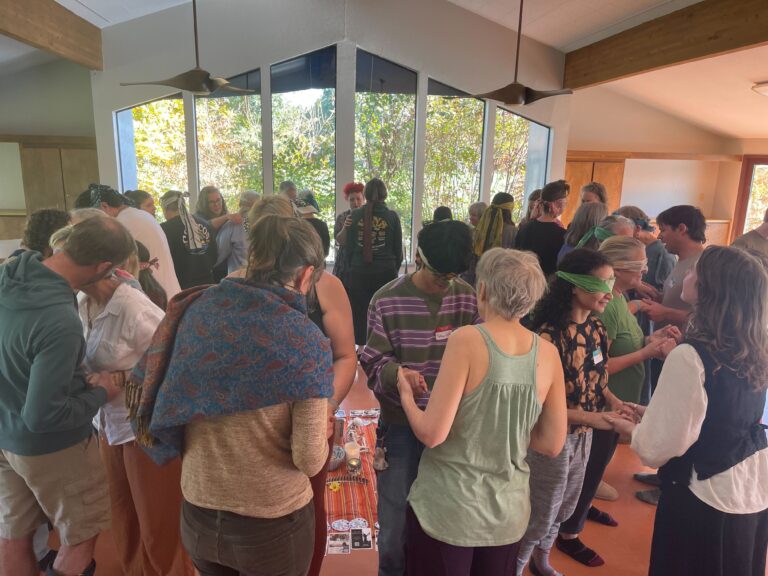
Afterward, blindfolded participants rotated in a circle to offer one another anonymous affirmations and care. From this group overall, there was a sense of accomplishment and appreciation for each other for making it to this ritual. For some, they described a picture or a poem, but for many, it was enough to have a helping hand or hug with someone there to say, “You are enough.”

Through these exercises, Wild hoped to achieve her mission of encouraging a society that is willing to tackle their grief without shame or support from others. 

“It is awkward because we do not normally do this as a culture,” Wild said. “But, awkward is not bad. It is just something we have not done before. After all, the other side of awkwardness is awesome.

Wild is hosting another grief ritual in Forest Love, Berkeley on Nov. 23, as well as a free Soul Journey Workshop on Dec. 7 at the Village Homes Community Center in Davis. This workshop is meant to introduce the Wild Women Rising group which is dedicated to fostering community and expressing womanhood. Wild hopes for another grief ritual event like this to return to Davis by spring; however, she has not confirmed a specific date for its return. Up-to-date information regarding events and her work can be accessed on her official website.

In her closing thoughts, Dr. Florie Wild described the strongest takeaway from the grief ritual and what she would want for all those who attended to have taken away that day.

“You are not alone, and you do not have to be alone with it,” Wild said.


Written by: Matthew Mceldowney city@theaggie.org


Petition to remove turkey from the Thanksgiving menu

Why would you want to eat something so sexy? 


By ALLISON KELEHER — adkeleher@ucdavis.edu


To whom it may concern:


I don’t know about you, but I am tired of eating turkey every year at Thanksgiving. Frankly, it’s unoriginal and boring. Why not spice things up with a nice smoked trout?

Ugh, I’m sorry — I can’t keep pretending. I started this article with the hopes of convincing you using persuasion, but that smoked trout thing slipped out, and I feel like I’m living a lie. Let’s start over. Hey. The name’s Ted. Ted the Turkey.

I’ve lived in Davis for my whole life and every year since my childhood, I see my fellow turkeys experience the most anxiety this time of year. It’s sad. Most of the year, we are content and free to frolic around the UC Davis campus without a care in the world. One time, I chased after someone on a bike to feel something. But once it hits November, we live in fear. I like to call it “Nervous November.”

Every year, when November comes around, I try to keep to myself and harass fewer students so that no one gets any bright ideas. This has worked so far, since I am a middle-aged turkey. However, I need to break my silence on this topic because I met someone. Her name is Tina. Tina the Turkey. She’s the most remarkable turkey I’ve ever laid my eyes on. Her feathers are so beautiful — specifically the tail feathers (if you know what I mean).

Tina is fearless. She chases after UC Davis students on the daily and I gobble it up every time. However, in November it’s a different story. She is overcome with fear and anxiety of being taken and put on your dinner table. This is because when she was young, one of her family members got taken away around this time of year. It was a slightly strange local who felt like they needed something fresh for their Thanksgiving. Now, Tina can’t rest during November.

As her boyfriend, I won’t stand for this. The other night, I caught her in the middle of the night scrolling on Reddit, reading turkey abduction horror stories, and I had to stop her from driving herself crazy. Once she went to bed, she was talking in her sleep about being chosen for the infamous presidential turkey pardon. This is getting to be too much, so I decided to take to The California Aggie and enact change in Thanksgiving culture.

Honestly, you could use some change, because why is it normal to stuff our insides with soggy bread and eat it? Your so-called “Pilgrims” were weird. I know this because I’m actually a descendant of the very first turkeys that were eaten at that Thanksgiving. It’s not something that my family likes to talk about. Once a turkey finds out that I’m turkey royalty, they always treat me differently — I just want to be like everyone else.

In conclusion, we should diversify our palettes at Thanksgiving, because it would really help me out. Thanks.


Best Regards, Ted (the Turkey).


Written by: Allison Keleher — adkeleher@ucdavis.edu


Disclaimer: (This article is humor and/or satire, and its content is purely fictional. The story and the names of “sources” are fictionalized.)

LGBTQIA Resource Center holds Transgender Day of Remembrance and Rage

The march is the first in the center’s history and was held to support the transgender community on campus in the face of growing anti-trans legislation


By Rivers Stout — campus@theaggie.org


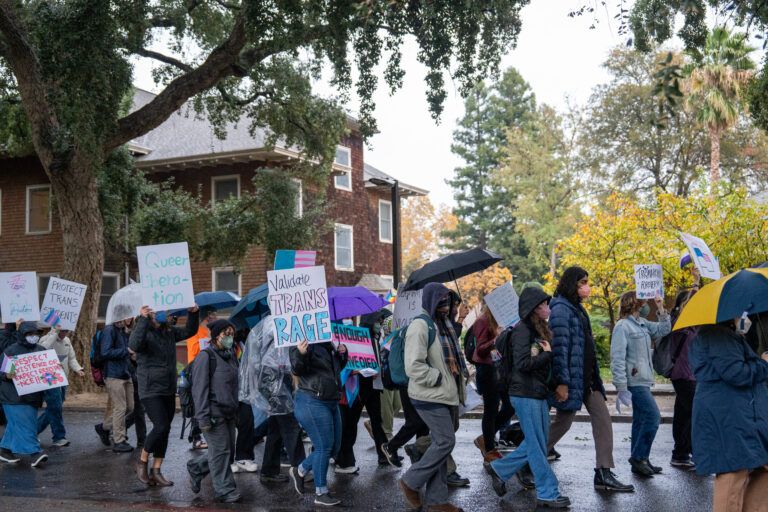
On Nov. 20, the LGBTQIA Resource Center’s Trans Day of Remembrance and Rage march was held around the UC Davis campus for the Transgender Day of Remembrance. The event was held to show that transgender voices will remain active despite a record increase in hostile legislation, and that the center will continue to resist anti-trans violence, according to Black Flaugher, the director of the LGBTQIA Resource Center. The center also produced a list of demands to the university in order to create a safer space for students.

Flaugher spoke on the significance of the Transgender Day of Remembrance and how the march supports its values.

“Today was all about marching in support of trans lives,” Flaugher said. “Trans people are prone to many forms of violence every day, and today — Trans Day of Remembrance — was all about honoring those trans siblings lost to anti-trans violence.”

An anonymous transgender student organizer had differing reasons for participating in the march. 

“We were here to inspire rage in the trans community,” the student organizer said. “I think that what has been happening in terms of the election and UC Davis’ largely inactive movements to try and defend trans students have been forming a lot of rage in the community, a lot of anxiety specifically.”

They also noted that members at the center have been feeling much fear after the election with some trans community members considering leaving the country or even detransitioning due to post-election safety concerns. 

“Its been depressing, post election [at] the center felt more like a funeral [and] the center is usually pretty happy,” the organizer said. “I mean, it has a lot of things in it. It’s a place where a lot of people come to feel a myriad of emotions. Post election, it’s been a feeling of anxiety.”

Protestors gathered in the LGBTQIA Resource Center at 11 a.m., where a presentation was held to demonstrate how to create protective sigils. By 12:05 p.m., roughly 50 protestors had gathered on the Memorial Union South Patio in the rain. Komolika Basu, the creator of Sakhi, a club for South Asian and Middle Eastern students within the LGBTQIA community or who are questioning, read a speech to the crowd on the importance of the day and resilience moving forward.

A list of pre-approved chants was handed out before the march began. Some of the chants included were: “They kill us, they fuck us, our bodies they don’t trust them. We riot, we riot, our bodies are above them”; “No restrooms, no sports, they want us to revolt” and “No borders, no nations, trans liberation.” These and others were used over the duration of the march.

Within a few minutes of the march’s start time, individuals with megaphones began shouting a variety of other chants, including some from previous pro-Palestine protests and other similarly pro-Palestine/transgender advocacy chants. Some chants included: “Queers and trans, we demand freedom for Gaza, free Sudan”; “Nex Benedict we remember, trans lives will live forever”; “We will never stay quiet, the first ride was a riot” and “Admin let transphobia slide, they are not on our side.” Although the chants differed from the pre-approved list, most of the crowd chanted along.

Flaugher commented on the pro-Palestine chants.

“It wasn’t a surprise,” Flaugher said. “We support queer students’ freedom of expression.”

The crowd also demanded the termination of Beth Bourne, a UC Davis STEPS+ program coordinator who is an active anti-transgender rights advocate. She was a popular subject on social media platforms over the summer, which resulted in UC Davis releasing a statement about her behavior. This demand, however, is not on the list of demands that the center created.

“I think Beth Bourne herself is not a particularly rare occurrence,” the student organizer said. “She’s more like a microcosm of how the university allows hate speech to happen on campus […] The university will allow [this] to happen so long as it doesn’t cut into their public perception or bottom line.”

Two of the center’s demands addressed these issues. One was for students to be treated with respect, including to stop deadnaming and misgendering in the classroom. Another called for UC Davis to “tighten up” policies on gender discrimination and harassment.

The organizer spoke on these demands and also addressed the future contention regarding the availability of certain medications that are widely used by transitioning individuals.

“It feels like this university does not have any contingent plans or any actual movement right now within the administration to effectively try to cover for these medications being removed near or after Jan. 20,” the student organizer said.

Flaugher addressed a similar concern.

“There’s a lot of fear that restrictions are going to be placed on gender-affirming care for adults,” Flaugher said. “Making sure that our university is prepared to continue funding care regardless of what restrictions may be put in place [is important].”

Three demands were centered around these fears and improving what systems UC Davis already has in place. One of the demands was partially created because of harassment the center has previously experienced.

“Our center has had some targeted harassment over the past year,” Flaugher said. “[We want] to make sure that the policies UC Davis and the UC system have in place are sufficient enough to protect us. I don’t want the bar for those policies concerning policy violations to be super high. We want to make sure that policies are able to protect us as they’re written.”

Flaugher believes there are administrators that would be open to discussing the center’s demands.

“We’re always going to support trans students’ freedom of expression,” Flaugher said. “We’re going to aim to be a safe and welcoming place for students to come and have refuge. We’re going to keep doing programming that educates our community and allies about what trans and queer people are experiencing every day. We’re going to keep doing what we’re doing.”

At 12:51 p.m., the marchers returned to the Student Community Center. Once the march had officially concluded, the crowd repeatedly chanted, “Fuck Beth Bourne.”

Those who wish to keep up with the center’s events can follow them on Instagram or visit their website at lgbtqia.ucdavis.edu. The center is located on the first floor of the Student Community Center and is open 10 a.m. to 6 p.m. from Monday to Thursday and 12 p.m. to 5 p.m on Fridays. 


Written by: Rivers Stout — campus@theaggie.org

What is the Pour Out Pepsi project?

The project is a part of the Environmental Policy and Planning Commission, with the goal of ending UC Davis’ pouring rights contract with PepsiCo


By JORDAN POLTORAK — campus@theaggie.org


The Pour Out Pepsi project functions under ASUCD’s Environmental Policy and Planning Commission (EPPC). Their goal is to end UC Davis’ contract with PepsiCo due to a lack of sustainable and healthy options for students. Many of the beverages sold on campus utilize single-use plastics, which raises questions for the university’s plan of phasing out unsustainable containers.

The 10-year contract with PepsiCo was set to expire in September 2024, but the university renewed the contract in July 2024. The contract reportedly provides $10 million to the university over the span of 10 years.

Ivy Schlosser, a fourth-year political science major and the EPPC commissioner and co-lead of the Pouring Rights Contract Project, spoke on the contract’s renewal.

“We explicitly asked them to not make a decision until school resumed in the fall, because we knew that they would [renew the contract and] there wouldn’t be students present to make a complaint against it,” Schlosser said.

Due to the renewal, the Pour Out Pepsi project is taking a different approach to their goals this school year.

Piper Mills, a fourth-year environmental policy analysis and planning major and EPPC commissioner and the project’s contract lead, expanded on their next steps.

“We are now working less in conjunction with administration to try to negotiate with them and talk about alternatives,” Mills said. “It is now more of a student outreach project. We are trying to amplify voices that are in opposition to that renewal.”

This new contract calls for 80% of PepsiCo products to be packaged in non-plastic containers, however, beverages such as Naked Juice, Muscle Milk, Gatorade and Pure Leaf Tea were given until 2030 to remove their plastic packaging, according to the EPPC’s website.

Mills spoke about the cost of buying Pepsi products for the university.

“[PepsiCo] has explicitly told us they cannot meet these single-use plastic guidelines,” Mills said. “They also charge the university a higher cost than if we were to wholesale purchase things from Costco. So not only is it an unsustainable pouring rights contract, it’s also not in the university’s best interest.”

The Pour Out Pepsi movement is not unique to UC Davis’ campus. UC Berkeley has a chapter with the same goal in mind, as their PepsiCo contract was renewed in September 2023.

Another one of the project’s goals for this school year is looking into the legality of the contract renewal. Mills and Schlosser spoke about how requests for proposals can be written to make it so only one company is able to bid on the contract. However, they had wanted to give more vendors, preferably sustainable vendors, the ability to bid on the contract as well.

Currently the project is promoting a boycott of all Pepsi products on campus, with the exception of the Coffee House (CoHo), which is the only location not included in the pouring rights contract.

Schlosser said that the pouring rights contract goes against what the university stands for.

“A monopoly with the second-largest plastic polluter in the world doesn’t fit the university’s values,” Schlosser said.

Written by: Jordan Poltorak — campus@theaggie.org

Editor’s Note: The University of California Davis has published its own information about the PepsiCo contract which can be found on the UC Davis Supply Chain Management website. Here, they detail the specific elements of the contract, as well as its projected goals.

The sun setting early is ruining my life

The onset of winter can worsen one’s productivity; here’s how to not let it


By Abhinaya Kasagani— akasagani@ucdavis.edu


I am not being hyperbolic, nor am I laughing when I say that the onset of winter has dampened all festivities. I am one to enjoy the cold — maybe even prefer it — yet, every year, I forget about daylight savings and the sun begins to set, taking with it all my will.

The sunset never throws a tantrum nor postpones its cruel, inevitable descent. Time waits for no one. What remains waiting in a dusty corner is a pile of work just about due. I am less productive, less inclined to desire productivity and, by the time I come around to the idea of work, it is dark out. While daylight savings time gets blamed for this, the issue has more to do with our biology and habits.

This is because the change in time disrupts our circadian rhythms, which are closely tied to natural light, causing sleep deprivation and reduced focus levels. The productivity conundrum of shorter days often leads to decreased energy and fatigue, changes in sleep or appetite and difficulty concentrating. This misalignment of our internal clocks makes even the simplest of tasks feel monumental: our bodies now interpret the dark as a signal to wind down. One may also associate the setting sun with the end of the day, even if several productive hours remain. This association can lead to procrastination and a diminished willingness to engage in physical or creative pursuits. One does not fail to address the paradox — an hour once gained is an hour eventually lost.

It is human nature to blame this lack of energy on an external problem. One might argue that daylight savings time, introduced to maximize evening light during warmer months, often exacerbates the effects of this shift. It can feel as though our days are shrinking, and even though this is temporary, our bodies take time to adjust.

While daylight savings time worsens the cruelty of winter and adds to the list of its many downsides, there are still some benefits (however hidden). This change was originally implemented to reduce energy consumption by decreasing the need for artificial lighting during warmer months. Longer hours of daylight encouraged outdoor activities that, in turn, benefitted several industries, including retail, food service and tourism. It also aligned with societal patterns that prioritized evening activities over early morning ones, extending usable daylight that better fit the rhythm of daily life.

While nothing can be done to change this, we’ve established before that winter is manageable. There are practical ways to combat this disillusionment. For one, we can strategically plan our schedules to maximize natural daylight and tackle high-priority tasks early in the day, when our brains are more alert. Adjusting your workspace to include more light sources also helps maintain productivity and well-being. I’ve always resorted to taking midday breaks outside, when the sun is still around, tricking my mind into thinking all is right in the world. With these solutions, consistency is key. Winter has already disrupted our circadian rhythms, so it is crucial to stick to a routine to regulate our bodies and energy levels.

To aid in adjusting to lost evenings — time once spent outside — it is crucial that we reclaim moments of joy, however we see fit. It is a season of adjustment, of finding ways to stay productive, whether through creative activities such as reading, writing and crafting or physical exercise. If this still feels overwhelming to plan, think of it like this: Winters are taxing on both the mind and body.

Split these pursuits into two parts of your day. Mornings are for work and moving your body; the opportunity has presented itself to you. Physical activity releases endorphins that help you feel more energized, regardless of time or place. Evenings, on the other hand, are for relaxation. Plan for activities that enrich and fulfill you, like reading, yoga or working on another hobby. These needn’t take up much of your time; the goal is to avoid succumbing to the weather and to instead adapt. Make time for nourishing meals, for friendships and for meditative practices to ground yourself.

The cruelty of early sunsets can feel limiting, but it also offers us a unique opportunity to reflect and create. Small, strategic changes can help embrace the slowness and value that winter offers. And if this hasn’t yet convinced you, remind yourself of this: only 106 days until spring!


Written by: Abhinaya Kasagani— akasagani@ucdavis.edu


Disclaimer: The views and opinions expressed by individual columnists belong to the columnists alone and do not necessarily indicate the views and opinions held by The California Aggie.

Headline: Davis City Council swears in new chief of police

Todd Henry replaces Darren Pytel for the Davis Police Department


By PIPER AWEEKA — city@theaggie.org


On Nov. 19, the Davis City Council shared a heartfelt goodbye to former Police Chief Darren Pytel and welcomed new Chief of Police Todd Henry. After 41 years of service to the Davis Police Department, Pytel was recognized for his outstanding leadership and compassionate approach to the job.

Davis Mayor Josh Chapman began the meeting by sharing the city proclamation for the former police chief. In his speech, Chapman highlighted Pytel’s employment in the Davis Police Department starting at age 14. Pytel followed Chapman’s speech by sharing his own reflections on a long, successful career and his appreciation for the Davis Police Department.

“I’ve truly, truly enjoyed working with the members of the police department,” Pytel said. “It’s been a pleasure. A true pleasure.”

Chapman then called upon fellow council members to share their farewells. City Councilwoman Donna Neville contributed her sentiment for Pytel’s years of service to the city of Davis.

“I am just deeply indebted to where you have run your department, to the compassionate way that you engage in policing,” Neville said. “It’s a model for how policing should be done, and I’m deeply grateful for that.”

Following farewells from the council members, Jean Lyon, the deputy director of police services for the city of Davis, shared a word of her own.

“When I think of the work that you’ve put in over the years, there’s two words that come to mind, and the first one is leadership […] I learned to listen and allow people to be heard,” Lyon said. “The second word is legacy […] I’m truly grateful you left the department better off than when you found it.”

After a hug between Pytel and City Manager Mike Webb, the swearing-in ceremony for Todd Henry commenced. Standing face to face, Pytel swore in Henry as Davis’ new Chief of Police. Following a handshake between the two men, Henry shared his regard for Pytel and his intentions for his new role in the department.

“How he has always put this community first has been nothing short of inspirational, and it’s been a guide to me as to how I should be a police chief and how I need to lead the police department within the city of Davis,” Henry said. “What I can promise this council and this community and the police department is I will absolutely embrace this job with everything that I have, my heart and soul.”

Together, the council stated their unanimous faith in Henry’s ability to fill the hole left in Pytel’s wake. An emphasis was drawn on the new chief of police’s compassion for his family, all of whom were in attendance that night. Webb voiced his own certainty about Henry being the perfect candidate for the position.

“The decision to hire executive team members within our ranks are not decisions that are made lightly, and sometimes they’re not easy ones,” Webb said. “But I will tell you, the appointment of Chief Henry to our police chief job was probably the easiest decision I’ve been able to make as a city manager. You’re going to do great things for this community, for the department. You’re going to continue the legacy of Chief Pytel in many ways, and in many ways, you’re going to have your own flavor in your own assessment and your own twist on things and how you do chief right […] I have no doubt that you will be extremely successful in doing that.”


Written By: Piper Aweeka — city@theaggie.org


Fall scenes at UC Davis’ Oakville Station

0

By Christian Cendejas — photo@theaggie.org

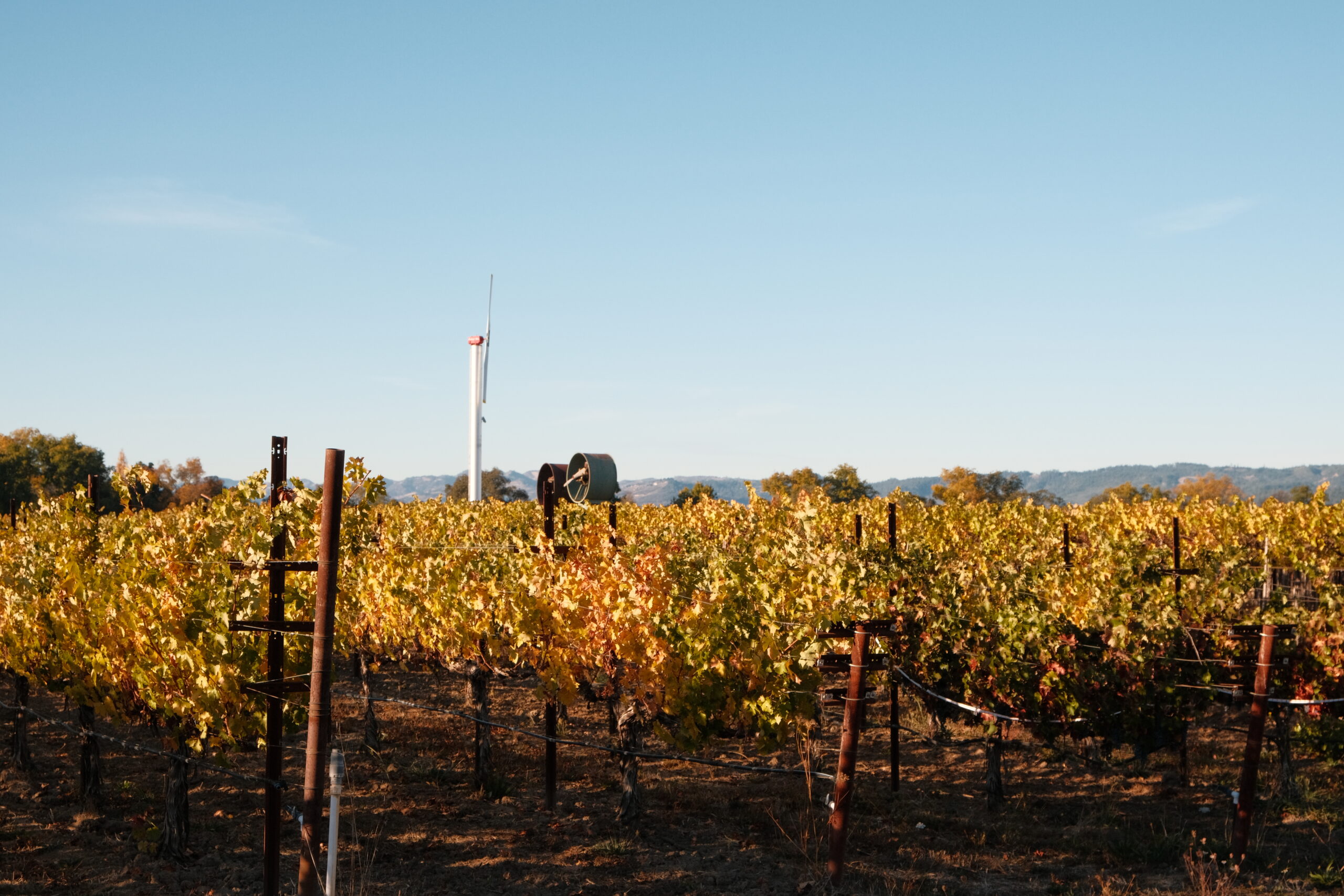
Oakville Station is a research vineyard in the Napa Valley used and maintained by the UC Davis Department of Viticulture and Enology.

These photos showcase the vineyard’s vibrant Fall colors, and embody what Fall looks like in the Valley. 

Oakville Station’s sign at the front of the vineyard (Christian Cendejas / Aggie)


Sun beginning to set behind the mountain at Oakville Station (Christian Cendejas / Aggie)


Fall colors in a close up of grape leaves (Christian Cendejas / Aggie)


Fans in the vineyard used to prevent frost (Christian Cendejas / Aggie)


Small bunch of grapes hanging on a vine (Christian Cendejas / Aggie)


Crows fly over rows of orange vineyards (Christian Cendejas / Aggie)


Red and yellow leaves up close (Christian Cendejas / Aggie)
Oakville seen from up Oakville Grade Rd (Christian Cendejas / Aggie)


By Christian Cendejas — photo@theaggie.org

Why I love the musical ‘Hadestown’

The beautiful meaning behind this musical’s interpretation of a beloved Greek myth


By SABRINA FIGUEROA — sfigueroaavila@ucdavis.edu


The ancient myth of Orpheus and Eurydice is a popular tale in Greek mythology. It is also, perhaps, one of the most tragic and poignant; so much so that it gives Shakespeare a run for his money.

Every retelling of the myth has the same basic storyline: Eurydice dies and goes to the underworld, and Orpheus, her lover, travels there to bring her back. Hades, the king of the dead and god of the underworld, grants Orpheus the permission to return his love to Earth, as long as he doesn’t look back at her along the way. In spite of the rules (and in the name of his love for her), Orpheus looks back to make sure she’s still behind him, sending Eurydice to the underworld forever.

Although there are multiple interpretations of the myth, one of my favorites by far comes from the Broadway musical “Hadestown” created by Anaïs Mitchell.

Much like other interpretations, “Hadestown” is able to underscore dimensions of the human condition in terms of survival, sacrifice, doubt and love. In this adaptation, Earth and its seasons are plagued by the dying connection between Persephone and Hades. Fall and spring disappear, and winter becomes a deadly force with storms and scarce amounts of food. Ultimately, this is what leads to Eurydice’s decision to go to the underworld. As much as she loves Orpehus, what good is any of it if she’s constantly at war with hunger? What good does love and life serve you if you’re in pain?

The decision to sacrifice her love for the deception of a “great life” in the underworld is commented on by the Fates in the emotional song “Gone, I’m Gone.” They ask the audience the probing question: “Wouldn’t you have done the same?” The song highlights how, although humans may have morals and principles, we don’t always follow them when it comes to ensuring our chance at a better life. In fact, we don’t actually know what we would do in a situation until we are thrown into it. So, who are we to judge Eurydice for her choice?

Perhaps one of my favorite things about this adaptation of the ancient myth is that it brings on a completely new dimension to the basic storyline. That is, it has a relevant political undertone to it that has been shaped by time.

Although Mitchell created the show’s music in 2006, she eerily mimics and comments on Donald Trump’s ideologies and the current political climate of the United States through Hades and the underworld he calls “Hadestown.” One of the songs that brings attention to this is called “Why We Build the Wall.” It’s a chant-like song with deep, baritone vocals by Patrick Page (who sings the part of Hades), while the exploited workers in Hadestown respond to questions he asks about why they built the wall.

This song encapsulates the irony of their so-called freedom. The workers say they are building the wall to keep themselves free, as it keeps those who are starving and impoverished from making their way in to take what the workers have. But if that “better life” is being chained up to do labor for eternity and being isolated from other regions of the world, how is that freedom?

Additionally, if the workers aren’t questioning what they’re told is “true” and aren’t speaking up about their mistreatment out of fear of retaliation from their leader, is it truly freedom? “If It’s True” is another commentary piece sung by Reeve Carney as Orpheus, where he presents this doubt to the workers. He asks them to think about their role and the role that Hades plays as a leader with power, and to remain skeptical of what Hades says is the truth.

At the end of the song, Orpheus tells the workers that they are stronger together and that their opinions and voices matter. They have their own power, strong enough to combat the power Hades wields.

These aspects of “Hadestown” are relevant to our world today: Human beings have been, are and always will be stronger together. Often, we take each other and our own voices for granted. We don’t question why society or authority figures tell us to live in certain ways as much as we should. We must remain curious about our world.

This musical, what Hermes calls a “sad song,” is retold over and over again, as most stories are. Even though we know the tragic ending, we continue to retell and relisten to the tales. Why? It reminds us of who we are at our core, as well as what we live and die for. To be able to turn a mirror around to humans — so that we see ourselves in our nature, the weaknesses and strengths we often lose sight of — is the most beautiful thing about art forms such as this one.


Written by: Sabrina Figueroa — sfigueroaavila@ucdavis.edu

Disclaimer: The views and opinions expressed by individual columnists belong to the columnists alone and do not necessarily indicate the views and opinions held by The California Aggie.

Hear me out — they’re not that attractive; it’s just their aura

What makes someone truly attractive?


By JHANA RHODES—jsrho@ucdavis.edu


In 2016, Disney released “Zootopia,” a thrilling adventure following the life of two mammals: a rabbit and a fox. While the studio likely intended for the audience to enjoy the film for its plot and characters, they didn’t anticipate the overwhelming amount of adult individuals that thirsted over Nick Wilde and Judy Hopps: an animated rabbit and fox.

That’s right — the two animals now have an influx of fan edits, fan fiction and fan art permanently embedded in a digital footprint. If you’re not a part of the Nick Wilde or Judy Hopps fandom, the appeal to fictional characters may be enigmatic. So, what’s the deal? Do people actually like these characters? Or is it something else? As the “hear me out” cake trend on TikTok has shown, looks aren’t everything.

For those of you who don’t have TikTok or are just on a completely different side of the internet, the whirlwind trend showcases users decorating a cake with pictures of (but not limited to) fictional characters and celebrities as they explain their unique opinions on who, or what, they believe is attractive. Bill Nye (the Science Guy), Optimus Prime, Elastigirl, a fork and the number eight are some subjects currently under stringent debate.

Though we all have our individual preferences on what we consider to be attractive, hopefully we can agree that “aura” is what draws us in. In other words, we tend to be attracted to someone’s unique impression, shaped by their demeanor, tone of voice or the little things they do that captivate us. Think about it like this: you show your friends a picture of your crush. Your friends don’t find them attractive, but you do. You keep showing them different photos, saying, “It’s just a bad angle; they look better in person.” But no matter how many pictures you send in the group chat, your friends still disagree. In your defense, if only your friends could see how your crush parallel parks — then maybe they’d agree with you.

While physical appearance is undoubtedly a large part of initial attraction, there is so much more to individuals than what’s on the surface. A confident demeanor, kindness, intelligence, optimism, authenticity, loyalty and empathy are on the list. Romantically or not, we are drawn to people’s energy. We, as humans, seek admirable qualities in others, whether we possess those qualities or not. However, I am certain that the most beautiful people, inside and out, are the ones with a heart of gold. Physical appearances can wither, yet genuine kindness and compassion will flourish.

Though this explanation of aura may not sway you into believing an animated fox is attractive, it hopefully helps you understand why others might be. Some may find Nick Wilde funny and therefore alluring. Others may think it’s his confident and sly demeanor. I say that Jason Bateman (Nick Wilde’s voice actor) has a nice voice. But hey, beauty is in the eye of the beholder — we all have unique preferences that make us stand out from one another.

So, next time you witness someone obsessing over fan edits of a fictional character, instead of judging out loud — judge them silently. Then, think to yourself: What is your favorite “hear me out” take?


Written by: Jhana Rhodes— jsrho@ucdavis.edu 


Disclaimer: The views and opinions expressed by individual columnists belong to the columnists alone and do not necessarily indicate the views and opinions held by The California Aggie.


How to bring holiday cheer into your daily life this December

As the holiday season takes a hold, find ways to make each and every day more magical than the last


By NATALIE SALTER—arts@theaggie.org 


With a shower of golden leaves and a stretch of rainy days, fall has at last transformed into winter. December in particular is a special time of the year for many, as it brings the holiday season which is so widely beloved. But with its cold, class-filled days, you might need a touch of extra work to make this year’s final month as wonderful as it ought to be. If you’re in need of a little inspiration, look no further. 

There are plenty of classic winter activities worth taking advantage of this year. Ice skating is especially fun with friends, a classic December sport that is enjoyable for beginners and pros alike. If you’re really ambitious about your cold-weather exploits, you can drive up into the mountains for some authentic skiing and sledding amidst a snowy wonderland. If your taste in activities is decidedly less physical, bundle yourself up in your favorite sweater and scarf and take a walk around Downtown Davis with a few friends, perhaps with hot chocolates in hand and an eye open for any holiday decorations. 

Unfortunately for any stress-free dreams you may have for December, not only is it the chiefest of holiday months, but it is also finals season. Combined with dreary, cold weather and a general gloom amongst students cramming for their big exams, you’ll need to take care of your mental health more than ever. One of the best ways to do so is finding ways to make the necessary — in this case, the slew of term papers and study guides you might find yourself saddled with come mid-December — more delightful. Pack your bags and find a cozy seat in a local cafe or restaurant of your choice, and combine your studies with a sweet treat or a steaming hot beverage to ease the load.

Speaking of hot beverages, there’s no time like December for the wonderful treat of hot chocolate. It’s a staple of the season which can be personalized in countless ways. Many stores, including every college student’s beloved Trader Joe’s, offer different flavors of hot chocolate for every preference. Flavored marshmallows and candy canes are also a clever way to inject a burst of flavor into an already-delicious drink. 

One of the coziest activities for cold days — and one that comes with a tasty result — is baking. Cookies are one of the easiest and most fun things to make in your free time. While the possibilities are endless, you can celebrate the season by making sugar cookies and decorating them as festively as you’d like. Sugar cookies can be formed into a variety of fun shapes and frosted in any color. You’re limited only by your imagination, and what you make can be shared with your loved ones as a thoughtful and adorable gift.

After a long day of classes in the frigid and t seemingly never-ending rainy weather, you’ll likely come back home feeling more than a little bedraggled. Treat yourself to a long, hot shower or bath to shake off the cold, then get into your favorite pajamas and indulge in all your self-care favorites. Lotions and balms can help soothe any dryness you might be victim to this winter. A classic holiday film or a cheesy seasonal romance novel can help you unwind with festive flair. And, if you haven’t had the chance to get in touch with friends or family at home, a cold December evening is the perfect time for a video call to catch up and spend quality time together.

Once finals come to its long-awaited end and winter break is finally free to begin, you deserve to ring in the occasion with some gifts for yourself. Whether you’re doing some last-minute holiday shopping for your loved ones or just feel inclined to reward your own hard work, there’s no better time to buy yourself that item you’ve wanted for forever. Plus, it’s a useful way to motivate yourself to study hard for your exams. Though finals are far from enjoyable, it’s the little things like these that make them at least bearable, and the month altogether as full of joy as it ought to be. 

Written by: Natalie Salter—arts@theaggie.org