54.8 F
Davis

Davis, California

Thursday, January 1, 2026
Home Blog Page 880

Campus Chic: Humera Durrani

0

IMG_8614

Have you found the perfect berry lip? In this first-ever beauty edition of Campus Chic, our muse of the week, fourth-year international relations major Humera Durrani tells MUSE how she rocks a classic, berry lip for the season.

First things first: identify what works best for your skin tone and eye color and the look you’re trying to go for prior to purchasing an arbitrary shade of berry lipstick. Personally, I recommend a matte lipstick because it’s chic and edgy, yet not over-the-top with all the gloss and the shimmer. Remember, what looks good on someone else may not look as flattering on you and, through this quick and simple guide, you’ll be on your way in no time.

For every skin tone, there is a perfect berry lipstick. For accentuating lighter colored eyes, use one with pink undertones. Lipsticks with blue or brown undertones are great for highlighting both lighter and darker colored eyes.

If you have a darker skin tone, pretty much anything goes, including brighter shades of berry; but I suggest opting for a deeper shade for added sophistication and avoiding pastels or pinks that will overpower the natural complexion of your skin. A purple hue is fantastic on very dark skin tones for those looking for subtle sophistication with a pop of color.

If you are of a medium/olive skin tone, you can get away with both darker and lighter shades of berry, but I would suggest opting for a medium shade for a seamless day-to-night transition.

If you are lighter-skinned, make a statement with a brighter shade of berry with red undertones or a deeper shade with brown undertones for an ultra-chic and classic look. But don’t feel limited by these suggestions! Experiment and discover what works best for you.

James’ Notes: As college students, beauty products can get real expensive, real fast; so how do we go about spending our money wisely? Jennifer Goldstein, the executive beauty/health editor of Marie Claire, once told me that the ingredients found in high-end beauty products, like Chanel and La Mer, are actually very similar, and almost identical, to those found in over-the-counter products, like Olay and L’Oreal. I suggest splurging on essentials like make-up brushes or foundation, but save your money on items like lipstick and nail polish. The quality of drugstore lipsticks is improving by the day, as brands expand their collection of different shades and colors and better the staying power of their lipsticks. Without breaking the bank, you too can play with your makeup and test different approaches in expressing your individuality and personal style. Cheers!

1. Describe your personal style in three words.

I don’t want to be a difficult subject for you, but James, you can’t categorize my fashion in three words. There are multiple words, but that’s the thing with fashion in that it’s so unique to every individual. Even if I say “vintage,” that can mean something different to you than to me.

2. Who or what is your style icon?

I love Elie Saab and Zuhair Murad! I just love their style. I’m also very observant of how people around me dress so I kind of take inspiration from my surroundings. There are certain patterns and textures that people are wearing and putting together and I sometimes think, “Maybe I can rock that?”

Did you see the Elie Saab spring/summer 2014 couture show?

Yes, it was magical! It’s like, “Where did you think of that?” The fabrics and the textures were just to die for. He’s just amazing and definitely gifted.

3. What are your three must-have items in your wardrobe?

A bold lipstick (a deep maroon or red and a hot pink), my headscarf and rings. My lipstick depends on the clothes I’m wearing. My headscarf has to be on point. It’s really hard to match them with your outfits. Sometimes, you’ll have the cutest outfit, and if you don’t have a head scarf that kind of flows with your outfit, it could really kill or make your outfit, so my headscarf is very important. I love rings because they texturize your hands […] and they look GREAT with nail polish.

4. What is your all-time favorite accessory?

My headscarf. As a Muslim woman, this is like my hair. We call it a hijab, so a bad hijab day is like a bad hair day. Sometimes they move around and you start looking like a hot mess. And I love a bold lipstick! It just makes your face pop and you can be wearing very minimal makeup, but if you have the right lipstick on, it just makes you glow. So those are two things I love.

5. Tell us more!

Your face and your smile are usually the first two things people see when they meet you, so I think the right lipstick just makes you pop out and your smile brightens. Reds, maroons, berry lips look great with earth tones and neutrals. Be mindful of the colors you are wearing in your clothing and choose a lip color that will complement [your outfit]. Different lip shades also complement different skin tones, so choose a color that makes your face pop. But you can’t go wrong with a bold lip while dressed in all black! I’m not wearing lipliner right now, but lipliner is a must so the color doesn’t bleed.

6. Where do you love to shop and why?

From what I can afford, it’s Forever 21, H&M and Target. When I want to splurge a little bit, it’s ZARA. I really like ZARA because it’s just classy and elegant. You look good without trying too hard. It’s not flashy, it’s minimal, but still gives you that impact. Like, “I’m here,” but a sophisticated “I’m here.”

7. How has your style changed since high school?

I used to think I had to match everything. If I was wearing black pants, I would think my headscarf would still have to be black. I wouldn’t do prints. I was a lot safer and I thought matching colors was safe. It just wasn’t that cute. Now, I think I’m a little bit riskier, especially compared to the rest of my peers. My roommates and friends don’t necessarily dress up that much so I think my fashion is a little more risky. [Fashion] tries to take me out of my comfort zone. I used to wear a lot of black-on-black and neutrals, so I started embracing colors more. If I’m not wearing [color] on my clothes, I’m probably going to wear it on a bright lipstick.

8. What does fashion mean to you?

I’m not an artistic person at all, so, in a way, this is my artistic form of self-expression. I don’t know how to draw, I’m not musically inclined, but every morning when I go to the closet I can be like, “Well, how do I want to express myself today?” I already stand out and it’s very clear that I’m a Muslim woman because I wear a headscarf, so I want to make sure that I’m well put-together.

9. What final tips can you give to our fashion-forward readers?

Dress however you like, but exude confidence when you do it. Sometimes, I’ll see an outfit [that someone’s wearing] that I might not have necessarily worn myself; but because that person carries it with such confidence and grace, I’m like, “Wow! That person looks really nice!” It might not even necessarily be their outfit, you know? So, I really respect that. Whatever it may be, like if it’s edgy, vintage or you’re trying to bring some sort of fashion back, only you can do that because, if you’re not going to do it, someone else is going to bring that fashion back and be the trendsetter. And that could be you, but you just have to have the confidence to go with it.

IMG_8631

IMG_8629

IMG_8625

IMG_8613


News in Brief: Davis homicide cases set court dates

0

In the past several months, Davis has seen a series of high-profile murder cases go through various court proceedings. The cases of Daniel Marsh, Aquelin Talamantes and Darnell Dorsey have all gained considerable attention.

Daniel Marsh is accused of murdering an elderly Davis couple, Oliver Northup, 87, and his wife Claudia Maupin, 76. According to medical examiners, both victims were stabbed over 60 times. The crime involved use of a deadly weapon, forced entry and heinous and depraved murder — actions that all have very serious legal ramifications for Marsh. A torture charge was debated, with the defense recently making a case to have this charge dropped. Marsh has pleaded not guilty to his existing charges.

On Feb. 6, Marsh and his attorneys will petition the Yolo Superior Court  for a motion to exclude the public and electronic media coverage from the case.

“These motions are brought on grounds that they are necessary for a fair trial … and due process under the federal and state constitutions,” Deputy Public Defender Ronald Johnson said in his notice to the Yolo County District Attorney.

Jonathan Raven, chief deputy district attorney, noted the harsh possibilities for the now 16-year-old Marsh.

“26 years to life on each murder for a total of 52 years to life in prison,” Raven said. “We will be dedicated to obtaining justice.”

 Marsh is ineligible for the death penalty as a minor. He will stand before a jury on Mar. 10.

In a separate case, Aquelin Crystal Talamantes, 29, is accused in the murder of her five-year-old daughter, Tatianna Garcia. The alleged crime involved Talamantes putting her daughter’s unresponsive body in the trunk of her car before driving to a relative’s house.

Talamantes’ defense has provided a report from a psychologist for the court stating that she would be pleading not guilty by reason of insanity.

“Nothing comes as a surprise,” Raven said, in response to Talamantes’ not guilty plea.

Talamantes underwent a preliminary hearing on Nov. 14, 2013.

“[The defendant] was held to answer on all charged counts, meaning she will face trial on all counts in the complaint,” Raven said.

 The trial date for Talamantes is uncertain. While the crime took place on Sept. 25, 2013, Raven said that most murder cases take about a year to go to trial.

Bearing similarity to the Talamantes case is the most recent Darnell Dorsey Case. Cameron Morrison, a 20-month-old child, died on Jan. 25 leading to a homicide investigation conducted by the Davis Police Department (DPD).

Dorsey has a criminal record that to date includes robbery, battery and unlawful sexual intercourse with a minor.

Details on the Morrison death are still unclear given the ongoing nature of the investigation, said Lt. Paul Doroshov of the DPD. According to the Davis Enterprise, it seems that an assault on the child may have taken place.

Dorsey will appear in court to enter a plea on Mar. 18.

Watts Legal: 02/06/14

0

My most frequent repeat questions come from students with landlord and roommate problems. Surprise, surprise. Although I’ve covered it before, it’s worth repeating now that a new year is well underway: Security deposits must be returned to you within 21 days of moving out, or else the landlord owes you a triple refund.

Question: My lease ended on Jan. 1. My landlord is refusing to return my security deposit. He says I need to collect it from the new tenant who’s replacing me. I don’t want to have to deal with whoever the new person is. Can the landlord make me do this?

— Various students, Everywhere.

Answer: No, your landlord can’t make you chase after the new tenants for the security deposit.

Within 21 days of you vacating the apartment, the landlord must refund your security deposit. If he doesn’t, or he refunds only part of it, he has to tell you why he did that. He needs to mail or personally hand to you an itemized list of the amounts of any deductions and the reasons for the deductions. He should also include copies of documents showing the charges incurred to clean or repair the apartment.

This list of deductions must be reasonable. He can’t just deduct for anything he wants.

Before you move out, you’re supposed to restore the apartment to the same level of cleanliness as it was in at the time you first moved in. Does the landlord want to steam clean the whole place? He can’t charge you for that, unless steam-cleaning is indeed necessary to return it to the previous level of cleanliness. Ordinary wear and tear is to be expected, and landlords cannot deduct money for “damage” that occurred due to ordinary use.

Some landlords automatically keep about $80 of the security deposit for unspecified “cleaning” fees. But cleaning is not always necessary, and they cannot deduct money for unnecessary expenses.

The portion of the security deposit that wasn’t necessary to return the apartment to its original condition must be returned to you by the landlord.

Back to your question. The landlord cannot tell you to recover your security deposit from the new tenant.

Why?

Because you don’t have a contract with the new tenant. You’ve probably never met the new tenant. The new tenant has no idea how clean the apartment was when you first moved in, so he has no way of refunding you the correct amount.

You have a contract with your landlord. That means that if something goes wrong with that contract, you can sue only the landlord.

The law requires the landlord to hang onto that security deposit during the entire time you live there. California Civil Code Section 1950.5(D) states that any security deposit “shall be held by the landlord for the tenant who is party to the lease or agreement.”

Get your refund from the landlord, not the new tenant. He’s the one with the security deposit, so he’s the one who should give you the refund. A landlord who withholds your deposit in bad faith is liable for triple damages plus your attorney fees.

If you try to get your deposit back, do not start with a lawsuit; start with a letter to the landlord. You can find template demand letters using Google. For more detailed information, there’s a California Tenants Handbook published periodically by the State Department of Consumer Affairs. The latest edition is available at www.dca.ca.gov/publications/landlordbook/catenant.pdf.

Speaking of questions I keep getting but covered but keep coming up …

Question: In student government elections, slates/parties are too powerful. Can ASUCD just ban slates? Does that violate any law or the Constitution? Is ASUCD even subject to the Constitution?

Answer: ASUCD cannot ban groups of candidates from running together under a common name. Nor can ASUCD restrict the number of candidates who run together, or whose endorsements they can use in their campaigns. Bans like these would violate a candidate’s right to free association under the First Amendment, which applies to student governments in public universities.

Courts treat student government elections as a limited public forum, in which the First Amendment applies, but with reservations. A rule restricting speech in such a forum will be upheld only if the government has legitimate interests in restricting the use of a forum to certain intended purposes that outweigh a speaker’s interest in using the forum for a different purpose. A judge would consider whether any restriction on speech is viewpoint neutral or reasonable in light of the purposes of the forum.

ASUCD isn’t nearly as bad as the student government of my undergrad alma mater, UC San Diego. There, the A.S. Council recently restricted the number of candidates who can run together under the same platform. They also banned candidates from jointly campaigning unless they all file paperwork with the elections committee. That’s pretty clearly unconstitutional, since the only conceivable purpose of such limits is to restrict the most popular candidates, those with lots of friends and supporters, from winning elections. No other purpose is served.

That does not mean that ASUCD’s bylaws are in the clear. This section, for example, is probably unconstitutional and unenforceable:

“A copy of the written list of [a candidate’s] supporters must be filed with the ASUCD Elections Committee one academic day prior to the [candidate’s] use of the endorsement.”

It is unlikely that a judge would uphold this, because its blanket restriction is unreasonable. Imagine the consequences: After a club holds its endorsement meeting on the Friday before a three-day weekend, the candidate cannot tell anyone that the club endorsed him until the following Tuesday. What reasonable purpose is served by this four-day waiting period? The club could announce its endorsement on Friday, but if the candidate’s roommate asks him about the endorsement on Saturday, he would have to stay mute or else risk disqualification. That’s nuts — or, in legal terms, unreasonable.

It’s great that UC Davis’ election bylaws are more free and fair than UC San Diego’s, but clauses like this are still a problem. Any candidate afraid of disqualification under this provision could file a lawsuit in federal court before the election even begins. Lawsuits are expensive, and ASUCD would do well to revise the bylaws before some ambitious political science student tries to test them in court.


Daniel is a Sacramento attorney, former Davis City Council candidate and graduate of UC Davis School of Law. He’ll answer questions sent to him at governorwatts@gmail.com or tweeted to @governorwatts.


The Philosophy of Education: The All-Night Cram

0

Have you ever used coffee, energy drinks or prescription stimulants to stay awake all night to study? Many of us do so, especially the night before midterms or finals. After doing so, how do you feel the next day? Do you feel fully alert and aware while taking the test? We mostly study all night because we are too stressed to stop studying or were too busy to study earlier.

However, pulling an all-nighter often hurts, not helps us. A good night’s sleep reinforces what we learned during the day. In addition, it allows the unconscious mind to process the information, which often leads to better understanding; the saying “sleep on it” reflects this.

Sleep deprivation also stresses us and reduces our alertness and mental capacity. If we lack sleep, we may struggle with questions that seem obvious when we get the test back. In addition, we are much more likely to make silly mistakes, like arithmetic errors, when exhausted.

When we study while sleep deprived, we absorb and retain less of the material. We absorb a bit less of memorized information, such as numbers and dates. However, we will quickly lose this knowledge after the exam, which defeats the purpose of the class: to educate us for the long term. More problematically, we have great difficulty absorbing conceptual, non-mechanical information that cannot be easily memorized. For example, an equation is easily memorized, but how and when to use it is not.

As sleep reinforces learning, the less we sleep, the more we have to study. The more time we study, the less time we have to sleep. Thus, the cycle positively reinforces itself. The reverse cycle also positively reinforces itself: if we sleep enough, we have to study less, thus giving us time to sleep. We cannot break the cycle by feeding it; rather, we must be brave and break it willfully.

If we cannot control the cycle and study through the night, we often turn to drugs for assistance. Most commonly, we use caffeine in the form of coffee or “caffeine bomb” energy drinks or pills. While we may not recognize it, caffeine is a stimulant drug like many others. Like all stimulants, it causes a “high” (the period of increased energy) followed by a “down” when it wears off. For “caffeine bomb” energy drinks, the “down” may be a crash, not a gentle descent like with coffee. Short-term caffeine binges often cause increased anxiety and difficulty sleeping, which feed fearful all-night mindless studying.

How did we fall into the cycle at first? If we put off studying until the night before, we have little choice but to stay up all night. To avoid this, have the discipline to study ahead of time. For example, I study three or four days before the exam so I am finished by the day before. Thus, I can sleep well and am less stressed, resulting in better exam performance.

Many of us study late the night before the exam because we are too busy to do it earlier. If you feel this way, examine your priorities. Are you spending a lot of time on things that don’t matter, like playing video games or wandering through Facebook? If so, develop the discipline to work first and play later. If you do not procrastinate but still lack time, remember: don’t spread yourself too thin. If you prioritize extracurricular activities over classes, consider an easier major; after all, you probably aren’t focused on your degree. If you are involved in too many things, you will struggle with all of them. You may want to drop an extracurricular activity or reduce your course load next quarter if you do not have time to study for your classes.

Many of us continue studying until the last minute because we fear the test and feel we must endlessly work to prepare for it. However, we need the courage to realize we have studied enough and stop. Studying due to stress can be recognized by its mindlessness; we flip through notes, read the same words many times over or grind through endless problems. This “studying” is not useful; rather, it is counterproductive and increases stress. If you notice yourself doing this, stop and take a break to clear your head.

Before your next midterm, get a good night’s sleep. Even if you haven’t finished studying, getting enough sleep is just as important, if not more so, than another few hours of studying. You will be happier, less stressed and likely to do better.


To share your thoughts on studying all night, contact WILLIAM CONNER at wrconner@ucdavis.edu.


Student Housing continues Tercero renovation

0

By June 2014, UC Davis Student Housing is expecting to complete Tercero Area Phase 3 (TP3). The project consists of opening seven brand new residence halls that will begin housing first-year students by Fall 2014.

According to Branden Petitt, director of the Office of Student Development, Student Housing plans to open 1,176 new beds as part of TP3 that will consist of 80 single rooms and 548 doubles. The total project cost for TP3 is $88,441,000. Petitt said that the funding for TP3, as well as all new residence hall projects done by Student Housing, comes from a combination of debt financing and capital reserves.

“Student Housing is an auxiliary operation which is funded through room and board fees students pay when they choose to live with us,” Petitt said via email.

For Frank Lin, a first-year animal science major, the high cost of living within Student Housing remains burdensome.

“Usually for me, it’s the cost. It’s expensive here,” Lin said. “It’s nice that they are building new housing, but I don’t know if it’s the case where they’re going to lower the price or not.”

According to Jill Tomcyzk, assistant director of Project Management, TP3 is a design-build project being constructed by Sundt Construction in collaboration with EHDD Architecture out of San Francisco.

According to Tomcyzk, sustainability features for TP3 include an energy-efficient design through strategies such as natural ventilation, shading from mature trees and proper orientation of the buildings.

She claimed that TP3 will reduce water usage in its landscaping by capturing on-site runoff in bioswales, a system for the removal of pollution from runoff water, for natural percolation.

Project specifications required the use of both high recycled content materials and regional materials when possible, according to Tomczyk. During the construction process, there was also a focus on projecting natural daylight and views into the living spaces.

“The buildings are aiming to achieve a sustainability rating by the U.S. Green Building Council of LEED Gold, with a chance to achieve Platinum,” Tomcyzk said via e-mail.

According to Tomcyzk, TP3 is largely similar to the residence halls constructed in Tercero Phases 1 and 2 in features and format. However, she stated that the uniqueness of TP3 residence halls will come from their 250-seat lecture hall to be used for the new student orientation program, movie viewing and other academic uses.

Student Housing expects to begin Tercero Area Phase 4 (TP4) in late June 2014 with the demolition of Leach Hall to construct more housing for first-year students.The total project cost is estimated at $64 million. Student Housing expects to complete TP4 by June 2017 and to be open for incoming students that fall.

According to Tomcyzk, Leach Hall will be replaced with approximately 500 beds in a similar arrangement to Tercero Phases 1, 2 and 3. According to Tomcyzk, Student Housing is still in its early stages of design, so the breakdown of singles and doubles remains undetermined. Tomcyzk claimed that the decision to demolish Leach Hall, built in 1970, came from the building’s age.

“[Leach Hall] is kind of old, so upgrading is always good,” said Kimberly Campos, a first-year and a current resident of Leach Hall. “If they’re able to add more rooms or maybe put more doubles so it will be more affordable for students that would be good.”

According to Petitt, TP4 is estimated at a higher cost than TP3 because of changes in the construction market, changes in California building code for energy efficiency and the programmatic decision made by Student Housing to have a higher number of single rooms for TP4. However, Petitt claims that the cost isn’t significantly different from the cost of other construction projects being completed around Davis.

According to Petitt, the Tercero Dining Commons was renovated in 2006 to accommodate the increase in residents TP3 will eventually add to the area. As for the increase in residents from TP4, Petitt said that Student Housing is in the beginning stages of its design to add seating to accommodate those residents as well.

After noticing an already crowded space, Ales Lee, a first-year neurobiology, physiology and behavior major, predicts the 2006 Dining Commons renovation will not be large enough to serve all the residents in the Tercero area after TP3 is complete.

“All those people in that one building is going to be ridiculous,” Lee said. “People are not going to be able to eat before their classes. The lines are already long in this area. So imagine if you’re adding another 1,000 students.”

Amanda Mponte, a first-year biological sciences major, echoed Lee’s thoughts.

“It gets so full,” Mponte said. “The lines are already down the stairs and imagine triple that. How am I supposed to eat before my class?”

According to Tomcyzk, in addition to the Tercero renovations, the current Student Housing Capital Plan proposes a redevelopment of Cuarto’s Webster Hall beginning in 2017.

Outside of Student Housing, there are currently three development projects in the works managed by UC Davis Real Estate Services. These include West Village, the redevelopment of Cuarto’s Castilian Hall and a redevelopment of Orchard Park.

According to Mark Rutheiser, assistant director of UC Davis Real Estate Services, Castilian Hall will be renovated into a graduate student single apartment to be renamed “8th & Wake.” The buildings are expected to be completed by Aug. 2014 and to be open for occupancy by Sept. 1 of the same year.

“The goal [of the apartments] is to provide below-market rents,” Rutheiser said via e-mail.

Rutheiser said that the apartments are being constructed by a third-party developer who will bear the cost of development as well. According to Rutheiser, the developer will also manage and operate the facility with its own funds. He said that this is not a new process for the University.

“UC Davis has several other residential facilities that have been built and managed by third parties in a similar manner,” Rutheiser said.

He said the reason behind rebuilding Castilian Hall was its age, which led it to becoming functionally obsolete beyond affordable repair.

“Castilian Hall was built in the late 1960s … Because of the very high cost of repair, the obsolete standards of the existing living units, and the higher level of health and safety that can be achieved by building to current building codes, it was decided to rebuild,” Rutheiser said.

According to Rutheiser, the redevelopment of Orchard Park is because of the same reasons as Castilian Hall. Additionally, Rutheiser said that the redevelopment will also bring an opportunity to increase the amount of student housing at the site.

The University is currently negotiating with a separate developer from 8th & Wake to redevelop Orchard Park. A meeting was held Jan. 25 to introduce the graduate student community to the third-party developer and to discuss the plan concept for Orchard Park further.

California in drought, State of Emergency

The State of California has been officially declared in a drought State of Emergency on Jan. 17 by Gov. Jerry Brown.

According to the Governor’s Office of Emergency Services, dry conditions were experienced statewide in 2012 and 2013 based on reports by the U.S. Drought Monitor and the Department of Water Resources.

Regions of the Central Valley and Southern California have been experiencing extreme drought conditions. Additionally, on the eastern border, there are record-low snowpack measurements, about 84 percent below average.

“The record has been surpassed for most days during the rainy season without rain,” said Clark Blanchard, spokesman for the Natural Resources Agency. “This is the driest that California has been since 1884.”

The effects of the drought are visible in lakes and mountains where the landscape requires precipitation to retain its functional and recreational purposes. Locally, the severity is evident at Folsom Lake, Lake Tahoe, the Sierra Nevada and agricultural establishments around Sacramento and in central California.

“Some municipalities have prepared accordingly,” said Nancy Barker from the UC Davis Extension’s Department of Land Use and Natural Resources. “However, most communities are high and dry; for example, places that take water from Folsom or the American River are in danger of their pipes running dry.”

According to the official written Proclamation of the State of Emergency, the magnitude of the severe drought conditions presents threats beyond the control of the services, personnel, equipment and facilities of any single local government.

“We can’t make it rain,” said Governor Brown in the State of Emergency proclamation. “But we can be much better prepared for the terrible consequences that California’s drought now threatens, including dramatically less water for our farms and communities and increased fires in both urban and rural areas.”

During 2013, Brown issued an Executive Order, directing state water officials to accelerate the review of water rights and transfers; he also created a Drought Task Force, to review expected water allocations.

While the government of California is taking precautions and planning ahead to reduce the negative effects of the drought and its current and possible future predicaments, it is impossible to do so without the cooperation of California’s residents.

“We hope to provide education on drought conditions,” said Andy Roy of the UC Davis Extension’s Department of Land Use and Natural Resources. “This is the driest that California has been in almost 40 years. We have had all this time to prepare for a drought, but has it really helped?”

The California Department of Water Resources is a co-sponsor with the Association of California Water Agencies in a statewide campaign called Save our Water. Details can be found at saveourh2o.org.

“A couple ways that the general public can reduce their water usage would be to shorten showers from ten minutes to five,” Blanchard said. “Make sure to do full loads in the washing machine and the dishwasher. Cutting back watering would also be beneficial; if you have a green lawn from watering, you’re doing something wrong.”

Easy tips from the Save our Water campaign include: turning off the faucet when brushing teeth, shaving or washing hair, soaking pots and pans, throwing unused water/ice cubes on a plant instead of down the sink, washing dark clothes in cold water and watering outdoor landscapes deeply but less frequently.

“Los Angeles has been upholding further restrictions as far as water usage,” said Ted Thomas, of the California Department of Water Resources. “They have been heavily encouraging water storage projects, and as a result, are in less danger than many other areas.”

Seeing how Los Angeles, one of the drier areas in California, is able to collaboratively reduce risk, exemplifies the potential for other regions of California to do the same.

“The current conditions are very severe,” Thomas said. “Keeping in mind that we have lost December and January, the concern is high but the conditions could change.”

The UC system is hoping that the universities and students will reduce water use by 20 percent by 2020.

“The UC has long been a leader in conservation efforts,” said UC President Janet Napolitano in a press release. “This new 2020 goal complements the University’s Carbon Neutrality Initiative and its broader award-winning sustainability efforts. UC is prepared to play a leadership role in response to California’s current water crisis by demonstrating water sustainability solutions to the rest of the state.”

According to weather.com, there is a chance of rain in Davis on Jan. 30 and Jan 31. This is the first sign of hope that there has been to alleviate this drought in months.

“We are in an unprecedented, very serious situation,” Brown said at a press conference. “People should pause and reflect on how dependent we are on the rain, on nature and on one another.”

News in Brief: Update on Freeborn Hall Renovation

0

Plans to renovate Freeborn Hall during the summer of 2014 have left the future use of the building up in the air.

Whether the lecture hall will be completely demolished for construction of an entirely new building or just renovated for seismic updates is still up in the air. However, Lower Freeborn is to remain open for an extended period of time.

“When we announced that Freeborn was going to go offline this year, even in that announcement it was clearly stated that even though Freeborn will be going offline, Lower will remain open,” said John Campbell, director of recreation, the Memorial Union, UC Davis stores and divisional facilities.

Although it may have been vocalized that it’d be helpful if both levels were closed, it was never intended to disrupt ASUCD’s operating units in Lower Freeborn, including KDVS.

The project is far from the point of needing the radio station to relocate as early as summer 2015, as was previously discussed.

UC Davis alumnus and former KDVS general manager Justin Cable expressed to John Meyer, vice chancellor of Administrative and Resource Management, KDVS’ concerns of the difficulty and cost of possibly moving to a temporary location.

“It really couldn’t have gone better for us because they’re including us in a lot of the discussions, now they know what our issue is,” said Cameron Cairns, general manager of KDVS.

A study for the project is being conducted to discuss current needs as well as other areas of student life. The first kickoff meeting with the project advisory group took place last week on Jan. 23.

“This is going to be one of the processes of a great study in discussion with multiple users and user needs,” Campbell said. “Our vice chancellor of Student Affairs has ensured that the student voice is being heard as we have a large number of student representation.”

The space’s intended use is student driven, and ideas of creating a new student union have been discussed.

“We don’t want to just build an ASUCD office building, we want to create a space that truly serves the student needs,” said ASUCD Controller Eric Evans.

The project is early in its stages, and program definition to determine the many needs and uses of the facility has only just begun. Campbell estimates eight to 12 months for the design group to solidify ideas, but it could possibly be years until any actual construction.

The 60-year-old hall will still shut down at the end of June due to safety issues, but there is no displacement plan for any of the operating units using Lower Freeborn.

Slumping Aggies head south in hopes of jump-starting season

0

Teams: UC Davis at Cal Poly; at UC Santa Barbara

Records: Aggies 6-14 (1-4); Mustangs 8-11 (4-2); Gauchos 12-6 (3-2)

Who to watch:

Corey Hawkins has been on a tear over the past several games. He has shot over 50 percent from the field in each of the last six games, averaging almost 21 points per game. Meanwhile the Mustangs have held their past two opponents to under 43 percent from the field. This matchup may prove to be Hawkins’ toughest challenge of the new year.

Preview:

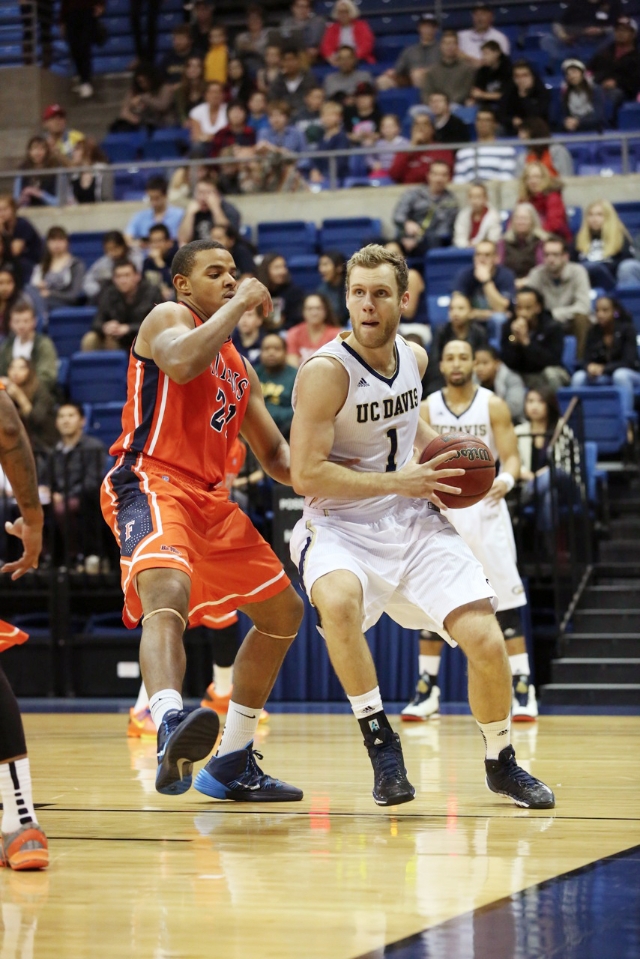
The UC Davis Aggies are coming off of a poor showing at home, losing two of their last three against Big West opponents.

UC Davis put together promising stretches in each game, including a nice run to bring them close against Hawai’i, but were unable to close out well in both of their losses. The Aggies’ defense allowed UC Riverside to shoot 55.1 percent from the field, despite the Highlanders averaging just 42.7 percent as a team on the season.

Head coach Jim Les attempted to remedy the problem, placing sophomore forward Justin Dueck and sophomore guard Olivier-Paul Betu in the starting lineup.

“Defense has been an area that we needed to address,” Les said.

The move worked for a game as the Aggies forced Cal State Fullerton to shoot under 40 percent. Against Hawai’i, however, the defense once again fell behind and allowed their opponents to absolutely dominate them to the tune of 58.2 percent shooting and 90 points.

The Aggies’ biggest struggles have come on the interior, something not helped by the recent news that senior forward Josh Ritchart will be sitting the rest of the season due to injury.

UC Davis was outrebounded by eight boards in the game and gave up 42 points to the starting frontcourt of Hawai’i. They lack an interior presence on defense as junior forward Clint Bozner has proven to be foul prone and junior forward Iggy Nujic lacks the tools to play defensive anchor. The Aggies have often resorted to having 205-pound freshman forward Georgi Funtarov play in the middle, despite not having the size or skill set to guard opposing big men.

The good news for the Aggies is that Cal Poly is equally lacking in size. Their leading rebounder, senior forward Chris Eversley, stands at 6’7” and seems to prefer shooting from beyond the arc to banging down low. Only one player on the roster who plays significant minutes is taller than 6’7” and he grabs just 3.6 rebounds per game.

This game should prove to be a way for UC Davis to get back to their stingy defense as they are facing an opponent that makes just 42.9 percent of their shots, including 33.8 percent from beyond the arc.

The Mustangs are led in points by Eversley who shoots 41.2 percent, while turning the ball over 1.4 times per game. They also score only 64.9 points per game, which ranks a solid 314 out of 351 teams playing NCAA Division I basketball.

The Aggies, meanwhile, have been able to pour in 72.4 points per game while shooting 45.2 percent from the field.

If UC Davis can recapture some of the defensive magic that they had against Cal State Fullerton while maintaining their consistent offensive performance, they should be able to escape with a win against their hated rival Cal Poly.

Of all of the flaws that UC Davis can take advantage of against Cal Poly, namely inside scoring and efficiency, UC Santa Barbara shares none.

The Gauchos are led by junior forward Alan Williams who leads the team both in points, at 22.9, and rebounds, at 10.6 per game.

Williams has also managed to be efficient, shooting 55.3 percent from the field while making over 70 percent of his 7.2 free throws per game.

Of course, to complete the package, the junior also averages an outstanding 2.4 blocks and 1.3 steals per game.

Williams is just one key part of a UC Santa Barbara squad which shoots 47.5 percent from the floor as a team. They also are No. 16 in all of Division I basketball in assists, with the team combining for over 16 per game.

Simply put, the Aggies will have to play a nearly perfect game to beat the Gauchos. UC Santa Barbara is strong where UC Davis is weak and their high powered offense will likely have no problem running through the Aggies.

The main hope that UC Davis has is to capitalize on the strategy that Cal State Fullerton recently used to beat the Gauchos. The Titans took and made a lot of three-pointers while forcing UC Santa Barbara into shooting only 33 percent from downtown on 21 attempts.

The Aggies may be able to hang with the Gauchos if they run-and-gun better than their opponent, as they seem to have little hope in hanging tough in a slowed down, half court game.


— Ryan Reed


Arts Week: 1/30

0

MUSIC

KDVS 50th Birthday Bash
Feb. 1, 9 p.m. to 12 a.m., free
Rock Band University, 720 Olive Drive Suite H
On Feb. 1 KDVS will be celebrating its 50th anniversary at Rock Band University. The show will be broadcast live and include a slew of bands, including local Davis favorites Big Sticky Mess and Whiskey Business. The doors will open at 8:30 p.m. with performances starting at 9 p.m.

Folk Music Jam Session
Jan. 31, noon to 1 p.m., free
Wyatt Deck Arboretum
Folk musicians are invited to come out and play in an informal jam session on the Wyatt Deck in the Arboretum. Musicians of all skill levels are welcome as well as listeners.

Haunted Folk Night
Feb. 5, 8:30 p.m., $5 suggested donation
Third Space Art Collective, 946 Olive Drive
Weyes Blood, Dead Western and Loner will be performing at Third Space. The bands, all similar in their dark/goth folky sound, will be sonically haunting, bringing chills to the back of your neck.

DANCE

Grupo Corpo
Feb. 4, 8 p.m.
Mondavi Center
Grupo Corpo is a contemporary Brazilian dance company that embodies the rhythmic and multicultural spirit of Brazil. The group, known for combining their contemporary stage movements with Afro-Brazilian dance, will be performing two pieces for their Mondavi Center performance.

ART

Exhibit Opening
Feb. 5 to Mar. 1
John Natsoulas Gallery, 521 First St.
The John Natsoulas Gallery will be presenting the work of Alex Reisfar along with Bark!, a collection of dog-related paintings and sculptures. Reisfar is an artist out of Portland, Ore. and was presented with the honor of being an Artist in Residence at the John Natsoulas Center for the Arts in Davis in 2012. The works will be on exhibit starting Feb. 5.

LITERATURE

Author Event with Penny Rosenwasser
Feb. 5, 7:30 p.m., free
The Avid Reader, 617 Second St.
Co-sponsored by the Jewish Voice for Peace, author Penny Rosenwasser will be discussing her book, Hope into Practice: Jewish Women Choosing Justice Despite our Fears, Feb. 5 at 7:30 p.m. at The Avid Reader. The book, which calls for Jewish women to free themselves from internalized anti-semitism by empowering themselves through activism, was published in October of last year.

Campus Chic: Judy Yi

Muse of the Week: Judy Yi, a fourth-year computer science major.

1. If you could describe your personal style in three words, what would they be?
Can I say weird three times?

2. What makes your style so “weird”?
Mostly the way I dress is like, I’ll do one style for one day and switch to a completely different style another day so I don’t really keep to my own “style.” I’ll do really androgynous one day just to see if I can do that and I’ll wear really bright colors one day and pastels on another day. I can never just like one type of style because I like everything. My closet is insane and it has mostly statement pieces in it.

3. What are your three must-have items in your wardrobe?
Acid-washed boyfriend jeans, oversized sweaters/shirts and a really comfortable pair of platforms just because I’m 5’1”.

4. What is your favorite accessory and why?
I invest most of my time and money in good shoes.

5. Where do you love to shop and why?
Thrift stores because I’m really strapped on cash and I’m still really into eclectic statement pieces, and the best place to do that is at thrift stores, like SPCA and R&R. My all-time favorite sweater cost me definitely less than $3.

6. Where did you get your head-to-toe look?
The shoes were thrifted and I originally I bought them for a cosplay. I think these thigh-high socks are my dad’s socks? All the main parts of my outfit, like the dress and the necklace, are my roommate’s. The jacket and bag are also thrifted. My dad got me this hat from Target for Christmas. The ring is from Karmaloop. The glasses are probably the most expensive part of my outfit. Everything of this outfit put together is like one-tenth of what these glasses cost me. I always buy things that are really, really cheap, but if it’s something that I’ve thought about over half a year, then at that point it’s like, “Well then I just have to get it!”

7. What do you love about shoes?
The first time I started wearing heels was like sophomore year. Now I have a full closet of heels so for the longest time every month I would buy a new pair of shoes that were around 50 bucks and I thought I was going insane. When I discovered heels I was like, “Oh my gosh, this is the best thing ever!” It was like discovering I had a superpower because I didn’t have to be short anymore. I have about five or six pairs of expensive heels so that’s not horrible, but it’s not great either. My favorite pair are my Jeffrey Campbell nightwalkers.

8. How has your style changed since high school?
I had a period in high school for at least two years where I wore the same gray sweater all the time. I thought I had really hairy arms for the longest time, so for some reason it really got in my head. I also had a crush on a guy who also wore the same sweater all the time so the combination of those two things led to me wearing that sweater everyday. I also had long hair until junior year of high school and, the first time I cut my hair, I did it myself in the bathroom. It was some kind of Mulan sh*t, but I just wanted to be different.

8. What is your favorite fashion blog?
My current favorite blog right now is Tokyo Fashion. It’s basically Tokyo street style, but it’s almost like a fashion show because that stuff you see in a fashion show is not something you would usually wear. I like looking at that because I like taking their colors and textures and incorporating it in a realistic way to wear clothing.

10. What does fashion mean to you?
I think for me it’s like an outlet because the things that I do academically, like math and science, seem very monotone to a lot of people — that’s one side of me and the only way I can express a lot of the more creative side of me comes out through clothing. It’s very much like painting. I don’t really see myself in outfits, but I see outfits as outfits on their own. I’m not going to call myself the canvas, but it’s a way to look at experimenting with fashion.

11. What final tips can you give to our fashion-forward readers?
Don’t be afraid. Most people will not think poorly of you if you’re wearing something that stands out. There’s rarely a malicious thought that’s going through someone’s head if they see someone who’s wearing something that’s out there. You’re the one who tells others what your image is, not the other way around.

012914campuschic-8378

012914campuschic-8391

012914campuschic-8393

012914campuschic-8426

012914campuschic-8455

012914campuschic-8403

012914campuschic-8451

This week in senate

0

Vice President Bradley Bottoms was absent from the ASUCD Senate meeting on Jan. 23. The meeting was called into session at 6:11 PM by President Pro Tempore Miles Thomas, who acted as presiding officer.

Senator Gareth Smythe was elected to take the place of President Pro Tempore during the meeting.

Three new commissioners were confirmed to Ethnic and Cultural Affairs Commission and four new members were confirmed to Aggie Public Arts Committee. One current member was re-confirmed to the External Affairs Commission, and a new member was confirmed as well.

A unit director report was given by Darren Schluep who represented the Associated Students Dining Services. He reported that CoHo sales have gone up this year, and that the CoHo hopes to introduce more vegetarian options for grab ‘n go salads. Schluep also reported that Chancellor Linda P.B. Katehi potentially will be serving coffee at the CoHo on Feb. 3 to fulfill her Promise to Education she made in October.

Dillan Horton, the unit director of University Affairs, reported on a recent Board of Regents meeting. He said that the UC schools, along with the CSU and CCC school systems, hope to increase their online education along with streamlining the transfer process and outreach to students in grades K-12. Some senators expressed concern that an increased amount of online courses would be detrimental because of the lack of contact between students and professors.

The Club Finance Council gave a presentation. The council said that its services have increased in the past year because of increased marketing towards campus clubs. It has not been able to fund as many club events as it would like because the cost of funding for clubs has increased.

Senate Bill 26 proposed to allocate $2,948.32 to the ASUCD unit Creative Media in order to replace old ASUCD servers. The bill passed in a 12-0-0 vote. IAC Chairman Spencer McManus said it would be simply irresponsible to not supply Creative Media with the servers that it needs because of all of the work that it does for ASUCD.

The senate meeting then moved into public discussion regarding the 2014-15 academic calendar. The issue of the 2014-15 winter break schedule was discussed for a substantial amount of time. Thomas was in favor of trying to take action on the issue, but a resolution for ASUCD to bring it to the University of California Office of the President was turned down in a 5-1-6 non-binding vote.

The remainder of the meeting consisted of senators adopting ASUCD units and assigning a member to the Experimental College task force. Three new pieces of legislation were introduced into the legislative process.


-Melissa Dittrich

Latin Americanisms: Divine Game

1

It’s no secret that football (soccer for you Yanks) holds a privileged position in the pantheon of Latin American culture. The beautiful game nears an almost religious significance for many in the region — I include myself in this group.

The commandments of the faith are beautiful in their simplicity: ‘stand by your side through thick and thin, through promotion, relegation, and be forever wary of the darkened figure with the whistle lest he lead your team astray.’

These are dictums not intended for the fickle and faint of heart. But for those who revel in the ecstasy of a well-placed slide tackle, acknowledge the exquisiteness of a goalless draw, and contemplate the mysteries of catenaccio, the pain and frustration of a lost, trophyless decade — a lost century if you happen to be an Everton supporter — is but a bump in the road on the path to salvation and silverware.

While the link between football and faith requires no metaphysical proof, in many ways the sport occupies a space that neither religion nor politics can hope to intrude on. This fact is brought out by some rather overstated but nevertheless telling incidents in football history.

Who hasn’t heard of the famed “Football War” — quite a few people actually judging from the responses I get when I bring it up — the armed conflict between El Salvador and Honduras touched off by their heated rivalry in the run-up to the 1970 World Cup? Or the more recent act of football-inspired peace brought about in Cote d’Ivoire’s Civil War by the return of their most beloved prodigal son, striker Didier Drogba. These are stories meant to provide if only a glimpse of the game’s true power to an uninitiated outsider.

This coming June will see the footballing world’s eyes turn towards what might rightly be termed the mecca of the game: Brazil. The heralds of ‘joga bonito’ will be hosting the 2014 World Cup hoping to add a sixth win to their already historic haul in past tournaments.

However, the path to the grandest spectacle in sports (hate to break it to you Super Bowl) has not been devoid of controversy. The same cities which are set to host the World Cup were embroiled this past summer in mass protests against the Brazilian government and the apparent contradictions posed by hosting a high-expenditure event in the face of persistent poverty and inequality.

The protests touched off a much needed reflection among football’s elite. A number of well-known Brazilian and non-Brazilian players expressed solidarity with a Brazilian people suspicious of the national image being sold to them. The suspicions are well founded in a world where football is increasingly commodified and encircled by interests alien to the game as many know it.

The idea that football can cure all social ills is not a new one. Many an aficionado would offer up personal testimony of its healing powers and its almost magical prowess which can serve to dispel the all-too familiar distinctions of race and class in a region which still struggles to come to terms with both. But the question that such an uncritical stance ignores is one that should be at the forefront of contemporary football — and all popular sports for that matter —  what is left when football is no longer a game for the people, but one reserved exclusively for the rich and powerful?

The popularity of the game is deeply rooted in its ascetic simplicity, a certain philosophical poverty which requires nothing more than a ball and a space to play in. The two gods of football, Maradona and Pele — Cruyff, Beckenbauer and Platini can be seen as demi-gods (think of Messi as a young, slightly smaller Hercules) — are arguably the greatest exemplars of this now often-ignored cosmology.

Maradona, on the one hand, rising from the roughest of Buenos Aires neighborhoods to conquer the world with both foot and hand (he is infamously known for his Hand of God goal in the 1986 World Cup), Pele emerging as a symbol of black accomplishment in a world maintained by the legacy of anti-blackness. This is the sacred corpus we as devoted fans risk losing in a world of multi-million dollar contracts and corporate takeovers.

If you would care to engage in some friendly banter with JORGE JUAREZ regarding Inter’s recent run of bad form you can poke fun at jnjuarez@ucdavis.edu.

Student-run international mentorship program attracts hundreds of applicants

1

After its successful run in Fall Quarter 2012 through the International Students Club (ISC), the International Buddy Program saw its official beginning on Jan. 22 and Jan. 23 at program orientation. Sponsored by the Cross Cultural Center (CCC) Services for International Students and Scholars (SISS) and the ASUCD Outreach Assembly (OA), the program aims to provide a platform for international and domestic students to socialize.

As president of ISC at the time, ASUCD Senator Shehzad Lokhandwalla created the program out of inspiration from his own experience as an international student.

“One of my good friends, Ellen Liang, was kind enough to mentor [and accommodate me to] the United States,” Lokhandwalla said. “Being inspired by that, I decided to start a domestic-international program through my club.”

A total of 234 students applied to be a part of the mentorship program, 134 of them being domestic students. During a selection process that focused on finding enthusiastic students who wanted to learn more about new cultures, 174 were chosen to participate.

Moira Delgado of the SISS and Koby Rodriguez of the CCC led the orientations, discussing the ground rules for the program, such as respecting the Principles of Community. Each night had three parts, an icebreaker, program description and restrictions and culture training.

The International Buddy Program committee behind the planning and pairing of students is comprised of Lokhandwalla, his interns Jessica Reiter, Tia Nguyen and Yanlin Alice Li and Rylan Schaeffer.

Li is a second-year applied math major and international student, and she wanted to continue her involvement with the international community.

“International students don’t normally connect with domestic students because of the language barrier,” Li said. “This is a great opportunity for international students to step out of their comfort zones, as it’s a big encouragement to do so.”
Along with learning about different cultures and getting more involved on campus, students involved also have the opportunity to form friendships. Lokhandwalla believes that participants will continue to socialize with their buddies after the quarter-long program.

Nguyen, a second-year political science and sociology double major, got involved because of an interest in her own history.

“I’m a domestic student, but I thought the program was interesting because my parents were immigrants,” Nguyen said. “People are interested in learning about new cultures, and hopefully people can make lifelong friends through the program.”

In addition to orientation, one hour of commitment per week is required. At a final event at the end of the quarter, participants will be able to discuss what they learned and receive participant certificates signed by Chancellor Linda P.B. Katehi.

The International Buddy Program is closed for winter 2014 and will not return spring 2014. Lokhandwalla hopes that the ASUCD International Undergraduate Committee (IUC) will be permanently institutionalized, as he wants the program to be sustainable and under its control in the future. On Feb. 14, ASUCD Senate will decide whether to terminate, extend or permanently institutionalize the IUC.

An official website is in the works, and until then, any inquiries can be directed toward Lokhandwalla at sslokhandwalla@ucdavis.edu.

Letter to the Editor: Response to Breathe Free: At What Cost?

0

As student assistants with Student Health and Counseling Services’ Health Education and Promotion Department, we appreciate your article for spreading awareness about the new and groundbreaking UC Davis Smoke and Tobacco Free Policy, implemented Jan. 1, 2014. Additionally, we would like to draw attention to the many resources and services offered by the University to support students during this transition period. Finally, we wish to address the editorial perspective expressed regarding the costs of promoting this new policy and supporting student tobacco cessation efforts.

Student Health and Counseling Services (SHCS) is now offering students free Nicotine Replacement Therapy (NRT) products in conjunction with professional smoking cessation services. NRT, in the form of a one-month (four-week) supply of gum, patches or lozenges, is available at no cost to enrolled students — and students can also get an additional free two-week supply of NRT from Rite Aid Pharmacy, 655 Russell Blvd., to help fight their cravings. Students just need to show their valid UC Davis ID when picking them up. In addition, free smoking cessation support group therapy is available from Counseling and Psychological Services, and individual tobacco cessation counseling with a Mayo Clinic-certified counselor is available at SHCS for as long as needed.

Regarding the cost of this initiative and the resources dedicated to its implementation, we believe what is interesting to consider is that a single pack of cigarettes costs between $6.50 and $7, including tax. This means that a student who smokes a pack a day will spend about $50 per week or about $200 per month on tobacco products. If a student chooses to quit, and there is a need to purchase more NRT than what is available for free on and near campus, the weekly cost of NRT (about $17-25 per week) would be half or less than half the cost of smoking a pack of cigarettes every day, seven days of the week. Furthermore, while a smoker will likely continue buying cigarettes, a successful quitter will probably wean themselves off of NRT in a few months.

It’s also important to keep in mind the increased healthcare costs the smoker is likely to incur in the future if they continue to smoke. Not to mention the improved health, well-being and longevity that comes with being tobacco-free. We are proud to point out that the services provided by SHCS can support a person in quitting tobacco and improve their chances of quitting for good, as many of our formerly smoking friends have been able to do. The money our friends saved on cigarettes gave them more “breathing room” in their budgets, as well as on campus.

For more information on the range of options supporting students who wish to quit tobacco, please visit breathefree.ucdavis.edu.


Sincerely,

Daniel Connor, Jillian Kern and Kevin Tran

Alcohol, Tobacco and Other Drug Student Assistants

Health Education and Promotion Student Health and Counseling Services

Aggie tennis fights through difficult weekend

0

The women’s tennis team salvaged a weekend split with a win over Pacific on Jan. 25. A day after falling to No. 1-ranked Stanford, the Aggies won the doubles point in their match against Pacific and triumphed with a 4-3 overall victory.

Senior Megan Heneghan, senior Melissa Kobayakawa and sophomore Tiffany Pham all won matches in both singles and doubles play. Heneghan and Kobayakawa dominated in their singles matches, winning 6-1, 6-0 and 6-2, 6-1 respectively, while Pham gutted out a dramatic super tiebreak win, scoring a 6-3, 4-6, (11-9) victory. Senior Nicole Koehly came up just short in her singles match, losing a tough battle in a super tiebreak as well 6-3, 6-7(4), (7-10).

It was an impressive turnaround for the Aggies after being outclassed by the top team in the nation the day before. Stanford defeated UC Davis 7-0 overall on Jan. 24. Stanford boasted a roster including five nationally-ranked players in singles, and a pair of top-ranked doubles teams as well.

The ability of the Aggies to bounce back and get a tough road win the very next day speaks to their strong and positive mentality as well as close team camaraderie. The skill and talent were present as well in the matchup against Pacific once the early season nerves wore off after the match against Stanford.

The road trip continues for the women next weekend when they play at San Diego State on Feb. 1, and then at UC San Diego on Feb. 2.

The men’s team was in competition over the weekend as well, albeit for only one match. They took the courts at Pacific on Jan. 25 just after the women’s team triumphed. The men did not fare quite so well unfortunately, falling 6-1 overall. The lone victory for the Aggies came in singles, courtesy of a 6-4, 6-4 victory for freshman James Wade. This was Wade’s 11th singles victory of the season, tying him for the team lead with sophomore Brett Bacharach. Bacharach very nearly added to his own tally, but came up just short in a 6-1, 6-7, 3-6 loss.

The men will look to bounce back at home as they open up a six-match homestand beginning this next weekend. On Feb. 1, they host San Francisco and on Feb. 2 they play Loyola Marymount here in Davis, Calif.