55.5 F
Davis

Davis, California

Tuesday, December 23, 2025
Home Blog Page 882

The Philosophy of Education: Rec. Letters

0

Most of us will need recommendation letters at some point in our careers, often upon graduation. How do you plan to get them, and who do you plan to ask?

Recommendation letters primarily show your character. They should be as if introducing a friend by detailing a long-term positive relationship. As a result, someone who does not know you well cannot write an honest letter. For example, if you got an A in a class and perhaps came to office hours once or twice, how can that professor honestly assess your character? We must first plant the seed by spending time with the person before reaping the letter.

While getting an A does not entitle you to a recommendation letter, it is a good starting point for getting to know a professor. For example, if you just got an A and greatly enjoyed the subject, and if the professor has a lab, why not ask to join it? The worst that could happen is to be rejected, which is exactly the same result as if you did not ask.

However, many students have not cultivated relationships with professors or employers during their college years. Thus, upon beginning their application to a graduate or professional school, they realize they need letters and thus go to all of their old professors, who do not remember them after several years.

To get a letter from a professor who does not remember them, many students introduce themselves with their grade in the professor’s class. Then, they flatter the professor. Afterwards, they ask for the letter — it’s like a business transaction, not a relationship. Here is an example of this trope, from a real student, provided by a UC Davis professor:

“My name is […]. I took your Organic Chemistry A Class in Spring of 2011. I received an A+ in that class. You were among the best professors I had at UC Davis. […] You are a very inspiring teacher, and I was honored to be one of your students […] I know it has been a while, but I need letters from my professors, and you were among the first people I thought of. Please let me know if you are willing to write me a letter.”

Then, whether or not they get the letter, they never come back. Many professors, if asked this way, will ask, “Are you sure you want me to write a recommendation letter for you?” This is a sure sign that the professor knows that he or she cannot write a letter that will help. If pressed, many professors will write the letter because they do not want to offend the student. They are worried that telling the truth — that they do not remember the student and thus cannot write a recommendation letter — would embarrass the student. However, these are not real recommendation letters.

Even if we get letters this way, it will definitely not help and instead likely hurt us. As the professor does not know us, he or she cannot write honestly about our character or experiences with us and so must focus superficially. However, applications require three recommendation letters. If all three of them are fabricated, do you think they will present a deep, coherent picture of your character?

Police use the same trick: they ask witnesses or suspects for their stories separately. If those stories do not agree beyond superficial details, likely all or most of them are lying. Similarly, any admissions board receiving fabricated letters will immediately see it and probably reject you.

For a professor to write an honest letter, he or she must know you well as a person. For example, if you worked or volunteered, such as in a research lab or a coffee shop, your boss would likely know your character well. That person would write about specific experiences with you that show your character, which are much more powerful than generic statements like “He is trustworthy and hard-working.” In addition, that work experience would appear elsewhere on your application, showing that this person actually knew you.

To get jobs or research opportunities, you must be bold. For example, if you want a job, whenever you see a “Help Wanted” or similar sign, apply for the job! Don’t be shy or afraid of asking people for what you want or you will never get it. Even if you don’t get the job, you likely learned something from the attempt and can try again for another job.

If you cultivate positive relationships with people of higher standing, getting recommendation letters, a critical part of applications, will be easy. In fact, those people will often tell you that they would be pleased to write you a recommendation letter whenever you need one without you asking first. This enthusiasm will be obvious in the letters, making them extremely powerful. However, we must make the effort; professors and employers will not come to us.


To share your experiences with recommendation letters, contact WILL CONNER at wrconner@ucdavis.edu.

 

UC Student Regent visits UC Davis

0

On Jan. 24, UC Student Regent Cinthia Flores and Regent-designate Sadia Saifuddin visited UC Davis to discuss the upcoming 2015-16 Student Regent Application, as well as answer questions from the public about the state of the University of California (UC). The meeting was held from 11 a.m. to 12 p.m. in South Hall.

The Student Regent is a representative of approximately 230,000 professional, graduate and undergraduate UC students on the UC system’s governing board, the Board of Regents.

The bulk of the meeting was spent showing a presentation by the Student Regent representatives on changes to the Student Regent application and encouraging students to apply.

A major change to the application includes a switch from paper to online submissions. According to Flores, instead of submitting a paper application to their respective chancellor, students will now email their application to Anne Shaw, associate secretary of the Regents and their prospective campus’ Regent liaison.

Another change to the application includes a new personal statement format. Instead of having to answer specific questions in a character limit as done in previous years, the application will now ask students to write a six-page, double-spaced narrative based on guided questions.

During the meeting, Flores encouraged students from UC Davis to apply for the position because of a lack of Student Regent presence from UC Davis for the last seven years.

“UC Davis hasn’t had a Student Regent in a really long time,” Flores said.

Before the presentation began, Flores and Saifuddin listened to and answered questions from the audience regarding issues facing UC students.

Issues presented included inconvenient access to Student Regents, more inclusion of gender-neutral restrooms, the increase in UC privatization, a longer orientation, an increase in online courses, an emphasis on teaching rather than research, not enough representation of international students and the decline of women in STEM (science, technology, engineering, mathematics) majors.

“A lot of times, instructors are not actually teaching students and they’re kind of paying a lot of money to teach themselves when that’s what your professors are supposed to be there for,” said Star Bacon, a third-year community and regional development major, as well as Student Assistant to the Chancellor.

The UC Student Regent application consists of three components: a general information form, three references and a personal statement. The applicant will also go through three interview rounds. Applicants will first be interviewed by the Regional presidents. The top ten candidates will then be selected and subsequently interviewed by the University of California Students Association, who will choose the top three students to be interviewed by the UC Regents Selection Committee.

The UC Student Regent must be a UC student with at least two years remaining at the UC. The student serves as the Student Regent-designate for the first year and the Student Regent for the second year. According to Flores, the Student Regent-designate and Student Regent perform the same job responsibilities, except only the Student Regent is allowed to vote.

For Saifuddin, the short term allows the Student Regent to develop innovative alternatives to current policy.

“Cinthia and I sit on the board for two years so we recycle out a lot more quickly than other Regents,” Saifuddin said. “Other Regents are appointed for 12-year terms and oftentimes they’re old, they come from a very specific demographic, so they may not have the same ability to think outside the box that we do as students.”

Saifuddin said she is the second undergraduate student to hold a Student Regent position in approximately 10 years. She said this is due to graduate and professional students having a longer time to build their resumes in order to obtain the position.

According to Flores, the Student Regent and the Student Regent-designate are the only people on the board who have a specifically designated student interest as their primary job responsibility.

“It is our job to fight for student’s interests and priorities; often times these are determined by the UC Students Association, the Council of Presidents and different governing bodies. Students bring us issues, and it’s our job to bring them back to the Board of Regents,” Saifuddin said.

Flores also said the Student Regent is the primary advocate for access, affordability and diversity at UC.

Along with voicing student issues to the Board of Regents, each Student Regent also has their own personal agenda they works toward. Flores said that her personal agenda dealt with issues involving access and diversity, while Saifuddin said that she was interested in issues of affordability. Student Regents also have the responsibility of building student power within the University through communicating with statewide leaders.

“There are times when the going gets tough, but at the end of the day I can sit back and say, ‘I’m here. I’m making a change. These are the issues I’m working on and working towards,’” Flores said.

The 2015-16 Student Regent application is due on Feb. 20.

Apartment rent in Davis increases

As Winter Quarter begins, so does the search for off-campus housing. Getting roommates in order, picking the perfect location and scoring the unit of your choosing can often seem like miracles when they come together. However, one detail can be the difference between realty heaven and housing hell: the price.

Over the last two years, Davis alumnus Matt Cooper has conducted a project in which he has recorded the prices of different apartment units within Davis. For the year 2013, he found the prices did increase when it came to singles and three-bedroom apartments.

Cooper’s data shows that the prices of one bedroom apartments rose 5.5 percent and three-bedroom apartments rose 7.5 percent. The price of two-bedroom apartments actually dropped 3 percent over the course of the year.

“The crazy thing to see is the fluctuation within the year,” Cooper said.

He found that it was cheaper to rent an apartment in Davis in December than it was in September, which he speculates is due to the University’s academic schedule. Cooper said that the prices can change as much as 20 percent between different months.

“It’s a supply and demand kind of thing,” Cooper said.

For one four-bedroom apartment unit at Sycamore Lane Garden Apartments, rent increased by $100 per month for next year. Prices also increased on all of the units at Sharps and Flats Apartment Homes located in South Davis. Ken Brown, their assistant community director, attributed the raise in rent to the increase in water prices brought on by the Woodland-Davis Surface Water Project, because the apartment includes water in the price of rent as does Sycamore Lane Garden Apartments.

Oakshade Commons Apartments, among others, have started charging their residents for water as a separate fee from their rent.

“Under new management, they raised rent by $600 a month and started charging $15 a month per person for water and garbage removal,” said Harman Grewal, a fourth-year exercise biology major. “It’s confusing because I don’t know if we had to pay this last year, or if new management is trying to make a larger profit.”

Fourth-year design major Hannah Feldman concurs with Cooper and said she believes that the rising prices have to do with supply and demand. She said she thinks that students are willing to pay the higher prices for prime real estate located comfortably close to campus.

Although the general price of housing in Davis is on the rise, affordable options are available. One option is to seek housing in one of the Solar Community Housing Association’s cooperative housing units which include the Baggins End Domes on the UC Davis campus.

The Solar Community Housing Association is a nonprofit organization that operates their housing in a cooperative structure, meaning that the residents both live and work together to do maintenance tasks in lieu of hiring professional help.

The average room in one of the co-op houses costs $375 per month. By comparison, Matt Cooper estimates from his data that a one bedroom apartment in Davis in 2013 would cost $895 per month.

“Creating community within our homes, and among our housing co-ops is a huge benefit that holds far more value for many of us, than just our relatively low rent,” said April Kamen, a coordinator for Solar Community Housing Association, in an email.

Although affordable options exist, as long as Davis has a steady flow of students that need roofs over their heads, the increases in rent will be inevitable.

“As long as UC Davis students are flooding the area, I see no reason why renters wouldn’t keep jacking up their prices to make more money,” Feldman said.

Meet Your Representatives: Victoria Tam and Gareth Smythe

0

Senators_CieraPasturel

Name: Victoria Tam
Major: Undeclared social sciences
Position: Commissioner for the Ethnic and Cultural Affairs Committee
Year: Second year

What career do you hope to pursue after your education? How will ASUCD help you in your future plans?

I came to Davis thinking I’d be a lawyer, and I discovered that I’d rather be helping younger students who need a little more push and encouragement, so I want to go into teaching — probably middle school or high school. ASUCD is definitely a busy organization, and being in ECAC which is a part of ASUCD is really helping me learn how to interact with people. You’re always busy planning something with other people, or listening to others give presentations about their legislation. It’s great for social skills — people skills.

What’s your favorite drink at the CoHo and why do you like that drink in particular?

Ahh! I get the drink that they have every month. They get me every time! I feel like people mostly buy them because they’re “limited,” but yeah they got me there.

What’s your biggest fear?

Not living up to people’s expectations. Yeah, my family — my mom in particular. It’s a family thing. Coming to college has really gotten me to loosen up a bit, I feel like I can breathe now.

If you were giving a graduation speech, what would your theme be?

I read this book the other day about bamboo, how it bends but doesn’t break. So you know when life throws stuff at you, you could use that idea. No matter life’s hurdles, be a bamboo: bend but don’t break!

If you give one person you know a superpower, what would it be and why would you choose that person?

Woah! I should’ve studied! It’s usually for yourself, I have to think about that. Oh man, I have so many people I’d give superpowers too. Um… well I have this one friend who’s going through some sort of self-reflective problems. I’d like to be able to give him the power to see beyond himself, and not be trapped with thoughts that are hurting him.

How confident do you think you are on a scale of 1-10?

For the political issues, I’m pretty confident so I’d say an 8 or 9.
But on a day-to-day basis, probably a 6.

Senators(Gareth)_CieraPasturel

Name: Gareth Smythe
Major: Double major in political science and history
Postion: ASUCD Senator
Year: Second year

What is your favorite memory from your hometown?

I was born in Torrance, Calif. but I live in Seal Beach so about 20 to 30 minutes away from L.A. Well, I was walking with some friends at the beach and all these sea lions were coming up on the sand. You know, it’s called Seal Beach for a reason. So I got to see them come up on the beach and everyone was taking pictures and it was really nice to be a part of that community experience.

What was the deciding factor that helped you pick Davis?

I was overwhelmed by the beauty. Also consistently, everyone’s been so friendly, that’s just the Davis culture — a smile and a wave. I’m a tree person, I love the trees, and I was going through the Arboretum and the redwood exhibit and it’s so beautiful. Then I stepped onto the Quad and there’s these huge trees and big flagpole and I just knew that this is the place I want to spend my time at. So I canceled all my other tours, and Davis was my first tour!

If you were giving a graduation speech, what would your theme be?

My theme would be the culture of UC Davis and how it can relate to your real life. So taking what it is that we do best here, so empathy which is kindness, which is accepting of all cultures, which is working together towards a goal — taking that out of this community and dispersing it throughout the country and the world. This whole #oneucdavis campaign, the message is “despite our differences we are united as one;” I think that’s something that the world is losing sight of.

What’s your ideal date?

My ideal date involves great conversation, good food and something with the Arboretum. I love the Arboretum, just walking through it or something like that.

Who is the person who you most admire and look up to?

There’s so many people that come into our lives that we look up to. My grandfather has had a huge influence on my life. He was very successful in his life and he’s kind of given me his philosophy on how to manage people, how you use honesty to control the situation and how you never let your emotions get the better of you. Always stay in the rational and the logical because only through that do you get the actual work done.

How confident do you think you are on a scale of 1-10?

In sociology class we’re talking about something called egoism, which is how everyone rates themselves higher than they actually are, so I’m not confident in my confidence … but I would say probably about an eight.

Amazon partnership: The 98 percent

0

Nov. 22, 2013 marked UC Davis’ embarkment on a unique partnership with Amazon, the massively successful online shopping website. UC Davis is the first university to partner with Amazon in this venture.

The program, as currently implemented, allows UC Davis to earn a little over two percent of all profit gained by Amazon when students shop on either Amazon.com using their UC Davis email addresses, or at the UC Davis storefront, davis.amazon.com.

The University is trying to help its students in this partnership with Amazon and it is admirable, to a certain degree. However, the collaboration with Amazon misses the point entirely. The money that the University receives will be directed back toward student funds. Part of the profit, at least $40,000, will be used to create a textbook scholarship to help students in need. The rest of the money will be used to help support other student programs on campus.

It’s nice to see money going back to the students, as it rarely does, but the University seems to believe that this partnership will provide an additional source of revenue for itself as well as quelling the masses of students who have been vocal about the ever-rising prices of textbooks. The problem with this thinking is that it attempts to mask a much larger problem: the ridiculous cost of required materials at the UC Davis Store.

The UC Davis Store is supposedly a service to the students that provides “the tools of education at the lowest possible cost.” This has not been the case, as evidenced by the large number of students who shop elsewhere, such as Amazon, when buying textbooks. Clearly, Amazon has been taking away business from the bookstore.

Yet, the University is under the impression that the deal with Amazon “will generate significant revenue for the University and [does] not believe it will harm [its] in-store sales.” After all, 2 percent of sales can add up to quite a bit.

While this may be true (we doubt it), there seems to be a much easier way of creating sustained revenue for the University through the bookstore: lower the prices.

It is asinine enough to be asked to buy or rent the newest edition of a textbook that only differs from an older version by a new picture on the cover and/or a rearrangement of chapters. The least the University could do is lower its prices to be semi-competitive with other textbook retailers.

Beyond that, this seems to be the “win-win” situation that UC Davis is yearning for. The University would be able to earn more money through students actually purchasing books from the bookstore. Instead of a measly two percent, UC Davis would actually earn 100 percent of the profit sold from these books.

This plan also allows students to actually purchase textbooks at a reasonable price and be winners of the deal. Instead of allowing other companies to provide for students’ needs, do it yourself. Provide affordable textbooks that students would be able to purchase.

Let’s face it, the students need the money way more than Amazon does.

Ethnomusicologist to speak on campus

0

A post-doctoral fellow at UC Berkeley, Dr. Rui Cidra, will be giving a lecture on his paper on the music of Cape Verde and its reflection of indentured workers from plantations in São Tomé and Principe.

Cidra will give his lecture on Feb. 7 at 3 p.m. in Everson Hall, Room 233. The lecture will be presented as part of the Valente Lecture series.

“My paper focuses on use of music as social memory between colonial and post-colonialism,” Cidra said. “I analyzed two modes of memory, music performance and music experience, while focusing on popular music between the 1960s and the present.”

Dr. Cidra will also discuss what the music means.

“The circulation of such music focuses on a national memory on the plantations of São Tomé,” Cidra said. “I interpreted narratives on indentured workers, which conveyed an ethics of survival and the experience of indentured work on a plantation. This music brings together different paths around the same events, broadening our ideas of pasts and present.”

Dr. Cidra’s research began at the end of the 1990s, when he began interviewing Cape Verdeans who lived in Lisbon. This eventually led to a nine month stretch doing field research in Cape Verde before he returned to Portugal to finish his research.

Dr. Cidra ended up at UC Berkeley when he wanted to do a post-doctoral program outside of Portugal.

“I contacted a professor in the music department, Jocelyne Guilbault, because I fond of her work,” Dr. Cidra said. “I think that the context and problematics of her work in the Caribbean and mine in Cape Verde had something in common. I got funding from Portugal to do this and I ended up here doing this program.”

Dr. Katherine Lee, who has been organizing the ethnomusicology lectures for the Valente series for a year, got Dr. Cidra to give a lecture at UC Davis while visiting Berkeley for an event.

“We met a faculty at Berkeley who suggested he give a lecture in Davis,” Dr. Lee said.

Dr. Cidra believes that his lecture will be interesting to audiences.

“First of all, they’re going to hear very nice music from different genres of Cape Verde music,” Dr. Cidra said. “Second, I think that this can bring new empirical and theoretical materials on music and social memory. It can help answer the very broad and global question of how music can shape social memory.”

Gratefulness leads to happiness

When it comes to gratefulness and positive thinking, not much research is available on children and adolescents. However, Dr. Robert Emmon’s research from UC Davis, in collaboration with Dr. Giacomo Bono (Whittier College) and Dr. Jeffrey Froh (Hofstra University) builds a scientific basis for trying to understand gratitude in children. This study is one-of-a-kind because it is the first to assess grateful thinking in adolescents — an area of research that has been neglected due to the common misconception that children are ungrateful.

“Gratitude is the ability to be aware of the gifts life provides that we have done absolutely nothing to earn, deserve or receive,” said Dr. Emmons in an email interview.

Seven hundred middle school students were assessed on their measures of gratitude, pro-social behavior, life satisfaction and social integration every three months for a six-month period.

The researchers found that gratitude is a complex emotion that begins to spark in children around the ages of 10 and 14.

“Participants were instructed to count up to five things in which they were thankful for and write and deliver an appreciation letter to someone. Aside from the control group, the non-control group were taught to think gratefully,” Dr. Bono said.

 After a six-month period, participants’ measures on these assessments were analyzed. The study took three years to complete.

“Gratitude interventions can enhance feelings of resiliency, which acts as a buffer in times of adversity,” Dr. Froh said.

The researchers found that six months after the study, the participants who were taught to be more appreciative achieved easier social integration — meaning they were more socially adept and fit in better with peers. Social integration was found to be negatively associated with depression, envy, delinquency and antisocial behavior. Consequently, it was found to be positively correlated with a higher grade point average, life satisfaction, positive affect, self-esteem, hope and happiness.

Practicing an attitude of gratitude can make individuals healthier, function optimally, improve well-being and lead to more resiliency. According to Dr. Emmons, resiliency acts somewhat like a psychological immune system that protects the individual during times of stress. Such a mindset can allow an individual to change his or perception about difficulties, and view them as opportunities instead.

This in turn, allows grateful people to notice and appreciate the good things that happen to them. Over time, if one is truly thankful for the gifts they receive in life, one develops the need or dependency to do something in return — paying it forward, also known as “upstream generativity.” Feelings of indebtedness evolves into a full circle, benefiting not only the individual, but others as well.

“Anyone can teach themselves how to become more grateful. That’s the great thing about gratitude — no one is ever too young, too old, too rich, too poor, too sick, too healthy to practice gratitude — [it’s] freely available to all!” Dr. Emmons said.

Before they were professors, they were us

0

Professor Ashutosh Bhagwat

UC Davis law professor worked as Justice Anthony Kennedy’s clerk

When Professor Ashutosh Bhagwat of UC Davis’ School of Law was 26 years old, he was one of the 36 clerks for the United States Supreme Court Justices. Today, he teaches constitutional and administrative law, subjects that had great importance during his clerkship.

“I’m really interested in politics and policy,” Bhagwat said.

Bhagwat completed his undergraduate education at Yale, where he majored in history.  Following this, he moved to the University of Chicago’s Law School, where he graduated in 1990. The Federal Reserve was his next move, where he worked as a research assistant.

 From there, he moved back to Chicago for a clerkship position with Richard Posner, a justice on the Seventh Circuit Appellate Court. Posner is widely regarded as one of the fathers of law and economics, according to Bhagwat, and with him, Bhagwat gained experience for his next job.

At the Supreme Court, Bhagwat spent a year clerking for Justice Anthony M. Kennedy, who still serves. His clerkship responsibilities included researching issues and helping the Justice write opinions, which, according to Bhagwat, was a job that held some weight.

“Clerks had more influence in technical cases,” Bhagwat said. “You could actually convince the justices.”

Though he said that it is not rare for the Supreme Court justices to defer to the judgment of their clerks, they rarely do so on landmark cases, for which they are sure to draft their own opinions.

The clerking experience has traditionally been reserved for only a handful each year. Clerks are often young, a conscious decision by the justices, according to Bhagwat. Young clerks help the justices understand the newest trends in law, often displayed to students in school.

Bhagwat also said he believes that many justices hire clerks with little attention to political leanings, despite their own views. Hiring on this basis helps the justices keep an open mind to varying interpretations of laws.

“All the clerks were encouraged by Kennedy to come up with their own ideas,” Bhagwat said.

Bhagwat described his one year with the court as an incredible experience. He still keeps in touch with several of his co-clerks, and said that these close relationships were the most valuable part of the job for him.

“One of the coolest things about clerkships in general is that there’s a familial-like relationship … the [Justices] keep mentoring,” Bhagwat said.

Bhagwat’s clerkship played an important role in his job search.

“[Being a clerk] makes you an incredibly valuable commodity,” Bhagwat said. “It helped in getting my academic job.”

Before academia, Bhagwat worked at a law firm in Washington for two years, but said that the allure of teaching was stronger than that of private practice.

One [of the advantages of] teaching is you get to a much bigger range of things, you get to pick your topics … it’s a lot more freedom,” Bhagwat said.

Professor Diana Davis

History professor practiced veterinary medicine in refugee camps

Professor Diana Davis said that her particular interest in environmental history stemmed from experiences in her youth. She offers unique courses like History 109A, which analyzes the human perception of how the world has environmentally changed, and History 109B, which helps explain how environmental change relates to disease and public health.

Davis said that both courses reflect her personal history. Her early ambition revolved around pre-medical aspirations, and she traveled extensively, feeding her insight into fields she had not initially considered, like geography, a discipline in which she earned a master’s degree.

“I went to Morocco … to study nomads,” Davis said.

Davis reflected on this excursion saying that in studying the nomadic people of Morocco, it became clear one of their main concerns was a severe drought that was having a heavy impact on the animals in the region.

“I came back wanting to be a vet,” Davis said.

According to Davis, she had a stroke of luck and was accepted to Tufts University School of Veterinary Medicine.

During vet school, she said she was able to take a trip to Afghanistan and Pakistan in the mid-nineties.

“This was before the rise of the Taliban and later Al Qaeda. The Soviet Union had just fallen a couple of years before … it was before things got so incredibly dangerous,” Davis said.

Davis was based in a town on the  Pakistan side of the Afghan-Pakistani border called Quetta. She said that for three months, she helped train Afghan male herders in basic veterinary medicine, using pictorial methods as many were illiterate.

“All the medical services and the veterinary services along with almost everything else in Afghanistan had been destroyed by the war,” Davis said.

Davis also interviewed women to see if their culture permitted them to be able to provide veterinary services. According to Davis it did, and the women were often more knowledgeable about the condition of animals than the men.

“Those three months, I worked largely in refugee camps,” Davis said.

She said she tried to learn the local language, Pashtu, but was largely unsuccessful, and so used an interpreter for interviews and conversations.

“I went straight into a PhD in geography at Berkeley. I wanted to go back to Afghanistan to get my PhD there, but it got increasingly dangerous,” Davis said.

She earned her PhD in 2001, and after this, ventured back to Morocco, studying ethno-veterinary medicine, a field which looks into how different cultures and peoples practice veterinary medicine.

After two years in Morocco, Davis also spent a year in France on scholarship.

She noted that the Moroccan nomads complained about NGOs (non-governmental organizations) as they had not been carefully considering the agricultural practices of the nomads.

These findings grew into Davis’ first book, Resurrecting the Granary of Rome, which looks at the colonial opinion of North African ecology and how these views have influenced the present day.

“My experience with the Afghans … profoundly shaped me. They were so kind, so gentle, so loving with their children and their animals,” Davis said.

Davis said that these years were transformative and integral in creating the educator and person she is today.

“As a trained geographer who has done extensive historical research on the Modern Middle East, Diana brings a refreshing interdisciplinary and theoretical sophistication to our department,” said Davis’ colleague Professor Omnia El Shakry of the History Department.

Tune In

0

Bedtime Music

One of the best times to listen to music is right before bed. You take a shower, get all clean and cozy, turn off the lights, put on some big ol’ headphones, put on a soothing playlist and chill. Such a great way to end the day.

In this situation, music saves us from the self-conscious thoughts that would otherwise consume us whilst laying in bed. Music calms us, it sends us into dreamland feeling like things will be okay. I attribute much of my sanity to these late-night music seshes.

But what makes a good bedtime song? One obviously can’t just put on his/her usual Iron Maiden or LMFAO. Here are some attributes I look for when I’m trying to prep for sleepy time:

1) The song must be relatively low-energy.

When lying in bed with the lights off, I’m aiming to become relaxed. After all, the overall goal here is to eventually get to sleep. Groups like Beastie Boys for example, while awesome, fill me with energy. They make me want to go play tackle football or run a few miles. In the morning, these effects are awesome, but when trying to wind down the day, it’s just not the right vibe.

Emotional content can still be present in low energy songs. I look for songs that instill a sense of subdued inspiration. I want my heart to feel the music, not the rest of my body. The song “Hear You Me,” by Jimmy Eat World, is a great example of this phenomenon. The melody of the song is slow and pretty, strummed lightly on an acoustic guitar. Toward the end, the song features loud electric guitar, but maintains the slow rhythm and sad, heartfelt lyrics.

Jim Adkins’ voice is soft and genuine, complemented by the soft acoustic guitar. The ingredients for subdued inspiration, perfect for a pre-sleep music session.

2) The song must be relatively simple.

I don’t want to hear a song that forces me to solve a riddle, or follow a complicated story line. I want to relax my mind, I want to let my brain rest. Therefore, I look for uncomplicated songs. When enjoying music at the end of the day, honestly, the sound of the music is often more important to me than the lyrics. So I certainly do not want to listen to a song in which the lyrics force you to use brainpower.

An example, you ask? “Heaven at Nite” by Kid Cudi. The song’s message is simple (although I’m not sure if I know what exactly it means) ­— have you ever been to heaven at night? The mental image of heaven at night is very pleasing. I imagine acres of perfectly lit, greek-style pillared buildings and green grass. Also, the soothing-ness of Kid Cudi’s voice is key — it doesn’t dominate the song. You aren’t forced to acknowledge his singing. This allows the listener to relax his/her brain. When this happens, the song as a whole can really engulf the listener’s being.

3) The song must have a beautiful melody.

I know what you’re thinking: Tyler, shouldn’t this one always be a rule not merely for bedtime music? Why, reader, not necessarily. The key word here is “beautiful.” A song can be great without being beautiful. The song “Thunderstruck” by AC/DC, for example, is a fantastic song. However, I would not consider it a beautiful melody. I love the song, but it is not one I would opt to listen to before bed.

To me, beauty comes from a song’s ability to speak directly to your heart and soul. When I can detect genuine emotion in a song and get a rise from it, then I consider it beautiful. Different chords, lyrics and melodies do this for different people. We are not all going to select the same pre-sleep music, but a song that exemplifies beauty to me is “I Wish” by R Kelly. The lyrics are simple and straightforward, how he wishes he could just step away from all the fame and see his parents again. The beat is slow, soft and melodic. His sadness comes through so unmistakably, and all of it together definitely hits me in the heart.

R Kelly gets a lot of crap for his offstage shenanigans, but he makes some beautiful music. This song gives my heart a final little jolt before I sleep, and sets me up to start the next day inspired.

Music is meditation. It can be a fantastic tool, one that can be utilized to manipulate your emotions. Songs following these three rules get me in that perfect bedtime zone, and let me drift off to dreamland in a satisfied trance. Hopefully they do the same for you.

UC Davis Store partners with Amazon

0

On Nov. 22, 2013, the UC Davis Bookstore officially announced online its partnership with Amazon — the first partnership that Amazon has had with any university. Amazon approached UC Davis during Spring Quarter of 2013 to pitch the idea of this pilot program.

UC Davis will receive a little over 2 percent of most purchases by  students that shop at Amazon with a UC Davis email account, or customers that shop at davis.amazon.com.

According to a Jan. 27 news release, students can sign up for a free six-month membership of Amazon Prime that would provide free two-day shipping. After the six months, students would pay $39 to continue their membership — 50 percent less than the regular price.

UC Davis Stores Director, Jason Lorgan, says that a portion of the funds will go to support a upcoming textbook scholarship program for students in 2014. The rest will fund other student programs and services.

“They recognized our store was the first university store in the nation to offer our students textbook price comparisons on our ucdavisstores.com textbook ordering page, resulting in UC Davis Stores being one of their larger textbook affiliates among U.S. colleges stores,” Lorgan said.

Lorgan believes the partnership will increase the current revenues for the UC Davis retail operation and that it will not be detrimental to in-store sales.

“The benefits the program provides to UC Davis students include a free six-month trial membership for Amazon Student Prime. Amazon Prime provides our students with free second-day air shipping on Amazon orders,” Lorgan said.

Lorgan explained in a news release that UC Davis has continuously set itself apart from other university bookstores. With the rapidly increasing cost of books and tuition, students are constantly looking for options to find better deals. Three years ago, the UC Davis bookstore began the price comparison for all books, a decision many were critical of at first. Now hundreds of stores have followed suit.

Public Relations Officer for Amazon Brittany Turner explained that the program so far has been a success. They have started an Amazon Brand Student Ambassador program.

“These students are big Amazon fans who want to help spread the word about Amazon’s offerings for students to their friends and peers,” Turner said.

Lead Brand Ambassador for the Amazon Student Ambassador Program, Ting Jung Lee, a fourth-year political science major, believes the program is really beneficial to the student community.

“As a student representative, I aid Amazon’s On-Campus Marketing Team to throw a series of fun and interactive events at UC Davis. During finals week of Fall Quarter, we had several ambassadors all over campus handing out free pizza and other goodies to fuel the students while they study,” Lee said.

Lee adds that she is excited about how prominent Amazon has become on the campus.

“It really goes to show what an influential university we’re becoming to have such a large brand come in and support us,” Lee said.

All other Brand Ambassadors declined to comment.

The UC Davis-Amazon collaboration is intended to be beneficial to students and the community at large who are already doing much of their shopping on Amazon. Without any additional costs, it is said to support the school and its students.

ASUCD Controller Eric Evans believes that Lorgan’s team has been creative in finding new revenue despite the changing climate of the bookstore.

“I don’t see UC Davis changing our school-owned and school-operated model unless the bookstore becomes drastically unprofitable without a solid recovery in the cards — if that happens, the campus would probably look to an outside contractor to run the Stores to shed the risk,” Evans said.

He expands on why it is important the bookstore remain campus-operated — to give back to students via student employment.

“The importance of a campus-run bookstore lies less in who’s taking home the margin and more in who gets employed there,” Evans said. “Our campus is a nonprofit entity, so any money we make at the Stores gets returned to the students in other ways … The university ownership and reporting structure ensure that when CRU is staffing the bookstore or the ARC, they turn first to student employees.”

Teresa Torres, a second-year microbiology, genetics and Chicana/o studies major and bookstore employee says she has been seeing a significant increase in advertisement for the partnership. She believes this program is very beneficial because as is, students often struggle with book expenses and Amazon has offered deals on books and other things students need.

“Honestly, I don’t think there [has been] a big impact … so far I haven’t [seen] anything happen,” Torres said. “I have seen them hand out discount coupons like $15 off a $50 purchase, but that is about it. Then again there could be some type of benefit to the partnership since it is still happening. Hopefully, the prices of textbooks go down. Now that would be awesome.”

MUSE speaks with Peggy Sue

1

Peggy Sue isn’t just “folk.” According to NPR, it’s “mountainous and brooding” — perhaps bluesy, pop-rock influenced post-folk, with catchy guitar rhythms and strong harmonies. Rosa Slade, Katy Young and Olly Joyce have been making music together since 2005 and have toured with the likes of Mumford & Sons, Jack White and The Maccabees. Their third album Choir of Echoes dropped Stateside on Jan. 29.

Of the album, the band wrote, “Choir of Echoes is an album about singing. About losing your voice and finding it again. Voices keeping each other company and voices competing for space. The call and response of the kindest and the cruelest words. Choruses. Duets. Whispers and shouts.”

The Brighton, England natives will be playing at Third Space in Davis on Feb. 8.  MUSE had the opportunity to talk to Joyce on the phone.

MUSE: Choir of Echoes sounds far more confident than your previous two albums. Did anything trigger that?

OJ: In between making the two albums we actually recorded a compilation of songs, an all cut up soundtrack. I don’t know if you’re familiar with the film Scorpio Rising, but there’s no dialogue [in the whole] film, just these songs, and we recorded covers for them. That influenced Choir of Echoes quite a lot. We learned what you can take out, as far as instrumentation, and what you can leave in. That added to the confidence, that understanding. One of the guitarists that played on the original recording actually came to a gig of ours, he said he liked our covers a lot.

This album is getting comparisons to big names, like Warpaint and The xx. Are these welcome, or uninteresting? Are they among your influences?

I always think it’s interesting when we get comparisons to particularly female artists, especially Warpaint and The xx. I think it’s sort of lazy journalism, really. They’re flattering, for sure, but kind of lazy. We’d like to think we’re more individual than comparisons like that. We’re influenced by Bob Dylan, for example, and other strong lyrical songwriters. But that kind of goes back to the previous thing — we work as a band to create our own music.

Has Peggy Sue been recording Choir of Echoes over the three year hiatus, or is it a relatively new production?

I suppose we were writing the songs for perhaps a year, and then the recording process was maybe a month at the most. We lived at the studio, and recorded there, but the girls [Slade and Young] are always writing songs, and they always have lyrical ideas. When they bring them to the band I don’t think you could ever guess when it was written or who it was written about or where it actually comes from. Then, when it comes to the band, the timeframes get a bit skewed, but definitely the songs were all new save for one, which Rose and I had from the Acrobats [Peggy Sue’s second album] demo.

What was the highlight of recording — was it your time in the studio?

Yes, staying in the studio was brilliant. Black Sabbath has recorded there, tons of people that we all admire, and the setting was really great. Ben Rubinstein, who plays bass on this record, didn’t play on Acrobats. It was really nice having him and the cohesion of having a bass player the whole time — writing songs with someone and performing and recording with him. This album felt really complete, from demo-ing to finishing it, recording it. To me, that felt like the highlight. We had a clear vision, and that vision was completed. We recorded with Jimmy Robertson, who recorded the covers album which I was speaking of. He’s a really great guy to work with. The whole thing was so fun. The setting is amazing, though. It’s in South Wales; there are rolling hills and horses there. It was brilliant.

It has been said a couple times that the theme of this album is “singing.” Is this building upon an established base or divergent from past work?

I think the first and second album we’ve wanted to be a band, together. The guitars have always been a big thing. [Slade] has always been an amazing guitarist, really underrated, in my opinion. I’ve seen a lot of people play, and she plays really well. They [Slade and Young] always were quite shy about admitting that. That took over a bit, the instrumentation. What they both have, though, is that they’re both great singers. When it came to this album, we were going to make a show of the vocals. I think it’s really great that they can show off a vocal aspect to this — it was definitely a conscious decision to put vocals at the forefront, and in my opinion, it definitely worked.

Peggy Sue is about to embark on a tour of the United States before heading to Europe. Do you have any other projects during or after?

That’s the next thing coming up, really. We’re going on tour with Mandarin Orange. Ben, who plays bass with the band, has his own project The Mariner’s Children so he’ll be supporting at some of the shows, but we’re super excited to come tour in the States. We always get on really well in America.


For more information on Peggy Sue, go to peggywho.com. Tickets for the show at Third Space cost $10, and can be purchased online at thirdspacedavis.com/event/peggysue. The show starts at 8 p.m.

Literary Lessons: Alice in NYC

0

It may be whiny, it may be bourgeois and it may be lacking in diversity. That being said, “Girls” is still one of my favorite shows on television. I tried watching it with someone over the age of 30, and on both occasions the whole experience went quite poorly. There is something so germane about “Girls” and our generation; something so specific and perfectly adept that even though I cannot figure out exactly what it is, I know that the show is a millennial girls’ anthem. At least for this millennial girl. Moreover, because I try to find a way to connect all the things that I love, I have decided that Shoshanna is a lot like Alice from Alice in Wonderland.

First, a synopsis of the show for those who do not watch: four girls live in NYC, all live frustrating but uber normal lives. I have heard it referred to as a 20 something’s version of “Sex and the City”, but with believable characters. In any case, the character I am referring to in this piece is Shoshanna, the once inexperienced NYU student who is having a sexual epiphany. I have a theory that in “Girls,” each character is a part of a full person. We all have our fabulous Jessa side, our up-tight Marnie side, the hypocritical and naïve Hannah side and the new-to-the-world Shoshanna side. Maybe “Girls” is as if each of these parts of our identity was a complete person who just operated under the parameters of small piece of us. Also, maybe not, but that is my hypothesis on the matter.

Shoshanna, like Alice, is generally confused about life. She is having a lot of new experiences and is not really sure where she stands in the larger spectrum of existence anymore. I think the 20-something girl could learn a lot from both Alice and Shoshana. All three of us are trying out new things. Shoshanna (spoiler alert!) just lost her virginity and is deciding if promiscuity might be her calling, Alice just fell into a psychedelic rabbit hole and is deciding if living a life of adventure is her lifestyle choice and the 20-something girl just noticed her very first facial line that she suspects might one day be a wrinkle, and is re-evaluating if she has made enough progress in life as someone who is getting their first wrinkle should have.

 Alice and Shoshanna also have something else in common — they both have this characteristic where they are scared about the future, but they still make really rash decisions that do not seem to follow the actions of someone who is overly concerned about life. Alice, if you are so anxious about trying to get home, why are you always taking so many tangential adventures? I know that there’s a part of you that thinks, “Screw going home, I want to run off into this sunset with this caterpillar” and you are trying to make this work with the familial responsibilities that you hold dear. However, worrying about both at the same time and then still deciding to go to that tea party is just very confusing to the reader.

Now onto Shoshanna, and the confused part of the 20-something girl she represents. Shoshanna, it was probably a big step for you to sleep with Ray, and I am all in support for figuring out at what level of sexually-liberated-woman you belong, but you need to figure out your priorities before spending nights in random guys’ dorms. I saw you get googly-eyed when Adam talked about how much he loved Hannah. If you want that, you need to sit and think about your life instead of jumping into a new self-imposed identity. The same goes for you, confused-part-of-the-20-something-girl. If you are so worried about your future, and how you are going to survive as an adult, maybe just think about it for a little while instead of suddenly making rash decisions.

The joy of “Girls” is being able to watch someone on television make similar mistakes as you did. I haven’t experienced everything those girls on TV have, but every once in a while I think, “I did that” and it comforts me to know that I am not the only idiot out there to make such a silly life mistake. Now, if I could just get Shosh a copy of Alice in Wonderland, maybe she would get to see herself in the mirror and might not feel so bad.

To follow Alice, Shoshanna and EREN KAVVAS into the rabbit hole that is your mid-twenties, email her at ebkavvas@udavis.edu.

Bringing stories to life

0

You’re never too old to have stories read to you — at least that’s what Stories on Stage: Davis believes. Stories on Stage is a monthly event where local actors read aloud short pieces and excerpts from the works of successful and budding authors.

Stories on Stage was founded in 2010 in Sacramento in hopes of revitalizing the art of oral storytelling. The series became an award-winning event, attracting renowned authors to submit and present their work. News of its success spread, leading local author Jeri Howitt to create a branch of Stories on Stage here in Davis.

The readings are held the second Saturday of each month in the main exhibit of the Pence Gallery in downtown Davis. The show features excerpts or short stories from works of one established author (usually someone who’s been recently and widely published) and one promising author (someone with great literary potential). Each story is dramatically presented by a local actor.

The February show is set to feature Pushcart Prize nominated author Kate Milliken and Washington D.C.-raised author and poet Alexa Mergen.

Actress Shelly Gilbride, who received her Ph.D. in performance studies from UC Davis, will be reading “A Matter of Time,” the first work in Milliken’s award-winning collection of short stories If I’d Known You Were Coming. Milliken explains that the piece is about a mother coming to the realization about “the death of her own greed.”

“It’s so fundamental to hear stories out loud,” Milliken said. “I’m from L.A. and I come at my stories with an L.A. perspective, so it will be cool to hear what it sounds like being read from someone outside the big city.”

Mergen’s short story “Learning to Swim” will be read by Sacramento-based veteran actress Analise Langford-Clark. “Learning to Swim” is one of the first stories Mergen ever wrote and she worked on it for 20 years before completing it this year. Mergen said she feels that now that her story is finally complete, it has become now a narrative that needs to be brought to life by being told aloud.

“I think Stories on Stage emphasizes writing as a living art,” Mergen said. “There’s something very intimate and human about sitting in a room with other people taking in a story. I mean, short stories are always about the human condition: love, loss, learning and delight, things we can all relate to.”

Stories on Stage: Davis is run by a panel of local writers, headed by Howitt, who pride themselves on carefully choosing easily readable, entertaining pieces. After choosing readings for the show, the panel goes through the meticulous process of hiring actors who can uniquely bring each piece to life.

“You really have to match the story with the perfect actor.” Howitt said. “How they phrase passages in the story changes how you understand the story. It can bring out the poetry in the piece without harming the content.”

Stories on Stage has recently become more popular in Yolo County, attracting large crowds that don’t always fit in the Pence Gallery. Howitt plans on keeping the event in the small space in order to preserve a sense of community and intimacy. It has been suggested to Howitt that she raise the price of the event in order to make a larger profit off its newfound popularity, but for Howitt it’s not about the money.

“Some people say we should charge more since it’s getting so popular, but I won’t,” Howitt said. “My attitude is that I don’t want to make this an expensive thing. This is an event for people who love writing and acting. I view writers as artists, and this event is for the art.”

The next Stories on Stage event is on Feb. 8 at 7:30 p.m. at the Pence Gallery. Doors open at 7 p.m. Seating and standing space is limited, so it is suggested you arrive early to secure a seat. Admission is $5.

Local Davis Creamery hosts ice cream flavor competition

0

Sugar Daddies is having its annual Bracketology competition, pitting two customer-chosen ice cream flavors against each other every week.

“Sugar Daddies is made up of two parts, the ice cream is from The Davis Creamery and the cupcakes are from Cupcake Craving in Arden,” said Bradley Santi, Sugar Daddies employee. “Both owners are dads, hence the name.”

This is the second year that Sugar Daddies has hosted the Bracketology competition, with future goals of making this an annual event.

“In December, customers suggested over 200 ice cream flavors; some of them really random and crazy,” said Stacie Hoyt, a manager at Sugar Daddies. “We picked 16 flavor suggestions and paired them against each other, in a kind of parallel to March Madness.”

Once the ideas have been submitted and chosen, the Sugar Daddies crew makes each flavor a reality, creating their perception of the suggestion and letting customers experience their own ideas.

For anyone unfamiliar with March Madness or the bracket system, this means that each of the 16 flavors will be paired off and compete directly, resulting in eight matches. The winners of these eight will proceed to the next round, into four matches. These winners will face each other until there are only two left. These two are the finalists.

This means that there will be a total of 15 matches, and so 15 weeks of competition.

The flavors for the week of Jan. 6 to Jan. 12 were Apricot Rose versus Chili Mango.

“Even the staff has been participating, and last week’s results were half and half for the staff,” Hoyt said.

The most recent flavors were Chocolate Sriracha versus Red Velvet with Cream Cheese.

“I love chocolate and hate cream cheese, so I would probably go for the Chocolate Sriracha,” said Zac Chan, a Cal Poly San Luis Obispo student and Davis visitor, sitting on the Sugar Daddies porch.

Every week, customers can walk into the shop and ask for free samples of the two flavors. All votes are tallied on a white board behind the counter. This week, Red Velvet is winning by almost twice the number of votes as Chocolate Sriracha.

“Personally, I prefer the Red Velvet with Cream Cheese,” Santi said. “I’m not so into spicy chocolate.”

The Chocolate Sriracha has flavorful elements of both components, but is shockingly not spicy, customers said. Its opponent, the Red Velvet and Cream Cheese flavor, presents a vibrant red hue but a creamier texture.

“I have heard of Sugar Daddies. I think that I would go in and sample the new flavors,” said Karen Ma, a first-year mechanical engineering major, and relatively new to the downtown Davis scene. “If I could make up an ice cream flavor, I would say Hazelnut Milk Tea.”

The setting of Sugar Daddies mirrors the inside of a classic ice cream shop. They make all of their ice cream in the store from regional and neighborhood sources, with a variety of flavors that change seasonally.

“What separates us from other ice cream places is that we try to use local products as much as we can,” Hoyt said. “We work closely with the Davis Farmers Market and in our ice cream flavors, we use what is in season.”

They are known for their Avocado Coconut flavor. Trying this flavor signifies a rite-of-passage into the Sugar Daddies’ family, according to Santi. Other uncommon flavors include Strawberry Lemonade, S’mores (with real marshmallow), Olive Oil, Peach Brown Sugar and Horchata.

“We have had about 300 flavors,” Santi said. “Recently, someone donated a ton of apples to us and we made an apple pie flavor of ice cream.”

Unlike many commercial ice cream companies that keep giant tubs of prepared and pre-determined ice cream flavors in storage freezers, Sugar Daddies is able to keep customers on their toes with options and localized ingredients.

“Everything is homemade,” Hoyt said. “If someone were to ask for a flavor, come back next week, and we will make it in the shop.”

The Sugar Daddies Bracketology competition will go on until the 16 flavors come to one final winner, which will become a permanent flavor.
“The Bracketology competition is an awesome idea,” said Kelly Lima, a fourth-year biological sciences major. “My roommates and I will definitely be visiting every week to try the free tastings; probably on Mondays, too!”
Sugar Daddies is located at 113 E St. in downtown Davis, open daily from 11:30 a.m. until 10:00 p.m., except Sundays, when it closes at 9:00 p.m.

Campus jobs provide students with work experience, friends

0

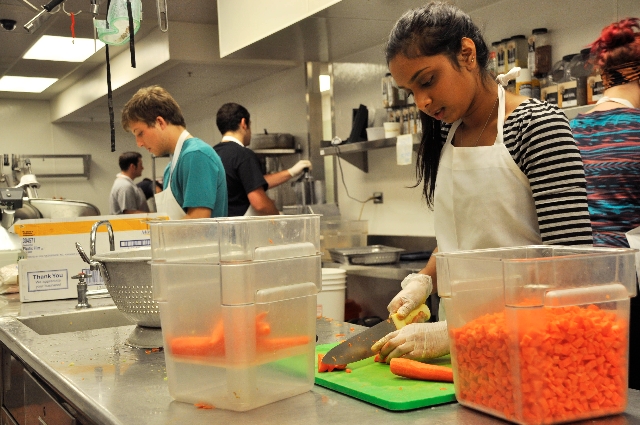
Programs and services that define the student experience are all partly run by employees who are students themselves. Jobs like this can be found on Aggie Job Link, a website that helps provide resources like job search tools, resume assistance, internship opportunities and professional networking.

Though many students work for financial supplementation, others may also apply for work experience, resume building or even to meet people and make friends.

Britney Larriva, a second-year human development and Spanish major who works in the Activities and Recreation Center (ARC), was introduced to her job through Aggie Job Link.

“Having an on-campus job is really nice. It’s a good opportunity, it’s great that they make it available and flexible for students,” Larriva said.

While working on-campus may seem convenient for students as employers are aware of holidays and finals week, Rachel Vogel, a second-year nutrition science major and an administrative assistant at the Study Abroad office, said that her job has still significantly impacted her academic habits.

“I actually find that having a job — it takes up more of my day, and so that means when I do have free time I need to study, to prioritize,” Vogel said.

Vogel’s duties primarily involve helping the quarter abroad programs process enrollment and overseeing administrative tasks.

In her four months on the job, Vogel said that the most rewarding part has been seeing the joy that comes from helping students finalize their study abroad plans. She said that she’s both enthusiastic about and committed to her job, and plans to work there for as long as she can, moving up within the program.

“It’s really just inspiring … it’s cool to see people get excited about travel,” Vogel said.

Students may be motivated to work for various reasons, and Aggies who qualify for financial assistance can utilize a work study program that helps provide jobs in a scholarship-like form. Through this program, students can gain experience, with the plus of a little more financial help.

“I don’t come from a lot of money, and I recently joined a sorority, so in order to pay for that and help my mom out … I pay for my books,” said Tiffany West, a first-year environmental and civil engineering major, who currently works for Unitrans cleaning busses and assisting supervisors in their given duties.

West’s time on the job has connected her with people also eager to work.

“I’ve gained friends … it’s given me a chance to meet upperclassmen,” West said.

Jobs on campus can vary in time commitment and demand. The Resident Advisors, or RAs, hold one of the most time consuming and important jobs. Sometimes stereotyped as the kill-joys of freshman year, RAs provide integral support to students in both their personal and academic lives.

Hannah Milner, a third-year managerial economics major, worked as an RA during her second year at UC Davis.

“You’ve got to learn more about the resources on campus … it was a really hands-on job,” Milner said. “There were difficulties with residents that you needed to sort out.”

        Being an RA comes with perks, such as priority registration, which according to Milner, often attracts a new group from within the freshman class each year.

        Milner currently works in the Managerial Economics Library in the Social Sciences and Humanities Building. She said this new job is a lot less demanding than the RA position, allowing her more flexibility. As an RA, she was always on call for her residents.

“I remember this one experience where someone was so upset over the grades they got … it was difficult. They came to me and I just remember that after we had our conversation and I let her know that it’s normal to have difficulty transitioning, she just seemed so much more calm. Little things like that from residents was definitely what was great,” Milner said.