


58.6 F
Davis

Davis, California

Monday, December 22, 2025
Home Blog Page 886

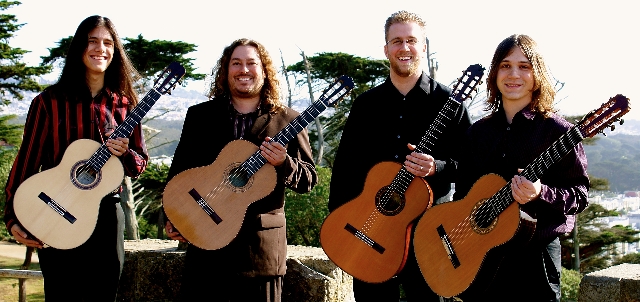
Performing in Davis: The San Francisco Guitar Quartet

0

Saccharine guitar melodies will soon ring through the halls of the Davis Art Center. On Jan. 17, the San Francisco Guitar Quartet will be performing to debut some new pieces, as well as showcase some international favorites.

Since 1997, the San Francisco Guitar Quartet has devoted itself to performing rich, innovative and complex interpretations of arrangements old and new. The current members of the San Francisco Guitar Quartet are Matthew Fish, Roberto Granados, Jon Mendle and Patrick O’Connell. Together, the group stands as a profound classical guitar ensemble in today’s music.

According to Fish, the guitar’s limitless ability to express emotion is what flourishes the group’s music-making process.

“The guitar can play the same note/pitch on many different strings, each giving that note a distinct sound,” Fish said. “We can also change the sound of our guitars by simply moving our right hand to a different spot when we pluck the strings, which opens up a whole spectrum of tone colors.”

The quartet members are all distinguished soloists, each adding a unique sound to the group’s medley voice. Because each musician possesses a distinct musical style, the group must approach arrangements pragmatically.

Mendle mentions that a lot goes on behind achieving the group’s ultimate aim: to play expressively and introduce listeners to a euphoric getaway.

“When reinterpreting classic pieces, it is first and foremost our goal to be truthful to what is essential to the original piece,” Mendle said. “Yet on another level we cannot be too tied to this, as each member of the quartet has a unique voice on the instrument. Sometimes it is a kind of balancing act — trying to find an appropriate balance between putting ourselves into the music, yet not altering what is already there.”

After establishing the motive behind a piece comes the actual procedure of reinterpreting arrangements. O’Connell further describes the process as a balance of both individual and group work.

“We usually tackle arrangements and original pieces individually,” O’Connell said. “We collaborate when we improvise and spontaneously arrange traditional songs, or when a piece written for us calls for improvisation or indeterminacy.”

San Francisco Guitar Quartet performances thus exemplify the group’s elaborate diversity and complexity. While audiences can always expect a show of innovativeness, the group’s upcoming Davis show has an even newer component in store.

“Our program this year is quite varied and will feature music from Africa, Brazil, Argentina, Australia and works that are dedicated to the San Francisco Guitar Quartet,” O’Connell said. “We will be playing a variety of instruments. This will be the first time the quartet will perform using mixed instrumentation.”

Overall, O’Connell anticipates a moving performance.

“We hope to keep our audiences engaged in our performances by exposing them to music that they are not used to hearing in juxtaposition, to get them thinking about how unique composers and different genres can be and show them how versatile the guitar is as an instrument,” O’Connell said.

Yolo County Film Society provokes discussion

At first glance, the Davis Pleasure Dome seems no different from any of the other houses on Pole Line Road. It’s certainly not a dome at any rate.

However, one of the Pleasure Dome’s residents, Drew Evans, envisions the Pleasure Dome as an anchor for the community. One of the community events he hosts at his home is the Yolo County Film Society, a free movie screening that takes place on the second and fourth Sundays of each month.

“When I moved into this house, me and the other residents wanted to make this place a community fixture,” Evans said. “We would host potluck meals and gatherings. Eventually, we decided to get a projector and screen movies.”

Evans has said that while he is open to suggestions as to what he will screen, he will show one American film and one foreign film each month.

For instance, Evans showed Into Great Silence, a German documentary about monks in the French Alps, on Jan. 12 and will show Groundhog Day, an American comedy starring Bill Murray, on Jan. 26.

“I’ve seen a lot of movies so I have an idea of what function film serves in a community,” Evans said. “I try and select movies that tie into that function.”

Steve Watson, UC Davis campus employee who has attended three screenings, discussed how the Film Society not only screens quality films, but also provides a welcome space to be a part of a community.

“I keep coming back because Drew’s nice and it’s a nice group,” Watson said. “It’s great to get people together and talking. I support it.”

Evans lets people discuss the movie afterwards, although the amount of discussion depends on the group. “Some people want to talk afterwards, and some people just want to watch and leave,” Evans said.

The two movies that caused the most discussion were Barton Fink and Adaptation, although for different reasons.

“Fink had a lot of weird imagery and allegorical stuff, which people wanted to figure out,” Evans said. “Adaptation caused discussion because some people were like, ‘What just happened?’”

On average, Evans said that about five or six people show up, although this number varies. He’s hosted around 20 people for some screenings.

“There seems to be no correlation between attendance and the movie I show,” Evans said. “One night I played a Woody Allen movie and one person showed up, but when I played a weird Klaus Kinski movie, a lot of people came for that.”

Andy Stewart, a resident of Davis, was present for the screening of Into Great Silence. It was the first time he attended a screening since the documentary appealed to his interest in monastic culture.

“This is the kind of Davis culture I like,” Stewart said. “I like that there are events like this. It’s a good kind of art culture.”

Evans’ goal with the Film Society is to try and get people to be less isolated.

“Society is geared around phones and virtual worlds, which are isolating,” Evans said. “I’ve been passionate about things that get us into a shared space, and the theater is the ultimate example of this. It’s nice to have a bunch of people get together and share the same experience.”

To learn more about the Yolo County Film Society, visit yolofilm.wordpress.com.

Campus Chic

0

The future of fashion is evolving, but in a way that you would least expect. Currently, fashion is undergoing a seemingly endless phase of minimalistic design, but what ever happened to celebrating color and embracing what makes fashion so fun and personal?

Well, the time has finally come and we couldn’t be more excited! As seen in spring/summer 2014 collections from the likes of Chanel, Lanvin and Marc Jacobs during New York and Paris fashion weeks, we are witnessing a new age of design and a sense of freedom through embracing ostentation and the idea that “enough is never enough.”

We’ve come to a point where we are no longer creating art with perspective, but instead are conforming to the hegemony of modern day fashion and taking a Fordist approach to design. Designers are exhausted of creating “what sells” and trying to achieve the impossible by thinking of ways to design something more minimal than “minimal.” Soon enough, we would be running around either naked or in blankets and, no, I am not joking.

In the following season, we will see lots of sequins, neon, hard-shell clutches, transparents and a whole lotta color. I would say this is a palatable transition, especially because some trends from fall/winter 2013 have carried on into spring/summer 2014, like the tuxedo suit and blazer. Our muse of the week, second-year microbiology major Aysha Wildman, is already way ahead of the trend as they truly embody the quintessential idea of being yourself, whether they be femme-representing or masc-representing. I decided to feature Aysha in this week’s edition of Campus Chic because they represent what it means to embrace all of your identities and celebrate what makes fashion so exciting and expressive.

1. If you could describe your personal style in three words, what would they be?

Queer, colorful, dynamic.

2. Who or what is your style icon?

I don’t really think of any one person as an icon — there are a lot of queer people whose style I admire. I find aspects of people’s outfits that I like, and then I emulate or outdo them.

3. What are your three must-have items in your wardrobe?

Collared dress shirts, all kinds of ties (regular, skinny, bow ties, bolo ties, ascots) and shiny jewelry.

4. What is your favorite accessory and why?

I love hats; I’ve been a hat person for years and I currently own over 20. They’re great for adding more flair to an outfit or pulling different parts together. (Hats are also a must-have for keeping my ears warm during 11 p.m. bike rides.)

5. Where do you love to shop and why?

I prefer getting clothes as hand-me-downs, from thrift stores or from places like Target or Ross that aren’t super expensive. I’ve found some dress shirts that fit me really well at Uniqlo. Hand-me-downs are great because I know they’re clothes that someone else already loved. That and thrift stores are good for finding things that have “gone out of fashion,” but look cool on me.

6. What is your most treasured item in your wardrobe?

I’m really glad that I now have two binders. Wearing a binder really helps me feel more comfortable with my body on days when I’m more of a guy. I like the way that shirts fit me and ties lay flatter when I wear one. A binder helps my body work with the clothes I want to wear.

7. How has your style changed since high school?

Since high school, I’ve begun exploring more masculine ways of presenting. I feel like I’ve experienced many more genders and I love playing around with my expression of that.

8. What does fashion mean to you?

Fashion is a way of expressing myself and turning a basic necessity into art. Sometimes my fashion expresses whatever gender I’m currently feeling; other times it’s just a way for me to feel fabulous and confident.

9. What final tips can you give to our fashion-forward readers?

Don’t listen to rules about what you can’t wear. Too much color for winter? No such thing. Too many patterns together? Never. Too femme to be a boi? Frak that.

High cholesterol is not only bad for heart, study finds

In a recent study conducted at the UC Davis Alzheimer’s Disease Center, a team of experts confirmed the relationship between unhealthy cholesterol fractions in the blood and an increased risk for Alzheimer’s disease. Led in part by Dr. Brian Reed of UC Davis, the study was the first of its kind to demonstrate the correlation between unhealthy cholesterol levels and cerebral amyloid plaque deposition in the brain. The study was published online as  “Associations Between Serum Cholesterol Levels and Cerebral Amyloidosis” on Dec. 30 in JAMA Neurology.

The study revealed that elevated circulating levels of cholesterol, specifically “bad” LDL (low density lipoprotein) cholesterol, and low levels of “good” HDL (high density lipoprotein) cholesterol, lead to the deposition of amyloid proteins in cerebral tissues; amyloid deposits are significant pathological markers for Alzheimer’s disease.

“Alzheimer’s disease is defined by a combination of clinical findings and pathology.  Clinically, the person has a dementia — a loss of multiple cognitive abilities severe enough to impair day-to-day function … this dementia is due to damage to the brain associated with amyloid plaques and neurofibrillary tangles,” said Bruce Reed, lead study author and associate director of the Alzheimer’s Disease Center.

The study itself was conducted on a diverse population of 74 men and women aged 70 years and older. The participants were recruited from California stroke clinics, support groups, senior facilities and the Alzheimer’s Disease Center itself. Of the participants, three of the recruits already suffered from mild dementia, 38 had slight cognitive impairment and the remaining 38 participants had normal cognitive function. The research team was able to measure the participants’ amyloid plaque levels by using a chemical tracer. It was confirmed that a trend of high levels of fasting LDL cholesterol (above 100mg/dL) and low levels of fasting HDL cholesterol (less than 40mg/dL) associated strongly with increased amyloid deposition in cerebral tissue.

“We have several ideas about how cholesterol levels might influence amyloid deposits.  Cholesterol in the brain plays several important roles in the production and transport of beta amyloid. Theoretically, cholesterol levels could influence the rate at which amyloid is created, or it could slow down the rate at which it is cleared from the brain,” Bruce Reed said.

Cholesterol is a hydrophobic, wax-like substance that is found in animal-derived foods; it is also produced naturally by the liver. It’s important to note that cholesterol itself is an important molecule with a myriad of biological functions and is not an antagonistic compound. Cholesterol-derived health problems arise when individuals consume it in extreme excess.

“Cholesterol’s main function in all tissues is to provide structure to cell membranes. In the liver it also undergoes its first conversion step to vitamin D. It also serves as a precursor for steroid hormones in the reproductive organs,” said Angela Zivcovic, member of the Nutrition Department faculty and part of the UC Davis Foods for Health Institute.

Some of the most common foods high in cholesterol include solid animal-fats (found in high-fat milk products, butter or lard), fatty meats (such as beef patties, and bacon), cheeses, egg yolks, non-vegan processed foods and some seafood (lobster being the most notorious). When consumed in moderation, most of the cholesterol from the diet is packaged into high or low density lipoproteins. A fraction of cholesterol is incorporated into bile and is lost through the dietary tract; this is the only way that the body may rid itself of excess cholesterol. Soluble fiber helps to expedite this necessary process by sequestering excess cholesterol in the dietary tract.

In extra-cerebral vasculature, “bad” LDL-packaged cholesterols (LDL) collide with arterial walls, causing microscopic injuries and the induction of immune response. Over time, these collisions lead to a scar-like plaque formation that remains on the arterial wall. Continuous plaque formation results in the narrowing of the arterial pathway. “Good” HDL-packaged cholesterol (HDL) helps to clear the arterial pathway by breaking up the plaque deposits and returning rampant cholesterol back to the liver. In individuals with cholesterol-derived health disorders, there are often sub-optimal blood concentrations of HDL cholesterol.

“HDL cholesterol can be difficult to raise in comparison to LDL cholesterol … but increasing physical activity does help to raise HDL levels in the blood,” said Francene Steinberg, chair of the UC Davis Nutrition Department.

The most commonly discussed consequence of unhealthy cholesterol levels are high blood pressure (due to the narrowing of the arteries), atherosclerosis (the hardening of arterial walls) and elevated risk for stroke and heart disease. As per the results of this study, Alzheimer’s disease has now joined the list.

Though the research team did not study the direct pathway by which unhealthy cholesterol levels cause amyloid plaque deposition in the brain, the confirmation that these levels are associated with amyloid plaque is a significant finding.

The typical American diet is highly conducive to a myriad of preventable health disorders. For atherosclerosis, high blood pressure, heart disease and stroke, elevated cholesterol is just the tip of the iceberg. Evidence that a disease as devastating and challenging as Alzheimer’s is a cholesterol-related health problem proves once again that significant steps should be taken to improve dietary choices and key lifestyle factors in individuals who are, or who may one day be, at risk. High-fiber, low-fat diets and regular physical activity are highly effective natural remedies that may help to mitigate preventable health disorders.

Long tradition of strikes, protests characterizes UC Davis

0

Historically, campus protests have received some form of support from the University, community or police, and as the University of California’s culture continues to host strikes and movements, this UC Davis tradition has as well.

On Nov. 20, 2013, AFSCME 3299, the union for UC service and patient care workers, held a strike disputing unfair labor practices. The strike involved several types of UC workers and students, and one student recalled how her professor held class off campus to show support.

“We went to The Graduate and moved two benches together,” said Falon Darville, a fourth-year English major. “Then we had our usual class discussion.”

Perhaps the most active times for strikes and protests, according to Dr. Jerry Drawhorn of CSU Sacramento, were during the Vietnam War era, when several issues like race, homosexuality and anti-war efforts were swirling together.

For a book he is currently writing, Drawhorn is creating a timeline of UC Davis’ radio station, KDVS, where he once DJ’ed. His research has catalogued the dates of several strikes and protests. Several subjects that students in Davis and surrounding areas have spoken out against were women’s liberation, anti-apartheid, nuclear energy, free speech, the Natural Food movement, Davis’ local D-Q University for indigenous people and field workers’ rights.

“There were enough broad issues to give everyone something to stand for,” Drawhorn said.

Drawhorn also remembered a short blurb in an issue of The Aggie that displayed the era’s general skepticism of authority and the government.

In 1967, a former veteran and off-campus representative of ASUCD was investigated by agents of the U.S. Secret Service. According to The Aggie’s original article, Chuck Papke wrote on the outside of a government return: “Johnson’s war in Vietnam makes America puke.”

The aspersion was seen as a legitimate threat to President Lyndon B. Johnson’s life, and the Secret Service questioned Papke at his home.

Agent Larry Sheafe was quoted as saying in explanation, “If enough people puked on the President, he would die.”

At least three of Papke’s G.I. benefit allotments were not granted because of his statement.

“It’s not a time I’d want to go back to,” said David Lundquist, a former UC Davis librarian who was employed in 1966.

Lundquist remembers casually bumping into a Hell’s Angel on Berkeley’s Telegraph Avenue. According to UC Berkeley’s Social Activism Sound Recording Project, members of the motorcycle club were opposed to the anti-war protesters and even attacked them.

A young student once told him it sounded exciting, and she wished she could have been there. Lundquist responded: “You really don’t want to.”

In 1970, several hundred universities and schools nationwide, including UC Davis, responded to the Kent State shooting in Kent, Ohio on May 4, 1970. The Ohio National Guard shot several unarmed college students during a protest.

“What are we going to do? How are we going to respond?” Lundquist recalled overhearing from the students. They had immediately responded, forming committees in the library and planning protests.

One such protest was held at Mrak Hall, Lundquist said. University administrators appeared to support the students, arriving at the scene and asking students what they could do to help. Lundquist said that even Chancellor Emil Mrak sat with the protesting students.

According to Lundquist, the University knew Kent State was a terrible occurrence. They didn’t want anything like it happening at UC Davis, so they did what they could to accommodate the students’ desires.

A few years later, protesting students found support from the city police. On April 28, 1973, a boxcar owned by the U.S. Department of Defense and carrying 250 pounds of bombs exploded near Sacramento in Antelope, Calif.

The shipment would have eventually been sent to Vietnam, and in response, UC Davis students staged a sit-in on the railroad tracks. Lundquist said that the city asked the students which streets they would need to use, and if they would like an escort.

“I remember seeing the march come down Second Street with a police escort,” Lundquist said. “At least one or two police cruisers were in front clearing traffic.”

Lundquist also recalled an incident where the police specifically took action to protect the students. During the railroad sit-in, one train engineer got fed up with the demonstration. He started moving the train and honked his horn. Students were forced to climb up on the train to prevent getting run over. A police officer promptly climbed up into the cabin and arrested the engineer.

According to Lundquist, it also wasn’t just students involved in this protest. He recalled a professor of environmental sciences and his wife sitting on the tracks. At some point, the police had to clear the tracks and warned the protesters that they would be arrested if they stayed. The professor left, but his wife stayed and was arrested.

“I wonder what their conversation was like the next day,” Lundquist said.

Protests in more recent years have also ended in arrests.

In November 2009, Mrak Hall was used as a demonstration location and 50 students were arrested for attempting to occupy the hall. In that case, students were protesting budget cuts and fee increases.

Again in 2011, students protested rising tuition fees during Occupy UC Davis. The Occupy movement at UC Davis resulted in the campus police pepper-spraying several students. However, Lundquist recalled that several people of the Davis community still brought soup and chili to feed the students, perpetuating a long history of community support.

“The city and the University wanted to take care of them, ” Lundquist said. “The whole pepper spray thing just doesn’t compute. It really tarnished Davis.”

However, not all activism in Davis has ended in arrests. Drawhorn remembered Jose Arguelles, a UC Davis art instructor who, in 1969, put on an “Art Happening.” According to its website, it was an event students used to focus their enthusiasm for activism and environmental issues through art.

After the United Nations’ declaration of Earth Day in 1970, the “Art Happening” was renamed and became the annual Whole Earth Festival.

Instances of community collaboration at the scale of the “Art Happening” have been rare. It’s tempting, then, to draw conclusions or make contrasts between the protests of then and now. However, Duane Wright, a graduate student in the Sociology Department, suggests the relationship is complicated.

“You really will need to understand the ways in which the social, economic and political are tied together, and what the effects of one causes in the others,” Wright said.

Wright said a particular movement may emphasize some of these aspects to give their cause an advantage. For example, Wright said he personally knows many people fighting for accessible public education.

“[They] are deeply invested in the social justice aspects of this cause,” Wright said. “It’s not just about numbers of dollars, but about oppression and inequality.”

Likewise, similar issues may have come up in protests of the past. Although people of all backgrounds were drafted into the Vietnam War, Wright said the poor and minorities were disproportionately sent to the front lines and killed in combat.

In the present day, he also said high tuition fees can make it difficult for these same disadvantaged groups to attend universities.

Wright also mentioned the AFSCME 3299 strike and the protest against President Napolitano, when protesters demanded the UC president’s resignation in November 2013.

“Both of those protests/demonstrations were very upfront about the issues of race, immigration, status, gender and class in the University,” Wright said. “The anti-Napolitano protest had many demands, such as stopping the surveillance against students, making the UC a sanctuary campus for undocumented peoples and fair contracts for campus unions.”

Though history demonstrates that strikes and protests on this campus have and continue to receive some form of community support, Wright suggests that students pay closer attention to the purpose behind the movements, rather than simply joining the crowd.


Are you BEST, SMART, NOW or independent?

0

Six ASUCD senators are elected each fall, and six more, the president and vice president every winter. Candidates can choose to run on slates, comparable to United States political parties, and if elected, serve a year-long term.

The Fall 2013 ASUCD Senate election season saw two independent candidates elected, along with three from the NOW slate and one from SMART.

The established slates on the UC Davis campus, NOW, BEST and SMART, each have specific goals, and their senators often vote accordingly.

Current ASUCD Senator, Miles Thomas, a fifth-year managerial economics major and co-founder of BEST, said that BEST is the only slate that doesn’t require a senator’s vote on specific issues.

“NOW wants you to vote against divestment from companies profiting off of the Israeli occupation of Palestine,” Thomas said in an email. “SMART wants you to primarily represent underrepresented communities.”

For example, SMART’s newly elected senator Mariah Kala Watson is interested in re-investing in the Food Pantry, according to her personal statement.

Yee Xiong, a fourth-year Asian American studies and design double major and the first Hmong ASUCD senator, chose to run with the SMART slate because she felt that there was a lack of representation for cultural issues at the table.

“In 2012, I was co-coordinating the 5th annual Southeast Asian Graduation and had heard that our student body government was not financially supportive of community specific graduations (CSG). I had to find out why,” Xiong said in an email.

After attending the spring budget hearings that year, Xiong was inspired by former senators who fought to support CSG, and who eventually got their bill passed.

“Representation from marginalized communities is hard to find, and this slate is the start of changing that around,” Xiong said.

The NOW slate has gained popularity in this election and in the last. Currently, six of the twelve senate seats are held by candidates who ran with NOW.

Felicia Ong, a third-year political science and communication double major and a former ASUCD senator whose term ended last quarter, ran with the NOW slate because she appreciated its vision for ASUCD.

“I loved what the slate had envisioned for our campus: making students on campus feel like they are a part of something larger than themselves,” Ong said in an email.

Ong ran for Senate as a second year after experiencing some things that she wanted to change.

“I noticed that there was this culture in ASUCD where student leaders became solely interested in themselves or the little things associated with politics,” Ong said.

Typically, senators vote with their slates, but on occasion have voted with other slates on specific issues.

“Please note that while Senator Nonga is to the right of the ‘table middle,’ she is very partisan, as she votes with SMART every time there’s a ‘SMART issue,’ and with NOW on everything else,” Thomas said.

The three recently elected NOW senators reflected a variety of different goals in their personal statements, which include creating online tutoring programs for late night help, making American Sign Language an accredited course at UC Davis and creating an advisory board to improve communication between students and city officials.

There are also independent candidates, whose decisions in senate are not influenced by the goals of slates.

“Independent senators are perceived as thinking more critically and not voting along party lines,” Thomas said. “They don’t swear allegiance to outside interest groups.”

The platforms of the two recently elected independent senators include promoting “open license” textbooks which have been adapted by professors for specific classes and are available to students at a reduced cost, as well as increasing involvement in international programs by all students.

While independent senators may be appealing because of their rapport for non-partisan voting, they have a more difficult time being elected because they don’t get as much exposure.

“Major credit to those independent candidates who ran and won — they probably must’ve worked twice as hard just to earn a seat,” Xiong said. “When you run with a slate, you have higher chances of being noticed and supported by others who know the established slate.”

The Fall 2013 Senate elections saw two independent candidates elected, which is relatively uncommon, and Thomas doesn’t predict a repeat of this in the future.

“An independent acting on their own cannot carry an election in single choice voting,” Thomas said. “If there are only two slates running, [like there were this quarter], independents would have a chance.”

However, in this Fall 2013 election, independent candidate Gareth Smythe was elected to senate by a large margin. Thomas attributes this to the fact that while Smythe ran independently, he had a lot of support from current ASUCD members.

“Most of the best and brightest in ASUCD supported him, which is how he came up on top by such an incredible margin,” Thomas said. “He’s an anomaly in a lot of different ways; I wouldn’t expect independents of the future to do as well.”

This week in Senate

0

ASUCD Vice President Bradley Bottoms presided over the first senate meeting of Winter Quarter on Jan. 9. The meeting was called to order at 6:17 p.m.

Senator Miles Thomas was elected as the new President Pro Tempore of the senate.

Ben Marchman was confirmed as the new Student-Police Relations Committee Chair. New members of the Internal Affairs Commission, Academic Affairs Commission, Ethnic and Cultural Affairs Commission, Outreach Assembly and Environmental Policy and Planning Commission were also confirmed.

A large focus of the meeting was on the temporary closure of the ASUCD Experimental College (EC) due to a budget deficit. Jonathan Goh, an instructor for the Experimental College, gave a presentation on the suspension of the EC due to a struggling market for its classes, which he faulted to a lack of awareness by the students of the EC’s existence.

“I was blown away to learn that the EC was such a secret,” Goh said.

The meeting then entered a public discussion in which Rick Schubert, chairman of the EC Instructors Advisory Board, shared similar opinions on the obscurity of the EC by the students. Schubert attributed this fault to poor marketing of not switching from print to online advertising quick enough.

Senator Mariah Watson claimed the decision to suspend the EC was done on poor timing as six of the 12 senators had just been sworn in that night. Senator Amrit Sahota claimed that the senate started drafting a plan to restart the EC by Fall Quarter 2014 as soon as the EC was suspended. During the meeting, Sahota suggested using Winter Quarter to find the bare minimum needed to restart the EC and raise that money during Spring Quarter.

A bill was introduced to create the special committee on restoring services for the Experimental College to be known as the Experimental College Task Force (ECTF). The bill was authored by Senator Shehzad Lokhandwallah.

No new legislation was passed.

— Jason Pham

Meet your representatives

0

senators2_Nguyen

Spencer McManus

Chairman of the Internal Affairs Commission, ASUCD

Majors: chemistry and political science, emphasizing in public service

1. How did you decide on your major?

In high school, I had a really great chem teacher who inspired me. He had all these really cool demonstrations. Then I got here and had really great general chemistry teachers that kept me going on that. I worked in the lab for a little while and I decided that wasn’t my thing, so that’s why I picked up the political science major also. I want to go to law school and I’ve always been interested in political institutions here in the United States.

2. What is your life motto?

“Each day is its own” I think is a nice one. I’ll be honest, I’m a pretty busy person so I have to look at my calendar every morning to remember what I’m doing. I’m sure a lot of people here are the same way. Also just being cognizant of what everyone else thinks too, as a student rep that’s an important thing to have, and just as a general life motto, just being able to listen to other people.

3. What do you do when you’re not studying or working?

Besides working at ASUCD and the occasional studying, I’m a peer advisor for the College of Letters and Science. Outside of that I’m a huge San Jose Sharks fan. I enjoy reading a lot. I’m a big tech nerd. And I need to catch up on Breaking Bad, so maybe that’ll be my thing this quarter.

4. What is your favorite stress-relieving activity?

Probably going running, which I haven’t done enough lately, that would be my stress reliever. Or going on a hike.

5. What’s your favorite restaurant in Davis?

3rd and U, I get their BBQ cheeseburgers a little bit too often.

6. If you were a fruit, what would you be and why?

I would be a strawberry. Sweet, the seeds are on the outside so you can kind of see where I’m at. But also I’m sweet and willing to listen. Is that a little corny?

7. What would be the theme song to a show about your life?

“What If,” it’s a Five For Fighting song. It talks about thinking about things that could happen or would have happened, and I like to plan ahead a lot.

8. If you could own any animal, what would it be and why?

A little owl. Have you seen the pictures of the cute little baby owls? I would love one of those just to sit on my shoulder. I think that’d be pretty cool.

senators_Nguyen

Mariah Kala Watson

ASUCD Senator

Major: international relations, emphasizing in peace and security

1. How did you decide on your major?

I’ve had the privilege of being able to travel  around the world with my parents from the very young age of six months. My first trip ever was visiting my extended family in Bermuda. Many trips soon followed. But my favorite trip of all time was my first trip to Egypt. I fell in love. The culture, the people, the food. It was all so amazing and enchanting. I had never felt more at home in a foreign country.

When I got older people began telling me to explore what I was passionate about. I decided to play sports, and then finally joined my local chapter of the YMCA’s Youth and Government when high school was nearing an end. And wha-la! I found another home in being engaged in dialogues and debates about politics both foreign and domestic. So I picked a major that mirrored both my love for Egypt and politics; international relations is perfect.

2. What is your life motto?

“Love everyone for every reason”

I know that sounds beyond corny, but I do truly strive to see the good and beauty in everyone and everything.

3. What do you do when you’re not studying or working?

There’s time for something else? In all seriousness my job is my joy, so I spend a lot of time doing things that revolve about ASUCD or the Cross Cultural Center. I’m always at retreats and conferences meeting fellow students. We talk about social justice, inequality, student leadership and cultural affairs, as well as the issues we face on campus and how we plan to fix them.

However, when I do have “freer” time I lalala-love movies. You can pretty much play anything, doesn’t matter how terrible the quality or plot is and I’ll find something enjoyable about it. I enjoy going out with my friends on the weekends. Brunches during the day and parties at night.

4. What is your favorite stress-relieving activity?

Watching Netflix snuggled in a blanket with tea = perfection.

5. What is your favorite restaurant in Davis?

Mikuni or Zen Toro for special occasions.

6. What is your greatest accomplishment outside of school?

Volunteering at an all girls camp called “Girls to Goddess” every summer for five years. I’m a head camp counselor and it’s always incredible to see how much personal growth and self discovery can happen in one week. I’m happy to be a part of it.

7. If you were a fruit, what would you be and why?

Passion Fruit — it’s sweet, unique and unexpected.

8. What would be the theme song to a show about your life?

Paolo Nutini — New Shoes

It’s my happy song. To me, it’s about finding the little things in life that make you joyful and letting them fill your life with bliss. If you ever hear me singing or humming this song, I’m in a fantastic mood!

9. If you could own any animal, real or mythical, what would it be?

A half wolf and half Australian German shepherd the size of the wolves from the Twilight saga. It would be extremely sweet and cuddly and also fun to ride and hike with.


Police Briefs

0

THURSDAY 1/9

Talking trash
On Leigh Drive, a known subject came up to someone’s door to ask who takes out the garbage and told her he was thinking of moving into the complex.

FRIDAY 1/10

Getting blood from a stone
Someone ran over a pebble on East 14th Street which then flew up and hit someone’s windshield. The owner contacted the person demanding $400 to fix it.

Such swag
Someone got out in front of the complex, exposed himself, urinated, then got back in the car and proceeded to spin donuts on Valdora Street.

SATURDAY 1/11

Childish
A drunk woman called from her neighbor’s residence to say her son was annoying her on Inner Circle.

Old college try
Someone on I Street reported finding two people had jumped the fence into the backyard. When confronted, the two said they had just moved in two houses down and were mistakenly at the wrong house.

Police briefs are compiled from the City of Davis daily crime bulletins. Contact EINAT GILBOA at city@theaggie.org.

ASUCD Senate temporarily suspends Experimental College classes

0

ASUCD Senate voted in December 2013 to suspend the Experimental College (EC) courses for the time being due to financial burdens. The ASUCD unit has been steadily losing funds from their reserves over the past eight years. Courses were suspended to stop funds from decreasing further.

ASUCD Controller Eric Evans said the decline in funds was due to not consulting the issue on a large scale sooner. After losing more than what was in their reserves, the EC has now completely depleted their funds.

“The Experimental College is at a net loss. The losses have exceeded the reserves. It lost $7,000 more than it had,” Evans said.

ASUCD Senator Miles Thomas said loss of funds is due to various reasons, one being a lack in marketing.

“The ARC opened in the mid-2000s and Campus Unions and Recreation began to have a ton of fitness and martial arts courses. These are Experimental College’s most profitable courses,” Thomas said in an email interview. “The unit could have been marketed better.”

Although the EC’s courses have been temporarily suspended, their garden plots are still available to rent. Renting garden plots has been a continuous source of revenue for the EC, which is why the plots were not suspended along with the courses.

“The gardens have a strong business model. They sell out every year and either break even or make a small profit,” Evans said.

A possible solution to the temporary suspension of courses is to offer part-time and pro-bono classes. Some instructors at the EC are willing to offer classes on a donation basis that will add to the EC funds.

“We are starting a pro-bono instruction initiative in which free classes will be offered to maintain awareness of the Experimental College courses program,” said Richard Schubert, chair of the EC’s Instructors Advisory Board. “We are hoping that we can begin offering these classes within the next couple of weeks.”

Two pieces of legislation are being brought to ASUCD Senate to allow courses to return fully and help reorganize the college. The first piece of legislation is a resolution that, if passed, will present the catalog of courses this spring and support more pro-bono classes in the summer. The second piece is a bill which will aid the EC with a financial task force to provide support in advertising their services and restructuring their business model.

“The resolution will help get classes back permanently,” said Bradley Bottoms, ASUCD vice president. “It will give long-term solutions instead of temporary ones.”

ASUCD Senator Gareth Smythe said several members of ASUCD and professionals from the EC will work together on the task force.

“The task force will consist of two senators, one commissioner from the business and finance commission, one commissioner from the Internal Affairs Commission, ASUCD controller and ASUCD president or a designee, the student unit director of the Experimental College as the chair of the taskforce and the chairperson from the Instructors Advisory Board,” Smythe said.

Schubert said if the bills pass, the task force would help the EC offer courses again.

“We hope that the task force will authorize advertisement of courses during the winter and spring 2014 quarters,” Schubert said.

A new marketing campaign for the EC began in Fall Quarter 2013 with the help of the ASUCD unit Creative Media. The campaign included a more user-friendly website with online course registration and new designs.

“Just as we were rolling out the marketing campaign, we received suspension notice from ASUCD,” Schubert said. “We will continue the campaign along with extensive changes for this year.”

Marketing did not start earlier because the amount of money being lost from the EC was not brought to the attention of ASUCD until 2013. EC Director Chriselle Vinson said that the suspension of courses may not have happened had the campaign begun earlier.

“The depletion of money has been going on for eight years,” Vinson said. “The realization that a big change should be made was caught too late.”

ASUCD and the EC faculty said they are moving forward with the reorganization of the unit.

“The goal of the task force is to have the Experimental College come back as a sustainable model,” Smythe said. “We want to keep it completely student-run, but get advice from the faculty.”

The current plan for the EC if the resolution is passed is to bring part-time and pro-bono classes back in summer 2014 and permanent courses back in fall 2014. The resolution and the bill will be publicly brought to ASUCD Senate by unit director Chriselle Vinson on Jan. 16.

PG&E raises residential gas, energy bills

0

For 2014, Pacific Gas and Electric Company (PG&E) projected an increase of 2.8 percent in total residential natural gas and electric bills. This will translate to an increase of about $3 to $4 in payments for normal residential energy prices.

“These increases in prices are not arbitrary,” said Jonathan Marshall, a representative from PG&E. “For us at PG&E, upholding trustworthy service and maintaining safety are top priorities. Thankfully over many years, our rates are moving side by side with inflation and our average customer bills are under the national average and will continue to be that way.”

PG&E is increasing fees to account for greater wholesale energy purchase costs and to improve, maintain and modernize the utility’s infrastructure. These fees will rake up an additional $145 million in revenue in comparison to last year.

“California’s fast-growing use of renewable power will also add to monthly PG&E bills in 2014. State law requires California utilities to get 33 percent of their electricity from the sun, wind and other renewable sources by the end of 2020,” said Tom Bottoroff, a PG&E worker. “We have added about 1,400 megawatts of renewable generation to its portfolio in 2013. That’s nearly the output of three nuclear reactors.”

In most cases, the changes in residential energy bills will not change the amount students pay for rent.

 “The increases in PG&E energy bills will not affect the subsequent rent lease; energy bills are paid separately by residents,” said Breinna Ghiorzo, a representative from Alhambra Apartments. “Even though we have yearly increases of $20, those are because we are following market trends.”

Jimmy Chen, a worker for Camellia Apartments, said that he has no complaints about PG&E.

“I pay mine, and you pay your bills,” Chen said. “I pay about $20 to $30 personally for electricity; PG&E is very reasonable in comparison to Cupertino [and] Sacramento for energy. I only pay $65 to $90 for air conditioning and heating. I cannot complain.”

Bryce Vick, a fourth-year sociology major living off-campus, said that he finds it challenging to deal with the energy bill.

“Gas was really expensive last month, usually we are charged about $9 to $12 a month, but last month we were charged $41. It has been [a] challenge to find the additional funds; however, we always find a way to pay it,” Vick said. “Usually it is about $50 … which is about three to four hours of work for my apartment mate and myself each, which is still hard to fit in with all the school work and groceries. “

For Ferris Elhein, a fourth-year biochemistry major living in a house in Davis, the energy and rent bill is mildly affecting his budget since he shares a house with four other people.

“For me, rent increased from last year by around $500. But that didn’t affect my budget because we just had an extra person to help pay the bills in the house,” Elhein said. “I don’t think PG&E is charging fair rates on energy consumption, but there’s nothing we can do about it other than applying for low-income prices. Personally, other than that, I haven’t had any problems with them.”

Overall, because of the increasing cost of living, Elhein is very conscious in his finances.

“I limit how much I eat out, spend less money on clothing and don‘t spoil myself,” Elhein said.

Marielle Tanton, a third-year genetics major, said the energy bill is not drastically affecting her budget.

“Overall it is not really affecting me right now. It is low enough for my financial aid and paycheck to cover,” Tanton said. “For PG&E, I have not felt cheated when I got a bill, and I have never had to call customer service.”

Watts Legal

0

Question: I’m a server at a certain Davis restaurant that I’d rather not name. People who come into the restaurant almost always leave us tips. My boss (the manager) has a policy of taking all those tips, putting them into a single account, and then deducting a portion for the restaurant before equally splitting the remainder among all the waiters, bartenders and other staff. The tips make up the majority of my paycheck, but they’d make up a lot more if I got to keep my own tips rather than sharing with everyone, including the boss (who did nothing to earn them!). Is it legal for a restaurant to split tips like this?

— G.N. Davis, CA

Answer: No, it’s not legal. The part about your boss taking your tips is definitely against the law in California. Mandatory tip pooling is fine; he can force all the service staff to share tips with each other as long as they are distributed fairly. But your boss cannot skim a percentage off the top before distributing the tips.

In California, your right to your tips are protected by Section 351 of the California Labor Code. Section 351 states in part:

“No employer or agent shall collect, take, or receive any gratuity or a part thereof that is paid, given to, or left for an employee by a patron, or deduct any amount from wages due an employee on account of a gratuity, or require an employee to credit the amount, or any part thereof, of a gratuity against and as a part of the wages due the employee from the employer. Every gratuity is hereby declared to be the sole property of the employee or employees to whom it was paid, given, or left for.”

This means that your employer cannot keep any of the optional gratuities that customers give you. The ban applies to all management and supervisors. But there’s an important caveat: The restaurant can indeed require you to “tip out” to other employees on the service line, unless they are managers. Courts have upheld such tip pooling arrangements as long as they are reasonable, “fair” to all employees and do not include managers.

Here’s an example. Your boss might occasionally wait on tables if the restaurant gets busy or another server flakes on his shift. Even though he pitches in as a waiter sometimes, your boss can’t collect other people’s tips or join the tip sharing pool. He is still a supervisor, and supervisors can’t participate in tip sharing. He can still require you and the other employees to pool your tips and give it to the bus boys, though.

Mandatory service charges are trickier. Your restaurant might charge patrons an 18 percent fee for large parties. I hate those fees, for both legal and moral reasons. The labor code defines a gratuity or tip as money that a patron has left for an employee in excess of the actual amount due for the services or goods he bought. In other words, a tip is a discretionary amount that the customer voluntarily leaves behind for the wait staff. If a customer’s bill is $15 and he leaves a $20, saying “keep the change,” that extra $5 is a tip.

A service charge, however, is usually mandatory, not discretionary. And since it’s not discretionary, it’s not a tip. Patrons might think that they’re leaving an 18 percent tip for their waiter, but there’s nothing forcing the boss to actually give that service charge to the employees. Only discretionary tips are yours; mandatory tips are not really tips at all, so they’re not yours to keep unless the boss decides to be nice.

You should also keep in mind that the same section of the Labor Code prevents your boss from charging you credit card transaction fees when customers pay tips by credit card.

As regular readers of this column know, California is really strict about credit card surcharges. Even though Visa and Mastercard charge merchants a fee for every credit card transaction processed at their store or restaurant, the merchant is banned from passing the fee along to consumers. Restaurants can’t charge their customers a fee when paying with a credit card, and they can’t pass the fee along to their employees, either.

California has strict rules about credit card fees and employees, too. If your employer charges you a fee for each tip received via a credit card transaction, your employer is breaking the law.

And your boss has to pay out these credit card gratuities in your next regular paycheck. They can’t wait until the end of the year or delay payment. Refusing to pay you the tips, or delaying payment of tips, would constitute an unlawful withholding of your wages. In such circumstances, you’d be entitled to sue the employer for up to 30 days’ worth of waiting time penalties for each day he delays paying you what you’re owed.

 Show this column to your boss and have him Google section 251 of the California Labor Code. If he still withholds your tips, you can file a claim with the California Labor Commissioner at dir.ca.gov/dlse/HowToFileWageClaim.htm.

Daniel is a Sacramento attorney, former Davis City Council candidate and graduate of UC Davis School of Law. He’ll answer questions sent to him at governorwatts@gmail.com or tweeted to @governorwatts.

Catch a butterfly, win beer

0

UC Davis Professor Art Shapiro, of the UC Davis Evolution and Ecology (EVE) Department, offers a pitcher of any kind of beer to the first person who catches the first cabbage white butterfly of each new year.

The official flyers for the competition regard any participants as being an essential part of a 43-year study of climate and butterfly seasonality.

Spring is commonly associated with the emergence of the cabbage white butterfly (Pieris rapae). For Shapiro, it means one more step to his research.

“I study phenology, which is the timing of biological cycles and why organisms do what they do at different times of the year. I study the variation from year to year and if it correlates to weather,” Shapiro said.

Another species that follows an annual biological cycle and blooms at specific times of the year is the cherry blossom tree in Washington, D.C.

“If you go to the other side of Wickson Hall, there is a cherry blossom tree of the same kind as in Washington, D.C., the species called a Piunus mume,” Shapiro said. “This tree should be blooming around early March, but it is blooming now, which is its earliest ever.”

The question then arises of the reasoning behind this biological shift. The same mystery applies to these cabbage white butterflies. This competition enables Shapiro to have eyes all over the area to identify emergence patterns.

Shapiro is studying physiological responses to environmental cues and if they have a genetic basis. Concerning the cabbage white butterfly, he has found that the cues are a combination of night length and temperature.

“He has actually based his research on life cycles of the cabbage white butterfly. It is his study organism,” said Ivana Li, former president of the UC Davis Entomology Club and currently working with Shapiro on his Biological Sciences 2B course.

Particular emergence times depend on location and climate, so the competition is open to everyone in the local area, specifically Solano, Yolo and Sacramento counties.

According to Shapiro, people notice the cabbage white butterflies. They are easy to recognize as well as being the most common and most ubiquitous species of butterfly.

“I thought, obviously I can’t be everywhere, so I came up with the idea to involve everyone. This way, I am less likely to miss the first one,” Shapiro said.

Unfortunately, the competition is at a close for 2014. The first cabbage white butterfly of 2014 was caught by Shapiro on Jan. 14 at 12:20 p.m. in West Sacramento. It was flying eastward along the edge of the service road and Shapiro caught it with a self-proclaimed jump shot.

There are only a few rules regarding the competition itself. The specimen must be captured alive, outdoors within the three counties and after Jan. 1. Only adult members of the species Pieris rapae are eligible, excluding pupae or caterpillars. Refrigeration is recommended to retain the health of the specimen if kept in captivity for an elongated amount of time.

“[Shapiro] usually beats me by at least half a month. I always get excited when I find one,” said Nick McMurray, the UC Davis Entomology Club president.

According to Shapiro, he has been running this competition annually since the early 1970s and has only been beaten three times and tied once within 20 minutes.

“Rumor is that Art has never lost, so I have never tried,” said Nick Fabina, a UC Davis graduate student with the EVE Department. “I’ve heard that Art has a secret place where he reliably finds them.”

Shapiro hinted that a common place that he has been successful is in West Sacramento or in various warm microhabitats. However, he will not disclose a specific location.

“Shapiro spends over 200 days of the year outside and he has been doing this for 30 years,” said Alex Nguyen, UC Davis Entomology Club secretary.

This dedication may seem daunting, but over the years, several undergraduates, graduates, faculty and members of the public have tried hopefully and ardently to succeed.

“I think that I will never catch one,” said Professor Sebastian Schrieber of the EVE Department. “I’m co-teaching with Art and I think he is amazing at what he does.”

If you are able to find a cabbage white butterfly before Shapiro or any of your county-wide competitors, you will gain notoriety but also the task of deciding what kind of beer you will celebrate with.

“There is a long tradition in this department to get Pabst Blue Ribbon,” Shapiro said.

However, some may have a more upscale beer in mind. The possibilities are endless.

“I would get a Firestone or a nice IPA (India Pale Ale),” said Alex Dedman, a UC Davis Entomology Club member.

Those who are able to catch this coveted bug should bring it promptly to Shapiro’s office in Storer Hall. Unfortunately, the competition is now over, but students are encouraged to still be on the lookout next year.


TAs struggle with low pay, large classes

0

Teaching assistants (TAs) permeate the UC system. These graduate students are both pupils and employees of the UC who, according to United Automobile Workers (UAW) 2865, are facing high class sizes and low wages.

The UC Student-Worker’s Union represents an estimated 12,000 tutors, readers and teaching assistants throughout the UC. The union started their contract campaign in June 2013 for renewing a three-year bargaining agreement with the UC.

Third-year anthropology graduate student and executive board guide of the UAW 2865, Caroline McKusick sees the union as an integral part of labor representation for Academic Student Employees (ASEs) and TAs in particular since they act as a liaison between undergraduates and professors.

“One of the reasons I’m involved in the union is because I think students deserve a good education and TAs that can give them attention,” McKusick said. “In this contract campaign, we envision a bargaining process that makes grad students’ concerns heard across the state, a space where members can speak to the seriousness of the issues they are facing.”

One of the requirements of student employees is that TAs must work 50 percent of their full-time student attendance, and one of the agreements made between the union with the UC is that this time should not amount to more than 20 hours per week.

However, due to the increasing ratio of students to TAs, McKusick has observed the struggles of TAs who also often have research, seminars and other campus jobs to manage.

“I’ve been a TA every year of grad school and worked in different departments, and what I’ve seen is that the kinds of pressures to increase class sizes and squeeze TAs happening on the UC-level is happening all over campus and is something that faculty and grad students are struggling with,” McKusick said. “With these increases in class sizes the responsibilities of TAs is really serious and we’re very concerned that TAs are working more than the hours that they should be working and that this is impacting students’ education.”

Besides expressing grievances for the assurance of fair working conditions and treatment during this contract campaign the UAW 2865 adopted an open bargaining process for the first time by inviting all members to UC negotiations to diversify the amount of coordination and representation of ASEs. They have also highlighted forums such as gender neutral bathrooms on campuses, undocumented student support and child care services for graduate student workers.

Third-year sociology graduate student and Davis unit chair for UAW 2865 Duane Wright is a parent himself, and previously spent eight years as a substitute teacher at elementary schools in Massachusetts before coming to Davis.

“Coming here I had an expectation that I would be teaching, but it’s a little disappointing that you only get less than 10 hours with your student in the quarter,” Wright said. “The problem with the lecture hall pedagogically is that it’s a one-way mode transmission … A quality education is one in which people participate and become subjects of their education instead of objects of their education. And [ideally] discussion section is a way to try to fill that gap … but now those are getting too big.”

According to Wright, the current subsidy of child support for union workers is $600 per quarter or $900 per semester, and there are talks in changing the amount to $900 per quarter instead due to the already low incomes of ASEs.

“Having an extra mouth to feed, having to have an extra bedroom; these are all extra costs for a student and I’m not making any more money than anyone else, ”Wright said. “It’s tricky. Especially my first two quarters here were so intense and required so much of my time … [My son] was in third grade at the time and I really don’t know much of what went on his third grade year… I’m not really sure how I feel about that.”

Ph.D candidate of geography Katharine Bradley, who has been both a TA and graduate student researcher (GSR) for most of her graduate experience, has seen the position of the TA as an educator in the UC system to be important, though she agrees they tend to have a lot to manage.

“As a TA, part of my job is to create as many distinct and diverse opportunities for students to connect with something about the class even if they’re not going to connect with me personally,” Bradley said. “[Grad students] have course work, they have to juggle whatever [their] on-campus job is and … looking for work every quarter can take a lot of energy away from the things we want to be studying.”

According to McKusick the experience as a TA is beneficial, however the labor legalities and time struggle they face can often take away from their interaction with students.

“In my experience, being a TA can be really fun,” McKusick said. “You work with faculty and try to get students to think really critically about the material which is impossible in lecture or other spaces. Some of the difficult things about it are having a lot of students and not feeling I can reach out to everybody.”

City-UCD Student Liaison Commission votes against Minor Alcohol Preclusion Act

0

The City-UCD Student Liaison Commission voted not to support a recommendation to Davis City Council for the Minor Alcohol Preclusion Act on Jan. 8 in a 4-2-0 motion. The commission is made up of 11 voting members and nine non-voting members that include UC Davis students, community members and law enforcement.

The Minor Alcohol Preclusion Act has been in the works for about three years. It states that a person under the age of 21 will be arrested if they are in a public place and they are presumed to be under the influence of alcohol, even without a preliminary alcohol screening test. Said individual can, however, request a preliminary alcohol screening test.

While the commission has consistently voted not to support the ordinance, Davis City Council is still capable of voting to pass it. There are currently no set plans to take it to City Council.

ASUCD Vice President Bradley Bottoms, a fourth-year political science and sociology double major, voted not to support the Minor Alcohol Preclusion Act. He comments that while binge drinking on our campus is a problem, the ordinance is not the most effective way of addressing the issue and that it will instead adversely affect students’ health.

“A lot of the culture around this ordinance has been about noise rather than about alcohol … they are trying to add … ‘a tool in the tool-box’ to help control these parties … I also didn’t like how the ordinance almost pits students versus the police when the police should always be there to serve the community rather than being punitive,” Bottoms said. “I don’t think that’s effective for the health of our students or the culture of the town.”

Captain Darren Pytel of the Davis Police Department (DPD) drafted the Minor Alcohol Preclusion Act. At the commission meeting, Pytel expressed that the act is less geared towards high-schoolers because he feels they cause less disturbance. He said it is the older 19 and 20 year olds who cause a greater disturbance in the neighborhood.

Individuals leaving a party in control will not meet the standard for the ordinance.

“It’s a bell shaped curve. There’s people that will never have any problems … you’ve got that group that is always the problem. A little bit of consequence may end up changing their behavior … passing this is a huge educational tool,” Pytel said at the commission meeting.

Bottoms and some other community members disagreed with this comment because students at UC Davis “know the rules and tend to follow them.”

“We’re not all perfect student leaders … there was a lot of rhetoric thrown around of ‘well it’s only the under-21-year-olds that cause noise because they are different when they drink.’ Eighteen year olds tend to have a lot of life experience … I don’t think a difference of one year makes the difference of a loud versus a not loud partier,” Bottoms said.

Bottoms adds that though some believe there is a historical precedent for the act, we would be the first college town to have this kind of ordinance. Cities like San Diego, Santa Cruz and Chico have curfews for kids under the age of 18.

“In all of these places a police officer doesn’t have the ability to stop you and breathalyze you. I think that’s pretty degrading to [UC Davis] students of such a high caliber,” Bottoms said.

Some members of the commission believe that an ordinance may be beneficial to the health and wellness of students and the community. Residential manager of The Colleges at La Rue Apartments and commission member Trish Whitcomb states she believes both sides make very legitimate arguments and that the police have valid concerns about the safety of kids.

“Our overall position is that we understand both sides. We understand the concern of students and their belief that they could be targeted but also we support the police department’s desire to make sure students are safe as possible,” Whitcomb said.

She adds that she has never experienced the animosity students speak about with police because she’s always witnessed positive interactions.

Most commission members, even if they don’t agree with the language of the act do agree that the premature alcohol use in our community should be addressed.

Executive vice president of the Interfraternity Council and commission member, Mitch Davis, a fourth-year biochemistry and molecular biology and applied mathematics double major, believes the act is “well intended but misguided” and that a problem is already established by the time someone is stopped with alcohol in their system.

“I think the ordinance will just create more problems than it’ll solve. I think there are better ways to reach out to the people who the ordinance is trying to educate — alternative and more effective means,” Davis said. “We applaud people in law enforcement and people who are trying to address problems with underage drinking in Davis, but the ordinance simply won’t benefit the fight at all.”

There are existing programs to help students such as ASUCD’s “Tipsy Taxi” which drives any student home for three dollars, the informational website Safe Party Initiative and the Alcohol, Tobacco and Other Drugs (ATOD) program. Bottoms believes additional measures can be taken to address underage drinking without adding a “punitive law.”

“I’d like to see a system where Davis Police can talk to first-year students before they move out of the dorms where they can say, look these are the policies. Instead of a resident advisor writing you up it’ll be a police officer with a $300 ticket,” Bottoms said.

He adds that students can play a huge part. He suggests that students get involved so that they can realize the impact the City of Davis has on their everyday life.

“Since half the Davis population is students we really should have a voice. Currently we really don’t — we are here for four years, we tend to not vote, we don’t get angry and go to City Council meetings,” Bottoms said. “My other suggestion is to be safe. Know the resources out there like Tipsy Taxi … know your limit, know your rights but really know what you can handle and what you can’t.”