


57.6 F
Davis

Davis, California

Tuesday, December 23, 2025
Home Blog Page 900

Davis students turn to Facebook for bargains

1

Beyond conversational exchange and friend tracking activities, Facebook groups have sprung up where members will post goods and services for sale. Those looking to buy can also post requests, if what they’re looking for isn’t already on the page.

One of the largest and most active of these pages is the Free & For Sale group. This page, and all the others, are under the umbrella “Groups at Davis,” meaning that all members have to have a UC Davis email address.

On Free & For Sale, it is often difficult to say what students will find, as the group is in constant flux. In the course of 24 hours, a member might see postings for anything from bikes to appliances, furniture, video game consoles and iPhones.

A seller might list a price and promise an item to the first person that meets it. He or she might also post a starting bid and sell to the highest bidder.

Every now and then, a member might even spot the coveted “Free” item that is the page’s namesake. With good timing, I was able to get a free pizza someone had posted that afternoon.

“The Free and For Sale page works like an online yard sale,” Beatriz Aguilar said.

Aguilar is a UC Davis graduate who majored in microbiology, and is currently one of the admins for the Free & For Sale group.

“I think what keeps this page active is the variety of things that you can find, from furniture to electronics, basically everything college students need when moving into apartments. [It] also gives students a way to sell their items when moving out,” Aguilar said.

As the months get colder, the group has seen an increase in postings and sales of personal heaters.

For those who can’t find what they want on Free & For Sale, there are several groups devoted to individual categories, like furniture, textbooks, bikes and food.

Michelle Fernandes, a fourth-year communications major, is the founder and admin for Clothing and Accessories, as well as an equivalent group geared toward men. She said she decided to create the groups after seeing, and finding some success with, a similar group specifically for her hometown.

“I think these pages have been so popular because people love to bargain. People love to make extra money on the side while getting rid of things they really don’t need or use,” Fernandes said.

Clothing and Accessories recently exemplified the way these exchange groups keep things from going to waste. Halloween costumes, items generally used very little, dominated the group in the weeks leading up to the holiday.

Other groups can be helpful to students looking to free up space in their homes, earn money or just help out fellow students.

Anyone looking for a desk, a table or a dresser might try out Furniture: Free & For Sale. All manner of bikes and bike supplies can probably be found on Bikes For Sale. A student might be lucky enough to grab tickets to an upcoming show or sporting event on Tickets for Sale.

For those with extra food or those in need of dinner, Food Trading facilitates the exchange of food, while a good meal may only be a swipe away on Sell/Buy DC Swipes.

Textbook Exchange and UC Davis Textbook Marketplace can help students skip the bookstore, depending on the popularity of the title they’re looking for. Oftentimes, the books listed on the group are cheaper than the Memorial Union bookstore’s, but it becomes more important to pay attention to the condition of the book and whether it is the correct edition.

Of course, not everyone is selling goods. Students with cars might be looking for extra gas money, and may turn to UC Davis Ride Sharing to offer rides to anyone with a similar destination, for a fee.

Kiha Lee, a recently graduated economics major, created the Ride Sharing group to make coordination easier.

“Most members of the group use it to go home or to visit other campuses. I think everyone likes the idea of having someone to talk to on their drives, and saving money is always great,” Lee said.

Facebook could be a valuable resource to those willing to put in the effort. Diligence is rewarded, as keeping track of particular pages could mean the difference between a free pizza from someone who didn’t want theirs and having to buy your own.

 

Fall Enforcement increases patrols through Davis

0

Officers from the Davis Police Department (DPD) have worked with campus police to increase patrols around the city for the first six weeks of school as part of their Fall Enforcement plan. The enforcement plan will return for another six weeks at the start of Spring Quarter.

“Fall Enforcement is simply the enforcement component of a more comprehensive plan to discourage illegal, irresponsible and dangerous behavior,” said Lieutenant Paul Doroshov of the DPD.

Doroshov said the police experience the most parties, crowded bars and underage drinking at the beginning of each academic calendar year.

“The goals [of the enforcement plans] revolve around community safety,” Doroshov said.

Excessive alcohol consumption by college-aged residents and visitors alike can lead to noise complaints and felony-level assaults. He said the police stay visible and proactive to help minimize traffic collisions, violent crimes and other disturbances associated with large parties.

“We have learned, from past mistakes, that not jumping out ahead of these issues contributes to more conflict and greater problems later,” Doroshov said.

The enforcement plan increases the number of officers on duty during the most active hours and works closely with UC Davis Police Department (UCDPD), according to Doroshov.

“The end results we are shooting for are higher levels of compliance with the law, a safer atmosphere and a higher level of understanding between the students and police officers,” Doroshov said.

Based on the police department’s statistics, Doroshov said it’s unlikely that most students will ever be detained or arrested. To minimize student arrests, he said they also work with various campus groups and organizations to help educate students.

“[The] enforcement has its place, but it is not the only way we make Davis safer,” Doroshov said.

One group aiding the Fall Enforcement program this year is the UC Davis’ Alcohol, Tobacco and Other Drug (ATOD) intervention service.

Jillian Kern, assistant student of the ATOD, said that the Fall Enforcement program started as a research project back in 2002. The main goals were to build a better sense of community, promote party safety and increase high visibility enforcement. The methods were known to positively affect a general population and were eventually refitted for a college environment.

“It’s the beginning of the quarter, freshmen don’t necessarily know what they’re getting into, people are excited to be back,” Kern said.

A large part of educating people means clearing up the misconceptions that seem to create themselves. In a recent survey by the ATOD, students believed 93.5 percent of their peers had drunk alcohol in the last 30 days. The truth is that 29 percent of students claim to have never drunk an alcoholic beverage.

Kern said that the ATOD-run website, safeparty.ucdavis.edu, does more than just give tips on how to drink responsibly. The website also has information for party goers and party throwers, a list of laws and policies and advice for avoiding harmful drug use.

For example, the website states that mixing marijuana with alcohol can have disastrous results. Marijuana can reduce symptoms of nausea, but when mixed with copious amounts of drink, it will work against you. If you mix the two in dangerous quantities, the marijuana will suppress your body’s need to expel the excess alcohol, absorbing it into your stomach and increasing chances of alcohol poisoning.

Additionally, male and female bodies metabolize alcohol differently. Even if they weigh the same, a female may have a higher blood alcohol content after consuming the same amount as a male.

The website also suggests obtaining a noise permit if you plan on having a loud party. However, the permit does not grant complete immunity from noise violations. The application for noise permits has several troublesome limitations and requirements.

“For us they seem to work well,” said Geoff Dodson, president of Sigma Chi. “I’ve been told that dispatch will even be notified ahead of time so cops don’t waste time coming over here only to find out we are cleared for noise.”

It’s important to note Dodson’s events have taken place on campus within UCDPD’s jurisdiction. Dodson mentioned however, that from what he’s heard, off campus noise permits are tougher to obtain.

Though Fall Enforcement recently ended, it will return in the spring, and Lieutenant Doroshov is looking for student volunteers to get involved with the enforcement plans.


The Left Nut: Fact and Crap

0

You may have heard it said that there are three types of lies: lies, damned lies and statistics. This holds true insofar as people can frame statistics to corroborate their points: I could argue against abortion by telling you that 99 percent of all abortions are not in response to pregnancies caused by sexual assault, or I could argue in favor of it by telling you that 13,000 women per year are forced to have abortions due to rape.

When we see statistics, we must instantly become skeptics. Without a frame of reference, statistics mean nothing. For instance, conservatives often point out how Obama raised the national debt by $4.73 trillion in his first term. Bush, comparatively, only raised the debt by $4.9 trillion in twice the amount of time.

In absolute terms, $4.73 trillion is a hell of a lot of money. Yet this figure deceives us, as it gives no indication of how much these presidents raised the debt compared to the debt inherited from the previous administrations. By this measure, Obama increased the debt by 44.5 percent in his first term. This figure, while accurate, means absolutely nothing without context.

So it’s no coincidence when Bush supporters conveniently neglect to point out that he raised the debt by 86 percent or that Reagan, the prodigal son of the so-called “fiscal conservatives,” raised it by 190 percent. Reagan only differs from the proverbial prodigal son in that he never had to beg forgiveness from his party after recklessly spending his money; they fully supported him the entire way.

Yet neither of these measures matter as much as the change in deficit, which measures how much the president actually increases or decreases spending during a term. You may know that Clinton was the first president to erase the deficit since the 1960s; this means that government income exceeded government spending, thereby cutting into the national debt.

What many fail to realize, though, is that not all the other presidents since then have increased spending. As long as a deficit exists, the debt will increase. Lowering the deficit simply causes it to increase at a lower rate. Few mention that Obama, despite running a deficit, has significantly lowered the amount of government spending since he’s taken office.

The same cannot be said for any Republican since Nixon. The combination of decreased revenue from tax cuts and increased spending on military programs beginning in the 1980s skyrocketed the deficit, thereby burying us in a load of debt.

As you just saw, we can whittle down federal spending statistics to something relevant. Not all statistics are so pertinent, though; some are outright bullshit no matter which angle we view them from.

To use a famous example, let’s look at Romney’s claim that 47 percent of Americans pay no federal income tax. He argued that, because these people pay no income tax, they would vote Democrat no matter what.

While the 47 percent figure was technically correct, the assertion that all 47 percent would vote for Obama was grossly misleading. Contrary to what Romney implied, 61 percent of these people work full-time jobs and pay a payroll tax, which the government collects directly from their paychecks.

Another 22 percent are citizens over the age of 65, most of whom worked their entire lives until retirement, and who now collect the Social Security they paid into for so many years. On top of that, they fit into the demographic most likely to vote Republican. Romney must have forgotten that.

The remaining 17 percent consists of a few different groups: students in the process of earning a degree so that they may one day pay income taxes; disabled people incapable of working a normal job who must live off government subsistence; soldiers in foreign wars exempt from paying taxes while on active duty; and finally, making up a miniscule percentage of the population, the long-term unemployed who Romney might have you believe are taking all of your hard-earned dollars.

While statistics can deceive us, they can also reflect important truths about our country. Statistical evidence still holds much more weight than anecdotal evidence, as we see through the myth of the “welfare queen” who hypothetically uses government assistance to buy drugs, tattoos and an iPhone without actively seeking a job, compared to the fact that over 75 percent of welfare recipients are children.

Instead of instantly accepting statistics as truths or lies, we must thoroughly scrutinize them. Statistics themselves do not lie, per se; we’re just fools for believing them.

If you think that 9 out of 10 statistics that ZACH MOORE uses are crap, go ahead and correct him at zcmoore@ucdavis.edu.

Early earthquake warning system bill passes

0

The earthquake early warning system, Senate Bill (SB) 135, was approved by Governor Jerry Brown on Sept. 24. The bill, introduced by Senator Alex Padilla (D-San Fernando), would expand the existing earthquake early warning system, the California Integrated Seismic Network (CISN).

“When it comes to earthquakes in California, it is not a matter of if, but when. A fully developed earthquake early warning system will provide Californians critical seconds to take cover, assist loved ones, or pull over safely to the side of the road … Most importantly, it will save lives,” said Sen. Padilla in a released statement.

SB 135 would direct the coordination of the Governor’s Office of Emergency Services (OES) with the California Seismic Safety Commission, California Institute of Technology (Caltech), the California Geological Survey (CGS), UC Berkeley (UCB) and the U.S. Geological Survey (USGS) in creating a comprehensive early earthquake warning system.

“The signing of [SB] 135 by Gov. Brown is a critical step forward in our efforts to provide Californians with enough warning that an earthquake capable of producing intense ground shaking has begun, to take action, such as [taking] cover under a desk, [stopping] elevators and trains, [suspending] manufacturing or [taking] other actions that will help save lives, [reducing] injuries and [mitigating] economic and property losses,” said director of the Cal OES and Gov. Brown’s Homeland Security Advisor, Mark Ghilarducci, in a released statement.

The system would process the data from a range of seismometers around the state — located at fault lines and densely populated cities. The seismometers would process data by “primary-wave”— “p-wave”— analysis. The p-wave is the first wave that is detected, followed by the secondary “s-wave.”

Ph.D. physicist and external relations officer for the Berkeley Seismology Lab Jennifer A. Strauss explains the process of earthquake early detection.

“As you get further from the epicenter [of the earthquake] the p-wave outruns the s-wave. If you have enough seismometers around where there are faults, you can measure that first p-wave so that you can figure out when the s-wave is coming and get that out to the public,” Strauss said.

The unprecedented system would go further than the systems that are currently in place by providing the general public with systemwide automatic warning.

“We are talking tens of seconds,” Strauss said.  “We are figuring out how to craft a public system and decide what the alerts are going to look like … One major issue is that these alerts need to go out very quickly — in 20 seconds you need to get that information out. If, for example, San Francisco were to text a warning, it would take hours. This is why we are figuring out a systematic distribution method.”

In March, the pilot beta-system was able to provide a 30-second warning for the 4.7 magnitude Riverside County desert earthquake.

Deputy director for the OES Kelly Huston said that because of the unpredictable and potentially catastrophic nature of earthquakes, a systematic early detection system is imperative for the future safety of California.

“There are [many] considerations … Who would take advantage of this system and how do we pay for it? We have sub-work groups that discuss the options for funding — whether it will be federally, state or privately funded? We take advantage of the public-private partnership and are taking a comprehensive group-prioritizing approach to determine what system will work the best,” Huston said.

In Jan. 2013, the OES convened along with Caltech, UC Berkeley, Seismic Systems and California Emergency Service responders, among other organizations, to discuss the potential for an early earthquake warning system — the advantages, what people could do with the 30 seconds of warning, and the feasibility in general.

That warning would likely capitalize on the prevalence of cell phone usage; however, they are still currently working on how to craft a public system that would be most efficient in notifying the public.

“There are a lot of ideas on how it will work. The hope is to provide alerts that produce automated changes. Lets say at the time of an earthquake, a 30-second warning would allow a BART train in a tunnel the ability to take action and stop automatically. Or consider an assembly line in Silicon Valley that, with an automated heads-up could potentially stop processes and shut down to prevent catastrophic damage,” Huston said.

There are many ideas in the running that are sure to be tested in the coming months. With SB 135, the legislation makes these ideas even more feasible.

“Cell phones are a good method. Additionally, we’ll be utilizing TV and radio. Different businesses can have internal mechanisms that work best for their company protocols,” Strauss said.

The biggest challenge in question is funding for the project, which would cost an estimated $80 million, according to Strauss.

“In order to have the full-fledged program that what we think of as robust, we would need about $80 million for the first five years. The money would go to hire more people, buy a bunch more seismometers and [pay for the] cost [of] operations. For the next five years after that we would just need additional yearly funding,” Strauss said.

Full funding for the system will be determined by the OES by Jan. 1, 2016.

“Funding all depends on how complex of a system we want to have. There are a lot of players and everyone has a stake in the collaboration effort,” Huston said. “We don’t need a perfect system.”

Let the Season Commence

0

Teams: UC Davis at Portland Pilots

Records: Aggies, 0-0 (0-0); Pilots, 0-0 (0-0)

Where: Chiles Center – Portland, Ore.

When: Friday, Nov. 8 at 7:30 p.m.

Who to Watch:

All eyes will be on junior guard Corey Hawkins, as he enters his second season as an Aggie. Finishing last season ranked 13th in the nation in scoring with 20.3 points per game, Hawkins has already received national acclaim, including being named mid-major All American, and earning a spot in this year’s Big West Preseason Media All-Conference Team. Hawkins was also an honorable mention as one of the top 50 best talents to watch for during the 2013-2014 season, based on USA Today’s Jason McIntyre.

Did you know?

Last season, UC Davis hosted Long Beach State in its first nationally televised men’s basketball game from The Pavillion. Based on last year’s nationally televised appearance, UC Davis will make its first televised appearance at Utah on Nov. 15 and at Stanford Dec. 14, both on the Pac-12 Network. The Aggies may also have the chance to be aired on ESPN U or ESPN 2 later in the year.

Preview:

Men’s hoops has finally arrived as the Aggies head onto the road in their season opener against the Portland Pilots.

UC Davis will not only be led by junior guard Corey Hawkins, but also senior guard Ryan Sypkens. By the end of the 2012-13 season, Sypkens was an All Big West Honorable Mention, and set four new three-point shooting records.

Along with a veteran cast of players, UC Davis also brings in a slew of new recruits including freshman point guard Brynton Lemar, who has been tabbed as ESPN’s “Freshman to watch.”

Men’s basketball, however, will be without the talents of junior J.T. Adenrele, as he suffered a season ending left knee injury while performing non-contact drills over the summer. The 6’7’’ forward who averaged 12.6 points, 5.9 rebounds and close to 2 block per game his sophomore season would have been a major contributor on both the offense and defensive end.

“I feel bad for J.T., but based on his work ethic and personality, I have no doubt that he will turn the adversity of this injury into a positive experience,” said coach Jim Les. “J.T.’s absence will also provide an opportunity for his teammates to show their true character.”

The Aggies start season play coming off a dominant exhibition win against Menlo State. Leading the UC Davis charge was senior Josh Ritchart, who recorded a double-double in the game.

As the Aggies square off against the Pilots for the first time in three seasons, UC Davis’ defense will be tested early by forward Ryan Nicholas who led the Pilots in scoring and was All-WCC Honorable Mention in 2013.

The Pilots come off a 92-77 exhibition victory against Concordia Irvine. The Pilots were led by guard Kevin Bailey who scored 19 points on 7 of 11 shooting.

This tough season opener on the road will be a test of the Aggies’ preparation. But this is definitely a roadblock that the Aggies can overcome.

— Shaun Moncada


News in Brief: Frat house arson attempt investigation continues

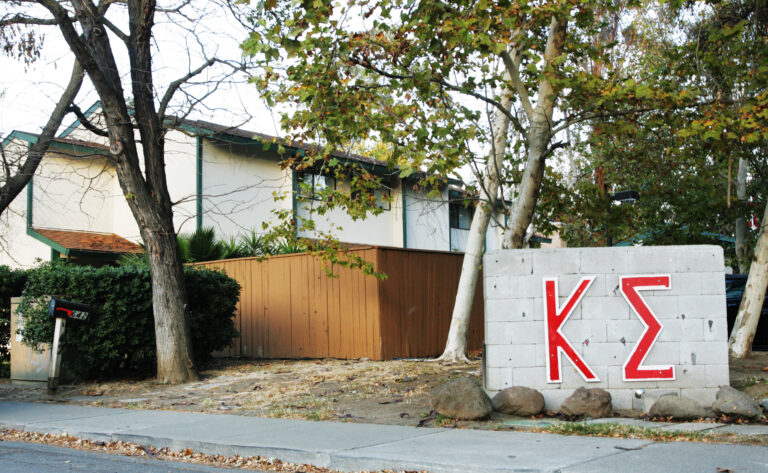
The Davis Police are still investigating an arson attempt at a West Davis fraternity house, Kappa Sigma, on Nov. 3. The arson fire was set around 1 a.m. on Sunday according to Lt. Glen Glasgow of the Davis Police Department (DPD).

An unknown suspect or suspects started a natural gas leak and set fire to the house, located at 642 Adams St. According to Glasgow, the incident looks like a deliberate attempt to harm. No one was injured in the incident.

An online police log states that someone had turned on all the stove burners in the kitchen and then lit a fire in the bathroom.

Residents at the house found the remnants of the fire and detected the smell of gas around 1 a.m. but police were called to the scene around 1 p.m. Glasgow said the DPD doesn’t suspect any malicious intent behind the delay.

The DPD has called in the Federal Bureau of Alcohol, Tobacco and Firearms to aid with the investigation and is working with the UC Davis police and fire departments. Suspects and motives are still unknown.

“We are continuing to investigate by interviewing people to try and identify a person of interest or suspect,” Glasgow said.

Around 15 people live at the fraternity house, but about 45 were there Saturday night and Sunday morning due to a party hosted by the fraternity.

The fraternity released a statement on Nov. 4 on their Facebook page about the incident.

“We are very fortunate and grateful that there were no serious injuries or fatalities, and that the house itself is fine,” the statement said. “The brothers would like to thank everyone who has shown and offered their support; you don’t know how much it means to us.”

The house is located in a neighborhood with many multi-family apartments.

“It’s a very serious incident and could have been disastrous if it had come to fruition,” said Keith Sterling, director of media relations for UC Davis. “We have gone to meet with the sororities and fraternities to hear their concerns and offer them resources [to deal with the incident].”

Anyone with information regarding this incident should contact the DPD at (530) 747-5400.

— Paayal Zaveri

The science behind sweating

Why do we sweat? Where in the long path of human history did we evolve this embarrassing characteristic? How does it work?

Well, the truth is that sweating is what gave us the ability to achieve greatness. Most other mammals don’t sweat, causing them to run internal body temperatures much higher than our own. They can pant, but they can’t hide. Humans, on the other hand, are unique in that we can direct heat off of our bodies and (more importantly) away from our big brains.

On top of giving our brains an easier time, we can use our perspiration powers for endurance activities that others cannot. The four-legged prey we used to run after with spears had to eventually slow down to pant. We didn’t. We could keep pace with them, outrun them and then eat them.

Almost every aspect of science plays an important role in keeping us cool. Let’s start with how we know when to sweat.

As we become active, our body temperature rises. Then, when the hypothalamus of the brain notices a temperature above the normal threshold, it activates a process called negative feedback.

“In negative feedback loops, a change causes the body to respond by doing what it can to reverse that change,” said Sahana Rajan, a second-year neurobiology, physiology and behavior major.

So as temperature goes up, the human body fights back by dilating blood vessels to give off heat and by sweating. When body temperature returns to normal, the brain inactivates these processes.

Once the body has been alerted that it needs to cool off, its sweat glands become active. There are 4 million of these glands all over the body — everywhere but the lips. The eccrine glands on the foreheads, palms and soles of our feet are connected to emotional signals as well as temperature changes. This is why we get sweaty palms before giving a speech.

How does sweating actually cool us off? Water released from our pores evaporates, cooling our skin and releasing heat. This requires understanding a bit of molecular chemistry. The molecules of water (H­2O) are in constant motion. If the liquid water increases in temperature, the average kinetic energy — energy from the movement of the different water molecules — also increases. If it reaches a certain temperature, the fastest moving molecules will move so quickly they can jump out of the pool, taking their energy with them.

“The hotter water becomes a gas, leaving behind the cooler water still in liquid form. That is why when water evaporates, it leaves behind cooler water,” said Maria Zarefakis, a chemistry graduate student.

Furthermore, we’ve all noticed that a nice breeze can cool us down even quicker.

“[This] has to do with heat transfer and the fact that the rate of evaporation of sweat increases as the wind blows … Sweat is evaporating and carrying heat away from our skin … the convective heat transfer coefficient is increased as air is ‘blown’ over the skin which also results in heat being carried away faster,” said Josef Efron, a fourth-year mechanical and aerospace engineering double major.

This technical explanation is essentially another way of saying that as the wind blows, in addition to heat from our bodies being directly carried away by the air (aka convective heat transfer), water evaporates more quickly.

Along with water, we release salt and nitrogenous wastes, like urea. While it may seem efficient to dump these unwanted materials out with our sweat, it actually reduces the efficiency of evaporative cooling. This is due to a concept in chemistry called colligative properties.

“Colligative properties only apply to solutions. They are a property of solutions that depend on the number of dissolved particles in the solution. What the solute is doesn’t matter,” Zarefakis said.

Essentially, when we add things to water, water behavior changes.

For example, colligative properties cause a boiling point elevation. The temperature required to change molecules from a liquid phase to a gas phase increases. All that salt in our sweat just gets in the way of the water molecules that are speeding up and trying to turn to gas. In the end, however, we are still able to cool off enough to keep our bodies happy, while also getting the added benefit of getting rid of all those extra waste products.

Yolo County applies for state jail funding

0

On Oct. 23, the Yolo County Board of Supervisors applied for a $40 million state grant in hopes of renovating its county jail.

The funds would be used for upgrades that focus on reducing recidivism rather than expanding capacity. These would include new beds for the prison’s health care facility and equipment for its aging kitchen, which, according to Yolo County sheriff Ed Prieto, is “pretty well antiquated.”

Prison officials are also seeking to build an expanded Day Reporting Center (DRC). According to Deputy County Administrator Mindi Nunes, the new DRC would provide “everything a released inmate would need to reintegrate back into society,” running the gambit from housing assistance to mental health counseling.

The funds would come from a pool of $500 million in potential bond revenue put aside for county jails by SB 1022, passed by the California State Legislature in June 2012. If the application is accepted, the county will match the grant by 10 percent, bringing the total amount of funding for the facility to $44 million.

Built in 1988, Yolo County’s Monroe Detention Center has been in need of renovation for years.

“Everything we do is 24/7; if it’s a 10-year-old facility, that’s more like 30 years from wear,” Prieto said.

This need has recently become even more pronounced as the prison attempts to cope with an influx of longer-term prisoners following the enactment of California’s realignment legislation package, AB 109 and AB 117, in Oct. 2011. This legislation was aimed at reducing the state’s overcrowded correctional system by sending new low-level offenders to local county jails instead of state prisons.

However, as many of these new inmates have longer sentences, local facilities are struggling to cope with the changes.

“The facility is overbooked,” Prieto said. “We’re like the Embassy Suites of county jails.”

In addition to overbooking, the prison is faced with meeting the changing needs of a new population of long-term prisoners. Although the prison was designed to accommodate shorter stays of a year or less, as the average term length increases, so does the number of issues the prison faces.

In one case, the prison has been tasked with accommodating an inmate with multiple sentences totaling 18 years.

Longer-term prisoners usually require greater resources in terms of medical and psychiatric care. Coupled with their lengthy residencies, this can pose a tremendous burden on prisons that don’t have the proper facilities or personnel.

Despite these challenges facing the prison, a recent Yolo County Grand Jury report on the Monroe facility found that the “staff has been creative in developing and implementing programs that adapt to inmates with longer sentences, more serious convictions and unique problems,” and that “the Center’s buildings and grounds are as well-kept and maintained as possible, considering the age and condition of this much-used facility.”

The report goes on to detail the complex challenges that many aging county jails like the Monroe facility are facing due to realignment, recommending that upgrades “be implemented as a first priority as funds become available.”

Robert Oates, a project director with the Board of State and Community Corrections acknowledges that many of these renovations for county facilities are long overdue.

“Some of these facilities are past 50 years old, and they show it,” Oates said. “So it’s time.”

Sacramento County has also applied for funding; however, due to its large size, it is able to request an increased maximum of $80 million for the Rio Cosumnes Correctional Center in Elk Grove.

According to Sgt. Lisa Bowman of the Sacramento County Sheriff’s Department, these funds would pay for new medical and psychiatric beds at the facility as well as introduce new prison vocational offerings such as a culinary arts program.

Due to the limited amount of state funding and large numbers of county facilities facing similar challenges posed by realignment, many are saying the application process will be particularly selective.

“We’re facing some pretty stiff competition,” Nunes said. “Some counties went all-out in preparing their application, and hopefully we were one of them.”

This competition is evidenced by the 36 applications that were received by the Oct. 24 deadline, totaling more than $1.3 billion in requested funds.

“This is the largest we’ve had in years,” said Leslie Heller, a field representative from the Board of State and Community Corrections, in regard to the volume of requests coming in from counties.

“It will certainly be very competitive,”  Heller said. “We knew there would be a lot of applications.”

The Board of State and Community Corrections will now send the applications to be appraised by an executive board comprised of members of law enforcement offices, counties and medical associations across the state.

“We try to get a cross section of society,” Oates said. “It’s a fair process, as much as we could make it.”

The board will rank the applications and is scheduled to announce its selections in January.

2nd Friday ArtAbout

0

On Nov. 8, Davis Downtown will be hosting its monthly 2nd Friday ArtAbout. Live music, performances and a mix of local, regional and international art will be featured in 31 venues.

The 2nd Friday ArtAbout, which was originally established by The Artery and overseen in part by the Davis Downtown Business Association, is a self-guided art-walk where downtown businesses exhibit new art each month.

“Over the years, ArtAbout has become a larger event with more venues hosting art and more viewers and participants from Davis and surrounding areas,” said Sandy Thai of the Davis Downtown Business Association in an email interview.

Among some of the highlights of this upcoming ArtAbout, the UC Davis Department of Theatre and Dance will have stilt walkers, a small performance and a raffle to win tickets to their upcoming production of “Spring Awakening” at the E Street Plaza from 6 to 8 p.m.

At their booth, attendees can learn about upcoming productions, such as ones by internationally renowned Granada Artists-in-Residence, three student showcases, the Shakespeare-On-a-Shoestring (SOS) class production as well as unticketed Institute for Theatre, Dance and Performance (ITDP) programs.

At the Pence Gallery, there will be a dedication ceremony for its first mural, created by Anthony Padilla, from 7 to 8 p.m.

The piece is titled “Solar Compass” and it is 22 by 22 feet, making it the tallest public mural in Davis. Using vibrant spray paint, Padilla addresses the plight of honeybees and the need for alternative sources of energy.

The Pence Gallery will also be having its annual Holiday Market, where various crafts and artworks can be bought for the holiday season. There will also be live music by the band Big Sticky Mess.

First Street Real Estate will be exhibiting a series of photographic prints that they purchased from Berlin-based photographer Erik Johansson.

“My images communicate stories, like dreams,” Johansson said in an email interview. “It’s up to every person to make up their own story around each piece, I just give them an image and a title to start with.”

Johansson, who has appeared on TED talks, combines different realistic elements together to create photo-surrealistic photographs.

At Studio 21, artists Lauren Brandy and Thelma Weatherford will be exhibiting some of their paintings. The show is titled “Small & Sweet” to account for the small paintings and the sweet desserts that will be available.

Weatherword’s pieces are abstract, while Brandy’s works feature impressionistic Central Valley landscapes that play with atmospherics.

“I try to connect through my art,” Brandy said. “I think people who are also in love with the landscape in the Central Valley can find a connection to what I see as well. Not just visually, but also emotionally.”

At The Artery, the show “Street Play” features photographer Anne Miller, who responds to urban landscapes by moving in close with her camera to capture details that are otherwise overlooked by passers-by. Feature photographs will include images from San Francisco, San Luis Obispo and Davis, among other places.

Art-is-Davis will be serving refreshments to go along with their exhibit of four artists, under which include works in acrylic, watercolor, oil, mixed media and printmaking. The artists will be Marieke de Waard, Seana Burke, Jan Walker and Joanne Andresen.

Other venues include, among others, Armadillo Music, the Davis Odd Fellows Lodge, the International House, the John Natsoulas Gallery, Nestware, Paulina’s Boutique and Studio 26.

For more information and for an ArtAbout guide and map, visit davisdowntown.com.

Men’s soccer amps up for season finale

0

Team: UC Davis at Sacramento State

Records: Aggies 6-8-3 (2-4-2); Hornets 3-10-3 (1-7-0)

Where: Hornet Soccer Field — Sacramento, Calif.

When: Saturday, Nov. 9 at 2 p.m.

Who to Watch:

With the devastating double overtime loss several weeks ago at the hands of UC Santa Barbara still fresh in the minds of UC Davis fans and players alike, a rematch on Nov. 2 was just what the team needed to snap out of their three-game losing streak.

UC Davis’ first game against No. 7 ranked UCSB this season was at home on Oct. 19. In front of a packed crowd the Aggies forced the Gauchos into double overtime, but with less than a minute left Santa Barbara scored the coveted golden goal, taking the match 3-2. Although the Aggies played hard, they could not wait for a rematch, which finally came this past weekend.

The Aggies recently traveled for a rematch with top-ranked Santa Barbara on Saturday, Nov. 2. Leading up to what ultimately ended in a double overtime 1-1 draw, junior forward Matt Sheldon found the back of the net midway through the second half of regulation play. UCSB then answered back with a late goal to even it up 1-1 and take the game into overtime. The game remained tied at 1-1 until the game finished.

Matt Sheldon has been a pivotal part of this team all year long and leads the team with five goals this season. His talent was on display once again with the clutch goal he scored on the Nov. 2 matchup with the Gauchos.

Another key player who played well against the Gauchos on Nov. 2 was redshirt freshman forward Dashiell MacNamara, who teed up a clean cross to the waiting Sheldon in the box. MacNamara has one assist and two goals on the season and is expected to do big things for the Aggies in the upcoming years.

Although the rematch between the Gauchos and Aggies ended in a double overtime tie, the players still feel that there is plenty of room for improvement and are eager to finally get a breakout win.

Another player who has been solid for the Aggies all season is junior forward Matt Wiesenfarth.

“We should have won but we just couldn’t hold onto the win again,” Wiesenfarth said. “We played really well for 89 minutes though and definitely deserved a victory.”

However, that victory remained once again just out of reach. With the two final games of the regular season fast approaching, Wiesenfarth and the rest of the team only have a few opportunities left to get those wins and finish the season on a high note.

Preview:

The Aggies travel to Sacramento for the much-anticipated final game of the regular season and a huge redemption match for the Aggies.

After an upsetting loss to Sac State on Oct. 26 at home, the UC Davis men’s soccer team is hungry to prove once again that they are the best team in the area.

“We are all a little embarrassed of our previous performance against them and are looking to make up for it with a big win,” Wiesenfarth said.

With two wins this week, Davis finally snapped their losing streak and set themselves up well points wise for the upcoming Big West tournament quarterfinals.

“If we play these last two games like we did against Santa Barbara, we will come away with six points,” Wiesenfarth said.


– Sloan Boettcher

Davis Musical Theatre Company presents ‘Oliver!’

0

Davis Musical Theatre Company’s latest production Oliver!, based on Charles Dickens’ classic novel, will premiere on Nov. 8, and will be running through Dec. 1.

The timeless holiday tale recounts the story of the orphan, Oliver Twist, who endures a miserable existence in a workhouse and then is sold to an undertaker. He escapes and finds solace with a group of juvenile delinquents, who teach him how to pickpocket in the busy streets of London. Along the way, he meets a group of characters with unforgettable personalities.

Located at 607 Pena Drive, the play will be performed at the Davis Musical Theatre Company. The theater was meticulously designed by its co-founders, directors, choreographers and husband-wife team, Steve and Jan Isaacson. Built in November 2005, the Isaacsons hired contractors to design their state-of-the-art facility, which houses a 238-seat stadium, has space for a full orchestra, a complete costume closet and underground prop storage.

“Everything at the theater is entirely made by our company,” Steve Isaacson said. “My wife and I designed the building and were able to find wonderful people that were willing to volunteer their time with lights, costumes and stage props. Everything we have, we have made, and we recycle all our props. We’re so blessed to have all these people who volunteer so many hours of their time for the company.”

Not only are the behind-the-scenes crew all volunteers, but so are all the actors involved in the Davis Musical Theater Company. All 25 actors in the production of Oliver!, ranging in age from young children to adults, practice five days a week.

“We chose to do this show because it involves seniors, adults, teens and kids. What’s nice is that although it is a childhood tale, it is a musical that appeals to all ages, and requires actors of all ages as well. We have a lot of real-life families in the show, so it’s fitting,” Isaacson said. “It also happens to be my wife’s favorite book. She basically adapts the movie representation, but in musical form, while adding a couple of her own twists.”

Jan Isaacson carefully selected the actors for their respective roles in the show, such as Brooke Flores, who plays the character of Charlotte, the undertaker’s daughter. A UC Davis alumna, Flores recently joined the Davis Musical Company, and Oliver! will be her first performance with them.

“It’s been such a great outlet being able to play the character of Charlotte, because I feel like I’m not anything like her in real life,” Flores said. “I’m not at all bossy or particularly flirtatious in reality, so it’s fun to get to come out and get to play someone who is totally different. It’s also just a lot of fun to get to play the stereotypical teenage girl.”

Flores, like many of the other actors in the musical, is not at all trained as a singer. Also, none of the actors use any microphones, so they rely purely on the power of their voices to project throughout the theater.

Mike Mechanic, who has had a 20-year long acting career, plays the role of Fagin, the conniving career criminal who trains the group of children to pickpocket. Mechanic discussed his role in the musical.

“Fagin is, in a sense, the quintessential bad guy with a good heart,” Mechanic said. “The show totally takes on a different atmosphere when Fagin steps on the scene. I’ve only recently gotten into musicals, but what I have noticed is, that in big musicals like this one, you have to be the kind of character that people want to see. I have to act like the kind of Fagin that people are accustomed to seeing, which is fun and exciting.”

Mechanic is not only an actor, but is also a producer for CBS in Sacramento. Being fully immersed in film daily, he spends a lot of time with actors, and he described the Davis Musical Theatre Company as being full of talent.

“There is honestly more talent on this stage than any other theater company I have worked for in the past,” Mechanic said. “There are people in this production that could be professional actors, if they wanted to be. The beauty of this is that everyone does this for fun. This is our outlett.”

Tickets are from $9 to $18 and can be purchased online at dmtc.org.

Police Briefs

THURSDAY 10/31

Peeping tom

Someone was watching through binoculars and believed there to be a mountain lion sitting and whining in a tree on Russell Boulevard.

Too old to trick-or-treat, too young to die

Someone reported a 20-year-old man wearing black leather and a gold chain that rang the bell to trick-or-treat even though the reporter’s house was dark on Rockwell Drive.

Mean spirited

Somebody saw a shadow of a person outside his window followed by someone opening his front door on Sycamore Lane.

FRIDAY 11/1

Bike snob

An elderly person refused to let a biker merge into the left lane, passed them with a foot to spare and yelled at them to get off the road on Pole Line Road.

SATURDAY 11/2

Train wreck

Someone was sitting in the bushes near the train tracks yelling and cussing at passersby on Fourth Street.

Out of the frying pan…

On Adams Street, someone went into a residence, turned on all the gas burners, and started a fire in the bathroom.

Cosmic Relevance: Vote or vote

0

The ASUCD senatorial elections start Nov. 12 and the university should be in a political frenzy, right?

So I asked my peers, are you going to vote?

I’m no statistician, but it appeared that only half of the respondents said they were planning to cast a ballot. Considering every student can vote online, I was curious why anyone wouldn’t vote if it was so convenient. Of those who said they were not going to vote, I asked why not?

“I feel like a little ant when I’m voting for politicians,” said one fourth-year student. Most answers were a variation of this powerless sentiment, claiming that their voice was silenced in the crowd.

Others who weren’t voting also thought ASUCD served no purpose, one calling the candidates “resumé-builders out for personal glory.” This view of a broken system was summarized by another student, “Does ASUCD really do anything?”

To be honest, I didn’t know what the student government did for me. Do these senators really impact my experience as an undergraduate?

I decided to go to the source, and I interviewed a senatorial candidate to ask them, why were they running? Did they really think they could make a difference?

They were convinced that the student government was crucial to campus growth, responding, “ASUCD is a tool to help students, and it can make some serious change.” They cited that Unitrans was a senator’s idea, and that the Experimental College, the Bike Barn and the Coffee House are all under the student government. Their bottom line was that their ideas could influence others to create something real.

Whether or not the specific platforms that senators are running on will be implemented is to be seen. However, free public transportation for students was once an idea, and now it’s a reality.

It appears that senators can significantly transform our campus.  Yet, it seems like many are disenfranchised from our student political affairs.

Granted, not everyone can run for Senate. The average student is just trying to go to school, get good grades and get a diploma to get a job. However, if you’ve ever eaten at the CoHo or seen an Entertainment Council concert, you’ve directly benefited from ASUCD.

So does this create some sort of responsibility? If you’ve received benefits from the school, do you have an obligation to give back? How does the average student get involved? As always, I asked my fellow scholars.

Many said they don’t do much, reasserting that schoolwork is their top priority. One biology major says, “I know it’s bad not to care, but politics aren’t my thing; I’m simply too busy.”

And that’s a valid point. It is unreasonable to ask each student to storm the streets asking for revolution, especially during midterm season.

But in spite of everything, I still think we can do more. One candidate shared the sentiment that “I can’t do it alone.”  Their ideas are only ideas, and they need many people on board to make one concept an actuality. (To see what the candidates are proposing to the student body, you can read their online biographies — it truly doesn’t take long to get informed).

Maybe we are all just guppies in a vast ocean. Nonetheless we all hold a piece of power that determines who speaks for us at the table.

If you would like to recite the Pledge of Allegiance with DANIEL HERMAN, you can email him at dsherman@ucdavis.edu.


Aggie Arcade: Your weekly dose of video games

0

Video Games: The Next Generation

We have now arrived at the biggest month in video games in about seven or eight years. In just one week Sony will release the PlayStation 4, and Microsoft will follow suit on Nov. 22 with the Xbox One. Let’s just say the next few weeks will be simultaneously hectic and thrilling.

I find myself surprised by the lack of enthusiasm from a large part of the video game community. I’ve been reading about people canceling pre-orders due to underwhelming launch lineups and rumored interface issues on the Xbox One. But what about the childlike enthusiasm that comes from owning the coolest new piece of technology?

As for the launch lineup, it’s far less dire than some make it out to be. Let’s not forget that Perfect Dark Zero and Resistance: Fall of Man were the big-name launch titles for the Xbox 360 and PlayStation 3 respectively. Even at the time they were merely serviceable games, and the ensuing years have not treated them well. I doubt we’ll feel the same way about the PS4’s Killzone: Shadow Fall or the Xbox One’s Dead Rising 3 in a few years.

But I’m also excited about some of the community features that Microsoft and Sony are pushing forward with the Xbox One and PS4. I love the idea of pressing the “share” button on the PS4 controller in order to upload a quick gameplay video if I destroy a boss or solve an incredibly difficult puzzle in record time. Additionally, on day one users will be able to stream through the console’s Twitch integration. As someone who streams regularly, I couldn’t be happier with the inclusion of that feature.

I freely admit that a lot of the appeal of new consoles is the potential for greatness more so than immediate results. When I first get the PS4 I’ll probably play the thing 24/7 before I get burned out. At that point it may collect dust for a month or two while I wait for more games to come out. Eventually we’ll get to a point in which both consoles feature large and diverse video game libraries, but that takes time. As they say, patience is a virtue.

The release of these consoles will also add fuel to the Sony vs. Microsoft debate, but I honestly don’t care who comes out on top this holiday season. I only pre-ordered the PS4, but the most important thing is a sense of competition. That brings out the best in both companies and in turn rewards the video game audience.

In the meantime, I’m going to obsessively read about these new consoles while I impatiently wait for my PS4 to arrive. I hope to provide some early impressions of the new console in the next edition of the Aggie Arcade.

Davis housing development sets examples in community planning

0

North of Covell Boulevard and between F & J streets, the location previously occupied by the Hunt-Wesson tomato processing facility will soon be the site of the Cannery Project — a 100-acre development implemented by The New Home Company (TNHC).

It will comprise of 547 residential units and 10 to 15 acres of mixed-use commercial space. With the goals of the city and developer being to balance out demographics and bring in private-sector jobs, the community will house a mix of students, seniors and families.

Affordable housing is also an important part of the project, with 40 to 60 units slated to be built. The number of housing units is variable due to the affordable housing subsidy coming from property tax on the lots surrounding the units.

Rob White, chief innovation officer for the City of Davis, addressed the income gap which would inevitably result.

“The more higher income you can bring in, the more you can subsidize the affordable,” White said. “What we’ve found, in planning, is that the more you can mix neighborhoods and income levels, the more you help those in lower-income levels rise faster.”

Among senior citizens in Davis, agreement hasn’t been reached on whether TNHC has done enough to accommodate accessible housing. Community groups such as Choices for Healthy Aging (CHA) have called for more single level houses to be included in the project, while the City Senior Citizen Commission found the plan sufficient in March 2013.

Community development administrator for the City of Davis, Katherine Hess, noted the lack of consensus.

“The Davis Senior Citizens Commission said … they were comfortable with the project as it was presented,” Hess said. “Different people have different priorities, and it may not be possible to make everybody happy.”

However, according to Mike Webb, director of Community Development and Sustainability for the City of Davis, including more single-level units would pose a density problem.

For businesses in Davis, the Cannery helps alleviate a bit of the pressure applied by the opposing forces of keeping overhead low while remaining in a desirable location. Half of the commercial space at the Cannery will be leased to tech companies while the other half will serve the neighborhood with retail and restaurants. White is responsible for attracting businesses to the area.

“A lot of the folks that are going to go there are university startups [or are] coming out of incubation programs such as Davis Roots,” White said.

White went on to mention that research and development companies are more likely to succeed the closer they are to the knowledge base of a region (i.e. UC Davis). They also tend to have fewer issues recruiting employees on account of the desirable proximity to the university.

“We have even had companies come forward saying ‘We’ll pay the premium to stay, if you’ll open up land for us to use,’ … So that’s a big driver for us to make that opportunity available,” White said.

Economic diversity provided by the influx of high-paying private jobs will stabilize the Davis economy, which is currently skewed between the service industry and academia.

“We need to grow private sector jobs … in order to create the diverse economy which will really keep us healthy,” White said. “We have a university which really is a crown jewel of Northern California … It gets you thinking, why aren’t we doing more to support it?”

White added that while students are a large and important part of the population, they aren’t the providers of the most financial driver in the city.

One of the primary concerns voiced at public hearings is a fear that the current plan for bike connectivity is unsafe and/or incomplete. There have been three options discussed, the most likely to be approved is a pathway which runs parallel to Covell, underneath the train tracks which links to the H Street Tunnel.

Ellen Moriarty, a co-owner of local green planning firm MAK Design+Build, expressed concern that TNHC won’t be putting in a bike path linking the Cannery to North Davis. In doing so, the TNHC is cutting off one community from another without anticipating the interaction that will inevitably occur.

“Some parents are going to feel squeamish about sending their children on bikes across Covell. [They’re] going to wind up driving them,” Moriarty said.

Covell Boulevard currently lacks a bike path on its north side, so biking to North Davis would require multiple crossings across a fairly busy intersection.

The problem with vehicle access on F Street is that any crossing would require the train running alongside the street to sound its horn whenever it passes through. This safety precaution has drawn the ire of Davis locals who want to keep the noise out of their neighborhood.

“We talked to people from the railroad to discuss other alternative signaling devices with a more localized sound, but their short answer was ‘No, we’re going to sound our horns,’” Webb said. “Should the tracks go away, we can reassess.”

Traffic buildup was also brought up as an issue at the public hearings.

“I’m really surprised that the city planners and the traffic surveyors think that this is a workable solution, knowing how Covell already works,” Moriarty said. “You’ve got two points of entry which are not far away from one another … I don’t see how there isn’t going to be any back up.”

Even though there are still concerns being voiced by the public, city officials believe that the Cannery Project would be an asset to Davis. TNHC has proven responsive to locals’ needs, and the development will likely be adjusted throughout the course of its implementation, but it is definitely going forward.

There will be one more public hearing on Nov. 12 at City Hall at 7:30 p.m., and anybody with concerns is welcome to participate.

“[TNHC] is listening to the community. Some of it has been shouted so loudly that they didn’t have a choice but to listen. Davis is not an easy place to develop; there are a lot of competing demands,” Hess said. “In order for a project to also be financially viable, it can’t always be pushed to the level that some people want. It might never get off the ground otherwise.”