


41.9 F
Davis

Davis, California

Tuesday, December 30, 2025
Home Blog Page 981

Davis kissed with Valentine’s Day dinner specials

Local chefs are getting saucy this Valentine’s Day, and couples looking to get in on the action should make their reservations soon.

The Mustard Seed is already nearly booked for its annual “Enhance Your Romance Dinner” next Thursday. Diners pay $69 for four courses — four very sensually-described courses. Greens are “caressed” with vinaigrette, “embracing” raspberries and jicama hearts. Beef tenderloin is “climaxed” with truffle-laced mushrooms with an “afterglow” of Bearnaise sauce. There’s even a dish called “Menage a Trois Gnocchi.”

Osterio Fasulo is booking up as well. The upscale Italian restaurant in West Davis is serving a special menu all day — four courses for $85 or five courses for $95. Each course has two options, and diners can expect to see oysters, lobster bisque, fresh pastas and other temptations.

Another sure-to-be popular destination: Tuco’s Wine Market and Cafe, with a more affordable four-course menu at $45. Entree options include steak with chimichurri, crab and cheese ravioli, wild mushroom risotto and pork loin with Valentine relish. In fact, “Valentine” sauces and jellies dot the menu, though we’re not so sure what “Valentine” tastes like.

Little Prague’s Valentine’s Day dinner starts off romantically with champagne and strawberries, segueing into four courses for $59. A live jazz trio will serenade all evening.

Our House is preparing a five-course meal, plus an amuse-bouche, for $75. Openers — hamachi or curried nuggets of lobster — have an Asian flair, which move on to soup and salad, ravioli, a choice of four entrees and dessert. The standout entree: filet mignon topped with jalapeno hollandaise and a poached egg.

de Vere’s Irish Pub’s special might be a steal — for $40, a couple is served three courses each and a bottle of wine to share.

Bistro 33, Seasons and Monticello Seasonal Cuisine are also expected to have special menus, though they haven’t been finalized yet. Monticello will host live music, too.

Did we miss anything? Put your Valentine’s Day destinations in the comments!

Vitals

The Mustard Seed – $69 – 222 D St. #11 – (530) 758-5750

Osterio Fasulo – $85-95 – 2657 Portage Bay E #8 – (530) 758-1324

Tuco’s Wine Market and Cafe – $45 – 130 G St. – (530) 757-6600

Little Prague – $59 – 330 G St. – (530) 756-1107

Our House – $75 – 808 Second St. – (530) 757-1232

de Vere’s Irish Pub – $40 for two – 217 E St. – (530) 204-5533
Police Brief

0

FRIDAY
A little late for the Turkey Trot
Approximately 15 turkeys were blocking the roadway on Hanover Drive.

I’mma cat you
Someone reported the person she was cat-sitting for was threatening to stab her for feeding his cat incorrectly on Ninth Street.

SATURDAY
Unclad to meet you
An unknown male undressed in front of somebody’s house, then sat in a chair in front of the garage door on Gregory Place.

SUNDAY
Vision of apparition
Someone reported that an unknown subject was entering through the walls of her house to steal food on Cowell Boulevard.

Pop goes the weasel
A male subject was passed out and vomiting in the parking lot of Jack in the Box on G Street.

Drunk munchies
A woman’s daughter came home intoxicated and was trying to leave the house; when the woman and her husband tried to restrain her, she bit the husband on Biscayne Bay Place.

Police briefs are compiled from the City of Davis daily crime bulletins. Contact EINAT GILBOA at city@theaggie.org.

Old dog, new tricks

0

General education (GE), also known as the unavoidable units to some UC Davis students, is something that we all must complete and poses a unique opportunity to study interesting topics.

Ever since the requirements changed two years ago for all UC Davis students entering in or after Fall Quarter 2011, understanding the transition from the old “GE two” to the new “GE three” has been confusing for a large part of the UC Davis community.

“When the new GEs came out for the advisors, it was very difficult for us as advisors to implement them,” said Kate Shasky, undergraduate adviser in chemical engineering and materials science. “I can only imagine the frustration and confusion the students might have.”

For the previous GE two, students were expected to complete a certain amount of classes, rather than a set number of units. Also, taking a course for pass/no pass was not an option under GE two, unlike the new requirements.

“Because GE three allows for pass/no pass, students are allowed to take a lot of classes they really like without feeling the pressures of a grade holding them on,” said second-year communication and psychology double major Kenny Tran. “Whereas in GE two, even though it’s much smaller, students aren’t really able to take classes of interest without them feeling like it’s not going to anything.”

Both GE two and three include a topical breadth section that includes requirements in arts and humanities, science and engineering and social sciences. A minimum of 52 units is needed in this area for the GE three, as opposed to nine classes for GE two.

A core literacies section was added only to GE three as part of the change, and totals to 35 units. There are four parts within this area, including requirements in literacy with words and images, civic and cultural literacy, quantitative literacy and scientific literacy.

“Professors wanted their classes to be included in the GEs,” said fourth-year science and technology studies major Lexi Farris. “They wanted student experiences to be more enriched, and want to make sure you are really well-rounded here at UC Davis.”

In order for students to finish their requirements on time, the university allows “double-dipping” between the topical breadth and core literacies sections, or using one GE class to fulfill two requirements. However, double dipping is not allowed within each section.

An example of this is Anthropology 2: Cultural Anthropology, which fulfills requirements in social sciences within the topical breadth and in the core literacies section.

“Think of the topical breadth areas as different ice cream flavors, and the core literacies areas as toppings,” Tran said. “Your ice cream cone can only hold one scoop of ice cream and one topping. If you have two flavors, it’ll fall over.”

Since those under the GE three requirements are expected to complete more units than previous years, many students found it difficult to manage their major requirements with GEs when the changes were implemented.

“Depending on the major, it’s an added workload,” Shasky said. “It makes completing a degree in time for engineering students much more difficult.”

Shasky said she sees students every day that are nervous about not finishing the GE requirement in time to graduate.

“I always recommend summer school if you want to guarantee graduation in four years, because that’s the best way to ensure it,” Shasky said. “GEs are a great thing to take during the summer because there is lots of variety in Davis, community college or abroad.”

Although student difficulties may have increased with the new GE three, many people think the benefits of the change outweigh the negatives.

“I am jealous of the new one because I feel like students have more opportunities to take fun classes,” Farris said. “I felt like the courses they wanted you to take were limited, but I feel like now you can take courses that are more tailored to your needs.”

Tran said he likes being on GE three requirements because it allows him to expand his horizons and take classes that he wouldn’t normally take.

“I think people are so concentrated in one area that they don’t get to see the context of what they are studying,” Farris said. “[GE three] gives students more flexibility, helps students explore things and it’s good to be knowledgeable.”

In a technical light, the broadness of the new GE requirements is also beneficial to students.

“Some of our major requirement courses count towards GE, so that’s helpful,” Shasky said. “Some of the units will actually be fulfilled by the major requirements.”

Major classes aside, UC Davis offers some interesting classes for students to fulfill the new GE requirements.

Plant Sciences 49: Organic Crop Production Practices, is a three-unit class for science and engineering GE credit that allows students to experience the garden firsthand with a variety of fieldwork days.

Another popular science and engineering class is Applied Biological Systems Technology 49: Field Equipment Operation (commonly referred to as farm tractors and equipment). The class has a cap at eight students, so older students have higher chances of getting in.

Comparative Literature 6: Myths and Legends is a larger class in which students read and analyze ancient stories. This class is particularly beneficial because it is a double-dipper for arts and humanities with either world cultures or writing experience requirements.

Other interesting classes for GE credit include Food Science and Technology 10, Science and Society 40 and Anthropology 32. Classics 30: Word Roots is now offered for arts and humanities credit under the new GE three.

“[Classics 30] really helped me break down words and I think that’s an important skill to have while you’re at UC Davis,” Farris said. “For academic scientific literature, you can run into large words and won’t have to go to a dictionary.”

Tran said that he enjoyed Film Studies 1 because it was something different from his normal major classes, something he said is important to do, along with taking classes you find interesting.

“This is your only chance to take fun classes that are completely random, and you can only do that with GE courses,” Farris said. “So have fun and take your time with it.”

Shasky said that GEs can be a break from your normal workload, something that allows you to explore a different subject without any restrictions.

“Engineering students might find some relief for taking a course in music, art, health or sociology,” Shasky said. “Overall, GEs are beneficial to a student’s academic success because they make you a more well-rounded student.”

Since the GE requirement change, students at UC Davis are more open to taking the vast variety of classes offered.

“I think it was a time of huge-scale academic policy change, but I think now it’s pretty well set,” Shasky said. “If a student is concerned, I think advisors are aware of what’s going on.”

RITIKA IYER can be reached at features@theaggie.org.

Tree of liberty

10

In his inauguration speech two weeks ago, President Obama mentioned that “our country cannot succeed when a shrinking few do very well and a growing many barely make it,” echoing the view of many liberals that income inequality is problematic and unfair in our society.

In the midst of the clamor for wealth redistribution and yet more progressive taxation, almost no one has stood up to defend the wealthy and the enormous productivity it often takes to achieve their status.

Actually, income inequality is among the noblest aspects of a free society: It reflects the fact that productive geniuses, who enhance our standard of living, are not robbed of their effort and are allowed to rise to their highest potential. In short, income inequality is chiefly the result of justice.

I do not care to speculate on the motives of those who would penalize the successful in the name of “fairness.” Let me just say this: No one is harmed by the mere fact of her neighbor having more income or wealth.

Income inequality does not create social instability — except perhaps in a statist or feudal regime where wealth disparities might arise due to corruption. In the laissez-faire society I advocate, where the government does nothing but protect individual rights to life, liberty and property, it is impossible to legally acquire wealth via the use of force.

Others claim that income inequality undermines the “American Dream.” A recent study by the Congressional Research Service is often cited as having shown that income inequality undermines social mobility, since it makes it unlikely that people are able to improve their position in the distribution of income. For instance, the 5 percent lowest income group is likely to stay in the 5 percent lowest income group.

This argument is misleading for two reasons. Firstly, it relies upon the erroneous view of wealth as being a fixed “pie” that is distributed among the population. Secondly, the focus on social mobility in the distribution of income, i.e. relative social mobility, is a red herring. What matters is absolute social mobility, which refers to the ability to improve one’s standard of living.

The view of wealth as a fixed sum that is divided among citizens is so short-sighted that it is difficult to believe it persists in 21st century society. Such a view drops the context of wealth creation and looks solely at the product — the wealth that currently exists.

But wealth arises out of the free, independent effort and thought of men and women pursuing their values — such as by scientists doing research to discover better medicines, software engineers developing more efficient programs, and farmers figuring out how to provide ever greater quantities of higher-quality food. As Ayn Rand once said, “wealth is the product of man’s capacity to think.” (For the New Intellectual)
It is clear, then, that wealth is not a zero-sum game. Everyone can benefit from the wealth creation of others, as it raises the standard of living in society. So the greater wealth production of others, and resulting income inequality, does not imply that the rich are taking away opportunities for the poor to create or receive wealth. In fact, the opposite is often true, such as when entrepreneurship creates employment opportunities.

Similarly, the focus on relative vs. absolute social mobility amounts to an attempt to transform productiveness and value-creation into a twisted competition; in other words, it does not matter whether you are better off than you were before (or better off than your parents) — it matters only if you succeeded in being wealthier than others.

This was never the American Dream. People fled the poverty, oppression and stagnation of the Old World because of the political freedom that the United States offered: the freedom from coercion by the government. This meant, with a few unfortunate exceptions, that no coercive mechanisms existed that could prevent a person from reaping the full rewards of her skill and effort — not for the sake of the monarch, or the Church or the “common good.” Because of this, wealth-creation was able to flourish.

The American Dream does not mean a guarantee of economic welfare (which could only be provided at the expense of others), and it does not mean attempting to be richer than others for its own sake. It means that people are politically free to search for opportunities to improve their lives, and create them.

This is the noble ideal that President Obama assaulted in his speech. This is what we must defend to establish a truly free society.

TRISTAN DE LIEGE can be reached at tflenaerts@ucdavis.edu.

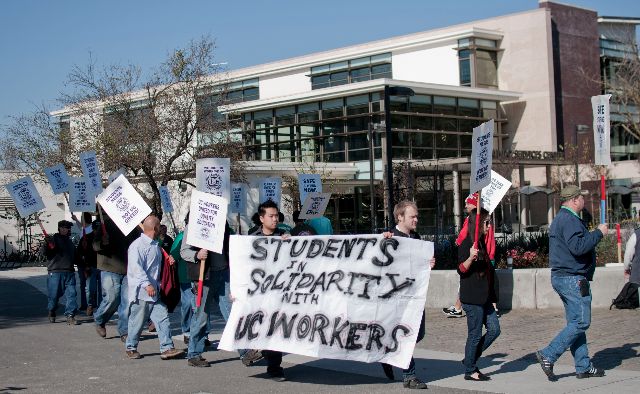
UC workers protest terms of new UC contract

Union members of The American Federation of State, County and Municipal Employees (AFSCME) 3299 picketed at the three UC Davis Dining Commons in opposition with their new University contract last Thursday. A rally was also held at the UC Davis Medical Center in Sacramento.

These protesters were among UC workers and medical center staff all over California who took part in Thursday’s statewide demonstration. The workers included janitors, cooks and gardeners on campus. Many of these workers had contracts ending at midnight last Thursday.

“We want a fair contract. We want fair staffing,” said Fernando Garcia, groundskeeper at UC Davis.

The new contract proposed by the University would include fewer retirement benefits for new workers, an increase in the amount current and new employees must pay to pension and no wage increases.

Shelly Meron, University of California Office of the President media specialist, said the University is addressing the retirement program to provide more aid to retirees by asking workers and students to pay more.

“We prefer to negotiate at the bargaining table,” she said.

She added that 14 unions across the UCs have agreed to the retirement reform measure.

Workers are protesting against the University’s pension reform. The University is trying to negotiate a 24 billion-dollar unfunded liability that has triggered workers to protest, according to Meron.

“It’s not the best, but it’s better than the new contract,” said Marcos Jimenez, a union representative for the University Professional and Technical Employees Union (UPTE), in reference to the old contract.

Worker proposals for the new contract have been denied by the University.

“How can you justify the president of the university making $601,356, while they are cutting pension for the employees by over 50 percent?” Garcia asked.

Workers have also expressed their concerns about staffing.

“We’re understaffed. We’ve lost so many people and the University is not replacing them. Quality is going to start going down,” Garcia said.

Garcia said that the issue of sanitation at medical centers, where cleanliness is extremely important, can be a matter of life or death. Many of the workers use chemicals in their jobs that can be harmful and may require medical attention.

“Sometimes the work here is stressful. We’re always exposed to chemicals,” Jimenez said.

Protesters said the University has ignored union proposals for no co-pay increases, which worries some workers about their medical bills.

Older workers who will not be directly affected by the retirement and benefit cuts that threaten new hirees attended the picket on Thursday to support their fellow union members. The workers have also received support from many organizations, including UC Student Workers Union Local 2865 (UAW) and UPTE.

“[The University] is trying to divide the union,” said Lucy Joseph, senior museum scientist at the UC Davis Viticulture and Enology Department. “We are fighting for the new employees to express our solidarity with them.”

LAUREN MASCARENHAS and KELLEY DRECHSLER can be reached at campus@theaggie.org.

Dear Governor, UC students need your leadership

0

Here at the University of California, students are living in interesting times.
After nearly a billion dollars in state funding cuts and a doubling of tuition in just five years, 2013 looks to deliver at least a moment of relief for students and their families. The
Governor has proposed a moderate funding increase to the UC, and as a result, for the first
time in years, tuition will be frozen in 2013-14.

We didn’t get here overnight. The Occupy Movement, the huge student response to
police brutality at UC Davis and UC Berkeley, a 10,000 student march in March 2012, and
hundreds of lobby visits and rallies all brought us to this moment. And most recently, with
the assistance of online voter registration, students turned out to vote in higher numbers in
2012 than ever before, helping provide the margin of victory for Proposition 30.

Yet it is clear that our work has only just begun. This brief moment of relief has not brought with it a long-term solution to the crisis in higher education. The reality on our campuses is still unacceptable: skyrocketing student debt, unaffordable tuition especially for middle class
families, inadequate student support services, overcrowded classes and cuts to courses,
departments, faculty and staff.

While Gov. Brown has pledged regular 5 percent funding increases over the next four years, this isn’t nearly enough to keep up with rising costs or backfill years of deep cuts. The
UC system receives roughly a billion dollars less than we did in 2006, and costs continue
to shoot up rapidly every year. If nothing changes, it is only a matter of time before the
crushing reality of annual tuition increases returns.

For this reason, students welcome the Governor’s newfound interest in the UC system with great hope and excitement. We also know that funding cuts are only part of the problem.

Similar to the Governor’s recent call for greater “modesty” and “elegance” at the UC,
students have long raised questions and concerns about internal UC operations.

At a time when students are being asked to give more and more, Californians expect the UC to take a hard look at executive compensation, sharing profits across the system, and more
cost effective ways to accomplish our core goals of instruction and research. UC executives
should be paid less, and in some cases, faculty may need to teach more.

Unfortunately, the Governor’s actions on the UC have not yet matched his rhetoric. The
two areas of “reform” that he has touted as solutions are a “unit cap,” which is based on
the misguided view that many UC students are staying too long by choice, and a $10
million earmark for “online education.” While experimenting with online education may be
worthwhile, it is dubious that it will bring either significant cost savings or a new instructional
model that meets long held quality standards.

We would expect more from a Governor who is clearly interested in making waves. Unit
caps and online education seem like mostly hype, and disconnected from the challenges
and barriers we face on a daily basis.

If the Governor wants true transformation of the UC, he will find willing partners in UC
students, as long as this transformation enhances quality, access and affordability rather
than further degrades it.

And if the Governor truly wants to protect the greatness of our public university system, he must talk not just about reform, but also about the need for enhanced long-term funding.

There is no other way to ensure access and affordability for every qualified California
student in the coming decades.

The UC remains drastically underfunded, and we need the Governor to advocate for new
revenue devoted to public higher education, including exploring an oil severance tax,
Prop. 13 reform and shifting funds from our still overcrowded prison system. Without new
revenue, we can be sure that students will continue to be asked to foot the bill.

With President Yudof stepping down and five openings for new appointees to the Board of Regents, the time is now. After years of playing defense, students hope to join the Governor
in going on the offensive, including ensuring that students have a major role in selecting a
new UC President and new Regental appointments that bring the experience needed to lead
the UC in the 21st century.

Students may have received a moment of relief in 2013, but we know from experience that without real action, it will be short. Our future, quite literally, depends on it.

RAQUEL MORALES is the UC Student Association president and a senior at UC San Diego. She can be reached at UCSA.org.

Choosing a sex toy

0

Today, we return to one of my favorite topics: sex toys. And no, they’re not my favorite for the reason you’re thinking (and people say my mind is in the gutter). I love researching and reading about sex toys because to me, they highlight just how diverse and creative human sexual desire can be. Scrolling through pages filled with all manner of objects designed to tease and titillate, you realise that each one was created because someone, somewhere, found it pleasing.

Now, I covered sex toys in a column last year, and I don’t want this article to be a rehash of the same info. However, I do want to re-visit two myths commonly associated with sex toys. First, they are not restricted only to women. Regardless of your anatomy or your gender identity, there is a sex toy out there that you can use if you so desire. Second, they are not only for the frustrated, the lonely or the perverse. There is nothing deviant or “sad” in experimenting with new ways to please yourself or enhance the sex you have with a partner.

Depending on who you talk to, a sex toy can be anything from a “bullet” vibrator to a flogger made of recycled bike tires. So, I’m going to get academic on you for a moment and define my terms. For today, a sex toy is any object manufactured to provide erotic pleasure that is primarily used in the genital region. With that out of the way, we can focus on two dimensions to consider when picking out a sex toy: what it’s made of and its shape/size.

Most sex toys you encounter are going to be made of either a soft, “jelly” material, hard plastic or silicone. Jelly-like materials are more elastic, and therefore good if you’re not sure what size you need. However, the fact that they’re porous means that they’re difficult to clean effectively (it’s highly recommended that you use a condom every time on jelly toys), and they break down faster than other materials do. The other “soft” toy options are those made from elastomer, which is still inexpensive but more durable than jelly (many masturbation “sleeves” are made from this).

Plastic toys are what you’re likely to encounter when looking at relatively inexpensive vibrators. Harder plastics tend to create more intense sensations when they vibrate, which some people find thrilling but others find overwhelming.

Silicone toys are generally the most popular for several reasons. They’re hypoallergenic and non-porous, meaning that they can be easily cleaned with soap and water. Silicone is also very durable and adapts to body temperature quickly, making it more comfortable to use and a better investment (particularly if it’s an expensive/fancy toy). And, silicone toys tend to exhibit the most variety in terms of texture, with varying degrees of curves, bumps and ridges.

Speaking of curves and bumps, the next detail to consider when picking out your toy is the shape. Now, to make an educated choice, you’ll want to be at least a little bit familiar with your own body. Which areas of your anatomy generate the most pleasure when touched? Is there anywhere you find sensations too intense to be comfortable? If the toy’s being inserted or you’re inserting something into it, is there a size that feels just right?

If you don’t know the answers to these questions, I recommend getting in (ahem) touch with yourself to figure them out. Feel free to get a helping hand from that certain someone, if you’re so inclined. Once you’ve got a sense of what you like, you can pick out a toy whose shape/size hits all your good spots.

If I’ve piqued your interest in sex toys, I want to recommend a few places to start your search. If you prefer to buy online, both Babeland.com and Goodvibes.com have a huge selection and provide information and how-to guides. If you feel like a field trip, Good Vibrations also has several locations in San Francisco and the East Bay Area (the staff is very friendly and knowledgeable).

Regardless of where you go, if you’re at all interested in sex toys I suggest you check out these resources. Because no matter how you get off, and what you and those you sleep with like to do to each other, there is a toy out there that fits your needs.

SAM WALL would rather not say how many puns she avoided writing this column, but you can email her at sewall@ucdavis.edu if you have other questions. Her earlier column can be found at theaggie.org/2012/01/31/column-good-vibrations.

Middle East/South Asia Studies Program hosts lecture on Arab Spring

0

Prince Moulay Hicham of Morocco is scheduled to visit UC Davis on Wednesday to present a lecture on the Arab Spring.

The talk, titled “Year Three of The Arab Spring: The Winners, the Losers and Those In Between,” is part of the Faris Saeed Lecture Series in Arab Studies.

This is hosted by the UC Davis Middle East/South Asia Studies Program.

The event will take place at the Conference Center, Ballroom A at 6 p.m.

More information can be found at mesa.ucdavis.edu.

Hicham is a consulting professor at the Freeman Spogli Institute for International Studies at Stanford.

— Muna Sadek

Rise of the Davis sugar daddies

0

With our current economy and rising tuition costs, a growing number of college students across the country appear to be dating sugar daddies, wealthy older men who pay for young female companionship. At UC Davis, this year’s 220 percent rise in our sugar baby population shows that we are quickly joining the trend.
Sugar daddy dating is commonly understood as young, attractive girls dating older, wealthier men for an allowance, and according to Angela Jacob Bermudo, the public relations manager of the world’s largest sugar daddy dating website, SeekingArrangement.com, college-aged sugar babies receive an average allowance of $3,000 each month.

To explore this phenomenon in which female college students appear to be turning to sugar daddies when they can’t can’t pay tuition, I delved into the economic and gender aspects of sugar daddy dating and additionally decided to make a sugar baby account for myself.

SeekingArrangement.com — In brief

According to Bermudo, there are about 2 million members on the website worldwide, though sugar babies outnumber sugar daddies significantly.

These sugar daddies average between ages 35 and 45, and according to Bermudo, are generous, wealthy men who may run their own businesses or be high-level CEOs who can’t be bothered by the stress of regular dating.
The average sugar baby is 21 to 27, and generally is struggling to make ends meet.

Safety and confidentiality is emphasized on the site. According to Bermudo, members are always advised to only date verified members, as SeekingArrangement.com offers to conduct comprehensive background checks on both sugar daddies and sugar babies.

Sugar daddies also have the option of being Diamond Members, which means that the website will confirm their actual income to make sure that they’re not pretending to be wealthy.

Once two people have met and an arrangement has been made, however, both sugar daddy and sugar baby are on their own, and if a sugar daddy refuses to pay his sugar baby, she can’t blame the website.

“You can’t come back and say, ‘Oh, we broke up,’” Bermudo said. “It’s just like any other dating website. We’re not involved in that.”

My dip into SD dating

To explore the phenomenon myself, I created a 20-year-old student and non-smoking sugar baby persona seeking a sugar daddy and expecting $1,000 to $3,000 a month.

Before I could use the Mailbox feature of the website to contact other users, my profile and photo had to be approved, which took about two days. Once they were up and available for viewing, sugar daddies began writing to me.

“Wow you are beautiful,” wrote a 55-year-old sugar daddy. “Among other things, I’m interested in a SD/SB relationship where we spend some quality adult time being naughty in the bedroom — three to four times a month. If that interests you please give me an idea of the amount of support you would need to make that work.”

“I had a Sugar Baby for five years, so I know what it takes to keep someone happy,” wrote another 55-year-old sugar daddy. “Monthly allowance, gifts, etc.”

“I liked your profile, so I thought I would give you a shout,” the above-mentioned sugar daddy wrote. “My specialty is spoiling! Mentor, benefactor, lover (world class) — all rolled into one! But would you be open to an arrangement with someone who is married?”

A 34-year-old sugar daddy took the time to type up and send specific instructions to me.

“It’s generally two times a week, two hours each of [those] nights. Of course if you want to hang out beyond that, grab dinner, a drink, coffee — that’s up to you. What you do when you’re not around is your own business and [is] never discussed so long as it doesn’t affect me. Your life remains your own, without drama or nonsense.”

He then requested that I send him recent pictures with measurements for my true height and weight included, and mentioned that I would need to be on birth control.

“That’s all we’ll be using,” this 34-year-old sugar daddy said. “I take my time and want to feel everything. If it works out, I can pay for part of that too.”

Other sugar daddies sent a variety of offers, several suggesting that I travel to see them, but the vast majority simply requesting that I explore their profiles and message them back if interested. Others had more interesting requests.

“How are you?” wrote a 53-year-old sugar daddy. “I am looking to meet a very dominant female. Have you ever had a fantasy about being dominant?”

“I would definitely want to make friends with such a smart person and help her succeed in life,” a 46-year-old sugar daddy wrote. “Let me know if you would let me be the wind for the kite you are flying!”

Competing perspectives — Dating vs. new-age prostitution

Amina Mama, director and professor of women and gender studies at UC Davis, views the practice negatively.
According to Mama, women are doing it for the money, which means that when an economy gets worse or gets more unequal, there is often a rise in transactional sex.

“It’s the oldest profession,” Mama said. “All women can fall back on it if they are excluded from other opportunities.”

Bermudo disagreed about the sexual part of this sugar daddy-sugar baby transaction.

“Prostitution is a one-time transaction; it is black-and-white money for sex. [At] SeekingArrangement.com, our mutually beneficial relationship does not involve sex. Sex is not part of the arrangement. It’s a mutually beneficial relationship,” Bermudo said. “[If] a man is showing a woman that her time is worth his money, that woman in turn doesn’t give what a normal relationship would: jealousy, selfishness or a constant demand on [his] time.”

Both Bermudo and Mama agreed that the current economy is most likely a large part of the recent rise in college-aged sugar babies. Bermudo stated that when parents lose their jobs or face financial hardships, their college-aged children must often find their own ways to support themselves.

“I think it reflects the persistence of gender and economic inequalities, which in fact are growing,” Mama said. “It’s a fact that women are paid less for doing the same jobs [as men]. So because more women are poor, especially younger women, it follows that men are more often in a position to pay for sex.”

Mama stated that because sugar babies are of age, sugar daddy dating can’t be called child abuse. However, the age difference is significant and is neither new nor old.

“We object to child marriages, and we’re very critical of sex with minors — there’s a name for it: The Lolita Complex,” Mama said. “[The idea of] old men who want to have sexual relationships with young women and girls is not well-regarded, but it is common. It’s a problem because there is already inequality between men and women, so when you compound that with the sugar daddy’s age, his gender advantage and his economic power, these relationships are far from equal.”

Mama stated that the economy is creating an atmosphere where sugar daddies can take advantage of young students in need of tuition money.

“What worries me about this is the large number of young people in need of selling their sexual services for money,” said Mama. “That confirms that it is economically driven and that young people, including students, tend to be the poorest.”

Bermudo made clear that SeekingArrangement.com is not attempting to target students by claiming that sugar daddy dating is the only way to pay their bills.

“We’re saying that this is a viable option,” Bermudo said. “But if you’re the type of person who is OK with earning money with a part-time job, then that’s for you.”

NAOMI NISHIHARA can be reached at features@theaggie.org.

Pros, cons of Measure I discussed in forum

0

On Saturday from 1 to 3 p.m., a public forum on Measure I was held at the Community Chambers in City Hall to provide community members with an opportunity to hear arguments for and against the measure, and pose their questions and concerns.

Due to a 2011 referendum, Measure I will allow Davis voters to vote on whether or not the city should move forward with a proposed regional surface-water supply project. The project is overseen by the Woodland-Davis Clean Water Agency (WDCWA), which was established in 2009.

The event was co-sponsored by Davis Media Access and the People’s Vanguard of Davis. According to founder and editor-in-chief David Greenwald, the Vanguard is a local, alternative online news source comprised of community blogs.

Greenwald said the purpose of the event was to enable community members to hear perspectives of proponents and opponents of the Measure I water project.

Arguing for Measure I were Mayor Joe Krovoza and Davis resident Alan E. Pryor. On the opposition were former city council member Sue Greenwald and CSU Sacramento economics professor Mark Siegler. UC Davis hydrology professor and hydro-geologist Graham Fogg was also present to serve as a neutral technical expert.

During the first hour of the two-hour forum, each side was given three minutes to make an opening statement. For the rest of the first hour, the discussion went back and forth between each side. Each side had two minutes to explain their stance on Measure I and address any topics brought up by the other side.

During the second hour, forum attendees had the opportunity to ask questions regarding the measure, which were written on index cards and relayed to the forum speakers by Greenwald.

According to the WDCWA website, the project would divert up to 45,000 acre-feet of water per year from the Sacramento River via a jointly owned and operated water intake. Pipelines will be built to transport water to a newly constructed water treatment plant, with additional pipelines transporting the treated water to Woodland, Davis and UC Davis.

“It’s time to get to a sustainable system — both environmentally and physically,” Krovoza said during the forum.

The cost of the project is estimated at $245 million and would be funded primarily by customer water rates.
The cost was reduced from the previous 2009 estimate of $325 million through the work of the city’s Water Advisory Committee (WAC), appointed in 2009.

Issues addressed by both sides of the issue at the forum included the costs of the project, the current state of regional deep water aquifers and whether the project is truly necessary.

“We should never go to ballot until we decide if the city can afford this or not,” Sue Greenwald said.

Voting on Measure I will take place during a special election to be held on March 5. Davis Media Access will be broadcasting the forum at a later date on their website as well as their local access channel.

MEREDITH STURMER can be reached at city@theaggie.org.

Never too early

0

“I’ve never really been one for the preservation of money/ Nah, I much rather spend it all while I’m breathing.”

I culled this little gem from a brilliant Drake song that popped up in my music player’s shuffle today.

I’ve probably mentioned Drake a handful of times in past columns, so let me set the record straight: I am in no way a Drake fan. Or at least, I can never admit to being one. I guess I only bring him up because I’m familiar with his lyrics and persona to a better degree than most other mainstream artists. Or whatever the kids are into these days.

I guess you can think of it as an ironic “Hey I listen to Clap Your Hands Say Yeah, but I also listen to Drake so I must be pretty diverse in my music tastes” sort of air.

Back on topic, Drake brings up a rather interesting point: Which is the better stance to take in regard to handling your money? Is it better to save up for a rainy day? Or to spend it all right here, right now?

Looking it at from a pessimist’s view, it’s probably better to just spend it while you’re still alive and kickin’. After all, you could feasibly die at any moment, and then where would all your earnings go? Certainly not to you! All those hours slaved behind the coffee press at Starbucks will go straight down the drain.

On the other hand, living paycheck to paycheck sucks. Going out to the bars after payday may seem like a good idea at first, but without a little restraint, your two weeks of work can be blown in an entire night.

I think most of us have felt the crippling effects of having a bank account in which you don’t even have enough money to make the bare minimum withdrawal from the ATM machine ($20). I know I have. In a sense, it’s the college lifestyle that is expected of us. But the real world is at our doorstep. Practicing intelligent and sensible money management early on could prove to be incredibly useful for the future.

Again, it all boils down to moderation and striking the right balance. Live a little bit some days, but always be sure to have a bit tucked away in your back pocket.

Saving your money in a sock stuffed into a suitcase is a novel start, but isn’t exactly the brightest of ideas. With inflation, the value of those miserable Lincolns (all rolled up uncomfortably together in that fetid gym sock) will slowly but surely shrink. Inflation is the reason why you can’t buy six pieces of Chicken McNuggets for a dollar any more.

A more viable option is to keep your money in the form of stocks, though they aren’t as liquid as currency (paper money/coins). A well-researched stock pick will keep its value better in the long run as you’ll receive dividends or earnings over time.

Another option is a Certificate of Deposit (CD), if you have larger amounts of money to store. The yields may not be as high as stocks, but stocks do run the risk of losing value. At least with a CD, you’ll earn a steady interest rate, which should offset the effects of inflation.

Of course, these are just ideas that I’m spitballing and I’m in no way the local expert when it comes to these matters. I took a “Banking and Financial Institutions” course and got a B in it. I also own a couple of stocks that I purchased with money set aside from work. I should therefore retain a smidgen of credibility.

When life comes a-knockin’, you don’t want to be caught with your pants down. If you get a ticket or get into an accident, you’re probably going to regret leading the YOLO lifestyle for the past couple of months. Get one less Wicky a week or one less coffee, and instead pool those dollars that you saved into a safer, spend-free spot.

Even if it is just in a sock.

But it’d be better if it were in a stock.

Just please no, not on rock (cocaine).

ANDREW POH actually just took a pretty big hit in the stock market. If you have any good ideas for safe, low-risk companies to invest in, let him know at apoh@ucdavis.edu.

Doin’ it…on campus

0

Editor’s Note: The Environmental Policy and Planning Commission (EPPC) is an ASUCD commission responsible for researching environmental issues affecting the campus and its surrounding area, and providing recommendations for improvement. Doin’ It Green is a new feature which provides tips and ideas for being green.

Recyclemania is back! UC Davis is participating in Recyclemania’s 13th annual competition, and we will be competing against schools nationwide and in Canada to see how we rank against them in reducing, reusing and recycling waste. The competition officially kicked off on Feb. 3 and will come to a close on March 30. Log onto recyclemaniacs.org for updated scores throughout the competition.

All students, staff and faculty members on campus are considered participants, so everyone is encouraged to do their part in minimizing their waste. Every week, weights of paper, cardboard, bottles, cans and food service organics will be calculated and submitted to Recyclemania to track our progress.

The student staff of the Waste Reduction and Recycling (WRR) Program will be promoting the competition and focusing on improving our school’s recycling and composting efforts to help reach our goal of being a zero-waste campus by 2020. WRR will also coordinate with other student-run environmental organizations on campus, such as the Environmental Policy & Planning Commission, Campus Center for the Environment, Project Compost and the Aggie Reuse Store, to put on activities and events that will encourage everyone at UC Davis to be active contributors in the competition. Throughout the quarter, there will be crafts and activities at tabling events on the Quad, so don’t hesitate to stop by and check them out.

Keep an eye out for more news and events throughout Recyclemania. We will be updating Rocky Raccoon’s (the official mascot of the WRR) Facebook fan page to announce the dates of giveaways, movie nights, tabling events and chances to win prizes, so make sure to give him a like! For more information and ways to get involved, come to a tabling event, call WRR at (530) 752-7456 or visit sustainability.ucdavis.edu.

De Luna Jewelers robbed, multiple suspects involved

0

Early morning last Thursday, de Luna Jewelers at 521 Second St. had its window smashed in by a number of thieves and vandals. The suspects took Native American pottery and dolls on display.

Adrian Blanco, the manager of de Luna Jewelers, was alerted of the vandalism at 3:50 a.m. After viewing the security camera footage, Blanco discovered the incident began at around 2:40 a.m.

Four men were walking along the store’s side when two of them began to fight. In the process of fighting, one of the men hit the store’s window and cracked it. Another man proceeded to kick the window twice.

Although the window shattered, the security alarm failed to go off and the incident went unreported. At 3:13 a.m., two men passing by the shattered window reached in and took some items, as did a group of three women and two men who passed by the window at 3:20 a.m.

Altogether, seven groups of people walked by without reporting the scene. It wasn’t until a person walking their dog noticed the broken window and reported it to the Davis Police.

Blanco said the suspects appear to be of college-age. The overall damage and loss sums up to thousands of dollars.

The Davis Police are currently investigating the situation, with much of the incident caught on security tape. The case is considered a burglary by the police.

Anyone with information about the incident should contact the Davis Police at (530) 747-5400.

— Claire Tan

Aggie Digest

0

The UC Davis athletics program had a busy weekend full of mixed results.

The men’s tennis team traveled to Portland, Ore. to play in a four-day tournament that started Friday. The team has been successful throughout the weekend and will play against Portland State in Washington to cap off the road trip Monday afternoon.

Led by Kyle Miller, the team began its play against George Fox with a 9-0 sweep on Friday. Miller won his match without losing a game, winning 6-0 and 6-0. Junior Alec Haley, freshman Mitch Thorp and senior George Horowitz all won their matches, which were their first wins of the young season.

On Saturday, the results were not much different, with the Aggies defeating University of Seattle 7-0. It was their third victory of the season and second straight sweep. Toki Sherbakov and Adam Levie won their doubles match 8-1. Freshman Brett Bacharach, Haley and senior Hugo Verdi-Fortin each won in straight sets.

Different events occurred on Sunday, however, as the team lost to the University of Portland 7-0. All seven of the singles matches were lost in straight sets, with the most competitive match involving Portland’s Justin Guay and Bacharach by scores of 6-4 and 7-5.

As of Monday morning, the men’s tennis team holds an even record of 3-3. The team will stay in California for the rest of the month and will travel to the University of San Francisco on Feb. 15, then to Saint Mary’s on Feb. 17.

The women’s tennis team took on Santa Clara University on Sunday and was defeated 4-3. Layla Sanders and Tiffany Pham each won their singles matches in straight sets, as Ellie Edles won two of three. Edles and Pham won their doubles match 8-4. However, the wins were not enough to overcome the losses suffered by their teammates. The loss brought their record down to 1-4 for the season.

The women’s tennis team has struggled to find its stride in the early going. They have lost four straight matches, and most recently to No. 5 Stanford on Jan. 31 by a score of 6-1. They will travel north to Oregon to play against the University of Oregon and the University of Portland on Saturday snd Sunday.

The UC Davis women’s water polo team had a rough weekend at Stanford, losing three matches in as many days. The No. 12 Aggies started play on Friday against No. 14 Indiana and barely lost by a score of 9-8. Jessica Dunn led the Aggies with three goals and five others finished with one. Goalie Riane Woods had a strong performance with 15 saves.

On Saturday, the Aggies lost to No. 8 San Jose State in another close game with a score of 7-6. Kathryn Bailey and Hannah Curran both scored two goals to lead the Aggies and Woods had five saves.

To finish a competitive weekend, the Aggies faced off against No. 1 Stanford and fell 11-2. Paige Oreglia and Hailey Wright had one goal apiece in the final quarter and were held scoreless until then.

The women’s water polo team will play Stanford again on Saturday at home for its next match.

— Luke Bae

Special events

0

On top of paying tens of thousands of dollars to study at this school, reside in this city and actively live in this college town, students are unfairly charged for on-campus amenities that they already subscribe to.

Take, for example, parking on campus. Yes, we obviously have the complaints about unwarranted tickets and ridiculous fines issued by Transportation and Parking Services (TAPS). Yes, we’ve been told that the high fee of $130 for a quarter-long parking pass is to discourage the use of motor vehicles. Yes, we purposely wait until 10 p.m. to drive to the ARC to avoid paying $7 to park. Being able to park free on the weekends is a blessing.

But when there are special events held on the weekends at venues like the ARC Pavillion or the Mondavi Center, all of a sudden no one is exempt from paying $7 to park on campus, even when it’s to attempt to use the elliptical for a measly 25 minutes or pay for an official transcript.

As students, we’re already technically paying for the facilities we use or plan to use or acknowledge and never step foot in. Sure, we may complain that we can’t go to the gym during the day because we’re too lazy to bike and parking isn’t free until 10 p.m., but on the weekends, we have no excuse. Until all of a sudden being a starving student who has no intention of watching a cheer competition isn’t enough of a reason to avoid the fee.

Rarely we’ll come across an understanding parking monitor who lets us park for free just to get to work at a building next to where the special event takes place. Let us avoid giving each other evil glares as we reverse our car out of the lot, because we have a solution.

Now that the majority of us don’t have the privilege of swiping into a dining commons, our student ID cards have little use, until now. The flash of a UC Davis student ID card should be reason enough to be exempt from paying to park on the weekends. Let the cheer moms fork over the cash and return home to a home-cooked meal while we spend the money we would’ve had to use on paying for a week’s worth of cereal.