57.6 F
Davis

Davis, California

Tuesday, December 23, 2025
Home Blog Page 124

ASUCD Senate bill for equitable parking costs needs to find alternative funding

The bill cannot be funded by the Senate reserves budget as it was originally passed due to issues regarding the use of student fees


By SYDNEY AMESTOY — campus@theaggie.org


Student Bill (SB) #8, which would provide ASUCD funding to financially disadvantaged students for on-campus parking, needs to find an alternative source of funding.  In its originally passed form, the bill would have seen $12,500 allocated from the ASUCD Senate Reserves Budget.

Passed during the Nov. 2 ASUCD Senate meeting, Senator Gaius Ilupeju, the bill’s author, said that the bill would also create an Equitable Parking Oversight Committee.

“The goal of the initiative is to subsidize parking for financially disadvantaged students, commuter students and student workers,” Ilupeju said. “That’s the short term goal, [and] the long term goal is to, you know, create affordable parking on campus for everyone.”

However, according to Ilupeju, the bill in its current state needs to be reworked due to its reliance on funding from the Senate reserves budget.

“After we passed it, [and] we should have probably done this before, we reached out to our campus legal council which advises all university departments on spending and sending in contracts or agreements to make sure that they don’t run into legal issues,” Ilupeju said. “This program is not one of the things that was explicitly listed on the fee referendum that students vote on, which makes up part of the Senate reserves budget.”

During deliberation for an emergency spending bill at the ASUCD Senate meeting held on Nov. 2, Controller Allyson Francisco mentioned that the Senate reserves budget was a quarter of the way spent already. That statement is no longer accurate, according to Francisco, as it included the $12,500 for SB #8.

According to Francisco, the ASUCD budget, and more specifically the Senate reserves budget, is made up of a variety of sources, from state funding to income made from units such as the ASUCD Bike Barn. On the other hand, the Senate reserve budget – which is around $91,000 and used for bills and emergency spending – is funded through set student fees which have been voted on in ASUCD elections.

Currently, according to Francisco, students pay $85 per quarter, with that number increasing by $8 every year until the 2029-2030 school year. This was voted on through the Basic Needs Fee referendum in the winter 2020 ASUCD election.

“We have one of the lowest base fees of any UC campus,” Francisco said. “UC Santa Barbara is in the hundreds, and the same with UCLA. This is all public information […] their students are paying hundreds of dollars per quarter for their student government.”

Since the money for subsidized parking was not part of the Basic Needs Fee referendum, according to Ilupeju, this meant that it was recommended that a new source of funding was needed.

“So that $12,500 is in limbo,” Ilupeju said. “We’re just waiting for further meetings for communication. But once everything is sorted out another option that we have for the subsidization programs is to just give it to students directly as a grant through financial aid. The problem with that is a lot of these students or a lot of students who qualify already receive a lot of financial aid to kind of regain over the cost of living […] So [if] we give them an additional grant, that might mess up their financial aid.”

According to Ilupeju, there have been other considerations for sources of funding, including writing a new bill that would allow this money to come from Senate reserves.

Currently, according to Francisco, the true status of the Senate reserves budget is not a quarter of the way spent, but spending so far has accounted for 15 percent of the budget, which is on track with other years.


Written by: Sydney Amestoy — campus@theaggie.org
 

Manetti Shrem Museum holds its first Art Jam of the year

The art jams aim to provide a comfortable space for students to creatively express themselves through art and culture


By RODRIGO VILLEGAS — campus@theaggie.org


On Nov. 16, the Jan Shrem and Maria Manetti Shrem Museum of Art hosted their first Art Jam of the year, celebrating Chicanx culture and printmaking inspired by their current exhibition, “Malaquias Montoya and the Legacies of a Printed Resistance.”

Previously called Student Nights, the events highlight an exhibition at the museum, foster student creativity and serve as a fun, sociable space for students.

“As a student, even if you come here for a class assignment or because you have a class that’s held in one of the classroom spaces here, you’re coming in with a slightly different mindset,” Linda Alvarez, the coordinator of museum programs and student connection at the museum, said. “It’s something where you bring your friends, you have a snack — it’s the same space, but [you’re] using it as a social space.”

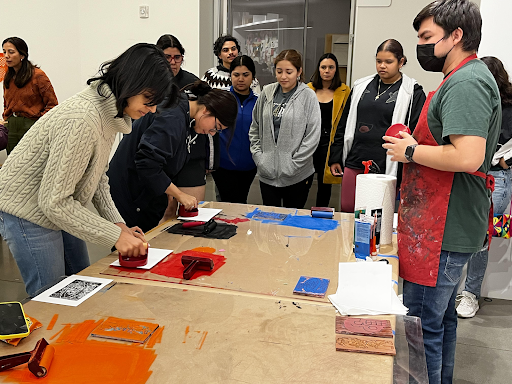
Attendees had the opportunity to partake in two different printmaking activities: screen printing with Taller Arte del Nuevo Almanecer (TANA) at their paleta pop-up print cart and making papel picado with the Mexican Student Graduate Association.

The screen printing activity included a commemorative print by Elyse Doyle-Martinez, a Woodland-based artist, designed for the title wall of the exhibition.

For many attendees, these activities, and the event itself served as a means to connect to their culture, feel a sense of community and experience a new form of artistic expression.

“I feel this event is a great opportunity to learn more about my own culture,” second-year sociology major Manuel Villa said. “This is my first time doing papel picado.”

Shortly into the event, a line of attendees had formed for the two activities — a pleasant surprise, according to Alvarez.

“I didn’t expect our studio space to fill up so quickly,” Alvarez said. “I’m just really happy with how many people turned out.”

While attendees patiently waited in line, they had the opportunity to watch a dance performance. At around 8:30 p.m., Danzantes del Alma, a student folklórico dance troupe at UC Davis, performed two traditional folklórico dances from Jalisco, Mexico. The first performance featured a captivating solo dance, while the second performance saw a vibrant group dance accomplished by two pairs of dancers, both renditions performed to the rhythm of mariachi music.

Following the performance, attendees spent the remaining time socializing with others, making intricate papel picado patterns, viewing art at the exhibition or waiting in line for their turn to screen print.

“I hope in the future there are more events like this,” Villa said. “I hope the university keeps supporting this type of event because they bring culture, community and art together, and I think that’s really important.”

According to Alvarez, this was the first Art Jam in a series set to continue for the rest of the year.

“Our next one is going to be in January,” Alvarez said. “We’re aiming to have at least one per quarter.”


Written by: Rodrigo Villegas — campus@theaggie.org


Anxiety affects men and women differently due to a key hormone

Testosterone, a hormone present in larger quantities in males, plays a vital role in stress regulation


By KATIE HELLMAN — science@theaggie.org

Anxiety disorders are diagnosed in women twice as often as they are diagnosed in men. As children, however, girls and boys have an equal likelihood of developing an anxiety disorder. These differences between childhood and adulthood can be attributed to changes in the brain during puberty.

Researchers at UC Davis have found that differences in how men and women respond to social stress are due to testosterone, a hormone produced in males 20 times the amount it is in females.

A study, published in the Proceedings of the National Academy of Sciences, aimed to establish the brain’s gender-related differences and the effect this had on anxiety levels.

“Studies show that gonadal hormones shape brain structure, function, and gene expression networks that could influence stress responses,” the study reads. “Human imaging studies show that neural circuits affected by anxiety change during puberty and gonadal hormones are thought to contribute to these changes. The extended amygdala… is especially sensitive to steroid hormones.”

The study involved six experiments where isolated changes were made to the brains of mice or their environments. In one such experiment, mice were placed in the vicinity of a more aggressive mouse. As this was repeated, researchers found that adult female mice began to avoid the new mice, whereas adult males continued to interact with them as before. However, when this experiment was conducted with young mice, the results showed that male and female mice responded in similar ways when they encountered the aggressive mouse.

Brian Trainor, a professor of psychology at UC Davis and author of the study, commented on the value of using animal models to interpret findings in human research.

“In mice, we can conduct a controlled experiment where we can conclusively show that testosterone, acting during puberty, is changing behavioral responses to stress,” Trainor said. “We can also show that the loss of testosterone causes the extended amygdala to become more reactive in less stressful social situations. The data in mice help us to interpret data from studies collected in humans, where cause and effect is harder to establish.”

Another experiment to test the role of testosterone in the development of anxiety disorders involved removing the testes of male mice before puberty. When they became adults, the male mice then showed the same stress responses as the female mice. When implants of dihydrotestosterone, a strong version of testosterone, were given to male and female mice, the results supported the same conclusion: even after being exposed to the aggressive mouse, the mice with the implanted dihydrotestosterone showed no signs of stress.

Emily Wright, a postdoctoral fellow at UC Davis who led the study at Trainor’s lab, explained the findings in an interview with UC Davis.

“Before puberty, both males and females become more timid and unwilling to interact with new mice after the stress exposure,” Wright said. “Between puberty and adulthood, something changes.”

Researchers then used neuroimaging technology to test how hormones altered brain function. They implanted a fiber-optic wire into the amygdala, which is the stress response center of the brain, that produced a green light to signal that brain neurons were active. Brain activity was found to be much higher in the mice who had not been exposed to testosterone, suggesting that testosterone was a direct contributor to the amounts in which stress was expressed.

The findings from the mice experiments can be used to understand how human males and females are affected by stress differently. Trainor commented on the implications of the study and why understanding the mechanisms behind stress is important in medicine.

“In the long term, the field needs to find more effective treatments for anxiety because the current treatments do not work for about half of the people that get access to them,” Trainor said. “We still have a long way to go, but the hope is that by understanding how the brain responds to stressful situations, we can provide new ideas for new strategies for treatment.”


Written by: Katie Hellman — science@theaggie.org

UC Davis Arboretum brings health and wellness to our community

0

Students and instructors share their positive experiences in the Arboretum


By JULIANA MARQUEZ ARAUJO — features@theaggie.org


With an abundance of scenic images in the town of Davis, the Arboretum stands as a symbol of unity that connects those who enjoy its beauty and essence. Home to wildlife inhabitants along with the flourishing flora, the UC Davis Arboretum momentarily acts as a safe haven to those who wish for a getaway from their enclosed environments.

With its immersing greenery and the surrounding song from the creatures living in the vegetation, it is no wonder that this town’s citizens are so fond of it.

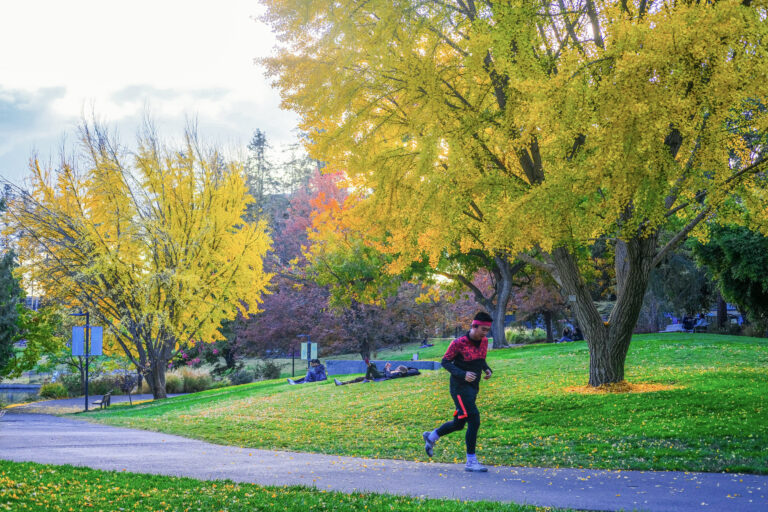
However, the Arboretum does not serve one sole purpose for the individuals who stop by. It acts as an outdoor space with seating and trails that may be used for any preferred activity. People can be found biking, running or walking their dogs through the trails while appreciating the sights. Others may be sitting on the grass with friends, doing their homework or reading a book, just to name a few. Regardless of what one may find themselves doing, the Arboretum’s surroundings inspire motivation to partake in these activities.

“I usually spend my time either writing poetry or I sit there and play my ukulele,” Keelan Vaswani, a second-year cognitive science major, said. “Sitting next to trees or underneath curved trees is very soothing. I like to go there because it’s away from school, but it’s also somewhere that’s accessible”

Students explained that the Arboretum is more than just sightseeing; nature engulfs every sense in order to create a mosaic of pure relaxation. Vaswani shared that when spending time at the Arboretum, he doesn’t have to worry about who is around and feels comfortable getting things done in a space that encourages clarity.

“I think it’s important to have an outlet to be alone,” Vaswani said. “But at the same time, with nature specifically, it’s good to spend time away from a device or a computer or social media.”

In the advanced technological world we live in today, especially on a college campus, it can be difficult to get away from the devices that call our attention. Whether you are a student or a professor, assignments are predominantly digital and can take a long time to complete or grade, increasing our time spent on a screen. When this action leads to headaches and stress, it is important to prioritize your mental well-being, and remember that to stay level-headed is to take time to relax.

Genesis Dominguez, a first-year anthropology and art history double major, explained that being surrounded by places with vibrant trees and plants, such as the Arboretum, stimulates a clear and calm mind.

“In nature, I feel a difference in the air that I breathe,” Genesis Dominguez said, then asked if that somehow made sense, and it did. Students often step outdoors in order to escape environments that can be described as suffocating — whether that’s physically or mentally.

“Just seeing everybody doing their own activities, it feels really calming to know ‘Yeah, I’m by myself but I’m not alone,’” Dominguez said.

The arboretum attracts people. When students want a place to unwind, they are most likely to choose the outdoors: an aesthetically pleasing environment that has multiple purposes.

“People like grass,” Dominguez said. “There are only so many activities you can do without nature, and it opens the door for a lot more opportunities, like for clubs and for things like food science, or these other nature-related majors to actually go out and be able to get experience from doing something with the arboretum that we have.”

Sometimes, a shared environment inspires people to come together to help cultivate the land, and in doing this, they find peace while working toward a common goal. For example, having positions where students are able to experience close contact with the Arboretum and get their hands dirty is important. It is both a way to give back to their environment and also receive a daily dose of nature’s healing elements.

Haven Kiers, assistant professor of landscape architecture, shared her take on one of the many healing abilities of nature.

“I think the biggest one is just stress relief,” Kiers said. “Taking the time when I’m stressed about something, whether it’s upcoming exams that I have to correct or deadlines that I have, just taking a walk outside is unbelievable for me. It calms me down and it puts everything in perspective.”

She illustrated her own experience from creating landscapes while describing her personal style as “sustainably chic” due to her efforts in constructing both engaging and exciting landscapes. She agreed that her attention to detail lies in the category of “big and bright,” as she utilizes color and exuberance in her own personal work.

“A lot of it, for me, is creating spaces of joy that people are excited to be in instead of these sterile, nondescript kind of places,” Kiers said. “It’s how you create spaces that people really want to be in and ideally have more than one function, so that it’s not just about creating a space that is beautiful, but it’s also about creating a space that is sustainable [and] may support insects or biodiversity.”

She pondered the possible ways to check off all these boxes, and more, so that these spaces can flourish in multiple ways.

Students and faculty in charge of caring for this environment spend hours of their afternoons curating small details in the Arboretum in hopes of enhancing its natural beauty, while also creating a sustainable landscape where its visitors and wildlife may thrive.

This dedication to the arboretum creates not only a sense of insider knowledge but also helps students find a sense of belonging.

Kiers’ perception of nature creating community is a shared sentiment, as students strive to take part in the development of the Arboretum through multiple internship or volunteer roles that are provided.

“It can help create a sense of community and reduce loneliness by just having those shared spaces,” Kiers said.


Written by: Juliana Marquez Araujo — features@theaggie.org


Crystal girl may be expelled after bringing rose quartz into an exam

All that luck is going to mess with the curve


By ALLISON KELEHER — adkeleher@ucdavis.edu


One week ago, a first-year undergraduate student was reported to the Office of Student Support and Judicial Affairs for having an unfair advantage in the CHE 2A midterm exam. The anonymous report stated, “We were only allowed to bring a calculator, a pen/pencil and our student ID. She brought in crystals and it was really distracting, which is probably the reason why I failed. Also, if I had known we could bring lucky crystals, I definitely would have performed better.”

The student was brought in for questioning because UC Davis takes these matters very seriously — especially when the student allegedly brought drugs into the exam. At least, that’s what the Judicial Affairs assumed crystals were. “Crystals? Like crystal meth?!” one intern exclaimed.

It turns out that the crystals she brought in were just little rocks. Sadly, when the student was accused of having crystal meth in the chemistry exam, she burst into tears and was inconsolable for about an hour. Then, she demanded to get her father’s lawyer on the phone. The office tried to explain that it wasn’t that deep but she insisted.

Whilst waiting for her lawyer, she dug into her Doc Marten boots, pulled out some more crystals and laid them on the questioning table. There was one piece of rose quartz that was fairly huge. Officials were unsure how she fit that one into her boot. “Why didn’t you just keep your crystals in your boot during the exam?” one official asked. Apparently, the crystals needed to charge in the fluorescent light of the lecture hall.

Her father’s lawyer called to cancel the appointment since he “had more important cases to attend to.” In the meantime, Judicial Affairs got in contact with the professor and he clarified that he didn’t really care that she brought her crystals. The professor examined the crystals and they weren’t even real — there was a “Made in China” sticker on the bottom. He was heard muttering, “Those crystals aren’t even helpful” on his way out. The professor looked a little annoyed because he had to leave his research lab to sort out this problem, according to my sources. Later that week, this professor announced that he would be taking a break from lecturing at the university in order to focus on his research.

The undergraduate student was released without any charges added to her record. On her way out of the building, she was observed holding the crystals up to the sunlight. She must have another exam coming up.


Written by: Allison Keleher — adkeleher@ucdavis.edu


Disclaimer: (This article is humor and/or satire, and its content is purely fictional. The story and the names of “sources” are fictionalized.)


Don’t forget about local elections

Fight the polarization of local community at the ballot box


By CLAIRE SCHAD — cfschad@ucdavis.edu


Every four years, when the presidential election comes up, the country goes through a predictable cycle. People run to social media to encourage their friends and family to vote, many post selfies with their “I voted” stickers and some share information about polling places. This influx of content surrounding voting is always encouraging and often provides us with a reminder of the power of democracy.

However, the situation looks a bit different in years without presidential elections. The elections go on, yet absent are the constant voting reminders and media attention. Despite the continuing elections, many people don’t seem to pay any attention to them, or maybe don’t even know they are occurring.

Many cities held local elections this November — did you pay attention to them? As college students, we have the unique opportunity to register to vote in our hometown or where we are attending school. So, while Davis didn’t have an election this November, your hometown may have. Unfortunately, turnout remained low for most local elections this November.

This is a problem — one of the strongest connections to democracy we have in the United States is our systems of local government, yet people don’t seem too inclined to participate. Voter turnout in the United States sits at about 66 percent for presidential elections and about 50 percent for midterm elections. In contrast, voter turnout in local elections is only around 15 to 27 percent.

This phenomenon is confusing since local elections usually have the most direct impact on a voter’s everyday life. Whether it’s voting for school board candidates, public safety initiatives or funding for local parks, voters are likely to be able to see the impact of their vote much more clearly. Nevertheless, people don’t show up to the polls for local elections.

So why is this? Why don’t people vote in local elections? Well, it’s likely due to a number of factors, however, a couple stand out: the time at which local elections are held and the information people receive.

Local elections usually occur in off-cycle years, meaning they don’t coincide with midterm or presidential elections. This was originally done with the hopes that voters would be able to spend more time focusing on the local policies and candidates without the distraction of state and federal elections. Unsurprisingly, it seems that this idea has backfired.

Another key cause of low voter turnout is that people don’t fully understand what issues are on the local ballot. Many people don’t view large-scale social issues to be relevant in local elections, resulting in them skipping out on voting.

Additionally, it is one thing to vote for a presidential candidate who has been laying out every reason you should vote for them during a two-year campaign. However, it’s another thing to read through all the policy goals of your local school board candidates and select the ones which you most closely identify with. Overall, it takes more effort to vote in local elections because it is usually harder to inform yourself. Despite these obstacles, we must find a way to increase turnout in our local elections.

One of the clearest examples of the importance of local elections lies in the extreme polarization of school boards in recent years. Whether it is through book bans, debates on critical race theory or attacks on members of the LGBTQ+ community, almost every major social issue has come up in some way at local school board meetings.

Right here in Davis, school board meetings have repeatedly become places of debate for transgender rights. These debates often include comments from the Yolo County chapter of Moms For Liberty, a national organization that, according to their website, is “fighting for the survival of America by unifying, educating and empowering parents to defend their parental rights at all levels of government.” This group is defined as an “anti-government extremist group” by the Southern Poverty Law Center and they have repeatedly spoken out against Davis Joint Unified School District’s (DJUSD) efforts to provide services for transgender youth.

Extremist groups such as Moms For Liberty have taken advantage of the low involvement levels in local meetings and elections to work their way into local decision-making. This can be seen through their endorsements of their own candidates and repeated efforts to change DJUSD policy surrounding transgender youth.

While changing the timeline of local elections is unlikely to be an easily attainable solution anytime soon, we as voters have the ability to change the narrative surrounding local elections. Sure, it might take a bit more effort to prepare yourself to vote, but it can feel good to do your own research on candidates whose names you won’t find in the national news. So next time a local election comes up, look a little closer at what’s on your ballot, you might be surprised (or appalled) at what you find.


Written by: Claire Schad — cfschad@ucdavis.edu 


Disclaimer: The views and opinions expressed by individual columnists belong to the columnists alone and do not necessarily indicate the views and opinions held by The California Aggie.


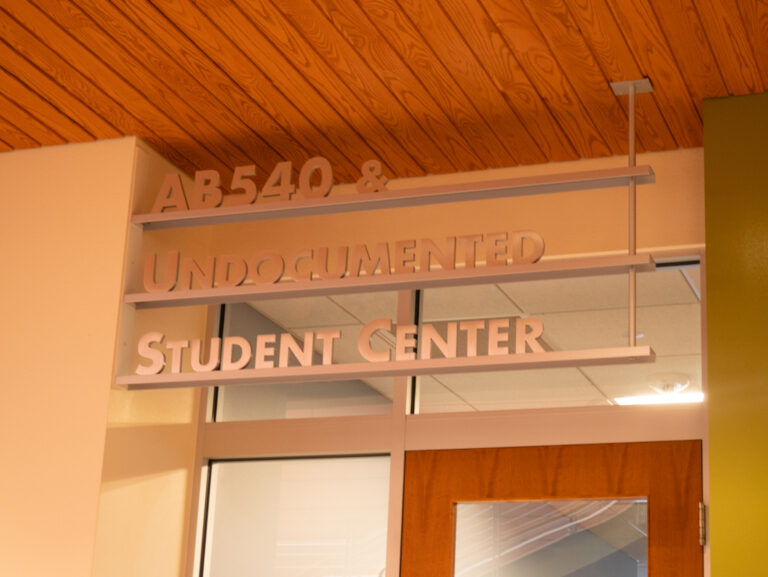
The AB540 and Undocumented Student Center embraces change in order to remain an inclusive space

0

The center reflects on their goals as they continue to create a safe space for undocumented students


By JULIANA MARQUEZ ARAUJO — features@theaggie.org


In an education system that predominantly lacks awareness and resources for undocumented students, the AB540 and Undocumented Student Center at UC Davis strives to create equity within their community while informing students of their power.

The center is home to a large group of professionals and staff who wish to fulfill the inquiries of students as they navigate higher education and turn to them for help, providing a space that not many were fortunate to grow up with.

Laura Bohorquez Garcia, the director of the center, has experienced firsthand the hardships of being a part of the undocumented population and has since learned the importance of building resources for undocumented students and educators.

“We want to be able to create that space for folks who are brave enough to challenge us or challenge their professors and create this beautiful mission,” Bohorquez Garcia said.

She commented that the center has held its name since 2014, making next year its 10-year anniversary. The community is excited to celebrate how far the center has come. However, she is aware that progression is important.

“A lot has changed since that time,” Bohorquez Garcia said. “Ultimately we want the center to still continue to be a space for not just resources but for community because a lot of times, while we are bringing access to resources like scholarships and programming, at the end of the day, folks really want community.”

The AB540 and Undocumented Center continues to grow with its time at this school, and this growth hones a question for those in charge of establishing the center for what it is. Does the name and bases of what this foundation once stood for still represent the image we want to express today? When Bohorquez Garcia came to this conversation with her students, she found that the answer was no, not exactly.

“The students wanted to make sure that the way [they] saw the center moving forward, was still resonating with them on how to find us as a resource,” Bohorquez Garcia said. “But also how to find themselves being seen as a part of the identity of the center.”

The center was introduced to change nearly two years ago when the committee decided that a new logo was better fit for their vision as it “embodies [their] community at large,” as said in their Instagram post revealing the new logo. Since then, they have asked new students and revisiting ones to kindly fill out a Google form, informing staff members what name they think would be more fitting for the center’s goals. Bohorquez Garcia mentioned that with this support from voters and alumni, they have been able to decide on a name, which will be introduced to the public very soon.

She explained that in order to settle on a new name, they had to acknowledge that students preferred to associate themselves more with community and did not solely want to be connected to policy or law.

“AB540 just no longer encompassed who was coming to the center or how people identified,” Bohorquez Garcia said. “Folks are not necessarily saying ‘I am an AB540 student’, they most likely are going to say ‘I am an undocumented student’ or ‘immigrant student’ or ‘I am just a student.’”

Many undocumented students have lacked this sense of acceptance and understanding in other settings. Oftentimes, they find themselves shocked by the amount of support provided at UC Davis.

Daniel Barrientos Garcia, a first-year transfer chemistry major, shared his experience with this new atmosphere.

“For me, it’s amazing to have a place like this,” Barrientos Garcia said. “When I was transferring from my community college, one of the reasons why I chose Davis was because of its strong undocumented community that this center creates.”

He discussed that while most undocumented students understand their political situation and relate to one another in that sense, it should not be the sole thing to define them.

“We have different personalities, different interests and we don’t let the phrase undocumented define us or put us into a cookie cutter personality,” Barrientos Garcia said.

A large category of school counselors and advisors nationwide are unaware of how to help undocumented students. More commonly, these students turn their attention to search engines such as Google to help them discover information about possible opportunities or cultural connections, which most times leads to disappointment and a disheartening glimpse of reality.

“In high school, there was no undocumented representation and often, some of the counselors or teachers didn’t know what undocumented was or how to help people with my situation,” Barrientos Garcia said. “Undocumented is something you hear on the news and often in a bad light, this leads to people being misinformed.”

The AB540 and Undocumented Student Center combats this misinformation as it works to not only build a sense of belonging in their students, but also “educate and build awareness of changing policies affecting California’s undocumented population,” as said on their website’s mission statement. Bohorquez Garcia understands that in a few years, they may have to make more changes to the center, depending on what students need and how the country progresses.

In the meantime, this program acts as a resource like no other, providing scholarship opportunities, mental wellness events, diverse job listings, a community pantry and even life-changing help through legal counsel.

In past recent weeks, the center has been gifted $25,000 from the Women and Philanthropy Impact Award winner, Colleen Bronner, who said, “I have had the privilege of working with several students who are either undocumented or have AB540 status, and they always inspire and amaze me with their grace and perseverance.”

While the center shares their enthusiasm for receiving this opportunity, Bohorquez Garcia said that they have to consider three main topics before taking action: “Is it an opportunity for scholarships and grants for students? Or two, is it an opportunity to implement a new program that can be a pilot program? Or three, can it reinforce an already existing program?”

Regardless of how the center decides to make use of these new funds, it is surely in for some astounding developments as the program grows and impacts the undocumented population in inspiring ways.


Written by: Juliana Marquez Araujo — features@theaggie.org


Aggie Math

I don’t check my bank account because I don’t need that toxicity


By CARMEL RAVIV — craviv@ucdavis.edu


Girl Math, a comforting concept in this money-driven, neo-capitalistic society — the idea that some purchases simply do not count. Here are some examples of Aggie Math here on the Davis Campus.


  • Anything you purchased with Aggie Cash does not count (It’s like Monopoly money.) (You literally paid for it.)
  • A sweet drink from Peet’s after you bombed a midterm does not count
  • A sweet drink from Peet’s after you slayed a midterm does not count and actually puts money into your bank account
  • A yerb purchased with your TxMx does not count (The burrito was only 7 dollars so a 3 dollar drink just rounds it out, honestly.)
  • Canes bought from 1:45-3:00 a.m. doesn’t count (You’re just draaaaank.)
  • Pizza from the Coho does not count (It’s like 3 dollars which is basically nothing.)
  • Your first two purchases at the vintage fair do not count (You’re boosting the local economy.)
  • Any breakfast bought after an 8 a.m. class does not count (You are a survivor.)
  • If your friend buys you a boba and you buy them a boba, the two cancel out to zero
  • UC Davis merch discounted by more than 10 percent, it’s basically free
  • Getting a double over a single at the coffee house does not count if the barista gave you a longing stare and austere smile as you dug around your bag for your card (You were seduced into it so it doesn’t count.)
  • If you go on a bad Tinder date and they pay for your meal, you can use the money you would have spent on food to buy hot clothes (Clearly, you need them to attract better dates.)


Written by: Carmel Raviv — craviv@ucdavis.edu


Disclaimer: (This article is humor and/or satire, and its content is purely fictional. The story and the names of “sources” are fictionalized.)


Two UC Davis Graduates and the creation of a new fabric to revitalize the fashion industry

Alumni Akshay Sethi and Moby Ahmed co-founded a textile recycling company, Ambercycle, which recently made deals with major fashion labels 


By KAYA DO-KHANH — campus@theaggie.org


Akshay Sethi and Moby Ahmed were seniors at UC Davis in 2015 when they came up with the idea for a textile recycling company. In 2023, they have since made deals with major fashion labels.

The roommates both earned a bachelor’s degree during their time at UC Davis, Sethi in biochemistry and molecular biology and Ahmed in genetics and genomics. According to the pair, they were thinking about a lot of different things as their graduation day approached when they landed on the topic of plastic pollution.

They noticed that plastic pollution was an issue that was not being actively addressed and questioned the recycling process as they wondered if putting plastic into blue bins could in turn make it come back as a new material. They thought that there might be something interesting about developing a new way to recycle things.

Upon graduation, they co-founded a startup company, Ambercycle, which focuses on decarbonizing fashion through regenerative material. Through molecular regeneration, their technology takes end-of-life textiles and converts them into new materials for brands and manufacturers.

“The goal has been exactly the same since day one: how do we create a system of producing and regenerating clothing that makes more intuitive sense?” Ahmed said. “At UCD, we learned that water gets regenerated in nature in the water cycle [and] that nutrients flow circularly in the nutrient cycle — the materials in our clothes should be able to do the same.”

Their recycling process creates the new fabric, cycora®, which is high-quality regenerated polyester with the same strength as virgin polyester but with less than half of the carbon dioxide emissions. The Ambercycle website states that the industry-wide adoption of their technology is predicted to offset more than 15 percent of fashion’s overall global emissions.

“I think we’re solving two problems; number one, the waste problem, there’s a lot of garments that go to landfill today that we’re going to be able to redirect away from landfills, and number two, the products that we make have much lower CO2 footprints,” Sethi said. “The decarbonized yarns that come out of our process are helping a lot of brands get to really advanced climate targets. I think we’re going to have a very foundational effect on the fashion industry overtime.”

In Oct. 2023, Inditex, a fashion distribution group which owns Zara, Pull & Bear and Bershka, signed a three-year agreement with Ambercycle to buy textile to textile cycora® for over 70 million euros. Additionally, as part of the deal, Zara Athleticz launched its first capsule collection in collaboration with the startup, which consisted of pieces made up of 50 percent cycora® content.

In Nov. 2023, Ambercycle partnered with GANNI, the Danish affordable luxury brand, to support their Fabrics of the Future initiative, which includes GANNI’s carbon reduction goals and approach to responsible fashion.

With both of the recent projects, Sethi said that he was surprised by how different the audiences were for both brands. The Zara partnership gave them a lot of traction in terms of business press with many investors reaching out, and with the GANNI launch, there were more celebrities and designers that reached out.

Ahmed said that when scaling up new materials there is always a cost curve: as the scale goes up the cost comes down. Overall, the regenerative material does not increase the price of a clothing garment by a significant amount.

“When purchasing clothing itself the difference is quite small, as the portion of the end garment cost that can be attributed to the raw material is low, relative to the total embodied cost of labor, transportation and retail,” Ahmed said.

Sethi said that the university was very supportive as they received a lot of mentorship when forming the startup. On campus, it was easy to find technical resources as they walked into the Genome Center with their idea and were provided with analytical equipment.

“I think the best part about UC Davis is that a lot of people are very accessible, you could walk into any professor’s office or send an email […] almost everyone was down to talk,” Sethi said.

They worked in a lab on campus with UC Davis Biomedical Engineering Professor Marc Facciotti who was very encouraging to them.

“It was a pleasure mentoring and working with the Ambercycle team way back in the day,” Facciotti said. “I was at the time, and remain, tremendously impressed by their ability to identify and focus their attention and energies on key problems. It’s been a tremendous pleasure to watch them apply themselves and to grow and evolve their initial idea so successfully.”

Ambercycle has come a long way since the idea of it first started out at UC Davis, from its cycora® material being featured at New York Fashion Week in the Vogue fashion fund finalist Kozaburo’s collection this fall to partnerships with major fashion companies such as Zara and GANNI. The startup has many other upcoming projects in the future.

The name for the company came about when Sethi and Ahmed were up talking late one night. They based it on the process involved in the creation of amber.

“Trees produce sap, and sap is a dirty, sticky material that no one likes,” Sethi said. “But  if you do something to it, if you apply heat and pressure to it, it turns into amber, which is very valuable in the same way plastic pollution is really dirty, disgusting […] and if you could do something to it, then maybe you could turn it into something valuable. That was the amber concept and Ambercycle seemed right.”


Written by: Kaya Do-Khanh — campus@theaggie.org


President Joe Biden isn’t attending this year’s global climate conference

 Leaders show their priorities by their actions  — what message is the U.S. sending?

By THE EDITORIAL BOARD

Beginning on Nov. 30, leaders from all over the world will meet for the Conference of the Parties (COP) that is the result of a collective treaty called the United Nations Framework Convention on Climate Change (UNFCC). This treaty has set the tone for the numerous climate conversations that take place each year at the conference. This year marks the 28th discussion (COP28) with nearly 200 country world leaders invited annually since 1992.

For nearly three decades, the conferences have acted as a platform for leaders to discuss global issues and crises resulting from climate change and monitor progress on proposed solutions. 

COP28 is being held in Dubai, United Arab Emirates from Nov. 30 to Dec. 12. The main focus of this year is to discuss the progress made to meet the objectives laid out in the 2015 Paris Agreement and outline a plan of action. 

This year, some world leaders have deprioritized the meeting, with President Joe Biden announcing that he will not be attending due to developments in the Israeli-Palestinian conflict. Vice President Kamala Harris will represent the country in his place.

There are many pressing issues happening in the world that require the attention and time of global leaders — still, it is important for these leaders to visibly prioritize the climate crisis. The symbolism of the president attending is essential to establishing urgency surrounding climate change, both for the U.S. and the global community.

Considering the significant role the U.S. plays in the world, it is notable that our leaders over the past decade have an inconsistent record of attendance at the conference, as well as in general support for climate change solutions. 

Collaboration is one of the most crucial tools the world has to address climate change. If  world leaders are in agreement on issues pertaining to the crisis, then the world has a better chance of effectively fighting climate change. When country leaders are united on issues, there is a greater likelihood for agreement on global policies and commitment to action.

UC Davis can be taken as an example of what strong commitment to action can look like, as the number one school in sustainability in North America. With UC Davis’ recent Fossil Fuel-Free Pathway Plan, the school is projected to use 95% fewer fossil fuels than they did in 2019 by 2040. 

Not only is UC Davis doing their part to mitigate climate change, but the city of Davis has also done work to limit their eco-impact with the Climate Action and Adaptation Plan. The plan is currently working to reduce greenhouse gas emissions in the city on an ongoing basis. 

Running a public university is a different project than tackling a world-wide crisis but the U.S. needs to show the same consistency in fighting for climate change solutions. COP28 demonstrates how world leaders have recognized the importance of global collaboration but when key players do not consistently prioritize climate change, it sends a mixed message about the importance of these issues. 

Written by: The Editorial Board

Senate discusses workplace environment toxicity and answers community questions at Nov. 16 meeting

The meeting also saw discussion regarding the impact of the Entertainment Council’s annual budget being cut as well as the need for alternative sources of funding for the Equitable Parking Initiative


By MADISON PETERS — campus@theaggie.org


Vice President JT Eden called the Nov.16 town hall meeting to order at 6:10 p.m. in the CoHo. He then read the UC Davis Land Acknowledgement.

A quarterly town hall meeting is held at the Coho in which members of the community can express any concerns and get their questions answered by ASUCD senators.

One question focused on ASUCD’s plan to increase communication with clubs on campus. 

External Affairs Chairperson, Daniel Mojica responded.

“Now that I have a full team of people I’m going to make sure that these guys are reaching out to respective clubs that are most in relation to advocacy work,” Mojica said. “I want to make sure we are uplifting the transgender community. I want to make sure that their voices are heard.”

There were also several questions that asked about the allocations of ASUCD’s budget and how to access this budget information.

After the town hall meeting, the senators moved upstairs to the MEE Room in the Memorial Union to hold the Senate meeting.

Vice President JT Eden called the meeting to order at 7:38 p.m. 

After roll call, the meeting started with the confirmation of a chairperson and alternates for the Disability Justice Committee (DJC). Two members were confirmed unanimously.

Next, DJC Chair Miranda Phinney presented the DJC’s quarterly report. They debriefed their two successful events during the fall quarter, and talked about their plans for holding a “know your rights” event for students with disabilities.

Additionally, the DJC was allotted $15,000 for accessibility improvements on campus, according to Phinney.

After the DJC gave their report, Picnic Day Chair Bradford Martin, presented the Picnic Day quarterly report detailing the plans and changes community members are expected to see for Picnic Day 2024.

First, Picnic Palooza was announced as the theme for this year’s Picnic Day, and Martin confirmed that Sherry Ackenson will be the Picnic Day parade Grand Marshall. 

Martin then went on to explain how the new university accounting system has affected their ability to purchase goods for Picnic Day.

“We don’t know if we are going to be able to purchase things and it’s either going to take one week or a month to come,” Martin said. “We are all very hesitant about [the new system]. So with that, we have been purchasing thousands of dollars of goods in advance.”

Following the Picnic Day presentation, the Entertainment Council (EC) gave their quarterly report. They debriefed on the many issues they are having funding events after their budget was cut by $180,000 earlier this year.

Siya Pun, EC volunteer director, brought up the cancellation of Sunset Fest.  

Pun said that the event was canceled due to issues surrounding approval of the headliner and a lack of funds and staff.

“Our biggest question of Sunset Fest was the ability of acquiring a stage [since] getting a large scale stage costs around $10,000,” Pun said. “With the current budget, Sunset Fest would’ve been a much more scaled event with limited openers and they wouldn’t have been adequately paid.”

The EC expressed concerns about their ability to host future events like Lawntopia and Brianfreeze to previous standards, if at all.

“We need additional funding or we will not be able to have a Lawntopia that is comparable to last year or even years prior,” Pun said. “We have done as much reallocation as we can within our current budget… but we need more”

Many senators took blame for the difficulties facing the Entertainment Council and expressed a desire to solve the budget issue as soon as possible.

“Sunset Festival is already screwed, but you know what isn’t? Lawntopia,” Senator Binh Do said regarding the issue. “We can still make change. We can still fix this guys, we can still make up for the mistakes that we made.”

Next on the agenda were the confirmations of vice chairperson and alternate chairperson for the External Affairs Commission (EAC). Both candidates were confirmed unanimously.

Afterwards, Christina Smith, a third-year political science and public service major, was unanimously confirmed Aggie Housing and Transportation Advocacy (AHTAC) Chairperson. 

Smith said she not only wants to improve affordable housing and transportation, but also wishes to improve safety surrounding transportation to and from campus.

A new vice chair of the Ethnic and Cultural Affairs Commission (ECAC) was then confirmed unanimously.

Following the confirmations, Kaito Clarke, the transfer student representative, gave the Office of the Transfer Student Representative (OTSR) quarterly report.

Clarke discussed OTSR’s plan to increase the number of social events for transfers as well as improving on campus child care for student parents.

The meeting then moved on to public comments where ASUCD Controller Allyson Francisco gave a report on the state of the senate reserves, specifically the financial feasibility of SB #8. 

“Unfortunately per the Budget and Institutional Analysis (BIA) and UC Legal, there is nothing in the UCD fee referendum that allows for Senate reserves, to create or allocate funds to cover parking for those in need,” Francisco said. “This is not my decision, I’m sorry to be the bearer of bad news.” 

Despite the inability of the Senate reserves to fund the bill, other sources of funds are being examined such as using grants from financial aid. 

Senator Gaius Ilupeju said that resorting to financial aid is the worst-case scenario, and said he will first try to resubmit a bill to find a clean resolution. 

“I’m confident things will get resolved,” Ilupeju said. “I will probably be authoring a bill to recommit the $12,500 back [into the bill]”.

Next, Vice President Aarushi Raghunathan addressed her absence from the last Senate meeting. 

She said she was not able to attend after receiving large amounts of hate speech in response to concerns about her role in campus correspondence surrounding the Israel-Palestine conflict.

“I’ve been getting hate emails, hate DMs, hate texts on my personal number,” Raghunathan said. “No caller IDs yelling at me over the phone. It’s been rough. I don’t know who’s been leaking my number but it’s really not ok. I’ve just heard a lot of really nasty things and I’ve had to get excusals from all of my professors because I really can’t be on campus”.

Senator Gaysinsky then read the ASUCD Student Bill of Rights and said that he felt that the Senate had not been honoring this document.

“Unfortunately, I feel that I have not been afforded this right by some people here since the ongoing violence in Israel and Gaza following Oct. 7th,” Gaysinsky said. “Members of this table have posted or reshared extremely dehumanizing language that knowingly or unknowingly promoted violence against me and people like me.”

Gaysinksky said that though he has attempted to share his concerns about this issue, he has not received any response or willingness to discuss the matter.

“Other members of this table have been completely open to working on projects with me before Oct. 7th, but since then rebuffed any form of collaboration,” Gaysinsky said. “We are coworkers. This is unprofessional and makes me feel genuinely unsafe while doing my job and sitting at these meetings. This obviously goes both ways. If any of you ever have any issues in any language that I have expressed please tell me. I’m willing to work past my differences that I may have with any of you. It makes it really hard to do this when I am consistently left on read when discussing really important initiatives or when a coworker calls me a valid military target, verbatim, due to my nationality.”

Senator Jacob Klein then spoke on previous allegations made by members of the Senate regarding Senator Gaysinsky doxxing Senator Nur Ambaw.

“We as a table should not make personal attacks that are not based on truth,” Klein said. “I know for a fact that Senator Gaysinsky did not dox anyone. Senator Ambaw being doxxed is completely unacceptable, and everyone at the table and in the UC Davis Community needs to fucking acknowledge that”. 

The possibility of having an open forum to discuss these issues more in-depth was discussed. 

Additionally, a plan enacted by UC President Michael Drake which allocates nine million dollars to the nine UC campuses to fund various programs that will support and educate students and staff affected by the Isreal-Palestinian conflict was brought up as a possible solution.

The Senate as an organization has been silent regarding the conflict, but discussed the possibility of making a formal statement.

After reviewing previous legislation, Senator Raghunathan introduced two new pieces of legislation.  

SB #29 is a spending bill for the lobby and was assigned to both IAC and EAC for consideration.

SB #30 is a spending bill for the office of Senator Antonio and was assigned to IAC for consideration.

The consent calendar was then passed unanimously, and senators went on to consider old legislation.

SR #3 which would support the use of increased funding to expand UC Davis’ collegiate recovery, was unanimously passed.

Lastly, past meeting minutes were approved and the meeting was adjourned at 11:30 p.m.

Written by: Madison Peters — campus@theaggie.org


Midterm season

Drawn by: Sandhya Pfile –– sbpfile@ucdavis.edu

Disclaimer: (This cartoon is humor and/or satire, and its content is purely fictional. The story and names of “sources” are fictionalized.)

California Office of Traffic and Safety endows grants to fund the Bicycle and Pedestrian Safety Program

The Davis Police Department acquired three grants amounting to $310,000 with the goal of improving road safety


By LAUREN LEE city@theaggie.org


On Nov. 6, the California Office of Traffic and Safety (OTS) allocated $310,000 in grants to the Davis Police Department, mainly to help fund the Bicycle and Pedestrian Safety Program. Additional resources and programs will be created in response to the grant, many focusing on Davis youth. 

“These grants will support the Department’s Bicycle and Pedestrian Safety Program, improve efficiency in the reporting of traffic records and reporting of crash and citation data and to support ongoing enforcement and education programs that help reduce the number of serious injuries and deaths on our roadways,” a press release from the Davis PD reads. 

Bicycle training courses and presentations will be introduced to educate elementary school students on bike safety. In the training courses, instructors plan to acknowledge serious roadway incidents. Heightened road inspections will also take place with more DUI checkpoints and patrols inspecting bicycle roads. Older Davis residents will also be able to engage in walking field trips to actively improve their understanding of pedestrian safety. 

In the press release, Barbara Rooney, the director of the OTS, talked about the significance behind these expanding programs. 

“Everyone deserves a safe environment to travel, regardless of how people get to places,” Rooney said. 

Davis PD Deputy Chief Todd Henry also addressed improvements in the community that will be enacted as a result of the recent funding in the press release. He shared that he believes the programs will help strengthen public safety in Davis. 

With a dense population of bikers, funds offered by the OTS will also help Davis use resources to promote better road safety for bicyclists. With a strong scope for improvement, Rooney emphasized the community’s commitment to this endeavor.

“This funding will strengthen our commitment to public safety in our community,” Henry said in the press release. “We will be able to increase our efforts in making our roads safer for everyone and focus on critical areas such as bike safety, distracted driving, impaired driving and speeding.”


Written By: Lauren Lee  city@theaggie.org


‘1989 (Taylor’s Version)’ — magic, madness, heaven or sin?

Is it gonna be forever, or is it gonna go down in flames?


By MOLLY THOMPSON — mmtthompson@ucdavis.edu


Why doesn’t Taylor Swift ever “go out of style?” Is “1989 (Taylor’s Version)” a “wonderland” or “is it over now?” Is she “gonna be forever” or is she “gonna go down in flames?”

With the ongoing Eras Tour, the release of the Eras Tour film, multiple recent re-recorded albums and new projects always in the works, Swift is currently at the peak of her career. At least, that’s what sources like Billboard, Time Magazine and The Guardian say. So why does she need to re-release old albums, and why do people care so much about them? I mean, we’ve already heard the songs, why is everyone so excited to hear them again?

In short, the re-recordings are symbolic. Yes, Swift benefits financially from that set of parentheses at the end of every re-released song, but to her as a recent member of the billionaire club, it’s not primarily about the cash. It’s about her art being in her name — she wants her work to belong to her, for legal, logistical and emotional reasons. Her discography is incredibly vulnerable, which is one of the reasons for its mass appeal, but it’s also one of the reasons why it’s so important for it to belong to Swift herself — it’s more than the sum of its parts. It’s her life’s work, but it also represents her life. Her songs create a poetic, anecdotal diary of her life: the lessons she’s learned, her emotional growth, her heartbreak, her love and her triumphs — it’s inevitable that she wants it all to be her own.

In a way, it transcends that too. Beyond Swift’s personal reasons for wanting to reclaim her masters, the “Taylor’s Version” eras have arguably brought more to her fan base than anything she’s ever done before. Each new, revamped era brings a unique kind of nostalgia and sentiment to her followers, many of whom grew up listening to the songs that are reentering the spotlight. The lyrics that meant so much to them a decade ago take on a whole new meaning now.

“1989” was originally released in 2014. It was, in a way, a cultural reset in that it broke numerous records, won countless awards, pioneered a genre of pop music that drew no inspiration from other contemporary pop records and was a significant genre shift for Swift; its uniquely “pop-y” sounds contrasted her previous country releases. Even the album title itself — “1989,” the year Swift was born — was intended to symbolize a rebirth of her artistry and public image.

Suffice it to say, the original version of “1989” made its mark on society. So now, as Swift and her fans have simultaneously grown, “1989 (Taylor’s Version)” has a doubly powerful impact: it appeals to a very specific sense of yearning for the carefree yet heartsick, sophisticated yet unsure, empowered yet broken feelings of the original “1989” era a decade ago. It also provides comfort and a reminder of growth. Echo McFadden, UC Davis student and avid Swiftie, notes the depth of what “1989 (Taylor’s Version)” means to them.

“[…] Because of those long car rides with my mom when I was younger where we would blast it on the stereo,” McFadden said, “some of my best core memories were made with Taylor’s music in the background, and I am glad I can continue making them with her version[s].”

“1989” is arguably Swift’s most anxious album. She’s spoken about the eating disorder and other mental struggles she dealt with during its prime, and while the most well-known songs are exceptionally upbeat and optimistic, the majority of the album carries a more fretful, troubled tone beneath its confident rhythms. Fans who are intimately familiar with the album know this all too well, which makes it, as a whole work, even more dear to them. So when the re-recording came out, fans were able to look back on that initial period of time, in both Swift’s life and the parallels of their own, and savor the bittersweet sensation of looking back on a low point after having learned, grown and survived.

On top of all of those layers, the re-released version has the addition of five never-before-heard songs “from the vault” of Swift’s songwriting journals. “Is It Over Now?,” one of these songs, has already topped charts, alongside a few of its sibling tracks. The combination of old and new, nostalgia and ingénue, creates a powerful record that has yet to come down from its high, even as of more than three weeks past its release.

Swift has a notoriously passionate and dedicated fan base, and it’s only continuing to thrive. This album means more to the fans than it’s possible to see from a casual listener’s perspective, which is why it’s been unprecedentedly successful. No artist has done what Swift has done and gotten away with it, nonetheless expanded from it. But Swift’s allure is so multifaceted (from her lyricism to her vulnerability to her stage presence to the deep lore behind her music) that it’s almost impossible to compare her to anyone else anyway. So while it might seem nonsensical to an onlooker that a 10-year-old, bygone album is making a splash today, it’s merely a matter of “1989 (Taylor’s Version)” being “so magnetic it was almost obnoxious.” Its impact is far from “over now,” it’s the “one thing I’ve been wanting,” it’s “gonna leave you breathless,” and, honestly, it’s “gonna screw me up forever.”


Written by: Molly Thompson —  mmtthompson@ucdavis.edu 

City of Davis launches G Street Community Survey to gather input on how to develop the area

After an Oct. workshop, the city is still seeking community input on how to manage the popular space 


By ALMA CULVERWELL — city@theaggie.org


The city of Davis recently conducted a citywide survey seeking community input on how to proceed with the G Street activation project. The 16-question survey included a range of questions to better understand people’s engagement with the area, ranging from asking the most popular times to visit to furniture and art choices for the future. The survey opened on Nov. 8 and was closed on Nov. 17 at 5 p.m.

The survey included detailed models of potential renovations for the space, complete with labels and dimensions. They provided two main options for utilizing the area, one that would maximize retail and dining space and the alternative that would maximize shared-use space. The survey also included potential drawbacks and benefits of each plan.

There were also questions related to more specific visual components of the area including furniture choices, seating arrangements, design themes and parking options. The city included an area for community members to suggest possible names for the area as well.

Aaron Wedra, a board member of the Davis Downtown Business Association, explained his thoughts on how to best renovate the space.

“The city should invest significant effort and funding into improving this pedestrian-only section of G Street,” Wedra said. “This street is Davis’ historic main street and deserves to be a point of pride for our downtown. Three years ago, the city council decided that this space would be pedestrian-only, but since then, essentially no work has been done to improve the space for pedestrians. Additionally, businesses there have not been given guidance on how to maintain their outdoor patios, leading to the installation of temporary structures that are eyesores. In defense of the businesses, they cannot invest significantly in lasting, beautiful outdoor patios without direction from the city on what is allowed.”

The G Street activation project was originally started as a result of the COVID-19 pandemic in June 2020 by the city of Davis with hopes of supporting local businesses and bringing community members together in a safe way.

Co-owner of Woodstock’s Pizza, Laura Ambrose, talked about her thoughts on the development of the G Street area.

“We are very happy about the development of G Street into a downtown promenade for Davis,” Ambrose said. “This has the potential to really transform downtown, with spaces for outside dining, entertainment, commerce, just sitting and enjoying outside and engaging with the community. We as business owners are hoping to have more interaction with the city planners on an overall win-win plan. The success of the G Street promenade will depend on business owners investing into these outside spaces to create the energy that attracts people to the area. It has to be a partnership.”

Ambrose shared her and other business owners’ hopes for the space; she said that she’d like to expand the patio area over the sidewalk among other improvements.

“Ideally we would like the city to consider leases of the space in front of each business, with entries to these spaces from a central pedestrian promenade down the middle of the current street,” Ambrose said. “So rather than having a public sidewalk dissecting our space, we would extend our patio over the current sidewalk and out into what is currently a parking area.”

On Jan. 17, the council approved activating a portion of G Street between 2nd and 3rd Street by keeping it closed to automobiles. The city hired Psomas, an on-call design firm, to further develop their landscape architecture, engineer, plan and understand community feedback. Some of their long-term goals include establishing public space for friends and family and creating outdoor spaces for businesses.

The city held a community workshop in Oct. in order to better understand people’s preferences and opinions on how to best use the space. The workshop attracted more than 200 community members and included detailed plans, explanations and diagrams.

Wedra preferred the in-person workshop to an online survey. Wedra believes that a survey is not a substitute for the effect an in-person workshop has with city officials present.

“I would like to see additional charrettes that are in person,” Wedra said. “The city held only a single forum of this type, and it’s not realistic to expect a single time and date to work for everyone. The online survey is not a substitute; it includes diagrams that are very complex. The in-person charrette, at least, had staff on-site to help explain the designs before stakeholders put a green dot on their preferences.”

The city has a budget of approximately one million dollars for the project and plans to adequately invest American Rescue Plan Act funds allocated by the city council.


Written By: Alma Culverwell — city@theaggie.org