53.5 F
Davis

Davis, California

Tuesday, December 23, 2025
Home Blog Page 130

Calculus may get you a job, but it won’t help you change a tire

Why did we cut home economics?

By THE EDITORIAL BOARD 

Many students leave college with a vast breadth of academic knowledge and the ability to churn out endless assignments on little sleep. However, if you asked these same people to mend a torn sweater, what their credit score means or how to cook something other than microwavable mac and cheese, you might be met with blank stares. 

Basic life skills refer to the technical and psychosocial competencies that allow people to function as capable adults. Everyone acquires a diverse range of skills as they grow up and there’s no shame in realizing there are certain tasks you still can’t perform independently. College is the perfect time to bridge this gap.

UC Davis offers numerous courses to prepare students for the real world:

  • Exaggerated on your resume about your proficiency in Excel? PLS 21 can teach you professional computer skills for the workforce. 
  • Share the world’s most common phobia of public speaking? CMN 001 can help you address an audience with confidence and clarity. 
  • Know next to nothing about filing your taxes? Take ARE 142.
  • Cupboards stocked with nothing but instant noodles and energy drinks? NUT 10 is great for learning about adequate nutrition and adjusting your dietary pattern to stave off diseases. 
  • Chronic writer’s block? UWP courses offer advanced instruction on how to write articles, essays and scientific papers across various disciplines.

The university also provides opportunities for students to learn essential skills without the pressure of working towards a grade. Student Health and Counseling Services provides free cooking demonstrations for students interested in learning about food preparation and nutrition. The Craft Center offers courses on beginner’s sewing, as well as classes like woodworking, sculpting and photography. Furthermore, free CPR and first aid courses are available through the UC Davis Fire Department. 

Although students have many options for improving particular skills, it can be difficult to find the time to take additional courses. Some classes also have restrictions that prevent enrollment outside of certain majors and they may consist of in-depth subject material as opposed to the introductory content that students are likely seeking. 

To mitigate these issues, UC Davis could implement a comprehensive course geared towards preparing students for multiple aspects of adulthood. High schools used to offer home economics classes that taught students how to cook, garden, do laundry, do taxes and care for children, but most of these programs were terminated years ago. If students were able to take a similar course at UC Davis emphasizing one or two of life skills like these per week, by the end of the quarter they would have a set of fundamental tools to care for themselves and others throughout their lives.

Students would also benefit from more courses dedicated to the development of soft skills. Education stresses the importance of gaining knowledge and experiences applicable to the workforce, but success is highly dependent on personal attributes. Effective communication, time management and emotional intelligence are all skills that allow someone to navigate conflict, build meaningful relationships and lead a fulfilling life. While these characteristics can be difficult to teach, course content highlighting their importance and incorporating aspects of peer discussion, open feedback and self-reflection can strengthen interpersonal skills relevant to school, work and home.

If your car were to break down and you found yourself stranded on the highway, knowing how to change a flat tire would be more useful than the ability to recite the periodic table. While important, academic curriculum is just one factor contributing to an individual’s success. There are a variety of classes at UC Davis based on specific life skills already, and the addition of courses appealing to a more general audience would allow students to flourish as confident, responsible adults far beyond the classroom.


Written by: The Editorial Board

 

UC Davis dominates the pool to defeat Cal State Fullerton

An outstanding senior night win for Davis with a final score of 17-8


By MEGAN JOSEPH  — sports@theaggie.org


On Oct. 10, the UC Davis men’s water polo team dominated the pool and added yet another win to their record. The Aggies left the Cal State Fullerton Titans speechless with their incredible 17-8 win, marking the eighth consecutive victory for the Aggies this season. The team put their blood, sweat and tears into this match-up to give the seniors a win on their one and only senior game night.  

Throughout the season, the Aggies have shown their phenomenal teamwork and skillful gameplay that became even more apparent in the game against Fullerton. The Aggies had a total of 30 shots against the opposing team’s goal with 17 of those shots going past the goalkeeper. 

Although the Fullerton team had a total of 25 shots against the Aggies, only eight of those shots made it into the back of the net. This gave the Aggies the upper hand and momentum over the Fullerton team for the entirety of the game. Both teams put up a strong battle for the win, but the Aggies’ powerful offense led by fourth-year Aleix Aznar Beltran and fifth-year Aaron Voggenthaler proved to be too much for the Fullerton defense.

Beltran and Voggenthaler proved themselves to be trouble for the opposing team’s defense, with both players scoring four goals each for a total of eight goals. Additionally, Beltran’s rhythm only helped the Aggies further their lead, scoring one goal every quarter of the game. Voggenthaler wasn’t as consistent with his goals, but still scored a total of four goals with one being in the first quarter, two goals in the second quarter and one goal in the fourth quarter.

Following Beltran and Voggenthaler’s lead, the rest of the Davis offense kept pressure on the Fullerton defense and continued to score more goals. Fifth-year Logan Anderson scored a total of three goals, with two scored in the first quarter and his last goal scored in the third quarter. Fifth-year Max Stryker and fourth-year Will Nomura each scored two goals, averaging a goal per quarter between the two of them. The last two goals of the game were scored by third-year Andrew Hitchcock in the second quarter and fourth-year Ben Fleming in the fourth quarter.

Not only did Stryker score twice in the Fullerton game, but he also stands as the player with the highest number of assists on the team for this season. Prior to the Fullerton game, Stryker’s total number of assists sat at 39 but has since increased with his four assists in the Fullerton game. With the Big West Water Polo Championship fast approaching, Stryker still has more chances to expand his total number of assists. 

Combining all of the team’s efforts led to the outstanding win by the UC Davis Aggies against the Titans, with 10 of those goals coming from members of the team who are graduating this year.

A total of five players on the team are part of this year’s graduating class, making the Fullerton game one of the most celebrated wins of the season. These players, fourth and fifth-years Anderson, Fleming, Stryker, Aaron Wilson and Voggenthaler, will be leaving the team after this year’s season. 

Throughout their time on the team, all five players represented what it means to be an Aggie and their inspiration to other players and students alike will be greatly missed. We wish them the best in their future endeavors and look forward to what the team has in store for the fans for the rest of the season and years to come.


Written by: Megan Joseph — sports@theaggie.org  


UC Davis women’s swim and dive team starts the season off with a successful tri-meet

The Aggies win 11 out of 16 individual events


By MEGAN JOSEPH  — sports@theaggie.org


The UC Davis women’s swim and dive team recently hosted the first tri-meet competition of the season. The competition was rigorous with the University of Nevada, Reno Wolf Pack and the Cal State East Bay Pioneers coming from out of town. Nonetheless, that did not stop the Aggies from putting on a thrilling performance for their fans as they won first place in 11 out of 16 events. 

Two of the 11 wins came from none other than second-year Elena Gingras, who obtained two individual wins in the 1000 and 500-yard freestyle races. This marks Gingras’ first tri-meet with Davis in her collegiate career, as she previously swam at Tulane University. 

The Oregon native impressed everyone with her ability to dominate long-distance events, even though she has just started swimming with the Davis team. With a time of 10:32.15 in the 1000-yard freestyle event and a time of 5:05.4 in the 500-yard freestyle, Gingras has a lot left in store this season that could potentially get her into the championships.

Along with Gingras, the Aggies had six other individual wins, with most of them coming from freestyle events. First-year Nalanie Marinel Cortez showed her stamina as she won the 200-yard freestyle event against 15 other competitors. In the 50-yard freestyle race, first-year Sophi MacKay took first place with a substantial lead and a time of 23.88 seconds.

  First-year Paige Dailey got her first individual win of the season in the 100-yard breaststroke competition by utilizing her ability to stay calm in the water. Following her lead, third-year Sam Rhodes earned her individual title in the women’s 200-yard breaststroke with a battle against tough competition that came down to the last 0.35 seconds.

The last two individual wins of the competition came from second-year team members Emma Hermeston and Mackenzie Young. Hermeston, the only Davis competitor in the meet to win an individual title in backstroke, dominated the 200-yard backstroke event, coming in first place. Young, one of the strongest divers on the Aggie’s team, took first place in the three-meter diving competition with a final score of 276.30. Young was the only diver from the Davis team to win an individual event; nevertheless, with such hard competition, the diving team put up good scores.

Even though there was only one winner in the 50-yard, 200-yard and 500-yard freestyle races, as well as the 100-yard and 200-yard breaststroke events, the Aggies won the top three spots in each event listed. This is an incredible performance for the beginning of the year that should make the Aggies and their fans proud.

Although individual wins proved to be the strongest part of the Aggie’s performance, the team also placed first in the 200 medley relay and the 400 freestyle relay. Second-year Katie McLain led the 200 medley relay and 400 freestyle relay team with first-years Emily Scheberies, Paige Dailey and Naomi Boegholm. Together, the team showed their determination and ability to work well together in a variety of competitions that earned them the win over other teams. 

In the end, the tri-meet competition was a success that exemplified the potential the Aggies have for the rest of the season, leaving fans and coaches enthusiastic for what is to come.


Written by: Megan Joseph — sports@theaggie.org 


What’s new at the Manetti Shrem Museum of Art?

Recent installations offer dynamic art-viewing experiences   


By ANA BACH arts@theaggie.org

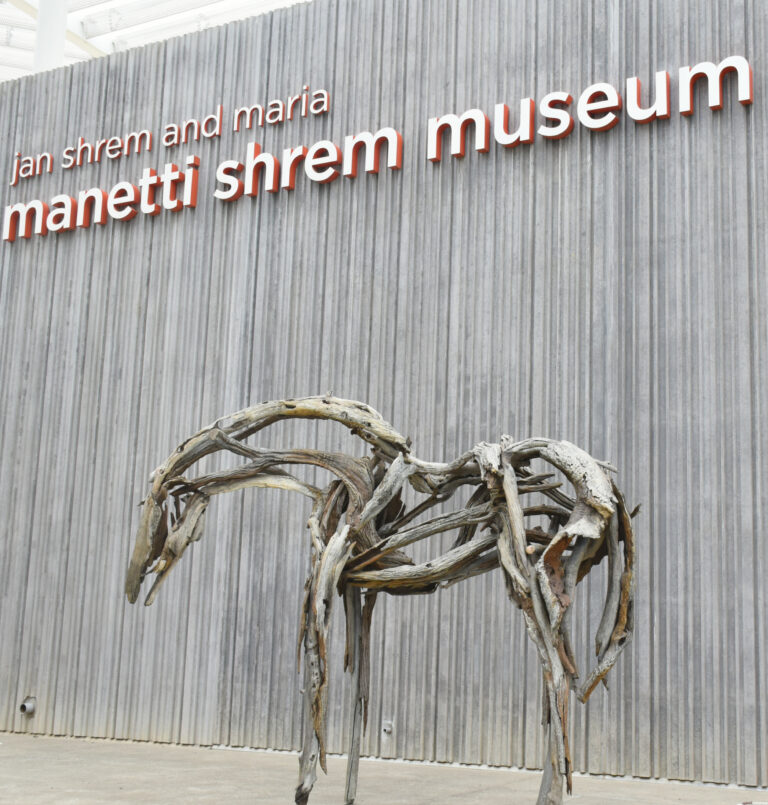
At the beginning of Oct., many new installations were put into place at the Manetti Shrem Museum of Art, located on the edge of campus. The museum offers many experiences for all age groups, such as guest speakers, food, music and hands-on art activities. The main attractions, however, are the seasonally featured artists and the pieces that are showcased from their latest collections. 

Deborah Butterfield is an American sculptor based out of Bozeman, Montana. She practices her craft on a small farm where she and her equally artistic husband, John Buck, live. When they aren’t in Montana, both of them also work out of a studio space in Hawaii. The UC Davis alumna has been exploring horses in many of her works for the past 50 years. Studying their form and structure has allowed her to create one of her largest compilations of work, “P.S. These are not horses.” The intention that lies behind the title might feel misleading, but the works provide the viewer with a deeper understanding of the equine world; many of the sculptures are abstractions of the horse’s corporeal form. Additionally, she experiments with bronze to create these lifesize sculptures. Butterfield also implemented some earlier ceramic pieces from her time spent studying at UC Davis into the collection. 

Ayanah Moor, another artist with an exhibition currently on display at the Shrem, utilizes similar methods of abstraction to question our current modes of communication and how we can use them to view art. Aside from painting, Moor also makes use of print, video, mixed media and performance art. The inspiration for her work comes from the motivation to interrogate identity in the hopes of digging deeper into its core. “Undercover” gives viewers an outlet to explore their own identity and offers a new outlook on finding the root of one’s self through the abstract medium. The audience is encouraged to grapple with the idea of gender, race and sexuality while viewing the installation. 

UC Davis Professor and activist Emeritus Malaquias Montoya takes on a new form of political printmaking to advocate for social justice. Prior to teaching at UC Davis, he maintained a lead position in the social serigraphy movement of the mid-1960s. In “Malaquias Montoya and the Legacies of a Printed Resistance,” his exhibition currently up for view at the Shrem, he has collaborated with many other artists to bring these vivid designs to life, make a statement and further promote social justice. 

Lastly, Alicia Eggert has one piece that is present alongside the other installations. Eggert utilizes language and time instead of common art mediums such as paint or clay. “This Present Moment” uses neon signage to modify the original phrase “This present moment used to be the unimaginable future” into the simpler phrase “This moment used to be the future.” The brightness of the neon light blatantly addresses the viewer, forcing them to grapple with the ambiguous statement. Students are welcome to contemplate their past, present and future selves when viewing this piece. 

The Manetti Shrem Museum is a wonderful resource for many UC Davis students as well as the general Davis community. Aside from the many events that the museum hosts, the works they house are just as impressive and should be explored. Many of the installations will be on view until June 2024. 


Written By: Ana Bach arts@theaggie.org


Culture Corner

The Art Desk’s weekly picks for movies, music and more


By YASMEEN O’BRIEN arts@theaggie.org


Book: “Wild: From Lost to Found on the Pacific Crest Trail” by Cheryl Strayed (2012)

This memoir is a profound recounting of the author’s struggles after the sudden death of her young mother when Strayed was only 22 years old. After an era of self-destruction in the wake of her mother’s death, including promiscuity and a bout of heroin use, Strayed makes the decision to solo hike 1,100 miles along the Pacific Crest Trail. She embarks on this journey from southern California to Oregon in an attempt to rediscover the parts of herself she lost after her mother’s passing. It’s a beautiful and brave story of survival, both in the wilderness and through deep pain. This story changed the way I think about grief and the inevitable ebbs and flows of life. It made me kinder to myself and to others. I want to scream from the rooftops how much I recommend this book to anyone who’s looking for a new read. 


Movie: “Almost Famous” dir. by Cameron Crowe (2000)

This is definitely an oldie, but a goodie, and one of my favorite movies. Set in the early 1970s, the film follows high school student and budding music journalist William Miller who is invited to write a story for Rolling Stone Magazine. The film follows the writer as he accompanies the up-and-coming fictional rock band Stillwater across the country for their concert tour. Through spending time with the group of musicians and groupies, he quickly gains the respect and friendship of the much older band through his kindness. He has to grow up fast on tour and ends up learning a lot about the world — the good, the bad and the ugly. Starring Kate Hudson, Billy Crudup (whose character, Russell, is my all-time celebrity crush!) and Patrick Fugit, this movie is wildly funny, achingly heart-wrenching and downright educational. I’m a sucker for period pieces, especially ones set in the ‘70s, and “Almost Famous” does a wonderful job of making you feel like you were there too. 


TV Show: “Girls” (2012)

Written and directed by Lena Dunham, “Girls” is a recent find of mine, despite it coming out over a decade ago. It has quickly come to hold a special place in my heart as it follows four friends post-college who are trying to make it in New York City. They’re broke, aimless and confused. Their love lives are freakish, their friendships are unsteady, their jobs are minimum wage and yet they manage to score great apartments somehow. It doesn’t shy away from the raunchy, awkward darkness that our 20s can be sometimes, which makes it all the more lovable. Much like in real life, the characters are constantly making the wrong decisions — though who’s to say they’re wrong, necessarily? — and life gets the best of them sometimes. As someone who is soon to graduate, it’s comforting to know you don’t have to have everything figured out, and that lots of good learning and laughing happens when you don’t. As cheesy as this all sounds, the show somehow doesn’t deliver it that way. Go watch!


Album: “The Babe Rainbow” by The Babe Rainbow (2017)

A band of Australian surfer dudes, The Babe Rainbow makes music that is many things all at once: it’s alternative, it’s psychedelic, it’s surf rock. You can’t help but groove to the dreamy bass and guitar riffs, drifting into a meditative state as the lead singer, Angus Dowling, takes you into a musical trance. While the lyrics are sometimes hard to understand due to their thick accents and breathy style, they do more than deliver with their talents on the guitar, bass, drums and tambourine. This album, their namesake, is their best one. A mixture of mellow and upbeat, it keeps me calm yet fired up and excited for the day. Not a lot of music can do both. My favorite songs on the album are “Losing Something,” “Johny Says Stay Cool” and “Peace Blossom Boogy.” If you’re looking for some groovy, down-to-earth music with a kick that is sure to put you in a good mood, listen to “The Babe Rainbow.”

Written By: Yasmeen O’Brien arts@theaggie.org

Department of Justice presents de-escalation forum in response to recent events in Davis

The city of Davis, Davis Joint Unified School District, UC Davis and Yolo County partnered to host the event


By ALMA CULVERWELL city@theaggie.org 


On Monday, Oct. 30, the US Department of Justice (DOJ) presented a Communication and De-Escalation Forum to the community of Davis in response to the series of recent bomb threats.

The forum highlighted ways to effectively communicate while discussing controversial issues. The event featured experts from the US Attorney’s Office for the Eastern District of California, the FBI and local law enforcement.

The DOJ proposed the forum as a response to the five bomb threats in the city of Davis. They reached out to the city, Davis Joint Unified School District (DJUSD), UC Davis and Yolo County to provide adequate resources and information and the opportunity for a community forum, which was accepted by all organizations involved. 

Jenny Tan, director of community engagement for the city of Davis, said the city may plan to host future forums. Tan also said similar events may be a part of the city, county and campus-wide project, Hate Free Together.

“We’ll have to kind of play things a little bit by ear […] we did take a lot of notes,” Tan said. “There were about four breakout sessions yesterday, and so we’re still sort of compiling the notes and looking through them. It may be that we have the Department of Justice come back for a follow-up meeting. It may be that, you know, this gets folded under Hate Free Together. We definitely want our community to know that we’re listening and that we value their input. But we also understand that this is a tough time for all of us who call Davis home.”

The event hosted a range of attendees including various organizations, nonprofits, local parents and invested community members who were curious about ways to better approach and deal with the presence of hate crimes in the Davis community.

Tan described the most important things for Davis residents to keep in mind moving forward in respect to recent occurrences.

“Our priority is always to keep our residents safe,” Tan said. “And you know we all have a role to play from a person who lives in Davis all the way to someone who works in government and is responsible for different parts of the government. But essentially, we all have a role to play in how we keep each other safe and how we stand up to things that happen in our community.”

Tan noted the city’s willingness to accept feedback from community members.

“If they [the community] have ideas, if they have ways to support, to reach out to their local government agency, whether it’s the city, whether it’s UC Davis or Yolo County or the school district, we’re always open to their feedback and want to hear what they have to say.”


Written By: Alma Culverwell city@theaggie.org 

The California Aggie can be a platform for your voice

Whether through submitting guest-ops or leaving a comment on an article, take advantage of the space that student journalism holds for community engagement 


By THE EDITORIAL BOARD


In today’s world, trying to become educated about current events can be difficult when it feels like people are trying to tell you what to think, rather than allowing you to build your own opinion in the midst of it all. Reading the news can also be overwhelming because it requires discerning what is real, what is fake and what is biased. But regardless of complications, the media allows people to stay informed on global topics and amplifies the voices of our communities. 

Producing balanced journalism isn’t as clear-cut as we would sometimes like for it to be. Especially on a college campus, which is home to so many diverse backgrounds and perspectives, student journalism will likely never perfectly represent the complexity of the student body. While imperfect, The California Aggie does its best to accomplish this in a variety of ways — one of which is by publishing guest opinion articles that are submitted to our opinion editor at opinion@theaggie.org

Our platform is for you. We edit these for clarity and grammar, but we don’t choose which ones to publish based on what we agree with. Of course, we have opinions and biases, but the role of a student newspaper is to fairly represent our campus. That’s why we want to give opportunities for the voices of all members of our community to be heard. Aside from guest-ops, you can also make your voice heard by leaving a comment on our website, where we recently re-opened the comments section. 

Of course, we as an organization will never be able to satisfy every reader with our coverage, and as a media group, we probably wouldn’t be doing our job right if we did. And we won’t change or delete our content according to every piece of feedback that we receive. That said, we genuinely do want to hear from you, listen to you and learn from you. We hope that you will feel empowered to take advantage of the pathways we have for you to share your thoughts with the UC Davis community, and with the staff of The California Aggie.


Written by: The Editorial Board

Antisemitic graffiti spray painted near Highway 113

The crime is being investigated as a ‘hate incident’ 


BY CHRIS PONCE city@theaggie.org 


Content warning: This article contains discussions of antisemitism.


On Monday, Oct. 30, Davis authorities were notified of reported “antisemitic graffiti” that was left near a wall that separates greenbelts and Highway 113, near Rio Grande and Joshua Tree Streets. 

“Davis Police officers and Code Enforcement officers responded immediately and the graffiti was removed,” a public release made on Facebook by the Davis Police Department stated. “The Davis Police Department takes these crimes seriously and is investigating this case as a hate incident.” 

Authorities have not publicly shared what the vandalism contained. But, according to The Sacramento Bee, the graffiti was of an Israeli flag with a swastika in the center replacing the Star of David.

The Davis Police Department believes that the graffiti was spray painted sometime Sunday evening or early Monday morning. Authorities are asking residents in the area to send any relative information or security footage from the time of the incident. Information about the incident can be emailed to PoliceWeb@cityofdavis.org or at 530-747-5400. Police said that callers can remain anonymous. 

“If you live in this area and have any security camera video that may have captured the suspect around this time, or if you have information about this crime, please contact the Davis Police Department,” Davis Police said in their public release. 

This incident comes less than two weeks after a vigil held at Central Park for the victims of the Hamas attacks in Israel. The event, which was organized by Israeli and Jewish community members, had police present to protect the event. Some elders even denied to attend the event because of safety concerns, stating they “can’t run very fast.”

UC Davis and the city of Davis have a history of antisemitic hate incidents over recent years. Last year, on Aug. 28, antisemitic banners were hung over the Highway 113 overpass by four white men. 

In 2015, the AMCHA Initiative, a group that investigates and combats antisemitism in universities, ranked UC Davis among the top 10 colleges in the country with the most antisemitic activity. 

Davis Joint Unified School District (DJUSD) responded to this week’s vandalism incident on Facebook.

“DJUSD stands in unity with our entire community in denouncing hate in any form — it has no place here in Davis or anywhere,” the DJUSD said on Monday via Facebook. 


Written by: Chris Ponce — city@theaggie.org 

New MRI system can capture live images of moving wrists

This emerging technology will improve medical diagnoses and anatomical knowledge


By KATIE HELLMAN — science@theaggie.org 

A recent study published in the British Journal of Radiology has shown that a new magnetic resonance imaging (MRI) system can capture the live motion of wrists. These new systems can lead to a better understanding of the anatomy of human wrists and can advance the future of diagnostic technology.

“A detailed understanding of the functional kinematics of wrist tissues necessary to carry out activities of daily living is essential to effectively diagnose and treat wrist dysfunction,” the study reads. “Real-time MRI of the moving wrist is feasible with high-performance 0.55T (Tesla) and may improve the evaluation of dynamic dysfunction of the wrist.”

Abhijit Chaudhari, a professor in the department of radiology and interim director of the UC Davis Imaging Research Center, commented on the value of this new advancement in an interview with UC Davis Health.

“Moving images give us a new tool to diagnose wrist dysfunction, either during motion or when there is load on the joint,” Chaudhari said. “The wrist is highly complex, so the ability to visualize motion will have an enormous impact.”

Traditional still MRI images usually provide highly accurate information regarding the wrist’s internal structures.

“Magnetic resonance imaging (MRI) has high spatial and contrast resolution, and can [characterize] bone and soft tissue without using [ionizing] radiation, making it an ideal imaging modality to assess pathologic conditions affecting joints,” a study published in PubMed states.

However, despite their reliability, current MRIs have a major fallback: still images can make it difficult to detect dynamic instability, which refers to unstable joints that are only visible during movement. Assessing wrist function while the wrist is in motion is the key to diagnosing certain injuries and administering subsequent treatment. 

Along with Chaudhari, Robert Szabo, a professor of orthopedic surgery at UC Davis, and Robert Boutin, a musculoskeletal radiologist and professor of radiology at Stanford University, have spent over 10 years developing three Tesla (3T) machines to create live scans of the body. Despite the development of this fascinating technology, using a high-field strength magnet created artifacts in images that made it hard to obtain a clear reading of the MRI scans.

To solve this problem, Chaudhari, Szabo and Boutin began working with Krishna Natak, director of Dynamic Imaging Science Center at the University of Southern California. They received a grant to create a 0.55T MRI system that can develop moving images at 78 frames per second. This allows for precise dynamic imaging in a matter of seconds without artifacts obstructing the ability to interpret radiology reports.

“The dynamic pictures, along with standard, still MRI scans, show us specific wrist anatomy that had never been evaluated to this degree before,” Szabo said during an interview with UC Davis Health. “This has tremendous relevance to evaluate injuries and conduct further research into how the wrist functions.”

Written by: Katie Hellman — science@theaggie.org

Environmental impact report discussed for new Davis affordable housing development

The most recent Davis City Council meeting featured discussion on the development and its environmental concerns


By HANNAH SCHRADER — city@theaggie.org


On Oct. 23, the Davis City Council met and discussed the creation of an environmental impact report for the Village Farms development.

Village Farms is a project created to combat the housing crisis in Davis through the addition of affordable housing within a mixed-use community. 

City Council Member Donna Neville opened discussion of the agenda item by clarifying the stage the Village Farm project is in. The agenda item elicited significant feedback from the public.

“It’s so important for people not to think anything has been decided,” Neville said. “The analysis has not been done yet, we are simply notifying the public that it will start. That’s it.”

After opening up the agenda item for public comment, a local resident expressed their support of the upcoming project because of its location and how that may affect car usage in Davis.

“This EIR (Environmental Impact Report) will be different from any EIR we have ever seen because it operates under a new bill called SB 743, which was passed in 2013 by Steinberg [and] basically says, ‘We do not care about traffic congestion anymore, we care about vehicles miles traveled,’” the resident said. “[…] Congestion relief is not an environmental impact, so this project is [great] and I think we should move ahead with [it].”

Another public commenter expressed a different opinion and voiced concerns about new housing near an already traffic-filled area. 

“Is there a plan to handle traffic on the Covell and Pole line intersection?,” the resident said. “Where a bicyclist already lost her life before any of this extra traffic? The idea of city density to prevent sprawl and protect farmland is a wonderful idea, but one size does not fit all, especially when you are creating sprawl and developing on farmland.” 

Mayor Will Arnold stated the purpose behind the SB 743 bill and how it pertains to this upcoming development.

“The mitigation measures are to allow for more traffic flow, whereas with the new state goals in terms of VMT [Vehicle Miles Traveled] reduction, that’s not something the state wants to incentivize […], greater flow of traffic, but instead fewer vehicle miles traveled — that’s the reasoning behind it as I understand,” Arnold said.

Councilmember Bapu Vaitla provided input from a long-term environmental angle on the overall impact of the project.

“For me, part of the frustration with the process, from a narrow short-term perspective, [is that] having more units or higher density might look like greater environmental impacts in terms of total VMT, for example,” Vaitla said. “But from a long-term perspective, it might be that higher density or more units might be lower per capita VMT.”

City Manager Mike Webb then suggested a plan to garner more public feedback on this project and eventually bring it in front of the city council again.

“The alternatives that are laid out right now are preliminary and with council direction to do so if we embark on issuing the notice of preparation kicking off that 30-day comment period,” Webb said. “There will likely be other comments and feedback from the community to suggest alternatives folks think we should be looking [at], and once we get those comments we can consolidate [them] and summarize that feedback.”


Written by: Hannah Schrader  city@theaggie.org

Campus prepares for fall 2023 ASUCD election

ASUCD is attempting to increase voter turnout after low involvement in elections of recent years


By SYDNEY AMESTOY — campus@theaggie.org


October marked the beginning of preparations for the ASUCD fall 2023 elections. There are six seats in the ASUCD Senate up for election this cycle, with 26 candidates currently running for spots, according to ASUCD Elections Officer Reid Rizk. 

Voting opens on Nov. 14 and runs until Nov. 17, but candidates are already following election procedures where they attend workshops to both explain how the elections are going to work and sign themselves onto the ballot. New candidates had until Oct. 30 to sign on to the ballot for the election, according to the elections calendar. 

Undergraduate students participating in the election vote for every seat. To better inform their decisions, they will be provided with each candidate’s statement along with the ballot.

Current ASUCD Senator Dani Antonio, who was elected in the spring 2023 cycle, highlighted the importance of voting for ASUCD Senate positions.

The ASUCD elections are your rightful time to choose the student leaders you want to represent you,” Antonio said. “Elected senators will be advocating for you and amplifying your voices, so it’s extremely important that you get to have a say in who will be doing so. Also, senators hold one-fourteenths of a vote on all legislation, including a 20 million dollar budget that is made up of student fees. We want to ensure that we elect student leaders that will advocate and vote for substantial and equitable uses of this budget to properly represent the students that we serve.”

While these elections happen both in the fall and spring quarters on campus, past elections have shown a turnout problem, according to Rizk, and this is an issue ASUCD continues to adress through increasing student engagement.

“The voter engagement in 2020, when we passed the basic needs referendum, was 25 percent,” Rizk said. “Since then, it’s kind of been in decline. Fall of 2022, I believe, was the lowest it’s been in a very long time.”

Rizk explained that recent cycles have seen an uptick in voter turnout, but not enough to pass acts or referendums in the ballot. 

“We got 16 percent turnout last quarter,” Rizk said. “And unfortunately, TGIF [The Green Initiative Fund], which was the fee referendum that was on the ballot last quarter, did not get passed.”

Fee referendums need at least a 20 percent voter turnout to pass, according to Rizk. While this isn’t the case for votes regarding senate seats, Rizk still stressed the importance of student involvement in the ASUCD’s election process.

Student involvement is extremely important with elections,” Rizk said. “The people that get elected through these elections are campus leaders and regularly meet with administrative staff like the vice-chancellors, provosts and Gary May himself. They advocate for the student body in the state capitol and even on the federal level in Washington DC. They also allocate almost 20 million dollars of student fees to [different] units and groups that they oversee. So, ensuring that the people that students want to have represent them and to allocate their money [are] on the senate table is essential.”

Last quarter, ASUCD used incentives to encourage students to vote, something that,  according to Rizk, will continue this year.

“We’re just [trying] to build up elections again and create sort of an institution for elections here on campus, because all of this [ASUCD services] comes through student fees,” Rizk said. “And if we can’t pass a fee referendum with 20 percent, we run out of money and we will not [be] able to provide services to the student body and our community as a whole.”

Antonio continued on the importance of student representation in the ASUCD Senate by discussing how educational incentives can play a significant role in informed voting. 

“I think it’s great to have some sort of incentive to [vote], given that we do not live in an ideal world where every person comes out to vote,” Antonio said. “It’s definitely been a challenge on our part to encourage people to and is our responsibility to reach out to students. I do think that incentives without education mean nothing for what we want out of elections. We want to make sure that students know who and what they’re voting for too. We want them to have that autonomy to elect people they want to represent them.”

Students who are looking to learn more about the candidates for the fall election cycle can attend the ASUCD Election Candidate Debate, according to Zachary Boggeln, Internal Affairs Commission vice chairperson and member of the ASUCD Elections Committee. The debate will take place on Oct. 14 from 1 p.m. to 3 p.m. in the CoHo.

“The debate is a great opportunity for voters to hear from the candidates directly and get a better idea of who their first-choice candidates will be,” Boggeln said. “It is also a fantastic way for candidates to have a face-to-face dialogue with voters to better describe their goals in office if they are elected.” 

Students can visit the ASUCD Elections website from Nov. 14 to Nov. 17 to cast their votes.

Written by: Sydney Amestoy — campus@theaggie.org


Gov. Gavin Newsom signs Davis climate action bill

Newsom signs Davis habitat and climate action bill from State Senator Bill Dodd


By ALMA CULVERWELL city@theaggie.org 


On Oct. 4 Gov. Gavin Newsom passed Senate Bill (SB) 256, allowing the city of Davis to create endangered species preserves and further climate action. The bill was introduced by Sen. Bill Dodd (Senate District 3).

SB 256 modifies Proposition 70, which was passed in 1988 and approved $776 million to fund acquisition and rehabilitation of park and wildlife areas in California, allocating $1.97 million for the city of Davis. The bill allows the city of Davis to collaborate with Yolo Habitat Conservancy to put easements on specific properties in need of preservation or rehabilitation. 

Tracie Reynolds, manager of the Davis Open Space Program, which is devoted to protection of farmland and habitat areas in the community, described the effect of SB 256. 

“Basically the legislation […] allows the city to put a habitat conservation easement on those eight properties if we want to,” Reynolds said. “[…] I mean, nothing’s been approved, it would still have to go through the community process and be approved by the city council and all of that but before we couldn’t do it and so now we can if we want to.”

Reynolds described that this is a crucial step in moving forward to implement the Yolo Habitat Conservation Plan, a plan first introduced in the 1990s that works to conserve endangered habitats and species in Yolo County.

Reynolds talked about the initial process for developing and coming up with the bill, which has been in the works for a while.

“Several years ago I talked with the Yolo Habitat Conservancy […] they actually approached me about possibly putting a habitat […] on some of the cities properties that the city owns along the South Fork of Putah Creek and [..] so at that time I kind of tried to work with the state on that, but given the language that was in Proposition 70 it basically prevented us from doing that, and so I kind of put it aside because we couldn’t do [it],” Reynolds said. “They basically said we couldn’t put a habitat easement unless we had an active legislature and so I said ‘Well, that’s kind of a lot, I’m going to put that aside for now.’” 

Reynolds explained long-term goals for the bill as well as the Yolo Habitat Conservation Plan. 

“Primarily what I try to do is […] slowly try to conserve farmland — you know, working with farmers around the city to put conservation easements on their property […] Some of my goals there are trying to acquire more land along the south fork of Putah creek to make it more of a habitat and public access area and to protect more farmland around the city,” Reynolds said.

She also encouraged community members who are passionate about the cause to get involved through volunteer work and support of the city’s open space program as well as Measure O, which is a parcel tax devoted to habitat restoration.


Written by: Alma Culverwell city@theaggie.org 

What’s in your water? What students should be mindful of while swimming in Putah Creek

0

Advice from a Putah Creek Reserve specialist


By FAITH DEMEULENAERE — features@theaggie.org


The sky is clear, the bees are humming, the plants are beautiful and the sun is, well, hot. 

On a warm day in Davis, visitors, students and locals alike flock to the Putah Creek public sector to take a dip in this beautiful, picturesque waterway. However, underneath the surface, Putah Creek is a habitat for multiple species, big and small. Could they pose any threats to swimmers? Or possibly more importantly, could we pose any threats to them?

Andrew Fulks, the assistant director of the UC Davis Arboretum and Public Garden, spoke on the art of swimming mindfully at Putah Creek. Fulks’ insights are not only valuable to those seeking aquatic adventure, but they also serve as a reminder of the importance of coexisting harmoniously with the natural wonders that grace our campus here at UC Davis.

“The live stream is no less safe than any natural water body in the area,” Fulks said. “The water comes from Lake Berryessa, flows past the town of Winters and through the agricultural fields out to the Delta. People need to know how to swim and wear water shoes to avoid any underwater hazards such as sticks.”

Fulks also addressed the circulating rumors that Putah Creek is unsafe due to leeches and other aquatic organisms.

“There are some [segmented parasitics, leeches or something similar] that have fish as the primary host, but they are harmless to humans,” Fulks said.

It’s no secret that Putah Creek is brimming with aquatic life. Beavers, river otters and a wide variety of fish species including bass, sunfish and trout are just some of the organisms that survive and thrive in the Putah Creek, according to Fulks.

 However, he reminds visitors that when swimming amongst these animals, one must be mindful of how their actions impact the wildlife in the area.

 “Don’t harass any wildlife you see,” Fulks said. “Don’t dump trash or fluids in the creek and pick up any trash you see when visiting so that it doesn’t go into the water.” 

As for fishing, the Rules and Regulations section for Putah Creek found on the Arboretum website directly states, “Collection of plant and wildlife specimens is prohibited, without prior written authorization and appropriate State or Federal permits.”

Fulks eased concerns about harmful bacteria that some fear when swimming in lakes or creeks by sharing information on the conditions of Putah Creek’s water. 

“There can be cyanobacteria blooms in the Arboretum Waterway, but we haven’t had these in Putah Creek proper,” Fulks said. “Those tend to form in waters that aren’t flowing, and Putah Creek has a healthy flow.”

Fulks has a long history with Putah Creek, being hired by the University in 2002 to manage the Putah Creek Riparian Reserve, according to a blog post on the history of Putah Creek found on the Arboretum website.

“He worked with the campus to establish a vision for the Reserve including creating a formalized network of trails, re-establishing native vegetation, removing invasive plants, restoring habitat and more,” the website states. 

However, before he could tackle any of that, he first had to work on securing the area. 

“Back then, the Reserve was akin to the Wild West,” Fulks said. “Because it wasn’t actively being managed, the Reserve had become a popular dump, illegal camping area and destination for off-road recreational vehicles.”

Thanks to the hard work and dedication of Fulks, the creek has been increasingly flourishing, making Putah Creek the beautiful waterway the city of Davis knows it to be.

“I’ve been going to Putah Creek since I was a second year,” Julia Cole, a fifth-year environmental science major, said. “There were always jokes about the ‘brain-eating amoeba.’ I have always thought it was dumb, the creek is well taken care of and the community obviously really cares about its cleanliness and dignity.”

“Treat the creek respectfully,” Fulks said. “Think about how to leave it better than you found it for future visitors.”


Written By: Faith DeMeulenaere — features@theaggie.org

Email scams commonly target UC Davis undergraduates for money and personal information

How to maintain cybersecurity and protect yourself from fraudulent job and internship offers


By LYNN CHEN — features@theaggie.org


At UC Davis, most of us are young adults just beginning to enter into society, trying to achieve career goals and become financially independent. As such, it is no wonder that many online scammers target our population.

Jade Lee, a second-year student majoring in psychology, said that she often receives emails advertising fraudulent job postings for research positions in labs.

“I would say I get a decent amount of emails from [UC Davis] non-affiliated accounts asking if I want to do lab work and stuff,” she said.

Lee was almost taken in by one of these scams in her first year. “I think I might have fallen for the first [scam email],” she recounted. “I was looking for a bit for lab work last year […] and I end[ed] up reaching out to the person who sent it the first time.”

Luckily, because Lee already obtained a legitimate lab position before the scammer replied, she was able to avoid the fraudulent position.

Unfortunately, many people receive similar emails like Lee does: messages that advertise fake research, internship or other employment opportunities to college students.

“By far, the most prevalent [form of scam] is a job scam,” Jeff Rowe, a senior cybersecurity analyst at UC Davis, said. In their emails, attackers typically pose as genuine recruiters from companies or professors from UC Davis and other accredited universities in order to trick students, according to Rowe. 

In recent years, email frauds like these have surged in numbers across student inboxes. Even undergraduates who have not yet stepped onto campus are being targeted.

“You have a natural refresh of ‘naive’ students every year,” Rowe said. “The summer before [new undergraduates] show up is when we see the most [scam] activity.”

Job scams typically belong to the bigger category of “phishing scams,” which refer to forms of fraud that attempt to acquire sensitive information from the victims. For students, their phone number, email address and campus LoginID username and password are all in danger of being stolen.

“The number one thing [attackers] want is, of course, money,” Rowe stated. “But the second thing they really, really want is your email account.”

Rowe explained that scammers will often try to deceive students into providing their email passwords and Duo Security tokens. With access to a verifiable email address, attackers can more easily target people at other universities.

“The third thing they want is your personal contact information,” Rowe added, “because once you start to communicate with them using your cell phone or personal Gmail account, […] none of the security controls that we have here at UC Davis or our security operations can help you anymore.”

Job scams can play out over several days, where bad actors — those who wish to cause harm through cyber means — have dialogue via email with a student several times, according to Rowe. 

During this process, potential victims can easily leak their bank account number and information to the attackers.

Chief Information Security Officer Cheryl Washington emphasized that repeated interactions between bad actors and victims can provide scammers with more opportunities to learn about their targets and more successfully siphon profits from them.

She underscored that the core of email scams is not how computer-savvy scammers are, but rather how adept they are at being manipulative with their targets. This was also agreed upon by Rowe.

“The psychological portion is what’s important for these attacks,” Rowe explained. “[The scammers] are not at all technical people who know anything about computers. They know how to send emails and that’s it, […] but they are extremely good at manipulating people.”

Rowe stated that it was common for attackers to impersonate people that students deemed their superiors, such as professors, to get to students.

“[Having] someone who’s above you, that has power over you, reaching out to you and communicating with you without you asking [for it] is a very powerful sort of psychological motivation,” he said.

Because of this, students may feel more compelled to reply to job scam emails, like Lee did.

“I dare say, in extraordinary cases, they want to probe and get so deeply immersed in who you are as a person,” Rowe remarked.

Additionally, scammers may try to be clever with their wording in emails in order to appear genuine. By offering opportunities to students who may not be actively looking for such work, potential victims feel specially chosen and thus have a greater chance of falling for job scams.

Furthermore, though it is common to think that job scammers will present huge sums of monetary rewards in their emails to attract more students, attackers actually often advertise quite reasonable amounts of “monetary compensation” for their fake job postings. This is to more effectively impersonate real recruiters to deceive undergraduates.

As mentioned earlier, attackers know to target those who would be more likely to fall for their schemes, like incoming first-years who may be more inexperienced. Evidently, the capabilities of scammers should not be underestimated.

However, if students are engaging with attackers through their school email, the campus may actually have time to step in and warn potential victims of their suspicious correspondents. As such, Rowe advises against undergraduates giving away personal emails and other contact information too easily to unknown senders, since the university would no longer be able to interrupt any questionable transactions for the students.

UC Davis has also been trying to prevent its community from being scammed through educational campaigns.

“A few years ago, [because] we saw a significant volume of these sorts of scams hit our community, [Rowe] and I met with a number of stakeholders including representatives from the Career Center, other branches of Student Affairs, the privacy officer, the legal council officer and a host of others to talk about some strategies that we could use to better educate our students,” Washington said.

“What we’ve tried to do is illustrate by way of example, [educating people about] things we see in emails that might serve as flags,” Washington stated.

The campaigns also strongly encouraged people to verify the legitimacy of the emails they were interested in through the Information Security Office, the Internship and Career Center and other relevant university offices.

“Part of the reduction [in numbers of people being defrauded] has been part of the byproduct of the campaigns that we’ve launched to educate, to educate, to educate,” Washington explained. “Not adding more technology, but expanding our outreach and education [to prevent scams].”

Rowe and Washington also provided specific tips on how to avoid job email fraud.

Initially, Rowe strongly recommended students never use their personal bank accounts to conduct business with UC Davis. “If you have a job at UC Davis, money goes into your bank account, not out,” he emphasized. 

In addition, undergraduates can use Google to search for unknown email senders’ names to verify their identity and actual email addresses.

Washington gave similar advice: “If a bad actor asks you to spend your money to buy supplies for their job, chances are, that’s a scam. If they ask you for your bank account information, that’s a scam.”

She also cautioned the community to be wary of emails offering opportunities that seemed too good to be true. 

“I won’t necessarily assert it’s a scam, but let’s ask questions first,” she said.

While knowing how to identify and protect yourself from job scams is important, Rowe also urged students to report any suspicious emails to cybersecurity@ucdavis.edu, in order to impede the potential attackers from victimizing other members of the school community.

As young adults, we have just begun to build our first steps into society and our careers. Don’t let an email with false hope compromise our valued wealth and assets.


Written by: Lynn Chen — features@theaggie.org


UC Davis Transportation Services introduces campus-wide parking changes

Changes include rate increases and the use of a new app, with some changes seeming to cause controversy in the West Village


By SYDNEY AMESTOY — campus@theaggie.org 

Starting in fall quarter 2023, a series of parking changes has been rolled out by Transportation Services at both the UC Davis campus and UC Davis Health campus, including a switch from the Parkmobile app and a rise in prices for affiliates. 

Transportation Services announced the new prices for affiliate parking in an August newsletter. Affiliate prices for off-campus students and employees are now $5.10. The changes affect all of the UC Davis and UC Davis Health campus parking and even Transportation Services’ controlled parking in the West Village.

The increase in prices ensures that the obligations of the Transportation Services are met across campus, according to Shelby Slutzker, the engagement and marketing specialist for Transportation Services.

Because the department is predominately [funded] through parking revenue, raising rates will help Transportation Services continue to provide services to our commuters, address deferred maintenance from years past and improve campus mobility,” Slutzker said. 

These new rates come as the campus transitions from Parkmobile to AggiePark. 

AggiePark, the name given to the new parking system, is operated using the AMP mobile parking app. Transportation Services announced that Parkmobile payment would no longer be accepted starting Oct. 1, according to the August newsletter.

Slutzker said that the transition to the app allowed for more control over changes made to parking.

 “We’re not app developers, so we can’t necessarily change how it looks, but we can make a new zone if that’s helpful with [AMP],” Slutzker said. “I think I’ve heard this example from some of our higher-ups. It would be like you’re working on a presentation and the font is wrong, so you’d put it in a service ticket. It takes them sometimes weeks to respond and then it comes back and the fonts [are] better, but now the font size is wrong. Then you put it in again. And it was just — we had to rely on [Parkmobile] to make any of those quick changes.”

However, the changes to the prices of two-hour parking rates along the roads of both The Green and Sol at West Village on-campus apartments have impacted the residents of these areas.

Will Dunn, a fourth-year political science major and resident at The Green, spearheaded a petition to change the raised prices of the two-hour parking rates. The rates for two-hour parking increased to $6 every two hours from 7 a.m. to 10 p.m., according to Dunn. This parking had previously been free.

The university and Transportation Services work off a lease agreement with the private entities that operate The Green and Sol Apartments. This means that apartment parking is not controlled by the university; however, street parking is. 

“This change is largely impacting the visitors to the West Village,” Dunn said. “That’s the primary impact and we’re not trying to argue that it’s affecting the student’s ability to park, while that is an inconvenience. So, the main thing is that this is a high-density housing area… In West Village, we’re on the other side of the freeway, so there’s a unique nature inherent in the geography of the area that we’re built into…. We’re on campus in a strict technical sense, and we don’t have adjacent streets to park for visitors.”

The design of the West Village itself was the reason many were upset over the change, since two-hour parking makes up the entirety of street parking in the area, according to Dunn.

“We really focus on the fact that you can’t say, ‘Oh, now I have to have my mom park over on F Street and walk over here,’” Dunn said. “You can’t park outside my unit because it’s two-hour paid parking. There is no F Street because there’s fields in between us and the rest of the neighborhoods. They invented this whole neighborhood from scratch. As a consequence of that, they have a full monopoly over the street parking. So this isn’t a minor inconvenience, it’s an impossibility for visitors to be able to park anywhere else.”

Dunn started a Change.org petition, with flyers across The Green and Sol apartments to argue against the change. Comments on the page reflect the impact of this change on visitors.

I have family who [visit] all the time to see their grandson, so the parking situation is ridiculous,” one comment read. “The fact that they are limited to 2 hours and that they need to pay for that is ridiculous. I shouldn’t have to worry about whether they will get a ticket or not while they visit.

There were two meetings held between the group of concerned West Village residents, led by Dunn, and Transportation Services to discuss the negative impact and potential changes to the new prices. 

The reasoning given for the price change was to maintain the roads throughout the West Village, including potholes that have had to be repaired in the past, according to Dunn. 

“Within the context of the university’s transportation system, each campus is required to charge for parking for their faculty, staff, students and visitors,” Slutsky said. “In this one excerpt of another policy, in conformity with the university’s implementation of the 1960 master plan for higher education in California, [it] says that parking is offered as a fee-based service and operated as an auxiliary self-supporting enterprise.”

The first iteration of changes came when prices were reduced to one dollar every two hours from 8 a.m. to 10 p.m.

However, Dunn stated that the second meeting saw concerns brought up about how late-night enforcement may put people at risk if they’re requested to move their car at night or encouraged to visit the complex at later hours to avoid paying the parking fee. 

Due to these concerns, the current pricing is one dollar every two hours Monday through Friday from 8 a.m. to 8 p.m.

“There are many students who still find this whole thing outrageous and they’re right to feel that way,” Dunn said. “There’s also a lot of confusion. The university, they take so much money in tuition and the rent and the parking spots and everything. The least they can do is provide us with parking… The general sentiment is students didn’t like it being taken advantage of. People are still unhappy with the current state of things, but at least for the dollars that will be coming out of their family and their friends’ pockets, it’ll be reduced.”

Written by: Sydney Amestoy — campus@theaggie.org