55.7 F
Davis

Davis, California

Monday, December 22, 2025
Home Blog Page 136

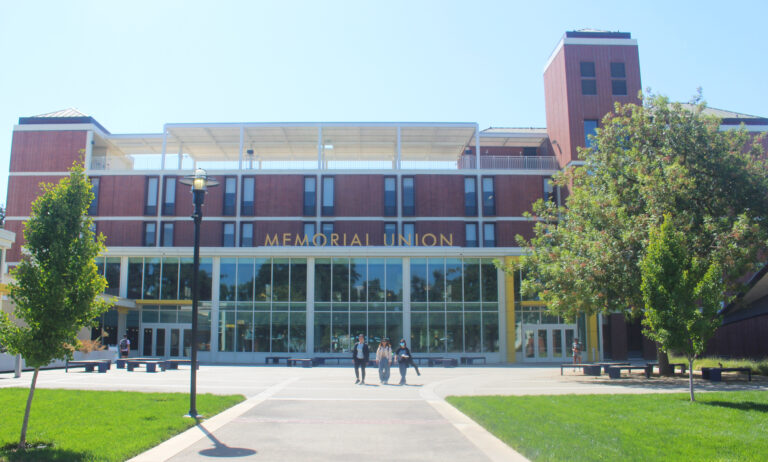
Buses, coffee and The California Aggie: How does the student government at UC Davis affect you?

ASUCD senators discuss goals and student engagement opportunities for the new school year


By LILY FREEMAN — campus@theaggie.org


A new school year brings a newly elected ASUCD Senate. The legislative branch of ASUCD is led by the Senate, which supports six commissions and several committees. 

Erek Leschyn, a fourth-year political science major and an ASUCD senator, described the role of the Senate on campus. 

“The biggest thing that ASUCD senators do is act as a liaison between ASUCD’s governing body, other ASUCD units and students,” Leschyn said. “Each senator will adopt different units and join different committees to see what kind of support they need, and bring that information back to the table to craft bills.” 

ASUCD manages a 19 million dollar budget and funds several of the services that students use on a daily basis, according to Leschyn.

“Whether it’s Unitrans, the Pantry, Aggie Reuse or the CoHo, a lot of students use the services that we provide,” Leschyn said. “Many perhaps don’t even realize that all of those operations are paid for by student fees and are monitored by the Senate.” 

The California Aggie is also partially funded through ASUCD.

Third-year international relations and Middle East/South Asia studies double major and ASUCD senator Gabriel Gaysinsky also explained the impact that the Senate’s activities have on students. 

“ASUCD is funded through student fees that are taken directly from your tuition,” Gaysinsky said. “The power we have is derived from these funds, and as elected members of the Senate, we are able to utilize these funds in the various bills we pass.” 

Gaysinsky went on to describe how students can ensure that their voices are heard by the Senate.

“The main thing is voting,” Gaysinsky said. “The voter turnout is abysmally low. It’s gotten as low as maybe six percent in recent years, which is just terrible. Anyone that studies how democracies function would understand that the lower the turnout, the worse the democracy.”

Gaysinsky went on to highlight that because of the low voter turnout in recent elections, the Senate has a goal to increase student engagement efforts this year.

“There’s a complete and utter lack of outreach, and most people don’t know anything about the Senate,” Gaysinsky said. “The best way to get students involved is to engage with them more and [for] students to demand that senators increase their presence.” 

Leschyn offered an additional method for students to voice their opinions to the Senate. 

“All senators are required to have office hours,” Leschyn said. “Their office hours should be listed in the ASUCD roster. This gives students the opportunity to individually discuss their thoughts one-on-one with the senators.” 

Dani Antonio, a fourth-year political science and psychology double major and ASUCD senator, said that ASUCD tabling is also an effective way to reach the senators. 

“If you see an ASUCD table, don’t be afraid to come up to us,” Antonio said. “We are there for you, and it is the perfect opportunity to quickly ask your senators questions, voice your concerns or discover how to get involved.”

Antonio also emphasized social media as a tool to interact with senators, where every senator has an Instagram account for students to reach them virtually.

Gaysinsky concluded with how students can get involved with ASUCD and the Senate through both volunteer and paid positions.

“The main way that students can get involved is through ASUCD’s vacancies website, vacancy.ucdavis.edu, where new positions are put up frequently,” Gaysinsky said. “It’s the best way to get involved, and it’s how I started. I joined the Ethnic and Cultural Affairs Commission through the website, and that experience allowed me to run for Senate. Because we have a number of different focuses, you can do something you actually believe in.”


Written by: Lily Freeman — campus@theaggie.org
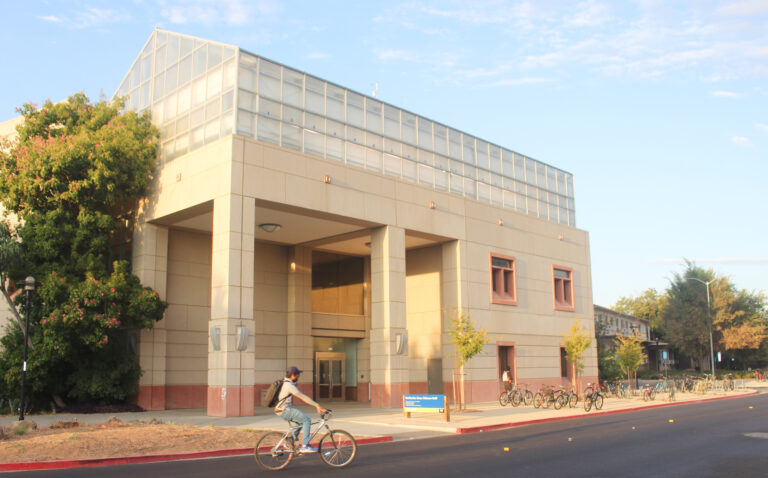
 

The best science courses to fulfill general education requirements

These are some of the most popular STEM GEs that UC Davis has to offer 


By KATIE HELLMAN — science@theaggie.org 


Every undergraduate at UC Davis needs to take a certain number of general education (GE) units to explore a variety of different subject areas, including science. These courses can be taken by students in any major and can range from subjects like diseases of the human brain to the evolution of dinosaurs.

Here are some of the best science GEs that UC Davis has to offer, according to students who have taken them.

ABT 49: Field Equipment Operation — Perhaps the most unique course on this list, this is usually dubbed as “the tractor driving class.” Students spend time learning about the components and operation of tractors and field equipment and how they relate to agricultural practices, but most importantly, they get hands-on experience operating the tractors themselves. 

AST 10L: Observational Astronomy Lab — This is only a one-unit course and is perfect for astronomers, physicists and stargazers alike. Students learn about major constellations, asterisms and celestial coordinates and gain direct experience operating telescopes to view night sky objects. 

Nicholas Richmond, a third-year mechanical and aerospace engineering major, took AST 10L in the fall of 2022.

“By far my favorite part was finding faint objects like galaxies and looking at them with my own eyes,” Richmond said. “I ended up enjoying the class so much that I applied to be a roof helper — we facilitate and teach everything on the roof — and now I work there during the fall and spring quarters!”

ECH 001: Design of Coffee — An Introduction to Chemical Engineering — This course is for all of the coffee lovers out there. Students learn the principles of engineering analysis and design through the process of roasting, brewing and tasting coffee. During the lab portion, they analyze how the flavor of coffee changes throughout various experiments. 

ENT 001: Art, Science, & the World of Insects — This entomology (the study of insects) course is run a little differently than most lecture-based classes. While half of the course revolves around the discussion of insects and their importance to human cultures, the other half is spent in an art studio designing and constructing clay insects that later become a part of a larger art piece.

NUT 010: Discoveries & Concepts in Nutrition — This class covers the properties of nutrients and foods as well as the development of nutrition concepts in history. It is (allegedly) one of the easier GEs you can take.

PSC 001: General Psychology — This course covers basic psychology concepts and dives into the discussion of human behavior, including perceptions, cognition and personality. It’s great for those who want to understand why people think, feel and act the way they do. 

Miko Santos, a fourth-year psychology major, took the class during his first year at UC Davis.

“That class is one of the reasons why I switched majors to psychology,” Santos stated. “The class got me thinking about questions I had already been asking, such as: How do people change over time? Why do people think, feel, and behave the way they do? Where does our behavior come from? but in a more academic manner.”

There are plenty of interesting courses to take as an Aggie, but you can’t go wrong with adding these to your schedule.

Written by: Katie Hellman — science@theaggie.org

Why frats should throw parties like bar mitzvahs

0

L’Chaim, bruh


By CARMEL RAVIV — craviv@ucdavis.edu


Have you ever seen walls sweat? Smelled a B.O. cocktail of 100 people in a single basement? Stepped in a puddle of possibly beer, piss or vomit to the sound of no one getting the words right to Pepas? Then you must have been to a college frat party!

Frat parties are essential to campus social life, but that doesn’t mean they can’t be improved. These functions can often leave us in the bathroom pleading to a God we just started acknowledging and re-considering if we were ever actually “built different.” Because if I’m not “him,” who am I in this messed-up world? What is my purpose? How quickly can I get an Ali Baba breakfast burrito before the Sunday Scaries kick in? 

Moments like these make us yearn for simpler times. For ancient, tried-and-true traditions for getting down at a function. We don’t just want to party, we want to celebrate. We don’t want to move to the sound of a Spotify playlist curated by that guy in your econ class wearing a “Certified Munch” T-shirt. We want to dance to the rhythm of DJ Shlomo playing “Cha Cha Slide” and Fetty Wap. I thought sitting through a two-hour Synagogue service that consisted of my friend reciting the Torah was hard, but then I experienced five days of lectures. With no recordings on Canvas. I’m downing that grape juice and now I wanna go goblin mode. 

Ladies, I know we’re getting tired of our scantily clad going-out outfits, and the boys in their boldly patterned button-downs. Instead, we should be embracing Bar Mitzvah attire traditions, such as skater dresses with Converse. And the boys… actually, they can keep wearing what they’re wearing. 

Enough of carrying my barely-conscious friend to a weirdly stained couch so they can yak in a bush. I want to carry them on a chair, for all of us to raise them high 13 times. As a community. As one. And then they can yak in a bush. 

Bring back snack tables. Bring back video montages. Bring back photographers to capture you in your worst angles at your best moment. Bring. Back. The Bar Mitzvah Party. 


Written by: Carmel Raviv — craviv@ucdavis.edu


Disclaimer: (This article is humor and/or satire, and its content is purely fictional. The story and the names of “sources” are fictionalized.)


The UC Davis women’s soccer team had a complicated start to their season with two wins and a loss, but players are keeping their heads high for future games

Another Aggie record has been broken by top-scoring fourth-year Leslie Fregoso


By MEGAN JOSEPH — sports@theaggie.org


The UC Davis women’s soccer team has experienced some ups and downs through the beginning of the 2023 soccer season, garnering two wins and a loss in the last few weeks. 

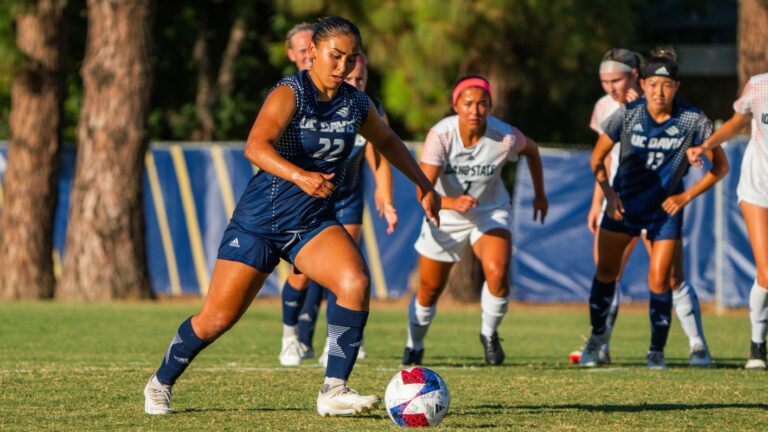
Starting the season off strong, the Aggies shut out the Idaho State Bengals with a five-to-zero win that proved their Division 1 (D1) status. 

The players showed their incredible talent with five players each scoring a goal. The first was made by fourth-year Leslie Fregoso. She scored off of a penalty kick in the 20th minute of the game, leaving fans and viewers enthusiastically celebrating the first goal of the season.

The second and third goals were made by none other than third-year Sam Tristan. Her first goal in the 26th minute was an incredible rebound shot into the bottom left of the goal that showed Tristan’s domination on the field. Later in the 49th minute of the game, Tristan scored another goal off a penalty kick that gave the Aggies a comfortable lead over the Bengals for the second half of the game.

The third and fourth goals were scored by third-years Risa Yamada and Devyn Simmons in the 57th and 82nd minutes of the game respectively. They were assisted in each of their goals by third-year Emma Vane and first-year Savannah Cordero. This ended the first game of the season, with the Aggies securing a significant win over Idaho State.

Following the win, the Aggies shut out yet another team when they played the Sacramento State Hornets on Aug. 20. This away game proved to be a spectacular win.

 The first goal of the game was a beautiful left-footer by Vane that crossed the box and went straight into the top right corner of the net in the 32nd minute of the match. The next goal, assisted by Fregoso and third-year Kylie Garcia, was volleyed by Simmons into the net after a collision and deflection by the opposing team in the box in the 43rd minute. The third and final goal of the match was a perfect through ball by second-year Sarah Canavan that Tristan fired into the back of the net.

The Aggies walked away victorious after a spectacular match, with one player in particular coming away with a new record. The second goal of the game solidified Fregoso as the new UC Davis career points leader during the D1 era. 

Fregoso, a highly-awarded player — already selected twice for All-Big West First Team and the holder of an NSCAA All-Region Second Team Honor — can now add this accomplishment to her resume. The previous record of 47 assists, set in 2009 by Rochelle VanBuskirk, is now replaced by Fregoso’s 48 assists. With plenty of games still left in the season, we can expect many more assists from Fregoso and possibly another broken record.

Even with such a strong start to the season, the Aggies felt their first loss on Aug. 24 against the Saint Mary’s College Gaels. The game started off with neither team scoring the entire first half, but luck changed for the Gaels in the 56th minute when they scored off a through-ball setup. 

Although the Aggies had 11 shots on goal, they were unable to connect and the Gaels walked away supreme. There is no doubt that the Aggies will have another chance to redeem themselves with an upcoming game against the University of San Francisco.

Overall, the Aggies have demonstrated their eagerness to win and dominate the field, leaving fans excited to see what they have in store for the remainder of the season.


Written by: Megan Joseph — sports@theaggie.org


Welcome to UC Davis!

0

My name is Sonora Slater, and I am an incoming fourth-year managerial economics major and the editor-in-chief of The California Aggie for the 2023-24 academic year. Whether you’ve called Davis home for many years, or you’re touring campus for the first time right now, just beginning to envision yourself merging into bike circles and studying in the window seats at Shields Library, welcome to one of my favorite places in the world. 

There are certain things that are essential to the unique culture of Davis: meeting friends at the farmers market on Saturdays, watching sunsets on top of Hutchinson parking garage and assigning the Doxie Derby the same level of importance as the Olympic Games, to name a few. Throughout your time at UC Davis, these traditions (and more) will shape the fabric of your college experience, permeating the stories you’ll one day tell your kids, your coworkers or the random person in line behind you at Disneyland.

But there’s one more thing that I hope you’ll make part of your college experience because to me, it’s just as essential to this campus as the cows (bold claim, I know). And that, as I’m sure you’ve guessed, is The California Aggie — the official student-run newspaper of UC Davis, serving the student body since 1915. 

Throughout the school year, we distribute print issues of the paper once a week on Thursdays, as well as post online articles every day and share updates on our Instagram @thecaliforniaaggie. For the summer, we have something a little different. What you’re holding right now is a curated selection of articles that showcase the best of what our seven desks have to offer: from campus news to sports, and everything in between. 

This issue features student work that includes humor articles, a cartoon, coverage of top research being done at the university, a spotlight on campus dogs, a QR code link to our recently added Spanish article translations, book and music recommendations from our arts desk, a crossword puzzle, introductions to some of the most recent winners of our annual ‘Best of Davis’ awards and dozens of beautiful graphics and photos, most of which were designed or taken by Aggie staffers. It’s jam-packed with exciting, important and entertaining coverage of our very own campus community, just like we strive for every week.

If you’re a student at UC Davis, new or old, I hope that you will let our stories become part of your college experience. And vice versa, I hope that our platform creates a space for all of your voices to be heard. Even if you’re just visiting for the day, I hope flipping through these pages gives you a taste of what (and who!) makes Davis the town it is, and helps you pass the time with some good-old-fashioned reading.

Feel free to reach out to me at editor@theaggie.org with questions, comments or things you’d like to see The Aggie do or cover, and have a great summer!


Best,

Sonora Slater

Editor-in-Chief


International Chess Federation announces ban on transgender women in women’s events

0

The regulation comes as the latest in a series of measures restricting the involvement of transgender athletes in sports


By CLARA FISCHER — sports@theaggie.org 


On Aug. 14, the International Chess Federation (FIDE) published a new policy regulating the involvement of transgender players in the sport. Notably, the policy states that transgender women are not allowed to participate in women’s competitions until “further analysis” is conducted by the FIDE council — a process that “shall be taken… at the earliest possible time,” but can take up to two years.   

The policy also mandates that players who hold women’s titles and later transition to a man will see their women’s titles abolished. However, if a player transitions their gender from a man to a woman, their titles will “remain eligible.” 

In a written response to the Associated Press, FIDE’s press office stated that the regulations are “aimed at clearly defining the procedure on how a person who has officially changed their gender may register that fact on FIDE Directory,” with transgender players still being allowed to participate in the open section of tournaments. 

Following the release of the policy, several prominent chess organizations published statements documenting their own stance on transgender players’ involvement in the game. 

The United States Chess Federation shared a document outlining their policy enacted in 2018, stating that it “reflects a position that will allow for players to affiliate with US Chess regardless of gender affiliation.” The German Chess Federation shared a similar stance. 

“The German Chess Federation (DSB) has a clear position: we do not exclude trans women,” DSB wrote in a statement posted on X, the social media platform formerly known as Twitter. 

Along with statements like these from major national organizations, FIDE has received backlash from chess players and LGBTQ+ advocates around the world.

“The new regulations will make chess players all over the world face a horrible dilemma: transition or quit chess,” Yosha Inglesias, a professional chess player, said in a statement on X.

“[The ban] is not just transphobic, it’s anti-feminist too,” Richard Pringle, an associate professor of socio-cultural studies of sports at Monash University said in an article for The Washington Post

Among criticism that FIDE’s policy is blatantly anti-trans, critics have also denounced the new regulation for being inherently misogynistic. 

“This is so insulting to cis women, to trans women, and to the game itself,” the National Center for Transgender Equality said in a post on X. “It assumes that cis women couldn’t be competitive against cis men — and relies on ignorant anti-trans ideas.”

Furthermore, many have voiced concerns over the timing of the policy, which came shortly after the release of an open letter penned by 14 female chess players concerning “sexist or sexual violence perpetrated by chess players, coaches, arbiters, and managers.” The letter now has over 100 signatures and is the latest in a series of revelations surrounding sexual misconduct and abuse in the sport.

“The governing body’s move seems like a smoke screen, a way to divert attention away from MeToo,” Jennifer Shahade, two-time US women’s chess champion and author said in an opinion column for MSNBC.

  In an opinion column for The Guardian, columnist and author Arwa Mahdawi referred to the defenses of the FIDE regulation as “sexist assumptions and shaky science.”

“Ultimately women’s chess isn’t helped by gatekeeping definitions of women,” Mahdawi said. “It’s not helped by excluding trans women; it’s helped by encouraging more women to get into chess and dismantling gender stereotypes.”

The policy set forth by FIDE comes as the latest in a string of regulations surrounding transgender athletes’ participation in sports such as track and field, cycling, swimming and more. As more controversial policy decisions are made regarding the presence of transgender athletes in the athletic world, there is sure to be an increase in both backlash and support from athletes and advocates alike.      


Written by: Clara Fischer — sports@theaggie.org

The Student Community Center at UC Davis helps foster connections while embracing diversity

0

The SCC strives to celebrate all parts of students’ identities and promote academic excellence


By ELIZABETH WOODHALL — features@theaggie.org


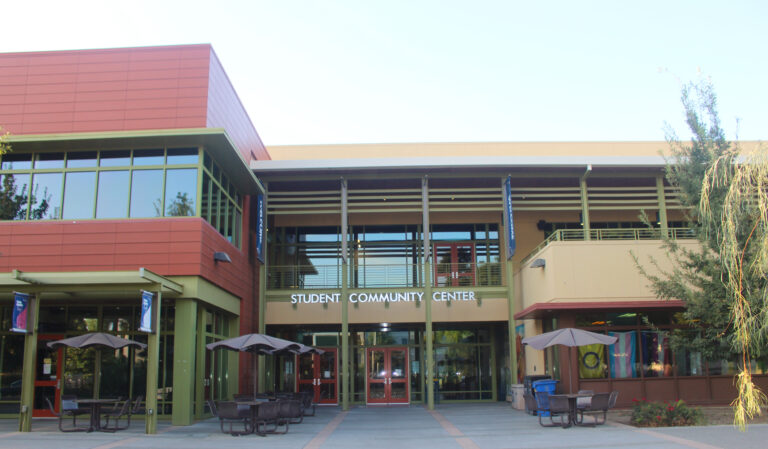
Forming friendships and becoming part of a community can often be challenging for incoming students, especially for those with anxiety about moving in and adapting to college life. Although there are various ways of getting involved on campus, the Student Community Center (SCC) — located “West of Shields Library and North of the Silo,” as stated on their website — is home to various centers that foster student success and belonging. 

The SCC houses various centers, including both identity-based centers and academic centers for success. Mayra Llamas, Ed.D., the Executive Director of the Student Resource and Retention Center, said that the building stands for a “dynamic student life.”

“The building opened up in the winter of 2012, so that’s over 10 years ago,” Llamas said. “The building is fairly new and added a vibrancy to the diversity of our campus, and because some of the resources were sort of spread out, [the building] now feels like a central location that helps with […] promoting intersectionality through some of the identity-based centers.”

Although the building includes a majority of identity-based centers, like the Cross Cultural Center and LGBTQIA Resource Center, Llamas said that the SCC hopes to offer different resources needed for students’ feeling of belonging, which also includes an environment that can help promote their academic success. 

“The building offers different resources — we wanted to make sure it was a building that students could come into and feel like they belong,” Llamas said. “The building is more than just identity-based centers; the students could see themselves reflected in other priorities of the campus, such as the Undergraduate Research Center.” 

Beyond the centers, Llamas said that other areas within the SCC make it welcoming to all students who might just be dropping by. 

“We also have a partnership with the Coffee House, and we have the South Coho, so we appreciate having the little coffee house,” Llamas said. “We also have conference rooms, event rooms and a computer lab. It’s a well-rounded space where students can come and hang out, study, be part of a group or just go to the student life centers and feel more at home, build that sense of belonging, begin to unpack their identity and feel that connection with others who are like-minded.” 

In addition to the SCC’s smaller spaces, seven units are a part of the Community Resource and Retention Centers, which are greatly focused on education equity. “We educate, engage, and empower students to act as dynamic leaders for their communities so that we can all transform knowledge into action,” the Student Recruitment and Retention Center Mission said on their website.

In terms of fostering a safe environment for students, Llamas said that intersectionality is something incredibly important for students who are visiting the SCC. 

“We understand that students have intersectionality, so you may feel very comfortable with being in the Cross Cultural Center, the LGBTQIA+ center and being involved in the core-curricular experiences,” Llamas said. “We want to enhance the overall experience of all of our students; we want students to feel welcome, to feel like they can thrive, like they have a space to unpack their identity, to affirm their cultural awareness, to be celebrated, to be embraced. Often we hear from students that being part of this community center makes them feel at home, or ‘because of this program, I was able to persist and graduate.’” 

Joyce Zamorano Sanchez, the Resource Coordinator for the AB540 and Undocumented Student Center, said that their center is focused on achieving a safe community that will support undocumented students at UC Davis. 

“We’re big on the holistic approach of supporting students via financial wellness, mental health, wellness and emotional well-being above all because we believe that their status as an undocumented student is not just their sole part of their identity,” Sanchez said. “There’s so much more, and we’re here to support them to ensure they have an equitable experience like any UC Davis student.”

AB540 and the Undocumented Student Center will be hosting a welcoming event, UndocuWelcome, on Oct. 14, 2023. More information is available on their Instagram, @ucd540undoc

“We’re really encouraging students to come out and learn about our center,” Sanchez said. “It’s on a Saturday. We try to make it a little later on from the start to ensure that students can attend because there’s just so much going on in the first few weeks, so I hope that students, especially freshmen, can come and reach out to us. But overall, any undocumented first-year student coming into UC Davis or transferring, we encourage them to stop by and say ‘hello’ and get to know us.”

Mahum Manan — the Program Coordinator for the Middle Eastern, North African, and South Asian Student Resources (MENASA) unit —  said that multiple events are coming up, and they encourage students to come into the center and check them out. 

“Our center is hoping to engage students together, build community, touch on cultural identities [and] provide academic support resources,” Manan said. “It’s a casual space. We have RSVP forms and whatnot, just to kind of gauge how many people might attend, but no need to RSVP or anything like that — you can just drop by. Most of the events are social events, and if you drop by halfway through, you’ll still be fine. We just wanna create a sense of belonging and home on campus where students can meet each other, meet our resources and students can also connect with us.” 

Manan said that their events, such as Chai Chats, are open to all students who are looking for an inclusive, safe space.

“We’re going to be having three of our annual Chai Chats,” Manan said. “So ‘Chai Chats’ [are] just a casual space where we’ll have chai, which is tea, and other drinks; it’s kind of like a discussion space or activity.” 

MENASA is hosting a fall welcome mixer on Oct. 11 for students to become familiar with the center and meet other students and campus partners. More information is available on their website and Instagram page, @ucdavismensasa.

Reynell Hamilton-Starks, the Director of the Undergraduate Research Center (URC), hopes that the center encourages students to understand and take advantage of the various resources available.

“The Undergraduate Research Center […] helps them understand the benefits of engaging, and then gives them some strategies to help them go out and start researching,” Starks said. “It really is a space for them to explore safely. We have wonderful staff here who are friendly and welcoming and they can come ask any questions. Sometimes the undergraduate research is very, like, ‘we know what it is, but we don’t know what it is, we don’t know how we should get involved — or even why,’ so this is a space for students to come and ask all those questions in a safe space.”

The URC’s first-ever undergraduate research fair will happen on Oct. 12, 2023, and the center hopes to bring students in to speak with faculty about available internships and jobs.

Whether students are dropping by for a coffee at the South CoHo, snagging some free scantrons or holding study sessions in a place that reminds them of home, the SCC encourages incoming students to come by and explore what the centers have to offer. It’s a home away from home — if students are looking to become part of a welcoming, positive community on campus, the doors are open to everyone. 


Written by: Elizabeth Woodhall — features@theaggie.org 

Correction: A previous version of this story misspelled the last name of a source. The article has been corrected to accurately reflect the names of all sources.

A guide to the coziest UC Davis study spots

0

Places guaranteed to get you motivated for the new school year 


By MAYA KORNYEYEVA — mkornyeyeva@ucdavis.edu


In every hero’s journey, there comes a time when the protagonist must cross the threshold from the known into the unknown. To do so, they must meet a guide; an individual who is able to mentor and instruct, inspire and advise. Like Gandalf the Grey is to Frodo Baggins, let me be your wise old wizard. As the wise old wizard… allow me to show you the study spots on and off campus that will prove to be a saving grace for the upcoming academic year. 


ON-CAMPUS:


Shields Library: The basic yet most reliable choice, this glorious library on campus is conveniently located a stone’s throw from both the Silo and the Memorial Union. With ample coffee and snacks available just a short walk away, you can stock up on all the caffeine and nutrients you need to get through a long study session. It is silent and spacious, and there are lots of private desks and beautiful views on the upper floors that allow for uninterrupted work. Plus, the millions of books lining the shelves of the library are motivation enough to turn anyone into an absolute academic weapon. 


The Silo: If the built-in Peet’s isn’t convincing enough, the cozy armchairs and classy interior design of the Silo are sure to capture your interest. Although the Silo can get very busy around noon, going there early in the morning can secure you a spot for nearly the entire day — and there are delicious crepes and fries available for a quick lunch break. My personal favorite spot is on the second floor, on one of the bar stools overlooking the floor below: it’s a nice spot to cozy up with a copy of The Aggie and have a go at the weekly Sudoku. 


OFF-CAMPUS:


Philz Coffee: Philz is just a few blocks from campus and situated right next to the Kobe Mini Mart. It always has the best music playing on the speakers and the smell of fresh-brewed coffee emanating throughout the entire store is heavenly. Just like the Silo, Philz can get pretty busy and the lines are often long, but once you get planted the atmosphere is perfect for generating creative ideas and working through a long to-do list. 


Mishka’s Cafe: The moment you step into Mishka’s, it feels as though you’ve time-traveled to an ornate 1900s coffee shop somewhere south of France. The typewriter in the front, the whimsical jazzy music and the stacks of old newspapers all contribute to a comfortable and sophisticated environment for studying. The tall windows and the flowering trees surrounding the cafe provide a wonderful backdrop for the occasional unfocused gaze, and the coffee is just superb. I recommend a hot lavender or rose latte with a pastry — perhaps you will even be blessed with some microfoam latte art on top of your beverage. 


Starbucks: Although technically “fast food,” Starbucks has some great options for coffee lovers and caffeine abstainers alike. The Starbucks located on 2nd and F Street is a prime study spot for both UC Davis students and locals who enjoy plenty of indoor and outdoor seating.  This location is ideal for those who thrive in a busy environment, as it is constantly bustling with commuters. The store has great air conditioning, access to charging ports and all the ice water you need. The biggest seller? Free refills. 


Written by: Maya Kornyeyeva — mkornyeyeva@ucdavis.edu


Disclaimer: The views and opinions expressed by individual columnists belong to the columnists alone and do not necessarily indicate the views and opinions held by The California Aggie.


Bomb threats made to three Davis schools, Mary L. Stephens Davis Branch Library, homes of Davis Joint Unified School District employees

Authorities have cleared the employee residences and campuses following searches


By CHRIS PONCE — city@theaggie.org


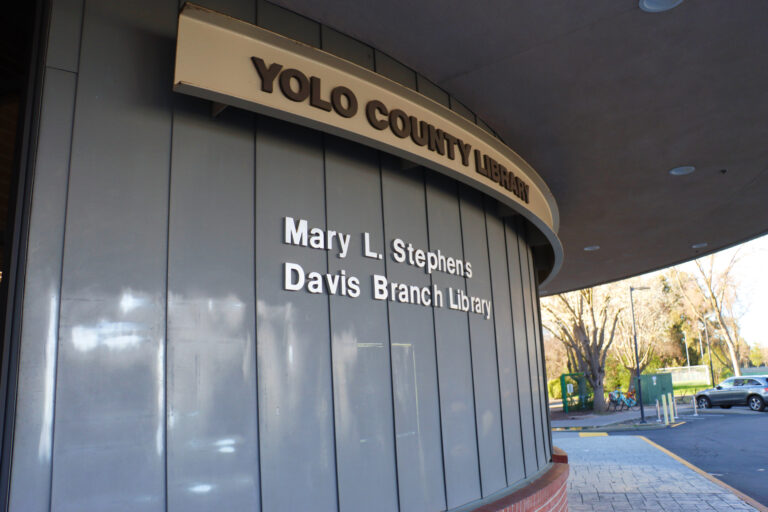
On Wednesday morning, at approximately 2:20 a.m., the Davis Police Department was notified of a threat claiming that bombs had been placed at the homes of Davis Joint Unified School District (DJUSD) employees, DJUSD District Offices, three DJUSD school campuses and the Mary L. Stephens Davis Branch Library. According to Davis Police, the threats were made via email and were sent to several different people. The three school campuses targeted were Davis Senior High, Oliver Wendell Holmes Junior High and Cesar Chavez Elementary.

“We have received bomb threats sent via email threatening Davis Senior High, Holmes Junior High, Chavez Elementary, and the District Office,” reads a Facebook post by DJUSD. “The Davis Police Department is coordinating with District staff to search all of these sites and have already cleared the District Office. Please do not come to these sites until further notice.”

Davis Police conducted searches at the district offices, school sites, the library and two DJUSD employee residences, according to a Facebook update shared by the Davis Police Department. All threats have since been cleared by Davis Police.

“The residences and campuses have been deemed clear and schools are open for classes,” the Facebook post by Davis Police states. “The Yolo County Sheriff’s Office also searched the Davis Library and deemed it clear. Davis Police Officers will be conducting extra patrols around DJUSD campuses.”

This is the fourth bomb threat made to the Mary. L Stephens Davis Branch Library since late August, but the first time a threat has included employee homes and school sites. The first three threats all referenced a controversial speaker event held by Yolo County Moms for Liberty at the library and contained “hateful messaging according to authorities. While officials have yet to officially link the motives of this threat to the previous ones, according to a Public Release shared on Facebook, Davis Police have stated that the language and content of this threat shares “some similarities” to the previous ones. 

“The Davis Police Department and the Davis Joint Unified School District take these criminal threats seriously and are closely working together to ensure the safety of students, educators, and the community,” Davis Police shared in their Public Release. “Davis PD will pursue every investigative lead to identify those responsible for these criminal threats. We know these incidents cause a substantial amount of concern and even trauma. These investigations can be very complex, and we will provide timely updates as more information is known to us.”


This story is developing, check back for updates. Last updated: Sept. 20, (2:27 p.m.)

Written By: Chris Ponce city@theaggie.org

Davis residents, activists debate implicit bias training at Woodland school board meeting

0

Woodland Joint Unified School District passes resolution to instruct implicit bias training for staff 


By CHRIS PONCE — city@theaggie.org


Content Warning: This article contains discussions of transphobia.


On Thursday, Aug. 10, the Woodland Joint Unified School District (WJUSD) convened to approve several agenda items. These included Resolution 2-24, which would offer student-led implicit bias and sensitivity training for secondary students and staff beginning as early as the fall of 2024. The board defines implicit bias using UC Davis’ Anti-Racist Practice: Implicit Bias and Microaggressions.

The resolution specifically addressed affirming the identities of LGBTQIA+ students — a  topic that gained the attention of Davis locals. Yolo County Moms for Liberty, a local organization that has previously advocated against transgender youth, shared a Facebook post before the meeting entitled “Protect Our WJUSD Kids,” encouraging people to attend the meeting. An Instagram post by Davis Pride, the committee that organizes Davis Pride events, encouraged people to turn out in support of the resolution.

The public comment section of the meeting featured 19 in-person speakers and 24 voicemails. Davis activists and concerned citizens spoke out to weigh in on the school board’s decision.

“I’m very concerned about the high numbers of children that are identifying as transgender, nonbinary, pangender, trigender, what else do we have: agender, two-spirited,” Beth Bourne, a Davis resident with Yolo County Moms for Liberty, said in a comment to the school board. “There’s quite a bit of different genders you’re offering these children. And I have access to the health-connected curriculum, and the puberty talk and the teen talk. So I understand that you are indoctrinating these kids to learn about an ideology that is not based in science.”

After Bourne’s public comment, a member attending the meeting spoke out and said to Bourne, “go back to Davis.”

Dillan Horton, a Davis City Council candidate for District 2, attended the meeting and spoke in favor of the resolution during the public comment.

“If there’s something that makes America great it’s that we are always striving to move forward and to include more and more people, to make everyone feel like they have access to the American dream and are part of the American experience,” Horton said. “Efforts, as previous speakers have touched on, that seek to exclude any class of our students but particularly in this time in our country LGBTQ+ students, particularly trans students, those are efforts that […] are anti-American. This is not who our country is, this is not who Woodland is.”

During the public comment, many speakers expressed concern about School Board Trustee Emily MacDonald and called for her to be recalled.

“I wish to thank the members of the board for reaffirming support of all students, including our LGBTQ+ students,” a caller said via voicemail. “This shows our LGBTQ+ students you will accept them for who they are, your students. […] For this reason, I, as a voter of Area 2, am asking for Trustee MacDonald to resign. She has invited hate to a particular population of students by making them ‘other’ than the rest of our students when they are still our students.”

One of the major reasons for the recall effort is MacDonald’s stance and comments on trans youth, according to the website campaigning to recall Trustee MacDonald.

“When Trustee MacDonald ran for school board, she did not disclose these controversial views on the LGBTQIA+ community as a candidate for office,” reads a statement on the website. “In light of these recent public statements, we believe that the voters of Trustee Area 2 deserve a chance to decide whether they want Trustee MacDonald to continue to represent them.”

These concerns about MacDonald sparked at a June 16 board meeting, which saw the board discuss Pride Month. At the meeting, MacDonald referred to the increase of people identifying as trans as a “social contagion.”

When the board discussed Resolution 2-24 at the August meeting, MacDonald stated that amendments should be made later and the board should vote on it at a later time. The board approved the resolution with only MacDonald voting no. Board Trustee Kandice Fowler shared at the meeting how implicit bias is something that needs to be discussed by educators.

“A lot of people consider race to be an awkward and uncomfortable topic just like when dealing with implicit bias,” Fowler said. “In saying that, just because you’re uncomfortable with it, doesn’t make it a bad thing.”


Written By: Chris Ponce city@theaggie.org


Local authorities, FBI investigate second and third bomb threat made to Mary L. Stephens Yolo County Library in Davis

A shelter-in-place was conducted for Davis Senior High School and the North Davis Elementary School in response to the threat


By CHRIS PONCE — city@theaggie.org


On Monday morning, at 10:06 a.m., Davis Police were alerted of another bomb threat made to the Mary L. Stephens Library. This comes one week after the first bomb threat which was made one day after a heated Yolo County Moms for Liberty event that was held at the library. The Yolo County Sheriff’s Office confirmed in a recent Facebook post that there have been three total bomb threats made to the library and each threat was related to the controversial event.

The Yolo County Mary L. Stephens Davis Branch Library has been targeted by three bomb threats in recent days,” the Yolo County Sheriff’s Department said in the post. “The initial threat came right after a heated meeting held at the library. These messages share a common thread of hateful content and revolve around the mentioned meeting.”

In a recent recorded Facebook update from the Davis Police Department, Lieutenant Dan Beckwith with Davis Police Department said each threat contained similar hateful messaging.

“The Yolo County Mary L. Stephens Davis Branch Library has received three bomb threats over the past week,” Beckwith said in the update. “The first took place the day following a contentious meeting at the library. The messages have all been similiar, containing hateful messaging and are regarding the meeting that took place at the library.”

It is unclear if the suspect or suspects are affiliated with Yolo County Moms for Liberty or any other local political organization but according to authorities, each threat made some reference to the event linked to the group. Beth Bourne, chair of Yolo County Moms for Liberty, has denounced the bomb threats and believes that the suspect or suspects are not involved with her organization. 

“The threats of violence made toward the Mary L. Stephens Davis Branch Library and its staff are appalling,” Bourne shared in a press statement via email. “We are deeply disheartened to learn of these threats and how it disrupts and jeopardizes the safety of the community. The response to speech that you disagree with is always more speech. Violence is never the appropriate response. Any news reporting that would imply our organizations are in any way associated with or responsible for these threats is wrong and maliciously inaccurate.”

Anoosh Jorjorian, director of Yolo Rainbow Families, believes that right-wing media runs on outrage and that Yolo County Moms for Liberty has been providing aid for that outrage by sharing videos from local events to right-wing media outlets. Jorjorian believes that there is a pattern between right-wing organizations and political violence and threats, but that the answer for who is responsible for these threats is more complicated.

“‘Are they [Yolo County Moms for Liberty] responsible for what happens when people are in fact outraged?’ According to our courts, they’re not,” Jorjorian said. “And yet we have seen in other cases how people have been targeted, people have been threatened, sometimes people have died. We have seen patterns like this. It is impossible to ignore that the vast majority of identity motivated violence comes from one side of the political spectrum.”

According to Beckwith, police are in communication with local schools as many are in close proximity to the library. On Monday, the Davis Joint Unified School District announced that two schools had to shelter in place due to the incident. 

Jorjorian shared how personal these threats have been because they have two children in the Davis school system, one of whom had to shelter in place.

“I had to send my child a text today saying that I had heard about the shelter-in-place, and to reassure him that I’m sure he’s going to be fine,” Jorjorian shared. “And I resent, as a parent, having to send that text. And I know there are many parents who have had that experience because of mass shootings for example. And in a lot of cases, those parents don’t know their kids are going to be okay. And so even though I felt that risk to my child was, in reality, relatively low, it does something to you emotionally.”

The library has currently been deemed safe by Davis Police. While Yolo County Sheriffs continue to investigate, they announced on Facebook that they will collaborate with the FBI to pinpoint the suspect or suspects. 

“It’s clear that these threats are meant to disrupt and intimidate our community, particularly affecting the library’s functioning,” the Yolo County Sheriff’s Department said on Facebook. “Despite these acts of intimidation, we stand firm in our support for the library, its dedicated staff, and the individuals who utilize its services, along with those attending the nearby schools.”


This story is developing, check back for updates. Last updated: Aug. 30, (4:23 p.m.)


Written By: Chris Ponce city@theaggie.org

The world cannot afford stalled climate action

Preventative action needs to be taken now to secure a safer future 


By MAYA KORNYEYEVA — mkornyeyeva@ucdavis.edu


This July, our planet once again hit record-breaking global temperatures: with almost every consecutive day becoming the hottest day ever recorded. Florida water temperatures hit above 101 degrees Fahrenheit, drought and fire season were jointly declared in the state of Washington and massive storms ravaged Italy, leaving many parts of the country flooded. More frightening news — if that is even possible — predicts the collapse of the mid-Atlantic ocean current system in the mid-21st century, with the potential to significantly raise sea levels and induce drought and extreme weather events.

For the past few years, it feels as though the world has slowly begun spinning out of control. These recent climate-related headlines are among the thousands of news stories and scientific studies that have proved over and over that pollution and industrialization are contributing to the frequent destabilized weather patterns recorded as of late.

Yet, it is with the deepest frustration that I log onto my computer each morning to read how climate legislation is being stalled in both governments and private companies — with no clear commitments made to curb global warming in these next few crucial years.

After the 2022 Climate Summit (COP27) in Sharm el-Sheikh, Egypt, progress was made to provide funding to vulnerable countries in order to minimize the losses and damages caused by climate change. However, solutions to the actual causes of these “losses and damages” — the causes of climate change itself — were vague and undefined, leaving me doubtful that countries will be able to stick to a concrete plan of action in terms of carbon emission cuts and transitioning to renewable energy. As global conversations negotiating climate action continue every other year, it seems as though humanity is ever so slowly inching toward a climate-induced demise: taking one step forward, and two steps back.

From an economic perspective, this unwillingness to make significant commitments in regard to climate change is understandable, seeing as our society is powered by energy derived from fossil fuels. If approved, authorizing large carbon emission cuts would force companies to opt for another energy source or face profit and production losses.

I strongly believe that in the climate emergency that we are facing today, time is running out too fast for governments and corporations to continue turning a blind eye in exchange for short-term financial stability. With less than a decade to prevent irreversible climate change, both individuals and organizations need to be focusing their time, energy and resources on taking the necessary steps to secure a safer future for everyone.

An important thing to keep in mind is that while the effects of global warming may feel far away to those who are unaffected by them, millions of people are struggling to survive around the world due to severe weather conditions that they did not contribute to. Countries like Chad, Somalia and Syria top the list of areas that will be most affected by global warming, according to the vulnerability criteria discussed during COP27.

By not pursuing adequate steps to curb the destruction the current state of climate change is bringing, the world is contributing to the creation of an even greater separation between those who are harmed and those who are able to afford some protection. In short, those that have the infrastructure and money to withstand dangerous weather events and those that do not — coincidentally the individuals with the most power often turn out to be the ones that allowed carbon dioxide emissions to continue in the first place.

My grim predictions of the future aside, the most important thing to take away is that the time to act is now. Whether it is using your voice to advocate for climate action, using your vote to pass the necessary legislation or taking personal responsibility to limit your own carbon footprint, any action will be a step closer in the right direction. Failure to do so only empowers the growing apathy that currently exists among the global population.


Written by: Maya Kornyeyeva — mkornyeyeva@ucdavis.edu


Disclaimer: The views and opinions expressed by individual columnists belong to the columnists alone and do not necessarily indicate the views and opinions held by The California Aggie.

Davis’ beloved Turtle House Co-op through the eyes of its newest hatchlings

Finding community within Davis housing co-ops


By YASMEEN O’BRIEN — features@theaggie.org


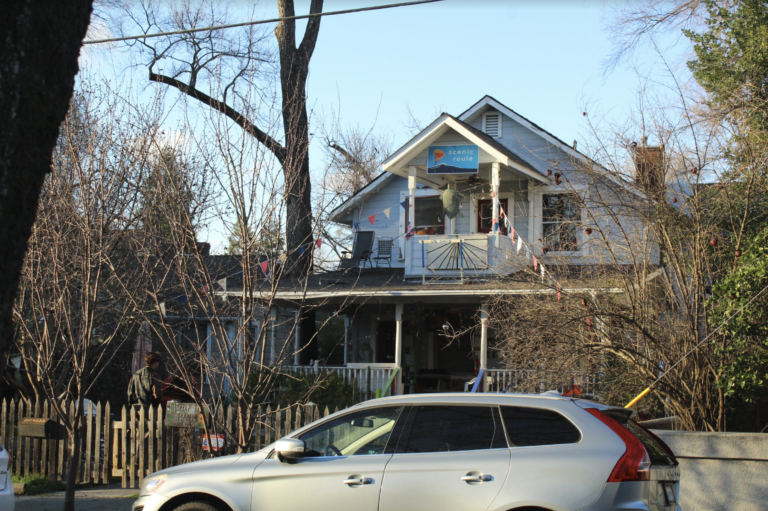
On a morning stroll past 217 2nd St. in Davis, CA, your eyes wander before you can catch them. The bold shamelessly crane their necks while the timid sneak glimpses through calculated side-eye. As the white picket fence enclosing the front yard unexpectedly conjures an image of the 1950’s American Dream, your gaze curiously travels onward, enticed by the colors and beauty of the big blue house.

Along the edges of unkempt grass, the yard is lined with bicycles, flower beds, trash cans, art pieces, tables and chairs. Soft ukulele strumming drifts past the fence and echoes through the trees. A metal turtle hangs from the roof like the mermaid of a ship’s bow while an armless statue presides over the front gate, wearing an elf hat and a T-shirt showing a lion with dreadlocks.

Among these happenings, a small barefooted group diverse in age, ethnicity and gender stares back at you smiling and waving from their spot on the porch steps, soaking in the early sun.

This group belongs to the Turtle House Co-op: currently home to 18 residents, 15 of which are UC Davis students. Housing co-ops — or democratically controlled corporations that are established to provide affordable housing for its members — are popular in Davis, with Turtle House and the Davis Tri Co-ops being notable examples.

Turtle House frequently hosts events open to the public such as live music shows, clothing swaps and open mic nights. Although a tight-knit community, they strive to welcome all with open arms.

“We share a lot of things. I get a lot of free clothes and free opportunities,” one resident, also known as a Turtle, said. “This is so much fun, this is exactly where I want to be.”

One evening, the aptly named Sierra Goodfriend wrapped me in a hug and enthusiastically welcomed me into the bedroom she shares with Katie Hostetler. Their door opens to the front porch where items littered across a large metal table invite images of late-night conversations, jam sessions and even play readings. An impossibly thick and slightly water-damaged copy of “William Shakespeare: The Complete Works” opened and book-marked to “Henry V” is responsible for the last image.

Goodfriend shared that while she feels close to her fellow Turtles, 14 of the 18 residents are newcomers so they are still in the process of getting to know each other deeply. Both Goodfriend and Hostetler have lived at the house for five months and praise the community of warm, artistic and open-minded people they have come to know as their family.

Draped in warmly glowing string lights, Turtle House at night resembles a person dressed up for a special occasion. Art and flowers adorn its exterior walls and yard. Hammocks sway like locks of hair over plants bursting with life.

One thing’s for sure: this house has a mysterious past, or at least a widely unknown one. And the large number of newcomers can’t help with this lack of knowledge. They’ve all heard whispers of origin stories, but no one is certain — although I heard a resident named Joe knows all.

“Apparently it used to be a boarding school for boys like a hundred years ago,” Hostetler said. “Maybe that’s wrong, I don’t know.” Goodfriend giggled, “Could be.”

Another relatively new Turtle, Ryan Foster, offered more information: “I think it was originally named ‘Music Note House’ and then someone had a turtle and they renamed it Turtle House. Not sure about that at all though.”

These sentiments unknowingly echo one of Turtle House’s most important ideals: life is about connecting and experiencing in the present moment. It’s about the beauty and fluidity of change.

This is an important factor when it comes to being accepted to live at Turtle House because the process essentially measures if you hold similar values to the other Turtles. It involves a written application followed by an invitation to dinner where the main focus is to see how comfortable both the applicant and the current residents feel in the space, according to Goodfriend.

Both Goodfriend and Hostetler expressed their admiration for each Turtle’s differences and how they make the house stronger together. Goodfriend added that it brings them closer together as everyone offers something irreplaceable to the group. People are celebrated for who they are and are always welcome at Turtle House, no matter how different they appear.

“Are you the person interviewing people?” Foster chirped excitedly as he hurried up the steps to the table I’m sitting at. He had just arrived home from an outing with his friend and fellow Turtle House resident, Maya Hendrix. Before I could even respond, they were sitting across from me, beaming.

Hendrix was clad in a headscarf and raccoon fur hat — complete with the tail — atop her shaved head. Her long, orange skirt had floated her onto the deck as I was greeted with a soulful and infectious smile. Ornamented in layered silver necklaces, jeweled bracelets, long hanging earrings and rings on every finger, each step she took jingled and chimed. Her right hand displayed an Apple Watch. An unapologetic modern hippie.

Foster wore blue jeans, a simple long-sleeve and a bomber jacket.

Under the string lights, Hendrix told me that Turtle House is a place where all ideas feel welcome. She conveyed that at the core of any housing co-op is democracy. Appropriately, house meetings are held in the basement at least once a month where people are encouraged to voice their concerns and share ideas on improvement and future projects.

Interested in the power dynamics of the house, Foster shared that the two people who have lived there the longest are the official communicators with the landlord, as per the lease agreement.

“They hold extra sway and are the rule-followers,” said Foster. A grin started to form on his face, “And then there are the more rebellious and rambunctious — some old people, some new people — and they say f*** the rules.”

Hendrix chuckled, “We don’t say that. We just want this place to be a good time.”

Written by: Yasmeen O’Brien — features@theaggie.org

UC Davis to potentially implement a ‘dead week’

Student leaders from the Chancellor’s Undergraduate Advisory Board share the process behind implementing the initiative with the ASUCD Academic Senate 


By ELIZABETH WOODHALL — features@theaggie.org


With the small time gap between assignments due during Week 10 and finals week, it’s no surprise that many students feel burnt out as finals draw near. This concern is not one that goes unnoticed; leadership at other UC campuses, including Berkeley and Santa Cruz, have implemented similar initiatives to that of a “dead week,” which are meant as a way to encourage designated time for students to prepare for finals.

Two UC Davis students are hoping to implement a dead week or “dead day” into the academic calendar. Alexandria Moncada, a recent graduate in political science-political service and history and a board member of the Chancellor’s Undergraduate Advisory Board (CUAB), along with Zara Shaikh, a recent graduate in psychology and communication and the student resource representative of Middle Eastern, North African and South Asian Student Group (MENASA) for CUAB hope to bring about this change for the future of UC Davis.

“Dead week/day is traditionally a week or day set apart from the final day of instruction, and before final examination, where there’s no academic obligation for students to complete assignments or attend classes,” Moncada said. “It’s beyond the normal class meeting, and this time is dedicated for students to either review their class work, retain information or, if anything, [practice] self-care time because we all need that before finals. I think that we neglect ourselves so much before finals begin because you’re going from Week 10 straight into finals week, and there’s no time for you to adjust to anything.”

Despite the popularity of the terms dead week or dead day, Moncada said that they are not ones she likes because of their insensitivity to the fact that suicide rates spike during finals week.

“A lot of students deal with a lot of suicidal ideation during finals week because it’s a lot of pressure,” Moncada said. “You don’t know whether you’re going to pass your class or not, and, like, you can’t afford that. You can’t afford to have a dip in your GPA because you’re planning on going to grad school or professional school, or you’re trying to find a job.”

Shaikh furthers that the pressure of wanting to succeed during finals has not been easy.

“It was so tough for me to just keep going, especially after weeks two and three,” Shaikh said. “It was just midterms after midterms or papers and assignments and all. It was just really hard to take some time for yourself to, you know, slow down and understand and learn the material as opposed to just, you know, memorize it for exams and then be done with it.”

Shaikh said that their research was heavily involved in how other UCs’ academic calendars followed dead day/week. Shaik said Moncada focused greatly on Santa Barbara’s current approach to dead week to see the best way to implement it into UC Davis’ academic calendar. With this research, they both proposed an initiative that best aligned with UC Davis’ academic calendar.

“[We wanted to] see some ideas that we can take from their system and implement it into our academic calendar at Davis,” Shaikh said. “I looked at Berkeley’s calendar, too, because they have a revision week before finals week, so I look more at their calendar and their ways of doing things. I also brainstormed a couple of ideas on my own to just, like, think about how Davis could potentially implement a dead day/week.”

They’ve worked closely with ASUCD Academic Affairs since the start of the 2022 academic year and have since proposed the initiative, created a survey for UC Davis’ students and have gotten over 2,000 student responses back. They also had a meeting with ASUCD’s Academic Affairs to get feedback on the survey and to make sure it was including a representative sample of students.

“We basically talked to the Academic Affairs Commissioner, Megan Chung, and she was awesome,” Moncada said. “She was amazing. She was very responsive, and we told her […] that we were working with the chancellor, and that we represent students at large — so this is something that a lot of students have complained about throughout the years, especially with going to the routine of Week 10, and how fast-paced that is.”

After they proposed the survey to the chancellor and other CUAD members, they received approval to circulate the survey, which consisted of three parts that asked students to share their thoughts on their mental health and academic success during Week 10. The survey is currently available on the UC Davis Student Advisory to the Chancellor’s Instagram, @ucdavissac.

“The first part goes over in more detail regarding just the student’s background, just to know more about what college they are part of, what their year is,” Shaikh said. “If they’re an international, transfer, in-state or out-of-state student, then it goes more into their studying habits and mental well-being during finals week, just to get more understanding about their studying habits, and how many hours [go] into studying and [completing] assignments. Then the second section also goes into more questions related to their mental health during Week 10, and the last section goes over in more detail regarding their feelings about implementing a potential dead day or dead week.”

Moncada shared that the survey wasn’t finalized until a few weeks before finals week, which meant that students offered more truthful reactions to this initiative.

“It was actually perfect timing that we got everything approved by the chancellor and approved by everyone else at that meeting,” Moncada said. “[We were able] to circulate it because Week 10 was right around the corner, and people were kind of feeling it so, like, you have authentic reactions.”

Moncada indicated that the survey was sent out to various groups, garnering an overwhelming response within the first few weeks. Students’ results revealed their diminished mental well-being during weeks nine and 10.

“A majority are from Letters and Science, with about 42 to 43 percent, and then about 30 percent in Agriculture and Environmental Sciences,” Moncada said. “A lot of students said that they started studying during weeks nine and 10. A lot of individuals rated themselves as having poor mental health as well. I would say an overwhelming amount [reported] having excessive workload during Week 10.”

Moncada saw these reports and felt frustrated that she was not able to do something “immediately.” An initiative like a dead day or a dead week is not something that can be easily — or quickly — implemented.

“The Academic Senate basically plans out the entire academic calendar six years in advance,” Moncada said. “So, we wanted to get the data now to see what we can do if we can’t get a dead day or [a] dead week. What else would students be interested in? And that’s largely why we got the data at the time that we did, [even if we] can’t even [see] it in our academic career. It could be somewhere beyond someone else’s academic career. But I like to make that impact. That’s awesome.”

Moncada said that the next step for implementing dead day/week is to share the results with the ASUCD Academic Senate. They also hope to share these results with the UC Davis Chancellor and Mayra Llamas, Ph.D., the executive director of community resources and retention centers.

“We’re just waiting back to see when we can potentially meet with Mayra or the chancellor so we can share these results,” Moncada said. “I think we work too hard not to be able to share the results. [We’ll share] what we found with the Academic Senate, and then potentially the end goal is to eliminate some of the work done during Week 10. We have no idea what it’s going to be like — whether they implement it, whether they do not implement it.”

Although they’ve both graduated, they hope that with over 2,000 students who’ve responded to their survey — and more responses coming in — their efforts will not go unnoticed.

“We hope that this survey is just getting the ball rolling and gets more people talking about this issue,” Shaikh said. “I guess for the next steps it all depends on the next CUAD team. Hopefully, they do continue with the project.”

Lesly Ramos, a fourth-year civil engineering major, expressed that a dead day/week would offer a greater opportunity to prepare for finals and would allow students to take a break to prioritize their mental health.

“I feel like a lot of us students are burnt out after turning in our last assignments before diving into finals, and I think it’d be nice if we get the dead week, I think that will definitely help our mental health,” Ramos said. “Taking a step outside and just putting in time for yourself, like self-care, mental health — after those last assignments where you’re, like, mostly exhausted. Because as soon as the last assignments are done, we have to think about finals. But then we’ll also have that in mind that, yes, we still have to deal with finals, but at least it’ll be a weight less off our hands before we dive into finals.”

Dead week would allow students to prepare for final examinations without the burden of regular assignments typically scheduled during Week 10. Shaikh and Moncada hope their efforts will not go unnoticed — especially when it means helping future undergraduate students by alleviating the stress that comes with finals week. Even if it means getting one day off from academic obligations, it could have a substantial impact on students’ mental health and academic success.


Written by: Elizabeth Woodhall — features@theaggie.org 

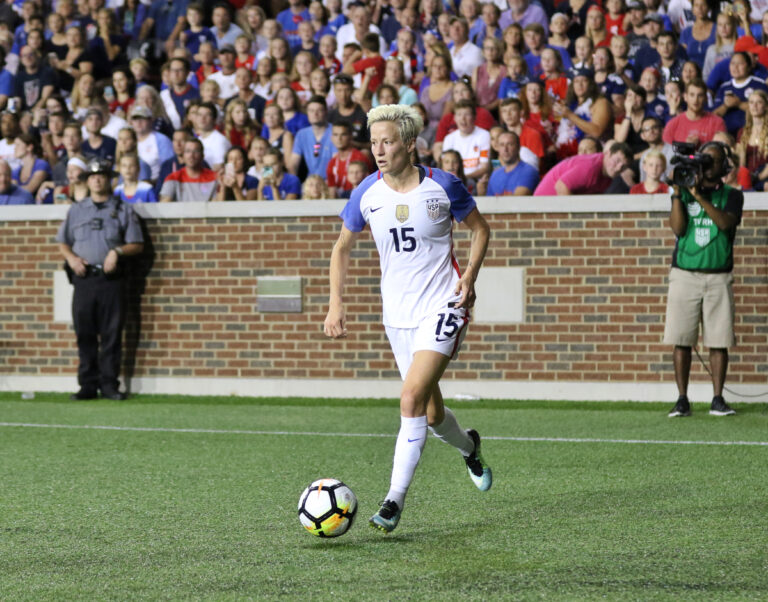
Highlighting Megan Rapinoe, one of the biggest and most prominent names in soccer history, and her legacy

0

The athlete announced her retirement a mere two weeks before the 2023 Women’s World Cup


By MEGAN JOSEPH — sports@theaggie.org


On July 9, professional soccer player Megan Rapinoe appeared in a press conference to announce that she would be retiring from the sport following this year’s Women’s World Cup.

“I just want to say thank you to everybody. I could have never imagined where this beautiful game would have taken me,” Rapinoe said in the conference. “The greatest thing that I have ever done.”

Rapinoe has truly been one of the most influential women’s soccer players of all time. From accomplishments ranging from a gold medal to a golden boot, she has done it all.

Although Rapinoe is 38 years old and one of the oldest players on the United States Women’s National Soccer Team (USWNT), she does not show it, with her skill and devotion to the game still clearly coming through. Throughout the years, Rapinoe has been a true inspiration as she’s spoken out for the LGBTQ community, equal pay for women, the Black Lives Matter movement and voting rights. She is one of the most accomplished and tenacious athletes in the United States today.

Rapinoe recently completed a sizable accomplishment on July 21 when she made an appearance in the United States’ game against Vietnam. The game ended in a win for the U.S. with an ending score of three to zero, but held a much larger meaning for Rapinoe. This game marked her 200th cap, or the 200th game that Rapinoe has played in, for the USWNT. This accomplishment has only been completed by three other athletes in U.S. soccer history, making Rapinoe the fourth.

This accomplishment is accompanied by many others that she has achieved while playing on the USWNT for 17 years. It still doesn’t seem like much time has passed since she made her team debut in 2006, appearing in a friendly match against Ireland. In October of the same year, Rapinoe achieved her first international goal in a match against Taiwan where she scored twice. It has been a thrilling experience to watch her career since then, with her now 63 goals on the international level alone. Rapinoe, tied with teammate Alex Morgan, holds the 10th spot for the USWNT all-time goals scored list. She is currently one goal short of tying for ninth place with old teammate Christen Press at 64 goals.

This is not the only history Rapinoe has made throughout her career. In the 2019 Women’s World Cup final in France, Rapinoe scored off a penalty shot that gave the U.S. the upper hand over the Netherlands for a two-to-zero win. At the time, she was 34 years old and set a record as being the oldest player to ever score in a final at the Women’s World Cup.

The 2019 season was arguably Rapinoe’s best season in part due to the incredible win at the Women’s World Cup, but also due to multiple other factors. Rapinoe was named Best FIFA Women’s Player, won both the Golden Ball and the Golden Boot and was awarded the Ballon d’Or Féminin, which is only awarded to the best in soccer.

Not only is Rapinoe a powerhouse on the Women’s National Team, she’s just as strong in her professional club team. Over the years, she has scored a total of 67 professional club goals.

As for her earlier days, Rapinoe first started her club soccer career playing as a youth at Elk Grove Pride in 2002. She later played Division I soccer at the University of Portland where she scored 30 goals and had 60 appearances.

While playing for the Pilots, Rapinoe got called up to play for the U.S. Women’s Senior team in 2006. This came as a big shock considering she had not started her professional career and was still playing at the collegiate level. However, when it did come time for her to play professionally in 2009, she was selected second overall in the Women’s Professional Soccer (WPS) draft by the Chicago Red Stars.

Rapinoe played in 38 games for the Red Stars before the club ceased operations in 2010. She then signed with a sister club, Philadelphia Independence, almost immediately. However, after only playing a mere four games, Rapinoe was traded to the MagicJack club. The struggles did not stop there as WPS voted to terminate the MagicJack club in 2011, making Rapinoe a free agent.

With this new freedom, Rapinoe decided to explore teams internationally by signing to play as a guest player for the Australian W-League with Sydney Football Club for two games where she even scored a goal. After that, it took Rapinoe until the following summer in 2012 to find the right fit at the Seattle Sounders with fellow USWNT members Alex Morgan, Hope Solo, Sydney Leroux and Stephanie Cox.

Her newfound team was short-lived: she only played in two games for the Sounders before she was taken away with the USWNT to play in London for the 2012 Summer Olympics. However, Rapinoe did not stop there and, following the Olympics, initially signed a six-month contract with the Olympique Lyonnais where she made her Union of European Football Associations (UEFA) Women’s Champion League debut.

Rapinoe played in 28 games for her new French team and ended up scoring eight goals before returning to her home turf in the U.S. where she joined her current team, Seattle Reign, which has since changed its name to OL Reign, all in the same year. She has been playing for OL Reign for the last 20 years and plans to finish out her final season as she returns from the 2023 Women’s World Cup.

Although this world cup resulted in a heartbreaking loss for the U.S. Women’s team against Sweden that came down to a penalty shootout, Rapinoe played a very strategic game and left the team with her head held high. It’s safe to say we have not seen the last of Rapinoe in whatever she chooses to do moving forward and she will always be an exceptional inspiration and soccer player.


Written by: Megan Joseph — sports@theaggie.org