53.8 F
Davis

Davis, California

Friday, December 26, 2025
Home Blog Page 147

The Zoonomia Consortium sheds light on the evolution of placental mammals

The project, which compares these mammals’ genomes, allows researchers to create a clearer evolutionary timeline


By KATIE HELLMAN — science@theaggie.org 

According to a recent issue from the journal Science, a project called the Zoonomia Consortium was able to shed new light on the evolution of mammals by comparing the genomes of 240 modern species. 

“Genomics can provide insight into the evolution and generation of important genetic variation and morphological traits,” the article reads. “Further, because humans are also mammals, understanding genetic variation across species can provide insight into not just our own evolutionary history but also our health.”

The Broad Institute at Massachusetts Institute of Technology and Harvard University lead the Zoonomia Consortium. The project is directly affiliated with UC Davis’s Earth BioGenome Project, which strives to sequence the DNA of all eukaryotes — which are organisms whose cells have a nucleus, including all animals, plants and fungi. Recently, the researchers pinpointed regions of genomes that appeared to be the most similar, spanning millions of years of evolution.

Kerstin Lindblad-Toh, scientific director of vertebrate genomics at the Broad Institute and a professor of comparative genomics at Uppsala University in Sweden, commented on the applications of the collected data.

“Looking at the amount of variation in a genome can help predict risk of extinction,” Lindblad-Toh said via email. “Constraint (if a letter [or nucleotide in the DNA] has stayed the same for 100 million years, it is probably doing something) can help us understand common diseases such as schizophrenia and diabetes and cancer.”

A question that the Zoonomia Consortium strives to answer is whether placental mammals, which are characterized by the presence of a placenta and make up the majority of mammals, evolved before or after the Cretaceous-Tertiary mass extinction that killed off the dinosaurs. Researchers have constructed a molecular clock by connecting dates to ancestors of mammal groups in order to better understand these lineages.

“We want to look at many more primates [using this molecular clock] so that we can understand human evolution and disease even better,” Lindblad-Toh said.

The clock has shown that mammals began to diversify prior to the Cretaceous-Tertiary mass extinction, as continental drift caused many species to relocate. They also began to diversify immediately after the dinosaur extinction, which caused resources to become more readily available and is partially responsible for the broad diversity of species that populate the planet today.

“Positions [in the genome] that have stayed the same across most or all of the mammalian species sampled — spanning roughly 100 million years of evolutionary time —  likely serve some important function, and hence could cause disease if changed by mutation,” the Zoonomia Consortium’s website reads. “Data from the Zoonomia project will therefore allow us to not only advance human medicine but also to support the health and conservation of species from across the mammalian tree.”

Written by: Katie Hellman — science@theaggie.org
Estudio de UC Davis descubre que los trenes de carbón son grandes contaminantes en el este de la bahía de San Francisco

Los trenes de carbón producen más partículas finas de materia que otros trenes, lo que afecta de manera desproporcionada a las poblaciones más vulnerables


Por LILLY ACKERMAN — science@theaggie.org 

Traducido por LESLEY REYES e ISEL SANDOVAL

Read this article in English.


Un estudio de investigadores de Air Quality Research Center (Centro de Investigación de Calidad del Aire, AQRC) ha cuantificado la contaminación de los trenes de carbón que pasan por Richmond, California, una ciudad en el área de la bahía de San Francisco. 

Este estudio es el primero en cuantificar la contaminación de trenes de carbón en un área urbana de Estados Unidos. Este en especial se enfocó en las cantidades de partículas finas de materia (PM2.5) o partículas con diámetros menores que 2.5 micras. 

Richmond es una ciudad racialmente diversa de alrededor 115,000 residentes que se enfrenta a altas tasas de asma y enfermedades del corazón. El estudio tiene como objetivo determinar si los trenes de carbón de Richmond y la terminal son una fuente significativa de PM2.5; en medio está el debate acerca de construir una nueva terminal de carbón en las cercanías del West Oakland. Ya se ha demostrado que PM2.5 tiene efectos negativos para la salud en personas que han estado expuestas a este componente. 

“La exposición a PM2.5 se ha relacionado con la mortalidad prematura; enfermedades cardiovasculares, cerebrovasculares y respiratorias; otras enfermedades crónicas; resultados adversos en el parto y deficiencias cognitivas y del desarrollo”, explica el estudio

Los autores necesitaban medir la cantidad de PM2.5 que se libera de los trenes de carbón en comparación con otros tipos de trenes que pasan por el sitio que se está estudiando, según el Dr. Nicholas Spada, un investigador del AQCR y coautor del estudio. Sin embargo, expresó que no fue posible tomar manualmente los registros de los datos necesarios ya que los horarios de llegada de los trenes de carbón no están disponibles públicamente por razones de privacidad y seguridad. 

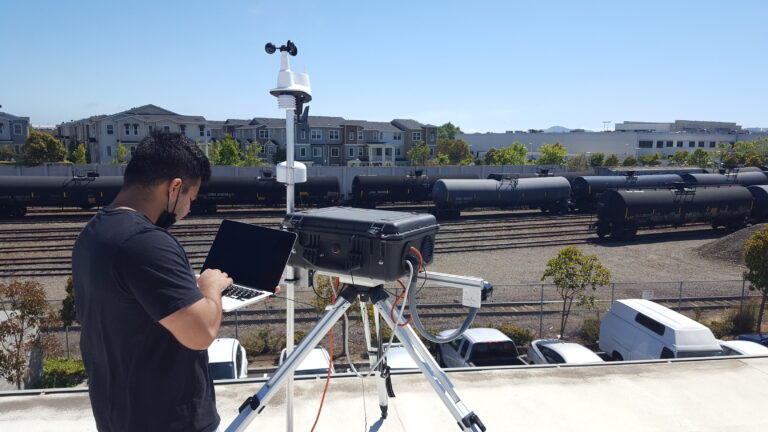
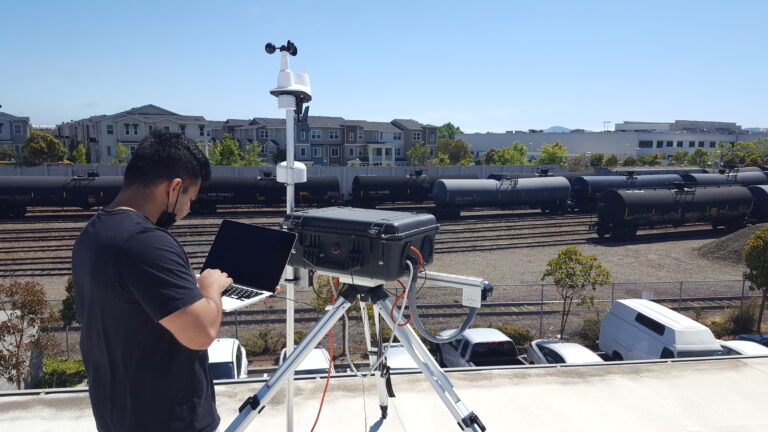
Para enfrentar esto, los investigadores instalaron una cámara junto a una pequeña estación meteorológica y un sensor de calidad del aire. El sistema de la cámara, programado con inteligencia artificial desarrollada por Spada, detectaría el paso de los trenes y activaría el sensor de calidad de aire para registrar las mediciones de los diferentes tipos de trenes. Se analizaron trenes de carbón llenos y vacíos, trenes de mercancías y trenes de pasajeros. 

“Literalmente no existía nada que pudiera resolver este problema para nosotros, así que creamos una solución”, dijo Spada. “¡Y funcionó! Pudimos capturar los pasos de estos trenes y medir la diferencia de contaminación, y resulta que sí hay una diferencia”. 

Los resultados fueron significativos al comparar las emisiones de PM2.5 de los trenes de carbón con las de los trenes de mercancías, de acuerdo con el Dr. Bart Ostro, un científico del AQRC y autor principal del estudio.

“Asombrosamente, encontramos incrementos de PM2.5 por los trenes de carbón que pasaban, que fueron mayores a los incrementos que se daban a partir del paso de los trenes de mercancías”, dijo Ostro. “Con viento suave, vimos un gran incremento con respecto a los trenes de mercancía. Es muy convincente”.

Comparado con las condiciones ambientales habituales, los trenes de carbón sumaron alrededor de ocho microgramos por metro cúbico de PM2.5 al aire. Incluso los trenes de carbón que habían sido vaciados sumaron hasta dos microgramos por metro cúbico. Los trenes de pasajeros emitieron relativamente poco PM2.5. 

Esta investigación tiene importantes implicaciones para la justicia ambiental; el transporte y el procesamiento del carbón tienen un impacto desproporcionado en poblaciones ya económicamente desfavorecidas a lo largo de Estados Unidos.   

 “Es un gran problema que, a nivel nacional, así como en el área de la bahía, estos trenes de carbón normalmente pasen por áreas de bajos recursos”, dijo Ostro. “Estas personas ya tienden a tener tasas más altas de asma y enfermedades cardíacas, por lo que tener una morbilidad preexistente los hace más susceptibles a estímulos adicionales [como la contaminación proveniente de los trenes de carbón]”.  

Ostro también señaló que ciertamente no existe un límite “seguro” de concentraciones de PM2.5 para la salud humana. Mientras el carbón siga siendo transportado y procesado, siempre significará un riesgo para la salud.

“Cabe destacar que la exposición a PM2.5 constituye una preocupación de justicia ambiental ya que los efectos adversos son absorbidos de manera desproporcionada por las poblaciones más vulnerables, incluidos niños, ancianos, personas de color, personas de bajos ingresos y personas con problemas de salud subyacentes”, explica el estudio.  

Con esperanza, la inteligencia artificial de Spada puede adaptarse para detectar casi todo lo que el ojo humano puede ver, desde destellos de refinería de petróleo hasta automóviles. Puede usarse para una variedad de problemas ambientales donde se requiera más, desde otros lugares del área de la bahía hasta ubicaciones de todo el país que procesan y transportan grandes cantidades de carbón, como Baltimore, Maryland.

“De hecho, lo estamos trasladando a Vallejo, donde observaremos algunas de estas otras fuentes que preocupan a la comunidad para que podamos adaptarlo fácilmente a otras situaciones”, dijo Spada.


Escrito por: Lilly Ackerman — science@theaggie.org

Traducido por: Lesley Reyes e Isel Sandoval


Nota de la editora: Las partículas finas se definen como partículas que tienen diámetros de 2.5 micras o menos (PM2.5).

Aumentan las tensiones entre artistas locales y revendedores de ropa en Davis

Con la reventa de ropa ganando popularidad, el Mercado de Arte de Davis ha hecho esfuerzos para resolver las preocupaciones de los artistas


Por KACEY CHAN — features@theaggie.org 

Traducido por MATHILDA BRINTON y JAZMÍN LEDESMA 

Read this article in English.


Los mercados vintage y de arte en Davis han ido ganando popularidad; el número de vendedores ha estado aumentando semanalmente ya que los revendedores de ropa se unieron recientemente a los artistas del Mercado de Arte de Davis.

La reventa ha ido en aumento en los últimos años. En 2021, Statista estimó que el valor de mercado global de la ropa de segunda mano y de reventa era de $96 mil millones. Se espera que el mercado de segunda mano alcance los $70 mil millones para 2027 solo en los EE.UU., aparte de los innumerables otros mercados de reventa en todo el mundo.

Incluso las mismas marcas de moda se han sumado a la tendencia en la última década. Marcas como COS, Lululemon e incluso marcas de lujo, como Coach, han lanzado programas de reventa para sus propios productos internamente. Las plataformas en línea como The RealReal, Depop y ThredUp se han disparado en popularidad para adaptarse al nuevo mercado de clientes que compran artículos pre-amados cuando buscan expandir sus armarios. 

La compra de artículos de segunda mano también ha ganado popularidad en línea. En las plataformas de redes sociales, como YouTube y TikTok, la segunda mano y la reventa han arraigado en la conciencia de las generaciones más jóvenes. Se entiende que la segunda mano no es solo una opción para comprar artículos caros a precios significativamente más bajos; también es una forma de encontrar ropa única y excéntrica, diferente a lo que ofrecen las tiendas convencionales. 

“Tengo una adicción a las compras, y la reventa se ha convertido en una buena manera de canalizarla”, dijo Mia Blake, revendedora local y estudiante de Solano Community College. “Comencé a comprar artículos de segunda mano y terminé vertiendo toda mi energía en la reventa”. 

Blake generalmente compra en las mismas tiendas de segunda mano, algunas de las cuales son organizaciones sin fines de lucro para ayudar a la comunidad sin hogar de Vacaville. Se ha convertido en un negocio secundario divertido que le permite canalizar su pasión. 

“Elijo cosas que se ajustan a mi estilo y son lindas”, dijo Blake. “Estoy obsesionada con los vestidos slip y la lencería, y me parece más agradable seleccionar ropa para vender de esa manera”. 

Blake también agregó que, con respecto al lado comercial, es mucho más fácil estimar el valor de la ropa si es un producto con el que está familiarizada. Para Blake, hay un mérito creativo y personal en seleccionar ropa para revender. A través de las compras de segunda mano, los revendedores pueden divertirse y adaptar una imagen de marca personal mientras ganan dinero. 

“Si bien comenzar es muy difícil y tuve que gastar mucho dinero para adquirir suficiente inventario, sin lugar a dudas, diría que obtengo un buen rendimiento por el tiempo y la energía que dedico a esto”, dijo Blake.

Sin embargo, han habido críticas en línea sobre la proliferación de la segunda mano y la reventa en los últimos años. Algunos llaman a esto la “gentrificación” de las tiendas de segunda mano, en las que los compradores de bajos ingresos han sido excluidos de sus opciones locales debido a la creciente popularidad de la reventa de segunda mano. Esta crítica, al parecer, está dirigida principalmente a los extremos de esta tendencia, en la que los revendedores acumulan un inventario excesivo y luego lo marcan para “obtener ganancias”, según un artículo de Vox sobre el tema.

El Mercado de Arte de Davis es un evento popular ubicado en 3.rd Street que incluye no solo revendedores de ropa vintage, sino también muchos artistas locales en Davis.

Sofie Kanayama, estudiante de quinto año con doble especialización en Diseño y Japonés, es una artista local que solía vender cerámica en el mercado. 

“Empecé a vender el año escolar pasado, durante el invierno”, dijo Kanayama. “Fui voluntaria en el centro de manualidades y pude tomar clases gratis allí.”

Desde entonces, ha crecido su amor por las manualidades. Pero de acuerdo a Kanayama, la dedicación no refleja las ganancias.

“Definitivamente, no obtengo un buen rendimiento por mi tiempo y energía”, dijo Kanayama. “Porque dependo del estudio comunitario, hacer una pieza a veces puede tomar hasta un mes, entonces el dinero no es nada en comparación con el tiempo requerido”. 

Kaden Zaldumbide, estudiante de quinto año con doble especialización en Arte y Teatro, está de acuerdo con la falta de ganancia en los mercados. 

“Por supuesto, yo vendo mi arte, pero últimamente hay una maldición en el arte, y es difícil obtener una increíble ganancia a menos que me vuelva muy famoso”, dice Zaldumbide. 

Mientras que es común en eventos como el Mercado SoSo en San Francisco y Berkeley o el Mercado SacTown en Sacramento aceptar tanto la venta de ropa como de artesanías, algunos en la comunidad han expresado preocupaciones sobre cómo cada tipo de vendedor debería ser considerado por la organización del mercado. 

“Cuando observas mi producto, no solo ves lo que hice en el momento sino también los años de educación y práctica que invertí para tener las habilidades que tengo hoy”, dijo Zaldumbide. “Si bien lo que los revendedores de ropa hacen sigue siendo trabajo, no están creando algo nuevo, lo cual es otro conjunto completo de habilidades”. 

Hay un interés de promover tu trabajo como pequeño artista local. Mientras que los mercados locales, como el Mercado de Arte de Davis, han tenido menos vendedores de ropa en el pasado, estos claramente se han multiplicado, trayendo naturalmente lo que es popular: la ropa y la moda. 

“Lo que hace a los artistas diferentes es que hay una especie de proceso de navegación en términos de compromiso con el cliente”, dice Zaldumbide. “Para un revendedor, si una persona ha comprado una pieza de ropa en el pasado, entonces otra persona va a volver a comprarla”. 

Zaldumbide dijo que ir al mercado casi parece un trabajo de tiempo completo porque hay un gran número de vendedores que resulta en una falta de espacio en 3rd Street.

“Tienes que levantarte muy temprano para asegurarte de conseguir un buen espacio, y ahora que el mercado está abierto hasta las 3 de la tarde, ir allí y establecerse es un esfuerzo mucho mayor”, dijo Zaldumbide. 

Aunque una atracción principal del mercado ha sido su naturaleza libre, tanto para los artistas como para los vendedores, algunos han dicho que eventualmente será necesario establecer reglas fundamentales. 

“El mercado en la calle tiene una vibra de ‘hacer-tu-propia-aventura’ porque no hay un gerente del mercado y no tienes que pagar un tarifa de vendedor”, dijo Kanayama. “Esto fue lo que me atrajo al evento en un principio. Pero desde entonces, ha estado muy difícil vender allí.” 

Debido a estas preocupaciones, el mercado ha tomado un enfoque más administrativo. De acuerdo a la publicación hecha por la organización del mercado en su cuenta de Instagram, @davis_street_market el 28 de abril, se estableció una nueva regla de delegar la mitad de la calle a revendedores de ropa y la otra mitad a artistas locales.

“En definitiva, creo que el meollo del problema es la tensión entre los revendedores y los artistas, así como la falta de espacio en 3rd Street, lo cual intensifica las cosas”, dijo Kanayama. 


Escrito por: Kacey Chan — features@theaggie.org 

Traducido por: Mathilda Brinton y Jazmín Ledesma

Julián Castro visita Davis para el evento de recaudación del Partido Demócrata de Yolo

El Partido Demócrata de Yolo, el Club Demócrata de Davis y los Demócratas de Davis College, entre otros, se reúnen para una recaudación primaveral


Por MADELEINE YOUNG — city@theaggie.org 

Traducido por LIZBETH COLIN NIETO y MAYRA TEJEDA

Read this article in English.


El 29 de abril, el Partido Demócrata del condado de Yolo organizó una recaudación de fondos de primavera en Veterans Memorial Center, presentando al excandidato presidencial y secretario de Vivienda y Desarrollo Urbano, Julián Castro. 

Castro habló acerca de la necesidad de que el Partido Demócrata obtenga impulso para las elecciones de 2024 y específicamente sobre recuperar la Cámara de Representantes, donde el partido Republicano tiene la mayoría. 

“Quería venir y agradecerles por lo que ya han hecho y desafiarlos a que multipliquen sus esfuerzos para que nos aseguremos de que los demócratas tengan éxito en 2024, no solo en la oficina oval sino también en el Senado, lo cual va a ser el gran botín”, dijo Castro. “Este año tenemos más de dos docenas de bancas para defender y también la Cámara de Representantes, para que Kevin McCarthy se vaya. Yo pienso que podemos hacerlo”. 

Al principio de este evento, Cecilia Aguiar-Curry, miembro de la asamblea, presentó a Castro y habló sobre los problemas que Estados Unidos y el condado de Yolo han enfrentado en los últimos años. 

“Nos reunimos esta noche en un momento único de la Historia de nuestro país y, pienso, del mundo”, dijo Aguilar-Curry. “Es justo decir que los últimos tres años han sido diferentes a todo lo que nadie en la Tierra haya experimentado antes de la pandemia en 2020, 2021 y 2022. […] Más de un millón de americanos ha perdido su vida a causa de COVID y complicaciones relacionadas, sumado a la recesión que esto trajo consigo y al hecho de que en mayo de 2020, el asesinato de George Floy reavivó la lucha de la justicia racial de nuestra nación y fuimos testigos de la polarización profunda y fuerza antidemocrática.

El presidente del evento de recaudación de fondos y supervisor adjunto del Distrito 4, Oliver Snow, explicó el propósito del evento.

“Estamos haciendo nuestra primera gran recaudación de fondos desde el inicio de la pandemia y quizás nuestro primer gran evento de recaudación de fondos ya que nunca habíamos tenido eventos grandes”, dijo Snow. “Tenemos al secretario Julián Castro que vino al condado de Yolo y estamos muy emocionados de tenerlo. Queremos recaudar fondos pero más que nada queremos volver a lanzar el partido del condado porque han sido unos años difíciles. Queremos hacer un esfuerzo y decir: “Hola a todos: estamos de regreso en el condado de Yolo y estamos listos para reconstruir; subiremos más alto que nunca”. 


El evento contó con una subasta silenciosa y presentó secciones de varios clubes demócratas a través del condado, incluido el Club Demócrata de Davis, los Demócratas de Davis College, el Club Demócrata de Woodland y más. 

Sam Hopwood, estudiante de primer año de Ciencias Políticas y excandidato del Senado de ASUCD, fue uno de los miembros de Demócratas de Davis College que asistió y declaró su apoyo a las pequeñas secciones locales del cuerpo demócrata. 

“Estoy muy, muy impresionado por la participación”, dijo Hopwood. “Soy un estudiante de primer año y es una de las primeras veces que hago esto; entro a una sala y veo a 100 personas –las mejores y más brillantes de West Sacramento y Sacramento, Davis, Woodland y Dixon– todas abarrotadas en una sala. Creo que la participación es realmente maravillosa, no solo cuantitativa sino cualitativamente. Es una muy buena manera de conseguir dinero, pero no se trata solo de dinero. Al tener a alguien tan carismático, importante y comprometido como Julián Castro, ayudamos, los ayudamos a construir su proyecto, y esto demuestra que el Partido Demócrata como organización grande realmente se preocupa por lo que sucede en un distrito más pequeño”.

El vicepresidente del Club Demócrata de Davis, Rick González, intervino con el micrófono y habló sobre su apoyo al activismo político de los jóvenes demócratas en Davis. 

“Julián parece tener los pies en la tierra, realmente sobre la tierra, y de verdad lo aprecio porque hay demasiadas personas que triunfan y luego se olvidan de dónde vienen y simplemente se quedan atrapados; pero algunas personas, como Julián, están aterrizadas”, dijo González. “Nuestros jóvenes demócratas en UCD son el club número uno en todo el estado; no solo inscriben a sus propios estudiantes cada año en la universidad, sino que ahora están registrando su trabajo y sus campañas y entrando en eso; van a ir al Sur de California; están haciendo operaciones bancarias telefónicas, [están tocando] puertas”.

Castro habló sobre la importancia de elegir demócratas en las próximas elecciones y sobre el hecho de que votar tiene efectos tangibles. 

“Si hacemos eso, no se trata solo de que un partido gane las elecciones”, dijo Castro. “Se trata del hecho de que el niño transgénero que está creciendo se sentirá mucho más bienvenido y tendrá un liderazgo que lo comprenda y haga políticas para mejorar la vida en lugar de empeorarla. Se trata del hecho de que más niños podrán graduarse de la preparatoria, continuar y alcanzar sus sueños en la universidad, porque invertir en ellos es una prioridad mayor. Se trata de asegurarnos de codificar Roe versus Wade para proteger los derechos reproductivos en nuestro país. Y también, mientras estamos en eso, poner algo de ética real frente a la Corte Suprema y asegurarnos de que en los años venideros nuestra nación realmente pueda reflejar los mejores valores de nuestra Humanidad –las personas que, como nación, nos hemos esforzado por ser, queremos ser y podemos ser si continuamos trabajando duro para lograrlo”.


Escrito por: Madeleine Young — city@theaggie.org

Traducido por: Lizbeth Colin Nieto y Mayra Tejeda

New exhibition at the International Center captures experiences of LGBTQIA+ international graduate students

“Alienation and Liminality” is an interactive installation of visual collages that disseminates qualitative research conducted by the Queer Trans Lab at UC Davis


By INDRANIL BASU — features@theaggie.org


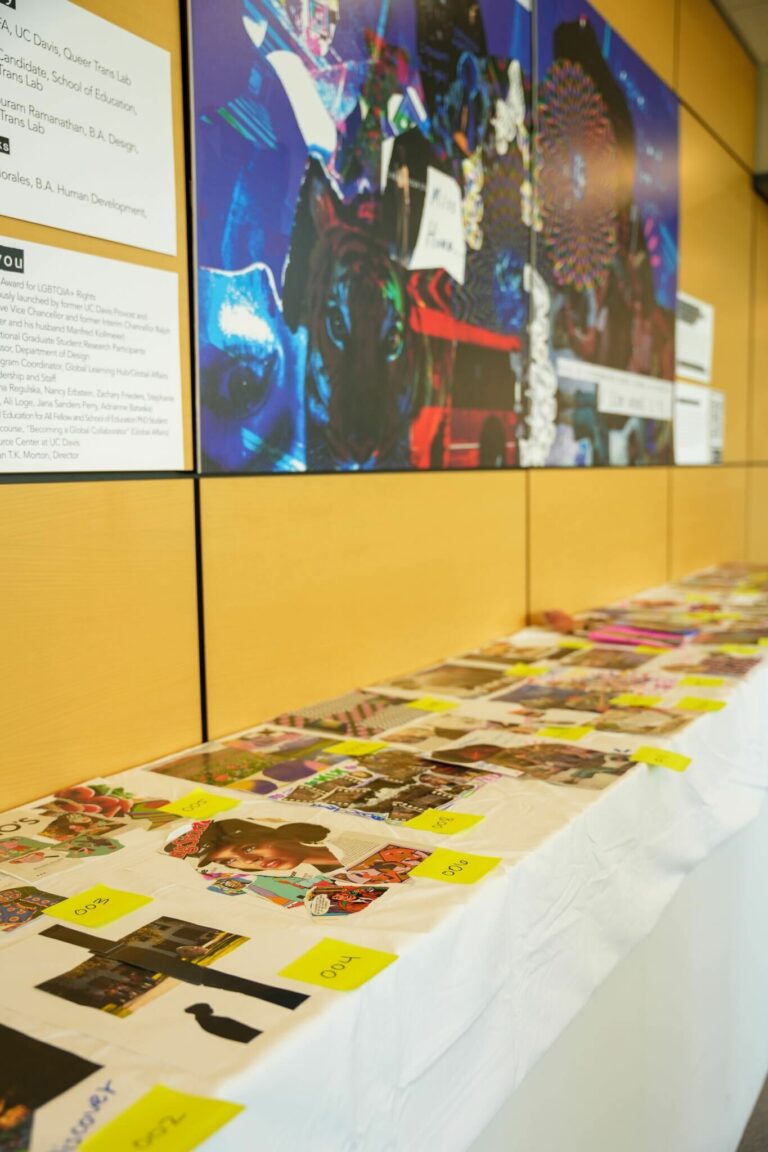
The interactive exhibition “Alienation and Liminality: An Installation on International LGBTQIA+ Graduate Student Experiences on Campus” is currently open for viewing at the International Center. The Queer Trans Lab (QT Lab), a UC Davis research group and the exhibition’s curator, was able to plan and install the project after becoming the inaugural recipient of the 2022 Global Aggies Award for LGBTQIA+ Rights.

Situated in the left wing of the lobby of the International Center, the installation consists of a large three-sided panel introducing the exhibition and ending with the prompt, “What are some experiences of alienation and/or liberation that the installation brings up for you?” The exhibition “connects the rights of LGBTQIA+ peoples globally and the needs and experiences of international LGBTQIA+ students here at UC Davis,” according to the panel. 

People engaging with the installation can write their responses and pin them on the other sides of the panel, as well as read and reflect on the experiences of others. Collages handmade by students at various workshops conducted by QT Lab as part of their grant work are displayed. The QT Lab team put together a digital collage of the handmade work as a central panel. The exhibition has QR codes that link to alt-text image descriptions for accessibility. 

The installation was inspired by the design styles of UC Davis professors Jiayi Young and Tim McNeil, according to Iris Xie, a recent graduate from the master’s in fine arts in design program at UC Davis

“Professor Jiayi Young has an interdisciplinary and free approach to her installations and design work that helped me feel supported and confident in my own skillset regarding working on the installation,” Xie said via email. “Professor Tim McNeil was really kind in advising and supporting us on the exhibition design component and lending us his prompt structure from one of his classes to use, as a way to show the unique nature of doing an exhibition in a non-traditional space like the lobby of the International Center.”

Xie applied their qualitative research background to design and co-create the exhibition with Santhoshi Ramanathan, a fourth-year design major, as a dissemination strategy for the research project of QT Lab.

QT Lab was formed in 2020 when the Chancellor’s Committee on LGBTQIA Issues approached the LGBTQIA Resource Center about doing a needs and assets assessment of queer and trans graduate students and staff on campus. The lab later formed collaborations with various organizations such as the Women’s Resource and Retention Center and later, Global Affairs.

The team developed questions and interviewed about 33 LGBTQIA+ graduate students, professional students and staff at UC Davis for a qualitative analysis of their experiences and what improvements can be made to policy and funding at UC Davis.

Kait Murray, a fifth-year Ph.D. candidate in science and agricultural education and the graduate research scholar at the Resource Center, describes the goal of QT Lab’s research project. 

“[The goal is] to create change at UC Davis, wherein the most marginalized within our LGBTQIA+ communities are the most resourced and most celebrated and the most central in our funding, in our work in everything that we’re doing,” Murray said.

The Lab’s goal also focuses on finding existing gaps and opportunities to improve the experience of queer and trans students on campus.

“We have these principles of community, we have all these ideals about diversity and inclusion, but we know that oftentimes, the institution falls short of these commitments,” Murray said. “And so […] our goal with our research is to make clear these opportunities for where we can be investing in the things that are already working. For example, we know that for most queer and trans graduate students, most of their social, academic and navigational support comes from peer networks. It’s not coming from the university. […] How can we be investing financial resources in the things that we know that are already happening that are really working well, as well as how we can be opening up new streams of funding to create things that don’t yet exist?”

QT Lab creates a very trauma-informed and caring environment for the work they do, prioritizing intersectionality, representation, accessibility and self-care for the community of researchers as well as participants. The Lab has also had many side projects directed by members according to their own interests in similar areas of research, such as a collaboration with VN CARES by one of their research assistants. Once the Global Aggies Award for LGBTQIA+ Rights was announced, the Lab had the opportunity to focus on specific data for international students, and launched their workshop series and exhibition. 

Ramanathan, the only undergraduate student who is a current research assistant at QT Lab, facilitated and conducted the interviews as part of QT Lab. 

“We were going through all of the interviews and seeing what the participants talked about, and the common themes we found [are] what we decided to call ‘alienation and liminality,’” Ramanathan said. “So ‘alienation’ as in being alone and separated from the groups that you’re supposed to be a part of; and ‘liminality’ is being suspended, kind of, in between. You’re not here, you’re not there. It’s an uneasy feeling of like, ‘I’m not where I belong, but I don’t know where I belong.’”

Ramanathan said the exhibition focuses on three intersecting groups that are often left out of activism on campus: international students, graduate students and queer and trans students. 

“Graduate students aren’t talked about,” Ramanathan said. “All of the activism and everything that happens on campus is definitely that of the undergraduates, but we want their experiences to come to the forefront as well. We decided to focus on international students because a lot of them, especially queer and trans students, […] come from homophobic families or homophobic countries or towns. They don’t really have the chance to talk about being queer. And a lot of them come here to the United States and UC Davis and are able to explore that feeling of queerness, […] not that the United States is safe, but it’s safe enough for experiencing being queer and experiencing your queerness, and that’s why we wanted to do this. We wanted to highlight the queer experiences of these people by having a place where they can be queer.”

Aramo Olaya, a second-year international graduate student in the performance studies Ph.D. program, resonated with this notion as part of all three of these intersecting groups. 

“As a 42-years-old queer graduate international student, I feel that the U.S. is quite conservative and isolating,” Olaya said in an Instagram direct message. “Being single equals being alone. I haven’t found a sense of community with other queer people. Maybe it’s because of my age, but I have the sensation that everybody feels quite isolated and unsupported. This is a work culture; everybody seems afraid of everybody else.”

Multiple international students socializing in the International Center lobby agreed that the language barrier is a primary reason international exchange students and students here for short-duration English-learning programs sometimes feel isolated.

“From talking to a lot of the exchange students here, the biggest thing is that a lot of them do want to speak to local students or domestic students, but the issue is that a lot of them don’t feel really confident in their English ability,” said fourth-year global disease biology major Moriah Shih. “A majority of people feel a lot more comfortable speaking in their native language, and as a result, they just stick with one another. However, I have noticed that when you do […] make the effort to go and speak to them, they’re really welcoming, and they want people to reach out to them.”

Xie said that they wanted the exhibition to be available in more languages for international students, but because of location, funding, time and logistical constraints, they had limited resources to do so.

According to Olaya, graduate students don’t have much political power at the university, which is another reason they have reported feeling alienated. 

“Graduate representatives don’t really represent,” Olaya said. “We don’t have decision power in the departments, nor a decision-making organ that dialogues with the Dean’s Office. […] Politically, a university where students don’t have decision-making power is structurally disempowering for marginalized groups.”

As an artist, they feel that “collective physical pieces of art are good when they create chances for people to meet each other, talk and open and deepen relationships of trust, friendship and mutual support.” The QT Lab can bridge the gap between international, queer, graduate and other students. 

Shih said she hopes the exhibition will bring more people to the International Center to connect with the international student community. 

“I think that what we’re really missing is the integration of the international exchange student community with the rest of the Davis,” Shih said. “And I think it would be helpful if there were more efforts to connect students together and bring a more unified presence. If it weren’t for the fact that I had an interest in outreaching to international students to learn more about different cultures, I probably would not have had the opportunity to come to the [International Center].” 

Being part of the QT Lab project helped Ramanathan feel less alone and helped him connect his different identities. 

“We’re all our own little islands,” Ramanathan said. “We’re all islands and we all form an archipelago together. And it’s just comforting to know that even if nobody has the same experiences as you, there are people that have similar enough experiences that you can form a […] community. It’s nice; it’s comforting.”

The QT Lab is currently working on its white papers to present to the Chancellor’s Committee and other authoritative bodies at UC Davis in hopes of influencing university policy. The International Center exhibition will continue until the end of spring quarter.


Written by: Indranil Basu — features@theaggie.org


Julián Castro visits Davis for Yolo County Democrats fundraiser event

 Yolo County Democrats, Davis Democratic Club, Davis College Democrats and others gather for spring fundraiser


By MADELEINE YOUNG — city@theaggie.org 

Lea este artículo en español


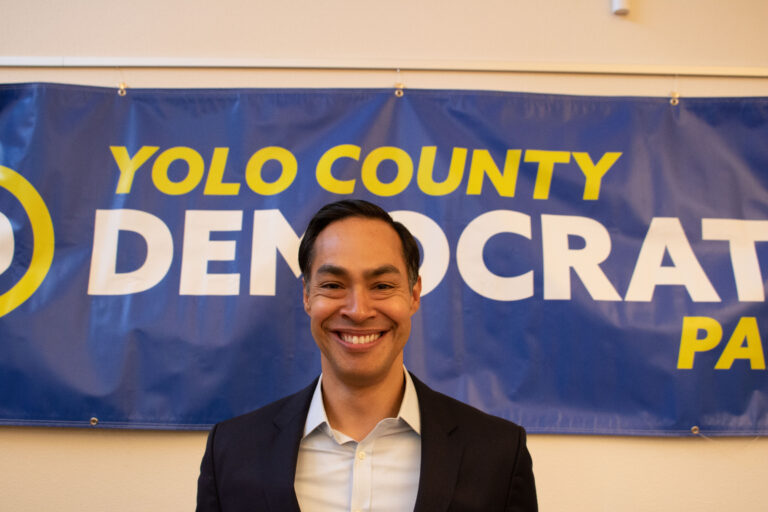
On April 29, the Yolo County Democratic Party hosted its spring fundraiser at the Veterans Memorial Center, featuring former presidential candidate and former Secretary of Housing and Urban Development, Julián Castro. 

Castro talked about gaining momentum for the Democratic Party ahead of the 2024 election and, specifically, about winning back the House of Representatives from the Republican majority. 

“I wanted to come and thank you for what you’ve already done and challenge you to redouble your efforts to make sure the Democrats are successful in 2024 not only in the oval office but also in the Senate, which is going to be quite a haul,” Castro said. “This year, we have more than two dozen seats to defend and also the House of Representatives, to send Kevin McCarthy packing. I think that we can do it.”

At the start of the event, Assemblymember Cecilia Aguiar-Curry introduced Castro and talked about the issues facing the U.S., and Yolo County, within the last few years.

“We gather tonight at a very unique moment in the history of our nation and I think of our world,” Aguiar-Curry said. “It’s fair to say that the last three years have been unlike anything that anybody on earth has ever experienced before with the pandemic in 2020, 2021 and 2022. […] The more than a million Americans that have lost their lives because of COVID and complications related to it, the recession that it brought along and in May of 2020, the murder of George Floyd, which reignited a push for racial justice in our nation and the deep polarization and anti-democratic forces that we have seen.”

The fundraising chair of the event and assistant deputy supervisor for District 4, Oliver Snow, explained the purpose of the event.

“We’re doing our first big fundraiser since the start of the pandemic, and sort of our first big fundraiser even before that since we didn’t have many big ones,” Snow said. “We have Secretary Julian Castro coming into Yolo County, [and we’re] really excited to have him. We want to raise money, but more than that, we want to see it as sort of a relaunch of the county party, because it’s been a difficult few years. We want to sort of make an effort to say, ‘Hey everyone, we’re back in Yolo County, we’re ready to get to work, we’re ready to rebuild and we are going to greater heights than we had.’”

The event featured a silent auction and hosted chapters of multiple democratic clubs across the county, including the Davis Democratic Club, Davis College Democrats, Woodland Democratic Club and more. 

Sam Hopwood, a first-year political science major and former ASUCD Senate candidate, was one of the members with Davis College Democrats in attendance and stated his support for the local small chapters of the Democratic body. 

“I am very, very impressed by the turnout,” Hopwood said. “I’m a first year and it’s my first few times doing this and to come into a room and see 100 people — the best and brightest of what we have going on in West Sacramento and Sacramento, Davis and Woodland and Dixon — all crammed into one room. I think the turnout is really wonderful, not just quantitatively but qualitatively. It’s a very good way to get money, but it isn’t just about money. By having somebody as vibrant and important and engaged as Julián Castro here […] we help out, we help them build on them and it shows that the Democratic Party as a big organization really cares about what happens in a smaller district.”

Vice president of the Davis Democratic Club Rick Gonzalez weighed in on the speaker and talked about his support for political activism by young democrats in Davis.

“Julián seems down to earth to me, really down to earth and I really appreciate that because there’s too many people who sort of make it big and then they forget where they came from and they just get caught up with everything, and some people like Julián are grounded,” Gonzalez said. “Our young Democrats at UCD are the number one club in the entire state, not only do they register their own students every year at the college, and now they’re registering their work and campaigns and going into that and they’re going to Southern California, they’re doing phone banking, [they’re knocking] on doors.”

Castro spoke about the importance of electing democrats in upcoming elections and that voting has tangible effects. 

“If we do that, it’s not just about a party winning the election,” Castro said. “It’s about the fact that [the] trans kid that is growing up, he’s going to feel so much more welcome and have leadership that understands and will make policy to make life better instead of worse. It’s about the fact that more kids are going to be able to graduate from high school and go on and reach their dreams in college because investing in them is a bigger priority. It’s about making sure that we codify Roe versus Wade, to protect reproductive rights in our country. and also while we’re at it, [put] some real ethics in front of the Supreme Court and to make sure that in the years to come, that our nation can truly reflect the best values of our humanity the people that we have been striving as a nation to be, want to be, and can achieve if you continue to work hard to do it.”


Written by: Madeleine Young — city@theaggie.org 


UC Davis organizations oppose Thirty Meter Telescope Project

The telescope would be the 14th of its kind on the sacred land of Mauna Kea in Hawaii


By RACHEL GAUER— campus@theaggie.org

Lea este artículo en español.


 The Thirty Meter Telescope (TMT) is a project that, if completed, would be the first in a new class of extremely large telescopes. Currently, it is planned to be built on the mountain of Mauna Kea, located on the island of Hawaii, and would “allow us to see deeper into space and observe cosmic objects with unprecedented sensitivity and detail,” according to the project’s website. However, the project has received backlash from the native Hawaiian community, who believe that the telescope would be invading sacred land. 

The University of California (UC) has invested more than $68 million into the project so far, but student organizations, including the UC Davis chapter of Mauna Kea Protectors (MKP), have called for the UC to halt funding. In late March of this year, a new state-appointed oversight board for the project was put together that includes representatives from astronomical observatories and Native Hawaiian communities. The current prevailing compromise appears to be that TMT will be built in exchange for several other telescopes in the region being decommissioned. However, student efforts remain focused on removing UC funding from the TMT project entirely. 

  Valeria Cantor Mendez, a third-year community and regional development major, commented on the efforts that the UC Davis community has taken to encourage UC leaders to divest funds. 

“Last quarter the [Mauna Kea Protectors] met with Chancellor May along with some ASUCD senators who helped us get the meeting with him,” Cantor Mendez said. “We brought the issue up to him and asked him to intervene in front of the Board of Regents [representing] the UC Davis campus. [We] compromised and he made TMT investment an agenda item for his meeting with the other UC chancellors.” 

Cantor Mendez also emphasized a future meeting that she is hoping will be impactful in the divestment efforts. 

“The director of the University of California Observatories is going to come to UC Davis this next quarter and he is expecting a group of students to talk to him,” Cantor Mendez said. “He is supposed to listen to us and hear our perspectives, which is something we are definitely looking forward to as MKP at UC Davis.” 

Prior to the project, 13 other telescopes of smaller diameters have been built atop Mauna Kea despite opposition from the community.  Amanda Wong, a graduate student studying ecology, who was born and raised in Hawaii, expressed her perspective on both the current project as well as the previous projects that have been completed. 

“I don’t think it is appropriate for the UC system to continue to be invested in this project, especially with so much pushback from the native Hawaiian community,” Wong said. “With 13 telescopes already, so much hurt has been done and I think enough is enough. There has been a strong stance for years now against TMT from the native Hawaiian community.”

Wong also said that she finds the project hypocritical on the part of the university. 

“UC Davis wants to promote and uplift marginalized communities, but by continuing to push for and funding the TMT, they are ignoring the voices of the native Hawaiian students that they’re trying to support,” Wong said.

Cantor Mendez also works for the University of California Student Association (UCSA) and serves as vice chair for Students Enacting Environmental Defense (SEED). Cantor Mendez said that SEED actually selected the UC to divest from the TMT project for their environmental justice campaign this year. 

 “During the last conference that UCSA had, we decided that SEED should focus on divesting funds from the 30-meter telescope, and instead, investing in indigenous communities,” Candor Mendez said. “The 30-meter telescope is not a new project, and so the goal of getting UC funds away from the project is also not new, but we wanted to bring it into the UCSA space because it is a UC-wide issue.” 

As of May 9, the university has not responded to a request for comment. 

Kealohi Sabate, a civil and environmental engineering graduate student, encouraged students to learn about the project and the impacts it would have on the Hawaiian community. 

“I would like UC students to be more aware that the TMT project is not a good use of funds,” Sabata said. “Native Hawaiians have been trying to fight against the building of these telescopes — now there [could be] fourteen of them and we are still on the same topic and still trying to fight for our native lands and our home. It is really crushing native community voices, especially since it feels like our voices are not being heard.”  


Written by: Rachel Gauer  — campus@theaggie.org

Las organizaciones de UC Davis se oponen al proyecto del telescopio de treinta metros

El telescopio sería el catorceavo de su tipo en la tierra sagrada de Mauna Kea en Hawaii


Por RACHEL GAUER – campus@theaggie.org

Traducido por JOSÉ HERNANDEZ

Read this article in English.


El telescopio de treinta metros es un proyecto que, si se completa sería el primero en una clase nueva de telescopios extremadamente grandes. Actualmente, está planeado que se va construir en la montaña de Mauna Kea, ubicada en la isla de Hawaii, “y nos permitiría ver en lo más profundo del espacio y observar con una sensibilidad y detalle sin precedentes”, de acuerdo con el sitio web del proyecto. Sin embargo, el proyecto ha recibido reacciones negativas de la comunidad Hawaiana, quienes creen que el telescopio estaría invadiendo tierra sagrada. 

La Universidad de California (UC) ha invertido más de $68 millones en el proyecto hasta ahora, pero organizaciones estudiantiles, incluyendo el UC Davis Chapter de protectores de Mauna Kea (MKP), han pedido a UC que detenga la financiación. En los últimos de marzo de este año se formó una nueva junta de supervisión designada por el estado para el proyecto que incluye representantes de los observatorios astronómicos y comunidades nativas de Hawai. El compromiso predominante actual parece ser que TMT se construirá a cambio del desmantelamiento de varios otros telescopios en la región. Sin embargo, los esfuerzos de los estudiantes continúan en remover el financiamiento de UC del proyecto TMT completamente. 

Valeria Cantor Mendez, estudiante de tercer año estudiando comunidad y desarrollo regional, comentó sobre los esfuerzos que la comunidad de UC Davis ha tomado para alentar a los líderes de UC para desinvertir los fondos.

“El último trimestre [los protectores de Mauna Kea] se juntaron con el canciller May junto con otros senadores de ASUCD, quienes nos ayudaron a tener la reunión con él”, dijo Cantor Mendez. “Le presentamos el problema y le pedimos que interviniera frente a la junta de regentes [representando] el campus de UC Davis. [Nos] comprometimos y él hizo la inversión de TMT un tema en la agenda para su reunión con los otros cancilleres de UC”.   

  Cantor Mendez también enfatizó una futura reunión que ella espera que sea impactante en los esfuerzos de la desinversión.  

“El director de los observatorios de la Universidad de California va a venir a UC Davis este próximo trimestre y el está esperando que un grupo de estudiantes le hable”, dijo Cantor Mendez. “Se supone que él tiene que escuchar nuestras perspectivas, lo cual es algo que estamos deseando como MKP en UC Davis”.

Previo al proyecto, otros 13 telescopios de diámetros más pequeños han sido construidos encima de Mauna Kea a pesar de la oposición de la comunidad. Amanda Wong, una estudiante graduada de ecología, quien nació y creció en Hawaii, expresó su perspectiva en ambos el proyecto actual así como también los proyectos anteriores que han sido completados.

“No pienso que es apropiado para el sistema de UC continuar invirtiendo en este proyecto, especialmente con tanto rechazo de la comunidad Hawaiana”, dijo Wong. “Con ya 13 telescopios, tanto daño ha sido hecho y pienso que suficiente es suficiente. Ha existido por años una postura fuerte en contra de TMT por parte de la comunidad nativa Hawaiana”. 

Wong también dijo que ella encuentra el proyecto hipócrita por parte de la universidad. 

“UC Davis quiere promover y elevar a las comunidades marginalizadas, pero al seguir empujando y financiando el TMT, están ignorando las voces de los estudiantes nativos Hawaianos que ellos están tratando de apoyar”, dijo Wong.

Cantor Mendez también trabaja para la Asociación Estudiantil de la Universidad de California (UCSA) y se desempeña como vicepresidenta de Estudiantes Promulgando Defensa Ambiental (SEED). Cantor Mendez dijo que SEED en realidad seleccionó a la Universidad de California a desinvertir del proyecto TMT para su campaña de justicia medioambiental este año.

“Durante la última conferencia que UCSA tuvo, decidimos que SEED debería enfocarse en desinvertir los fondos del telescopio de 30 metros, y en lugar, invertir en las comunidades indígenas”, Cantor Mendez dijo. “El telescopio de 30 metros no es un proyecto nuevo, así que la meta de quitar los fondos de las UC del proyecto tampoco es nueva pero queríamos traerlo al espacio de UCSA porque es un problema de todas las UC”.

Hasta el 9 de mayo, la universidad no ha respondido a una solicitud de comentarios. 

Kealohi Sabate, un estudiante graduado de ingeniería civil y medio ambiental, alentó a los estudiantes a que aprendan acerca del proyecto y los impactos que tendría en la comunidad Hawaiana. 

“Me gustaría que los estudiantes de UC estén más conscientes de que el proyecto TMT no es un buen uso de fondos”, dijo Sabata. “Los nativos de Hawai han estado tratando de pelear en contra de la construcción de estos telescopios — ahora podría haber catorce de ellos y estamos todavía en el mismo tema y todavía tratando de pelear por nuestras tierras nativas y nuestras casas. Realmente están aplastando las voces de las comunidades nativas, especialmente porque se siente que nuestras voces no están siendo escuchadas”. 


Escrito por: Rachel Gauer campus@theaggie.org

Traducido por: José Hernandez

Classic novel inspires generations through contemporary performance

Texas-based collective Theatre Heroes performs “Call of the Wild: Illustrated Edition” at the Mondavi Center


By MIA BALTIERRA — features@theaggie.org


“The Call of the Wild,” the classic tale of a dog named Buck and his journey from lavish pet to laboring sled dog in the Yukon, is a novel many people grew up reading in school. Despite being written 120 years ago, it remains a story relevant to all ages with themes of self-discovery and perseverance. 

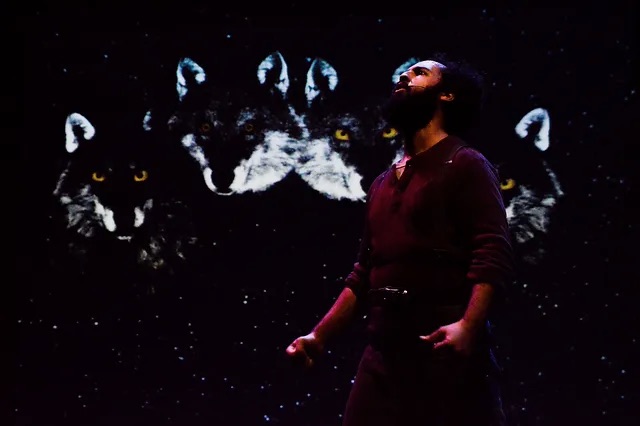
Theater collective Theatre Heroes seeks to keep this story alive and tell it in an innovative way in their touring production “Call of the Wild: Illustrated Edition.” The performance is a one-man show, with a single actor telling the story amid a minimal set of just two boxes against a background of three large electronic screens with various imagery. 

The actor in the production, Noel Gaulin, also helped develop the show and said a major life event spurred the creation of a staged version of the novel.

“When I found out I was gonna be a dad, I wanted to make a show that would last,” Gaulin said, “because a lot of theater shows happen and then that’s it, so I wanted to make something that would be sustainable. I had been working with kids […] and figured out that the youth audience is sustainable. I wanted to make something for older kids, upper elementary [and] middle school ‘cause they don’t get a lot, but they are a great audience because they can handle a lot.”

Gaulin said that he felt “The Call of the Wild” was the obvious choice for a story to stage with a younger audience in mind.

“‘Call of the Wild’ was my favorite book,” Gaulin said. “I think it has everything. It makes you laugh, makes you cry. It’s scary, it’s fun, it’s about a dog — everybody loves dogs.”

The creative process of developing the show took two years before it premiered in Austin, Texas and then started touring across the U.S. Gaulin said that in the process of creating the show, it was important to him to remain close to the original work while still presenting it in a way that felt new.

“The style is on purpose — the one-man-show style makes the audience use their imagination,” Gaulin said. “I wanted to bring back an essence of storytelling, the storyteller-around-the-campfire vibe.”

The three screens have projections that change during the course of the show. The projections include the original illustrations from the novel, as well as historical photos from the time period the story is set in and original drawings from a graphic designer.

“They create the world around me,” Gaulin said. “All sorts of imagery help tell the story [and] introduce characters without a bunch of stuff.” 

Another element of keeping the presentation simple is the set of two boxes. 

“I really liked his use of the boxes,” said audience member Natalia Ricci, a second-year political science major. “Sometimes, he used it to emphasize dramatic things that were happening, and he threw the box down, or sometimes he was shape-shifting the boxes into a sled. He used it and was able to manipulate the item into multiple things.”

During the course of the show, Gaulin also transforms himself, as he takes on around 30 different characters and shifts from human to dog and back again.

“Him portraying the dog was incredible; I didn’t think someone could act as a dog that well without having some kind of Milky White-esque puppet,” said audience member Lou Wagoner, a third-year theater and dance and English double major, referencing the cow puppet used in a recent Broadway revival of “Into the Woods.” “From what I had heard about it, I was like, ‘It’s a one-man show of ‘Call of the Wild;’ how is he gonna do that? Oh, he probably has a puppet or something.’ Then he just started howling, himself, and I was like, ‘Oh! This is good; this works.’”

While the show was developed with a young audience in mind, Gaulin says it is a story all ages can appreciate. On April 7 at the Mondavi Center, Gaulin performed to an audience of varying ages.

“Stories are special; they bring people together,” Gaulin said. “There were three generations of people there —  grandpa read this book, too — so bringing people together for this story specifically is special. […] I don’t care who you are; you can’t help but empathize with a dog. That’s important to me.”

After seven years of touring the show across what will be 145 cities, “Call of the Wild” is set to close after next season. Gaulin and his team already have plans to develop another classic novel into a show with a similar model. Gaulin hopes to alternate between this show and a new one, continually inspiring youth around the nation.

“I want to get kids excited about reading; I think this can do that,” Gaulin said. “You know, they still read this book in school. A lot of schools, because of the show, decided to read it. So I think inspiring kids to read and be excited about reading a classic story like this is really important to me. I think it’s really cool that theater can do that. That’s important to me that we are inspiring kids to love the arts.” 

Written by: Mia Baltierra — features@theaggie.org

The definitive Davis bucket list

The Editorial Board shares their favorite things to do in and around Davis


By THE EDITORIAL BOARD


Sometimes, the small college town of Davis tests us; school monopolizes our time, it’s hot as all get out and the town can feel boring at times. But if you take a second to stop and look around, you’ll see that it isn’t so bad. In truth, Davis is a pretty magical place. 

For those graduating, time here is coming to an end, while for others it’s only beginning. Whether or not it’s your last quarter in Davis, we’ve compiled a list of all the activities you should do and places you should see before Davis becomes another happy memory.

In this article, we’ve highlighted some of the most crucial things you’ve just got to do before you leave Davis, but make sure to print out our complete bucket list and check it off yourself! Download here.


Picnic in Central Park during the Farmers Market

The Davis Farmers Market is a staple of Davis culture, and is a must-attend event at least once during your time at UC Davis (although we personally recommend that you go whenever you can). The market is open on Wednesdays from 3-6 p.m. and Saturdays from 8 a.m.-1 p.m., and offers all sorts of different foods and goods from local vendors. It doesn’t get much better than getting a bite to eat from a stall or food truck and sitting out on the grass with a few friends. Even if you can’t make it to the farmers market, there is almost always something going on in Central Park. Head over there and participate in the Davis lifestyle!


Join a club

UC Davis offers a mind-boggling amount of student-run clubs. Take a quick look at the almost 900 different student groups on the AggieLife website, and we’re sure you’ll be able to find something that piques your interest. We think that joining a club on campus is a great way to get more involved with your school and community while also making friends.


Go to a sports game

We’ll be the first to admit it: UC Davis could stand to be a little better at sports. But even though we aren’t the best, you’ll still have a great time going out and cheering for the Aggies. Whether that be basketball, football, volleyball or something else entirely, showing your UCD pride is an integral part of the Davis experience. If you’re lucky, you might even see Gunrock. Go Ags!


Take a day trip

It might surprise you to find out that Davis is actually a very central location (it ain’t called the Central Valley for no reason). A day trip to Sacramento, San Francisco, Yosemite, the Sacramento River, Six Flags or even Tahoe are all viable options. While we all know that Davis is a great place to be, sometimes it can be fun to spread your wings and explore more of California.


Go to the Manetti Shrem Museum

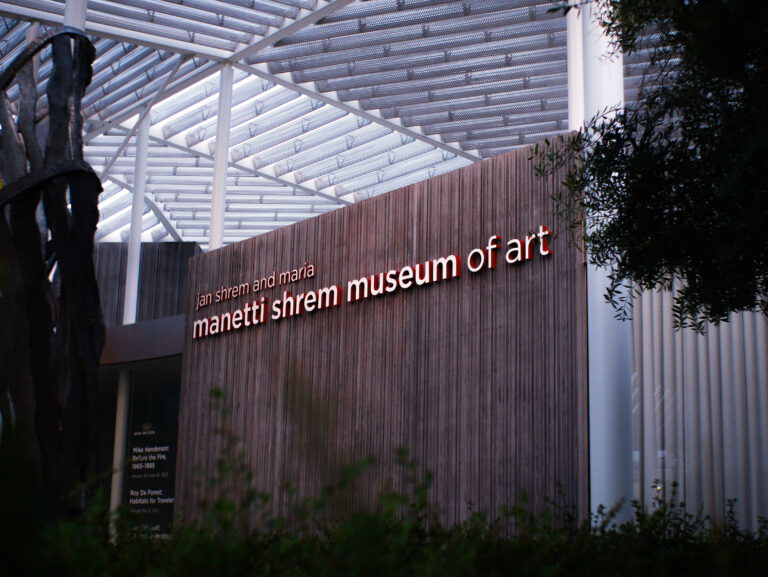
You may or may not know that we have a museum right on UC Davis’s campus. The Jan Shrem and Maria Manetti Shrem Museum of Art, or just the Manetti Shrem, is a fine arts museum that has super interesting, rotating exhibits, and it’s also free for students. Definitely take advantage of this awesome opportunity while you can.


Participate in the legendary Davis festivals

Throughout the academic year, UC Davis hosts a variety of different events and festivals. There’s Lawntopia and Sunset Fest, and recently, the Whole Earth Festival. And any conversation about Davis isn’t complete without mentioning Picnic Day. We think you should definitely aim to go to all of these, but if you can’t, make sure you go to at least one or two. You won’t get events like these anywhere else but in Davis!


These items only scratch the surface of what you can do and see in Davis. Check out our complete, printable bucket list here.


Written by: The Editorial Board

The new Snapchat AI is terrifying

AI cannot replace human connection


By AUDREY BOYCE — afboyce@ucdavis.edu


For years, social media has caused a whirlwind of controversy about how it can impact young brains. Humans hiding behind screens while communicating with each other has opened the door to many potential risks for upcoming generations. 

You probably think the words you are reading right now are written by a human being. Are you sure?

You open your Snapchat app, and at the top of the screen, you notice an update; pinned at the top of your chats is a Bitmoji titled: “My AI.” You click on it and realize it is formatted exactly like the rest of your chats with friends are. Curiosity takes over, and you type “hello” in the chat. Within seconds, an avatar pops up and says, “Hey, what’s good?”

Alarmed by this immediate human-like response, you continue the conversation. After a few minutes, you find yourself getting advice from the AI. 

You ask it, “Am I a good person?” Its response is, “Of course you are! Why would you think otherwise?” You ask further, “What’s your purpose?” It responds, “My purpose is to be your friend and help you whenever you need it.”

Users have sent over 2 million messages per day using the chatbot (My AI), according to Snapchat. The compelling and novel robot-friend is attention-grabbing to users, but at what cost? This AI feature may not be the end-all, be-all of valuing human interaction yet; however, to be forthright, that possibility terrifies me.

I am not ignorant of the fact that, eventually, robots will have the capacity to take over all of our human jobs and day-to-day basic tasks, but I was not ready for it to be able to mimic the role of an online “friendship” this quickly. Further, I did not think it would become available on one of the most popular social media apps for teens. 

Although a robot may be able to perform cardiovascular surgery and speak 500 different languages, a genuine human connection is not something that can be replaced so easily. Attempting to do so is harmful, especially to young teens using the app who may not understand the concept of AI and have trouble differentiating it from a human on the other side of the screen. 

“My AI” is a chatbot powered by ChatGPT, a very popular and advanced large language model. Many conversations with the AI feel organic and unique. However, it’s really no replacement for human conversation. The fact is, the advice or comfort that someone needs is specific to that individual. A human connection allows people to know and understand each other to an extent that a robot cannot. To receive advice from an entity that can only respond based on a series of algorithms is not to receive genuine advice. Human connections contain an element of empathy that artificial intelligence cannot embody.

According to UC Berkeley Neurotech, “It is possible for AI to learn how to detect emotions and demonstrate empathy; however, it is improbable for AI to connect with humans in the same way as humans do with each other.”

Developing human connections is something that is important in the healthy growth and maturity of kids and teens, and the Snapchat AI sets a dangerous precedent. As a society, we have to be more careful about how we go about implementing AI into our daily lives.


Written by: Audrey Boyce — afboyce@ucdavis.edu

Disclaimer: The views and opinions expressed by individual columnists belong to the columnists alone and do not necessarily indicate the views and opinions held by The California Aggie.

Attend the Art Spark events at the Manetti Shrem Museum

The classes come at no cost to the Davis community and provide a space for all to unleash their artistic side


By ANA BACH — arts@theaggie.org


Every weekend at the Manetti Shrem Museum, the Carol and Gerry Parker Art Studio invites members of the local and university communities to explore their artistic sides free of charge through various activities. The studio keeps these activities going from 12 p.m. to 4 p.m. on both Saturday and Sunday. 

Each month, the studio hosts a themed craft event. For the month of May, the subject is “Internal Landscapes.”

These afternoon explorations of creativity allow people of all experience levels to try different art mediums and discover what they like best. 

At the May event, participants chose how they wanted to map out a landscape of their choosing using watercolor. The environment was surprisingly intense, with many people picking their own paints and mapping out ideas.

The structure of the event is helpful, as there isn’t a given set of instructions or a formal time cutoff. Rather, people are encouraged to come and go at their own pace. There are different areas to sit and work around the studio, but again, since there are limited rules placed upon visitors, these are not the only spaces that attendees are free to explore. Once they have finished their work, participants can either bring it home or leave it behind to contribute to an artwork wall. 

If they hadn’t done so already, attendees are also encouraged to take a look at the Shrem’s exhibits before participating in an Art Spark event. Currently, the museum is offering “Mike Henderson: Before the Fire, 1965–1985.”

A “drop-in art program” at the Shrem used to exist before the COVID-19 pandemic. Due to the circumstances, they had to shut the program down but were eventually able to acclimate back to a comfortable state where people could make art while feeling safe. 

Art Spark events provide people with the ability to freely express themselves with the wide variety of flexibility that art provides. Other than the set themes for each month, there are really no other guidelines that need to be followed. 

The platform encourages people to feel that they can relax and table their stresses for the duration of the event. The program advocates for the need for art in our everyday lives to break our fixation on the hectic nature of the world around us and reminds us that art is for everyone. It is reassuring to know that there is a space to come on campus that welcomes both new and old faces with open arms and an array of art supplies to create just about anything. 

Written by: Ana Bach — arts@theaggie.org

City of Davis and Bike Davis host 13th annual Loopapalooza

Several local businesses come together to hold annual 12-mile bike loop


By ALMA CULVERWELL city@theaggie.org 


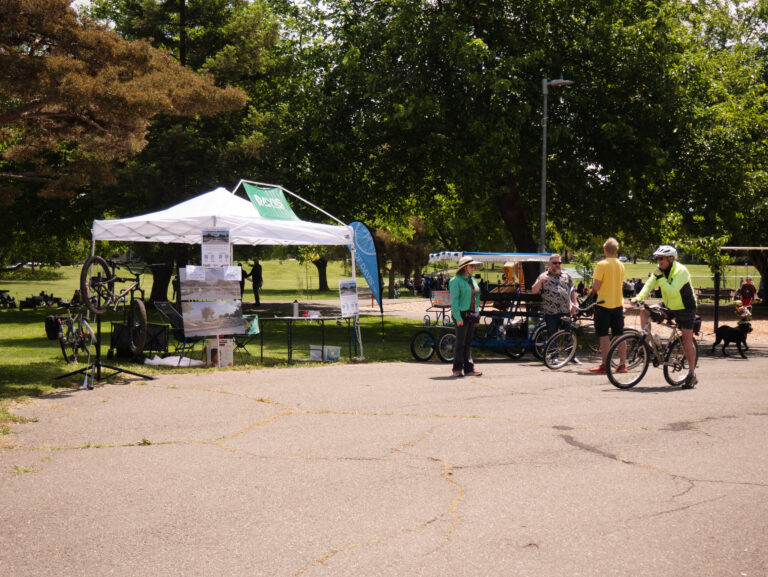
On May 7, the city of Davis and Bike Davis held their 13th annual Loopapalooza, a 12-mile bike loop with several stations along the way, each highlighting different local organizations. 

The celebration originally started in 2010 when community members and bicycle advocates realized that people needed better education and guidance on how to navigate Davis on bike. Loopapalooza allows Davis residents to familiarize themselves with bike routes and ways of transportation other than driving. 

This year’s celebration had a total of ten stations and hosted a wide variety of local organizations, including Ken’s Bike-Ski Board, Cool Davis, Bike Davis, ASUCD Bike Barn, The Bike Campaign and more. Participants were encouraged to ride in either direction and stop at any of the ten stations along the loop. Maria Contreras, outreach director for The Bike Campaign, shared her favorite part of the celebration.

“We love meeting people and answering lots of questions about their bikes and biking in Davis,” Contreras said. “We help riders learn how to notice that they are missing reflectors if their tires are flat or worn out, how to use a bike pump and see if their chains need to be lubed.  Keeping your bike in good working order is a skill that we are constantly teaching. […] Let’s all share the bike love and enjoy riding with our friends, family and other community members. Seeing each other and smiling is the best way to build community.” 

In light of the recent stabbings in Davis, the last station at Sycamore Park, which was the site of the second homicide, was omitted from the event. The Girl Scouts, who were scheduled to be at the Sycamore station, moved to another park in South Davis. Jennifer Donofrio, the senior transportation planner for the city of Davis, talked about holding Loopapalooza after facing uncertainty about the event in recent weeks.

“The biggest highlight was that people came out and enjoyed the day,” Donofrio said. “All week, we were stressed and unsure if the event would happen because of the recent crimes. After the press conference on Friday afternoon with police Chief Pytel about the suspect being captured, we were relieved and felt like we got our streets and pathways back.” 

In spite of the prior events, Loopapalooza still had a large turnout and was well received by community members. Donofrio talked about her favorite part of the event.

“[My favorite part is] seeing happy people bike around Davis and learn how to navigate the pathways,” Donofrio said. “I met several people last Saturday who were new to Davis and were participating in the event to become more confident using the pathways to get to places they want to go.” 

Written By: Alma Culverwell — city@theaggie.org

Tensions rise between local artists and clothing resellers in Davis

With clothing reselling gaining popularity, the Davis Art Market has made efforts to resolve artists’ concerns


By KACEY CHAN — features@theaggie.org 

Lea este artículo en español


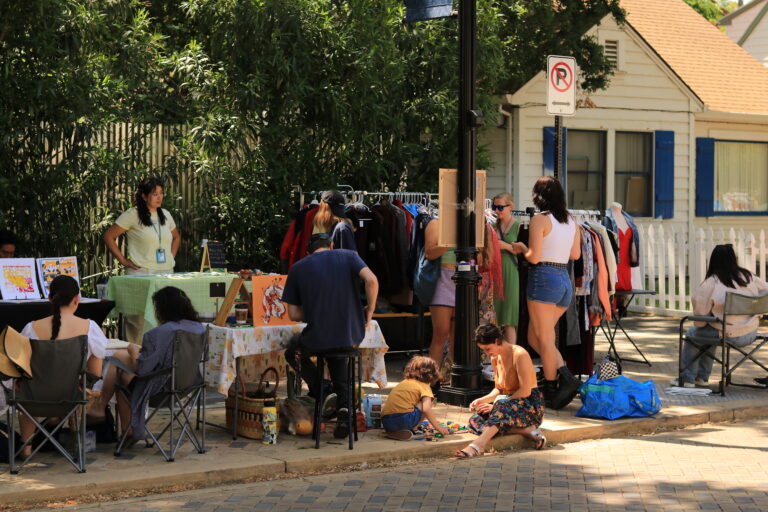
The vintage and art markets in Davis have been gaining popularity and the number of sellers has been increasing weekly, as clothing resellers recently joined the artists at the Davis Art Market.

Reselling has been on the rise these past few years. In 2021, Statista estimated the global market value of secondhand and resale apparel to be $96 billion. The secondhand market is expected to reach $70 billion by 2027 in the U.S. alone, aside from the countless other reselling markets around the world. 

Even fashion brands themselves have hopped onto the trend in the past decade. Labels such as COS, Lululemon and even luxury brands, like Coach, have launched resale programs for their own products in-house. Online platforms like The RealReal, Depop and ThredUp have soared in popularity to accommodate the new market of customers buying pre-loved items when searching to expand their closets. 

Thrifting has gained popularity online as well. On social media platforms, such as Youtube and TikTok, thrifting and reselling have become entrenched in the consciousness of younger generations. It is understood that thrifting is not just an option for buying expensive items at significantly lower prices; it is also a way to find unique, eccentric clothing different from what mainstream stores offer.  

“I have a shopping addiction, and reselling has become a good way for me to channel that,” said Mia Blake, a local reseller and student at Solano Community College. “I started thrifting and I ended up pouring all my energy into reselling.”

Blake usually shops at the same thrift stores, a couple of which are non-profits to help the unhoused community in Vacaville. It has become a fun side business allowing her to channel her passion. 

“I choose things that fit my style and are cute,” Blake said. “I’m obsessed with slip dresses and lingerie, and I find it is more enjoyable to select clothes to sell in that way.”

Blake also added that — in regard to the business side — it is far easier to estimate the value of clothing if it is a product she is familiar with. For Blake, there is a creative and personal merit to curating clothes to resell. Through thrifting, resellers are able to have fun and tailor a personal brand image all while making money as well. 

“While starting is super difficult, and I did have to spend a lot of money to acquire enough stock, I would 100% say I get a good return for the time and energy I put into this,” Blake said.

However, there has been criticism online of the proliferation of thrifting and reselling in recent years. Some call this the “gentrification” of thrift stores, wherein low-income shoppers have been priced out of their local options because of the increased popularity of secondhand reselling. This criticism, it seems, is mostly targeted at the extremes of this trend, in which resellers build up excessive stock and then mark them up to “turn a profit,” according to a Vox article on the topic. 

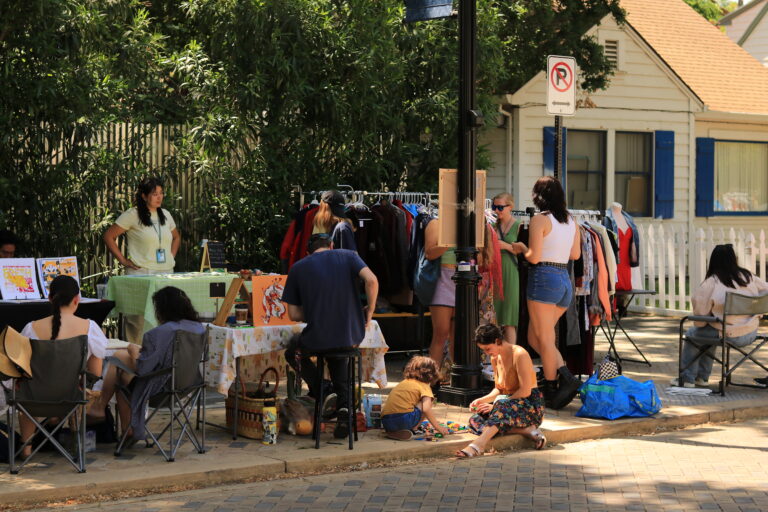
The Davis Art Market is a popular event on 3rd Street that features not only vintage clothing resellers but also many local artists in Davis. 

Sofie Kanayama, a fifth-year design and Japanese double major, is a local artist who used to sell ceramics at the market. 

“I first started selling last school year during winter,” Kanayama said. “I volunteered at the craft center and I was able to take a free class there.” 

Since then, she said she has grown to love the craft. But according to Kanayama, the commitment doesn’t match the profit. 

“I totally don’t get a good return for my time and energy at all,” Kanayama said. “Because I rely on the community studio, it can sometimes take up to even a month to make one piece, so the money is nothing in comparison to the time required.” 

Kaiden Zaldumbide, a fifth-year art and theatre double major, agrees with the lack of profit turned at markets.

“Of course, I sell my art, but there is ultimately a curse to art, and it is difficult to be incredibly profitable unless I become super famous,” Zaldumbide said. 

While it is often common for events such as the SoSo Market in San Francisco and Berkeley or the SacTown Market in Sacramento to host both clothing and craft vendors, some in the community have raised concerns over how each type of seller should be regarded by the market organizations. 

“When you see my products, you’re not just seeing the thing I made in the moment but also the years of education and practice that went into getting my skills to where they are today,” Zaldumbide said. “While what clothing resellers provide is certainly still labor, you’re not creating something new, which is a whole other skill set.” 

There is also the concern of promoting your work as a small, local artist. While local markets like the Davis Art Market may have had fewer clothing vendors in the past, they have clearly multiplied, naturally bringing in what is popular — clothing and fashion. 

“What makes artists different is that there is more of a navigating process in terms of customer engagement,” Zaldumbide said. “For a reseller, if someone has bought the piece of clothing in the past, then someone will buy it again.”

Zaldumbide said that going to the market almost seems like a full-time job because a large number of sellers means there is a lack of space on 3rd Street.

“You have to wake up super early to be sure you get a good space, and now that the market is open until 3 p.m., going there and setting up is a far bigger effort,” Zaldumbide said.

While a key attraction for the market has been its freeform nature, for both artists and vendors, some have said that ground rules do eventually need to be set up.

“The street market is more of a ‘do-your-own-thing’ vibe because there isn’t a market manager, and you don’t have to pay a vendor’s fee,” Kanayama said. “This is what attracted me to the event at first, but since then, I have found it too difficult to sell there.”

Because of these concerns, the market has recently taken a more administrative approach. According to a post made by the market organization’s Instagram account, @davis_street_market, on April 28, a new rule has been established delegating one half of the street to clothing resellers and the other half to local artists. 

“I think, ultimately, the heart of the issue is the tension between resellers and artists and the lack of space on 3rd street, which can heighten things,” Kanayama said.


Written by: Kacey Chan — features@theaggie.org 

UC Davis study finds coal trains are significant polluters in the east San Francisco Bay Area

Coal trains give off more fine particulate matter than other trains, disproportionately affecting vulnerable populations


By LILLY ACKERMAN — science@theaggie.org 

Lea este artículo en español


A study from researchers at UC Davis’s Air Quality Research Center (AQRC) has quantified the pollution from coal trains running through Richmond, California, a city in the San Francisco Bay Area. 

The study is the first to quantify pollution from coal trains in an urban area in the United States. It specifically focused on quantities of fine particulate matter (PM2.5), or particles less than 2.5 microns in diameter.

Richmond is a racially diverse city of about 115,000 residents that is faced with high rates of asthma and heart disease. The study aimed to determine whether Richmond’s coal trains and terminal are a significant source of PM2.5 amid discussion of building a new coal terminal in nearby West Oakland. PM2.5 has already been shown to have negative health effects for those exposed to it.

“Exposure to PM2.5 has been linked to premature mortality, cardiovascular, cerebrovascular, and respiratory diseases, other chronic diseases, adverse birth outcomes, and cognitive and developmental impairments,” the study reads. 

The authors needed to measure how much PM2.5 was being released from coal trains versus other types of trains passing through the site being studied, according to Dr. Nicholas Spada, a researcher with the AQCR and co-author on the study. However, he expressed that it was not feasible to manually take the necessary data recordings, since coal train arrival times aren’t publicly available for privacy and security reasons. 

To combat this, the researchers set up a camera alongside a small weather station and an air quality sensor. The camera system, programmed with artificial intelligence that Spada developed, would detect trains passing through and trigger the air quality sensor to record measurements from the different types of trains. Full and empty coal trains, freight trains and passenger trains were of interest. 

“There was literally nothing in existence that could solve this problem for us, so we created [a solution],” Spada said. “And it worked! We were able to capture these train events and measure the difference in pollution, and it turns out that there is a difference.”

The results were significant when comparing PM2.5 emissions from coal trains to those from freight trains, according to Dr. Bart Ostro, a scientist with the AQRC and the lead author of the study. 

“We did find, not surprisingly, increases in PM2.5 [from coal trains passing through] that were greater than the increases that occur from freight trains [passing through],” Ostro said. “With calm winds, we saw very large increases relative to freight trains. It’s pretty convincing.” 

Compared to ambient conditions, coal trains added about eight micrograms per cubic meter of PM2.5 to the air. Even coal trains that have been emptied added up to two micrograms per cubic meter. Passenger trains gave off relatively little PM2.5.

This research has important environmental justice implications; coal transport and processing have disproportionate impacts on already economically disadvantaged populations throughout the United States. 

“It’s a big issue that nationally, as well as in the Bay Area, these coal trains will typically go through low-income areas,” Ostro said. “These people already tend to have higher rates of asthma and heart disease, so the fact that they have pre-existing morbidity makes them much more susceptible to additional insults [such as pollution from coal trains].”

Ostro also noted that there is no truly “safe” threshold of PM2.5 concentrations for human health. As long as coal is transported and processed, it will consistently pose a health risk.

“Of note, exposure to PM2.5 constitutes an environmental justice concern as exposure and adverse effects are borne disproportionately by the most vulnerable, including infants, children, the elderly, people of color, those with low incomes, and those with underlying health conditions,” the study reads.

Promisingly, Spada’s artificial intelligence can be adapted to detect almost anything that the human eye can see, from oil-refinery flares to automobiles. It can be used for a variety of environmental concerns where it is most needed, from other parts of the Bay Area to locations nationwide that process and transport large amounts of coal, such as Baltimore, Maryland. 

“We’re actually moving it to Vallejo, where we’re going to watch some of these other sources that the community is concerned about,” Spada said. “So we can easily adapt it to other situations.”


Written by: Lilly Ackerman — science@theaggie.org