53.5 F
Davis

Davis, California

Tuesday, December 23, 2025
Home Blog Page 182

Culture Corner

The Arts Desk’s weekly picks for music, movies and more 


By CLARA FISCHER — arts@theaggie.org


Album: “SOS” by SZA (2022)

SZA’S debut album, “CTRL,” was formative during my teenage years, so it’s only fitting that her sophomore follow-up is ushering me into my twenties. “SOS” truly feels like a big sister album to “CTRL,” with the same soothing harmonies and mellow R&B-inspired beats but slightly elevated lyricism. The songstress takes us on a cohesive, harmonious journey through the turbulent emotions that come with breakups, makeups and the lonely periods of solitude in between. Standouts include “Love Language,” “Special,” “Gone Girl” and, of course, the TikTok-famous “Kill Bill.” 


Song: “Did you know that there’s a tunnel under Ocean Blvd” by Lana Del Rey (2022)

After a somewhat disappointing last album, Lana Del Rey has returned with aplomb. “Did you know that there’s a tunnel under Ocean Blvd” is the singer at her best, with emotionally gripping lyrics, a beautiful vocal buildup and solid production. I will warn you though: this song did make my housemate and I cry during finals week studying, so listen at your own risk of emotional damage.


Movie: “How to Lose a Guy in 10 Days” dir. by Donald Petrie (2003)

If you’re anything like me, then you’re a sucker for a good rom-com — and this 2000s classic starring Kate Hudson and Mathew McConaughey ticks all the necessary boxes. Aside from stellar performances across the board, this film provides an escape from everyday life into the busy world of Andie Anderson, an aspiring journalist who is tasked with writing a piece detailing how to “lose a guy in 10 days,” and Benjamin Barry, a womanizing worker in advertising who is bet that he can’t make a woman fall in love with him by the next company party. The two meet, and naturally, fall in love despite all odds. 


TV Show: “Jersey Shore” (2009-2012)

If there’s one show that my roommates and I can always agree on watching, it’s this classic reality TV hit. The antics of these guidos and guidettes, while usually problematic, is undoubtedly entertaining and makes for a great watch when you need to take a break from reality for a little bit. I highly recommend gathering a group of your friends and sitting down together for a good ol’ trip to the Jersey Shore. 


Written by: Clara Fischer — arts@theaggie.org

Historic unionization election at Peet’s Coffee locations in Downtown and North Davis scheduled for this month

What you should know about the upcoming unionization election at the two Peet’s Coffee locations in Davis on Jan. 17 and 20


By ANTHONY W. ZAMMIKIEL  — city@theaggie.org


On Nov. 29, the Peet’s Coffee locations in Downtown and North Davis announced in a joint press release that the cafes have filed a motion with the National Labor Relations Board (NLRB) to schedule an election to decide whether the employees at each location are to unionize. 

According to the official press release, “Workers are joining a growing wave of unionization at coffee chains across the country, following the precedent set by workers at coffee companies like Colectivo Coffee, Starbucks, and Spot Coffee. Peet’s workers are filing their locations with Workers United-SEIU, the same union that represents Spot Coffee and the Starbucks Workers United campaign. Workers cited being inspired by organizing Starbucks workers as a key motivation for their organizing efforts.” 

The press release continues, “There are 208 corporate Peet’s locations in the United States, with a vast majority of the stores located in the state of California. If successful, the North Davis and Downtown Davis locations will be the first corporate Peet’s cafes to successfully unionize.”

Schroedter Kinman, Alyx Land, Trinity Salazar and Molly Green, the leading organizers of the filing by two Peet’s Coffee locations, explained that there are multiple reasons why the employees at each location are organizing for union representation; however, the primary reasons are their desires for better pay and scheduling practices.

“You’re onboarded at minimum wage, and after a month or so of training you’re promoted to barista, which is paid 50 cents above minimum wage,” Kinman explained. “The work we do as baristas — taking orders, preparing food and drinks, filling bean orders, cleaning equipment with special chemicals, keeping the store clean and up to health standards, acting as de facto IT specialists when people have trouble with our mobile app, de-escalating the few customers who are unruly, all while having proficient knowledge in the coffee roasting process and basic flavor profiles of coffee blends — it deserves more than $15.50 an hour, especially when places like McDonald’s and In-N-Out are now offering starting wages at $17.”

Kinman said that employees desire an increase of labor hours as well, sharing that ongoing national inflation rates have caused an 8% decrease in wages over the previous year and that employees need more labor hours to continue being able to afford basic necessities. 

We’re also so short-staffed, so if more than a couple of people come down with a cold, we can end up shutting down the whole store because we just do not have the people to stay open,” Kinman shared. “Some readers might remember when we had to shut down [the Downtown Davis location] last month for half of finals week. That was all because a cold was going around and not enough people were available to keep the store open. Those of us who were working those short-staffed days were worked to the bone and received no compensation for doing the work of multiple people in a shift.”

According to Kinman, managers operating at both Peet’s Coffee Davis locations have employed various tactics to discourage unionization activities, like “suddenly promising to revamp the [human resources] HR system so we can get better pay and benefits without a union, sowing fear of unions with personal anecdotes of bad experiences with them, bringing in higher-ups from corporate to watch us while we work and talk to employees one-on-one about the dangers of unionizing, promising they can change, etc.,” Kinman said. “Higher-ups have even taken employees out to eat on their dime to talk about their concerns of unionizing.” 

The unionization elections have been scheduled for Jan. 17th and Jan. 20th. The leading organizers at both Peet’s Coffee locations in the city of Davis asked that supportive community members support their efforts by fostering community engagement.

“Come in, order something cheap and easy like a drip coffee or iced tea, tell us how stoked you are to hear we’re unionizing and leave a tip if you’re able,” the organizers said. “It will show your support, keep the store profitable so we don’t get shut down and put a little extra money in our pockets to help fight inflation. Another thing folks can do to support is DM a solidarity statement to @peetsunited on Instagram. We’ve been posting anonymous support for the union, and we’d love to hear more from the community about why they love Peet’s and how much they want to see us unionize.”


This is a developing story. Election results will be published after the results are confirmed and released.


Written By: Anthony W. Zammikiel  — city@theaggie.org

Your grandma may not be that homophobic after all

Give your queerphobic family a chance this winter break, and be the bigger, gayer person if you can


By KOMOLIKA INDRANIL BASU — ibasu@ucdavis.edu


TW: Homophobia, queerphobia


As one of the very few students who actually lives with their family in Davis and is staying back here for the break while seeing the campus become a ghost town, I’m realizing that all my queer friends are facing their own versions of a “happy holiday” at their homes. In a country where four in 10 LGBTQIA+ adults are rejected by their family or friends for being queer, we have to deal with our generally queerphobic families and do some conflict work when we’re back home for the holidays. With my mother in Davis this holiday season, I can’t help but reminisce about how our relationship changed over the last break. 

I came out as gay to my mom around three years ago. I thought she’d take some time to understand, but being my mother and loving me unconditionally, she would eventually come to support me. My mother and grandmother have been huge influences on me, and I thought they’d be happy to see me become more like them while embracing my femininity. But I was wrong. 

My relationships with my mother, and even my grandmother, were greatly affected by my coming out. They wouldn’t allow me to do anything related to my queerness: I couldn’t own it, talk or write about it, do my makeup, paint my nails, dress androgynously, post pictures on Instagram or engage with queer content. I knew that these things were each a huge deal for them as part of a very binary, cis-heteronormative patriarchal society in India, so I tried to ease them into it, but it didn’t work.

 Last winter, I came to the realization that I am trans-feminine and largely reached the conclusion because of the questions my mother was asking me about my gender identity. When she was expecting me, my grandmother prayed that I would be born a son and was overjoyed when I was assigned male at birth, so I see why they feel let down by my trans identity and choice to live openly as a trans person (as much as I can within my circumstances). Maybe they feel that I am voluntarily giving up all the privilege I got by “being born a man” and instead “choosing” to live a much harder life. I had stopped speaking to them on and off in my freshman year as it was hard to talk to them while I was struggling with my identity myself. 

However, things changed this summer when I went back to Kolkata in India and stayed with my mother and grandmother for four months. I was made to cut my hair short, remove my nail polish and not go out much. These might seem like very small things when queer people are facing so much violence elsewhere, but they still mattered to me. 

I became bitter about their lack of acceptance, and I ended up moving every conversation toward the fact that they did not accept and support me as a queer child. We would have arguments about it because almost every aspect of me — the art I make and the cinema I study — stems from my queer identity and its oppression in some way. I thought that if my own parents don’t support me, how will I be confident in myself and how will the world ever accept me? And as I was suffocating in the lack of freedom of gender expression, I saw this spoken word poem by one of my favorite poets and people, Alok Vaid-Menon, called Trans/Generation, in which they speak of a similar experience but react very differently.

Vaid-Menon says, “Today my grandmother calls me the biggest disappointment in her life,” referring to their queerness and gender-non-conforming expression. “I recognize this not as a form of my own gender oppression, it is hers / You see, I come from a long legacy of women punished by men, who continue to push the man inside of me / How good it feels for the hurt to hurt someone else.” They go on to say, “I refuse to call my grandmother transphobic / I will not blame her for her own violence / Instead I will join her […] / And there is solidarity in this silence / And there is resistance / In our refusal to pretend we are both something we are not.” 

This made me think a lot about how my family, too, is only acting from a place of what they know and have experienced in the past. They cannot understand what I’m trying to ask of them, or even why I’m asking it. I know that they are worried about me facing the world as a queer person, as any discussion of or reference to queerness they had been exposed to was extremely negative. 

Bollywood movies or TV serials contain few gender-non-conforming characters who are often portrayed in stereotypical and problematic ways. Further, distant friends my family members had who were rumored to be queer ended up in bad domestic circumstances. A lot of their negative reaction to queerness comes from social conditioning and not having seen anyone express themselves like me before. If I am struggling so hard with my own identity because I am forced to face it and am scared of the world as a queer person, I can imagine how much they, who are not in my shoes, would struggle with coming to terms with my identity. 

This, coupled with some other TV and cinema I saw where queer children are bearing with and forgiving their parents for not being able to deal with their queerness, inspired me to take a deep breath and stop begging for their acceptance. The main offense they did was to not accept me or support me for my queerness, but I missed their silent acts of support in letting me do other things and all the other ways they loved me: the way my grandmother hid the best mangoes in the high kitchen shelf from the rest of the family this summer to save them for me, or argued with other relatives defending my other stupid actions, or the way they loved listening to me sing. I realized that I needed to accept myself first and give them some space. 

So I let go of their snide comments and only explained things once, ignoring them if they didn’t understand. Instead, I spent my time loving and letting myself be loved in whatever way we could love each other. I felt the rage I had experienced for so many months leave my body to be replaced by self-acceptance and fortitude. This approach helped my whole relationship with my mother and grandmother, as well as my own mental health, and made them look at the issue in a different light where I wasn’t projecting or pressurizing them to be there for me in a particular way.

Now, having moved to Davis and living with my mother, and regularly calling my grandmother, they have become more accepting as I keep making my own choices related to gender expression. Even though they question them and may not vocally support me, I can feel them slowly and silently standing with me, as they see me be more organically myself, and see my peers and faculty on campus at UC Davis supporting me. They see that I can be myself in a safe and accepting environment in ways that they had never seen before. I know that a lot of what they say, comment or ask of me isn’t fair or healthy for me, but I strive to find a balance and look at the brighter side. Their love for me might not be unconditional but it is still immense and they are my two favorite people in the world. 

I reached out to Angel Bernardino, the trans advocate and Student Services specialist at the UC Davis LGBTQIA Resource Center, and asked for some advice on how queer people can deal with our families when we’re back for the holidays. 

“Identify who your allies are,” Bernardino said. “Often, LGBTQIA+ people are outnumbered around their family, and allies can act as a buffer to some of that pressure. Don’t underestimate the importance of creating a chosen family. Not everyone has a supportive biological family and that is okay. A chosen family can provide a sense of belonging and security, and everyone deserves that. Most importantly, know when it is time to step out. No amount of familial approval is worth having to put up with verbal or physical abuse. While my experiences have only been verbal, queer hate can become violent. Having constructive conversations with people willing to listen is great. Knowing when to remove yourself from a harmful situation is even better.”

Although families may be ignorant, hurtful or hateful, remember that sometimes ignoring that part could help to maintain a relationship with a (hopefully mostly loving) family, and, sometimes, your grandma is not homophobic but just extremely conditioned and unknowingly continuing a tradition of queerphobia. Maybe give your family a chance this winter break, and be the bigger, gayer person. See if you can find your own solutions to dealing with your queerphobic family. That may be by ignoring parts of them while appreciating others, understanding where they’re coming from and letting them be unconditioned, or something more drastic based on your situation. No matter what, make sure to always prioritize your own safety and mental health, as Bernardino said, and navigate accordingly.

Happy Holidays to everyone (especially my queer friends)! If you need support dealing with any form of queerphobia, I’d recommend you to reach out to our campus LGBTQIA Resource Center or email Ms. Bernardino at aabernardino@ucdavis.edu


Written by: Komolika Indranil Basu — ibasu@ucdavis.edu

Disclaimer: The views and opinions expressed by individual columnists belong to the columnists alone and do not necessarily indicate the views and opinions held by The California Aggie.

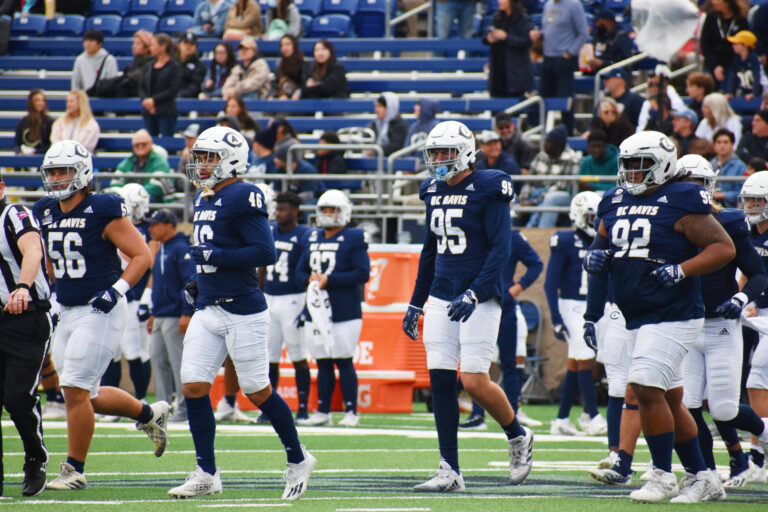
Despite slow start, UC Davis football finishes season with winning record

The Aggies miss the playoffs in the final game of the season against Sacramento State


By MARLON ROLON — sports@theaggie.org


Before the season started in a media press conference, UC Davis Head Coach Dan Hawkins claimed that this was the best football team in Aggie history. 

With that statement, all eyes were on UC Davis as they faced Cal in the season opener in Berkeley. Hawkins’ team looked promising in the game’s opening minutes, with the offense marching down the field to score a touchdown. It wasn’t just the offense that looked good though; Aggie defense took to the field, almost immediately stopping the Berkeley offense with an interception. Despite leading 7-0 in the first quarter, Cal beat UC Davis 34-13 in the contest. 

Then, the Aggies traveled to Brookings, South Dakota to face South Dakota State. UC Davis got off to a slow start and trailed the Jackrabbits 17-10 heading into the fourth quarter. The Aggies’ second-year quarterback Miles Hastings was throwing dimes, including a 68-yard pass to second-year running back Lan Larison. UC Davis outscored the Jackrabbits in the fourth quarter 12-7 but ultimately fell short (22-24) as the clock expired. A strong performance against a team that makes the postseason year in and year out proved that the Aggies had a strong unit, but the team’s record fell further to 0-2. 

In game No. 3, UC Davis claimed their first victory of the season. The Aggies played their first game at home against UC San Diego (UCSD) and gave the home crowd something to cheer about, beating UCSD 43-13. The win provided relief as the Aggies prepared to begin their Big Sky Conference schedule. 

UC Davis then hosted Weber State. The Wildcats reached the 2022 FCS postseason and defeated the North Dakota Fighting Hawks in the first round in a close game that came down to the final play. The Aggies’ offense struggled against the Wildcats’ defense, which held UC Davis without a touchdown until the third quarter, in which Hastings attempted to go for a failed two-point conversion. Despite this, UC Davis still had an opportunity to win the game in the final drive on Weber State’s 15-yard line; however, the defense held up and Hastings failed to throw the winning pass into the endzone. The Aggies fell to 1-3; those three losses were against a Pac-12 team and two teams in the FCS who are top contenders.

With one of the most difficult scheduled opponents in the FCS, things didn’t get easier for the Aggies. The Montana State Bobcats, their next opponents, were 4-1 before they played UC Davis. 

Despite being on the road, the Aggies got off to a strong start in the first quarter as fourth-year star running back Ulonzo Gilliam Jr., sprinted for 38 yards into the endzone, putting Davis up 7-0. UC Davis led 10-7 after the first quarter, but never led again, as the Bobcats roared back to win the game 41-24. Gilliam Jr.’s stellar performance was the bright spot in the game, as he rushed for 140 yards and scored a touchdown. The Aggies fell to 1-4, and their playoff hopes dwindled. 

The team looked like a far cry from the team that got off to an 8-1 start last season. With six games remaining, UC Davis needed to win all of its games to make the playoffs. By losing four of the first five games they played, that seemed like an unlikely feat. Regardless, Hawkins remained optimistic about his team’s chances. 

“It’s time to get on a roll,” Hawkins said in a post-game press conference after his team’s loss to Montana State. 

UC Davis did just that, beginning with a 56-27 win over Northern Arizona. The team’s offense was rolling with Hastings at the helm; he threw for 328 yards and had two touchdowns. Gilliam Jr. was also running the ball well, gaining 152 yards and scoring two touchdowns.

“It’s really impressive how they all stuck together to get a win like this. We got a bunch of guys into the game, and that was great, and we were able to score in a number of different ways,” Hawkins said. “Now, we just have to keep dialing it up and get ready for the next game.”

UC Davis built momentum one game at a time. They traveled to Colorado and defeated Northern Colorado, 58-10, improving their season record to 3-4. Once again, the team’s offense was fluid and certainly looked more like a playoff team.

“Our guys are getting some momentum, and a win like this helps build confidence,” Hawkins said. 

For the third straight game, the Aggies would score above the 50-point mark to beat Cal Poly 59-17. With each week, Hastings looked more comfortable in the pocket as he posted 425 yards along with four touchdowns. A strong run game is another reason the offense was starting to get on a roll. Gilliam Jr. rushed for 139 yards and two touchdowns, and his longest run of the day was a 59-yard rush. The offensive line’s dynamic was causing teams trouble and was the perfect recipe for UC Davis’s team, who was seeking a chance to sneak into the postseason. 

“Our offense has found its groove,” Hawkins said. “We’re cooking in the pass game and in the run game. And the defense is getting turnovers and setting the offense up with great field position.”

The Aggies continued their win streak, defeating Idaho State and improving their record to 5-4. Davis’s defense was hot in this contest, allowing Idaho only three points for a final score of 43-3. 

The offense turned up yet again this time against the Idaho Vandals on the road and UC Davis extended their win streak to five straight games, defeating the Vandals 44-26. The run game was a major factor in the win; Gilliam Jr. rushed for a staggering 164 yards and three touchdowns. This game was special for Gilliam Jr., who broke the school rushing touchdown record of 40 that was held by Preston Jackson since the early 1990s. 

“We’ve been on a five-game playoff run with one more to go, so we have to win it to stay in it,” Hawkins said after defeating Idaho. “But it’s not really so much about winning as it is about playing well, and that’s what we did tonight. We were very efficient on offense, and we didn’t turn the ball over. Any time you can do that, you’re going to be successful.”

The win moved the Aggies to 6-4 on the season, and with five straight wins, UC Davis earned a ranking of No. 24 in the country for the FCS. With their impressive win streak, maybe this was the best team in Aggie history — Hawkins’ statement didn’t seem so far-fetched. 

UC Davis had to win one more game to reach the postseason, but it was going to be on the road against their undefeated rosstown rivals who were ranked No. 2 in the country: Sacramento State.

In a back-and-forth contest, UC Davis’s offense kept up with the Hornets’ offense the entire game. Going into the fourth quarter, the Aggies trailed 13-17, but Sac State’s fourth-year quarterback Asher O’Hara flipped into the endzone for what seemed to be a game-winning touchdown. However, Aggies second-year tight end Josh Gale caught a pass from Hastings and ran it into the endzone for 75 yards. UC Davis then converted on the two-point conversion, shrinking Sac State’s lead, 21-24. 

However, the Hornets held on to the win. The final score was 21-27, and the Aggies’ season came to an end in dramatic fashion in the final seconds of regulation. 

“I told our guys afterward I love them. I love them a lot,” Hawkins said after the game. “But most games and most seasons are made by a few plays that decide which side of the ledger you’ll end up on.”

UC Davis came to a touchdown away from winning the game and extending their season into the playoffs. Despite having the toughest schedule in program history, they managed to end the season with a winning record (6-5). They overcame a 1-4 start and proved that maybe this really was one of the best teams in program history. 


Written by: Marlon Rolon — sports@theaggie.org


Commentary: Ye’s fall from grace: Why the art cannot be separated from the artist this time around

Even amidst a double standard of scrutiny, this dangerous narrative must be condemned 


By RUMA POUDELL — arts@theaggie.org


American rapper and fashion designer Ye, formerly known as Kanye West, has come under fire for a recent string of antisemitic and racist comments and actions.

These include instances such as the time Ye wore a t-shirt with the slogan “White Lives Matter” printed on it, which is an organization created to uphold white supremacy in response to the Black Lives Matter movement. He also voiced his false belief that George Floyd’s death, proven to be at the hands of law enforcement, was instead due to the drug fentanyl.

Most recently, he appeared on a podcast on which he claimed to “see good things about Hitler,” amongst other brazenly antisemitic comments. This blatant display of hatred led to many companies, colleagues and others publicly cutting ties with the 45-year-old musician.

“These kinds of horrible statements have no place in our public discourse,” said Kevin Johnson, the dean of the UC Davis School of Law. “[His actions] demonize and demean real people with real emotions, even if you can’t snuff it out.”

Ye was once a figure that many looked up to for his deeply personal music and cultural presence, as well as his lyrics that offered meaningful insight into race issues in the U.S. Having someone like this begin to perpetuate such hateful and violent rhetoric can be emotionally damaging for some. 

In addition, certain reactions to his actions perpetuate the harmful notion that people with mental health disorders are “crazy” and something to gawk at rather than understand, empathize with and seek to help. Ye has notably brought his bipolar disorder diagnosis into the public eye — a decision that has arguably shed light on the shortcomings of modern society in terms of understanding mental illness. Public perception of the rapper’s diagnosis is varied, with Ye himself even noting that “‘crazy’ is a word that’s not gonna be used loosely in the future.” 

Those with an understanding of bipolar disorder may sense that his recent outbursts might be a result of a manic episode and might show a dire need for medication or counseling. However, his mental health disorder should not be an excuse for his offensive actions and use of discriminatory language. Some mental health experts have stated that mental illness does not excuse harmful behaviors, especially on such a large scale; it simply provides some explanation for why someone may be acting a certain way.

Likewise, just as it is vital to be sensitive when discussing mental health concerns, it is also critical to consider the increasingly dangerous implications these episodes can have on others.

 “We’ve seen […] other related areas where hate speech can also lead to hate violence,” Johnson said. “We saw President Trump target Chinese people using racist tropes and stereotypes. After that, we saw a great increase in hate violence directed at Asian Americans.” 

So, what can we do to challenge this rhetoric? Well, according to Johnson, both individuals and businesses can choose to disengage with the artist’s content. 

“If you don’t like the language of a particular artist, one way of registering that objection is through taking your business elsewhere,” Johnson said. 

Following this line of thought, Adidas has cut brand deals with Ye, and so have other influencers, partners and even banks — but what about what we can do as individuals? 

“It’s really a gray area,” said Yuri Khadka, a second-year law student at McGeorge School of Law. “Separating art from the artist boils down to personal morals; we can be wary of technical validity for his actions and claims and how it can be used to cover up bigotry.” 

The pushback against Ye is justified, but it also raises a question: why does society seem so quick to push back against African American public figures when they come to face criticism?

“In some ways, it seems interesting to me this comes around the same time as Kyrie Irving’s suspension for similar hateful comments,” Johnson said. “It is the case that the people who seem to be subject to punishment and attack right now are African Americans, when others use similar distasteful language and don’t suffer repercussions; President Trump being one of them.”

While Ye may be entitled to his own perspective, there is a difference between an opinion and dangerous hate speech. Hopefully, given the severity of the comments made by him in the past few months, we will see increased backlash from the public. This kind of violent and outright dangerous narrative should not be accepted, regardless of how talented the person propagating it is. 

Written by: Ruma Poudell — arts@theaggie.org

Yolo County, city of Davis and UC Davis launch ‘Hate-Free Together’ campaign

Increase in hate crimes results in resolution to eradicate hate through community-based program


By LA RISSA VASQUEZ — city@theaggie.org


On Nov. 30, Yolo County, the city of Davis and UC Davis signed a collaborative resolution to build a campaign called “Hate-Free Together.” The campaign aims to combat discrimination in the community by educating businesses, public agencies and individuals about how they can be agents of compassion.

Mayor Lucas Frerichs talked about the discussions he had with Chancellor Gary May and Yolo County Supervisor Don Saylor leading up to the resolution. Mayor Frerichs said discussions became more serious after antisemitic banners were hung across the Blue Ridge Road Bikeway and Highway 113 overpass on Aug. 28.

“We were all very troubled by some of these incidents,” Frerichs said. “The banners [are] one thing. Both on campus and in the community, there have been a number of instances of swastikas popping up [as] graffiti in different locations both on campus and [at] apartment complexes and around the community. I think those have definitely been a real concern.”

According to the California Department of Justice’s annual report on hate crimes, Yolo County recorded 21 hate crime events in 2021. Yolo County Supervisor Jim Provenza said that he believes a united resolution such as Hate-Free Together sends a powerful message.

“People who are victims of hate, whether it be graffiti or a physical attack or [an] attack on property, […] feel very unsafe and insecure and also very alone,” Provenza said. “And we found that by putting the county and the city and the university behind the resolution, it’s telling [people], ‘No you’re not alone; we’re with you, we support you and we’re going to take whatever steps we need to help you.’ So the resolution in and of itself is important.”

Workshops will be held in the early months of 2023 to gauge the community’s needs. Some of the resolution’s goals will be to create zero-tolerance policies, offer cultural competency training and provide resources on how to report when incidents of hate occur in the workplace or at schools. Supervisor Provenza said that the campaign revolves around education, prevention and understanding the consequences of hate. 

“When an incident does occur, we need to have a plan [for] getting together as a community, not just government but [as] community leaders [or] religious leaders, and it should be something that kind of happens automatically,” Provenza said. “On the civil side, there’s some pretty strict sanctions for this type of behavior. A person can sue for punitive damages, meaning that even if you can’t show that you lost money or lost property, you can still recover damages. Most importantly, it tells a person committing the act that ‘Yeah, there is a consequence,’ and I’d like to see volunteer attorneys be ready to go into action.”

Davis City Councilmember Gloria Partida said that the early stages of the initiative allow for full community input and exploration of their ideas and needs.

“As a community, you do need places where you can process hate incidents or other issues that are happening and talk about ways that you can be proactive [and] ways that you can do things so that we are building communities where everyone feels safe [in] their identities,” Partida said. “And right now, it’s so new and so wide open that it’s kind of the exciting part about it; it can be anything that we think will work, and [we can] also explore.”

An official campaign website for Hate-Free Together and more information will become available in the coming months. Members of the community are encouraged to stay connected and provide input for the campaign.


Written By La Rissa Vasquez — city@theaggie.org

Low voter turnout in ASUCD fall 2022 election sparks plans for improving voter participation in upcoming elections

Following the failure of the TGIF ballot measure despite popularity, ASUCD senators reflect on what can be done to increase turnout in the future 


By LILY FREEMAN — campus@theaggie.org


The fall 2022 ASUCD elections had a historically low voter turnout of 5.58%, according to the ASUCD elections website, with less than 2,000 undergraduate students participating in the election. The site also outlines that voter turnout has been consistently below 20% since the spring 2016 election, with the exception of the winter 2019 election. 

The ASUCD elections have a significant impact on students whether they vote or not, according to Senate President Pro Tempore Gaius Ilupeju, who encouraged students to vote in future elections.

“The senate candidates […] approve an $18 million budget that is assembled through student fees and allows for the continuation of services like Unitrans, which is utilized not just by undergraduates but the entire city of Davis and other vital services like the CoHo and the Pantry,” Ilupeju said.

ASUCD Senator Stephen Fujimoto, who was elected to his current position in the fall 2022 election, shared his thoughts about the persistent issue.

“[It’s] concerning,” Fujimoto said. “Our work is going to affect pretty much every UC Davis undergraduate here on campus, [but] only 5.58% had a say in who their elected leaders are.” 

Ilupeju expressed similar concerns.

“What we are witnessing right now with election turnout is not new,” Ilupeju said. “It has been a problem for years, but COVID-19 exacerbated that issue. I think I speak on behalf of all of the ASUCD Senate members [when I say] that we are not pleased with the election turnout. We have been having conversations about how to move forward and what we can do in upcoming quarters.”

Without a voter turnout above 20%, any initiative that involves student fees automatically fails, according to the ASUCD Constitution, regardless of the majority vote. As a result, several initiatives on the ballot over the past few years have failed despite popularity. This includes one that sought to eliminate portions of athletic fees and most recently, a measure that would provide continued funding to The Green Initiative Fund (TGIF), which is a group on campus that provides financial resources to sustainable organizations and projects run by UC Davis undergraduate students. 

This is the second time that the TGIF fee referendum has failed due to insufficient voter turnout, which originally appeared on the ballot in the spring of 2021. Madison Suoja, the program manager for TGIF, spoke about the next step they’re planning to take in order to secure funding for the program and what will happen if the measure fails again. 

“[The spring 2023 election] will almost definitely determine the fate of TGIF,” Suoja said. “If we do not pass, TGIF is likely going to end at the end of this year.” 

Ilupeju outlined various strategies that he said ASUCD is hoping to implement for upcoming elections in order to address the voter participation issue.

“One of the bills you will be seeing at the first ASUCD Senate meeting of winter quarter will be to create an internal committee that looks at issues pertaining to engagement and outreach,” Ilupeju said. “This committee will look into holding events during elections that make them more pronounced in the campus environment. [We want] to have a physical presence, where we can engage with people and interact with them to express more ideas and provide information about the elections.” 

Ilupeju said that ASUCD also plans to raise election awareness through marketing on Unitrans buses, displaying election information on the television screens in the CoHo and collaborating with Student Housing and Dining Services to publicize election information. 

Fujimoto said that he believes another approach to increasing voter turnout is to make the elections more competitive. 

“The head of ASUCD, our main student representative to the chancellor and the Academic Senate, the External Affairs Vice President, the Transfer Student Representative and the International Student Representative were all uncontested [during the fall 2022 elections],” Fujimoto said. “I find that deeply problematic. If races were more competitive, candidates [would be] more likely to encourage students to vote, and there would likely be a wider electorate.” 

Fujimoto went on to raise another idea, which is not a current plan in motion but is one that he has affirmed his support for. According to Fujimoto, UC Santa Barbara has a 20% voter turnout requirement for all student government elections to be considered valid — and Fujimoto said that he believes a similar widening of the turnout requirement would increase the effort that candidates put into advertising the election. 

“We have a turnout requirement for initiatives involving student fees,” Fujimoto said. “Maybe we explore something like a turnout requirement for all races. If it meant that to get a position, we needed a [specified] voter turnout, I am sure that candidates would be very eager to raise awareness. I am definitely curious to see if that would be something that students want their elected leaders to pass.” 

Fujimoto concluded by emphasizing why he believes it is important for students to take the time to vote in ASUCD elections. 

“We make decisions that affect you,” Fujimoto said. “Whether you vote for us or not, we are the final say for how an $18 million budget is allocated and spent, which includes fees collected from students. We are also trying to represent and speak on behalf of you, so if the voter turnout is low and we are not in line with what the student body wants and what they think is right, that is going to be an issue.” 


Written by: Lily Freeman — campus@theaggie.org

Art therapy paints a picture of improved mental health

The practice provides a way to think without overthinking it 


By ANA BACH — arts@theaggie.org


Modern society has made considerable strides toward breaking down the stigmas surrounding mental health. Though we still have a long way to go, it has become more socially acceptable to open up about mental health struggles and advocate for alternative forms of therapy to aid recovery than ever before.

Thanks to social media, it has become normalized to share personal experiences and the journey towards healing online, which has created a large community to help people of all demographics feel comforted in times of distress. However, there is still an undeniable sense of taboo regarding some mental health discussions that may make it difficult for people who need help to seek it. 

For those who have difficulty opening up, practices that involve less thought with more reflection may be easier options, with one such practice being art therapy. In its simplest terms, art therapy is defined as a practice of psychotherapy that has little to no strict structure in terms of painting, drawing or making other forms of art. 

I started practicing this style of therapy after seeing countless therapists by the age of thirteen and making little progress toward a better mental state. It helped to have an outlet that was free from any harsh instruction or constrained way of thinking. Art therapy gives me the ability to create something without a strict standard to hold myself to. 

Watercolor is a common medium used in art therapy sessions and has proven helpful in terms of building problem-solving skills because the paint creates amorphous structures that can be left up to interpretation. I typically would focus on one or two colors within the same palette and, as silly as it may sound, would just let the brush take control. Through this explorative endeavor, I discovered more about myself without the limitations of what was expected from me.

An article by the Canadian Counselling and Psychotherapy Association that goes into the psychological benefits of art therapy shares how the practice is extremely helpful for children in their developmental stages. Asa Don Brown writes, “A child’s empowerment occurs when they are capable of expressing their troubles, concerns, and challenges in a non-threatening, non-hostile, and noninvasive therapeutic session. When a child is empowered they are given a torch of emotional freedom.” 

Art is a powerful tool for those who struggle with verbal forms of communication. It is a great way to make someone feel heard amidst all the noise in the world around us. This “torch of emotional freedom” is something that we rarely embrace and oftentimes shut down altogether in our adult lives if we were never taught how to be comfortable expressing our emotions in our adolescence. 

In an effort to “explore my inner child” and reteach myself how to feel at ease when being benign and vulnerable, I often rekindle my practice of art therapy, using watercolor, pen, collage-making and more. It feels good knowing that little mistakes can be turned into something better and more beautiful than anticipated. 

Art is a practice that welcomes all. Everyone can create something, no matter their skill level, and that should be celebrated. I recommend trying it out, and letting yourself harness the power to be the catalyst for your emotional freedom. 


Written by: Ana Bach — arts@theaggie.org

Students with disabilities and temporary injuries struggle to acquire transportation accommodations at UC Davis

Experiences vary for students seeking academic and physical accommodations, but many encounter a lack of communication, long waiting times and inadequacy of services


By REBEKA ZELJKO — features@theaggie.org 


Many students with disabilities at UC Davis go through the process of obtaining accommodations with the UC Davis Student Disability Center (SDC) to ease their academic experience. 

According to the SDC website, “The Student Disability Center (SDC) is the campus unit designated to receive requests for accommodation, approve services, and coordinate support for students with disabilities to create equitable access to the University’s educational programs.”

The SDC is responsible for a wide variety of services and accommodations for students, according to director Jennifer Bill. The accommodations students with disabilities seek range from extended test-taking to transportation services.

“The net is pretty wide,” Bill said. “We are the office that handles disability requests from students. Our charge is academic accommodations. Pretty much everything that comes through us is any accommodation for a disability.”

However, students’ experiences with the SDC aren’t always positive. Sonia Romanova, a third-year physics major, injured her neck ahead of the fall 2022 quarter. She contacted the SDC to seek accommodation, but she found the experience to be difficult.

“It was easy to get in touch with them, but it wasn’t easy to stay in touch with them,” Romanova said. “They don’t have much pull in terms of how they can help you. They can give you information, but there’s not much they can do to enforce accommodations.”

Romanova sought out an online accommodation for a coding class that was offered online during the COVID-19 pandemic. She was eventually denied the online course. 

“Obviously, if it was a chem lab, that couldn’t be accommodated because they can’t send me hydrochloric acid in the mail,” Romanova said. “But it was a coding lab, like we did this online during COVID anyway.”

The reasoning behind the lack of accommodation further emphasized Romanova’s frustration.

“In their words, ‘The online education wasn’t up to standard,’ so they couldn’t accommodate me online, even though during COVID they taught these classes online,” Romanova said. “So it’s basically the university admitting that their classes were not good quality during COVID, even though we paid full tuition. That money could have gone to my medical bills instead.”

Romanova’s frustrations weren’t just with the Physics Department’s lack of flexibility. She also said she experienced a lack of responsiveness from the SDC.

“I contacted them three weeks before the quarter, and they contacted me a week into the quarter,” Romanova said. “It’s not necessarily their fault, but they lack the ability to improve a lot of situations for disabled students. Maybe they are understaffed or underfunded; I don’t know.”

Romanova had to take two quarters of academic leave due to the lack of accommodation and the slow communication. 

Despite Romanova’s experience, Bill maintains that the SDC sticks to a responsive schedule.

”We don’t want people waiting a long time; quarters move very quickly,” Bill said. “This is an internal process. I review student requests, and I assign them to specialists Monday, Wednesday and Friday mornings. So it’s really always less than two business days.”

Much of the disconnect between students and the SDC tends to occur because of jurisdictional issues. Students with disabilities encounter a large scope of difficulties in higher education, but the SDC is exclusively responsible for providing academic accommodations.

Morgan Babauta, a second-year double major in managerial economics and environmental policy analysis and planning, experienced first-hand how these jurisdictional disconnects affect students with disabilities.

”I tore my ACL, and I needed surgery for it, so I was on crutches before and after the surgery,” Babauta said. “I couldn’t easily get to class because I couldn’t bike, and obviously crutching to class was painful.”

Babauta’s leg injury inhibited her from commuting to class easily, so she attempted to request transportation services from the SDC.

“I filled out the pre- and post-surgery documents and submitted them to the SDC,” Babauta said. “The doctors I was seeing were having difficulty diagnosing my injury, so I didn’t have a doctor’s note until a week into using crutches.” 

Despite a three-day grace period, Babauta wasn’t able to obtain necessary transportation services because of this technicality.

“The SDC actually denied me transportation because I didn’t immediately have a doctor’s note,” Babauta said. “But the problem was [that] I needed to go to class immediately.”

Babauta was eventually able to fill out all documents, but she still wasn’t able to receive transportation services.

“On the website, you can schedule times to be picked up and transported,” Babauta said. “I did that like three times, and I never got a response from them.”

Bill said the SDC’s official role is to ensure academic accommodations, while transportation services are arranged with a separate campus organization.

“Our charge is academic accommodations,” Bill said. “We set the accommodation but transportation services handle the transportation.”

Although the SDC is responsible for setting academic accommodations, Babauta still found that she had to arrange them herself.

“My academic accommodations were completely done between me and the professors, not through the SDC,” Babauta said. “I just stayed home until finals, and I emailed my professors so I was able to take my classes remotely.”

Other students found that necessary accommodations were met accordingly, including Amara Aimufua, a third-year sociology major.

“I tore my Achilles in June 2022,” Aimufua said. “The nice thing is, I have ADD, so I’m already familiar with the SDC, and I [had] my whole summer to figure out my accommodations.”

Over the course of her time at UC Davis, Aimufua was able to receive both academic accommodations and transportation services. 

However, Aimufua also encountered some difficulties.

“It was really annoying because there was a gap between the SDC transportation and TAPS services, so I had to get there by myself,” Aimufua said. “The whole first week of school they were late and they didn’t have enough drivers. I started biking more often if I could to avoid that issue. I don’t know if that was safe.”

Bill said the mission of the SDC is to ensure students with disabilities have the best academic experience possible, and the difficulties that have been reported are not the intended outcome. 

”Our goal is not to create a barrier for students and try to make it work,” Bill said. “And when things aren’t great, we ask students to come back to us. I would just like to emphasize […] that we work with a broad range of disabilities. So our goal is to assist students and provide support so that their academic experience isn’t disrupted.”


Correction: A previous version of the headline incorrectly stated that the Student Disability Center provides transportation accommodations. It has been updated accordingly. 

Written by: Rebeka Zeljko — features@theaggie.org

Five reads to kick off the new year

There’s no better way to start 2023 than with a healthy new hobby


By VIVI KIM — arts@theaggie.org


“The Man Who Was Thursday” by G.K. Chesterton (1908)

Genre: literary fiction, mystery

Taking place in 20th-century London, the story follows a series of characters’ unfolding mysteries. Gabriel Syme is a poet and detective who infiltrates a council of anarchists and begins to discover the hidden identities of its members, each of whom is named after a day of the week. This mystery thriller novel, which doubles as a biblical allegory, blends heavy symbolism and a clever plot with themes of philosophy and politics, making it a great pick for those who like a book that will keep them engaged and on the edge of their seats. 


“The Design of Everyday Things” by Don Norman (1988)

Genre: psychology, business

How exactly do we know how to work a thermostat? Or to navigate the never-ending complexities of push/pull doors? And what tempts us to buy Ikea furniture despite their virtually unreadable instruction manuals? In “The Design of Everyday Things,” cognitive scientist Don Norman draws on the subjects of psychology, management, engineering and cognitive science to explore these types of questions. The book breaks down the psychology behind our encounters with everyday objects and the fundamentals of design strategy, including everything from the inner workings of human cognition to the optimal placement of faucet controls. Though it is heavily informational, the book itself is understandable and very informative, thereby serving as a useful tool for anyone interested in product design. 


“The Code Book: The Science of Secrecy from Ancient Egypt to Quantum Cryptography” by Simon Singh (1999)

Genre: non-fiction, factual

As one can judge from the lengthy title, this book is truly just for those interested enough to read it, but I would recommend it nonetheless. “The Code Book” gives multiple fascinating accounts of codebreaking in history, explores the mechanics of cipher machines and dives into the math of ciphertext, encryption algorithms and more. Despite exhaustive lists of people, events and numbers in each chapter of this book, Singh’s detailed and dramatic storytelling approach to writing makes for an engaging experience. For anyone interested in ancient history, mathematics or cryptography, this book is most definitely worth a read.


“White Elephant” by Mako Idemitsu (2011)

Genre: biographical fiction

This fictional autobiography follows the life of Sakiko Morimoto, the youngest daughter of a prominent Japanese family. Seeking separation from the conservative ideals and expectations imposed on her by her father, Sakiko moves to the United States in pursuit of a new life. Though this novel is not driven by any consistent plot, it shifts between different character perspectives and reminisces on impactful anecdotes. The story is a light and enjoyable coming-of-age novel that also hits on heavier themes like parenthood, family legacy, war, trauma and cultural division. But perhaps the best part of this book is the concise and compelling style of storytelling — Idemitsu highlights only the character’s most essential struggles while covering her life from childhood to motherhood and every time in between.


“Braiding Sweetgrass” by Robin Wall Kimmerer (2013)

Genre: biographical non-fiction

This non-fiction book is unique in its ability to blend casual storytelling with teachings of nature and cultural wisdom. It weaves through family anecdotes, traditions and mythological tales and offers profound insights into the modern world and our collective relationship with nature. From the planting, tending and picking to the braiding and burning of sweetgrass, each of Kimmerer’s lessons falls under a chapter named after the art. The book is full of reflection and is meditative in its style. I would recommend this to any nature writing enthusiasts. 

Written by: Vivi Kim — arts@theaggie.org

Bike Racing

Drawn by: Lidya Shcherbakova — lvshcherbakova@ucdavis.edu


Disclaimer: (This cartoon is humor and/or satire, and its content is purely fictional. The story and names of “sources” are fictionalized.)

Advice on love, courtesy of the Ancient Greeks

It’s important to recognize all the types of love in your life


By YASMEEN O’BRIEN — yjobrien@ucdavis.edu


I have always thought that the word “love” is not specific enough. There are too many kinds of love for there to be only one word for it. As a result of this language limitation, I have often struggled to express myself properly. For example, I am “in love” with my friends — I enjoy spending time with them, I am eager to learn more about them, I worry about them when they come home late and I want to grow old with them. However, I do not desire to have romantic relationships with them. The closest words to express how I feel are “in love,” but they have additional meaning that doesn’t apply. 

As a society, we put too much emphasis on romantic love. I believe we have developed something of an addiction to it. As a result, issues surrounding self-worth arise when we don’t have romantic love in our life. But romantic love is far from the only, or even most valuable, love we experience. We can learn something from the Greeks in this sense; they identified six kinds of love, along with a word for each of them.

  1. Eros

Eros, named after the Greek god of fertility, represents the idea of sexual passion and desire. As I learned more about this facet of love, I thought it was interesting that the Greeks didn’t always think of it as something positive, as we might now. It was regarded as dangerous and fiery, an irrational form of love that could take hold of you and possess you. It involved a frightening loss of control. As I compared these views to the widespread cultural beliefs surrounding romantic love in the modern age, I noticed the paradox that many people hope to fall “madly” in love, which, by definition, involves losing control.

2. Philia

Philia, or deep friendship, was valued by the Greeks far more than eros. It meant showing loyalty to your friends, sharing your emotions with them, and making sacrifices for them. It was described as a deep comradely friendship akin to the bond that develops between brothers who fight side by side on the battlefield. There is also another kind of philia, sometimes called storge, that represents the love between parent and child. 

3. Ludus

Ludus, or playful love, is a playful affection between friends, children or casual lovers. It embodies the flirting and teasing that comes with the early stages of a relationship, as well as sitting around laughing and bantering with friends or going out dancing. I think this one is especially important because of its prevalence in many people’s lives. I enjoy how simple it is; it’s just having fun with others. Sharing laughter is a wonderful kind of love.

4. Agape

Agape, or love for everyone, is a selfless love. It’s the love extended to all people, ranging from family members to distant strangers, and is associated with some religious traditions. C.S. Lewis, a British writer and Anglican lay theologian, referred to agape as “gift love,” similar to the views of Theravāda Buddhism, where it is described as “universal loving kindness.” I think this type of love is crucial. With empathy levels in the U.S. declining drastically over the past 40 years, and with the most substantial fall occurring in the last decade, reviving our capacity to care for fellow human beings is an urgent matter. It can bring love to our lives, as well as enrich the love in others’ lives.

5. Pragma

Pragma, or longstanding love, is a mature, realistic love that is most commonly found in long-established relationships. It’s about making compromises in order to help the relationship work over time. It’s about showing patience and tolerance. I think of it as a slow and rewarding love. There was an interesting idea I came across in my research by the psychoanalyst Erich Fromm, who said that we spend too much energy on “falling in love” and need to learn how to “stand in love.” It’s about making an effort to give love rather than just receive love, which I think is profoundly admirable and can be a difficult thing to do. 

6. Philautia

The last is philautia, or love of the self. I would argue this is the most important one. The Greeks recognized two types — the unhealthy version associated with narcissism, in which you become self-obsessed and focused on personal fortune, and a healthier version, which enhances your capacity to love in general. The main idea is that if you love and feel secure in yourself, you will have plenty of love to give to others. Not only does philautia enhance your relationships with others, it also enhances your relationship with yourself, which I believe is the most valuable one in your life.

Upon reflection, I’ve uncovered a few messages we can take away from the Greeks. It’s important to nurture all the varieties of love that are present in our lives and utilize the many sources of love we have. Love comes in all shapes and sizes. We shouldn’t create boundaries around what is most important because it restricts us from all the love we could be feeling. It’s valuable to recognize and appreciate all the varieties — it will probably help you discover that you have more love in your life than you think.


Written by: Yasmeen O’Brien — yjobrien@ucdavis.edu

Disclaimer: The views and opinions expressed by individual columnists belong to the columnists alone and do not necessarily indicate the views and opinions held by The California Aggie.

Are we watching the death of Hollywood?

Developments in how movies and visual media are consumed could mean the end of the industry as we know it


By GEETIKA MAHAJAN — giamahajan@ucdavis.edu


At Universal Studios, Hollywood, there is an attraction that allows park visitors to go “behind the scenes.” It’s essentially a tour of the soundstages and sets, interspersed with immersive experiences that recreate moments from films that the studio has produced. Visitors are chased out of a motel by Norman Bates and watch on as a shark emerges from the waters of Amity Island. These scenes — and the films that they are from — are iconic moments in cinematic history; for nearly 100 years, the American film industry has been a cultural landmark of epic proportions. However, this status may be diminishing. The increasingly profit-focused, machine-like production of movies in Hollywood and the rise of streaming services are contributing to the decline of the film industry as a whole.

When “Iron Man” came out in 2008, nobody could have predicted the domino effect that the movie would have on the film industry as a whole. Yet, nearly 10 years later, it’s increasingly obvious that the Marvel Cinematic Universe (MCU) has changed the way in which people view actors and the characters they play. Anthony Mackie, who stars in Marvel’s “The Falcon and The Winter Soldier,” commented on this phenomenon, explaining that, “[he] Anthony Mackie isn’t a movie star; the Falcon is a movie star.” 

While in the past, people would often watch films because their favorite actors starred in them, now, it’s common for people to go to movies simply because they love a certain character or franchise, regardless of the quality of the movie. Because of this, rather than creating new and innovative stories for actors to star in, studios may focus on producing as many films as possible starring characters that they know will draw crowds. 

On the surface, this may not seem like a bad thing; these characters mean a lot to people, so why shouldn’t they get longer, more in-depth storylines? The issue is that these films are not made with the characters in mind; they are primarily produced to draw large crowds to the box office. In fact, the characters themselves seem like almost an afterthought. Take “Black Widow,” released in 2021. The film came out after Scarlett Johansson’s character had already died in “Avengers: Endgame.” The film seems to abandon the original Black Widow storyline in favor of milking the character’s popularity for as long as there is a willing audience for them. Marvel’s method of churning out sequels and remakes has also infiltrated the rest of Hollywood. The Jurassic World Trilogy, for example, is a testament to the film industry’s ability to produce copy after copy of a movie that was originally successful.

However, it is not simply the rise of superhero movies and franchises that contribute to the decline of the industry. Streaming services have contributed to a focus on binge-ability, forgoing producing movies to focus on limited series. “The Queen’s Gambit” and “Squid Game,” two Netflix original TV shows, are examples of storylines that, a few decades ago, would probably have been written as movies. However, the series format is not without its perks — it offers more time for in-depth character development and for audiences to connect more deeply with the story. 

This format seems to be increasingly popular when it comes to book-to-screen adaptations. “Shadow and Bone,” a Netflix original series that came out in 2021, was wildly successful with both original fans of the novel and new viewers because of how much time the characters were given to develop.

Due to the proliferation of limited series and the rise of franchises, there has been a decrease in the originality of movies being released in the modern day. It seems to me that studios are powerful enough to have total control over what stories are written and developed. This results in a strategy that milks previously-successful plotlines rather than focusing on storytelling and originality — which are the two components that made films from the “Golden Age” of Hollywood so enjoyable. 


Written by: Geetika Mahajan — giamahajan@ucdavis.edu

Disclaimer: The views and opinions expressed by individual columnists belong to the columnists alone and do not necessarily indicate the views and opinions held by The California Aggie.

Having a big ego can be the key to a healthy relationship with yourself

How your ego can make you a better person 


By MICHELLE MENDOZA — mimendoza@ucdavis.edu


Ego is usually considered a negative thing to have. Often, having a big ego seems to mean that you are full of yourself and feel superior to others. When used in everyday speech, ego aligns with trying to satisfy the self and one’s desires, which is unlike its Freudian origins. In other words, it’s all about “me, me, me.” And most of the time, an excessive amount of ego seems unable to make up for the lack of other, better qualities. Ego has a bad rap; no one likes it and no one likes to be told they have it. 

Like many others, I never wanted people to think I was full of myself or that I had a big ego. To prevent this, I would practice self-reflection. I believe it is essential to take the time to evaluate our behavior and character. Through the process of self-reflection, we can learn about our motivations and how our actions impact the people around us. As a naturally emotional person, whenever I feel conflicted, I try to think objectively and rationally. I tend to analyze myself and question my choices. I try to be a good person, to be the best version of myself. 

Eventually, though, I began to realize that my introspection could often be unproductive. Sometimes I would spend hours thinking about the ways I could have taken a different approach to an essay, talked to someone I was interested in or put more effort into my work; I would think of all these ways I could have been better. I would say to myself, “Well you’re just not that great at ‘blank.’” At the time, I thought I was being rational. I thought I had to accept that I may not be good at everything. I thought that I was being honest with myself. 

This line of thinking led to days filled with anxiety and negative energy. The line between being self-aware and being self-critical can blur if you are not confident in your abilities or potential. As humans, we make mistakes; and sometimes the only way we learn is through making them. I still have to learn to let myself be authentically me, even if there are parts I don’t like.

I, and others like me, can benefit a lot from a stronger ego. Having a healthy ego allows us to be confident in our actions and to be secure enough in ourselves to learn from them. Self-reflection is essential to growth, but so are self-love and acceptance. 

Nurturing my ego is a work in progress and I like to think of it as a friend; it’s my own personal hype man, and its intentions are always in my best self-interest. I hope in the future, we will build a stronger bond. 

With final exams finished and the new year upon us, it’s easier now than ever to think about all the things we could have done differently. With a stronger ego, I hope everyone can be more secure in themselves and approach the new year with confidence. 


Written by: Michelle Mendoza — mimendoza@ucdavis.edu

Disclaimer: The views and opinions expressed by individual columnists belong to the columnists alone and do not necessarily indicate the views and opinions held by The California Aggie.

UC Davis Health cardiologists incorporate new 4D holographic software alongside surgery

EchoPixel’s Holographic Therapeutic Guidance allows physicians to view and manipulate a 3D map during procedures


By BRANDON NGUYEN — science@theaggie.org 


For the first time, UC Davis Health surgeons conducted a heart procedure technologically assisted by EchoPixel’s 4D holographic software called Holographic Therapeutic Guidance (HTG). According to the company’s website, their “software platform is the first turnkey solution that enables physicians to use a digital twin of a patient using standard medical images and experience it as a 4D interactive hologram.” 

Dr. Gagan Singh, an interventional cardiologist and Director of the Cardiology Fellowship Training Program at UC Davis Health, performed a MitraClip procedure, which involves fixing a leaky mitral valve of the heart and restoring normal blood flow. 

“The MitralClip procedure was designed — while the heart is still beating — to be performed with what’s called a transesophageal echocardiogram,” Singh said. “So the patient is usually sleeping under general anesthesia and this ultrasound goes down the esophagus and takes a look at the heart from behind. That provides us with the real-time imaging that we need as we bring this clip in with a catheter to put it on the mitral valve and cut the leaking down.”

The MitralClip procedure does have disadvantages. Specifically, with the echocardiogram, Singh would view multiple two-dimensional images and have to piece together a mental 3D diagram of the patient’s heart while conducting the procedure. With EchoPixel’s new holographic software, however, this would no longer be a problem.

“So this software is a hologram, portraying in real-time the patient’s heart while it’s beating, and you can crop out the part of the heart that you’re really interested in,” Singh said. “You have the device in there at the exact same time while doing the procedure, and I’m no longer relying on an echocardiologist to do all the manipulation. I actually have a little stylus that I can move the heart around in space and crop away the roof of the left atrium, which is where the mitral valve is located, and really look down and make appropriate manipulations of my imaging to really understand what I’m doing.” 

Singh further discussed the impacts technology like this would have on centers across the country.

“The ultimate hope is that what people don’t have to do is […] take a series of 2D images and then create a map in their mind,” Singh said. “You just have a 3D map in front of you, and you’ve leveled the playing field for a lot of these centers across the country who still struggle with that mental mapping.”

While this 4D assistive software has revolutionized surgical operations for Singh, he cautioned against impulsively jumping to reliance on this technology as the hologram is still in its early stages of development. Factors like the software’s image resolution and enhancement of the current standard of care whether it would match the current standard of care of the MitralClip procedure still need to be studied and enhanced. Nonetheless, the rise of EchoPixel’s HTG shows promise of technological enhancements in the operating room for many surgeons, including Singh and his team at UC Davis Health. 

Written by: Brandon Nguyen — science@theaggie.org