53.5 F
Davis

Davis, California

Tuesday, December 23, 2025
Home Blog Page 188

Democracy and political violence can’t coexist

Recent attack on Paul Pelosi is an example of how democracy is being threatened by extremist ideology


By CLAIRE SCHAD — cfschad@ucdavis.edu 

There is no denying that violence is intricately woven into the history of the U.S. In times of transition, those who oppose radical change lash out. This can be done through protest, showing up at the ballot box, or if all else fails, resorting to violence. And, unfortunately, violence gets attention. Or, at least it used to.

Former president Abraham Lincoln was assassinated just eight months before the ratification of the 13th Amendment, which aimed to abolish slavery in the U.S. Many Southerners opposed the amendment causing political unrest. John Wilkes Booth claimed that in assassinating Lincoln, he was acting for his country, standing up to the supposed “tyranny” promoted by Lincoln that was tearing America apart and doing what he thought was right. “Tell Mother I die for my country” were his famous last words

This use of violence in the name of “protecting the country” might seem familiar. Maybe because we saw it from those who participated in the insurrection at the Capitol on Jan. 6, the men in Michigan who planned to kidnap Michigan Governor Gretchen Whitmer or more recently from David DePape, the man who had plotted to hold House Speaker Nancy Pelosi hostage. These individuals all had something in common. They all believed that attacking political figures would help save the country from the supposed danger those politicians posed. 

When DePape entered Paul and Nancy Pelosi’s San Francisco home in the early morning hours of Oct. 28 he had one goal: to send a threatening message to Democrats in power. “Where is Nancy?” DePape called out repeatedly when entering the home. 

He had planned to hold the Speaker of the House hostage and interrogate her about her political decisions and motives. According to a federal affidavit, DePape planned to break Pelosi’s kneecaps if he had reason to suspect she was lying, in order to send a threatening message to other members of Congress that there were consequences to their actions.

DePape had a history of following fringe right-wing conspiracy theories online. He had a blog where he frequently shared QAnon conspiracy theories and memes that showed support for far-right media personalities. Many of these posts were hateful towards Black, Jewish and transgender people, Democrats and the news outlets. He also had demonstrated support for the idea that the 2020 presidential election was stolen from former President Donald Trump —  a commonly-held belief among individuals committing acts of political violence. 

The House Speaker was fortunately not home when DePape broke into her house, but her husband, Paul, was. After a struggle to calm the intruder, Paul Pelosi was able to slip into a bathroom and call 911. But he wasn’t able to escape without injury. DePape struck him in the head with a hammer, fracturing his skull and leaving him incapacitated on the floor. Thankfully, after undergoing surgery and remaining in the hospital for multiple days, he is expected to recover.

While the attack on Paul Pelosi was appalling, it was clearly not an isolated incident. This is yet another act of political terrorism that is increasingly plaguing the U.S. Terrorism, defined as a violent act aimed at attaining an ideological goal, with an intention to coerce or intimidate, has increased dramatically in the U.S. in recent years. More specifically, in the years since Donald Trump was elected president, the U.S. has seen the number of recorded threats against elected officials increase tenfold since 2016, with over 9,600 threats in 2021. These acts of threatened or attempted violence have become expected.

While violence is woven into every corner of U.S. history, the nature of the violence has changed in recent years. Extremist groups and individuals no longer see elections as valid, resulting in individuals feeling compelled to forcefully intimidate or remove elected officials from seats of power.

 In recent years, attempted attacks on political figures and candidates have become normalized. Even more concerning, elected officials are spreading rhetoric of violence against their own colleagues, providing motivation for violent individuals to step in.

Each planned, attempted or successful attack threatens our democratic system. Political violence cannot continue to rise and, more importantly, all political figures must reject the violent rhetoric of their colleagues outright.

Whether you support them or not, all elected political officials deserve to live free of targeted violence. Representatives in the U.S. government must work together to dismantle dangerous extremist groups before it is too late.


Written by: Claire Schad — cfschad@ucdavis.edu 


Disclaimer: The views and opinions expressed by individual columnists belong to the columnists alone and do not necessarily indicate the views and opinions held by The California Aggie.

Diving into the history of TIME 100

The list’s rise to fame is marked by triumphs, controversies and progress


By Sarah Han — arts@theaggie.org


TIME 100 is an annual list, compiled by Time magazine, of the 100 most influential people across the world. From celebrities to politicians, the list highlights individuals who have made a noteworthy impact in their fields in a given year. 

The list was initially proposed in 1998, and a year later, the very first version was published. Those selected were separated into five categories: Leaders and Revolutionaries, Artists and Entertainers, Builders and Titans, Scientists and Thinkers and Heroes and Icons. 

Since then, Time has annually released the list, following the same format. However, many controversies have arisen throughout the years, primarily stemming from public disagreements about who deserves to be on the list. The most notable controversies surround the inclusion of Donald Trump, Greta Thunberg, Adolf Hitler, Joseph Stalin, Richard Nixon and Nikita Khrushchev. The magazine has defended their chosing these and other controversial figures, explaining that their objective criteria is for choosing the most impactful people — whether that impact is positive or negative. 

The list has also been published with multiple errors since it began, including listing Evelyn Waugh, a male writer, under the “100 Most Read Female Writers in College Classes.” 

Despite these critiques, Time has been able to produce lists that generate an overwhelmingly positive response. 

TIME 100 has included some lesser-known individuals who have significantly impacted the world throughout the years, and has been able to showcase people of all different backgrounds, cultures, genders and more. In the 2019 list, nearly half of the people listed were women, which was the highest percentage since the creation of TIME 100. The 2017 list focused on highlighting racial diversity.

This year’s list features ice skater Nathan Chen, artist Faith Ringgold and women’s rights activist Hoda Khamosh. 


Written by: Sarah Han — arts@theaggie.org

‘Dragonfly Eyes’ is a surreal and intricate exemplar of multimedia art

A special screening and artist lecture given by the director Xu Bing offers unique perspectives into the realm of contemporary art


By Vivi Kim — arts@theaggie.org


Editor’s note: Quotes attributed to Xu Bing were originally spoken in Japanese but were translated into English.


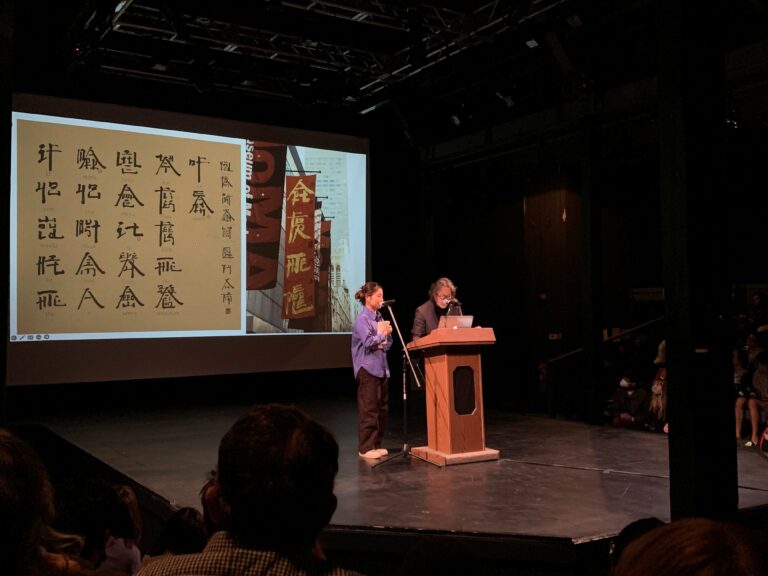
On Nov. 1, The California Studio: Manetti Shrem Artist Residencies program hosted a special screening of “Dragonfly Eyes,” a feature film by the studio’s fall quarter spotlight artist Xu Bing. 

As shown through previous works of the artist, including his renowned “Book From the Sky,” Bing’s ability to create a fabricated sense of reality through art is proven yet again with this film. Consisting entirely of footage from surveillance cameras in China, the work is intentionally “embedded in experimentality” and introduces a unique method of filmmaking. 

 “I’m just really excited to be doing something that’s never been done before and that’s one of my greatest creative drives,” Bing said.

While the film itself is a collection of real-time footage, the story is completely fictional. It follows the life of Qing Ting, a young girl navigating modern China and getting entangled in romance after leaving her life at a Buddhist temple. Each event of the story is captured through surveillance clips edited together, giving the illusion of a false reality.

Bing’s method of storytelling goes far beyond the boundaries of conventional filmmaking. He pieces together seemingly disparate events to form a cohesive story; one that distorts the audience’s understanding of reality and fiction. In an interview with Musee magazine, Bing explained that “Dragonfly Eyes” includes pieces of footage recorded years apart and edited together, guiding the audience to reflect on the themes of time and reality, both of which are central to the film. 

In addition to the film screening, the California Studio hosted an artist lecture with Bing, during which he discussed his previous and most recent works in a presentation titled “My Creative Concepts and Methods.” During the event, he explained his works in the context of modern contemporary art and defined the purpose of contemporary art in culture. 

Bing said that artists produce work from a subjective realm of experience, but once the work leaves the studio and enters the realm of objectivity, it can become something entirely different.

“Everyone receiving it is bringing new meaningfulness to the work, including the artist, and they are also supplying content for the artist to contemplate,” Bing said.

Bing’s process of taking real events and recontextualizing them visually is not only a unique method of storytelling but also a way of bringing new meaning to the original perspective. Rather than using surveillance footage to create an aesthetic experience for the audience, Bing displays objectivity that can be interpreted in various ways.


Written by: Vivi Kim — arts@theaggie.orgVivi

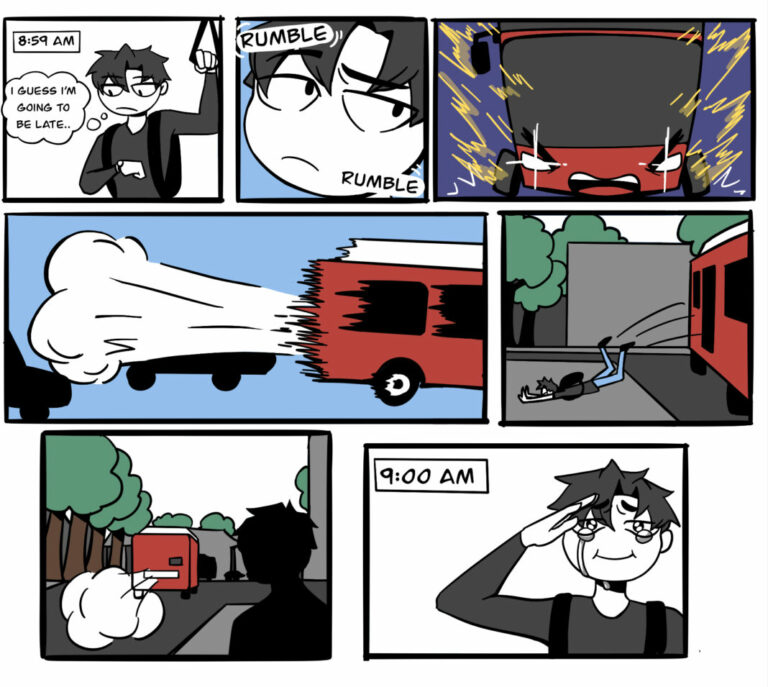
Unitrans pulling through

Drawn by: Lidya Shcherbakova — lvshcherbakova@ucdavis.edu


Disclaimer: (This cartoon is humor and/or satire, and its content is purely fictional. The story and names of “sources” are fictionalized.)

Davis community rallies in support of Davis Teachers Association amid ongoing contract negotiations

0

Residents gathered at the Davis Joint Unified School District meeting to demand better pay and benefits for teachers


By JILLIAN MARCH — city@theaggie.org


On Nov. 3, residents gathered in front of the entrance to Davis City hall during the Davis Joint Unified School District Board (DJUSD) Monthly Meeting in a show of support for the Davis Teachers Association (DTA) amid ongoing contract negotiations with the local school district.

 “Davis students deserve the best!” cheered the crowd as DJUSD Superintendent Matt Best arrived at the most recent School Board Meeting. Parents, teachers, school site staff and students were in attendance to protest what they considered the school district’s unwillingness to negotiate in good faith with their teachers’ association.

According to California School Employees Association (CSEA) President Sande Royval, over the course of the past few months, DJUSD has seen a large number of teachers and other essential faculty members leave the district for neighboring ones. She attributes this to DJUSD’s salaries and benefits, which she explained have not kept up with the city’s high cost of living.

“We are an important and essential part of the school community,” Royval said. “Unfortunately, we’re not feeling that way. Our families and our lives are being threatened by historic inflation and it seems like [DJUSD leaders] don’t care.”

During his initial presentation, Victor Lagunes, the DTA president and educator at Da Vinci Junior High, said that due to the district’s teacher shortage, remaining teachers have a shortened prep time period and increased difficulty obtaining substitute teachers. Negotiations have focused heavily on increasing the pay of school-site staff members, but so far, offers from the district have been disappointing.

Attendees in support of DTA negotiations were especially concerned by the district’s recent proposed solution of one-time payments and bonuses for teachers instead of salary increases, which the DTA argues will begin to remedy the district’s main problem, teacher retention.

Before the floor was opened for public comments, Lagunes talked about the impact that teachers have on students.

“Our students deserve the best,” Lagunes said. “DJUSD must invest in students by investing in and attracting great educators.” 

Lagunes said that DJUSD is unable to find and retain quality teachers and that this is a main concern during the negotiation process. 

“I think about all the teachers that have taken on an extra FTE (full-time equivalent) than what they had planned on this year because we have not hired sufficiently to cover the staffing needs and how that has impacted their ability to prep effectively for their classes, groups and interventions.”

In some cases, students have been left without a permanent teacher for the 2022-2023 school year. Christopher Fluetsch, a teacher and librarian at Willett Elementary, elaborated on this concern during public comment.

 “You have four elementary school classrooms here full of students who have been denied a full-year, long-term teacher for the entire year,” Fluetsch said.

Katelyn Moseanko, a special education teacher at North Davis Elementary, said during public comment that particular groups of students will face harsher educational deficits if DJUSD does not come to an agreement with DTA. 

“Who will replace us?” Moseanko said. “Davis students deserve the best, and I am one of the best. We can’t afford to live here and when we compare salary and benefits not only now, but in 30-some years when we retire, we can’t make the commitment to stay. And so what if we leave? Who will replace us?”


DTA negotiations are still developing. The next DJUSD Board Meeting will take place this upcoming Thursday, Nov 17 from 6-11 p.m. at Davis City Hall.


Written by: Jillian March — city@theaggie.org

UC Davis researchers combine civil engineering and biology to model stronger infrastructure using snakeskin

Snakeskin has frictional properties that can be applied to surfaces of large column structures to securely support large buildings


By YASH RATHI — science@theaggie.org 


At the UC Davis Center for Geotechnical Modeling, researchers used the facility’s large geotechnical centrifuge to test a design inspired by the unique properties of snakeskin. According to their website, “A geotechnical centrifuge is used to conduct model tests to study geotechnical problems such as the strength, stiffness and capacity of foundations for bridges and buildings, settlement of embankments, stability of slopes, earth retaining structures, tunnel stability and seawalls.”

Alejandro Martínez, Ph.D., who is the lead author on the research study and an associate professor of civil and environmental engineering at UC Davis, explained the team’s interest in snakeskin and its potential real-world applications to infrastructure. 

“Snakeskins are a promising bioinspiration,” Martínez said. “Their belly scales have evolved in such a way that it reduces friction as it moves ahead and increases friction if moved in the opposite direction. Their ventral [belly] skin helps them to move more efficiently through soil and slide up a tree without sliding down.” 

This natural phenomenon is called frictional anisotropy, and it allows snakes’ to experience a change in surface friction depending on the surfaces they interact with.  

Martínez believes that the snakeskin surface can help improve the strength and efficiency of geotechnical structures like driven piles, which are rigid columns that form the foundations of large buildings, and the anchors of offshore structures and tunnels, because these structures require different levels of friction. For example, low friction is required for installing driven piles while high friction is required for anchoring a pile. 

Until now, it has been hard for researchers and engineers to create structures that are both easy to install and difficult to remove — as they need to serve as strong anchors — especially on dense soil.

“Installing driven piles is a challenge in the field, especially on denser soils,” Martínez said. “Imagine a pile that’s easy to install and yet strong enough to support the applied loads. We think snakeskin’s frictional properties will reduce the difficulty of establishing driven piles in more difficult terrain.”

Martínez explained that using a bioengineered snakeskin structure would allow piles to be installed more firmly and anchor the foundation more securely to the ground. 

Additionally, Martínez said that determining the snake species that has the best skin to use for the geotechnical structures was difficult. To do so, he and his team collaborated with Brian Todd, Ph.D., who is a coauthor on the study and a professor in the UC Davis Department of Wildlife, Fish and Conservation Biology. Todd suggested certain species to examine, and the team eventually selected the western hognose snake, parrot snake and Saharan horned viper as potential candidates. 

 “One of the important parts of our bioinspired geotechnical work is learning about biology,” Todd said. “As a biologist, I helped Martínez’s team better understand the relationship between the topography and snakeskin of interest so they could tackle and maintain the friction in the process of locomotion in these large structures.”

Using the three snake species above, the team developed a geometric design for each of their ventral skins in the lab to test and understand how they behaved on different surfaces. 

“With the snakeskin scans, we realized that many of them had an asymmetrical sawtooth pattern,” Martínez said. “With the three-dimensional printed surfaces, we then applied the snakeskin patterns onto structure surfaces, which would make them stronger than the typical material surfaces used, like concrete or steel. From this, we learned that we could make directionally-dependent, stronger surfaces.”

They created model driven piles with snakeskin-inspired materials and conducted various tests on them using the large geotechnical centrifuge at the UC Davis Center for Geotechnical Modeling. These tests helped Martínez’s team understand the behavior of the pile when put in the soil and how its application reduced or increased friction. 

The study concluded that the snakeskin surface produced a lower friction when the pile was being installed but a higher friction during pullout. This means that the use of bioengineered snakeskin could allow for easier installation of piles and make them more resistant to being uprooted once they are in the ground. Martínez believes that this invention, and similar research into other bioinspired, geotechnical tools is promising for increasing the efficiency and strength of these structures in future construction.


Written by: Yash Rathi — science@theaggie.org

City of Davis sued by former city mayor and his wife over noisy playground equipment

Former Mayor Krovoza and his wife sue the city over Arroyo Park Sky Track equipment


By LA RISSA VASQUEZ — city@theaggie.org


On Oct. 17, the city of Davis was served a petition for writ of mandate by former city mayor Joe Krovoza and his wife over the relocation of the Arroyo Park Sky Track playground zipline. Former Mayor Krovoza and Janet Krovoza claim that the city failed to file an Environmental Impact Report (EIR) when city council decided to relocate the playground equipment and is therefore in violation of the California Environmental Quality Act (CEQA).

The lawsuit, filed through the Superior Court of Yolo County on Oct. 5, became public when Davis City Council released a statement addressing it on Oct. 25.

“The Davis City Council tonight, in its closed session discussion, unanimously voted to direct the City Attorney to defend the Krovoza v. City of Davis CEQA litigation,” read the statement.

The Sky Track zipline first opened in May of 2019 and since its opening, only Joe and Janet Krovoza have submitted a formal noise complaint.

Following the complaint, city council retained Acoustics Group, Inc. (AGI) to conduct a noise study. AGI’s report was submitted to the city council for review on March 1, 2022. According to the study, the playground equipment was not compliant with noise ordinance levels.

“Based on the measurement data from NM1, the existing noise from Sky Track operations slightly exceeds the City’s Daytime Noise Standard of 55 dBA,” the statement reads.

AGI referenced a noise source and decibel (dBA) level comparison chart for their assessment. According to their report, 50-60 decibels is the sound equivalent of a quiet office to a normal conversation on the phone. For comparison, a vacuum cleaner operates at 70 decibels.

The report was discussed in an Aug. 30 city council meeting. Unhappy with the findings of the report, Janet Krovoza stated at the meeting that the noise is a disturbance regardless of what is shown by the meter. 

City Attorney Inder Khalsa also commented on the AGI report during the meeting.

“If noise ordinance is set at such a low decibel level that it precludes everyday activities and especially free speech activity, it is not constitutional,” Khalsa said.

Regardless of the decibel difference, on Aug. 30, the city council unanimously approved the relocation of the Sky Track facility in Arroyo Park to a new location within Arroyo Park based on CEQA exemptions under Class 1, existing facilities, and Class 3, new construction or conversion of small structures.

According to the Oct. 25 statement, relocating the equipment with these exemptions does not require the city to file an EIR under state law, saving the city up to hundreds of thousands of dollars. 

Unsatisfied with the city council’s response, the Krovozas have proceeded with legal action. They are arguing that the city improperly used CEQA exemptions to avoid filing an EIR and are suing the city to rescind their Aug. 30 decision, stalling construction and building efforts to keep the popular playground equipment open to the public. 

Khalsa said in the Oct. 25 statement, “The City’s action to relocate the Sky Track was consistent with the law. I am confident that the City will prevail in this lawsuit.”


Written by: La Rissa Vasquez — city@theaggie.org


Two victims hit in drive-by BB gun shootings

The two consecutive incidents occurred on Oct. 30 and are the second BB gun-related crimes in Davis this quarter


By RACHEL GAUER— campus@theaggie.org


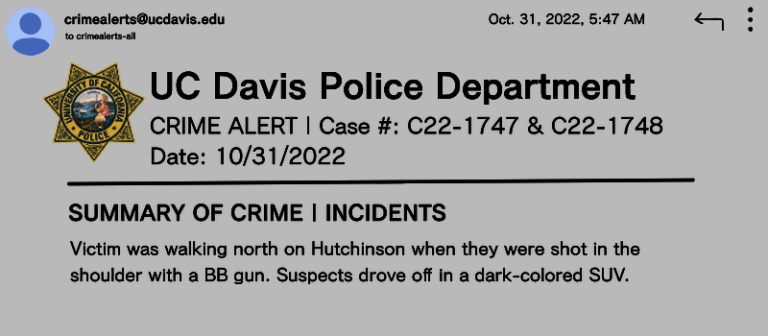
On the evening of Oct. 30, two victims reported being hit with BB gun bullets during two separate drive-by incidents, according to an email crime alert from the UC Davis Police Department sent to community members during the early morning of Oct. 31. 

The crime alert, written by Sergeant Vincent Kwong, reported that two incidents occurred within a short time period just after 8:20 p.m. and that both victims described the suspected vehicle as a dark-colored SUV. 

One of the victims, a first-year bioscience major who requested to be anonymous, described their experience and their actions immediately following the initial shot. 

“I was in the bike lane and a car drove beside me and I suddenly felt a sting in my back,” the student said. “I didn’t really know what happened but I looked at the car that was passing me and I saw an airsoft gun hanging out of the window. I started yelling at them and I tried to chase them with my bike down the road but they sped off before I could catch their license plate and everything.”

Due to their quick response to the shot, the victim stated that they were able to offer information to the police regarding the specific type of gun and the model of the vehicle. The student offered advice for others involved in a future incident of the same nature. 

“For a lot of people, the initial shock of it can throw you off, and then you can miss really pertinent information,” the student said. “I think the best way to respond is to try to get as much information [about] the perpetrator as possible, like the color of the car, who the person is, the type of gun it was and especially the license plate.” 

These incidents were the second on-campus BB gun crime that has been reported this quarter. On Sept. 27, victims were hit by an unknown suspect on the corner of La Rue Rd. and Orchard Rd., according to a crime alert that was sent out the following day. According to the report, no victims involved requested medical attention.

Earlier this year, on April 1, another drive-by incident of a similar nature occurred when a group of students gathered atop the parking garage on Hutchinson Drive for a club social event. 

According to Cecelia Wong, a third-year biomedical engineering major who attended the event, a Jeep turned a corner at rapid speed and began shooting at the group of students with what looked like a BB gun, hitting multiple of them. Wong was one of those who was hit, and she described the incident. 

“When I saw the car zooming around the corner, I actually thought they were going to [run into] us because they were going so fast,” Wong said. “We were all standing in a big group together and we couldn’t see anyone’s faces but we saw guns pointing out the window.” 

Wong noted that the group later analyzed the bullets and determined the gun was likely not a BB gun but rather a water pellet gun due to the watery, gel substance of the pellets. Despite the relatively harmless nature of the bullets, the event left the students shaken up.

“We didn’t really react because it was so fast, but everyone felt the shots of getting hit,” Wong said. “We were all in shock and didn’t really move. We all just stood there and then soon the car drove down the parking garage and sped off.” 

Due to the rapid speed of drive-by incidents, law enforcement officials explained that it is difficult for victims to quickly identify those involved in the shootings, and therefore, the police are not able to make prosecutions related to the incidents. 

Doug Voska, the Patrol Lieutenant for the UC Davis Police Department, noted that one common theme of the events tends to be the areas surrounding Russell Boulevard, which he described as the dividing line between UC Davis and the city of Davis. However, according to Voska, the lack of information regarding the suspects’ identities and their motives makes the search for them difficult. 

 “I don’t know why [incidents like these] are happening,” Voska said. “I don’t know if it’s maybe something done by high school kids [as a prank], but we haven’t received a whole lot of information that we could consider actionable.” 

Though there haven’t been any prosecutions so far, Voska highlighted the importance of being aware of one’s surroundings for the sake of personal safety and in order to retain information that could lead to a successful prosecution.

 “It is unfortunate, but it seems to be that now we have to be aware of cars that are passing by,” Voska said. “But if people are on notice that this is happening, and they’re aware of their surroundings, then if something does happen, they can get a better description.” 


Written by: Rachel Gauer — campus@theaggie.org

Where are the humanities heading?

Students and faculty speak about the importance of these departments on campus


By ADHITHI ANJALI — arts@theaggie.org


UC Davis is well reputed as a research university,  most known for its position as an environmental powerhouse among universities nationwide. However, how does such prestige factor into the wellbeing of non-STEM programs on campus?

Andrew Haley, a fourth-year classical studies and evolutionary anthropology double major, heads the Classics Students Association and offers a unique perspective through his experience in science- and culture-oriented courses. 

“The general sense that I get is that the university sees the Classics Department as a chance for non-majors to fulfill their GE humanities requirement,“ Haley said on the immediate differences between major courses. 

Having to balance an appropriate number of GE courses and in-depth, specialized courses is a tension that Haley saw frequently in his classic studies. “I think anthropology, though still a small major, gets a little bit more room for specialized courses designed for majors,” Haley said. 

Haley relates the lack of diversity and depth of courses in the humanities to a lack of funding and, subsequently, professors. 

“To be honest, I think the future of humanities at Davis is uncertain. There’s been a trend with humanities departments at various institutions where, when someone retires, that position doesn’t get replaced,” Haley stated. He expressed concern about the fact that these job openings tend to get filled by lecturers, worried that “generally, [lecturers] get less benefits from the university [than professors], less job security, and doing research is not considered part of their employment.” 

Funding at the university level has become an evident problem in the lives of all scholars. Dominique Paz, who graduated from UC Davis with a degree in classical civilizations with an emphasis on languages, now works as a teaching assistant. Having transitioned into the working world, Paz underscores the difficulty of finding work as a result of the lack of structure from the university. 

“We’ve come across this issue where large companies and governments have funded STEM studies, which allowed more jobs and opportunities in those fields, but left the humanities in the dirt,” said Paz. “In some cases, even, [funding has been] cut, like in California.”

 Dr. Tiffany Jo Werth, an associate professor within the Department of English and recently appointed director of the Medieval and Early Modern Studies program (MEMS), calls this the “self-fulfilling prophecy” of the humanities. 

Werth mentioned the lack of a “robust culture of supporting the humanities in the United States,” which she experienced during her work in the Simon Fraser University in Vancouver, British Columbia. She expressed a desire to find more funding to work and research with undergraduates. 

“We used to have matching grants in Canada for undergraduate funding so it was quite easy to hire and work with undergraduates,”  Werth said.

Working as the director of MEMS, Werth noted how the issue expands from the top-down. The lack of funding for research performed by the faculty limits their ability to work with undergraduates. Following this absence of professional academic opportunity, graduates of the humanities find themselves lacking in connection and direction. 

“I think that is the main bridge that many star-eyed academics are lacking,” said Paz, speaking about the seeming dearth of entry-level jobs. “Many Ph.D. [holders] get their degrees then are like ‘What now?’ because their field is so niche.”

The unstable eye of the university on the humanities has fostered this larger sense of inopportunity, with funding being the largest concern for all levels of scholarship. 

Dr. Keith Watenpaugh, current professor and founding director of the Human Rights Studies program at UC Davis, wants to see a movement from the university to “redouble its commitment to global education and embrace it as a core principle.”

“The modern American research university is really beholden to industry, grants and money,” said Watenpaugh. The perception that humanities are unwelcome or useless in a modern economy drives the flow of money within all universities, not just UC Davis.

Watenpaugh heads Article 26 Backpack, which he believes to be the largest undergraduate humanities internship on campus with around 16 to 24 students. It is built upon the core principle that there is a human right to education and culture as the product of both the arts and sciences.

Of grant-funding programs connected to UC Davis that specifically focus on the humanities, the University of California Humanities Research Institute (UCHRI) and the UC Davis Humanities Institute (DHI) are the most prominent on campus, but still lack larger recognition from the student body. 

“I would love to see those sorts of programs made more robust so we could have more centralized places of information,” Werth said.

Looking towards the future of humanities programs, Werth sees potential in UC Davis as an exciting place for collaboration between STEM and the arts. Werth has worked across disciplines, having been able to organize a symposium at the UC Davis Coastal and Marine Sciences Institute at Bodega Bay Marine Laboratory, so she understands the potential for collaboration on a personal level. 

Similarly, Dr. Watenpaugh wants to shift the narrative of the humanities and sciences towards being parts of a whole, and said that “we tend to envision the campus as divided — the people in authority on campus need to see how they are equal parts of the human experience.” 

A lack of centralization across the humanities is a common theme from these testimonies, as well as a desire to see more structure in fostering and supporting a community of scholars in arts and culture. 

This may come in the form of more exposure and advertisement that draws students from all departments to the humanities. Taking notice of the vibrancy and need of the community, despite how small it may seem, can be the first step in recognizing the true desire on campus for undergraduate research and participation. 


Written by: Adhithi Anjali — arts@theaggie.org

Concert etiquette and what it means

How to act appropriately at a concert from a frequent concert-goer


By MICHELLE MENDOZA — mimendoza@ucdavis.edu


Not too long ago, Davis students were graced with a thrilling hour-long set by Remi Wolf at Sunset Fest. As a fan, I was excited to get the chance to see her band for free. The atmosphere was perfect; it was the Friday of Halloweekend, people were dressed in costume and a bright, full moon was out. 

I have been to many concerts since the sixth grade. My first concert was The Neighbourhood’s “Sweater Weather” tour. Standing in a crowd made up of mostly tall people smelling faintly of cigarettes, it was difficult to fully enjoy the experience. However, a few audience members realized that I couldn’t see and asked if I wanted to move in front. I was surprised by the kind gesture and it made the concert even better.

I was a bit farther away from the stage at Sunset Fest than I was at my first concert. This time, my friend was the one who couldn’t see past the shoulders of the person in front of her. As Remi’s set grew closer, people became more desperate to get a better view. They pushed forward and elbowed each other in retaliation. The most frustrating part was, during the performance, some people felt the need to move on top of each other’s shoulders. We decided that we wanted to leave the crowd, but it was difficult for others to move aside to let us pass.

Even though I have my complaints, the crowd was fine overall, and Remi put on a great show. Ten years to the day, these events made me want to reflect on concert etiquette and how it has changed.

Concert etiquette is generally defined as the social norms or the standard of behavior that is appropriate during a musical performance. These expectations change based on the type of concert you are going to. For example, the dress code and behavior expectations are different at a K-pop concert than at a rock concert. Concert etiquette is important because it ensures that everyone has a good time. This also applies to the performer, as people expect a certain quality of performance from an artist. 

A notable event where I noticed the change in behavior from a crowd was during Drake’s performance at the Camp Flog Gnaw music festival in 2019. He was the surprise performer, but fans had speculated and hoped that Frank Ocean would make an appearance instead. After all, Frank Ocean was a more fitting and exciting surprise for fans than Drake would ever be. This became clear after the crowd booed him off stage and cut the set an hour early. The initial reaction from the crowd was completely disrespectful to Drake, as he had only tried to entertain them and the organizer of the festival, Tyler the Creator. 

However, some argue that Tyler could have chosen a better performer that suited his fan’s expectations. I mean, as a Tyler fan myself, I’ve noticed that the majority of his fans are from his flower boy and post-Igor era, which more aligns with Frank Ocean’s genre of music than Drake’s. In a way, it’s understandable that fans might get angry, as Drake’s music is such a departure from what the attendees of Camp Flog Gnaw were expecting from the event.

Controversial behavior during Steve Lacy’s current tour has caused a major discussion about bad habits at concerts. A viral video shows a fan throwing their disposable camera at him on the stage and Lacy responding by smashing it. The pattern continued in a Tik Tok of a fan yelling “Can you say hi to my mom?” as he was about to start a new song, to which Lacy responded, “Can you be quiet?” This interaction clearly shows that there is a lack of respect for Lacy and his music, particularly from his newer fans. 

As we gradually come out of the pandemic and start going to more live music events, I think it is important to remember that we — fans and performers — are interacting with each other. Concerts are an exchange of human experience and energy that we often take for granted. And as fans, we are also interacting with the people around us, and our behavior affects them as much as their behavior affects ours. 

I can go on and on about how it is important to not push through a crowd or block someone’s view (which is all true), but I mostly want to emphasize it is important to be aware of the people in one’s environment. Live music is more fun when everyone is trying to make the concert the best experience possible for each other. Make sure you keep your fellow concert-goers in mind next time you see your favorite band.


Written by: Michelle Mendoza — mimendoza@ucdavis.edu


Disclaimer: The views and opinions expressed by individual columnists belong to the columnists alone and do not necessarily indicate the views and opinions held by The California Aggie.
Lift-off: Astros win World Series for first time since 2017

The Houston Astros win the World Series against the Philadelphia Phillies in six games


By PATRICK FIGUEROA — sports@theaggie.org


On Nov. 5, the Houston Astros defeated the Philadelphia Phillies in game six of the World Series. This marks the Astros’ first World Series win since 2017, a title that was more so marked by a cheating scandal rather than the championship itself. However, with this championship and prolonged seasonal success since 2017, the Astros have fought to prove that their 2017 championship was not just the result of their cheating scandal. In fact, the 2022 World Series will go down as one to remember. 


Game one: The Phillies come back from behind to take a 1-0 series lead

The 2022 World Series started off with a comeback in which the Phillies won after being down 5-0 after three innings. The Astros’ starting pitcher Justin Verlander, who gave up five runs early on, raised his World Series’ earned run average (ERA) to 6.07, the worst ERA in World Series history among starting pitchers with at least five starts. The Phillies evened the score, however, with five runs in the fourth and fifth innings combined to tie up the game at 5-5. Scoring then ceased until Phillies’ catcher J.T. Realmuto hit a go-ahead home run in the top of the 10th inning. Phillies’ relief pitcher David Robertson secured the 6-5 victory in the bottom of the 10th inning.


Game two: Astros win 5-2 to tie series at 1-1 

The Astros evened the series with a 5-2 win that featured an impressive pitching performance from their starting pitcher, Framber Valdez. Valdez pitched over six innings, allowing just one run and four hits, and striking out nine batters. The Astros’ offense struck early with a three-run first inning, featuring RBIs from Astros’ shortstop Jeremy Peña and outfielder Yordan Alvarez. Astros’ third baseman Alex Bregman hit a two-run home run in the fifth inning to extend the Astros’ lead to 5-0. The Phillies would not get shut out, as they scored a run in each of the seventh and ninth innings, but it was not enough to come back. 


Game three: Phillies win blowout 7-0 

Game three was the first game in Philadelphia, and the Phillies dominated on their home field. The Astros’ starting pitcher, Lance McCullers Jr., had a disastrous performance; giving up seven runs, including five home runs. There was speculation that McCullers was tipping pitches or inadvertently giving signals to the opposing batter and team as to his upcoming pitch plans. Regardless, the Astros’ offense could not muster a single run and were shutout 7-0. 


Game four: Astros achieve a no-hitter in 5-0 victory to even series

After an embarrassing pitching performance in game three, the Astros’ pitching staff tossed a combined no-hitter in game four. The no-hitter included performances from starting pitcher Christian Javier and relief pitchers Bobby Abreu, Rafael Montero and Ryan Pressly. The team’s offense scored five runs in the fifth inning thanks to outfielder Alvarez, third baseman Bregman, outfielder Kyle Tucker and first baseman Yuli Gurriel. With excellent pitching from the bullpen, the Astros cruised to a  5-0 victory.  


Game Five: Astros win 3-2, setting up the series-clinching game 

The Astros got their first series lead after winning game five 3-2. Both teams scored one run in the first inning; Astros’ shortstop Peña hit an RBI single and Phillies’ outfielder Kyle Schwarber hit a solo home run. Peña broke the tied game in the top of the fourth inning with a solo home run and the Astros added to their lead with a run in the top of the eighth inning, thanks to an RBI groundout from Alvarez. The Phillies’ second baseman Jean Segura hit an RBI single in the bottom of the eighth inning, thus making the score 3-2. Astros’ relief pitcher Pressly closed the game out with almost two scoreless innings, with the help of outfielder Chas McCormick making a leaping catch in the bottom of the ninth inning. 


Game Six: Astros win the 2022 World Series 

The Astros won game six 4-1, securing the series win. The game was scoreless for the first five innings, with impressive performances from Astros pitcher Framber Valdez and Phillies pitcher Zack Wheeler. In the top of the sixth inning, Phillies’ outfielder Schwarber broke the tie with a solo home run, but the Astros responded with four runs in the bottom of the sixth inning, thanks to Alvarez’s three-run home run and catcher Christian Vazquez’s RBI single. The Astros’ bullpen once again shut out the Phillies’ offense, and the team cruised to victory.


World Series MVP: Astros’ Shortstop Jeremy Peña

The rookie shortstop Peña won the World Series MVP, the first rookie position player to ever do so. Replacing former Astros’ shortstop and 2021 Platinum Glove winner, Carlos Correa, was not going to be easy for the young player, but he managed to do so effectively. Throughout the World Series, Peña had 10 hits, one home run, three RBIs, a .423 on-base percentage (OBP) and a 1.023 on-base plus slugging (OPS).  


Dusty Baker 

Before winning the World Series, Astros’ manager Dusty Baker had the longest active tenure without a World Series. Not only did he break this titleless streak, but he also became the oldest manager to ever win the World Series. The future hall-of-famer was able to add a World Series win to his résumé


Written by: Patrick Figueroa — sports@theaggie.org


UC Davis men’s basketball cruises past Cal Maritime in home opener

The fresh Aggies’ squad starts the season 2-0

By GABRIEL CARABALLO — sports@theaggie.org


The UC Davis men’s basketball team made history on Nov. 7, beating UC Berkeley for the first time in program history 75-65. The team has previously had a 0-33 record against the Bears. The historic win was made possible by fourth-year forward Christian Anigwe who led the game with 21 points and newly-acquired transfer student, second-year guard Ty Johnson, who contributed 17 points. 

“[It was a] big time win against a PAC-12 school, but honestly, we felt confident going into that game, thinking we could beat them,” Johnson said “We go into every game like that.”

UC Davis head coach Jim Les also reacted to the historic upset.

“I was really proud of the guys and how they played in that [Cal Berkeley] game, and we were riding that high into this game,” Les said.

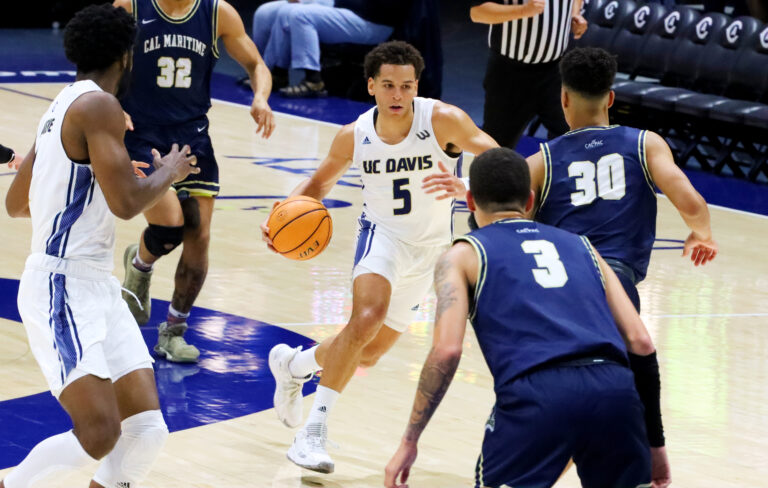
The momentum Les described carried over to the Aggies’ second game of the season against the Cal Maritime Keelhaulers. The game began with Ty Johnson expeditiously scoring a mid-range shot and three-point shot off of a Keelhauler turnover to give the Aggies an early 5-0 lead. 

With solid defense and consistent outside scoring from fourth-year guard Braxton Adderly, the Keelhaulers stayed within striking distance for most of the first half. Adderly kept Maritime going offensively with 12 first-half points making ⅔  from behind the three-point line. 

“We’re pleased to see Braxton knock down a couple shots. He really helps our team stretch the floor,” Cal Maritime Head Coach Tim Bross said in regards to Adderly’s shooting night.

Adderly’s second three-pointer of the first half gave the Keelhaulers a 24-23 lead with six and a half minutes left in the second quarter, but, in those remaining minutes, UC Davis would go on an incredible 15-point run. 

The score was 38-26 in favor of the Aggies with only a minute left in the half. With the clock winding down, UC Davis’ second-year guard Leo DeBruhl made a long three pointer with 20 seconds left on the clock; DeBruhl patiently waited until the two-second tick to release the final shot of the half. A statement shot put the Aggies up 43-26 along with a 20-2 point run. A fourth of those points came from Ty Johnson, who ended the half with 16 total points. 

The second half started and the Keelhaulers were looking to gain some momentum with an exciting play. Fourth-year forward Miles Pennington drove to the basket to deliver an emphatic slam dunk but his attempt was blocked by Aggie forward Anigwe. After the block, UC Davis would go on a seven-point run to start the second half, setting the tone for the rest of the game. 

First-year forward Jac Mani, along with third-year guard Kane Milling and third-year forward Sam Manu, took over in the second half for the Aggies, totaling 27 points. In his first game at the collegiate level, Mani played with confidence, banking a three-pointer and a few hook shots inside the key. Typically, first-year players don’t get a lot of minutes on the floor, and if they do, they don’t produce much, as it takes time to get used to playing Division One basketball at the college level. However, Mani seemed to play like a veteran, scoring with ease.

The Aggies defeated the Keelhaulers 90-67. Cal Maritime shot 39% from the field and 56.3% from three-point range. Adderly gave a notable performance, leading the team in points with 16 and five rebounds.

“We came here to win a basketball game, it didn’t work out that way, but I feel really strongly that we grew tonight, and there were some bright spots,” Bross said. 

UC Davis shot 49.3% from the field and 33.3% from the three-point range in the game. The Aggies had notable performances from Anigwe and Milling, who each had 13 points. First-year forward Mani put up 11 points in 17 minutes and second-year guard Robby Beasly led the game in rebounds with nine. Overall, UC Davis had an impressive number of contributors to the win. 

The Aggies are now 2-1 after a loss to Loyola Marymount University on the road on Nov. 12. The Aggies will host Arkansas State on Nov. 18. 


Written by: Gabriel Caraballo — sports@theaggie.org

Newly-elected Congressman Mike Thompson tests positive for COVID-19

0

Thompson, recently elected to serve as the representative for California’s 4th congressional district, received positive test result

By ANTHONY W. ZAMMIKIEL  — city@theaggie.org

Congressman Mike Thompson, the former Rep. for California’s 5th Congressional District and recently elected representative for California’s 4th District, tested positive for COVID-19 on Wednesday. The announcement comes a week after Election Day, where Thompson as the Democratic candidate won against Republican challenger Matt Brock.

“After taking a regular PCR test, I have tested positive for COVID-19. Thanks to being fully vaccinated and receiving both booster shots, I am experiencing only mild symptoms. I will be working from home and my office remains fully open to serve the people of our district,” Rep. Thompson said in a press release from his office. “As COVID-19 continues to evolve, I recommend every American to get their updated COVID-19 vaccine and booster to stay healthy and protect their friends and families.”

On Jan. 1, Rep. Thomspon would have been the representative for California’s 5th District for a decade, having also represented California’s 1st District for 14 years prior. The change in districts comes as a result of redistricting in California starting with the 2022 Congressional Elections. 

According to the New York Times, Rep. Thompson was elected with 67.4% of the vote, compared to challenger Brock, who received 32.6% of the vote. Rep. Thomspon will replace Democratic Congressman John Garamendi, who represented California’s former 3rd District and who will now represent California’s 8th District. California’s 4th District now includes UC Davis, the city of Davis and Yolo County, all formerly represented in California’s 3rd District. 

For more information detailing the changes made to both state and congressional districts in the state of California, CalMatters has created a program allowing for an address of residence to be used to determine which new districts cover the address given.


Written By: Anthony W. Zammikiel  — city@theaggie.org


Dive into Arneson, the artist behind UC Davis’s famous Eggheads 

0

The John Natsoulas Gallery celebrates the work of UC Davis Emeritus Art Professor Robert Arneson with 30-year Memorial Exhibition

By MARIA MARTINEZ CASTRO  — features@theaggie.org 


On the second floor of the John Natsoulas Center for the Arts, the work of famous artist and UC Davis Emeritus Art Professor Robert Arneson sits waiting for the Davis community to see. Walking through the space and stepping on the creaky wooden floors of the gallery, the art forms Arneson was most famous for — ceramics and self-portraits — are on display. 

At the top second-floor stairs, you are greeted with a cheeky self-portrait of the artist, who is staring at you picking his nose in an explosion of color. Further into the room are ceramic forms of foods, bricks and portraits of Cold War United States and USSR army generals. 

The Robert Arneson 30-Year Memorial Exhibition will run from Nov. 2, 2022, to Jan. 7, 2023, at the John Natsoulas Center for the Arts in downtown Davis. The exhibit honors the late artist’s work and his contributions to the UC Davis Department of Art. 

Arneson is most well-known for his ceramics and self-portrait work, his massive influence on the Funk art movement, and his establishment of the famous ceramics art studio TB-9 (Temporary Building 9) at UC Davis. 

“He revolutionized sculpture and he created, there’s a movement on the first floor, called Funk art,” John Natsoulas said, founder and operator of the John Natsoulas Center, and Arneson’s mentee. “He was the clay godfather of Funk art. There are painters in there; there are sculptors in there, but he was it.” 

Arneson’s career at UC Davis spanned three decades, from 1962 to his retirement in 1991. While at the university, Arneson and his students changed the trajectory of ceramics as an art form. They did so in the margins at the famously known TB-9 studio on campus. 

“Temporary Building 9, which was the ceramics building, you know how that started?” Natsoulas said. “That’s where food science had all of their fruit. A lot of their fruit and vegetables were canned and jarred and stored there. It was a giant fruit and vegetable storage, and these guys and gals ate it all for them to have room to have this big ceramics warehouse.” 

Simon Sadler, chair of the UC Davis Design Department and professor of design, spoke to the revolutionary nature of Arneson’s ceramics works. 

“It is a bit of a marginal art form,” Sadler said. “But UC Davis is a bit of a legend in ceramics. Arneson was famous for creating a culture around TB-9 […] Arneson was a bit on the margins as a ceramicist, in a department that was on the margins […] in the 1960s and ‘70s.” 

Natsoulas also pointed out the importance of Arneson’s influence on ceramics at UC Davis, and specifically his use of the TB-9 building.

“The impact of TB-9 at that time was huge,” Natsoulas said. “Now, there are no ceramics sculptors working in the graduate [department]; there is not really that kind of movement because he was so amazing.”

However, Arneson’s legacy at UC Davis extends beyond the ceramics Funk art movement and TB-9. Students on campus can witness his work every day when walking by the Shields Library, Mrak Hall or the UC Davis School of Law. 

Arneson is the creator of the famous Egghead sculptures on campus, which Sadler believes Arneson created as light-hearted critiques of the university.

“They are kind of endearing, but they are critiques,” Sadler said. “An egghead, you know, is a euphemism for an intellectual. […] Arneson was probably like […] at once sort of happy and grateful to be at the university and on the other hand thinking, ‘What the hell am I doing at the university? Why am I with all these other eggheads who think that everything’s gotta be scientific and provable when clearly I’m a counterculturalist, full of emotions and fun-loving?’” 

The Eggheads and the exhibition at the John Natsoulas Gallery showcase the intricate work and mind of an important artist and professor in UC Davis history. 

“The big legacy is of art at UC Davis,” Sadler said. “And it’s been sort of a hidden legacy for a long time. Arneson was famous […] but we’ve never quite known what to do with that legacy, and I think [what] the creation of the Manetti Shrem Museum does is [help] solidify UC Davis, not just as one of the world’s preeminent centers of agriculture and animal science, but it’s also a weird place where you can go study the arts out in the tomato fields. And there’s a long legacy there.” 


Written by: Maria Martinez Castro — features@theaggie.org


Gunrock speaks out on mascot vote

“I just didn’t see it coming”

By ANGIE VELARDE — avelarde@ucdavis.edu


Rejecting the student vote to replace the official mascot of UC Davis has left a bad taste in the mouths of many. But the controversial vote has had the biggest impact on one individual: a mustang named Gunrock. Ahead of the release of his new tell-all memoir about the vote, “Whinnying and Losing,” I sat down with Gunrock to talk about his life, his legacy and his feelings on the cow that might one day replace him. 

“I mean, you give almost a century of your time to a place, and then they try to vote you out. It feels like a slap on the muzzle,” Gunrock said to me, shaking the mane out of his eyes. “I mean, have you seen me out there? I’m a star.”

Yes, Gunrock is aging — he’s been the mascot at UC Davis since the first half of the twentieth century, and his mannerisms and mid-century slang give him away — but the look in his eye is one of a much younger horse. 

This year’s vote was not the first challenge to his status as mascot. There was another vote in 1993, but this one, he said, feels different. 

“It feels like I’m getting forced into retirement. Young people just don’t respect their elders like they used to, and it’s destroying this country.”

He also responded to those students who say that he does not represent them and instead represents an age of elitism and classism to which they do not feel connected.

“I’d say that the whole thing feels like hooey,” he responded as an assistant oiled his mane. “My trailer has windows, just like anyone’s. I’ve been attacked for spending too much on grooming, but I have an image to maintain. What do they expect?” He popped a sugar cube into his mouth and winked. “Sorry, I normally eat very well, but every once in a while, my dietician allows me to have a little treat.”

At this point in the interview, I asked him to share his final thoughts on the vote to make the cow the official mascot of ASUCD, which was presented as a compromise to the rejection of the UC Davis mascot change.     

“It’ll never happen,” he said.“They’d never vote against me.”

I informed him that they had, in fact, voted to make the cow the official mascot of ASUCD on Sept. 30, and he was quickly shuffled out of the room before I could get his response. We have since reached out to Gunrock’s representatives to see if they have an answer to our question, but were told that he is “unavailable for comment.” 

“Whinnying and Losing” will be officially released on Dec. 1. 


Written by: Angie Velarde — avelarde@ucdavis.edu


Disclaimer: (This article is humor and/or satire, and its content is purely fictional. The story and the names of “sources” are fictionalized.)