55.4 F
Davis

Davis, California

Monday, December 22, 2025
Home Blog Page 299

SR #4 veto override failed at Dec. 10 ASUCD Senate meeting

A resolution opposing the elimination of the PE program passed 

The ASUCD Senate meeting on Dec. 10 was called to order at 6:10 p.m. The meeting began with a quorum roll call, followed by the farewell addresses of senators who finished their terms. 

New senate officers were sworn in, including Ryan Mariquez, Kristin Mifsud, Michael Navarro, Kabir Sahri, Lauren Smith and Maahum Shahab. 

Maria Martinez, the External Affairs Vice President, introduced the External Affairs Quarterly Report. Martinez noted working with the Davis Housing Element and ASUCD Housing Taskforce, introducing a bill to the state legislature on housing and a campaign to expand internet access to students in rural and low-income areas and working on the development of on-campus infrastructure to allow undocumented students access to federal internships. 

The Senate was then pushed into Gender and Sexuality Commission confirmations. Ashley Chan, a first-year political science major, Sabrina Gelini, a first-year communication major, and Mary Padilla, a second-year gender, sexuality and women’s study major, were all confirmed to the commission. 

The Pantry Director Ryan Choi talked about the services offered to students staying in Davis over winter break through its grab-and-go program, saying that it is an “opportunity to expand the net and catch students who are staying and provide basic necessities.”

Senator Juan Velasco brought up the legislations SB #66 and SB #65 that were passed last spring, in efforts to help the most vulnerable communities at UC Davis to receive emergency funding due to the pandemic. Velasco said that the Senate needed “to hold people accountable.”

Velasco said the Student Advocate, Ashley Lo, and Ethnic and Cultural Affairs Chair, Yalda Saii, as well as other members of the Senate did not show up to any committee meetings about this legislation. Despite the emergency bills being passed, the funds did not get distributed, according to Velasco. 

Senator Tenzin Youedon proposed the veto override of SR #4, which opposes the elimination of the PE program. 

“The only way PE will be restored is by means of passing Senate Resolution #4 and then sitting down at the table at a position of strength, whereafter hopefully the administration will rescind its decision,” said Paul Medved, a UC Davis alumnus and parent of a former UC Davis student-athlete. 

PE lecturers also emphasized the importance of the program.

“I couldn’t tell you the number of young ladies, young women, that come to me and tell me, ‘Coach, I would never go into a weight room by myself because it intimidates me, but the way that you present this to me makes me much more comfortable,’” said Mark Johnson, a PE lecturer. 

Ari Kelman, the interim dean of the College of Letters and Science, commented on the administration’s cancelling of the PE program. 

“I don’t think that the administration should be exerting pressure on ASUCD […] that’s not what I’m doing this evening,” Kelman said. “But, it concerns me when employees are coming into a meeting like this and urging ASUCD to use leverage on behalf of employees on what really is a labor-management issue.”

Kelman emphasized that this issue would further be discussed with some members of ASUCD through upcoming meetings. 

“These lines of communication are opened and are not going to be closed,” Kelman said.

 Previously, the UC administration cut the PE education program without any consultation with ASUCD. 

Youedon questioned Kelman on why these consultations with ASUCD were made following the decision to cancel the program. Kelman stated that he could not say for certain, but “only that [they] had a transition in leadership.”

SR #4 failed to be overridden with four senators voting no and five abstaining. Some senators said the resolution would strain the relationship between students and the administration, and some senators questioned the way it would be executed.  

“If we had a good relationship with admin, they would’ve told us they were making this decision […] when it first started months ago, and they wouldn’t be coming to us and having these conversations once we […] have written a resolution,” Youedon said. 

Youedon called for further “concrete actions” from the senators on the issue. 

SB #38, to establish an Undergraduate Student Parent Committee (USPC) passed unanimously. SB #45 to revise the adopted senator process also unanimously passed. 

The meeting adjourned at 10:59 pm. 
Written by: Annette Campos — campus@theaggie.org

SB #39 passed at Dec. 3 ASUCD senate meeting

 ASUCD votes to oppose campus administration’s PE cuts

The Dec. 3 Senate Meeting was called to order at 6:11 pm by Vice President Emily Barneond. 

Environmental Policy and Planning Commission Chair Hunter Ottman was present but left early, and President Kyle Krueger was absent. 

The meeting moved into the UC Student Association’s (UCSA) presentation, delivered by UCSA President Aidan Arasasingham, who is also the external vice president for UCLA’s governing body. Arasingham presented on the history of UCSA, highlighting the parallels in social movements today with the social movements at the time of UCSA’s founding 50 years ago and emphasizing the avenues of collaboration between all UC Student Associations. 

Julian Garcia, the Internal Affairs Commission (IAC) chair, delivered the IAC Quarterly Report. IAC is in the process of recruiting new members and interviews are currently being conducted to fill vacancies. Garcia emphasized IAC’s contribution to the ASUCD Bylaw Clean-up Project, which began in July 2020 and was finalized in November 2020.

“We organized the bylaws into three sections in a thematic way, and we finally passed it on Nov. 12,” Garcia said.

Ethnic and Cultural Affairs Committee (ECAC) Chair Yalda Saii began the ECAC Quarterly Report, but technical difficulties ended her presentation prematurely. When her presentation resumed, Saii highlighted projects ECAC has contributed this quarter—including a statement on Indigenous Peoples’ Day, a statement on California ethnic studies, voting on Senate Bill #36 and election day processing spaces.

Gender and Sexuality Commission (GASC) Chair Jane Casto delivered the GASC Quarterly Report. GASC began with two members at the beginning of fall quarter, but the committee now has six active members to be confirmed at the Dec. 10 Senate meeting. Casto acknowledged GASC’s increased social media presence, outreach program and project growth this quarter.

“One of the very big projects we’re working on this year is the reinstatement of Title IX Taskforce and subsequent legislation that will come out of that,” Casto said. 

Barneond then moved the meeting into public announcements. 

“If anyone here is planning on anything related to the budget, please come and talk to me because our financial situation is still not a pretty financial situation,” Controller Alexis Eduardo Lopez-Perez said. “We are running a deficit this year, and that deficit keeps getting larger as the quarter goes on”

The meeting then moved into elected officer reports.

External Affairs Vice President Maria Martinez said she was sent by UC Davis to meet with the Republican Leader of the US House of Representatives, Congressman Kevin McCarthy. 

Purva Bhattacharjee, a third-year political science major, delivered the Student Employee Career Launch Presentation

“Using my connections with ASUCD, we launched the ASUCD New Student Employee Career Launch Program,” Bhattacharjee said. 

The project intends to help students start their job search nine months before graduating, using resources provided by the UC Davis Internship and Career Center. 

Valerie Tu was confirmed to be Aggie Reuse Store Unit Director. Controller Lopez-Perez recommended Tu for the position and urged for a speedy confirmation. 

The table introduced Senate Bill #38, authored by Martinez. SB #38 is still awaiting commission vote. 

“An ASUCD Senate Bill to establish an Undergraduate Student Parent Committee (USPC) in recognition of undergraduate students who are caring for dependent children or have caregiving responsibilities for young family members, students who are pregnant, and students whose partners are expecting,” SB #38 reads.

SB #39 was authored by Casto and intends to re-establish the Title IX Task Force. The bill passed unanimously.

Title IX policies will be implemented into a myriad of campus organizations. GASC will cooperate with the Interfraternity Council at UC Davis to legislate sexual assault mitigation throughout Greek life. 

Emergency Senate Resolution #4, authored by Senator Tenzin Youedon, passed. Senator Samantha Boudaie, Senator Juan Velasco and Senator Mahan Carduny abstained. Senators Amanjot Gandhoke and Lucas Fong voted no. SR #4 opposes UC Davis’ decision to discontinue Physical Education courses.

“I believe as student representatives, we need to actively work to serve our constituents,” Youedon said. “The students have been non stop emailing their representatives and expressing their concerns and oppositions to the discontinuation of the [physical education (PE)] program.” 

Interim Dean of the College of Letters and Science Ari Kelman addressed ASUCD senators’ concerns over lack of communication between the student government body and campus administrators in issues such as the cancellation of the PE department during public discussion.

Barneond adjourned the meeting at 10:59 pm. 

Written by: Hannah Blome — campus@theaggie.org


Punjabi-Sikh Americans in San Francisco join worldwide movement in support of Punjabi farmers

0

Laws passed by the Indian government prompts solidarity movement among the Punjabi-Sikh community across the globe

On Dec. 5, the largest protest by Sikh Punjabis in support of Indian farmers in the U.S. took place in San Francisco, with about 10,000 vehicles forming a 20-mile caravan from Oakland to the Indian Consulate. 

This movement began in September, when the Indian government passed a series of laws, being referred to as “black laws,” that were meant to revolutionize and deregulate the agriculture sector. These laws have been met with resistance from Punjabi farmers, who are directly affected. In turn, the government has responded violently to the farmers’ protests. This reaction and the lack of media attention from the Indian government has prompted the Punjabi-Sikh community across the globe to protest in solidarity with the farmers back home. 

Jaspreet Khunkhun, a third-year neurobiology, physiology and behavior major, attended the rally in San Francisco. Khunkhun noted that the new laws enable farmers to be exploited by larger corporations. The first law eliminates the minimum support price (MSP), which guarantees a certain purchase price from the government for at least a few crops. 

“Now imagine this, [what] if we had no minimum wage and large corporations could pay you as little as $2 an hour, [and] while you peacefully protest, you are getting attacked by the police. This is what is happening in India right now,”  Khunkhun said via email.

Eliminating MSP allows corporations to make farmers sell at lower prices, likely driving them into debt.

The severity of this issue is now being recognized not only within the state of Punjab, but across the world. Sikh communities have united in demonstrations outside of Indian embassies in the U.S., the UK, Canada and Australia.

“With more coverage and leaders speaking out about this issue, it will put pressure on the government to meet the demands of the farmers,” Khunkhun said. “Our farmers will continue staying in the streets of Delhi and a worldwide movement will continue to occur in solidarity with our farmers. We will not stop until our farmers get the justice they deserve.”

Khunkhun encourages community members to stay educated through social media posts and to help spread awareness. Posts related to the issue can be found under the hashtags #nofarmersnofood, #isupportfarmers, and #farmersprotestors.

Navya Kaur, a 2020 graduate from San Jose State University who majored in American studies, also attended the protest in San Francisco. Kaur stated that she was astonished by the turnout and inspired to see the unity between the Punjabi-Sikh community overseas and in India.

“I think the energy put out in San Francisco was a result of the mass mobilization we’re seeing in India right now,” Kaur said. “These are people who, despite having their livelihoods threatened, [having] faced the trauma of Partition and the 1984 Sikh Genocide, and [having] a fascist government are dancing in the streets, setting up cinemas and foot massage stations, and giving out langar. Seeing images like this from journalists on the ground made me realize that though I am miles away, this movement is personal. We have to show up for our people back home, because, especially in our position of privilege, it’s the right thing to do.”

Kaur also stated that these protests can inspire art, and art, in turn, can be used as a political tool.

“Already, I am seeing friends creating things from digital design, poetry, videography and photography in relation to this protest,” Kaur said. “Art serves as a political tool, and I’m fascinated to see how people who cannot be there in India to protest are using their skills, time and energy in California or elsewhere to propel this movement forward.”

Kavenpreet Bal, a third-year biological sciences major, is the Vaddha Chotta Coordinator for the Sikh Cultural Association (SCA) and the Social Justice Committee Lead for the Bhagat Puran Singh Health Initiative (BPSHI) at UC Davis. Bal pointed out that the new laws significantly impact a majority of the population in India, as 60-70% of the total population are farmers. A large portion of the protestors are the elderly, whose livelihoods depend on farming.

“It’s the middle of a pandemic, it’s freezing, it’s raining, but these people are traveling and moving,” Bal said. “Largely, we see it’s the older population who’s lived on farming for generations and generations. And they know that if these rights are infringed upon, they’ll have nothing left.”

Although the main battle is taking place overseas, Bal stated that there are still several ways to show support from Davis. For example, Bal has drafted an email template highlighting the events taking place in India. Bal shared this template with approximately 65 members of BPSHI, who can then send those emails to politicians and share the template with others who would like to get involved. BPSHI was also able to fundraise and donate $2,000 to Khalsa Aid, one of the largest Sikh nonprofit organizations in the world. These funds were then used to pay for the food and services for farmers who are protesting.

“This issue sort of became my forefront because this injustice was happening to our brothers and sisters in India,” Bal said. “I wanted to use my access and privilege of education to help fight my battle over here for them.”

One of the most prominent issues that Bal encourages community members to fight against is the large censorship of national media from the Indian government. The protests currently taking place in India are among the largest in history, with over 250 million people joining the movement, yet so much of it is not being televised or reported.

“By raising awareness, we raise a group of people who understand the injustice and people who can contribute to the protest, people who can network to their different communities,” Bal said. “It’s so amazing to see solidarity and unity between groups of people who are fighting for the same thing. And honestly, it’s empowering to see people from our community, people from other communities coming out and standing together.”
Written by: Liana Mae Atizado— features@theaggie.org

Memorable Christmas Day games in sports

0

Revisiting the top Christmas Day moments across all sports in the 21st century

The holiday season is a joyful and important time for many. Although this year’s plans will be affected by the ongoing pandemic, there are still opportunities to continue traditions in a safe way. 

One of the long-standing traditions in sports has been the NBA Christmas Day games. Every year since 1947 (with the exception of the lockout-shortened 1998 season), there has been at least one basketball game played on Christmas Day. But this year, that tradition seemed unlikely, as the pandemic halted the NBA season in March, and they were unable to conclude it until October. Such a quick turnaround seemed unlikely–until it wasn’t. When the NBA decided to begin their season on Dec. 22, it gave the greenlight to continue their annual Christmas Day games. With Pelicans-Heat, Warriors-Bucks, Nets-Celtics, Mavericks-Lakers and Clippers-Nuggets on the schedule this Christmas, fans will be able to sit back and enjoy the tradition. 

When Christmas lands on a certain day, there are opportunities for more than basketball to be played. This year, the Vikings visit the New Orleans Saints on Dec. 25 in a matchup that could have playoff implications. Due to COVID-19, many leagues and sports are not on their normal schedule so this year might not be as active when it comes to sporting events. Nonetheless, in the spirit of the holidays, The Aggie looks back at the many memorable sports moments that have happened on Christmas Day this century. 

Former championship teammates square off in Los Angeles

Even after winning three straight championships together from 2000-2002, the fallout between superstar teammates Shaquille (Shaq) O’Neal and Kobe Bryant reached a breaking point in the offseason following their loss in the NBA Finals to the Detroit Pistons. Their storied and public feud led to O’Neal being shipped off to the Miami Heat, and on Christmas Day of 2004, the Heat and the Lakers were scheduled to face-off, the first time both Kobe and Shaq played against each other. 

The matchup was highly anticipated, and ilived up to expectations. In a thrilling overtime game, both teams battled it out among a rowdy Staples Center crowd that showed their appreciation for O’Neal, even cheering for him in pregame introductions. After O’Neal picked up his sixth foul late in the fourth quarter, his then-rising star teammate Dwyane Wade had his back, finishing with 29 points and 10 assists and eventually leading the Heat to a 104-102 win. Bryant had a game-high 42 points and six assists, but missed what would’ve been the game-winning three-pointer in overtime. 

The game lived up to the hype, and with the whole basketball world watching, both delivered a memorable game. 

Thriller in Hawaii

In a regular college football season, the end of December marks the start of bowl season. With the games starting around Dec. 20 each year, games usually progress from the teams that barely made a bowl game to the contenders, meaning that the earlier the bowl game, the “worse” the team. But in 2003, the Hawaii Bowl made everyone overlook the records, as they played an unforgettable triple overtime thriller. 

In what was a back-and-forth game of momentum between the Houston Cougars and Hawaii Rainbow Warriors, the teams entered overtime tied at 34. Both teams delivered punches, but neither refused to go down. In the first two overtimes, both teams scored touchdowns. In the third overtime, Hawaii’s Michael Brewster put them ahead, but failed the two-point conversion, giving the Cougars a chance to win. With everything riding on their last possession, Houston was unable to punch it in the endzone, giving Hawaii a bowl win behind Timmy Chang’s 475 yards passing and five touchdowns. 

Christmas Day Payback

The bitter rivalry between the Boston Celtics and the Los Angeles Lakers reached another chapter during the 2008 NBA Finals. As the two storied franchises faced off for the championship once again, the Celtics were the ones who would come out on top, winning Game 6 by 39 points and capturing their first championship of the century. On Christmas Day 2009, the two met again with a sour taste still left in LA’s mouth. 

The Celtics went into the matchup winners of 19 straight games, a franchise record, but the Lakers were set on breaking that streak. In front of a sold-out Staples Center crowd, the Lakers were able to pull away late, winning by a final score of 92-83. Bryant had a night of 29 points, nine rebounds and five assists. His running mate Pau Gasol added 20 points and five assists, as well as scoring seven points in the last three minutes that helped the Lakers pull out the win. 

Not only did the Lakers exact some revenge in that win, but history was made that afternoon as well. Lakers Head Coach Phil Jackson achieved his 1,000th victory from the sidelines, the sixth coach to reach the milestone and the fastest to have done it. The Lakers would go on to win the 2009 NBA Finals against the Orlando Magic, and in 2010, their revenge came full circle, as they beat the Celtics in a seven game series. With some bad blood and history made, this game ranks highly in memorable Christmas Day games.

The Reach

Marking only the 19th time an NFL game was held on Christmas Day, the Baltimore Ravens visited the division rival Pittsburgh Steelers in a divisional matchup that would decide the AFC North. A Steelers win would clinch Pittsburgh their second division title in three years, but a Baltimore win would let the Ravens control their own destiny entering the final week of play. A lot was at stake for both teams, and on a chilly afternoon, they showed just how much it meant to them.

A tightly contested game throughout, the Ravens seemed to be on the cusp of a victory, scoring a touchdown with only 1:18 remaining in the game. Needing a field goal to tie, the Steelers quickly drove down the field, getting down to the four-yard line. With 13 seconds left and no timeouts, the Steelers decided to try for the endzone. Because they could not stop the clock, any tackle inbounds would almost certainly signal the end of the game. As quarterback Ben Roethlisberger snapped the ball, wide receiver Antonio Brown caught it and was instantly met by three tacklers. In a display of pure strength and determination, Brown managed to fight through the tackles and extend his arm out across the pylon, scoring the game winning touchdown and winning the Steelers the division.

Déjà vu in Cleveland

The 2016 NBA Finals will go down as one of the greatest of all time. Having been the only time a team blew a 3-1 series lead, it will be etched in the history books forever. After facing off in both the 2015 and 2016 finals, the Cleveland Cavaliers and the Golden State Warriors had split the two meetings. Following the 2016 loss however, the Golden State Warriors added superstar Kevin Durant to a team that already consisted of three other all-stars. The Warriors had basically stacked the deck, and this 2016 Christmas game would be our first look at these two teams facing off.

Trailing by seven entering the fourth quarter, the Cavaliers were once again able to come back against the Warriors, winning by a final score of 109-108. Down by three with 1:14 left, Kyrie Irving scored the last four points of the game, including a tough fall-away jumper with three seconds left to win. Irving had once again punished the Warriors in the clutch, as he had also drained the go-ahead shot in Game 7 of the 2016 NBA Finals just six months earlier. This highly anticipated matchup lived up to the hype, as it was one of the most watched NBA Christmas Day games ever. 
Written by: Omar Navarro — sports@theaggie.org

Livvy’s top 5 albums of 2020

Music thrived in a year many would otherwise like to forget

In the onset of isolation in March, it became clear that either this period of time would either give us masterpieces or some of the worst music ever made. There were definitely some duds (I’m looking at you Justin Bieber) but ultimately, 2020 was a good year for music. These five albums proved themselves the best of tough competition.

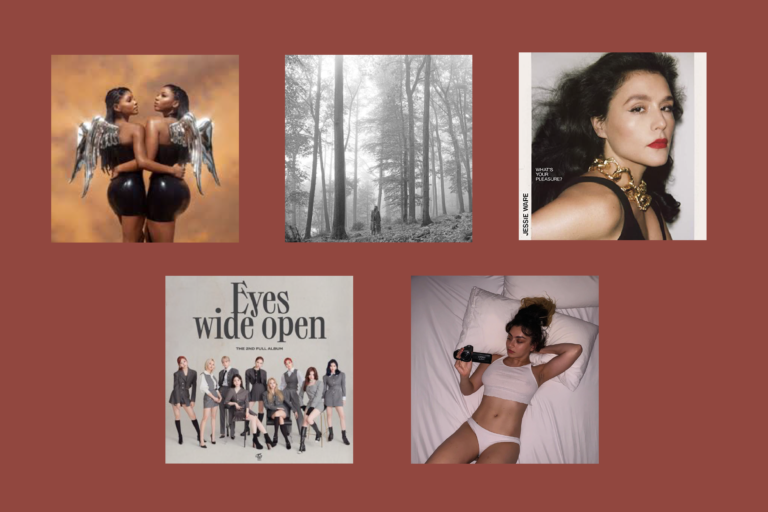
5. “Eyes Wide Open” by TWICE 

Though TWICE has been topping charts around the world for half a decade, their second full album was only released this year. The nine-member K-pop girl group took their music to new heights with their genre-pushing sophomore album “Eyes Wide Open.”

With a group like TWICE, known for bubblegum poppy earworm tracks, audiences are desperate to see various sides of them. Though the cute concept they utilize fits them perfectly, the push for them to release darker music has been with them from their beginning. With synth-pop title track “I CAN’T STOP ME,” TWICE have found a way to hear the feedback, while never straying from the signature TWICE sound that has secured them as their generation’s top girl group.

The cohesiveness of the album is unlike any of their previous works—each song showcases a different genre. The ’80s American retro influence is quite easy to pick up on in several tracks, including “I CAN’T STOP ME” and “UP NO MORE.” They venture further into Japanese city pop than ever before on “SAY SOMETHING” with incredible results. They even throw in an unexpected sprinkle of dubstep on “GO HARD,” but if anyone can pull it off, it’s TWICE.

Each track just has this ability to fill you with energy. The sweetly produced, full of feeling “UP NO MORE” is definitely the stand out of the album. “DO WHAT WE LIKE” and “HELL IN HEAVEN” are also near the top, both showcasing TWICE’s varied vocal abilities and styles.

Lyrical simplicity is not a damper on the tracks. The English hooks stick in your brain from the first listen. “I CAN’T STOP ME’s” “risky risky, wiggy wiggy this is an emergency” is modern day Shakspeare. And I don’t think any lyric has ever hit me as hard as “QUEEN’s”  “you’re a queen”—like, thank you TWICE, I needed to hear that.

Though tragically overlooked, “Eyes Wide Open” was truly one of the best albums of the year. It displays better than ever that TWICE are an ever-evolving musical force.

4. “folklore” by Taylor Swift

Taylor Swift is no stranger to switching genres (the transition from “Speak Now” to “Red” to “1989” will be immortalized in the history books). But “folklore” is different from Swift’s previous ventures into uncharted music territory. It represents not only the transition from her previous polished pop albums into new indie influenced sound, but also a change in her intentions as an artist. “folklore” sounds like something she needed to release: less for everyone else, and more for her.

Every song feels like its own experience. Soft production leaves ample space to explore the lyrical content, and it’s the best Swift has ever been. Lead single “cardigan’s” lyric “I knew I’d curse you for the longest time/Chasing shadows in the grocery line/I knew you’d miss me once the thrill expired” captures the tragic and haunting beauty of her words. “folklore” is full of the kind of sentences that will keep you up at night.

 The more you immerse yourself in the music, the deeper your connection to it becomes. At first somewhat forgettable, “august” has become my favorite song ever released by Swift. The sweeping background and guitar paired with some of her best lyrics (“Back when we were still changing’ for the better/Wanting was enough/For me, it was enough”) prove that she is a masterful storyteller and composer.

Though it was written by one of the biggest pop stars in the world, there is something about “folklore” that is so personal. Rationally, I know it went number one on practically every chart that exists, but I still have a moment of confusion when someone mentions a song from the album they like. Like how did you hear this indie album that only I know about?

The individual feeling of “folklore” shows that perhaps the greatest example of Swift’s artistry is her ability to make a highly specific lyric or experience feel like it can apply to anyone’s life. “folklore” is delicate and complicated. Swift has created an album that is impossible to forget.

3. “how i’m feeling now” by Charli XCX 

The only album on this list that really captures the raw truth of pandemic isolation is Charli XCX’s “how i’m feeling now.” (See: “I miss them every night/I miss them by my side/ Catch my tears when I cry/My clique on me for life”). The former radio darling and current avant-garde pop connoisseur wrote and recorded the 11-track album in her home during the earlier months of the lockdown. It sounds like a compilation of her greatest hits rather than an album she made in less than six weeks.

Charil is the face of hyperpop, experimental music that relies on unconventional computer generated noises. Her songs normally feature heavily edited vocals over synthesizer so powerful it can sometimes sound a little scary. “how i’m feeling now” is her furthest venture from traditional pop yet, and it proves that the more out there the better for Charli.

Though the production is the most compelling aspect, the simple lyrics that resonate deeply are a staple of this album. For example, the first lyrics of “pink diamond” and perhaps the best album opener of all time: *unidentifiable noises* “Yeah, hahaha/ I just wanna go real hard, I just wanna go real hard” because, it’s true! It’s the truth!

She includes a gradient of emotionality throughout the album. There are her classic club bangers that were practically crafted to be blasted in some basement 50 people past its maximum capacity (“claws,” “detonate”) intertwined with tender tracks brimming with vulnerability. “party 4 u” and “forever,” two of the best songs on the album, prove she understands her genre so well that she can write tracks that cultivate a feeling of longing through words and style without having to strip them of their hyperpop production.

“how i’m feeling now” has some of the best songs of the year while simultaneously sounding like when you drop a spoon in the garbage disposal—proof that Charli XCX is a once-in-a-generation talent.

2. “What’s Your Pleasure?” by Jessie Ware

2020 has conjured up somewhat of a disco renaissance. The influence of the ‘70s sound reached everywhere with Doja Cat’s “Say So” and Dua Lipa’s “Future Nostalgia” topping the charts. It’s ironic timing considering there’s nowhere to actually dance, but that didn’t stop Jessie Ware from releasing the best disco album of the year.

The British artist’s fourth studio album “What’s Your Pleasure?” is an hour of masterfully produced dance tracks. Each song is its own experience, and builds the atmosphere of a neon nightclub. If you close your eyes while listening, you can almost see bright lights flashing behind your eyelids.

The song lengths average at around four minutes and 30 seconds, so each track feels like a composition. The more upbeat songs are brighter and faster and stand out in your first listen. “Ooh La La” feels like dance steps are hidden in the music, the moves just come naturally. “Soul Control” doesn’t take itself too seriously with lyrics like “Baby, it’s automatic/We touch and it feels like (woo!)” and uses Ware’s stellar vocals.

The other tracks are less noticeably upbeat, but still have a possessive quality that makes you need to move. The way “Spotlight’s” pulsating beat gets into your head is almost overwhelming. “The Kill” is similar. It’s romantic and dramatic and makes you feel like everything around you is moving in slow motion. The album closer “Remember Where You Are” sounds like the night is over, finishing the album with the powerful voices of a choir reminding you “The heart of the city is on fire/Sun on the rise, the highs are gonna fall.”

The album manages to balance sophistication and thrilling, consuming fun. It’s incredibly underrated but once you hear it, it will never leave your head.

  1. “Ungodly Hour” by Chloe x Halle

Sister duo Chloe x Halle’s “Ungodly Hour” is the best album of the year. The duo’s vocals are their guide through these 13 songs, utilizing their voices as instruments. Older sister Chloe grounds the songs with her strong, controlled vocals while younger sister Halle’s voice floats atop the tracks. You can hear the meshing of their artistic abilities; the dynamic produces unique music while keeping the sound uniform. 

The production manages to create somewhat of a signature sound for the duo. And it’s a sound that isn’t tied to convention. One of the album’s best tracks, “Tipsy,” a song that uses off-time beats and rapping to cement itself in your brain, was produced solely by Chloe. The thumping beats of the title track “Ungodly Hour,” produced by Disclosure, are sentimentally beautiful. “ROYL,” with its inquisitive lyrics “Won’t you live tonight? (For the rest of your life)/Could be paradise (never know ’til you try)/Running out of time (baby, get up and try)” is one of the most fun songs they have ever released. At its core, it’s beautiful music that lets you enjoy yourself.

What really secures “Ungodly Hour” as the best is Chloe x Halle’s commitment to visuals and performance. They have performed various tracks off the album on the majority of recent award shows. They always match their outfits, and curate a new elaborate set and performance fitting within the constraints of pandemic performing. It’s truly impressive how they have been able to turn their album into an audio/visual experience when no one else was able to make it work.

In a year of impressive albums “Ungodly Hour” came out on top. Chloe x Halle have proved they are some of the most talented artists on the scene.
Written by: Livvy Mullen — arts@theaggie.org

Farmers’ protests highlight India’s failing democracy

With India’s failure to uphold democratic values on display, it is imperative that we stand in solidarity with farmers

In our current political age and climate, we have seen myriad instances of police  brutality and institutional racism. As American people we recognize our constitutional rights and condemn police brutality and racism. Now more than ever, we need to set a positive precedence for international issues and pave the way for democracy. 

Currently in India, over 260 million farmers are protesting against the new agricultural laws passed by Prime Minister Narendra Modi’s administration in what is now being called the largest protest in the world. Passed in September of 2020, these “black laws” have privatized and corporatized India’s agriculture, resulting in the end of wholesale markets and assured prices, leading farmers into debt and suicide. One law enables the removal of the minimum support price (MSP) for farmers, which had guaranteed them a minimum pay for their crops. As such, private corporations now set the price for crops and have the free ability to exploit farmers as they see fit. Another law states that farmers cannot take these private corporations to court. These two laws coupled with each other illustrate the monopolization of the farming sector in India which will inevitably lead to the usurpation of farmers across the country.

Domestic and international economic analysts have repeatedly condemned the Modi administration’s selfish interests to monopolize the agricultural industry of India, a sector of business that makes up nearly 60% of the country’s economy. With these laws passed, Modi’s administration has disenfranchised farmers across the country who have already been dying by suicide because of increasing debt and lower crop yields amid a global pandemic.

Farmers started to peacefully protest in September upon hearing these laws and have now been doing so for more than 60 days. Amid a pandemic, freezing temperatures and increasing famine, protesters are met with the brutality of the Indian police who fired tear gas and water cannons, piled mountains of dirt and even assaulted individuals to prevent them from reaching New Delhi, the capital of India. Some protestors have died after suffering from pneumonia, the flu or COVID-19. Farmers, however, have expressed willingness to lay down their lives for their rights and the future of their generations.

India, a country that was freed from Britain largely because of Mahatma Gandhi’s peaceful protests, is now violently retaliating against the desperate farmers’ protests. The world’s largest democracy has tainted what it means to be a democracy by disenfranchising the low and middle classes to provide assets to the rich. Despite ongoing protests now occurring internationally and steadily increasing international pressure, Modi’s administration has not suggested mediating the solution. Rather, the government’s efforts are to disperse the protests, unhesitant to use force. This fascism displayed by the Indian government and Modi’s administration is just one of many instances in India in which minorities are forsaken.

Canadian Prime Minister Justin Trudeau has publicly shown his support for the farmers and has emphasized his dissent toward the Indian government’s actions to disperse the protests. However, the U.S. media and politicians have failed to effectively shed light on this massive breach of democracy and innate human rights. Despite considering ourselves as a national hegemon and the hallmark of democracy, farmers’ plights seem to have fallen on deaf ears within the U.S. As models of democracy for the world, we need to condemn the Indian government’s actions as a nation, as did Prime Minister Trudeau. Doing so would create international pressure on Modi’s administration to reprimand their unjust laws that benefit corporate greed and create a peaceful resolution with farmers. 

In the age of social media, an increasing number of videos exemplifying the Indian  government’s methods have been posted online. These videos, however, remain censored or are taken down. In fact, social media companies like Instagram had temporarily censored and removed hashtags that supported the protests. Supporters across the world have risen in support of farmers in India. With protests across the world from San Francisco to Canada to Britain to New Zealand, supporters have gathered to exemplify the power of unity and solidarity.

These protests show one of the many instances prevalent in the status quo of governments consciously choosing to disenfranchise minorities and those of lower  socioeconomic status. With India’s failure to uphold democratic values on display, it is imperative that we stand in solidarity with farmers. Failure to uphold democracy and equity now will inevitably lead to further breaches of inalienable rights. As such, it becomes our moral and social obligation to support democracy. I encourage you all to take action: Email congresswomen and congressmen, raise awareness on social media and become an active voice for your brothers and sisters fighting for their rights and lives in India.

Written by: Kavenpreet Bal

Kavenpreet Bal is a student at UC Davis majoring in biological sciences with a minor in political science. During his free-time, Bal enjoys working with Bhagat Puran Singh Health Initiative (BPSHI) to provide free healthcare to the medically underserved Sikh community. As an aspiring MD/JD candidate, he seeks to increase accessibility to healthcare while fighting against social injustices. 

Disclaimer: The views and opinions expressed by guest contributors belong to them alone and do not necessarily indicate the views and opinions held by The California Aggie.

To submit a guest opinion, please email opinion@theaggie.org

After death of individual experiencing homelessness, Sacramento announces new warming center criteria

0

Advocates for unhoused individuals claim Sacramento is failing to support its homeless population during the pandemic

On Dec. 15, Mayor Darrell Steinberg of Sacramento announced new criteria regarding public warming centers for the city’s homeless population this winter. Under the new plan, the city will open warming centers after the temperature reaches 33 degrees Fahrenheit or below for 24 hours. The previous Sacramento County and City threshold was 32 degrees Fahrenheit or below, maintained for three days. 

“Every life matters,” Mayor Steinberg said in the press release. “We will do all we can even with all of the Covid restrictions to provide our homeless neighbors with a warm, safe place to come inside.”

The new policy follows the death of Greg Tarola, an individual who experienced  homelessness, in Sacramento on Nov. 20. Sacramento Regional Coalition to End Homelessness Executive Director Bob Erlenbusch described that it was 37 degrees Fahrenheit and raining when Tarola was found. 

“Greg Tarola froze to death about two weeks ago,” Erlenbusch said. “[A] 63-year-old gentleman, and his sleeping bag and clothes were drenched—it had rained during the night. It’s pretty obvious that he froze to death—he was drenched, he was soaked to the bone.”

The Sacramento County Coroner’s Office has Tarola’s cause of death listed as “undetermined.” 

Although acknowledging that the new plan for warming shelters is an improvement, Erlenbusch called the move disappointing. He explained that temperatures over 33 degrees Fahrenheit can still be dangerous depending on a variety of circumstances. 

“If I stepped outside and it was 35 degrees Fahrenheit, it would be cold—especially if it’s raining or if there’s any kind of wind,” Erlenbusch said. “We’re going to continue to push the city and the county to open up warming centers from Dec. 1 to March 31, regardless of the temperature.”

Faye Wilson Kennedy, the Sacramento Poor People’s campaign lead organizer and the Sacramento Black Caucus immediate past chair, described how unhoused individuals are trying to protect themselves from the rain when resources like warming centers and shelters aren’t available. 

“The folks who are unhoused are in the rain under tarps, under plastic bags, under your car, trying to stay dry from the rain,” Wilson Kennedy said.

Sacramento Loaves & Fishes Advocacy Director Joseph Smith described that both public and faith-based homeless shelters are taking in less individuals because of the pandemic.

“The city’s stock of shelters is really low,” Smith said. “It was low before COVID-19, and then COVID-19 restrictions went into place, and most of those public-run shelters cut their population back to 50%. The faith-based shelters closed altogether.”

Wilson Kennedy echoed a similar sentiment, describing that the high contagiousness of the coronavirus discourages shelters from operating at their normal capacity. 

“Before COVID-19, you would have churches opening their doors, you would have community centers,” Wilson Kennedy said. “But because of the virus, lots of places are very reluctant to open their doors. The pandemic has really thrown a wrench in how we engage with those who are unhoused.”

Erlenbusch explained that alongside its new criteria for warming centers, Sacramento also plans to shelter homeless individuals in motels this winter. 

“The positive side is that the city announced that they had about $35,000 to purchase motel vouchers, so people could come in out of the cold and stay in a motel,” Erlenbusch said. “That [program] is not temperature-driven.”

Although organizations and governments can support individuals experiencing homelessness, Smith explained that he doesn’t think change is possible until people challenge their perception of unhoused individuals. 

“The ‘Not in my backyard’ folks want to see people get help, but they just don’t want it to be in their neighborhood,” Smith said. “Until we change the conversation and make it more human and welcoming, it’s never going to get any better.”
Written by: Eden Winniford — city@theaggie.org

People are taking a cut in 2020

The plastic surgery “Zoom boom” we least expected from COVID-19

Since the pandemic has started, there has been an increase in washing hands rigorously, eating healthier, purchasing exercise equipment and taking an interest in skin care. The COVID-19 pandemic has also seen an increased interest in plastic surgeries. People have been spending more time looking at themselves through a screen—in not the most ideal lighting—and realizing wrinkles, lines and texture that they often didn’t have the time to notice or address.

COVID-19 has given people the dangerous opportunity of too much time spent at home and inside. As people spend more time inside and on their phones scrolling through various social media platforms, personal insecurities are also likely to increase. A Huffington Post poll revealed that 60% of people who partake in social media platforms have reported that it has negatively affected their self-esteem. Fifty-one percent of participants say that social media increased insecurities about their appearance. 

As people spend more time consuming images of extremely edited, photoshopped and idealized images, insecurity increases. We begin to wonder why our faces are not perfectly symmetrical, why our stomachs aren’t as flat as an ironing board or why our skin has so many pores. It is not shocking that a plastic surgery “Zoom boom” happened after months of looking at ourselves through a screen, nitpicking every insecurity or flaw we don’t like. Since the pandemic, doctors all around the world—the U.S., Australia, the UK, South Korea and Japan—have all had an increase in bookings for both surgical and non-surgical treatments.

A survey conducted in June of 2020 by the American Society of Plastic Surgeons (ASPS) of more than 1000 participants revealed that 49% of people who previously hadn’t had plastic surgery were interested in some form of cosmetic or dermatologic treatment. Twenty-nine percent of respondents indicated a preference for face lifts, rhinoplasties and breast augmentations. 

Another ASPS survey also showed that while plastic surgeon offices were closed, plastic surgeons continued to make use of telemedicine and virtual visits. The survey showed that the most asked for procedures  were botulinum toxin A (botox), breast augmentation, soft tissue fillers, liposuction and abdominoplasty.

Plastic surgeries like rhinoplasties usually require three to six weeks of healing time. A face lift requires at least two to three weeks for the swelling to subside. A breast augmentation takes an average of six weeks of healing time.

Most of the time the social stigma behind plastic surgery is that showing one’s swelling or bruising face to the world can be a deterrent. People prefer to keep the work they have done private. 

Limited exposure to the outside world and working from home provides people interested in any form of enhancement ample time to recover from going under the knife without ever having to let anyone know. Masks also let people hide what they don’t want the world to see and if someone has nipped or tucked something, it’s even easier to conceal. 

As we become older, some of us are able to accept and celebrate our insecurities and some of us may want to change them. Aging and beauty is subjective and forever changing in its standards. Modern medicine and plastic surgery exists not to just fan the flames of vanity but to actually give us the option to change what we do not like and be happy in the skin we live in, something many have taken advantage of in the appealing circumstances of the pandemic. 
Written by: Muhammad Tariq — arts@theaggie.org

2020-21 NBA season preview

0

With the season on the horizon, the quick turnaround will test the league’s best

The NBA proved this past summer that, even with an ongoing pandemic, it was possible to hold a successful season while also making the health of their players and staff a priority. The famous NBA bubble in Orlando, Fla. was a memorable couple of months consisting of fan-less NBA basketball where the league’s best went at it in high-level competition. It culminated with the Los Angeles Lakers capturing their 17th NBA title in franchise history after a six-game series against the Miami Heat. With zero positive tests in the entirety of the NBA’s stay in Orlando, the league was the first to boast a successful finish to a season. However, they still had a lot of decisions to make regarding their 2020-21 season, and those came quicker than anyone thought. 

After much thought and conversation, the NBA quickly came to the conclusion that a Dec. 22 start to the NBA season would be best for all parties. Despite there only being a 61-day gap between the last game of the NBA Finals and the first preseason game, potential financial losses that would come with a January start were enough for the NBA to decide on a December start. 

There will be no bubble for this upcoming 72-game season. The NBA will embark on a journey they hope is nothing like the journey of the NFL, MLB or college football. Their start runs parallel to the rising COVID-19 cases across the country, and the league is hoping they can limit the damage. Prior to players reporting, the NBA issued a COVID-19 safety protocols guide that was 134 pages long to all 30 NBA teams. In this guide, it explains what would happen if a player tests positive, among other COVID-19 related things. For example, it describes how, if a player is asymptomatic, they must sit out for 10 days, pass a cardiac screen, and work out at the team’s facility alone for two days before they can return to team activities. Furthermore, if a positive player is symptomatic, he must sit out 10 days, then proceed to complete all protocols of asymptomatic players as well. A positive test could mean that a player misses at the very least two weeks and in some cases, possibly more. 

Similar to the NBA bubble, masks must be worn at all times, even on the bench. When it comes to travel, teams will only be allowed to take up to 45 members of the team with them.The way the NBA worked its schedule this year, teams who travel will have some games against nearby opponents in an effort to reduce the number of long trips. While on the road, players have also been given a list of what they can and cannot do. Players can only leave the team hotel for outdoor dining, fully private dining rooms in restaurants or restaurants the NBA approves. While at home or away, they cannot go to bars, lounges, clubs or visit gatherings of more than 15 people. 

The NBA believes that they have the best interest of everyone involved with these protocols. Ensuring that everyone can have a safe, secure season is the goal, and enforcing strict rules can make this season a success. 

The league has released the first half of the season schedule running from Dec. 22- March 4, with plans to release the second half sometime in the beginning of 2021. The defending champions, the Lakers, will begin their title reign on Dec. 22 against their crosstown rivals, the Los Angeles Clippers. Entering what was the shortest offseason in professional sports history, the Lakers retooled their team, adding some well-needed youth and fire power to both their starting lineup and their bench. Although they lost five key pieces of their championship team including Rajon Rondo and Dwight Howard, the Lakers arguably upgraded, adding two Sixth-Man of the Year candidates Dennis Schroder and Montrezl Harrell. In addition, they added key veteran pieces, former Defensive Player of the Year Marc Gasol and a gritty 3-and-D player Wesley Matthews. Moreover, the Lakers were able to lock up their superstar Anthony Davis to a 5-year $190 million contract and keep Kentavious Caldwell-Pope and Markieff Morris, two players who played crucial playoff minutes down the stretch last season. The Lakers hope to repeat for the first time since their 2009-10 season, and their offseason moves show that they are serious about defending their crown. 

When looking at disappointing teams in last year’s finish, both the Milwaukee Bucks and Los Angeles Clippers stand out. Once looked at as a potential NBA Finals matchup, both teams crashed out in heartbreaking fashion. 

On the Bucks side, their 4-1 series loss to the Eastern Conference Champion Miami Heat added another stain to reigning MVP Giannis Antetokounmpo’s playoff woes in his young career. The back-to-back MVP has been criticized for his inability to show up in the big moments, and with a possible free agency on the horizon, the Bucks hoped their moves would convince their star to stay. With one of the first splashes in the trade window, the Bucks acquired two-way guard Jrue Holiday from the New Orleans Pelicans in exchange for a premium package of players and first round picks. Although the move may be seen as giving  up too much, it was enough to make Antetokounmpo re-sign on Dec. 15 to the tune of 5 years and $228 million. The city of Milwaukee can now exhale that their superstar is staying, but the race is on for the Bucks to achieve their championship goal during this period that they have their MVP playing at the highest level. 

On the other disappointing side, the heavily favored Clippers crashed out of last season’s playoffs, blowing a 3-1 series lead to the Denver Nuggets. After acquiring both Kawhi Leonard and Paul George last offseason, their monumentous collapse was unexpected. This offseason, they intended on ensuring one of their weaknesses and signed Serge Ibaka to a two-year deal. Ibaka’s size gives them the ability to stretch the floor while also getting the toughness on the defensive end that they were missing last season. They also retained Marcus Morris, who they traded at last year’s deadline. Although they did not get a point guard that they needed to take the load off of Leonard, the Clippers are hoping that with newly-hired head coach Tyron Lue, they will be able to make it past the second round for the first time in franchise history.

This season will mark the return of some major superstars that were missing last season. After injuring his achilles in the 2019 NBA Finals, superstar Kevin Durant will be making his way back to the hardwood this season with the Brooklyn Nets alongside Kyrie Irving, who also missed the end of last season. The Nets’ star power coupled with their solid depth makes them a legitimate contender in the Eastern Conference. If the team maintains their health, they will be making noise come playoff time. 

Also coming back from an injury this season is  Steph Curry, Durant’s former teammate on the Golden State Warriors. The two-time MVP and three-time NBA Champion will lead his Warriors back on the court with hopes of keeping the franchise as contenders. After his teammate  Klay Thompson suffered another major setback with an Achilles tendon tear before the season began, Curry will be with the likes of Kelly Oubre Jr., Draymond Green and Andrew Wiggins. Number two pick James Wiseman is hoping to be the spark that they are looking for, as they begin this new era of Warriors basketball post-Durant.

This year will certainly be very competitive, as there are many teams that look good enough to compete for a title. As it stands, the Lakers are the odds-on favorites to repeat at +210 according to Odds Shark. Behind them are the Nets at +550 and the Clippers and Bucks tied at +600. After those four teams, there is a bit of a drop off to the Boston Celtics at +1600 and the reigning Eastern Conference champions the Miami Heat at +1800. In the annual general manager survey the NBA conducts to all teams, an astounding 81% chose the Lakers to repeat as champions. Next is the Clippers at 11%, with the Nets and Heat both receiving votes. 

In such an unprecedented time, there are no certainties with this NBA season. The quick turnaround will test all teams, but the constant threat of the ongoing pandemic will live on the front of their minds as well. Hoping to handle this situation better than other sports, the NBA’s plan for their upcoming season is an extensive one. But in the end, if the world allows it, this season can be a treat to basketball fans all over the world. 
Written by: Omar Navarro — sports@theaggie.org

Dissecting the surprise ‘evermore’ album

How storytelling takes over in Taylor Swift’s new sister album

Taylor Swift has done it again. A surprise release shocked fans when Swift shared the news about “evermore,” the sister album to her previous release “folklore.” The new album has the same whimsical vibes that fans grew to love with “folklore” and more songs written by the cherished William Bowery (the pseudonym of Joe Alwyn, Swift’s boyfriend). 

When Swift posted an iconic “not a lot going on at the moment” picture, fans assumed there would be a music video to the song “exile” or “august,” but she tricked us once again. Instead of releasing a music video for one of the fan-favorite songs, she released “evermore.” She’s a liar and we love her for it. 

It was announced that “evermore” would be a sister album, so I expected it to have the same kind of tone that “folklore” brought. But I found “evermore” to be a more mature album. The lyrics emphasize the thing Swift is best at: storytelling. 

One of my favorite things about Swift as an artist is that her albums are immensely personal. Listening to her music feels like I’m reading a page straight from her diary, and this is something her fans have felt since her debut album. It was nice to know that I was hearing a personal side of her life that she chose to share with the world. 

For this reason, “evermore” didn’t quite top “folklore” for me. With a growing maturity comes a loss of the connection that I’ve grown to feel with her music. Swift has mentioned that with these sister albums, some of the stories and characters are fictional. But in “folklore,” we still have those personal stories like “mirrorball” that speak to her unending need to be liked or “mad woman” and “my tears ricochet” that express her pain when Borchetta sold her albums. There is a personal connection in “folklore” that I didn’t quite get in “evermore.” 

While there are still a few songs on the album that do relate to Swift, like “closure,” “willow” and “marjorie,” this album was more of a series of stories that fans could play out in their heads. It was a new change that I didn’t expect from Swift, but I have to admit that it is a welcome one. She’s at a time in her life where it’s normal to want some privacy and after years in the spotlight—I’m sure that it’s craved at some points. If she wants to release an album with more fictitious stories than fans are used to, then so be it. I’ll still listen and fall in love with the characters that she’s decided to give us.

Now let’s talk about my favorite songs from the album. For years, fans have begged Swift to collaborate with a woman. While we did get that with “Soon You’ll Get Better” from the “Lover” album, I can’t listen to it without having a full cryfest, so I usually steer clear of listening to the song while in the car. But with this album fans finally got a collaboration with HAIM, the pop band and long time friends of Swift. To say the least, the collaboration was genius. The song titled “no body, no crime” very clearly plays out as a murder drama scene that’s better than any Netflix mystery movie I’ve watched. I didn’t know this song was something I needed until I heard it and I officially can’t get enough of it. The song does bring Swift back to her country roots and while that would normally put me off, it’s Swift. She could just be playing with a banjo and I’d listen. 

I would like to think that “closure” is about Scott Borchetta simply because it fits so well. “Closure” starts off with loud metal clashing and sounds that don’t sit right, but the song soon falls into a beautiful piano melody as the abruptness of the clashing metals fades into the background. The song describes someone reaching out for closure, but it’s unnecessary because the other person doesn’t want it nor do they need an apology anymore. The musicality is a beautiful reflection of Swift’s storyline in the song. The healing process is reflected in the piano, but when something interferes with it, the interference is loud and unnecessary, which is exactly what the crashes sound like in the beginning of the song. With the crashes constantly playing in the background and being dulled out as the soft piano melody takes over, it’s a beautiful testament to how the healing process isn’t linear. The people who hurt you will still be in the back of your mind, they will still consume you, and sometimes the thoughts will grow louder, but sometimes they’ll be nonexistent. 

Besides the beautiful musicality, in this album, we get to see a lot of Swift’s maturity over the years. Her songs are no longer about Romeo and Juliet, but about alcoholism and a runaway bride. One of my favorite songs in the album is titled “champagne problems” which is a take on someone losing the person they love because they couldn’t agree to marrying them and everyone else blames it on the alcoholism. Songs like this are a perfect example of why Swift is still at the top of the music industry. She can tell a story about something that is usually not discussed and can do it in four minutes.

My least favorite song of the album is “cowboy like me,” but I still have to applaud the storytelling. The song describes a con artist falling in love with another con artist and they are forced to put aside their old ways  while trying to build a life with the person they love. The song is a little slow for my taste, but after a deep dive into the lyrics, I gained a deeper admiration for it. 

This goes for most of the album—it’ll grow on you. A good number of fans are having trouble deciding which of the sister albums they love more, but I can easily tell you that “folklore” is my favorite. That’s because on the first listen of “evermore,” the only song I loved was “no body, no crime,” which is unusual for one of Swift’s albums. But after a few listens to more songs, I did slowly fall in love with the album. I didn’t have many expectations for this album, especially because I wasn’t given the time to develop them. Although I did want some faster songs, I know this album is more indie pop and country. I have been craving those upbeat songs that we’ve been used to for years, but I can’t say I’m disappointed with “evermore.” 

Fans are still skeptical after Swift debunked a surprise third album, but we are grateful that she’s been with us for the mess that has been 2020. Her songs allow me to step into another world and that’s especially true with “evermore,” where we get to meet fictitious characters that are dealing with problems I couldn’t even imagine. 
Written By: Itzelth Gamboa — arts@theaggie.org


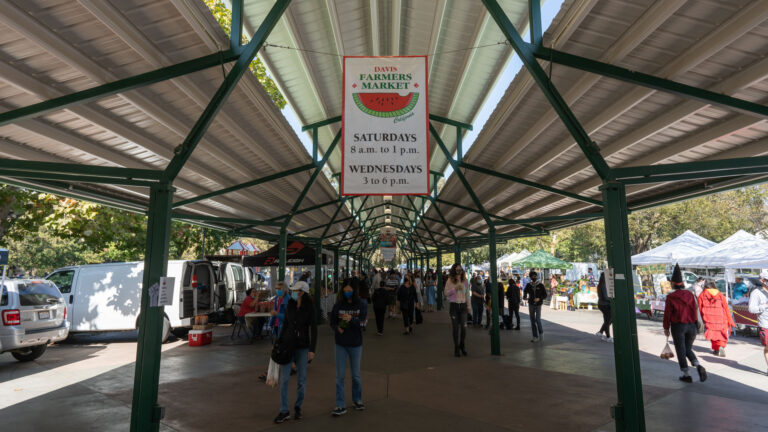
Study finds low food safety risk among Northern California farmers markets

Although risk of Salmonella and generic E. coli is low, researchers still emphasize good food safety practices

A recent study published by UC Davis researchers in the Journal of Food Protection found low food safety risk at Northern California farmers markets in terms of exposure to harmful bacteria. The study looked at the prevalence of foodborne pathogens such as Salmonella and Escherichia coli, and found that produce and meat sold at the markets are relatively safe. Researchers, however, still urge caution and good food safety practices. 

The study was conducted with data from the California Farmers Market Directory and the U.S. Department of Agriculture (USDA) Local Food Directory. This data included samples from 44 certified farmers markets in Northern California that sold produce, meat or both. Across a selection of 44 farmers markets, 51 vendors sold meat, 41 vendors sold produce and one vendor sold both. They collected 338 samples across the 93 vendors between February and July 2018. The selections were based on which targeted products, such as meat products, leafy greens, root vegetables and fruits, were available there. 

The study shows that less than 2% of meat products tested positive for Salmonella while none of the produce did. Additionally, 31.3% of produce tested positive for generic E. coli. Not all E. coli is harmful, and the generic E. coli that was detected is not a pathogen. Alda Pires, a co-author of this paper and the associated extension specialist for urban and agricultural food safety at UC Davis, explained the distinction. 

“It is a generic bacteria and is an indicator of contamination, which is different from the pathogenic bacteria E. coli O157 that people might remember from different outbreaks,” Pires said.

According to Pires, the findings show that it is fairly safe to consume products from farmers markets in Northern California. The 31.3% contamination for generic E. coli may seem high, but it is in relatively small concentrations. 

“There is very low risk compared to other studies, so it’s really good news for farmers markets when you compare to other studies,” Pires said. “Although a small sample size, it reflects a low risk of contamination of those products.”

Despite the otherwise low food safety risk from produce and meat at farmers markets, Pires said that consumers should abide by good practices when buying, transporting and cooking their food. 

“Specifically, when preparing the food, and you are preparing meat products and vegetables, just follow the CDC guidelines and avoid cross contamination,” Pires said. “[For example] use different cutting boards, don’t wash your chicken and so on.”

Linda Harris, a specialist in cooperative extension in the department of food and science technology, lays out a series of practices to make sure food is safe to consume. Both consumers and vendors, at large and small farmers markets, should pay attention to the cleanliness of the products. They should also make sure that raw and processed meats are kept at cold temperatures, including when transporting the meat back home and especially during the summer months. 

As a specialist in cooperative extension, Harris works with various individuals in the community, such as growers, processors, consumers and regulators in the state and federal government on food safety.

“My interaction with these groups differs based on their needs but can include responding to an individual’s question, [providing] information on our website for more frequently asked questions and topics that require more in depth resources, online training [and] presentations at various public meetings,” Harris said via email. “The types of information might range from information on how to comply with state and federal food safety regulations to understanding approaches to building food safety into everyday practices.”

The University of California Food Safety website from Harris and Dr. Erin DiCaprio includes all these important resources to educate and empower individuals across the supply chain about food safety. Their resources cover food safety topics, spanning from food safety after natural disasters to food safety practices during COVID-19. 

Shopping locally at farmers markets has grown in popularity among consumers. The findings from this study are increasingly relevant in providing shoppers with crucial food safety information.  

“There is a great interest to buy local, sustainable and organic products,” Pires said. “In my personal opinion, the consumers [want] to be closer to the farmer and know where their food is coming from and that reflects in their preference, where they get their products.”
Written by: Simran Kalkat — science@theaggie.org

Davis Joint Unified School District to discuss reopening under a hybrid model

0

Educators examine how the pandemic has exacerbated educational inequalities, especially for students of color

On Dec. 18, the Davis Joint Unified School District (DJUSD) announced in an email that it will spend January discussing a plan for reopening under a hybrid model. Small groups of students are already learning on campus, but the majority of DJUSD students are still learning virtually. 

DJUSD Director of Secondary Education and Leadership Troy Allen explained via email that distance learning has been difficult for students, especially by impacting how they communicate with their peers and mentors. 

“The challenge that students speak about most are the barriers that exist to relationships and casual interactions,” Allen said via email. “Relationships, between peers and with teachers and staff, are what characterize school for most students and many are feeling that loss; this makes engaging in content harder for students.”

The challenges of virtual learning have also raised awareness about whether educational systems in the U.S. are equitable both during the pandemic and otherwise, according to Sacramento State Professor of Education Dr. Margarita Berta-Avila. 

“Educational inequities have always existed,” Berta-Avila said. “COVID-19 has brought them to light, but this is not a new concern.”

 Black Parallel School Board Operation Director Carl Pinkston defined educational equity and its relationship to social justice.  

“Educational equity is that the educational outcome is the same for all students, but it is not that all students receive equal resources,” Pinkston said. “One part [of educational equity] is educational justice, which is addressing all the harm that has been created as a result of racial capitalism and the history of inequities around the educational system.”

Berta-Avila described how economic hardships brought by the pandemic, coinciding with virtual learning, results in students with parents working from home having more support than their peers whose parents are working in person. 

“Schools are providing computers and different ways for people to do distance learning, but not everybody has the same support at home,” Berta-Avila said. “There are parents who have to work to make sure they have food on the table and that they can pay the bills for their children. Some children have to navigate their way through schooling without the support that some other children might have with their parents being able to work from home.”

Faye Wilson Kennedy, the Sacramento Poor People’s campaign lead organizer, the Sacramento Black Caucus immediate past chair and a former educator, noted that with or without the pandemic, students of color are most impacted by educational inequities. 

“We have an educational system that is not designed for poor children, not designed for kids of color and specifically not designed for Black kids,” Wilson Kennedy said. “The majority of people who are impacted by COVID-19 nationally and in Sacramento are people of color.”

Echoing a similar sentiment, Pinkston described how the achievement gap has already existed for students of color in the Sacramento Unified School District, but the increased importance of technology has put already-vulnerable students at more of a disadvantage. 

“Prior to the pandemic, the quality of education in the Sacramento Unified School District was poor,” Pinkston said. “They were never going to close the achievement gap. The pandemic has exacerbated inequalities in terms of access to technology. Since everyone had to go into remote learning, not all students—particularly Black students—had access to the Internet, and many of them didn’t have Chromebooks.”

Pinkston continued to explain that when students don’t have access to adequate technology, it becomes impossible for them to turn in their schoolwork and get good grades. 

“Because many Black students are low-income, they don’t have the quality resources in terms of technology, so they’re not able to upload their assignments,” Pinkston said. “Many of these students are actually failing—there’s an explosion of students receiving Fs.”

Berta-Avila explained that it’s important to strive for educational equity because it will give all students the ability to succeed and to improve society as a whole. 

“Our youth are our future,” Berta-Avila said. “We want schools to be the venue in which we foster an opportunity for students to become critical thinkers, to become conscientious of themselves and of one another and to be able to recognize their role in creating a better society.”
Written by: Eden Winniford — city@theaggie.org

The production of ‘[re: Click]’ is an eclectic and experimental viewing experience

Have you ever been online?

“[re: Click],” a joint production between the UC Davis Department of Theatre and Dance and the American Music Theatre Project at Northwestern University, adapted and directed by Margaret Laurena Kemp and Roger Ellis, gave its final performance of the year on Dec. 12. It’s an experimental piece of theater—performed entirely online—that follows a group of students as they traverse the difficult and identity-disrupting realities of digital existence.

The show is based on a stage production, “Click” (written by Jacqueline Goldfinger), and was reimagined in a way that manages to capture the idiosyncratic and repetitious experience of online information gathering in a surprisingly evocative way. Through the series of embedded YouTube live streams and Vimeo links that make up the four parts of the show, viewers are fed a narrative suggesting rejection and exploitation, among other difficult symptoms of the modern flesh/internet split life.

Lines and inflections are repeated through various characters and motions are synchronized across screens, creating moments of near deja-vu that reinforce thematic ideas and concepts. The bulk of the performance, however, consists of college students staring blankly at some place just below the camera and almost unintelligible mutterings by performers off-screen. The presentation is purposely eclectic and never gives the viewer space to piece together information. Moments of clear focus are rare, but this is intentional: It’s built to mirror the cluttered informational wasteland of the internet. This is a focus that seems to be based in a boomerish fear of digital life and the implications of ownerless information, a fear many of us raised on the internet do not hold.

Furthermore, it’s easy for a viewer to wonder why none of these performers have been provided with a decent microphone, especially when so many lines are quiet and/or mixed with a chorus of others. A usable condenser mic plus audio interface is around $60.

The performance’s website is black and moody, often filled with Matrix-reminiscent hashes of binary, and generally sets a tone comparable to something off a deep web URL, which provides a fitting accent to the nebulous nature of the performance itself. The whole thing is steeped in a 2000s conception of the internet.

While definitely interesting, “[re: Click]” is an effort that in no way curbs its experimental presentation in the name of clarity. It’s an experience that requires active attention and deciphering to make a lick of sense out of what could be loosely considered its plot. It has shades of the multimedia spheres of “This House Has People In It” and co., though more limited in its capacity and less sprawling. This is an attribute that may or may not be to your taste. Live performances go on while you visit different parts of the website with no guidance, and it’s entirely possible to miss pivotal moments while on a different section (though due to their nature as embedded streams and videos, skipping back is easy).

While this year’s performances—the “alpha” version of the show—have come to an end, “[re: Click]” will have further dates with its “beta” version in 2021. 

Written by: Jacob Anderson — arts@theaggie.org

Students provide reasons for their recent decision to delete social media

0

A UC Davis Health psychiatrist and students offer insight and opinions on deleting social apps and the positive and negative consequences of social media

Social media is prevalent in the lives of many college students. Some, however, have recently made the decision to delete certain social apps from their phones. For example, Maile Kim, a second-year history major, decided to delete Instagram towards the end of November after periodically deleting and redownloading the app since its creation in 2010. 

Kim’s main motivation for deleting Instagram was the new shop feature on Instagram that allows users to browse and purchase products through the app. She saw this feature as taking advantage of users’ attention in order to promote trade. 

“That just really threw me off and I was like, ‘Oh my gosh, this app is totally commodifying everything,’” Kim said. “And it was just so blatant. So that really made me feel uncomfortable.”

Beyond her dislike for this feature, Kim found that Instagram was taking greater precedence in her life than she wanted it to.  

“I just noticed that as time goes on, the significance of Instagram in my life has just grown dramatically, and I think that it’s the same for a lot of people, just the way you hang out with people, the way you take certain photos, it just has completely changed society,” Kim said. “I really wanted to get out of that cycle and not care so much about how others view me and how my feed looked or how I presented myself online.”

Kim noted that with the increase of time spent indoors as a result of the pandemic, she felt that she more often compared herself to others through Instagram.

“In relation to quarantine I feel like I definitely spent a lot more time on Instagram and especially comparing myself and seeing everyone picking up new hobbies or doing this and doing that,” Kim said. “And I felt like, ‘Oh my God, what am I doing with my life?’ I don’t think [quarantine] necessarily directly correlated to me deleting it, but it did intensify those feelings of comparison for sure.”

Dr. Paula Marie Wadell, a child and adolescent psychiatrist and the medical director of early psychosis programs for UC Davis Health, believes that social media has the potential to disrupt life patterns and make it harder to complete tasks with a focused mindset. 

“I do think there’s a level at which engagement in social media can become so problematic that it interferes with normal functioning,” Wadell said.

While Wadell has her own opinions about social media’s effects on attention and functionality, she acknowledges that social platforms can be both positive and negative.  

“That’s what’s so difficult about social media,” Wadell said. “I think we’ve got people on one side of the issue saying that you know, it’s this harmless thing, it’s great. And then other people on the other side of the issue saying it’s toxic and drives some teens to suicidal thoughts and behaviors. Like so much in life, the truth lies somewhere in the middle.”

Victoria Odom, a second-year biological sciences major, made the decision to permanently delete Twitter after years of deleting and reinstalling the app. For Odom, Twitter is a problematic atmosphere that often houses unproductive arguments.

“It totally brings out the worst in people because people would never say this type of stuff to each other in person, yet they have no hesitation doing it on this platform,” Odom said. “Every time I’d log in, I feel like I’ve been bombarded by arguments, especially during the debates and the election. I feel inclined to chime in and then I just get angry too.” 

Wadell believes that social media can either be a way for users to vent their anger or a healthy forum for building connection. 

“There’s a tendency to behave in ways that you never would face-to-face and say things that are really hurtful,” Wadell said. “The other side of it, of course, is we’re in a pandemic and so there’s some level of engagement on social media that can be really adaptive and helpful.”

In Wadell’s work with adolescents, she has witnessed that her clients have an increasing understanding of the possible negative effects of social media. 

“I think [with] a lot of young people I’ve been really impressed,” Wadell said. “I think older generations are not giving younger generations enough credit for the thoughtfulness that I see in many of them. I see them bringing up [that] social media is a problem. I think that there’s a growing recognition of what problematic use might be, and what helpful use is.”
Written by: Lyra Farrell — features@theaggie.org

Health care workers receive first doses of COVID-19 vaccine at UC Davis Medical Center

UC Davis Health begins administering shots to employees based on exposure risk for COVID-19, with plans to eventually distribute to general public

Employees at the UC Davis Medical Center were some of the first individuals nationwide to receive the coronavirus vaccine on the morning of Dec. 15. The long-awaited vaccine, developed by Pfizer and BioNTech, brings hope to many Americans as the COVID-19 death toll in the U.S. has surged to over 300,000.  

Eva Teniola, a clinical nurse in the emergency department, was the first person at UC Davis Health to receive a dose of the vaccine. After getting the shot in her left arm, the 47 year-old was met with applause from other employees and health professionals, according to a video posted by UC Davis Health. 

“Thank goodness the vaccine is here,” Teniola said. “It’s happening.”

Teniola’s shot was one of the 4,875 vaccine doses that arrived at the medical center around 7 a.m. on Dec. 15, before being administered to dozens of health care workers later that morning. The vials were shipped out of the Pfizer distribution center following the vaccine’s emergency use authorization by the Food and Drug Administration (FDA). 

UC Davis Health plans on inoculating about 400 employees a day, though they expect that number to rise as other vaccines get emergency approval by the FDA. The storage space at UC Davis Health could hold up to half a million vials. 

Employees in the Emergency Department are the first group to be inoculated, including doctors and nurses, food service workers and receptionists. A tier system has been developed to determine which groups of employees will receive the vaccine next, based on their exposure risk to COVID-19 in the workplace. Though it is uncertain when the vaccine will be widely available, the California Department of Public Health (CDPH) estimates that vaccinations for the general public could begin as early as spring 2021. 

UC Davis Health was selected by the CDPH to receive vaccines based on “their storage capability, highest-risk health care population and ability to distribute vaccine in the community when it becomes widely available,” according to a UC Davis Health press release. The medical network also played a critical role in testing the efficacy of the Pfizer and BioNTech vaccine during clinical trials earlier this year. 

David Lubarsky, chief executive officer for UC Davis Health, emphasized how this is a turning point in fighting COVID-19, which has infected nearly 17 million Americans.

“This is truly the beginning of the end of the war on the pandemic,” Lubarsky said in the press release. “And now we have the tools to win this war and to save lives. We are ready to lead the way out of the pandemic.”

Written by: Madeleine Payne — science@theaggie.org