57 F
Davis

Davis, California

Monday, December 22, 2025
Home Blog Page 300

Police logs

0

Hello officer, can I get a ride home?

November 19

“Dropped car keys in storm drain.”

November 22

“Vehicles illegally parked facing opposing traffic and specific concern about ‘bicycle traffic and 12 neighborhood kids that love their scooters.’”

November 25

“Male crouching down shooting finger guns in the plot.”

November 28

“Female asked if she got food delivered, respondent said ‘no’ and closed the door, subject came back and egged the front door.”

November 30

“911 hang up. She is trying to speak with her niece and can’t find the phone number.”

December 1

“Respondent ordered a Lift ride but it hasn’t come and now he is extremely cold.”
UC Davis professors compare and contrast the 1918 Spanish flu pandemic and COVID-19

0

It has been over 100 years since the world experienced the devastating 1918 pandemic, and history seems to be repeating itself, according to UC Davis professors

Before COVID-19, it had been over 100 years since the world experienced the H1N1 influenza pandemic, more commonly known as the Spanish flu. The flu hit right at the end of World War I and continued in waves into the 1920s, and the virus was believed to have far more fatalities than the war. According to the Centers for Disease Control and Prevention (CDC), the Spanish flu caused 50 million deaths worldwide. 

Despite its name, the Spanish flu was thought to have originated from the U.S.. Spain remained a neutral country during the war, and the national newspaper in Spain was one of the only papers that reported about the virus, leading to the name ‘Spanish flu.’

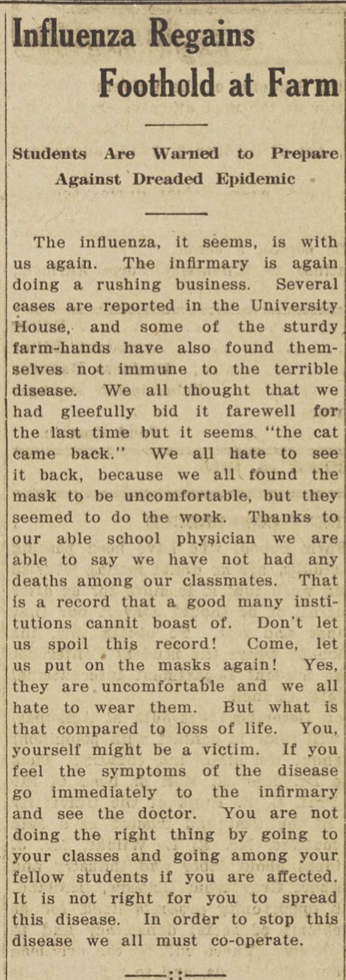
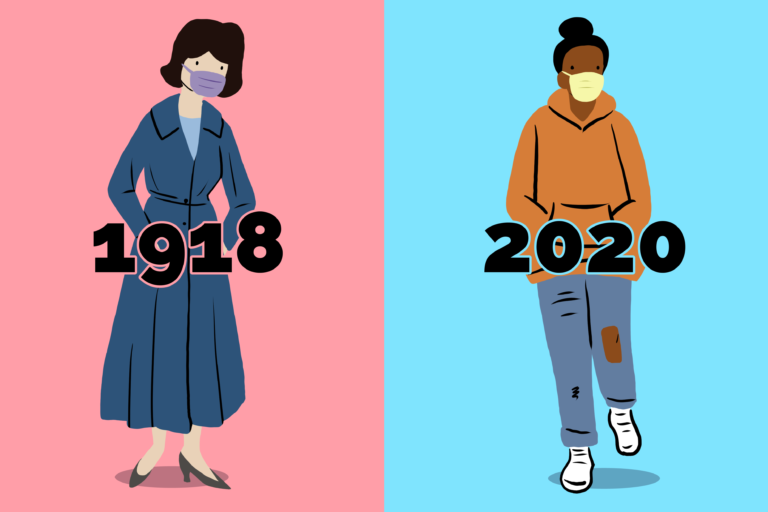
COVID-19 parallels the Spanish flu in many ways. Pictures of people wearing masks in 1918 and anti-mask protests have been circulating around social media as of late. Last April, The California Aggie completed its digitalization of its archives since its foundation in 1915. The archival records show articles written by Davis students in 1918, when the Spanish flu pandemic was at its peak.

“Influenza Regains Foothold at Farm, Students Are Warned to Prepare Against Dreaded Epidemic

The influenza, it seems, is with us again. The infirmary is again doing a rushing business. Several cases are reported in the University House, and some of the sturdy farm-hands have also found themselves not immune to the terrible disease. We all thought that we had gleefully bid it farewell for the last time but it seems ‘the cat came back.’ We all hate to see it back, because we all found the mask to be uncomfortable, but they seemed to do the work. Thanks to our able school physician we are able to say we have not had any deaths among our classmates. That is a record that a good many institutions cannit boast of. Don’t let us spoil this record! Come, let us put on the masks again! Yes, they are uncomfortable and we all hate to wear them. But what is that compared to loss of life. You, yourself might be a victim. If you feel the symptoms of the disease go immediately to the infirmary and see the doctor. You are not doing the right thing by going to your classes and going among your fellow students if you are affected. It is not right for you to spread this disease. In order to stop this disease we all must co-operate.”

  Dr. Sarah Dye, an assistant professor of global disease biology, gave a brief overview on the scientific similarities and differences between the two diseases. 

“Scientifically they’re completely different viruses,” Dye said. “They are in two totally different taxonomic groups, although they are both respiratory viruses, have similar symptomatology and both originated from animals and migrated to humans. But they aren’t closely related.”

Another key difference between the two viruses is the age group they affect the most. According to Dr. Edward Dickinson, a professor of world history and the history of imperialism, the Spanish flu mainly targeted men ages 20-40 whereas COVID-19 is believed to most severely impact individuals ages 65 and older. 

Dr. Neil McRoberts, a professor of plant pathology, studies the epidemiology of vectored plant diseases and the impact of the spread of diseases throughout populations. According to McRoberts, COVID-19 is believed to be much more deadly. 

“Even though there were 40 million people who died from the Spanish flu, COVID-19 is known to be much more infectious, so you are more likely to catch it compared to the flu,” McRoberts said. “The fatality rate for COVID-19 is much higher compared to influenza and the reason that there were significantly more people who died from the Spanish flu is largely due to the fact that we were not scientifically advanced enough to treat influenza back then.”

Research has shown that the 1918 influenza strain was highly virulent and transmissible. According to Johan Leaveau, a professor of plant pathology and disease and society, a combination of low quality medical care, poor hygiene and lack of medical technological advancements contributed to the higher numbers of deaths for the Spanish flu. By the end of 1919 there were believed to be 50 million lives taken by influenza. So far COVID-19 has taken about 1.5 million lives. 

In early March of 2020, California was the first state to issue a stay-at-home order. Dye discussed how the concept of quarantining was implemented during the Spanish flu as well. 

“From what I understand about the 1918 pandemic, there were no strict lockdowns like we have now,” Dye said. “The response from health officials was like localized patchwork, meaning that the federal government didn’t have a lot of influence on how the 1918 pandemic was controlled. Local responses played a much stronger role, which is similar to what we are seeing with COVID-19 with states issuing different policies about quarantining.” 

According to Dye, another reason that stay-at-home orders were not mandated during the 1918 pandemic was because a majority of the working class held jobs that required in-person manual labor. 

“A strict quarantine would have been more difficult to implement without completely shutting down the economy in 1918 because we didn’t have things like Zoom,” Dye said. “If people fell sick and stopped going to work, they stopped earning money and that would have made it difficult for them to support themselves and their families.”

Leaveau further explains how the lifestyles of people during the pandemic hasn’t changed much over the past hundred years. 

“What strikes me the most are not so much the differences, but the similarities,” Leaveau said. “People were asked, as they are now, to stay home, socially distance and wear masks; shops closed and went under; people got tired of the pandemic and of the mandates imposed by public health officials and let down their guard, which resulted in additional outbreaks and preventable deaths. It all sounds very familiar.”

The public responses to the two pandemics have been significantly different in terms of provided care, Dye explained, largely due to the fact that the majority of the population was not treated in hospitals during the Spanish flu.

“I think the fear was a bit more tangible in the 1918 pandemic,” Dye said. “With COVID-19, if someone gets really ill, they go to the hospital. You aren’t allowed to visit them, so you don’t really see the gruesomeness firsthand unless you are a healthcare worker. With the 1918 flu, those who were sick were most likely put on bed rest in their homes instead of being treated at hospitals, and oftentimes they would see people on the streets getting very sick and dying.”

Similar to the COVID-19 pandemic, the health restrictions in 1918 like wearing a mask caused resistance, Dye said. 

“Interestingly, there were people that protested wearing masks back in 1918 and there was even a whole anti-mask league that was formed in San Francisco with people claiming that masks made them hot and uncomfortable like they do now,” Dye said. “So I do think that there is a lot of similarity between the two pandemics in terms of the public responses [to health directives].” 

There have been a lot of technological advancements in the past century, some of which have helped healthcare officials fight COVID-19. Advancement in social media and news coverage, however, has been detrimental to flattening the curve, according to Dickinson. 

“I think social media has clearly had a very negative impact [on COVID-19],” Dickinson said. “There are bizarre theories floating around—about this being a fake epidemic—that are given currency by the fact that anyone can post whatever they want to. The amount of disinformation that is being produced is incredible, and there wasn’t the capacity to generate nonsense in 1918.”

Dye believes, however, that the spread of false information was prevalent even in 1918, and countries went as far as censoring information about the virus to maintain wartime optimism. 

“There was a lot of disinformation even back in 1918, but not [to] the extent that it spreads now,” Dye said. “The pandemic was going on during World War I and so countries that were actively fighting in the war wanted to suppress reports of how bad the influenza pandemic was to keep up morale for the war.”

McRoberts explained how through social media and the news coverage, the pandemic has become more of a political issue than a global health crisis. 

“Social media is dangerous in a situation like this,” McRoberts said. “The ideas of social distancing and masks have become a political issue and the spread of misinformation about the importance of these things has become essentially uncontrollable. While we are battling the COVID-19 pandemic, we seem to also be fighting the misinformation epidemic, which was not as significant or even possible in 1918.”

Dye noted that in addition to social media, a lack of a unified message about the response to the virus in some countries has played a role in the spread of COVID-19 compared to the Spanish flu. 

“I do think that back then, staying home when you were sick and taking the proper precautions to stay safe were considered to be more a patriotic duty,” Dye said. “By staying home you would help win the war and [it would be] for the good of your country. And we’ve only heard that message from our government recently, from President-elect Joe Biden.”

McRoberts noted that in addition to the increased patriotism in 1918, the growing rate of social individuality has been a contributing factor in the countries with the highest rate of infections. 

“Back then, around the world there was a stronger social fabric,” McRoberts said. “People would conform to what was expected of them, and they generally had a stronger tendency to follow instructions, compared to what we see now.”

In the early 2000’s the idea of One Health was introduced at the CDC. The goal of One Health is to have a method of local, national and global collaboration to achieve optimal health care for people around the world. Dye explained the role of One Health in the fight against COVID-19.

“We have scientists now who have been studying diseases like this and other animals for potential viruses,” Dye said. “To a degree, we had some knowledge about coronaviruses and how they worked, so we had scientists ready to hit the ground running because they were already studying zoonotic disease that had the potential to become catastrophic.” 

It has been over a century since we last experienced a pandemic, and Dye shed some light on what she thinks we as a society have learned from these health crises. 

“I think one of the biggest lessons that we learned from the 1918 pandemic is the importance of getting on top of it quickly,” Dye said. “Unfortunately, I don’t know if that has even really been implemented now with COVID-19. Governments didn’t really start taking action right away, so the Spanish flu was able to spread fast. Once it starts to spread it’s much harder to control it, which is what we also saw happen with COVID-19.”

Dye also emphasized the importance of having government and health care organizations that are able to gain and maintain the trust of the public. 

“Organizations and governments in charge need to be transparent and openly communicate and give out reliable information,” Dye said. “Right now there is so much controversy because the information that was given to the public kept changing. And unfortunately, that’s just the way that science works; you learn and then you revise your hypothesis and then you revise your recommendations. But not everyone understands how the scientific method works, to them it might seem like no one knows that they are talking about.”

According to Dr. Joanne Emerson, an assistant professor of plant pathology, a sense of unity is important to combat a pandemic.

“What we can learn from the current pandemic and the 1918 pandemic is the importance of a coordinated body.” Emerson said. “As a society we need to do a better job of outlining how our personal actions can impact the welfare of others. This issue is not one dimensional and these are events that are going to impact our future generation, and we need to keep that in mind.”


Written by: Sneha Ramachandran — features@theaggie.org

Correction: The original version of this article incorrectly referred to the COVID-19 pandemic as the first pandemic since 1918. The article has been updated to correct this error.


Cannabis Land Use Ordinance could expand or reduce cannabis activities in Yolo County

0

Yolo County Planning Commission moves forward with plans to require discretionary use permit for cannabis activities

On Nov. 12, an online public hearing was conducted on the Cannabis Land Use Ordinance (CLUO) as part of the ongoing project by the Yolo County Planning Commission to amend Yolo County Code. 

The amendment could potentially add a discretionary conditional use permit requirement for cannabis-related activities, according to a press release. In turn, this could bring about changes in zoning, site design, operational standards and development of cannabis in Yolo County. 

“The Cannabis Land Use Ordinance (CLUO) will potentially reduce or expand allowed cannabis activities in the unincorporated County and will include requirements for public noticing, buffers from identified sensitive land uses, caps on the number of operations and license types, and other performance standards,” the press release reads. 

Yolo County Cannabis Policy and Enforcement Manager Susan Strachan explained that a land use ordinance is a permit that outlines what can and cannot be done on the parcel of land for which the application is made. 

“In the case of our Cannabis Land Ordinance, this includes performance standards for what can be done on the property as part of that permit,” Strachan said. “With cannabis, that’s things like odor, lighting and biology culture resources. There are 40-55 performance standards that fall under that use permit.”

Strachan explained that in addition to the standards that are outlined by the CLUO, use permits are discretionary—unlike the ministerial licenses currently required for cultivation, which do not require approval from a body. 

“The planning commission has to use its discretion in terms of whether to approve or deny a use permit,” Strachan said. “For all use permits—not just cannabis—the public gets notified that there is that application, and they have that opportunity to get involved and learn more about that project rather than something being sited next door without their knowledge.”

While the ultimate decision-maker in this process is the Yolo County Board of Supervisors, Strachan explained that public involvement is a crucial advantage of the CLUO.

“The fact that it will provide the public the opportunity to get involved and participate in that use permit process—that’s really important and a good part of the Cannabis Land Use Ordinance,” Strachan said. “We did a lot of public outreach before we started putting pen to paper and then through the course of its development.”

Since the push to move to a discretionary permitting process by the Board of Supervisors at the start of fall 2017, there have been approximately 40 public meetings to gauge public opinion as well as efforts to take feedback from existing cultivators into consideration, according to Strachan.  

“The keyword is ‘balance,’” Strachan said. “It is judgment-based on what is appropriate, given all of the different interests.” 

Representing one of these interests is the Director of the Davis Cannabis Collective Ashley Kammerer. She explained that the CLUO could have a significant effect on vendors, particularly in terms of cultivation. 

 “As a retailer, having a healthy supply chain that is local is highly desirable,” Kammerer said via email. “It means we have the ability to provide fresh products that are of higher quality for a lower cost. This is an opportunity for Yolo County to maximize the potential of this industry and how it benefits its community members.”

The CLUO could also have an effect on business which—while possibly detrimental to vending—is important for safe and legal use, explained Kammerer. 

“If retail is allowed in Yolo County that will surely impact our business,” Kammerer said via email. “We would have fewer sales per day. As the director, I am of course disheartened by that. As a medical cannabis activist, I am thrilled. It is imperative that community members have access to regulated, lab-tested cannabis products.”

The cannabis industry is highly regulated, which Kammerer explained makes maintaining compliance with state and local government regulations particularly important for vendors. 

Kammerer described that public involvement is vital as residents have the potential to shape the outcome of local government decisions by communicating with local officials and attending public meetings. 

“Yolo County has a real opportunity for growth by developing the cannabis industry here,” Kammerer said via email. “If developed correctly, there could be many positive impacts on the community.”

There will be a public workshop for supervisors on Jan. 19 and a hearing on Feb. 2. Moreover, on March 9, the Board of Supervisors will determine the exact nature of the CLUO’s effect on Yolo County cannabis activities. 

More information on the CLUO and Yolo County cannabis regulations can be found on the Yolo County Community Services website
Written by: Yan Yan Hustis Hayes — city@theaggie.org

Culture Corner

The Arts Desk’s weekly picks for movies, books, music, television shows

Movie: “Happiest Season” dir. by Clea DuVall (2020)

Starring Kirsten Stewart, Alison Brie and Aubrey Plaza—to name a few from the star-studded cast—“Happiest Season” is about a woman who brings her girlfriend home for the holidays to a conservative family that is clueless about her sexuality. It is categorized as a “romantic comedy,” but also sheds light on the implicit and explicit difficulties of being a queer woman, the challenges of comeing out to one’s family and the impact that this can have on one’s partner. I do have my own issues with some things that occurred in the plot, but it is overall refreshing to have queer representation in a holiday movie, especially given the different experiences of “coming out” that are depicted.

Book: “The Strange Library” by Haruki Murakami 

This book is a fast-paced nightmare. Although this short novella was written for children, it has some creepy imagery that is bound to sneak up on you. Murakami’s vivid description of a little boy trapped in a secret labyrinth deep below his public library is enough to make you never underestimate the librarian again. It is on my favorites list because it is a short and easy read but still gives you chills. 

Album: “True” by Solange

A fusion of 80’s electronic music and Alternative R&B, Solange’s album is a seven song gold mine from top to bottom. There are also unique instrumental sounds that pop up in the background of some songs. While the album itself has an upbeat nature, the lyrics within detail a heartbreaking journey through a breakup. My personal favorites of the album are the first and last songs, “Losing You” and “Bad Girls – Verdine Version.” The entire album is less than thirty minutes but will have you playing it on repeat for hours on end. 

Television Show: “Portlandia” dir. by Jonathan Krisel (2011)

Fred Armisen and Carrie Brownstein’s random collection of comedy sketches feature Portland’s citizens, who pride themselves with the slogan “Keep Portland Weird.” From eclectic bookstore owners to troubled couples, each sketch brings to light what exactly the city’s slogan can mean. Armisen and Brownstein play the main characters in different recurring roles based on the sketches. They often crossdress and wear various costumes to distinguish themselves from each role. My favorite sketches include Nina and Lance, which has Armisen and Brownstein play opposite genders to portray the couple, and Toni and Candace, the two “feminist” women who own the eclectic bookstore. While some sketches can be a miss, most are comically random and parody Portland’s weird population.

Written by: Mariah Viktoria Candelaria –– arts@theaggie.org

Senator term review: Khalil Malik

Malik describes challenges and rewards of working with The Pantry and addressing sexual assault and harassment issues

Khalil Malik, a third-year political science major, will finish his term as an ASUCD Senator next week. Malik reflected on his time in student government, highlighting his work for The Pantry and his involvement with the Sexual Assault Awareness and Advisory Committee (SAAAC).

“It’s honestly been the best part of my term—the units and committees,” Malik said. “[They] are one of the most essential parts of UC Davis, not just ASUCD. They’re mostly student-led, and you get to see a lot of talent. You get to see people passionate about what they’re doing, and I’m honored to have gotten the chance to have gotten to work alongside other student leaders.” 

Malik noted that one of his proudest moments as a senator was when he accepted a check from Golden Credit Union on behalf of The Pantry at a UC Davis basketball game last summer. He also praised Pantry Director Ryan Choi for his work this year. Malik and Choi have worked on expanding The Pantry’s services, even with a decline in use due to the coronavirus pandemic. 

“Right now one of the things that Ryan is currently working on is creating a career staff position to help out with the facilitation of the services provided by The Pantry,” Malik said. “While Ryan does an incredible job, it’s really a job for someone who can dedicate their full time to it. The Pantry has grown so exponentially throughout the last few years and it would be beneficial to bring in someone who can dedicate their sole focus to the Pantry.” 

Being a senator during the pandemic has posed other challenges, too. Malik noted that smaller units within ASUCD suffer more, since outreach efforts are hampered by COVID-19. 

Malik also discussed his role with SAAAC. 

“The Gender and Sexuality Commission does a lot of great work to help SAAAC when it’s inactive, but it would be great to have a full committee that could take on the issue as their sole focus,” Malik said. 

According to Malik’s platforms when he was first running for office, he was planning to work on sexual assault legislation in partnership with CARE, an on-campus organization providing support to sexual assault and harassment survivors. Rachel Henry, the Outreach and Education Manager at CARE, said that the organization wasn’t working directly with Malik, although she did say he was part of a Zoom call with CARE director Sarah Meredith last May. 

“Ultimately, my work with CARE [last] Winter Quarter was not as productive as I had hoped,” Malik noted in an email before the interview. 

And in the interview, he discussed the challenges of student involvement in adjudicating issues of sexual assault and harassment on campus. Ultimately, individuals from CARE recommended that students should not be part of addressing these problems in the disciplinary context.

“I had a perception of the issue of sexual assault when I was running for Senate, but after many meetings, I realized it’s a lot harder because a lot of time the students involved in student government don’t have the training, background and knowledge to be judging their peers on the claims,” Malik explained. “That’s a job for CARE and different bodies. The challenge has been finding a system that works. The legislation that I proposed on the platform was just not the best way to go about it. That’s why I think having the Sexual Assault Awareness and Advisory Committee (SAAAC) is important.”

Still, Malik hopes that sexual assault and harassment prevention training will be implemented as part of the onboarding process for ASUCD senators and that more people will be made aware of reporting processes, which they can access with CARE on campus, among other organizations. 

He said that the biggest challenge he faced as a senator was “internal knowledge and confidence,” or the ability to understand ASUCD as a whole organization. 

“It was really intimidating and a lot of times I felt that I wasn’t the person who should be doing this—that I needed to look to other people with more experience,” Malik said. “To solve that, there should be more training in ASUCD to help people know what ASUCD is,” 

Malik referenced Senator Samantha Boudaie’s new legislative transitional task force designed to help incoming senators familiarize themselves with ASUCD as a type of training to help inform people about ASUCD.

“I think that [training] and communication are probably the biggest issues, and a lot of the time units and committees in ASUCD have the resources that other units need,” Malik said. 

He described his most recent efforts to help establish an ASUCD newsletter.

Malik has also received praise from other members of the Senate. External Affairs Vice President Maria Martinez said that although she hadn’t worked with him directly, she was impressed by his efforts while serving as a senator.

“Personally, I think he’s one of the very few senators who actually consistently produces work of substance,” Martinez wrote via instant message. “He’s highly active within the campus community, participates in internal [ASUCD] logistics, and is an active senator during meetings. In terms of affordable housing, I think he did a great job at promoting Davis’s Measure B for this past election! Although it ended up failing, he was great at relaying information about the measure to the Senate table and encouraging folks to vote it through. Wish he wasn’t terming out, but I think he’s one of the good ones for sure.” 

Written By: Rebecca Bihn-Wallace — campus@theaggie.org

Yolo County homeless shelter and outreach aids homeless community through pandemic

0

Organizations share their impact on the Davis and Yolo County homeless communities

While today’s “new normal” continues to change many aspects of life, issues like homelessness have remained present amid the difficulties of a pandemic. With rising health concerns, leaders in Yolo County continue to adjust in order to provide resources for the homeless community. 

Under normal circumstances, the Interfaith Rotating Winter Shelter (IRWS) in Davis provides the homeless community with shelter and a home-cooked meal. This involves a process of intake, transportation and arrival at the host site. A distribution of dinner follows before the guests go to sleep and are transported back to a drop-off site in the morning. 

Linda Scott, a long-time member of the IRWS board, described the moments of kindness that took place with the homeless community in the shelter. 

“Occasionally, when the weather was really bad, when we went from a large site to a small site, we would have to do a lottery for who could sign up for the smaller site,” Scott said. “But what happened is that our guests were very kind to their fellow guests. Somebody would say, ‘Well, he’s really sick, I’ll let him have my place.’ Women virtually always had somebody give them a place to stay if there was no room.”

Due to COVID-19, these services have been halted and replaced with alternative housing options. IRWS applied for and received a government grant to rent apartments that will house the homeless community. Scott stated that they are specifically serving the most vulnerable population, which is made up of people over 60 and people with underlying medical conditions.

Scott shared how the decrease in college students in Davis left more room to help people get off the streets and into apartments. 

“Because so many students are not on campus this fall due to COVID, there are actually available apartments in Davis,” Scott said. “And a really wonderful apartment building owner agreed to rent 25 two-bedroom apartments at a reduced cost. We also got donations of furniture and things that you need in the apartment, and then with the grant money got the rest of the things that everyone needs.”

Two of these apartments are being used as offices, but the remaining 23 apartments can house 46 people. Scott reflected on the power of the service and IRWS’s hopes for the future. 

“It gives them a place to be inside and away from COVID, out of the cold and to live basically a normal life,” Scott said. “Originally, we got the apartments through March, and we’re applying for another grant to have the apartments till the end of July, which is when the owner wants them back. Our goal is to hopefully get housing vouchers for the people who are in the apartments so that they can move into permanent housing.”

Fourth & Hope in Woodland has continued to provide services to the homeless community in Yolo County, such as a year-round shelter. This faith-based community’s primary areas of focus are homeless services, treatment and housing. Dawn Brown, the Fourth & Hope development and marketing manager, explained the specific shifts that have taken place in order to simultaneously provide for the homeless community and comply with health guidelines. 

“The emergency shelter has adjusted services within this new climate by operating with day services, seven days a week for our overnight clients to have a way to shelter in place,” Brown said via email. “Beds have been moved into the dining room for distancing, and barriers have been installed between beds in the men’s and women’s dorms. All new clients must be thoroughly screened and possibly quarantined before entry. COVID testing is done onsite as needed.”

Beyond being the designated shelter for Yolo County, Fourth & Hope provides further services to move the homeless community toward a more secure and bright future. 

“We provide case management services that connect our shelter clients with resources such as housing, employment, health services, income assistance, clothing and food closets,” Brown said via email. “Clients are required to follow a case plan specific to their individual needs.”

Looking forward, Brown shared that Fourth & Hope is moving to an expanded shelter in Woodland.

“These last months have been filled with challenges and uncertainty—and hope,” Brown said via email. “We are doing all we can to sustain services for our community and our most vulnerable neighbors. While a lot of uncertainty remains, we know that we need to be ready to adapt fast to our changing reality.”

Grace in Action is a Christian outreach ministry in Davis that has been involved with aiding the homeless community. Before the pandemic, Grace in Action would provide indoor lunches twice a week inside the United Methodist Church of Davis and Pole Line Road Baptist Church. They had to move these lunches outdoors, however, because the church buildings are not open. Grace in Action also serves to connect people in need with different organizations. 

Steve Smith, the executive director of Grace in Action, described the organization’s ability to understand the members of the homeless community as individuals and actively solve the problem. 

“In relation to all these other organizations, we try to see what gap is not getting filled,” Smith said. “It’s because we know people and what their situations are, and they know us, [and have] been able to trust us for a long time. We are very familiar with a lot of people’s circumstances and therefore able to target what we do.”

Although efforts such as apartment housing are being made to help the homeless community, Smith shared that there is still work to be done. 

“These are different needs we see with people right now,” Smith said. “They still don’t have enough to eat, they may not have furniture, they still may not be properly clothed, so we work with other organizations, but we also plug gaps in a shifting scene which COVID has created.”
Written by: Nora Farahdel — features@theaggie.org

To the men of ASUCD

I notice

The name of the elected ASUCD official who penned this op-ed has been omitted in order to protect her identity. 

To the men of ASUCD:

When you ignore my ideas, but praise them when they come out of another man’s mouth, I notice. 

When you talk about sexual assault like it’s a political talking point and not something that impacts real people in the Association, I notice. 

When you speak over survivors in Senate meetings, I notice. 

When you yell at the women on the Senate table and speak levelly to the men, I notice. 

When you frequently question my knowledge on a subject area I was hired to work in, I notice. 

When you speak over me in meetings that I organized, I notice. 

When you speak to me like a five-year-old, I notice. 

When you expect me to meet with you solely on your time because you think you are entitled to my free time, I notice.

When you can’t believe I accomplished something that you weren’t able to, I notice.

When you automatically assume I’ll be the one taking notes on a call, I notice.

When you shove all of the logistical work of a project onto me and write your name at the end for credit, I notice. 

When you automatically feel the need to fact-check everything I say because you can’t believe I’m right, I notice. 

When you call me over-emotional and your male peers passionate, I notice.

When you contradict everything I say because you can’t stand the fact that I’m right, I notice. 

When you tell me I look sick because I don’t have makeup on in a Zoom meeting, I notice.

When you think I inherently don’t deserve my position even though I worked for it, I notice. 

We notice, and now I hope you do too.

And when you finally treat us like equals, we’ll notice. 

Written By: An anonymous ASUCD official

Disclaimer: The views and opinions expressed by guest contributors belong to them alone and do not necessarily indicate the views and opinions held by The California Aggie.
To submit a guest opinion, please email opinion@theaggie.org

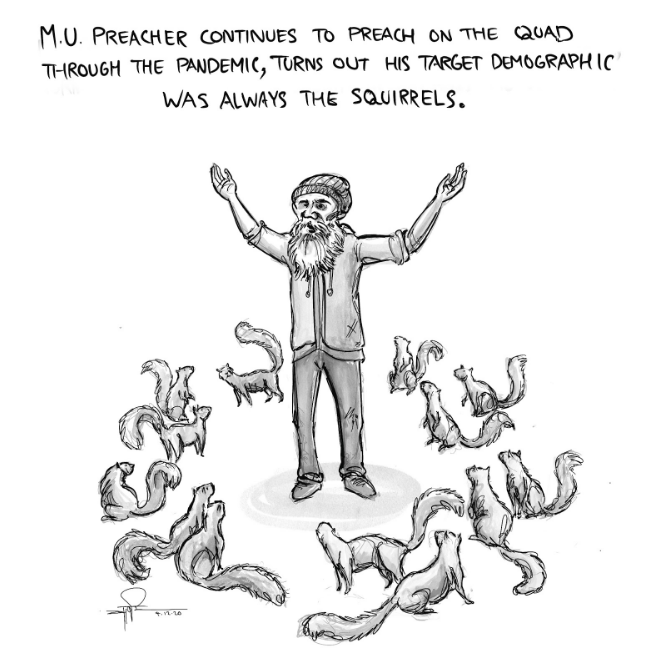
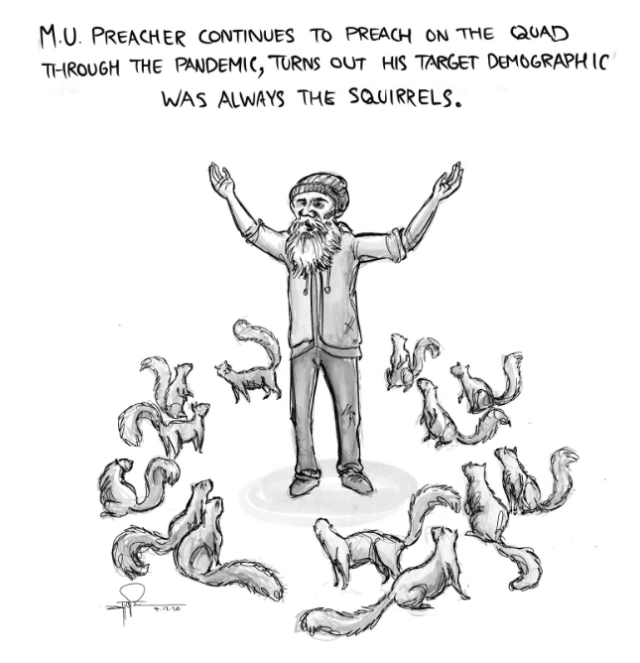
MU Preacher finds his true audience

Drawn by: Rushi Tawade –– rntawade@ucdavis.edu 
(This cartoon is humor and/or satire, and its content is purely fictional. The story and names of “sources” are fictionalized.)

COMMENTARY: We love the Raccoon Man

Arts desk writer Jacob Anderson loves the Racoon Man—and you should too

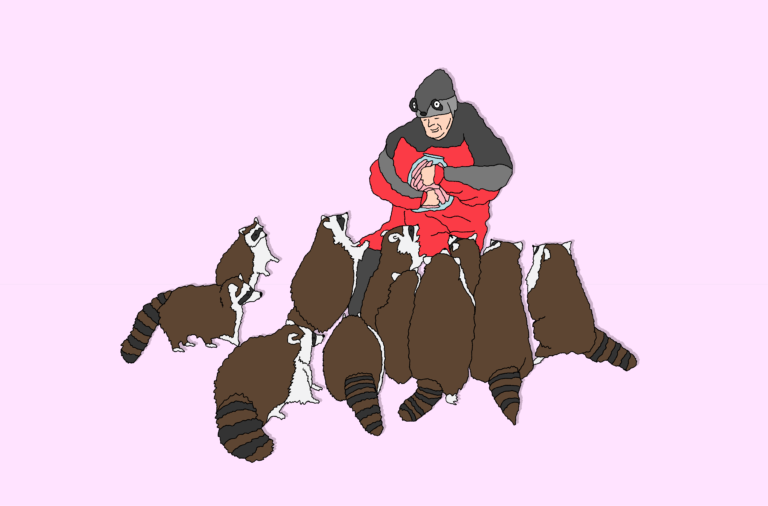
Raccoon connoisseurs out there need not be reminded of James Blackwood—the elderly Nova Scotian man who made his internet bones nearly a decade ago with a bucket of sliced hot dogs and several dozen feral (but rabies-free) raccoons on his property. 

Since his debut, he’s charmed the cultured among us with classics upon classics such as “Raccoons and Peanut Butter Sandwiches,” “2020 06 19 Friday Night Raccoons” and “Monday Night – Raccoons try whipped cream,” a monster filmography full of geriatrically-titled but undeniably lovable home movies of himself feeding his raccoons various foods. Blackwood, whose preferred title seems to be “Raccoon Whisperer,” is a consummate professional in the field of gonzo wildlife-feeding content.

While Blackwood is hardly a new face, his exploits have garnered mainstream attention at only a few specific points over his career—most recently, with his video “Mobbed by Raccoons (25) Tuesday Night 03 Nov 2020.” This video, not unlike the others of Blackwood’s oeuvre, features him sating his visitors with a generous three-course meal of sliced hot dogs, grapes and cookies that vanish at a ghastly rate as the animals grunt and hiss at one another, tiny hands grasping at the air with nunnish desperation from all directions surrounding Blackwood’s bench as he soothes them with a fatherly tongue.

“Take it easy,” he says. “Wall-to-wall raccoons,” he repeats at several points in the video. His observation rings true—the raccoons crawl all over and at points seem to nearly swallow him whole into a mass of fur and claws. He regales us with an anecdote about the closure of the Halifax bridge and later points his camera at his cat Connor, who seems to have been watching the whole affair from the other side of a sliding glass door: “Mister Connor—you know what? You took my chair. Tell ‘em that you took my new chair,” he booms, mugging the cat with his handheld camera. The cat just stares.

Blackwood’s motivations seem to be completely non-financial. Most of his videos gross well under 50,000 views, and he has made absolutely no effort to upscale his production in any way as he grows in popularity. In any other circumstance, this style would be nearly unwatchable. Blackwood makes it work.

The raccoons, as Blackwood revealed in an early video, were the charge of his late wife, who passed away in 2003. Her dying wish was for him to take care of her cats, raccoons and mother. Blackwood seems to have fulfilled her wish dependably.

Despite the moving context to these largely playful videos, Blackwood rarely speaks about his wife—the bulk of the conversational content in his videos is directed at raccoons and/or cats, who regard him with childlike absence as he speaks. They don’t understand him, but he knows this.

Raccoons live up to 20 years in captivity. In the wild, their life expectancy drops to about three years. This is primarily due to hunting (more frequently simple killing—raccoons are popularly seen as pests in areas of the U.S.), disease and starvation. Life isn’t easy for wild raccoons, and they find little kindness from the average person. This is to say that people like Blackwood are the exception, not the rule.

Wildlife biologist Stan Gehrt once said “People call me an expert, but one thing I’ve learned from working with raccoons for so long is, I’m not an expert.” Raccoons frequently defy empirical expectations of behavior and intelligence. Nobody, even in academia, knows entirely what to make of them.

Blackwood seems to have accumulated some wisdom about raccoons, however. “Boy,” he says, “They sure do like hot dogs.”

Written by: Jacob Anderson — arts@theaggie.org

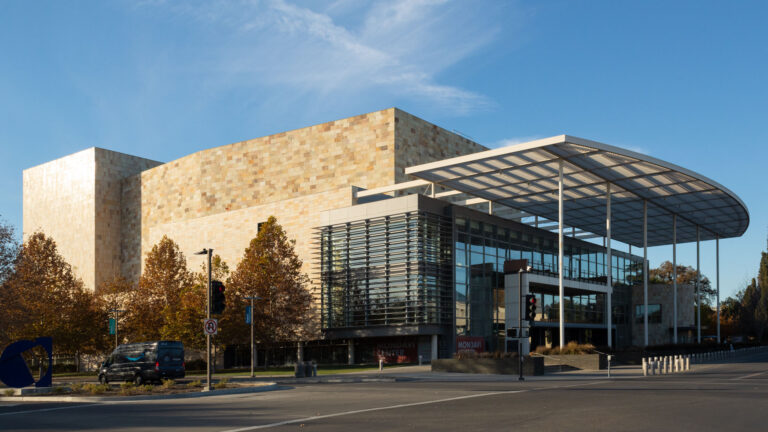
Mondavi Center transitions to virtual productions, cancels live spring performances

Live performances anticipated to resume in October 2021, dependent on COVID-19 vaccine, according to the Mondavi Center’s executive director

The Mondavi Center has cancelled its spring performances for the 2020-21 performance season, but live virtual productions are available to all UC Davis students for free on the Mondavi Center website, according to Mondavi Center Executive Director Don Roth. 

The “Homestage” production series is accessible on the Mondavi Center website. To access the performance streams, students must make an account with the Mondavi Center and sign up for the events. All recorded virtual events are free for UC Davis students with the exception of a few select productions, according to the website.

While the Mondavi Center auditorium remains desolate today, it was once a campus hub for performing arts and provided a creative outlet for students.

“Performing in front of a Zoom crowd is not the same,” said Sheila June, a third-year international relations major. “You need the energy in the room, and that needs people. But that’s just not something we can do right now.” 

June performs spoken word poetry at the Mondavi Center’s open mic nights.

“Spoken word is something that I’ve been wanting to get into since high school,” June said. “The Mondavi Center has hosted open mic nights every quarter. That’s when I got out of my shell. That’s where I’ve been able to branch out and explore performing.”

Roth said he tended to go to many shows throughout the school year prior to the pandemic.

“Normally during the school year, which is when our season is, I spend a lot of time going to shows,” Roth said. “We’ve done as many as 100 performances in a year and normally we do around 50-60.”

Roth is in frequent contact with other performing arts directors across the country. UC Davis is part of an organization of arts programs called Major University Presenters (MUP). MUP includes UC Davis, Stanford University, UC Berkeley, University of Washington and 15 other American universities. Although the organization regularly meets twice a year, Roth said that the arts directors have been meeting twice a week since the pandemic started. 

“All of us are checking in with each other a lot, because it is such a complex time and everybody can learn from each other,” Roth said.

Performing arts is a unique experience with unique challenges to virtual operations compared to other educational departments. 

“All of us who work at the Mondavi Center believe in the value of the live arts experience—for people to be in the room with the artist while something is happening in that moment and to share that experience together,” Roth said. “We believe that it is important to stay connected to our public by having the home stage productions, but we also don’t think that they substitute for the live experience.”

Roth said that in-person performances are not only significant for viewers, but also for the performers themselves.

“For the artists too—they want the feedback from the audience, they want to be there and hear the people’s response,” Roth said. “That gives them energy and changes what they might be doing.”

June echoed these sentiments and noted the difficulty of a lack of connection between artists and audience members in an online platform.

“Performing is already such a big connection,” June said. “You need to have that audience to be your connection. Not having that is hard. At this past open mic night, recording into my phone wasn’t the same. My educational experience and performance experience, being able to be more comfortable with public speaking and getting up in front of a microphone, that is on the decline.”

June said that the Mondavi Center has been very accommodating and communicative to students who are active in performing arts. She explained the Mondavi Center staff’s assistance with uploading performances in virtual formats. 

“I’ve been getting weekly emails about the open mic nights,” June said. “They’ve been very supportive. Any contact I’ve had with any of the Mondavi Center directors or event coordinators has been pleasant and they have been very helpful.” 

Roth projects the Mondavi Center will resume in-person productions beginning in October 2021. The performance experience may be different, however. Roth predicts temperature checks and social distancing at live performances.

“It’s our intention to return to live performances next season, which is the next academic year 2021-2022,” Roth said.
Written by: Hannah Blome — campus@theaggie.org

Free saliva-based COVID-19 testing now available for Davis community

0

Healthy Davis Together partnership between UC Davis and the City of Davis provides testing at the senior center

Healthy Davis Together, a partnership between UC Davis and the city of Davis, has brought free saliva-based COVID-19 testing to the broader Davis community. This test involves spitting, unlike the more invasive nasal swab test. The program also distributes free surgical masks.  

Currently, testing is available at the Davis Senior Center. On Dec. 6, a second testing center will open at the Mondavi Center for the Performing Arts.  

City of Davis Councilmember Dan Carson stressed the importance of collaboration between the City of Davis and UC Davis via email, and mentioned the newly introduced COVID-19 exposure app, called California COVID Notify.  

“One of the great things about the Healthy Davis Together program and efforts like the new Covid notification app are that they allow the City of Davis and the UC Davis campus to help each other to combat this dread[ful] disease and potentially save lives,” Carson said via email. 

Yolo County Supervisor Don Saylor explained via email that people who live in Davis, work in Davis or travel to Davis should take advantage of this testing opportunity. 

“Priority is being given to essential workers and people with significant public contact, including people who think they may have been exposed,” Saylor said via email. “But this saliva test is specifically for asymptomatic individuals; people experiencing COVID-19 symptoms are prohibited from using this test and should contact their healthcare providers for testing.”  

Chief Operating Officer of Healthy Davis Together Kenneth Burtis mentioned that frontline workers specifically are encouraged to take advantage of the free testing.  

“Until we expand with the Mondavi Center, when our goal will be to test everyone in Davis, right now we really want to encourage a certain group of people to come in for testing,” Burtis said. “Those are people whose daily job or occupation requires them to be in contact with other people—frontline workers.”  

Saylor noted that Yolo County is considering ways to bring the saliva testing to other high-risk populations.  

“For example, we are considering ways to utilize saliva testing for staff and residents at skilled nursing facilities, convalescent hospitals and other congregate living facilities,” Saylor said via email. “For now, there are 500 tests available per day through the Healthy Davis Together project, which is focused on preventing the spread of COVID-19 specifically in the Davis community.”  

City of Woodland Mayor Pro Tempore Tom Stallard expressed hope that the program could eventually be introduced to other nearby cities.  

“The university has done a phenomenal job of developing testing protocols for their own campus community and now the wider Davis community,” Stallard said. “Dr. Ken Burtis, a Woodland resident, has been overseeing it. It could be a model for communities everywhere.  I’d love to have that testing protocol in our community.”  

Woodland has been harder-hit by COVID-19 than Davis, with 2,067 cases compared to 687 cases in Davis, as of Dec. 3. This is largely due to demographic differences, according to Stallard.  

Burtis stated that the source of the Healthy Davis Together funding made it unlikely to be expanded to other cities.  

“Healthy Davis Together was actually funded by philanthropic donations from a number of parties with the specific goal of funding Davis and the city of Davis,” Burtis said.  “We are also supporting people who live in other cities but work in Davis.”

The collected samples are processed in the Genome Center at UC Davis, a process which Burtis described in detail. Once samples arrive at the Genome Center, a protein-cleaving enzyme is used to digest the polymers that create viscosity in saliva. The samples are placed in a machine called the IntelliQube, which conducts a type of polymerase chain reaction called quantitative PCR.  

“One of the ways we’re able to do so many samples is because robots do a lot of the work,” Burtis said. “The IntelliQube allows us to do many reactions at a time using a tape array. A fluorescent signal develops if it’s a positive—if the primers have amplified some viral RNA. If there’s no virus in the sample, the viral primers don’t cause any amplification.”  

Saylor expressed enthusiasm about the team effort.  

“The continued partnership between UC Davis, the City of Davis and Yolo County has been a great demonstration of the ‘Yolo Way’ and has been instrumental in allowing this program to get off the ground and operate as a key part of the COVID-19 mitigation measures in our region,” Saylor said via email.
Written by: Rachel Shey — city@theaggie.org

The UC Immigrant Student Services Center provides legal aid, assists in the establishment of similar programs

0

The UC system’s support for immigrant students aims to help them through changing legislation and administrations

In 2015, the UC system began an initiative to provide legal services for immigrants directly through the school. Operating out of UC Davis’s law school, the UC Immigrant Legal Services Center (UCIMM) has been able to help students and their immediate families with legal services related to immigration and has inspired other higher education institutions to do the same.

The UCIMM has branches at all UC campuses, each of which have legal fellows, like Ariel Bailey at UC Davis, who shared some of the legal services that she and the other fellows provide for UC students.

“I do consultations and represent our clients who are associated with the UC Davis campus,” Bailey said. “We do general immigration consultations where we review an individual’s immigration history and personal situation to determine if they have any forms of immigration relief available. If they do, we can provide legal advice or even full-scope representation related to applying for immigration relief. The most common types of things that we do are DACA renewals and eventually hopefully DACA initial applications.”

Rachel Ray, a managing attorney at the UCIMM, explained that in addition to DACA, the center also provides comprehensive consultations, family petitions, U and T visas for students and their family members, special immigrant juvenile status and referrals for legal matters outside of the center’s abilities. It provides all of these services to students completely free of charge, and they are even working to bring similar programs to other colleges and universities nationwide. 

The center has put together the “UCIMM Toolkit,” which is a resource containing important information about the UC’s immigration legal services model, in the hopes of expanding this service to other higher learning institutions. Ray explains that the toolkit aims to guide other institutions to create programs similar to UCIMM on their own campuses. UCIMM has consulted with the California State University system, the California community college system, the University of Oregon and other institutions. 

“We do semi-regular advising of other higher learning institutions who want to implement a program similar to ours,” Ray said. “We’ll talk with them about their students’ needs and everything from funding to case management software to how to hire attorneys.”

Since President Donald Trump took office in January 2017, Ray explained that the needs of her students have changed, as the president has consistently threatened DACA throughout his term. 

“There is a lot more fear and there are, generally speaking, fewer options for students,” Ray said. “The bulk of our clients are DACA recipients and DACA has been in flux since 2017, and we do a lot of advising on DACA and a lot of DACA renewals.” 

In addition to changing DACA policy over the last four years, Bailey added that there has been a lot more confusion in the realm of immigration legal services.

“The biggest thing is just how quickly immigration policy has changed,” Bailey said. “It can be very confusing for even an attorney to navigate those changes, but for individuals who are trying to focus on school and living their lives, it can be a whole lot to deal with. So, we, as an organization, have had to […] be pretty nimble and react to a lot of changes and make sure we’re keeping students informed and staying on top of the law.”

As Bailey said, DACA policies have added new barriers for students who are also trying to juggle their course loads, jobs and commitments on and off campus. Since President-elect Joe Biden was officially announced as the president-elect, the center released a statement about their optimism for the next four years.

“It is our great hope that the election of Joe Biden and Kamala Harris will reverse the many anti-immigrant policies of the Trump administration,” the UCIMM team stated on their website. “In the months leading up to the election, we have been working to increase our capacity to assist the many students and family members who may be newly eligible for immigration relief under a Biden administration.”
Written by: Katie DeBenedetti — features@theaggie.org

UC Davis joins the Cybersecurity Manufacturing Innovation Institute to examine cybersecurity in supply chain management

Community members weigh in on this step toward a secure digital world

UC Davis has joined the Cybersecurity Manufacturing Innovation Institute (CyManII) through a partnership started by the University of Texas at San Antonio, an institution that is known for securing automation and the supply chain network, and creating a national program for education and workforce development.

         Prasant Mohapatra, the vice chancellor for research at UC Davis, is directly involved in this partnership, especially with cybersecurity, smart energy efficiency and supply chain management.

         “We take pride in training our students and helping in building the pipeline for the workforce in the idealism of cybersecurity and energy efficiency,” Mohapatra said.

         UC Davis became involved with the institute after the Department of Energy sent out a call for proposals asking for groups to participate. Along with forming a partnership with the University of Texas at San Antonio, UC Davis also allied with three national laboratories. These laboratories included Oak Ridge National Laboratory, Idaho National Laboratory and Sandia National Laboratory.

         “CyManII is a one of a kind institute providing cybersecurity in our supply chain and manufacturing enterprises,” Mohapatra said.

         The institute is currently working with 24 universities and three national labs. This team will participate in many collaborations to share their expertise about cybersecurity and energy efficiency to secure U.S. manufacturing companies for years, according to Mohapatra.

With his role in the partnership being to look at cybersecurity in supply chain management, Mohapatra believes it is increasingly important to secure manufacturing processes because today they are mostly digital and therefore have more vulnerabilities. Cars being more like computers than mechanical devices is one example that illustrates how digital society has become. 

UC Davis has taken on the responsibility to search for aspects that combine hardware and software security. The vice chancellor of research has taken on the role of monitoring all the UC Davis locations, which consists of the Davis campus, Sacramento campus, Health System, satellite campus in Tahoe and the Bodega Marine Laboratory.

Maria Martinez, the ASUCD vice president of external affairs, says the driving factors for the university collaborating with CyManII is UC Davis’s commitment to environmental sustainability, which the partnership enhances, and their research of computer science meets the goals of the institution. The partnership will also bolster UC Davis’s credibility as a research institution.

“I think it is great to see that our university’s efforts are recognized by a national institute like this,” Martinez said. “Hopefully this opens the door to other types of partnerships that we can help out even if it is outside environmental sustainability and computer science.”

Many undergraduate environmental and policy planning majors are highly involved in the topic because of the environmental sustainability of energy efficiency, according to Martinez.

When asked about the importance of cybersecurity, Martinez took into consideration the state of our world during this pandemic and how everything is virtual today, especially with most conversations being over Zoom.

“Considering the model of the world we live in right now is so highly based on the internet, having that type of security is definitely important,” Martinez said.

 Martinez elaborated how this translates to U.S. manufacturing companies and how it is even more important for them since they are responsible for making huge decisions on a day-to-day basis that need protection and secure networks. Although Martinez does not have a direct role with the partnership, she is glad it was brought to the university’s attention and hopes that ASUCD can be a part of it in the future.

Many students at UC Davis are unaware of this great collaboration. Kory Lopez, a fourth-year political science major, was thrilled when she heard the news.

“I think it is important that a university in the UC system is going to be a part of an initiative that is going to help protect companies with cybersecurity,” Lopez said. “It’s been an important issue, especially in the U.S. since so many things are in computer systems.”
Written by: Francheska Torres —science@theaggie.org


Pfizer employee accidentally ruins all COVID-19 vaccines

Oh no, this is some really bad news

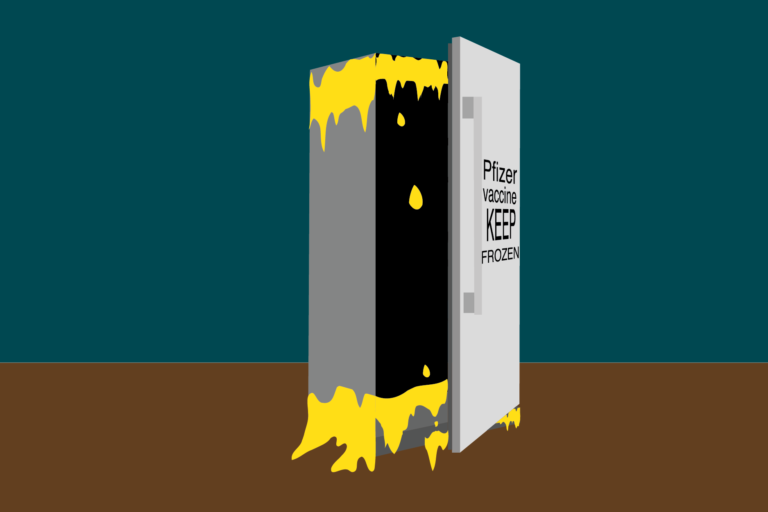
Bad news, guys. A Pfizer employee just ruined all COVID-19 vaccines. You guys know who did it? Matthew J. Pfizer. Yeah we all knew it was him—he’s so irresponsible. We all know he only got this job because he’s a Pfizer. Nepotism. Classic. 

How did this happen? What could Matty Pfizer possibly have done to ruin this shining beacon of hope? Did the burden of his name drive him toward an attempt to do something beyond his capabilities? Nope, apparently he just left the freezer door open all night. Typical Matthew. So careless and irresponsible.

Yeah, this morning a horrified scientist walked in to find the cold freezer air escaping into the lab, along with humanity’s hope. Everybody knew who the culprit was when they found that container of melted rum raisin ice cream alongside the ruins of the vaccines. Yup, that’s his favorite flavor of ice cream, rum raisin, and he just had to put it in the same freezer as all the vaccines.

What is wrong with you Matthew? You’re an animal. Rum raisin? Seriously? That is the worst flavor combination you could think of. You think you’re so cool because you’ve chosen a unique favorite flavor of ice cream. You’ve just taken garbage pirate alcohol and the worst snack and put them together. Congratulations, you’ve managed to come off as pretentious and trashy at the same time. 

Pfizer CEO Albert Bourla was none too happy this morning upon learning the news. He let the Pfizer heir know that, “He wasn’t mad, just disappointed.” And it should be noted that he is not referring to Matthew’s terrible favorite flavor of ice cream. Although equally appropriate, it is in reference to how Matthew ruined all the vaccines and the world’s hope. Seriously though, rum raisin? 

Moderna CEO Stéphane Bancel is taking no chances. He’s not letting Thomas P. Moderna anywhere near their precious vaccines and he’s no longer letting Tommy Moderna hang out with Matty P. That’s what you get Matthew. That’s right no more playdates and you’re grounded. So have fun eating your disgusting rum raisin ice cream alone while society collapses. 

Written By: Ean Kimura — etkimura@ucdavis.edu

(This article is humor and/or satire, and it’s content is purely fictional. The story and or names of “sources” are fictionalized.

UC Davis Panhellenic formally separates itself from associating with UC Davis IFC

Multiple public sexual assault allegations impacted the relationship between the two organizations, according to the Panhellenic president

UC Davis Panhellenic has dissociated from the UC Davis Interfraternity Council (IFC) fraternities effective immediately, citing issues of sexual assault culture.

Apeksha Kanumilli, a fourth-year psychology major and the president of UC Davis Panhellenic, said that the decision was made partly in response to a recent public sexual assault allegation but added that the problem has been going on for years.

“It felt like we were going in circles in terms of how we were dealing with [allegations] as they came up,” Kanumilli said. “We would do this separation thing on an individual basis, and then every time it happened we would be adding another chapter, so there needed to be something done on a broader level.”

The move is intended to reorient the Panhellenic-IFC relationship away from events such as parties—although there are no social events due to the COVID-19 pandemic. 

“There is kind of this expectation that our relationship is based around alcohol and alcohol-related events,” Kanumilli said. “I think we’ve gotten to the point where that feels like the only relationship that we’ve had or cultivated recently, so we wanted to start with a relationship that wasn’t based around that.”

Previously when allegations arose, the organization would create separation from individual chapters, according to Kanumilli, but she said there was a need for more sweeping action as the list of chapters affected with sexual assault allegations increased.

“It’s more than just these isolated incidents,” Kanumilli said. “It’s a culture thing, and that again stems from IFC as a whole and [it’s] what we are aiming to [fix].” 

The decision includes a quarter-by-quarter review of the IFC and its relationship with Panhellenic. The steps to reintegrating IFC chapters will be tiered, starting with charity events. 

“First is the philanthropy events,” Kanumilli said. “And then brotherhood/sisterhood events and things like that before we get back to what this normal relationship was in terms of other kinds of socials.”

Kanumilli said the organization is looking at ways that it can improve, and isn’t intending this to be a one-way street—she is open to listening to IFC concerns as well.

The pandemic created a unique opportunity for Panhellenic to make a move since COVID-19 regulations limited indoor gatherings on and off-campus.

“That’s why we felt this time would be perfect for this, because we’re not doing these events anyway and so it’s not a big change,” Kanumilli said.

Kanumilli said that Panhellenic would like to see IFC proactively seek out resources from the campus, like from the Center for Advocacy, Resources and Education (CARE).

“We want to see more initiative to have these conversations even when there is no specific incident,” Kanumilli said.

Panhellenic is still looking at how integration with IFC will occur but believes it will take time.

“It’s like we’re in a toxic relationship and we really just need a break to work, or we can’t be together again,” Kanumilli said. 

Written by: Kathleen Quinn — campus@theaggie.org