54.2 F
Davis

Davis, California

Friday, December 19, 2025
Home Blog Page 30

Yolo Food Bank faces significant funding cuts

$2 million budget shortfall comes from federal cuts to food assistance programs and expiring pandemic aid


By GIA LOOMIS — city@theaggie.com


This year, the Yolo Food Bank will experience an over $2 million loss from its federal funding. With an annual budget of $5.1 million, this almost 40% budget cut could have detrimental effects on their operations. These budget cuts are resulting from recent losses in both federal aid and emergency pandemic funds.

Since taking office, President Donald Trump’s administration has attempted to reduce inflation by cutting back government spending. As a result, on March 10, the United States Department of Agriculture (USDA) cancelled $1 billion in national funding for Local Food Purchase Assistance (LFPA) for schools and food banks.

Additionally, they have also cut around $500 million in funding for The Emergency Food Assistance Program (TEFAP). These cuts are resulting in a $750,000 hit to Yolo Food Bank’s upcoming fiscal year’s budget.

Furthermore, the food bank is also experiencing a large loss from expiring American Rescue Plan (ARP) funds. These are emergency funds for organizations from COVID-19. Yolo Food Bank will have $1.3 million in funds expiring this year. Consequently, Yolo Food Bank will suffer a $2.1 million reduction in their operating budget for next year.

With these recent federal cuts, there are concerns of additional cuts in aid. The Trump administration is considering further decreasing USDA or Supplemental Nutrition Assistance Program (SNAP) funding.

In a recent press release, Karen Baker, the executive director of Yolo Food Bank, expressed concerns for the impact these cuts may have on the food bank’s distributions.

“If resources continue to decline, we may have no choice but to reduce the amount of food families receive at our public distributions,” Baker said. “We’re calling on local leaders, policymakers and our community to take action. Without financial and legislative support, we won’t be able to meet the growing need. We’re doing everything we can, but we can’t do it alone. It will take all of us to keep food on every table in Yolo County.”

Declines in local food bank funding are an especially pressing issue in Yolo County. In recent surveys, Yolo County has consistently measured a high poverty percentage. In 2024, it sat at 15.3%, around 4% higher than the national average. Yolo Food Bank’s recent Yolo County Food Access survey also showed that 29% of households in the county are food insecure.

Food insecurity is a major concern in Yolo County that the food bank is working to combat. California Assembly District 4 Majority Leader Cecilia Aguiar-Curry touched on the concern of falling resources and increasing need in the press release.

“Yolo County is facing a rising need for food and fewer resources to service those in need throughout our community, leaving our most vulnerable people in worse circumstances,” Aguiar-Curry said. “No one, especially our kids, seniors and working families, should have to worry about where their next meal is coming from.”

Since learning of funding cuts, Yolo Food Bank is pushing to increase fundraising in an effort to make up for some of their lost budget. The food bank recently participated in the Big Day of Giving on May 1. Following the Big Day of Giving, Yolo Food Bank surpassed their initial goal and raised over $260,000.

“Every dollar will go directly to our Public Community Food Distributions, which feeds 9,300 families who rely on those distributions to make ends meet,” the Yolo Food Bank’s Instagram post reads.

Baker expressed gratitude for the support in a statement on the social media post.

“The generous response from our region has blown us away,” Baker said. “On behalf of the families we serve, we thank every single one of you who has supported us during this time of critical need.”

People are being encouraged to help out the Yolo Food Bank in any way they can, from donating to volunteering. Yolo Food Bank’s Creative Services Manager, Brittany Cornejo​​​​, explained how people can help in this strained time.

“People can help Yolo Food Bank by making a gift if they are in a position to do so at yolofoodbank.org,” Cornejo said. “[Or] by volunteering their time with us or helping us spread the word about the need in our community.”


Written By: Gia Loomis — city@theaggie.org

 

The incredible importance of a new LSD analogue

This new molecule, called JRT, has potential applications to treat neuropsychiatric diseases in ways that have not previously been possible


By MADELINE HASS — science@theaggie.org


A team of UC Davis researchers within the Olson Lab, run by David E. Olson, has synthesized a new molecule named JRT that has the potential to treat neuropsychiatric diseases. This molecule is an analogue of lysergic acid diethylamide (LSD) with reduced hallucinogenic potentials yet many therapeutic properties, making it an outstanding candidate for treating conditions like schizophrenia.

The creation of this new molecule was accomplished over a five-year process, and it consisted of transposing two atoms within LSD that lowered the potential of producing hallucinogenic responses in humans. This molecule’s close relation to LSD allows it to contain many plasticity-producing aspects and the ability to promote cortical neuron growth, both of which are necessary in the treatment of neuropsychiatric diseases.

Cassie Hatzipantelis, a postdoctoral scholar at the Institute for Psychedelics and Neurotherapeutics and key member of the study, spoke on the creation of this new JRT molecule.

“Lee Dunlap, along with many people in the chemical field, had identified this key interaction [in LSD] between the tryptamine core structure and the 2A receptor — this serine residue. He made this version of the molecule where you just take the nitrogen and you put it somewhere else,” Hatzipantelis said. “After this, it can’t make that interaction anymore, and it completely obliterates the hallucinogenic potential of the molecule.”

Before testing JRT’s therapeutic potential, the team focussed on confirming that this drug would not have the potency of hallucinogenic potential that is associated with LSD. The first step in this process was to create a general characterization of the molecule on the cellular level.

The team utilized a biosensor assay that they developed, called pyschLight, that will show if a drug is predicted to be hallucinogenic or not based on a fluorescence indication. Hallucinogenic and non-hallucinogenic ligands within molecules will bind to pyschLight and showcase different fluorescence profiles.

“We know that hallucinogenic drugs versus non hallucinogenic drugs will induce a different confirmation; they kind of change in a slightly different way, so when this lights up we can say this will most likely be hallucinogenic,” Hatzipantelis said. “We found that LSD has a really high response and is incredibly potent, but our compound JRT was far less potent and way less active so it was predicted at this stage to be non-hallucinogenic.”

After confirming the reduced hallucinogenic potentials on the cellular level, the team moved to confirming this with a biological correlation. This was done via a study conducted on mice, which entailed giving each drug to a mouse and overseeing a head twitch response test, a famous method to test a drug’s hallucinogenic potency.

“We know that when you give a hallucinogenic drug to a mouse, they have this very stereotypical head twitch,” Hatzipantelis said. “And we know that the potency of a drug in a mouse head twitch is a near perfect correlation with the potency of the drug with its hallucinogenic potency in humans.”

Yara Khatib, a fourth-year Ph.D. candidate and member of the Olson Lab, further commented on this part of the study.

“We found that when we tested JRT and compared it to LSD, there was a very significant reduction in the number of head twitches that we have,” Khatib said. “We saw the same number of head twitches you would see when giving a mouse just a normal saline injection, so that was really encouraging to us.”

Neuropsychiatric diseases have a wide range of indicators that are categorized into positive symptoms, negative symptoms and cognitive symptoms. Current antipsychotic medicines have shown success in treating the positive symptoms of these conditions, such as hallucinations and delusions yet have not been successful in treating cognitive or negative symptoms.

Defining features of the negative and cognitive symptoms are morphological and synaptic deficits. So, one of the next steps of the team was to test the therapeutic properties of JRT, they wanted to see if it had the plasticity-promoting aspects and ability to cause cortical neuron growth that they had hypothesized, as well as the ability to treat many of the other aspects of negative and cognitive symptoms associated with neuropsychiatric diseases.

“For this process, we literally give the drug and then count the neurons,’” Hatzipantelis said. “We can see if the neurons get really complex and count how many branches and how many spines they have, how many synapses and if their synapses are functional. A whole suite of structural and functional plasticity experiments are done to really assess if this is happening or not, and JRT was seen to be one of the strongest plasticity-promoting compounds we’ve ever tested.”

Another test that was done was a sucrose preference test as part of the behavioral assay, in order to see if JRT could combat the symptom of loss of pleasure symptom, which is commonly seen in neuropsychiatric diseases. It consisted of first testing initial preference for sugar water in mice, then inducing a depressive model in them before administering JRT to see if it could restore their desire to drink this sugar water.

“It was a one-month process of working with the animals and seeing how their preferences change. After administering the JRT, we could see that the drug was able to restore their preference,” Khatib said. “It also had the ability to maintain that for weeks after. 10 days later, I set up the study again and saw that the mice with the JRT still preferred the sugar water relative to the animals that remained in their depressive state.”

There is still much work to be done before JRT can see wide-scale use or application, yet the creation of it alone is groundbreaking work. It showcases that there is a way to lower the hallucinogenic properties while harnessing many of the positive properties of certain drugs, a discovery that will prove very useful as time moves forward.

“It’s a proof of concept that we can change the direction of drug development and the way that we approach the treatment of these conditions and maybe even make more scalable treatments that can reach a more sizable population,” Khatib said.

Written by: Madeline Hass— science@theaggie.org

Davis track and field hosts Sacramento State for Causeway Classic

Aggies close regular season at home, looking ahead to Big West Championships


By THEO KAYSER — sports@theaggie.org


On April 25, the UC Davis track and field team hosted Sacramento State University for the Causeway Classic dual meet. Dual meets, which differ from standard invitationals, involve a dozen or more schools with only two teams going head to head.

The meet events began at 9:30 a.m., with the first portion of the meet hosting throwing and jumping events.

The first event was women’s hammer throw, with UC Davis Aggies claiming first, second and third place. Hailey Hernandez, a third-year sustainable agriculture and ecology major, won the event with a distance of 50.46 meters, finishing just ahead of teammate Ashpreet Kler, a fourth-year biological psychology major, who threw 50.45 meters.

The UC Davis women’s team continued to shine in the throws during the javelin, where Brianna Nunn, a fourth-year economics major, claimed another Aggie victory, throwing 33.68 meters. This performance was followed up moments later by undeclared major Harrison Hansen, who came in first place in men’s javelin throw. Hansen dominated the rest of the field with a throw of 47.36 meters, more than 10 meters further than second place.

The final throwing event of the day was shot put, where Nunn again claimed first for the women’s team with a distance of 14.66 meters. Additionally, Jake Joerger, a first-year undeclared major, won first place for men’s with a throw of 16.03 meters.

In the jumping events, more Aggie victories came in the form of the long jump and pole vault events. Third-year Daren Randolph won the men’s long jump, jumping 7.28 meters. Sarah Graessley, a fourth-year civil engineering major, and Aidan Hagerty, a third-year systems and synthetic biology major, won in pole vault for both women’s and men’s, respectively.

The latter half of the meet moved to running events. This began with the women’s 5,000-meter run, where Aggies came in first and second place. UC Davis teammates Lauren Villegas, a first-year communications major, and Dani Barrett, a fourth-year wildlife, fish and conservation biology major, battled out for the top spot. Ultimately, Villegas came in first with a time of 17:19:02, hardly edging out Barrett, who ran 17:19:42.

The men’s 5,000-meter went similarly, with teammates Zachary Graeber, a third-year computer science major, and Ethan Brooks, a third-year undeclared major, finishing fractions of a second apart, both with a time of 15:13.

After this began the 4×100-meter relay races. In the women’s heat, the Aggies were narrowly defeated by under a second, running a combined 45.95 seconds, just behind Sacramento State at 45.03. The men’s race soon after ended with another close Aggie loss.

The Aggies got back on track during the 1,500-meter race, taking first place in both men’s and women’s. Kayla Towne, a first-year psychology major, won with a time of 4:41 in women’s, alongside Jacob Lawrence, a first-year undeclared major, who ran 3:58.

The next four events were all won by runners for Sacramento State, who claimed victories in the men’s and women’s 100/110-meter hurdles, the 100-meter, 400-meter and the 800-meter. At the halfway point of the meet, Sacramento State, as a team, was leading overall in points, with their women’s team leading the Aggies by a score of 64-53 and their men’s team ahead by 54-49.

After running events and jumping events had finished, Sacramento State had finished ahead in team points, with their women’s team defeating UC Davis 87-84 and the men’s team winning in more convincing fashion by a score of 82-64.

The remainder of the meet saw a few more individual victories for UC Davis, as Maya Shinnick, a third-year undeclared major, won the women’s 200-meter, Kayla Rutz, a third-year managerial economics major, won the women’s 3,000-meter steeplechase and Chance Tokubo, a third-year applied mathematics major, won the men’s 3,000-meter steeplechase.

The meet concluded with women’s and men’s 4×400-meter relays, where Sacramento State walked away victorious in both. Overall, the Sacramento State University women’s runners defeated UC Davis 101-99, and the men’s runners defeated the Aggies 102-83.

The Causeway Classic was the final regular-season meet on the Aggies’ schedule for the 2025 season. Athletes will have two more opportunities to compete this season at the Big West Conference Multi-Event Championships on May 9 and, finally, the Big West Conference Championships on May 16.


Written by: (Theo Kayser) — sports@theaggie.org


Omar Offendum bridges hip-hop and Arabic poetry in ‘Neo-Hakawati Nights’ for Arab American Heritage Month

“Songs, stories and poetry are how we keep memories in our hearts and pass them on from generation to generation”

By KHADEEJAH KHAN — campus@theaggie.org

On April 24 and 25, Syrian American rapper and poet Omar Offendum performed “Neo-Hakawati Nights” at the Mondavi Center, joined by Palestinian multi-instrumentalist Zafer Tawil and DJ Thanks Joey as a part of a series of events for Arab American Heritage Month.

In Arabic, “hakawati” translates to a storyteller who performs in a collective setting.

The event took the audience through the journey of the Arab American experience while bridging New York, where he lives, and Damascus, Syria through hip-hop and Arabic poetry.

“The goal is to bring the hakawati experience of Damascus with the hip-hop music that I love,” Offendum said. “Putting it all together and just talking about the experiences of Syrians moving through the United States in the late 1800s and early 1900s through rap and poetry.”

The performance began with Offendum reading a poem by Lebanese American writer and poet Khalil Gibran, titled “To Young Americans of Syrian Origin,” followed by a performance of Offendum’s song, “Damascus.”

Offendum reflected on growing up in the ‘80s and ‘90s, when most of his peers were not familiar with Syria at all. However, that changed at the height of the Syrian Civil War — not only for Offendum but for the greater Syrian community.

“That [war] became what Syria was known for,” Offendum said. “Not the beautiful images, or the history, or the culture, or the tradition, or the stories, or the mountains, or the castles, or the alleyways or the food and the music and all of it. All of it just got whittled down to this idea of this conflict.”

Highlighting tradition and culture in his art, Offendum performed the “Story of Qahwah,” conveying coffee’s forgotten roots in Yemen and its role as a commodity reflecting how Arab achievements and contributions are exploited and sidelined.

“I call it ‘qahwa’ – it went from ‘qahwa’ to ‘kahve,’ caffe to coffee,” Offendum said. “From an Ethiopian cherry to one of the most traded commodities in the world after oil. And in a world long before it, it’s what Muslims were known for. So, of course, they tried to ban it.”

Offendum explores “suppressed history,” shedding light through his poetry in an effort to preserve memory. Another element of this history that Offendum hopes to preserve is Little Syria, an Arab American neighborhood in Manhattan that was later pushed out to construct the Brooklyn Battery Center. Offendum’s Little Syria Project carries on its memory as a tribute to the poets who lived there and the newspapers that told their stories.

“A lot of the poetry that I find myself drawn to from these poets is descriptive of their lives and these places that I’ve perhaps dreamt of living or wish I did or wish I could have,” Offendum said. “Whether it’s Palestine or Damascus in Syria, or Little Syria, the neighborhood where all the other poets lived.”

Toward the end of his performance, Offendum recited a poem by Palestinian poet Mahmoud Darwish, titled “Alaa Hadhil Ard,” which translates to “On This Land.” After reciting the poem in Arabic, he recited its translation in English.

“We have on this land all of that which makes life worth living,” Offendum said.

The poem recounts the small details of everyday life, such as moss on a rock, bread’s aroma or the changing of seasons — the retention of which is the roof of “the invaders’ fear of memories” as Darwish wrote.

“The lady of our land, the mother of all beginnings, the mother of all ends, she was called Palestine,” the poem reads. “My lady, it is because you are my lady, that I have all of that which makes life worth living.”

After reciting Darwish’s poem, Offendum performed his song, “God is Love,” originally released in 2024 amid Israel’s ongoing genocide in Palestine.

“This one is for Haifa, Yafa, Akka, Gaza, Areeha, Ramallah, Tabariyeh, Ramleh, Jenin, Safad, Beit Lahm, Al-Quds, Min il-Sahr, Lil-Jibaal and every Falasteeni hood around the world,” Offendum said, naming various Palestinian villages under Israeli occupation.

In these poems, land has always been tied to memory. For Arab Americans in the diaspora, like Offendum, stories about these lands are bearers of memory and connection for those unable to visit them.

“Without memory, you can’t have hope,” Offendum said. “It is something you have to maintain and cultivate because the oppressor doesn’t want us to have hope. Songs, stories and poetry are how we keep memories in our hearts and pass them on from generation to generation. It’s what human beings do. That’s especially what Arabs do.”


Written by: Khadeejah Khan — campus@theaggie.org


Major changes to Lawntopia include adding ticket costs indoor venue

The developments have sparked discourse around the new prices and the ASUCD’s potential role in creating them

By SAIRAKSHA THIRUNAVUKKARASU — campus@theaggie.org

For the first time in the concert’s history, the ASUCD Entertainment Council (EC) began charging for this year’s Lawntopia tickets. The decision has been criticized by students, with many taking to the comment sections on the EC’s social media account, resulting in conversations between the unit and the student government in charge of their oversight.

The event, which is on May 8, features Don Toliver as the headliner with DJ Odd Mob as direct support and singer Umi as opener. Ticket offerings began with a 48-hour presale followed by a general onsale; presale offered upper and floor general admission tickets at $16 and $31, respectively, while the general onsale raised each tier’s prices by $5 to $21 and $36.

In a FAQ post on their Instagram, the EC claimed that the reason why tickets were not free this year was due to constraints placed on them by the ASUCD Senate, who is responsible for approving their annual budget.

“The ASUCD Senate has decided that we would not receive a workable budget unless we met certain financial goals,” the comment reads.

Jonathan Ng, a third-year political science major and the EC’s unit director, said that his unit’s budget had faced cuts in the past and that ticketing proved one solution to address the problem.

“The EC’s budget had been absolutely decimated,” Ng said. “The senators [were] more comfortable in giving EC a larger budget if they just charged for one of their concerts.”

In the 2023-24 academic year, the ASUCD Executive Office proposed a budget for EC factors in a sold-out show held at the University Credit Union Center (U Center). Currently facing a roughly $200,000 deficit, ASUCD has already cut funding for this year’s budget for many of its units, including EC.

ASUCD Senator Amrita Julka expressed her thoughts on the EC’s claim regarding the Senate’s involvement in ticket price increases.

“It wasn’t the whole truth,” Julka said in a statement to The California Aggie. “I do find it discouraging that they were very quick to blame Senate for the tickets, just because it wasn’t even our current Senate table that decided [the budget], it’s actually theirs. And they knew that.”

Ng was an ASUCD Senator at the time the EC budget was approved.

Julka also noted that because the EC used many of its funds earlier in the year for Sunset Fest, which was free, they faced further financial constraints going into Lawntopia.

“Because they blew through their budget, they are not able to afford security for their event if it were to be on the Quad or on an actual lawn,” Julka said.

EC Assistant Unit Director Binh Do, a fourth-year economics and history double major and former ASUCD Senator, confirmed that both he and Ng voted in favor of the current budget at the end of last year. He also acknowledged that compromises had been made in the process and that Don Toliver’s platform and profile are a step above previous headliners, which results in higher operating costs.

“This is the largest talent by monthly listener [record] that has ever come to UC Davis at the time of performance,” Do said. “A mid-sized artist was getting charged around $20 for a ticket [at UC Santa Barbara]. Despite Don Toliver being three times [larger] in monthly listeners, we were able to keep the price as low as possible.”

UC Davis’ EC has the smallest budget of any of the similar entertainment units in the University of California system, despite the university having the largest student government, according to Ng. He explained that the EC looked to other UC schools for inspiration to model Lawntopia but was never able to hold the concert on the same scale as their contemporaries.

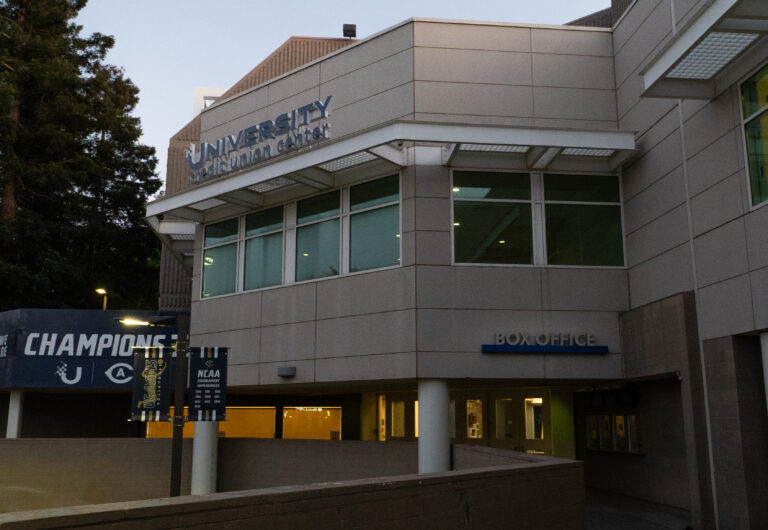
“The U Center was not only the predetermined destination but also the best possible security option and production option that we have,” Ng said.

The expected revenue from ticket sales is $137,500; The EC has a total projected expenditure of some $676,000, according to the ASUCD 2024-25 operating budget.

Marking another change, this year’s Lawntopia is planned to take place at the University Credit Union Center, a deviation from previous years in which it was held outside. Past venues have included the Memorial Union Quad and Dairy Field. Concerns over the availability of tickets due to capacity constraints have also been raised. Capacity at the U Center is 5,500; Last year’s capacity at the Quad was some 6,000.

Lawntopia tickets sold out in less than five minutes during both presale and general sale this year, meeting maximum capacity within the U Center as well as the income requirement the EC needed to meet, according to Ng.

ASUCD Controller Mostafa Rasheed, a fourth-year managerial economics major who acts as a chief financial officer of the ASUCD, explained how the money generated from tickets is distributed.

“Any money that [EC makes] doesn’t go [back] to that unit,” Rasheed said. “It goes to general reserves, and then from there, that money is reallocated for everyone else.”

Rasheed also said that the distribution of income generated from the tickets and sponsorships secured for the event will be finalized at the next budget hearing for the 2025-26 school year.

“ASUCD as a whole is not getting much money from external sources,” Rasheed said. “This was kind of like our trial period. Now we know that we can sell out quickly [but] with bigger venues comes bigger costs — with bigger costs comes higher ticket sales.”

Rasheed, Julka and both EC directors all emphasized their commitment to carrying out the student body’s demands amidst budget concerns.

“If they wanted to make Lawntopia free, they would have just had to have a different artist,” Julka said. “We would have to lessen our expectations on the artists for sure, so I don’t fully blame them.”

A fee referendum, which would implement a compulsory student fee of $10 per quarter to help fund campus events, was introduced earlier this year to be voted on during the ASUCD spring 2025 elections. Ng, inspired by similar referendums at other UC campuses, heavily advocated for the fee because it would help the EC run as a self-sufficient unit without having to rely on the Senate for money. It was later rejected by the vice chancellor and the Council of Student Affairs before it would be placed on the ballot. Because the EC already falls under the ASUCD Basic Needs Referendum, the separate referendum solely for itself was vetoed, according to Do.

While he expressed frustration with having to charge students, Ng is optimistic of the event’s success and remains thankful for everyone who has had a role in making the event happen.

“I couldn’t be more proud of [my team who] has taken all the nuances and challenges […] and played such an amazing role in helping Lawntopia come to life,” Ng said.

The EC leadership told The Aggie that they plan to release a statement to the public after Lawntopia acknowledging students’ disappointment in the changes, further explaining the reasons as to why it was structured differently and whether this format will remain the same in the following years.


Written by: Sairaksha Thirunavukkarasu – campus@theaggie.org

The biggest present you can give yourself is being present

Dealing with the monotony of everyday life


By TARA ROMERO — tcrome@ucdavis.edu


Everyone says life is like a roller coaster with ups and downs, but why does it feel like I’m stuck in a loop-de-loop?

Wake up. Go to class. Work. Sleep. Wake up to do it all over again. We’ve reached the part of the quarter where we’ve settled into our routines, and I’m starting to get restless. Every day feels the exact same, and it’s getting harder and harder to tell each day apart.

Yet, limiting this feeling to just this quarter doesn’t do the monotony justice. We have 10 weeks full of midterms, papers, more midterms and then a final exam — and we’re on our third round just this year. Our hair grows long and we cut it short again. We clean the kitchen just for it to get dirty. Then the years go by, cycling through each season before the Davis heat starts to roll in and cook us all.

Life is cyclical. Every morning the sun rises, and every night the sun sets. The moon rotates the earth and shifts into different phases. The earth does one cycle around the sun, and we call it a year.

These facts always fill me with a sense of dread. How are we supposed to escape this never-ending loop? If every day feels the same, then what’s the point?

I’ve been grappling with this feeling for years at this point, and I don’t think it’s in my power to change how the world works. Unfortunately, I can’t just stop the world from turning — and I know professors aren’t going to want to skip out on their midterm cycle just because I asked them to.

Instead, we must continue to move forward, and we must learn how to live a cyclical life. So, how do we turn what feels like a circle into a spiral? How do we feel like time is moving forward if everything feels exactly the same?

While every day may feel identical, if we look closer we can see that everything is a little bit different than it was yesterday. There are so many moments that don’t seem like they matter — yet those are the moments we have to rely on. Maybe today you saw a gopher pop out of his hole on the ground by Bainer Hall. Maybe you noticed two women in your apartment complex propping up chairs and having a coffee together. Perhaps the air had a noticeably sweeter scent when you opened your window this morning — or you noticed someone on campus almost trip and then regain their balance.

Little details like those make days memorable. All of those examples occurred around me on different days this past month, and, without them, the month would just be one big blur of “Wake up. Class. Work. Sleep.” That’s not how I want to remember my life.

Making yourself present in the moment doesn’t mean you have to make the world your oyster every single day. While I can respect the “live each day as if it were your last” mindset, there are still everyday responsibilities we have to tend to — and those responsibilities can get tedious if you’re performing them robotically.

Focusing on the small details around us is a good reminder that every moment is unique. It keeps us present and helps to differentiate the days from one another. We can get so caught up in our routines that we forget to look around and see life as it’s happening all around us. Observing and noticing different aspects of life reminds us that the world continues to move forward. Maybe we’re stuck going in a loop-de-loop forever, but that just means we get to see life from every different angle.


Written by: Tara Romero— tcrome@ucdavis.edu

Disclaimer: The views and opinions expressed by individual columnists belong to the columnists alone and do not necessarily indicate the views and opinions held by The California Aggie.

Human Relations Commission’s Muslim, Arab and Palestinian study draws contentious opposition

The HRC votes overwhelmingly to recommend further actions to protect marginalized groups 


By SUNNY LIU — city@theaggie.org


On April 26, the Human Relations Commission (HRC) met to discuss recent hate incidents and a three-month-long research report on discrimination against Muslims, Arabs, Palestinians and their Allies (MAPA).

The commission first discussed a troubling rise in hate incidents in the Davis Joint Unified School District. Vice Chair Leonie Pickett informed the group of one recent hate incident in a local Davis high school.

“There was an incident with a swastika drawn somewhere in Da Vinci High School,” Pickett said. “I know, there, it’s being investigated as hate speech as the school always would, and I don’t think we’ve quite figured out the details of it yet, but it’s a hate incident.”

One resident who identified herself as a teacher at North Davis Elementary School described the situation in the school district further.

“We’ve had several incidents this year,” the public commenter said. “I think the most recent was the swastika and the n-word in an elementary school bathroom, but it’s pretty regular. […] Some of the students have kind of just stopped reporting to us. I found out recently, because there’s just a lot of racism, antisemitism and sexism. […] And that’s my main concern, just that our young people are kind of swimming in this right now and I don’t think most adults are aware.”

Following the discussion on rising hate incidents in Davis schools, the majority of the time in the meeting was devoted to discussing the MAPA Report and the commission’s list of recommendations. The previous meeting held on April 2 presented the report’s findings. The meeting on April 26 was intended to address only the commission’s recommendations to the Davis City Council.

Commission Member Ellie Kaplan provided some background on the research.

“These recommendations are coming out of three months of research [and] many, many conversations with Muslims, Arabs, Palestinians and allies within Davis,” Kaplan said. “We primarily took a qualitative approach for this. We really wanted this to be an opportunity for people to share their experiences, their thoughts [and] their feelings in a safe way. One of the things that came up is that there [are] enormous risks in speaking out for many members of this community.”

A Davis resident provided a comment to the commission and expressed their support for the initiative.

“I wanted to urge that the MAPA Report and recommendations be sent on promptly to the city council,” one public commenter said. “I wholeheartedly agree with the recommendations. Institutional acknowledgement of the hurt and distrust in the community is the beginning step towards healing and building a healthier community. […] I think that honestly recognizing that speech in favor of Palestinian justice is not antisemitic is important.”

Another supporter of the project thanked the commission for their work in highlighting the struggles faced by the MAPA community.

“I want to start by thanking the subcommittee for performing such a complete survey of the MAPA community and presenting your findings in such a clear and effective manner,” the commenter said. “This survey was so necessary because our community often doesn’t talk about hate speech or incidents, or it’s so common that it doesn’t even register anymore as something new.”

The commenter continued by describing specific incidents and their relevance.

“I have youth in the community who just casually mention stories of other kids calling them terrorists and saying racist, Islamophobic comments, and I’m hearing them in shock while they say, ‘Oh, it’s fine, I just play it off,’” the commenter said. “We don’t want our kids thinking it’s normal for others to call them these things, and as was mentioned earlier, these comments are a reflection of what their classmates hear at home. And that comes back to this survey and the recommendations. It’s an actual opportunity to make change in the community.”

Despite the broad support for the recommendations from those attending the meeting, other Davis residents voiced their apprehension with the MAPA study itself. One commenter who was reading off a mobile device claimed to speak for David Siegle, a professor emeritus of medicine at UC Davis.

“Islamophobia and anti-Arab sentiment are serious issues in the [United States] and worldwide,” the commenter said. “That said, the Davis Human Relations Commission’s meeting on April 2, last month, did little to advance knowledge of or combat these problems. Rather, they presented a 45-minute biased report. […] The report obstructed a deeper understanding of these concerns by making numerous false charges, promoting conflict and weaponizing Islamophobia and anti-Arab sentiment.”

The commenter continued by describing their perspective of the meeting.

“At the April 2 meeting, HRC members read long quotes from interviews, [interviewees] who supposedly represented a crop-section of the MAPA groups in Davis,” the commenter said. “It was quickly apparent that the quoted individuals were not randomly selected but were purposefully picked to spread carefully chosen political themes and falsehoods.”

Another public commenter further questioned the scientific rigor of the methods used to create the report.

“It is interesting to note that much of the report doesn’t actually include evidence or examples,” the commenter said. “Without clear examples and evidence, I worry that this report also serves to slander and libel community members. The Congregation Bet Haverim Counter Antisemitism Committee put on a presentation that is mentioned in the report. Three different people called it Islamophobic and anti-Arab, yet, somehow, none of these people provided specific examples.”

The commenter furthered describing their perspective.

“So, how do we know it isn’t just slander? How do we know that it isn’t just weaponization to silence Jews talking about antisemitism?” the commenter said. “It makes me wonder, are you, the Human Relations Committee, putting Jews in danger? I don’t have any issues with any of your recommendations, but bad data in makes bad policy out.”

One public commenter spoke out in favor of the report by pointing out that the report’s findings and efforts to combat antisemitism are not mutually exclusive.

“Hate is not a limited pie, it’s extremely expansive,” the public commenter said. “The good thing is, justice is also expansive. Justice for one group does not take away from justice for another group. And I think that’s what is being impressed here today, is to give justice, to give voice, to give legitimacy to the experience of the Arab, Muslim and Palestinian community. That does not take away [from] the need to give justice to other groups in this community who also feel hate.”

In discussing the merits of sending the report to the city council in addition to the recommendations of the HRC, Commission Member Deema Tamini addressed some of the comments.

“You might not like what the report says,” Tamini said. “You might not agree with what people feel, but this is what people feel. […] We did qualitative work where we actually talked to people. We gathered information. A lot, because this community is very scared to speak up. So there’s that, but there’s also just low numbers in this community, so we did not do quantitative [analysis]. We have shown that through this qualitative analysis, this is the sentiment of a group of people, whether that’s two people or a thousand people, that’s the sentiment. I think that the context is needed, but what we are not asking the city council to do is bless this report.”

Commission Member Edgar Wong-Chen also spoke out about the need to take action despite concerns with the MAPA Report.

“What I also realized was that there [were] a lot of people surveyed, and in my honest opinion, I don’t need a critical mass of people,” Wong-Chen said. “I just need a few good examples. We’ve had people who have come to HRC meetings, a single individual who […] brought up an issue, and we’ve taken it on, and we’ve formed subcommittees from a single person representing a single topic that they felt marginalized [on].”

Ultimately, the motion to move forward with the list of recommendations to the city council passed with a large majority. The sole dissenting vote was Commission Member Amir Kol, who then requested to include his dissenting opinion with the packet to be sent to the city council. His subsequent motion was not seconded. After the meeting, Kol explained his reasoning for voting against the motion to move forward with the recommendations.

“The report is not transparent, the methods are completely not transparent and biased and the recommendations are based on a report [where] the methods are flawed,” Amir said. “This report is not gonna heal anything in this community, just as we see again and again, it just deepens that divide, because it’s not about healing one community. It’s by definition, healing one community at the expense of another. Pointing fingers at another community. […] The Jewish community has lost its trust in [Davis] City Council, and the commission as a body that can represent us and care for us and have our needs and interests in mind.”

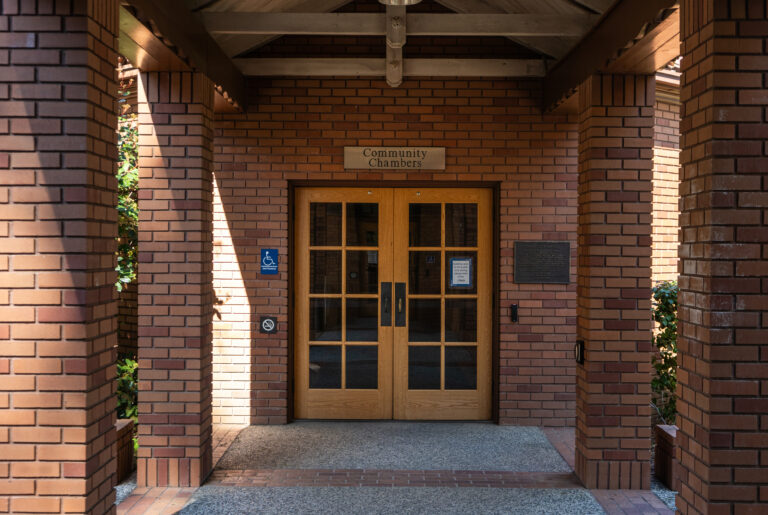
The Davis HRC meets on the fourth Thursday of each month at 6:30 p.m. The meetings can be attended in person at the Community Chambers at City Hall or viewed online at the city of Davis YouTube page. The MAPA Report and recommendations can be found online at the city of Davis website.


Written By: Sunny Liu — city@theaggie.org


Review: ‘Headphones On’ sets the tone for Addison Rae’s bold debut album, ‘Addison’

Former TikTok creator Addison Rae’s aesthetic transformation and artistic reinvention signal her return to pop culture


By SHREYA KUMAR — arts@theaggie.org

Addison Rae is cementing her transformation from TikTok star to mature indie-pop princess with the release of her new single, “Headphones On,” on April 18, 2025 under Columbia Records. This dreamy, toned-down song marks a significant evolution in her musical journey, showcasing a more mature and emotional side of Addison Rae that we’ve only just begun to see in her recent releases.

“Headphones On” is the fourth single leading up to the singer’s highly anticipated debut album, titled “Addison,” set for release on June 6, 2025. The album promises to be a culmination of her artistic journey, featuring a collection of tracks that showcase her versatility and depth as a musician in ways her fans have never seen before.

Addison Rae rose to fame in 2019 through TikTok, quickly becoming one of the platform’s most-followed creators thanks to her dance videos, polished appearance and approachable personality. Her involvement in the Hype House, a collective of young influencers known for their choreographed, high-gloss content, further cemented her status as a mainstream star. The Hype House didn’t just amplify Rae’s fame, it helped shape her image as the all-American “girl next door” and aligned her with conventional beauty standards and aesthetics that appealed to mainstream audiences.This is what ultimately made her surprise feature on Charli XCX’s “Von Dutch” remix last year so jarring. The song was a fast-paced, electric synth-pop anthem on the now-iconic “Brat” album representing a sharp pivot from Rae’s earlier persona.

By stepping into Charli XCX’s niche, defined by glitchy beats, high fashion and subcultural rebellion, Rae shed her squeaky-clean image and embraced a far more messy and real style. The feature was criticized by some and a surprise for most, but it succeeded in signaling her desire to be taken seriously in a space known for challenging the very norms she once embodied.

Though many only began to take her music career seriously in the wake of her Charli XCX feature, Rae released her debut single, “Obsessed,” back in 2021. The track, originally intended to lead her debut album, was widely criticized by audiences, and the entire project was shelved shortly after. At the time, it seemed to most fans that her time in the spotlight had come to a close. But instead of retreating, Rae quietly regrouped. Her recent surprise singles, “Diet Pepsi” and “Aquamarine,” reframed her image, drawing comparisons to a younger Lana Del Rey with their brooding, retro-tinged sound and aesthetic melancholia.

“Headphones On” continues this shift, blending elements of trip-hop, new jack swing and chill R&B to create a lush, sensuous atmosphere. The track explores themes of surrendering to life’s pain and finding escape through music, offering a more intimate look at her inner world. She croons about her parents’ divorce and her insecurities about her status as a celebrity, exposing the emotional cost of fame beneath the curated surface. It’s a moment of unexpected vulnerability, and shows that her reinvention isn’t just for aesthetics, but also for personal discovery.

The music video, directed by Mitch Ryan, drives home the song’s ethereal and dreamy vibes. Filmed in the picturesque landscapes of Reykjavik, Iceland, the video portrays Rae escaping the monotony of everyday life through vivid daydreams. Wearing a blindingly bright pink wig and riding a white stallion or dancing on the beach in neon underwear, she finds herself lost in a hyper-saturated fantasy world of her music. The music video truly captures Rae’s own personal artistic brand, and sets a precedent for what “Addison” is going to look like.

With each new single, “Addison” takes shape as a project centered on finding hope and love even when dealing with somber emotions. Based on the singles we’ve heard so far, the album seems to blend influences from alternative pop, vintage R&B and electronic dream pop, all while remaining anchored in Rae’s personal storytelling. Rae is curating a very specific vibe, crafting a sonic identity that is far removed from the influencer culture that first brought her fame.

As release day approaches, anticipation for “Addison” continues to build. Both critics and fans are eager to see whether Rae can carry the creative vision of her recent singles into a fully realized debut. If “Headphones On” is any indication of her future music trajectory, the album will not only solidify her artistic reinvention but also carve out a new niche for her and her fanbase. This debut is more than a career shift for Rae; it signals a deliberate break from the image that first brought her fame. Addison Rae is not interested in fitting into the mold that made her famous, but rather, in breaking it.

Written by: Shreya Kumar — arts@theaggie.org

Not very eco-friendly

Drawn by: Lauren Swing–– laswing@ucdavis.edu

Disclaimer: (This cartoon is humor and/or satire, and its content is purely fictional. The story and names of “sources” are fictionalized.)

Aggies reflect on the habits that help them stay grounded

UC Davis students share details of their daily routines


By AMBER WARNKE — features@theaggie.org


Having healthy habits and routines can help students start their day fresh and keep them regulated throughout the busy life of a college student. Whether it’s taking five minutes to reflect on their day before they go to bed or being mindful about the way they drink their morning coffee, starting out with small changes can turn into long-term routines over time.

Mariam Soifer, a second-year sustainable agriculture and food systems major, involves purposeful movement in her morning routine, taking time to start her day with a set of stretches.

“It’s just something that I feel like I need to start the day with,” Soifer said. “It helps me get more limber from my night’s sleep and helps [keep] me [grounded].”

Stretching is known to have a variety of health benefits, including stress relief, improved balance and coordination and increased circulation. This is especially important for college students, who can spend hours a day sitting in lecture or doing homework, which can lead to poor circulation in the body.

Another habit Soifer has started implementing is completing daily meditations, which further help her stay calm amidst the stressors of college life.

“It was even just for five minutes, and I felt a really big difference from that,” Soifer said.

Meditation has been proven to be beneficial to mental health, decreasing stress, improving memory and attention and even decreasing blood pressure, depression and anxiety. The thought of meditating every day can be daunting to some, but it can be helpful to remember that meditation can last for as long as one wants, and even just a few minutes spent doing it can have a huge impact.

Benton Buecker, a second-year environmental policy analysis and planning major, also benefits from the routines he uses to start the day.

“Usually with my coffee, I usually like to get my mind going in the morning by playing some of those [online] games, like the New York Times Connections, New York Times Mini Crosswords and Duolingo,” Buecker said. “I really think that it’s a good way to, at least with those games, […] get your brain up and at them and thinking.”

Games like this are also proven to be good for the brain, boosting memory, improving focus and even slowing down cognitive decline in aging. One game Buecker particularly favors is called Juxtastat, which is free to play online and features trivia questions about geography.

“[The games] get your brain thinking in different ways,” Buecker said. “It’s good for critical thinking.”

Ava Dillard, a UC Davis alumna, also has daily routines that allow her to engage her mind, including setting aside time to read nightly before bed.

“I think it’s great to have time away from my phone and at the same time be transported to another world,” Dillard said. “I fall asleep right away [after].”

Studies have shown that reading before bed can lead to better quality of sleep, helping reduce stress at the end of a long day and redirecting time that many people would spend on their phones before bed, which can make it more difficult to get a good night’s rest.

Another routine Dillard has implemented into her schedule is spending time in green spaces as often as she can.

“Every lunch, I will go eat in the community garden by one of my favorite parks, and it’s so lovely,” Dillard said. “I’m usually the only one there, and it’s just me and the bees.”

Spending time outdoors has immense benefits for mental and physical health, improving creativity and problem-solving skills, which can be particularly appealing to college students. It also correlates with better heart health, better sleep and less risk of chronic disease.

However, students don’t necessarily need to go backpacking to reap these benefits. Even studying outdoors, taking short walks outside and noticing the nature around them while biking on campus can be helpful.

While being intentional about your daily habits is beneficial at any stage of life, college students may find it particularly important, as they can set habits now to follow well after college and into their careers. What may start out as five minutes of meditation now can lead to better focus in the workforce and an improved ability to work well against a stressful deadline.

Building workout routines into one’s life now can turn into a healthier lifestyle for years to come, and spending just a few minutes sorting out your schedule the week prior can lead to better time management and planning skills.

“I think we’re at a time of our lives where we’re creating, establishing or solidifying certain habits, and if we want to bring those into our adulthood, then I think this would be a perfect time for that,” Soifer said.

Defining habits and routines can also be helpful in college due to the increased routines students can access on campus. Davis students looking for better or more structured exercise routines can join a workout class or a recreational sport at the Activities and Recreation Center.

UC Davis also offers free library books to students hoping to spend more time reading, as well as the Arboretum to Aggies seeking to implement more time in nature into their routines. Even just taking a brief walk through the Arboretum a few times a week, reading for 10 minutes before bed or going for a quick run every few days can make a big impact on your day-to-day life.

Soifer believes that intentional routines and habits are not only helpful but also an important element of self-growth.

“[Forming habits] comes from a desire to work on yourself and feel good and comfortable in yourself,” Soifer said. “It’s an active love — like a service to yourself.”

Written By: Amber Warnke — features@theaggie.org

I have beef with love triangles

It’s time to ditch the drama and choose the better love interests    


By JHANA RHODES — jsrho@ucdavis.edu


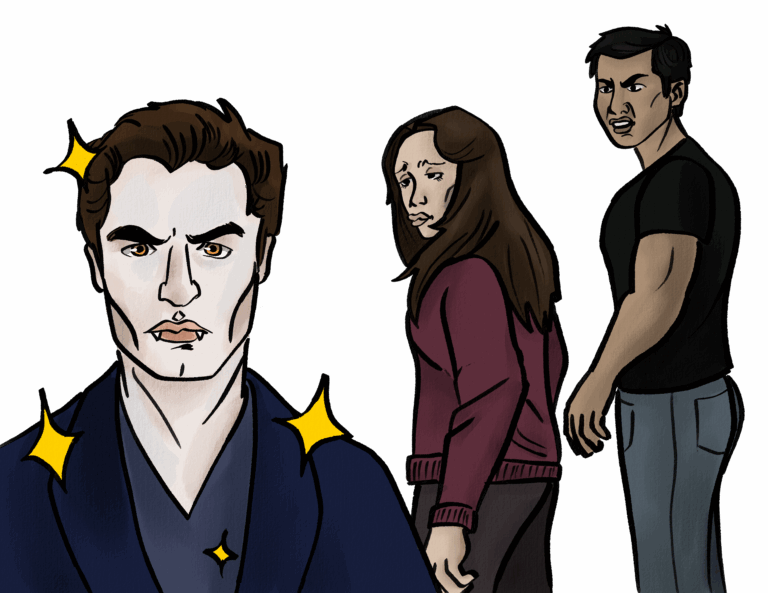
Every other week, “Twilight” enthusiasts come out of the woodwork to discuss whether the franchise’s protagonist, Bella Swan, should have ended up with Edward Cullen, a 104-year-old high schooler with the personality of a brick, or Jacob Black, the portable heater with 30-inch locks. While the choice between a sparkly, self-loathing vampire and a werewolf with no respect for boundaries can hardly count as a “better choice,” this consistent and frankly comical debate represents a timeless romance trope: the love triangle. This trope, so often seen in young adult media, draws our attention to a bigger issue found in many romance films.

Why does the protagonist always go for the first choice when the second choice is almost always better? Don’t get me wrong, Jacob Black is the second-worst example of this phenomenon regarding “secondary” love interests. The first-worst example is, by far, Daniel Cleaver from the film “Bridget Jones’s Diary.” That being said, while there are certain exceptions to this phenomenon, pop culture narratives often set up a dynamic where a second lead character could be the more stable and beneficial partner, if only the protagonist (and the plot) weren’t so fixated on the often more unbelievably toxic and dramatic “first choice.” This tendency to prioritize initial and usually unhealthy attraction over genuine compatibility is already something I hear about from my friends’ bad dating choices, so I’d prefer if movies stopped romanticizing it.

Take the classic 2004 film, “The Notebook,” for example. Ryan Gosling’s character, Noah, and Rachel McAdams’ character, Allie, are the embodiment of a toxic relationship. Throughout the film, Noah acts obsessively with Allie, often making unwanted gestures — such as dangling off of a Ferris wheel — until Allie agrees to date him. When Allie was with him, she was constantly stressed, crying in every other frame. My jaw dropped when I found out (spoilers) that she didn’t end up with James Marsden’s character, Lon Hammond Jr. — Allie’s (ex) fiancé and a handsome lawyer who is the opposite of Noah. However, for some odd reason, Allie leaves a life of happiness and stability to return to a summer fling.

More often than not, the “second choice,” initially made to be either an obstacle, plot progress or fallback, embodies traits that any reasonable human being would consider desirable in a partner. The second choice is often kind, patient and compassionate, someone who the protagonist feels safe confiding in and offers unwavering support without toxicity or dramatics. This starkly contrasts with the first choice, where (depending on the trope) they are outright rude, condescending, impulsive and possessive (yes, I am talking about Damon Salvatore).

Honestly, the protagonist’s total lack of regard for their own red flags baffles me. While dating the “bad boy” may seem exciting, the continuous prioritization of toxic relationships over healthy ones in the media teaches us to view toxicity as fun and stability as boring.

However, the second lead is sadly second for a reason. That is primarily because — to put it simply — we all love a little drama. Stories thrive on conflict and tumultuous character dynamics; the first love interest often provides the necessary fuel to create a good story. No matter how much we (and the protagonist) know that the second choice is better, the drama is much more enticing.

The bitterness I still harbor over Carrie choosing Big in “Sex and the City” and my undying adoration for Duckie Dale from “Pretty in Pink” highlights my dissatisfaction with love triangles. While individual viewers may have their favorite love interest, consistently prioritizing an often toxic “first choice” can reinforce unhealthy romantic relationships within our modern culture.


Written by: Jhana Rhodes— jsrho@ucdavis.edu 


Disclaimer: The views and opinions expressed by individual columnists belong to the columnists alone and do not necessarily indicate the views and opinions held by The California Aggie.


UC Davis’ Julie Wyman debuts her documentary, ‘The Tallest Dwarf’

Wyman, a cinema and digital media associate professor, shares her experience with filming 


By EVELYN SANCHEZ — features@theaggie.org

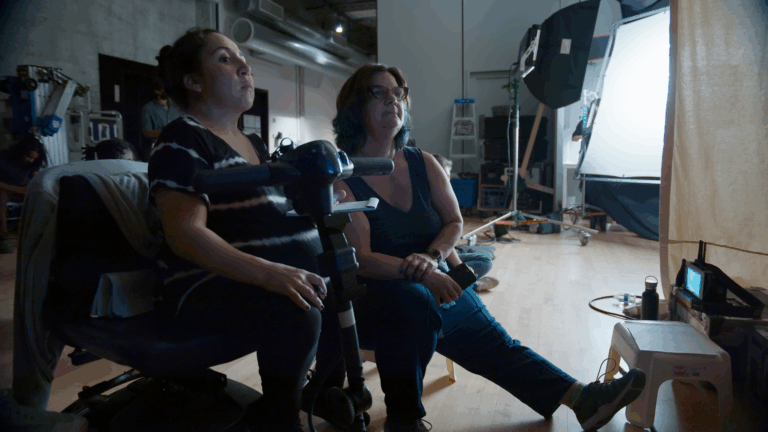
Many professors on campus have their own projects occurring beyond the courses that they teach — from lab-work research to writing papers to creating films. UC Davis Associate Professor Julie Wyman, alongside teaching cinema and digital media studies courses like small-scale production and experimental digital cinema, has also spent the larger part of a decade shooting her documentary film “The Tallest Dwarf,” which had its worldwide premiere at the South by Southwest film festival in Austin, Texas in March of 2025.

“The festival is very selective, and it’s hard to get in,” Wyman said. “And it was a really big deal to be selected for the program. We had three screenings there and it was very nerve wracking seeing it for the first time. It was screened in a 200-person theater, so it was kind of our launch.”

For Wyman, she used film as a continuation of a conversation surrounding bodies and their many forms, exploring their differences and prejudices.

“I had been making films already for a while,” Wyman said. “A lot of my films are about people whose bodies don’t fit in a lot of different ways. I’m interested in looking at people in a different way so we can see the beauty and power of bodies that get marginalized.”

Wyman is interested in telling the stories of different bodies as a way of exploring questions about her own.

“I made a film about a [transgender] man and his partner before our culture talked about transgender people, and before it was a word in our culture,” Wyman said. “That came out in the 2000s. I also made a film about a fat synchronized swimming troupe called the Padded Lilies, and another film about a weightlifter who was heavyweight.”

Wyman’s film “A Boy Named Sue” followed the six-year-long transition of Theo and how the experience affected their life and relationship with their partner. Wyman’s other film, “Strong!,” documented Cheryl Haworth, a United States weightlifter and Olympic Games medalist, as she trained for the 2008 Beijing Olympics.

“These are all documentaries,” Wyman said. “The reason why I’ve made these films is because I’ve had the feeling I don’t fit in [in] such ways. After I finished ‘Strong!,’ I was kind of at a point where I felt like I needed to make a film about my own body.”

“The Tallest Dwarf” was just that for Wyman. Engaging her lifelong questions about bodily belonging, the opening scene follows Wyman as she discusses her body with her parents and reminisces on childhood memories of difference and isolation.

“There’s hundreds of kinds of dwarfism,” Wyman said. “It seemed we might fit into one of them.”

The documentary follows Wyman’s journey as she discovers herself and finds community and understanding with other individuals with dwarfism. The film eventually leads her to the annual Little People of America National Conference, and one of the highlights is the interaction between the subjects and Wyman as the documenter, turning the piece into an artful collaboration of community.

“The way the project evolved is that it kind of leaned into this collaborative work with some of the key people in the film,” Wyman said. “One thing that has been said about my films is that they take a long time, and over time, I build close relationships with the people I’m making films about. I think of my documentaries as collaborations in a way.”

UC Davis students who have viewed the film have responded very positively, including Taylor Harrison, a fourth-year cinema and digital media major, who attended the film’s premiere.

“I thought it was inspirational,” Harrison said. “It was very fun to watch, and I loved the comedy aspect within it. There were some funny aspects within it, [such as when] she was interacting with her family and the other little people.”

Harrison particularly appreciated the collaborative aspect of the film as mentioned by Wyman, with the authenticity of the people filmed standing out as a highlight.

“They were being themselves, and they weren’t trying to be anything other than that,” Harrison said.

The sense of collaboration, in time, guided Wyman back to her original question of personal identity.

“Eventually, I get a diagnosis within the film,” Wyman said. “You kind of see it [gradually] unfold, how I find that out, and I go tell my dad because I start with him. And then you end up with me — I go back to tell him, and it’s a moment of reconciliation.”

Jatzira Gonzalez, a fourth-year cinema and digital media and history double major, also watched the San Francisco International Film Festival screening.

“You can tell it was a passion project,” Gonzales said. “It was super personal to her when she’s talking about herself. I think there were a bunch of things that were promoted and some things that were followed through, but some things were left unfinished. It kinda felt incomplete, but I understand if it was because she’s still living and learning.”

Even as an experienced filmmaker, Wyman naturally had reservations about capturing such an intimate story of herself.

“The main thing I was scared of was putting such a personal story on screen,” Wyman said. “I really wanted to do justice to my new friends and community and not overstep. It’s definitely very risky. I wanted to make sure I did it with integrity, that it was fair and that it lived up to the beauty and greatness of the people around me.”

Wyman also expressed her goals and ambitions she hoped to portray through the project.

“Artistically, the hope was to make something that kind of breaks some new ground in terms of little people representation,” Wyman said. “And [the film] lets people have a complicated experience and doesn’t tell people what to think of it. On a cultural and spiritual level, it was to provide a form of beauty in the world and make space for lots of kinds of bodies in the world.”

“The Tallest Dwarf” has thus far been showcased at the San Francisco International Film Festival in addition to the South by Southwest film festival, and the documentary’s team is currently working to get it to festivals taking place in the summer and fall. Next year, the documentary will be broadcast and streamed by Public Broadcasting Service (PBS), where it will see its national broadcast run.

To follow the documentary’s journey, visit @thetallestdwarffilm on Instagram or @thetallestdw4rf on Facebook.

Written by: Evelyn Sanchez  — features@theaggie.org

Co-operative living in Davis: Turtle House

Past “hatchlings” share allegations and incidents leading up to a mass departure of 17 residents 


By NOAH HARRIS — features@theaggie.org


“That’s when I learned that I would never be on the lease with 17 other people ever again, because you’re liable for whatever the fuck they do,” Piper, a former tenant of Turtle House who wishes to leave her last name anonymous, said.

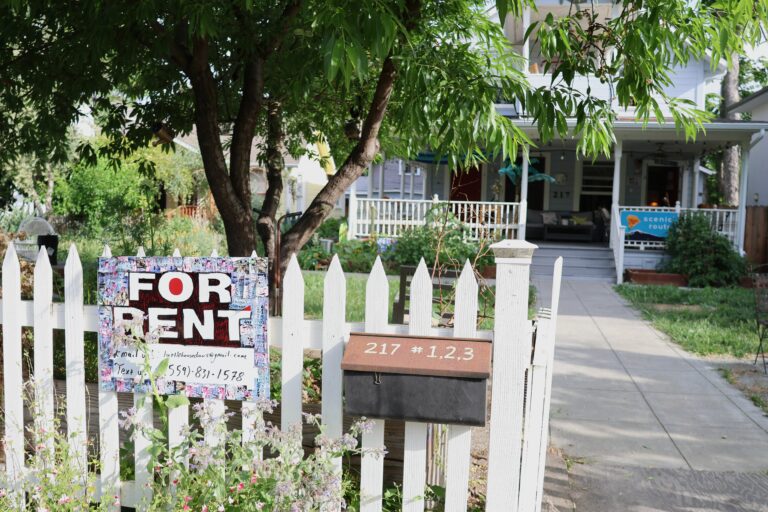
Turtle House, a cooperative (co-op) residence in Davis’ downtown, has faced issues with tenant-owner relations, as well as lease violations, that led to almost all of Turtle House’s occupants vacating the property in a less than two-week period.

Turtle House is known for their frequent concerts, which have mostly stopped in the last two years. Up to 600 people would typically attend these concerts, routinely utilizing the area in front of the house, according to numbers reported from various sources.

One of the first inciting conflicts for the residents of Turtle House began over the front lawn.

“Things really started to boil over starting from the grass,” Piper said.

Another past resident, who wishes to remain anonymous, expressed frustration with the situation, noting that the owner, Michael Harrington, was being particularly strict about visitors standing on the lawn, which was newly renovated at the time.

“We had this big show planned and he told us [at the] last second, ‘Nobody’s allowed to stand on the grass,’” the resident said. “And we were like, ‘Well, where the hell are people supposed to stand?’ It was a big point of contention.”

For the event, the residents put mats over the grass, in an attempt to protect it from damage. One former resident, who wishes to remain anonymous, described the situation in more detail.

“We went and got all these carpets at Goodwill to cover them so that the actual grass would not be stomped on,” the resident said. “It was just kind of compacted under. And then after the show was over, we pull[ed] it up, let the grass breathe, water[ed] it and it was 95% fine.”

The damage done to the lawn resulted in Harrington charging residents a $2,500 fine.

This became a cause of tension, and many of the tenants asked lawyers for advice on whether they should pay the full charge and were advised to not pay Harrington for the damages, according to multiple anonymous former residents.

Eventually, the amount of money Harrington requested for the damage was paid through the residents’ collective security deposit, which many residents alleged they later received only a fraction of the amount that they initially paid upon moving out of the house. Some residents believe they weren’t given the fair amount owed from their deposit.

Around the same time as the lawn damage, an injury occurred at a concert, which turned into a potential lawsuit against Harrington as there was no insurance that covered these events at Turtle House.

“Those kids weren’t buying commercial coverage for their profitable Venmo shows,” Harrington said. “They were using Daddy’s resources for free, right? If somebody’s seriously injured and there’s no coverage, guess who eats it? Daddy does, right?”

When the injured individual’s attorney sent a letter requesting to speak with Turtle House’s owner, the tenants who received the letter debated how to proceed. One former tenant explained what happened after the letter was received.

“When we got the notice from the guy who injured himself, we were instructed [by other residents] to take the letter and rip it,” the tenant said.

Because the letter was allegedly ripped, it wasn’t until months later that Harrington learned from the single resident who stayed at Turtle House that a letter had been sent. Later, a settlement was reached outside of court.

Another set of incidents that occurred at Turtle House was the usage of urine jars. Claimed by several past residents of the house, jars of urine were visible around Turtle House, including in public areas such as one of the house’s communal kitchens.

“I saw one on the back porch,” one former tenant said. “It was a gallon water bottle, like a Crystal Geyser water bottle.”

Piper made a similar discovery in a different location.

“I remember looking for my iron one day — like we were sharing an iron back and forth — and I went into the closet and found the jugs,” Piper said.

The origins of the urine jars came from one resident, who had previously joined a Facebook group of individuals who drink their own urine as a “joke,” according to multiple sources.

This wasn’t the only urine-related situation that occurred. When one former tenant brought a friend over to the house, they alleged that at the same time, other residents peed over the balcony railing that publicly faces the street.

“They just sat on the railing, like right there, and then they just peed over it when [the visitor] was there,” the tenant said. “It was kind of a free for all with the pissing.”

Other allegations surrounding the house included resident applications and why some people were chosen to live at Turtle House over others. There was one tenant who, according to multiple former tenants, set up meetings with applicants only looking for one specific demographic: white women.

Another tenant allegedly found evidence of significant bias in applications during their time at Turtle House when they were reviewing applications.

“One of my friends was in charge of [applications],” the former tenant said. “We were struggling to fill the house so we’re looking through the [Turtle House] email for any applications. We found a bunch of emails and applications that were sent in by people who were not white women that just were never responded to.”

Only one resident, who was a white man, was in charge of applications during this time, according to the source. One former resident mentioned that many who visited Turtle House observed a perceived lack of diversity.

“Honestly, when you looked at us in a picture, it kind of looks like a cult,” the resident said.

Multiple residents also alleged that someone wasn’t selected to live in the house because of their appearance. One resident who was attempting to leave the house and was seeking a subletter expressed dissatisfaction with the selection process.

“I [prolonged] my stay here and [had] to pay rent, which I [could] no longer [do],” the resident said. “It [caused] me financial issues, because you [all] [didn’t] like that he’s bald.”

There was also significant friction between members of the house and one specific resident. Based on meeting notes provided by an anonymous former resident, this individual was put up to a vote during a meeting, and the majority of tenants voted to evict them. However, the vote only held ceremonial power and was not enforceable, so the individual chose to remain a resident, despite being asked to leave multiple times by other residents.

In interviews, multiple former tenants expressed that this individual made them feel uncomfortable.

“I wouldn’t leave my female friends alone [in the house],” one former tenant said.

Additionally, during a “room crawl” held in the house — an event where people visit different rooms in a house and drink in each one — one room in particular featured multiple pictures of Harrington with his eyes crossed out with the letter “X.” There was also a photo of Harrington next to a photo of Mao Zedong, the former president of the People’s Republic of China.

For many involved, what happened at Turtle House was an emotional time and for some, it continues to be.

“Every time I looked at the house the first couple of months I walked by, I would tear up a little bit and be like, ‘Damn, the house is really beautiful,’” Piper said. “It was hard seeing new people there out front and [thinking], they don’t even know. They have no clue what happened.”

Co-operative living spaces can be complicated, as the events at Turtle House from August of 2022 to September of 2023 have shown. Everyone involved — from the tenants to the owner — mentioned numerous issues inside of the house that contributed to 17 residents leaving the premises.

However, co-ops in Davis, as a whole, have provided a unique, collaborative space for students to contribute to a shared living experience. Turtle House continues to serve as a communal space for students in Davis, whether through its band performances or simply its recognizable exterior and central location within Davis’ downtown.

Written by: Noah Harris — features@theaggie.org


Grab the glitter and glue sticks: it’s time to start scrapbooking

From snaps to scraps, read more about why and how to start preserving your memories


By IQRA AHMAD — arts@theaggie.org


With paper and pencil in hand, a pair of scissors at the ready, cutouts of magazines scattered around and a blank page, the possibilities are endless. Somewhere between sketching ideas and cutting dreams from paper, scrapbooking is the art of seeing the beauty in your life.

From scrapbook to screens

So what is scrapbooking? It’s the art of combining snapshots of your life or the moments you wish to experience, wrapped around words and phrases that capture the ambience of your feelings. Scrapbooking has always been about more than just a crafty hobby. It’s a way to collect all the little moments in between — a photograph here, a handwritten note there — stitching memories together into something lasting. It’s a way to say: this matters.

People turn to scrapbooking for a plethora of reasons, whether it be to capture memories, to organize thoughts or simply to make life’s chaos look a little more beautiful on paper. At its heart, scrapbooking is where visions take shape and daydreams find a home.

TikTok trends around vision boards for the new year and mood boards for changing habits have become a sensation, offering people a chance to picture a new and different future. For many, this ideal reality can be one that’s more productive, filled with adventure or brimming with the moments they’re striving to experience. People even use colors and little details to evoke a feeling, think citrus fruits and honey-toned photos for dreamy summers at the beach with hibiscus flowers in your hair or mood boards with shades of red and gold, paired with coffee and plaid, to capture the essence of autumn.

Even if you don’t think you scrapbook, chances are, you already do. Through Instagram saves, Pinterest boards or just the pictures you snap, the tools might have evolved, but the feeling remains the same.


Why we still love it (especially now)

In a world where social media is often the go-to place for storing memories, it’s easy to forget the power of a more personal, tactile form of reflection. While Instagram stories and TikTok posts may capture the highlights, they can feel fleeting and easily lost in the scroll of time. Scrapbooking, on the other hand, offers something more enduring, a way to preserve your experiences and ideas in a deeply personal, creative format.

Don’t let social media be your only archive of memories and magical moments. Let scrapbooking be a space where you not only store photos but also share your thoughts and dreams with yourself. It’s a tangible, hands-on experience that lets you reconnect with your story in a meaningful way. It invites you to slow down, reflect and craft something that’s uniquely yours.

In today’s fast-paced world, scrapbooking can serve as an escape, offering a break from the constant digital bombardment and a chance to really be present in the moment. It’s a place to preserve the little details, the ones that social media may overlook, and turn them into something lasting. Whether it’s a ticket stub, a handwritten note or a pressed flower, scrapbooking lets you hold onto what matters and revisit it whenever you need a reminder of how far you’ve come.


Pencil, paper, pinterest: pick your weapon and create

So how do you get started? The first step to a meaningful scrapbook is to tap into what truly excites you. What are you passionate about? What brings you joy or inspiration? Take a moment to reflect on what you want to surround yourself with, whether it’s nature, travel, fashion or certain colors and vibes. This is where you get to dream big. Once you’ve identified your passions, start gathering elements that reflect those interests. A vision board is a great way to pull it all together and keep you inspired. You can even make it seasonal. Think flowers and sunshine to capture the essence of spring or photos of rollercoasters and beach piers to bring summer to life.

Now, it’s time to collect the visuals that represent your passions. Snap some photos of places you’ve visited or frequent, romanticize your daily life. Finding images that evoke the feelings you want to cultivate or searching for quotes that inspire you can also be helpful in gathering all the pictures and elements that speak to you. Remember, these images don’t have to be perfect; they just need to be about what you love and want to focus on.

Now that you’ve gathered your materials, it’s time to get creative. Arrange your images, quotes and other collected items on a page in a way that feels inspiring and true to you. Don’t be afraid to mix things up; play with color, texture and layout. Glue, cut and add a personal touch, whatever feels right. And remember, there’s no “perfect” way to do this, it’s about what makes you feel motivated and connected to your vision.


So, whether you’re creating a vision board to map out your dreams, capturing memories from a summer trip or simply collecting your favorite things, scrapbooking is the perfect way to make your story tangible. It’s a creative adventure that lets you add a little more color to your life, one page at a time. So, grab those scissors, some glue and a sprinkle of imagination, and start crafting your own masterpiece. After all, the best stories are the ones you create yourself.

Written by: Iqra Ahmad — arts@theaggie.org 


A collection of apologies from all of your friends

They might be late and semi-anonymous, but at least they’re sorry!


By MADISON SEEMAN — meseeman@ucdavis.edu


Your friends are sorry. From not commenting on your most recent Instagram post to making excessive “Breaking Bad” references, they know they’ve messed up. There are a number of little crimes we commit in friendships — little knots in an otherwise beautiful bond. However, confrontation is hard and awkward: that’s where I come in.

I’m here to deliver a series of apologies — a collection of statements that include everything from “I didn’t mean it” to “my bad” to even “oopsies.” Like a slightly-more-cynical-but-no-less-sincere cupid, I’m here to hit you with arrows of apologies. Think of me as a carrier pigeon of remorse or a pony express of regrets.


Anyway, here’s the list:

  1. I bumped into a friend of yours yesterday who wanted me to clear the air about how many TikTok videos he’s been sending you. He thought they might give you a giggle. And really, isn’t it a compliment that he wants to share his laughter with you? And okay, maybe 22 TikToks a day is 20 too many. He’s sorry! He won’t stop, but he’s still sorry.
  2. Some of your friends have voiced regrets to me about not having watched the YouTube video you sent yesterday. Can you blame them for not taking the time to watch a 10-minute video? Maybe you can, especially since they can set it at double speed. Still, they feel bad and they’re sorry! They’ve all just added it to their watch lists for later.
  3. A few of your friends told me that they’re really, really sorry they keep accidentally triggering identity crises with incredibly accurate reads that change the way you see yourself. They were just trying to be silly! They didn’t know telling you that you “give off Charlie Brown vibes” or “look a little bit like you were a horse girl” would be so devastating. It may be true, but they would all take it back if they could!
  4. One of your favorite classmates has already seen that meme you just showed them. They do feel bad about it. I mean, it was funny! But they have already seen it, so the laugh was maybe just a tiny bit forced. If it helps, they are sorry.
  5. You also have a friend who just watched that TV show without you. The guilt is killing them, but it got too hard to avoid spoilers, and they’re willing to pretend they haven’t seen it before to save your friendship, if you count that as an apology.
  6. One of your closest friends is sorry that your periods aren’t synced up. It doesn’t matter whether you’re not someone who even gets a period. She’s worried it’s a sign your friendship is going south, and she apologizes if she’s done anything to put them out of sync.


  1. Someone you know just can’t stop googling things mid-conversation — you can probably guess who. Well, they’re sorry for being too curious, and they feel some remorse for their ruthless pursuit of knowledge. Mostly, they’re sorry it’s annoying but not sorry enough to stop.
  2. Um, ok, let me see who else. One of your other friends has had trouble reading your frantic body language in public. She hasn’t quite put together that the way you’re pointing to the door with your eyes means you want to leave or that you’re trying to get her to — subtly! — look at the cute guy behind you. She feels a little bit like she’s failed you — or at least failed to bail you out of parties.

In the end, you may have some friends who are sorry about spontaneously bursting into song (but only part of the time), other friends who are sorry they can’t stop referencing shows you haven’t seen and friends that are just sorry they can’t remember your elementary school ex-boyfriend’s name (even though you talk about him, like, a lot).

But the beauty of friendship is that these little bumps won’t make or break a bond. Our relationships are stronger than jokes that don’t land and a little (or a lot) of off-key singing. Your friends are sorry, and they’ve sent me to deliver these incredibly compelling apologies to prove it.


Written by: Madison Seeman –– meseeman@ucdavis.edu


Disclaimer: (This article is humor and/or satire, and its content is purely fictional. The story and the names of “sources” are fictionalized.)