55.5 F
Davis

Davis, California

Tuesday, December 23, 2025
Home Blog Page 311

Woodland nursing home experiences second outbreak, rising case counts threaten to move Yolo County back into Purple Tier

Yolo County supervisor urges people to comply with health guidelines, prevent winter outbreak

Over the past two weeks, Yolo County has experienced a rise in COVID-19 cases.  Although the county is still in the Red Tier of the state’s reopening plan, the adjusted daily new case rate as of Nov. 5 stands at 7.3 per 100,000 residents, up from 5.4 the week of Oct. 26.

If the daily new case rate reaches 7 per 100,000 residents for two consecutive weeks, the county will return to the Purple Tier.  

District 4 Yolo County Supervisor Jim Provenza explained that the rise in case count is driven by several factors. He referred to the Woodland Alderson Convalescent Hospital, which is now experiencing a second outbreak after mitigating their first outbreak in early July.  

“One of the biggest increases in cases was in a nursing home that had previously had an outbreak,” Provenza said. “I don’t think the nursing home is doing a good enough job of preventing outbreaks, and I think we need to have stricter enforcement with them and any other nursing home that isn’t doing its job.” 

Provenza emphasized the need for the nursing home to use protective equipment and also suggested daily testing.

“There’s really no excuse for a second outbreak in such a short period of time,” Provenza said.  

As of Nov. 4, the total case count at Alderson Convalescent Hospital has risen to 97, with 11 deaths.  

The age demographic of the new cases in Davis spikes at 18-24, suggesting that these new cases could be UC Davis students. Despite this data, Provenza explained that college students are not the primary driver of the rising case count. 

“It doesn’t seem like UC Davis is a particular problem now,” Provenza said. “They’ve taken a lot of steps to regulate behavior and compliance.”  

Provenza added that the impending holiday season poses a larger challenge than the beginning of instruction. 

“If people over the holidays, have indoor gatherings with people who aren’t in their household, and they’re together for extended periods of time, that could definitely result in more cases,” Provenza said. “We need to make sure that the community understands that it needs to continue to comply with the rules about not having large gatherings, wearing face masks and maintaining social distance.”  

Yolo County Public Information Officer Jenny Tan explained via email that Yolo County is at risk of moving back into the purple tier over the holidays if people don’t follow health guidelines. 

“The possibility is very real that Yolo County could move backwards especially in the winter, when people tend to gather and it’s the holidays,” Tan said via email. “We hope to prevent a slide backwards with our gathering guidance and for residents to continue to physical distance, wear a face covering and limit gatherings. Either our efforts will move us forward (to orange) or our lack of efforts will move us backward (to purple).”  

Maya Martinez, a third-year UC Davis student and biological sciences major, described the temptation of attending large gatherings during the holiday season, starting over Halloween weekend.  

Martinez succinctly warned her fellow students to continue following guidelines in order to prevent an outbreak.  

“Stay home and do your school work,” Martinez said. “The third wave is coming, and it’s already here.”  

Written by: Rachel Shey — city@theaggie.org

UC Davis Activities and Recreation Center opened Nov. 2

ARC weekday hours limited to afternoons, evenings

The UC Davis Activities and Recreation Center (ARC) officially opened to students on Nov. 2. Andy Ramirez, the associate director of Campus Recreation, outlined the procedures students should be aware of prior to their workout at the ARC.

“All patrons are required to complete a symptom survey before entering, wear a face covering everywhere in the building and stay a minimum of six feet apart at all times,” Ramirez said. 

Students can reserve a gym time at rec.ucdavis.edu and are advised to download the UC Davis Recreation app to speed up the line by using the app’s QR code to check in.

An employee for Living Well at Campus Recreation said that the app offers both the ability to complete a symptom survey and the convenience of holding students’ reservations.

“We are told not to take ID’s to lower the risk of transmission,” the employee said.

While students can verbally tell the attendant their student ID number, this slows down the process and infringes on students’ hour-long time slot at the ARC.

To make a reservation on the app, select “reservation,” log in with a Kerberos password and select a day and time. The ARC is open Monday-Friday from 5:00-10:30 p.m. and on weekends from 1:00-6:30 p.m. The ARC’s evening operations are attributed to accommodating popular lecture times, according to the employee.

The ARC has implemented measures to ensure COVID-19 precautions are respected. All equipment has been placed six feet apart and mechanical machines have been taken offline. 

“Currently, we are limiting our capacity to 150 students in ‘reservation blocks’ throughout the day,” Ramirez said. “Students will need to reserve a time online prior to visiting the ARC. That number of patrons is below 10% of ARC capacity and helps patrons follow physical distancing guidelines.”

Ramirez said that student campus recreation staff is tasked with cleaning the entire building between each reservation block.

“We wear these backpacks that are filled with disinfectant cleaner,” the employee said. “When the ARC shuts down, we go to every single piece of equipment, every rack, every area in the ARC and use that disinfectant sprayer.”

“Protective plexiglass has been installed at all point-of-sale stations for employee safety,” Ramirez said. “Also, we are scheduling student employees so they can work a safe distance from each other. Employees have access to all the appropriate PPE for their job and cleaning duties. Hand sanitizer has been placed at the front desk for both employee and patron access.”

The employee explained the difficulty surrounding scheduling outdoor classes. Factors such as weather, air quality index and wind play into scheduling decisions. She also applauded the student campus recreation workers’ diligence in their planning. 

“The student workers built a plan from scratch for group exercise classes to be outdoors,” the employee said. “I feel that a lot of the student campus recreation workers don’t get enough credit for what [they] do.”

So far, the employee and Ramirez observed that campus recreation is doing the best they can under the circumstances provided.

“I was really impressed with the compliance of our students and our campus community regarding the new county health guidelines,” Ramirez said. “People just wanted a place to experience wellness after being sheltered in place. Wellness and exercise is really important during these times, and our number one priority is student safety.” 

Yolo County, although currently classified as being in the red “substantial” level of COVID-19, is trending back towards being in the purple “widespread” level, according to data from the county’s health and human services website. The percentage of positive cases has been on the rise, and if it continues, the county will be forced to adhere to the more restrictive measures of those in the purple tier around the state, which may include the re-closure of the ARC.

“To help keep our Aggie community healthy, we ask that students follow university guidelines and protocol when visiting our facilities,” Ramirez said. “These are challenging times, but Aggies have always been at the forefront of solving the world’s problems, and our campus community will make it through these hard times.”

Written by: Hannah Blome — campus@theaggie.org

The Empathy Paradox: valuable yet not considered a ‘universal good’

UC Davis study shows empathy may not always be perceived as a merit

Empathy often has the connotation of being a universal good, but is this truly how society perceives it? A recent UC Davis study led by Y. Andre Wang, a Ph.D. candidate in psychology, revealed that empathy may not always be seen as a virtue. 

“Empathy in the public discourse has become a stand-in for ‘desirable personal qualities,'” Wang said via email. “We have this idea that someone with empathy is by default a good person. But empathy can be biased.”

Chris Hopwood, a professor in the department of psychology, stated that the psychological definition of empathy is feeling and thinking the same way another person feels and thinks. In his experience as an instructor and therapy supervisor, many people who think they are empathetic may be mistaking their feelings of sympathy for empathy.

“Empathy is quite different [from] sympathy, in which a psychological distance remains—in sympathy, you feel or think about someone in an unfortunate circumstance, usually with a kind of benevolent judgment,” Hopwood said via email. “In empathy, you are right there with them.”

In the experiment conducted by Wang’s team, they showed participants various scenarios where an individual was sharing a personal experience, either positive or negative, with another individual who expressed either neutrality or empathy toward the statement. The participants would then rate their impression of how the latter individual responded, along with how warm they perceived this individual to be. Another important component of this experiment was whether the individual sharing their experience was portrayed either negatively or positively. Wang explained that in some cases the individual was a white nationalist, whereas in others, the individual would be a healthcare worker at a children’s hospital.

“What we found is that this portrayal mattered for their impressions of the empathizer,” Wang said. “Participants liked and respected the empathizer, but only when the character receiving empathy was liked as well. When the character was disliked (as a White nationalist or an “anti-vaxxer”), participants did not like and respect the empathizer as much, even though they still viewed the empathizer as warm and caring.”

Wang also stated that in some cases, participants would rather have the individual condemned than empathize with them. These results parallel Wang’s initial motivation for conducting this study. Wang explained that he came across a profile by The New York Times, where he noticed that the author was receiving a lot of criticism for taking an empathetic approach in understanding a white nationalist’s point of view. A controversy ensued when some readers wanted the journalist to condemn the individual, while others praised him for his humanity, leading Wang to look deeper into the subject.

“To me, this controversy illustrates the complex nature of people’s evaluations of empathy and empathizers, and it suggests the possibility that who receives empathy matters for these evaluations,” Wang said. 

It’s because of this that Wang believes empathy is not always a good, moral quality that all people should have. In fact, Hopwood also described how logic, rather than empathy, should be called for when making moral decisions. Wang added that, especially now with the pandemic and election season, empathy is widely praised or called for. One of these instances is when presidential candidate supporters highlight their preferred candidate’s empathetic character. Kimberley Elsbach, a professor of management at the Graduate School of Management, explained that empathy is a critical component of benevolence, which is one of the three pillars in Roger Mayer’s Three Pillars of Trust, in addition to integrity and competence. 

“Benevolence is about looking out for others,” Elsbach said. “It’s about perhaps even forgoing one’s own desires and goals in favor of supporting others and helping them with their goals, so maybe even doing something that might not be in one’s personal best interest if it’s in the interest of others. In order to express benevolence or to even understand what that means, one has to be able to experience empathy.” 

Elsbach explained that if one has a difficult time demonstrating empathy, this will negatively impact their expression of benevolence and therefore trustworthiness. Although she has not experienced the phenomenon described in Wang’s study, Elsbach considered the possibility that if one shows empathy toward an unfavorable group, the general public may reason that the individual must be similar to the group. 

Although Wang’s study didn’t focus on the context of the pandemic or the election, he stated that the results may apply to the public opinions of political leaders who show empathy. The real-world applications of his study are still yet to be observed, and it is still unclear whether people are more likely to vote for someone who empathizes with an individual they may like or dislike.

“Empathy is valuable and has great potential to improve our lives,” Wang said. “But it is not a panacea, and people do not necessarily consider it a ‘universal good.’ In a time where empathy is touted as a solution to many social ills and empathy training is becoming a booming industry, I think it is worth thinking critically about what empathy does, and who tends to receive empathy.”

Written by: Michelle Wong — science@theaggie.org


Students deserve more from university-provided mental health resources

 COVID-19 and remote learning have increased the demand for mental health services, due to rise in student loneliness, stress and anxiety

Any student can schedule individual counselling sessions with the Student Health and Wellness Center by calling 1(530)752-0871. The phone number for the 24/7 National Suicide Prevention Lifeline is 1(800)273-8255 or text RELATE to 74174 to confidentially chat with a Crisis Counselor. Speak with a trained counselor, available 24/7, through The Trevor Project at 1(866)488-7386. Yolo County’s 24-hour crisis line is 1(530)756-5000.

There is no doubt that the COVID-19 pandemic has worsened the already unstable mental health of college students. Not just UC Davis students, but across the world, students struggle with mental health—and the COVID-19 pandemic has only heightened these issues. With classes at UC Davis being held almost entirely online, it is all too easy for students to feel anxious, stressed and isolated right now. 

A Texas A&M University study researching the effects of COVID-19 on college students’ mental health found increased levels of stress, anxiety and depressive thoughts among students. Of the 195 students under study, 71% indicated increased stress and anxiety due to the COVID-19 outbreak. Of those surveyed, 91% reported fear and worry about their own health and of their loved ones, 86% reported disruptions to sleeping patterns and 82% reported increased concerns on academic performance.

A report released last August by the Centers for Disease Control and Prevention (CDC) studying COVID-19’s effect on mental health found that among 18-to 24-year-olds, about one-quarter of those surveyed had “seriously considered suicide” in the last 30 days. 

These studies clearly illustrate an urgent need for universities to develop new strategies addressing student mental health. While the Editorial Board acknowledges that UC Davis has recognized the increasing demand for mental health resources, and has adapted their existing resources to the COVID-19 pandemic, more action needs to be taken. UC Davis must learn to mitigate long appointment wait times and understaffing of their resources—problems felt by universities across the U.S

In accordance with CDC guidelines, Student Health and Counseling Services (SHCS) has moved all in-person services, including individual counseling, to secure video conferencing and telephone consultation. Yet, only students currently located in California at the time of the appointment may access these specific resources due to legal constraints. 

When writing this editorial on Nov. 10, a member of the Editorial Board attempted to schedule a session for individual brief counseling—which is typically a set of 3-5 therapy sessions—yet, the first available appointment was Dec. 1. 

A member of the Editorial Board also tried to set up a one time visit—which is scheduled on the same day or for the next day. No appointments were available. 

SHCS is widely known to be understaffed, resulting in long wait times for appointments. Despite the increasing need for meetings with counselors, leadership within SHCS recently furloughed 37 employees within the department resulting in “decreased availability for students.” Counseling through SHCS, however, is the only option for many students who may not have the financial means to use a private counselor. Students should not have to wait around three weeks before they can meet with a counselor, even if they are not in a crisis situation. 

Crisis consultation services are still available for students who call (530) 752-0871. Drop-in consultation services have been suspended due to the pandemic, however, as of June 30, access to LiveHealth Online is only free for those on the UC Student Health Insurance Plan. While one-time appointments, in theory, allow students to meet with a counselor at a moment of crisis, in reality these resources are not always available when students need them. Students may also find one meeting is not sufficient at providing the help they need.

Due to the online nature of these appointments, unreliable internet connection and issues of privacy also create difficulties for students. The possibility of family members or housemates listening into private counseling meetings may scare some students away from accessing these resources, even if they really need help. 

UC Davis has provided resources to help students cope with the unique challenges posed by COVID-19. For the 2020-2021 school year the Campus Community Book Project is focusing on mental health by featuring the graphic memoir “Marbles: Mania, Depression, Michelangelo, and Me” by Ellen Forney. Podcasts and “You Got This” workshops are also available for students. 

Students who are already overwhelmed may not be looking to read more books, watch more lectures or attend more classes on top of their schoolwork. These resources are not sufficient replacements for conversations with mental health professionals—which are what students really need during times of crisis. 

While it is clear that students deserve more from university-provided mental health resources, it is not only the job of administrators to solve these challenges. Students, faculty and staff can help by openly discussing mental health. Students should increase their conversations with peers about mental health; oftentimes hearing that others are also struggling with anxiety, depression or stress makes others feel less alone. Professors should check in with students, be flexible with assignments and do whatever they can to decrease stress in class.  

Regarding UC Davis administrators—more work needs to be done to ensure every student is aware of their “mental health tool kit,” or the resources the university provides to students. These resources should be easier for all students to access and understand. 

All students should have equal access to SHCS and should be able to make an appointment within a day or two of their request. Drop-in counseling appointments should be reinstated through Zoom to ensure all students can speak with a counselor in a moment of crisis. More counselors should be hired to meet the increasing demands for appointments. 

Changes must be made so all students can access the mental health resources that they deserve. 

Written by: The Editorial Board


Borat isn’t just ‘Very Nice!’ anymore

Taking crude commentary, social criticism to new heights

“What is more dangerous, this virus or the Democrats?” asks Borat Sagdiyev to his American hosts, Jerry Holleman and Jim Russell. “The Democrats,” they quickly answered. Sascha Baron Cohen spent five days in “quarantine” with the two conservative QAnon believers that let him stay in their home, in character, as Borat. During that time, the foreign reporter could be seen killing the virus with a frying pan, sporting a strap-on of sorts while exercising and ordering the wrong kind of flashlight. Holleman and Russell had assumed and remained under the impression that Cohen was just a confused foreign reporter who didn’t know what was going on at the start of the pandemic.

As you may remember, Baron Cohen introduced this character in his 2006 mock-documentary style film “Borat: Cultural Learnings of America for Make Benefit Glorious Nation of Kazakhstan.” In the guise of a foreign reporter visiting the U.S., Baron Cohen was able to deliver numerous social criticisms while maintaining a level of absurdity through an offensive, often vile character. Borat’s misogyny goes widely unnoticed and only does so in part of the natural anti-Semitic beliefs that he displays throughout the film.

While the film was well received in both the U.S. and the UK, numerous Arab countries banned the film, including the “Glorious Nation of Kazakhstan” where the film was certainly not as well received, all things considered. At the box office, the film grossed over $262 million worldwide with a budget of $18 million.

What sets “Borat” aside from other comedies is Baron Cohen’s impeccable ability to blend slapstick antics with social satire in a way that looks and feels almost seamless. Yes, it’s uncomfortable at times. Yes, there is some really messed up stuff in the film. The allusions, however,made in the film yield much more weight than what is deemed offensive to the reasonable viewer.

Baron Cohen achieves this in a way that certainly leans on stereotypes as he’s done in the past with characters like Ali G, Brüno Gehard and Admiral General Aladeen. Each of these characters depend on stereotypes they project, but smartly and methodically. Boundaries of what is socially acceptable in some scenarios are pushed, while navigating those scenes sheds light on either the bigotry of those in question or just putting their problematic nature under a scope. Ali G even gave a commencement speech at Harvard in 2004.

Nearly 15 years later, Baron Cohen has brought back one of Kazakhstan’s most beloved journalists in an effort to bring glory back to his home country. “Borat Subsequent Moviefilm: Delivery of Prodigious Bribe to American Regime for Make Benefit Once Glorious Nation of Kazakhstan” (2020) is as timely as it is brilliant, critical and hysterical.

The sequel begins far away from the small village of Glod, Borat Sagdiyev’s hometown. We are met by a raggedy and bearded prisoner laboring in “the gulag” or simply a labor camp that he is bound to for the disgrace that came with the reception of his debut film in Kazakhstan. Soon enough, Borat is released and charged with a mission to return to America and deliver Johnny the monkey, No. 1 celebrity in all of Kazakhstan to Vice President Michael Pence, or as Mr. Sagdiyev describes him: “The Vice pussy-grabber.”

Unfortunately for Johnny, he is eaten by Borat’s daughter who stowed with the monkey on his voyage to the states. Rather than face certain execution upon return to his home country, Borat suggests that his stowaway daughter Tutar is given to Pence in place of the “less alive” Johnny the monkey.

The subsequent film takes a similar approach to its 2006 predecessor, including the mock-documentary style, genuine and unlikely interactions and unmatched social satire. Just one small difference—Borat is widely recognized, so much so that he is chased in the streets by Americans calling his name and demanding photos. In light of this, Sagdiyev must wear disguises in order to avoid any unnecessary attention that would compromise his mission.

This is one of many aspects of the film that makes it truly something unique, even for Baron Cohen. Still under the cameo of Borat, other disguises are made in order to avoid unwanted attention in common situations and in others with higher stakes. One primary example of this is at a Washington gun rights rally. Baron Cohen attended in the guise of “Country Steve,” which is the actor dressed as Borat, who is then dressed as this new cameo. After some time and singing a song that Borat and his conservative quarantine buddies wrote, someone in the crowd recognized Baron Cohen. Many were enraged enough to charge the stage, chasing the actor until he escaped into an ambulance, repeatedly trying to break in as he held the door shut.

It is importantto note that the very misogynistic character Borat is stuck with his daughter, which of course leads to some very awkward and crude encounters at an anti-abortion clinic, a professional babysitter’s home, a ball and more. While it may simply be a byproduct of spending time with one another, Borat undergoes some character development and becomes more or less a father to his daughter. There is no evidence or reason to believe that this has much to do with the success of the film, other than the fact that it just feels right to see the two connect and develop, rather than just remain stagnant as characters. One thing it could imply, however, is that even someone as far gone as Borat Sagdiyev can take steps in the right direction.

The first film undoubtedly makes numerous comments on American politics but doesn’t rely on them for the basis of the plot. This sequel, however, is rooted in its blatant criticism of the U.S., its social climate and American politics. From the start, Vice President Pence is put into the plot to receive Johnny the Monkey as a gift from Kazakhstan to infiltrate the U.S. government and bring back some respect to the then disgraced Kazakhstan, as part of the leaked title “Gift of Pornographic Monkey to Vice Premiere Mikhael Pence to Make Benefit Recently Diminished Nation of Kazakhstan,” suggested. Of course, the title was changed or was always—“Borat Subsequent Moviefilm: Delivery of Prodigious Bribe to American Regime for Make Benefit Once Glorious Nation of Kazakhstan.” Regardless of either title, it is clear even before viewing the film that it is going to be deeply rooted in political commentary, and rightly so.

One of the most impressionable scenes where Baron Cohen does this is at the 2020 CPAC Conservative Political Action Conference (CPAC), during which Pence was set to be speaking. Borat of course was concerned he would attract too much attention upon his arrival and be stopped from his mission to deliver Tutar to Pence. Sagdiyev, however, finds an apt disguise (which you’ll either find hilarious or abhorrent) to avoid detection while entering the conference. Quickly changing in the bathroom, Borat slips into another disguise that is just as amicable in this setting. 

Beyond this, Borat goes into what one may consider expected behavior for him as a character, but again with that slight progression that we wouldn’t expect from his 2006 debut. The plan to deliver his daughter to Pence is unsuccessful, but fortunately his new suggestion of gifting Tutar to Rudy Giuliani is accepted by the Kazakhstan government official with whom  Borat is communicating. And as I’m sure you know well by now, that encounter made headlines. Regardless if Giuliani was tucking in his shirt, he’s on camera with his hand down his pants. Doesn’t matter who you are, it isn’t particularly a good look to have.

That isn’t all though. Since the release of the sequel, the once-banned film has been embraced by Kazakhstan, adopting Borat’s signature “Very Nice!” as a slogan for their recent tourism campaign. This is undoubtedly a big leap ahead from 2006, when the film was outlawed and newspaper articles were taken out in the U.S. by the Kazakhstan government to refute some of the statements made in the first film.

On home turf, our commander in chief has also taken notice—but not lightly. The film was released for streaming on Oct. 23, less than two weeks before election day in the U.S. President Donald Trump made comments recalling an interview he had with Baron Cohen as Ali G years ago, in which he claimed to reporters outside of Air Force One that he was trying to scam Trump. “That’s a phony guy. And I don’t find him funny,” he said before boarding.

This year has been a wild ride to say the very least and if anything, this film is emblematic of the times we live in today. We’re all navigating an age of constant floods of information credible and not, deeply rooted division, isolation, injustice, inequality and more to the point that it just feels absurd. American viewers and even those abroad can take this film for what it is and walk away feeling a little better about what is around the corner for us, and that alone makes this film impactful and effective.

“Borat Subsequent Moviefilm: Delivery of Prodigious Bribe to American Regime for Make Benefit Once Glorious Nation of Kazakhstan” is available to stream exclusively on Amazon Prime Video.

Written by: Cameron Perry — arts@theaggie.org

A Welcome Kit for Next Year’s Apocalypse…

Drawn by: Rushi Tawade –– rntawade@ucdavis.edu 

(This cartoon is humor and/or satire, and its content is purely fictional. The story and names of “sources” are fictionalized.)

Senate bill in support of affirmative action passes at Oct. 22 Senate meeting

Public commentary raises concerns about cancellation of PE program

Last week’s ASUCD Senate meeting was called to order at 6:10 pm on Thursday, Oct. 22. ASUCD President Kyle Krueger was absent, as were Senators Samantha Boudaie, Roberto Rodriguez Ibarra and Juan Velasco. Remaining vacant Senate positions are the External Affairs Commission Chair and the Judicial Council Chair. 

The meeting began with a confirmation of the Refrigerator Services Director position of Julianna Christofi, who was elected by unanimous consent.

Food Service Director Darin Schluep then presented about the status of the Coffee House. Assistant Ombuds Jenny Xia, of the Ombuds Office, gave a presentation on conflict resolution and how the Ombuds Office can help people resolve the intergroup and interpersonal conflicts they may have. 

Then, Gaurav Kappa, an undergraduate at San Jose State University, gave a presentation on the science of climate change and climate disruption. Kuppa also spoke about an upcoming climate disruption event he is hosting, which will include a panel of leaders from academia and the private sector. 

During the second half of the meeting, Gender and Sexuality Commission Chair Jane Casto was absent. 

During the public discussion period, Paul Medved, a UC Davis alumnus, spoke about his frustration over the UC Davis Administration’s recent decision to discontinue the PE program on campus. 

“PE is important not only for student wellness, but it’s an essential component of the Intercollegiate Athletics Program [ICA],” Medved said. “Since the early 1990s, student fees have gone to ICA on the basis that it would continue to fund and offer credit-bearing PE classes. Currently, there is a petition with 3,000 signatures that was sent to both the Chancellor and the Provost. It may very well take more than that.” 

No new legislation was introduced. The meeting then moved into consideration of old legislation.

Brooke Isrow, a second-year political science-public service major, gave a presentation about Aggie Mentors, which provides mentoring for new students at UC Davis. 

“We have seen the positive impact that Aggie Mentors has had on the lives of new students in just the couple of months that the program has been active,” Isrow said. 

Senate Bill #2—designed to pass the Aggie Mentors programmatic committee (AMC)—then passed via unanimous consent. 

Senate Bill #6, which adopts changes to Unitrans’ budget, was also passed. External Affairs Vice President Maria Martinez authored Senate Bill #7—which supports the reinstatement of affirmative action in the state of California—and Senator Khalil Malik motioned to consider emergency legislative procedure. According to Martinez, California is one of only 9 states that has banned affirmative action. 

 “[Affirmative action] will affect our day-to-day lives as students and our day-to-day lives when we graduate and go into the job market,” Martinez said. “The barriers we were facing to [SB 7] were at an institutional level, in terms of getting answers about what ASUCD could and could not vote on. Thankfully, our business manager Greg was able to jump through a lot of hoops and help us get this [on the table].”

A proposition regarding affirmative action is on the California ballot this election season, and Martinez noted the importance of making sure students know about it. 

“We want to give students as much time as possible to make informed decisions when they’re going to the voting booth or mailing in their ballots,” Martinez said. 

Senate Bill #7 passed unanimously. 

Past meeting minutes from Aug. 13, 2020 and Oct. 15, 2020 were approved with unanimous consent. 

Internal Vice President Emily Barneond adjourned the meeting at 9:43 pm. 

Written by: Rebecca Bihn-Wallace — campus@theaggie.org

Seasonal flu set to make big comeback after rise of COVID-19

“I’m ready to prove all the haters wrong”

“COVID-19 is only as bad as the flu!”

“COVID-19 is worse than the flu!”

That’s what we have been hearing for months from people comparing the flu to COVID-19. The Flu has also been paying attention to this, and it has some thoughts.

 “I’m tired of all the haters! I could kick the s***t out of this COVID-19!” the Flu said. 

At a time when pundits in the U.S. can’t seem to agree on whether COVID-19 is a serious threat, the one thing they can agree on is that they don’t think the flu is a big deal. The Flu is ready to prove the doubters wrong.

“I’m still the number one kill-for-kill virus! All these so-called ‘disease experts!’ How can they be an expert on a disease when they’ve never been inside a human body fighting off those T cells and antibodies?” the Flu said. “They can’t.” 

When asked about COVID-19, the Flu didn’t hold back, saying, “Look I respect COVID-19 for doing it’s thing and going to work and getting in there, but at the end of the day it still needs to prove itself. It’s only been seven months, I’ve got over a century of work.”

“Hey, listen man, COVID-19 has an 11 day incubation period, I’m getting to work in two. So I’m faster.”

When questioned about how their resumes match up, the Flu responded, “I’m more experienced. In two years I’ve killed 50 million people––50 million. And a vaccine has only slowed me down recently. I’m still lethal when I can get to work. Talk to me about competition when COVID-19 does that.”

Despite the Flu’s confidence, Las Vegas has COVID-19 as the 42-1 favorite coming into this winter. This has led some disease experts to believe that COVID-19’s reign as the number one kill-for-kill virus will continue for years to come.

Despite the Flu’s verbal shots leading up to the upcoming showdown this winter, COVID-19 has not responded at this time. It has been rumored, however, that Smallpox and the Bubonic Plague will be coming out of retirement this spring. 

Written By: Ean Kimura — etkimura@ucdavis.edu

(This article is humor and/or satire, and it’s content is purely fictional. The story and or names of “sources” are fictionalized.)

A conversation with a serial non-profit creator

There is no better clout than generosity

Second-year Chris Ryan is known as “The Non-Profit Guy” around campus and this is a title that he wears with pride. He has created 11 different non-profits since he was a senior in high school. Beaming, Ryan tells me his love of founding non-profits began when his sister’s non-profit earned her admission into an Ivy League school.

“That was like … wow,” Ryan said. “It made me realize the enormous impact giving back to others has for yourself. Sure I volunteer, but creating my first non-profit really signalled to others how charitable I am.”

To prove his point, Ryan proudly pulls out a laminated news clipping about his first non-profit from a local newspaper. In the photo, Ryan stands with a thumbs up among confused middle schoolers.

“This was my non-profit to encourage young kids to code,” Ryan explains with a fond smile.

“Wait,” I interject. “Aren’t you a communication major?” 

 “Yeah, that’s why the kids look so confused,” Ryan says nodding solemnly. “I watched a how-to-code video on YouTube as I was driving over, but it wasn’t very helpful. That’s why my first non-profit didn’t last long. Getting kids into STEM was the really trendy thing, but then mental health advocacy became more popular so I had to switch gears.”

With his experience in non-profits, I had to ask Ryan—what is the best part about creating a non-profit? Is it the smile on the faces of people he has helped? Is it the connections he made with those he met? 

“Definitely the great impact it has had on my resume,” Ryan said. “It is such a boost. Without these non-profits, how else can I convey to potential internships and employers how compassionate and savvy I am?”

Next, I ask Ryan about his newest venture, a non-profit dedicated towards raising money for the Black Lives Matter movement.

“Yeah the movement could not have reignited at a better time,” Ryan said. “I was stuck after my last non-profit became oversaturated. Like, suddenly everyone cares about this after so much time? Like yes, all lives should matter, but Black Lives should have mattered the whole time––you only care now because it gets you clout.”

So far, Ryan’s new non-profit is dedicated to reposting important infographics and resources on their Instagram. He pays his younger brother to find and repost information daily.

“We are generating such great momentum,” Ryan remarks.

“Have you raised any money for the movement yet?” I ask.

“Thank you for your question. It is so important to ask questions in these unprecedented times. But really, how can you measure generosity? You can’t,” Ryan said. “For now, the monetary impact of our organization is top secret. And we will take no further questions on that.”

Written By: Renee Wang –– reswang@ucdavis.edu 

(This article is humor and/or satire, and its content is purely fictional. The story and the names of “sources” are fictionalized.)

Chancellor Gary May needs to start using clickbait in his emails

If Logan Paul can get millions of views, so can Chancellor Gary May

When I first opened an email from Chancellor Gary May, I vowed to never open another one again. The vague subject lines, lack of emojis and blocks of text gave me a headache. Since then, I made my mom read and summarize all of his emails for me. But because I am moving out, I think May and I need to come to a compromise.

I have suggested that the emails be reformatted as a TikTok, where we see May dancing to the “Renegade” as text quickly flashes amid neon lights. I told May that this will be awesome for his brand––with great clout comes great merchandise possibilities. We could make May a UC Davis icon instead of Gunrock––an extremely confusing mascot. 

Who needs an electric-blue horse that stands like a human when you could have a Chancellor that does the “Renegade”? As great as it seems, May’s office has yet to respond to my hundreds of requests that he convert his emails into a more digestible format. 

It seems like there’s only one solution: May needs to start using clickbait in his emails, or else no one will read them. It’s an effective method, trust me. Using clickbait in my emails is how I get my professors, who have hundreds of students, to respond to me immediately. 

For example, if I have a question about an assignment, I title the subject line: “Cheating going on during class!” when in reality the only cheating that is occurring is me cheating on my diet during lecture.

It’s time to move away from subject lines that reflect the lines from motivational posters you see in high school classrooms––that is the least inspiring thing ever. 

Instead of “We Can Do This!” let’s take a lesson from the clickbait masters of YouTube. An improved subject line would be: “Can We Do This? COVID-19 is Beating Us, 0-1.”

Instead of “It Takes All of Us,” try: “It Takes All of Us, and that is why UC Davis will not Hesitate to Publicly Shame You if You Refuse to Wear a Mask.” 

Finally, instead of, “Slow and Steady,” try: “Slow and Steady? Or Fast and Furious? Click to Find Out the Rate Campus Reopens!” 

If there is one thing we can count on in these unprecedented times, it’s the effectiveness of clickbait.

Written By: Renee Wang –– reswang@ucdavis.edu 

(This article is humor and/or satire, and its content is purely fictional. The story and the names of “sources” are fictionalized.)


A recent massive bird die out calls into question the balance of water management in California

Nestled in Northern reaches of California, Lower Klamath National Wildlife Refuge is not always on the forefront of water conservationists’ minds 

On the Oregon border lies Lower Klamath National Wildlife Refuge. For over a century, visitors have flocked to Klamath’s wild tule marshes and open waters to canoe, fish, bird watch and hunt. Visiting the park might feel like taking a trip back in time to when settlers first came to California and saw extensive wetlands as far as the eye could see. But this year, something sinister lies beneath the Klamath Basin’s immense beauty.

Roughly 40,000 birds have died at the refuge this fall alone––wiping out an estimated 86% of it’s normal bird population. To put that into perspective, if 40,000 people in Davis suddenly dropped dead, that would be two-thirds of the total population. So why is this happening? The short answer is that it’s a combination of many factors. The biggest contributing factor is the water crisis in California. As less water is available for the wildlife refuge, birds are forced to be more concentrated in the areas of the refuge that do not have water. This high concentration of wildlife in a small area allows a disease to spread quickly through the population. In addition, climate change has made the water warmer and kept it warm for longer periods of time. These conditions have created a perfect storm for certain waterborne diseases, like Avian Botulism.

According to the USGS, Avian Botulism is one of the most potent toxins. Its symptoms include the inability of birds to keep their head up, slowness and restricted movement. This disease is particularly deadly to waterfowl, as they spend most of their lives in water which means when infected, they often drown. Two million birds come annually through the refuge, which is considered a critical piece of the Pacific Flyway and was the first national waterfowl refuge. 

Adding insult to injury, some waterfowl molt in the refuge for roughly a month between July and October––the exact period of the outbreak. This meant that many species of waterfowl weren’t able to fly away to escape this gruesome fate. Although naturally occurring in the Klamath Basin, this outbreak speaks to a larger problem within our state: water rights. The allocation of water to wildlife refuges historically has taken a backseat to virtually everything else, from agriculture to water in the Delta. This is to no fault of the park, which is often overlooked despite its historical status.

In fact, wildlife biologists in the park have spent the past few months doing the excruciating work of removing the dead birds to prevent further infection. This isn’t the first time this has happened. In the winter of 2012, roughly 20,000 birds died from avian cholera in the Klamath Basin. It is likely that the disease transmission worsened after only half of the basin flooded that year, creating similar conditions to this year’s die off. Water is the single most important resource to California’s development––how much are we willing to give up to expansion?

This might sound like a familiar story, as you likely have heard about the thousands of migratory birds that died off across the Southwest earlier this fall. The combination of intensely dry conditions due to a drought in the Southwest and the wildfires causing birds to change their behavior and fly further east are likely causes of this event. At this point, it has become virtually impossible to ignore the blatant impacts of climate change to our homes and on our daily lives, but also in the last few wild places in California. Today, 80% of Klamath Basin’s wetlands have been lost due to irrigation to address the West Coast’s endless development. Even after the immense loss of wetlands in the basin, they are also the last in a long line of water recipients in the region. 

Water is such a precious resource to all aspects of our society, but it has to be distributed equitably. Balancing obligations to agriculture, the environment and local Indigenous people like the Yurok tribe is complicated and messy, but necessary to the survival of the region.

You shouldn’t have to be Yosemite Valley to get proper funding and resources. Every last bit of wilderness in the West matters, and as Californians, we must hold our government accountable to continue to protect our natural resources before it is too late. The United Nations estimates that roughly 150 species go extinct every day. We are in the midst of a global mass extinction event caused by our actions. Fighting every environmental battle at a local level is necessary to protect these rapidly disappearing pieces of wilderness. 

To learn more about how you can help Lower Klamath specifically, join the California Waterfowl’s newsletter or donate. But the Lower Klamath is just one of many stops along the Pacific Flyway which desperately need funds and help. Friends of Malheur National Wildlife Refuge is another great resource which works to protect wildlife refuges along the coast.

Written by: Joe Sweeney — jmsweeney@ucdavis.edu 


Disclaimer: The views and opinions expressed by individual columnists belong to the columnists alone and do not necessarily indicate the views and opinions held by The California Aggie.

Anti-Racism Syllabus developed at UC Davis following the death of George Floyd

Syllabus intended to foster conversation, engagement and change with regard to race

The Office of the Vice Chancellor for Diversity, Equity and Inclusion created an Anti-Racism Syllabus for the summer and fall 2020. This syllabus is an effort of “moving from isolated allyship to action,” according to the syllabus

This syllabus follows UC Davis’ response to the death of George Floyd and “the unjust killings of too many other Black people in America,” according to the syllabus. 

“During this time of unrest and racial reckoning, following the death of George Floyd and so many other Black Americans, our campus was requesting more information and opportunities for deeper understanding of race,” said Vice Chancellor for Diversity, Equity and Inclusion Renetta Garrison Tull via email. “More importantly, members of our community wanted to examine themselves, address any issues that they were seeing, and confront cycles that might be contributing to racist behaviors, even unknowingly.” 

The Anti-Racism Syllabus introduces the UC Davis community to a series of events that have taken place over the past few months and looking forward to the next few months. 

“The Anti-Racism Syllabus is intended to be a resource to anyone who wants to learn more about what constitutes racism and how to address it both personal understanding and professional behavior,” Tull said. “We also wanted to highlight the work that is being done across campus.” 

For instance, a virtual event with the Manetti Shrem Museum of Art at UC Davis will feature Claudia Rankine, the author of Just Us: An American Conversation, and will take place on Nov. 4. 

Rankine’s text “questions what it means to interrogate white privilege, liberal political, white male aggression, and much more,” according to the webinar registration website. 

Alternatively, the Transformational Justice Center at UC Davis is spearheaded by Professors Maisha Winn and Lawrence Winn discussing the five pedagogical stances: our histories, race, justice, language and futures. 

“We are working on those stances, and the syllabus is one of the resources that is assisting with the process,” Tull said. “The syllabus is only one tool, and serves as a portal for information and opportunities to engage.” 

The fruition of this syllabus is a result of the Office for Diversity, Equity, and Inclusion collaborating with many other units and departments across the UC Davis community, Tull said. 

A series of courses being offered by the university about race relations, spanning across various departments, are listed at the end of the Anti-Racism Syllabus webpage. 

Examples of such courses include and are not limited to AAS 80: Introduction to Black Politics, AMS 156: Race, Culture & Society in the United States and CHI 182: Race & Juvenile Justice. 

“It is super important to know the history of the United States of America, especially today,” said Sophie Weisman, a second-year international relations major. “As a white woman, it is really important to know my privilege. Taking these classes, learning about what certain minority groups have to go through, and respecting how they have to work so much harder than I do will benefit someone like me, and others on campus.” 

“UC Davis reflects and is committed to serving the needs of a global society, comprising all people and a multiplicity of identities,” according to the UC Davis Principles of Community YouTube video

Looking towards the future, the Office of the Diversity, Equity and Inclusion is currently working on implementing the Diversity and Inclusion Strategic Vision, a plan more commonly known as “To Boldly Go.”

Tull said that she hopes that this framework will assist in “mitigating bias, reducing gaps in access, and removing barriers” that disproportionately impact different groups.

“We are heartened that so many on our campus, and on other campuses are learning more about how to be anti-racist,” Tull said. “Our goal is to make sure that the information within the syllabus is accessible to all, and that people can return it to learn more or enhance their knowledge.” 

Written by: Aarya Gupta — campus@theaggie.org


Gardening provides students with positive outlet, opportunities for growth

0

Students and gardening organizations share the value that can be found in gardening 

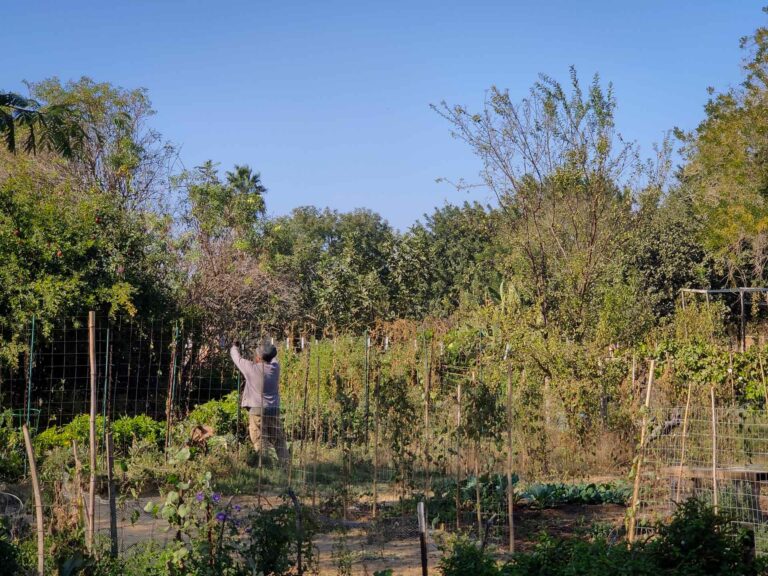
While many activities have been compromised due to the COVID-19 pandemic, UC Davis students have found an outdoor outlet through gardening. Whether it is in a backyard or in shared spaces like the ASUCD Community Garden and the Davis Student Farm, students continue to explore their love of caring for plants. 

Nina Isaka, a first-year pharmaceutical chemistry major, has taken up gardening with her family at home. Isaka’s gardening journey first began when she fell victim to the mental gloom of the COVID-19 pandemic, and her mother encouraged her to help with a tomato plant in their backyard. Isaka explained that while it wasn’t necessarily love at first sight, she grew to truly enjoy the act of gardening. 

“At first it was tedious, and ironically, it felt like a waste of my time,” Isaka said in an email. “Yet, as I spent more time digging holes, wrenching out rocks, and watching our plants grow, I really became fond of it. Eventually, I would spend hours outside in the heat digging holes and planting new plants.”

For Isaka, gardening quickly transformed from an obligation to an activity that is, in her words, beneficial and rewarding. Among the benefits, Isaka is able to provide her family with fresh vegetables and compost. Furthermore, she explained how gardening has impacted her mental health and provided her with a positive outlet. 

“As soon as I would feel any level of depression, I would immediately put on clothes I wouldn’t mind getting dirty and walk into my garden,” Isaka said via email. “There is something really healing and calming about taking care of plants and watching them thrive. I almost feel like they are my children. When I garden, my mind wanders elsewhere, anywhere from fantasizing about my first year of college to resolving any conflicts going on in my head.”

In Davis, students and community members can frequent the ASUCD Community Garden and buy a plot of land to plant seeds of their choosing. The plots can be taken care of individually, or even shared by a group of people such as a student organization. Sophie Le, a second-year animal science major and the ASUCD Community Garden director, shared the value in the community aspect of this garden. 

“Gardeners learn from other gardeners,” Le said. “What I’ve seen is that, sometimes [with] more experienced gardeners, you can tell when their gardens are flourishing, […] and a lot of the newer gardeners will actually go and ask the more experienced gardeners, ‘Oh, what should I plant for this for the winter season?’ Or they’ll ask, ‘How do you get your plants [to] look like that?’ We learn from each other, and we build a really nice community for people to feel welcome.”

According to Le, it’s this friendly community aspect that makes the Community Garden a great introduction to gardening, as students can ask for help and get tips from others. The opportunity to be innovative and the ability to successfully grow a plant can be gratifying, Le explained.

“Having your own plot is […] an expression of creativity,” Le said. “You can add pathways, you can add literally whatever you would like, and you get to see that grow, and you get to see it succeed if you take care of it which I feel  is really rewarding. Especially as a student, when classes are hard, being able to come to the garden and harvest crops and vegetables [is] a nice pick-me-up. “

There is also another opportunity for students at the UC Davis Student Farm in which students participate in a variety of ways including volunteer, internship and paid gardening positions. While some students work in the Market Garden and Ecological Garden at the Student Farm, others simply come to learn gardening practices on a different site. The Student Farm produces crops for a variety of different projects, such as the Community Table project that delivers produce to students facing food insecurity on campus. 

Carol Hillhouse, the associate director of the UC Davis Student Farm, described the learning environment presented at the Student Farm in which students are growing along with the plants.

“Students are learning by doing when they come to the student farm,” Hillhouse said. “They all work with folks who are experienced in gardening and farming. But also, part of that experiential learning is that they quickly become the leaders and the experts in these different tasks that it takes to keep a student farm going.”

The Student Farm also provides a different kind of gardening experience because students are working together to take care of the crops, rather than working individually. Hillhouse discussed how the student farm eliminates the burden of performing the tasks necessary to maintain a garden independently by instead providing a collaborative community. 

“Maybe as a busy student, you don’t have time to do all of the aspects of gardening, or make sure that your garden gets weeded, or watered or maintained, from the moment you put the seed in the ground to when you want to harvest it,” Hillhouse said. “As a community, when we work together in a place like the Student Farm, an individual doesn’t have to do all of those things.”

Among many other benefits of getting involved in gardening, Hillhouse shared that it allows students to truly understand how their food is being grown and be completely involved in the cultivation process. 

“It’s very easy for us to take for granted the food that we eat, but when you have engaged physically in growing that food, you just have a different way of relating to it,” Hillhouse said. “And that’s really fundamental to who we are as a species, is that ability to understand where we’re getting our food, how it’s being grown, how it’s being processed and how it gets from the farm to the fork to your table.”

Written by: Nora Farahdel — features@theaggie.org


StUCC at home: How a UC Davis stand-up comedy club has adjusted to virtual entertainment

0

Through creative tactics and Zoom shows, StUCC has continued to spread laughter from home

When in-person gatherings stopped in March, the live-entertainment world went almost completely dark. The Stand-up Comedy Club at UC Davis (StUCC), however, has found a way to keep students laughing from their homes over the past eight months. StUCC shows, performed from separate Zoom screens, look different than last year’s when they held live audiences of up to 500 people, but they have held true to the idea that “the show must go on.”

Matt Simons, a fourth-year economics major and the president of StUCC, acknowledged that live performances simply are not the same in a virtual setting. 

“It’s hard to capture the feeling of a live show over the internet, […] but I’m happy to say that I think we’ve gotten close and we’ve done a good job at preserving the comedy community at Davis,” Simons said. “It’s like the difference between listening to live music and listening to an album. One is definitely more exciting, but live is not an option, and I think Zoom shows are a good alternative.”

One key piece of comedy is interacting with the audience, which is not possible in the same way over Zoom, according to Simons. He said that in person, pointing out audience members and doing crowd work was a huge part of many performers’ shticks, but over Zoom, they have had to find more creative ways to engage the audience.

“What makes live shows so cool is that there’s a very thin line between audience and performer,” Simons said. “What that looks like over Zoom is pointing out different things about people’s backgrounds, asking people to turn on their mics and videos or making comments on people’s weird usernames.”

Even using these strategies to engage the audience, the whole experience can feel less personal in a virtual format. Martitza Filman, a second-year international agricultural development major, shared that a lot of the genuine connection with the audience at live shows is hard to replicate over Zoom.

“It feels a lot less personal,” Filman said. “It’s harder to form a genuine human connection. When we were in the [Sciences] lecture hall, there was someone like five feet away from you and you could just look that person in the eye while you’re telling a joke, so you miss that human connection.”

In addition to the change in atmosphere of virtual shows, comedy shows are not immune to the technical issues that have become routine in the online world. Zoom software and internet issues are common during shows, and can often interfere with a performer’s routine, Filman said.

“There’s always performances where [Zoom] does that thing where it lags for a second,” Filman said. “With stand-up, comedic timing is essential, so when you don’t have that perfect pacing or a few words get messed up, the whole joke can fall apart.”

Along with lags and muffles, Zoom tends to quiet most of the audience, which can be a challenge when an audience member’s laughter overpowers a performer continuing their bit, Filman added. Zoom also pins the speaker’s face, acting as a mirror for comedians during their performances, which can be distracting and get in performers’ heads. Simons said that he’s had to start covering his screen during his performances to keep himself from getting distracted. 

“It’s torture,” Simons said. “It’s the worst. At a certain point, you can’t take looking at your face because you’re looking at yourself doing comedy and you’re not looking at the audience. You’re not looking at how well your joke’s being received, you’re looking at how well you’re receiving your own joke.”

When shows first went virtual, Simons explained that he would be sitting in front of the camera during his sets, but he’s learned that by standing and mimicking the footwork and movement he would be doing in person, he’s been able to perform better on Zoom. According to Simon, the learning curve has been steep over the past few months for members of StUCC.

Filman said that one way comedians have changed their routines is in the types of jokes that they share during their sets. 

“People are starting to do more anecdotal type comedy where they just share a funny, personal story that happened instead of solid jokes,” Filman said. “I have less pauses and there’s less laughter throughout, but I still try to keep it funny.”

Simons has also had to alter his stage presence since the stage became the living room of his childhood home in March. He explained that he’s had to exaggerate his character—a sort of self-embarrassing dad—a lot on Zoom. 

“On one Zoom show, I felt almost like I was playing a caricature of a caricature,” Simons said. “It’s so hard to pick up on nuance on Zoom, so my response is just to hit it with a blunt instrument.”

Despite the challenges that this new form of comedy has posed for StUCC, it has allowed them to get more creative with the way they perform. Filman expressed that it’s been harder for members to tell jokes based on real-life experience since they’ve all been in quarantine for so long. Simons reiterated that this lack of content has been challenging, but that it has allowed for greater creativity.

“One meeting we were hitting the bottom of the barrel for ideas, and [a club member] came in with, of all things, a PowerPoint slide,” Simons said. “He went through this odd PowerPoint presentation that was ostensibly about ramen noodles, but as the presentation goes on, you can tell it’s really about him breaking up with his girlfriend. It had us in the equivalent of virtual stitches.”

Another StUCC member, Lauren Low, who graduated from UC Davis last March, agreed that doing virtual shows has helped her rethink the way she delivers her sets.

“I tried to do this bit where I acted out Hamlet talking to his friends but kind of just talking over them, but it didn’t really work over Zoom to do the act outs,” Low said. “I started thinking of creative ways to make that work and I settled on sock puppets […] it worked over Zoom because I’m doing a normal set and then all of a sudden these two haphazard puppets pop up. In front of a live audience, there wouldn’t have been a way to have that same element of surprise.”

Stand up comedy is not the same without the energy and interaction of a live audience, but Low said that performing through Zoom has helped StUCC continue to foster their community and stay social while being apart.

“Stand up is usually a very individualistic art form, but we’ve managed to really make a community around it,” Low said. “Especially in the past year, it’s become something that’s expanded past our members, and a lot of the UC Davis community enjoys […] participating in our shows. I think right now a lot of people are feeling kind of isolated, so I think it’s really important that we keep trying to have that space in the community for people to make social connections.” 

Written by: Katie DeBenedetti — features@theaggie.org

Disclaimer: Matt Simon is currently a humorist for The California Aggie.


Culture Corner with Itzelth Gamboa

The Arts Desk’s weekly picks for television, movies, books and music

TV Show: “Locke and Key” (2020 Netflix Original)

The ten-episode Netflix fantasy series focuses on three siblings as they move into their father’s childhood home after his murder. The family moves into the ancient home that is rumored to carry a strange hold on people. As the series progresses, the siblings find magical keys that alter their life. But over time, the children discover that they’re not the only ones searching for new keys and other people are willing to pay a lot more for them. The show is based off of the comics of the same name written by Joe Hill and Gabriel Rodriguez.

I wondered when I’d get a good Netflix show after finishing so many of its disappointments and I finally got it with “Locke and Key.” I loved “Locke and Key” and while a few characters just made me want to shake them until they gained some common sense, they are teenagers so I forgave their mistakes. Overall, I found myself being able to love everyone despite their flaws and that is a rarity when it comes to Netflix series.  

Movie: “Real Steel” dir. by Shawn Levy (2011)

Hugh Jackman and Dakota Goyo star in “Real Steel,” a movie that takes place years in the future that features gigantic robots fighting in the ring that have replaced real-life boxers. The movie follows dead-beat father Charlie (Jackman) and 8 year-old-son Max (Goyo) as they try to form a relationship over the summer after Max’s mom passes. When Max finds an old robot at a junkyard, he sets out to fight in a ring. But this is an opportunity for his father to find his way out of the piling debt and trouble that always seems to follow him. 

I have watched “Real Steel” over a dozen times. It has a little bit of action, a lot of sci-fi and a few heartwarming moments thrown in to make it perfect. I love seeing character development, especially when characters develop with each other and grow overtime; it’s what makes movies worth watching. 

Book: “The Ballad of Songbirds and Snakes” by Suzanne Collins (2020)

“The Ballad of Songbirds and Snakes” follows Coriolanus Snow, future president of Panem in the hit “Hunger Games” series, when he was a young man trying to make a name for himself and drag his family out of filth. When he’s called upon to be a mentor for the Hunger Games, he sees it as his one chance to change his life for the better. But trouble strikes when he is assigned the girl from District 12, the one destined to lose. The story follows Snow on his journey with a feisty girl from 12 and how he rose to be the villain we all hate. 

While I would have much rather enjoyed hearing how Finnick or Haymitch or even Johanna went through the Hunger Games, it was nice to step into Collins’ world once again. This was something 16-year-old me never saw coming and I am not too sure how I feel about it. When I first heard the book was going to be about Snow, I was hesitant, but nothing can keep me away from another addition to “The Hunger Games.”

Album: “Jukebox the Ghost” by Jukebox the Ghost (2014)

I found these gems on Spotify after The Lumineers was on repeat. I’ve always loved the hints of old music being played with a mix of modern tunes and “Jukebox the Ghost” gives me exactly that. With slow romance songs that have a sudden switch to pop in the middle like “Hollywood” and dance beat songs like “Girl,” this album made its way to my heart in the matter of a day. The best part? They have acoustic piano versions of all of their songs on the album, which is a perfect switch when I need to do homework. 


Written by: Itzelth Gamboa — arts@theaggie.org