55.7 F
Davis

Davis, California

Wednesday, December 24, 2025
Home Blog Page 342

Social media as a window, not a mirror

With all this free time, be mindful of your social media use 

With more time on our hands than ever before, checking social media has never been easier or more appealing. We now find ourselves spending many hours scrolling (possibly stalking) on Instagram or watching thousands of videos trying to learn the newest TikTok dance. While this may seem like a great way to stay occupied, it’s not the best use of our time. 

By Psychology Today’s stated measures, I’m what you would call a “passive user.” I have one picture on my Instagram profile and I almost never update my stories or Facebook status. But I am no stranger to the rabbit hole of social media. I find myself reaching for my phone throughout the day to observe the lives of “active users” for hours on end. Before I know it, five minutes turns into two hours and I’ve watched over 10 videos of Charli D’Amelio doing the same TikTok dance. All of which has taught me nothing other than that I will never be famous because I can’t dance. 

Yes, social media is a beautiful advancement which I am grateful for. It brings people together, especially in times like this, when we cannot physically be near each other. But no matter what type of user you are, overuse of social media is never good. 

Constantly looking at other people’s pictures makes it easy to compare our lives to others, leaving us feeling insecure and anxious. And regularly posting gives people the feeling that they have to filter their lives in order to maintain their persona. Either way, we all face judgement for how we portray ourselves. 

Today, our feeds can only be filled with memories or trending DIY projects and activities. It is not until you see a picture from a festival you went to last year or a date night that you realize how much you miss the way life used to be. Confined in our houses and with our phones, we begin to fear we are missing out on some of the most important years of our lives. 

There are some people, though, who are taking this time as a challenge where they  make delicious food and write their first novel — kudos to them. For those of us who are taking this time to binge watch Netflix and play Animal Crossing, seeing others be more productive may make us feel lazy and unaccomplished. Ultimately, we are all just trying to cope with the scary world in which we are living. No one way is better than the other. 

It would benefit us to admit that right now is not the time where we have to maximize productivity and happiness. It is okay and should be encouraged to be honest with yourself about your state of mind. Post about your life even when it’s messy. Reach out to people when you need to be uplifted. Show your “followers” that you’re human too and that we are all experiencing the stress and pressures of our new reality. Expressing yourself in this way may also encourage others to do the same. 

I am by no means boycotting social media, but there is a tangible harm in constantly comparing ourselves to others and only sharing the highlights of our lives. Social media makes it easy to filter out the bad and ignore the good around us. Not everyone who reads this article will reduce their screen time, but if there’s one thing you do take away, I hope that it is to be mindful. 

Be mindful of how you use social media and how much you use it. Challenge yourself to put down your phone and pick up a book instead. When you do use social media, use it as a window to admire people for who they are, rather than as a mirror through which we judge ourselves and others too harshly. 

Written by: Kacey Cain — klcain@ucdavis.edu 

Disclaimer: The views and opinions expressed by individual columnists belong to the columnists alone and do not necessarily indicate the views and opinions held by The California Aggie

The short-lived benefits of fast fashion

The ugliness of fast fashion is no secret, but where does that leave consumers?

Americans have a shopping problem, and it’s easy to see why consumerism has skyrocketed. Major retailers are now mass producing fashionable and trendy clothes so fast that consumers are overwhelmed with a plethora of options. But as many know, fast fashion comes with environmental and ethical costs that greatly outstrip the benefit of engaging in such a rampant consumer culture.

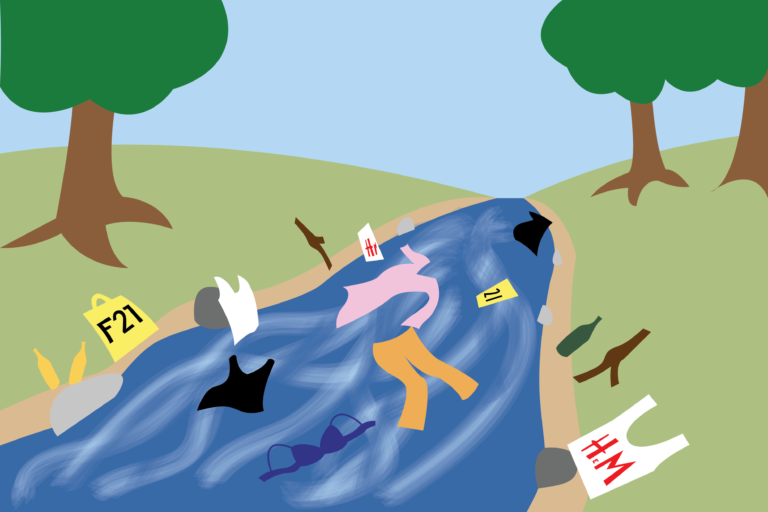
Sustainability has become a key talking point within the fashion industry in recent years and for good reason. The manufacturing process requires intense water consumption and uses various chemicals and hazardous materials, polluting rivers and other bodies of water. But what’s more astounding is what happens to the clothing once it’s been manufactured. “Each year over 80 billion pieces of clothing are produced worldwide,” according to Greenpeace. Of the clothing produced, three-fourths will end up in the landfill or be incinerated and only a quarter will be recycled.

Albeit shocking, these figures are just a surface-level look into the complex web of consumption patterns and corporate behaviour. 

I was really excited to see H&M roll out its Garment Collecting Program and Conscious Collection, which promised to put sustainability at the forefront of its business model. I now had a place to send my jeans that were too torn for charity donations and could get a 15% coupon for my very eco-conscious actions — what I thought was a “win-win.” Ironically, however, such programs are likely counterproductive to the goal of sustainability. 

The 15% discount is a smart marketing trick that boosts consumerism and protects the company’s profit margins. I gave H&M old sweaters that I was bored of and jeans that had gone out of style only to use the 15% discount and come out of the store with new sweaters and jeans. Although H&M has made strides toward more sustainable practices and may genuinely aspire to be a part of the solution, they are still not the eco-conscious company they’ve marketed themselves to be.

Our consumer culture also plays a heavy hand in supporting the fast fashion industry. Demand for trendy yet cheap clothing allows for retailers like Zara and H&M to continue operating their business in such an environmentally unsustainable fashion. For many, however, fast fashion can be more important than a meaningless shopping spree — it allows people to get the clothing they need at an affordable price. 

Patagonia is one of the most sustainable and ethical clothing companies, but their prices, however reflective of the product’s quality, make their clothing unaffordable for many. 

The issue with fast fashion lies within the name itself — production is fast and longevity is short. These businesses are modeled to create clothing that is disposable, bringing consumers back to buy new clothes frequently. But it’s hard to know what the appropriate response to this problem is when prices are alluringly affordable, and there is lots of contradictory information on the scope of the problem and its solutions. 

A number of varying responses have manifested within the fashion industry itself. At last year’s G7 summit, French President Emmanuel Macron debuted his Fashion Pact, headed by Kering chair and CEO François-Henri Pinault, bringing together some of the biggest names in fashion to collaborate in making substantive, long-lasting change. Then, there was the instance of many brands at Paris Fashion Week directly incorporating themes of the environment and climate into their shows. 

While such initiatives are commendable, we also need to hold retailers and clothing companies accountable for destructive and problematic manufacturing and supply chain problems that make the industry so unsustainable. This isn’t just a problem for the fast fashion retailers that produce cheap, affordable clothing — luxury brands like Hermès and Dior have much work to do. The pervasiveness of sustainability issues in an industry as impactful as fashion is a clear sign that long lasting solutions are urgently needed. 

Written by: Simran Kalkat — skkalkat@ucdavis.edu

Disclaimer: The views and opinions expressed by individual columnists belong to the columnists alone and do not necessarily indicate the views and opinions held by The California Aggie

Police logs

Don’t pick your nose before serving ice cream — it’s a pandemic!

April 9

“Guest upset over incorrect change given, was banging on drive thru window.”

April 10

“Abandoned rolling suitcase left at the front door.”

“Ice cream trucker driver picking nose prior to servicing ice cream.”

April 11

“Saw possible mountain lion run across Covell past apartments and into greenbelt.”

April 12

“Lawn was spray painted overnight.”

April 13

“When asked to turn music down, respondents have been turning it up.”

April 14

“Noise complaint. Two units above respondent stomping loudly in one unit and the other is closing windows loudly.”

April 15

“Bob cat was in his backyard, went into neighboring yard.”

OSSJA makes minor changes to judicial process, no update on possible increase in cases

OSSJA operations remain continuous during COVID crisis, process not set to change

Amid the COVID-19 pandemic, the UC Davis Office of Student Support and Judicial Affairs (OSSJA) is taking no new initiative to combat alternate forms of academic dishonesty. 

“We are encouraging faculty to inform students about expectations for academic integrity in a remote environment, and we want students to understand the importance of remaining honest in their work when completing assignments and taking exams without proctoring,” said Donald Dudley, director of OSSJA.

This quarter, judicial proceedings through OSSJA are occurring through Zoom, but the rules and sanctions remain the same. 

“Most information is electronic,” Dudley said. “Gathering information is the same as normal quarters.”

In response to questions of confidentiality, given the recent lawsuits against Zoom for lackluster privacy protections, Dudley said OSSJA has been taking precautions to ensure anonymity. 

“OSSJA uses necessary Zoom features for the confidentiality of meetings and hearings,” Dudley said. “Students are required to show ID cards when they schedule meetings.” 

One student, who asked to remain anonymous, said they weren’t “asked to show ID or confirm [their] identity when setting up a Zoom meeting with OSSJA.” 

When asked about the possibility of an influx in cases, Dudley explained that the office is doing the best it can “to manage cases in a timely manner.” 

“I can see reasons that might lead to more cases or fewer cases,” Dudley said. “In our current environment, a quote by C.S. Lewis is highly relevant: ‘Integrity is doing the right thing even when no one is watching.’”

Written by: Alex Weinstein — campus@theaggie.org

Processing an unexpected end to the UC Davis women’s water polo season

Senior standout Emily Byrne discusses cancellation, plans moving forward

Following the decision to cancel all sporting events due to concerns over the spread of the novel coronavirus, student-athletes are having to adjust to remote instruction for the first time while still processing the suspension of their seasons. 

Emily Byrne of the UC Davis women’s water polo team is a fifth-year transfer from Loyola Marymount University who began playing water polo when she was 12 years old. The utility from Orinda, California has dedicated a large amount of her life to the sport ever since.

Byrne has had an impressive career as an Aggie. Last year, she earned a Big West Conference Honorable Mention and finished the season as the program’s No. 5 all-time in drawn exclusions, with 168 through her almost three years competing at UC Davis.

When the cancellation was announced, the women’s water polo team had a handful of games remaining in its 2020 season, including the Big West conference tournament set to begin on April 23. The entire team — along with several other programs at UC Davis and many more across the nation — now has to cope with the loss of its season and the inability to practice, including senior athletes who face the especially disheartening reality of this being the end to their final season as college athletes.

“I think some of us were really devastated,” Byrne said. “[For] myself personally and for most of the seniors, it was just heartbreaking to have something you worked so hard for taken away in a matter of seconds.” 

Byrne recalls finding out about the end of her season by waking up to messages from friends and relatives. Within the next two hours, Head Coach Jamey Wright had gathered the team for a final meeting to allow them the chance to cope with the news together. 

According to Byrne, Wright’s primary concern was the emotional well-being of the team. He wanted to hear from players while they processed the news, though he was just as devastated as the rest of the team, she said. 

“We are all a family, and to be told you can’t spend time with your family anymore is just a horrible feeling,” Byrne said regarding the final team meeting, which took place before the guidelines about gathering in large groups had been issued. 

There is a great deal of sacrifice, both physically and mentally, invested in being a college athlete, and there is no way to make those sacrifices without being “absolutely in love with your sport,” Byrne said. This is why watching her season come to an end in such a way was especially difficult for her.

Although athletes and coaches have the ability to prepare themselves for tough games and difficult losses, there is no way any athlete could have prepared for something so life-altering as this current pandemic. 

Byrne provided a metaphor for the loss of her team’s season, saying it felt almost like “having a limb severed off of you immediately with no warning,” because the amount of dedication that goes into a college sport makes it a part of who you are.  

The Aggies had just played their first Big West matchup against UC Irvine the week prior to the cancellation and had six more matches scheduled in the weeks leading up to the conference tournament. 

Regardless of the fact that the Aggies were defeated by Irvine 14-8, according to Byrne, UC Davis captured a good amount of “small accomplishments” that the team had been working toward in practice. It was hoping to build upon those successes through the rest of the season. 

The team also had a match scheduled for April 4 that would have been played in Hawaii. With the Big West tournament also scheduled to take place in Hawaii, the cancellation essentially took away the team’s chances of traveling to the islands together on two separate occasions. Because not every athlete on the current roster travels with the team for road games, earning a traveling spot is typically seen as a big deal for most players. Being able to travel with the team and experience that sense of comradery on the road is a big opportunity on its own even if you do not end up playing in any matches, said Byrne.

For the seniors on the team, traveling to Hawaii twice would have been a memorable experience for their final season. In Byrne’s case, her family had already booked hotels and flights to watch her perform in Hawaii, and she wishes she had been able to provide them with the finish she knew they all were hoping to see. 

“Your family puts in a lot of sacrifice as well for you to play the sport,” Byrne said. “This season for me was more about giving back to family, it wasn’t so much about myself.”

Seniors were also presented with a very difficult decision after the NCAA announced its decision to allow certain student-athletes to extend their eligibility. Originally believing they were saying goodbye to their sport, college seniors now have the opportunity to decide if they want to return to compete for another year.  

But this does not mean that every athlete who wants to return can do so easily. This decision is especially difficult for those who have already made other post-graduation plans, such as job opportunities or graduate programs, which they have already applied for. There are also financial considerations that some athletes have to account for before in making such a big decision.

Although some of the women on the team are trying to adjust accordingly, in order to compete at UC Davis for another year, Byrne has already made the decision that she will not be returning. 

Being an undergraduate student for the last five years, and having made adjustments to her major courses over those years in order to maintain the ability to play in her fifth year of college, Byrne has decided it is time to focus on what comes next for her. 

“I’ve been making sacrifices for the sport for 11 years now but there comes a point where you have to stop sacrificing your life plan for a sport,” said Byrne. “I just didn’t want to continue sacrificing my academics for my sport — as much as I love it.”

Student-athletes do have the option to take their eligibility with them somewhere else, however, so Byrne believes she may not be looking at the end of her water polo career just yet. For her, the ideal situation would be to move on to a graduate program that also allows her to play water polo, giving her the ability to recreate the senior season that she missed. 

Although missing out on the end of your season is a very difficult thing to process, Byrne remains positive while looking back on the most memorable moments from her time as an athlete. She recounts this season’s match against Michigan as the team’s “peak of performance” in which everyone contributed to victory over a team that was ranked No. 7 in the nation. 

As far as her favorite career memory, Byrne often looks back at when she scored the game-winning goal against Pacific in sudden-death overtime during her redshirt-sophomore season. She describes the reaction of her teammates and fans as something akin to a fairy tale. 

“I still think about that now and realize this is why I play,” Byrne said. 

Byrne’s new day-to-day life without water polo consists of class three days a week, but she wakes up early each morning to maintain a regular schedule. Water polo players and swimmers in general are placed in an especially difficult situation, as workouts in the water are limited because athletic pools are shut down during this time. 

“I love the pool, it’s an outlet for me and a source of comfort, so not being able to get in a pool during a time like this has been another mental block for myself that I’ve had to push through,” Byrne explained, adding that she has been swimming since she was three years old. 

As far as staying in shape, Byrne is eating well and developing creative ways to work out at home in case she does end up going back to playing the sport she loves. 

One of the ways the team is keeping in touch throughout this time is through Zoom meetings, which helps the athletes communicate and continue to support one another. The coaching staff has also been working to have different people speak to the team during these meetings. Byrne has been reaching out to alumni athletes for support as well, to learn how they managed to say goodbye to their sports.

“People don’t really understand what we’re going through,” Byrne said. “Unless you really listen and see our perspective, or if you are or were a student athlete and know what goes on behind the curtain before our games.”

Regardless of the unfortunate ending that the UC Davis women’s water polo team — among many other teams — endured this season, Byrne stays positive by reminding herself how much love she has had for this sport through her entire life. The amount of energy invested into each season is almost always going to be worth it, even if you do not get the most ideal outcome. 

Written by: Rain Yekikian — sports@theaggie.org

Aggie Animals: Goat and horse barns continue through the spring

Spring Quarter is a time of new life for animal barns on campus, and students, staff at the goat, horse barns continue animal care

Waking up multiple times a night is not out of the ordinary for fourth-year Teresa Greenhut and third-year Craig Miramontes. With goats about to give birth and kids to feed, it is common for these two animal science majors and residents at the campus goat barn to keep irregular hours in the spring.

“We were just in the vet hospital at two in the morning the other night with a doe that was having kidding difficulties,” Greenhut said.

These middle-of-the-night wake up calls are a fairly ubiquitous experience for the staff at many of the animal barns on campus, as spring is the season when baby animals are born.This requires intensive attention from barn staff. Although classes officially moved online and many UC Davis students vacated campus, the students and staff at animal facilities continue to provide necessary care for each animal.

Kidding around

Spring Quarter is an especially busy time at the goat barn, as it falls during kidding season. In an average Spring Quarter, over 60 kids will be born, requiring attention and bottle feeding, according to Ben Rupchis, the manager of the goat barn facility. With fewer student interns, staff members have had to take on more hours outside of their regular schedule.

“Labor-wise, it’s a really intensive time of year,” Rupchis said. “We feed at 6 a.m., 1 p.m. and 7 p.m. and we would have two or three interns for each of those shifts. We’ve cut back all shifts to have a single intern or myself or one of the student staff.”

Due to the restricted staff, the reliable work of the barn residents — Greenhut and Miramontes — is crucial, Rupchis said.

“The barn residents who live out here, undergraduate students, they’re really key in making things function ideally,” Rupchis said. “If there are kids born in the middle of the night, they still process those kids even if it’s one or two in the morning.”

Helping in the horse barn 

Similarly, the on-campus horse barn is particularly busy in the spring. In addition to new births, the barn would normally participate in events such as Picnic Day and Decision Day. As a result of COVID-19, however, many events were canceled, and the barn has restricted the number of student interns, according to horse barn facility manager Kelli Davis.

“We don’t have all of those big events, and I don’t have all of my students here,” Davis said. “We’re down to the very core group of interns. We had to, unfortunately, not take a lot of interns.”

Despite widespread cancellations and conversion to online platforms, the barn will continue its daily operations in the spring, which, according to Davis, is one of the best times of the year.

“Spring is definitely my most favorite time because we’re having babies and halter-breaking them and training them,” Davis said.

Life as a barn resident

As residents of the goat barn, Greenhut and Miramontes live one door away from the animals, so they can easily make routine check-ups near the end of their gestation period. Although this quintessentially Davis job requires odd hours, it also offers the opportunity to live in a barn and gain hands-on experience in animal science. Greenhut has lived and worked at other animal facilities, but she said working at the goat barn provides a greater level of animal interaction.

“I think that there’s a lot more getting to know the animals because there’s less of them,” Greenhut said. “If you compare it to the sheep barn it’s just a lot of heads and a lot of numbers. With the dairy goats, each goat has a name that we use, and there’s less of them. It’s a lot of taking care of the animals as individuals.”

For Miramontes, the goats show more personality than other animals which he has worked with.

“The goats, in general, are a lot more personable, unlike a lot of the other livestock species,” he said. “There’s kind of a more name to a face versus the overall health of the herd.”

Written by: Sophie Dewees — features@theaggie.org

As life becomes virtual, musicians turn to online streaming to perform

From empty arenas to couch concerts, we hear them play

Italian opera legend Andrea Bocelli performed at the heart of Milan on Easter this year — but it wasn’t your typical concert nor Sunday service. The world-renowned Duomo di Milano was completely empty, with only Bocelli’s camera crew and accompanying organist there to witness his songs. The YouTube video “Music for Hope” has garnered over 36 million views since its live stream on April 12, thanks to Bocelli’s angelic voice resonating against the strikingly vacant cathedral and still Italian cities. 

Although visibly strange, Bocelli’s performance isn’t so out-of-the-ordinary anymore. Given the shelter-in-place recommendations, large gatherings won’t be happening any time soon, ruling out live concerts for an indefinite period. Though a tragic realization for rave-baes and concert-goers across the globe, artists must compromise by opting to hold online “concerts” for fans to enjoy from home. 

There is no denying that a virtual streaming of a show pales in comparison to a live music performance. For anyone who’s attended a concert, you know how exciting it is to see an artist you like live, to bond with strangers over your shared appreciation of the new album and to see the raw version of your favorite song from (if you’re lucky) only a few feet away. Your laptop screen just doesn’t provide the same thrill. But it’s something. 

Several classical and opera musicians have joined Andrea Bocelli in letting their enchanting music echo throughout empty halls. The famous opera “Carmen” was performed at the Berlin State Opera and the Philadelphia Orchestra played at the Kimmel Center, both taking place on March 12. This New York Times article details these and other classical performances with expert analysis. 

But most artists haven’t been performing in audience-less arenas. Instead, they choose to perform from the comfort of their home, understandably so, holding livestreams or just posting videos of themselves singing. Many shows and tours have been postponed, with stars opting to join the common folk for once and stay put like the rest of us. 

Instagram, YouTube and Twitch are among some of the popular “venues” performers have graced over the past few weeks. Some simply start a live stream and start singing, while others promote their events as though they were real concerts. PARTYNEXTDOOR, for example, announced a live stream at the end of March ahead of his album release.

Artists are also getting creative with their performances, quarantine style. Diplo is going on a “Corona World Tour” with weekly performances on multiple platforms, including Corona Sabbath on Fridays and Coronanight Fever on Saturdays. Miley Cyrus is hosting what is possibly the first Instagram Live talk show called “Bright Minded,” a daily show featuring a spread of Hollywood guests. Though not limited to singing friends, many musicians have joined her on the show.

Some fans have used the virtual concert trend as a manipulation tactic — the hashtag #1DOnlineConcertStayAtHome was trending last week in efforts to get One Direction back together online for the sake of encouraging people to stay at home. With the anniversary of the band’s formation coming up in July, the idea isn’t so far-fetched. Clever of the Directioners, I must admit. 

A tragic loss for many was the postponement (or cancellation, if we’re being realistic) of one of the most popular music festivals in the world: Coachella. With arguably one of the best lineups to date, I was selfishly relieved that I’d have a chance to see the amazing artists another year when I can afford tickets to the legendary festival — we all need silver linings right now, right? In its place, Coachella released a free documentary on YouTube on the history of the 20-year-old desert festival. Not quite the same but interesting nonetheless. 

In an attempt to emulate the appeal of massive music festivals, Global Citizen partnered with Lady Gaga to create the Together At Home global broadcast on April 18, where singers, comedians and leading global health experts came together virtually to promote staying at home. Proceeds are being donated to healthcare workers, the World Health Organization and regional response organizations that have been working to stop the spread of the coronavirus. “Together at Home” is also a series of its own where big-name singers like John Legend, Hozier and Celine Dion perform in live-streams supported by Global Citizen. 

Finally, The California Aggie itself released videos for our last two Couch Concert events with Bomba Fried Rice and Negrete. Both high-energy bands offer student and local musicians in our beloved basement, and we would love it if you’d check out our contribution to the online concert sensation (notably, we’ve been posting videos of in-person performances for years). 

Whether it’s an unoccupied venue or a couch concert from home, the virtual performances of musicians have been a much-appreciated form of entertainment during quarantine. The adaptability of the human race has proven stronger than ever over the past few weeks, but without an end date, staying inside is becoming increasingly difficult for us all. I can only hope that the message to stay home from artists everywhere will carry as far as Andrea Bocelli’s voice did. 

Written by: Allie Bailey — arts@theaggie.org

Development of Nishi project able to continue after appeal against project withdrawn

With appeal withdrawn, case concludes 

In a press release published on April 2 by the City of Davis, it was announced “that the appeal of the Yolo Superior Court decision regarding the Nishi project has been withdrawn” and the case is now “concluded.”

The Nishi 2.0 project is an apartment complex project aimed at students located on a 47-acre site between UC Davis and Interstate 80. It consists of 700 units, with a total of 2,200 beds. 

The project was originally approved by the Davis City Council in February of 2018. Following this, it was approved by 11,638 individuals in a Measure J vote in June of 2018, or 60.6% of the total voters. 

In March of 2018, the Davis Coalition for Sensible Planning filed a lawsuit, according to an article from The Davis Enterprise, saying that while approving the Nishi 2.0 project, the Davis City Council had not followed the California Environmental Quality Act, among other zoning and planning laws, as well as Davis’ “affordable housing ordinance.”

“This group filed repeated lawsuits and appeals to try to block the Nishi project,” said Davis Councilmember Dan Carson, according to the news statement. “It’s worth noting that they lost every single legal claim they made that came before the courts even after dropping some of their dubious claims before they could even be tested.”

Before the Nishi 2.0 project was able to be voted on by voters in 2018, a previous version of the project was passed by voters in 2016. It was known as the Nishi 1.0 project, according to The Davis Enterprise. 

The initial proposal for the project had fewer beds available than the Nishi 2.0 project, specifically 1,920. It also had 325,000 square feet of office space for research and development and would “require changes to the west end of Olive Drive to provide access to cars driving to and from the Nishi property,” according to an article from The Sacramento Bee. 

“The city prepared an Environmental Impact Report for the original Nishi project in 2015 — one upheld by the court in that lawsuit — and prepared an addendum to the [Environmental Impact Report (EIR)] for the new project two years later, contending the original EIR adequately assessed the impacts of the revised project,” according to The Davis Enterprise article. 

The Environmental Checklist Addendum, which is available on the City of Davis’ website, includes an introduction and description of the project, as well as an “environmental checklist for supplemental environmental review” and further descriptions on the factors present in the environmental checklist. 

The addendum to the original EIR contains an analysis and description of the impact that changing the circulation of traffic and land uses would have. For instance, the EIR mentions that office space for research and development would be eliminated in the second stage of the project, alongside removing condominium units that were meant to be on-sale, increasing the numbers that are available to rent and “revisions to the circulation network.”

The addendum also analyzes the impact the project would have on various environmental factors, such as water and agriculture. 

“No new circumstances or project changes have occurred nor has any new information been found requiring new analysis or verification,” the addendum read. “Therefore, the conclusions of the Nishi Gateway EIR remain relevant and valid, and approval of the project would not result in new or substantially more severe significant impacts to agriculture and forestry resources.”

Ultimately, the withdrawal of the appeal to the development of the Nishi project will allow the project to be carried out.

 “After 11,638 voters approved Measure J and the Nishi project, the appellants then defied the will of the voters and filed a motion specifically asking that the Measure J/R vote of the public be set aside,” Carson said, according to the press release. “I am glad to see the decision of the voters will be finally carried out so that we can take another major step forward to provide critically needed housing for our students and our community.”

Written by: Shraddha Jhingan — city@theaggie.org

Enter the Zumbaverse

Ditch the dumbbells, get a full workout in comfort of your room

With the suffocating stress of school and daily life, it’s hard to find time in the day to fit in exercise. There are people who will try to convince you that running or lifting weights will make you feel better, but finding the motivation to move is a lot harder than telling someone they should. When you do have those bursts of motivation, without the equipment of the ARC, it’s easy to feel lost.

Luckily, there’s a form of exercise that only requires an internet connection, space to move and the will to push forward. Dance exercise, known as Zumba, takes the daunting task of working out and turns it into something enjoyable. YouTube is home to thousands of free Zumba videos. The simple dance routines rely on repetition and routine that cement themselves in your mind, ensuring that even the least experienced dancer can find some rhythm through Zumba.

Even if you’re not familiar with Zumba, you might know its predecessor, Jazzercise. Both are fitness franchises that use group dance and strength training to provide a full-body workout. While Zumba videos on YouTube dont have the same uplifting energy of a studio environment, each channel attempts to relay the steps as entertainingly as possible.

 Many videos come from Zumba studios with full-time employees who teach the dances in matching tank tops and leggings. LIVELOVEPARTY.TV has easy choreography coupled with pop songs you probably know and a crew that makes you feel like you’re in the studio with them. D’Hype Fitness Crew is another channel that utilizes this format. They use more complicated moves, but once you master them their dances, these videos are some of the best you can find.

Other channels mimic the classroom style that Zumba classes are traditionally taught in (if you’re quarantining with other people, have them join!). Usually with a leader in the front and 10–20 people dancing in the back, these videos make you feel better about your own lack of skills. The Fitness Marshall is led by one instructor who shouts motivating (and slightly personal) anecdotes as you try to keep up with his dramaticized movements. His intense moves seem too hard,even for a seasoned Zumbanator to master, but his commentary and pure dedication keep you following along; after just a few watches, you’ll get a grasp of the moves.

The world of online Zumba has been hidden too long. Ditch the dumbbells and get a full workout from the comfort of your room. If a song has a good beat, look it up: There’s a Zumba for it! If the moves are too complicated, dumb them down! No one’s watching! Bored of all the videos you’ve already danced too? Make up your own! Become so talented you must show it off? Teach it to your friends — Zoomba! Hone your dance skills, get exercise and generate some dopamine in our current state of purgatory.

If you want to get started, check out this playlist my sister and I have carefully cultivated during our Zumba journey. It is organized by order of difficulty and always growing!

Written By: Livvy Mullen — arts@theaggie.org

City of Davis faces business uncertainty amid coronavirus pandemic

UC Davis research says COVID-19 will have long-lasting economic impact, Davis businesses say economic losses are incalculable

The economic impact of COVID-19 is something we will see for decades to come,

according to a working paper authored by professors in the Department of Economics. 

When asked about possible revenue losses locally, Mayor Pro Tempore Gloria Partida said the city has not made any predictions yet. It is not yet known the effect that the lack of widespread business closures and the loss of student presence will have on the town, Partida added. 

“We’re going to see a drop of the amount [of revenue] that’s coming into the city to pay for our services,” she said. 

In the meantime, Davis has taken steps to ensure that residents and businesses are able to continue operating. 

“This is sort of like summer coming really early for them, so I’m sure they’re going to struggle,” Partida said. “The Downtown Business Association is trying to find creative ways […] to offset that price — to sell gift cards, for instance.” 

Beyond that, the city also plans to take advantage of state and federal grants and funding and has passed an emergency resolution which implemented an eviction moratorium, among other relief acts. 

“They’ve done a lot of great things on paper, but in reality, not a lot of people are able to take advantage of [these programs],” said Alex Volzer, the owner of Davis Massage and Body Therapy. 

Volzer recently moved their business away from Northern California following the Camp Fires. 

“I don’t know how much longer I can hold on,” Volzer said. “But I’m optimistic that maybe I’ll be able to make it through this.”

Since many small business owners, like Volzer, are unable to take advantage of these loans and programs, they face special difficulties in continuing to operate. The City of Davis has supported small businesses in the past, but it remains unknown how the city will continue this support. 

“These are our neighbors, people we go to church with,” Volzer said. “I think Davis has a responsibility to step up.”

Partida added that the city continues to look into new avenues for helping small businesses, like a support hotline, but said the situation is evolving so rapidly that the town is having trouble keeping up with new information. 

“We are very grateful for the local programs,” said Derar Zawaydeh, the co-owner of Crepeville and Burgers & Brew. “And the [property owners] have been nothing but a class act.”

Many companies and company owners, like Zawaydeh and Volzer, rely on flexibility from land owners. But even with this support, Zawaydeh has cut his employees across both locations by over 60%, laying them off so that they can take advantage of unemployment benefits.

Sometimes, other avenues of keeping business afloat are not as profitable. 

“Third-party delivery companies charge a hefty commission for their services, a minimum of 20% and sometimes as high as 35%,” Zawaydeh said. 

These companies helped supplement income before COVID-19 changes, but now the profit margins are not high enough to sustain business. Zawaydeh is looking into having his employees deliver for free ー just another step in keeping up with the crisis. 

Some businesses also face long-term closure due to the economic impacts of the pandemic.

“Me and my family talked about it,” said Chi Hoang, the manager of Ding How, in an interview with The Davis Enterprise. “If it gets worse again, we better close the restaurant down and find something else to do.”

“Be it in Davis, Chico or Sacramento — it’s all being hit the same way,” Zawaydeh said. “This is really something significant.” 

Written by: Alex Weinstein — city@theaggie.org 

UC Davis administration implements improvements to new public bus service with ridership involvement

Free fare for six months for UCD affiliates, with bicycle storage, direct intercampus stops

The launch of the Yolobus and SacRT Causeway Connection public bus service, which was set to replace the long-running UC Davis intercampus shuttle service on April 6, has been postponed through May 1 due to COVID-19-related matters. 

The decision of the service replacement previously resulted in riders’ concerns. Following the replacement’s announcement, many intercampus shuttle riders expressed their concerns and requests in an open letter published in October of 2019. 

The letter outlined complaints about the zero-emission service, which had no seat belts, dramatically reduced the capacity for bikes, increased commute times as a result of added public stops and terminated direct intercampus connectivity. There were also complaints regarding a lack of communication between the UC Davis administration and shuttle riders in the decision-making process.

Since then, administrators have offered open house meetings on both the UC Davis and Sacramento campuses, as well as online comment opportunities and regular outreach to communicate with riders. 

Russ Zochowski, a disability specialist at the university’s Student Disability Center, stated in a previous article in The California Aggie that he relied heavily on the shuttle and its current stops as someone who is blind. 

In a recent interview, Zochowski said he was unable to attend the open house meetings, but addressed his personal access concerns as a result of the changed bus stops directly with UC Davis’ Transportation and Parking Services and the supervisor of the UC Davis Health drivers. 

“The driver supervisor has assured me that I will still be able to get rides from [UC Davis Medical Center] to my outpatient clinic appointments and to the 39th Street light rail station,” Zochowski said. “I found the 29th Street station inaccessible because of the need to cross two streets without audible walk signals.” 

Zochowski also commented on the accommodations made for other frequent shuttle riders.

“After reading the meeting summaries, I agree with the majority of riders who feel that we probably got all we could from the University at this point,” Zochowski said. “They promised to retrofit the existing buses with seat belts and increase the number of bike racks. Let’s see if those things actually happen.” 

Vice Chancellor of Finance, Operations and Administration Kelly Ratliff released a message on March 31 stating that the Causeway Connection was “improved markedly with ridership involvement.”
UC Davis Director of Environmental Planning and Local Government Relations Manager Matt Dulcich said rider feedback received through outreach efforts and public meetings has been critical in improvements to the service.

“The University is paying for fares for all Aggie riders through October with use of their University ID,” Dulcich said. “UC Davis will offer complimentary bicycle cage storage such as the new facility at the Gateway Parking Structure for any rider wishing to have a dedicated, secure bicycle parking stall on campus. The Causeway Connection will provide expanded service during peak hours and maintain direct trips between campuses allowing for more flexibility in commute schedules.”

Dulcich explained the addition of “Smart Stops,” where different transportation system routes intersect near or along main thoroughfares and freeways. 

“Stops in the Downtown Sacramento area would allow students to reach internships, riders to connect with other bus lines and modes of transportation, and have easy access to shopping and entertainment,” Dulcich said. 

To accommodate riders who relied on the original intercampus routes, Dulcich said there will be direct and express trips for commuters wishing to travel directly between the campuses. Additionally, Dulcich said there will be no difference in the pricing structure for employees and graduate students at the end of the six-month fare free period. 

 “While switching from diesel to electric buses and helping to reduce congestion and emissions along I-80, we also had to consider where we could make improvements for the everyday Aggie rider and their door-to-door commute,” Dulcich said. 

Dulcich noted that the administration will continue to solicit rider feedback at quarterly meetings beginning in May 2020 and conduct detailed monitoring of bus utilization, on-time performance and rider satisfaction to continue to improve the service in the future.
The Causeway Connection is currently set to launch in May after careful consideration with Yolobus and SacRT of all options for maintaining public health protection and providing needed transit services. Dulcich said they expect to continually adjust the bus services as the COVID-19 situation progresses.

Written by: Graschelle Fariñas Hipolito — campus@theaggie.org

Generation Z talks about loneliness in the age of coronavirus

Studies describe a current “epidemic of loneliness,” the impact of social media on relationships

Studies show that the U.S. is currently experiencing an epidemic of loneliness. Approximately two in five Americans have reported feeling that their relationships are “sometimes or always not meaningful,” and one in five reported feeling socially isolated or lonely, according to an article by the Health Resources and Services Administration. These feelings may be compounded by a decline in household size and more people living alone than before, the study noted. 

This issue can cause adverse health effects, with some researchers concluding that it’s as dangerous as smoking 15 cigarettes a day. The problem isn’t limited to Americans, either — the U.K. appointed a Minister of Loneliness in 2018. 

“Loneliness is not necessarily having few friends,” said Cynthia Pickett, an associate professor in the UC Davis Department of Psychology. “The idea is that people crave and need deeper social relationships.“ 

Pickett believes this lack of meaningful social interactions may be due to changes in the way we communicate as a society. 

“When you have a face-to-face interaction, you get more [social] information from that interaction,” Pickett said. “And when people are communicating over social media or text, those are fairly impoverished forms of communication — they’re fleeting.” 

Pickett identified loneliness as different from forms of depression because it is intrinsically tied to “awareness of one’s social standing.” She added that there may be people who are lonely but not depressed, or depressed but not lonely. The two can, however, coincide.

“Loneliness can lead people to feel like they’re not socially valued, which can lead to a drop in self-esteem,” she explained. 

According to Pickett’s research, loneliness can also lead to a heightened awareness of social cues in situations with other people.

 “My research was looking specifically into the cognitive changes that occur when people are lonely,” Pickett said. “People become more attuned to social information in their environments — they’re better at decoding facial expressions, they’re better at decoding social activities than non-social activities. To form those social connections, you have to have those social skills.” 

A recent study by Cigna, a global health service company, said that people from Generation Z — composed of individuals between the ages of 18 and 22 — make up the loneliest generation. Members of Gen Z also claim to be in worse health than their older counterparts. But the study didn’t find great differences in loneliness based on whether the person used social media frequently or not. 

Instead, a growing scarcity of neighborhood communities, family fragmentation and a decline in religious affiliation has led young people to feel lonely, according to an op-ed published in USA Today. People who are employed are also not as lonely as students or the unemployed, said CNBC, and exercise and sleep might also play a role in these feelings. 

A third-year political science and human development double major anonymously spoke to The California Aggie about their experiences with this phenomenon, both before and during the coronavirus pandemic. 

“I think [this loneliness stems from] an understanding of what it means to have meaningful relationships,” they said. “When I think about my parents or older people, they find value in knowing someone […] just as acquaintances. Their relationships seem not easier, but less substantive.”

People their age might be more inclined to categorize their friends, they explained. 

“For Gen Z, it’s more of a matter of saying, ‘These are my friends, these are my best friends,’” they said. “We don’t necessarily reach out to everyone, we have certain categories of friendship.” 

And sometimes, fear of burdening others prevents individuals from connecting. 

“I think it also goes into the concept of awareness of other things — mental health, how dumping your thoughts on someone can be hard on someone,” they said. “You want to be sure to trust the person [that you’re talking to]. Just knowing that someone might not be on your side, might not like you venting to them.”

Describing a recent volleyball injury that prevented them from going out during Winter Quarter, they said they were unsure whether they could rely on friends to sacrifice finals studying to spend time with them. Volleyball was a big part of their identity, they said, and the injury changed them completely. 

Although their health improved, they have been unable to go home during the shelter-in-place orders, and staying in Davis, without their roommates, was the “only thing that was feasible.”

“I’m from SoCal and my parents are older, and I was scared for them,” they said. “Since the whole thing started, they’ve been staying indoors. I was afraid I was one of those people who was asymptomatic and [could give it to them].”

Another interviewee, a third-year communications major who also wanted to remain anonymous, said she hoped college would be different than her high school experience, when she was largely preoccupied with academics and extracurriculars and didn’t always have the time to build sustainable relationships with people. 

“I would give up on potential friends and friendships because it was a one-way street and just me reaching out,” she said. The shelter-in-place orders during the current pandemic have affected this too.

 “Right now, with COVID-19, it’s putting relationships and friendships to the test — who are you really going to talk to when you’re not seeing one another?” she asked. “Who do you invest more time in — somebody you think is going to be there in the long run or the one who isn’t? It’s hard to understand, it depends on the person’s interests and maybe not being lazy at the same time.”

While she clarified that she didn’t think Generation Z is necessarily lazier, she noted that the availability of FaceTime sometimes eliminates the need to talk to people face-to-face. 

When it comes to social media sites like Facebook, things can get confusing. 

“It hurts with the loneliness a little bit because you see people liking your pictures and commenting, but they haven’t reached out to you in months or maybe even years,” she said. “It’s not efficient communication.”

On the other hand, she explained, Zoom has helped her connect with friends during the current shelter-in-place conditions. She said they spent two hours talking and reconnecting by playing an online game together. 

According to Pickett, social media creates “pluralistic ignorance,” defined as the belief that one is different from one’s peers despite behaving the same as they do. 

“In order to decide that your social interactions are lacking, we compare ourselves to other people,” she said. “By comparison, people feel like their social relationships are lacking. It leads people to think they’re lacking those activities or friends. Social media creates pluralistic ignorance around social relationships and leads people to feel lonely even if the quality of their relationships are fine.” 

Despite these difficulties, the political science and human development major said, the epidemic has given them a new perspective. 

“We’re coherent enough [to see] where things affect our adult lives and our adult futures,” they said, adding that before, during instances like the 2008 recession, the effects were not experienced directly. “You were there and you experienced the effects, but you didn’t have to deal with it, [your parents did]. But now people are figuring out what it means to be lonely, not to have enough money and not to have enough people in your life to help you turn things around.”

Now, ordinary activities, like going to a coffee shop, seem like a luxury, they noted. The pandemic has also given them insight into the quality of their relationships, including those in their family. 

“Even though people kind of hate spending so much time with their families, they’ll have a different perspective on what family means,” they said. “I come from an immigrant family and there are a lot of memes about that — like, your mom being disrespectful when you’re on Zoom — but I’d love to be with my family right now. It’ll give you a fresh perspective on what and who is important in your life.” 

The anonymous communications major has also had a similar realization. 

“I definitely think the pandemic has shown me who my real friends are and who are the ones who are going to try to reach out to me,” she said. “It’s going to make me appreciate so much more going out with friends. A year from now, it might make us think twice about cancelling plans just because we’re so lazy.”

Written by: Rebecca Bihn-Wallace — campus@theaggie.org 

How UC Davis engineers are contributing to COVID-19 research

Researchers outside of health field also contribute to minimizing problems posed by coronavirus 

In addition to efforts by the UC Davis Medical Center and other university health facilities, UC Davis engineers have been working to address problems related to the COVID-19 pandemic. These efforts include manufacturing alternative personal protective equipment (PPE) to use in instances where traditional PPE is not accessible, according to Steven Lucero, a development engineer and manager of TEAM and 3DPrintViz labs.

In his laboratory, Lucero is currently attempting to adapt off-the-shelf, commercially available gear in order to manufacture emergency PPE. Although he did try to create fully 3D-printed alternatives, he found that these models would not be safe in the long-term and could not be used properly. The main purpose of his research is to have usable PPE if facilities run out of traditional ones — but he hopes his gear will not have to be used, as manufacturing facilities increase their supply of PPE.

“I would say that 3D printing, while not specifically well suited for this climate, does have a purpose in this current situation,” Lucero said via email. “While it’s unlikely I could furnish the necessary supplies to satisfy our entire local healthcare system (my facilities and my equipment are not set up for this kind of scale), there are creative ways in which I can at least prepare emergency backup supplies, or fill partial shortages (specifically, in the case of clear face-shields).”

Many other engineering researchers, as well as researchers in other fields, are collaborating with each other as well as with medical facilities to contribute to growing COVID-19 research. To facilitate such collaboration, the Office of Research has launched the COVID-19 Research Working Group, led by Prasant Mohapatra, the vice chancellor for research and a distinguished professor of computer science. Although this group started organically as a Slack channel, the need for more structured collaboration grew as more people joined the group. 

“There was a lot of energy and excitement shared in the COVID-19 research group in order to collaborate and look for opportunities and how to find solutions related to testing, treatment, vaccines and diagnostics,” Mohapatra said.

UC Davis faculty within the group have recently announced their opportunity to submit short proposals in order to receive seed funding to continue their studies. With this funding, in addition to providing specimens and facilities for research, Mohapatra hopes they will be able to produce tangible results in six months, if not sooner.

“As an engineer, I think my role at this point is to listen to clinical input (needs), and attempt to identify engineering solutions to those problems,” Lucero said. “Many different medical supplies are experiencing shortages, and much of my time has been focused on how I might develop and implement alternatives to those supply — but only where it’s safe to do so, and where no other alternative exists.”

Written by: Michelle Wong — science@theaggie.org

Commentary: The hyper-competitive nature of TikTok characterizes a generation

I’m a savage! Classy, bougie, ratchet! Sassy, moody, nasty!

Five hundred million people use the short-video sharing app TikTok. The app utilized an algorithm that closely tracks your video likes and interactions to curate your app experience, making it unlike any other social media app. The user statistics prove it; the app captivates the younger Generation Z, as well as straggling millennials who are attempting to keep up with the trend. Sure, the same concept of short-video sharing seems to mirror the late Vine (rest in peace to my high school comedy), but TikTok distinguishes itself by its app design and, more significantly, by the generation it targets. The idea that TikTok is simply a new version of Vine fails to acknowledge just how embedded technology is in the lives of the younger sector of Gen Z and how it silently reflects the pressures and characteristics of modern teenage life. The TikTok user experience unfortunately demands competition within the Gen Z generation, especially its younger cohort.

Gen Z includes people born in the mid-1990s to early 2010. People often cite this generation as the technology-age generation, keen on social media. I find it useful, however, to further divide this generation in two. I’m not an expert on generational distinctions, but I think there is a clear, yet subtle, divide between those who learned to use technology at a younger age versus those who have always lived in a technology-filled reality. 

Although I — born in 1997— received my first flip phone at age 10 for safety reasons, I would assume those born in the early-to-mid 2000s (with some sort of economic privilege) grew up with an early version of an iPhone or iPad in their hands. Children with more advanced technology entrenched in their lives at an earlier age would inherently produce a generation that uses technology in its many forms in a significant way. They grew up in an era of fast technological growth and keeping up with such has become second nature to the late Gen Z.

The difference between early and late Gen Z is delicate. Both have the same technological capabilities and similarly high amount of usage compared to earlier generations. But early Gen Z, I believe, has more of a capability to step away from technology when we need to or want to because we lived a short span of our lives without a smartphone or an advanced computer. We have a conception of life without technology, but the late Gen Z cannot say the same. Their presence on social media is more of an extension of themselves, another limb, an online brand that demands upkeep. Early Gen Z can choose to use technology as a tool for expression; late Gen Z feels a much stronger external social force to express themselves in such a format. 

On a macro-level, an attention economy grew simultaneously with technological growth. I borrow this idea of an attention economy from Jenny Odell’s book “How To Do Nothing.” This is an ironic yet captivating book of nonfiction for shelter in place, I must add. 

To Odell, the internet in general is not to blame. 

“It is the invasive logic of commercial social media, and its financial incentive to keep us in a profitable state of anxiety, envy, and distraction,” Odell writes.

Social media, central to a caricature of our technological age and the attention economy, relies on a business model in which users must engage with the products through some version of likes. These likes are, for the most part, passive, disingenuous and abuse “our attention and leaves us no time to think.” Our time and attention have thus become profitable and exploitable, and TikTok is no exception. Apps are meticulously designed to capture and maintain our attention (Why do you think TikTok doesn’t display the time at the top of the screen? The programmers are purposely trying to keep you there for hours). TikTok is the newest, and arguably most successful, social media company that functions in the attention economy. It was natural for Gen Z, especially late Gen Z, to attach itself to such an application.

It may seem eerie to those who have not grown up in Gen Z to witness how captured a generation is on a single application. Similar to Odell’s argument, it would be shortsighted and surface level to criticize TikTok on such a general level. The “internet is bad!” argument holds little merit. The true detriment lies in how it plays into the real lives of its users. I expand upon Odell’s analysis in relation to TikTok in her mention of the envy that is stimulated by the attention economy.

Envy stems from a feeling of competition — a competition for likes and views is how almost every social media product of the attention economy sustains itself. The app garners the user’s attention and directs it to others and their online personas. The app produces a quantitative statistic in the form of likes to give a clear indication of the content’s likability and popularity compared to others. It’s cyclical. TikTok and the customs expected when using the application, however, have taken this competition to an extreme. TikTok has become a breeding ground for competition among the late Gen Z. 

Most of the content one sees on TikTok is a variation of a larger trend. Dance choreography like “Savage” or “Renegade,” various hashtag challenges and more have a standardized foundation. The expectation is that each user will add their own spin to the trend, making it their own. Of course, there is original content or hilarious moments serendipitously caught on film that illustrate the highly creative characteristics of Gen Z teenagers, however, there is a clear emphasis and influx of the user-friendly trends. 

The only way to distinguish yourself is to simply be better: be more creative, be more innovative, be more attractive, be more sexual, be more funny, be more captivating than the other 500 million users. Though this type of trend variation is evident in other social media forms (afterall, it is the basis of meme culture), it’s the principle nature of the competition that is unique to TikTok. 

There is also evidence of Gen Z TikTok users that relay much of their personal lives on the application. It’s not uncommon to watch content related to teenage sexual encounters and desires, as well as struggles with depression and anxiety. One’s real life, and often jokes concerning it, feed into the competition. Who can express their clinical mental health or existential angst more comically or “sincerely”? Even videos of users showing off their aesthetic bedroom or simply posing and lip-syncing are highly performative. Creativity, expression and physical attractiveness fuel the race for likes. 

Ultimately, there are a number of likes associated with the content production and that statistic is not easy to neglect (as much as one could claim they don’t care). And indeed, the scale of TikTok emphasizes and creates the competition. The competition is heightened by the millions. 

The true consequences of such social media use are discovered when the generational analysis is combined with the cultural expectations of TikTok usage. Late Gen Z teens’ deeply personal online brand and TikTok’s unprecedented level of competition pose, what I anticipate, a detrimental emotional consequence to the generation. There is a translucent line between a late Gen Z user’s real life and their online identity. Losing in the competition is not a blow to an ego, it’s a blow to one’s identity. Winning the competition anticipates the brand will be maintained to a tee. The pressure is on.  

This is not to say that similarities between TikTok and other forms of social media do exist. This is also not to say that each generation, not only the younger cohort of Gen Z, have been impacted or interact with TikTok in some way. Not every person in Gen Z will interact with TikTok in the same way and for the same purpose. But this is to say an understanding of new waves and trends in social media and technology have implications on larger bodies of people — how we characterize a generation. By reflecting on the macro-level social impact of one element of social media and technology, we can possibly garner a greater understanding of how we got here and where we are going.

Written by: Caroline Rutten — arts@theaggie.org

The new outfit: living quarters as self expression

How where you live can be where you thrive 

On a normal day, I would awaken and immediately begin thinking about what I wanted to wear for the next eight hours or so. Who did I want to be today? It should be nice out; I could finally break out those new loafers I’ve been wanting to try. Maybe I could pair that with my old Mercedes jumpsuit, I would ponder. Although, on the other hand, there is that blazer I’ve been wanting to throw on for a while…

The love I have for clothes is a mixture of self expression and appreciation — the former scratching my creative side, while the latter soothes the obsession I have for good aesthetics. I assume that many others feel the same way. 

 Overall, I absolutely love getting dressed. Which is why, in the time of COVID-19, I have become saddened. Am I really going to look like an absolute snack, just to get a can of Pringles from the Walgreens a block away? (The answer, as most people who follow me on Instagram know, is yes.) I missed the satisfaction of putting something together that brought me joy, through nothing else but its visual construction. 

In the midst of my woes, I stumbled on the latest Instagram story by Bobby McCole, the owner of my favorite establishment for San Francisco crate digging, Pyramid Records. Whenever I’m home, I try to stop by to check on prices of hard-to-find Stereolab first pressings. I quickly realize I am a baby and have absolutely no money for any of these. Inside the shop, records in blondewood boxes are juxtaposed with ferns and other plants. It is a deeply relaxing, meditative space. McCole himself once came up to me in the shop and remarked, “Those are some funny shoes.”

Indeed they were. I bought $20 white canvas sneakers and sharpied Saint Laurent on the side. I thought it was avant-garde, like Marcel Duchamp. I think Bobby thought it was avant-garde too, but more like the sushi-burrito place that opened a couple blocks away.

In the Instagram story, McCole proclaimed, like Moses on Mount Sinai, that “ROOMS ARE THE NEW OUTFITS. DON’T HAVE AN UGLY ROOM PEOPLE!” I stopped in my tracks, which is quite easy to do when you are fully immobile at home, adhering to CDC guidelines and also practicing adequate social distancing. The man was absolutely right! McCole was no influencer, at least not in the traditional, bothersome way, but the interior of his shop was impeccable. He did, in a sense, influence me to begin thinking of my room as an extension of myself, much like an outfit. 

I started to look around my room, which I had been living in since childhood. Oh God. Oh my god. What is going on. Is this really who I am? 

I didn’t need to live in a Pinterest mood board or a Reddit approved man-cave, but there were some changes I could definitely make. I put up some more posters. I got a couple of plants I began to take care of. I organized all my books and displayed all the old cameras I have been collecting over the years. Heck, I even ordered some room spray, which made my place smell more like Douglas Firs and less like Jewish adolescence. Immediately, I felt better.

The act of re-designing a room is much like curating an outfit for the day — endless combinations with the best results coming only after some trial and error. To stare at a room you want to perform aesthetic surgery on may be a little intimidating, but once you get into a groove, it suddenly becomes clear. It is equivalent to when one you cut something, and the scissors steadily begin to glide. A bit of a therapeutic element is at play here, one that forces you to take stock of what’s important in your own space and what is not. 

There is also, of course, a performative aspect to the room becoming the new outfit as well. You could opt-in for some clever virtual background on Zoom, but the true flex is having a space that you are proud of as your background, one that doesn’t just look good, but makes you feel good as well. Investing in a space, one that you’ll be operating out of for the majority of the time, is not only smart — it’s practical. 

The students of UC Davis are a resilient bunch; I’ve seen this firsthand, from the way we have adapted in our situation to the commitment we have to not letting it defeat us. Perhaps the room, in this snapshot in time, is the oasis in the desert, a small lantern in a tunnel we can’t spot the end of (yet). To give it the same function as the outfit — a self expression, a therapeutic space, an investment — we are only adding to that resilience.  

Written by: Ilya Shrayber — arts@theaggie.org