55.7 F
Davis

Davis, California

Wednesday, December 24, 2025
Home Blog Page 343

Voter turnout is key for 2020

The battle to mobilize voters this November is already on

With all the uncertainty regarding the 2020 presidential election, there is one surefire guarantee: The outcome will depend on how well either side can mobilize non-voters.

America’s hyperpolarization has effectively limited the number of persuadable voters over the last several election cycles. To put it simply, the vast majority of Americans remain anchored to their partisan allegiances, leaving two groups up for grabs: swing voters and non-voters.

Swing voters are who we traditionally think of when we look at the impact of electoral campaigning. In past elections, they are what one might call Reagan Democrats or Obama-Trump voters. Oftentimes, they are non-ideological or belong to the socially conservative, fiscally liberal-to-moderate constituency. Their exact numbers are debated, but analysts generally agree that they are a declining portion of registered voters. 

Geoffrey Skelley of FiveThirtyEight puts the number of voters who shifted from voting for one party in 2012 to another in 2016 at around 7% of the electorate, while Lee Drutman of The New York Times estimates this value at about 5.5%. The majority of these voters, of course, supported Donald Trump in 2016.

The other decisive group consists of non-voters. This group represents an enormous share of the American population — about 43% of eligible voters did not turn out for the 2016 presidential election. Non-voters tend to be disproportionately non-white, less educated, younger and poorer than active voters. Conventional wisdom would suggest that this is a natural Democratic constituency, as the party’s voting bloc is substantially younger and more diverse than Republicans. Regional differences, however, challenge this assumption.

While an overwhelming amount of evidence suggests that non-voters are more likely to favor Democrats, this trend reverses among constituents in swing states. Here, a large portion of non-voters actually favor President Trump in 2020. The exact causal relationship behind this trend is unknown. Some analysts theorize it has to do with the fact that a larger share of non-voters in swing states are white voters or that non-voters here are more likely to be energized by insurgent candidates that they see as violating the status quo.

Some within the Trump campaign are well aware of these trends. Despite general opposition to broader voter engagement, as demonstrated by Trump’s resistance to the prospects of vote by mail, the president’s re-election campaign has still targeted potential supporters among 2016 non-voters. Officials are not focusing their efforts on increasing broad turnout but instead are aiming to directly increase registration solely among likely supporters. Likewise, Trump campaign manager Brad Parscale has developed an intricate digital database intended to collect and contact potential first-time Trump voters.   

The president’s staff is also making appeals to minorities, even though it likely won’t result in any substantial increase in support. The Trump campaign has made concessions to black voters through outreach programs and advertisement investments aimed at highlighting legislation like the First Step Act. These efforts are probably not aimed at winning over new voters but rather at changing the administration’s depiction as an existential threat to minorities. In doing so, they may hope that eliminating this stigma will depress black voter turnout and appease white moderates who might otherwise feel guilty for supporting the president. 

The Biden campaign likewise faces an uphill battle to spur enthusiasm this fall. While the former vice president’s moderate stances appeal to older voters, his path to the nomination has highlighted the division between centrists and progressives in the Democratic Party. Enthusiasm for Biden is weak among young voters, with a substantial number of them already vowing to abstain from voting in this year’s election. Older voters may remain the most consistent demographic, but a substantial loss of youth and minority voters could doom Biden in 2020 the same way it did Clinton in 2016.

It is still much too early to determine how voters will act this November. As 2016 proved, polling data can be wildly inconsistent and misleading, and it is impossible to know just how much black swan events like the current COVID-19 pandemic can sway elections in the near future. Still, one thing remains certain: Increased voter turnout will be the not-so-hidden secret to victory in 2020. The question is who can get there first. 

Written by: Brandon Jetter — brjetter@ucdavis.edu

Disclaimer: The views and opinions expressed by individual columnists belong to the columnists alone and do not necessarily indicate the views and opinions held by The California Aggie


Aggie Profile: Samantha Shepherd, a student living on-campus during a pandemic

“Quiet” and “empty” — a look into a student’s daily routine in the freshman dorms during a unique quarter

A majority of the class of 2023 said goodbye to their freshman dorm experience early this year in response to COVID-19 and the switch to remote instruction. Although many have moved out of Davis and back to their hometowns, there are still a number of freshmen who decided to continue living in the dorms. 

Samantha Shepherd, a first-year math and scientific computation major, is living in the Tercero residence area. While many have been busy creating new quarantine routines in their hometowns, students like Shepherd have had to create a routine of their own in the dorms. 

To start the day, Shepherd tries to attend lectures at the regularly scheduled times, whether they are pre-recorded or live on Zoom, in order to maintain some kind of academic structure. Shepherd made the decision to return to Davis in order to learn and study in the environment that she was used to, fearing the impact of distractions from living at home.

Although she isn’t the biggest fan of online classes, she concedes that returning to Davis put her in the best position to succeed. 

“I’ve known this about myself for a while, but I can’t focus very well in online classes,” Shepherd said. “I knew that this quarter was going to be rough going in, and I knew that if I stayed at home, it would be even rougher. So that’s why I came back, to try to make the best out of it.” 

Shepherd either eats in her room or goes to the dining hall when it’s time for a meal. The dining halls on campus have changed their policies this quarter to keep students safe. All food is take-out with disposable condiments and utensils, and each student gets a limited amount of servings rather than the usual unlimited amount. 

Shepherd described her experience adjusting to these changes.

“[It’s] really, really weird going in there,” Shepherd said. “It feels very methodical, instead of more casual, which is how it was back then. You could just grab your food and sit down.”

For the rest of the day, Shepherd does school work either in her room or in her floor’s lounge and gets food again at the dining commons. Later in the day, Shepherd incorporates a workout in her room, using a yoga mat and online videos to make do without the availability of the ARC.

With such a small number of people in the dorms, Shepherd described her experience as “quiet” and “empty.” Shepherd listed one of the most notable differences this quarter as the change in her dorm life environment. 

“Definitely, not hearing dorm shenanigans — those have gone down so much,” Shepherd said. “There’s no random running through the hallways, singing, you know, those sort of things are just non-existent.”

Shepherd believes she made the right decision to return to Davis, even as she continues to adjust to the circumstances and general uncertainty of the time. 

“I’m still getting everything done that I need to do for my classes, going to my classes, and I know that if I needed to cancel my housing contracts, it would prorate it,” Shepherd said.  “I feel like there’s more freedom this quarter, which is a good thing and a bad thing. And it’s just really interesting to be living through a historical event, a major historical event like this.”

Written by: Nora Farahdel — features@theaggie.org

City Council moves forward on new solar-farm plan amid some controversy

Councilmembers approved plans to lease city land for 235-acre solar farm, but many complained about approval process 

The Davis City Council proceeded with plans that would allow for leasing public land to the energy company BrightNight on March 24, with plans to use the site and build a 235-acre commercial solar farm and testing facility. Some members of the council and the public, however, expressed skepticism toward these plans, as well as the process through which the plans were approved. 

In February, the renewable energy company BrightNight approached the city with an unsolicited offer to lease unused county land, according to Assistant City Manager Ash Feeney. The proposed site is adjacent to the city’s wastewater treatment plant on County Road 28H, close to the Yolo County Dump. The land was formerly occupied by ponds used to purify the city’s wastewater. Recent upgrades to the city’s treatment plant eliminated the need for these ponds, leaving the land unused, according to the staff report. Feeney presented to the council during the March 24 remote council meeting.  

The staff report encouraged the council to approve the project. The unused land did not bring in revenue, according to the report, and leasing it would result in a net-positive fiscal impact for the city. Preliminary estimates of the plans suggested that the solar farm would bring in roughly $80,000 in city revenue per year, once it was up and running.   

Moreover, the staff reports claimed that the new solar farm would help the city meet its own sustainability goals.

“The proposed solar panels, which are estimated to be able to produce about 25 megawatts of solar power per year, will help the City meet its climate goals under the City’s 2020 Climate Action and Adaptation Plan Update which calls for the City to be carbon neutral by 2040,” the report reads. 

There was implied urgency for the council’s vote in the staff report — pending approval from the council, BrightNight would apply for connection to the California Independent System Operator (ISO), the non-profit body that manages the majority of the California electric grid. The deadline for this application was April 15, according to Feeney, but BrightNight wanted to apply by April 1 to allow a two-week window for feedback on their application. Missing this deadline, according to Feeney, would push the application process back another year. 

Though the entire council expressed support for the spirit of the proposal, Mayor Pro Tempore Gloria Partida and Councilmember Lucas Frerichs voiced concerns about the approval process. Due to COVID-19 shelter-in-place orders, March city commission meetings had been canceled. Consequently, the solar-farm proposal was not reviewed or vetted by commissions as it might have been during ordinary circumstances.

Frerichs also argued that the city should solicit other proposals before approving BrightNight’s to ensure the city was getting the best deal possible. 

“We’re responding to someone that came in the door,” Frerichs said. “They may have a very good proposal in front of us, but I think that we are doing ourselves a disservice — if this is such a good proposal — by not comparing it to other proposals that may exist.”  

Much of public comment on the matter — which was submitted via email, due to Zoombombing issues earlier in the meeting — also urged the city to wait on approving the plans until further review and further study by city staff and relevant commissions, such as the Utility, Finance and Budget and the Open Space and Habitat Commissions. 

Councilmember Will Arnold, however, argued that the council should act quickly on approving the deal, calling BrightLight’s offer to buy the land a “bird in the hand.” He disagreed that it would necessarily be better to wait for a better deal or committee review. 

“I don’t get the sense that we’re going to be in a much better and more informed position a week from now, or two weeks from now, if we allow for more process and recommendations that we may or may not be able to act on,” Arnold said. 

Mayor Brett Lee agreed, pointing to the significant amount of clean and sustainable power the solar farm would provide to Davis and other communities. 

“What I think is being lost here, is this is a very exciting opportunity,”  Lee said. “In spite of the COVID-19 issue, the reality is we face a long-term issue regarding greenhouse gas emissions and global warming. With a stroke of the pen tonight, we literally can have 25 megawatts of generating power for our community or located adjacent to our community.” 

Councilmembers Arnolds, Partida and Lee and Councilmember Dan Carson voted to approve the project, while Frerichs voted against it. The council’s approval allows BrightLight to apply for the ground lease for the project. After the company secures entitlements from the county, including compliance with CEQA, the proposal will return again to the council for a vote, according to the staff report.  

Written by: Tim Lalonde — city@theaggie.org

Legislation meant to help students during pandemic passes at first Senate meeting of the quarter

Senate pro tempore elections, adoption of units, Senate recorder confirmations among items completed 

ASUCD Vice President Akhila Kandaswamy called the first Senate meeting of Spring Quarter, held on April 9, to order at 6:14 p.m. 

The meeting began with Senate president pro tempore elections. According to the ASUCD Bylaws, the Senate president pro tempore “shall serve as the official representative of the Senate.” 

Senator Khalil Malik nominated Senator Shreya Deshpande for the position, while Senator Samantha Boudaie nominated Senator Juan David Velasco. Ultimately, Velasco was appointed as the ASUCD Senate president pro tempore. 

“I think at this time, it’s a really good idea to have a nice, fresh face to bridge the gaps between our communities,” Boudaie said when nominating Velasco for the position.

Following ASUCD Senate president pro tempore elections, Daniel Wallace, a third-year  applied statistics major, who recently transferred from Santa Barbara City College, was confirmed as Senate recorder. Wallace said he applied because he aspires to be more involved with student government. 

“I have a lot of experience writing about student government, creating balanced reports of what went on in the meetings and […] I also know about parliamentary procedure,” Wallace said. 

According to the ASUCD Bylaws, the Senate recorder “shall, to the best of their ability, record all matters and discussions for the duration of the meeting.” 

Deshpande and President Kyle Kreuger both recommended Wallace for the position. 

“[Daniel] is willing to go above and beyond to make sure that the recorder is not just directly transcribing what everyone is saying, but rather paraphrasing it,” Deshpande said when recommending Wallace. “[He’s someone] making sure we are succinct in our minutes, and is really willing to take the extra mile to sort of restructure what the [Senate] Recorder position looks like.”

After Wallace’s confirmation, the senators adopted different units and committees. 

According to Chapter 14 of the ASUCD Bylaws, each “ASUCD Unit must be adopted by at least one (1) Senator, but not more than three (3) Senators.” 

The table then focused on ex-officio reports. 

In her ex-officio report, Gender and Sexuality Commission (GASC) Chair Elena DeNecochea said she had been working with Free The Period California to write legislation for the Cal State Student Association. Additionally, she noted that GASC has a lot to accomplish this quarter. 

“Just with GASC right now, we have a lot on our plate about what we want to accomplish,” DeNecochea said. “But I have to kind of see where everybody is at with their safety and their help this quarter before we can move forward with all of our ideas.” 

External Affairs Commission Chair Shelby Salyer said she was collaborating with HOPE and the ASUCD Pantry to organize a webinar series of policy talks.

“They are basically just little presentations given on how to be more involved with ASUCD student government [and] opportunities in Sacramento, because we thought that student involvement in ASUCD needed a boost,” Salyer said. “We came up with different projects we could tackle while apart, ranging from advertising resources to online events.”  

Boudaie emphasized the importance of bolstering communication in ASUCD in her ex-officio report. She said she had scheduled meetings with different individuals within ASUCD in order to gauge the aspirations and accomplishments of the different units. 

Following ex-officio reports, three students — Marlene Andrade, a fourth-year linguistics major; Mark Murakami, a third-year cognitive science major and Gurteg Singh, a third-year economics major  — were confirmed for the Transfer, Reentry and Veterans Committee (TRVC), chaired by Maya Clark.

According to the 2019-2020 ASUCD Roster, the TRVC Committee “seeks to advocate for the unique interests and needs of transfer, reentry, and veteran students of UC Davis.” 

Hunter Ottman, a fourth-year landscape architecture major, was also confirmed as chairperson for the Environmental Policy and Planning Commission.

“What I’m hoping to do as chair, moving forward, is to expand the impact of EPPC across ASUCD, but also throughout the Davis community,” Ottman said. “I also plan on demonstrating leadership, but also provide guidance and support for commissioners, old and new, and actually achieving the goals of collective and personal goals.” 

ASUCD Senate Bill #8, authored by Emily Barneond and co-authored by Ashley Lo, was introduced. 

“We’ve been working on it for quite some time,” Lo said. “Essentially, it’s just to form some sort of committee among [Judicial Council] for any investigations of code of ethics, for any appointed or elected officials. It’s just for a little more accountability for our appointed as well as elected officials in ASUCD. We currently don’t really have any system like this. We also took some inspiration from UC Berkeley.” 

ASCUD Senate Bill #8 is “an ASUCD Senate Bill to rename Chapter Fourteen (14) of the Bylaws to “GUIDELINES OF CONDUCT,” and introduce Chapter Twenty-Four (24), “CODE OF ETHICS,” according to the bill

After about an hour of deliberation, the bill as amended failed in a 7-5 vote. 

Senate Resolution #13, authored by Deshpande, is “an ASUCD Resolution to contact Department Heads, the Academic Senate, and other academic contacts to urge leniency for issuing Permission to Drop (PTD) numbers throughout Spring Quarter 2020 in light of the impact that COVID-19 has had on course structure.” 

“The coronavirus has really impacted us as students,” Deshpande said. “This resolution takes from other student populations that are particularly disadvantaged at this time.” 

Academic Affairs Commission Chair Naomi Reeley expressed similar sentiments. 

“We want the Academic Senate to think about how every single decision they make right now, impacts the student body,” Reeley said. “We really need to remember that students are struggling right now.”

Senate Resolution #13 passed. 

ASUCD Senate Resolution #14, authored by former ASUCD President Justin Hurst, is “an ASUCD Senate Resolution to urge the Academic Senate to temporarily modify the Planned Educational Leave Program (PELP) in light of the impact that COVID-19 has had on course structure.” 

“This all started with a conversation with President Kreuger,” Hurst said. “There is something known as the PELP. Basically, you can take a quarter off as a student. This is a practice that is not widely known. But we both feel that this should be an option for students right now.” 

Reeley commented on the time-sensitive nature of this bill. 

“We all know that everything that has been going on with COVID-19 has been affecting every student at different capacities,” Reeley said. “We really need to support students that are affected by this bill. 

This resolution also passed. 

ASUCD Senate Bill #49, authored by Lara Ibrahim, is “an ASUCD Senate Bill to create the Student Sustainability Career Fair Committee.” 

“[This resolution creates] a sustainability career fair each quarter,” Ibrahim said. “We will be providing a resource to students, who have like-minded beliefs about the three-pillars of sustainability. We want to be able to bring forth an opportunity that was asked for by students.” 

Ottman was in support of the bill as well. 

“We will be hoping to bring in students from other backgrounds to make sure we are covering our bases,” Ottman said. “We want to make sure that we are being very broad in our definition of sustainability and sustainability companies. This committee is meant to bring in additional help and backing to this endeavor.” 

After public discussion, consisting of rhetoric advocating for more unity among members of the Senate and the appropriate use of pronouns when addressing individuals, the meeting came to a close at 11:51 p.m. 

Written by: Aarya Gupta — campus@theaggie.org 

Correction: A previous version of this article listed Shelby Salyer as a Senator. Salyer is actually the External Affairs Commission Chair. The article has since been updated to reflect this change.

College of Biological Sciences launches new COVID-19 virtual, capstone lab course

Course features remote lectures, labs, weekly town hall meetings

Amid mass transition to remote learning, professors and faculty members within the College of Biological Sciences have collaboratively launched a virtual COVID-19 capstone lab course. The course is set to cover a variety of modules ranging from evolution and ecology to biochemistry.

The capstone course encompasses a variety of scientific disciplines that are relevant to COVID-19 research and thus welcomes students from a range of majors. The course primarily consists of graduating students who were previously enrolled in other capstone lab classes, such as within the departments of molecular and cell biology (MCB) and microbiology. 

“[The course] really started with concern by several of the instructors of the capstone courses in MCB and in microbiology that our seniors were really going to lose out because they couldn’t take their capstone lab courses, and this was a real problem,” said Mitchell Singer, a professor from the department of microbiology and molecular genetics.

In order to combat this issue, professors and faculty members within the College of Biological Sciences, including Dean Mark Winey, Associate Dean Michele Igo, Professor Ken Kaplan, Professor Mitchell Singer and others, joined together to create an alternative option for students. 

“Dean Winey came up with a brilliant suggestion, [which was] when life gives you lemons, make lemonade,” Singer said, explaining that, in other words, Winey was saying “to take advantage of the COVID-19 pandemic and treat it like real scientists do. [This involves] bringing in people who do biochemistry, genetics, microbiology, immunology and epidemiology all together to attack the problem.”

Beyond teaching critical problem-solving and scientific skills, professors leading the capstone course hope to demonstrate the value of teamwork in the scientific field to their graduating students. 

“I think this course is one of those examples of a silver lining from an obviously very stressful and difficult situation,” Kaplan said. “I hope it will show students the power of team science, […] that progress is never made by a single lab, but rather by a group of scientists.” 

The layout of the course is set to follow a progression of modules covering a variety of topics, including pandemic coverage in the media, the evolution and phylogeny of viruses, host-pathogen interaction, COVID-19 tests, viral detection and vaccine development. 

Course components include remote lectures and labs, homework, pre-lab and post-lab assignments and weekly town hall meetings, which are live-streamed and feature speakers with expertise in a variety of fields pertaining to the subject matter.  

For the first week of the quarter, guests included a public health professor and virologist, both from UC Davis. During Week Three, two medical school deans spoke on public health policy and “how the epidemic is exacerbating inequities in public health,” according to Kaplan.

  “What’s nice about that town hall format is that students are getting this broad view from experts in the field, even as they are working in the virtual lab, to understand methodologies for studying viruses,” Kaplan said. 

The town hall meeting component of the course features a different expert in the field each week. This expert is then available for students to learn from, as they can ask them questions during the live-streamed sessions. 

“They have one professor that comes up and starts introducing themselves, what they do, why they matter in this circumstance and then we just get to ask them whatever questions we want about what’s going on in the world,” said Reese Carlson, a fourth-year genetics and genomics and food science double major. “And they’re honest with us, which is wild, but awesome.”

For students not previously enrolled in virtual lab courses, there is an opportunity to take part in the COVID-19 remote course by enrolling in BIS 198, a one unit Pass/No Pass seminar-style course that allows students access to the weekly town hall live streams. 

“I know staff and faculty have also been listening to [the weekly town hall] recordings,” Singer said. “I’ve actually emailed the links to groups that I interact with — friends of mine and my family so that they have a better understanding of what’s going on.”

Though the course highlights important aspects of the scientific process as well as problem-solving strategies in light of the pandemic, both Kaplan and Singer agree that the course also emphasizes the importance of collaboration within the scientific community.

“The course would not be where it is today if everybody in the college was not really on board with it […] that’s been really the best part of it,” Singer said.

Written by: Dina Gallacher — science@theaggie.org

Physical education classes transition to online learning model

Fitness classes adapt to provide students with physical activity through distant learning

With the shift to online learning for Spring Quarter and summer sessions, many classes have had to adapt to a virtual plan. And physical education classes are no exception. 

For physical education lecturer Mark Johnson, the transition to online classes has had a steep learning curve. Johnson is teaching weight training, aerobic running and general fitness classes this quarter, and he has had to figure out how to transition these classes to an online environment. 

The first week of the quarter served as his transition period, as Johnson worked to explain the new course structure and syllabus to his students. As the next week approached, he began to post assignments for students to complete. Each assignment was posted to Canvas and students were expected to respond to the post once they had completed the assignment. Students were also asked to track their workouts in a fitness app of their choice. 

“The second week I did too much, and I was doing too many assignments,” Johnson said. “I had an assignment for every aspect [of the class]. And I said, ‘Guys, I apologize. Your instructor is technically challenged. I’m a dork.’ And so I combined all of that into one assignment.”

To help make sure he’s listening to his students, Johnson has worked to solicit feedback on the assignments and instructional videos that he posts. He makes an effort to respond to every comment that students make after their workouts, whether it be a follow-up question about how the workout went or a smiling emoji. To him, these interactions are just as important and equal to the encouragement he would give his students if he was standing next to them at the end of a workout telling them to be safe and have a great day. 

This communication is important to Johnson, whose background as a football coach means he feels it necessary to stay in tune with his students’ emotions in order to give them the best experience. 

“I’m big on tuning into my people,” Johnson said. “So when I see my people, and I can see they’re having a bad day [where] I need to pump them up or I need to back off. I just say positive things [so] that they can understand that, ‘This guy’s paying attention to me and cares about me.’”

For second-year theater and dance major Yvette Carillo, the transition to online learning was not easy either. Carillo signed up for an advanced kickboxing class for Spring Quarter after taking beginning and intermediate kickboxing with the same instructor in previous quarters. 

When she heard that Spring Quarter classes were being moved online, she wasn’t sure what to anticipate from the class. But when her instructor posted an announcement saying the class would no longer be a kickboxing class and would instead become a physique training class, Carillo was understanding and excited that she would still be able to get a good workout.

Despite the adjustment to completing her workouts in her living room and watching the lecturer demonstrate techniques through YouTube videos, Carillo found that the workouts themselves were still as physically intense as they had been in previous quarters. 

As the workouts ramped up and the instructor asked the class to purchase dumbbells, Carillo decided to drop the class. Though Carillo acknowledged that requiring the class to have dumbbells “makes sense because we can get a better workout with them,” she said it proved difficult to find the weights.

“I didn’t really know anyone who had them, or there were stores running low, and if [the stores] had some they were really expensive,” Carillo said. “So I was like, ‘Well, if I want to get a good workout in I can probably look at and save the homeworks that she gave us or go back to my knowledge of the previous courses from beginners or intermediate and do my own workouts because she’s given us workouts in the past that are really great without those dumbbells.’”

Although she dropped the class, Carillo still uses the workouts from that class and the previous classes she has taken with that instructor regularly. She said she hopes she can retake the class at a later time. 

Carillo said working out and remaining physical every day has served as a stress release from a hectic quarter. 

“One of the reasons I was bummed that I decided to drop it was the fact that I personally am one to always find a time in my day to either work out or go for a walk or run or something,” Carillo said. “And I really think it’s important to stay physical.”

For Kevin Nosek, a physical education lecturer and the UC Davis men’s basketball associate head coach, teaching students the benefits of physical activity is the mission of these fitness classes. This has remained his mission even throughout the changes that the online course structure has brought. 

“Our mission is, has been and always will be to provide physical and mental well-being for our students,” Nosek said. “With that in mind, we’ve got to be cognizant of what each student has at their disposal. And we’ve got to be a little more resourceful, a little more ingenuitive in providing the students a platform that they can continue to have the physical and mental well-being that we provided so many thousands of students on an annual basis.”

For Nosek, who was set to teach an aerobic swimming course as well as an ultimate frisbee course this quarter, this has meant making some adjustments for individual student resources. His ultimate frisbee class became a general fitness class, and his swimming class has focused on giving students dryland workouts thus far. He is also planning to introduce workouts that can be done in a pool if a student has access to one, though he will continue providing general workouts for students without access.

YouTube and other online resources have made this process much easier. Through YouTube videos, Nosek can easily demonstrate these workouts for the students and ask students to keep track of their progress through online journals on Canvas. Although learning to use Canvas more efficiently and effectively has, by his own admission, taken some time, Nosek said it has not been a huge challenge. 

Like Johnson, Nosek found that Canvas in particular has allowed him to check in with students and remain connected through the distanced learning structure. On the first day of the quarter, he had a wellness check where he listed the benefits that can come from physical fitness and asked students what they were most concerned about. 

“Almost [for everyone] anxiety was the number one choice of all these students,” Nosek said. “They’re feeling stressed about their own remote learning and online courses. And hopefully, as a whole faculty, not only in physical education [but] across the globe, we’re able to provide enough of the resources to take away the anxiety. We hope our physical education classes do that in two ways, both through activity and health and fitness, but also by providing them an easy platform for them to manage [their anxiety].”

Written by: Priya Reddy — sports@theaggie.org

Humor: Local man has trouble being outside again

News from the future 

“Apple, ” says Alan Chen, gesturing with his finger.

“Apple,” agrees Terry Fulton, who points to the card between them. “Good.”

I am sitting down at a table, observing this session and taking notes. Terry Fulton, 28, was a UC Davis student during the Great Coronavirus Outbreak of the early 2020s. This was when Gov. Gavin Newsom issued his famous shelter-in-place order. Terry has been in his apartment for about six years now. 

Alan Chen, 25, is a volunteer with UC Davis Medical Center’s Social Re-Entry Initiative. Alan works with Terry on weekdays, until he can recognize the outside world again. Today, their topic is fruits.

“It’s hard work,” Chen said. “But it’s good work.” Behind him, Terry begins eating the “apple” card. 

The room we are in is filled with former students and members of the UC Davis community. Each is trying to relearn basic outside-the-home objects after their quarantine. Dummy trees have been installed inside the room to re-acclimate patients to nature. They also come equipped with Kevlar armor in case patients mistake the trees for apex predators and attack them.

Alan shuffles a deck of cards with images of daily life on them: a dog playing in the grass; two children flying a kite; a graph that shows his tuition going up. All things that a college student would recognize. He shows them to Terry one by one. 

Terry’s life and the lives of millions of Americans changed with the COVID-19 outbreak. Prior to his rescue by law enforcement earlier this month, Terry was in dire straits. He finally upgraded his Hulu account from the student plan, “just to check it out.” Sources close to the story believe that he may even have started delving into that Netflix backlog he’s been talking about.

 “I was about to start ‘Friends,’” he admitted in a separate interview. “That’s like, nine seasons, man.” He buried his head in his hands and sobbed. “I was out of control.”

Last Wednesday, local law enforcement responded to reports of “loud complaints about season three of “Cake Boss” at Terry’s F St. Apartment. At approximately 3:32 p.m., a rescue team broke down Terry Fulton’s door and carried him out of his apartment. 

Eyewitnesses report him clutching a bag of Fritos and screaming about the show “Lost,” saying “The ending was never really resolved and could have been expanded on much more!” before he was placed into an ambulance and made to look at pictures of nature and potted plants for three hours.

Terry is currently being housed at the UC Davis Medical Center. Aside from one aggravated assault on a potted plant in the recovery wing, he seems to be readjusting well.

“Okay, I think I’ve got it figured out,” Terry said, after their third session of the day. “This,” he points to the half-chewed card, “is an apple.”

“Yes,” Chen said. Terry takes another card from the deck.

“This,” he says, “is an orange.”

“Yes!” Chen said. He leans forward in his seat. Terry wears a triumphant smile. 

“And you,” he shouts, “are a pear!”

Chen’s mouth is hanging open. He sighs and reshuffles the cards. “Let’s try this again.”

Written by: Matthew Simons — mrsimons@ucdavis.edu 

(This article is humor and/or satire, and its content is purely fictional. The story and the names of “sources” are fictionalized.)

Everything we missed on “Glee”

Looking back, Emmy-winning “Glee” was more problematic than progressive

When the comedy-drama musical television series “Glee” first aired in 2009, it was praised for its humor, cast and diversity. It is a coming-of-age story about outcasts in high school following their dreams and finding their places in the world. The series was unique and, while certainly over-the-top at times, had character and sentimental value. The first season received a score of an 88% on Rotten Tomatoes.

“Glee is not just entertaining but elating, dramatizing ‘Breakfast Club’-quality teen angst with the aid of tight production numbers covering new and classic popular songs,” Troy Patterson wrote in 2009 for Slate

As the seasons carried on, however, the storylines became so melodramatic as to border on bizarre. Although the show was always quirky, the characters became cartoonish, and the humor based itself on very ridiculous situations. Central cast members were constantly being added and dropped with little explanation in the script. The storylines felt forced, at best, and there were constant plot holes and continuity errors.

In a 2019 YouTube interview, cast members Jenna Ushkowitz and Kevin McHale were quizzed on some of the most outlandish storylines that occured on the show, such as a cafeteria riot over tater tots or when two characters using wheelchairs sang “I’m Still Standing” in an insensitive display of irony.

“Did that really air?” Ushkowitz asked after one of the questions. 

Both Ushkowitz and McHale agreed that “Glee” would not survive today’s social and political climate, and it’s hard to argue with them. Looking back, there are several aspects of “Glee” that range from nonsensical to ignorant and even offensive. “Glee” never shied away from a storyline, but here’s a list of some of the ones they most definitely should have. 

The Entire Character of Mr. Schuester

Played by Broadway performer Matthew Morrison, Mr. Schue could have been a likable character who mentored the kids in Glee Club and provided a moral compass on the show. From the beginning of the series, however, both Morrsison and the writers imbued a sense of both cringworthiness and creepiness into the character. 

In the pilot episode alone, Mr. Schue confronts a student, Finn Hudson, about joining the Glee Club while Finn is showering in the locker room. Then, he proceeds to plant drugs in Finn’s locker in order to blackmail him into joining. In retrospect, this may not have been the best way to introduce a character that was supposed to have a paternal influence over the young students. 

There were several other horribly inappropriate moments where Mr. Schue crossed the line, and the character is highly regarded as one of the worst by viewers today. From planting drugs on a minor to performing sexually provocative songs and dance numbers with students to suspending a female student for not wearing a revealing costume, it is hard to believe this character was presented as a charming teacher who just cared about the success of his students. 

Actress Rachel Zegler tweeted that she  “wanted nothing more than to be a glee club member at mckinley until i rewatched glee and realized will schuester should be in jail.”

That Puppet Scene from “The Hurt Locket: Part 2”

Premiering in 2009, “Glee” was recognized for creating three-dimensional gay characters who were not reduced to token characters. Same-sex couples were revered by fans as much as heterosexual ones, which was powerful for the time. 

“Glee,” however, ruined it by making meta-jokes in reference to one couple’s popularity. Cheerleading coach and eventual principal Sue Sylvester became obsessed with the relationship between characters Kurt Hummel and Blaine Anderson. She even refers to them as their couple name “Klaine.” Although the two were originally an iconic progressive gay couple, the series took it several steps too far when they made Sue a voice for online fangirls.

In a particularly terrifying installment of the sixth and final season, the writers attempted to force Kurt and Blaine back together by having Sue lock them in a makeshift elevator and communicate with them through an animatronic puppet. Obsessed with getting them back together, Sue fashions all of this in the middle of a high school with zero superstition, telling them that they must kiss in order to be let out. Not only did this actually happen, but the robotic puppet also rode into the elevator on a tricycle through an automated trap door. You can’t make this up. 

When Sue Married Herself 

Trapping a couple in a make-shift elevator is just one of dozens of outlandish storylines given to Sue’s character. While Sue was an easy fan-favorite — and actress Jane Lynch won multiple awards for her portrayal of the intense cheerleading coach — there is no denying that Sue was one of the most outrageous characters ever written for a television show. One example in particular was when, in a full-blown Adidas tracksuit gown, she supposedly had a legally binding marriage to herself after realizing that no man could compete with her. She also somehow becomes Vice President of the U.S. at one point in the series. 

The Mishandling of Many Controversial Issues 

In an effort to be inclusive, “Glee” attempted to address several controversial or hot-button issues such as teenage pregnancy or dealing with disabilities. This often led to either stereotypical misrepresentations or reductive versions of the issues in order to appease Fox representatives at the time. 

In an article in The Atlantic, Richard Lawson analyzes what may be the best example of this. In an episode ridiculously titled “Shooting Star,” Glee attempted to tackle the issue of gun violence in America. Most of the episode, however, was spent focusing on useless drama between the characters and hardly on the real effects of gun violence itself. 

“This is Glee‘s frequent M.O., to run up alongside a serious issue but never actually make contact with it, to peel off at the very last minute back into the safe and cozy and toothless world that Ryan Murphy has created,” Lawson writes.

Sexual Assault for Laughs 

One of the biggest issues in ”Glee” is the constant downplaying of sexual harassment and asssualt. Much of the show’s humor results from the characters being despicable human beings, but several moments occur that seriously cross the line. 

In a Season One episode titled “Hell-O,” Sue attempts to regain control of the cheerleading squad by slipping a roofie into her bosses’ drink and taking compromising photos with him in order to frame him. In a later season, an adult character is perfectly fine flirting with a minor because she explains she has a fake I.D. In yet another episode a female character straddles and rubs VapoRub on her crush’s chest while he is nearly unconscious. This is appalingly described as “Vapo-Rape” in the episode and is yet again played for laughs. 

“Glee” never took itself too seriously, but the mockery it makes of sexual violence should not have been tolerated in 2009 and certainly isn’t admissable in 2020. 

And that’s what you missed on “Glee.”

Written by: Alyssa Ilsley — arts@theaggie.org

Russia’s suspicious calmness during COVID-19

The nation’s past issues with transparency may come back to haunt the government during the pandemic

“Under control” are the two words President Vladmir Putin used to describe Russia’s current management of COVID-19. And up until recently, the numbers reported seemed to be saying that too. 

Despite Russia’s large population and close border with China, the number of coronavirus cases are lower than many other countries –– at one point, they were even lower than Luxembourg, a nation with only 628,000 citizens, compared to Russia’s population of 146 million. 

Russian news broadcasts are evidence that the government isn’t afraid to boast its excellence during the crisis. Countless reports show Russia sending aid to suffering countries, including Italy –– a gesture that exudes confidence amid the pandemic. According to Italian newspaper La Stampa, however, 80% of the coronavirus supplies sent by Russia were “useless.” 

Dr. Melita Vujnovic, the World Health Organization’s representative in Russia, asserted that the country took extensive measures early on, including testing, case identification and isolation.  

 As the numbers are starting to pick up, so are questions of transparency between the Russian government and its people. 

“Glasnost,” which translates to “openness,” refers to the Soviet Union’s final leader Mikhail Gorbachev’s attempts to democratize and open the political systems to the people. The reform effort was catalyzed by the USSR’s poor track record of transparency, such as with the cover up of the Chernobyl nuclear catastrophe in 1986 and the country’s silent HIV/AIDS epidemic in the 1980s.

On social media, many Russians express doubts over the official number of cases, comparing the situation to the aforementioned Soviet-era cover-ups. 

In Moscow, the number of pneumonia cases grew by 37% in January compared to the same time last year. Some speculate that the Russian government is misdiagnosing patients with pneumonia instead of coronavirus to keep infection numbers low. 

“It’s impossible to know the real situation, but we know one thing for sure: the state is ready to manipulate medical statistics for political purposes,” said Anastasia Vasilyeva, the head of the independent Doctors Alliance trade union.

  Although these theories should be taken with a grain of salt, they do have some basis in the post-Soviet era.

Back in 2015, Putin announced that he wanted to lower the death rate caused by cardiovascular disease, the country’s leading cause of death and disability. Shortly after, hospitals began reporting a drop in death rates from heart-related illnesses. At the same time, there was a rise in deaths from other causes, namely rare or unclassified diseases.

Given its history, similar manipulations are likely at work today. 

In March, a 79-year-old professor died at a Moscow infectious diseases hospital. Russian officials initially attributed her cause of death to the coronavirus, but later changed it to “blood clot.” 

Vasilyeva suggests that such incidents may imply either a purposeful cover-up or simply a lack of equipment, testing abilities or know-how. Still, Russia’s emergency response hasn’t been as pristine as Putin may impress upon the rest of the world. 

While nations such as Uzbekistan and Kazakhstan evacuated citizens on regular planes from Wuhan, China during the initial outbreak, Russia’s government sent in two military cargo planes –– not intended to transport humans –– to evacuate its citizens.

During the 10-hour flight, small tents with buckets inside were used as restrooms, and there wasn’t any heating or air conditioning. And while citizens were informed that they’d be sent to Moscow, they were instead dropped off at a hotel outside Tyumen, a region about 1,000 miles from the capital city. 

Despite opposition against the unconventional evacuation plan, the Russian state media insisted that military planes are much easier to clean and disinfect. 

“Our big and great country follows a certain protocol in such emergency situations,” said Russian television presenter Evgeny Popov during a live broadcast.  “The protocol says that health and safety of the citizens is the most important thing. But of course, nobody ever thinks about that. What’s more important now is to try to get some clout from the situation.” 

Putin is not one to be the bearer of bad news. The virus’ effect on Russia has made that clear. Especially with cover-up claims reminiscent of the Soviet Union era, transparency and trust in Russia is clearly still an issue. In a time of global crisis, honesty and safety should be prioritized, not the finish line of a pandemic-response race.

Written by: Julietta Bisharyan — jsbisharyan@ucdavis.edu

Disclaimer: The views and opinions expressed by individual columnists belong to the columnists alone and do not necessarily indicate the views and opinions held by The California Aggie
Billie Eilish: Should we see her in a crown?

Billie Eilish’s success is a combination of hard work, privilege

Thank you, Billie Eilish, for making me feel that I have nothing to show for in my life. At 18, she won five Grammys and made herself one of the most magnetic figures in the music industry. At 18, I spent my senior year making origami and clearing the loose trail mix out of my backpack. 

Eilish’s story intrigues the masses simply because she used to be “normal” — like one of us. She grew up in Highland Park, a neighborhood in Los Angeles that’s just a stone’s throw away from mine. She loved Justin Bieber and was homeschooled, all qualities that could be attributed to any of us. Her age makes her emotionally closer to her demographic of listeners.

Eilish’s talent is undeniable. She honed her craft alongside her brother and producer Finneas O’Connell in their childhood home. Many students can say they’ve thrown together a song for a class project, but not everyone can say their work has gone triple platinum. That’s Eilish’s “Ocean Eyes.” 

O’Connell and Eilish rose to fame at an astonishing rate. Critics call Eilish an “industry plant,” a term that basically means we were swindled by her seemingly organic rise to fame. It’s a term that denounces the “zero to hero” ideal touted by artists like Justin Bieber and Chance the Rapper. 

I don’t think Eilish is an industry plant, but I find that some of her practices and ideologies often conflict with what her proposed persona should reflect.

O’Connell and Eilish often detail how much hard work they put into their records. In a Rolling Stones interview, they do exactly this — mull over every point of production in “bad guy” and tell funny stories about the way their hit song came to be. 

Making music is hard work, but attributing success to solely hard work is a pretty unrealistic view of the rise to stardom. Eilish and O’Connell are wrought with privilege, which they often reject as the source of their success, instead favoring the narrative of success through hard work. 

I have no doubt that hard work contributed to their success, but their hard work is recognized largely because of their privilege. Lots of people work their tails off to make music, but not everyone becomes the world’s biggest pop star as a result. People dedicate hours to their uploads and don’t get nearly as much overnight fame and acclaim. Working hard is not the only factor at play here.

Oftentimes, privileged people reject the label of “privileged” because of the stigma it carries: that privileged people have had perfect, easy lives. But this is a common misconception. Having privilege means that certain societal institutions benefit certain groups of people for no other reason than superficial qualities. 

In an interview with Pitchfork, Eilish outright said that parents are “lazy” if they send their children to school instead of homeschooling. This is obviously not the case at all. As one of the kids who got picked up last at after school care, I can safely say that my parents were not lazy. The services that my elementary, middle and high schools provided made it easier for my parents to work full-time jobs while my brother and I recieved education. Homeschooling is a matter of being able to afford not to work, so her comment reflects blatant ignorance of the reality in most people’s lives. 

 It’s also worth noting that a large part of Eilish’s appeal is her look: piercing blue eyes, unique hair dye and a fascinating fashion sense. She’s gorgeous. It’d be unfair not to attribute some of her success to her inherent marketability. As a white person, it’s easier to break onto the music scene and succeed because you are what is most digestible to the masses. 

Remember how Taylor Swift won Best Album for “1989” over Kendrick Lamar’s “To Pimp A Butterfly?” Yeah, I wish I didn’t either. The next year, Beyoncé’s “Lemonade” lost to Adele’s “25,” perpetuating the Recording Academy’s long-standing tailoring of the music scene to fit a majorly white ideal.

 Considering their age and newness to the public eye, Eilish and O’Connell would benefit from addressing their privilege outright. They brand themselves as raw, real and honest people, discussing everything from dealing with fame to mental health. Owning up to their privilege would work to reinforce these features of their persona. I also think it’d be refreshing to see young artists breaking the mold not only in terms of their work but in the social sphere. 

 That said, I am a huge fan of Eilish. I believe it’s important to be critical of those who shape our cultural narrative. In doing so, we help shape the culture we aspire toward.

Written by: Isabella Chuecos – ifchuecos@ucdavis.edu 

Disclaimer: The views and opinions expressed by individual columnists belong to the columnists alone and do not necessarily indicate the views and opinions held by The California Aggie

Yolo County to require face coverings, masks in public beginning tomorrow

Shelter-in-place to be extended past May 1

Yolo County is requiring all citizens to wear face coverings in public to try and reduce the spread of COVID-19 between individuals. The order is part of a broader “Roadmap to Recovery” plan for reopening Yolo County businesses while continuing to protect public health amid the coronavirus pandemic. 

Effective tomorrow, April 27, all Yolo County residents will be required to wear some form of face covering while shopping in grocery stores, picking up food at a restaurant or going to see a healthcare provider. Though the covering does not need to be a medical-grade mask, it must cover, “only the nose and mouth and surrounding areas of the lower face,” according to the health order. Some examples include a scarf, handkerchief or even a modified t-shirt. 

Yolo County Health Officer Ron Chapman called, in a press release, on essential businesses to help enforce the face-covering mandate.

“Individual violators are unlikely to be cited however essential businesses and other enterprises will be expected to enforce this order,” the press release states. “Everyone has an opportunity to contribute to public health and the welfare of our community by following this health order. Individuals that choose not to wear face coverings may encounter difficulties such as being refused access to public transit and essential businesses.”

Some exceptions to the mandate include those who are in their own car, children under two and residents who are unable to wear coverings due to medical reasons documented by a doctor’s note. Residents do not need to wear a face mask while exercising in public, but they are required to follow social distancing protocol by staying six feet apart and are encouraged to have a face covering readily available.

While requiring new restrictions in public, Yolo County is also offering more flexibility with regards to outdoor activities. Residents can now golf, fish and hunt, “as long all activities adhere to social distancing, face covering guidance (if applicable), and good hygiene practices,” according to the press release.

The broader “Roadmap to Recovery” is going to be reviewed by the Board of Supervisors on Tuesday, April 28. The board is expected to adjust and refine the document. In the press release, however, county officials emphasized that the final draft is aimed at being flexible and responding to new developments surrounding the coronavirus pandemic. 

“The draft document is meant to be a living document which means that it will evolve over time in response to new information, data and feedback,” the press release states. “Yolo County will be utilizing guiding principles, key indicators, and continuous evaluation to help guide decision-making in the foreseeable future.”

Officials added that the county’s shelter-in-place order will be extended past the current May 1 timeframe, though it has not been announced how much additional time will be added. 

Written by: Madeleine Payne — city@theaggie.org

UC Davis counseling services continue online

Virtual counseling provides more efficient scheduling process, well-being specialist says

UC Davis’ transition to online instruction has prompted changes to campus counseling services, but some students were left unaware that these services were still provided to them despite reduced campus operations.

A third-year student who asked to remain anonymous questioned why campus counselors have not reached out to students.

“I haven’t heard from counseling services at all,” she said. “This is a time that the entire world is going through trauma.”

UC Davis Student Health and Counseling Services (SHCS) will continue operations virtually, and a variety of online mental health and wellness services are provided to UC Davis students for free. 

Director of UC Davis Counseling Services Dr. Paul Kim said via email that Counseling Services is now offering appointments via video, with Telemental Health sessions, and via phone sessions to ensure that students are still able to access services. 

The SHCS provides free services to all UC Davis students, regardless of insurance plans. 

 “Students can still access counseling services for free,” said Emilia George, a UC Davis mental well-being health promotion specialist. “That is one of the biggest myths around counseling services, that you have to pay for counseling. As a UC Davis student, you have free access to mental health support.”

George said the SHCS’s transition to an online platform has helped speed up the time between when students ask for services and when they receive them — virtual counseling services currently provide same-day or next-day appointments, and students can either set up one-time counseling sessions or a repeated session plan. Communicating with counselors is administered through “Health E-messaging,” accessible on the SHCS website

In the past, accessing in-person counseling services has proved difficult for some. Previously, throughout the academic year, students across the UC have waited up to or over a month to see a counselor.

George oversees the student-run organization Each Aggie Matters, which promotes and spreads awareness about mental health and wellness services offered to UC Davis students. She noted that counseling services have received fewer visits since the virtual transition, but said that may be because students are unaware of pre-existing resources. 

“We have therapists who are ready to support students remotely, and we just need to promote that [remote counseling] is an option to students,” George said.

Each Aggie Matters’ student ambassador Bianca Rodriguez said the organization is partnering with other mental health clubs and associations on campus to organize virtual events and to spread awareness to students who may be unaware of accessible mental health resources.

“We definitely want to remain in touch with what students are going through right now by finding different ways to reach them, even [with] something as simple as a quick Instagram story,” Rodriguez said. 

Both Kim and George said, in addition to UC Davis-affiliated counseling services, UC Davis students have access to free services from Live Health Online, a third-party counseling resource that does not share information with UC Davis. 

Current social distancing protocols and the emotional weight associated with a global pandemic might negatively impact students’ mental health and wellbeing, Kim said.

“The impact of COVID-19 will differ for each person, but this is a very difficult time,” he said. “It is common for people to experience increased stress, fear and anxiety.”

Third-year student Nicole Johnston, a representative from the Mental Health Initiative, said students should not hesitate to reach out to others — whether mental health professionals or friends. 

Rodriguez suggested that students create a routine for their days to keep their minds balanced.

“Now that the boundaries between work and home are blurred, it is really hard to keep it separated,” Rodriguez said. “Establishing some type of routine does help.”

Johnston also said counselors may also be adjusting to changes in their home life. 

“Everyone has to have a mutual understanding that counselors are human too,” Johnston said.“But they will get back to you, they are not going to leave you hanging.”

Johnston and George both said scheduling appointments has been surprisingly uncomplicated — arguably easier than accessing services prior to campus closures. 

George recommended that students  “take things day by day.”

“There is slight pressure that you have to be super productive right now,” George said. “But it is perfectly okay if all you do is just ‘be.’”

Written by: Hannah Blome — campus@theaggie.org

Open seat on Judicial Council prevents ASUCD Senate from meeting

Application for JC seat open until April 27

The ASUCD Senate did not meet yesterday because a seat on the Judicial Council (JC) is vacant. The ASUCD bylaws prohibit the Senate from convening — except under exceptional circumstances — if a JC seat remains vacant for more than four regularly scheduled Senate meetings.

According to ASUCD Senator Shreya Deshpande, the vacant seat on the JC was previously occupied by Maria Martinez, who was elected to the position of external affairs vice president this past Winter Quarter.

The Senate has continued to meet every Thursday evening at 6:10 p.m. during the coronavirus pandemic, albeit through Zoom. Before the outbreak, these meetings were typically held in the Mee Room on the third floor of the MU.

Included in the bylaws is a provision that states, “The ASUCD Senate shall not conduct business if a vacancy on the Judicial Council persists for more than four (4) regularly scheduled Senate meetings after the vacancy initially occurs, unless determined by a two-thirds (2/3) supermajority vote of the entire Senate that prompt action is urgent and necessary for the functioning of the Association.”

Undergraduate students interested in serving on JC can apply online at vacancy.ucdavis.edu until April 27.

Written by: Rebecca Bihn-Wallace — campus@theaggie.org

Revisiting the Armenian, Assyrian and Greek genocides a century later

Through a deliberate decades-long campaign of ethnic cleansing, Turkey eradicated its minority communities and denied their history. Now it’s time to speak up.

Deep in the heart of the Syrian desert, some 280 miles east of Damascus, lie the ruins of the Armenian Genocide Martyrs’ Memorial. Constructed in 1990, the memorial long served as a sight of pilgrimage for thousands of Armenians, descendants of a systematic genocide that once drove their ancestors into these same desert sands over a century ago. With its beige marble walls and pointed domes, the building was a premier example of Armenian architecture in a country where so many members of the diaspora now live. 

Tragically, the complex was destroyed at the hands of ISIS in 2014 — perhaps indicative of a cultural cleansing that never really ended.

The deserts of Deir ez-Zor, where the Ottomans marched thousands of Armenians until they died of starvation or disease, is just one of many open-air killing grounds that were utilized by the empire against its Christian minorities. In his memoir “Black Dog of Fate,” author Peter Balakian notes that so many Armenians died at Deir ez-Zor that, when visiting the region in 2009, he was able to easily dig up some of the bones of the victims, relics of just some of the roughly 1.5 million Armenians who were killed by their Ottoman oppressors from 1915 to 1923. 

Yet, despite its significance, the Armenian Genocide continues to remain largely an afterthought in our understanding of world history. Despite this, the blowback from these same mass killings shaped the geopolitical world we know today and served as a preview to the great massacres of the 20th Century that would follow. Understanding the complexity and impact of the Armenian Genocide is thus not only important from a historic context but also as a means of understanding the human capacity for evil. 

But before you can grasp the magnitude of the Armenian Genocide, you must first understand the backdrop on which it occurred.

****

“The attack on the Armenian people, which soon developed into a systematic attempt to exterminate the race, was a cold-blooded, unprovoked, deliberate act, planned and carried out without popular approval, by the military masters of Turkey.”

Henry H. Riggs, American missionary in Kharpert during the Armenian Genocide

If memory of the Armenian Genocide has been forgotten in time, then the concurrent Greek and Assyrian genocides have similarly vanished from our recollection. 

The history of the Armenian Genocide does not solely begin with the Armenians themselves. Rather, there is a greater context in which these killings began. Indeed it has been argued that the Armenian Genocide was not purely a distinct event, but part of a much broader, decades-long genocidal policy aimed at other Christian peoples as well, such as the Greeks and Assyrians. This is the argument brought forward by Israeli historians Benny Morris and Dror Ze-evi in their extensive book “The Thirty Year Genocide,” released in April of 2019, and history shows that it is one with much credence. 

****

“This business will end in blood.”

— Sultan of the Ottoman Empire Abdul Hamid II, 1895, in reference to a reform package issued by European powers to protect the Armenian people

Christian populations in the Ottoman Empire long played the role of second-class citizens to the ruling Turkish Muslim elite. The Ottoman dhimmi system permitted the Christian Armenian people a fairly large degree of autonomy, but also enforced upon them a different set of standards as their counterparts. They were referred to in Turkish as giaours, meaning “infidel” or “unbeliever,” and were unfairly levied higher taxes and given stricter legal restrictions. The so-called “Armenian Question” came into conversation in the late 19th Century, as European powers began to observe the Ottoman Empire’s mistreatment of its Christian minorities. Around the same time, Armenian leaders began to hear increased reports of crimes directed at their community, such as land seizures, forced conversions, rape and murder.

A turning point in the treatment of Armenians came in the aftermath of the Russo-Turkish War of 1877–1878. Armenians in the eastern provinces of the Ottoman Empire often saw the largely-Orthodox Russian invaders as liberators. Accordingly, Kurdish and Circassian tribes razed Armenian communities during the war, leaving them devastated and pushing survivors toward an ideological movement in favor of liberation and self-determination. While efforts at independence following the war failed, the brewing revolutionary fervor among Armenians began to stoke great fear and suspicion among their neighbors.

The first set of mass killings of Ottoman Christians occurred soon after, with the Hamidian massacres of 1894–1896. Distraught by increasingly nationalistic sentiments and pushes for civil rights by the Armenian people, Sultan Abdul Hamid II sought to put down a potential rebellion by creating a paramilitary group known as the Hamidiye, whose sole task was to harass the Armenian population. Hamid II was especially irritated by the Armenian community’s pleas to Europe, including efforts in 1895 to pursue a new reform package aimed at limiting the Sultan’s power.

 After violently suppressing an uprising by Armenians who refused to pay an oppressive tax in the Sasun region in 1894, the Hamidiye and a handful of other Ottoman Muslims began to indiscriminately attack Christian communities. An estimated 100,000 to 300,000 Armenians were then killed, in addition to roughly 25,000 Assyrians. The massacres led to Sultan Hamid II becoming internationally dubbed “Hamid the Damned,” and served as a precursor to the Armenian Genocide.

****

“A large segment of the Young Turk party maintains the viewpoint that the Ottoman Empire should be based only on the principle of Islam and Pan-Turkism. The non-Muslim and non-Turkish inhabitants should either be forcibly Islamized (converted to Islam) and follow Turkish customs, or otherwise they ought to be destroyed. These gentlemen in Turkey believe that the time is now for the realization of this plan.”

Report from German Vice Consular to the Ottoman Empire, Max Erwin von Scheubner-Richter

Anti-Christian and pro-Turkish nationalist sentiment in the Ottoman Empire continued well into the early 20th Century as the country took steps to modernize amid a visible geopolitical decline. In 1908, a small group of ambitious political revolutionaries known as the Young Turks gained power of the empire through their political party, the Committee of Union and Progress (CUP). The Young Turks sought to modernize Turkey and, through a coup d’état by military officers that same year, they removed Abdul Hamid II from power. 

An ideological struggle between nationalists and decentralization-focused liberals emerged in the CUP, however, even as the organization was pushing the country toward modernization. Ultimately, in 1913, the fight came to an end when the nationalistic wing seized control of the party, appointing a triumvirate of Grand Vizier Mehmed Tallat Pasha, Minister of War Ismail Enver Pasha and Minister of the Navy Ahmed Djemal Pasha to head the government — a group collectively known as the Three Pashas.

The trio came to lead what was now a crumbling eastern empire. Nationalist aspirations were fermenting among Arab intellectuals to the south, and a series of brutal defeats against Christian subjects in the Balkan Wars of 1912–1913 lost them what little European territory they had left. This resulted in an increased antipathy toward the Ottoman Christian population as well as a mass influx of Muslim refugees into historically Christian territories.

Seizing on the political opportunity of a recently defeated and rapidly collapsing Ottoman Empire, the oppressed Armenians appealed to Europe for help, hoping to secure greater international oversight regarding their treatment. Meanwhile, in 1914, the Ottomans entered World War I on the side of Germany. In January of 1915, Enver Pasha was soundly defeated by Russian forces at the Battle of Sarikamish. Ill-equipped for the freezing conditions of the Russian winter, Ottoman forces were routed in what was one of the most humiliating battles of the war. The presence of Armenian volunteers fighting alongside the Russian military also proved particularly enraging to Ottoman military leaders. As a result, Enver Pasha returned to Turkey, publicly blaming the loss on all Armenians and stoking ethnic tensions in the months preceding the genocide.

****

Turkey is taking advantage of the war in order to thoroughly liquidate its internal foes, i.e., the indigenous Christians, without being thereby disturbed by foreign intervention. ” 

— Grand Vizier of the Ottoman Empire Talaat Pasha to Dr. Mordtmann of the German Embassy, June 1915

After the defeat at Sarikamish, Enver Pasha declared the removal and demobilization of all Armenian and other Christian soldiers from the Ottoman military. Enver sought to move the Christian soldiers into unarmed labor battalions, claiming it was a preventive measure against the possibility of them siding with the Russians. Many members of these units were ultimately executed by Turkish soldiers, the transfer of Armenians into an unarmed capacity serving as a preliminary run of the genocide that was yet to come.

Relations between the Armenians and the new Ottoman government took a turn for the worse on April 20, 1915 in the city of Van. The day before, an Ottoman official had demanded the conscription of 4,000 able-bodied Armenian men, a deliberate ploy aimed at pre-emptively executing a possible resistance force. The community resisted and eventually took up defensive arms. A siege by Ottoman forces ensued. Portraying the event as an insurgency, Ottoman officials used this as an opportunity to finally initiate the forced deportations and killings of their Armenian subjects. The decision to eradicate the Christian population, of course, had already been made well before this.

****

“I am confident that the whole history of the human race contains no such horrible episode as this. The great massacres and persecutions of the past seem almost insignificant when compared to the sufferings of the Armenian race in 1915.”

Henry Morgenthau Sr., U.S. Ambassador to the Ottoman Empire

And so it began. 

The start of the Armenian Genocide itself is frequently cited as April 24, 1915, a date sometimes referred to as Red Sunday, when 235 Armenian intellectuals in the Ottoman capital of Constantinople were rounded up and deported in a preemptive decapitation strike aimed at stifling any form of organized Christian resistance. The total detainees eventually numbered 2,345, the vast majority of who were murdered following their deportation.

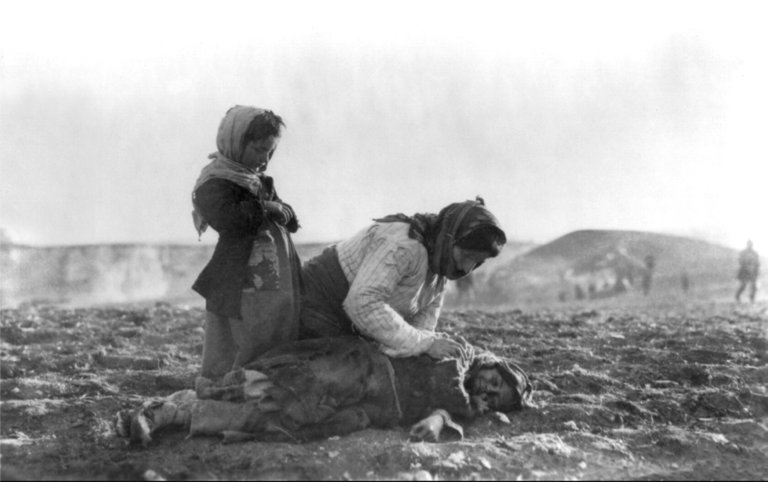
Starting in the summer of 1915, Armenians in eastern Anatolia were forcibly removed from their homes and marched toward concentration camps in the Syrian desert. Insufficient rations were given to displaced Armenians, who were frequently subject to disease, starvation and mass-killings, along the treacherous journey. The death marches were organized by Ottoman military leaders, who utilized irregular military forces to lead the Armenians to their deaths. Local Kurdish and Circassian tribes frequently attacked and looted the prisoners along the way.

Rape and murder were commonplace among these marches. Turkish soldiers, having been told, “Do to [the women] whatever you wish,” took advantage of defenseless women. In cities along the route, such as Damascus and Mosul, female deportees were frequently displayed naked and sold as sex slaves or forced into marriages. Most of all, food was scarce and shelter was non-existent, with many prisoners falling victim to the brutal, scorching conditions of northern Arabia.

****

“The roads and the Euphrates are strewn with corpses of exiles, and those who survive are doomed to certain death. It is a plan to exterminate the whole Armenian people.”

Report from The New York Times, August 18, 1915

Those who did survive the death marches, who were few and far between, found themselves in concentration camps in Iraq and Syria. The Empire’s Greek and Assyrian populations did not fare much better.

The Ottoman massacres of its Pontic Greek began first with the government’s policy of population transfer, which frequently relocated Greeks through violent intimidation and fueled ethnic tensions. Coinciding with the timeline of the Armenian Genocide, the Greek population transfers gradually evolved into outright death marches. In total, anywhere from 450,000 to 750,000 Greek civilians were killed from 1913–1922. 

The Assyrians, a distinct ethnic group of Aramaic-speaking Christians, meanwhile, suffered a similar fate as their Greek and Armenian counterparts. The mass killings of Assyrians by Ottoman forces took a number of forms, deportations sometimes among them, but also through other strategies, such as forced famine and the direct destruction of villages. Ultimately, scholars place the total death toll at anywhere from 150,000 to 300,000 Assyrians, out of a pre-war population of around 600,000. 

“The Ottoman Empire should be cleaned up of the Armenians and the Lebanese. We have destroyed the former by the sword, we shall destroy the latter through starvation.”

Enver Pasha, Minister of War of the Ottoman Empire, May 19, 1916

Occurring adjacently, but oftentimes left out of the history of the Ottoman killings, was the deliberate mass starvation of the largely Maronite Christian Lebanese population of Mount Lebanon. Through a blockade of supplies from 1915–1918, an estimated 200,000 Lebanese in the Mount Lebanon Mutasarrifate starved to death, out of a pre-existing community of 400,000. This massacre was further worsened by a siege of international trade routes by the Allied powers, which additionally isolated the communities. The killings implemented on the Armenians were thus becoming the preferred strategy against Ottoman enemies everywhere.

In regards to the Armenians, other forms of mass killing were utilized as well. Mass burnings were a frequent strategy of the Ottoman military; some 80,000 Armenians in 90 villages across the Muş plain were killed by this technique alone. Drownings occurred in the Black Sea, where thousands of Armenian children and women were rounded up and placed on boats that were later capsized — around 50,000 Armenians drowned to death in just the Trabzon province. 

Lesser known and more infrequent incidents of medical killings also occurred. Cases of poisonings (particularly among children and infants), gassings and deliberate typhoid infections were reported as well, techniques that have been argued to have served as inspiration for Nazi human experimentation decades later. Regardless of the manner, the goal was always the same — the deliberate destruction of the Armenian people.

****

“The Armenians’ horror shook the world,

The Turkish throne fell to the ground,

Let me tell you about the death of Talaat.

Pour the wine, dear friend, pour the wine,

Drink it nicely; drink it with delight.”

— “Pour the Wine,” Armenian revolutionary song

As is true with all empires, the Ottomans eventually fell.

The defeat and partition of the Ottoman Empire and its territories to the Allied Powers at the end of WWI marked the end of over 600 years of continuous Turkish rule. In its wake, its territories were divided among England and France, eventually becoming hotbeds for their own independence movements.

As for the Three Pashas, the Ottoman leaders who worked to orchestrate the great genocide, they fled the collapsing Turkish empire and found refuge in Germany, only to suffer a series of violent deaths. They were among the targets of Operation Nemesis, a covert mission by the Armenian Revolutionary Federation — known as Dashnaks — aimed at assassinating the masterminds of the Armenian Genocide. Naval Minister Djemal Pasha was killed in Tbilisi, Georgia in 1921.

Grand Vizier Talaat Pasha, widely considered the primary architect of the genocide, was assassinated in broad daylight in Berlin by a Dashnak named Soghomon Tehlirian. Tehlirian, whose parents died in the Armenian Genocide, was arrested and tried for murder — but was then acquitted in just over an hour after he pleaded temporary insanity caused by the trauma of his parents’ deaths. The trial became just as much about the atrocities committed in the genocide organized by Talaat as it did the crime by Tehlirian. The evidence presented in this testimony, in addition to witnessing the Holocaust first-hand two decades after, later motivated Polish-Jewish lawyer Raphael Lemkin to coin the term “genocide” in 1944. 

Interior Minister Enver Pasha escaped the wrath of Operation Nemesis only to die at the hands of a Red Army brigade while leading a revolt against Russian forces in Central Asia. Enver was killed during a counter attack led by Yakov Melkumov, an ethnic Armenian himself.

****

“With the genocide of Armenians, Greeks, Assyrians, the culture of an entire region has been distorted, the ancient civilization of Asia Minor disappeared forever. Wasn’t this a crime against humanity?”

Nikol Pashinyan, 16th and current Prime Minister of the Republic of Armenia

In those 30 years between 1894 and 1924, Christians in Turkey declined from 20% of the population to just under 2%. Once home to a diverse population that included some of the world’s oldest Christian communities, Turkey’s population is now estimated at 99.8% Muslim. The ethnic cleansing of the country’s Christian population transformed what was once seen as the great cosmopolitan crossroad between east and west into a contemporary monoculture. Survivors of the great killings of the 20th Century have since become dispersed across the world, with the genocide serving as the primary catalyst for the formation of the Armenian and Assyrian diasporas. 

The Greek population of Turkey, which once numbered in the millions, has declined to the point of virtual extinction, with just around 2,000 ethnic Greeks remaining in the country. In addition to the deliberate massacres of Greek communities, fallout from the Greco-Turkish War of 1919–1922 resulted in the mass expulsion of the Anatolian Greek population. The Lausanne Convention, signed by both sides at the end of war, saw the exchange of some 1.5 million Greeks from Turkey and 500,000 Muslims from Greece. Attacks during the exchange were widespread, and committed by both groups. Around 200,000 Greeks were permitted to remain in Turkey, but decades of racist policies and violent pogroms saw the remaining Greek population decline to its miniscule numbers today. 

Armenians and Assyrians left Turkish territory en masse as well. Driven on death marches to the deserts of Syria, Armenians, in particular, found refuge among smaller, pre-existing communities in both Syria and Lebanon, where they developed into a numerically small, but socially prominent minority, living mostly comfortably among their Arab neighbors. Others fled to Russia, where they briefly formed the Republic of Armenia, later incorporated into the Soviet Union, before once again achieving independence in 1991.

Assyrians, meanwhile, did not fare nearly as lucky, failing to achieve statehood and remaining dispersed throughout the world. The largest populations of Assyrians are still found in their ancestral homelands in Syria and Iraq, where, in recent years, their numbers have continued to decline due to extemist Islamist violence, with BBC and The Atlantic both reporting last year that Assyrians in Iraq and elsewhere were on the verge of extinction. 

****

“Who, after all, speaks today of the annihilation of the Armenians?”

Adolf Hitler, August 22, 1939, one week before the Nazi invasion of Poland

To this day, the Turkish government denies the role of the Ottoman Empire in the Armenian Genocide. 

Turkey has long questioned the scholarly consensus on the legitimacy of the Ottoman role in the genocide, instead claiming that the numbers are inflated and not the product of an organized killing, but rather the casualties of war. The Turkish lobby in the U.S., meanwhile, has spent millions of dollars in a decades-long campaign to ensure that the U.S. does not formally recognize the Armenian Genocide. Despite widespread pressure from the Armenian diaspora, the U.S. government still refuses to use the term “genocide” to describe the mass killings of Armenians from 1914–1920, due largely in part to worries over harming its strategic relationship with NATO ally Turkey.

Contemporary attempts at recognition and reconciliation between Turkey and its miniscule remaining Christian population have largely failed, with advocates of genocide recognition sometimes falling victim to violent retribution. In 2007, for example, Hrant Dink, the editor of the bilingual Armenian magazine “Agos,” was assassinated in Istanbul by Turkish nationalist Ogün Samast. Dink, an ethnic Armenian and long critic both of the country’s policy of genocide denial and of certain aspects the Armenian diaspora’s efforts at recognition, had previously been prosecuted three times for “denigrating Turkishness.” Controversy ensued when a photograph of the assassin — posing in front of the Turkish flag side-by-side with smiling police officers — surfaced, doing little to assuage concerns over a possible conspiracy or cover up. 

As Turkish ethnonationalism has risen and the country’s population has become more and more racially homogenized, the country’s religious minorities have found themselves in an increasingly hostile environment. And yet, ironically, many Turks themselves have a large degree of Greek or Armenian ancestry.

Some estimates place the number of self-identified Turks with Armenian ancestry to be as high as three to five million. The eradication and assimilation of the Ottoman’s religious minorities took a unique trajectory, with definitions of “Turkishness” combining different complex elements of religious, racial and national identity that were often contradictory. In the years coinciding with the genocide, Armenian women and children were frequently kidnapped and enticed into forced conversions, with the children adopted by Muslim families and the girls and women taken to harems to be married to new husbands. Armenian orphans were deliberately placed into Turkish orphanages where they were given news names, circumcized and forced to convert to Islam. Indeed, the eradication of the Armenians of Turkey can be understood as a deliberate ethnic cleansing, a product of the late Ottoman nationalistic government’s policy of Turkification, which sought to homogenize the empire’s population.

****

“The Armenian massacre was the greatest crime of the war, and the failure to act against Turkey is to condone it […] the failure to deal radically with the Turkish horror means that all talk of guaranteeing the future peace of the world is mischievous nonsense.”

Theodore Roosevelt in private letter to Cleveland Hoadley Dodge, May 11, 1918

The legacy of the Armenian Genocide has thus been subject to scorn and debate. Efforts at lasting recognition have become a key goal of the Armenian community, both at home and abroad. In addition to attempts at raising awareness and lobbying the U.S. government to formally recognize the genocide, Armenians have used April 24 — Armenian Genocide Remembrance Day — as an opportunity to both mourn and educate. In 2015, on the 100th anniversary of the genocide, over 130,000 protestors marched from the Little Armenia neighborhood in East Hollywood to the Turkish consulate in Los Angeles, demanding recognition of the Armenian Genocide.

Such action has become replicated elsewhere, including at UC Davis. Every year, on April 24, members of the Armenian Student Association gather in the MU for a “die-in,” where protestors silently lie down or hold signs in commemoration of the genocide. Elsewhere, pushes by Armenian students and other allies have resulted in the implementation of legislation aimed at the recognition of these killings.

In 2015, the ASUCD Senate joined a number of other UC campuses in passing a bill calling for the UC Board of Regents to divest over $74 million dollars from the Republic of Turkey due to its continued denial of the Armenian Genocide. Three years later, in 2018, ACUSD passed Senate Resolution #12, which formally recognized and condemned the Ottoman government’s destruction of its Armenian community.

These sorts of maneuvers may seem insignificant initially, but they are the first small steps in establishing a formal recognition of one of the great crimes against humanity of the 20th Century. For it was the Armenian Genocide that partly inspired and enabled the slaughters that proceeded it. For it was this bloodshed that initiated the first mass exodus of Christians from the Middle East and empowered the ongoing one that followed. For it was this carnage and butchery, this deliberate eradication of an unjustly villainized people, that not only annihilated the presence of an ancient ethno-religious community in the very lands where it first took root, but also destroyed thousands of years of history in the process. 

Lest we forget.

****

“I should like to see any power of the world destroy this race, this small tribe of unimportant people, whose wars have all been fought and lost, whose structures have crumbled, literature is unread, music is unheard, and prayers are no more answered. Go ahead, destroy Armenia. See if you can do it. Send them into the desert without bread or water. Burn their homes and churches. Then see if they will not laugh, sing and pray again. For when two of them meet anywhere in the world, see if they will not create a New Armenia.”

William Saroyan

Written by: Brandon Jetter — brjetter@ucdavis.edu

Disclaimer: The views and opinions expressed by individual columnists belong to the columnists alone and do not necessarily indicate the views and opinions held by The California Aggie

UC Davis cultural centers cancel in-person graduation celebrations

Students reflect on what cultural graduations mean to them

Cultural centers on campus canceled in-personal cultural graduation celebrations in response to the state’s stay-at-home directive and Chancellor Gary May’s announcement of a virtual commencement ceremony for those graduating this spring. Centers will consider alternative, virtual ways to celebrate graduating students in June.

The LGBTQIA Resource Center, the Center for Chicanx and Latinx Academic Student Success (CCLASS), the Asian American and Pacific Islander (AAPI) community and the Center for African Diaspora Student Success are some of the centers that hold annual graduation celebrations for members of their community. 

These celebrations allow participating students to have the option of taking part in a ceremony that is more private than the larger UC Davis commencement, with friends and family members, that honors their achievements. 

The LGBTQIA Resource Center is one center that made the decision to cancel their in-person Lavender Graduation ceremony. Monae Roberts, the director of the LGBTQIA Resource Center, commented on the center’s decision.

“Our decision to cancel the in-person Lavender Graduation was a difficult one,” Roberts said. “However, given the current pandemic, we felt it best to be cautious for the safety of our most vulnerable populations.” 

Although the in-person ceremony has been canceled, according to Roberts, center leadership is in the process of planning a virtual celebration for students to take part in.

On April 7, Cirilo Cortez, the director of CCLASS, decided to cancel the center’s graduation celebration. Cortez responded to students’ disappointment via email. 

“I know this can be difficult news to digest and I do want to offer myself for support if you need it,” Cortez said via email. 

Like other centers, CCLASS is looking to students for suggestions for alternative ways to celebrate. During the ongoing pandemic, any graduation ceremony would present a clear, public health hazard, but for many students, the feeling of disappointment remains.

Emily Mijangos, a fourth-year international relations major, will be the first person in her family to graduate college. Mijangos shared her experience with the CCLASS graduation ceremony and what the decision to cancel the celebration meant for her.

“You have to understand that in the Latinx graduation, you are able to bring a family member to the stage with you,” Mijangos said.

Mijangos recalled attending last year’s ceremony. A friend of hers brought his father to the stage and proceeded to remove his own graduation stole and place it around his father’s shoulders.

“Not only did my friend graduate, his family gained its first college graduate,” Mijangos said. “Through the hard work of his father and the hard mental work of my friend, their struggles finally paid off with this specific moment. I wanted to bring that honor to my family.”

Mijangos planned to invite her grandmother, the matriarch of her large family, on stage with her in June. 

“I pictured a horde of family members and students within the pavilion celebrating the graduation of the Class of 2020,” Mijangos said. “I did not predict being confined within my house during my graduation. It’s like I am losing a bit of that magic that you feel when going through that experience. Hopefully our class can, sooner or later, get the ceremony that we deserve.”

Written by: Ally Russell — campus@theaggie.org