55.5 F
Davis

Davis, California

Wednesday, December 24, 2025
Home Blog Page 341

Yolo County and partners help unemployed individuals, struggling nonprofits as economic crisis continues

Technical assistance, advice provided to those who are unemployed, cash grants available for essential nonprofits

In the wake of the economic fallout caused by COVID-19, Yolo County and its partners have stepped up to provide financial resources to struggling individuals and nonprofits. 

The Yolo County Health and Human Services Agency created an advice hotline for people financially strained during the crisis. Executive Director of the Workforce Innovation Board Elaine Lytle described how hotline operators connect callers with unemployment benefits and other government programs. 

“We have started a hotline where we have staff manning the phone lines,” Lytle said. “It’s for individuals calling for information about unemployment, and then also for any other resources. We want to make sure they’re getting other resources that they may need, such as Medi-Cal, CalFresh and CalWORKS.”

Medi-Cal is California’s medical insurance program serving low-income individuals, and CalFresh provides nutritious foods and financial means to buy food  to low-income individuals and families. CalWORKs gives “cash aid and services to eligible needy Californian families,” according to its website

Data collected by the California Employment Development Department records that Yolo County Unemployment Insurance claims rose from 112 on Jan. 4, 2020 to 3,014 on April 4, 2020. The unemployment rate in Yolo County is 5.9% as of April 17. 

Confronted with these numbers, Lytle explained that the hotline workers also fill an important role as empathetic listeners who help stave off hopelessness in callers.

“What I told the team when they first started is that people are calling because they want to talk to somebody,” Lytle said. “Sometimes they just need someone to hear them — they might have just lost their job and the kids are coming home from school. For a lot of the calls we received, it was listening and assessing what they were really asking for.”

Executive Director of the Yolo Community Foundation Jessica Hubbard listed the ways local nonprofits are being helped during the crisis, which includes a campaign to ramp up donations. 

“We are partnering with Yolo County on what we’re calling the Yolo COVID-19 Nonprofit Relief Initiative,” Hubbard said. “We’re working on a donor education campaign that’s designed to encourage local community members to give directly to local nonprofits.”

The Yolo Community Foundation website describes the goal of the COVID-19 Relief Initiative seeks to aid struggling nonprofits that provide essential services. 

“The new COVID-19 Relief Initiative provides resources to help the essential work of Yolo nonprofits during this unprecedented crisis” the website reads. “Yolo County’s nonprofits care for the most vulnerable in the community and enrich the fabric of the Yolo community through a wide range of programs that support, teach, and connect.”

Hubbard explained that most of its funds will be given to essential nonprofits, and the remainder will be granted to nonprofits negatively impacted by the crisis. 

“We are accepting grants in two categories,” Hubbard said. “One is organizations that are frontline responders to the crisis — so organizations addressing problems that have been created or exacerbated by COVID-19 and the economic condition. We’re also accepting grants from nonprofits seeing revenue drop or a loss of volunteers due to the crisis.”

As of April 17, the initiative raised $325,000 from Yolo County, Davis and Woodland. Winters and West Sacramento were also considering donating to the fund. 

Because of the economic strain caused by COVID-19, Hubbard said she understood that many people would be unable to donate. For those in a better financial position, however, donating is especially important at this time.  

“A lot of us are worried about our jobs or our income or have already seen job loss and income drop,” Hubbard said. “But for those of us who can, it’s really important to do what we’re able to in order to support local nonprofits.”

Written by: Eden Winniford –– city@theaggie.org
PREDICT project, providing support to countries in detecting COVID-19, receives six-month extension

The project, initiated in 2009, is focused on developing precautionary initiatives for responding to infectious diseases like SARS

PREDICT, a part of the Emerging Pandemic Threats (EPT) program administered through the UC Davis One Health Institute, received a six-month, $2.26M extension on April 1 to offer emergency technical support in detecting SARS-CoV-2, the virus that causes COVID-19. 

The project, which began in 2009, was supposed to end in March 2020, but was given an extension by the U.S. Agency for International Development. So far, it has provided data to the National Institute of Health, hinting that SARS-CoV-2 had pandemic potential, connected COVID-19 cases with the “wildlife-human interface” in China and provided early testing protocols for COVID-19.

In an interview with UC Davis News, Professor Tracey Goldstein, PREDICT’s pathogen detection lead and an associate director of the UC Davis One Health Institute, called both the labs PREDICT has trained and the networks cultivated through the program key for detection of initial cases.

“They are a trusted resource in their countries, are assisting with coronavirus detection and included on government taskforces to support the response,” Goldstein said. 

PREDICT is run out of the UC Davis One Health Institute, but it is part of a larger network of cross-disciplinary labs and partnerships. According to the institute, One Health partners approach global health problems by acknowledging that they are part of the network of animal, human and environmental health.
PREDICT, along with other EPT partners, played a role in studying, controlling and understanding the 2014 Ebola outbreak and received a $100 million grant to continue the work it did during the Ebola pandemic. 

Jonna Mazet, the director of the One Health Institute, said in an interview with UC Davis News that the EPT program was instrumental in creating a platform that facilitated global health problem-solving.

“PREDICT and its partners have enabled a platform for effective collaboration across disciplines and geographic borders,” she said.  

Currently, PREDICT is supporting government evaluations of potential COVID-19 cases in Asia, Africa and the Middle East. 

Written by: Janelle Marie Salanga — campus@theaggie.org 

Celebrating National Space Day: Retired astronaut, current UCD professor Stephen K Robinson discusses tips for being in isolation

New UC Davis College of Engineering space innovations detailed

National Space Day, which falls on the first Friday of May, is a day committed to celebrating the achievements made toward space travel, research and technology. UC Davis is making its own contributions to the progress of space technology and travel which will allow better collaboration between humans and machines in space. 

Mechanical and aerospace engineering professor and retired NASA astronaut Stephen Robinson directs the UC Davis Center for Human/Robotics/Vehicle Integration and Performance (HRVIP Lab). There, a number of researchers, including both graduate and undergraduate students, work on the newest space-related technological advancements. 

The Fall 2019 Engineering Progress magazine, which features projects underway at the College of Engineering, cites innovations at the HRVIP Lab, including a device astronauts can affix to the top of their helmets that informs them of nearby radiation, enabling them to steer clear of it. Another project detailed in the magazine is a possible alternative to remote surgery. An unmanned spacecraft ambulance with room for two crew members and a patient would potentially transport astronauts in need of emergency medical attention from the International Space Station (ISS) to any airport and, from there, to the nearest hospital. This is an idea entirely unique to space travel. 

Robinson, who has embarked on four Space Shuttle missions and spent a total of 48 days in space, gave his advice to those currently struggling with isolation as a result of quarantine, which he said can be compared to the isolation of space. 

“My approach to feeling isolated and restricted from the things I want to do has always been to try to remember all the things that I am fortunate to have — health, freedom, intellectual challenge and a wonderful community,” Robinson said. “In other words, try to get outside your own mind, find a way to feel fortunate and then make yourself (and others) feel better by learning, giving and sharing.”

Robinson plans to celebrate National Space Day this year by joining an online call with his team of researchers at the HRVIP Lab and watch videos of space together. In his spare time while in quarantine, Robinson watches the ISS fly overhead. 

“Besides all the space research I am involved in, it is always wonderful to watch the International Space Station fly over, and to think about the fortunate astronauts and cosmonauts that are on board, doing scientific research up there in the coolest lab of all,” Robinson said.

Using NASA’s Spot the Station website, anyone can track the movement of the ISS through the sky by entering in their location. The site provides a chart of dates, times, number of minutes of visibility and the degrees above the horizon at which the ISS can be viewed according to where you are. A full calendar of lunar phases, eclipses and meteor showers can also be found on the NASA website. 

If given the opportunity to deliver the first words ever said on Mars, Robinson would remark at the lengthiness of the mission leading up to his landing on the Red Planet. 

“Mars is something like 140 million miles away from Davis,” Robinson said. “So since I’m no Neil Armstrong, I think my first words would be, ‘Wow, it sure took a long time to get here!’”

Joking about the similarities between self-quarantining and space travel, Robinson said, “After this, we are all going to be qualified to be astronauts!”

Written by: Lyra Farrell —  features@theaggie.org 

Systemic racism fuels coronavirus pandemic in US

Los Angeles County sees death rate of 13.2 per 100,000 people for African Americans, versus 5.7 per 100,000 for whites

The COVID-19 pandemic has brought a multitude of America’s systemic inequities to the forefront. Increased instances of overt racism against Asian Americans, virus outbreaks throughout the incarceration system and a surge in domestic violence sheds light on just some of the marginalized populations that are facing more challenges and greater threats to their lives during this time. And as early coronavirus racial and ethnic data shows, Black and Latino populations are being disproportionately infected and killed by this disease. This is happening not only in California but across the country where racial demographics concerning COVID-19 are being reported. 

Compared to their shares of state, county and city populations, African Americans are overrepresented in COVID-19 deaths, accounting for more than one-third of them in the U.S. In Chicago, for example, African Americans make up less than a third of the population but constitute 72% of virus-related fatalities. Additionally, in North and South Carolina, the ratios of Black to white residents who have tested positive for coronavirus far exceed that of the general population.

Los Angeles County, with a quarter of California’s population but half of the state’s coronavirus deaths, has seen a death rate for African Americans of 13.2 per 100,000 people, the highest death rate compared to that of Latinos, Asians and whites. When looking specifically at age, Black and Latino patients in the county aged 18 to 49 comprise more deaths relative to their shares of the population and compared to both other racial groups and older age groups. 

The primary disadvantages, some of which are rooted in systemic racism, that cause such alarming disparities are clear to experts: underlying health risks like diabetes and asthma in Black and Latino populations, unequal access to health care resources and unequal health care treatment, lack of insurance and essential worker status

“America’s newest infection seems to be mating with America’s original infection, reproducing not life, but death,” said Ibram X. Kendi, the director of the Antiracist Research and Policy Center at American University, in an article for The Atlantic.

Echoing medical professionals and policymakers, the Editorial Board urges the federal government to, at the very least, release a more comprehensive racial breakdown of coronavirus testing, cases and deaths to better inform strategies aimed at mitigating the virus’ disparate impact thus far. Seeing as how the virus has also disproportionately affected low-income and minority neighborhoods, often housing front-line workers, it is imperative that the most vulnerable are protected both physically and mentally. 

On top of the emotional toll of facing higher rates of infection, minorities — and especially Black communities — must contend with a distrust of the medical system from a history of mistreatment and exploitation. The mental impact of such a combined burden cannot be overstated. Emotional wellbeing must be part of efforts seeking to alleviate the added stress, particularly as it concerns structural racism and racial profiling, brought on by this pandemic. 

We must be willing to confront the inherent biases that escape no one and place Black, indigenous and people of color in more danger. Of course, these communities needed us before the pandemic, but they especially need us now, and our support must continue long after.

Written by: The Editorial Board

ASUCD could lose $1.1 million as a result of COVID-19

Millions from emergency reserves, government acts, Basic Needs and Services Referendum to offset losses

ASUCD is projected to face $1.1 million in losses due to the COVID-19 pandemic if the campus does not reopen for Fall Quarter 2020, according to ASUCD Controller Kevin Rotenkolber.

ASUCD Business Manager Greg Ortiz and Rotenkolber, who is responsible for securing the financial stability and solvency of the association for the future, have suspended each unit’s access to its budget line items until further notice — unless exempted by Rotenkolber or Ortiz —in order to mitigate losses until they are able to determine the exact financial impact of the pandemic. Once the exact amount of financial loss is determined, the ASUCD management team will decide how to cover it, pending Senate approval. 

“As far as putting a number to the financial impact, it is still too early to know for sure what the impact will be,” Rotenkolber said. “After consulting with [Associate Vice Chancellor for Health, Wellness and Divisional Resources] Cory Vu and Budget Manager Luci Schmidl, we came to a preliminary estimate for the financial impact on ASUCD’s bottom line: approximately $1.1 million dollars. This number may change depending on the duration of the campus’ switch to remote instruction and the shelter-in-place Order, as well as spending decisions made between now and then.” 

Rotenkolber said the $1.1 million estimate is the result of ASUCD planning for the worst while hoping for the best. The UC Davis administration has not yet made a decision on whether Fall Quarter 2020 will take place remotely. A few universities, including Cal State Fullerton, have already announced plans to hold fall instruction online.

Rotenkolber explained that since most ASUCD units are service- or advocacy-based, even business operations such as the CoHo and the Bike Barn are near break-even operations. Virtually all aspects of ASUCD — especially the CoHo, the Bike Barn, Picnic Day and Whole Earth Festival — have been financially impacted by COVID-19. 

“In the case of the Bike Barn, until the shelter-in-place order went out and we suspended their operations, they were on track to meet or exceed their income expectations,” Rotenkolber said. “[They] are now projected to fall approximately $105,000 short of pre-COVID-19 expectations. Units like KDVS, Picnic Day and Whole Earth Festival, which all have big events in the Spring that generate almost all of their income in Spring, are more or less projected to bring in almost no income.” 

Additionally, the CoHo and its satellite locations, BioBrew and CoHo South, are profitable only four months per year in a normal year, with the two most profitable months being April and May. The high profit made in those four months offsets the cost of the other eight months of the year and allows for the CoHo to serve students year-round. Without income from the CoHo, Rotenkolber expects a significant loss in ASUCD funds. 

Ortiz, however, explained that ASUCD has a significant amount of reserves in place to offset financial losses during situations like this, similar to the California wildfires in 2018 that shutdown the campus for over a week. ASUCD lost a significant amount of revenue at that time, as well.

Rotenkolber confirmed that ASUCD has about $2.3 million between three main reserves. He expects to dip into some of these reserves, as well as other smaller unit-specific reserves that could be liquidated to ensure the survival of the units. 

The Basic Needs and Services Referendum that passed this past February also allows access to approximately $1.4 million in increased general funds, which will aid in offsetting the costs incurred due to COVID-19. 

“We are quite fortunate in that we passed the Basic Needs and Services Referendum when we did because other ASUCs [Associate Students of the University of California] which have their elections in the Spring have been forced to postpone their referendums, whereas we were able to pass it in the 11th hour,” Rotenkolber said. 

Unitrans, a unit of ASUCD that is not funded through ASUCD’s general fund but instead through student fees and city grants, also has its own budgetary reserve to mitigate some of the lost revenue. Unitrans is operating fare-free until further notice to reduce customer contact with bus drivers and conductors and to support customers whose finances may be negatively impacted by COVID-19. 

“Through the recently signed into law $2 trillion Federal Coronavirus Aid, Relief and Economic Security (CARES) Act, Unitrans can get reimbursed for lost fare revenue due to coronavirus impacts,” said Unitrans General Manager Jeffrey Flynn. “The CARES Act provides specific funding opportunities to public transit operators like Unitrans. 

Flynn explained that Unitrans will experience financial impacts if gasoline taxes or student fees decrease, as they are tied to city grants and enrollment respectively. Therefore, Flynn said he is uncertain at this time how much revenue will fall and how much alternative revenue may be needed to avoid service reductions. 

“We’re closely monitoring ridership, our finances and county, city and university plans, but at this time, we don’t know the full extent of the short- and long-term impacts of the COVID-19 situation,” Flynn said. 

Although some services may experience budget cuts to adjust for financial losses, ASUCD is able to prevent the dissolution of any departments, units and committees.

“With the Basic Needs and Services Referendum, careful planning and intelligent decision-making, I am confident that ASUCD will survive this pandemic as we have [survived] for the past 105 years,” Rotenkolber said.

Written by: Graschelle Fariñas Hipolito — campus@theaggie.org

When the campus reopens, students should not expect operations to look the same

For the sake of everyone’s well-being, we must proceed with caution

UC Davis students received a mid-quarter check-in email on Tuesday from Emily Galindo, the interim vice chancellor for Student Affairs.

“As you think about your fall plans and upcoming class registration, please note that while no final decisions have been made, some or all instruction for all or part of Academic Year 2020-21 may be delivered remotely,” the email read. 

It is difficult to come to terms with the idea of the next school year being completely online. And although the Editorial Board is composed of graduating seniors, we wholeheartedly empathize with the students who will be affected. 

We support the university’s decision to continue remote instruction if that is what is safest for our students; however, we also urge UC Davis to take into consideration the negative impact that remote instruction has on students and to coordinate with health officials on how best to prepare for students’ returns. Only when there is a continued, significant reduction in deaths, hospitalizations and the infection rate, as well as an increase in available testing, should we consider taking steps to return to campus. 

Christina Paxson, the president of Brown University, argued in an op-ed for The New York Times that it should be a top priority for universities to reopen and highlighted the negative impact that remote learning has on students. Paxson, however, does not recommend that students return to their campuses in the traditional sense. Even if universities reopen in the fall, this pandemic will force us to reconsider how we interact on campus. 

If UC Davis decides to allow in-person instruction at any point in the next academic year, its campus must be reopened gradually and in a way that prioritizes everyone’s health, well-being and personal needs. Strict guidelines will need to be put into place to include limiting social gatherings and reconfiguring classroom spaces.

Every student and faculty member’s circumstances will be different. Professors and administrators will still have to make special exceptions for students, and they simply cannot expect every single student to come back — nor can they force them to. Some people face underlying medical conditions, need to take a break to work for a bit or simply feel unsafe in general.

We also urge UC Davis to make decisions about upcoming quarters as quickly as possible — the email sent earlier this week has, understandably, induced panic. Students have a lot of decisions to make such as signing leases, adjusting course loads and schedules to accommodate work schedules or coordinating with advisors on fulfilling major requirements. 

Adhering to shelter-in-place orders is challenging enough every day, and it’s only made harder seeing when others are not as committed to public health directives. Most agree that those protesting their local governments are impeding our efforts to flatten the curve, but everyone who went to the newly reopened California beaches this past weekend is, too. Ignoring state directives, or taking advantage of opened beaches is irresponsible and puts everyone at risk of exposure to the virus. It is our collective responsibility to look out for society’s most vulnerable. 

It will be impossible to entertain the idea of returning to campus if we are not taking the necessary precautions. The impact of the coronavirus pandemic cannot be understated, and what is happening at UC Davis is only a microcosm of how the pandemic is playing out on the national and global stage. Regardless of the university’s decision on reopening campus, we must implore our leaders to trust health experts and proceed with caution, knowing that moving forward will require monumental long-term planning and restructuring. 

Written by: The Editorial Board

Boom or bust: Ranking the three best and three worst NFL drafts of all time

A look back while the 2020 draft dominates amid global sports shutdown

The 2020 NFL Draft was held from April 23–25, and the anticipation going into it was the biggest it had been in years. Originally scheduled to be held in Las Vegas, the draft was forced to move to a virtual format due to the ongoing COVID-19 pandemic. This made the NFL’s job a lot harder, as each organization’s coaching and management staff now had to interview and scout players from afar, further testing their football intelligence. 

The top two picks, held by the Cincinnati Bengals and the Washington Redskins, respectively, were seen as locks, and they picked the players everyone expected. LSU quarterback Joe Burrow went first overall to the Bengals and Ohio State defensive end Chase Young went right after him. From there on out, much of the picks were generally unknown. But in the end, there were no major surprises, as in years past. 

Heading into the draft, there was a strong belief that there might be many trades executed, specifically in the top 10. That belief, however, proved to be false as a trade did not take place until the Tampa Bay Buccaneers traded up one spot with the San Francisco 49ers. 

There were three quarterbacks drafted in the top 10 and four total in the first round. The 2020 draft class was also regarded as having one of the deepest wide receiver classes in history, and it seemed many teams agreed. Six receivers were drafted in the first round and, by the end of the second round, a total of 13 were off the board. 

Perhaps the biggest surprises of the draft involved the quarterbacks. The Green Bay Packers traded up four spots to number 26 and drafted Utah State gunslinger Jordan Love. Green Bay already has an all-pro starting quarterback in Aaron Rodgers, so spending the team’s valuable first round pick on Love indicated that the franchise is looking toward the future. Rodgers, 36, signed a four-year, $134 million extension with the team in August 2018, so the pick has many thinking that the Packers are beginning to prepare for life after Rodgers. 

Speaking of big money quarterbacks, another shocker in this draft came from Philadelphia, as the Eagles selected Heisman finalist and Oklahoma Sooner quarterback Jalen Hurts with the 53rd pick. This came as a surprise to many, as the team had just given its former number two pick and current starting quarterback Carson Wentz a four-year, $128 million extension before the past season. Wentz, 27, however, has had an extensive injury history, so the Eagles’ approach makes sense. Still, it is surprising that Philadelphia chose a backup with such a high pick with more pressing needs still available. 

Even given the strange circumstances and different format, the draft gave sports fans something new to look forward to for the first time in a while. The thirst for sports showed, as the NFL Draft shattered the all-time viewership on the first night. Up 37% from last year’s telecast, the draft averaged 15.6 million viewers on the first night and peaked at 19.6 million. The combined ESPN-NFL Network broadcast made it feel similar to years past and served as an escape during these sports-less times. 

There are usually great players that come out of every draft, but some classes are loaded while others have players that are out of the league in three years. For this year’s class, it’s still too early to judge. But since it is draft season, The Aggie decided to rank the three best and three worst NFL drafts of all time.

The Busts

2009

In terms of recent NFL Drafts, 2009 stands out because, although there were some players that turned out to be solid pros, there were a large number of high picks that just didn’t pan out. 

After Matthew Stafford was taken at number one by the Detroit Lions, the St. Louis Rams drafted offensive tackle Jason Smith out of Baylor who would play a total of 26 games in his career. That seemed to be the theme, as 23 of the 32 players drafted in the first round did not sign a second contract with the team they were drafted by. Only 11 players from the first round and 27 players overall have been selected to the Pro Bowl in their careers. 

Aside from Stafford, the 2009 class did produce other notable players like Brian Orakpo, Julian Edelman, Clay Matthews, LeSean McCoy and Malcolm Jenkins, but never to the magnitude of a superstar or even potential Hall of Famer. It was a forgettable draft that produced minimal talent, and it is the worst draft since the turn of the century.

1991

The 1991 NFL draft produced one of the best quarterbacks ever in Brett Favre, who went on to make the Hall of Fame after a career that saw him win three consecutive NFL Most Valuable Player awards from 1995–1997 and a Super Bowl title. Defensive back Aeneas Williams, drafted in the third round by the Phoenix Cardinals, also went on to have a Hall of Fame. 

Aside from those two players, there was very little elite talent. Others went on to become nice depth players, but with the draft being overshadowed by Favre’s selection at 33 overall, no one notices that it was one of the most forgettable draft classes ever. 

1992

In 1992, the Indianapolis Colts held the top two picks in the draft after a fortunate trade with the Tampa Bay Buccaneers two years prior — an unprecedented circumstance that had never occured in any major sport — but it could not have been a worse year for them to get them. The talent pool was limited going into the draft, and the Colts selected defensive tackle Steve Emtman and linebacker Quentin Coryatt. Neither player would ever make a Pro Bowl and both had forgettable careers. 

That was basically the theme of the entire draft, as the 1992 class never produced a Hall of Fame player or anyone who even came close. There were only two players in the first round that made All-Pro teams, and to this day it remains the only draft class with none of its members in Canton. Although it did produce players like Troy Vincent, Jimmy Smith and Darren Woodson, who all went on to have successful careers, it will be hard to ever duplicate how bad that draft was. 

The Best

1996

It feels like 1996 was a great year for both the NFL and the NBA when it came to the draft. On the NFL’s side, this draft produced some of the best players of all time in a variety of positions. 

This was the last draft where a quarterback was not taken in the first round, but that did not mean there were no impact players taken. There are currently five Hall of Famers from that class, including the Baltimore Ravens duo of Ray Lewis and Jonathan Ogden, and other all-time greats like Marvin Harrison, Terrell Owens and Brian Dawkins, who will all go down as some of the best at their respective positions. 

Even after these legendary players, there were other notable players, like Keyshawn Johnson, Eddie George, Mike Alstott, Lawyer Milloy and Tedy Bruschi, who won’t make the Hall of Fame but still had great careers. Overall, the 1996 draft will go down as one of the most legendary drafts of all time. 

1981

The 1981 draft was great in general, but it is difficult to surpass from a defensive standpoint. It possesses seven Hall of Famers, six of whom were on the defensive side of the ball. Lawrence Taylor, Ronnie Lott, Mike Singletary, Howie Long, Kenny Easley, Russ Grimm and Rickey Jackson are all in Canton, with Grimm being the lone offensive player from this list. 

It was a star-studded defensive class, but the overall draft was also a successful one, as it had 32 Pro Bowlers. E.J. Junior, Dennis Smith, Eric Wright and Dexter Manley were all also a part of this class. Taylor and Singletary are now regarded as among the NFL’s most iconic stars in history, and when reflecting back to this class, it is hard to see any year ever passing this defensive masterpiece. 

1983

When looking back at the history of NFL drafts, the near-unanimous pick as the holy grail of draft classes is the 1983 draft. It is almost impossible to replicate the amount of talent and game-changers that were a part of this one draft. 

It is by far the greatest quarterback class ever with John Elway, Jim Kelly, Dan Marino and UC Davis’ own Ken O’Brien all drafted in the first round. It had one of the greatest running backs of all time in Eric Dickerson and defensive greats like Darnell Green and 203rd overall pick Richard Dent. Add the likes of Jimbo Covert and Bruce Matthews, there are a total of eight Hall of Famers and 42 Pro Bowlers (including 26 who made multiple Pro Bowls) in the class of 1983. When the draft comes around every year, there will almost surely be a mention to the historic class of 1983. It truly is a “who’s who” of NFL history.

Written by: Omar Navarro — sports@theaggie.org

Stop loathing masks, start making them — and leave the N95 masks for healthcare workers

Masks: a sustainable way to protect yourself, others from COVID-19

The lack of indispensable items has concerned an already panicking public amid the COVID-19 pandemic. A wave of unease has had people rushing to grocery stores and hoarding essentials under what could be months of shelter-in-place directives. While people stock up on toilet paper and hand sanitizer, what they should be concerned about is the shortage of masks, especially as counties — including Yolo County — announce that face masks must be worn in public.  

For years, masks have been an essential item for our well-being and health. From fires to air pollution, masks have been there to protect us. Now, amid the COVID-19 pandemic, masks are dwindling in supply, forcing people to get creative.

Healthcare workers lack adequate personal protective equipment, masks included

Healthcare workers have had their own share of issues regarding mask rights, if you will. Before the unions got involved, hospitals were not allowing healthcare workers to bring masks from home or bring in any sort of protective gear that was not distributed by the hospital itself. 

One nurse, who works for Kaiser Permanente and wished to remain anonymous, cited the element of public fear as a reason for the mask shortage. 

“If people walking down the street or patients saw every health care worker with a mask on, they would start to get concerned and wonder why [they] weren’t wearing masks as well,” she said.  

The unions became involved in concern for public safety, and now hospitals are allowing facemasks brought from home and providing them if needed. They do not, however, have the resources to supply a sufficient amount of masks under the circumstances. According to a new survey, 80% of nurses say they still don’t have enough protective gear. 

The nurse explained that, under normal circumstances, healthcare providers throw away masks after a single use — which accumulates in hundreds of masks used and thrown away each day. But now, health professionals like herself are given one mask to wear for the entire day (or more, if soiled).

In order to maintain a healthy environment despite the lack of masks, healthcare providers are starting to wear N95 respirator masks with a simple mask covering to keep the N95 filter clean and long-lasting. 

As for the general public, a simple face mask, a homemade mask or even a bandana when in public will suffice. Although homemade masks and bandanas will not prevent all the particles from getting through the material, they capture the large droplets, which, the nurse explained, are the “main issue.” 

The nurse further urged that even with a face mask, staying six feet apart is vital during the pandemic. Many people simply aren’t wearing masks properly. In order to protect those around you, the mask must cover from your nose down to below the chin. 

“Once you have your mask on, it’s considered clean,” she said. “So don’t reach up and touch the mask. If say, you’re in a grocery store, and you’re touching things, then you reach up and touch your mask, it may potentially have the virus on it.” 

In order to kill the virus on clothing or masks, wash your hands and hang your mask in the sun so UV rays can kill the virus. If your mask or clothing is washable, make sure to wash right away as the virus can live on masks for about seven days. 

It is strongly advised, if not mandatory in some counties, to wear masks out in public for the health and safety of others. Masks do not necessarily protect the mask wearer, but they are meant to prevent you from spreading an unknown illness to others. Those who may be asymptomatic and unaware that they are carrying the virus are referred to as “silent carriers.” 

“The more people that wear masks, the less chance for transmission of the virus to other people from those who may not think that they’re even infected,” the nurse said. 

Do-it-yourself masks

Kyleigh Jacobs, a fourth-year biotechnology major, has been sewing masks from her own recycled material out of concern for her community, expecting nothing in return (though she did receive a lemon cake out of gratitude). 

“I’ve made at least 20 different masks for people in my community,” Jacobs said. “[Masks] help people feel safe. [They] give a lot of people I know a lot more comfort and the ability to feel safer when they go out in public.” 

Because they’re easy to make, comfortable and machine-washable, people have begun looking into making their own masks. Jacobs decided to post a step-by-step do-it-yourself (DIY) face mask tutorial on her Instagram story after requests for her masks increased.

The supplies needed are relatively easy to secure, even during the pandemic. Any emergency sewing kit has the necessary needle and thread. For the material, Jacobs has been using old T-shirts as the outer lining and a softer tablecloth for the inner lining. Hair elastics or extra cloth strips suffice for the ties. 

“I’m using old clothes and stuff that I would probably throw away if I didn’t have a need to repurpose them,” Jacobs said. “It’s also nice because [the masks] are reusable and machine washable. So you can just have one mask rather than hoarding dozens of disposable face masks.” 

Jacobs is a big advocate for sustainability and upcycling. In fact, she admitted that she began sewing as a result of her online shopping addiction. After hundreds of dollars worth of clothes that she would have otherwise thrown away, she began refurbishing the clothes herself. Jacobs described this restoration as “bringing a new life” to these perhaps forgotten items. 

“I think having reusable face masks is just one way that we can still be sustainable in a pandemic,” she said. “It’s important to use what we have, whether we’re in a pandemic or not.”

Jacobs isn’t alone in her attempts to inform others how to upcycle materials into masks — clothing brands like Free People have added instructions for DIY mask-making to their websites.

The author of Free People’s DIY mask-making instructions makes the universal struggles of the pandemic relatable on an individual level in the form of a diary entry. Witty and enticing, the post will make you want to put your laptop down and make your own mask ASAP. The article title is “Breathing new life into my old clothes. Literally.” How much more clever can you get?

Similarly to Jacobs’ DIY, Free People utilizes essentially the same materials. You can find videos on how to make your own mask with recycled material on Jacobs’ Instagram @kyleighhunterj and on the Free People website

Those who are not interested in making their own masks have turned to bandanas and winter gear to cover their mouths and noses.

The point of sheltering-in-place, staying six-feet apart and wearing a mask out in public is to flatten the curve of COVID-19 cases. By making your own mask with recycled material, a mask might even be fashionable while also sustainable. When everyone participates in flattening the curve, we can get through this pandemic together and ditch the masks once this frenzy is over. 

Written by: Sierra Jimenez — arts@theaggie.org

Culture Corner with Livvy Mullen

The Arts Desks’ weekly picks for movies, books, music and television shows.

Movie: “Skate Kitchen” dir. Crystal Moselle

I’m a simple girl. If a movie is about a group of girls having fun, I give it five stars. “Skate Kitchen” is a documentary-style film that follows the day-to-day life of a group of female skaters in New York City. It feels incredibly real. It’s breezy and atmospheric and is relatable despite the fact that I do not skate and have lived in California my whole life. Skate Kitchen is the name of a real-life, NYC-based girl skating collective. Their goal is to make the skating world more accepting for women, and their platform of choice is posting videos on Instagram and holding skating workshops for girls. They draw people in with their incredible talent, a unique sense of style and fiery personalities. “The Skate Kitchen” has now taken on a new endeavor: the world of television. HBO’s “Betty” re-imagines the characters from the film and places them in a new storyline. Check out the premiere on May 1.

Book: “The Magical World Of Strega Nona” by Tomie DePaola

When I volunteered in a first-grade class, I stumbled upon a basket full of every “Strega Nona” (grandma witch) book. It was news to me that there were more than one, as the original story was a staple in my childhood. I read them all and explained to my mom the joy of each story. A few months later, she gifted me “The Magical World Of Strega Nona.” The large hardcover book holds six of the best Strega Nona stories. The anxiety-inducing first book kicks it off, transporting you to Calabria, Italy and acquainting you with Strega Nona’s magic pasta pot and ditzy Big Anthony. 

“Strega Nona Meets Her Match” introduces two more staples in the magical world of Strega Nona; Bambalona, the aspiring witch, and Strega Amelia, Strega Nona’s best friend. In “Strega Nona: Her Story” we get some much desired information about the witch’s early life. Each story builds Strega Nona’s world even further, with delightful art style and comforting familiar characters. Tomie dePaola, the author and illustrator of the Strega Nona series, passed away this March, and I can think of no better way to honor his impact and memory than sitting down and appreciating the stories that changed so many lives.

Album: “Hannah Montana: The Movie Soundtrack” By Various Artists

After swiping through story after story of Bill Clinton sitting cross-legged surrounded by favorite albums, it dawned on me that none of the people I follow on Instagram have taste. To have four slots and not use one to promote “Hannah Montana: The Movie Soundtrack” is appalling and, frankly, should result in the limitation of music-listening privileges. Ms. Montana is not a stranger to making hits, but she deepens the meaning of her music by using the album as a catalyst for her future as an artist. It blends typical country-infused Disney pop (“You’ll Always Find Your Way Back Home”, “Let’s Get Crazy”, “Don’t Walk Away”) with mature ballads, like the forever impactful “The Climb” and “Butterfly Fly Away.” It is enriched by the interactive dance track “Hoedown Throwdown” and the unforgettable Taylor Swift feature “Crazier.” It’s hard to measure the impact this album has had on the music and film industries as a whole. It is a genuine pop masterpiece.

TV Show: “Big Little Lies”

I wish I could recommend something more contemporary, but alas “Big Little Lies” is the only thing I am capable of thinking about. The hit HBO show follows the timeline of five women’s lives before, during and after a baffling murder. Its stacked cast, incredible editing and possibly the best title sequence of all time made it a cultural phenomenon when it debuted three years ago. It has the perfect balance of atmospheric coastal visuals and suburban mother drama to keep you hooked. Each woman has her own distinct and flawed personality, which makes them all magnetic. Exploring the lives of the Monterey Five and the aftermath of the events of season one was more captivating as we got to see the women hang out and be friends (like I stated above, that is ideal). Both seasons are available on Hulu.

Written by: Livvy Mullen — arts@theaggie.org

UC Davis’ medical student response team collects PPE, machines for healthcare facilities

The organization is currently accepting student volunteers to help with cold-calling, pick-ups, outreach

As the COVID-19 pandemic has continued to expand globally, there has been a surge in demand for personal protective equipment (PPE). Healthcare facilities nationwide have become desperate to locate this equipment, which protects healthcare workers on the frontline from catching and spreading the virus. Without access to proper PPE, healthcare workers, who are regularly being exposed to the coronavirus, are having to be quarantined and are unable to continue treating patients. 

In March, a group of medical students from the Georgetown University School of Medicine started the Med Supply Drive (MSD) to assemble and distribute supplies to hospitals in need across the nation. Since then, the coalition, which has expanded to 42 states, has collected over 200,000 supplies. 

Mahtab Danai, a fourth-year medical student at the UC Davis School of Medicine, has been the organizer of the COVID-19 UC Davis Medical Student Response team based in Sacramento. The Sacramento MSD branch is currently composed of 48 volunteers, who are from the UC Davis Medical School and who are UC Davis undergraduates.  

“MSD helps us locate hotspots for donations, or hospitals in need,” Danai said. “Right now we are accepting N95 masks, surgical masks, procedure respiratory masks, CAPR/PAPR machines and disposables, surgical or isolation gowns, full and partial face shields, goggles and eye shields, disinfecting wipes, gloves and flocked swabs. [The] items must be unused but can be open [and] we are not accepting DIY homemade masks at this time.” 

Each day, thousands of frontline workers put their lives on the line to battle the coronavirus. Although a majority of individuals are stuck at home in quarantine, there are certain actions one can take to support healthcare workers, Danai explained. 

“At this time, we are accepting undergraduate and graduate student volunteers to help with PPE donations,” Danai said. “You can help us by calling business and organizations for donations, picking up PPE supplies and spreading word via social media outreach.” 

Most of these actions can be taken from the comfort of one’s own home, and do not require volunteers to come in contact with one another. 

Danai wanted to thank the community’s efforts during these troubling times. 

“It’s been really inspiring seeing the great work everyone is doing to support patients and providers during this pandemic,” Danai said. “I want to give a huge shout-out to our COVID-19 UC Davis Medical Response team leads for their efforts and leadership at this time: Eve Solomon (MS3) & Diana Lopez (MS1), Patient Education & Outreach; Kimberly Ngo (MS3) and Christina Lowry (MS3) for doing great work with the un-housed Sacramento community, and provider support: Kelsey Millar (MS4) and Daisy Cruz (MS4).”

Fourth-year UC Davis Medical student Eve Solomon is the MSD regional co-coordinator for the Sacramento branch. Solomon discussed the efforts of the MSD Sacramento branch to help those who have limited access to medical supplies.  

“Last week, we sent a package of 20 boxes of nitrile gloves to the Navajo Nations in New Mexico, where a fellow UC Davis medical student grew up,” Solomon said. “She had heard from her contacts back home that supplies there were really low and connected us with the IHS COVID logistics coordinator who requested gloves. We were thrilled that we could help them. We have also partnered with Sac SOUP and Encampment Med Team to donate hygiene kits and homemade face masks for the unhoused population.”

Solomon described how being a volunteer for MSD offers students the opportunity to make a difference in their communities. 

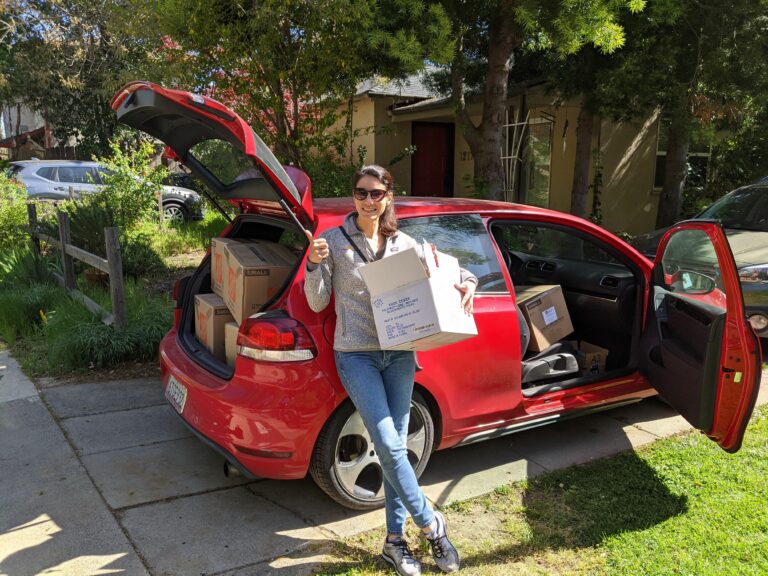
“This is a great way for students to get involved while still social distancing and maintaining shelter-in-place,” Solomon said. “All of our outreach to the community is done by phone, social media and email. We also have drivers who pick up and drop off donations, but we require that they take precautions to protect themselves, including wearing facemasks.”  

Before starting medical school at UC Davis, Solomon spent two years in the Peace Corps in Costa Rica.

“This project reminds me of that time, because it is a grassroots effort that requires partnering with community members and local groups to achieve a common goal,” Solomon said. “While COVID-19 and shelter-in-place has been a difficult and trying time for most of us, the high level of community action and the enthusiasm of our donors and recipients has inspired me and given me hope that we will get through this challenge together.”

For those interested in joining the volunteer efforts and for those who wish to donate supplies, contact the UC Davis MSD Sacramento branch at covid.ucdsom@gmail.com. The MSD Sacramento branch is also accepting medical students, who are not required to be a UC Davis medical student, to aid in provider support and patient outreach. For more information about MSD, visit their pages on Instagram, Facebook or Twitter.    

Written by: Sneha Ramachandran — features@theaggie.org

Humor: Letter: Lockdown proves we can live without the arts. Time to defund them for good

It’s nothing personal

For over 40 years, I’ve lived happily just off Main Street in an affable, amiable, agreeable little town where the Bible Belt meets the Rust Belt and the rubber meets the road, doing honest, blue-collar work at an honest, blue-collar factory that specially produces the highest-quality blue collars for America’s strongest, sturdiest, stoutest, solidist, soundest, heaviest-duty, longest-lasting, hardest-wearing, most robustly built beautiful, blue button-up blouses and shirts. The name’s S.M. Bleelyne, and I love my work. I love my work and I love baseball. In fact, I really love baseball, gosh darnit. I love baseball so much that I can’t live without it, even though it brings back memories of my son Junior. 

Obviously, with the coronavirus quarantine keeping me home from work and forcing the suspension of the MLB season, I’m currently struggling to live without my three loves. But I’m no pessimist, which is how I’ve managed to see that some good may yet come from this god forsaken plague. For example, we could emerge from lockdown with a renewed appreciation for the simple, pure, pastoral lifestyle that baseball epitomizes. Perhaps we could finally shed many of the laughable luxuries and trifling trivialities that the coronavirus has proved we can live without. That’s where I come in. You see, I’m optimistic that with a little help from me, this pandemic can most certainly eradicate a certain specific one of these useless vanities once and for all. And with the coronavirus by my side, I’m confident that I can actually come out the other side of this quarantine with all three of my loves again. Man he could swing a bat, that kid. Even when it was just T-ball. Sure do miss that.

That’s why I’m writing this letter. Now, I’m not a writer and I’m not a reader. But I know how to read the writing on the wall. And you know what it says? It says that the writing is on the wall for the arts. Yeah, that’s right. All the art galleries and performance halls are closed indefinitely and you know what? We’re all just fine. Fine without the fine arts. Just fine. Get it? We simply don’t need them like we need our real jobs and our baseball. The pandemic has proved we can live without the fine arts, so it’s finally time to defund them for good! Believe me, it’s nothing personal.

As you’ve probably gathered, I’m a fan of sports. But I’ve never been a fan of the arts. You know why? Because you can’t be a fan of the arts. You have to patronize them, and that’s just lame and boring. “I’m sorry, no cheering, screaming or booing in the art gallery! Hey old man, no beer, cottoncandy, peanuts or crackerjacks in the concert hall! Whoa there, pops! No fighting over foul balls at the theater!” Oh wait, I’m sorry — the theatre. Yeah, yeah, yeah, I get it, you don’t have to patronize me, okay sonny? Hey, how bout y’all patronize this, you pretentious patronizing f**ks! 

You see, I don’t go to take in a nice afternoon ballgame at the ballpark because I’m looking for “transcendence” or “self-actualization” or the need to “feel moved.” No, I go because I love baseball, gosh darnit! And it makes me feel alive. Art lovers wouldn’t get that. But you know who really used to get that though? Junior. When he was in Little League, he was alive. He was so damn good that he played on a team with the older kids. And you know what he did? What my little boy did? He hit a grand slam to win the Little League World Series. From then on, the bigger kids called him “Baby Grand.” He certainly was alive back then. When I was his age, I obsessed over trying to get a cool nickname like that on my baseball team!

But obsession isn’t healthy. People who needlessly obsess over the arts by buying season tickets to the symphony, frequenting the local art gallery, attending weekly poetry nights and going to their silly book clubs simply don’t understand what it’s like to regularly enjoy the comforts of cherished rituals and routines like sports fans do. Like I do by watching SportsCenter every night and taking myself out to the ballgame whenever I can spare a few bucks. Like my old neighborly neighbor Lee did by bringing over a batch of his homebrewed beer for us to enjoy every time the Yankees played the Red Sox. But that sacred tradition is where it all went wrong for Junior. One night, after his Red Sox destroyed my Yankees, Lee mentioned that his mother left him a baby grand piano that he could neither play nor make space for in his living room. He offered it to Junior for free. Said a couple piano lessons never did a kid any harm. Boy, was he wrong! Piano lessons killed Baby Grand. 

After several months it became clear that he was learning quite fast and was extremely musical for his age. And he really enjoyed it. I should have put a stop to it then. But how was I supposed to know that he’d soon turn into a goddamn child prodigy? Anyway, he soon quit baseball to focus only on music. He eventually got a scholarship to New England Conservatory, wasting all his baseball talent. I think he chose New England over Julliard just to spite the Yankees! And that’s not even the worst thing. Apparently, right before a performance of Poulenc’s Concerto for Two Pianos somewhere in the former Soviet Union, the concert hall’s second concert grand was badly damaged and he was forced to perform his part on a baby grand instead. Yet, he still managed to compensate and adjust in the moment to the instrument’s worse projection relative to the orchestra and the other piano. Big deal! But because of that, all his music pals call him “Baby Grand” now. Can you believe that? The nerve!

Well, the joke’s on you now, sonny! You’re quarantined in Paris or Prague or Parma or someplace. And you know what? You can’t do all your Brahms and Schumann and Chopin recitals. Maybe not for a while. That means no income. But you don’t need to worry because I’m taking action to make sure that this is never a problem for you ever again. I’m starting a movement to defund the arts for good. And believe me, it’s for your own good. Now you can finally pick up your hat, bat and glove again and lose this newfound fear for getting your hands dirty. You had it all! You coulda gone pro! But it’s not too late! You’re still young and fit enough to make it to the Major Leagues! This will all be worth it in the end. Because in times of crisis when they can’t work, classical musicians don’t get paid. But pro baseball players do. And if we defund the arts entirely, they can get paid even more.

Written by: Benjamin Porter— bbporter@ucdavis.edu 

(This article is humor and/or satire, and its content is purely fictional. The story and the names of “sources” are fictionalized.)

Local man steals COVID-19 sample from Sutter Davis, impersonates CDC official

Shaun Lamar Moore, 40-year-old Davis resident, arrested, charged with possession of restricted biological agent, burglary 

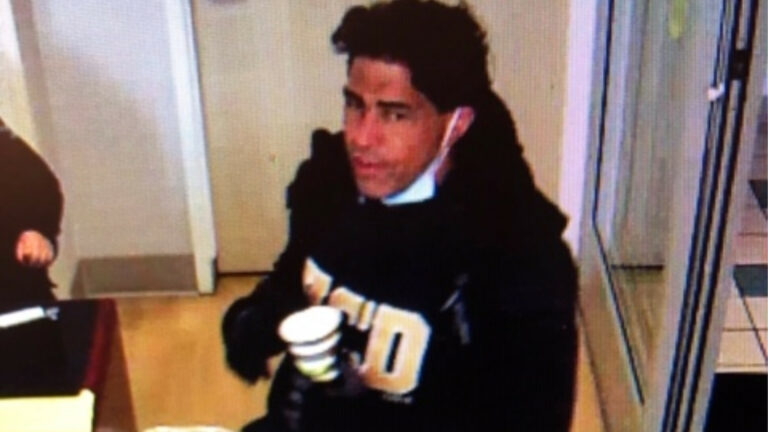
On Saturday, April 11, a man stole a COVID-19 specimen from Davis Sutter Hospital before abandoning it at a local pharmacy, an act that gained national media attention amid the coronavirus pandemic. The sealed specimen was recovered later that evening, and Shaun Lamar Moore, a 40-year-old Davis resident, was arrested the next day in connection to the incident. 

Late Saturday morning, Moore allegedly left the hospital carrying a lab specimen of COVID-19, but raised suspicion with hospital staff when they saw him leaving on his bike. The hospital staff’s concerns were amplified “when the actual courier arrived several minutes later,” according to The Davis Enterprise

Davis Deputy Police Chief Paul Doroshov discussed the police department’s response when they were notified of the incident. 

“Patrol officers responded to the hospital, and they made an initial assessment as to what’s going on based on the facts,” Doroshov said. “When there was a higher level of concern, the command staff was notified, and we responded — detectives too.”

Police patrols were sent out in search of the culprit, and the specimen was found abandoned later that day in a shopping cart at the CVS Pharmacy on West Covell Boulevard. A crime alert issued by the Davis Police Department mentions that there was no evidence the sealed specimen had been tampered with.

“Officers retrieved the specimen and Sutter Davis Hospital was able to confirm it was the missing specimen,” the statement read. “The lab also confirmed that several layers of protective packing were secure and the specimen had not been tampered with.”

Doroshov elaborated on how the Davis Police Department collaborated with Sutter Davis Hospital to determine the stolen specimen’s risk to public safety. 

“The sample was packaged twice, so there were two layers of plastic packaging the sample was in,” Doroshov said. “Each layer had some type of security seal on it. Sutter Davis subsequently looked at that and said the security seal does not look like it had been tampered with.”

Sutter Davis Hospital opened an internal investigation into the incident, according to an emailed statement from a Sutter Health spokesperson.

“Sutter Davis Hospital is committed to providing high-quality care to the Yolo County community and beyond,” the statement read. “We take this situation very seriously. We are conducting our own internal investigation, as well as working closely with county officials and law enforcement on the matter.”

The next morning, police officers spotted Moore biking on the Richards Boulevard overpass, and he was taken into custody. In a crime alert detailing the arrest, Davis Police Department officials mentioned that they were unsure of his motives; however, they do not believe his intent was to cause harm. 

“Davis Police are familiar with Moore and are determining whether any mental health conditions played a factor in this incident,” the statement read. “Although the incident is very serious, Detectives do not believe he intended to harm himself or others.”

When asked about Moore’s motives for stealing the specimen, Doroshov could not disclose any information as the case is active and “still under investigation.” In The Davis Enterprise article, the bail motion from Moore’s case explains how he allegedly impersonated a federal employee from the Centers for Disease Control and Prevention (CDC) in order to obtain the sample from the hospital. 

Yolo Superior Court Judge David Rosenberg, who oversaw Moore’s bail hearing, outlined certain restrictions for Moore now that he is released on bail, according to The Davis Enterprise.

“He ordered that Moore, who is homeless, be fitted with a GPS monitoring device and stay at least 100 yards away from Sutter Davis Hospital,” the article states. 

Moore is charged with two felonies and one misdemeanor: attempted possession of a restricted biological agent, second-degree burglary and petty theft by false pretenses. His next court hearing will be on May 27.

Written by: Madeleine Payne — city@theaggie.org

Yolo County election results from March 3 finalized: Measure G and Q pass

One county supervisor ousted as another heads to run-off election

Yolo election officials have released the final results of the March 3 primary elections, after more than a month of vote tallying. Two Davis ballot items — Measure G and Measure Q — passed, while the countywide supervisor races saw Angel Barajas defeating long-standing incumbent Duane Chamberlain, and Supervisor Jim Provenza heading to a run-off election in November against challenger Linda Deos. 

Final tallies for the March election were posted to the Yolo County website the morning of April 8. In the press release announcing the results, county officials said local voter turnout had surpassed the past two primary elections, and the vote counting had finished ahead of state deadlines — despite complications created by the outbreak of COVID-19. 

“Even with all the challenges associated with COVID-19, we were able to still certify an accurate and transparent election two weeks prior to the Governor’s extended deadline and had the highest primary election turnout since 2008,” wrote Jesse Salinas, Yolo County’s assessor, clerk-recorder and registrar of voters.  

Some of the races were all but decided shortly after the election, like Measure Q, which sought to renew a 1% city sales tax. Measure Q was approved by Davis voters, with 82.53% voting Yes and 17.47% voting No.

Approval of Measure Q brought to a close a process that began in September of last year when the city declared a fiscal emergency in order to avoid a “dramatic loss in revenue.” Assistant City Manager Kelly Stachowicz told The Aggie in 2019 that the emergency declaration was a pro forma move by the city council to allow the sales tax renewal to appear on the March 2020 ballot and avoid a gap in critical city funds.

The fate of Measure G was less certain before April’s final tally. The ballot measure —  which sought to impose a parcel tax on Davis properties in order to fund DJUSD teacher and staff salaries — required a two-thirds majority to pass. The initial results, posted two days after the election, showed the Yes vote at 65.06% — only a couple points shy of approval — leaving supporters in a state of uncertainty for most of March. 

The final results show a slim victory for the Yes of Measure G campaign, with 68.05% of voters approving the measure against 31.95% voting No. On the Davis Unified School District website, administrators thanked Davis voters for passing the measure once the election results had been finalized. 

“We are extremely thankful to the Davis community for their support,” Superintendent John Bowes stated in the post. “Our teachers and staff are the heart of DJUSD. Especially in these challenging times as we deal with the Coronavirus outbreak and this period of school closure, the successful passage of Measure G sends an important signal of support from our community.”

The April results also cemented the defeat of longtime Yolo Supervisor Duane Chamberlain, who began his tenure as the representative for the county’s fifth district in 2005, according to the county website. Chamberlain lost his seat to Woodland City Councilmember Angel Barajas, who earned 52.37% of the vote to Chamberlain’s 47.63%. 

In an Instagram post celebrating the victory, Barajas thanked his supporters as well as Chamberlain for his years of service in the office of county supervisor. He listed a few issues he plans to address before and during his time in the office, including issues related to the COVID-19 pandemic. 

“Although, I’m not sworn into office until January 2021, in the interim, I will closely monitor and work on issues of importance such as the COVID-19 pandemic, preservation of prime [agricultural] land, street and road repairs, homelessness, public safety, and other important local issues that matter to residents,” Barajas wrote. “I am dedicated to serving my constituents and will continue working hard to do so.”

The other contested county supervisor seat was a three-way race between incumbent Jim Provenza and challengers Linda Deos and David Abramson. Provenza finished first with 48.43% of the vote, Deos with 37.50% and Abramson with 14.07% — because no candidate received more than 50% of the vote, the top two finishers, Deos and Provenza, will compete again in a November run-off election. 

Written by: Tim Lalonde — city@theaggie.org

Announcement that The Pantry served over 5,000 unique students during February of 2020 at April 16 ASUCD Senate meeting

Senate re-does its pro-tempore election

The April 16 ASUCD Senate meeting was called to order by Vice President Akhila Kandaswamy at 6:12 p.m.

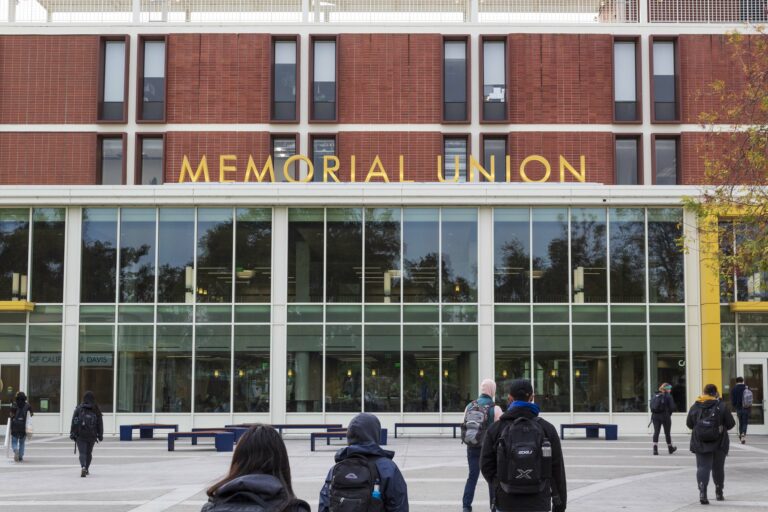
The meeting began with a quarterly report from Ryan Choi, the director of The Pantry, who discussed the ways The Pantry has adapted to social distancing and stay-at-home directives. The Pantry encouraged senators to volunteer to work on Wednesdays to help staff from The Pantry and Aggie Compass distribute groceries to students in need. Despite the closure of the MU, students continue to volunteer to help The Pantry provide for food-insecure students.

In his quarterly report, Choi highlighted how visits have increased exponentially since June of 2019. This past February, The Pantry served over 5,000 unique students. This number dropped by 50% in March 2020, likely in response to classes moving online and both local and state stay-at-home orders.

Choi encouraged senators to donate to The Pantry on UC Davis’ Give Day. Donations would be matched to help better support The Pantry’s continued efforts to address students’ food insecurity.

Next, Senator Juan Velasco, who was appointed as the Senate president pro tempore at the prior week’s Senate meeting, brought up the fact that the Senate did not have a majority when he was elected and, therefore, the election was unconstitutional. After a lengthy discussion regarding exactly what aspects of the Constitution were violated, the Senate moved to re-do pro-tempore elections. 

Senators Shreya Deshpande and Samantha Boudaie were nominated for the position. The table voted to postpone the pro-tempore election until later in the meeting.

Nicole Deacon, the Picnic Day chair, said she and her team made the decision to cancel Picnic Day before Chancellor Gary May released an official statement. Deacon was applauded by multiple senators for the way she handled the disappointing cancellation of the event after months of preparation. 

Though Picnic Day was cancelled, Deacon shared that her new priority was fundraising for next year’s Picnic Day through Give Day contributions.

After Deacon’s report, the Senate returned to the senate pro-tempore elections for the third time. Ultimately, Boudaie was elected to the position.

Greg Ortiz, the ASUCD business manager and acting director of Refrigerator Services, presented the unit’s quarterly report. This service provides students living on-campus with refrigerators. According to Ortiz, this is usually one of ASUCD’s most profitable units, but due to COVID-19, Ortiz anticipates the unit will incur around $25,000 in refunds, in addition to cleaning expenses.

Next, Alexa Kendell, a first-year philosophy and political science double major, was confirmed as Internal Affairs Commission (IAC) chair. Kendell currently serves as a member of IAC.

The Senate then moved into consideration of new legislation.

Senate Resolution #15, authored by Academic Affairs Commission Chair Naomi Reeley, aims to bring attention to the difficulties and constraints Muslim students face during Ramadan. Reeley said in the past, professors have lacked understanding about the unique challenges students observing Ramadan face. The resolution would encourage teachers to be flexible with these students in class and and in terms of attendance.

Senator Mahan Carduny argued that the wording of the resolution may encourage what he called, “Ramadan laziness,” when students neglect their academic responsibilities. After discussion and an amendment to clarify the language, the table moved into a roll call vote. Despite frequent opposition during discussion, Carduny voted in favor of the resolution and it passed without objections.

The Senate moved into discussion of Senate Bill #48 and SB #49. SB #48 would amend the language associated with the student advocate office in the bylaws. SB #49 would amend language associated with the cabinet of the student advocate in the bylaws. Both bills passed without objections. 

The Senate then discussed the recent editorial published by The California Aggie Editorial Board entitled “The Aggie demands selection of its new editor-in-chief be halted until adjustments are made.” Authored by the nine members of The Aggie’s Editorial Board as well as the four prospective candidates for the 2020–21 editor-in-chief (EIC) position, the editorial announced that all four candidates for EIC were refusing an interview with the Media Board, the campus advisory board that selects The Aggie’s EIC, until it was able to obtain quorum, as mandated by its bylaws. 

The editorial also demanded that the selection process be completely remodeled in the future to give Aggie staff members, not the staff and faculty members who composed the Media Board, autonomy in choosing their own EIC, as is the case at all other UC campuses and at most other colleges newspapers.

The Senate then moved into a closed session to discuss a personal issue.

Written by: Ally Russell — campus@theaggie.org

Correction: A previous version of this article stated that the number of students served by The Pantry was 15,000. That is incorrect. That was the number of visits. The number of unique students served was actually 5,242. The article has since been updated to reflect that change. The Aggie regrets the error.

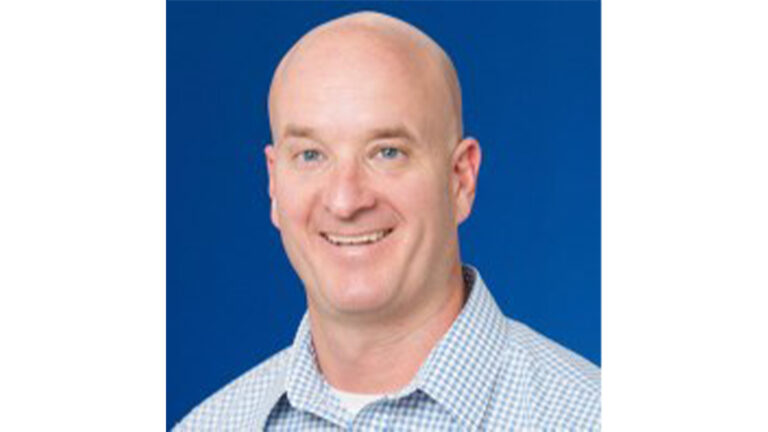
Economics Professor Scott Carrell provides perspective on teaching online, while maintaining a sense of humor

Carrell discusses readjusting his teaching style

Professor of economics Scott Carrell has a keen sense of humor and a spirited demeanor while teaching, according to his students. Carrell said although transitioning to online learning has negative aspects, such as not being able to see his students’ faces, it’s mostly akin to the real thing. 

“It’s really interesting,” Carrell said. “It feels to me like 80% of a live lecture because I am getting that feedback in real time. A disadvantage is that I don’t see the students’ faces, so I feel like I’m not getting to know any of the students. With 400 students in a lecture hall, you don’t tend to get to know the students, but you do recognize the faces.”

 When Carrell first began as a professor in the Air Force Academy, he taught classes of only 15 to 20 students and would learn every student’s name. When he moved on to teaching at Dartmouth College, there were 40 to 50 students in his class, and he still eventually managed to learn every name. Now, teaching lectures of 400 or more students at UC Davis, he only gets to know the students who attend office hours, and said, now, there’s an added difficulty to establishing relationships when office hours are held on Zoom. 

“I get to know students who come to office hours, when I had regular office hours, […] pretty well — but that’s obviously a little tougher on Zoom,” Carrell said. “And they don’t show their face on office hours most of the time either. There is this culture among students not to show their video feed. Even in my graduate course — I have 15, 16 students in my graduate course — and only one or two have their video feed going.”

Although face-to-face interactions between students and professors might be lacking, Carrell said he continues to add the same humor and anecdotes to his lectures as before, whether or not there’s an audible response on his end.

“I still try to have a little bit of sense of humor,” Carrell said. “The problem is, you don’t know if people are laughing or not. But I have a few stories that I’ve told for the last fifteen years, and so some of the ones that the students seem to like, I still try to tell the same jokes or stories and have a sense of humor online. I don’t know how those are going via Zoom, but there’s 400 students out there you could ask.”

The feedback he has received on his online lectures so far has been indirect, in the form of a social media post his son passed on to him.  

“I have an iPad that I’m using and I didn’t have an Apple pencil, I had this cheap pen that I got off of Amazon,” Carrell said. “But I was drawing my graphs the other day and my son, who’s a junior at Davis High, […] shows me a picture of his, I think it was Snapchat, and says, ‘Dad, your graphs are horrible.’ So someone in my class had put on Snapchat, ‘Someone tell Professor Carrell to get an Apple pencil.’ So I rush-ordered an Apple pencil, which I will use in my next lecture.”

During one of his online tests, in which students are proctored by having their webcams turned on, Carrell witnessed something that he deemed to be meme material.

 “One person left their camera on and left, and their roommate was out in the hallway dancing,” Carrell said. “I thought that if someone was watching that, it would definitely be a meme.” 

Written by: Lyra Farrell —  features@theaggie.org