40.5 F
Davis

Davis, California

Sunday, December 28, 2025
Home Blog Page 397

Power to the player

0

As athletes begin to take more control over their careers, owners are looking for a way to limit damage

Since the inception of the various professional sports leagues in the United States, the athletes would take care of business on the field and make sure that they abided by the rules set by the team, regardless of how it affected them. Players were discouraged from challenging these teams because, after all, it was the team that had control over them and their careers. But recently athletes have begun to take major steps to control their own career outcomes, even while under the control of a franchise that pays them. These developments have owners and executives wondering how far until players completely take control over the sports they play. 

The three major professional sports leagues, the National Football League, National Basketball Association and Major League Baseball, are all controlled very differently and have developed at different paces. But each league is slowly progressing toward one common goal and their observations of one another have had a huge impact. 

In many aspects, the NBA seems to be the league that is the most progressive and forward-thinking. When it comes to player autonomy, the situation is no different. After the turn of the century, there was a shift in the thought process among the players. One specific incident sparked a new era in professional basketball that signaled to players that they could play wherever and with whoever they want. 

On July 8, 2010, free-agent superstar and reigning MVP Lebron James announced on ESPN that he would be signing with the Miami Heat, joining fellow all-stars Dwyane Wade and Chris Bosh in creating the first-ever “superteam.” After seven years and only one NBA Finals appearance with the Cleveland Cavaliers, James shocked the NBA universe by leaving. 

When examining the great teams of the past, the majority of them were “homegrown” like Michael Jordan and Scottie Pippen or the Spurs dynasty of Tim Duncan, Tony Parker and Manu Ginobli, and so many other greats, so this decision was one that came with much criticism. After James’ move to Miami, more players began to realize how much control over themselves they really had, and that the idea of loyalty to a team only worked for the benefit of the team itself, not them. 

This event largely set the stage for what is happening in today’s NBA, where a number of star players seem to be able to join whatever team they chose, force themselves out of situations they don’t like and finally just be free. A more recent example occurred just this past summer between Paul George and the Oklahoma City Thunder. After leaving a frustrating situation with the Indiana Pacers just two years prior, George requested a trade to join Kawhi Leonard and the Los Angeles Clippers in July. The Thunder were left with no choice but to trade George as they faced a combination of the possibility of receiving valuable record-setting picks and having a disgruntled star in the locker room.

All-NBA power forward Anthony Davis, who spent the first seven years of his NBA career with the New Orleans Pelicans, decided that he wanted out last season. His preferred destination was Los Angeles to join James and the Lakers, but the two franchises were unable to reach an agreement at the trade deadline in February. This led to an awkward last leg of the season for Davis and the Pelicans. Davis had to instead wait until June 15, when he finally got his wish to become a Laker. 

The NFL in many ways contrasts everything the NBA is and what it isn’t. The league is more conservative in nature and has a relatively unpopular commissioner. But despite these differences, the NFL has slowly begun to mirror the NBA in terms of players demanding more for themselves. 

One of the best running backs in the game, Le’veon Bell, sat out an entire year as a result of a contractual dispute with the Pittsburgh Steelers and then left for New York in free agency. In the last year, players like All-Pro wide receiver Antonio Brown, defensive end Jadeveon Clowney, young offensive tackle Laremy Tunsil, veteran offensive tackle Trent Williams and All-Pro Cornerback Jalen Ramsey have all either sat out in protest or demanded trades from their respective teams. While Williams has still has not been traded from Washington, Brown, Clowney, Tunsil and Ramsey were granted their wishes and sent elsewhere. All are among the best in their respective positions and with players like Minnesota Vikings wide receiver Stefon Diggs voicing displeasure more openly, it seems like it is something that has begun to make its way across leagues. 

While the MLB doesn’t necessarily have an issue with players demanding trades, it appears that there is a different problem looming. When you look at the biggest contracts among professional sports leagues, none are more lucrative than those in baseball. This past offseason, star players Bryce Harper and Manny Machado were available as free agents and there were rumors spread about the possibility that one of these players would sign a never-before-seen $400 million contract. 

This ultimately wasn’t the case, but both were still able to sign extremely lucrative deals. Machado got 10 years and $300 million with the San Diego Padres, while Harper received $330 million over 13 years with the Philadelphia Phillies. These ridiculous numbers were soon to be overshadowed when, just weeks later, arguably one of the game’s best players, Mike Trout, agreed to an unheard of $430 million dollar extension over 12 years. 

These types of deals seem to be the new going rate in baseball now, and as salaries continue to grow, team owners might be more reluctant to offer that much money to these players. Investing that much money on one player is typically a high-risk investment, and in a sport like baseball, it is rare that one player can change a whole franchise all at once. None of the three players who received the big money deals this past offseason played in a playoff baseball. The owners, particularly of big market teams, have begun to notice that and will likely become hesitant to offer huge contracts in the future.

All of this begs the question: What point is it too much and when does a league needs to step in? These trade demands by high-profile players and big money spending can ruin some franchises and throw off the parity of the league, as only the big market teams will be the destinations for these players. 

These are all major talking points in the upcoming Collective Bargaining Agreement negotiations. The NFL has already begun negotiations between the owners and players’ association as the CBA is set to expire after the 2020 season. In the MLB, the CBA is set to expire until after the 2021 season, and we will know more about the direction of these contracts. Finally, the league that arguably started it all, the NBA, has to wait until after the 2024 season before their contracts expire after a seven-year agreement was taken into effect starting in 2017. Based on the events that have transpired, it will be interesting to see where the league is in five years and whether the trend continues. 

When players are playing at their highest levels, they are loyal to their colors and teams love every moment of it. But when a player begins to struggle, the team wastes no time to get rid of them. That is the unfair balance in sports and something these players have begun to realize. Star players have become more aware of their power and the teams will try to do something to stop this before they end up on the losing end. 

Written by: Omar Navarro — sports@theaggie.org

Bachelor vs. Love Island

Students explore which guilty pleasure dating show they gravitate to more

The dating and relationship reality television series “The Bachelor” first aired in 2002 on ABC. The show’s premise is centered around one bachelor who dates a pool of women contestants, eliminating women as the weeks go on and ultimately proposes to the winner with a Neil Lane engagement ring.

 Since its premiere 17 years ago, “The Bachelor” has risen to national acclaim, spawning the three spin-off series “The Bachelorette,” where one woman dates multiple men in search of a husband, and “Bachelor in Paradise,” where previous contestants of either show are sent to Mexico and try to find compatibility with other contestants and “The Bachelor Winter Games.” These series are viewed by millions of people, and the entire franchise remains as successful and relevant as ever. 

However, just because the show is successful does not mean that it goes without criticism. The premise of one person dating multiple people until finding “the one” can be seen as disingenuous and tacky. The ridiculous fights and dramatic moments on the show feel forced and storylines are often an obvious result of clever editing. 

The franchise has also been criticized for its lack of diversity and conservative values that force women into traditional roles. On both “The Bachelor” and “The Bachelorette,” it is presumed that the woman will follow the man in life. Women are shamed for kissing numerous men and taking advantage of the Fantasy Suites, which men are not.  

“Even on ‘The Bachelorette,’ where the women presumably have all the power to decide, she is as inactive as possible in her own decision,” writes Kelsey McKinney for Vox

Carla Correa, a writer for The New York Times, explains how most people tolerate the absurdity of it all due to the escapist pleasure it provides for its viewers. 

“The only way to sit through a two-hour episode is to accept the polyamorous spectacle as one big social experiment,” Correa writes. 

Meanwhile, the 2015 British reality series “Love Island” has been rising in popularity in America, competing with “The Bachelor” franchise for the top reality dating series.

“Love Island” centers around a group of young singles sent to live in isolation in a villa in Mallorca, Spain. In order to remain on the show, contestants must be coupled up with each other by the end of the round. However, unlike “The Bachelor,” couples rarely have their eyes set on marriage. Often, contestants couple up with their friends just to remain on the show.  

While “Love Island” is equally as melodramatic and vapid as “The Bachelor” franchise, it maintains a British sense of irony and humor. Narrator Iain Stirling constantly makes fun of the contestants and mocks the reality television format in general. 

“There’s nothing fake about this show, nothing,” Sterling quips in a voice-over during one episode. “Now would someone move that plastic fern next to the AstroTurf, it’s blocking the shot.” 

While similar in premise and content, this aspect gives “Love Island” a starkly different tone than “The Bachelor.” It’s raunchier and more self-aware — it does not try to force elements of classiness that “The Bachelor” so often attempts but fails to do.  

Second-year philosophy major Susmita Bagchi prefers the relatable nature of “Love Island” in comparison to the often larger-than-life romances of “The Bachelor.” 

“I love all the sayings and their accents,” Bagchi said. “I like how messy it is and how the producers just add people in to stir up drama.”

Meanwhile, third-year psychology major Amanda Druyan said “The Bachelor” franchise, especially “Bachelor in Paradise,” is a better version of what “Love Island” tries to accomplish. 

“‘Love Island’ is weird to me,” Druyan said. “They all sleep in one room together. The ‘Red Room’ reminds me of something from ‘50 Shades of Gray.’” 

She also mentioned that the contestants being confined in one villa feels claustrophobic and that the series gets boring and repetitive, especially with 50 episodes per season. 

Some students prefer neither. Third-year cognitive science major Hayley Raizes dislikes both series due to her belief that they are trivial and self-indulgent.

“I don’t really enjoy watching the shows that dramatize things because, even though it can be funny, I don’t really agree with the way it tends to amplify first-world problems,” Raizes said. 

At the end of the day, it comes down to preference. While neither show is revolutionary, they provide some sort of romantic escapism that is sometimes helpful when life becomes too real. 

“I think people just gravitate towards the idea of watching the journey of people falling in love and seeing it all unfold,” said fourth-year managerial economics major Samar Feghhi. “It’s just a mixture of drama but also rooting for a happy ending and a happy couple.”

Written by: Alyssa Ilsley — arts@theaggie.org

Is faking your death the only way to get your absences excused?

Another one bites the dust

More often than you’d like, you get that one flat-haired professor who really demands your company in class. You know, the whole “attendance is mandatory and if you miss one class you fail” spiel. Death in the family, a nasty case of the flu —  he’s already heard it all. You should have planned ahead of time. No excuse could ever come close to the importance of your 8 a.m. discussion — no — your two-hour lecture, if your life depended on it.

Chemistry major and proud Swiftie, Freddy Morten thought he would test out a controversial yet brave approach. On Sunday night at 2 a.m., he emailed his organic chemistry professor John Demort the following message:

“Hello Professor Demort,

Unfortunately due to his sudden passing, Freddy Morten will not be able to attend lecture on Monday. Thanks!”

To no surprise, the email jolted Professor Demort, leading him into canceling Monday’s 4 p.m. to 6 p.m. lecture. That afternoon, a dark cloud hung over Haring 1207.

Outside his humble Sequoia apartment, we questioned Morten about the audacity of his plan.

“It was easy, I just signed it as my mom. The old man totally bought it!”

We couldn’t help but mention Morten’s eye-catching t-shirt. He maniacally grinned.

“You see, there was a Taylor Swift concert happening that night. You know I couldn’t miss it.”

Looking around his living room at his various posters and figurines, we soon understood that he really couldn’t miss it.

In the following lecture, Morten promptly attended class, even taking the midterm that day. It wasn’t until he began grading later at night that Professor Demort noticed Morten’s name marked on the attendance sheet. 

“For a moment, I thought I was seeing things,” Demort lamented. He carefully removed his glasses and looked down at them. “Could it be that… after all these years of failing these careless, ditching students, that I would be the one haunted by this torment?”

Morten notes that even though he missed almost every single point, he still received an A on the test.

“I think he feels bad, you know, since I’m supposed to be dead? Sometimes I’ll accidentally make eye contact with him in class and he’ll start to tear up.”

Morten tells us that he plans to tell the truth to Professor Demort after the final. In the meantime, he’s planning a fake funeral to be held next week.

“It’d be really cool if you guys could come,” he wants to tell readers. “I’d really appreciate all the support!”

Written by: Julietta Bisharyan — jsbisharyan@ucdavis.edu

NBA 2019-20 Season Preview

0

A wild offseason leads to most anticipated season in years

A league that has been predicated on drama, storylines and massive change year-to-year, the NBA did not disappoint this summer as a wild offseason has led everyone to believe this year may be the best NBA season in recent memory. In only the first 24 hours, players across the league totaled over $3 billion worth of new contract value, according to Jeff Siegel of Early Bird Rights.

The madness began, however, even earlier than the June 30 date. On the afternoon of June 15, just days removed from the end of the NBA finals, ESPN’s Adrian Wojnarowski broke the massive news that superstar power forward Anthony Davis had become a Los Angeles Laker. In a deal that included young players Brandon Ingram, Lonzo Ball, Josh Hart, three first-round picks and two pick swaps, the Lakers finally acquired another star to put alongside Lebron James after many failed tries throughout the season. 

After the news broke, the Lakers instantly became favorites to win the 2020 NBA Finals, with 9/2 odds, and looked to add someone else that would make their odds of winning it all even greater. Once news of the Lakers getting Davis settled in, like the rest of the NBA, Los Angeles set its sights on the biggest free agent, Kawhi Leonard.

Fresh from winning the Toronto Raptors their first NBA championship in franchise history, Leonard sparked ambiguity over where he would go. Even though the star forward won a ring with the Raptors, there were no promises he would stay since he was traded there. With many questions in the air, there were almost no answers. NBA analysts across networks made confident statements that their belief was that Leonard was going to become a Los Angeles Laker and be a part of one of the most powerful superteams the leagues has ever seen. “Kawhi Watch,” as it was called on social media, tracked the star’s every move. Finally on the night of July 5, the NBA world was hit with groundbreaking news once again.

Yahoo Sports’ NBA Insider Chris Haynes broke the news just minutes before 11 p.m. PST that Kawhi Leonard was signing with Los Angeles. But to the surprise of many, it was the other team in the City of Angels: the Clippers.

The news certainly shocked most everyone around the NBA, as it had seemed the Clippers were supposedly out of the running for Leonard. But as was later revealed, the Clippers had been silently moving towards acquiring both Leonard and another superstar piece to put beside him. Just three minutes later, Wojnarowski broke the news that the Clippers had acquired all-star Paul George from the Oklahoma City Thunder for young point guard Shai Gilgeous Alexander, Danilo Gallinari and a record five first-round picks. The Clippers went from a team with a promising future to an instant contender in one night.

On the other side, it seemed that the Oklahoma City Thunder had a decision to make regarding homegrown superstar Russell Westbrook. It now seemed like the team was going to enter a rebuilding phase following three straight years of first-round exits. So after the Thunder’s executives sat down with Westbrook to discuss possible options, a destination for the former NBA MVP was found.

Wojnarowski once again reported on the afternoon of July 11 that a trade had been agreed upon between the Thunder and the Houston Rockets. It was yet another major move in an already loaded western conference that made things so much more intriguing. But although the West did get a lot stronger, the Eastern Conference had its share of major moves as well — some that will impact this season and some that will impact the next. 

Two minutes after free agency officially began, two-time Finals MVP Kevin Durant announced via “The Boardroom” Twitter account that he was heading to Brooklyn and sign with the Nets alongside all-star point guard Kyrie Irving. For much of the year, it was believed that the two stars were planning on teaming up, but on the Knicks. Ultimately, they decided on Brooklyn. While Durant will miss this season to recover from a torn Achilles tendon he suffered during the NBA Finals, it will be interesting to see next year what he is able to do with Irving by his side come next season. 

Durant and Irving left their teams in two very different situations. After the Warriors acquired Durant in the summer of 2016, they went on to win two championships out of the three years he was there. While no one knows the exact reason for his departure, many speculate that it could be due to a mix of views about his legacy, bad relationships in the locker room and an overall lack of faith in the medical staff. On Irving’s side, after Boston acquired him in 2017, there were high expectations that he was unable to fully meet, which bred dissatisfaction all around. Both the Warriors and Celtics lost great players, but they did not go quietly in the offseason, either, as they tried to stay relevant and possibly get better. 

While you can never replace Durant, Golden State did acquire young all-star guard D’Angelo Russell. Russell gives superstar point guard Stephen Curry help as the Warriors wait for Klay Thompson to recover from a major ACL injury. And after the loss of Irving, Boston looked to fill its point guard spot by signing free agent Kemba Walker to a max deal of 4 years/$140 million. Walker will look to help young players Jayson Tatum and Jaylen Brown develop as they will need to be major focal points if this team looks to contend this year.

For the Celtics, the loss of Irving took a hit, but the fact that their star forward, Al Horford, left to another contender in the East makes matters worse. Horford signed with the Philadelphia 76ers, who also re-signed small forward Tobias Harris, putting themselves at the top of the discussion to come out of the conference. It would seem that they will have to battle the Bucks and reigning NBA MVP Giannis Antetokoumpo for a ticket to the NBA finals this season. 

As the season gets ready to tip-off on Oct. 22, the Clippers are title favorites according to the Las Vegas Superbook at +350. Close behind them are the Lakers at +400, followed by the Bucks at +600 and the Rockets and Sixers tied at +800, rounding out the top five. It continues with Curry and the Warriors at +1200, the newly acquired Mike Conley and the Utah Jazz at +1400 and the promising Denver Nuggets at +1600. 

Many other small moves may have gone under the radar and we will begin to see them as the season goes along. This offseason has brought a tremendous amount of excitement and eagerness to many NBA fans, and for the first time in a long time, the NBA seems to have found a new level of parity. The Western Conference will be shifting throughout the year as teams will have to battle out to become among the top eight teams. It seems like at the very least, there are nine legitimate contenders this year as opposed to one clear-cut favorite. It can go either way and if you are a basketball fan, this season is shaping up to be one you do not want to miss. 

Written by: Omar Navarro — sports@theaggie.org

Town Hall meeting held on campus focused on cancellation of student debt

Davis City Hall to hear on issues concerning student debt

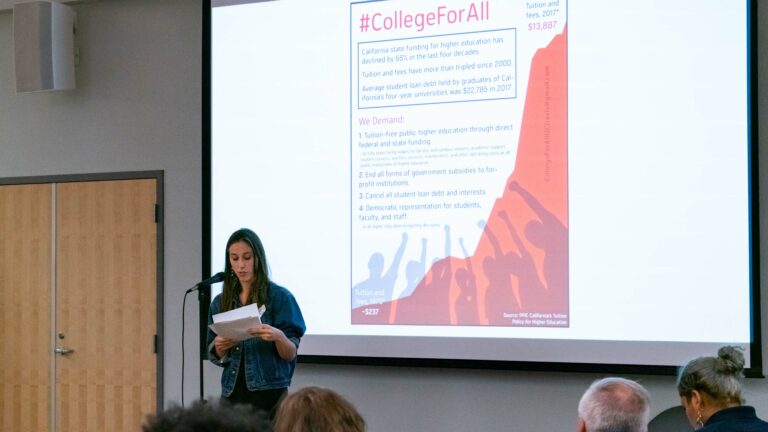
A town hall meeting held on Oct. 9 revolved around a discussion of potential strategies to cancel student debt. The event, held in the Art Annex at UC Davis, was open to Davis community members and groups led by California for Student Debt Cancellation — a coalition comprised of student organizations, labor unions and other community groups.  

The meeting, which began at 7 p.m. and ended at 8:30 p.m., featured various speakers discussing potential ways to tangibly solve problems concerning debt. Dillon Horton, a 2017 UC Davis alumni, spoke about his campaign platform to run for Davis City Council: Horton hopes to tackle student debt by means of addressing housing issues and economics. As a former student, Horton tied in his own experience in seeing gaps with student accessibility that stem from debt.  

“We haven’t had a student or recent graduate on the city council for a decade, and we have never had an African-American man on the city council,” Horton said. “I spent most of my time in student government on student accessibility issues. I’m running right now for the city council — mostly focused on the housing crisis and economic development. Those issues are inextricably linked to student debt.” 

Morganne Sara, a graduate student in the anthropology department at UC Davis, discussed the large impact student debt currently has on millions of individuals.

“Total student debt right now is at around $1.6 trillion [for] 45 million people,” Sara said. “48% of our students will graduate with debt. Knowing that my students will be graduating with this amount of debt makes me anxious and angry.” 

Katie Rodger, president of the University Council-AFT Union, spoke about her experience with the system of loans and student debt, according to a video posted on Facebook. Rodger initially believed she could handle her debt, but interest began piling on top of what she owed. She now consistently has to keep paying off her loans. 

“To the best of my ability, I determined that I could shoulder the burden of my debt,” Rodger said. “As a middle-class graduate student, I didn’t have the means to finish my degree without those loans. It wasn’t a question of negligence or responsibility — it was simply reality.” 

Sara asked rhetorical questions on how students lack freedom when they owe student debt, which can follow them for the rest of their lives.

 “Let me ask you this — is it really freedom if you chose not to start a family because of student debt?” Sara asked. “I don’t think so. Is it really freedom that you can’t rent an apartment because you have student debt? I don’t think so… I don’t think that’s freedom.”

This meeting generated pressure for solutions — the town hall was just the beginning of conversations concerning student debt. An additional town hall meeting will be held on Oct. 21 at 3 p.m. at Davis City Hall will bring the movement to the consideration of local leaders.

Written by: Taylor Martinez — city@theaggie.org

Northern California wind advisory issued, conditions expected to continue until Tuesday

The National Weather Service issued a High Wind Advisory for North Central California that expired at 11 p.m. on Sunday night. Conditions are expected to continue into Tuesday, when another wind front will reach the Davis area.

“The wind advisory was allowed to expire, and tomorrow should be fairly calm,” said Sierra Littlefield, a meteorologist at the Sacramento Weather Forecast Office. 

Still, the next front could “reach upwards of 40 mph at night, and still be pretty breezy in the day,” according to Littlefield.

This weekend, northeast winds averaged around 30 to 40 mph and reached upward of 65 mph in areas with higher elevation. 

There have been several reports of fallen trees and power lines on campus and in the surrounding areas, causing road blockages and leaving many residents in the dark. The Sacramento Municipal Utility District reported there being as many as 200 active outages with more than 20,000 total customers affected at one point on Sunday — with 4,000 of those customers located in Davis, according to a PG&E report obtained by UC Davis campus officials. 

“The power outages are wind related and not part of [the PG&E] Planned Shutoffs,” tweeted the City of Davis Police Department.

Davis received an Air Quality Index score of 156 by the Environmental Protection Agency, indicating unhealthy levels of particulate matter in the air blown in by the high winds. A petition was started by user “Fire Out” on Sunday at 3 a.m., calling for the cessation of instruction at UC Davis until the air quality improves; more than 4,800 have signed it. 

“Similar to last year, we should have the same procedures and expectations to close down the school and classes until the conditions are healthy for us to breathe in,” the petition states.

At 5:56 p.m., however, a UC Davis Aggie Alert was sent to notify staff and students that class will resume as usual.

There is concern that the current weather conditions could fuel the spread of several fires currently burning through Northern California. One county of specific concern is Sonoma, where the Kincade Fire has continued to grow, forcing nearly 200,000 to evacuate. A Red Flag Warning will be in effect through early Monday for the Sacramento area.

“It’s really dry, the moisture levels are still low […] so try to avoid anything that could start a spark,” Littlefield said.

UC Davis has provided safety information on its website and will continue to update students through WarnMe messages and social media. 

Written by: Megan Tsang — city@theaggie.org

Player Spotlight: David Goulak

Fourth Year Men’s Tennis Captain reminisces on past accomplishments, prepares for final season as an Aggie

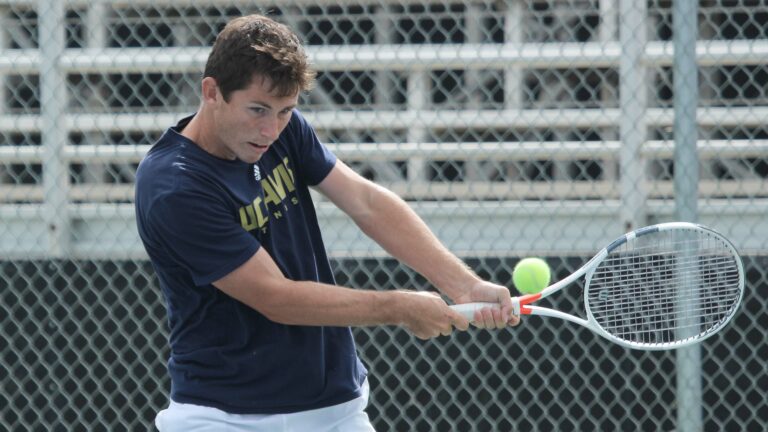
Balancing life around one’s academic work is difficult as is, but for fourth-year tennis star Davis Goulak, the balance is just another part of his everyday life.

Goulak is a force on the UC Davis men’s tennis team for both doubles and singles. He has participated on the team since he was a freshman, when he was awarded Big West Conference Freshman of the Year. The Oak Park, Calif. native has always been a strong leader on the court, too. He has been playing tennis since a very young age. When he was just 10 years old, Goulak started participating in competitive tournaments. At around 14, he began to gain more attention and started going to national-level tournaments. And by the age of 16, he was ranked in the top five in his region. 

A five-star recruit according to TennisRecruiting.net, Goulak was ranked No. 40 in the nation and No. 12 in the state of California. He also finished third in doubles at the 2015 U.S. Tennis Association Winter National Championships in Arizona.

 Goulak finished his high school career with the Coastal Canyon League MVP in doubles. For the Aggies, Goulak has been awarded Big West Conference Second Team Doubles his freshman and sophomore years and then first team doubles as a junior. He has been awarded second team singles during his sophomore and junior years. At the end of last season, Goulak and his doubles partner, junior Ivan Thamma, became UC Davis’ first ITA national doubles ranking since 2011, ranking No. 66 (as of Apr. 16) and finished the year ranked No. 4 in the ITA Northwest Region. 

The Aggie sat down with Goulak to discuss his tennis upbringing, his biggest accomplishments here at UC Davis and much more.

Aggie: You have had a tremendous career at UC Davis, both first and second team accolades for the Big West conference. What do you think has helped you get to where you are now?

Goulak: I mean it is probably a lot of things, like my parents pushing me when I was younger, my coaches when I was younger, getting recruited here, the coaches here, just everyone who has helped me get here. I also feel like I am a pretty hard worker — so my work ethic. 

Aggie: How did your youth playing and high school help prepare you to be such a force at Davis?

Goulak: My parents really toughened me — they pushed me. They made me understand that there’s a lot higher level to compete even when I was a kid and nationally ranked as a junior, there is still a lot of a long way to go so they were always there to help push me. [Those were] the biggest factors. 

Aggie: What were some of the biggest challenges you faced while being on the team here at UC Davis?

Goulak: Staying healthy. I keep on getting injured and it is so tough when you go through rehab and can’t be 100% at practice and you can’t compete or be there for your teammates. It is very tough mentally, and obviously physically — but that’s probably the toughest thing I have had to deal with. Also, time management. Sometimes it is so tough when you’re on the road for so long and missing so much class. 

Aggie: What are your goals this season, both individually and for the team?

Goulak: Individually — doubles-wise for me and Ivan [Thamma] to go to the NCAA tournament at the end of the year and try to be All-Americans. That’s our biggest goal. Singles-wise, I am just going to try to win as much as I can and get as many wins as I can for the team. And hopefully get first team singles this year. [Team-wise], hopefully we can have another good year and a winning record. The biggest goal is always [to be] Big West champions at the end of the year. 

Aggie: What are the prospects for the UC Davis men’s tennis going forward? 

Goulak: I think it is to just keep growing. The last five to six years, Davis had a bunch of losing records. Now we have a bunch of winning records. The last couple of years we won the number one going into the conference tournament. I think [head coach] Eric [Steidlmayer] is pushing in the right direction, he has a lot of big ambitions. Hopefully we win Big West this year and I am sure they will be pushing for wins in the first round of NCAAs and then keep pushing and get higher ranked. I know he wants to make this an elite program.

Aggie: How are you able to balance playing division-I tennis at a high level and your academic schedule as a mechanical engineer double major? 

Goulak: Good time management. I have been doing tennis and school my whole life — I just manage my day. I know what I need to do and how much time do I need to do it. I don’t really waste too much time with free time. You’re kind of just working all the time. You grind when you grind and if you have some free time, you go and enjoy it.

Aggie: For someone who must have been highly recruited out of high school, why did you ultimately end up choosing to come to UC Davis?

Goulak: A lot of reasons. I love the coach. I love the campus. I wanted to stay in California, but I wanted to get away from SoCal. The campus is unreal, the coaches are unreal. When I met the team, it was by far the closest team I met, compared to all the other campuses. It’s just a bunch of good guys — I just wanted to be around that. 

Aggie: What have been your major highlights or achievements so far in your career as an Aggie? 

Goulak: Me and Ivan [Thamma] last year, we won a pretty big tournament — a well-known Fall tournament called the Jack Kramer Classic. Davis had never played in that, and me and him, we won the doubles and I’m sure a lot of people out there hadn’t really heard too much about Davis Tennis, so that was pretty big. A bunch of doubles wins [as well]: beating Stanford, ranked 21 and 22 two straight years, and beating Cal when they were top two in the nation at that time in doubles. For singles, my most memorable win would be against UC Irvine my sophomore year. I was down match points in the second set, and came back to win and clinched it for us. 

Aggie: What are your plans for next year?

Goulak: I have another year in school because I am double majoring, so I still got some work. I want to try and start working right after college in the aerospace industry to try and work my way up there, and eventually my biggest goal is to be an astronaut. 

Aggie: What will you miss most about playing college tennis?

Goulak: The two things would be, [one] the comradery with teammates. All the road trips and late nights driving on [Highway 5] back from SoCal and just being with those guys. That was a lot of good, fun memories. The second thing would definitely be the competitiveness. That’s one of the main reasons why I play: I love to compete and I have never played tennis on such a competitive level. There can be a guy who is way worse than you and he will fight to the death with you, and he won’t care what name you are, what school you play for — he’s just going to compete. 

Written by: Frankie Veverka — sports@theaggie.org

Software bug hampers Wi-Fi access

Campus Wi-Fi gets back to school jitters

In early October, with Fall Quarter just underway, many on campus encountered an inability to log in or stay logged in to the campus Wi-Fi Eduroam. These difficulties impacted students and faculty who rely on the network’s capabilities for accessing Canvas, using the library catalog and registering for classes. 

Eduroam is a “world-wide roaming access service developed for the international research and education community” provided by the software management company InCommon. The system provides access to Wi-Fi over a community linked to the credentials of the users. It has its roots in Europe, where it gained traction in education facilities before crossing the Atlantic and spreading into academic institutions all over the United States. Today, there are over 10,000 Eduroam hotspots at academic-oriented facilities across the world.

Eduroam, however, is only one major component in a multipart system that distributes Wi-Fi to the thousands of devices online on campus each day. 

Bill Buchannan, a communications representative from the UC Davis Informational and Educational Technology Department or IET, explained the issue.

“In early October, technical personnel noticed anomalies with the distribution of load across the wireless controllers,” Buchannan said via email. “Technical personnel implemented several mitigation measures, and asked the equipment vendor (Aruba Networks) to help diagnose the issues. By October 7, the vendor identified the software bug and recommended a code upgrade on the controllers to resolve the load-balancing issues.” 

The bug arose in the software running wireless controllers from Aruba Networks, a Santa Clara, California-based wireless networking subsidiary of Hewlett Packard Enterprise company, unrelated to Incommon’s Eduroam service. The bug affected the load balancing of the network — the capacity to evenly distribute traffic between multiple servers in order to avoid excess stress on one server and to increase network responsiveness.

On Oct. 8, the UC Davis Information and Education Technology Department updated their system status report to say that the “wireless network had one of the campus controllers crash.” Traffic taken up by this specific controller was then rerouted and the “other controllers did take over for most of the wireless traffic.” 

On Oct. 9, the IET department released another statement about the ongoing disruption, writing that the system was “experiencing load balancing issues between the wireless controllers.”

The primary cause of the malfunction as the “software bug on our wireless controllers that affected their ability to properly balance user connections,” Buchannan said. After learning about the bug in the system, IET took action to eradicate the defect and return the system to operational status. 

“[IET] installed the upgrades as soon as we could, on Oct. 8 and 11, with follow-up work on Oct. 18,” Buchannan said. “We scheduled the work after hours, to minimize the service disruption caused by performing the upgrade.” 

Despite IET’s reaction, the bug managed to affect members of the UC Davis community, many of whom were getting their bearings during a bustling start to classes.

Bucnannan acknowledged this overarching impact.

“The repercussions were significant,” Buchannan said. “Some faculty reported that lack of Wi-Fi disrupted their teaching; Wi-Fi connections were slow in different parts of campus; and there were login problems, and systems notifying about incorrect passwords. These were all related to the Wi-Fi connectivity issues.” 

The bug hindered students’ ability to keep up with their studies. One such student was Iris Sanchez, a fourth-year electrical engineering student, who commented on her back-to-school experience with the wireless network.

”Every year I’ve come here, I would open my phone or laptop and it would automatically connect,” Sanchez said. “But the first couple of days, more with my phone, it wasn’t connecting, so I had to use my data.” 

For Letian Kong, a third-year applied statistics and psychology major, the spotty wireless connectivity impeded access to course materials.

“My first few lectures I tried to log into the Eduroam, but I failed using my iPad,” Kong said. “It then logs in, but I get logged out again after 10-20 minutes. It just keeps happening. It said there was an error on the account name, but I checked and there wasn’t. I thought it was very weird.” 

As of now, the reason behind what caused the bug to surface so late after the programs initial installation remains unclear. 

“The version of software running on the controllers was installed in March 2019, and no issues (bugs or otherwise) were experienced throughout the spring and summer,” Buchannan said. “Why the software bug manifested this fall is unknown.”

Since dealing with the initial predicament, IET remains committed to discovering what caused the bug to emerge in order to improve their ability to handle similar issues in the future.

“Since we installed the code upgrade recommended by the vendor, load has been properly distributed,” Buchannan said. “We cannot guarantee that software bugs will not manifest themselves in the future, but we are thoroughly investigating this service disruption and will use what we learn to improve our procedures.” 

In the meantime, if students continue to have issues with Wi-Fi connectivity they should report it to ithelp@ucdavis.edu or call 530-754-HELP.

Written By: Andrew Williams — acampus@theaggie.org

KDVS’ future location remains uncertain, but employees are making the most of the time left in historic office

3

Moving out of Freeborn will be bittersweet, challenging for radio station

KDVS, UC Davis’ student-run, on-campus radio station which broadcasts on 90.3 FM to the greater Sacramento area, has occupied a few different spaces since its founding in 1964. The organization has occupied both a dormitory laundry room and a space in Kerr Hall in its past, but has been broadcasting out of Lower Freeborn Hall since 1967.

The upcoming demolition of Freeborn Hall, however, puts the organization in a tricky spot. As of yet, KDVS does not know where they will be moving to.

Noel Fernandez, a third-year economics major and general manager of KDVS, did not appear to be overly worried in an interview with The California Aggie. His responsibilities as general manager include running the station daily, dealing with FCC regulations, budget, community relations and general oversight. 

“It’s all up in the air, still,” Fernandez said. “We have people looking for us [from] ASUCD and campus.”

In 2014, Freeborn Hall was closed to the public after failing seismic tests. Freeborn Hall’s basement — often referred to as Lower Freeborn — was deemed fit for use. The basement has remained open and continues to provide space for several ASUCD units, including Entertainment Council, The California Aggie, Aggie Studios and KDVS. In 2018, the university released plans to demolish the entirety of Freeborn Hall after concluding that renovations to the historic building would be too costly for its worth, forcing Lower Freeborn’s occupants to make plans for relocation.

The decision was announced over a year ago and destruction is planned to occur in the near future.

“This whole ordeal has been happening for years now,” Fernandez said. “I don’t think anyone has definite dates of when [Freeborn Hall] is going to be demolished.”

While other units in Lower Freeborn have solid arrangements — The Aggie, for instance, will relocate to a house on A Street — KDVS has yet to decide where they’re going, or when. 

Knowing that all of the other units are moving out, the organization knows that its time is also coming. 

“I think KDVS is more of a logistical problem, because there is so much more stuff that we have to keep,” Fernandez said.

The station’s interior is decorated with vintage posters and sentimental memorabilia. KDVS has accumulated thousands of pieces of musical collectibles, including stickers, posters, CDs and vinyls. There is a recording room, a maze of their record and CD collection and multiple rooms for their DJs to listen to music. Moving will be no easy task for KDVS, as they will have to essentially move the entire station. 

“It’s definitely going to be a really big project,” said Nicolas Dinato, a third-year philosophy and political science major, and development coordinator at KDVS. “Here at KDVS, everyone here is very passionate. We have a large community of both students and community members from around Davis/Yolo County area. It’s just going to be a big project where we all band together and move all of our vinyls, all of our CDs. We have, like, a million posters, a lot of which are really, really old, so it’s going to be a big process of slowly taking everything down and moving it over. It’s going to be a lot of work, but we’re definitely capable.”

It could take weeks for the radio station to sort through its collection, pack its belongings, and move and organize it elsewhere. With such a large collection, one might think that the station would consider donating or discarding some items.

“We have a team of archivists [whose] job it is to identify the ‘KDVS’ memorabilia we should keep directly in the studio and archive the things we should look to preserve,” Fernandez said in an email. “Their main focus is the posters, stickers and such that accumulated through the years. All of them are sent by artists or labels, and people have been sticking them on our walls ever since. Throwing away all this history is not an option.”

Having been in room 14 in Lower Freeborn for 20 years, the staff and community of listeners are emotional about having to leave. 

“For a lot of people at the station, it’s a little disheartening because of the fact that we’ve been here for so long,” Dinato said. “There is a lot of culture and history down here, but at the same time, we’re hopeful for the future. We’re excited to start a new era for KDVS when we move to the new location, to increase our campus visibility and our outreach.”

While the future for KDVS remains undecided, the station’s staff is still enjoying entertaining their listeners from Lower Freeborn in the short time they have left. Moving to a different location surely will not change the station nor its impact in the community, but it will be bittersweet to all involved in KDVS and their fans to have to be relocated.

Written by: Linh Nguyen — features@theaggie.org

Editor’s Note: A previous version of this article stated that KDVS had been broadcasting out of Lower Freeborn for over 20 years. It has been broadcasting out of Lower Freeborn since 1967. The article has been updated to reflect this for purposes of clarity.

The best environmentalist movie you’ve never heard of

“Koyaanisqatsi” (1982) stands the test of time

The release of “An Inconvenient Truth” in 2006 helped initiate a string of powerful new documentaries about the existential threat of climate change and the countless sustainability crises we face. I’m thinking of films like “Chasing Ice,” “Chasing Coral,” Leonardo DiCaprio’s “Ice on Fire,” “Before the Flood” and, of course, Al Gore’s follow-up, “An Inconvenient Sequel.”

All of these documentaries are equal parts fascinating and frightening. They each have strong political messages and are not shy about making explicit calls for action. There’s nothing wrong with taking a strong stance on the issue of climate change, which calls upon our need to divest from fossil fuels and implement radical changes to our economy as a whole. Some nature documentaries have controversially failed to take a strong enough stance on climate change. As good as these more overtly political nature documentaries are, they often become overly political. While supremely informative, they are often just preaching to the choir, failing to reach an audience beyond those who are already convinced of climate change’s urgency.

This is why the most compelling environmental film is not one of the more recent films that blaringly sounds the alarm but Godfrey Reggio’s 1982 experimental film, “Koyaanisqatsi.” The film is comprised of nothing but time lapse and slow motion photography of nature and modern excess, complemented by the minimalist score of Philip Glass. No narration, no talking, no interviews. Just stunning imagery and mesmerizing music. Yet the film urgently conveys the sheer scale of our ruthless exploitation and vandalism of the Earth, critiquing our failure to live in balance with nature. It’s the story of man’s domination and destruction of his surroundings, told with stark, simplistic beauty and the clarity of the wordiest documentaries out there. 

The lasting impact and relevance of “Koyaanisqatsi” is not only a testament to its prescience, but a necessary reminder of our collective failure to act. It would be difficult to convince most people that the movie is older than a decade, much less three. Perhaps a viewing or twelve of this beautifully subtle film, which quite refreshingly lacks the partisan filter of today’s media, could help instill in people a stronger sense of purpose to reevaluate our abusive relationship with the planet.

It’s not just the beauty of the images that makes the film so engrossing but also the progression and juxtaposition of images, composition of the shots and shifting moods of Glass’s music. In the first section of the film, the music bubbles and simmers softly, like raw ingredients ready to be transformed, while the viewer is hypnotized by gorgeous images of pristine nature — sand blown by desert winds, endless ocean waves, millenia of erosion in canyons, layers upon layers of clouds. This makes it even more jarring and disturbing when the sinister, industrial sound of the orchestra’s low strings usher in imagery of irrigated agriculture, explosions, oil refineries and big ass trucks spewing fumes, massive mines, power lines and pipelines. The camera flies above Lake Powell, which infamously flooded some of the most beautiful valleys in the world in order to harness the immense electricity-generating capacity of the Colorado River at the Glen Canyon Dam. Next is my favorite shot of the film: the camera slowly pans from some happy beachgoers to reveal the massive San Onofre Nuclear Power Plant looming over them in the background. Chant-like singing gives the image divine significance, as if the nuclear reactors are demanding worship.

We then get faster transitions to mark our rapid societal and technological development. Cars are built. Cars wind through highways and interchanges in LA. Cars are stored in lots by the thousands as unused derelicts. Tanks are built by the thousands. Commercial planes. Fighter jets. Fighter jets ready for battle on a massive aircraft carrier that ironically says “E=mc2” on the runway. Nukes explode. We innovate so much but don’t hesitate to destroy even our own creations.

A crucial aspect of the film links a lack of environmental sustainability with war, poverty, the mundanity of modern life and general unhappiness. A fascinating sequence begins by showing glistening American cities from afar, with the glass of corporate skyscrapers reflecting the clouds, as if to protect the corrupt people inside from the consequences of their sins. The camera then zooms into the cities to reveal extreme urban decay, with people showering in the streets. We see the planned demolition of the massive Pruit Igoe housing project in St. Louis, which was created to house urban workers but fell into extreme disrepair and squalor. This is accompanied by destruction of countless more buildings and bridges. Reggio then presents images of ordinary people as they endure the drudgery and tedium of modern life. A moving sequence composed solely of people’s faces on the street reveals a pervasive melancholy.

At the end, after the final images of an exploding rocket fade away, Reggio finally gives a few small textual clues as to what viewers should make of his idiosyncratic film. Leaving this until the end is an important choice because it allows the viewer to absorb the images and not try to superimpose too much meaning on the film. Reggio provides translations of the three Hopi prophecies sung by the chorus in the score, but he first provides five definitions of “koyaanisqatsi,” the titular Hopi word: “1. crazy life, 2. life in turmoil, 3. life out of balance, 4. life disintegrating, 5. a state of life that calls for another way of living.” 

I am most intrigued by the final definition, which has a certain optimism that Forbes Magazine says implies a “good faith in what humanity is able to accomplish” — an important message for the climate change era.

Roger Ebert commented on the film’s interesting contradictions, with civilization simultaneously going “out of control” while making incredible innovations. I can’t help but see similarities with “2001: A Space Odyssey,” an even older but equally thought-provoking film, which can be interpreted as either a celebration of, or warning about, the power of technology. Reggio hinted at this in a 2002 interview about “Koyaanisqatsi.”

“For some people, it’s an environmental film,” Reggio said. “For some, it’s an ode to technology. For some people, it’s a piece of shit. Or it moves people deeply. It depends on who you ask. It is the journey that is the objective.”

Written by: Benjamin Porter— bbporter@ucdavis.edu 

Disclaimer: The views and opinions expressed by individual columnists belong to the columnists alone and do not necessarily indicate the views and opinions held by The California Aggie.

ASUCD Senate hosts first quarterly town hall

Town hall format different from previous years

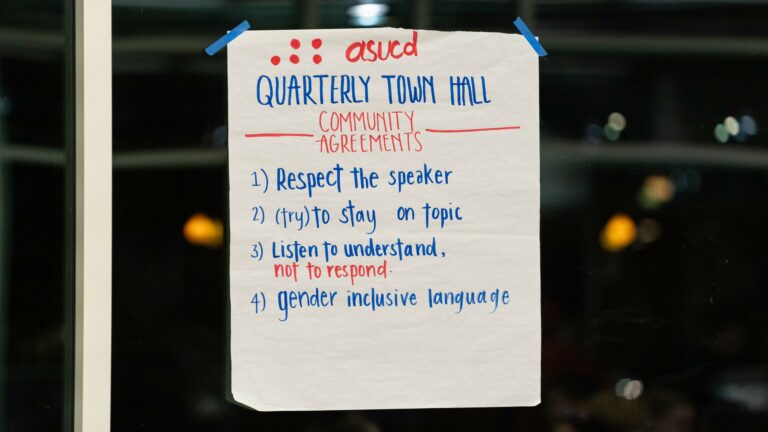
The ASUCD Town Hall, which took place in the CoHo, was called to order at approximately 6 p.m. on Thursday, Oct. 17. The meeting was presided over by President Justin Hurst and Vice President Shreya Deshpande. 

Participants broke into groups and discussed questions posted at different tables. In previous years, town hall meetings consisted of an open mic panel discussion, rather than breakout groups. The questions focused on ways that ASUCD can proactively address student needs. 

Both Senator Sean Kumar and Filip Stamenkovic, chair of the Business and Finance Commission, spoke about the need to address ASUCD’s $400,000 deficit, which was partially caused by the loss of revenue during the Camp Fire in Nov. 2018. For example, in April 2019, the Experimental College closed due to financial losses it experienced. 

“[Closing the Experimental College] was an absolutely necessary step and otherwise we wouldn’t have had a budget, but it could have been avoided,” Stamenkovic said. 

He stressed the importance of ASUCD units updating quarterly reports so that they remain aware of their financial status and don’t have to seek help at the last minute. 

“It was personally very painful for me,” Stamenokovic said, referring to when he informed some units that they were closing. “[These groups] came up to us and they said they didn’t know they were in trouble. They had only three weeks to resolve the problem.”

Food insecurity was also a frequent topic raised during the meeting. 

“[I hope for] continual education and understanding from our Senate that what we’re doing for basic needs is vital,” said Ryan Choi, chair of the ASUCD Pantry. 

Other topics covered included increasing student voter turnout, being proactive rather than reactive and improving communication between members of ASUCD and the public. 

Written by: Rebecca Bihn-Wallace — campus@theaggie.org

DNA sampling of migrants is inhumane, unjust

Trump administrations denies migrants a shred of human dignity

Between impeachment inquiries, elections and cease-fires, it may be easy to find oneself distracted by the political turmoil currently unfolding within the U.S. It is, however, important to remember that the crisis at the Southern Border is far from over.

Tensions between the Trump Administration and asylum seekers appear to be at an all time high, evident through recent reports of gross mistreatment both at detention centers and beyond. Just because the migration crisis has persisted for years does not mean that it should be forgotten about or deemed as “old news” — if anything, its continuance should serve as a reminder that a solution is far overdue.

In one of his more outrageous decisions, Attorney General William Barr issued a ruling on Oct. 15 that allows all “relevant” federal agencies to collect DNA samples from individuals who are “detained under the authority of the United States.” Legal permanent residents and those legally seeking U.S. citizenship will not be affected — however, this decision poses great concern for an estimated 748,000 individuals. The Department of Justice’s proposed rule is subject to a 20-day comment period, which ends today. 

The samples will be added to an extensive FBI database, which already contains the genetic information of 17.7 million individuals who were either convicted of a crime or arrested. President Donald Trump, in his presidential campaign announcement speech, made a widely-criticized statement asserting that migrants attempting to cross the Mexican-American border were convicts, drug dealers and rapists. He has since backtracked on this claim, yet anti-migrant sentiment still runs rampant in his administration, and this new ruling does nothing but reinforce it.  

By collecting these samples, the Trump Administration is sending a clear message that it has little to no faith in the character of asylum-seekers, and is perpetuating the false notion that a large proportion of migrants are criminals. These individuals have not been convicted of any crimes — forcing a swab into their mouths, however, essentially asserts that they either have been or will be. 

The Editorial Board not only believes this is an egregious violation of the presumption of innocence, but also of one’s privacy. DNA is a highly sensitive identifier, and should only be extracted with explicit consent or under extreme circumstances. Forcing detainees into surrendering their personal physical information is a clear violation of bodily autonomy. 

Yet another extreme violation of privacy includes the 28-page spreadsheet that the Trump Administration used to keep track of migrant girls’ menstrual cycles while they were in custody. The tracking was done specifically by Scott Lloyd, then-director of the Office of Refugee Resettlement and infamous anti-abortion activist. Unsurprisingly, Lloyd was removed from his position when it was reported that he obstructed pregnant migrant minors from obtaining abortions. 

The list of offenses does not stop there, it ranges from making migrant children eligible for adoption to maintaining inhumane conditions at border detention centers — all of which are frankly, if not obviously a continued embarrassment for the country. The administration’s behavior toward those seeking a new life in America is immoral, yet all the while unsurprising considering the list of chronic atrocities the president has tallied up during his tenure at the White House. 

For the miniscule amount of humanity and respect shown to asylum-seekers, the government sure seems to care a whole lot about migrants’ personal information. Political views aside, we all must empathize with and condemn the appalling treatment that these human beings, just like us, are facing. America claims to be a nation dedicated to upholding human rights and promoting new beginnings — and it’s about time we start acting like it.

Written by: The Editorial Board

Letter to the Editor

Chancellor May responds to The California Aggie’s editorial voicing concerns about the 2020 commencement

To the Editor: 

Re: “Students deserve a commencement that celebrates them, not a high-profile speaker” by the Editorial Board (editorial, Oct. 24):

With regard to your Oct. 24 editorial, one portion of the headline is worth repeating: “Students deserve a commencement that celebrates them.”

  I couldn’t agree more.

  UC Davis’ graduating students deserve the best possible commencement experience. They’ve earned it. Changes to 2020 Spring Commencement ceremonies were made with this in mind. We want to create a more meaningful, prestigious and memorable celebration for UC Davis students.

I was disheartened to read that The Aggie editors believe otherwise. I’d like to provide some insight about these decisions and answer the questions you raised.

  Commencement ceremonies are one way that we recognize and celebrate students who have worked hard to earn a degree from UC Davis. Many hours are devoted to creating a commencement experience that students, their families and friends will enjoy and remember for many years to come.

  We sought feedback from students when discussions about 2020 Spring Commencement first began. Students shared their input during the decision-making process. They’ve been involved with planning and have assisted with speaker selection. 

  Next year, instead of having seven smaller, college-specific undergraduate ceremonies, the university will hold three combined ceremonies, each with about 2,500 students. These larger events will celebrate all of UC Davis, rather than focusing on one particular college. In this way, we hope to inspire that which unites all UC Davis students — our Aggie pride.

  Of course, departments and other constituencies will still be welcome to hold their own, more personal graduation celebrations. 

  You raised some specific questions about spring commencement and I’d like to provide the answers here. 

1.    Will students’ names still be read at the ceremonies? Yes. UC Davis commencements will include reading the name of each graduate as they walk across the stage. We will continue this time-honored tradition that recognizes the achievements of each individual. 

2.    Can students petition for more tickets? Yes, students may petition for additional tickets. However, these will be handled on a case-by-case basis and cannot be guaranteed. Each student will receive four tickets. In an effort to allow additional family and friends to take part in this special day, we will open the Pavilion with overflow seating and live-streaming of commencement ceremonies.  

3.    Can students with multiple majors pick the major they wish to walk with? Yes. Students who graduate with more than one major will have the option to choose.  

  UC Davis continues to grow and excel. We’re now home to about 39,000 students. College rankings consistently place UC Davis among the nation’s top public universities. 

  It’s true that larger UC Davis commencement ceremonies may help us to secure new and noteworthy speakers. While that’s not our primary goal, it’s a good thing. It gives us an opportunity to host the type of commencement celebration that students will cherish — and one you might expect from one of our nation’s top public universities.

UC Davis students deserve nothing less. 

CHANCELLOR GARY S. MAY, DAVIS, CA 

To submit a letter to the editor, please email opinion@theaggie.org

Let kids read what they want to read

Judging kids for what they read discourages them from exploring their interests

I’ve talked a bit about how I’ve personally felt disgruntled with the reading curriculum throughout my middle school and high school experience. That isn’t to say that I didn’t appreciate the work and effort that my English teachers put into my education, I just didn’t particularly enjoy the selection of books or the monotonous work that went with it. 

Reading is one of the few activities in which I find joy, exhilaration and an immense amount of satisfaction. There’s a satisfaction in not only seeing the daily progress I make but also in realizing the number of stories and ideas I’ve accumulated just by opening my books. 

I volunteered at my local public library for all four years of high school, and one of my favorite activities of the year was the summer reading game. The summer reading game was an annual program the library put on for patrons of all ages but with a special focus on children. The goal was to encourage patrons to spend time in the summer reading something — anything. Once they hit the target number of hours, they got a prize. But when the librarians said read anything, they meant anything. This list included not just books, but magazines, cereal boxes, emails, websites and more. As long as there was some reading happening, you were participating in the summer reading game. 

As I continued volunteering at the library, I noticed it was a place that truly committed itself to creating an inclusive and welcoming environment for all its members to read. And one way in which they accomplished this was by encouraging visitors to read without judgment. 

The library was the last place to impose value judgements on books, especially children’s books. This initially puzzled me since I had grown up with a sense that some books are worth reading whereas others offer little literary value and shouldn’t be encouraged. When I was in elementary school, my teachers weren’t too keen to see their students reading graphic novels. In middle school, one of my English teachers wasn’t very enthusiastic to see her daughter reading “Junie B. Jones” because of Junie’s bad grammar.

For much of high school, I didn’t express great interest in graphic novels and often imposed my own judgments on those books. Like many other adults, I felt like graphic novels could hardly count as books; although they might be great stepping stones for getting kids to read, they should quickly move on to other, more “valuable” books. 

Adults try to ensure that kids grow up with strong literary skills, which might be why they place a large emphasis on reading certain books. It’s understandable that parents and teachers want children to grow up with strong critical thinking skills and an appropriate knowledge of grammar and vocabulary. But that doesn’t mean there isn’t value in children picking up a book about a silly eight-year-old who, like many other eight-year-olds, doesn’t have the best grammar. It also doesn’t mean that a book filled with mostly images and little text should be viewed negatively. 

Not only is giving children the choice to choose their books a great mechanism in fostering a genuine appreciation for reading, but the choice in and of itself is empowering. I’m not an expert, but I can confidently say that letting children read what they like, given the content is suitable and appropriate, affords the freedom to find the stories that matter to them.

I love to hear my six-year-old cousin talk excitedly about his beloved characters and scenes from his favorite series “Captain Underpants” — the silliest and craziest children’s book around. At the library this summer, I listened to other kids tell me all about their favorite books and why they loved them so much. 

I enjoy hearing this because childhood curiosity made me fall in love with the world of reading. When I read books in elementary school, I wasn’t looking for how to become the most efficient and capable reader, although that is what most teachers and other adults hope their students turn out to be. I read because I was a seven-year-old who wanted to independently travel to another country and see the most breathtaking sights from the comfort of my home. I also wanted to read silly stories in which I could see Baby Mouse stumble and grumble through her school hallways. 

Graphic novels and “silly” books are fun, creative and exciting stories with which children can fall in love, and they should be encouraged to explore what they love without being judged.  

Written by: Simran Kalkat — skkalkat@ucdavis.edu

Disclaimer: The views and opinions expressed by individual columnists belong to the columnists alone and do not necessarily indicate the views and opinions held by The California Aggie.

Cartoon: Joshua Diagram

MARIO RODRIGUEZ / AGGIE