53.5 F
Davis

Davis, California

Tuesday, December 23, 2025
Home Blog Page 406

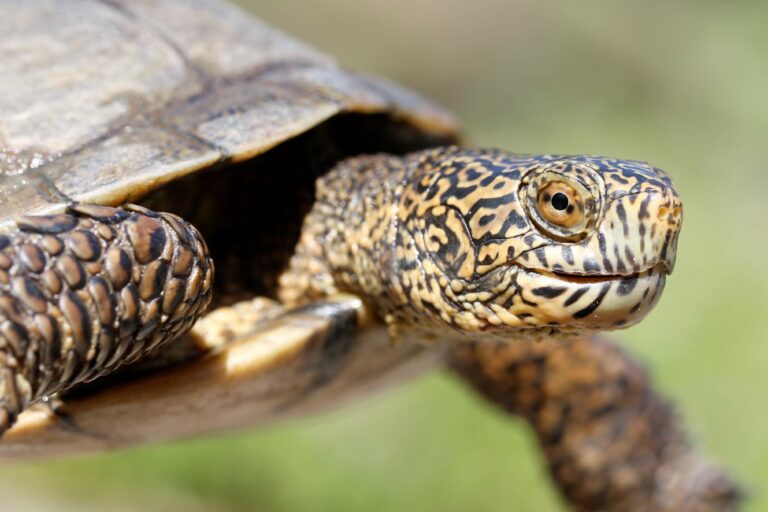
UC Davis alumni conduct groundbreaking study to understand competition between invasive, native turtle species

Native western pond turtles benefit from removal of invasive red-eared slider population in UC Davis Arboretum

    Today, UC Davis Arboretum visitors can see two species of turtles: the native western pond turtles and the non-native red-eared slider turtles. Both live together and swim peacefully through the algae-coated waters — sometimes, if caught at the right moment, visitors might witness their adorable faces peeking out of the water or sunbathing on logs and rocks. Behind the scenes of this seemingly harmonious lifestyle between the two turtle species, however, is a competition for food and habitat space.

After a group of former UC Davis students studied this relationship in the wild and co-wrote a paper, they found that the living conditions and health of both turtle species can be greatly increased by removing large percentages of the invasive red-eared slider turtle species.

    “Nobody has ever studied this competition, which is why we wanted to do it,” said Greg Pauly, a wildlife, fish and conservation biology graduate who is now the curator of herpetology and co-director of the Urban Nature Research Center at the Natural History Museum of Los Angeles County.

Although red-eared sliders are only native to the central U.S., they have been introduced all over the world when abandoned as pets. This has contributed to sliders becoming one of the most invasive species in the world, according to the Global Invasive Species Database under the International Union for Conservation of Nature. The western pond turtle is currently undergoing review for listing under the U.S. Endangered Species Act, according to Max Lambert, a postdoctoral fellow at UC Berkeley and a UC Davis graduate in wildlife, fish and conservation biology.

“People buy [red-eared sliders] when they are hatchlings, when they are beautiful and cute,” Pauly said. “People take them home and do not realize they will live up to 30-40 years and can grow as large as dinner plates. These spur-of-the-moment decisions become big investments, and people regret it and abandon the turtles in urban and rural waterways. Now we have the turtles found in all but two states in the United States and on every continent except Antarctica.”

    Despite the spread of sliders before this study, there was no data on how red-eared sliders impact the native western pond turtles because the relationship between these species has never been studied in the wild, Lambert said. Experiments like this have been conducted in labs, but this paper demonstrates how non-native species can impact native and imperiled species in the wild, which makes this study important. 

    “These turtles are imperilled everywhere they live,” Lambert said. “The non-native turtle is pushing the native turtle away from best spots.” 

Along with Lambert and Pauly, UC Davis alumni Jennifer McKenzie, Robyn Screen, Adam Clause, Benjamin Johnson and Genevieve Mount — along with Brad Shaffer, a professor in the evolution, ecology and biodiversity department — all contributed as co-authors of the study. Their first paper was written in 2003, as the project began when the co-authors were undergraduates at UC Davis. The turtle removal and observations, however, occurred over a period of several months in 2011 and 2012.

Over four months, researchers removed about 90% — or about 177 turtles — of the red-eared slider population to see if the pond turtles changed their habitat use, according to Lambert.

To capture the red-eared slider turtles, the researchers used traps resembling giant funnels in which the turtles swim in without being able to escape. To get turtles smart enough to avoid the traps, researchers jumped in the water with giant nets, Lambert said. Without a place to relocate these turtles, they were euthanized and donated to the UC Davis veterinarian school. Since the diet of these turtles consists of eating human trash, sliders were also donated to a Los Angeles County Museum of Natural History study on urban diets and a UC Davis museum also conducting a study on diet.

After the turtle trapping, the research team spent several months monitoring the basking behaviors of the turtles and tracking their weight. After completing the study, the team found that sliders do have an impact on the western pond turtle, Lambert said. 

Overall, the western pond turtles were healthier and better able to use their habitat freely. The turtles increased their weight by about 40 grams, which is 5-10% of their bodyweight. Female turtles also increased the number of eggs they were able to produce. This body mass data directly shows how competition between the species was present, Pauly said, which was the first time this had been documented in the wild.

“The western pond turtles had a more even habitat use and were more evenly distributed out,” Lambert said. “They do not like being near other turtles, and they were forced to be super dense, so the pond turtles could spread out to be where they wanted to be.”

Additionally, the remaining non-native red-eared sliders benefited from their decreased population as well. 

“The non-native turtles got much bigger,” Lambert said. “They gained 5-15% of their body weight, which is a high increase for one year. There was much more food to eat, and less mouths to feed.”

Additionally, the invasive species could choose better habitats to live in that better suited their species. They abandoned large areas and resided in smaller spaces closer to people, which they actually prefer, Lambert said. The turtles were also able to bask more and do so in better locations — meaning they could rest on logs and rocks out of the water without having to compete.

“They were negatively impacting themselves because there were so many of them,” Lambert said. “Decreasing their populations relieves them of competition amongst themselves and best habitat use.”

The Davis Arboretum is not the only place that suffers from the issue of turtle overpopulation. When people abandon their pets, it subjects them to unfair treatment, according to Lambert. The turtles have to live in unpleasant and overcrowded conditions and in unfamiliar places where they have to fight among each other for food and habitat space. To fix this issue, Lambert said individuals need to stop buying and abandoning these animals in the wild.

Since this is the first time scientists have studied the relationship between these turtles in the wild, Lambert said that more people need to be monitoring the habitats around the world to understand the relationship between these two specific native and invasive species.

“There are lots of sliders across the world, and nobody is monitoring the success of the removals,” Lambert said. “You can take data before and after on native species because you want to know if the invasive species is hurting environment if you are going to invest lots of time and money into it.”

The research team said they were lucky to be able to use the Arboretum to conduct the study. 

“We do really important conservation research right where we live,” Lambert said. “UC Davis is a great place for research opportunities early on in students’ school experiences and careers.”

Written by: Margo Rosenbaum — science@theaggie.org 
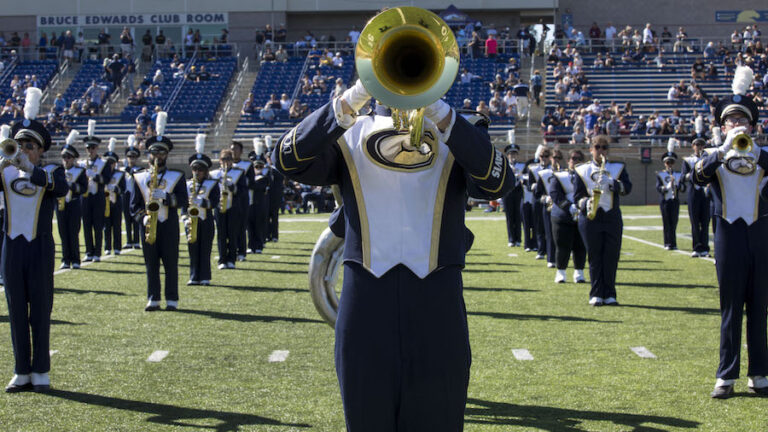
Band-uh! to be permanently disbanded, university announces

Serious allegations of misconduct lead Student Affairs to axe student-led band

The Cal Aggie Marching Band, popularly referred to as the Band-Uh!, will cease to exist following allegations of misconduct committed by band members. These allegations were first published in The California Aggie.

Those allegations were later covered by The Sacramento Bee and the Los Angeles Times. Following these articles, the university conducted an independent “climate survey” of and investigation into the band organization. Today, Interim Vice Chancellor for Student Affairs Emily Galindo announced in a statement that the university had discontinued the Band-Uh!, effective immediately.

In deciding to eliminate the current Band-Uh! organization, the university will now establish a new, “university-supervised” organization under a “new name, bylaws and governing structure, guidelines and practices.” Student leadership will now occur under the auspices of a student leadership team, whose establishment and composition will be selected by Campus Recreation.

“The safety of our students is the highest priority,” Galindo said in her statement. “With the seriousness of the allegations, our goal throughout this process was to act swiftly, thoughtfully and appropriately in both our assessment and decision making. The plan put forth was developed with great reflection, intention and care and is rooted in the desire to rebuild the band program into a safe and welcoming organization.”

Once the new band organization is composed, it will be subject to a two-year probationary period, during which “the band must follow the new structure, guidelines and practices, and will be permitted to participate only in events and activities approved by Campus Recreation.”

Student testimony regarding the alleged misbehavior of Band-Uh! members — first published by this paper in April — led The Bee to launch its own investigation into the matter. The Bee’s investigation detailed allegations of hazing and sexual assault by band members.

Following The Bee’s investigation, the university placed the band on an interim suspension in May and also hired “an external law firm to conduct a comprehensive independent review to evaluate the climate of the band,” according to Galindo’s statement.

The firm distributed a “climate survey” to both current and former members of the band. The results of that survey echo student concern regarding worrisome traditions and behaviors in the band previously reported upon. Galindo’s statement did note that 85% of respondents reported that they were “satisfied” or “very satisfied” with their overall experience participating in the band.

Joel Gutierrez, a fourth-year American studies and gender, sexuality and women’s studies double major, is a former member of the Band-Uh!. Gutierrez is one of the few students who initially came forward in The Aggie to discuss the concerning behavior they viewed and experienced first-hand in the Band-Uh!.

“I’ll admit I’m surprised that the university chose to take such drastic action – especially after their long history of giving Band-Uh! a simple slap on the wrist with few consequences,” Gutierrez said. “Still, I’m thankful for the action being taken and I hope that this restructuring of the band will have a lasting positive impact. I am immensely proud of everyone who came forward, publicly or not, to speak up against the harmful culture that the band has housed for decades.”

Over the summer, university leaders in the Division of Student Affairs met to determine the best steps moving forward regarding the reconstruction of the university band. In addition to the complete overhaul of the band’s current structure, the university also decided to discontinue its relationship with the Cal Aggie Marching Band Alumni Association.

“The alumni band will no longer be recognized by the campus and will be prohibited from participating in any campus events,” Galindo’s statement read. “While we recognize that the concerns regarding the alumni band are not reflective of the entire membership, we feel this step is necessary to provide the greatest opportunity for the student band to rebuild as a new and independent program.”

The alumni band was previously suspended by the university in Winter Quarter of 2018 over allegations of misconduct by a member. In The Aggie’s article covering the allegations, band members recounted band alumni sexually harassing or intimidating current band members at parties.

“Under our new restructuring, social interactions with alumni band members will be strongly discouraged,” Galindo’s statement read.

Moving forward, the university said it will collaborate with students to develop a new name, uniform design, mission and vision for the band in addition to implementing required trainings.

“I hope that the university continues to take this two-year probation seriously, and that they do all they can to keep future band members safe and healthy,” Gutierrez said. “Hopefully this entire process can set an example for organizations in the future, as well as for survivors of sexual violence, hazing and all forms of abuse that may occur within the university. Our voices were heard, and we will continue to use them to protect ourselves and our communities from harm.”


Written by: Hannah Holzer — campus@theaggie.org

“First Lady of Wine” Heidi Peterson Barrett talks success as pioneer winemaker

Former UC Davis student has now influenced wine industry

Heidi Peterson Barrett, queen of the American winemaking industry, an icon and oenological legend, was born in Berkeley, CA, to a family of vintners. Wine flowed through Barrett’s veins, and she took the first steps toward her calling by attending the fermentation science undergraduate program at UC Davis, at which time she was one of four women in a 30-person class.

After graduating from this program, Barrett went on to become the winemaker at Buehler Vineyards at the age of 25. This was 1983, a time when there were not many women dominating the wine industry, let alone leading it as head winemaker.

After Buehler, Barrett continued influencing the wine industry — she was hired at various iconic houses such as Dalla Valle Vineyards, Screaming Eagle and several others and also worked as a freelance winemaker.

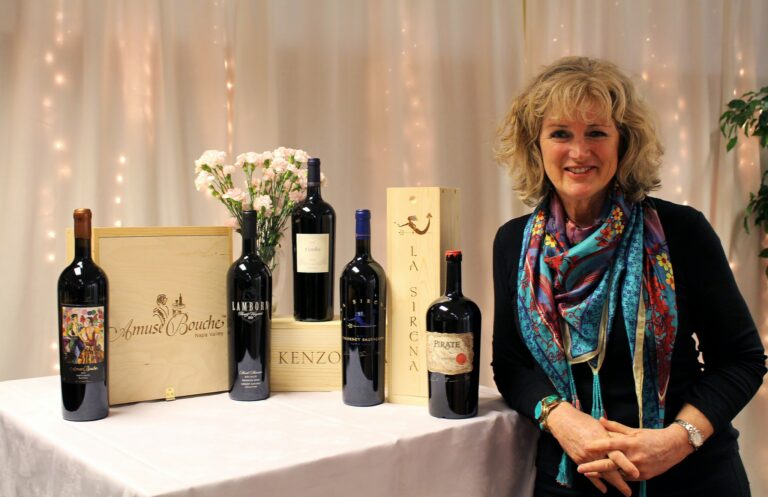
Barrett is currently winemaker for her own brand, La Sirena, and has produced wine under the labels Amuse Bouche, Paradigm Winery, Lamborn Family Vineyards, Fantesca and others. To top it all off, Robert Parker has awarded five of Barrett’s wines a perfect score of 100 points on his wine critic scale and has fittingly dubbed her “the first lady of wine.”

In the spring of 2018, the Viticulture and Enology department hosted Barrett as a guest lecturer for its speaker series VEN 190X. The event was an opportunity to listen first-hand to Barrett speak about the wines she had crafted and also taste these wines as she gave notes on their flavor profiles and histories. 

A one-hour lecture was simply not enough time to even scratch the surface of Barrett’s impact on the thousand-year old industry of wine — Barrett is full of life and her passion radiates through her love of wine, so I sat down with her in an attempt to highlight just that.

Gillian Allen: First off, how are you?

Heidi Peterson Barrett: Really busy and very jet lagged. I was on this trip to the Maldives for the last two weeks. Some of the best [diving] in the world is over in that part of the ocean: Papua New Guinea, Indonesia, Great Barrier Reef, Palau, Fiji. I took diving at UC Davis as a two unit class, so the open water training dives were at salt point and a second weekend was down in Monterey, so that’s where I learned to dive.

Allen: When you spoke at the 190X seminar, I remember you going into the details of the name “La Sirena” and the idea behind the labels. How does it feel that your label represents you as a winemaker? Does it channel your passion for scuba diving at all?

Barrett: Yeah, absolutely. That was a way for me to combine my two passions of making wine and my love of the ocean, and also the magic element of both. There’s definitely something special about [making wine] that we all recognize, it’s different than making any other product, and choosing a mermaid as my logo was a way to represent that as well. There’s just so much more to it that brings in the magic element of … working with nature, and weather, and something that grows out of the earth and elevating that in some way, which is really fun.

Allen: How does it feel knowing you have created something that brings enjoyment to so many people?

Barrett: It’s really satisfying. It’s a lot of work, but then it goes to improve people’s lives with either helping them celebrate a special occasion or just making them happy. They’re drinking something delicious. It’s very satisfying when you can help bring joy to people through making wine. Also, I like that it’s sort of a time capsule — a moment in time or [something that] happened in any given vintage, and that can live on for a while. It lasts at least a couple of decades if it’s done well, for red wine certainly sometimes more. So it’s a piece of your work that can actually have some longer impact that sticks around for a while and can change and keep improving.

Allen: When your success first started taking off, did you ever see yourself as an inspiration to future female winemakers? And if so, did this affect the way you made decisions?

Barett: No! I never saw that coming, I never even thought about that. I was just trying to make great wine, do the best I can, keep learning [and] see how far I can take this. I never thought about that side of it, that that would be sort of a side benefit, and I love that that’s happened — that it does inspire people. Some other young women have told me, “We love what you do and it really helps us think that if you can do it, we can do it too.” It’s really nice to hear these great stories from women that are fired up about it and inspired. I love that.

Allen: What is one challenge you overcame and what did you learn from it? 

Barrett: I don’t know if I can pick just one, there’s definitely always challenges and you just kind of keep digging in to push forward. Just figure out a way to make things work or just improve whatever the situation is. It’s definitely a changeable business — just the nature of it, you have to be ready for anything. I think I’m kind of well-suited to it because I don’t give up easily, so I think those things really help create a good career. Just be willing to keep moving forward and keep learning. No matter what age we are, we just keep learning every year. It makes it a lot of fun, too.

Allen: What advice do you have for first-generation, aspiring female winemakers who didn’t have the same exposure to the industry growing up as you did?

Barrett: Make sure you love it. Go out and test the water — it may be different than you think, it’s not entirely this whole romantic industry. It’s actually a lot of hard work, and I think that surprises people sometimes of how much physical work there is unless you’re up for all of that. I always encourage people, before they get hook, line and sinkered, to go work and make sure you love it before you full-on commit to this industry, because it may be a little different than it looks like on first glance.

Allen: What are some things you haven’t seen in the wine industry that you would like to see more of?

Barrett: Accessibility to people with wine and [making them] feel more comfortable with it. A lot of people are really intimidated about not knowing enough when they go to a restaurant to feel confident when they order. Just get enough knowledge that you feel as comfortable when you order wine as you do [ordering] food and, if not, rely on the person from the restaurant who bought those wines. They know what they taste like and they can make a recommendation for you. Just make it really user-friendly — more a part of everyday life, not so intimidating. It doesn’t only have to be a special occasion kind of thing that’s always on a pedestal, it can be just an enjoyable part of life.

Written by: Gillian Allen 

Gillian Allen is a recent UC Davis graduate who previously wrote and edited for The California Aggie for several years. She received a degree in viticulture and enology and is now working in Napa Valley.

A pin collector reviews Patches and Pins Expo held in Orange County

One of the largest pin exhibitions hosts over 10,000 attendees

The Patches and Pins Exhibition, a free, all-day event with over 10,000 patrons in attendance, held its Southern California event in Santa Ana on Aug. 18. Unlike with previous stops in Santa Ana, this exhibition hosted different bands to play for the crowd. Some of the more high-profile vendors included Castle Babe Co., Pin Lounge and Just Peachy Place. 

When I first heard of the Patches and Pins exhibition, I was in my first year at UC Davis and I was devastated to have missed it. After following its Instagram page, I kept the event on my radar as summer rolled around. I spent all year looking forward to the event that would only serve to feed my four-year-long addiction. 

I started to collect pins in my junior year of high school. My collection started out small, as most do. I bought only $1 flea market pins. I knew that enamel pins existed — I’d been to Disneyland and seen the stands — but I didn’t know there was a whole community for their collectors. That was until the Instagram advertisements caught up with me. 

Eventually, seeing the intricate designs and beautiful colors, I fell in love with enamel pins. The only downside is that they are, at the very minimum, $10 a piece. While this doesn’t sound too bad, when you add in the shipping and taxes, $15 for a one-inch piece of metal is completely out of my budget. Once a year, however, I allow myself to splurge on these beautiful pieces of metal that I show off on my backpack. 

The summer after my freshman year, I decided to take my dad with me to the event. While he didn’t (and still doesn’t) know much about pin collecting, he didn’t grumble too much. But this year, I went with the intention of experiencing the exhibition as an avid collector — fully immersed in everything the vendors and fellow pin-enthusiasts had to offer. 

My biggest frustration with this event is that it’s marketed as an all-age event. And for the most part, it is. But pin designs, like every other genre of art, come in some explicit styles which can lead to uncomfortable explanations by parents to their children. I’m not advocating for an adult-exclusive event, but the graphic nature of some booths is something of which both parents and young adults with their dads tagging along should be aware. 

One of the best aspects of the expo is that there are over 150 vendors. I’m claustrophobic, however, and there were some vendors who were too close for my comfort. The overcrowdedness, especially at popular vendors, made me feel rushed. The vendors were always nice and respectful, but in such a small space it was hard to talk to them and learn more about their brand. 

Everytime I attend a Patches and Pins expo, it grows — not just in size, but in content. This year, the live music was a nice touch.

While I loved meeting the artists behind the Instagram account I’ve followed for so long, I was met with some frustration and disappointment. Because I have been collecting for over four years, I know the difference between an A-grade pin and a B-grade pin. It was disheartening to see some of my favorite vendors marketing what is clearly a B-grade pin as an A-grade pin. 

While the burden of inspecting a pin does fall on the buyers, the buyers should also be able to depend on the integrity of the sellers. This experience made me appreciate other vendors who made sure that I knew their pins were B-grade pins. My first purchase at the festival was at the shop Mexikawaii, whose salesperson let me know before buying that the pin I was holding was B-grade. Vendors like her reassured my love for this community. 

Despite some of its flaws, there are no other expos as big and as accepting as this one. A big pin event like this could get away with charging their customers an entrance fee, but instead Patches and Pins gives their own pins away to the first 200 attendees. They also provide parking at a reasonable cost. 

Because there is such a small community of people who like to collect, the expo gives vendors the opportunity to meet with their fans. It also assures collectors that they’re buying authentic pieces of art directly from their creators, rather than from websites like Wish or AliExpress, which are known for stealing designs and selling them at reduced prices. 

An upcoming Patches and Pins exhibition will take place in San Francisco on Oct. 19. Tickets for the event can be found on their website

Written By: Itzelth Gamboa — arts@theaggie.org

Exploring D.C. through running

Arts writer Caroline Rutten takes up running, discovers D.C.

One of my biggest accomplishments from my summer in Washington, D.C. was picking up running as a hobby. Not only did it fit into my zero-dollar budget for a gym membership (I blame my unpaid internship), but it was a way to become accustomed to my new stomping grounds. With 68 square miles to explore, each run became an opportunity to discover a new neighborhood while dripping in sweat. Below are a few areas of Washington, D.C. explored by quickly moving feet.

The National Mall

While this may be unoriginal, the expansiveness and historic significance of the monuments on the National Mall made it one of my first and favorite running spots. After all, it’s quintessential D.C.; it would be shameful to have left after a summer here without having explored it thoroughly. Starting at the Washington Monument, passing through the World War II Memorial Fountain and Reflecting Pool, you meet the rest of the tourists at the Lincoln Memorial. Due south, you hit the Martin Luther King Memorial and, my personal favorite, the FDR Memorial. This collection of statues and marble reminded me of the significance of the place where I was spending my summer — a concentration of power, historic happenings and transition. Running on the National Mall served as a weekly reality check.

Adams Morgan 

Located in the northwest region of the city, Adams Morgan is the multicultural nightlife and independent store hub of D.C. With colorful murals and local parks, each store and restaurant front owns a distinct personality — so much so that I found myself having to pause my Strava app on multiple occasions to window shop. Returning on multiple occasions, Madam’s Organ became one of my favorite live music destinations, Lost City Books’ two stories tempted me into many literary purchases and Roofer’s Union served me one too many beers. 

U Street Northwest

Located near Howard University, U Street Northwest was the African American cultural epicenter of the 1920s through the 1940s. Today, jazz still rules the area, among a plethora of theaters, restaurants and bars. The best biscuits are served at the Mason Dixie Biscuit Company, the best chili and fries are found at the famous Ben’s Chili Bowl and the best speakeasy is behind the hidden door at a pizza parlor. 

Georgetown 

Best known for its university and shopping strip, Georgetown had my favorite waterfront to run alongside. Right on the Potomac River, the waterfront beckons patrons to take a moment to look across the river at Arlington, Va. With children playing in the fountain, a musician with a tip jar and people dancing along, I couldn’t help but pause my run to observe each time. 

Rock Creek Park 

One step into this almost 2,000-acre city park transports you out of the metropolitan hub of Washington, D.C. into a quiet forest oasis. And while there is an excitement to running through city streets, the meditative qualities of running on a dirt path should not be underestimated. Especially to a California native, the lush green terrain of the east coast is unique — the ability to explore the natural landscape was just as special as discovering the city. 

Written By: Caroline Rutten — arts@theaggie.org


Aggies stand tall in hard-fought defeat to Cal

UC Davis makes plenty of positive strides against tough Pac-12 foe

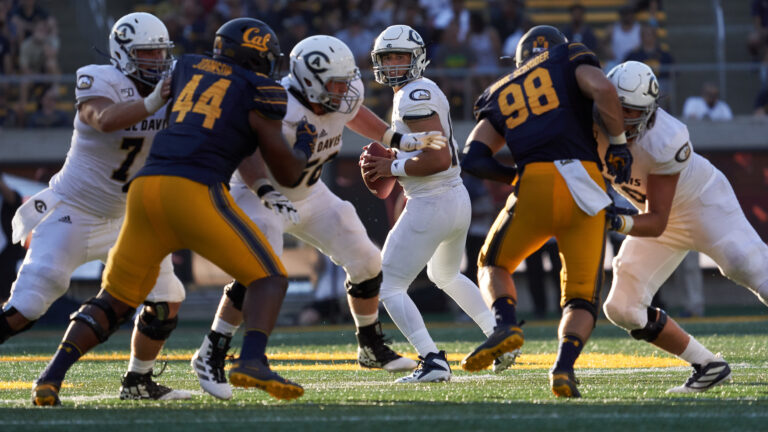
After one quarter of play on Saturday afternoon, it looked like the UC Davis football team was well on its way to a shocking upset over its fellow UC-counterpart, the California Golden Bears.

This is not to say that the Aggies weren’t expected to be competitive against a difficult Pac-12 opponent, because UC Davis has received a great deal of recognition this past offseason following the program’s first Big Sky title and deep playoff run last fall.

Everyone in the college football world takes the Aggies seriously these days, so the team will not be sneaking up on anyone this time around. In fact, UC Davis will have to learn to play under the weight of considerable expectations, after placing in the top-5 of multiple preseason top-25 polls and garnering numerous individual player honors.

The 2019 season could not have gotten off to a better start, under picture-perfect skies and a mid-70’s sun inside Berkeley’s California Memorial Stadium. Aggie redshirt freshman defensive back Jack Shippy scooped up a Cal fumble on the opening kickoff of the year, forced by junior tight end Pat Miller, and the visitors picked up right where they left off eight months before.

Just four plays later, UC Davis found itself in the endzone, courtesy of a two-yard run by sophomore running back Ulonzo Gilliam, Jr.

Meanwhile, the UC Davis defense could do no wrong, forcing a pair of three-and-out’s and another critical turnover when sophomore defensive back Devon King picked off a floating pass in the first quarter. Early frustration even started to set in amongst the Golden Bear faithful, as subtle boos began to matriculate around the crowd of 44,168 late in the opening quarter.

After kicker Max O’Rourke nailed a 40-yard field goal to push the UC Davis lead to 10-0, senior linebacker Nas Anesi forced a fumble and junior defensive lineman Bryce Rodgers was right there with open arms to make the recovery.

With only 16 minutes gone by, UC Davis had already forced a trio of turnovers, giving the offense a golden opportunity to create some much-needed separation on the scoreboard.

Unfortunately for the Aggies, that opportunity fell by the wayside, largely due to a stiff California defense, and led to an eventual 27-13 season-opening defeat.

The Aggies struggled to move the football for the majority of the contest, up against a Golden Bear defense that many consider to be one of the best in the nation. They refused to surrender easy yardage and limited UC Davis to a 29.4% conversion rate on third downs.

Despite spreading the ball around to eight different pass-catchers, senior quarterback Jake Maier finished just 19-of-37 for 173 yards, the lowest yardage total in his 25 career games under center. 

“I’m not surprised as far as how they came out today,” Maier noted. “They do what they do at a very high level, and that’s what makes them great. We pretty much knew what they were lined up in most of the night, and we weren’t able to convert on certain plays.”

Although the Aggies felt very confident in knowing what to expect from the Cal defense, this knowledge was only so helpful to a certain extent, especially when their opponent executed its scheme to perfection.

“They don’t give up a lot of big plays so they’re going to force you to dink and dunk, catch it and run with it, but they’re seldom going to be out of position and you’re seldom going to get behind them,” Hawkins explained. “They’re going to keep things in front of them and pressure you.”

One bright spot for the offense was the performance of Gilliam, who found a nice rhythm at times during the afternoon while tallying 89 yards and 4.9 yards per carry. The sophomore from Merced has established himself as a workhorse tailback, after nearly eclipsing the 1,000-yard mark and scoring 13 touchdowns a season ago. 

It was only a matter of time before the Golden Bears started to piece things together offensively, and they did just that with back-to-back pass completions of 30 and 37 yards, with the latter winding up in the end zone after an acrobatic leap over the pylon.

Within seconds, California had completely snatched the momentum that UC Davis worked so hard to build up. From then on, the Aggies knew they were in for a dog fight the rest of the way.

A pair of field goals sent the Golden Bears into the locker room with a 13-10 advantage at halftime, forcing the Aggies to gather themselves and brace for the half hour of hard-nosed football that laid ahead.

UC Davis refused to back down from the challenge and made a point to establish the run on its opening possession of the second half, feeding Gilliam the pigskin on five consecutive plays. The drive resulted in a 32-yard field goal by O’Rourke to level the score at 13-13.

But as the afternoon wore on, California continued to grind down the Aggie defense with a relentless rushing attack that topped 230 yards by the end of the game. Cal ran the football nearly twice as often as they dropped back to pass, which proved to be a successful formula. 

“They did a really good job as far as staying on their blocks,” Anesi explained after the game. “We’ll go back and continue to watch film and focus on having more integrity. I thought they did a really good job.”

The Aggie defense was well-equipped to handle anything Cal was going to throw at them, but the final result simply came down to execution and minor details.

“There were no surprises at all,” Anesi said. “Our coaches did a really great job as far as game planning and our scout team did a great job preparing us. It’s a lot of small things and errors we need to fix.”

“When you play this level of competition, whether it’s a playoff game or this level, you obviously are not afforded a ton of errors like untimely penalties and turnovers, which are going to hurt you,” Hawkins added.

The Golden Bears broke the 13-13 tie with a touchdown drive late in the third quarter and added another insurance touchdown early in the fourth quarter to put the finishing touches on their tenth straight victory over the Aggies.

Despite the disappointing result, nobody in the UC Davis locker room was holding their head low walking out of the stadium on Saturday night. For the second year in a row, the team put up a respectable performance on national television and showed it can be a headache for Pac-12 schools to deal with.

“It’s not a win but I don’t think we’re walking away from here thinking we operated poorly or we didn’t give our best effort,” Hawkins said. “We played hard, we played well. We competed. We did the things you’re supposed to do in this sport and that will carry a long way.”

The Aggies clearly left a solid impression on their opponent, as evidenced by several compliments dished out by California head coach Justin Wilcox in his postgame press conference.

“Davis is really good team,” Wilcox said. “We knew they were going to come in here and try to win the game, and that’s exactly what they did. They’re really well coached with really good schemes and they have a hell of a quarterback.”

No matter the result, the team will have to dust itself off quickly as another road challenge beckons next Saturday afternoon. The Aggies travel to the University of San Diego with a chance to beat the Toreros for a third year running. After that, the home opener takes place on September 14 at UC Davis Health Stadium, when Lehigh visits for a 7 p.m. kickoff.

Written by: Brendan Ogburn — sports@theaggie.org


Anticipation builds as return of Aggie football nears

0

UC Davis looks to keep positive momentum going on, off field

It would be an understatement to say that the anticipation and eagerness surrounding the UC Davis football program is higher than it’s been in many years.

Friday evening’s fan fest on Aug. 16 was a culmination of the budding optimism and rapidly-growing momentum centered around the football team, and the rest of the athletic department for that matter, heading into the 2019 season.

UC Davis football has been making strides both on and off the field in recent years, paving the way for a bright future and many more memorable seasons in Davis.

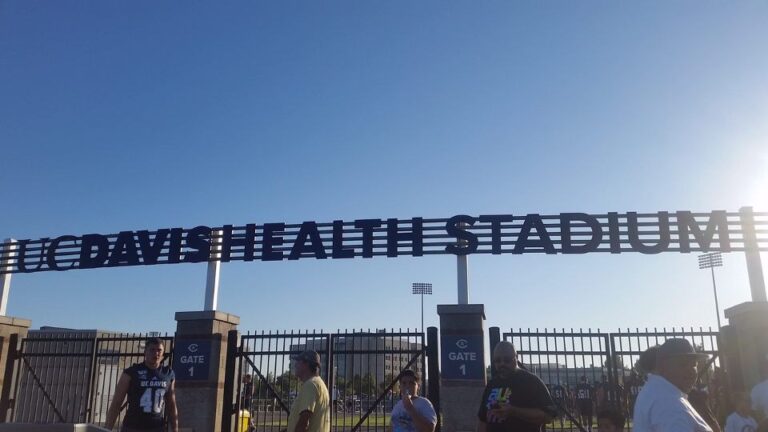
The highlight of the Aug. 16 event was the official renaming of the Aggies’ home field as UC Davis Health Stadium and the subsequent unveiling of new signage at the front gate. 

With most of the football roster standing by in their navy-blue home jerseys, Director of Athletics Kevin Blue made his opening remarks to a sizable crowd of fans and season ticket holders on hand, expressing his excitement for the upcoming campaign while making recognition of the incredible progress the program has made in such a short period of time.

Blue, entering his fourth year at the helm of intercollegiate athletics, was a pivotal figure in establishing a 20-year, expanded partnership with UC Davis Health back in November. The agreement spearheaded the funding for a new 38,000-square foot student-athlete performance center and practice facility, which will be located next to UC Davis Health Stadium on the corner of Hutchison Drive and La Rue Road.

“The facility will have several components, including a sports medicine facility for the student-athletes, a new strength and conditioning facility, a home for our student-athlete academic and career development work and several other functional areas,” Blue said.

Along with the help of UC Davis Health, other significant contributions from donors and alumni, including a school-record donation from notable football alumnus Bruce Edwards, came together to pick up the tab on the estimated $40M project, now in its early stages of construction.

“Success in the modern era of Division I football requires contributions from everyone associated with the university and we’re very appreciative of the support all of you [the fans] have provided for the team,” Blue explained.

Later on in the ceremony, third-year head coach Dan Hawkins stepped up to the microphone and made a point to acknowledge this gracious off-field support, while revealing that UC Davis had the 80th-most athletic donations amongst both FBS and FCS teams last year, a group comprised of over 200 schools.  

“Each one of you matters and every seat at [UC Davis Health] Stadium means a lot,” Hawkins said. “I’ve been at a few places along the way that have experienced some building, and we are a lot farther ahead and have so much more potential.”

Hawkins reiterated that this type of backing not only helps the current team, but enables future Aggies to get the esteemed UC Davis “experience” he frequently speaks of, in regards to a world-class education and the chance to play Division I sports.

“We have so much potential and room to grow here,” Hawkins declared. “What you’re doing here with this new practice facility is amazing and it fuels their fire, my fire and future Aggie fires.”

In addition to spurring the construction of this new state-of-the-art facility for student-athletes, Blue pointed out that the new partnership and stadium name will “increase brand awareness and visibility for UC Davis Health” through the many ways in which fans consume UC Davis football action, both inside the stadium and on television around the world.

Chancellor Gary May also addressed the crowd and stressed the importance of branding within the university.

“Today we celebrate not just outstanding football, but teamwork that stretches all the way across the university and a collaboration that makes us thrive as scholars, athletes and just plain Aggies,” May said. “No matter what side of the Causeway we’re on, we are all on the same team, and that’s what we’re showing with UC Davis Health Stadium. This spirit is only going to get stronger.”

While there was lots of praise to go around for the recent off-field developments, much of the focus on Friday evening centered around the upcoming season and the Aggies’ looming season opener against the California Golden Bears on Aug. 31 in Berkeley.

Despite their close proximity, these two California public institutions have only met on the gridiron ten times in their history, with the most recent match-up being a 52-3 victory for the Golden Bears in 2010.

May, a UC Berkeley alumnus himself, made a pitch to the players to give their best effort and make UC Davis proud.

“I got some trash talking to do on Saturday night, so don’t let me down!” May said.

Hawkins, who took the podium a few minutes later, couldn’t help himself, throwing a playful jab in the direction of UC Berkeley.

“We have some great challenges ahead of us, and we get a chance to play the lesser of the two Cal schools here in Northern California,” Hawkins joked, drawing a loud roar and applause from the crowd.

After that challenging showdown in week one, the Aggies will also get a crack at North Dakota State, the two-time defending FCS National Champions, when they travel to the FargoDome in week four. UC Davis fell just two victories shy of reaching last year’s National Championship where they would have faced the mighty Bison, a team that’s remained atop the FCS world for seven of the past eight seasons.

After non-conference play concludes, the Aggies will have their work cut out for them in a brutal Big Sky conference slate of games. Some of the notable opponents on the schedule include Montana, Southern Utah, Weber State and Montana State, in addition to rivalry games against Cal Poly and Sacramento State.

When the dust settles, UC Davis hopes to capture its second consecutive league title and make a return to the FCS playoffs in December. Last year was undoubtedly one of the greatest seasons in the program’s 101-year history, but many people around the team believe the Aggies have only scratched the surface.

“We’re looking forward to the season and it’s gonna be exciting,” Hawkins said. “We’ve talked about creating a season to remember and our guys have busted their tails all summer doing a great job in camp.”

By the end of Friday’s fan fest, it was exceedingly apparent that UC Davis is in an excellent position to do something truly special, not only this season but in many years to come. The Aggies are ready to write themselves into the history books and dive headfirst into this new, exciting era of athletic prosperity.

Written by: Brendan Ogburn — sports@theaggie.org

Davis Trader Joe’s adopts new store mascot, Agnes the Cow

Trader Joe’s rings in a new era

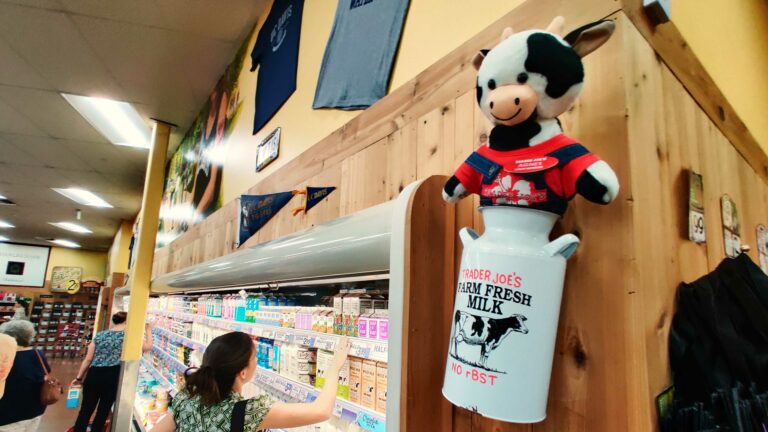
The Trader Joe’s in Davis’ University Mall underwent a recent change, replacing their previous mascot, Davis the Duck, with a new mascot, Agnes the Cow, as of July 22. The mascot acts as a prize for children to find while their parents are shopping and is meant to help them enjoy trips to the store.

Davis the Duck was chosen as the mascot when the store first opened in Davis. 

“Davis the Duck has been the mascot at our location for almost ten years now and it’s time for them to retire,” said Tess Newton, an employee at Trader Joe’s, via email. “We had a graduation ceremony to honor Davis the duck’s accomplishments and long standing duck-uate program. They have graduated with highest honors and the word on the street is that Davis the duck is going into the billing department at Trader Joe’s HQ.”

Newton described Agnes the cow as “an incoming freshman cow” who will be sticking around the Davis location for the next few years.

“She is a cute black and white stuffed cow with denim overalls,” Newton said via email. “She is hiding in the store for kids and college students alike to find for a prize, just let your cashier know!”

Having a mascot is not unique to the store in Davis — each Trader Joe’s store in the country has a mascot that represents the surrounding community.

“There’s a sea otter in the Monterey Trader Joe’s and a Lobster at a Santa Rosa store,” Newton said via email. “When parents with children come into a store, the mascot creates an opportunity for children to try and locate the mascot for a prize.”

Katt Nguyen, a second-year chemical engineering major, said the choice of Agnes the Cow was a suitable one for the Davis community.

“I think it makes sense for the type of environment […] it’s all about the cows,” Nguyen said. “[Agnes] would just fit with the culture. I think mascots are great to bring groups of people together.”

Written by: Taylor Martinez— city@theaggie.org 

College of Biological Sciences’ Undergraduate of the Year crafts genetic algorithm to decipher complex familial relationships

Problem-solving algorithm created by Cole Williams contributes to more inclusive science

Since fifth grade, Cole Williams knew he had an interest in genetics and the relationship between biology, math and probability after first learning about Punnett squares. Williams, a class of 2019 genetics and genomics major, was able to further these interests at UC Davis through his classes and through his work in the lab of Associate Anthropology Professor Brenna Henn. He was recently named the 2019 Undergraduate of the Year by the UC Davis College of Biological Sciences.

“Not many schools offer genetics as a major, where you can focus solely on genetics,” Williams said. “UC Davis had so many classes that interested me, so it was a great place to study this.” 

After working at another lab, Williams wanted to perform research more closely related to genetics and genomics and, at the start of the Winter Quarter of his third year, Williams began working at Dr. Henn’s lab, where he could do just that. Here, he was able to write an algorithm that allowed researchers to distinguish between complex familial relationships in genetic datasets of Africans. 

In Dr. Henn’s lab, researchers study populations from southern Africa and neighboring countries to solve questions about human evolution and disease. According to Williams, these populations are some of the most genetically diverse in the world, yet some of the least studied. 

“The lab uses genetics to study the genetics of complex traits, like skin color, disease susceptibility, tuberculosis … and demographic history of the region,” Williams said. 

Limited genetic information is known about non-European individuals, as the majority of knowledge about human diseases comes from data sets with large proportions of European individuals. Seventy-eight percent of individuals in “genome-wide association studies” are of European descent, according to an article published in Cell, however, according to the U.N., Europeans make up only about 10% of the world’s population.

“Not a lot is known about non-European populations and there is a tremendous amount of information we can learn from these populations,” Williams said. 

In Williams’ project, he worked with a dataset from the Himba population of Northern Namibia and was tasked with constructing pedigrees using genetic data alone. His goal was to study tuberculosis susceptibility and the inheritance of traits in a family context, as well as understand family structure and mating practices in the population. 

The Himba population has unique attributes including a complex mating system where both men and women have partners outside of their marriage. This results in complicated family trees of multiple half relatives. Additionally, mating between first cousins in this population is preferable, resulting in an inbred population, according to Williams. These factors made constructing the pedigrees difficult for Williams because most algorithms have been designed and developed using outbred northern European datasets, which are incapable of factoring in the Himba database’s complexities. 

Previously used algorithms cannot decipher between relationships where individuals share a quarter of the same DNA, such as grandparent-grandchildren, half-siblings and avuncular relationships — those between uncles and aunts and their nieces and nephews — without external information. According to Williams, this is because algorithms review the genome in terms of the proportion of the genome that is identical by descent. 

“I tested these algorithms, and they didn’t work at all because of these problems, so I decided to write my own algorithm that dealt with these populations better,” Williams said. 

Williams’ algorithm looks at identical by descent segments instead of proportions since they are more informative. Through this algorithm, Williams can decipher between the differences in segments between different familial relationships. Through this discovery, he was able to create a pedigree for the Himba population. 

“Being able to distinguish the relations, that’s been a problem in genetics for a really long time,” Williams said. “My algorithm solves that problem. The way the future is going, it is important that we can build these family trees so we can study disease in the context of families and not as the population as a whole, so we can better understand how these traits and diseases work.”

Williams’ academic performance, in addition to his volunteer work as a counselor at Camp Kesem, a student run organization for children with parents affected by cancer, was taken into consideration in his selection as 2019 Undergraduate of the Year by the College of Biological Sciences.

“Camp Kesem was a really huge part of my time at UC Davis,” Williams said. 

Currently, Williams works as a research assistant at the Colorado Center for Personalized Medicine at the University of Colorado Anschutz Medical School. He is working to rewrite and improve his algorithm in order to be able to apply it to more outbred populations and larger datasets. 

“I’m continuing what I was doing and learning more about disease in non-European individuals,” Williams said. 

Written by: Margo Rosenbaum — science@theaggie.org 

NFL Offseason 2019

0

Player and coaching changes highlight the off-months of the season

Picture this: Tom Brady is coming off of his sixth Super Bowl ring at 42 years old, the Cleveland Browns are not only favored to win the AFC North, but have the fifth highest odds of hoisting the Lombardi Trophy and the Pittsburgh Steelers have a top tier offense after willingly letting go of Antonio Brown and Le’Veon Bell.

Just a few years ago, this mental image would have seemed ludacris; however, this is the shocking reality of today’s NFL. The landscape of the National Football League was drastically remodeled this offseason, making for one of the most anticipated regular seasons in recent memory.

An entire group of elite players found new homes during this offseason, for a variety of reasons, such as money or simply being put in a better personal situation. Though some of these moves were ultimately decided by teams, not the players themselves.

Some NFL stars were able to control their own destiny and choose their new home, including former Pittsburgh Steelers running back Le’Veon Bell. Bell sat out the full duration of the 2018 season mainly due to frustration stemming from the fact that the Steelers placed a franchise tag on him for a second year in a row in the hopes of eliminating any chance of injury before he could sign a long-term deal. Not only was Bell considered a top-three player in his position in 2017, but he either caught or carried the ball 406 times  — over 100 more touches than the next closest back.

If he signed the franchise tag again in 2018, the Steelers would have likely used him in the same, high-volume fashion. A player refusing to sign the deal and choosing to sit out a season was certainly a rarity in the NFL, but the move ended up working out for Bell, as he signed a four-year deal with the New York Jets worth $52.5 million ($25 million guaranteed) this offseason.

A situation considered to be closely related to Bell’s was that of safety Earl Thomas, who was holding out for a contract before the season started. Thomas, on the other hand, did not choose to miss games, and to the world’s dismay, suffered a gruesome leg injury during week four, ending his season.

At the time, it was unknown if he would get a big contract this offseason, or even be able to play at the same level again. Thomas was widely considered the best, or at least one of the best, free safeties in the league, being the only player in the NFL with 25-plus INTs and 10-plus forced fumbles since 2010, per NFL Research.

Ultimately, when free agency started, the injury became irrelevant to teams interested in him. Thomas was able to secure a huge bag, cashing in on a four-year, $55 million deal, with $32 million guaranteed, to play for the Baltimore Ravens.

Additionally, plenty of athletes were relocated to different teams in trades, with some moves more surprising than others. Other notable players making their way to new homes include star wideout Antonio Brown being traded to the Oakland Raiders, rookie quarterback Josh Rosen being traded to the Miami Dolphins to make room for first-overall pick Kyler Murray in Arizona and Odell Beckham Jr. being shipped to Cleveland. Rosen and Brown were both at least rumored to be gone when the offseason started, but Beckham Jr. was a head-scratcher to most, as he is going into his prime as one of the most athletic players to ever grace an NFL field.

A player who could be making his way to a new home soon is Ezekel Elliot, who has said he refuses to play another down for the Dallas Cowboys without a contract extension. Elliot is due to receive just under $13 million over the next two years, even though he has led the league in rushing attempts and rushing yards in two of his three years in the NFL.

Given that Los Angeles Rams running back Todd Gurley is set to make over $14 million just next year perhaps legitimizes Elliot’s claim that he’s underpaid. The shelf life of a typical running back is shorter than any other position in football. Throw in the fact that he’s been the most used back in the last three years, and he seems to have a strong case for deserving a new contract.

Unfortunately, Elliot’s quarterback, Dak Prescott, just turned down a $30 million a year deal in hopes of getting $40 million, which could further limit the Cowboys’ salary cap leeway. To make matters worse for Elliot, Cowboys owner Jerry Jones doesn’t seem too concerned about not having his star running back around.

“We know he’s capable of … carrying the whole load,” Jones told reporters, in reference to newly drafted running back Tony Pollard, indicating that they might be okay with letting one of the league’s best running backs sit on the bench for an unspecified amount of time.

Either way, every team that made an offseason move, questionable or not, is banking on it paying off in the future.

In the last few football-less months, some teams have also gone through massive renovations, hoping to fix past years’ problems. Most notably would be the Arizona Cardinals, picking up offensive mastermind Kliff Kinsbury to be the new head coach and drafting a dynamic gunslinger in Murray with the first overall pick, only a year after drafting Rosen in the first round.

The Cardinals were not the only team who felt as though a change at the top would benefit the organization, as the Green Bay Packers, Cleveland Browns, Denver Broncos, Tampa Bay Buccaneers, New York Jets, Cincinnati Bengals and Miami Dolphins all made changes at head coach. Even though this may appear as an extensive list for just a single offseason, Sean McVay and the Los Angeles Rams showed the world how monumental of a difference a head coach change can make.

Aug. 1 officially marked the beginning of the NFL Preseason, with the Denver Broncos taking on the Atlanta Falcons. Similar to the offseason, the game was hectic and full of surprises, with the Broncos winning on a last play hail mary into the endzone. Denver’s new head coach, Vic Fangio, took a speedy trip to the emergency room after the team’s mid-day meetings, passed a kidney stone, then returned to the stadium in time to see rookie wide receiver Juwann Winfree win the game. Winfree was thrown a fade in the back of the endzone as time on the clock clicked down to zero, fought the defender for the ball as it popped into the air, just for Winfree to outmuscle his defender and secure quarterback Brett Rypien’s pass for the game winning score.

The most game-altering rule change implemented this offseason was the ability to challenge pass interference calls or no-calls, and Fangio was the first coach to utilize the new rule, although unsuccessfully. This change stems from the overwhelming outcry after the blown pass interference call in the NFC championship game between the Los Angeles Rams and New Orleans Saints. This was not the only rule change implemented, as a few minor rules were inputted, such as restrictions of celebrations and forcing the kicking team on kickoffs to have five players on each side of the kicker.

Another major rule change implemented was the restriction of blindside blocks, fully removing them from the game of football to decrease the amount of head and neck injuries. While not all fans may immediately love these new rules, the NFL Rules Committee assumes they are what is best for the game. With these changes and offseason moves, the upcoming season is likely to be filled with intrigue.

Written by: AJ Seymour — sports@theaggie.org


UC Davis researchers look to social media to spread cervical cancer awareness

Social media identified as tool for health organizations

How much do you know about cervical cancer? Jingwen Zhang, an assistant professor of communications, suggested posing this question to students. Although cervical cancer is an important issue, it carries a lot of stigma because it is sexually transmitted and therefore not widely discussed, but Zhang believes that organizations can combat this by using social media to spread messages about cervical cancer prevention to a larger population. 

“Without social media, you may only get the cervical cancer prevention information from your doctor, but how many times do you see your doctor a year?” Zhang asked. “It’s not that frequent, and a lot of people don’t have a regular health care provider. [Health organizations] have to reach them in a way, and social media has come to be the most affordable and accessible way to get [that] information to individuals, especially the underserved individuals.”

In order to understand the kind of content that is “more likely to be shared by social media users,” Zhang and her team needed to make clear distinctions between two variables: the source of the message and the type of message. This helped them understand which specific factor could increase the dissemination of preventative messages. 

Urmimala Sarkar, a professor in the division of general internal medicine and associate director for vulnerable populations at UC San Francisco, discussed perceptions of what drives individuals to share information on social media.

“Most people believe that humans make decisions based on stories with emotional influence,” Sarkar said. “I thought people would be more likely to share stories they read online rather than facts, [but] I was wrong.”

Instead, it was determined that, on average, factual messages from organizations were being shared more. Although viral personal stories seem to be disseminated widely, Zhang explained that this is actually a skewed observation because these stories are only a small percentage of all personal stories posted on social media. In reality, a larger percentage of all factual messages posted on social media are shared more often.

Based on her findings, Sarkar explained that organizations can now see it is more effective to regularly share factual information rather than focus on personal stories. 

In the face of stigma surrounding discussions of cervical cancer and misinformation on the internet, Zhang wants to emphasize the amount of power young internet users have to promote accurate health information that can help their loved ones and others. 

“I think people are actually exposed to a lot of health promotion messages on the internet, and even if we don’t expect ourselves to read them really carefully, it’s helpful that […] we share it to the networks to enable the broader dissemination of messages,” Zhang said. “You have a purpose of sharing it to improve the overall public health because social media is this disseminating network — a distributing network — that information gets through by individuals sharing [it].”

Written by: Michelle Wong — science@theaggie.org


Explaining moral lessons in media can help children behave more prosocially

30-second TV inserts might help children become more empathetic

The high saturation of messages from television shows is nothing new, but the influence of these messages on children might have previously been overlooked. Recent research conducted by Drew Cingel, an assistant professor of communication at UC Davis, along with professors at other universities, however, demonstrates that with further explanation, these messages can help children develop more prosocial behaviors.

“Media and technology use is a dominant activity of childhood and adolescence, not just in the United States, but around the world, and I don’t think it’s going anywhere,” Cingel said. “So I would like to spend my time as a researcher trying to understand for whom and under which conditions we can leverage these really powerful and far-reaching technologies to benefit kids in some particular way.”

For this particular field of research, Cingel was interested in how TV can be designed to promote or impede learning. Whether we are aware of it or not, children are learning both positive and negative lessons from media, explained Marina Krcmar, an associate chair and professor of communication at Wake Forest University. 

Krcmar said she was curious how children extract moral lessons from media and how media influences not only short-term behavior, but also “their more complicated processes like developing a sense of right and wrong.”

In the study, two groups of children were shown an episode of the TV show “Sofia the First.” One group watched a 30-second insert before the episode started that gave a general overview of the episode while the other group watched a 30-second insert that explicitly explained the lesson of the episode before it began, Cingel explained.

After watching the show, the children from each group were met with puppets used by researchers to measure whether their intentions to behave prosocially had increased. Since the episodes showed to the children concerned lessons around inclusivity, the researchers, via the puppets, asked questions such as, “How nice do you think this child is?” or “Would you like to be friends with this person?” 

Cingel and his team found that children who had a low theory of mind — meaning children who struggle to conceptualize other people’s thoughts — who had watched the episode including the insert explicitly explaining the lesson had an increase in prosocial intentions. Since it only takes 30 seconds to see this change in behavior, Cingel explained that production companies would be able to add these explanatory inserts in with little impact on advertising time. In addition, these inserts are cost-effective, since they don’t require a high level of production. The researchers were able to see results even though the inserts were not professionally made.

“I’d like people to see that well-designed, developmentally appropriate media can have a positive impact in the lives of kids and that there are things that we can do as content producers, as parents, as supportive adults in the lives of at least a child,” Cingel said. “There are relatively small things that we can do to help a child learn something that can be really important. Learning to be more prosocial and more stigmatizing is going to have a profound impact on many dimensions of that child’s life.”

Krcmar advises parents to be selective with the media they let their children consume to mitigate its negative effects while also being active consumers with their children in order to enforce the positive messages. 

“Television influences kids not in terms of their behavior, but [in] more subtle ways including things that we hope that we’re doing well which is improving their sense of moral reasoning,” Krcmar said. “If we could teach children to take the perspective of others, hopefully we can create a population that is more ethical — essentially better human beings.”

Written by: Michelle Wong — science@theaggie.org

Police investigate alleged drugging at Dive Bar in Sacramento

A woman accused Dive Bar employee, bar denies allegations

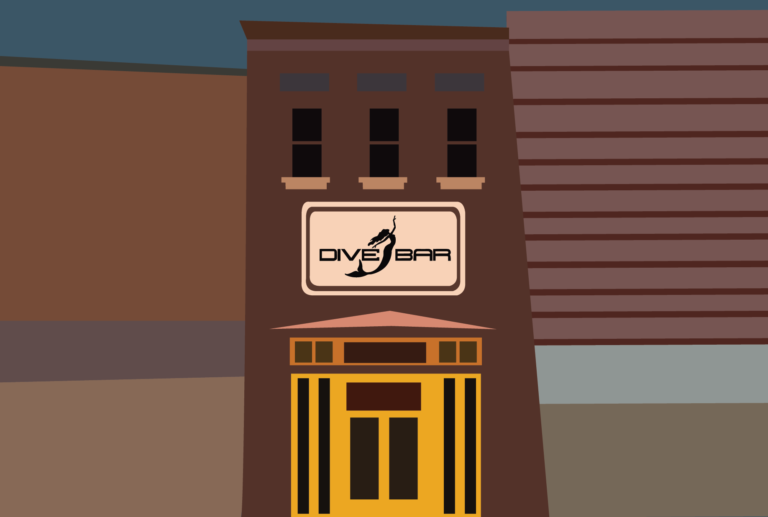
A customer who went with a friend for a drink at Dive Bar in Sacramento accused a bartender of drugging her drink in a tweet on July 15, sparking independent investigations by the bar’s management and the Sacramento Police Department. The customer, Angel Gonzalez, said in an interview with the The Sacramento Bee that she went with her friend for a drink at Dive Bar on K Street the night of July 11, a bar famous for its “live mermaid performances” that take place in a large water tank above the bar.

Gonzalez said to The Bee that she felt more intoxicated than anticipated. She claimed that after a single sip, she also began to experience hallucinations.

“I have honestly drank way more than that, like so much more than that, and I still had the ability to think and know where I was going and know who I was going with,” Gonzalez told The Bee.“I was hallucinating. That’s when I knew I had to go, because that had never happened ever (before).”

As stated in The Bee, she left the bar with her friend and took a rickshaw to LowBrau, a nearby beer hall, where her fiance picked her up and drove her home. Gonzalez took to Twitter to make an accusation against a bartender at Dive Bar in a since-deleted tweet.

“So I got roofied at dive bar BY THE BARTENDERS on Thursday night,” Gonzalez said via Twitter according to The Bee. “I’m bearly (sic) feeling better. ‘HOW THE F— IS SAC PD GOING TO TELL ME THEY CANT (sic) DO S—? HOW THE F— IS THE OWNER OF DIVE BAR GOING TO READ MY MESSAGE AND NOT REPLY? How the f— is this fair … it’s not.”

The since-deleted post garnered mixed reactions from users both on Twitter and Reddit — while some reacted with skepticism toward the accusation, other users expressed sympathy towards the accuser and hostility towards the bar and many also claimed to have similar experiences at the same location or at other Sacramento bars.

Gonzalez’s Twitter account became private after gaining thousands of likes and retweets and the account has since been deleted.

Dive Bar management addressed Gonzalez’s claim in an Instagram post on July 19, after the post accumulated attention from the public. The bar’s management claimed that they reviewed the footage from their security cameras and had not found “any evidence that supports the alleged victim’s claim.”

In addition, Dive Bar elaborated on how its surveillance system could detect the scene in its entirety. 

“Fortunately, [our surveillance] system was able to capture the alleged victim’s every move and interaction leading up to and departing from the bar; our surveillance system was also able to capture every pour and step of the staff-member in question,” the bar’s post read. “We categorically refute all claims made against said staff-member as well as those made against Dive Bar.”

The post further indicated that the bar gave police full access to their security system for their own investigation. Sacramento police confirmed that they opened an investigation into the alleged incident, but there had been no new developments at the time of publication. Police officials declined to comment on whether the investigation was still ongoing.


Written by: Tim Lalonde — city@theaggie.org

7 infant primates die at UC Davis’ primate research center

Some believe negligence is to blame

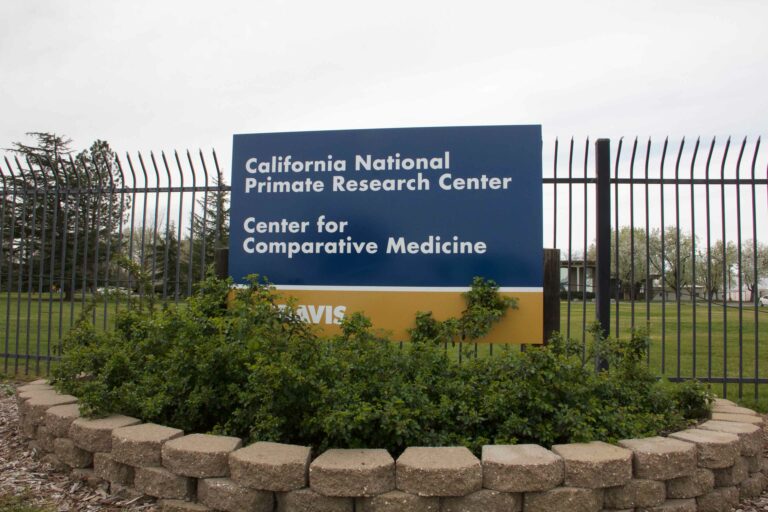
Seven infant primates died while under the watch of scientists at the California National Primate Research Center. Dedicated to improving the health of both animals and people, The California National Primate Research Center is located on the outskirts of the UC Davis Campus, between West Village and Putah Creek. 

“The center carries out research that benefits human health, for example on HIV/AIDs, Zika virus and other infectious disease, respiratory disease, reproductive health, Alzheimer’s disease and aging,” said Andy Fell, a spokesperson for the primate center.

The animals died due to a suspected cause of negligence in 2018. However, this news was not announced until just last month

The university said the infant primates died from an allergic reaction to dye passed on to them by their mothers, but Michael Budkie of Stop Animal Exploitation NOW says this is not likely. 

“It seems to me that UC Davis is attempting a cover-up,” Budkie wrote in a complaint filed with the U.S. Department of Agriculture. 

According to federal documents, the baby primates died from untreated sepsis and bronchopneumonia. There is no evidence of veterinary care given to these animals, according to Budkie. 

“The records indicate that five of the infant monkeys likely had an anaphylactic reaction. But the other two had severe infections. Things like this do not develop overnight. UC Davis clearly failed to provide adequate veterinary care and their negligence in that regard killed two of these infants,” Budkie said. 

Fell said animals at the center receive “the utmost care.”

In an attempt to improve this animal rights issue, SAEN filed a complaint with the USDA asking for a $10,000 fine to be imposed on The California National Primate Research Center for the death of each primate.

Written by: Ellen Caminiti — science@theaggie.org

Biosensing soft robot uses E. coli to detect surroundings

UC Davis, Carnegie Mellon engineers bring together synthetic biology and soft robotics

Robots are often thought of as metallic, manufactured and artificial. Yet recent research conducted by engineers at both UC Davis and Carnegie Mellon University (CMU) has opened up a branch of science in which robots and nature collide.

Carmel Majidi, an associate professor of mechanical engineering and director of the Soft Machines Lab at CMU, expressed interest in the relationship between biology and machinery.

“I’ve always been interested in how natural organisms and biological materials

can inspire new types of machines and materials technologies,” Majidi said.

Cheemeng Tan, an associate professor in biomedical engineering at UC Davis, began collaborating with Majidi when he was a post-doctorate at CMU. They both wondered if combining synthetic bacteria with a soft robot could create a new function for the robot.

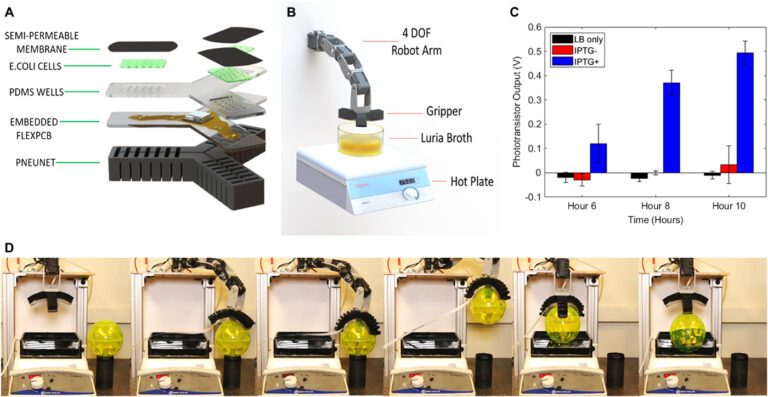
The term “soft robot” is due to the robot’s gripper function — the fingers are made soft in order to grab and adapt to the shape of the object, according to Tan. Majidi explained that these rubbery fingers are embedded with sensors composed of genetically modified E. coli bacteria that are able to create fluorescent proteins when in contact with a certain chemical and a flexible circuit. The fluorescence is then converted into an electrical signal that directs the robot’s fingers.

“We chose E. coli because of the versatility with which we can turn it into an artificial cell with properties that we can engineer,” Majidi said. “Through genetic modifications, we can ‘program’ the E. coli bacteria so that it responds to chemical stimulation in a way that we can measure with on-board electronics.”

Tan discussed two primary challenges that arose when designing the robot: creating an environment within the soft robot where the bacteria could function and engineering an interface where the bacteria could communicate with the robot. The solution was to house the bacteria in an artificial growth chamber and design a tube to detect the optical signal from the bacteria and instruct the robot.

“We had a challenge for awhile with the membrane system, but we didn’t know it for awhile,” said Phillip LeDuc, a professor of mechanical engineering, biomedical engineering, computational biology and biological sciences at CMU. “It was through patience and persistence that this was solved!”

Since the communication aspect of the robot was one of the most challenging parts of the design — because of how small the signal being detected was in comparison to the environment — it took two years to finetune this function. The original idea for this collaboration was conceived in 2013, and its first prototype was developed around three to four years later.

“The next steps are to literally design the robot so that it can start taking steps,” Majidi said. “The current robot is a gripper that is mounted to a robotic arm. The next robot would be like an octopus or starfish that could move around and collect chemical samples at different locations. Another future goal is to use advancements in synthetic biology to be able to measure a wider range of chemicals or environmental conditions.”

Majidi hopes that from their research people will realize it is indeed possible to combine synthetic biology and soft robots in the same material architecture. She believes that the continuation of this field of study could lead to the development of soft biohybrid robots that use artificial cells to achieve new adaptive functions. 

“In terms of science, I’d like people to learn about how we could combine living cells and materials in a new way to create new hybrid systems that can do new things that existing organisms or existing materials cannot do,” Tan said. “In terms of just general approach, I’d like people to know more about interdisciplinary science and how one can work with people with different expertise and then combine the expertise to really create a new area.”

Written by: Michelle Wong — science@theaggie.org