53.5 F
Davis

Davis, California

Tuesday, December 23, 2025
Home Blog Page 405

Sunset Fest to kick off Fall Quarter

Here’s what Entertainment Council has in store for students 

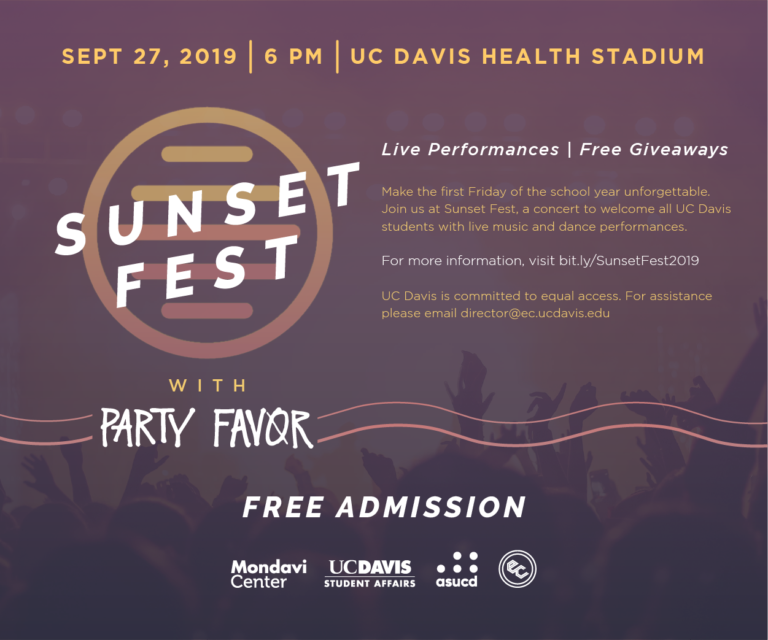
The ASUCD Entertainment Council will be hosting their second annual Sunset Fest, a welcoming concert event for all students. 

Sunset Fest will be held at the UC Davis Health Stadium on Sept. 27. Doors will open at 5:30 p.m. and the event is free for all students. 

“We decided to have the show at the Health Stadium this year because the venue has yet to be used for anything besides sporting events,” said Entertainment Council Director Kimya Khayat via email. “We wanted students to feel more connected to the campus that they pay for by hosting a free show at one of the largest venues on campus.” 

Sunset Fest will be headlined by EDM DJ Party Favor. 

“He has a very versatile and edgy style that has helped pioneer the festival trap and twerk genre, exhilarating audiences and turning heads across the globe,”  Khayat said.

Party Favor has collaborated with popular artists like Diplo, A$AP Ferg and Lil Baby. 

There will also be a variety of student acts performing. Student DJ Mello Mase will perform first, followed by dance groups AX, Agape, MK Modern, Na Keiki O Hawai’I and SONE1. San Diego-based DJ Arshdeep will then open for Party Favor.

Students will have the chance to learn about different ASUCD units at the event and they will also have the opportunity to win free merchandise and enjoy food. 

“Sunset Fest isn’t just a concert,” said Christopher Montes, the Entertainment Council Recruitment Manager and Interim Promotions Director via email. “Students come to Sunset Fest to take scenic pictures, win free merch, and learn about other organizations on campus, especially about EC!” 

Montes said Party Favor was chosen after polls sent to students revealed a preference for EDM music.

“We want to cater to as many students who’d like to hear a certain genre of music or a particular artist on stage,” Montes said.

Khayat planned Sunset Fest to kick off the school year in a celebratory way and get all students excited for what’s to come.

“I think that Party Favor’s style does exactly that,” Khayat said. “His song choices and mix are sure to get people bouncing, and I can’t wait to see it all come together.” 

Written By: Gabriela Hernandez — arts@theaggie.org

Diving into the new season: UC Davis Men’s Water Polo

Aggies’ 2019 campaign starts strong

Coming off a tough 2018 season, the UC Davis men’s water polo team is starting its 2019 season off strong, as the Aggies picked up a number of quality wins in September. 

Last season, UC Davis ultimately fell short in the Western Water Polo Association (WWPA) title game to long-time rival and competitor UC San Diego. Despite that being the end of the 2018 season, the year consisted of many significant accomplishments, victories and a few tough losses that all ignited the start of the 2019 season. 

This year, the Aggies look to build off of an 18-8 overall record and an impressive 6-1 conference record from 2018. The team graduated six seniors last year, but it also welcomed six freshmen this Fall. Seniors Yurii Hanley, Holden Tamblyn and Max Somple now captain the 2019 squad and have all been significant forces in the pool offensively and defensively for the Aggies throughout their Davis careers. 

The 2019 team also consists of active upperclassmen players like juniors George Kuesis, Jack Stafford, Keenan Anderson and Jonah Addington in addition to senior Eric Martel who contribute in the team’s successes. 

“Every year we are really close, and that is no different this year,” Hanley explained about the team. “We are a tight-knit group who all love working hard and working for each other. We all have the same goal.”

The Aggies are firing into this upcoming season with full force in their September schedule, with wins against Loyola Marymount University, Chapman University and UC Berkeley. The Aggies have tallied 72 goals in their first five matches. 

The overtime thriller win against Cal at Berkeley’s home pool has set the tone so far for the 2019 season. Entering the game, UC Davis ranked #11 nationally, while the Golden Bears, ranked #5, have been a perennial powerhouse. 

“Our mindset was basically just keep on grinding,” Hanley said. “That we knew we could hang with them, that we knew if we got down a little bit not to freak out because we just knew we put the work in and we can hang with them — and we could win if we kept grinding.”

This UC match-up ended with back-to-back goals by Kuesis and Somple in the final 30 seconds of regulation, tying the match 12-12 and taking it to overtime. While the first overtime period ended in 13-13 after sophomore Nir Gross fired one to the back of the net, Kuesis, Tamblyn and Anderson sealed the deal in the second overtime period, each scoring and cementing the Aggie upset with a 16-13 score. 

“We were all excited,” Somple recalled. “We were confident, we look forward to playing those guys every year. We have, the past few years, had some close games with [UC Berkeley], so it was nice to get over the hump and get a win against them.”

 Hanley also explained that the team plans to build off this win by “maintaining the mindset that we are only as good as our last win, so you just gotta keep on building you can’t rest on your laurels.” 

The victory in Berkeley was certainly a highlight for the program and a large reason why the Aggies’ 2019 season is looking strong. The team’s captains highlight that communication is the team’s best asset. 

“Communication is key,” Somple explained. “We really take pride in the way we treat each other, so you know it’s the way you treat each other in the pool. [Such as] the passes you’re giving each other, just working for each other if you see someone is off their block and always covering for each other. Always having your teammates back.”

This season, the Aggies strive to get to their end goal of winning the WWPA. With a few big wins so far, the team has a strong mentality of always reaching toward that goal. But it doesn’t mean that the Aggies won’t be tested. Over this past weekend, UC Davis split a four-game tilt in the 2019 Aggie Roundup, beating Cal Baptist and Ottawa University but falling to the #1-ranked Stanford in a rematch with the Golden Bears.

 “It all comes down to that last game in November,” Somple said. “And that’s the one you want to win, and that’s our main focus, […] as well as just building connections with your teammates and really caring for each other.” 

The team believes it has big things in store for this season, filled with a lot of good play, hard work, resilience and teamwork. According to Somple, the men of UC Davis water polo are aiming toward their end goal by “just playing our game” and always playing “at a high level.” 

Written by: Frankie Veverka — sports@theaggie.org

Summer Reads: Aggie Arts writers discuss summer picks

From Didion to Atwood, a peek into what Aggie Arts Writers spent their summers reading

Liz Jacobson, Arts and Culture Editor: “Between the World and Me” by Ta-Nehisi Coates

I bought “Between the World and Me” at the National Museum of African American History and Culture in Washington, D.C. this summer because I’m a fan of Coates’ pragmatic Atlantic essay “A Case for Reparations.” On par with Gayl Jones and Toni Morrison, Coates’ letter to his teenage son eloquently speaks to the black experience in America. His memories of his youth in Baltimore, Md., his intellectual awakening at Howard University — which he calls the Mecca — and his experiences as a black father, who is filled with so much love, and fear, for his young, black son are pure poetry. “Between the World and Me” forced an introspection of my own privileges and, in agreement with Ms. Morrison, it should be required reading. 

Caroline Rutten: “The Year of Magical Thinking” by Joan Didion 

Joan Didion grants the reader a personal account of her greatest life tragedy: the sudden death of her husband and the long-term sickness of her only daughter (side note: her daughter died shortly after the release of the book). The book reads as a diary, a longform thought process that grapples with mourning and grief of the most intense form. The opportunity to dive into the mind and masterful syntax of a great American novelist is only one reason to pick up this book; the opportunity to witness Didion come to some form of closure is another. 

Andrew Williams: “Hillbilly Elegy” by J.D. Vance

The true story of “Hillbilly Elegy” recounts the trials and tribulations of author J.D. Vance as he comes to terms with life in poverty-stricken Middletown, Ohio. Vance details life as a hillbilly, confronting drugs, domestic abuse and a seemingly unconquerable feeling of malaise seeping into his community. The main antidote to his hard-pressed environment comes in the form of a hotheaded, no punch-pulling grandma who he affectionately calls “Mamaw.” “Hillbilly Elegy,” written in straightforward prose, is a rags-to-riches tale packed with unlikely role-models, a whole lot of hard work and a little bit of luck. This book is well-suited for anyone who wants to glimpse into Appalachian values and the cultural obstacles that face one of America’s most despondent populations.

Alyssa Ilsley: “The Goldfinch” by Donna Tart 

Donna Tart’s “The Goldfinch” ambitiously spans 700 pages and details nearly 20 years in the life of Theodore Decker. While the novel can be described as both a coming-of-age story and a crime drama, it is ultimately about one’s recovery from trauma and loss. Tart introduces this theme in the beginning of the novel, when Theo survives a terrorist attack in New York’s Metropolitan Museum of Art. His mother dies in the bombing and Theo lives his entire life obsessed with maintaining a connection to the moment it happened. Tart’s prose is impressive; the novel feels sophisticated, but not pretentious. There is a perfect balance between artistic language and traditional storytelling devices that keeps the plot moving forward. Finishing this novel is quite an undertaking considering the page count, but it’s worth the investment.

Itzelth Gamboa: “The Naturals” by Jennifer Lynn Barnes

Barnes’ series “The Naturals” is the perfect poolside read. Barnes focuses on Cassie, the daughter of a sort of fortune teller. Instead of telling fortunes, Cassie’s mother reads people: their nervous ticks, the way they dress and how they speak. Her natural ability to read others is passed on to her daughter. Cassie is soon forced to cope with her mother’s sudden murder, but then gets the opportunity to work with the FBI on cold cases. Fans of true crime murder television shows will be glued to the books as Cassie solves crimes and searches for the truth.

Gabriela Hernandez: “Oryx and Crake” by Margaret Atwood

Margaret Atwood is mostly known for her work “Handmaid’s Tale,” but this dystopian novel, the first in a three-part series, draws on our fears of the direction in which our world might be heading. The story is told through the eyes of Snowman, who, before the world changed into a genetically modified society, was known as Jimmy. We follow his past and present narration, as he reminisces about the time he spent with his friend Crake, who’s responsible for creating the genetically modified society. Snowman also longs for Oryx, a woman both men loved. Atwood leaves readers to uneasily contemplate what our future holds.

Letter from the Editor

From the 2019–2020 Editor-in-Chief

Welcome back returning students, and for incoming students, welcome to UC Davis — you’re an Aggie now! My name is Kaelyn Tuermer-Lee and I am a fourth-year neurobiology, physiology and behavior major. I am very excited to be the editor-in-chief for The Aggie for the 2019–2020 academic year. Some of you may wonder how being an NPB major relates to journalism — while the curriculum and course load is vastly different, I find that both have the same underlying concept. Both attempt to investigate the How’s and Why’s, whether that be through quantitative polymerase chain reactions or through attending press conferences at the police station. I try to relate things I do to everyday life, and continue to ask questions and investigate rather than simply accepting things as facts.

I started at The California Aggie as a city news reporter fall quarter of my freshman year, and became assistant city news editor a quarter later before being city news editor for the following two years. Before college, I was the news editor for my high school newspaper and then became editor-in-chief the year after that, so it’s nice to come full cycle and see how some things remain constant over the years.

As the former city news editor, I am very news-oriented — I love investigative journalism and the satisfaction of being the first one to break hard-hitting news. I know that articles we publish this year will inevitably spark considerable debate and controversy, but we, as the staff of a newspaper organization, wouldn’t be doing our duty if we didn’t report on what’s going on at our university and in our community. The purpose of journalism is to report factual, timely news in an effort to not only engage with and educate readers but also to hold people and organizations accountable. The purpose is to get people to think critically and to evoke change. The California Aggie gives a voice to the student body and the greater community of Davis, and I can ensure that we are dedicated to upholding our journalistic integrity. I know that we will never stop asking questions, and neither should you.

Sincerely,

Kaelyn Tuermer-Lee

Editor-in-Chief

Aggies fall short in Fargo, look ahead to Big Sky play

UC Davis nearly upsets NDSU, faces Montana on Saturday

Saturday’s UC Davis football game against North Dakota State was undoubtedly one of the biggest showdowns in the last couple of decades — perhaps even over the program’s entire history. A match-up of the No. 4 Aggies, per Hero Sports, and the top-seeded Bison seemed sure to supply a wealth of entertainment and provide some insight into UC Davis’ ability to step up to the table and prove itself as one of the top powers in FCS football.

Despite the disappointing 27-16 loss, the Aggies came away from this game with a renewed sense of positivity and optimism after the team came so close to shocking the world.

It was a sheer dogfight for four quarters inside the vaunted FargoDome on Saturday afternoon. After weathering an early storm, the Aggies settled down and went blow for blow with the defending national champions for the remainder of the contest.

Trailing 20-16 midway through the fourth quarter, the Aggies had three offensive plays from inside the Bison four-yard line, but a pair of stuffed runs followed by a costly interception from quarterback Jake Maier appeared to seal the visitors’ fate.

Thanks to a quick stop from the Aggie defense, Maier and the offense got the ball back for one more shot at redemption with just under four minutes left.

Just before North Dakota State’s punt, UC Davis sophomore cornerback Devon King, possibly the best Aggie defender through the first four games, had a chance to intercept a pass on third down, but the ball narrowly slipped out of his hands. King, playing one-on-one coverage close to the sideline, would’ve had a clear path to run the ball back for a pick-six, but it just wasn’t meant to be.

Nevertheless, UC Davis still had more than enough time on the clock to take time and put together a game-winning touchdown drive. Unfortunately, the very first play of the drive resulted in another Bison interception when Maier’s pass was tipped at the line of scrimmage and picked off.

North Dakota State made quick work of the very short field ahead of them and punched in a game-sealing touchdown three plays later, putting the hopes of a UC Davis to bed.

UC Davis actually outgained their opponents by a tally of 422-354, but a handful of untimely penalties, including a few favorable home calls for the Bison, and a stiff North Dakota State defense forced the Aggies to end their drives with three points instead of seven.

Maier handled the pressures of this enormous clash in an extremely calm and confident manner, drawing rave reviews from many people associated with the North Dakota State program who were getting an up-close look at him for the first time.

“Their quarterback is a special young man,” said Bison head coach Matt Entz. “We tried to hit him as much and pressure him and he still hung in there and did a great job. I have all the respect in the world for [UC Davis] and how they go about their business. They’re good.”

Maier completed 29-of-48 pass attempts for 312 yards, connecting with junior wide receiver Jared Harrell a dozen times for 102 yards. UC Davis was able to get the running game going at certain times on Saturday, as tailbacks Ulonzo Gilliam Jr. and Tehran Thomas broke off a few long runs and averaged 3.75 yards per carry between them. Gilliam was very active in a pass-catching role out of the backfield, bringing in seven completions for 47 yards.

The UC Davis defense gave an exceptional all-around effort, allowing a season-low 156 yards through the air and holding a relentless Bison rushing attack to a respectable 4.5 yards per rush. The scoreboard doesn’t exactly tell the whole story of the unit’s performance on Saturday, as two of the three Bison touchdowns came on drives that started inside the Aggie 35-yard line.

Head Coach Dan Hawkins and the rest of the Aggies always stress the importance of winning the turnover battle as the main key to winning every football game. The Davis defense managed to create one of those game-changing plays they always talk about when King forced a fumble at the start of the third quarter, and junior linebacker Connor Airey was there to swoop up the loose football.

The Aggies showed a certain fearlessness on Saturday, refusing to back down from one of the biggest challenges they may face all season. In typical fashion, Hawkins placed great trust in the offense on five separate fourth down situations, and his players responded by converting three of those.

For many outsiders watching the game, it was a feeling of relief, more than anything else, to know that the Bison won’t simply waltz through the FCS and be handed their eighth National Championship in ten years. Although North Dakota State extended their historic winning streak to 25 games, they were given a test unlike one they’ve faced in quite some time.

At the end of the day, this is a loss that will only help the Aggies in the FCS playoff conversation come late November, and potentially aid their chances of receiving a higher seed in the 24-team tournament should they qualify. Over the years, very few teams have been able to accomplish what UC Davis did on Saturday — go into the FargoDome, force the Bison to be on their “A” game, and position themselves to win the football game in the closing minutes.

UC Davis has only strengthened its resume with this type of showing and while the team will ultimately have to navigate a grueling Big Sky schedule over the next two months, Saturday’s performance was another huge step in the right direction for a group with legitimate National Championship aspirations.

The first test of conference play awaits this upcoming Saturday when UC Davis hosts the Montana Grizzlies for a 1 p.m. kickoff at UC Davis Health Stadium. 

Most fans will remember the epic slugfest these two teams participated in last October in front of a raucous environment in Missoula. The Aggies overcame an 18-point deficit and rattled off 46 unanswered points in the second half to stun the home crowd and put the rest of the Big Sky on notice. 

If Saturday’s game is anywhere close to as entertaining as last year’s matchup, we should be in for a real treat.

Written by: Brendan Ogburn — sports@theaggie.org

Police chief gives new information about anti-Semitic fliers found on campus

0

Fliers credited to neo-Nazi, white supremacist group American Identity Movement

Updated at 4:46 p.m.

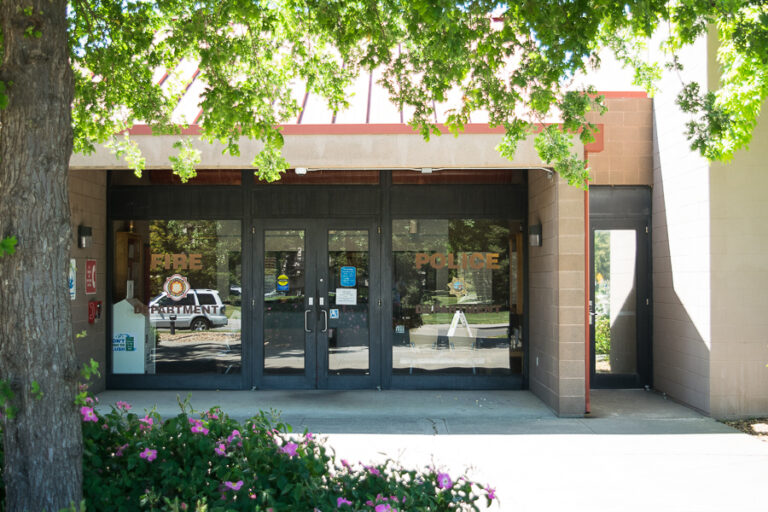
New information has emerged regarding the anti-Semitic fliers posted around campus on Monday, Sept. 23. UC Davis Campus Police Chief Joe Farrow spoke with The California Aggie about the incident, saying the fliers were posted by members of the American Identity Movement, also known as Identity Evropa, which explicitly affiliates itself with neo-Nazi and white supremacist ideology. 

The group was founded in 2016 by Nathan Damigo, an Iraq war veteran, and it is known for distributing fliers on college campuses to “build name recognition,” according to the Southern Poverty Law Center. Damigo helped plan the fatal Unite the Right Rally in Charlottesville, Virginia in August of 2017. 

There were three different types of fliers distributed that day: the first, posted in Mrak Hall, contained the slogan “Nationalism Not Globalism,” framed by United States insignia; the second contained the name of the group; the third was a decal.

Farrow noted that the fliers seemed to be more “recruitment-based” than in previous years. 

“My personal reaction [to this] is extreme disappointment,” Farrow said. “I think it angers most of us that we’re such a diverse campus and we’re so inclusive and […] things like [this] are distributed on campus that are meant to divide [us]. It disappoints us.” 

Farrow stressed that he didn’t believe the fliers were affiliated with anyone in the community, adding that “the trend [we’ve] seen across the nation is that these groups try to grow in strength and try to recruit and pay people to distribute these messages so they can cause a reaction and recruit members.” 

Farrow added that he believes the group’s actions were motivated by “opportunity and will,” saying the fliers are distributed by “[individual people] who try to raise their point of view in the largest audience possible.” He also said he thinks the UC Davis community is “stronger” than the messages conveyed in the fliers. 

Correction: A previous version of this article contained a factual error regarding the content of the fliers. Chief Joseph Farrow has clarified that he misspoke regarding the number and content of the fliers. There were only three posted. A flyer containing a Twitter excerpt saying that “the group is an American neo-Nazi and white supremacist organization […its] members have pushed for what they described as the ‘Nazification of America'” was not found on campus.

Written by: Rebecca Bihn-Wallace — campus@theaggie.org 


Second incident of anti-Semitic fliers found on campus in less than a year

1

Chancellor, Jewish fraternity respond to anti-Semitic incident

Anti-Semitic, neo-Nazi fliers were recently found distributed throughout campus, according to a message from UC Davis Chancellor Gary May posted on the university’s website on Sept. 23. This incident comes less than a year after anti-Semitic fliers credited to the neo-Nazi organization The Daily Stormer were found posted throughout campus last October.

“Campus police have been notified and are investigating,” May’s message states, adding his condemnation of the fliers and saying that the university is “sickened that any person or group would invest any time in such cowardly acts of hate and intimidation.”

The fliers were found posted around 4 p.m. in Mrak Hall and the Mathematical Sciences building, campus spokesman Andy Fell told The Sacramento Bee

Asa Jungreis, the president of the Jewish fraternity Alpha Epsilon Pi at UC Davis and a third-year community and regional development and sustainable agriculture and food systems double major, responded to the anti-Semitic incident in an email statement sent on behalf of AEPi.

“As members of the Jewish community at UC Davis, we are deeply saddened and angered that neo-Nazi and white supremacy flyers were found on campus on September 23rd,” AEPi’s statement reads. “We fully condemn this cowardly act of hiding hateful rhetoric and intolerance behind anonymous flyers left around campus. No community at our university should have to contend with this form of virulent bigotry, particularly as many Aggies are beginning their college careers this month.”

Last October, fliers posted throughout campus and credited to a local division of the neo-Nazi site The Daily Stormer depicted then recently-confirmed Supreme Court Justice Brett Kavanaugh surrounded by politicians and individuals — including a likeness of California Senator Dianne Feinstein and Senate Democratic Leader Chuck Schumer, who are both Jewish — with Stars of David on their foreheads. Dr. Christine Blasey Ford, who accused Kavanaugh of sexually assaulting her, is depicted with the words “Good Goy” written on her forehead.

“Every time some anti-white, anti-American, anti-freedom event takes place, you look at it, and it’s Jews behind it,” the flier states in large, bold type.

In 2017, a sermon “calling for the annihilation of Jews” was given at the Islamic Center of Davis; in 2016, campus printers received anti-Semitic fliers from The Daily Stormer; also in 2016, UC Davis received a ranking in a list of universities with higher incidents of anti-Semitism and in 2015, swastikas were spray painted on the AEPi house in Davis.

Following the posting of the anti-Semitic fliers last October, a group of Jewish student leaders met with Chancellor May to discuss ways in which the university could proactively address the issue of anti-Semitism on campus. This meeting resulted in an agreement on the university’s part that it would host a town hall allowing students to voice concerns as well as a series of workshops for students and staff led by the Anti-Defamation League (ADL).

Two workshops focused on combating anti-Semitism on campus were held in November and February, but both were expressly unaffiliated with the UC Davis administration.

To date, university officials, including the chancellor, have not hosted a town hall nor any workshops targeting anti-Semitism.

“Acts of vandalism against any ethnic or religious communities on campus have no place at our university,” AEPi’s statement reads. “In the coming year, we hope that student groups across campus will find ways to come together and demonstrate a united front against antisemitism, racism and all forms of hate and bigotry on the UC Davis campus.”

May’s statement listed support services for students and faculty, including Student Health and Counseling Services and the Academic and Staff Assistance Program.

Written by: Rebecca Bihn-Wallace — campus@theaggie.org

Managing editor Hannah Holzer also contributed to this report.


Guest: University students deserve access to medication abortion on campus

0

To our future patients 

As future medical providers, we are faced with the impending challenge of meeting patients’ needs in an era of historic hostility to health care access, including abortion care. One in four women will need an abortion in their lifetime. Yet stigma, as well as barriers like cost and distance, increasingly put this safe, clinically simple medical procedure out of reach. These barriers severely limit access to reproductive health and abortion care, especially for low-income, minority and queer communities.

California college students are our future patients, and part of our job as their doctors is to do all we can to ensure their long-term health, well-being and success. Patients’ ability to make personal decisions about whether to have a child and get the reproductive health care they need without burden or delay is critical to their futures.

  Once again, California has the opportunity to set an example as a leader in reproductive rights and access to abortion by enacting the College Student Right to Access Act, Senate Bill 24. The bill requires all 34 UC and CSU campuses to provide medication abortion to students on campus, alongside their existing primary and reproductive health care services.

  Every month, up to 519 UC and CSU students seek medication abortions at off-campus health care facilities, according to research by Advancing New Standards in Reproductive Health (ANSIRH) at the University of California, San Francisco. Students, just like all patients, have the right to receive health care in the setting they choose — and for students, it’s often the on-campus health center. They shouldn’t be forced to make multiple, often expensive trips off campus and pay out of pocket when they could easily get medication abortion care from the health center staff they already know and trust.

  As medical students, we constantly see the impact of our multi-tiered health care system on our peers who, like the vast majority of UC and CSU students, don’t have a car. And it’s not assumed these students know someone to confide in someone about sensitive medical issues in the hopes of getting a ride to an off-campus health center.

  Over half of the students in the UC and CSU system are low-income students, and many struggle to meet their basic needs. ANSIRH research found that one quarter of UC students had to choose between paying for food or housing expenses, and 9% of CSU students suffer from housing displacement. Unexpected expenses, such as paying for transportation to off-campus providers, disrupt both a student’s immediate life and their overall academic career. We should be proactive in caring for these needs; the College Student Right to Access Act tells current and prospective students that their long-term success matters.

Eighty-nine percent of students say that having a child while in school would make it harder to achieve their goals. Only five of the off-site providers closest to UC or CSU campuses have any weekend hours available, and those appointments fill up quickly. Overall wait times at off-campus clinics can be up to three weeks, a timeframe that can potentially delay care past 10 weeks (the latest timepoint for which medication abortion is recommended) and force students to instead seek out an in-clinic procedure.

  Additionally, being denied reasonable access to abortion services results in increased mental health issues, including increased incidence of anxiety. The additional burden of mental illness when denied access to abortion care, combined with the financial and transportation limitations of UC and CSU students, may greatly impact their academic, personal and professional ability to thrive. Each month an estimated 1,038 UC and CSU students seeking abortion — whether medication or an alternative form like surgical abortion — must consider these factors and potential hurdles. 

  University health centers already offer other reproductive health services such as birth control and STI testing. Medication abortion is clinically simpler to provide than many of the services already offered at student health centers, such as diabetes management and mental health care.

  By offering medication abortion on our state’s university campuses, we help ensure that all students have an equal opportunity to build the lives they are working so hard to realize.

Written by: Caitlin Esparza and Kevin Mortazavi 

Caitlin Esparza is a second-year medical student at UC Davis and Kevin Mortazavi is a second-year medical student at UC Davis, an alumni of UC Riverside and earned his masters degree in public mental health from Johns Hopkins Bloomberg School of Public Health. 

Humor: The ants in my apartment are my only friends

1

An ode to the loneliness (and inevitable infestations) of Summer Session

Hello there, gents. I am a student taking Summer Session II, and I would like to share some of my feelings about UC Davis in the summa times.

    It’s hot.

    My classes are hard.

    I’m very lonely because I’m the only one in my apartment for these next few weeks, and it sux. It sucks so much that I had to spell it with an “x.”

    Oh, wait. I’m not really alone.

    I can’t forget about the uninvited guests crashing in my bungalow. Or should I say I cANT forget them because they’re a bunch of fecking ants.

    A few days after I arrived for Summer Session, I noticed a couple of ants out on a date in my bathroom sink. “It’s just two of them, best to leave them alone,” I told myself.

    Biggest mistake of my life.

    Those two ants must’ve told their little ant friends that my bathroom sink was the hottest date spot in Yolo County, judging by the swarm in my sink later that day. I flicked and squashed like no tomorrow, only to have them regenerate like a hydra’s heads. So, I submitted a pest control request to my apartment complex.

Like a Yankee soldier’s wife awaiting her husband at war, I stared out my window in 

longing. Longing, of course, for an exterminator.

    In addition to the ant problem, I was growing more and more lonely. I had no buddies, and I just wanted a friend. And then I had an epiphany: What if the reason my apartment complex stalled pest control was so I could realize I had friends with me all along? The ants!

    The ants had been with me through a lot at this point. Strife. Self-doubt. Heartbreak. Heck! Who’d have thought that my best friends in these trying times would be a gaggle of insects?

    Now that I am #woke, I hang out with my formican friends on the regular. Just last night we bonded over the season finale of “Mindhunter” while eating a DoorDash-ed burrito (except for Antoinette the Ant — she’s on a diet and limiting herself to one crumb-a-day). Thank God for these ants and my apartment complex’s ineptitude.

Written by: Madeline Kumagai — mskumagai@ucdavis.edu

UC Davis veterinarians and campus community provide aid to wildfire-impacted animals

University serves as go-to when wildfire aid is needed

It’s fire season and UC Davis knows its role in helping out: As the number one veterinary school in the United States, UC Davis provides relief, aid and treatments to animals harmed in wildfires and other natural disasters.

“We’re identified as a resource because of our veterinary school so we have a lot of staff, faculty and students who volunteer,” said John Madigan, a distinguished professor in the UC Davis school of veterinary medicine and the director of the Veterinary Emergency Response Team (VERT).

“VERT manages most of the cases in the field and makes decisions to ship animals into the VMTH when their injuries are too severe to be handled in the field,” said Michelle Hawkins, a professor of avian and exotic animal medicine in the department of Veterinary Medicine and Epidemiology and School of Veterinary Medicine.

When a natural disaster occurs, such as the recent wildfires, UC Davis receives requests for aid from the state office of emergency services or from local sources in Yolo County. Necessary aid may include veterinary supervision, assistance with sheltering, biosecurity and preventing infections. The UC Davis William R. Pritchard Veterinary Medical Teaching Hospital (VMTH) itself is a referral base for severely injured animals, according to Madigan.

“We are not the only ones who give help, but we make ourselves available to assist with veterinary care to animals,” Madigan said.

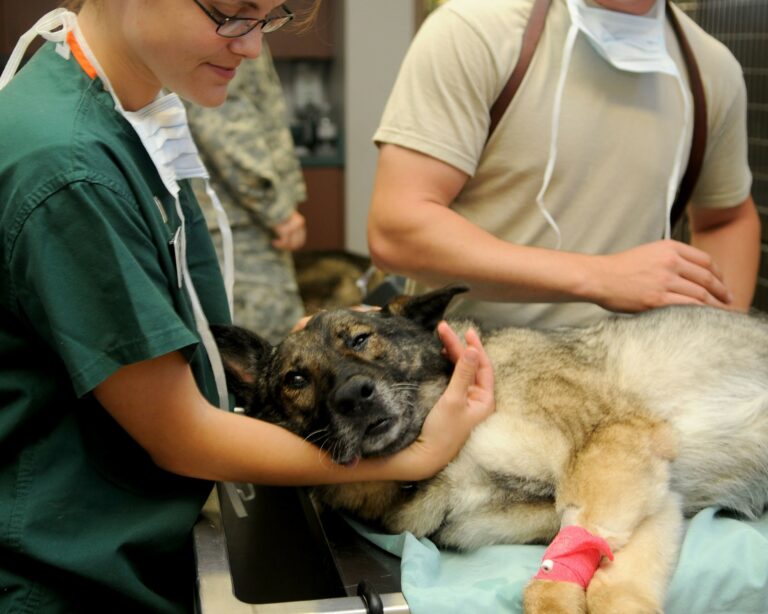
In response to the 2018 Camp Fire, 55 student volunteers and 10 veterinarians helped out, according to an article by the Association of American Universities. Veterinarians and volunteers involved with VERT cared for 950 affected animals, including chickens, ducks, pet birds, llamas, goats, horses, alpacas, sheep, dogs and cats, all housed at the Butte County fairgrounds, according to Madigan. A total of 40 to 50 cats and dogs who suffered burns from the fire were sent to the Veterinary Medical Teaching Hospital for severe care, Madigan said. 

A second VERT team was sent to a Red Cross shelter to care for people and pets at the same fairgrounds. Madigan also led teams into the burned areas to perform checkups and deliver food, water and supplies to animals sheltering in place once the areas were safe to navigate through. One-hundred thirty students are in the VERT program, according to Madigan.

“We as veterinarians part of VERT did everything in our power to help as many animals as possible,” Hawkins said.

Some of these animals had injuries directly related to the fires, such as burns or smoke damage. These animals were also sometimes indirectly harmed by the fires — some animals were hit by cars or cut by fencing when trying to run away from harm. Other fleeing-related injuries include broken or stressed limbs, wire cuts, issues from smoke inhalation, stress injuries, gastrointestinal problems, lack of eating or dehydration.

“In veterinary medicine, you use all the skills you have to help the animals,” Madigan said. “Through physical exams you can make treatments such as topical treatments for burn care, giving them fluids, controlling their diet, putting them in air conditioned units, giving stressed out animals sedation or tranquilization or pain relief. It’s those kinds of things, just like you do with a person.”

With the expert help provided by UC Davis, the animals’ survival rates are typically high, Madigan said. Once animals are treated either in the hospital or at the temporary resource sites, owners are contacted through pet identification tags, microchips, or advertisements on websites.

“For a fire as extensive as [the] one in Paradise, with the intensity of heat, a lot of animals succumbed and didn’t make it,” Madigan said. “In this case, severe burns were often fatal. But there is usually a very high survival rate, and we can help return the animals to their owners.”

Due to the high amounts of donations to the UC Davis Veterinary Catastrophic Need Fund at the School of Veterinary Medicine and donations to VERT itself, enough funds are generated so that veterinarians do not need to charge pet owners for the costs of care, according to Madigan. Through social media posts requesting funds, usually enough money can be raised to cover treatment costs.

Once the animals’ injuries from natural disasters are treated, questions arise as to how they will recover and resume their normal lives. Maurice Pitesky, a veterinarian and associate specialist in cooperative extension for poultry health and food safety epidemiology in the School of Veterinary Medicine, studies food safety effects from wildfire on poultry eggs. Backyard birds spend hours every day eating off of the ground, so the toxins that wildfires spread are big concerns for human health. 

After studying wildfires from 2017, Pitesky said his lab concluded that no correlation was found between the location of the fires and the presence of heavy metals in backyard eggs. Lead was found in some of the surveilled eggs from impacted areas, but there was no spatial correlation between the location of the fires and the presence of heavy metals.

“We cannot have healthy food without a healthy environment,” Pitesky said. “If there are heavy metals, fire retardants and pathogens in our environment, then our foods are going to have those same chemicals.”

In order to reduce trauma for animals when natural disasters occur, pet owners who live in risk areas should be prepared. Madigan said that people should always have supplies, food and water for themselves and their pets, all pets should be microchipped and have collars with identification tags, families should make a plan for where to meet up with each other in case a disaster occurs while they are not together and, finally, individuals should evacuate early to be safe.

“Just like with the Camp Fire, in many cases, there is little time and people often are fleeing for their own lives,” Hawkins said. “Developing the best possible disaster plans for you and your animals in advance, and even performing drills to practice evacuation will give you the greatest chance of everyone getting out of the disaster safe and sound.”

Written by: Margo Rosenbaum — science@theaggie.org 

UC President Janet Napolitano to step down next year

Napolitano served seven years as UC President, during which she survived a cancer diagnosis

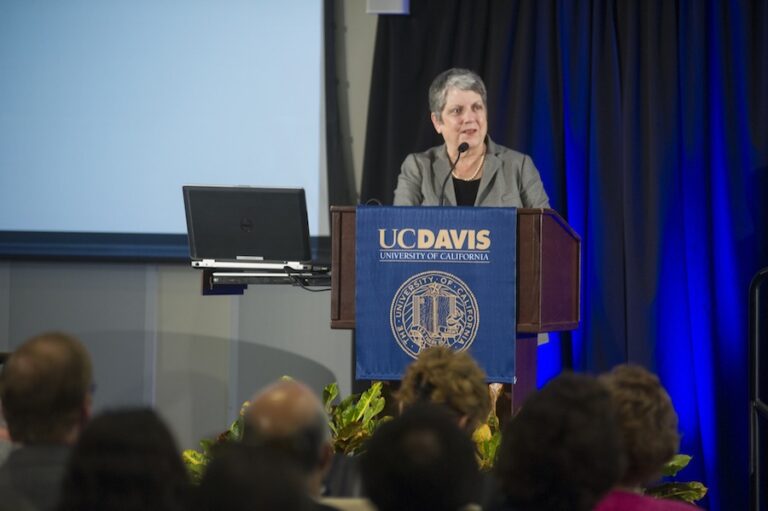
UC President Janet Napolitano announced to the UC Regents at their meeting today, Sept. 18, that she is stepping down from her role after a seven-year stint as the UC’s executive.

Napolitano, the UC’s 20th president, has led the UC since 2013 and will end her term on Aug. 1, 2020. Before coming to the UC, she was the head of the Department of Homeland Security from 2009 to 2013, served as the governor of Arizona from 2003 to 2009 and was Arizona’s attorney general from 1998 to 2003.

“My time at UC has been deeply gratifying and rewarding,” Napolitano said, according to a statement. “I have been honored and inspired every day to serve this institution alongside incredibly dedicated, passionate people. The decision was tough — and this moment, bittersweet — but the time is right.”

The statement the UC released highlighted some of Napolitano’s efforts during her tenure as UC President. These included increasing enrollment, stabilizing tuition and shaping the Deferred Action for Childhood Arrivals program, as well as expanding access to the UC for community college transfer students and addressing the basic needs crisis for students.

DACA was created under her leadership when she was the Secretary of the Department of Homeland Security. She has thus been one of the key leaders in attempts to stymie President Donald Trump’s efforts to end the program.

“Under Napolitano’s leadership, UC became the first university in September 2017 to sue the Department of Homeland Security for its rescission of DACA, a program that protects from deportation young undocumented immigrants brought to the U.S. as children,” the statement said. “The resulting preliminary injunctions by the courts have enabled many of UC’s undocumented students, along with Dreamers across the nation, to renew their DACA status and live and work in the United States; since January 2018 more than 500,000 DACA recipients have extended their authorizations.”

During her time at the UC, Napolitano also survived a cancer diagnosis, for which she was briefly hospitalized before returning to her duties. She stated that since her treatment for the disease in 2016 and 2017, her health has improved and her tests are clear. She added that her health was not a factor in her decision to step down and that the average tenure of a university president is around six years.

Former UC Board of Regents Chair George Kieffer praised Napolitano for her work over the past six years, saying that “the university is better off today than when Janet became president.”

During a press teleconference regarding her announcement, Napolitano was asked about her efforts to hold UC tuition flat.

“We were very grateful for the governor’s budget for the university this year,” Napolitano said. “His budget which was basically the budget adopted by the legislature, and increased funding for the university by almost 7%.”

She noted that over the previous six years, tuition has remained flat across the system for in-state undergraduates, except for one year that saw a roughly 2% increase.

In her final year as UC President, Napolitano has promised to continue working hard on the issues set out before her, which Kieffer called “an ambitious agenda.” This includes increasing degrees awarded by the university; closing education gaps, including those affecting low income families; continuing to support research; strengthening policies around sexual harrassment and sexual violence for students, faculty and staff; moving forward on making the UC carbon neutral and 100% reliant on renewable energy by 2025; improving student’s access to housing and, finally, improving access to basic needs, especially food security.

After leaving her role as UC President, Napolitano will take a sabbatical from the UC. She will then begin teaching at the Goldman School of Public Policy at UC Berkeley, where she is a tenured professor, in Fall of 2021. She has not yet decided on the topics her classes will focus on, noting her breadth of available expertise.

Napolitano did not rule out a future role in government.

“I have no intentions in those regards, but you never say never and I won’t say never,” Napolitano said. “But I think my intentions going forward are pretty clear.”

The search for a new UC President will begin soon under an appointed search committee. The composition of this search committee will be announced by the end of this week by UC Board of Regents Chair John Pérez.

The search committee will be influenced by various advisory committees. These advisors will represent the broad swath of the UC, with committees focused around students, faculty, staff and alumni. Each advisory committee will include members of the 10 UC campuses.

“Per policy, the search committee will include student, faculty and alumni representatives who will seek and incorporate input from the UC community and the public at large,” the statement said.

Written by: Kenton Goldsby — campus@theaggie.org

Aggies run riot in lopsided home opener

UC Davis football delivers 41-13 blowout with huge game looming

Saturday night’s home opener was a chance for the UC Davis football team to flex its muscles on an unfamiliar non-conference opponent, rewrite some school records and work out the kinks in advance of next weekend’s road showdown against the defending FCS National Champion North Dakota State Bison.

The Aggies did not disappoint on any level, delivering a clean 41-13 demolition of visiting Lehigh, a member of the Patriot League. With all due respect to the Mountain Hawks, there was never any doubt that the Aggies were going to impose their will and ultimately choose just how much they wanted to run up the score. Numerous oddsmakers had UC Davis favored to win the ballgame by upwards of 35 points, a striking indication of the newfound respect the defending Big Sky champions have garnered from outsiders in a short period of time.

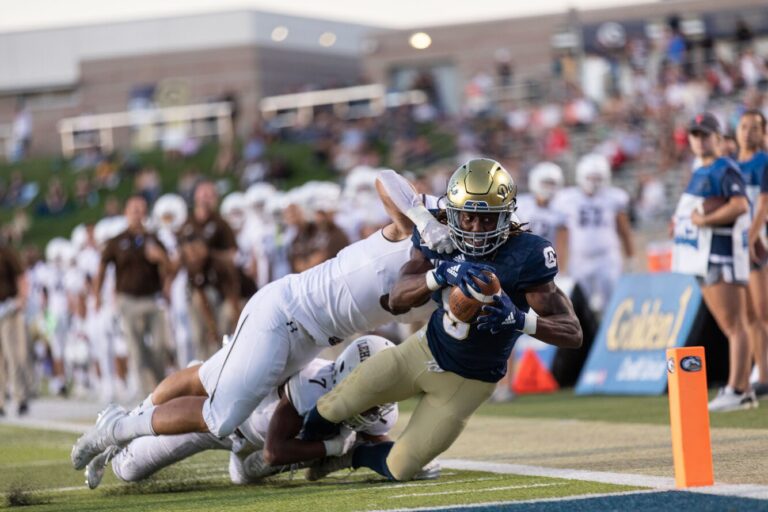
The UC Davis offense exploded for a second successive week, amassing over 500 total yards and rewriting the record books on a couple occasions. Senior quarterback Jake Maier lit up the Lehigh defense to the tune of 389 passing yards and four touchdowns on 38 completions. He went on a staggering run at one point in the game, completing 30 out of 32 pass attempts, including eight in a row on the opening drive.

Maier topped the 300-yard mark for the seventeenth time in his 27-game career, now tied for the most in school history. He was able to spread the ball around to numerous pass catchers, 11 in total, before getting a rare break and giving way to backup quarterback Hunter Rodrigues in the fourth quarter.

Sophomore wide receiver Carson Crawford put on a show for the home crowd with the best performance of his young Aggie career, hauling in nine receptions for a career-high 148 yards and a touchdown. Crawford’s outstanding display comes as no surprise to anyone in the program, as the wideout has led the team with 21 catches through the first three weeks.

In the past, he’s been a consistent, reliable safety net for Maier in underneath and intermediate routes, but he turned things up a notch on Saturday night and showed another element to his game with four catches of 20+ yards. The two have continued to develop a prosperous working relationship, partly due to the extra work they put it in during the spring and summer months.

“In the offseason, I tried to get with Jake [Maier] as much I could,” Crawford said. “Having the trust of your quarterback is one of the biggest things to have as a wide receiver. He always says he’s going to throw to the guys that get open in practice.”

Crawford has quickly gained a reputation in the locker room as an extremely smart and hard-working leader who focuses on all the small details of the game.

“The little things mean a lot to him,” Hawkins said. “He’s starting to become a little bit of a coach on the field for the rest of the guys and helping them. Jake [Maier] has maximum trust in him and he knows he’s going to be where he’s supposed to be, when he’s supposed to be there.”

Besides Crawford, junior wide receiver Khris Vaughn was the other standout performer in the passing game, finishing with eight catches and a pair of touchdowns. Similar to Crawford, Vaughn’s work ethic and relentless dedication has also made a solid impression on his teammates.

“Coaches call him the detail guy, whether it’s in the weight room, taking notes or on the field, because he’s doing everything right,” Crawford explained. “That’s just KV. He’s there when you need him, making big plays in practice and it translates to the games. You should expect more of that in the upcoming games.”

Vaughn started the scoring for UC Davis with his first career touchdown, a two-yard catch that capped off the Aggies’ third straight game with an opening drive touchdown.

“We have really high expectations for ourselves, so going out there and scoring on the first drive is what we expect to do every week,” Crawford said. “Regardless of who we play, we go out there expecting to score on every single drive because if we don’t, we’re not living up to our full potential.”

It’s safe to say that confidence is very high in the Aggie scoring attack these days, as evidenced by the eight fourth down plays when Hawkins decided to keep the offense on the field. The team responded by converting six of those attempts on Saturday, including three that went for touchdowns.

“Having Coach Hawk believe in our offense and Coach Plough having a play ready gives us so much more confidence to convert those fourth downs,” Crawford explained. “We’re almost ready to go for it on every fourth down and then we’re honestly surprised when he brings on the field goal unit because we want to score on every drive.”

On the other side of the ball, the Aggie defense turned in an impressive bounce back performance after surrendering 35 points in last week’s 38-35 nail-biter win over San Diego.

“We didn’t really play to our standard last week,” said redshirt freshman linebacker Nick Eaton. “All week in practice we emphasized bringing the juice and running to the ball, and it really showed on the field tonight. When you make big plays, it’s the whole defense working together and everybody doing their job.”

The UC Davis front-seven was rampant in creating pressure up front and essentially lived in the Mountain Hawk backfield for much of the night, racking up seven sacks, thirteen tackles for loss, and two turnovers.

Eaton was the leader of the pack, flying all around the field with two and a half sacks, two and a half tackles for loss, two pass break-ups and a forced fumble.

“We emphasis sacks, turnovers, and interceptions,” Eaton said. “We call it the ‘big three’ and we’ve got to get at least three in each of those categories every game.”

It looked as if the home team might pitch its first shutout since 2006, but a pair of Lehigh touchdowns in the final six and a half minutes spoiled any hopes of completing that historic achievement.

Nonetheless, the defense made a lot of positive strides and built some confidence heading into a tough matchup next weekend.

Following Vaughn’s early touchdown, the Aggies tacked on another seven points later in the quarter when senior tight end Wes Preece, blanketed by a defensive back, caught a four-yard touchdown pass on fourth and goal.

With the score, Preece moved into tenth place in school history with his 19th career receiving touchdown, which is also the most ever by a tight end.

Shortly before halftime, sophomore running back Ulonzo Gilliam extended the UC Davis lead to 21-0 on a short touchdown run, his fourth of the season. Gilliam had a relatively quiet night by his standards, rushing for 56 yards on 15 carries.

In the second half, UC Davis scored on three straight possessions, with junior running back Tehran Thomas, Crawford and Vaughn all finding the endzone.

Crawford’s touchdown came on a spectacular 24-yard catch in which he leaped to high-point the football between two defenders.

Vaughn’s touchdown catch was equally as impressive, as the junior was being dragged backwards by a defender but somehow managed to swallow up the football with one hand in the front corner of the endzone.

The Aggies will fly to Fargo, ND at the end of the week, ahead of Saturday’s 12:30 p.m. kickoff versus North Dakota State at the FargoDome. The game can be streamed online at ESPN+.

As you would expect, UC Davis refuses to treat this contest any differently than every other game on its schedule, despite the mighty opponent that will loom on the opposite sideline.

“We always say nameless and faceless opponent,” Crawford said. “They’re a great team and we’re really excited to play them, but we’re going to go at it like any week because you can’t look up or down at an opponent.”

No matter what happens, the Aggies will leave North Dakota with a better grasp on how they stack up against the best team in the FCS.

“It’s always great to play really good football teams,” Hawkins said. “It’ll be a great, fun environment. The kids want to play in big games and big environments, so it’ll be a really good litmus test.”

UC Davis will return home to UC Davis Health Stadium on Sept. 28 for the start of Big Sky play against Montana. That game will kick off at 1 p.m.

Written by: Brendan Ogburn — sports@theaggie.org

Processing times mean students could still owe after submitting SHIP Waiver

Fee payment deadline is today, Sept. 15

Students whose Student Health Insurance Plan Waivers were tentatively approved should be on the lookout — they could still be on the hook for an $874 bill if their waiver has not fully processed by today, Sept. 15, the fee payment deadline.

The UC Davis fee payment deadline is today. Students who owe money to the university could face dropped classes if they do not pay the fee on their MyBill account. And though the SHIP Waiver was due on Sept. 10, processing times mean that if the waiver has not fully worked its way through the system, students could still owe the university $874. Once the waiver receives final approval, students will be refunded that money.

When submitting SHIP Waivers, students who meet all the insurance criteria have their forms “tentatively approved,” according to Todd Atwood, the insurance services supervisor for Student Health and Counselling Services.

Changes this year, however, have led to longer processing times. Atwood explained that while in previous years only 10% of waivers were audited, this year every single waiver is undergoing an audit. 

Waivers, once submitted and approved, usually take 48 hours to fully process. With five days between the SHIP Waiver deadline and the fee payment deadline, in previous years the vast majority of all approved waivers would have processed completely by the second date. Audited waivers, however, “can take 7-10 days, or longer, if additional documentation is required from the student,” according to Atwood. This could lead to students needing to front the money for the SHIP, even if they do not plan on using the insurance.

Most students submit their SHIP Waivers far before the deadline, Atwood explained, “so that they do not run into this issue.”

“It is important to note that the online waiver application for Fall quarter 2019 has been open and available for students to submit their waivers since May,” Atwood said via email. “We also sent out email reminders to all students in July, and again in August. It is also one of the requirements on the MyAdmissions checklist for new students to review their health insurance needs, and to submit a waiver if they already have their own coverage.”

Students who do not pay the SHIP fee by the deadline today will receive non-payment notices. According to Atwood, his department will review the names of students on the dropped for non-payment list.

“If anyone on the list is at risk of being dropped solely because the UC SHIP fee hasn’t been paid, we will look to see if they have submitted a waiver, and where it is in the process,” Atwood said. “If it has final approval, but it hasn’t posted to their student account yet, we will notify the Office of the Registrar to not drop that student.”

Once this year’s round of SHIP Waivers have been processed, Student Health and Counselling Services will look at the process and see if changes need to be made regarding the timeline.

“Several years ago, we actually moved the waiver deadline date back from the same day as the Fee Payment Deadline, to 5 days prior, to allow time for the waivers to process and post to their student accounts,” Atwood said. “We will review this year’s information about turnaround times for the audit process, and possibly adjust our deadline date further back in future years, to allow for more time between the waiver deadline date and the Fee Payment Deadline date.”

Written by: Kenton Goldsby — campus@theaggie.org


Christian French headlines “bright side of the moon” tour

Christian French, 22-year-old Indiana native, headlines first tour / ANGELO KRITIKOS

22-year-old Indiana native goes from dropping out of college with 13 credits left to headlining his first tour

For four to five years, Christian French was posting acoustic covers he recorded as  voice memos on his iPhone onto Soundcloud. Fast forward to last year, when he dropped out of Indiana University after being invited to open for EDM producer Chelsea Cutler on her “Sleeping With Roses Tour.” Now, this fall, 22-year-old French is headlining his first tour, “bright side of the moon,” that began on Sept. 4 in Ann Arbor, Mich.

French’s music falls under the alt-pop genre. His debut single, “Fall for You,” with producer Triegy, charted on the United States Viral 50 Chart on Spotify. Other singles include “love ride,” “superstars,” “sweet home” and “hearts of gold.” French recently released an EP with six songs, serving as the inspiration for his tour.

French explained that although he wasn’t exposed to playing music at a very young age, his mom would rotate CDs from artists such as John Mayer, Eric Clapton, the Eagles and Fitz and the Tantrums. He became interested in percussion between the ages of 10 to 12 before joining band and choir in middle school, where he fell in love with playing piano and singing. Although he began to play more covers after learning songs on YouTube, French said his biggest musical inspiration was John Mayer.

“I’ve been listening to literally every single one of [John Mayer’s] albums for my entire life,” French said. “‘Room for Squares’ and ‘Heavier Things’ and ‘Continuum’ were the three albums that were just always playing. And so I just got really, really into him at a young age, and he’s still around — he’s still releasing incredible music, and it’s really cool to see his transformation and his growth throughout his career. I think he’s incredible all around.”

French has grown tremendously within the last year, from opening for Cutler and Quinn XCII to headlining his own tour.

“I’ve been performing for about a year now, and it’s pretty much only been opening slot shows — 30-45 minute shows — so this is the first time that I’m getting to play a lot of the songs that didn’t make the cut the first time around or two,” French said.” “It’s just a whole new experience. We’re playing with a drummer this time, we’re just getting to do what we want this time instead of being told what we can and can’t do, and it’s just opened so many doors […] I’m just so amped about it — there’s just so many things that we’ve never been able to do in a performance that we’re able to do for this tour.”

But before going on tours and recently moving to Los Angeles a few months ago, French had lived in Fishers, Ind. his whole life and was enrolled at Indiana University.

“So I went to Indiana University and I was studying human biology because I wanted to be a doctor when I got to school,” French said. “As college went on, I just kept getting more and more into music to the point of kind of daydreaming about it all day in class […] At the end of my junior year, I got connected to Chelsea Cutler and we started texting a little bit. One night, I just got a text from her that was like, ‘Yo, how would you feel about opening for me on this next tour that I’m going on.’ And so I could not turn that down — I had been trying to do some shows for a while, but I had wanted to kind of be an opener before.”

French explained that while he weighed the option of going on tour versus finishing his college education, he couldn’t turn down touring with Cutler, who is also a 22-year-old who got her break while she was an undergrad at Amherst College.

“Chelsea was literally the number one person on my list that I wanted to open for, and getting that text was just the most exciting thing ever,” French said. “It was at a really weird time — I think a week or two of school left — and it was all just kind of an idea at first, there was no confirmation. So I left school that year not knowing if I was coming back or not. But it ended up working out — I’m very thankful for that.”

French also said that his parents were supportive of his decision, “they knew what I wanted to do — they were totally behind it, always with it and they made the decision easy,” he said.

“It was a tough decision but it was also a no-brainer for me because I had decided that music was what I wanted to do with my life,” he said. “And to not go on tour with someone I think is a phenomenal artist that is in the same demographic as me […] it was just the perfect tour to go on.”

French admitted, however, that going on tour and moving to California had made it more difficult to maintain his friendships back in Indiana.

“Moving out here has been really tough on my friendships back home,” French said. “I try to FaceTime them and talk to them as much as I can, but it sucks sometimes seeing them all hanging out during the summer and … missing out on a lot of that stuff. But, obviously, I’m out here doing what I love, so I can’t be mad about that. And one of my best friends from Indiana just moved out here to be helping out with the team — he’s going on tour with me and selling merch — it’s really cool that I’ve gotten to involve my friends in it as well.”

Along with staying in touch with friends in Indiana and being able to have one of his best friends tour with him, French talked about how important being aware of his mental health has been.

“I’ve been kind of really into self help and staying on top of my mental health because it’s just the most important thing, whether you’re doing music or not,” French said. “So I’ve been really, really focused on my emotions and being aware of all that stuff, and it’s helped me tremendously. I’d say I’ve grown more this past year than my entire life, and I’m really happy the way things are going. I feel like I’m interested in the right things, and some things that will last a long time.”

“bright side of the moon” was a concept that French contemplated for some time, writing out what the idea meant in a journal. He explained that while some songs take a few weeks to complete, other songs, such as “call me your love,” were written years before being released. The “bright side of the moon” EP consists of six songs, and was the inspiration for French’s tour.

“bright side of the moon is mostly about how much negative shit there is in this world that you could focus on, but instead of just feeding negative energy, just focus on the bright side of things,” French said. “Finding the positives in every situation has just helped me so much — on tour, it’s really easy to get hung up on some stupid little stuff that could ruin your day and make you not be in the mood for a good show, but tour just kind of forces you out of that mood. I mean, you can’t go on stage and be like a sour dude on stage — you gotta be in the mood. So tour kind of helped me focus on the positives and keep my head above the water.”

In terms of what’s next for the rising artist, French explained that he’s taking it day by day, setting goals but also knowing that he doesn’t want to compare himself to other artists.

“I have goals, but I’m trying not to be so set on them to the point where if I’m not at this exact spot, I’m going to freak out — I’m trying to keep it very free-flowing,” French said. “My goal is just to do the very best that I can every single day. Every artist has their own kind of journey to just navigating the music world, and I’ve been trying not to be hung up on the progress of other artists.”

Being a newer artist himself, French knows what it’s like to just start out and become acclimated to a music career.

“It takes time to get to where you want to be, it takes patience,” French said. “It sounds cliche, but it’s true. Just finding your message, what you want to say in your own unique way and bringing it to the world is what’s most important. There’s a lot of people that can piece together a song that is fabricated, but it comes down to whether you have something meaningful to say that people will latch onto.”

In terms of his own music, French is optimistic and wants to continue writing music that positively affects his audience.

“I just hope to continue to build this fanbase so I can continue to tour and continue to spread a positive message because that’s kind of my mission at this point,” French said. “It’s a pretty dark time going on in this world, and a lot of artists are honing in on that darkness and writing music about that — which is great — but my goal is to just find the happiness and find the positives and start a movement to get back to healthy minds. That’s really my goal — if I’m helping anybody, that’s all I can really ask for.”

French will perform at the Rickshaw Stop in San Francisco on Oct. 1. Tickets can be found on French’s website.

Written by: Kaelyn Tuermer-Lee — arts@theaggie.org

UC Davis alumna fatally stabbed in Washington D.C.

D.C. Police Department arrests suspect, court hearing to come Sept. 12

Margery Magill, a UC Davis alumna from the class of 2015, was fatally stabbed on Aug. 27 in Washington D.C. while walking a dog. Police were able to arrest the suspect and described the alleged attack as random, without any clear motive.

Police Chief Peter Newsham discussed how the event played out, according to a video the D.C. Police Department posted on Twitter.

 “A little after 8:45 PM, members of the fourth district were dispatched to the 400 block of Irving Street, northwest for the report of a woman down,” Newsham said. “When officers arrived, they found 27-year-old Margery Magill from northwest D.C. suffering from multiple stab wounds. She was brought to a local hospital where she was later pronounced dead.”

Currently, only one suspect, Eliyas Aregahegne, is known to have been involved in the stabbing.

“We have not recovered any information to suggest that Margery knew or had any association with that suspect,” Newsham said. “We do not have any information that it was a robbery or an attempt of sexual assault. Detectives located the suspect…a follow-up search warrant was obtained and additional evidence was recovered. The suspect was transported to the Metropolitan Police Department Homicide Branch for questioning, sufficient probable cause was established and 24-year-old Eliyas Aregahegne from Northwest D.C was arrested for first-degree murder.”

The court case is now ongoing. The next hearing for Aregahegne will be held on Sept. 12. In a preliminary hearing, Aregahegne initially stated that he had a finger injury, evading the possibility that he stabbed Magill. Court documents mentioned that his statements were inconsistent.

According to court documents, the “defendant then placed himself on scene and explained that a dark force was speaking to him from inside of his head… multiple times throughout the interview, the defendant denied the stabbing.”

While the court hearings will be ongoing, faculty at UC Davis are reminiscent of Magill’s time as a student. Magill worked at UC Davis’ Study Abroad department and graduated with a major in international agricultural development. She went on to receive a master’s degree in international relations.

Blake Cooper, the assistant director of communications in the Global Affairs department, hired Magill when she was a student at UC Davis.

“Margery worked for UC Davis Study Abroad for two wonderful years and contributed so much to our office,” Cooper said via email. “She brought incredible energy and a passion for global education that was inspiring to those of us who worked with her every day.”

Jenavieve Hatch, a former program coordinator and advisor for UC Davis’ quarter abroad program, was also part of the hiring panel when Magill applied.

“I remember her application, and I remember interviewing her with a handful of other colleagues — she was just insanely impressive,” Hatch said. “She was a really accomplished, smart person. She was in that cohort of student assistants, and she had done some cool international education so we were excited to have her on the team.”

While working at the study abroad program, Magill appeared in a video project encouraging students to take a chance at exploring a different country. Cooper emphasized how much Magill contributed to the program and how the team was fortunate to have had her in their cohort of student assistants.

“We were lucky to have Margery on our team for as long as we did and always looked forward to hearing from her after she left UC Davis,” Cooper said via email. “Losing her in such a tragic way has been extremely difficult for the staff in our office who worked with Margery. Our thoughts and prayers go out to her family and all who knew her.”

Hatch also elaborated on Magill’s energy while she was a student assistant for the study abroad program.

    “Her work ethic was pretty amazing,” Hatch said. “There’s a reason we hired her, she was really active and enthusiastic. She really liked international education — she was excited about the job. I remember she would always say yes to everything, [and] she was always helpful.”

Hatch heard the news of Magill’s death after a friend messaged her on Facebook. She said she felt sheer shock when she first heard the news.

“It was pretty surreal, I think it was such a senseless and horrible thing,” Hatch said. “It’s one of those things you read about on the news, and you think that must be hard for that person’s family and friends. When it happens to someone you know, then you don’t really know how to come to terms with it because it’s just so wild and senseless.”

Cooper reacted in shock as well, remembering how Magill stood out to him as a student. 

“My reaction was probably similar to others who knew her: I was shocked and devastated,” Cooper said via email. “Margery was one of the most energetic and passionate students I have had the pleasure of supervising.”

Written by: Stella Tran — city@theaggie.org