55.4 F
Davis

Davis, California

Monday, December 22, 2025
Home Blog Page 442

Video Game Orchestra: Explore Beyond

A performance of beautiful, lesser known indie games scores

On Sunday, March 10, the Video Game Orchestra Club presented its concert “Explore Beyond” in the ARC Ballroom. Consisting of thirteen songs that come from mostly independent video games, the ensemble proved their musical prowess by conducting an impressive performance that was filled with with soul-moving songs and an obvious air of comradery between the team of musicians.

What started as a nine member string ensemble in 2017 has grown to a 40 member group two years later. It has also become an official UC Davis club and welcome all music and video game lovers. According to the program handed out at the beginning of the concert, their goal is to “showcase the many endless unique worlds [one] can find in video games.”

The orchestra executed their goal quite well as their songs moved from joyous to melancholy to upbeat to downright hilarious. The ensemble’s performance was hosted in a room with a theater-sized screen, which projected certain scenes from each video game they covered.

As 6 p.m. dawned, the orchestra took their positions with their instruments, all clad in their black club shirt and aligned themselves in sections of strings, winds and percussion. They began their set with a song from the game “Capoka,” which truly set the mood for the night; a game that focuses on a free-roaming bird flying across a totalitarian landscape, the music was uplifting and brought a level of excitement to the audience as they watched scenes of this unbound blue jay taking flight above the concert of students.

Each song lasted anywhere from three minutes to upwards of ten minutes; most of the drawn out songs featured soloists showing off their talent attained over the years in the span of a few minutes. Directly after the opening song, the mood shifted as the concert went from upbeat to downhearted with a song from the (not-so-indie) “The Last of Us,” which featured Austin Kyran as the solo cello. One but needs to look into the gloomy, apocalyptic storyline of this game to understand the depth of musical talent that Kyran brought to the performance of this song titled “All Gone (No Escape).”

From there, a series of other merry performances would have raised the audience to their feet for a dance had there not been a climate of formality tying them to their chairs. The orchestra covered songs from “To the Moon,” which featured Savita Pereira on piano and vocals; “Journey,” which featured Kyan on cello, Diane Le on piano and Lauren Ting on flute; “Undertale,” which featured Justin Satnick on clarinet, Justin Tavassolikhah on alto saxophone, Brandon Cao on trumpet, Ziad Asadi on piano and Ryan Jung on guitar and “Hollow Knight,” which featured the string orchestra, Satnick and Julie Meyers on french horn, Shannon Kipling and Christopher Rivas on clarinet and Ting and Sharon Giat on flute.

Just before the 10-minute intermission, an obvious fan favorite was the “Super Smash Bros Medley” from the Super Smash Bros Series which featured Satnick and Tavassolikhah on center-stage in a brotherly fashion performing the medley’s entirety. Satnick bounced back-and-forth between french horn and trumpet while Tavassolikhah took on saxophone and clarinet. A far from simple composition, the Justins made it look easy as they performed the piece with such groove it had many audience members holding up camera phones to record the spectacle. They ended on a firm high-five that was echoed by a round of applause.

The intermission consisted of friendly, video game based conversations and a massively popular raffle consisting of two prizes: a Cuphead video game figurine and the privilege to choose what song the orchestra would master and perform in the next concert. The raffle winner from their last concert met their chosen song from the video game “Xenoblade Chronicles” in the second act. This raffle takes place every year, and although I dumped 20 dollars into the pot in hopes to pick a song from “Halo 2,” but my luck was no match to that of another audience member.

The second half of the concert went as smoothly as the first, featuring songs from “Ori and the Blind Forest,” which featured Jason Mak on piano; “The Beholder,” which featured Oscar Santamaria on bassoon and Jung on guitar; “A Hat in Time;” “Cuphead,” which featured Gabriel Patterson, Abigail Cohen and Aliya Hunter on samba percussions, Charles Cook on trumpet and Mak on piano and more “Hollow Knight,” with Chung on piano.

At the end of the concert, the crowd was ecstatic and laden with applause and loud cheers — for video game and music lovers alike, the night was a success. It’s safe to say that this diverse crowd of musical gamers are in good hands with the Video Game Orchestra.

The Video Game Orchestra plans to host a concert every quarter in order to bring joy to the community through their music. The environment they cultivate and the music they produce is one of a kind, as well as the sideshows they host — such as the raffle I will be doubling up on for their next performance.

To any and all who are interested in joining their community, they meet in Room 105 in the Music Building every Friday from 6 to 8 p.m.. More information can be found on their website as well as on all social media platforms.

Written By: Clay Allen Rogers — arts@theaggie.org

Review: Cold War

The Arts Desk reviews

Last week, the Arts Desk saw “Cold War” at the Varsity Theater. The 2018 Polish black-and-white drama follows Wiktor and Zula, two artists who fall deeply in love. Their love story is set against the background of the Cold War and the Communist propaganda machine. Directed by Paweł Pawlikowski, the film was nominated for Best Foreign Language Film, Best Director and Best Cinematography at the 91st Academy Awards.

Liz Jacobson

I didn’t realize the impact of this movie’s emotionally profound and thoughtful story on me until I started crying at the rolling credits. The score, which featured Chopin’s “Fantaisie-Impromptu,” Dwa serduszka” and an Ella Fitzgerald tune, perfectly complemented the beautiful cinematography.

Josh Madrid

The love between Zula and Wiktor is like two rivers flowing side by side, meeting each other at times, and eventually spilling out into the same deep ocean. The suffering and indulgence of these two lovers is a spectacular must-see.

Clay Allen Rogers

I was able to Shazam the whole movie, resulting in my new favorite Russian folk music playlist on Spotify. Besides the tear-jerking score and soundtrack, the more I contemplate the intricate scenes of this black-and-white masterpiece, the more I find myself wondering why this film didn’t win every award there is to win at the Cannes Film Festival.

Caroline Rutten

I’m going to see this movie again this weekend. The camera shots are too beautiful, the on-camera chemistry is too convincing and there is so much depth to the plot that one viewing won’t suffice.

Written By: The Arts Desk — arts@theaggie.org

Students express concerns over English department’s creative writing emphasis

Application process has potential for unclear expectations

The UC Davis English department offers undergraduates in the major a creative writing emphasis by way of acceptance to and completion of three upper division creative writing classes. Some students, however, have expressed concern regarding the perceived ambiguity in the application process to these upper division classes.

The creative writing emphasis allows students to produce material in three writing genres: poetry, fiction and nonfiction, denoted as P, F and NF respectively.

“English 5F, 5P and 5NF are the gateway classes in creative writing; these are the first classes you take,” said Associate Professor of English and Director of Creative Writing Katie Peterson. “If you want to take more classes, you apply to get into 100F, 100P, and 100NF. They are all workshop classes. The way they are taught is you go and you write things and then you bring them back to the classroom community. You get feedback and you learn to be a better writer through seminar based discussion. You learn what good writing is and what your writing is.”

Each class has space for roughly 17 students, and there is on average one section of 100F, 100P and 100NF offered every quarter. There will be two 100F sections this upcoming quarter, however.  Students apply for a place in the class through an application that requires writing samples. The professor teaching that quarter’s class decides which students from the application pool will be accepted into their class. Students who are denied are not offered direct feedback or justification as to why they were not accepted.

“I’m interested in screenwriting and media writing, and I think creative writing could cover these areas more than being just a communications or journalism major,” said fourth-year English major Kenny Menjivar. “The application process itself isn’t that difficult, but I haven’t gotten into fiction all year, and I’m still trying to get the emphasis with that. My [English 5F TA] was telling me different professors have their own tastes … I went to one of the major advisors last quarter and they told me it’s all up to the professor. I was a little mad at first, but I figure at one point I’ll get in.”

According to Peterson, the quality of the student’s work is the underlying factor to determining a student’s acceptance to the course.

“Every professor reads the applications and makes the decision on their own,” Peterson said. “The professor chooses the best writers, so the criteria [for acceptance] is the best writing. They chose the writing that is the most alive and dynamic. I can’t speak for everybody, but I know when I am faced with the applications for 100P, I choose the best poems. I know there is a popular view that nobody agrees what the best is, but I think if you chose a life in the arts you don’t think that’s true. There can be agreement what the best is. I choose students who are interested in poetic form in some capacity, whether it is the form of slam poetry or the sonnet. I choose students who think poetry is more than putting feelings down on a piece of paper. I choose students who are memorable. I often find myself choosing students who are interested in things other than themselves.”

A quote by poet Elizabeth Bishop summarizes good writing in multiple forms to Peterson.

“There are three things she looks for in good writing: accuracy, spontaneity, mystery,” Peterson said. “For me that covers it. I’m looking for things that show the writer knows what they are doing, I’m looking for things that surprise me and I’m looking for things where I walk away and there is quality of continual thinking.”

While fourth-year English major George Liao was initially denied to the emphasis, he was accepted upon reapplying. To him, focusing on growing as a writer was the cause of his eventual acceptance into the emphasis courses, rather than attempting to write in accordance to a style the professor of the class might want.

“[The emphasis] is really excellent, I’ve grown a lot since I’ve been here,” Liao said. “The classes are small and it’s concentrated. You get to work with other writers and see yourself grow and them grow as well. Writing is an expression of self. The more you adhere to yourself, find truth and instill it in your writing, it shows and the better writer you become.”

Writing for the purpose of adhering to a specific professor’s style goes against the writing itself, according to Peterson. A trust in oneself as a writer is fundamental to the creative writing program and is supported by the variation within the application process.

“What [you should think] is what is my best piece of work, rather than trying to guess what the professor will think is your best piece of work,” Peterson said. “The minute you start doing that is when you start becoming truly ambitious as a writer because you’re thinking about your own judgement. That is your best resource when revising a piece of work, as opposed to thinking ‘what does this person want from me.’”

Moreover, this nonlinear academic path is part of true instruction in the arts.

“It is much easier to know what instruction in the sciences looks like,” Peterson said. “The tradition of the instruction of arts in this country is a rich tradition, but it’s much less deeply respected and much less understood. And being an artist of any kind, you have to be the best judge of your own work. It is a really self-governing thing to do to want to be an artist. There is no rubric or set of criteria that is going to tell you what good writing is […] I think we’re less used to being comfortable saying one piece of writing is better than another than we are saying one set of coordinates in a problem set is more accurate in one problem set than another.”

Nonetheless, students can feel stress in the simplicity and inherent ambiguity of what is expected from them in the application as well as the number of students who apply. Moreover, these factors add stress to academic planning.

“I’m supposed to graduate, but if I don’t get into fiction I might have to take it in the fall,” Menjivar said. “But I don’t want to wait and see what the professor is going to say, so I might just play it safe and apply to nonfiction or poetry. But you do also get priority for a class as a senior so maybe I will get in with priority. But a lot of people are applying to fiction and there are only 15 people in the class, so I might take the easy way out. I think it’s random, it all depends on what the professor wants”

Moreover, according to Menjivar, students are notified a “week or two before the quarter starts” whether they are accepted or denied from the class which can complicate a schedule.

“I probably won’t find out until spring break if I get into my class for Spring Quarter,” Menjivar said.

According to Liao, the underlying issue that causes complications in student planning is the unequal ratio of student demand for creative writing classes and the supply of classes offered.

“I think perhaps if they opened up more 100 [series] classes that would be good,” Liao said. “Hopefully they will look into that to allow more capacity to bring students into these classes. Other majors are also impacted, and other students on campus also have to find other ways around it.”

The English department has taken steps to address student concerns about the creative writing emphasis.

“I had a meeting last quarter, and I’m going to have one next fall, with students before the application process to talk about the application,” Peterson said. “One of the things I did during the meeting was talk to them about how to select their best pieces of work and how to revise them.”

Peterson suggested seeking one-on-one attention with a professor or taking other creative writing classes can help improve a student’s work in order to better re-apply for an emphasis course.

“I think you can seek out that thing with the professor or take English 5 again,” Peterson said. “Fiction is the genre of our day, it is what everyone wants to write. But as long as you’re writing you’re probably improving. English 5 is there every quarter. Poetry classes often have less students who want to get into them, and you can learn a lot about writing a story through a poetry class. Non-fiction, too.”

Written By: Caroline Rutten — arts@theaggie.org

Can’t touch this: Avoiding illness at university

Students discuss the preventive measures they take to avoid getting sick

Gesundheit! Being sick is never fun, and the prevalence of sickness during the winter, accompanied by gloomy days, early sunsets and crowded Unitrans buses full of wet umbrellas, can be particularly discouraging. A violently loud sneeze during lecture may garner a “bless you” from the professor, while during a certain midterm, sniffles seem to harmonize all around. On top of actually being sick, college students are no longer at home and find themselves with added responsibility when taking care of themselves.

Students like first-year biochemistry and molecular biology major Aparna Manoj find getting sick inconvenient. Manoj said that by constantly being surrounded by so many more people than she would be at home, it feels easier to get sick and harder to recover.

“When someone gets sick, everyone gets sick,” Manoj said. “Usually when I get sick it lasts a few days, but here it lasts [a] week, even with all the medication.”

First-year neurobiology, physiology and behavior major Palavi Lodhia agreed with this. When Lodhia was sick recently, she also found it hard to recover. Manoj tries to drink warm water and avoid cold food, something that Lodhia would have liked to do, but was unable to.

“Being at home, I have parents to help,” Lodhia said. “But here I am on my own with limited food and resources to help me recover […] the market doesn’t have vegetarian soup and I can’t drink tea, so I barely drank any warm liquids.”

Going to classes became challenging, according to Lodhia, in part due to a lack of motivation when classes are far away from the comforts of home. Students who live off campus have the added step of getting to campus and then going from class to class. Not only are there classes to stay on top of, but there are also other responsibilities, including club involvement and work obligations.

Many students try to avoid getting sick by taking precautions beforehand. For some, like second-year environmental policy analysis and planning major Liliana Jeske, this includes getting a flu shot. Lodhia generally gets an annual flu shot, but was unable to this year because of the insurance she has.

“I get [my flu shot] just to be safe and think others should too,” Lodhia said. “I only went to the Wellness Center once to try to get a flu shot, and they didn’t accept my insurance and said there was no one available to give me one regardless at the time I went. So that kind of sucked.”

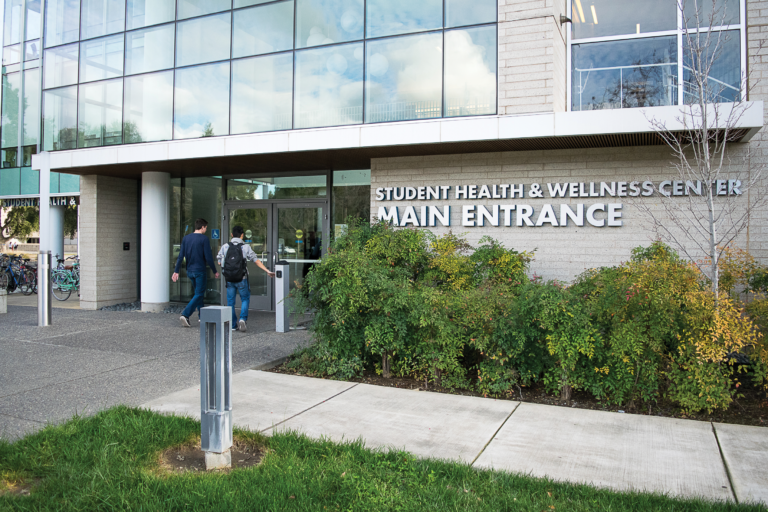
The Student Health and Wellness Center can be hard to navigate as students have concerns about the UC Student Health Insurance Plan (SHIP) waiver, insurance and payment options. Neither Jeske nor Manoj have gone before, though Manoj considered it when she had a long-lasting cold.

Lodhia makes sure to hydrate and drink Emergen-C, a staple in many dorm rooms (the classic flavor of Super Orange has a distinct smell that can remind anyone of storm clouds around Tercero). When the weather is bad, she controls the amount of time that she spends outside and what she wears. Once she is sick, she tries to catch up on sleep and sometimes homework as well if she can focus on it.

Manoj, on the other hand, doesn’t typically get a flu shot. Her preventative measures are similar to Lodhia’s, and she also tries to eat healthier. She says that although “it seems kind of silly,” she sometimes just tells her body not to get sick as “a desperate measure.”

“I get all my vaccines and everything of course, because it’s important to be protected against serious illness,” Manoj said. “But if the flu doesn’t seem really abnormal, my family usually doesn’t get the flu shot.”

Manoj understands that everyone has different reasons for choosing or not choosing to get the flu shot each year, but her reasons reside in her health history.

“For me personally, it’s because I don’t get sick that often at all, and usually I don’t get the flu, but my family also kind of thinks that getting sick at times is better, ironically,” Manoj went on. “I guess the logic is to let your body really get sick and fight it off to kind of revamp your system, but of course this only applies with the common cold, not anything serious.”

Although many students try to stay on top of classwork and other responsibilities, prioritizing one’s health is important as well. And all things considered, nobody wants to get sick.

“Don’t go to class if you’re really, really sick, [especially] if you’re working with or next to other people,” Jeske said. “You don’t really want to catch what other people have.”

Of course, this advice can be more easily said than done. Many classes require a doctor’s note for absences or have strict attendance policies. Though this can prevent students more attached to their pillow than their textbooks from missing weeks of lecture, it comes at the expense of sniffly students coming to crowded classrooms and spreading what no one wants to have during finals season.

This being said, take care of yourself, and in doing so, you will be taking care of your fellow Aggies.

Written by: Anjini Venugopal — features@theaggie.org

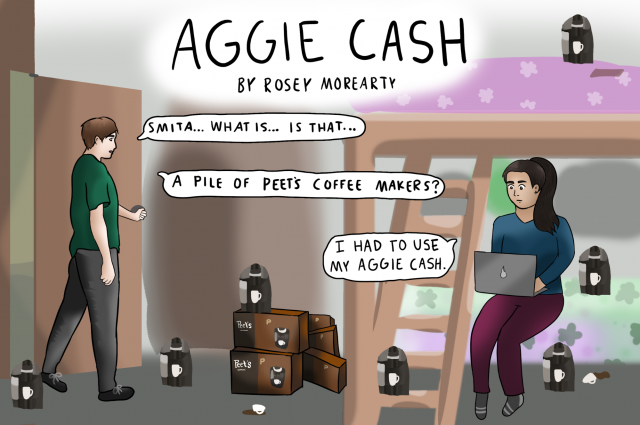
Cartoon: Aggie Cash

ROSEY MOREARTY — rosey@morearty.org

Written by: Rosey Morearty — rosey@morearty.org

A Tale of Two Californias: Is it time to finally restructure our state legislature?

California’s rural voters are feeling increasingly left out of the state’s political processes

Take a drive from California’s north to its south, and you’ll realize just how diverse the state really is — geographically, culturally and, yes, even politically.

While extensive population growth and wide scale demographic change have solidified California’s political homogeneity, the state’s far north has remained largely immune to this transformation. The vast, sprawling forestlands of Northern California have persisted as outposts of hardline conservatism amidst a sea of blue. An area of 13 of the state’s northernmost counties was recently dubbed by The New York Times as “California’s Great Red North,” featuring just three percent of the state’s population but over one-fifth of its landmass. California’s other dwindling Republican strongholds, such as the High Desert and the Central Valley, also feature rural communities strung across vast swaths of land.

In a state whose 53-strong congressional delegation features 46 Democrats, nowhere does California feel less like the liberal enclaves of San Francisco or Los Angeles than in the rustic cattle ranches of the Central Valley or in the rural logging communities around Mount Shasta. Given the vastly different cultural identities and economic concerns of these diverse regions, it follows that they would frequently butt heads politically. The problem is that now California’s rural voters feel increasingly left out of the state’s political processes.

Much of this is due to the problematic nature of California’s state legislature. Currently, the state features a bicameral legislature consisting of the California State Assembly, with 80 members, and the California State Senate, with 40 members. Representatives in both bodies are equally spread among the state’s nearly 40 million residents. This means more people are represented by State Senators (931,349) than by California’s 53 members of the United States House of Representatives (704,566 people). California’s lower house, the State Assembly, features just over 465,000 residents per assemblymember. By contrast, the New Hampshire House of Representatives features 400 seats — each member representing just over 3,320 constituents.

Since 1862, California’s bicameral legislature has limited the number of statewide representatives to just 120 people, spread across the state’s two houses. The refusal of state lawmakers to expand limitations on representation has led to the accumulation of political power by heavily populated urban enclaves. Not only has this left rural Californians feeling robbed of a voice, it has also worked to diminish the influence individual voters have upon their representatives. This has led to a state that, despite Democratic supermajorities in both chambers, continues to suffer from mass middle class outmigration, skyrocketing rent and a Gini coefficient on par with many Latin American countries.

Expanding the lower house to reduce the number of constituents represented by each member would give communities greater say in political decision-making, irrespective of geography or ideology. As such, it is a proposal that would likely enjoy a great degree of bipartisan support.

Most controversially, California should also consider restructuring its state Senate system to tie legislators to jurisdictions based upon regions, as opposed to equal populations. A power divide between the two houses would increase ideological diversity in one of the most politically homogeneous states in the country. Additionally, it could help ensure that voices in California’s valuable agricultural and logging industries do not go ignored. It would also give Native American communities, specifically those in the state’s northwest, a bigger say.

California has long been heralded as an image of the country’s future; a diverse, trendsetting culture that spread amongst an assortment of different people. Now it’s time to make sure they all have a seat at the table.

Written by: Brandon Jetter — brjetter@ucdavis.edu

Disclaimer: The views and opinions expressed by individual columnists belong to the columnists alone and do not necessarily indicate the views and opinions held by The California Aggie.

UC Berkeley Retirement Center pilots home-sharing program for retirees, graduate students

Home Match as a housing solution that could be explored for Davis

The UC Berkeley Retirement Center has started a program where retired UC Berkeley faculty can provide housing to UC Berkeley graduate students. So far, three pairs of students and retirees have been matched through the Home Match pilot program, and the pilot hopes to match three more. The vision is that the program will be mutually beneficial, saving students 10 percent in rent and offering retirees support to stay in their homes longer, with the center and its resources present to assist both parties throughout the process.

The program, developed in conjunction with the center’s partners including Ashby Village, Legal Assistance for Seniors, At Home With Getting Older, SEEDS Community Resolution Center, Transition Network Home, Covia and six others — is funded by a Chancellor’s Community Partnership Fund grant, which the center received last fall.

According to Cary Sweeney, the retirement center’s director, Covia has been a key partner in providing additional seed money, guidance and materials. Covia also has a home-sharing program for retirees that is being expanded and is not limited to only students.

The idea was also implemented in Santa Cruz, Boston and Canada, according to Sweeney. Sweeney hopes that Berkeley can offer leadership for other colleges if the program goes well but said that the “verdict is still out” regarding how adaptable the program might be for other colleges in cities with housing crises like Berkeley’s.

“We certainly have a vision of creating a model that’s scalable out to other campuses,” Sweeney said. “It just takes time and effort, so that’s what I think we’re learning. We’re six months into the program, only a couple weeks into the matches […] I think we’ll have a better sense of [adaptability] once we’re complete with the grant, which is at the end of the academic year.”

If a similar housing program were to be piloted by the UC Davis Retiree Center, the administration would be interested in supporting the program, according to Emily Galindo, the vice chancellor for student affairs at UC Davis.

“I think it’s a great option for students,” Galindo said. “It’s certainly something worth exploring. It seems like it will be a win-win for both parties, and, in fact, there are a lot of faculty and staff that routinely do provide opportunities in housing for students — I just don’t know of a formalized program.”

Galindo added that although UC Davis does not necessarily have a grant parallel to the one at UC Berkeley that the center received, the university is still interested in providing opportunities for programs like this.

“Individuals are always welcome to put forth ideas,” Galindo said.

Launching the program, however, has required a lot of time and effort, so it would be a big commitment and project for the UC Davis Retiree Center and community partners.

For Berkeley’s program, the center met with Legal Assistance for Senior and the City of Berkeley, and shared the program’s documents with stakeholders on campus for input about details and policies to consider. They have also held recruitment meetings for students and orientation sessions for homeowners and received advice from SEEDS Community Resolution Center about how to get ahead of potential conflicts.

Lou Ziskind, the director for the UC Davis Retiree Center, confirmed that a home-sharing program is not currently in the works in Davis.

“At this point in time the UCD Retiree Center has not begun any discussions about the program UC Berkeley is piloting,” Ziskind said via email.

Sweeney said that graduate student Rachel Bell  created an evaluation protocol to determine the program’s success, particularly in its emotional impacts, which could be a useful element in determining whether and how to implement it in other places.

“We hope that this will be able to show that it’s beyond the value of sort of just getting affordable rent or just having someone live with you, and that perhaps we can move the needle on levels of stress and loneliness,” Sweeney said.

Written by: Anne Fey — city@theaggie.org

OASR renamed to Office of the External Vice President

Change reflects new External Affairs Vice President position within ASUCD

Senate Bill #39, recently passed by the ASUCD Senate, effectively renamed the Office of the External Vice President (OEAVP), previously known as the Office of Advocacy and Student Representation (OASR). According to Francois Kaeppelin, the director of the OEAVP, ASUCD President Michael Gofman supported this initiative because he “has been wanting an External Vice President.” Senate Pro Tempore Alisha Hacker, who “untabled” SB 39, also backed the bill.

The bill, formerly known as SB 11, was revised and authored by Adam Hatefi, the chief of staff for OEAVP, to reflect the new role of the office after the establishment of the External Affairs Vice President position within ASUCD.

“With this name change, ASUCD aligns with the rest of the UC student governments and sets forth on a journey of cooperation to promote proper and equitable representation for the campus population,” the OEAVP said in an official statement.

The statement also highlighted the office’s desire to “tackle issues that affect students most, like homelessness and food insecurity.”

“We’ve worked hard and waited for so long to see this change happen,” Kaeppelin said via email.

One current project is the Davis Community Co-operative (DCC), specifically designed to address these issues. The DCC program aims to help feed the homeless and work with socioeconomically disadvantaged communities in Davis, Woodland, Winters and Sacramento. This project is evidence of OEAVP’s desire to be a “community service-oriented office.”

The OEAVP is also hopeful that the role of the DCC can be expanded to help students in a wide range of academic fields as well as address student-life related topics, including philanthropy, housing, clubs, the environment and social justice.

Additionally, OEAVP has been working on a bill in the California State Assembly that will provide grants for small farms to use water-saving and cost-effective irrigation techniques.

“It’s important for students because reducing our water usage allows us to grow more food with less water and can therefore alleviate food insecurity here on campus,” the statement added.

Written by: Rebecca Bihn-Wallace — campus@theaggie.org

UCD police rally around bill that would allow DACA student recipients to enter law enforcement

Legislation would amend citizenship requirement for law enforcement

In order to promote opportunity and increase UC student hiring eligibility, the UC Davis Police Department, led by Chief Joseph Farrow, is currently pursuing action to pass a bill exempting DACA students from the California citizenship requirement to become a peace officer.

DACA, or Deferred Action for Childhood Arrivals, was announced on June 15, 2012 by the Department of Homeland Security and grants certain legal privileges, including the right to work, to undocumented individuals brought to the U.S. as children. DACA is not the same as citizenship and is a deferment of deportation action.

Farrow’s goal is to enact change at the state level that would only affect the UC system. Under the proposal, DACA students would be able to become peace officers.

“[Currently,] persons with DACA status are not eligible because there is no pathway to citizenship,” Farrow said.

According to the police department’s website, the academy strives to provide “opportunity for UC Davis seniors and graduate students interested in law enforcement, forensics, criminology and array of other related professions.”

Witnessing a DACA student’s difficulties in the UC Davis Police Department’s Cadet Academy inspired Farrow to pursue this legislative action. Farrow described the student as “distinguished” and “an outstanding cadet.” Issues arose when Farrow wanted to hire him but could not due to legal restrictions.

“The reason I was interested in changing the law supports the very reason I choose to work here,” Farrow said. “Universities are places of social change. We can see things, ask why and perhaps make a change. I saw what I believed to be a problem with a possible resolution.”

Farrow also cited a report from President Barack Obama’s National Task Force on Policing, published in May 2015, as an inspiration for working on the bill. He found that Obama’s report on policing outlined ideals that could be proactively applied to this situation. According to the report, the task force was initiated in order “to strengthen community policing and trust among law enforcement officers and the communities they serve.”

 “One of the Pillars of their recommendations was to hire officers who reflected the communities they served,” Farrow said. “I strongly support their findings and the college campus is perhaps the best example of where this is true. One key recommendation is that law enforcement agencies should strive for a workforce that contains a broad range of diversity including race, gender, language, life experience and cultural background at all levels of the organization.”

According to California Government Code Sections 1031 and 1031.5, to be a peace officer in the state one must either be a citizen or a candidate for citizenship. Neither of these Government Codes are inclusive of the population of the United States residents that have DACA status, since DACA students are not eligible for citizenship.

Currently, Farrow and others are in the gradual process of moving legislation into law, which includes working with the University of California Office of the President .

“Right now we are at the stage of gathering information [and] we do not have a draft text,” Farrow said. “When we look at this issue a little closer, we realized we would have to address a Federal statute […] which means we would have to clear both the state and federal legislative processes. We simply need more time to prepare for such an undertaking.”

Farrow also stated that while the legislation did not receive UCOP’s approval to move forward, that “Chancellor [Gary] May was a strong supporter as is the University President.”

In response to this proposed legislation, UC Davis’ Chief Marketing and Communications Officer, Dana Topousis, emailed The California Aggie the following statement on behalf of UC Davis, including May’s view.

“On behalf of UC Davis, I can say that undocumented students contribute to the rich diversity of cultures and perspectives that is integral to our success as a university that serves all Californians,” Topousis said. “They are paving a future for themselves and their families so they can give back to our society. UC Davis graduates who have DACA status have blossomed with careers in medicine, law, science, social work and much more. UC Davis stands firmly in support of all of our undocumented students.”

Farrow stated that this legislation is a continuation of the UC Davis Police Department’s efforts to respond to the campus’ needs and build community trust.

“Policing on a college campus calls for the most contemporary and modern law enforcement agency,” Farrow said. “At the UC Davis Police Department, we are working from the principles in the task force report and taking a critical look at our policies and practices. We want to meet the highest standards of professionalism and make sure our policies are current and relevant.”

Written By: Priyanka Shreedar — campus@theaggie.org

Humor: Davis student uses Hydro Flask to fight off angry turkeys

Turkeys gone wild

Now I know you read the headline thinking this is some desperate attempt to promote the wildlife here at Davis or a smear campaign against the over-hyped and depressingly expensive Hydro Flask, but that’s an article for another week.

I’m here to tell you about the modern-day David versus Goliath battle. Yes, the angry Davis turkeys against a stressed-out Davis student who just so happened to have a Hydro Flask in hand. The Hydro Flask was custom-made and bedazzled, rumored to hold 80 ounces of pure Acqua di Cristallo Tributo a Modigliani water.

But as the student came out of a meeting they had with a Gary May cardboard cutout, he noticed several turkeys slowly waddling toward him, as if they were sizing him up for their own personal pleasures. Thankfully, the student remembered a few signs from the Bike Barn that offered tips on how to handle such a fowl situation:

Tip #1: Mind your own business. Turkeys can sense when you’re thinking about how nice they would look on your Thanksgiving plate.

Tip #2: Perform the “Macarena.” The bird-like movements paired with horrible coordination should scare off the turkeys.

Tip #3: If the turkeys fly toward your face, grab both of their wings and catapult them into the sunset.

Unfortunately for this particular Davis student, these helpful tips only piqued the wild gang of turkeys. The student only had two choices at this point: run and get stomped out by a bunch of wild turkeys or stay and show those turkeys who’s the bravest hen in the barn.

With a Hydro Flask in one hand and a bike ticket in the other, the student did what most people who own a Hydro Flask do at least ten times a day — he dropped his Hydro Flask on that cold blacktop concrete with the confidence of a student who successfully cheated on a midterm. Once they heard that deafening sound of the Hydro Flask, the gang of turkeys flew away in a hurry.

As legend has it, the student originally planned to throw a bike ticket at the gang of turkeys and run.

Written by: Hilary Ojinnaka — hiojinnaka@ucdavis.edu

(This article is humor and/or satire, and its content is purely fictional. The story and the names of “sources” are fictionalized.)

Call for termination of Professor Clover, YoloAlert, If Trees Could Talk: Your Weekly Briefing

Happy last Friday of Winter Quarter, Aggies!

Week 10 has come to a close, we made it… and now for finals week. Sending good study vibes — make sure to get plenty of rest and take advantage of the nice weather by enjoying a study break in the sun. Go grab another cup of coffee, Aggies, and hit those books!

Here’s what you need to know this week…

Photo of the Week:

TREVOR GOODMAN / AGGIE

In Campus News:

California Assemblyman James Gallagher called for the termination of UC Davis professor Joshua Clover who tweeted, “I am thankful that every living cop will one day be dead.” This call for the removal of professor Clover arose from an article Aggie columnist Nick Irvin published last month which gained national attention. This anti-cop rhetoric is not an isolated situation, in an interview Clover said, “People think that cops need to be reformed. They need to be killed.” Gallagher presented a petition signed by 10,000 individuals at a press conference outside Mrak Hall on Wednesday. Read more.

MICHAEL LEAHY / AGGIE

In City News:

Davis Police urged Davis residents to sign up for YoloAlert, a new countywide alert system, after WarnMe malfunctioned following the Natalie Corona shooting. This Everbridge platform is being encouraged because social media alerts, which were employed to notify residents during the Corona manhunt, fail to reach a majority of the community. The YoloAlert system will also include notifications for events such as flood warnings, unexpected road closures and missing person reports. Read more.

JOSH MOY / AGGIE

Features:

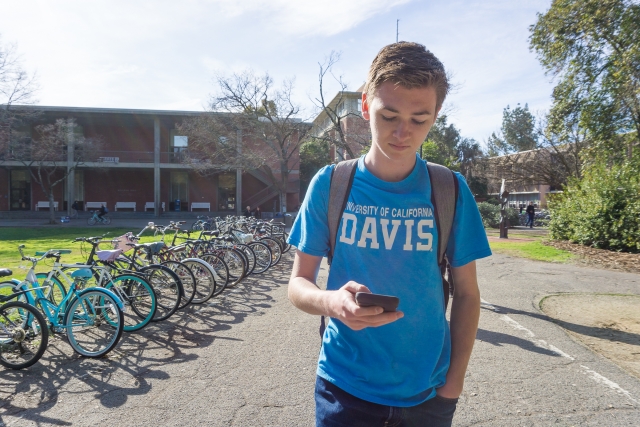
UC Davis students shared the effects of social media on their college experiences. Today’s technology increases communication and allows for people to connect across geographic separation, but social media can foster habitual phone-checking.“There’s no universal rule that says, ‘Oh, social media is bad,’” said Kush Patel, a fifth-year computer science major. “I think it comes down to the mindset of the person using it, whether they are easily distracted or they’re not stable in the sense that, if someone says something crazy in a group chat, they might lose it.” Read more.

ZOË REINHARDT / AGGIE

Arts:

“If Trees Could Talk” — if you’ve caught a glimpse of your reflection in a tree on campus, you’re not imagining it. As part of an art installation project, Maxine Aiello has installed mirrors in tree hollows around the UC Davis campus. Below the mirrors are dog tags attached to the trees to “demonstrate personal responsibility in environmental degradation.”

“At this point, a lot of information had come out about how bad our climate is doing and  how scary it is that our planet is going down this path,” Aiello said. “I was just overwhelmed with the idea that we were kind of on this unstoppable path, and people weren’t really paying attention to it. So the messages I was adding to the trees ended up being my way to get people to think about the planet and think about what they’re doing, how they’re affecting it, what they can do and kind of finally take some personal responsibility for their role in our future.” Read more.

WAYNE TILCOCK / AGGIEPHOTO.COM

Sports:

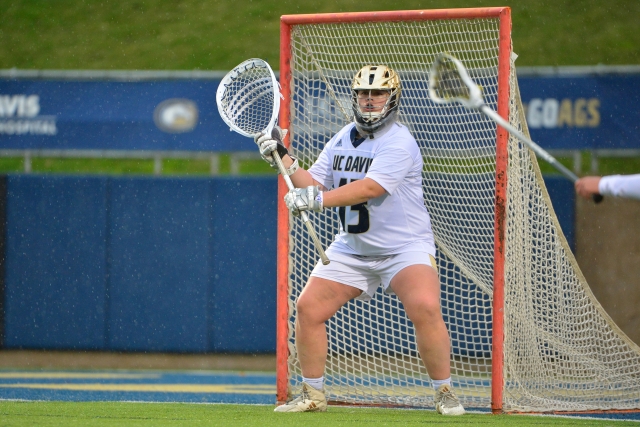
Grace Richards, a senior Lacrosse goalie, shared her story about changing positions. “[The transition] has given me the power to be able to look at things in a positive light that may not be positive or taking something and thinking, ‘what could I have done better?’ Richards said. “It’s made me more accountable as an athlete, as a person, as a student and I think that that’s the biggest thing this role change has given me, and I couldn’t thank anybody more.” Her goalie coach Emi Smith, a former All-American goalkeeper at Penn State, and her brother, who was also a collegiate lacrosse goalkeeper, guided Richards in the transition from attacker to goalie

CHAUDHARI LAB / UC DAVIS

Science:

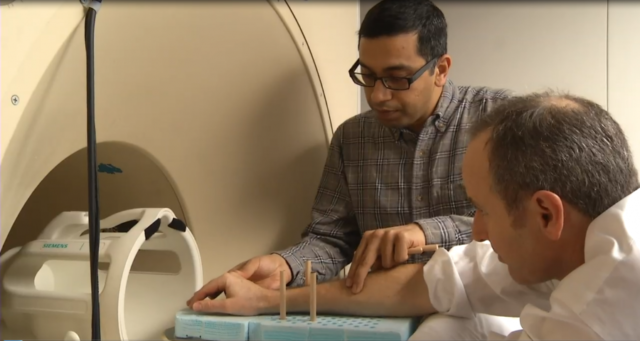
A team of researchers is studying the movement of wrist bones. Wrist function is vital in everyday activities like using our phones and opening doors, but knowledge is limited on how the wrist bones move together. Using MRI scans, the team is creating a model to better understand and develop treatments for those with wrist issues. Read more.

Opinion:

Letters to the EditorCommunity members react to Professor Joshua Clover’s statement that cops “need to be killed”

Editorial:Student loans make up majority of young Americans’ debt

Column: The millennial left’s dangerous disinterest in the Trump-Russia scandal

Clay’s Weekly Pics:

Television:Lovecraft Country”

Movie: “MidSommar”

Novel: “Riot. Strike. Riot.”

Album: “The Sky’s Gone Out”

More…

That’s all for this week, Aggies. We are taking next week off, but check back in two Friday’s for a recap of the best stories from Winter Quarter.

Have a bangin’ Spring Break!

— Grace Simmons

California assemblyman calls for termination of UC Davis professor who said cops “need to be killed”

Petition demanding professor’s termination signed by 10,000, given to UC Davis officials

California Assemblyman James Gallagher held a press conference outside of Mrak Hall on March 13 demanding the termination of Joshua Clover, a professor of English and comparative literature at UC Davis, over comments he made on his personal Twitter account, which is now private, in 2014, and in a 2016 interview in which he said: “People think that cops need to be reformed. They need to be killed.”

At the event, Gallagher presented the UC Davis administration with a petition with 10,000 signatures demanding the university fire Clover. Also present at the event was the President of the California Police Chiefs Association Ronald Lawrence and Linda Mobilio-Keeling, the widow of Officer Davis Frank Mobilio.

Clover’s comments came to light in an opinion article published in The California Aggie last month. The article, published on Feb. 27, included a couple of Clover’s tweets from 2014 where he wrote, “I am thankful that every living cop will one day be dead.”

The Aggie reached out to Clover for a comment on these sentiments and he responded with this statement: “I think we can all agree that the most effective way to end any violence against officers is the complete and immediate abolition of the police.” In response to The Sacramento Bee’s request for comment on the tweets, Clover responded with a different statement: “On the day that police have as much to fear from literature professors as Black kids do from police, I will definitely have a statement.”

UC Davis released a statement which included a statement Provost Ralph Hexter provided to The Aggie which condemned Clover’s statements. The statement addressed the “continued interest” from the public over the matter and clarified that “only the UC Board of Regents can dismiss a tenured faculty member.”

Chancellor Gary May has since asked UC Davis’ legal team to review Clover’s “conduct” and “provide advice on the application of federal and state constitutional protections for freedom of expression.” No official action has yet been taken by the university, and Gallagher addressed this inaction.

“These comments are completely unacceptable,” Gallagher said at the event on March 13. “What we’ve heard from the university is that these are reprehensible comments, we’ve heard that these are abhorrent, but what we haven’t heard yet is that there is no place for these comments at UC Davis.”

Gallagher also criticized the argument that Clover’s comments should be protected under federal and state constitutional protects for freedom of expression. Gallagher claimed that rhetoric which advocates violence is not protected under the First Amendment.

“We believe that the campus community is a place where we should have a diversity of debate,” Gallagher said. “There is room for unpopular opinions to be expressed, but we can not have free speech when people are intimidated. We can’t have free speech when people are being punched in the face on campus for expressing a viewpoint. We can’t have free speech when you invite a speaker to campus and people show up in masks and throw molotov cocktails and beat people and intimidate people, and we certainly can’t have free speech when we have professors calling for the deaths of people they disagree with.”

Gallagher referenced a recent incident where a UC Berkeley student was punched in the face for protesting and holding a sign that read, “this is MAGA country” and “hate crime hoaxes hurt real victims.”

Gallagher also referenced conservative speaker Milo Yiannopoulos, who was scheduled to speak at UC Davis on Jan. 13, 2017. The event was ultimately shut down after a large number of protestors denounced Yiannopoulos’ racist, homophobic and transphobic rhetoric.

Ron Lawrence, the president of the California Police Chiefs Association, also spoke at the press conference. Lawrence represents 332 police chiefs across the state.

“Unfortunately in the United States, violence against police officers has been on the rise,” Lawrence said. “We lost 144 police officers in the line of duty last year. That’s a 14 percent increase from the year before.”

Lawrence called for the university to terminate Clover’s employment, then addressed Clover specifically.

“Mr. Clover, if you’re listening to this, you should hold yourself accountable and do the right thing — resign from your position immediately,” Lawrence said.

Other speakers addressed UC Davis administration and UC Davis regents. Linda Mobilio, the widow of a former police officer killed by a college student in the line of duty in 2002, claimed that her husband’s shooter was influenced by their professors and the university’s environment.

“He was influenced by the people he was learning from and spending his time with,” Mobilio said. “As a result of what he heard, he killed my husband. He shot him in the back.”

Another speaker, UC Davis alumni Cherie Stephens, threatened to stop donating to the university unless the administration terminates Clover’s employment.

“For me, the answer will be no, and it will continue to be no until action is taken,” Stephens said.

Following the press conference, speakers brought boxes of petitions to UC Davis administration in Mrak Hall. One news reporter present at the conference pointed out that any decision regarding termination will likely have to go through the UC Board of Regents, rather than the UC Davis administration, so the petitions might be ineffective. Gallagher responded to this comment saying he didn’t care who’s responsible, “someone has the authority” to terminate Clover “and they certainly can do it.”

“What we want to hear from the university system is that they are going to take action ,” Gallagher said. “And they are going to begin the termination procedures, whatever those are.”

The Davis College Republicans and former ASUCD President Michael Gofman have co-organized the rally “Fire Josh Clover: A Rally Against Violence,” which will take place today.

Written by: Ally Russell — campus@theaggie.org

Culture Corner

The Arts Desk’s weekly picks for television, movies, novels and music

Television:Lovecraft Country”

In an upcoming HBO series, executive producers Jordan Peele and J.J. Abrams will try to take back the Lovecraftian trope by turning it on its head. The series will follow Atticus Black, his friend Letitia and his Uncle George on a road trip across 1950s Jim Crow America in search for Atticus’s missing father, resulting in a struggle to survive and overcome both the racist terrors of white America and the horrific monsters from H.P. Lovecraft’s most notable works. Based on the dark horror fantasy novel by Matt Ruff, the series is set to release late 2019.

Movie: “MidSommar”

Remember the movie “Hereditary” *tongue cluck* written and directed by the brilliant Ari Aster? On Aug. 9, he is set to release his follow-up horror film that is said to be more brutal than his first. As it goes, the film follows a wife and husband on vacation in a Swedish village hosting a festival that only takes place once every 90 years — filled with flowery Pagan crucifixes and a little too much bleached blonde hair for comfort, Aster is surely setting us up for another ritual that will inevitably result in the summoning of some hellish deity. Coming from A24 studios, my hopes remain high for this summer release.

Novel: “Riot. Strike. Riot.”

Award-winning poet and UC Davis’s own Joshua Clover offers a new understanding of the riot as a form of insurrection. Clover highlights the history of the riot as the central form of protest in the 17th and 18th centuries, then speaks to its supplanting in the 19th century with the strike, only to return in full effect in the 1970s, forever changed in coordination with race and class. This book creates new ways for its readers to acknowledge the embarrassments of present history, thus providing petrol for all antagonists in their struggle toward a revolutionary horizon and a means to break through the oppressive simulation of utilitarianism.

Album: “The Sky’s Gone Out”

Bauhaus, considered to be pioneers of goth music, released this album back in 1982, and it was an absolute hit — it still is. The dark and ominous tones of the ensemble hold a melody with the Bowie-esque vocals of Peter Murphy, the lead singer, resulting in my undying love for this collection of works. In 2005, Bauhaus took the stage at the Coachella Music Festival and performed a number of these hits while Murphy conducted the whole of his performance suspended upside-down from a crane, as an homage to Carl Laemmle’s “Dracula,” who inspired their hit song “Bela Legosi’s Dead.” And though they have been broken up since, their music is still worth a listen today.

Written by: Clay Allen Rogers — arts@theaggie.org

Battle of the burgers

Cool Cuisine Burger Battle offers competition for plant-based burger artisans

This year, March is all about being green: not just for St. Patrick’s Day, but for the Cool Cuisine Burger Battle happening in Davis. Cool Cuisine is a partnership between organizations and individuals that searches for the tastiest plant-based burgers. According to the Cool Cuisine website, “restaurants in Davis will compete to create the most mouth-watering, enticing, planet-friendly, plant-based burgers and diners will vote on each one they taste!”

There are many different restaurants here at Davis that are participating in the contest, even some on campus. See below a list of restaurants and the name of their plant-based burgers:

  • Bistro 33- “Impossible Burger” created by Chef Manny Cruz
  • Chay Corner at Lazi Cow- “Grilled Goodness Burger” created by Chef Chay (Brandon Dinh)
  • Cuarto Dining Commons- “Road Runner Burger” created by Chef Janos Levin
  • Davis Food Coop- “Pakora Fritter Burger” created by Chef Terry Brooks and Kathryn French
  • De Vere’s Irish Pub- “Southwest Vegan Burger”
  • Segundo Dining Commons- “Falafel Burger” created by Chef Cesar Cienfuegos
  • Smokin’ Ewe BBQ at G Street Wunderbar- “Smokey Quinoa Portobello Burger” created by Chef Arturo Gonzalez
  • Solomon’s Delicatessen- “Pastrami Burger” created by Chef Aimal Formoli
  • Spokes Grill- “Beyond Bulgogi”
  • Tercero Dining Commons- “Eggplant Parmesan Burger” created by Chef Robert Reilly
  • The Gunrock- “Beyond Bella”
  • The Hotdogger- “Bratwurst with Sauerkraut” created by Chef Ivan Franks
  • Yeti Restaurant- “Bara Bara Nepalese Burger” created by Chef Prajwal Bajracharya
  • Zumapoke & Lush Ice- created by Chef Rachael Ryen

As of March 1, anyone and everyone is invited to visit these restaurants and vote on each burger based on a five point scale of “ok” to “awesome” in the following categories: taste, presentation, texture, unique flavor, juiciness and similarity to real meat. The voting form is located online. Each vote gives you one entry into a raffle for the chance to win a one night stay in a Grass Valley guest house. The site also indicates that “we will tally all of the rankings at the end and give awards to our competing chefs as well as calculate the Burger Battle’s environmental impact on savings of water, energy, and contributions to greenhouse gas.”

Having a plant-based burger competition is Cool Cuisine’s way of attempting to crush the misperception surrounding plant-based food and encourage the public to recognize the possibilities, according to Anya McCann the founder of Cool Cuisine.

“COOL Cuisine hopes that after an excellent experience with something as approachable as the all-American burger… with a twist,” McCann said. “Diners will be willing to eat more sustainable foods more often, seek them out and support them in restaurants, too. The burgers in the competition] offer generally more healthy, nutritional content: lower fat, low cholesterol and are full of good things your body needs to function well and feel good, like vitamins from vegetables and fiber from grains and protein from nuts and legumes.”

Richard Ronquillo, the associate director of Departmental and Student Outreach for Student Housing and Dining Services, said, “UC Davis has incredibly talented chefs who work hard to create a variety of great food and this is an opportunity to show everyone how good the good on campus really is.”

UC Davis Dining Services has created an eggplant parmesan burger, a falafel burger, a sweet potato and black bean burger and a “Beyond” burger. The toppings range from vegan mozzarella and marinara to roasted pasilla, avocado puree and roasted red pepper to spicy mayonnaise, kimchi, Portobello and chimichurri sauce.

To encourage the public to try these new burgers, Ronquillo said the Dining Services department has made an effort to create unique recipes that attract students.

“In the last 15 months, [the Dining Services Program] have created some incredible recipes, forged relationships with even more local growers and really are doing some amazing and delicious things with our campus dining program,” Ronquillo said. “Eating a meal is a great way to create memories and explore different cultures, and I encourage everyone to step out and try new things.”

If you like eating burgers, especially plant-based ones, you should participate in the Cool Cuisine Burger Battle happening all throughout the month of March. In the words of Anya McCann, “Go forth and eat.”

Written By: SIERRA BURGUENO — features@theaggie.org

The millennial left’s dangerous disinterest in the Trump-Russia scandal

Why pursuing Trump’s Russia connection is a crucial and pragmatic step in pursuing a progressive America

Anyone who cannot stand the fact that Donald Trump is president probably agrees that his greatest accomplishment has been catalyzing a powerful new counterwave of civic engagement among younger people.

This younger generation of progressive millennials is strongly motivated by views and values that sharply contrast with Trump’s, especially on topics like healthcare, the environment and social justice. It’s wonderful to see so many young people passionately engaging with these important problems. I’ve grown increasingly concerned, however, with the lack of interest and knowledge from people of my generation in the expansive investigation into Trump’s ties to the Russian Government. Or, as Trump referred to it in an interview in which he admitted to obstruction of justice (a crime) on live TV, “this Russia thing, with Trump and Russia.”

Over the last two years, I’ve observed equally-concerned commentators allude to this disinterest. Even more powerfully, I’ve had numerous encounters with friends who don’t even know basic information about the scandal, like who Robert Mueller is, the fact that actual crimes have been uncovered and the fact that the Russia story is NOT “that thing where Trump asked Stormy Daniels to pee on him,” as my friend once thought. Thus, I realized it would be a tall order to hope that they would understand the gravity of the House Intelligence Committee issuing subpoenas for over 80 individuals and organizations associated with Trump on March 4.

This disinterest in the Russia scandal is appalling because of what’s at stake. Determining whether Trump, his businesses and his campaign were or still are in a corrupt relationship with the Russian government, and whether one or all of those parties are in an ongoing effort to cover up that relationship, should take priority over any other subject like healthcare, climate change or social justice. The Russia scandal gets to the very heart of the values, principles and robust institutions that have sustained our democracy for over two centuries, regardless of whether conservatives or liberals were in power. Failure to realize this significance is a symptom of our worsening understanding of civics and lack of appreciation for the strengths and weaknesses of the American democratic system. This ironic combination of increased civic engagement and decreased civic knowledge perhaps goes hand-in-hand with the younger generation’s heightened idealism and progressivism.

Many millennials who have only known a post-Soviet Russia hold the view that fearing Russia is antiquated — that it’s stupid and impractical to keep demonizing the Russians when we won the Cold War almost three decades ago. It’s absolutely true that we should neither demonize the Russian people nor conflate them with the Russian government in any circumstances, but we must also remember that the people running the Russian government never stopped fighting the Cold War. We did. When the Soviet Union collapsed, we assumed that defeating communism equated to eliminating the source of the conflict. That being said, the conflict between the countries was — and continues to be — rooted in geopolitics and deeper philosophical differences that transcend the capitalist-communist dichotomy.

After the Soviet collapse, disdain for our system and vengeful desire from ex-KGB thugs like Vladimir Putin and oligarchs is what motivated them to help Trump in an effort to compromise and show the weaknesses of American democracy. They were successful, and the idealistic millenials need to understand that addressing this crisis in our democracy has to come before any other issue they want to champion. Failing to do so would negate any progress made on social or environmental justice issues because it would show that we don’t even have faith or pride in our institutions in the first place.

Before the 2018 midterms and going into 2020, Democrats have shown a desire to run in “affirmative ways” by advocating healthcare and social and environmental justice issues. Implicit here is the assumption that prioritizing the Russia scandal is too negative and “in-the-weeds” to be a successful strategy. In a piece for New York Magazine, Jonathan Chait wrote that leftists feel the Russia story is somehow “preventing the left from prosecuting a populist case against Trump.” This attitude is wrong. Russia needs to be the central issue of the 2020 campaign cycle because challenging Trump’s suspicious Russian political and business connections and his attacks on the Justice Department is in fact “affirmative.”

It is a positive message to fight for American values and rule of law, especially when the president is hostile toward our own legal institutions, ethical norms and intelligence services and refuses to do anything about the continued cyber threats from Russia. The left must prosecute this as a populist case against Trump in the court of public opinion to ensure our country can support our progressive agenda in the future. Nothing could be more affirmative and pragmatic. Yet, the Democrats’ pathetic messaging strategies (one area where they could take a cue from the GOP) have prevented them from successfully making this case to the public, especially to millennials. Polls carried out and published by Vanity Fair Magazine before the 2018 midterms showed this failure, with millennial women especially likely to be completely disengaged from the Russia investigation.

Since many moderates and old-school Republicans are also quite alarmed by the Russia scandals, Chait added that some leftists may view promoting the Russia revelations as a frustrating appeal to the center. He said that, “By expanding the Democratic coalition into the center, at least temporarily, the Russia issue runs counter to their goal of repositioning the party to the left.” Again, this reasoning is horribly wrong and misguided because Russia needs to be the basis of the populist, grassroots case against Trump.

The article goes on to say that the millennial, social justice, anti-imperialism left may think it is hypocritical to worry about the Russian threat to American democracy when the U.S. has been guilty of the same, meddling in the elections and domestic politics of countries worldwide. Chait writes, “[Trump’s] realpolitik alliance with Russia, and his premise that America has no right to hold its political system above Russia’s, strikes a chord in some precincts of the left.” Justifying an indifference to Mueller’s investigation with this anti-hypocrisy, anti-imperialist argument is also horribly misguided because it represents resignation to the pessimistic and unpatriotic notion that we as Americans shouldn’t aspire to continuously improve and perfect our democracy.

Meanwhile, Glenn Greenwald has surprisingly become a darling on Fox News for saying that the Russia story is just a convenient scapegoat for Democrats who would rather look outward than inward after the humiliating 2016 defeat. While this may also be an appealing argument for the millenial left who want to promote reflection, it’s important to realize that “reflection” and getting to the bottom of the Russia story are not mutually exclusive. Determining how Russia has been so successful in manipulating our social media platforms and our discourse will require a great deal of inward reflection; Russia is not a scapegoat for our loss because Americans and the American system had to be gullible and flawed, respectively, for Russia to have been this successful.

I’ve previously written on why it is essential to stay informed and not tune out. Seeing the high levels of interest from young people in some of America’s most pressing problems is beyond encouraging, but at no point did I say that intense interest in some issues exempts one from caring about others that are just as, if not more, important. You don’t get to chose the news — it happens, and if you want to consider yourself an engaged citizen, it’s your responsibility to know as much about everything as possible.

Written by: Benjamin Porter — bbporter@ucdavis.edu

Disclaimer: The views and opinions expressed by individual columnists belong to the columnists alone and do not necessarily indicate the views and opinions held by The California Aggie.