55.5 F
Davis

Davis, California

Tuesday, December 23, 2025
Home Blog Page 463

Davis community rallies for students, families who were displaced from their homes due to Glacier Point Apartments fire

JOSH MOY / AGGIE

Glacier Point Apartments expected to cost over $200,000 for reconstruction

At approximately 5:45 p.m. on Jan. 1, a call was reported to the Davis Fire Department that the Glacier Point Apartments, located at 2225 Glacier Dr., had smoke and flames spewing from the roof. It started with a large crackling noise and led to much worse, as residents fled their homes and came to realize that they would not be able to return to them.

With 30 residents displaced from their apartments, the fire department brought in backup to try to save as much as they could. The Dixon, UC Davis, Woodland and West Sacramento Fire Departments sent backup to contain the structure fire. Firefighters figured out that the fire was coming from within the walls, as the building was constructed with walls meant to contain fire.

“The firemen tried to put the fire out from my room, so there was a lot of debris from insulation, drywall and wood found all over my room because they took apart the ceiling to combat the fire,” said Brianna Murphy, a masters student in structural engineering. “Regarding my belongings, it was mostly damage from water and the fire retardant. The only thing I actually lost was my mattress and bedding, everything else was able to be washed to get the water, retardant or smoke out of it.”

Staff and firefighters could not locate the fire at first and had to kick seven doors down, practically tearing up each of 10 apartments. The fire walls suppressed the fire, but they burned slowly and started smoldering, causing the fire to make it to the roof and reveal itself.

“The fire ended up being in some void spaces in the middle of two apartments, so it took us some time to find the seat of the fire,” said Joe Tenney, the Davis Fire Department division chief, to The Davis Enterprise.

Gregg J. Herrington, the president of Yackzan Group Inc. and Yolo Property Manager, received a call from on-site staff around 6:15 p.m. regarding the fire.

“With the amount of fire agencies present, they were actually able to move people’s stuff before tearing up walls within the rooms of the apartments, saving clothes in closets,” Herrington said. “People were able to come back and expect potentially everything to be ruined, but rather came back to find a good amount of their personal belongings in the living room. It was these little things that were executed that made a huge difference to the students returning from break or families coming back with their children.”

Hallmark Inn was flexible with its booking and offered to block off rooms for all those evacuated. Herrington would not let any resident leave homeless and made sure past residents were either put up in a hotel or placed in available property offered by local landlords. The community came together to offer relief efforts and assist those affected. The city manager and mayor reached out almost immediately to Herrington to offer assistance.

Even staff from UC Davis gave Herrington contact information for on-campus counseling and support for students that were at Glacier Point.

“It was really stressful as a grad student because I had assignments due for class, and I had to miss my shifts for work,” said Kassidy Heckmann, a first-year graduate student in the UC Davis environmental policy and management program. “The housing we found was four miles from campus, and Unitrans doesn’t accept graduate students for free. So now, I have to spend even more money on top of what I already spent on the move so I can just get to class and work. Finances has been the greatest struggle of this entire thing.”

Heckmann described the inconvenience and difficulties that stemmed from the fire.

“It’s been a hard transition for sure, and definitely not the ideal way to begin 2019,” Heckmann said. “But, every day I’m grateful that I was able to walk away from this unharmed.”

Herrington informed the public that the fire was ruled accidental after two investigations by the city and its insurance company. The two agencies discovered it was an electrical fire that sparked inside an attic wall.

“I believe we took the right actions and made a good decision by taking care of people to the best of our ability, highlighting the importance of renter’s insurance,” Herrington said. “Renter’s insurance is a game changer, and I think after this incident and looking back at everything that just happened, we are going to start requiring it and educate renters’ property on how important having this form of insurance is.”

After inspecting the damage, Herrington and his team estimate a maximum of six months to rebuild and have not found an exact cost for reconstruction but estimate anywhere from $200,000 to $500,000.

Herrington has followed up with everyone who was displaced. With how efficiently the situation was handled, Glacier Point Apartments is still receiving and taking lease applications for the next academic year.

Written by: Lauren Tropio — city@theaggie.org
HOPE at UC Davis

HOPE AT UC DAVIS / COURTESY

Student organization enacts powerful change against homelessness, stigma

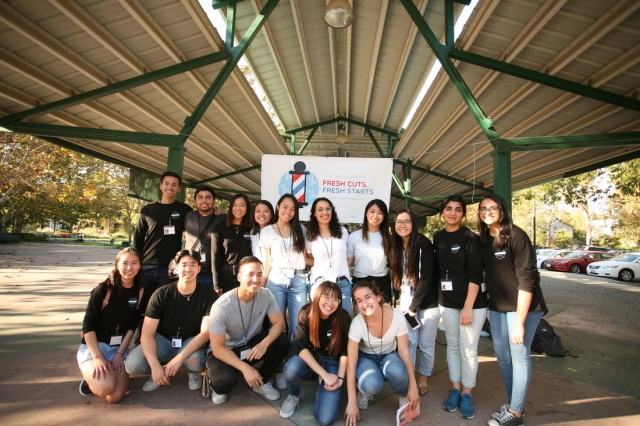
Homeless Outreach through Prevention and Education, a student organization founded at UC Davis in 2016, has a mission of assisting those experiencing homelessness and educating others about homelessness through project-based solutions that come from the collective input of all its members. The organization receives the majority of its funding through the Sheila Kar Health Foundation.

Projects have included gathering donations of dental hygiene equipment paired with instruction flyers, computer literacy classes and GED tutoring to increase the chances of those experiencing homelessness to find a job. During the winter, the Interfaith Rotating Winter Shelter provides a warm place to stay.

Sarah Shandy, a fifth-year biochemistry and molecular biology major and co-president of HOPE, felt that the sense of agency she experiences allows her and the team to make a difference.

“We all have a part in the club, and I really like that,” Shandy said. “I can have a real impact on the club.”

HOPE understands that it’s important to educate those who aren’t experiencing homelessness as well because it facilitates better understanding and communication — which leads to more action.

Julia Nguyen, a third-year global disease biology major and outreach coordinator for HOPE, described a way the organization is trying to start this conversation.

“We had a whole presentation about the language we use when we talk about homelessness,” Nguyen said. “When we talk about the individuals that we meet, we refer to them as people who are experiencing homelessness [instead of homeless people]. We hope that through language our peers can start to see that homelessness doesn’t define the person.”

Not defining those experiencing homelessness by unfortunate events that have led them to their circumstances is the first step toward humanizing them as individuals — some of whom have been forced to choose between paying for doctors’ appointments, medication, textbooks or paying rent.

“In high school, I signed up for a park cleanup,” Nguyen said. “The woman leading the cleanup was affiliated with the city, and she [led] us down to a homeless encampment. She said to start clearing everything, and I was really confused because there was a whole community there with tents, bikes and other personal belongings. I remember digging up an ID, and the woman told me to just throw it on the pile.”

While many students cannot give their time or funds to those experiencing homelessness, there is something priceless and more meaningful they can give — recognition.

“They really just want to be recognized when you’re walking on the street,” Shandy said. “Sometimes they’re holding signs and people just look away and not make eye contact. Just say hi or smile.”

Nguyen also advises against not acknowledging.

“The norm is to turn your back when you see someone on the street because there’s this awkwardness of not knowing what to do with yourself […],” Nguyen said.

Tuition spikes at UC Davis have forced some students to experience homelessness by living out of their cars, and HOPE is seeking to further their outreach to that population.

“We haven’t come into contact with very many, but by getting our message out there, hopefully, we can offer them whatever we can,” said Daniel Lam, a fourth-year neurology, physiology and behavior major and co-president of HOPE.

HOPE at UC Davis goes beyond one-time acts of kindness and is always welcoming new members. Brandon Aguilar, a fourth-year biochemistry and molecular biology major and historian for HOPE, shared the benefits he experienced after joining the club.

“Joining the club allowed me to learn more about their lives and their stories,” Aguilar said. “Being able to have that opportunity to really interact with them, you really start to understand that these people are coming from a different background, but that doesn’t mean they’re less human.”

HOPE at UC Davis hosts quarterly meetings. Information about joining and making a difference can be found on its Facebook page.

Written by: Josh Madrid – arts@theaggie.org

Adventure Awaits: Picnic Day 2019

TREVOR GOODMAN / AGGIE

Theme, grand marshal announced for annual event

The 105th celebration of Picnic Day will be held on Saturday, April 13, during which an estimated 75,000 past, current and prospective UC Davis students along with faculty, staff and Davis community members will partake in a myriad of festivities.

The theme for this year’s event will be “Adventure Awaits,” and this year’s parade marshal is professor and planetary scientist Sarah T. Stewart, a recent recipient of the MacArthur Genius Fellow grant.

“The theme captures both that Picnic Day itself is a day of adventure, exploration and opportunity and that coming to Davis for school is an adventure in its own right,” said Elise Pohlhammer, a fourth-year human development and psychology double major and Picnic Day chair, in a press release.

Aaron Garcia, a third-year psychology and communication double major and the Picnic Day publicity director, explained the meaning behind this year’s theme.

“When we were looking at past Picnic Day themes, we saw a lot were sentimental and serious themes,” Garcia said. “Last year’s theme [was] ‘Where the Sun Shines’. We wanted to continue with that fun, bright uplifting theme of representing Davis and the community.”

Garcia said that the theme was chosen to also represent “the characteristics of being fun and playful, and for people to reflect on their past, present or future adventures” at UC Davis.

In an interview with The California Aggie, Pohlhammer said Picnic Day 2019 will offer a variety of activities, including the return of the Children’s Discovery Fair, aimed at entertaining and engaging all attendees, regardless of age.

“There is a children’s fair, so children can stop by and do arts and crafts,” she said. “This year, we are doing a lot more sensory and interactive games and planning for an ‘Angry Bird’ type of interactive game.”

The proposed expenses for this year’s events will be $37,253, $1,200 of which will be for transportation and $2,200 budgeted for publicity. $3,000 will also be used for t-shirts for volunteers, and $2,800 will be allocated to sound equipment.

The expected income is $48,000 — generated through business sponsorships and food sales.

Bringing Picnic Day to fruition and ensuring it runs smoothly is a team effort. 15 student directors were recruited for Picnic Day, including hires for the animal events, Children’s Discovery Fair, entertainment and parade publicity. An estimated 80 assistant directors will also help with the event.

Bryan Perez, a third-year political science and managerial economics double major, was involved in last year’s Picnic Day through his position as a former ASUCD student senator. Perez said he participated in the event by being physically available onsite, starting at 6:30 a.m.

“If you see what people are doing and if you see how passionate they are doing their jobs, it rubs off on you, and you will feel passionate too,” he said.

The annual event consistently sees a significant number of alumni return to campus.

“Alumnae get to come back and explore the campus from a different point of view,” Pohlhammer said. “You get to come back and see how much the campus has changed since they have been here. It’s just a chance to come and see what the campus looks like and be reminded that this is a tradition that has been going on for 105 years.”

For Pohlhammer, who lived in the Bay Area and drove by UC Davis as a kid, the event is a good chance for prospective students to become acquainted with the university.

“The first time I really came to campus and thinking that I might go to UC Davis was [because of] Picnic Day,” she said. “For potential students, Picnic Day is a way to see the diversity of scientific endeavors as well as cultural experiences that will be offered.”

Picnic Day will be preceded by a pre-week — which changed from five days to two days — aimed at getting students excited about Picnic Day. The pre-week will take place on the Quad and will feature an interactive animal exhibit, cultural presentations and performances and both a sports day as well as a Greek day, aimed at UC Davis Greek Life, Pohlhammer said.

More information on Picnic Day 2019 is available on the unit’s website.

Written by: George Liao — campus@theaggie.org

Humor: UC Davis Love Lab unveils Shah’s-flavored condoms

ALEXA FONTANILLA / AGGIE

Delicious chicken-over-rice flavored contraceptives promote safe sex among students

With STI transmission rates climbing among college students, UC Davis’ Love Lab has taken on the task of promoting safe sex among Aggies. The solution? A partnership with the condom brand Trojan.

“We’ve been trying for months, but we’ve finally conceived the perfect way to get students to use contraceptives,” said Love Lab scientist Richard Dixon. “What do Aggies love even more than cows and bikes? Shah’s chicken-over-rice. We’ve incorporated every ounce of flavor that can be found in that beloved combo meal into one little latex condom. It’s like that scene in ‘Willy Wonka and The Chocolate Factory’ when Violet chews that stick of gum and can taste a three-course meal. But instead of blueberry pie, you can taste the succulent, Sriracha-drenched chicken and that white sauce that they put a little too much of on the salad.”

If you’re vegan or allergic to latex, the Love Lab will even offer a falafel polyurethane edition to suit your dietary restrictions.

The condoms come in a compostable take-out box, just how Aggies like it. The packaging has the following description on the front: “When it’s getting hot and heavy, wrap it up with your favorite hot and heavy flavor. Spice up your love life, if you’re not too chicken.”

If this business venture proves to be a success, the Love Lab and Trojan plan on expanding their selection to include other Aggie-favorite flavors. CoHo taco salad and bubble tea-flavored condoms are already in development.

“The possibilities are endless,” Dixon said. “We had a great time working with our brand reps from Trojan. As for this project, I am looking forward to wrapping it up and seeing the results!”

Starting next quarter, students can go to the Love Lab or the Wellness To Go vending machine in the ARC to pick up the Trojan: Fire and Rice condom.

Written by: Madeline Kumagai — mskumagai@ucdavis.edu

(This article is humor and/or satire, and its content is purely fictional. The story and the names of “sources” are fictionalized.)

Oscar nominated films perpetuate inauthentic storytelling

CAITLYN SAMPLEY / AGGIE

Academy, industry still has work to do

As the Feb. 24 airing of the 91st Academy Awards rapidly approaches, the high-profile film awards show remains quagmired in a space that promotes both genuine progress and a love affair with the Academy’s customary white male dominance.

This year, the Academy made a handful of nominations that broke the mold of what is typically recognized by Hollywood. In the Best Picture category, a blockbuster Marvel superhero movie with a majority black cast, “Black Panther,” is among the list of 10 nominees. “The Favourite,” a genre-defying historical comedy with queer themes and three strong female leads was also nominated. Also breaking the mold is Yalitza Aparicio, the first indigenous Mexican woman to be nominated for Best Actress in a Leading Role for her performance in “Roma.”

While these strides toward greater minority and female representation in the year’s film are noteworthy, it is frustrating to see that the Academy still very much clings to conservative traditions. All of the five Best Director nominees are men. Despite a noticeable uptick in minority representation in mainstream American film, the majority of the best actor and actress nominees — with the exception of Aparicio and Rami Malek of “Bohemian Rhapsody” — are white.

The most glaring display of Hollywood’s tone-deafness and vestigial conservativism, however, lies in several of the Academy’s nominations for best picture. “Bohemian Rhapsody” has been heavily criticized for its insensitive and inaccurate portrayal of Freddie Mercury’s life, and its director, Bryan Singer, has faced a flood of sexual assault allegations dating back two decades. For both similar and different reasons, “Green Book” has proved problematic in its own right. The family of the film’s black protagonist, pianist Donald Shirley, played by Mahershala Ali, has claimed that the film is constructed upon a false narrative of Shirley’s life and his relationship with the black community and the film’s white protagonist, Tony Vallelonga, played by Viggo Mortensen.

Regardless of whether the concerns over the portrayal of these stories are valid or not, other issues still linger. “Green Book,” a story that revolves around complex racism and stereotypes, is told through the lens of its white writers and white protagonist, Vallelonga. The film’s director and co-writer, Peter Farrelly, has also admitted to repeatedly tricking coworkers into looking at his genitals in 1998, an act so pathetically juvenile for a boy of any age, let alone for a man over the age of 40.

In terms of the film itself, “Green Book” is laden with “white savior” and “magical negro” stereotypes. Vallelonga is paid to drive Shirley, a brilliant but aloof black man, through the American South for a concert tour. Vallelonga protects Shirley from the horrors of the Jim Crow era while his racism is predictably “cured” after forming a bond with his employer. It is exactly the kind of toxic, contrived, feel-good narrative that white audiences are enamoured of — one that prevents more authentic stories of American life and society from being recognized in the same light.

There is nothing inherently wrong with enjoying these films and the talented acting on display. But by considering these pictures as among the year’s finest works, the Academy sends a clear message of its willingness to overlook the obvious faults within them. For an industry that supposedly sits at the forefront of progress, the Academy should and must do better to promote and support the making of films that, at the very least, tell stories in a more authentic manner.

It makes sense that writers and directors commonly take certain liberties in creating these works in order to tell a more compelling story and appeal to a wider audience. But when these liberties and false depictions alter a film in such a way as to present audiences with a more palatable narrative, it does viewers a disservice, depriving us of a more robust, well-rounded account of important issues steeped in a broader range of perspective. Perpetually rewarding a single-minded story of the white savior signals to the industry that this is the “best” way to tell stories where racial tension is at the core.

Written by: The Editorial Board

Couch Concert: Lillian Frances

LILLIAN FRANCES / COURTESY

Electronic engineer and singer speaks on broken phones, finding herself

Lillian Frances, a 25-year-old Davis-bred electronic musician and singer, constantly takes notes on her phone: phrases she likes, Instagram pictures of babies in retro bright blue outfits and irregular ideas.

“It is all inspired by day-to-day life,” Frances said. “I like to be an observer of what is around me and package it into a song. It’s just random shit that comes to my mind that is remotely interesting or funny. I try to think of little things that everyone would identify with.”

Her synth-pop, experimental electronic music is just as dynamic as she is, so she gets her inspiration from anything and everything. No idea or thought process goes unrecorded.

She listed some song title ideas she had brewing to prove a point: “Your Boyfriend Likes All of My Instagram Posts,” “You’re Literally the Worst,” “San Francisco Smells Like Marijuana and Parking Tickets,” “Fuuu— That Dude,” “It’s Not Called Being Polly It’s Wanting to F— That Dude,” “Has Anyone Ever Found the Emoji They Are Looking For” and of course “Google Docs are Where Ideas Go to Die.” Quirky and relatable, it is obvious that Frances’ music is an unaltered reflection of her. She does not present herself as anything more or anything less.

An acoustic guitar player since the age of 12, her passion for music solidified and expanded after moving from Davis to study urban and environmental policy at Occidental College in 2015.

“It wasn’t until college when I started writing my songs on acoustic guitar and recording them at our student-run recording studio,” Frances said. “But my senior year, I went to go see Sylvan Esso at a free music festival in Los Angeles. They are huge now, but I had never heard of them at the time in 2014. It blew me away. I never had electronic music vibe with me so hard. It plucked every string in my body. I was vibrating for days. That senior year I started taking Music 100 and electronic music classes at my college.”

Extending her formal music education, Frances took electronic music production classes at the Beat Lab Academy in Los Angeles post-graduation. Then, through a teaching program, she moved to the northwest corner of Spain for a year, which allowed her to improve her Spanish language skills. Dual language competency diversified what she could say in her music and how she wanted to say it.   

“Even though I got better at the language, it is really hard to express yourself and your personality in a second language,” Frances said. “Especially since so much of myself is expressed through nuances in language and bad jokes, translating that into Spanish can be hard to tap into. When you’re stripped of language from fully expressing yourself, I learned how to express myself more with my energy. That process of translating yourself through your essence pairs really well with songwriting. Having Spanish as another method of expressing myself in songwriting is liberating. There are a lot of things I can say in Spanish that I can’t say in English and vice versa.”

Because of her experience in Spain, many of Frances’ songs feature her singing in Spanish, like “Bailamos con el humo” off her second EP “Timeism.” With musical introspection accomplished during her time abroad, she returned to Davis in 2017 ready to focus on her electronic music career. Indeed, her first performance of said genre was that summer at the Davis Music Festival.

“I don’t see a lot of young women doing what I’m doing,” Frances said. “Electronic music is unique, different and fun.”

However, such official branding as an electronic musician was forced after developing tendonitis in her hand.  

“I had always been an acoustic artist and I was planning on moving into this electronic sphere but with my guitar,” Frances said. “I love my guitar so much, it was like a limb. Losing this part of me required to lean into electronic music.”

While Frances’ tendonitis has healed and she has begun to take guitar classes again in order to incorporate electric guitar melodies in her new music, such moments of transition and altering identity became the subject of her song “Phone Keys Wallet” from “Timeism.”

“We all lose pieces of ourselves,” Frances said. “It’s about how we separate ourselves from an identity that we always held.”

The beauty in France’s “Timeism” is its ability to package such complex, even lofty ideas into something digestible and relatable. Emotional crutches are equated with a millenial material necessity.   

“It was a looking glass into what I see in my little millenial life,” Frances said. “An invitation to see things through my eyes, which is kind of funny, playful and a little tongue and cheek.”

Even down to her hypnotic high-pitched vocals, she does not overcomplicate or take the album too serious. It’s not laziness, but strategic realness.

“My voice is super wonky and I have to sift through [vocal recordings] alot,” Frances said. “But you should keep the imperfections because people latch onto imperfections. You know that one part of Jeff Buckley’s ‘Hallelujah’ and he hits a super wonky note and he snaps in that one place? They kept it in on purpose to show his imperfection.”

Such is another prime example in Frances’ ability to bring herself and her music back down to earth.

“Everything that I do [that] is awesome is a mistake,” Frances said. “I am not at a point where I can decide what I’m going to make. If I mess things up I’m going to get things I never even thought of.”

With this mindset, Frances stays experimental in her sound — no criteria to meet, no structure to follow. She’s all the more exciting to follow, to witness the development of an artist.

“I’m not at the point yet where I have found my sound,” Frances said. “I think ‘Timeism’ has a sound, it’s great and I’m proud of it. But other than that, it’s whatever comes to me. I would say it’s synth-pop. It’s experimental electronic. It’s pop, but it’s not vapid. I would love to do more hard-hitting electronic, more party bangers. I’m always trying to do that, but haven’t been able to pull it off. I’m loving my new stuff and think it’s better than anything else I’ve done before.”

Her new album initially was going to be based on her solo El Camino voyage that she took immediately after releasing “Timeism” in order to gain new songwriting inspiration.

“I wanted to leave ‘Timeism’ at home, absorb new energies and then crank something new out at home,” Frances said. “The idea was I would take a bunch of sound field recordings across the Camino and take a bunch of notes. But at the end of the Camino, I broke my phone and lost all of my information. So the new album will not be set on the Camino, and there’s not set sound to the new album. It will be me finding myself through music.”

Releasing her first full-length album will be a transformative moment in her music career, releasing an item that represents her.

“I have never released a full album,“ Frances said. “I’ve done two EPs, but I really want to get something out there with my name on it … I really just see myself as a different girl from two years ago. I admire her for her vulnerability and strength, but I feel like a different girl. My album will be my next stage and next sound. It will still be a similar electronic sound but more refined.”

In whatever form her first album reveals itself as, we can be sure it will be something authentically Frances — the good, the quirky and the raw.

Frances will be performing at Beatnik Studio in Sacramento on Jan. 25, and at the Holy Diver in Sacramento on Feb. 8.

Written by Caroline Rutten — arts@theaggie.org

Girls on the Run of Greater Sacramento receives $30,000 grant from Rite Aid

Girls on the Run of Greater Sacramento, a local branch of a nonprofit that facilitates after-school running and character-building programs for young girls, received a $30,000 grant from the Rite Aid Foundation’s KidsCents Regional Grant Program.

Girls on the Run is an international organization based in Charlotte, N.C., and was chosen by the Rite Aid Foundation for its focus on promoting children’s health and well-being. Along with Girls on the Run of Greater Sacramento, 22 Girls on the Run councils in 12 states received the KidsCents Regional Grant.

KidsCents funding is raised through customer purchases at Rite Aid when members of the rewards program choose to round up their purchases to the nearest dollar amount. The money can go toward a particular charity or toward grants like the one Girls on the Run received.

As an independent council, Girls on the Run of Greater Sacramento serves Sacramento, Yolo, Placer and El Dorado counties. In Davis, it has programs at Marguerite Montgomery Elementary, North Davis Elementary School, Patwin Elementary School and Robert E. Willett Elementary School. Registration for Girls on the Run’s spring season began Jan. 21.

According to Shaina Brown, the board chair of Girls on the Run of Greater Sacramento, Girls on the Run aims to empower girls from third to eighth grade.

“We have a curriculum that teaches lessons about care, community, character, confidence, and we help empower girls,” Brown said.

This empowerment happens, according to Brown, through the running season that culminates in a community-wide 5K event at Inderkum High School in Natomas. This year, it will be held on May 11.

“We get them to run and, over the course of the ten-week season, they train for the 5K race,” Brown said. “That is where girls will run sometimes the longest distance they’ve ever ran.”

The Rite Aid Foundation and Girls on the Run of Greater Sacramento look forward to how the grant will increase Girls on the Run’s presence in communities through scholarships. Of the grant funds, 100 percent will go toward scholarships; these scholarships depend on need and can include all registration fees, a new pair of running shoes and a healthy snack at each practice. Other costs include coach training, curriculum support materials and site insurance.

Girls on the Run of Greater Sacramento anticipates that compared to last season, 120 more girls will be able to participate in the program because of the grant.

For Maryrose McCoy, the grant director at Girls on the Run of Greater Sacramento, a grant of this size will be especially impactful for the Sacramento council, which is a smaller, volunteer-driven council.

“It is such a transformational amount of money,” McCoy said. “[At first,] it was too shocking to even get excited, and then it really was exciting.”

Brown called the grant an important milestone for Girls on the Run.

“We’re going to be able to have an extended reach into the Title One schools, so it’s a really great opportunity for us to get more girls in the program,” Brown said.

Tracy Henderson, the director of The Rite Aid Foundation and charitable giving initiatives, spoke on the foundation’s behalf.

“[Girls on the Run wants] to expand their presence and offer this really great program to young girls in underserved communities,” Henderson said. “They had a goal of increasing the number of girls that they serve in the greater Sacramento area by 20 percent, and this grant will help them achieve that.”

Henderson went on to explain how she anticipates the program will affect the girls it reaches.

“This grant not only helps with fitness, but it also helps with raising the self-esteem and the confidence of girls,” Henderson said. “[The girls] do community service projects, they’re able to be mentored by volunteers and they’re able to really work on being the best that they can be.”

The KidsCents regional grants, 180 in number, ranged from $15,000 to $30,000. This was their second round of funding since the program was launched in May of 2018. Henderson invited community-members to participate in KidsCents.

“We thank our customers for being part of the solution in communities to help kids be healthy, and we look forward to doing more in the communities that we serve through our program,” Henderson said. “We’re really excited to be investing in these girls.”

Written by: Anne Fey — city@theaggie.org


Yolo District Attorney’s office helps secure $1.5 million grant for Woodland nonprofit Fourth & Hope

JEREMY DANG / AGGIE

Grant will fund new program HOPE that aims to provide transitional housing, services to homeless victims of crime

The Yolo County District Attorney’s office announced on Dec. 31 that it successfully secured $1.5 million in funding for a new transitional housing program led by the Woodland homeless shelter Fourth & Hope.

In a press release, the DA’s office celebrated the acceptance of a grant application. The California Office of Emergency Services Transitional Housing Program approved the request, awarding $1.5 million over a period of five years to the new program. District Attorney Jeff Reisig praised the efforts of his staff in writing and obtaining the grant.

“We have an outstanding team of grant writers who are knowledgeable, dedicated and very creative,” Reisig said in the press release. “We are always pleased to assist our partners particularly when it comes to important causes such as homelessness. We will continue to seek out partnerships with nonprofits and other county agencies to achieve shared policy goals.”

The DA’s office worked in conjunction with Fourth & Hope, a nonprofit based in Woodland, to secure the grant. In addition to providing emergency shelter for local homeless individuals, Fourth & Hope operates supportive programs that seek to help them re-enter the community.

“Over the past 20 years, programs have been established to assure that every person has food to eat; a place to sleep; dignity and hope,” their website reads. “Our programs address physical and mental health, substance use, employment and income needs, and housing.”

According to the release, the new program is called The Homeless Opportunity and Positive Engagement Program. HOPE aims to deploy a “housing first” strategy, which prioritizes securing housing as the first step to reintegrating homeless individuals into the community. Fourth & Hope will work alongside Empower Yolo, a domestic violence intervention group, to provide rapid re-housing services for their clients. The grant also will fund a full-time case manager to assist Fourth & Hope clients, as well as short-term rental assistance after they move into permanent housing.

HOPE specifically targets homeless individuals who have been victims of crime, according to Jake Whitaker, an administrative service analyst at the District Attorney’s office. Whitaker, who was the primary grant writer of the proposal, noted that the grant reserved its funding for crime victims, but allowed applicants to choose which populations to target.  

“In the instructions for the [grant] application, you were told that you had to serve victims of crime, but you could choose your target population,” Whitaker said. “So we saw that as an opportunity to help serve the population in a way that would be broadly accessible.”

Whitaker said that homeless individuals are often victimized of crime, but hesitate to seek help from police in fear that they may be arrested themselves.

“The definition of victimization isn’t simply for cases that have been reported to a law enforcement agency, but it can include self-reported victimization as well, as long as that circumstance would rise to the level of something that would be a criminal charge,” Whitaker said. “I know that there is a certain level of fear among the homeless community. A lot of these people have warrants for their arrest, so it makes sense that they would not call law enforcement.”

An informal survey of Hope & Fourth’s clients revealed that the majority of those surveyed had been the victims of crime within the past year. The majority of the victims surveyed did not report the crime to the police, however.

“The survey found that 26 of 46 clients — 57 percent — self-identified as a victim of crime in the past year,” Whitaker said. “Only 42 percent — 11 of the 26 — reported that crime to law enforcement.”

Whitaker, alongside fellow grant writer member Kevin Clark, saw an opportunity to secure the funding for this underserved population. He spoke with pride regarding his success in obtaining funding for the new program.

“One of the great things about being a grant writer — if you do your job well enough — the things you write down on paper actually become real,” Whitaker said. “So, I was so excited when I saw this one had gotten approved. It’s probably my proudest one yet.”

Written by: Tim Lalonde — city@theaggie.org

California Hall opens for public use, other campus projects under construction

TIMOTHY LI / AGGIE

Design and Construction Management workers discuss campus projects

The Design and Construction Management (DCM) office at UC Davis has been busy with the recent opening of California Hall, a lecture facility located behind Wellman Hall, and with construction projects in the pipeline for the foreseeable future.

The opening of California Hall is within the context of a campus-wide trend aiming to set Davis apart by providing students with advanced classroom technology, allowing them to interact with both the lecture material and with each other. Current campus construction projects are part of a long-term plan to provide additional learning space and housing on campus.

Debra L. Smith, a senior project manager for DCM responsible for California Hall, spoke about how California Hall uses technology to facilitate collaboration in the classroom.

“We are very forward-looking in technology,” she said. “We have a lot of infrastructure that is not only for use today, but will be flexible into the future for new technologies [such as] the annotations on the screens and the ability to do different kinds of lecture captures and having more participation from students.”

Smith said that California Hall was not anticipated to become a large lecture hall, but after analysis of class needs and schedules, it became apparent another lecture hall was necessary.

“During design, it was anticipated that down-the-line the building could be repurposed into four smaller classrooms that would be 120 to 150 [students] each — that is why there are exit doors at the four corners of the building,” she said.

Smith then offered a story about Clayton Halliday, the recently-retired campus architect who gave a nickname to California Hall.

During construction, Smith said Halliday noticed a yellow glow through the front glass windows caused by light bouncing off of the walls inside. He nicknamed the space “our lantern of learning.”

Jim Carroll, a university architect and an associate vice chancellor at UC Davis, added that the ‘lantern of learning’ effect inside of California Hall gave visitors “an idea of what is happening inside the building from the promenade” and “pulls back in a very handsome way,” which allows passersby to receive “a very good indication of what is happening inside the space.”

In addition to California Hall, there are a number of other new structures set to be built on campus.

Carroll mentioned the DCM’s work on the expansion of West Village, which will add an estimated 3,300 beds. The project will cost $379 million in construction and $201 million for financing, design and construction management fees, site development, furniture, contingent and other associated costs, he explained via email.

Julianne Nola, the director of major capital projects for DCM, said via email that this is an “unusual but exciting year” in regards to the high number of projects under construction.

“In 2019, DCM will complete the ARC Renovation, Recreation Pool (two brand new pools and complete renovation to the bath house), Tercero Dining Commons 2, Webster Housing, Walker Hall (complete renovation), Controlled Environmental Facility Expansion, PSE Library Seismic Retrofit and QMAP Renovations, Athletics Practice Field, Beach Volleyball Complex, Chemistry Seismic Retrofit and Vet Med Large Animal Holding,” she said. “As well as California Hall that just opened for winter quarter. Whew!”

Nola said the projects currently under construction are mainly funded by the university.

“However there are a few that include donor funding, such as Beach Volleyball and Athletics Practice Field,” she said. “There is also the large West Village Expansion project being managed by UC Davis Real Estate Services that is a public/private partnership.”

With regard to the architectural themes on campus, Carroll said “individual architectural design solutions are important.”

“But not every building can be an individual building that makes an individual statement,” he said. “I think what is most important […] is contributing to the fabric of campus and not necessarily the individual structures.”

The Robert Mondavi Institute and the Manetti Shrem Museum are two examples of impressive and memorable individual structures on campus that Caroll mentioned.

“These are all in and of themselves beautiful buildings, very nicely designed and have a great connection to the surrounding community,” he said. “This is a phenomenal entry piece to the campus.”

Carroll said that while these buildings have different styles, “they greatly contribute to the whole that provides a fantastic front door for the campus.”

More information on the ongoing project on campus can be accessed at the DCM website.

Written by: George Liao — campus@theaggie.org

BioInnovation Group offers students opportunities for independent research

BIOINNOVATION GROUP / COURTESY

The undergraduate-run organization aims to provide all students with laboratory experience

From developing a vegan cheese to finding a lower cost alternative for assaying plant disease, BioInnovation Group offers undergraduate students a myriad of opportunities to obtain hands-on research experience.

Initially called the Synthetic Biology Club, members such as Lisa Illes, a fourth-year biosystems engineering major and current president of BIG, and Alex Krueger, a fifth year biochemical engineering major and strategy and development advisor of BIG, decided to restart the club utilizing the UC Davis Molecular Prototyping and Innovation Lab. Their decision to revitalize the club came under the advisement of Marc Facciotti, an associate professor of the biomedical engineering department and director of the TEAM labs.

“[We want to] provide a resource for undergraduate students that does not already exist because there’s a few classes that you can get lab skills, but not really [one that] teaches you how to make your project or what it takes to formulate your own idea,” said Karenna Rehorn, a third year biomedical engineering major and project coordinator of BIG. “No one really gives you the structure for that, and that’s what we’re trying to do.”

Illes said that she wanted to see opportunities for students to work in research labs and gain research experience, as she herself had trouble finding these opportunities as a freshman and sophomore. In addition, BIG gives students the chance to participate in independent research rather than working under a professor or graduate student, as the organization is entirely undergraduate-run.

“It’s really cool having undergraduates run something because, for the most part, no one thinks undergraduates are capable of much, especially in scientific terms,” said Jacob Lang, a third-year biochemistry major and vice president of BIG. “It’s just really awesome to know that we organize all this stuff, and we’re able to actually accomplish real things in science.”

BIG currently offers five research projects: looking at stress pathways in mammalian cell models, 3D printing microfluidic molds to be able to do small scale manipulations, synthesizing the four primary cheese proteins in yeast cells and utilizing a 3D bioprinter to print plant cells in gels. The organization is also currently working in conjunction with HM Clause, a seed-research company, in order to optimize a bioassay that screens plants for diseases.

In addition, BIG recently revamped their Student Lab Managers program, which according to Daniel Graves, a third-year genetics and genomics major and senior student lab manager of BIG, was sparked by the need to scale up. Graves stated that the organization found it important to have a set of students who could help run the laboratory space and train students in hands-on skills that are not commonly offered in coursework. According to Lang, in addition to serving as safety officers during laboratory hours, the student lab managers are currently developing a set of protocols to teach students laboratory skills and the background knowledge behind these skills simultaneously.

“Our Student Lab Managers program is basically built around the idea that we want to provide students on campus and every student on campus with two opportunities: the opportunity to discuss scientific papers that they read with other students and [to] provide them the opportunity to learn basic laboratory techniques that they would need in any biological laboratory they would find themselves in, be it in industry or somewhere on campus,” Illes said.

According to Graves, moving forward, the organization hopes to scale up to provide even more opportunities to a larger number of students. He stated that BIG strives to be as inclusive as possible and provide a space for anyone who wants to participate in innovating biology.

“The main goal of the group is to allow any undergraduate that wants to do research be able to come in with minimal barrier and be able to do meaningful research,” Lang said. “It’d be really awesome if [students] can come in with an idea and they have no skills, we’re able to help them gain all the skills needed and then they’re actually able to do something that came from their own mind and they’re actually able to create something out of it.”

Written by: Michelle Wong — science@theaggie.org

A look into the growing fantasy sports industry

0
CAITLYN SAMPLEY / AGGIE

With the fantasy sports industry on the rise, more people around the world find themselves getting involved to win big

The fantasy sports industry has become an increasingly lucrative industry, estimated to be worth $7 billion according to the Fantasy Sports Trade Association. With 59 million players in the U.S. and Canada, players and sports enthusiasts alike continue to create fantasy sport leagues and play daily or weekly to try and win large amounts of money.

“I think fantasy sports allows each game to become more important than it is,” said Trevin Anderson Soria, a third-year economics and political science double major and four-year fantasy sport player. “When your fantasy team has players on many different teams, many more games become interesting and relevant to you. I just think it allows people to care even more about the sports they love, or even start to care about sports that perhaps they weren’t into as much.”

Even though there are a countless number of leagues to join, platforms to play on and different formats to play and earn points, all fantasy sports generally have the same premise. Fans choose players from a particular sport in an in-person or online draft and assemble a fantasy team. The real-game statistics earned by the players are then converted into fantasy points for those competing against other fantasy teams for money over a specified time period.

Sites such as Yahoo Fantasy, CBS Fantasy and ESPN allow players to create their own commissioned league and allow friends or coworkers to join for a more intimate fantasy season experience. This creates an atmosphere for fantasy owners to keep coming back to play with friends or branch out into other sports such as hockey, soccer, golf and more to test their knowledge of players’ performances.

“At its heart, fantasy has allowed me to stay in contact with my friends from high school,” Soria said. “Of course, I am a very competitive individual, so taking sports and statistics and melding it into a competition is absolutely intoxicating. I’ve also appreciated how much I’ve learned about players and a game as a whole due to playing fantasy sports.”

Over the years, however, daily popular fantasy sites such as DraftKings and FanDuel give people the ability to choose players in a particular sport or in a specific game with a single day’s worth of stats. Both sites give a similar three-step process to participate on their sites: sign up and create an account, make your fantasy picks and win big. This gives players the chance to generate quick investments and turnovers into quick money-making opportunities. Currently DraftKings and FanDuel have reported to pay out $6 and $4.5 billion respectively to players.

Many wonder if fantasy sports are really games of skill based on knowledge of the sport, or games of chance, since any player could have a good game and increase their stat production. Under the Unlawful Internet Gambling Enforcement Act of 2006, fantasy sports is deemed legal under federal law because fantasy sports is considered a game of skill. Games of skill are usually legal under federal law, while games of chance are considered to be illegal gambling. As long as people do not bet on the outcome of a single game or the performance of a single player, fantasy sports is deemed legal.

According to Camron Clifton, a fourth-year food science major and eight-year fantasy veteran, fantasy sports always has some luck involved for new and experienced players alike.

“At the end of the day I think that it can be pretty luck-based,” Clifton said. “I think that it is inherently pretty random and going off of an expert’s projections, you definitely can have as much success as someone who spends hours on it. I think that luck is inherent to picking fantasy players because you really have no idea which players are going to do well, so I think it is a mix of luck and skill and that’s why I find it interesting.”

Even with luck factoring into the fantasy atmosphere, there are tips that people can use to grow their fantasy repertoire and develop their skills.

“I think I would just say go with your gut,” Clifton said. “You can read as much as you want and do a lot of analysis and it’s a coin flip. You’re going to be wrong a lot more than you’re right, but that is the whole point in playing and taking those chances.”

Due to the immense financial growth the fantasy sports industry has seen over the last couple years, it is clear that fantasy sports will not be going anywhere anytime soon and is due to become one of the biggest forms of gambling in the coming years.

Written by: Ryan Bugsch — sports@theaggie.org

Deb Olin Unferth speaks at UC Davis

ARIEL ROBBINS / AGGIE FILE

Critically-acclaimed author reads new collection

On Jan. 19, the English Department brought critically-acclaimed writer Deb Olin Unferth to campus for a reading of her new collection of short stories titled “Wait Till you See Me Dance.” The event was a part of the Creative Writing Reading Series that the department has organized. The goal of the series is to bring both up-and-coming and established writers to campus as well as to bolster interest among students in contemporary fiction.

Unferth is an associate professor at the University of Texas at Austin and has received many awards for her writing. She was a finalist for the National Book Critic Circle award, has won four Pushcart Prizes and received a Guggenheim Fellowship.

Her writing is concise and poignant, with subtle hints of dry wit and irony present throughout her work. She is able to tackle dark themes effortlessly and has mastered several different genres of writing.

Unferth had a bit of an unusual start to her writing career. As an undergraduate student at Syracuse University, she studied philosophy. She then worked at a homeless shelter in Chicago for some time after graduation.

“I didn’t really know what I was going to do with my life,” Unferth said. “That went on for a couple of years.”

It wasn’t until she was 25 that she would even begin writing. Her career started when she met a man she had an interest in.

“He said ‘I’m a writer, what are you?’” Unferth said. Without thinking, she told the man that she was a writer as well. “And then we started going out, and I had to actually write something to show him,” Unferth continued.

But it was when she sat down to write proof of her ostensible career for the guy she was dating that suddenly her whole life fell into place.

“As soon as I wrote it I was like…this is what I want to do,” Unferth said. “So then I just started writing.”

While the man may be “long gone” according to Unferth, she has continued to grow and improve as a writer.

Unferth has a wide range of work under her belt, including a novel “Vacation,” a graphic novel “I, Parrot” and a memoir, “Revolution: The Year I Fell in Love and Went to Join the War.” When asked why she chooses to explore so many different mediums and genres of writing, Unferth explained that she has a lot of interest in form.

“I like trying different forms and seeing what happens,” Unferth said. “I feel like a lot of the formal things I learn from one, I can carry over into another.”

Her most recent work uses short stories as the vessel to unleash her ideas. Published in 2017, “Wait Till You See Me Dance” has been described as smart, profound and chillingly dark.

Jenni Ahlquist, a graduate student in the Creative Writing program, introduced Unferth at the event. Ahlquist praised the book and Unferth’s style of writing. Ahlquist, who had read the entire book just a few days before the event, said that “Wait Till You See Me Dance” perfectly encapsulates Unferth’s distinct voice as a writer. She noted that Unferth is a “master of compression in a sentence” and that each story in the book displays such mastery.

“I like to say it’s ‘muscular’ writing,” Ahlquist said. “Every sentence is doing the most work it could possibly do. And it means that it’s just really clean and a lot of her sentences are really simple, but they’re really effective.”

Unferth intertwines a rapid stream of consciousness with short, concise sentences that jar the reader. There is a constant swerving of directions and emotions in her writing that keeps the reader on their toes throughout each story.

“She can devastate you and make you laugh all in one sentence,” Ahlquist said.

At the event, Unferth read two stories from “Wait Till You See Me Dance.” The first story, titled “Your Character,” speaks to the frustrations of writing and the difficulty of creating a plot for a story. Unferth explained how she came up with the idea after getting writer’s block and proceeding to Google, “How to write a book.” She stumbled upon forums of writers offering plot devices or story prompts for overcoming a rut in the writing process. Unferth then wrote an abstract piece about an ambiguous “character” who lives through random plots and story tropes.

There is a sort of humorous self-deprecation that comes across in the story, making Unferth and her writing even more likeable. Jyotsna Natarajan, a fourth-year genetics major, came to the reading for her ENL 5F (Introduction to Creative Writing: Fiction) class. She thought that Unferth’s attempt to get story ideas off the internet was relatable.

“We’re learning in class about tones and inspirations for stories,” Natarajan said.

The second story Unferth read aloud gave the entire audience chills. Titled “The First Full Thought of Her Life,” the story takes place over the course of 15 minutes. It is about a family climbing sand dunes together, as an unnamed shooter watches over them from a parked car. As Unferth read, the room grew silent. Everyone was hanging onto each word she said, desperate to find out what happens in the end. There are dark comedic moments mixed with the sensitive subject matter, making the audience feel guilty for laughing almost immediately after they do.

“That’s what’s exciting to me, the way [Unferth] marries humor with kind of really serious personal quandaries,” Ahlquist said.

The story reads like a punch to the gut, yet stays with the reader long after it is over. Unferth’s writing is enthralling and ponders the deep questions and complexities of life. Surely, all the other stories in “Wait Till You See Me Dance” will have a similar effect upon the reader.

“I guess if there’s any sort of overarching theme as a whole it would maybe be that it’s really hard to help someone,” Unferth said. “But you have to try anyway.”

There will be two more writers coming to campus this quarter on Feb. 7 and March 7 for the reading series. All readings are held at 7 p.m. in the Shields Library.

Written by: Alyssa Ilsley — arts@theaggie.org

Vision science in sight

QUINN SPOONER / AGGIE

UC Davis Center for Vision Science hosts the 2019 Annual Center for Vision Science Symposium

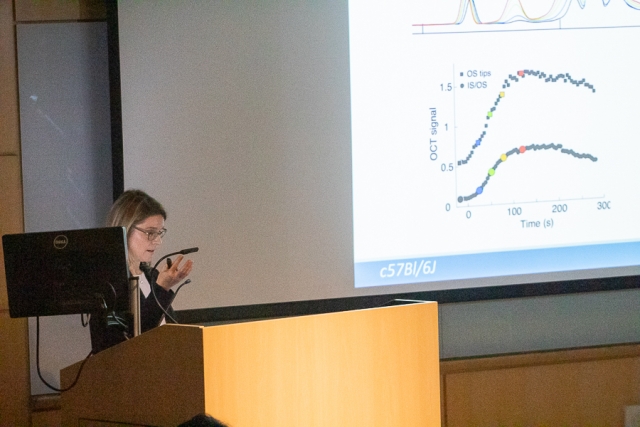
The Genome and Biomedical Sciences Facility Auditorium was packed with researchers, students and the general public as the Center for Vision Science hosted its Annual Symposium on January 11.

The event featured updates from the center, research talks presented by faculty members, keynote speakers from universities outside of UC Davis and a data blitz, which challenged graduate students and faculty members to concisely capture their research, impacts and future pursuits in minutes.

“The Center for Vision Science started in 1984 with a group of segmented scientists around campus,” said Paul FitzGerald, the director of the UC Davis Center for Vision Science. “Since then, we have had a growth in the number of faculty. We have over 40 faculty members scattered all over campus. This symposium gives us a chance to get together.”

Each year, the symposium rotates between subjects and fields, FitzGerald said.

“We have strong psychology, retina, cornea, optical devices and cell imaging research,” he said. “We want to show different communities embedded in vision sciences and the translational sciences between research and clinical applications.”

Jonathan Horton, a professor of ophthalmology, neurology and physiology at UC San Francisco, presented the John Kelter, MD Distinguished Lecture, discussing how exotropes, individuals who have either one or both eyes turned outward, select an eye for vision.

“Exotropes have a favorite eye,” Horton said.

His research tracked each eye independently, mapping eye movement and behavior.

“Exotropes are faithful to their dominant eye, but it takes more effort to focus on something,” Horton said. “When we provide a challenging target distance from the dominant eye’s perception, they begin to acquire the targets with their other eye instead of their dominant eye. It’s like doubles in tennis—one player dominates and the other player finally gets to play in the game.”

Aaron Beckner, a fourth-year psychology Ph.D. student, presented a segment of his research during the data blitz, which investigates how infants learn through saccades, which are rapid eye movements or eye blinks.

“Imagine you’re trying to sample your environment and you’re an infant,” Beckner said. You don’t have the ability to grab and manipulate items. It becomes really important for you to be able to fixate on individual items and remember something about that individual item in order to guide subsequent items. The logic is at that age, infants have limited motor abilities, the way that they’re learning is through their vision. They have the remarkable task of learning across their lifespan, they have to do memory encoding, vision helps start this process.”

Beckner tracks infant visual learning by exposing infants to the visual features of objects, including different colors and shapes, and measuring how long infants fixate on an object and a changed feature about the object presented using eye tracking and change detection.

“Infants have a natural desire of proclivity, to seek new over old information,” Beckner said. “We try to measure their ability to store information by looking at their novelty object preference for something new.”

When an infant looks at a new object longer than an older object, they have recognized that an object is older through their stored information or encoded memory.

The symposium concluded with vision researchers discussing each other’s findings.

“When we get together and present in front of each other, it leads to collaborations across disciplines,” said Marie Burns, a professor at the UC Davis Department of Cell Biology and Human Anatomy. “It also gives a chance for students and faculty to improve their presentation and communication skills. All of the data blitz speakers gave superb presentations and we got to see their progress in their research projects.”

Written by: Foxy Robinson – science@theaggie.org

Three years later: Where the Women’s March is today

1

In Sacramento’s first year as an official chapter of Women’s March Global, attendees remark on the past, present and future

On Jan. 21, 2017 the first Women’s March became the largest single-day protest in U.S. history, coinciding with Donald Trump’s inauguration. Crowd scientists believe that the women’s march in Washington was about three times the size of the audience at the inauguration. Marchers across the nation protested Trump’s misogynistic statements while advocating for legislation and the protection of human rights.

Just months after the first Women’s March, the #MeToo movement began in full force. Electrified by the widespread misconduct in Hollywood as well as the first year of the Trump presidency, the marchers returned to the streets on Jan. 20, 2018 for the second annual Women’s March.

The beginning of 2019 was marked by increased publicity about the record-breaking number of women in Congress in the “Pink Wave,” as well as news about Sony Music dropping R. Kelly following the release of Lifetime’s documentary in which multiple women accused him of sexual misconduct. Marchers returned to cities across the U.S. this weekend, on Jan. 19, 2019.

Armed with posters, Pussyhats and flags, marchers in Sacramento started their 0.8 mile walk to the Capitol from Southside Park. As they marched along closed streets, accompanied by friends, family and pets, there were others standing along the sidewalk cheering them on. Chants of “No borders, no wall” and “Hey hey, ho ho, Donald Trump has got to go” waxed and waned as the march went on. Led by the Women’s March WOC Contingent of Met High School was a rallying cry of “Si se puede.” There were musicians every few blocks — notably the Davis Raging Grannies. The Raging Grannies, decked in “Granny garb,” held their song sheet binders as they sang of workplace equity and presidential impeachment.

Also at the march was 98-year-old Lollie Rueppel, a veteran of World War II, along with two of her daughters and her granddaughter. During the march, many people stopped to take pictures of or with Rueppel, who smiled from her wheelchair. Rueppel enlisted in the service when she was 21, and her daughter Susan Rueppel describes what a role model she’s been to the whole family.

“Mom was one of only eight women in the military that was an International Morse code operator,” Susan said. “She was a pioneer back in World War II when she was 21 […] She’s been a role model for her five kids for all our lives. And she’s been an activist all her life. […] We are just so appreciative and admire that she has not been the ‘traditional woman’ throughout her whole life, and doing things that other women often don’t do. So she’s just such an inspiration to our family and the world.”

This is the family’s third year in attendance, and Lollie described her beliefs on the importance of the marches and how she feels activism has changed over the course of her life.

“The big thing is people are learning more about [feminism] and that’s what’s important,” Lollie said. “The more people that know about this the better, [so] we can make change in the right direction. That needs to happen always, every year. More people have to get out and let it be known how they feel about things. Yes, it’s a very important job that they should do.”

After reaching Capitol Mall, marchers gathered to listen to speakers who were discussing a range of issues — some first stopped by the food trucks lining 10th Street or at the rows of organizations that were tabling. One of the two emcees, Coco Blossom, tried to encompass the spirit of the event.

“We’re here today to uplift all women,” Blossom said. “We’re here today to stand in unity on this platform to inspire and facilitate grassroots actions. This platform is intersectional, diverse, flexible [and] bringing us all together to bring us together [and] represent what we want and who we are. Today we’re building community on a positive level that will impact all lives to create transformative social change.”

The CEO of Planned Parenthood Affiliates of CA, Crystal Strait, touched upon multiple issues, including reproductive justice, poverty, workplace equity, intimate partner violence, economic security and healthcare accessibility. After the speakers concluded, Miss Shalae, the first black trans performer to headline the Sacramento Women’s March, performed Beyonce covers, closing with “Run the World” and a declaration: “We are feminists as f**k.”

Despite the overall enthusiasm for the march, this year’s event was marked by some controversy after leaders of the national Women’s March organization were charged with anti-Semitism. This was troublesome to many, including 57-year-old Kerry Burton.

“Why would this organization, in general, align themselves with something that even remotely resembles hate,” Burton said. “But in the end, that’s not what we’re about. We’re about inclusion, we’re about human rights, we’re about people of all color, we’re about feminism. Hate like that doesn’t have a place in this group or in this mission at all. It wasn’t started, that way, it shouldn’t be that way in the middle and it shouldn’t end that way.”

Burton described herself as socially liberal, fiscally conservative and formerly Republican. She said that for over the 57 years of her life, she watched the party lose its platform and foundation and said that it alienated her and her beliefs. Burton’s poster talked about the political strides that women had made, including the fact that there are now 131 women in Congress and Democrat Kirsten Gillibrand’s recent announcement about a run for presidency in 2020. At the top, it said “Future’s so bright” along with a pair of sunglasses. Burton attended the march the past two years, but this is the first time she has made a positive, hopeful sign.

“[There’s] a Hawaiian saying that’s like, ‘No rain, no rainbows,’” Burton said, “And sure, two years ago, we were sort of shocked and in disbelief about the kind of person that was elected to the presidency, the highest office in this country. But sometimes, it takes that major event where it just shocks your sensibilities and your intelligence and your senses and says, ‘Okay, now is our time to shift and change.’ […] We’ve made strides, [but we need to] keep working on it, because we’re not there yet, by any stretch. We’re doing the right things, to get people in place who can make those changes and lead instead of posturing for the next election.”

For Burton, this year seems to be the “pay-off” after the #MeToo movement, and she found the atmosphere to be more hopeful than the past two years, with increased Congressional diversity and rising progressive women working towards solutions. Additionally, Burton strongly believes in the power of youth.

“I’m 57, but I absolutely want young, vibrant energy, people who grew up differently and understand you got to work together,” Burton said. “We’re so polarized right now […] Two years ago, I was just kind of in a state of shock that this would happen. It’s also a reminder, don’t sit on your laurels, get out there, vote! Get out there, organize! Get out there and talk to others about it. And that old saying, ‘If you don’t stand for something, you’re going to fall for anything.’ I think a lot of people are falling for anything with 45.”

Representing UC Davis at the march was a coalition of women and female centered organizations. Laurel Low, third-year community and regional development major, serves as vice president for the new club, Students for Reproductive Freedom. They work directly with Planned Parenthood in order to advocate for reproductive justice. Low is concerned about reproductive justice, particularly with regards to the Supreme Court upholding Roe v. Wade.

“I think it’s just our job to make our voices heard at the state level, because I don’t know if those federal protections will be there in a few years,” Low said. “ California is one of the best states in the nation in terms of providing abortion access, but there are a lot of women who live in states where legislators are actively chipping away at those rights. That’s where the fight is really going to be if those federal protections go away.”

Estimates for the size of this year’s march in Sacramento stand around 10,000, which is smaller than in previous years. According to 67 year old Bill Reichle who has attended all three marches, however, the “gusto” from the past remained. He talked about the significance of intersectionality, and how groups can support others.

“Anytime there’s a big movement, people hitch their wagon to it so other groups come,” Reichle said. “It says, time for people to come out. Well, I’m going to push this cause, I’m going to push this cause.”

Despite the smaller crowds, there was evident energy in the mass of people especially as Sacramento city councilmember Angelique Ashby introduced 36 newly elected women in the November 2018 election. Some of those women were attendees of the former marches and according to Ashby, hadn’t even really considered running for office.

“See what a difference two years can make,” Ashby said to the cheering crowd. “Correction — see what a difference you can make.”

Written by: Anjini Venugopal — features@theaggie.org

Woodland celebrates construction of new affordable housing complex

West Beamer Place apartments officially opened in December, offering 80 new homes to low-income families

On Dec. 11, Yolo County officials and developers celebrated the opening of West Beamer Place, a low-income apartment complex in Woodland almost 15 years in the making. The 80 new homes in West Beamer Place aim to provide relief for homeless individuals or those at risk of homelessness in Yolo County and to residents in need of mental health services.

The opening ceremony took place at the site of the new complex, 10 N. Cottonwood Street in West Woodland. Housing and mental health officials from Yolo County spoke alongside staffers from Mercy Housing, the national affordable housing nonprofit that led the project. Mercy Housing worked in conjunction with Yolo County Housing and New Hope Community  Development Corporations to oversee construction of West Beamer Place, thanking these partners in a Facebook post announcing the dedication.

“Mercy Housing joined with New Hope CDC, Yolo County Housing, and Yolo County for the Dedication of West Beamer Place earlier this week,” the post read. “We are so grateful to our partners for helping create these 80 lovely homes for families in Woodland.”

Among the speakers at the event was James Glica-Hernandez, the chairman of the Yolo County Mental Health Board. In a later interview, Glica-Hernandez spoke optimistically about the completion of the project, as well as the future of West Beamer Place.

“Yolo County Housing, Mercy [Housing] and the HHFA — you know, the Health and Human Services Agency for Yolo County — and all the other partners of this have worked a very long time to make sure this is an outstanding project,” Glica-Hernandez said. “It’s going to serve a lot of people for a long time.”

Glica-Hernandez also spoke on his personal connection to the site of West Beamer Place, where the General Hospital and Peterson Clinic formerly stood.

“The site is on the site where my brother was born, and my brother died when he was 45 of mental illness and substance abuse issues,” Glica-Hernandez said. “So, for me, this is hope for people like my brother.”

Construction of the project began in June 2017, according a Nextdoor post from Woodland Community Services Program Manager Kris Bain. But planning and development began long before that. Glica-Hernandez doesn’t remember exactly when planning for the complex started, but estimates sometime in the early 2000’s. He believes that it required about 13 years to coordinate plans for West Beamer Place. Glica-Hernandez marveled at the support he witnessed throughout the planning process from the residents of Woodland.

“Some people are really afraid of having that kind of housing development, and that wasn’t the case here in Woodland,” Glica-Hernandez said. “We really had a wonderful community come together and create a beautiful place.”

Now completed, West Beamer Place will allocate the new homes between homeless individuals, those who are at risk of homelessness and others. Bain detailed the planned distribution of units in his Nextdoor post.

“The development will provide 48 family units as well as permanent supportive housing for 32 qualified Yolo County residents experiencing, or at-risk of, homelessness,” Bain’s post read. “Twenty of these 32 units will be reserved for Mental Health Services Act qualified households. The other 12 case managed units are for homeless or at-risk of homelessness. All units are permanent affordable housing.”

According to Mercy House’s website, alongside the 80 garden-style apartments, the complex also provides a number of amenities to residents, including a computer area, multi-purpose community spaces, on-site laundry and an outdoor terrace. Health services, shopping centers and schools are also located nearby.

Glica-Hernandez spoke highly of the design of the new homes and of all those involved in the project.

“I would live there in a New York minute,” he said. “They’re beautiful. It’s really affordable, and it’s just beautiful. So I think the people are really lucky, and they’re really doing things to create community there. From my vantage point, this hasn’t just been an assignment, a work assignment. This has been a passion for a lot of people involved for a long time. They wanted to get this right, and that’s what’s been so inspirational about the whole thing.”

Written by: Tim Lalonde — city@theaggie.org