55.5 F
Davis

Davis, California

Tuesday, December 23, 2025
Home Blog Page 464

Humor: Passengers carry humongous bottles of lotion through TSA

Our president has created pandemonium

In the wake of Donald Trump’s historic wall tantrum, the government has been partially shut down, and America has been left to deal with the consequences of Trump’s childish antics. As a result of Trump’s refusal to end his fantasy plan, hundreds of thousands of federal workers have been forced to go to work unpaid. Although many have called out sick with a contagious virus known as “I-ain’t-working-for-free-itis,” some brave souls who work for the TSA have been forced to clock in for a payless payday for almost an entire month.

   Since TSA workers would rather be anywhere but the airport, passengers have been trying to make the best out of a dreadful situation. For instance, passengers at Sacramento International Airport have successfully done what most frequent flyers have been dying to get away with. That’s right: TSA agents have been letting passengers through security with bottles of lotion larger than 3.4 ounces!

Some might view this as unprofessional or unacceptable, but what’s really unprofessional is how our elected officials are sitting around and bickering with each other like there isn’t a president who’s eager to fulfill the little plans he drew in his coloring book before he was elected.

Written by: Hilary Ojinnaka — hiojinnaka@ucdavis.edu  

(This article is humor and/or satire, and its content is purely fictional. The story and the names of “sources” are fictionalized.)

Weisinger brings experience to UC Davis’ newest athletics program

0

Women’s Equestrian begins season next week

For UC Davis Equestrian Head Coach Jessie Weisinger, her love for horses started at the age of four. The South Texas native recalled the day that she formed her love for horses. She went to the barn with her mother and a horse veterinarian, where she found a note reading: “For Jessie” taped onto a stall. In that stall was Junior.

“My first little pony, so that started it all,” Weisinger recalled.

Next Thursday will be UC Davis’ first official Division I meet against Delaware State. Weisinger admits getting the equestrian program up to speed has been hectic.

“It’s very exciting, it’s been crazy busy with starting a new team from scratch,” Weisinger said. “When we got here in August, we didn’t even own a brush, so to see how far we’ve come in less than six months is pretty awesome.”

Forming a team, organizing practices, finding equipment and finding the horses the team needs sounds like a daunting task for even the most highly-funded athletics programs. But this isn’t unfamiliar territory for Weisinger.

Weisinger started giving horseback riding lessons as a high school student, noting that there was quite a high demand in her community.

“In South Texas, you had to drive about four hours to your trainers for quality instruction, that was the Houston area,” Weisinger said. “There were a ton of kids that wanted instruction.”

Weisinger and a friend saw the opportunity to coach riders and get some more experience under their belts.

“We just started giving riding lessons at the barn,” Weisinger said. “Then we actually had  high school teachers that were like ‘we want to start taking lessons’, and then we started giving lessons to our high school teachers.”

After this, others began to ask them to work with new horses and their list of clients grew. They both stayed in Corpus Christi for junior college.

After Weisinger graduated from Texas A&M, where she rode under Head Coach Tana McKay from 1999 to 2002, she worked for various rodeos in Texas. She then moved to Colorado in 2011 for the opportunity to work as an assistant coach for the Guynn Training Center under Mark Guynn.

Weisinger gained insight into how the management aspect works, rekindling her passion for riding and teaching.

Guynn recalled a conversation he and Weisinger had after noticing that a form of riding, called ranch riding, was gaining popularity on the East Coast.

After Weisinger suggested starting a team, Guynn made her head coach of the Rocky Mountain Wranglers, a team that competed in the Interscholastic Equestrian Association.

“Our team really grew under Jessie’s help, she’s a great individual,” Guynn said.

When an assistant coaching opportunity at the collegiate level presented itself at Texas A&M, Weisinger took it.

The format for the National Collegiate Equestrian Association is different from other formats, such as the IEA, which Weisinger taught to the Rocky Mountain Wranglers. Competitors in NCEA do not get to use their own horses for matches, the horses are selected for the meet and riders go head-to-head with each other on the same horse. Weisinger rode this format while competing at Texas A&M.

This particular format is often difficult for some riders to get accustomed to, but Weisinger excelled in the mental aspect.

“She did a really good job of prepping these kids in a high pressure situation,” McKay said. “On our team, we have 55 girls standing at the end gate watching with that pressure of ‘we need this point and we’re all counting on you.’”

Weisinger coached one of A&M’s top riders, Avery Ellis. Ellis won the AQHA Collegiate Horseman Challenge Championship in 2016 and 2018, a competition in which competitors are selected based on their riding statistics, among many other notable athletic achievements.

The relationship between Weisinger and Ellis goes back to when Ellis was five years old. While an undergrad competing at A&M, Weisinger gave riding lessons to Ellis when Ellis was five years old. Ellis kept Weisinger’s horse, and this was the only connection the two maintained until Ellis committed to A&M for college.

“A lot of the times she was really goofy and silly but definitely got stuff done, and there was going to be no excuses,” Ellis said of Weisinger’s coaching style at A&M.

In Ellis’ estimation, she can be a tough coach but is understanding.

“It was a good balance, she’d have the radio playing in the middle of the arena and making jokes, but when it’s time to be serious, we were serious,” Ellis added.

Texas A&M’s equestrian program was the NCEA Reining Champions in the 2017-18 season and NCEA National Champions in the 2016-17 season. Under McKay’s leadership, the program has also produced many coaches for the sport, which McKay notes is still growing. The head coaches of South Dakota State, TCU, UGA and all of Baylor’s coaches are A&M alumni. And now, UC Davis.

“I think being under [McKay’s] leadership and guidance really helped me grow as a person and grow as a coach,” Weisinger said.

As for the UC Davis riders, they’re excited to get things going next Thursday.

Junior horsemanship rider Bobbie Piddock transferred from University of Tennessee, Martin to be closer to home. But without the addition of equestrian, Piddock said she probably wouldn’t have transferred to UC Davis.

For senior rider Hayley Fredericks, this season presents one last opportunity for her to fulfill her goal of riding for a Division I team.

“I’ve learned so much while being part of this team with Jessie,” Fredericks said.  

It’s apparent that Weisinger brings a wealth of knowledge to one of UC Davis’ newest programs and will likely continue to impact the sport at the collegiate level for years to come.

Ellis is now a student assistant coach at A&M and says that Weisinger was a big part of that decision.

With a growing sport like equestrian, McKay thinks other colleges looking to add it to their Division I lineup will use UC Davis as a model.

“[Weisinger] will be really good for our sport as a whole to be the one who has started that program and help future schools in the challenges she had in starting the program,” McKay said. “I know she was excited to take on this new challenge.”

Written by: Bobby John — sports@theaggie.org

Increase in electric vehicle charger installations in Davis

Electric vehicle charger in Muir Commons example of rise in alternative energy

On Nov. 9, 2018, Muir Commons celebrated the installment of 26 Level-2 electric vehicle chargers, one for each household, as part of PG&E’s EV Charge Network program — making it the largest multi-unit dwelling electric car charging project in California thus far. Both UC Davis and Valley Clean Energy also plan on implementing more charging stations in parking lots and public places.

The EV Charge Network Program aims to “accelerate California’s transition to a clean transportation future by offering electric vehicle charger installation at select locations in PG&E’s service territory,” according to the PG&E website. The Muir Commons ad-hoc committee for EV charging related-services applied to the grant, which is specifically tailored to the implementation of chargers in workplaces and multi-unit dwellings such as apartment complexes.

Eugen Dunlap, a Muir Commons resident and committee member — along with members Ben Finkelor, Corey Bock and Laurie Friedman — spearheaded the movement for EV chargers. The initial estimate was around $700,000 in total, about $25,000 to $30,000 per household. The PG&E grant reduced the cost to $1,150 per household, and a grant from the Yolo-Solano Air Quality Management District’s Clean Air Funds Program lowered the final cost to $550, according to Dunlap, who noted the necessity of the grants to cover the costs of the technology.

“If you have a garage, you can put in a charger, but if you live in an apartment complex or something like that, you have a central parking lot and it gets very complicated and expensive,” Dunlap said.

Surprisingly, Dunlap is among only three residents out of the 26 who currently own an electric vehicle. According to the U.S. Department of Energy, electric vehicles can reach up to an average of 114 miles on a full battery, but many consumers are off-put by purchasing one due to range anxiety — the fear one’s car battery will run out before their destination — which the chargers may eliminate. However, all residents supported the cause, and the chargers opened up the possibility for residents’ next cars to be electric vehicles.

“The concept of range anxiety really isn’t as much of a problem as people think,” said Jim Parks, the director of customer care and marketing at Valley Clean Energy. “In other words, it’s not much of a real problem because people are mostly commuting and they have plenty of energy to do that with their electric vehicle, and the ability to charge at home.”

Level-2 chargers allow for more electricity to be delivered at a faster time as they are 240-volts, compared to the 120 volts of a Level-1 charger that most appliances are plugged into. The Level-2 chargers are maintained by PG&E and receive electricity from Valley Clean Energy Sources. The convenience of a Level-2 charger in combination with solar power helps incentivize an environmentally friendly form of transportation.

“For me, it was environmental because there [were] no tailpipe emissions, and it’s when you have solar cells on your roof you’re creating your own fuel,” Dunlap said. “I don’t have [an] oil well in my backyard you probably don’t have one in your backyard. Even if we would have it, we still have to process the oil, so we’d have to have a refinery, and we don’t have that either. So, with solar, you’re producing your own electricity, and the electricity is in general cleaner than anything burning fossil fuels.”

Muir Commons has fostered a history of innovation, as it was the first new construction cohousing development in the United States when it was built in 1991. Additionally, the housing complex implemented its first electric vehicle charger 17 years ago and solar panels atop their Common Room several years ago, which was rare for residential areas.

“The Muir Commons installation is going to be [a] unique one in that there is one charger per home, and all of the homes do not have electric vehicles,” Parks said. “I think in the future, you’re going to see new homes built with chargers as a standard part of the package. It may, at some point, become a requirement of the building codes.”

Just as solar panels increased globally by nearly 30 percent in 2017, according to SolarPower Europe, and is becoming a popular sustainable energy alternative, electric vehicles may become the next technology to be integrated into daily life. UC Davis has been updating the presence of chargers with charging station installations at the Mondavi Gateway District Parking Structure and ARC Pavilion Lot 25, with a goal to install 100 new chargers each year.

Valley Clean Energy recently secured a $2.9 million Sacramento Area Council of Governments grant to install electric vehicle charging infrastructure in Yolo County, according to Parks. Over the next few years, more and more electric vehicle chargers will be publicly available.

While Muir Commons just celebrated its latest leap in technological advance, the next may already be in the works.

“We’re always a pioneer in these things, and we love being pioneers,” Dunlap said. “Every time an individual comes up with these new ideas, we try and incorporate it.”

Written by: Renee Hoh — city@theaggie.org

Martin Luther King Jr. celebration

Downtown Davis holds freedom march in honor of Martin Luther King Jr. Day

Davis hosted its annual celebration for Martin Luther King, Jr. Day on Monday, Jan. 21 at the Varsity Theatre. The event featured guest speakers and music to commemorate civil rights with the theme, “Advancing the Dream; Empowering and Uplifting the Next Generation.” One of the goals of the event was to encourage dialogue on race.

A few performances consisted of an Afrovibes dance, a local youth reading and another reading by Davis’ Poet Laureate James Lee Jobe, as well as singing by Nathalie Minya. The program was concluded with a freedom march through downtown Davis.

Cynthia Pickett, an associate professor in the Department of Psychology at UC Davis, was invited to give a speech.

“I was approached by the organizers to see if I would speak at the event,” Pickett said. “I think it’s because of my research on social identity, intergroup relations and belonging [as well as] my work on diversity and inclusion at UC Davis — plus being on school board and being interested in children.”

Carrie Dyer, a community engagement and cultural services and management analyst for the City of Davis, explained that the event intends to build a community of acceptance.

“The function of the Davis Human Relations Commission is to promote mutual respect, understanding and tolerance among all persons,” Dyer said via email. “The Commission shall seek to build a community where relationships among diverse peoples are valued by all, discrimination and hate are not tolerated, the voices of the voiceless are heard, and where citizens can address issues dealing with hatred, discrimination and alienation through education, outreach, studies and recommendations to the City Council.”

Pickett highlighted concepts such as race in her speech to inspire children. She referenced Martin Luther King, Jr.’s famous “I Have a Dream” speech to explore how race is perceived and treated in society.

“In Martin Luther King’s ‘I have a dream’ speech, it talks about the idea of being judged for the content of our character and not the color of our skin,” Pickett said. “A lot of people have interpreted this speech as colorblind ideology, but if you read Martin Luther King’s readings, you see that it was what he intended. He recognized that people are judged and treated differently based on race, gender and a host of other factors. His dream was that through recognizing people’s differences [it] can litigate the damages and to not ignore race entirely.”

Pickett also included the dichotomy between colorblind ideology and multicultural ideology.

“What I will be doing is to talk about what colorblind ideology is versus multicultural ideology — where you recognize and embrace differences and how by not talking about race, we are actually causing harm,” Pickett said.

Pickett’s speech largely focused on how to empower children to ensure that the next generation can move forward from race-related issues and conflicts.

“In terms of empowering children of color and also being able to improve race relations, if you don’t talk about race and understand other people’s perspectives and come up with solutions to problems that arise, [then] my focus is to highlight the importance of talking about race especially among children and youth,” Pickett said.

This was not the first time Pickett has attended the event.

“I’ve been going to this for several years and one of the traditional parts of the event are African American children who do a poem or speech, and it’s just inspiring to see that next generation,” Pickett said. “I think my message is an important one — about why we shouldn’t shy away from talking about race and by having that platform to talk about it is valuable and I appreciate being able to speak.”

Mayor Brett Lee indicated his support for the community event.

“I look forward to this tradition of our community coming together to promote mutual respect, understanding and tolerance among all people,” Lee said, according to Davis Enterprise. “Please join us.”

Written by: Stella Tran — city@theaggie.org

Spotify vs. Apple Music

Discovering which streaming service reigns supreme

When comparing Spotify and Apple Music, there are many features that make the two streaming services almost identical: both offer a family plan for up to six people, a $5 monthly student fee (instead of the regular price of ten dollars a month), a free trial period and a social aspect that allows users to follow friends and see what they’re listening to. However, they also differ, and this sparks a Spotify versus Apple Music rivalry which has fostered debate over which is the better.

Spotify was founded in 2006, whereas Apple Music only began in 2015, which has given Spotify an upward advantage in coverage and recognition as the premier music streaming app. Because of this seniority, Spotify offers its services to 83 million users while Apple Music remains behind with 50 million users. However, according to Forbes, “Spotify is increasing at a monthly rate of 2%, while Apple’s growth rate is 5%,” which means Apple Music could eventually surpass Spotify in users.

Both services have features that differentiate them from the other. Spotify offers a free ad-supported tier for users that do not want to pay monthly, while Apple’s free version is provided through the Beats 1 radio station. In addition, Apple Music offers 45 million songs while Spotify offers 35 million, which, depending on one’s musical preferences, could make a big difference in preferred streaming service.

Even though both Apple Music and Spotify offer student plans, Spotify’s student plan for $4.99 per month includes Hulu and Showtime. Spotify also appeals to students with its year-in-review “Wrapped” feature.

Kevin Lentz, a fourth-year political science major, explained his reasons for preferring Spotify over Apple Music.

“Spotify has a more intuitive and user-friendly user interface,” Lentz said. “Searching for music and queuing songs is instant and the platform creates many ‘For You’ custom playlists from the music you routinely listen to. Finding music via genre is also more exact. Spotify has sub-genres categorized under the primary genres. Spotify seems to do a superb job at finding more music beyond my initial selection that I find really appealing, even across polar genres.”

In terms of user interface, both Apple Music and Spotify pride themselves on their aesthetic qualities: a clean white background with pink font and a grungier black background with green font, respectively. While this might seem unimportant, when spending so much time on an app, many users place a high value on user interface.

Lee Chisholm, third-year communication major, explained her reasoning for choosing Apple Music as one rooted in familial preference, overall user experience and song availability.

“I started [using] Apple Music my freshman year of college because my dad purchased the family plan,” Chisholm said. “I like the lighter background of Apple music, and I’m not that into the green and black color scheme.”

In addition, other streaming sites such as Soundcloud, Amazon music or Tidal can serve as supplements and influence users’ streaming choices.

“I also find that there are a lot more songs on Apple Music that they don’t have on Spotify, especially with remixes and things like that,” Chisholm said. “I’ve always been a big Soundcloud user, so I never really focused on Spotify.”  

For many, choice of streaming service stems from years of attachment and devotion to a site. Many college students who grew up buying songs on iTunes were introduced to Spotify around the time of adolescence when they were branching out from their parents’ music tastes and ready to begin exploring music for themselves.

Fourth-year history and psychology double major Josie Kamida explained her preference for Spotify as a mixture of both comfortability and popularity.

“I think my favorite thing about it is weirdly the social aspect,” Kamida said. “I really like going onto my friends’ Spotify [profiles] and seeing what they’re listening to. I’ve also been using it since sophomore year of high school, so it’s fun to see how my tastes have changed or what I was listening to in different phases of my life.”

At this point, most people have already chosen where their loyalties lie for favorite modes of streaming. Because both streaming services have their specialties and benefits, it’s impossible to objectively choose which streaming service triumphs. As people plug in their headphones or put in their Airpods, Apple Music and Spotify can be credited for changing the way that we listen to music.

Written by: Rosie Schwarz — arts@theaggie.org

An old material might build the future

A new building on the UC Davis campus is a part of the growing trend of using wood in large structures to reduce carbon emissions.

On the south side of campus, workers are busy installing a gigantic wooden roof that will cover the new Tercero Dining Commons 2, a new dining hall meant to accommodate more students. The roof is part of an international trend of using wood in large buildings. Although wood is not a new material, most large buildings are built with steel and concrete. Today, more architects are turning towards wood to build critical parts of large buildings because of environmental concerns and style considerations.

Shiling Pei, an assistant civil engineering professor at the Colorado School of Mines and an expert on wood buildings, said the trend is occurring for several reasons.

“The increasing market demand for wood buildings comes from the unique architectural features provided through exposed wood, environmental benefit of using sustainable material, and the efficiency and safety in construction provided through a high level of prefabrication,” Pei said.

Around the world, builders are using wood to replace and augment concrete and steel in new apartment buildings, office buildings and even skyscrapers. Developers recently proposed a wooden building that would be 21 stories in Milwaukee.

At UC Davis, the roof of the new dining hall is made of wooden panels and supported by long wooden beams. The designers chose wood for the roof because of its unique style.

Benjamin Caffey, an architect at Harley Ellis Devereaux, the firm that designed the building, described the stylized roof in an email: “The wood roof is exposed on the interior of the building and offers a natural warmth unattainable with other materials.”

Though the beauty of wood is driving more architects to use this material, there are other benefits to building with wood as well. Wood is a renewable material that fixes carbon dioxide, whereas steel and concrete are not renewable or environmentally friendly. The production of cement, the main ingredient of concrete, is responsible for about 5 percent of worldwide carbon dioxide emissions. Manufacturers use a lot of energy leading to indirect emissions, and they directly release carbon when they heat limestone, an important part of the production process. Manufacturing steel also releases large amounts of carbon. Many architects believe using wood will reduce these emissions.

“[Wood] is becoming attractive for construction because it is renewable and sequesters carbon,” Caffey said. “Its creation uses less energy and produces less carbon than steel or concrete.”

Wood buildings also satisfy another preference in the construction industry: pre-fabrication. Wood panels can be shipped to the build site pre-cut and finished and then assembled to form major components of the building with very little material waste. These prefabricated pieces are not the traditional wood beams milled from gigantic old growth trees. The majority of those trees were cut down in the early development of the United States.

“There are very few traditional old growth forests left,” said David Rizzo, a professor of plant pathology at UC Davis. “It’s a tiny percentage of what it was many years ago when Europeans first arrived here and started cutting trees down to build the cities.”

Today most lumber comes from tree plantations, where trees are planted and harvested like any other crop. These trees are generally much smaller and grow much faster than old growth trees. To produce large beams, engineers have designed sophisticated composite lumber products that can be formed into almost any shape or size. These products have existed for decades, but an increase in demand has led to new variations that are designed to be incredibly consistent, attractive and fire-resistant. A product called cross-laminated timber, designed in the 1990s and refined in the 2000s, is at the forefront of the wood construction boom.

Despite the excitement, some detractors are concerned about the stability and longevity of the new buildings. Engineers across the world are working to study the composite wood products and develop standards to keep people safe in these buildings. According to Pei, the results suggest that wood buildings are safe and long lasting.

“As of now, we have good evidence through research and full scale testing that at least for seismic performance, well-engineered wood buildings can withstand major earthquakes without much damage,” Pei said. “As for durability of wood buildings, look no further than well-engineered temples in Japan and China that have lasted over 800 years.” .

In the coming years, more and more large buildings will be built with wood to reduce carbon emissions and make building designs more compelling.

“There’s no doubt we will see the use of composite wood construction flourish in California,” Caffey said.

Students at UC Davis will get to experience the trend firsthand when the new Tercero Dining Hall opens next fall.

Written by: Peter Smith – science@theaggie.org

Editor’s note: An earlier version of this article stated that concrete is one of the main components of cement. That is incorrect. Cement is one of the main components of concrete. The Aggie regrets the error.

Women’s basketball keeps the good times rollin’

Aggies blowout UC Irvine to extend hot streak

Brendan Ogburn — sports@theaggie.org

The UC Davis women’s basketball team continued its hot streak with a 80-57 blowout victory over visiting UC Irvine on Saturday afternoon at the Pavilion. The Aggies have now won eight of their last nine games, including three out of four in Big West play.

“I’m really proud of our team’s effort, preparation and focus, most notably on the defensive end,” said UC Davis Head Coach Jennifer Gross. “Our goal for the week was to really bring a lot of urgency on every single possession, and we really tried to do that for the most part.”

Senior forward Morgan Bertsch, the all-time leading scorer in UC Davis history, led the way she’s done so many times in her career. She scored 29 points, including a perfect 11-11 mark from the free throw line, and had a significant impact on the game even when she wasn’t putting the ball in the net. Her mere presence on the offensive end of the court, especially around the basket, demands a large amount of attention from opposing defenses, which opened up quality opportunities for teammates to take shots from the outside.

“Morgan takes a lot of attention inside, so if we can move the ball like we did today, we can get good shots,” Gross said.

UC Davis did just that, lighting it up to the tune of 52.9 percent shooting from the field.

Senior guard Kourtney Eaton was a beneficiary of that plan of attack, as she tallied eight points in the first 12 minutes to go along with seven total assists.

Junior forward Nina Bessolo also made her presence known, firing four three-pointers in her first 15 minutes of action off the bench.

“I just feel super energized and hyped and even more confident, which boosts my game,” Bessolo said.

The Aggies relied on their three-point shooting, where they converted 10 of 23 attempts, to jump out to an early lead and distance themselves from the Anteaters. UC Davis did not trail for a single second on Saturday and led by as many as 30 points at one point in the fourth quarter.

The Aggies started to kick it into high gear on both ends of the hardwood in the second quarter. They held UC Irvine without a field goal for a five minute stretch and used an 18-5 run to close out the first half, taking a 43-23 advantage into the locker room.

“We’ve been talking a lot about stop-score-stop,” Gross said. “How many of those can we put together? If you do that, you’re going to jump out to a big lead.”

The story remained the same in the second half and the Aggies stayed in cruise control for the final 20 minutes of play. Bertsch continued to dominate and added another 15 points, before leaving to a standing ovation midway through the fourth quarter.

She etched herself into the Big West history books versus UC Riverside in early January, becoming just the eighth player in conference history to surpass 2,000 career points.

UC Davis has 12 more conference games on the docket before the Big West tournament arrives in mid-March. A first place finish in that competition would send the Aggies to the NCAA Tournament for the first time since the 2010-2011 season.

Written by: Brendan Ogburn — sports@theaggie.org

Federal government shutdown affects UC Davis

Some research grants delayed, already-awarded federal financial aid not at risk

UC Davis, a federally-funded institution, is not immune to the effects of the ongoing federal government shutdown. This means that research grants, student immigration cases and financial aid may be delayed across the university.

The National Science Foundation (NSF), NASA and U.S. Department of Agriculture are examples of some of the departments that have closed and aren’t receiving funding. The NSF distributes the funding for research done by graduate students and professors in UC Davis science departments.

The federal government’s partial shutdown came after Congress didn’t approve a $5 billion funding allocation for the construction of a physical wall along the southern border. As a result, hundreds of thousands of federal employees are not being paid.

The UC Davis Office of Research assured that most federal research grants have already been dispersed for the fiscal 2019 year, but others, like the National Science Foundation, have not. According to the UCOP, university science researchers who are funded by the NSF have not been paid since December and will not be paid until the agency reopens and the government shutdown ends.

New awards, funding increments, payments and prior approvals will be impacted or delayed because of the shutdown, according to Jean-Pierre Delplanque, the vice provost and dean of graduate studies.

Despite the delays, Delplanque urged those applying for grants to “please submit your application by the deadline published in the funding opportunity announcement, regardless of the status of the government shutdown. Continue working normally unless you receive guidance from your program to stop work. If you receive a stop work order or if [you] have not received your obligated funds, contact externalfellowships@ucdavis.edu immediately.”

Additionally, the UC Davis School of Law, which hosts the UC Immigrant Legal Law Center, said the shutdown has halted immigration cases, leaving trials stagnant while immigration judges are furloughed.

“Thousands of immigration cases have been postponed as a result of the federal government shutdown,” a post on the school’s website read. “Immigration judges have been furloughed, and only cases involving migrants in custody are moving forward. Because of already crowded judicial calendars, postponed matters may not be heard for years. According to the New York Times, delayed proceedings in busy New York immigration courts may not take place until 2022 or 2023.”

Kimberly Hale, of UC Davis news and media relations, spoke about the importance of the funding that fuels scientific research.

“The University of California urges Congress and the administration to quickly reach an agreement to re-open the federal government,” Hale said via email. “Many of the agencies affected by this shutdown provide critical funding for important research underway by our students, faculty and staff across the university system.”

Hale mentioned the federal Pell Grant program, which provides financial aid to low-income students. She said students currently receiving the grants should not be affected.

The IRS’ closure troubles those who need tax returns from the IRS to apply for aid. Students who want to apply for federal aid may be delayed because the online application may be locked out from federal online databases that confirm their identities.

“We are pleased that earlier this year, Congress was able to provide strong investments for federal financial aid programs – including an increase in Pell Grant funding – and that our students currently receiving this aid are not affected by the shutdown,” Hale said. “However, as a key partner with UC in pursuit of scientific and technological breakthroughs that keep our state and the nation at the forefront of innovation, we urge Congress and the administration to immediately fund […] agencies that have been affected by this shutdown. We are continu[ing] to closely monitor the situation.”

The White House claims that even though the IRS is down, tax returns will still be paid out during the shutdown.

Written By: Aaron Liss — campus@theaggie.org

Facing growing budget deficit, Unitrans proposes fee referendum

Student fees funding Unitrans would increase by $13.30 if referendum successful

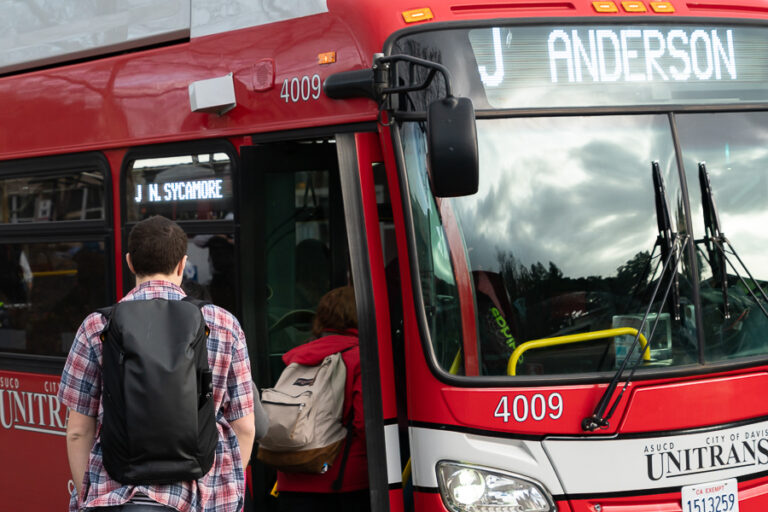
Unitrans recently began instituting changes to combat its growing budget deficit, including decreasing the frequency of certain less-popular buses. In order to avoid cutting more services, Unitrans proposed a fee referendum which would increase the $34.50 fee each student already pays for Unitrans services by an additional $13.30.

Last May, after the transportation service proposed its first fare hike in 14 years, Unitrans’ General Manager Jeff Flynn told The California Aggie that the unit ran a $450,000 deficit for the 2018 fiscal year and is projected to run a $750,000 deficit in the 2019 fiscal year. Flynn estimated the deficit would increase to $1.6 million within four years without the implementation of substantive changes.

As a unit of ASUCD, Unitrans is a transportation service many UC Davis students and Davis residents use on a daily basis. Unitrans buses, routed around much of the city of Davis, transport students to and from campus everyday.

The unit is funded by both the city of Davis and UC Davis students through student fees, according to Flynn, who mentioned that while the student fee is fixed, funding from the city increases with inflation. The only way to increase the funding Unitrans receives via student fees is through fee referendums.

“Students, over the last 27 years, have voted four times to fund Unitrans service and provide free boardings for undergraduates,” Flynn said.

In order for the fee referendum to pass successfully — which will be introduced on the ballot for the upcoming ASUCD Winter Election — 20 percent of students must vote in the election and the referendum must receive a 60 percent ‘yes’ vote.

Due to historically low voting rates of UC Davis undergraduates, there is concern over whether 20 percent of students will vote in the election. While the ASUCD Winter Elections typically yields greater turn-out, less than 7 percent of students voted in the most recent Fall Election.

The last time Unitrans successfully passed a fee referendum was in 2008.

Factors contributing to Unitrans’ growing budget deficit include California’s increasing minimum wage over the last few years. A minimum wage of $15 will be implemented by the year 2023 and, as a result, Unitrans will be required to pay its workers more, thus increasing its costs.

The fee referendum is currently making its way through the ASUCD Senate. According to Flynn, the increased fees would accomplish several primary goals: maintaining fair, free boarding for undergraduates, introducing more trips or higher capacity buses and hiring career staff trainers and another mechanic.

“With the additional funding, we could also introduce more trips or service or [higher] capacity buses,” Flynn said.

In 2020, regulation changes will require individuals to have more experience before they are allowed to become trainers, Flynn said.

“Right now, Unitrans relies on mostly student trainers — undergraduates who are also our trainers — to train other people to be bus drivers, and right now, that works,” Flynn said. “However, in 2020 the regulation changes […] will essentially eliminate our training workforce, so we’re going to have to hire career staff trainers. And they are significantly more expensive than student employees.”

Of the $34.50 fee students currently pay for Unitrans, $1.50 of that goes to fund student aid, required by UC policy. If the fee referendum is successful, $3.30 would go to student aid, Flynn said.

ASUCD Senate Pro Tempore Alisha Hacker, a second-year political science—public service major and the adopted senator for Unitrans, said that there is a “return-to-aid” component built into student fees in order to support students who may struggle to pay the higher student fees.

“Those who would be otherwise negatively impacted by increased fees, especially low-income students, will get an additional increase in the amount that will be given out in financial aid to offset the higher cost,” Hacker said.

Unitrans will launch an education campaign about the fee referendum in late January, consisting of signage on Unitrans buses, social media posts, fliers posted around campus and communication with Greek Life and Athletics.

“Unitrans is not allowed to take a position on the measure,” Flynn said. “So we will merely be providing information on what the vote does and try to get people to vote. We will have a website about the measure through ASUCD [and] Aggie Studios did a video on it.”

Weston Snyder, a third-year history and international relations double major and operational manager at Unitrans, will play a role in educating students about the fee referendum. He believes that no matter what way students vote, it is important they do.

“Making people aware that this issue is on the ballot and that it is up for them to decide is really important,” Snyder said.

If the fee referendum is not successful, Unitrans will be forced to cut services. Currently, the unit is able to function thanks to reserved funds built up over the years, but these funds will run out by next year, Flynn said.

“Next year, we’ll be looking to implement 15 to 20 percent service cuts and the year after that, another 15 percent or so service cuts,” Flynn said. “To put that in perspective, currently we run 18 lines, so that’s essentially eliminating six or so bus lines. We would be reducing staffing on the students and career staff sides.”

These cuts will affect both students and workers at Unitrans.

With the knowledge of how a failed referendum would impact the campus, Hacker said ASUCD officials, including both senators and commission chairs, are backing the proposed fee increase.

“They understand the need and importance for Unitrans not only for our communities and the campus but just knowing that it’s an institution,” Hacker said. “They see the value of doing what it takes to make sure we can keep it.”

Hacker hopes that students will also view Unitrans as a key campus institution and a critical resource for students that must be supported.

“We’re just really going to have to tell Unitrans’ story to people: let them know exactly what’s at stake here, let them know what a benefit Unitrans is not only to the campus but to the community at large,” she said. “And hopefully that will be enough to let people see the urgency of this.”

Written by: Sabrina Habchi — campus@theaggie.org

Solidarity with Los Angeles teachers on strike

L.A. teacher union demands better pay, more staff, student support

United Teachers Los Angeles, the union that represents over 30,000 public and charter school teachers in L.A., entered a second week of striking on Tuesday. While a tentative agreement was reached on Jan. 22, the union stated that it would stay on strike until union members formally voted to approve the contract. Teachers are expected to be back in the classroom on Wednesday.

The UTLA strike was the latest in a series of teacher strikes that began early last year; teachers in West Virginia, Oklahoma and Arizona won significant victories against reticent lawmakers and inspired similar protests in Kentucky, North Carolina and Colorado.

Los Angeles teachers enjoyed an unusually high level of public support. One survey showed that close to 80 percent of Los Angeles residents support the strike. A GoFundMe campaign to bring taco trucks to the picket line, which was set up in hopes of raising $1,000 to feed teachers at a few schools, has raised over $40,000. Hundreds of firefighters marched in solidarity with teachers on Tuesday.

Los Angeles teachers went on strike for better pay, but that’s not all they asked for. UTLA’s demands included smaller class sizes; fewer standardized tests and more teacher discretion over administering tests; increases in per-pupil funding; hiring more school nurses, counselors, social workers, librarians and other staff and increasing charter school accountability. Union members are fighting increased privatization and the encroachment of charter schools, which threaten to undermine public schools and have been shown to increase school segregation and negative outcomes for students. Students will be the primary beneficiaries of the demands won by Los Angeles teachers.

While much of the public discourse about education tends to revolve around improving test scores and learning outcomes –– which are no doubt worthy and important goals –– teacher strikes address something more fundamental and important about the state of American education.

Strong neighborhood public schools not only provide academic education, but also are foundations of the community. Teachers provide care and a stable adult presence to children who may not find such support at home. School nurses and counselors are a vital source of intervention, particularly in a country where medical and mental health care is otherwise inaccessible to many. Free and reduced school lunch programs feed over 20 million hungry kids nationwide every day. In the earliest days of the American republic, the founders recognized that a functioning democracy and civil society were impossible without a robust system of public education.

The Editorial Board is in solidarity with the UTLA teachers on strike. Meeting UTLA’s demands will help ensure that one of the largest school districts in the country continues to have a strong, well-funded and effective public school system that works for its students, its teachers and its community.

Written by: The Editorial Board

Trump begins to right the wrong on America’s disastrous foreign policy

The withdrawal of American forces from Syria finally moves the U.S. away from its catastrophic military endeavors

It’s time to give credit where credit is due.
President Donald Trump’s decision to withdraw American forces from Syria, in addition to halving the number present in Afghanistan, has largely been met with universal disdain from both sides of the political spectrum, as well as by many of the military’s establishment elite. Yet this momentous policy decision represents the first departure from the status quo of disastrous, interventionist American foreign policy since the post-War era.

America’s involvement in the war in Syria — defined by questionable legality, the arming and funding of suspect rebel groups and a generally vague strategic agenda — has gone mostly unchecked by a mainstream media that seems increasingly interested in petty politics and less concerned with checking the powers of America’s imperialist managerial state.

Similarly, after 17 years of deadly and largely ineffective combat in Afghanistan, media coverage of the war is almost non-existent — and when it does cover the conflict, it is conducted with little regard for transparency. Both the war in Afghanistan and the ongoing American intervention in Syria project a muddled coverage of the American war machine, often featuring contradictory reports, inconsistent narratives and, according to some, fabricated stories. The failure of the mainstream media to provide consistent and unbiased coverage of America’s foreign policy endeavors has done little to alleviate the anxieties of an anti-war crowd that sees the media as complicit in fueling disastrous American military endeavors.

So it came as no surprise this week that Trump’s positioning toward a less interventionist military strategy was been met with nearly universal disdain from the country’s biggest and most powerful media outlets. But perhaps more disturbing was the similarly uniform statements of contempt expressed by both aisles of America’s political establishment.

Democrat elites have jumped on the decision as an opportunity to continue to push the bizarre narrative of Trump being subversive to Russian influence, while hawkish Republicans have accused the president of rash and impulsive decision making. Yet ending catastrophic foreign policy blunders was a key component of Trump’s presidential campaign agenda, one of the few issues that had cross-spectrum appeal to both left and right populists. In fact, the pacified variant of neoconservative policy adopted by Trump during the first two years of his presidency was largely met with opposition from his anti-war base.

Defined by a platform of political resistance to President Trump and absent a unified ideological foundation, the Democrats will continue to portray the military establishment’s disapproval of Trump’s decision-making as evidence of his incompetence. Similarly, pro-war Republicans will become increasingly hostile towards the president’s administration and cite prominent military resignations as proof that warmongering is the only way forward.

What both sides fail to realize is that America’s attempts at regime change and hegemonic influence have been catastrophic failures that have both harmed our global image and made the world less safe. The War in Iraq led to a power vacuum that facilitated the rise of ISIS, paved the way for greater Iranian influence, increased sectarian violence and led to the mass exodus of the country’s already dwindling Assyrian Christian minority. Libya — once North Africa’s crown jewel — descended into chaos after the NATO-backed ousting of Muammar Gaddafi. Now the country has plunged into chaos and has become littered with violence and home to a modern-day slave trade.

So what future awaits Syria if a similar strategy were to be adopted? Already, conflict between the sovereign government of Syria and American-backed rebels have helped create a massive refugee crisis that has overwhelmed surrounding countries and emboldened the European far right. Should the U.S. and NATO continue the illegitimate policy of regime change, Syria’s diverse collection of ethnic and religious minorities stand to lose the most in the inevitable violence.

While it remains to be seen whether or not Trump’s recent policy announcements are a legitimate departure from the status quo or mere rhetoric, it is at the very least a clear indictment of the shocking power of the American military-industrial complex. No longer should Americans or the world remain hostage to hawkish, transnational interest groups who stand to benefit from perpetual foreign wars. Political allegiances aside, it is time to end the bloodshed.

Written by: Brandon Jetter — brjetter@ucdavis.edu

Disclaimer: The views and opinions expressed by individual columnists belong to the columnists alone and do not necessarily indicate the views and opinions held by The California Aggie.

Men’s basketball welcomes fresh start as Big West play begins

Aggies remain optimistic after difficult 4-10 non-conference run

The UC Davis men’s basketball team has enjoyed a journey of unprecedented success over the last two seasons.

The team made history with a run to the NCAA Tournament in the winter of 2017 and came within two victories of doing it again last season.

As a result, it should come as no surprise that the expectations were very high entering this current season, especially considering the number of seniors and amount of overall experience on the roster. UC Davis was picked by 24 media members to finish third in the Big West this season, according to the conference’s official preseason poll.

Long before this campaign began, many of those veteran players made a plea to Head Coach Jim Les to ramp up the team’s non-conference schedule this year so they could test their abilities against superior competition. Les obliged and did not pull any punches, putting together a demanding preseason slate and setting up dates with traditional powerhouses like Arkansas, Indiana, Arizona and USC among others.

Being in a mid-major conference like the Big West, UC Davis knows that its only real path to the NCAA Tournament is by taking home the conference title in mid-March at the Big West Tournament in Anaheim. Anything the team does in non-conference play is an added bonus, so they don’t have much to lose by scheduling tough opponents.

Needless to say, the Aggies had their struggles through November and December, losing 10 out of 14 games and winning just once away from the Pavilion. Nonetheless, one of the important details that gets lost when simply looking at the win-loss record is the fact that UC Davis was incredibly competitive and hung around in the majority of these contests, often trailing by single digits late into the second half. The Aggies typically started off strong in the first half of most games but struggled to retain that level of play for the full 40 minutes.

Playing in a hostile environment halfway across the country on Black Friday, UC Davis had Indiana on the ropes with an eight-point lead in the second half but could not seal the deal. In another road game against Arizona in mid-December, the Aggies fell on a game-winning shot in the final minute of regulation. Lastly, the team finished out its roadtrip with a tough battle against USC that saw them hold an advantage early in the second half before tailing off.

If nothing else, this challenging stretch of basketball has served as a wake-up call for the team and has shown them what areas they need to improve on.

“I think we played some really good teams and [had] really good competition,” Les said. “It’s accentuated what our strengths are and what our weaknesses are, so it’s out there.”

In response, UC Davis has altered some of its practice routines and tried to pinpoint where it has gone wrong thus far.

“We picked up the competitiveness in practice and tried to figure out those deep-rooted problems, and I think we’re getting there,” said senior guard Siler Schneider.

In a way, the string of tough losses also gave the team some confidence, as it offered a glimpse into what they are capable of doing when everything comes together.

“I think the takeaway is that we can really play with anybody,” said senior guard T.J. Shorts II. “When we’re clicking on the defensive end and we’re getting out and doing our stuff on the offensive end, we can really compete with anybody. We just got to take that confidence from those first halves and put it together when we go into conference, and play two halves of basketball everytime we step on the court and we’ll be alright.”

UC Davis’ four victories included an overtime triumph over Texas A&M Corpus Christi and blowouts over Northern Arizona, William Jessup and Holy Names.

Les and his players know what their winning formula is and realize that it all starts on the defensive end of the floor.

“We don’t have a false sense of security,” Les said. “We know who we are and what it takes to be successful. The stats are pretty clear—when we defend and hold teams to a low shooting percentage, come up with first rebounds and create turnovers, we give ourselves a chance to win.”

Overall, the players don’t regret asking for a tougher non-conference schedule and ultimately think the experience will pay dividends down the line.

“How we finish at the end of the season will tell us if it helped or hurt us,” Schneider said. “I don’t regret anything. We’ve figured ourselves out and learned things within ourselves that we might not have with an easier non-conference schedule. Hopefully it’ll be a blessing in disguise.”

The Aggies view the start of Big West play as a chance to reset, both physically and mentally, and prepare themselves for the grueling conference schedule that extends nonstop until early March. This has always been a philosophy of Les’ teams over the years.

“We’ve reset it every year regardless of what our record was,” Les said. “You can’t rest on your laurels if you had a great non-conference because now you can get humbled quickly in conference and vice versa.”

In order for the team to reach its ultimate goal of winning the conference, the Aggies know they have to pick up their level of play away from the friendly confines of the Pavilion.

“We respect the grind of a conference season and we know how hard it is to go on the road and get conference wins,” Les said. “You put yourself in a position to contend when you go out on the road and steal some victories, and that’s we plan to do.”

That plan has not gotten off to a great start, as the Aggies dropped both games of their road trip to Southern California last week. On Thursday night, UC Davis overcame a 16-point deficit in the second half and forced overtime against UC Irvine, but ended up falling 71-69. The Aggies came out hot against Long Beach State on Saturday afternoon, but watched an eight-point halftime lead slip away in the 82-77 loss.

At the end of the day, UC Davis has no reason to push the panic button just yet. The team has been in tough situations countless times over the last few years and has always found ways to stick together and overcome adversity.

“I’m excited for this group and the level that they’re going to compete when we hit the league season,” Les said. “We’re not an unproven commodity and these guys have proven they can be successful, so I’m looking forward to that.”

The Aggies are well aware that championships are not won in December and know that they have time left to right the ship.

“We got a lot of confidence,” Schneider said. “I know it might not show with our record, but we’ve been practicing really well and clicking and we’re ready to start this new year off right. This is a senior-led group and an experienced team, but there’s still a lot of kinks to work out with that, so it all matters on how you finish the year.”

UC Davis hopes that a return to the Pavilion can help jumpstart its Big West campaign. The team will take on UC Santa Barbara on Thursday at 7 p.m., before facing Cal Poly on Saturday evening at 5 p.m.

Written by: Brendan Ogburn — sports@theaggie.org

Repeat DUI offenders face new consequences in 2019

California implements mandatory in-car breathalyzers for second-time DUI offenders

On Jan. 1, Sacramento County became one of the first areas to enforce in-car breathalyzers for residents convicted of DUI offenses. California put the new requirement into action after the original bill received unanimous approval in legislature, emphasizing the consequences of individuals drinking and driving.

The new mandatory breathalyzer installation is an ignition interlock device that requires the driver to breathe into it in order to start the automobile. This procedure is mandatory for six months for first-time DUI offenders and a year or longer for repeat offenders whose violations resulted in injuries. When blowing into the device, the person behind the wheel must exemplify a blood alcohol level below .02 to start the car.

If the driver chooses to try to start the vehicle while intoxicated, the ignition interlock will lock the driver out for a certain amount of time based on the failed test. The smart device can also detect mouthwash and produce a negative test result even if attempts are made to cover up the smell of alcohol.

The ignition interlock system also retests the driver throughout the car ride. When a retest is run, in the case of someone continuing to drink after passing the initial breathalyzer test, the vehicle’s lights will flash and its horn will go off to get the attention of law enforcement.

“When it comes to driving under the influence, the impacts of decisions made in minutes or seconds can last a lifetime,” said Nathan Trauernicht, the UC Davis fire chief. “Not only is there a tremendous legal price to pay but also ramifications in potential injuries or death(s) of those involved in a collision.”

Originally, the protocol in California was to take the suspended license of those with DUIs. The realization surfaced, however, that two-thirds of the people who were charged would still continue to drive under the influence.

“My experience was my mother and sisters almost died because a guy chose to drink and drive on Saint Patrick’s Day,” said Dallas Cunningham, a California resident. “It is a miracle they didn’t [die], but they suffered countless injuries including punctured lungs, a broken pelvis, a broken neck, a fractured spine, and traumatic brain injuries and were hospitalized for months. After this, my mom and sisters had to relearn how do a lot of things because of the seriousness of their injuries, but my mom and older sister are still, today, recovering since the accident. All of their pain and suffering could’ve been avoided if the guy had just made a different decision not to drink and drive.”

The in-car breathalyzer devices cost between $70 to $150 to install and $60 to $80 per month to enable monitoring.

California is one of 31 states that motioned to approve these devices. Drunk driving is the number one cause of death on the road, according to Mothers Against Drunk Driving. MADD estimated that over 300,000 incidents of intoxicated driving happen per day or 121 million times per year.

California is taking steps toward eliminating drunk drivers under the influence of drugs or alcohol. There are even cell phone applications to help drunk drivers stay off the roads and find a ride home.

“My partners and I are so dedicated to preventing tragedies regarding driving under the influence that we have launched a new smartphone app appropriately named ‘I’M DRUNK’ for both Apple and Android cell phones with a simple goal in mind: ‘Two Clicks to Save a Life,’” said Tom Marquardt, the co-owner of the I’M DRUNK app. “The I’M DRUNK application allows any user who had too much to drink to simply secure a safe ride home.”

Written by: Lauren Tropio — city@theaggie.org

On Jan. 1, Sacramento County became one of the first areas to enforce in-car breathalyzers for residents convicted of DUI offenses. California put the new requirement into action after the original bill received unanimous approval in legislature, emphasizing the consequences of individuals drinking and driving.

The new mandatory breathalyzer installation is an ignition interlock device that requires the driver to breathe into it in order to start the automobile. This procedure is mandatory for six months for first-time DUI offenders and a year or longer for repeat offenders whose violations resulted in injuries. When blowing into the device, the person behind the wheel must exemplify a blood alcohol level below .02 to start the car.

If the driver chooses to try to start the vehicle while intoxicated, the ignition interlock will lock the driver out for a certain amount of time based on the failed test. The smart device can also detect mouthwash and produce a negative test result even if attempts are made to cover up the smell of alcohol.

The ignition interlock system also retests the driver throughout the car ride. When a retest is run, in the case of someone continuing to drink after passing the initial breathalyzer test, the vehicle’s lights will flash and its horn will go off to get the attention of law enforcement.

“When it comes to driving under the influence, the impacts of decisions made in minutes or seconds can last a lifetime,” said Nathan Trauernicht, the UC Davis fire chief. “Not only is there a tremendous legal price to pay but also ramifications in potential injuries or death(s) of those involved in a collision.”

Originally, the protocol in California was to take the suspended license of those with DUIs. The realization surfaced, however, that two-thirds of the people who were charged would still continue to drive under the influence.

“My experience was my mother and sisters almost died because a guy chose to drink and drive on Saint Patrick’s Day,” said Dallas Cunningham, a California resident. “It is a miracle they didn’t [die], but they suffered countless injuries including punctured lungs, a broken pelvis, a broken neck, a fractured spine, and traumatic brain injuries and were hospitalized for months. After this, my mom and sisters had to relearn how do a lot of things because of the seriousness of their injuries, but my mom and older sister are still, today, recovering since the accident. All of their pain and suffering could’ve been avoided if the guy had just made a different decision not to drink and drive.”

The in-car breathalyzer devices cost between $70 to $150 to install and $60 to $80 per month to enable monitoring.

California is one of 31 states that motioned to approve these devices. Drunk driving is the number one cause of death on the road, according to Mothers Against Drunk Driving. MADD estimated that over 300,000 incidents of intoxicated driving happen per day or 121 million times per year.

California is taking steps toward eliminating drunk drivers under the influence of drugs or alcohol. There are even cell phone applications to help drunk drivers stay off the roads and find a ride home.

“My partners and I are so dedicated to preventing tragedies regarding driving under the influence that we have launched a new smartphone app appropriately named ‘I’M DRUNK’ for both Apple and Android cell phones with a simple goal in mind: ‘Two Clicks to Save a Life,’” said Tom Marquardt, the co-owner of the I’M DRUNK app. “The I’M DRUNK application allows any user who had too much to drink to simply secure a safe ride home.”

Written by: Lauren Tropio — city@theaggie.org

Navigating date night as a vegetarian

How being vegetarian, vegan affects dating
More people are switching to vegetarian or vegan diets every day. Though many choose the lifestyle for health and environmental benefits, it can be difficult to navigate the already murky waters of dating with the added factor of food restrictions on date nights.

Eliana Thompson, a second-year psychology major, has been vegetarian for over a year.

“Well, I pretty much started on a whim, but since then I’ve learned a lot about how much more sustainable it is to eat a vegetarian, or ideally vegan, diet,” Thompson said. “It’s especially important to me considering how prevalent climate change is, which our food systems play a huge role in.”

There are no set rules on how or when to tell potential partners about dietary preferences.

“I would definitely tell them because it’s important to me personally and fits into my values in general, but it wouldn’t be a dealbreaker if they weren’t vegetarian themselves,” Thompson said. “As long as they’re open to it and also see it as something positive, we’re all good.”

Yash Dani, a second-year computer science major, has been vegetarian since birth. He agrees that his vegetarianism is something important to tell a potential partner.

“The biggest thing would be the places we could go to eat for a date or just to hangout,” Dani said. “I think that it may not be a problem early on and any potential issues may be downplayed, but it could be an issue or something to talk about long term.”

Annalise Gushue, a third-year plant sciences major, has been vegetarian for about 18 years and vegan for four.

“I think if you are dealing with a close-minded person, probably hold off for a bit on telling them, so that they know you before they write you off as a stereotype,” Gushue said. “But also if you’re considering a relationship with someone that close-minded you might have other problems down the line.”

Gushue’s partner knew from the start that she does not consume animal products.

“He ate meat for the first couple years of our relationship and I didn’t care at all,” Gushue said. “He also didn’t mind eating vegan, however, and he actually became vegan after watching a documentary over a year ago, so that’s definitely something we have bonded over.”

Several cuisines simply do not offer a diverse enough array of nutritious, filling vegetarian and vegan options. This can be a problem for dating.

Gushue has found herself more likely to eat at Chinese and Indian restaurants, which offer more vegan choices.

“A couple of guys I dated didn’t like that food and that was obviously somewhat problematic, but I think someone who is open-minded with food is more of a requirement for me than someone who is vegan, so that may have been the real issue,” Gushue said.

Fortunately, Davis is both welcoming and accommodating to those with dietary restrictions. The Farmer’s Market provides a wide selection of local produce, and UC Davis Dining Commons and eateries typically offer different vegetarian or vegan options per meal, saving students from too many trips to the salad bar.

Though Davis does not yet have a completely vegetarian or vegan sit-down restaurant, there are still many options for dates.

“I’d probably go to Paesanos because it’s one of the nicer places I’ve been to in Davis,” Dani said. “I’d order the tortellini formaggio just because it’s my go-to dish there.”

Thompson also weighed in on restaurants ideal for dates.

“I would probably go to Sam’s [Mediterranean Cuisine] because it’s one of my favorite places to eat in Davis,” Thompson said. “I always get the falafel on pita, but there are plenty of other vegan and vegetarian options, and you really can’t go wrong. Burgers and Brew would also be a great place for a date, and I usually get their garden burger when I’m there.”

Gushue prefers Asian cuisine for its wider selection of vegan options.

“[I prefer] Sophia’s Thai for [its] cozy atmosphere,” Gushue said. “[I order the] yellow or panang curry and some noodle dish, basil tofu and maybe tom kha all, no fish sauce. Or Hunan because Szechuan is me and my boyfriend’s favorite. [I also enjoy] mapo tofu and dan dan noodles, no pork and spicy and sour shredded potato.”

Being a vegetarian or vegan is made a lot easier with many accommodating restaurants and opportunities to buy fresh produce in Davis. No one should feel anxious about menu options due to their dietary restrictions because dates can be nerve-wracking enough.

Written by: Cheyenne Wiseman — arts@theaggie.org

Woodland firefighters, police investigate suspicious boxcar fire

Fire crews able to suppress a train car fire before it ignited a nearby diesel tanker

Woodland firefighters and police are investigating a suspicious fire that erupted in a boxcar on the evening of Dec. 26, according to Woodland fire officials. Fire crews were able to suppress the fire quickly before it reached a nearby oil tanker containing diesel fuel.

At about 6:15 p.m., dispatchers received a report of a train car on fire near East Main and Thomas streets, said Woodland Fire Marshal Emily Richter. The entire fire crew at the station responded to the scene, while firefighters from nearby stations provided coverage for the city of Woodland.

“Thirteen firefighters responded to this incident, so that’s all of our station here in Woodland,” Richter said. “City of Davis Fire Department and Willow Oaks [Fire Protection District] provided coverage for the city while we were at this incident.”

Once the Woodland crew reached the fire, flames from the blazing boxcar were encroaching on a nearby fuel tanker. Unsure of the contents of the burning boxcar and the tanker, fire crews protected the tank car and attempted to suppress the flames from the outside, Richter said.

Footage of the scene recorded and posted on Youtube by Jim Smith of the Daily Democrat shows the still-smoking boxcar at about 7:15 p.m.. In the video, the fire crew is preparing to open up doors of the car to access the inside. Smith reported that an oil tanker with then-unknown contents stood just beyond the boxcar, out of sight of his camera. The fire crew was concerned that potentially hazardous materials in either car might pose a threat to the surrounding community. Initially, however, firefighters were unable gain access to the interior of the sealed boxcar.

“They’ve notified environment services, they’ve notified the train personnel and all that, to try to get here so they can gain access to this,” Smith said. “Again, they did get the fire knocked down fairly quickly, but they don’t know the contents of what’s inside of here. Until they can actually get inside of it and extinguish from the inside-out, if you will, then it’s going to continue burning.”

A press release from the Woodland Fire Department reported that crews eventually forced their way into the boxcar. Once the firefighters gained entry, the contents were determined to be not hazardous. Battalion Chief Eric Zane said in the press release that personnel later learned the boxcar was used for storage by the Yolo Shortline Railroad, while the oil tanker was found to contain some diesel fuel.

“According to the Yolo Short Line [sic] Railroad representative, the box car was used as  storage for the railroad company, the tank car on the other hand is less than 25 percent full of diesel fuel,” Zane said in the release.

Zane went on to encourage Yolo County citizens to sign up for the local emergency alert system. If the boxcar fire had indeed posed a risk to the nearby residents, fire personnel would have used this countywide alert system to send out emergency notifications via phone and email.

“Had there been a need to inform residents about the fire and potential protective actions, Yolo-Alert is the tool we would use to do so,” Zane said.

As of Monday, Jan. 7, police and fire personnel were still working together to determine the cause of the blaze. Richter confirmed the circumstances around the fire were suspicious, and a joint police and fire investigation was still underway at the time of publication.

“I’ve talked to the primary investigator — between Woodland PD and Woodland Fire, they conducted a joint investigation,” Richter said. “That is still in progress, that’s the most recent update I’ve gotten.”

Written by: Tim Lalonde — city@theaggie.org