52.4 F
Davis

Davis, California

Tuesday, December 23, 2025
Home Blog Page 59

The Avid Reader hosts author Sarah Adams

Accompanied by a surprise speaker, both authors bring the rom-com spirit to Davis


By IQRA AHMAD — arts@theaggie.org

Attention all rom-com aficionados! Grab your popcorn and front-row seats, because a queen of romance literature has graced our humble college town with her presence. Sarah Adams, the New York Times bestselling author with a knack for writing swoon-worthy moments, joined USA Today bestseller Julie Soto for a night in Downtown Davis.

The Avid Reader rolled out the literary and metaphoric red carpet at the Veterans Memorial Theater to host Adams and Soto as they charmed the audience to discuss Adams’ latest release in her four-part “When in Rome” series: “Beg, Borrow, or Steal.” (Spoiler Alert: it debuted at #4 on the New York Times Best Sellers list of Paper Trade Fiction in just eight days.)

Guests were greeted with a signed copy of Adams’ new book. Attendees, true to the spirit of book lovers anywhere, lined up immediately to buy more books because, honestly, you can never have too many.

Inside the theater, the ambiance was set. Songs from Taylor Swift, Gracie Abrams and Sabrina Carpenter created a cozy and lighthearted atmosphere that felt like the absolute perfect soundtrack to a rom-com. Adams later shared that this newest release is best read listening to “Imgonnagetyouback” from Taylor Swift’s “The Tortured Poets Department.”

Attendees mixed, mingled and buzzed with excitement as they snapped selfies with one another to capture the magic. The hall was nearly sold out, with just a few empty seats left, and let’s face it, those seats were probably saved for latecomers stuck in traffic. The crowd was packed and ready, anticipation bubbling as they waited for Adams and Soto to step onstage.

When the duo finally appeared, they kicked off things with jokes and playful banter. Adams entertained the crowd with a fun tidbit: Each of her books is loosely inspired by an Audrey Hepburn film — cue the collective oohs and aahs from the audience. Adams also shared that some scenes and interactions between her characters are a nod to the little moments between her and her husband.

As Adams shared her journey into writing, she described how it all started during her kids’ nap times when she wanted to rekindle the joy of falling in love with literature.

“Every woman has a closet of romance books,” Adams said.

The event continued to unfold with a lively Q&A, where eager attendees lined up to ask Adams about everything from her writing process to overcoming challenges. With refreshing honesty, Adams admitted that she takes feedback personally: “Don’t we all?”

Adams and Soto, proving they are as kind as they are talented, stayed late to meet their fans. They signed and personalized up to three books per attendee (a true test of wrist stamina), chatted with readers and posed for photos. The line to meet them snaked through the hall, but no one seemed to mind — for fans, this is the rom-com equivalent of meeting royalty.

If this sounds like the kind of event you don’t want to miss, be sure to check out The Avid Reader for future author meet-ups. Who knows? Your next favorite writer might be just a bookstore visit away!

Written by: Iqra Ahmad — arts@theaggie.org
Davis Fire Department assists with Los Angeles fires

Alongside other Yolo County fire departments, Davis firefighters traveled to Southern California to help battle the Eaton Fire 


By OLIVIA HOKR — city@theaggie.org


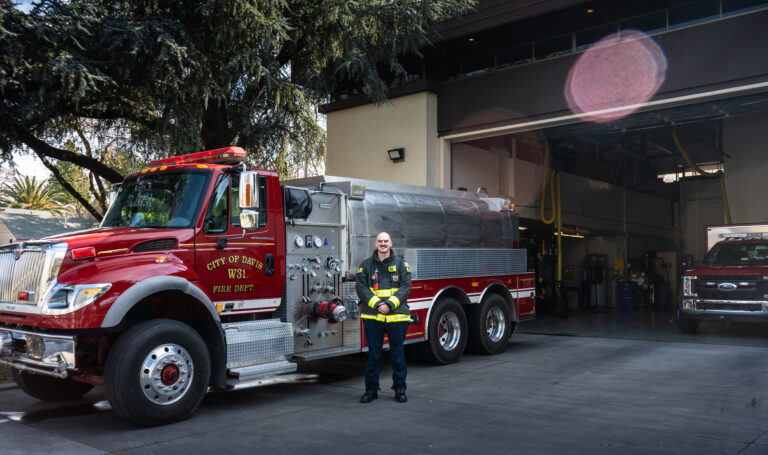
On the night of Wednesday, Jan. 8, four firefighters from the city of Davis Fire Department left for Southern California to provide mutual aid against the Los Angeles fires. Firefighters from the Woodland Fire Department, Winters Fire Department, Yocha Dehe Fire Department and the UC Davis Fire Department also mobilized in Southern California. At the time these engines departed, Los Angeles County was battling the major Palisades and Eaton Fires while smaller fires continued to ignite in new areas.

Strike teams formed among the Yolo County fire departments, which are groups of firefighters and engines that gather to rapidly respond to emergencies. The Davis Fire Department was then assigned to the Eaton Fire in Pasadena.

City of Davis Fire Chief Joe Tenney explained the responsibilities of the fire departments that volunteer to battle the fires.

“Mobilizing hundreds of fire engines in the state of California in short order is something most fire departments do, Davis Fire Department included,” Tenney said. “Of those hundreds of engines from counties and cities, the assignments greatly vary from working at the fire front, mopping up to prevent further spread or two miles in front of the fire anticipating the need to protect lives, homes and properties. Every day can be a different assignment by the incident commander.”

The Los Angeles Fire Department needed more equipment, tools and people to battle the size and power of the fires. Tenney emphasized the courage of those providing support for the needs of other fire departments on such short notice.

“Davis Fire Department and the Yolo County Strike Team of five engines with leaders were deployed to the Eaton Fire and fulfilled whatever the need was on any given day,” Tenney said. “The bravery comes from working as a complete team to fill the need. They risk their lives to safeguard others, turning courage into action and duty into service. All of California’s firefighters do this every day and are, frankly, some of the best in the world at mobilizing resources for large disasters and protecting our communities.”

The strike team from the Woodland Fire Department that traveled to help fight the Eaton Fire was deployed for nine days. They worked hand in hand with fellow Yolo County firefighters to protect people and property.

“We want to extend our deepest thanks to these brave men and women for their selflessness and professionalism, as well as to their families who supported them during this time,” the Woodland Fire Department said in an Instagram post. “Thank you, Strike Team 4275C, for representing our community with such courage and commitment.”

Strike Teams from the UC Davis and Yocha Dehe Fire Departments have almost entirely returned home. As of Jan. 24, UC Davis Fire Department Captain Steve Dunn has returned to campus from his work battling the Eaton Fire.

With the help of hundreds of fire departments from across the state, as well as from Canada and Mexico, the Eaton Fire is now over 99% contained and the Palisades Fire over 96% contained at the time of publication. Fighting the fires in Los Angeles has been a collective effort by both local and international fire departments, and Strike Team 4275C has made the Davis community proud.


Written by: Olivia Hokr — city@theaggie.org

The Doomsday Clock is not one that we can snooze

The clock serves as a reminder of the impacts of real-world issues — but it’s not too late  


By THE EDITORIAL BOARD 


As 2024 kicks off, we are already reminded of how we are living on borrowed time — metaphorically speaking. On Jan. 28, 2025, The Bulletin of the Atomic Scientists declared that the Doomsday Clock now reads 89 seconds to midnight, the closest it has read since its creation in 1947. The official announcement stated that even the shift of a single second should be taken as an unmistakable warning of the increased probability of global disaster. 

While the clock isn’t predicting a definite outcome, its metaphorical weight should serve as a wake-up call, urging people to continue seeking out information and leaders to reevaluate their choices with an ethical mindset. Now more than ever, it’s imperative that we understand the severity of the events we are currently facing and the lasting impact they will have on humanity — because there is always time to rewrite these wrongs. 

Upon its founding in 1945, The Bulletin’s main incentive with the creation of the Doomsday Clock was to educate the public on the consequences of nuclear weapons, with several of the Chicago-based scientists on the project also having worked on the world’s first atomic bomb. 

“We do not advise Americans that doomsday is near and that they can expect atomic bombs to start falling on their heads a month or year from now,” an article from The Bulletin, regarding the Soviet Union’s successful testing of its first atomic bomb in 1949, reads. “But we think they have reason to be deeply alarmed and to be prepared for grave decisions.” 

The clock was originally set at seven minutes to midnight because The Bulletin member and the clock’s designer, Martyl Langsdorf, claimed that it “looked good to his eye.” Now, the clock hands have been repositioned a total of 26 times, oscillating closer to and farther from midnight over the past several decades. The clock read 17 minutes to midnight in 1991, after the Cold War had ended and the Strategic Arms Reduction Treaty between the Soviet Union and the United States was signed. This was the farthest the clock had been to midnight, and now we are closer than ever before. 

The non-profit organization sets the clock annually, assessing three main factors: nuclear proliferation, climate change and disruptive technologies. With the rise of Artificial Intelligence (AI), the Russia-Ukraine war and the Israel-Palestine conflict, scientists have determined that the international order of nuclear actors and the lack of action taken toward climate change are the main signifiers of doomsday being a mere 89 seconds away. 

The recent events happening on a global scale have been nothing short of frightening, leaving anyone who has been keeping up with the news unsettled and unsure of what is to come. While the metric by which the elements of the Doomsday Clock are decided may be arbitrary, it still signifies real dangers across the globe. However, the clock’s countdown does not need to be a cause of unnecessary panic and can instead be used as motivation to power through times of uncertainty. The Editorial Board encourages you to stay informed and reflect on the impact that the decisions and events taking place will have on the future. Unlike the restrictions linear time bears, we still have the chance to rewind the Doomsday Clock. 


Written by: The Editorial Board

Donald Trump has taken a cruel stance on the loss of life in Gaza

The Editorial Board condemns the Trump Administration’s dangerous rhetoric on the Israel-Hamas ceasefire deal 

By THE EDITORIAL BOARD 


As the Trump presidency enters its second week, significant changes to domestic and international relations are well underway. Trump has signed executive order after executive order, confirmed new government positions and halted all United States foreign aid, with two exceptions.

On Jan. 15, 2025, a ceasefire in Gaza was announced, set to begin four days later on Jan. 19. The agreement is meant to constitute three stages: During the first, a complete ceasefire is meant to be held while Hamas releases 33 Israeli hostages in exchange for over 1,900 Palestinian prisoners, and displaced Palestinians will be allowed to return to their homes. Only a couple of weeks into this first stage, Israel and Hamas have both claimed that the other side has breached the ceasefire agreement, and tensions are continuing to heighten despite the deal. 

The second stage is meant to establish a permanent ceasefire: The remaining living hostages in Gaza will be exchanged for more Palestinian prisoners and Israeli forces are meant to make a complete withdrawal. Stage three will see the return of all remaining bodies of dead hostages and, eventually, the reconstruction of Gaza itself.

“Gaza is very interesting,” Trump said on Saturday, Jan. 25. “It’s a phenomenal location on the sea, it’s the best weather. You know, everything’s good. Some beautiful things could be done with it.”

This was only shortly after Trump referred to Gaza as a “demolition site” that should “be cleaned out” — a blatant suggestion to ethnically cleanse the region through mass displacement. Trump’s attitude toward Gaza and its rebuilding is incredibly dangerous; It is apparent that Trump views Gaza and the potential of what could be built there in the same way that he might view a potential new site for one of his golf courses. 

In addition, as of Jan. 27, Israel has violated the agreement by blocking displaced people from re-entering Northern Gaza, announcing that it had not received a list disclosing the status of the 33 hostages that Israel wanted returned during this first stage. That list has now been received, revealing that 25 of the 33 hostages remain alive. Communication between the two groups appears incredibly complicated, with both Israel and Hamas accusing the other of violating the terms of the current ceasefire agreement. 

This is an incredibly complicated and ongoing situation, during which it will be more important than ever to stay informed about both Trump’s plans and what is taking place during Israel and Hamas’ ongoing negotiations. 

Though the ceasefire has already been widely celebrated among Palestinians, it is important to remember that ceasefires have been violated throughout history, with Israel in particular having breached a ceasefire agreement that was proposed in Gaza during November of 2023. Netanyahu has also commented that Israel may not complete its full withdrawal from Lebanon by the deadline of its ceasefire with Hezbollah, which is this upcoming Sunday, Feb. 1, 2025. 

Despite the thousands of Israeli citizens having taken to the streets throughout the conflict, engaging in massive protests against Netanyahu and his actions toward the Palestinian people, the Israeli government disregarded these protests for peace. On Jan. 26, Israeli forces fired into crowds of Palestinians attempting to return home, wounding nine and killing two.

Trump has already displayed a callous and unfeeling attitude toward the ongoing conflict in Gaza, both regarding Israeli and Palestinian lives that have been impacted or lost. The casual delivery of how he believes the conflict should be solved, involving mass ethnic cleansing and Palestinian displacement, is incredibly disturbing. 

The Editorial Board condemns Trump’s rhetoric surrounding Palestine and the ceasefire deal, as well as his claims that the war has nothing to do with the United States — as the nation continues to provide billions in military funding to Israel. 

In addition, as of Jan. 28, all foreign aid from the United States has entered a 90-day freeze period, with the only exceptions being continued military aid to Israel and Egypt. The United States provides four out of every 10 dollars of humanitarian aid; This will prove catastrophic for countless individuals and programs if much of the aid is not resumed. Potentially afflicting other crucial world conflicts such as the Russia-Ukraine war, as Ukraine relies on the U.S. for security funding. 

Trump’s administration is claiming that this freeze is for foreign aid reassessment — in the meantime, however, aid and funding to thousands of programs has been completely halted. 

This ethos, and Trump’s willingness to speak of the situation with such carefree language, is characterized by a dangerous desire to ethnically cleanse entire populations and cannot be normalized. It is more important than ever to fight for marginalized populations as harmful rhetoric about “cleaning Gaza out” spreads. 

He has made a point to insist that “it’s not our war, it’s their war,” despite the U.S.’ ongoing financial involvement. This remark is also particularly interesting considering many United States politicians’ attitudes toward perpetuating the conflict. Past Republican presidential candidate and United Nations ambassador Nikki Haley even signed an artillery shell in Israel with the words “Finish Them” in May 2024, a sickeningly casual remark openly suggesting the remainder of the Palestinian population be wiped out. 

Currently, Trump and his administration have begun to suggest with a foundational lack of empathy that all Palestinians remaining in Gaza be relocated to surrounding nations, including Egypt and Jordan. 

“I said to him: ‘I’d love you to take on more because I’m looking at the whole Gaza Strip right now and it’s a mess, it’s a real mess.’ I’d like him to take people,” Trump said regarding a phone conversation with Jordan’s King Abdullah.

With the loss of so much life and culture, it is imperative not to lose sight of the ethnic cleansing that has been taking place in Palestine. Countless people have been impacted —  relocating people with no regard for their homes, the depth of their cultural ties and no answers as to when they might be able to return is unacceptable. While we acknowledge that this second Trump Administration is cultivating fear and unrest, it is important to continue paying attention to what is happening both across the globe and nationally. 


Written by: The Editorial Board 

What was the TikTok ban really about?

The recent, short-lived TikTok ban might have deeper implications than we think


By SABRINA FIGUEROA — sfigueroaavila@ucdavis.edu


In 2024, the government passed a bill that would ban TikTok in the United States if it was not sold to an American company by Jan. 19, 2025. While many did not believe that statement to be true, it eventually occurred — hours ahead of time. However, TikTok wasn’t gone for long: The ban was suddenly lifted after just 12 hours for many American users.

Many in the U.S. were confused as to why TikTok would go down for only a short period of time and why the app displayed a message thanking President Donald Trump — even though he was the one who originally wanted to ban the app back in 2020.

TikTok has been a powerful social media app that has managed to spotlight the ugly truths of the world, such as police brutality and discrimination. Not only this, but it has also allowed for millions around the world to organize, protest and learn things more efficiently. All of this made the app an immense check on power — a check that didn’t necessarily have to come from journalists. Perhaps this is why the government wanted to ban it in the first place.

However, in recent press releases, Trump has appeared to have changed his mind on the TikTok ban, though not because this action is unconstitutional (according to the First Amendment). Instead, he changed his mind after winning the 2024 presidential election with the help of popular right-wing TikTok influencers and streamers, which provided him a crucial increase in percentage of the younger vote.

That being said, there are deeper implications — an ulterior motive — behind his change of opinion and stance on the TikTok ban. TikTok has a largely younger audience, and “saving” it would pin him as a savior in their eyes. In the end, he’d get a bit more empathy and a little less resistance from a younger generation who despised him and vowed to continue to do so.

Nevertheless, a vow is simply not enough. There will be people in the U.S., especially among the younger generation, who will fall in line with the entire “TikTok Ban Plan” that Trump is currently leveraging to gain support. It is important to think critically about every piece of media we consume —  none of us are immune to propaganda.

To reiterate, the ban being lifted is a good thing, don’t get me wrong — U.S. residents will still have this outlet to get the word out about discrimination, events, protests and more. However, how well this outlet will work during Trump’s presidency seems to be unclear.

Trump now has presidential immunity, after a Supreme Court ruling in July 2024, and has proved he can exercise this significant power with the over 20 executive orders signed in his first days in office, many undoing years of social justice work by and for minorities. He also seems to have the tech industry wrapped around his finger, with Elon Musk, Mark Zuckerberg, Jeff Bezos, Shou Zi Chew and more in attendance at his inauguration. All of these factors can come together to help him inflict serious damage to U.S. society, including pushing censorship and propaganda on the social media apps we use.

This is certainly not the time to make jokes, nor is it the time to take things lightly. The TikTok fiasco of January 2025 is just the beginning of what may be in store for us, so it’s incredibly important to keep our eyes wide open. We are just as powerful as our leaders.


Written by: Sabrina Figueroa — sfigueroaavila@ucdavis.edu


Disclaimer: The views and opinions expressed by individual columnists belong to the columnists alone and do not necessarily indicate the views and opinions held by The California Aggie.


Following the ‘Queen of Wolves’

One of the oldest wolves ever recorded in Yellowstone, Wolf 907F, died after a conflict with a rival pack


By KATELYN BURNS— science@theaggie.org


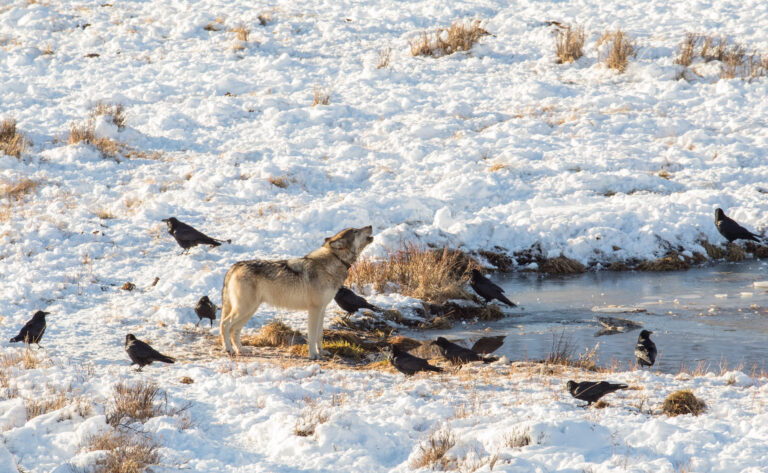
Wolf 907F, nicknamed the “Queen of Wolves,” died on Dec. 25, 2024 after fighting with a rival pack of wolves. Considered one of the oldest wolves ever recorded in Yellowstone National Park at over 11 years old, 907F was one of the oldest wolves to ever give birth, with her 10th litter being born in 2024.

Throughout her life, 907F regularly appeared in the Yellowstone Wolf Project Reports. First noted in the 2013 report as one of many wolves captured and handled, 907F was a pup from the Junction Butte pack.

Her first litter of pups, which she raised alongside her sister and fellow Junction Butte wolf, 969F, was documented in the 2016 report.

From May 2016 to May 2017, 907F was the alpha of the Junction Butte pack. That role switched to her sister 969F in 2017 and switched back to 907F in 2018, according to the 2017 report and 2018 report.

This was not the only occasion of 907F losing and regaining pack leadership. Due to the breeding nature of wolves, many will disperse and attempt to form their own packs, especially after a pack gets too large.

“Basically, each wolf wants to leave and start a pack of their own,” the 2020 report reads. “Some may find a dominant position in the pack they were born in (907F is a good example). While we anticipated the large Junction Butte pack might split during 2020, they mostly remained together and by the end of the year the pack was the third largest ever recorded in North America.”

That year, Junction Butte consisted of 35 wolves: 17 adults and 18 pups. While a split was anticipated, the larger pack size allowed Junction Butte to overpower other packs and hunt more bison, as opposed to elk.

However, this changed in February 2021 when a group of males split off to form the Rescue Creek pack, as noted in the 2021 report. Rescue Creek stabilized with 13 wolves — all adults. However, their territory overlapped with some of the largest packs in Yellowstone: Junction Butte, Wapiti Lake and 8 Mile. The Wapiti Lake and 8 Mile packs had 21 wolves each that year.

The Junction Butte pack was now significantly smaller, with 17 wolves — 11 adults and six pups. It was unique in its number of elders, 907F being the eldest in the pack at over eight years old.

“The pack [had] four wolves over the age of five,” the 2021 report reads. “An extremely rare situation, as only about one in every five wolves lives to reach five years old.”

The next year, Junction Butte had recovered from the split and grown to 25 wolves, 10 adults and 15 pups, once again surpassing the size of any of the other Yellowstone packs, according to the 2022 report.

However, in this past year’s 2023 report, Rescue Creek was heavily featured and the focus of bioacoustics data collection — it had grown to 15 wolves: eight adults and seven pups. Rescue Creek also surpassed Junction Butte, which had shrunk to 11 wolves: 10 adults and one pup.

On Dec. 22, 2024, Rescue Creek entered Junction Butte territory and attacked. While defending her pack, 907F sustained injuries. Three days later on Dec. 25, 2024, 907F succumbed to her injuries. 907F’s collar signaled her death after 12 hours of laying motionless.

Written by: Katelyn Burns— science@theaggie.org

Is the algorithm contagious?

You are what you like, share and subscribe to 


By Abhinaya Kasagani — akasagani@ucdavis.edu


It has, in all honesty, been 3,652 days since I have had an original thought. This would be perfectly permissible if my reasons for failing to be inventive happened to be a lingering byproduct of artist fatigue and not “the algorithm of taste,” yet the prevalence of this algorithm effectively curates our digital environments and influences our collective behaviors, forbidding us from following our own inclinations. In lesser words, the algorithm both captivates and holds captive.

American sociologist Henry Pratt Fairchild described culture as a set of codified patterns acquired through contagion. The social contagion — the phenomenon wherein ideas, behaviors and emotions spread within a society — has become increasingly mediated by algorithms, distorting how we behave and think. Their curatorial capacity effectively controls modern cultural processes, amplifying certain cultural narratives and suppressing others. 

The cognitive foundation of cultural contagion lies in the human mind’s propensity to adopt ideas that are repeated or reinforced. Since algorithms favor sensationalist and polarizing content, they operate with inherent biases, resulting in echo chambers wherein users are exposed predominantly to ideas and opinions that reinforce their preexisting beliefs. Sometimes, it is not divisive and controversial material that thrives within these algorithmic ecosystems but simply digestible media and short-form content. This not only sustains user engagement but simultaneously contributes to the rapid dissemination of ideas that discourage critical thinking and foster ideological homogeneity within groups. Everyone is cut from the same cloth.

Algorithms fracture human thought, homogenizing global culture. An entire generation of people is less inclined and more selective about being exposed to content with which they disagree. Disregarding objectionable content in favor of what one finds pleasurable, however, does a disservice to critical thought. Shortening attention spans have deprioritized in-depth narratives, causing a separation that exacerbates social tensions and limits opportunities for constructive dialogue and understanding. Following continuous exposure to curated content, as such, rewires cognitive processes, making individuals more reactive and less autonomous in their tastes and preferences. The data generated by user interactions is then monetized, further entrenching algorithmic influence. 

Sorry to be too gauche, but you are, in fact, your own tastemaker. Mutuality is one thing; the problem lies in blindly following. What is it that you truly like? Trends often emerge in niche communities before becoming mainstream phenomena. By inserting media into the broader cultural consciousness, the algorithm succeeds in diluting its uniqueness in favor of mass appeal. 

This claim about algorithms is paradoxical. While they reduce users to a binary of approval or dismissal, they encourage the development of these niche subcultures. This contributes to a “mob mentality” of sorts, both globally and locally, reinforcing collective behaviors at different levels. This dispatch of collective thought renders us passive consumers; all personhood is packaged and out for delivery.

There is nothing more aggravating to those who carefully and cautiously consume media than being eclipsed by someone who doesn’t know what they’re talking about or why. Sure, I slip in and out of these roles; my personalities are hats. But do not wear what is rightfully mine simply because your phone told you this is what you should be consuming. Find out what it is that you like. 

Kyle Chayka, in his book “Filterworld: How Algorithms Flattened Culture,discussed how this passivity of consumption has discredited masterpieces of art simply because they are not immediately engaging to the consumer. 

“We’ll never have the Fellini film that’s so challenging you think about it for the rest of your life or see the painting that’s so strange and discomforting that it really sticks with you,” the text reads. 

Algorithms also influence creators of culture, pushing them to distill their work into cheap iterations that align with algorithmic recommendations. This leaves us to engage with things that are not, in any way, challenging or provocative. Taste is no longer cultivated, only curated.

In essence, algorithms shape the cultural contagion by prioritizing specific types of content to augment collective behaviors. Algorithms, despite their pitfalls (and like anything in moderation), can amplify advocacy efforts, raise awareness of critical issues and work to mitigate some of the negative effects of their influence. 

When leveraged ethically, as tools that require careful wielding, they can promote the compassion and collaboration we aim to recover. Too much of anything dulls the edge of the sword. The real issue here is less about the dispersion of content itself and more about our collective inability to discern what we find enjoyable and important. When one consumes their content in a grid, they back themself into a corner.


Written by: Abhinaya Kasagani— akasagani@ucdavis.edu

Disclaimer: The views and opinions expressed by individual columnists belong to the columnists alone and do not necessarily indicate the views and opinions held by The California Aggie.

Mary L. Stephens Library holds Lunar New Year celebration for a packed house

The Davis community was over the moon for the celebration’s talented musicians, choreographed performers and Dragon Dancers 


By MATTHEW MCELDOWNEY — city@theaggie.org


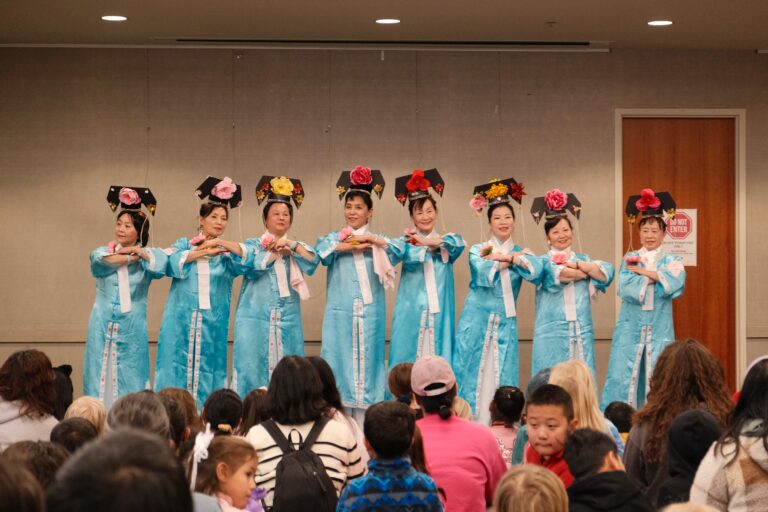
On Jan. 18, Mary L. Stephens Library hosted an array of craft workshops and Lunar New Year-themed performances for their early Year of the Snake celebration. Community members, including faculty from UC Davis, participated in and performed at this event.

This Lunar New Year celebration was packed with Davis families enthusiastic to share and participate in the dances, musical ensembles and crafts inherent to the diverse cultures that celebrate this holiday.

The event began with a musical performance of “Happy Chinese New Year,” “Clementine” and “Spring Carols” from a very young and gifted ensemble of violinists, cellists, flautists and harpists. Shortly after, the Mira Loma Chinese Club’s Performing Arts Team took stage as vibrant red and gold dragons and lions. True to this famous Lunar New Year tradition, they danced in rhythm and melodically banged their drums.

In addition, Mary L. Stephens Library invited choreographed dancers to perform a variety of traditional and modern Chinese dances. Modern Persian fusion dancers also performed more traditional folk dances, such as the Dai Peacock Dance.

Hualing Wan, a Yolo County catalog librarian who helped organize the event, emphasized the importance of expressing the diversity of the Lunar New Year.

“In the past, we have invited Davis High School students from the Korean Culture Club, [also] Vietnam and even Brunei,” Wan said.

Through inviting a diverse group of guest performers and representing a wide range of cultures in their Lunar New Year reading list, Wan hopes they can best capture the spirit of this holiday — a spirit that reflects the many different backgrounds and identities that celebrate it.

One such performer was Dr. Jiahui Wei, an associate professor of chemistry at UC Davis. In Wei’s performance, she played the guzheng, a type of plucked zither with an illustrious history in Chinese culture — an instrument that Wei has practiced for around 25 years. Wei has previously performed at similar events at the library, and she also makes other public appearances as recorded on her YouTube channel, 南南田田. In these performances, Wei describes the work that goes into playing a variety of instruments in her elaborate hanfu dress and preparing the traditional Chinese makeup prior to these performances.

While Wei only showcased her guzheng and pipa, a traditional Chinese plucked instrument, for the library that day, she has performed with up to six instruments in the past, sharing her diverse skill set as well as the enduring musical and artistic traditions she expresses to this day.

For Wei, whether it be to educate or enjoy, her passion for these Chinese traditions is an integral part of her identity. Wei explained that she incorporates this passion through a combination of artistic expression and teaching at UC Davis. For instance, she chooses color-coded modern hanfu to help students find corresponding online lectures more easily.

“It’s part of the reason I teach at UC Davis and even at community colleges,” Wei said. “I want to see [and meet] the people that I would have never had the chance to be around when I grew up in China.”

In this way, Wei’s passion for intercultural exchange goes hand in hand with her educational commitment to the community. It is this sense of community that lies at the very heart of this holiday.

“In most of China, it’s the time for all of your family to come back [together],” Wei said.

For Kacey Chan, a fourth-year history major, the significance of the Lunar New Year holiday celebration in Davis is dearly felt.

“In terms of Davis, it is really good because we are ultimately in the [United States], and the Chinese are a group of diaspora in the U.S.,” Chan said. “So, it is good to provide that space for them to celebrate and find other Chinese families, especially if they do not know anybody near them.”

This combination of cultural education and community is reinforced through the traditions preserved and passed down from generation to generation. Chan recalls the childhood memories of lion dancers going from apartment to apartment to throw vegetables for the families to collect. Wei is fond of coming with her friends to make handmade hairpins resembling flowers. At the Mary L. Stephens Library, families learned how to draw snakes, write calligraphy and paint lanterns.

“It is the same kind of [activity] as [eating and] doing dishes together,” Wei said. “A good thing about it is you can keep it forever, and after a certain amount of years, you and your friends can look back at the times [you] celebrated.”


Written by: Matthew Mceldowney — city@theaggie.org


‘Eat your heart out’: Why you should tune in to the newest season of ‘Yellowjackets’ this Valentine’s Day

Friendship, supernatural occurrences, the great outdoors, occasional cannibalism — what’s not to love? 


By SAVANNAH ANNO — arts@theaggie.org

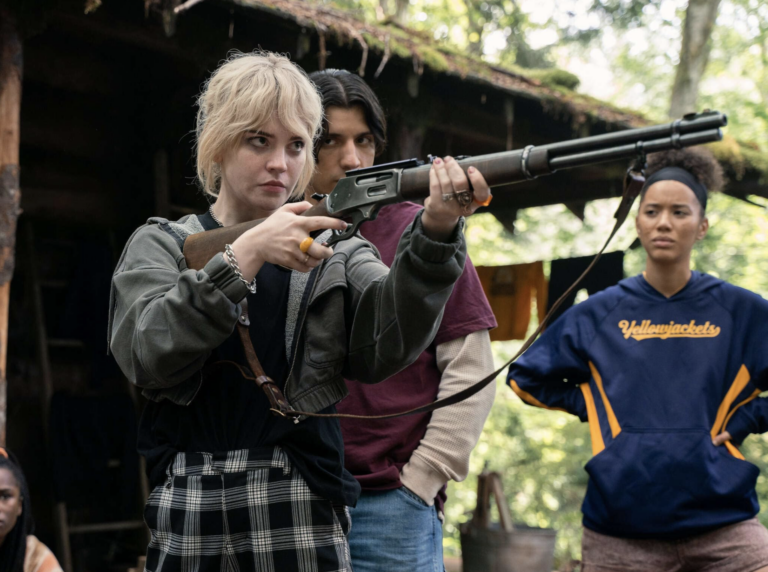
Everyone is a fan of the all-girl ensemble drama; Shows like “Big Little Lies” (2017), “The Wilds” (2020), “Pretty Little Liars” (2010) and beyond, are known for their jaw-dropping twists and unique depictions of female relationships. “Yellowjackets,” which premiered in 2021 via Showtime, is no stranger to embracing the flaws and complexities of its core cast. Bringing each character’s darkest instincts to the surface, the series has solidified itself as one of the most prominent thriller-dramas streaming today, holding a 97% rating on Rotten Tomatoes and 10 Emmy nominations.

With the premiere of season three just weeks away, prospective viewers have one last chance to catch up on the first 19 episodes. A small feat when you are immediately sucked into the mysterious nature of each character and plot line.

Imagine “Lord of the Flies” but with teenage girls; Then, imagine that instead of being set on a tropical island, they are lost in the middle of the Canadian Rockies; Then, imagine that you got to see the cast not only while they were stranded, but 25 years later as they try to live “normal” lives as adults.

With not one but two ensemble casts — one in their teens, one in their 30s — “Yellowjackets” is full of both legendary and upcoming actors. Big names like Christina Ricci from the iconic “The Addams Family” and Elijah Wood from “The Lord of the Rings” play a psycho but lovable couple in the show’s second season, while newer actresses like Sophie Turner and Ella Purnell can be found in recent religious horror movie “Heretic” and the highly acclaimed “Arcane” animated series.

Made up of over 10 main and supporting characters, some who survive to the second timeline and others who do not, “Yellowjackets” shines not only in its gory and oftentimes creepy visuals but also in its complex depictions of friendships. Undergoing the ultimate test, the young girls of the series experience the average teenage dramatics of jealousy and romance while they also fight over authority, food and even spirituality as they do everything it takes to survive what they come to call “the wilderness.”

Moving back and forth between the cast in 1996 as they struggle to adapt to the woods and in 2021 as the smaller cast of survivors tries their best to cope with the past, writers Ashley Lyle and Bart Nickerson make it clear that each of the character’s actions has consequences.

The 1996 timeline opens, of course, with a deep nostalgia for the decade. Teenage girls in New Jersey, high off of winning a spot in a national soccer tournament — hence “Yellowjackets,” their team name — are dancing in their locker room, dressing up for a party and arguing over a junior varsity player with no idea that they would be stranded the next morning after surviving a plane crash.

In the present-day timeline, viewers are unsure how many of them survived their 19 months in the wilderness or the extent of what occurred while they were there, though the opening scene of the series gives some idea. Images of the girls in the dead of winter, faces covered in handmade masks and wearing animal furs as they eat a very much human meal hint at their ultimate dissent from civilization.

If you are a fan of the psychological or the supernatural, “Yellowjackets” serves as the perfect blend of both. Are the characters hallucinating and engaging in horrific acts because they have been starving all winter or is there something with them in the wilderness, bringing about their animalistic behavior? Answer the age-old question of how far someone will go to survive by tuning in to the can’t-miss drama series.

Written by: Savannah Anno — arts@theaggie.org

UC Davis women’s basketball falls to strong UCSB performance in first home conference loss

After a dominant start to the season, a difficult second quarter left the Aggies struggling


By COLINA HARVEY — sports@theaggie.org


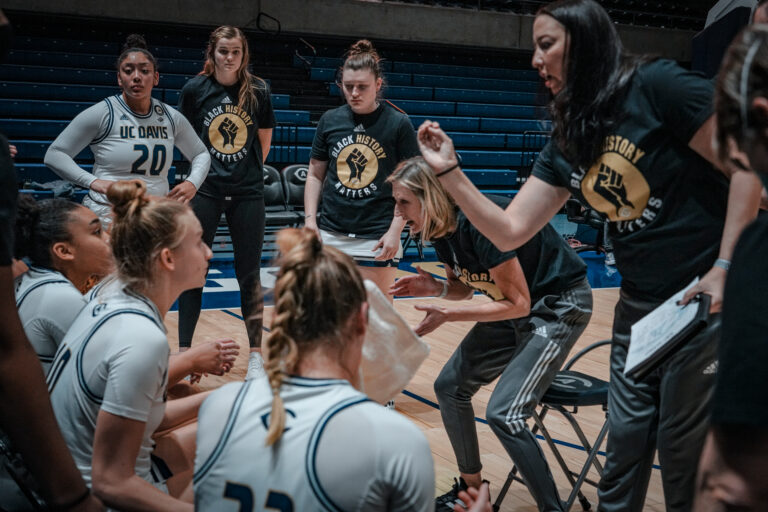
The UC Davis women’s basketball team took on the UC Santa Barbara Gauchos on Jan. 18 for yet another home game this season. The UC Davis Aggies have had a dominant season so far, ranked fourth in Big West standings and going 6-1 in their conference games. While they had gone 12-6 overall, only one of those losses was at a home game. 

The Gauchos, on the other hand, were only 3-3 in conference play and ranked sixth in Big West standings, making the Aggies the favorite going into the game. 

At the start of the game, UC Davis looked strong, showing home fans why they have been so successful during this season. They racked up five quick points with a layup from Mazatlan Harris, a fourth-year animal science major, and a three-pointer from Nya Epps, a third-year undeclared major. 

The Aggies, also strong on defense, only allowed the Gauchos to go 4-15 from the field in the quarter. An offensive rebound and layup from Harris brought the Aggie lead to double digits with only a few minutes left in the first quarter. While a Santa Barbara layup and a three-pointer in the last two minutes decreased the UC Davis lead, the Aggies had a comfortable six-point lead entering the second quarter.

However, as the second quarter began, the Gauchos quickly tied the game with two layups and a jumper in the first three minutes. At the same time, the Aggies were 0-3 from the field and committed two turnovers. 

A Gaucho two-pointer, with about seven minutes left in the quarter, marked the first lead change of the game, prompting an Aggie timeout. A UCSB layup and deep three-pointer and a UC Davis offensive foul brought their lead to seven, putting an end to the Aggies’ momentum. With four minutes left in the quarter, Megan Norris, a third-year political science major, was fouled, sending her to the line. Norris made the first of two free throws, marking the first points of the second quarter for the Aggies. 

The Gauchos’ lead reached double digits when a UC Davis foul sent UC Santa Barbara’s Alyssa Marin to the line. With less than a minute to go, Epps went for a two-pointer but was blocked by Santa Barbara’s Flora Goed. Increasing the UCSB lead, Zoe Borter hit a buzzer-beating three-pointer to end the half and bring the score to 32-19. 

The Aggies went the entire second quarter without making a single shot, despite 14 attempts — their only three points from free throws. Meanwhile, UC Santa Barbara put up 22 points in the quarter. Coming out of halftime, the Aggies needed to pick up their shooting and defense in order to mount a  comeback from a 13-point deficit. 

Unfortunately, the Aggies did not have a strong start to the third quarter, with five turnovers in the first four minutes. They were, however, fouled twice in those first four minutes, resulting in three points off of free throws.

About halfway through the third quarter, Harris ended the Aggies’ field goal drought by shooting a three-pointer. With about four minutes to go, the UC Davis defense called a 24-second violation for the Gauchos and then secured a layup on the other end of the court, building some momentum for UC Davis. 

The Aggies’ shooting did improve in the third quarter, as they were 50% from the field overall. UC Davis also capitalized on free throws to chip away at UC Santa Barbara’s lead, going 9-12 from the line, while the Gauchos did not make it to the line once. The Aggies managed to win the quarter 15-20 but still trailed by eight going into the fourth. 

Two quick Gaucho three-pointers in the fourth quarter put Davis in a 12-point deficit. Despite a relatively even fourth quarter, the Aggies could not generate enough momentum to surpass UCSB’s lead, and they lost the game 50-63. 

The lack of success in the second quarter created an unbeatable obstacle for the Aggies, resulting in their first home conference loss of the season. UCSB’s 38.5% three-point shooting accuracy average outperformed UC Davis’ 26.3%. The Aggies not only had a worse shooting percentage overall but were also unable to get as many shots off, shooting only 46 compared to the Gauchos’ 60. 

Up next, the UC Davis Aggies will travel to the University of Hawai’i to take on the Rainbow Warriors on Jan. 23 and then come home to play UC Riverside on Jan. 30, hoping to secure an at-home redemption win.

By (Colina Harvey) — sports@theaggie.org

Naomi Campbell returns to London for ‘NAOMI-In Fashion’ exhibition

The installation captures her meteoric rise and the golden era of supermodeling


BY BETH MUNRO-MORRIS — arts@theaggie.org


A museum renowned for its emphasis on art and culture, London’s Victoria and Albert Museum is celebrating supermodel Naomi Campbell with a groundbreaking honorary exhibition. Running from June 22 to April 6,  ‘NAOMI- In Fashion’ is an interactive experience that takes visitors on a journey through Campbell’s lifelong career, delving into the story behind her meteoric rise while showcasing some of her most iconic looks.

Gracing the pages of Elle and the front covers of Vogue was never part of Naomi’s plan.  Growing up, she dreamed of performing on stage rather than on a catwalk. Although she performed in music videos for artists including Bob Marley and Culture Club, she quickly transitioned into a global fashion icon after a model agent scouted her in London’s Covent Garden at the age of 15. She, and the rest of the world, would come to realize that this move shaped both her career and the industry as a whole.

Foundational to Naomi’s success was her background in dance, which photographers drew upon to direct poses that we see in her catwalk strut. While many models specialized in either print or runway, Campbell excelled in both, appearing in editorials, advertisements, clothing catalogs and, of course, on some of the world’s most prestigious catwalks.

Landing her first cover on Vogue at the age of 17, Naomi Campbell immediately captured the attention of distinguished fashion houses including Versace, Vivienne Westwood, and Yves Saint Laurent — proving to be among their most lucrative endorsements. Catapulted into the spotlight, she jetted between London, Paris, New York and Milan, quickly gaining international acclaim. Having conquered fashion’s “Big Four,” Campbell solidified her place in the pantheon of iconic ‘90s supermodels, alongside the likes of Cindy Crawford, Tatjana Patitz and Linda Evangelista.

Campbell is the face of one of fashion’s most unforgettable moments — a theatrical fall during the 1993 Vivienne Westwood show. As she navigated the Paris runway in 12-inch heels, Naomi tumbled to the floor. It was her poised recovery that captured the public’s attention; With a laugh, she rose to her feet and continued walking as though nothing had happened.

Another memorable moment for Campbell came at the Azzedine Alaïa Spring 1998 show, where she spontaneously broke into an unchoreographed, tap-inspired dance routine mid-catwalk. Naomi’s ability to infuse the runway with her playful personality helped define the 1990s supermodel era — fashion shows were not just about clothes but also the aura that models brought to the stage.

Campbell’s resilient reputation became a part of her larger legacy as a trailblazer for Black models in the fashion industry. Although successful in challenging Eurocentric ideals of beauty within the modeling industry, Naomi’s influence extended far beyond the fashion world. She became a global advocate for social justice, using her fame to challenge inequalities and empower marginalized communities.

In the late 1990s, Naomi earned the title of “honorary granddaughter” from Nelson Mandela, joining him in his efforts to improve the lives of South Africa’s youth. Raising substantial funds for the Nelson Mandela Children’s Fund, she participated in various charity galas, fundraising events and public initiatives related to education, healthcare and the fight against child poverty.

In addition to her philanthropic work, Campbell also leveraged her fame into entrepreneurship, launching her own perfume line. Her appearance in Michael Jackson’s “In the Closet” music video marked a full-circle moment as she reconnected with her roots in the entertainment world.

Under Naomi Campbell’s influence, fashion evolved into mass entertainment and supermodeling became a globally recognized industry. Despite decades of success, her reign is far from over. Naomi continues to model for top designers, showing that her influence on the fashion industry, now more enduring than ever, remains unparalleled.

Written by Beth Munro-Morris — arts@theaggie.org 

BOOM or DOOM: UC Davis edition

The Rizzler (me) has spoken


By ALLISON KELEHER — adkeleher@ucdavis.edu


UC Davis is a well-known institution with many bright students and faculty who support the advancement of higher education. With that being said, as a student of this university, I feel it is my duty to share with you the brain rot that is The Rizzler — a young boy on the Internet who rates items from Costco with the Costco Guys and gives them either a “BOOM” for “good” or a “DOOM” for “bad.” Now, I am essentially bringing the BOOMs and DOOMs to UC Davis.


  • The basement of Shields Library. DOOM.
  • LeShelle May. BOOM.
  • The egg salad sandwich in the vending machine in the Olson Hall basement. DOOM.
  • The Pantry. BOOM. BOOM. BOOM.
  • Slow walkers. DOOM.
  • Running into friends on campus. BOOM.
  • Muscular man on a bike, riding full speed into a girl on the sidewalk. DOOM.
  • People who noisily pack up to leave the lecture early. DOOM.
  • Electric scooters. DOOM.
  • Bugatti electric scooter. BOOM.
  • On-campus jobs that don’t hire you. DOOM.
  • LinkedIn influencers. DOOM.
  • Unitrans. BOOM. BOOM. BOOM. BOOM. BOOM.
  • Riding a bike in the cold without gloves on. DOOM.
  • The person I keep making awkward eye contact with in the library. DOOM.
  • Red Bull ambassadors. BOOM. BOOM. BOOM.
  • Scary pre-med students. DOOM.
  • Staying in the library until 10 p.m. on the first week of the quarter. DOOM.
  • My Peet’s Coffee order not looking like the right color after I just spent $7. DOOM.
  • Experiencing someone else’s Peet’s Coffee order all over my backpack after it just spilled three lecture rows behind me. DOOM.
  • Digging up a squirrel’s nut it just buried in front of them. BOOM.
  • Sitting on the second floor balcony of Wellman Hall as the sun sets. BOOM.
  • Eating a crepe from the Silo. BOOM. BOOM. BOOM.
  • Spokes french fries. DOOM.
  • Aggie Mental Health ambassadors approaching me on a bench and asking me if I’m okay just because I’m sitting alone. DOOM.
  • The Grove, Surge III, lecture hall. DOOM.
  • Making “Come as you are” jokes. BOOM.


In conclusion, UC Davis. BOOM.


Written by: Allison Keleher — adkeleher@ucdavis.edu


Disclaimer: (This article is humor and/or satire, and its content is purely fictional. The story and the names of “sources” are fictionalized.)

Commissioner, Davis Journal of Legal Studies editor call for creation of ASUCD body at Jan. 23 senate meeting

The student government also passed several spending bills for student events and programs


By VINCE BASADA — campus@theaggie.org


ASUCD Senate Pro Tempore Dhilena Wickramasinghe called the Jan. 23 senate meeting to order at 6:10 p.m. before reading the UC Davis Land Acknowledgement.

After elected-officer and ex-officio reports, the table opened itself to public comment.

Robi Castaneda, a third-year political science and music double major and member of the External Affairs Commission (EAC), presented to the senate ways to increase accessibility to legal resources for international students. He spoke on behalf of the EAC and the Davis Journal of Legal Studies (DJLS).

“In recent days, the United States has undergone a profound political transformation that has shaken the foundations of our government, questioned our values and tested our commitment to shared human dignity,” Castaneda said.

He highlighted that some 42% of the 2024 first-year class consists of international students, noting that this statistic leaves out other student groups affected by recent events.

“This alone does not account for the amount of students who do not classify as international but are still labeled as resident aliens,” Castaneda said. “Individuals waiting [for] visa appointments, interviews or the chance to work in this country.”

Castaneda continued by citing his own personal experience as a call to action.

“While it is easy to categorize these individuals to data, it is decidedly more difficult to comprehend the face behind every number and the story behind every percentage point,” Castaneda said. “I am one of those numbers. When I was three years old, I immigrated to this country from the Philippines with my parents with nothing but the clothes on our backs and the food in our suitcases. It would take 10 years before we earned our permanent residency in this country — we were denied three times.”

Castaneda also said that immigration resources should be better known to students who share similar backgrounds.

“Many students on campus, like myself, know the struggle to find adequate immigration resources,” Castaneda said. “While our community possesses a variety of resources on campus related to immigration, it is to our understanding that not enough people are truly aware of [them].”

On top of funding existing resources, Castaneda asked the senate to create a new body specifically for immigrant students.

“The existing pool of resources is so vast and disparate that students don’t even know where to start,” Castaneda said. “As such, we would like to have a bill that puts all legal resources for international students and immigrants under a single official body, the ASUCD Immigration and Rights Commission.”

Castaneda also said he hopes that this single unified body could better connect students to resources.

“The last thing a busy student should have to worry about amidst the flurry of midterms and exams is their ability to pursue an education and stay in this country,” Castaneda said.

Castaneda was joined by DJLS Editor Avery Redula, a third-year English major, who proposed possible collaborations with the International House, the King Hall Immigration Clinic and other existing legal resources.

Several members of the table, including Senators Asif Ahmed, Zack Dollins, Amrita Julka and External Affairs Commission Chair Henry Rosenbach, echoed support for the proposed body before public comment was over.

Afterwards, the senate heard a quarterly report from Picnic Day Unit Director Mina Sarmah, a fourth-year statistics major. Sarmah told the table of plans to sell Picnic Day merchandise at the bookstore and on campus, as well as her desire to balance an uptick in corporate event sponsors with local business representation.

After a short dinner break, the table passed the consent calendar. It included Senate Bill (SB) #34, which allocates $8,000 to the ASUCD Community Development Fund for internal grants for identity-based presidential councils for community events, and SB #35, allocating $575 for the ongoing ASUCD Study Jams project.

The senate also passed two separate bills, both presented as emergency legislation due to planning delays resulting from the Martin Luther King Jr. holiday weekend.

The first was SB #36, which allocates $1071.24 to Julka’s office to book a venue in the Student Community Center for the ASUCD Supporting Students event on Jan. 28. The bill passed 9-1-4, yes-no-abstain. The sole “no” vote was from Senator Mia Cohen, who had voted against a different spending bill for the event at the previous week’s meeting. At that time, Cohen cited concerns that language in the event’s description in the bill, notably the term “post-inauguration stress,” may alienate certain campus communities.

The senate also passed SB #37, allocating $116 to reserve the Quad for the ASUCD Quarterly Showcase on Feb. 28.

After a brief open forum, the meeting was adjourned at 7:05 p.m.


Written by: Vince Basadacampus@theaggie.org

UC Davis shines a little brighter on a cold Wednesday night

0

Campus Safety Lighting Walk offers a chance to share thoughts about lighting improvements on campus


By NOAH HARRIS — features@theaggie.org


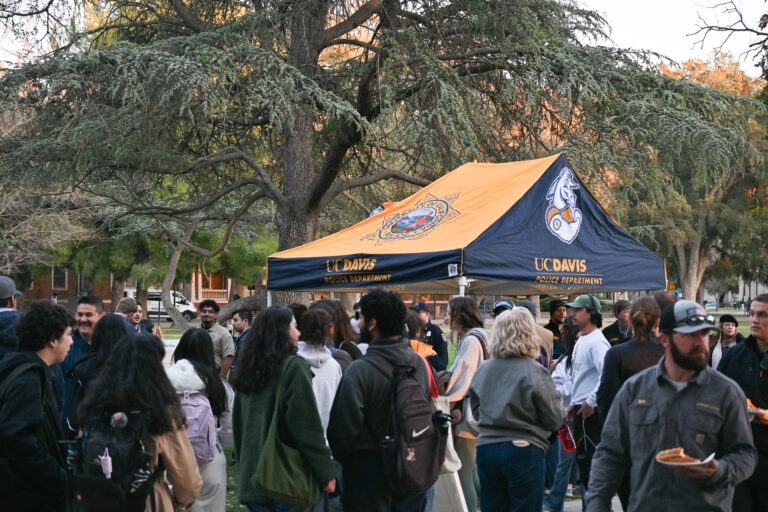
The annual UC Davis Campus Safety Lighting Walk gathered around 100 people this year, including many working for the University of California Police Department (UCPD) or the UC Davis Facilities Management Department. While it might not be the flashiest or biggest event on campus, the annual UC Davis lighting walk offers community members a chance to discuss lighting problems and potential improvements with those who hold the power to light up our campus.

Next to the Memorial Union (MU) flagpole, a small gathering began to assemble at 4:30 p.m. on Jan. 22. By 5 p.m., several dozen people were talking with friends and coworkers, eating free pizza and waiting to go on a two-hour walk.

Jeff Rott, UCPD’s director of security, spoke to reporters and student advocates alike before speaking in front of the entire group. Rott shared the community-driven goals of the lighting walk.

“We really want community members to come out: students, staff [and] faculty [to…] walk the campus with us, [to] see [the] campus through a different light, so to speak — no pun intended,” Rott said.

Clint Lord, the associate vice chancellor of the Facilities Management Department at UC Davis, expressed similar sentiments to Rott, describing that the walk is intended to promote and improve on-campus safety.

“We’re obviously looking to get the campus community involved, see what we’re trying to do to make them safer and identify those areas that we feel are risks for the students and the staff and the faculty,” Lord said. “We want to have the safest environment possible for everybody to come and enjoy.”

The lighting walk began with a few speeches from those involved with UCPD and the Facilities Management Department before attendees were split into nine different groups, each covering a large area of campus. On the roughly two-hour walk around their assigned areas, attendees were shown spaces that were going to become more well-lit and what areas had already been improved, as well as were told to report any lights that were damaged or out.

Rott walked around with a 10-person group during the lighting walk, answering questions about lighting and sharing the occasional story about his own time at UC Davis. Rott described many potential improvements, including plans to create a more well-lit pathway from the Housing Administration Building to downtown, with emergency call boxes visible the whole way to downtown to promote student safety, particularly during the weekends.

Part of the walk aimed to highlight improvements specifically around Kleiber Hall Drive. In addition, they pointed out new LED lights that are more energy efficient, reducing glare and light pollution.

Lord said that while the lighting walk is an important part of identifying issues with lighting on campus, it is not the only way that these problems are addressed.

“We [also] have crews that go around and check street lights and things like that on a regular kind of rotation,” Lord said.

Derek Benson, an employee on the exterior lighting team at Davis, explained the day-to-day process of checking up on lights.

“So when we come in, we do a morning drive,” Benson said. “Whichever lights are out, we generate our own work orders.”

Significant lighting changes are pending for the UC Davis community. In October 2023, UC Davis announced that they were putting $20 million toward improving security on campus. The first projects in 2024 and 2025 are focused on significant lighting improvements to the campus, among other things such as outdoor security cameras and emergency call boxes.

As of right now, there are seven areas scheduled to increase lighting that will be completed by the end of 2025. These lights will cover around one mile of pedestrian pathways.

“I’ve been trying to really pump this out a lot this year for students to recognize how significant it is that our facilities team, they genuinely take the feedback from these lighting walks, and it has a direct impact on what happens with lighting improvement[s] in the coming years,” Tim Jefferies, the advocate for student community and safety at UC Davis, said.

There are over 13,000 lights on campus, and according to Benson, just four people work on fixing any issues that arise, including himself. Despite the small number of employees, 94% of the issues that were raised during the January 2023 walk have since been addressed, according to the UC Davis Finance, Operations and Administration.

“We just take it one task at a time,” Benson said. “I mean, the work orders come in, we assign them and then we just take it one task at a time.”

Vrinda Vutukury, the chair of ASUCD’s Sexual Assault Awareness Advocacy Committee (SAAAC). Lighting has become an unexpected passion of hers, and she has become much more knowledgeable about it.

“I didn’t even enter the school year thinking I would care about lighting,” Vutukury said. “I never really thought about it that intensely to be completely honest.”

She first started focusing on lighting improvements after an instance of sexual assault that took place at Kleiber Hall in October 2023, which she said many thought was partially due to a lack of lighting.

After that, a friend who was doing a project about lighting reached out to her. Vutukury decided to contact someone in the administration who had the power to help spark change.

“I was like, I can definitely talk to some people and see if it is possible to increase lighting around the area,” Vutukury said. “So that [was] the spark to get in here because the [SAAAC] committee has been grappling [with] how to address that case from last year around that area. And then when this friend kind of talked about this idea, I was like, let me follow through with it. So I got in touch with the campus safety director. His name is Tim Jefferies.”

Jefferies is the first person to hold the advocate for student and community safety role at UC Davis.

“A big portion of my role is just helping reveal to different students and student communities what’s going on behind the scenes in terms of safety in a bunch of different places,” Jefferies said.

Often, he serves as a voice for students to help create change from the ground up.

“Instead of having administrators and people in roles like that tell students what safety is gonna be like on campus, my job tries to reverse that role,” Jefferies said. “I’m feeding student voices up to administrators in a bunch of different arenas of safety on campus.”

Jefferies has already worked with the city of Davis to create a lighting map, which has markers for street lights, bike lanes, pathway lights and pathways, helpful for planning a route for bikers and walkers, especially at night.

In Vutukury’s case, Jefferies had someone for her to talk to.

“He was like, ‘If you wanna get some sort of lighting placed around [Kleiber Hall], you would have to talk to Jeff Rott from the police department,’” Vutukury said. “So I met with Jeff Rott from the police department.”

A few weeks ago, Vutukury was able to go on an exclusive lighting walk, where Jefferies, Rott and others from the police and facilities departments showed her lighting on campus, including many places that lack adequate lighting.

“It wasn’t like a meeting where I walked out with the XYZ solution and they walked out with a plan,” Vutukury said. “It was more like they were telling me what they can do in their capacity and what they’re limited by.”

Part of their walk around campus involved Vutukury pitching an idea for temporary lighting, while the $20 million funding from the university is being used for more permanent lighting.

“Cornell University had this very interesting lighting project where students, in light of [an act of] sexual violence, just took fairy lights and wrapped [them] around a bunch of trees and lit up the area,” Vutukury said. “That got my gears rolling, and I’m like, we can do that in Davis — or we can at least entertain that possibility.”

She is still working with several people on a specific proposal for Rott, and is collaborating with several people to make it happen.

“Lighting doesn’t just impact us but everybody in all communities because it’s a public safety concern,” Vutukury said. “It pertains to all of us, and I’m happy to work on it a little bit on campus, and make it safer for the freshmen.”

For all lighting-based problems on campus, students and staff are encouraged to text (530)-574-4100. The Campus Safety Lighting Walk is an annual chance to make the campus safer. Changes might not take place immediately, but future students and staff will likely benefit from the work that Rott, Jefferies, Lord, Benson, Vutukury and many others at UC Davis are doing.


Written by: Noah Harris — features@theaggie.org

Davis Senior Center hosts a grand opening for its new patio space

The new patio includes a steel-framed pavilion, seating options and a heater


By RORY CONLON — city@theaggie.org


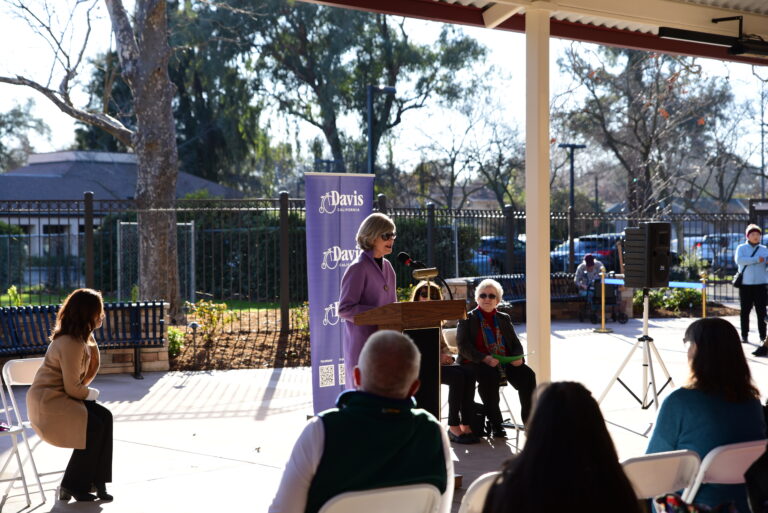
The Davis Senior Center hosted a grand opening ceremony for its new patio, which was funded by local non-profit and community donations, on Jan. 16. 

Deanne Machado, the director of parks and community services for the city of Davis, said the patio has been years in the making. 

“We first received design proposals back in 2016, and there have been many iterations to that design since that time,” Machado said. “We were absolutely thrilled to kick off construction of this project back in June of 2024, and it’s really incredible to see the vast amount of work that was accomplished in such a short time.” 

Machado pointed out several features included in the new patio. 

“It has created a versatile space for gathering in the community, with the concrete patio, the steel pavilion you’re sitting under, the seating areas all around and the heaters [for cold days],” Machado said. “We have catering counters in the back, and while the doors are closed right now, those can open up and provide for the seamless exit and entry into the indoor areas of the center.” 

City of Davis Vice Mayor Donna Neville highlighted the importance of creating community spaces. 

“It’s going to be a wonderful place for public gatherings and to develop a really great sense of community,” Neville said. “It’s really spaces like this that draw us together and enrich and deepen our sense of community, so I’m incredibly excited to see it happen.” 

Neville also reflected on how her late father, who was a member of the senior commission for the city of Davis, made efforts to get the patio constructed. 

“He became one of those people who was really involved in the early days of what would later become this project,” Neville said. “He passed away five years ago, but I know he would be amazed, because I know that the patio would far exceed what he had in mind when [the city] first started talking about how the money would be used. I’m just deeply thankful that it’s come to fruition.” 

The city of Davis, along with several local non-profits, including the George and Lena Valente Foundation, the now-defunct Senior Citizens of Davis (SCD) and the Sunset Rotary Club of Davis, funded construction of the patio. 

Lynn Volkerts runs the George and Lena Valente Foundation, which was founded by her parents in 1978 to provide community services throughout the Solano, Sonoma and Yolo counties. She thanked the staff of the senior center, as well as Maria Lucchesi, the city of Davis community services supervisor, and Lisa Miller, a member of the senior citizen commission, for their efforts. 

“Lisa [Miller] and Maria [Lucchesi] and the entire staff here have made this home for so many seniors, and I am so full of gratitude for their efforts,” Volkerts said. “Maria, Lisa, you’ve been in my heart since the first donation in 2000. The first time George [Valente] walked into the senior center was in 1999, and the first thing he wanted in place was a TV room for all the seniors because he was an avid TV watcher. CNBC — that was his focus, his life, his investment plan, and that’s what brought us to fruition here today.” 

Elaine Roberts Musser, the legal advisor for the former non-profit Senior Citizens of Davis, said her foundation played a key role in getting the patio built. 

“The reason you have a beautiful patio at the Davis Senior Center is because of the imagination and creativity of the non-profit Senior Citizens of Davis,” Musser said. “At a certain point, [President Margot Loschke] and I both wisely decided to disband SCD for good reason, but it was necessary to decide what to do with the remaining funds of the organization, which were considerable.” 

Loschke and Musser directed the funds toward the outdoor patio. She said that while they first envisioned a modest outdoor space for seniors, she now thinks it can serve many different purposes for the community. 

“Our hope is that this patio can be exploited for many uses, including outdoor tai chi classes, a speaker series we’re working on, intergenerational interactions between seniors and younger folk, perhaps even a wedding or two — who knows?” Musser said. “We hope this ushers in a new era in which the Davis Senior Center becomes more of a community center where any age is welcome to participate and enjoy what it has to offer.” 


Written By: Rory Conlon — city@theaggie.org