

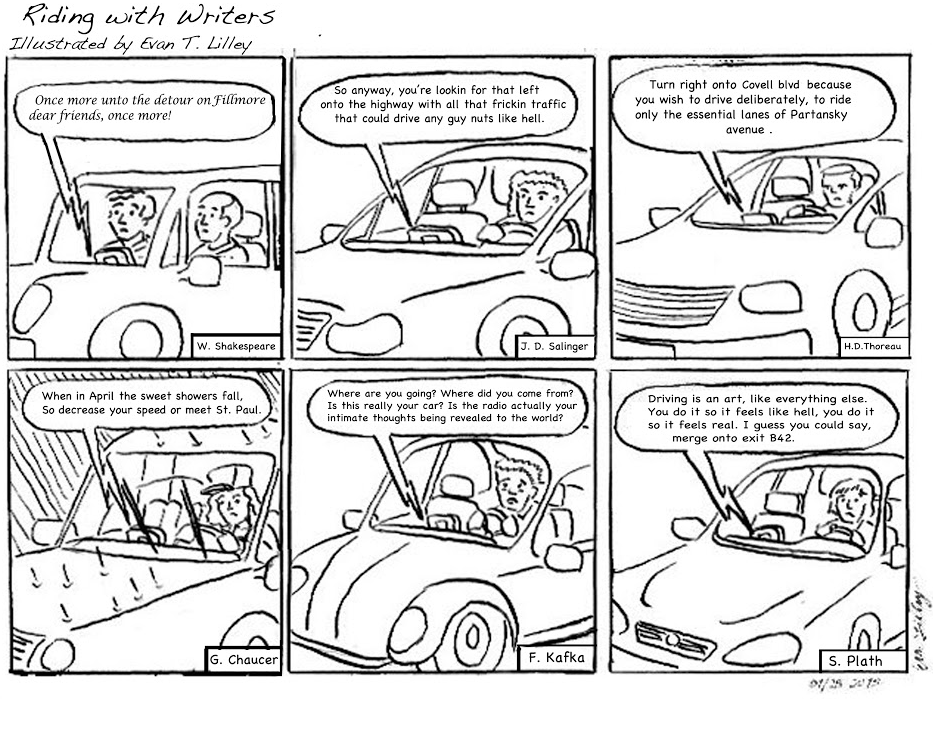
Evan Liley is a cartoonist for The California Aggie. You can contact him at magazine@theaggie.org.

Evan Liley is a cartoonist for The California Aggie. You can contact him at magazine@theaggie.org.


Evan Liley is a cartoonist for the California Aggie Newspaper. You can reach him at magazine@theaggie.org.

 Jan. 3 The Davis Enterprise released its first newspaper not printed in the Davis Enterprise pressroom located on Third and G Street. The official newspaper for the city of Davis is consolidating its press operations and will be printed at its sister newspaper, the Daily Republic, in Fairfield.
“We built this press in 1966 and it was on the edge of town, now we are in the middle of a vibrant downtown area,” said Davis Enterprise Publisher, Burt McNaughton.
According to McNaughton the printing of the first edition of the Enterprise to be printed in Fairfield went smoothly.
“My head pressman here is my head pressman down there,” McNaughton said.
The “head pressman,” or operations manager, Bill Erickson will be overseeing the production of the Enterprise in Fairfield, and is next in line to become the operations manager for all of McNaughton’s newspapers.
Davis Enterprise Editor-in-Chief, Debbie Davis, said that there were some glitches in the first week, but they were to be expected in a transition such as this one.
“We’re ironing them out quickly. Our customers are receiving their newspapers on time, and that’s what counts,” Davis said.
Although the printing of the newspaper changed, the content will uphold the standard that the Enterprise’s readership expects of it, according to Davis.
Davis said that this change enables the Enterprise to save money and streamline its operations, which will help solidify its financial well-being.
The publisher of the Daily Republic in Fairfield, Foy McNaughton, said that the transition has gone well.
“The challenge is now, we have two crews when we used to have one, a day crew and a night crew,” McNaughton said.
McNaughton said that consolidating the Enterprise’s printing operations was a plan that had been in place for years, and only now was it finally coming to fruition.
“It is a lot more efficient as it is a bigger press in Fairfield,” McNaughton said.
According to McNaughton, the Enterprise was one of the last newspapers to have its own press operation.
“A lot [of newspapers] have been outsourcing their press rooms,” he said.
A factor in the decision to move the printing operations was the 302 G Street location being such a prime piece of property.
The plan, according to Burt McNaughton, is to renovate the 5,000 square foot space.
The current plan is for FIT House, a fitness studio to take residence in 302 G Street. The Enterprise’s main offices at 315 G Street will remain open.
“It’s a big move, it’s the right move, it’s better for the Davis Enterprise,” McNaughton said.
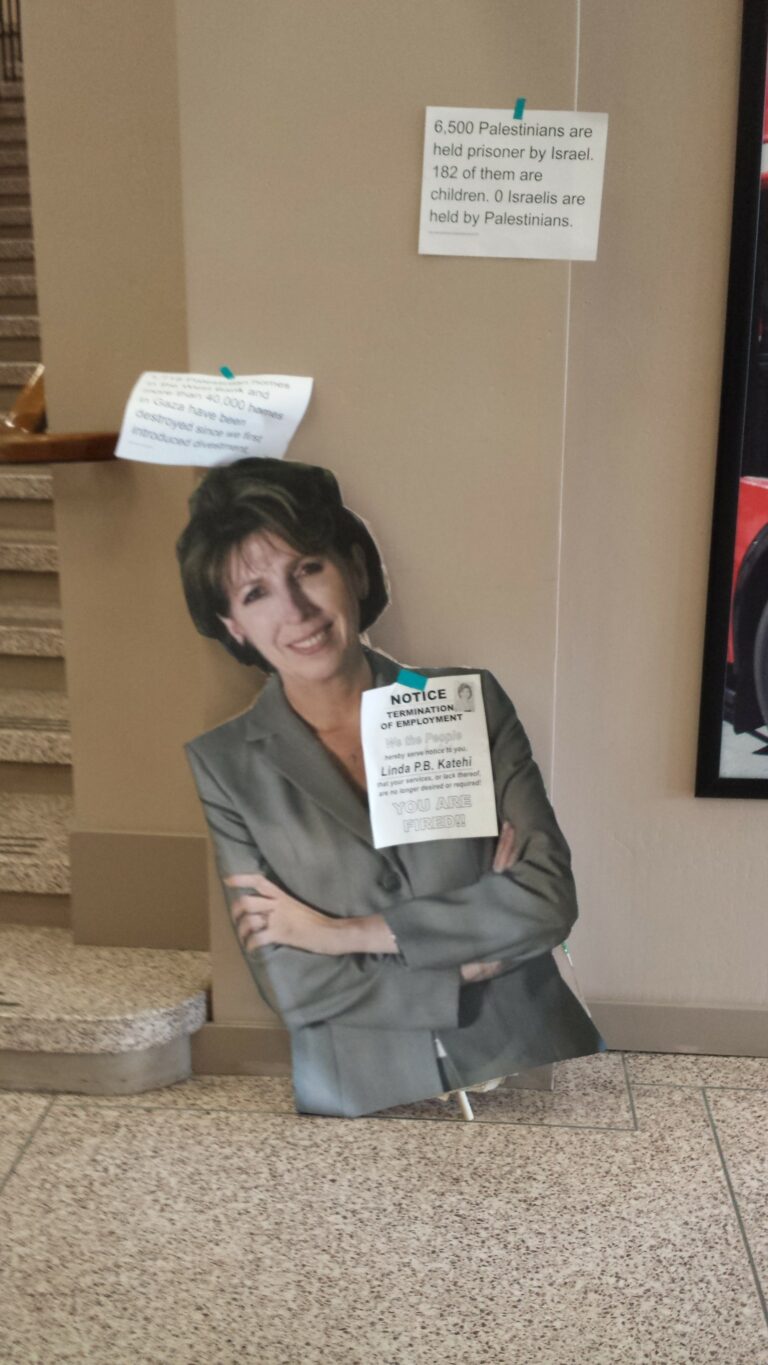

After noticing that Chancellor Linda P.B. Katehi did not hold her usual office hours, protesters marched from the Memorial Union to Mrak Hall today at 1 p.m.
The protesters say their objective was to speak with Katehi regarding her emails she has sent to the students since ASUCD Senate Resolution No. 9 passed on Jan. 29.
Tory Brykalski, second-year anthropology Ph.D. student and UC-Student-Workers Union 2856 head stuart, spoke at the protest and said that Katehi has stifled the voices of student activism on campus.
Protesters addressed a number of points as to why they are calling for Katehi to leave her post, including issues of accountability, austerity, divestment, Israel, privatization and violence, and racism.
The protest included a large cut out picture of Katehi, a Palestinian flag and flyers that covered Mrak.
One of the flyers stated: “NOTICE TERMINATION OF EMPLOYMENT We the People hereby serve notice to you, Linda P.B. Katehi that your services, or lack thereof are no longer desired or required! YOU ARE FIRED!!”
Brykalski also stated that the anti-tuition hike movement will be making a comeback soon and will be coupled with their movement against Katehi.
Photo by Alissa Reyes

On Jan. 29, ASUCD Senate Resolution No. 9 passed with an 8-2-2 vote. The resolution calls for the University of California Board of Regents to divest from “corporations that aid in the Israeli occupation of Palestine and illegal settlements in Palestinian territories.” ASUCD voted down a similar resolution this past May and in 2013.
Following the vote at the Jan. 29 meeting, ASUCD senator Azka Fayyaz, elected in Winter 2014, posted a picture on her personal Facebook page which stated, “Hamas & Shariah law have taken over UC Davis. Brb crying over the resilience.”
Hamas is a Palestinian Islamic group designated by the U.S. Department of State, and multiple other nations, as a terrorist organization.
Fayyaz’s post was met with harsh criticism. As a result of of public backlash, Fayyaz uploaded the same photo again on Jan. 29 with a different caption stating, “If a movement is not controversial, if no one is mad, it’s not strong enough & it’s not worth the fight. Israel will fall Insha’Allah : ) #UCDDivest.” She has since disabled her Facebook account.
In a public statement released Feb. 2 and published Feb. 3, Fayyaz stated that the reference in the first photo was a satirical caption. At the end of the statement, she extended an apology to her own community members for any difficulties she put them through and asked them to “stand with [her] during this time.”
“Although I made a comment on the picture stating that the caption was satirical, the anti-divestment community conveniently left out the comment from the rest of the picture and took the caption out of context,” Fayyaz said in the public statement.
While it is understandable — and even encouraged — for a political figure and an ASUCD senator to express her excitement over a bill she supports passing, the Editorial Board believes it is inappropriate and insensitive to make a post on a public area that marginalizes and offends certain groups. Although the posts were published on her personal Facebook profile, Facebook posts are a grey area, as ASUCD senators historically use Facebook politically to promote their campaigns, publicize events and release public statements.
When ASUCD officials are sworn in, they agree to certain policies. One is the ASUCD Principles of Community, which state that members of ASUCD “strive to make decisions in an open and inclusive manner that respects, nurtures and reflects understanding of the needs and interests of all community members.”
We believe Fayyaz has failed to uphold the ASUCD Principles of Community with her public statement and Facebook posts. These posts did not reflect the needs of a broad range of student groups and community members on our campus.
In addition to these online statements, Fayyaz has spoken publicly in a manner that we feel does not align with the Principles of Community. At the Jan. 29 meeting after senate conducted a roll call vote to see where senators stood on the issue of passing the resolution, Fayyaz made an extreme statement about the definition of Zionism.
“You can’t have coexistence with Zionists. Their purpose of Zionism is discrimination, elimination and ethnic cleansing of a group of people,” Fayyaz said at the meeting. “So if you want to talk about coexistence, I’m not talking with you because you’re going to try to kill me. I’m Muslim.”
Furthermore, a public statement is an opportunity to empathize and connect with her constituents, and we feel her letter did not do so. In the case a senator has differing viewpoints and disagrees with some of his or her constituents, according to the Principles of Community, he or she has an obligation as a member of our elected body to “recognize that our actions and decisions have consequences that impact each other.”
“I have a choice to release this statement — just like those of you who are connecting me to anti-Semitic sentiments and maliciously attacking me are making a choice. I’m choosing to communicate with you my truth because I want to make a lasting and positive difference in this world,” Fayyaz wrote.
We feel that Fayyaz’s public statement was insensitive not only for its absence of remorse to the general community but also for its incendiary nature in this sensitive time. The campus community would benefit from its leaders showing cooperation and positive communication over this indisputably-divisive and polarizing issue.
Although there are typically opportunities for the public to speak at senate meetings on Thursdays, ASUCD president Armando Figueroa announced in an email that senate would be cancelled this past week to “pause and reflect before [beginning] a process of renewed dialog in ASUCD on all issues.”
According the the ASUCD website Fayyaz typically holds office hours in the Student Community Center and senate office weekly. We encourage members of the UC Davis student body who are affected by this situation to be peaceful and respectful when expressing their opinions, and to share their concerns in a respectful way so there can be an open, effective conversation between students and Fayyaz.
We urge students to approach Fayyaz in a manner that abides by the UC Davis Principles of Community. Senator Fayyaz has stated that she felt threatened multiple times by several members of the community, which is equally unacceptable. No student should ever feel threatened or unsafe on this campus
We hope that Fayyaz can remedy her wrongs, as it is not becoming of an elected official to not offer an apology that empathizes more with the students she hurt and represents.
2/10/15 edited for clarity
Graphic by Jennifer Wu
If you’re looking for a way to de-stress, watching the UC Davis gymnastics team compete might just do the job. With energizing pop music, unending backflips and contagious smiles, these Aggies have crowds dancing in their seats week after week.
But despite high spirits and the heavy crowd support present at the Pavilion on Feb. 9, the women of UC Davis gymnastics fell short of their attempts to defeat 26th nationally ranked, George Washington University. The Aggies finished at 194.250 overall, trailing the Colonials who totaled 195.725.
The team saw three falls on beam, but recovered with soaring individual performances on vault, bars and floor. A 9.9 score executed by junior Katy Nogaki on vault was the highest of the scores the Aggies posted on Sunday. Nogaki took second place on vault, coming behind Colonial Cami Drouin-Allaire who posted a 9.925.
Junior Dani Judal posted scores of 9.825 or higher in all of her participated events. A 9.825 on bars and a score of 9.850 on both vault and beam, Judal was at her personal best this season, knocking season highs set at the Norcal Classic and at Utah State.
“I felt really good going into the meet. I made sure I stayed calm and confident,” said Judal. “I just went out there and did the best that I could.”
Judal’s secret for consistent performance is simple.
“I actually just take my iPod and block everything out. I’ll get in my little bubble and listen to hard core rap, or calming music like Ed Sheeran.”
Junior Stephanie Stamates posted the highest score for the Aggies on floor, tying with Colonial Chelsea Raineri at 9.875. Senior Kala DeFrancesco followed Stamates on floor with a close 9.850 for an overall third place in the event.
“Today was a little disappointing with three falls on beam,” said head coach John Lavallee, following the meet. “That’s not really going to get us to the top 36 qualifying regionals [as] we would like. But we’re very talented, and I’m sure we’re going to recover, and be just fine for next week.”
“We’ve got six meets left and we’ve got some work to do, but we’re certainly capable of climbing the ranks, and hopefully getting within the top 36,” said coach Lavalle.
The team returns to action at home on Feb. 13, facing off against 61st ranked Seattle Pacific University. Action begins at 7 p.m.
Men’s Basketball (18-4):
UC Davis @ UC Irvine (W, 75-56)
UC Davis @ CSU Northridge (W, 68-55)
After 20 games of relying on senior guard Corey Hawkins to drag the offense to wins, the Aggies proved that they could do it without their star. Hawkins sat out for the two-game road trip and UC Davis came home with two straight double-digit victories. Against UC Irvine, who had tied them for a conference lead, senior guard Tyler Les and senior forward Josh Ritchart rode hot shooting nights to 18 and 22 points respectively, missing only two of their combined 16 shots.
While their competition against CSU Northridge was closer than the score implies, the Aggies were once again able to close out a game successfully. Ritchart once again led the Aggies, this time with 21 points, while Les finished with 14. Head coach Jim Les nabbed the 200th victory of his career, a milestone he was happy to reach with this winning group.
Men’s Golf:
Amer Ari Invitational (13th place)
The Aggies opened up their spring season with a trip to Hawai’i, finishing No. 13 in a field that featured the nation’s top-ranked player and a number of high-ranked teams. As a team, UC Davis saw scores get worse over each of the three days, falling from No. 10 to No. 13 on the final day.
Junior Luke Vivolo was spectacular, finishing eighth overall individually. He shot three-under for the first two days before finishing with a five-under 67 on the final day. No other Aggie finished in the top 40 individually.
Indoor Track and Field
New Mexico Classic
The Aggies traveled to New Mexico and made an immediate impact, setting a school record and personal bests along the way. Senior Ashley Marshall was remarkable, setting the school record for the 200-meter dash on the first day. She also broke the school record in the 60-meter the next day, falling just short.
Senior Cekarri Smith set career highs in the 200- and 60-meter, moving into the top five all-time at UC Davis. Several other Aggies were able to set personal bests. The Aggies will compete several times over the next month.
Women’s Basketball (11-10):
UC Davis vs. CSU Northridge (W, 73-67)
UC Davis vs. UC Irvine (W, 79-69)
Two victories from the two home games as the Aggies defeated consecutive Big West foes. UC Davis beat the CSUN Matadors thanks to hot shooting from beyond the arc by senior forward Sydnee Fipps. The forward finished just one three-pointer shy of the school record. Senior Kelsey Harris added 15 points and six rebounds.
An unlikely hero ruled the day against UC Irvine as freshman guard Rachel Nagel scored a career and game-high 15 points. She was one of five Aggies in double figures for points, allowing the team to finish their homestand over .500. UC Davis will play at home on Feb. 19 after a quick trip to CSU Fullerton.
Gymnastics:
UC Davis vs. George Washington (2nd, 194.250)
After four straight meets away from home, the Aggies returned to UC Davis to face off against George Washington. Several Aggies finished strongly, including sophomore Katy Nogaki, who tied a school record with 9.900 on the vault. UC Davis shared the lead in three of the events, but did not place in the top three in the all-around.
The Aggies will once again compete on campus on Friday, against Seattle Pacific, and will see three of their next five matches at home.
Softball (1-4):
UNLV Sportco Kick-off Classic (1-4)
In the first tournament of the season, the Aggies fell to four out of five opponents. UC Davis started the first inning of the year off poorly, allowing Louisville to score four runs before adding two more in the fourth inning. The team fell 4-6. Against UNLV, the Aggies flipped the script and held their opponents to one run in the first three innings before allowing 11 in the last three. The first day of the tournament ended with two losses.
The second day was similarly disheartening as the Aggies dropped two straight. The team was shut-out against Washington, nabbing only three hits. Against Minnesota, the defense once again struggled and allowed 15 runs, including seven in one inning.
The team got their lone win of the weekend against CSU Bakersfield despite being outhit three to 10. The game was tied at two apiece before the Aggies were able to drive in three runs in the final inning. The team will now move on to the Fresno State Kick-Off on Friday.
Women’s Water Polo (4-6):
Triton Invitational (2-2)
UC Davis women’s water polo headed down to San Diego to face three top-15 teams. On the first day, the team played No. 11 CSU Northridge, falling in a close 8-10 game. Sophomore Bryn Lutz led the team with three goals. Against No. 9 Loyola Marymount, the Aggies scored a dominant victory after holding their opponent to just one goal that came in the first quarter.
The second day of the tournament saw similar ups and down as the Aggies finished 1-1. UC Davis fell by one goal to No. 14 Michigan, scoring no goals in the last quarter. Perhaps as vengeance, UC Davis defeated their only unranked opponent, Santa Clara University, by double digits. Two Aggies had hat-tricks while only two Broncos players scored.
The Aggies return home for the Davis Challenge that will take place on Friday and Saturday.
Graphic by CA Aggie Graphic Team
On my tour of Third Space, an art warehouse and performance venue on 946 Olive Drive, the echo of my footsteps and voice as I was introduced to members of this independent art collective – Sally Hensel, Evan Clayburg, Dylan Wright, Denise Dempsey and Chandler Lavin – made me realize how much open, usable space there was in the building. Originally constructed as an auto shop, the collective’s repurposing of the facility allowed for the creation of a spacious industrial gallery and performance venue. One corner, with the couches and chairs where the interview was conducted, was stationed next to a fairly sizeable collection of worn vinyl records and cassettes. The walls were adorned with visual art, ranging from a collection of images that visualized musical tones, to a vividly colored painting of a woman with piercing blue eyes by founding member Clayburg.
Walking past the gallery, the offices had been turned into private work studios. The garage, which at one point housed old cars, has been replaced with the scents of oil and acrylic paints, as well as wood for projects such as sculpture or set design for the theatrical black box housed in the middle of the building. Paintbrushes brimmed from containers and screen-printing machines sat impatiently waiting to be used. Any artist who comes to Third Space is provided with potential inspiration and access to the tools to mold their creations, and that’s exactly what the collective envisioned.
“It can be expensive to be an artist,” said Dempsey, a member of the collective since March 2014. “And that’s something we’re trying to address for the people who don’t [have access to supplies and space]. [Lack of access to supplies] can keep them from [creating the art they envisioned].”
Clayburg, a founding member of the collective, said he felt Third Space was an important part of enabling local artists to create original masterpieces.
“[A benefit to giving access to supplies and working space] opens up room to experiment,” said Clayburg. “You’re willing to try something new without [thinking]. I’ve spent $500 on supplies and I had to book my show at a gallery two years in advance [so I have to do something more conventional to recoup costs].
We’ve tried to lower the bar on the entry point to experiment.”
Third Space, the Davis-based independent art collective, was conceptualized in 2013 when founding member Sally Hensel wanted a location where she could host “House Shows” – concerts and exhibitions by mostly independent bands – and avoid noise complaints from neighbors. While looking for locations, the idea evolved into establishing a collective of artists and finding a location that could support not only musicians, but artists using a wide range of mediums. Not having an official name, the collective was inspired by the third space theory. The theory, coined by critical theorist Homi K. Bhabba, proposes that there is a third sphere of social congregation in addition to home and work that allows for expression of self.
“[The theoretical Third Space] is a low-cost, public, low-risk [space], as opposed to work or school [where there are repercussions for failures],” Hensel said. “You can play or experiment.”
Third Space has been able to provide a space for artists of all backgrounds working in all mediums. Through a monthly membership of $50, artists are provided with donated supplies and a space to work or perform.
“[With membership] you get a key to [the building], locker storage and you can book concerts [and other events],” Wright said.
While membership – and its benefits – can be gained for a fee, Wright also mentioned that Third Space provides discounted fees for aspiring artists who are willing to volunteer.
“You can volunteer a lot and pay less,” Wright said. “If you’re time-rich and cash-poor you can still be [a member and have access to Third Space]. Some people are a part of the space and don’t pay anything, just because they’re working.”
Through the combination of volunteers and paid members, as well as regional artist booking, there has been a variety of events at Third Space. As of February 2015, the events at the multipurpose building have included (but are not limited to): band practices and performances, poetry readings, storytelling night, theater art, leather working, yoga and performance art.
In addition to independent artists from the Davis community and surrounding areas, the UC Davis art scene has also embraced – and been embraced by – Third Space, with organizations such as the Art-Science Fusion seminar and Feminist Film Festival hosting events/exhibitions in the gallery area. The collective has also taken on UC Davis undergraduates as interns.
To conclude the interview, I asked the members to share their individual vision of Third Space, both the repurposed automotive shop and the collective:
Dempsey: More community art shows. Now that we have [expanded to the front room], we have more art on the walls, so [community art shows] are on our lists.
Wright: I would like to see it become self-sustaining so that no one has to pay [a fee to be a member]. We’ve reached a threshold as a nonprofit [organization] that we can start applying for grants.… It’s valuable for artists to have rented art space, and for members to be able to drop in and be a part of [workshops and classes with a small donation]. As far as keeping the lights on, I would like for that to be helped by benefactors with resources to support us. I want [Third Space] to be recognized as a destination in the Central Valley.
Hensel: I would love to come to a show and ask, “Who booked this? I don’t recognize any of the faces of people working the door, working the PA, or booking the bands.” To have a totally fresh new wave of energy come into the space would be cool.
Clayburg: It would be awesome to own our building. Whether or not it’s this one or another space, the long-term goal would be to own our building. [We also want to be more] proactive with hosting monthly art shows.
Lavin: Out of [Third Space], we’ll grow other collectives and community organizations that will come from what people learned here. We’re the newest baby now, but eventually we’re going to be a part of [a lineage of organizations], passing on our skill and art [and] making people excited to be able to do their own thing.
As a literal encapsulation of the collective’s “artists-helping-artists” ethos, following my interview and tour of the space, they were helping move chairs in preparation for the other member’s workshop.
For more information on Third Space, including how to get involved or donate, as well as future events, visit their website or their Facebook page.
Photo by Rashad Hurst
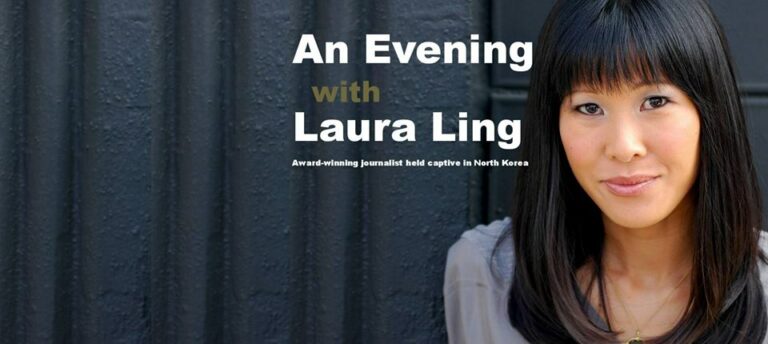
Nearly six years after her captivity under North Korean government in 2009, award-winning journalist and Sacramento native Laura Ling is set to speak at Davis Senior High School (DHS) on Feb. 21 as part of the event, An Evening with Laura Ling: Journey of Hope.
Ling, who plans on discussing her experience in captivity and issues relating to human rights, will follow her speaking with a signing of her New York Times bestselling book Somewhere Inside: One Sister’s Captivity in North Korea and the Other’s Fight to Bring Her Home, which she co-wrote with her sister and fellow journalist Lisa Ling. MUSE got a chance to speak with Ling this past week.
MUSE: For those who may not be familiar with your experience in North Korea in 2009, can you just talk a little bit about what happened?
Ling: I was there working on a story about the trafficking of North Koreans, specifically women who are being trafficked or smuggled out of the desperate conditions in North Korea. What I found was that many of these women end up in a different kind of situation that is quite dire. Some are placed in the prostitution industry, others are forced into marriages. I was working on the trafficking of North Korean women and that was when, while we were filming along the Chinese/North Korean border, I was apprehended by North Korean soldiers along with my colleague Euna Lee. We were taken into North Korea and held there for nearly 5 months. It was the most frightening time of my life. I was trapped in what’s considered the most isolated country in the world with no communication with my family. Just living with the constant fear of not knowing what was going to happen and if I would ever see my family again. It was very stressful; very scary, but it was also, I guess a test of my own strength. I found ways to maintain hope in different strengths within myself that I didn’t know existed.
MUSE: How do you think that this experience shaped you both as a journalist and as a human being?
Ling: It really has changed everything in my life. In terms of my personal life, it’s the relationships with my family and my friends that I value even more. The fact that I have two kids now, I consider it a blessing and a miracle. I cherish every second that I have with my family. Professionally, I do believe that stories like this and other stories about humanitarian issues and crises that are happening around the world really need to be told. But having said that, with two small children now and given what happened to me, I am a little bit more hesitant to go out there overseas and do that kind of reporting. It’s been a conflict for me because as passionate as I am about reporting on these very critical issues, I do approach things with a lot more caution.
MUSE: Your event is titled “Journey of Hope.” I’m wondering how did you come up with that title and how does it relate to the message you want to convey?
Ling: It’s called “Journey of Hope” because not only in my experience was I able to maintain hope, but I’ve found that in these stories that I’ve covered around the world, whether it be women’s rights in the middle east or monks protesting for greater freedom in Myanmar, in some of those darkest situations, there are glimmers of hope and signs of humanity. I have been able to see those rays of hope in my reporting and was able to feel that personally. So I hope to share some of those stories with the audience in Davis and hopefully compel them to maintain hope and to value the freedom that so many of us take for granted.
MUSE: At the speaking, you’ll be signing copies of your book Somewhere Inside, which you co-wrote with your sister Lisa Ling. Can you talk a little bit about that process?
Ling: The decision to write the book was not an easy one because I wasn’t sure if I really wanted to share my story, but it was a very therapeutic and cathartic experience to write that book and to write it with my sister who is my best friend. The book is about not only the story I was working on, my time in captivity, but also about the diplomatic efforts to get us home and the geopolitical situations at the time. And that’s why I wanted to write about it with my sister because she was able to tell that other side of the story. Everything that was happening when I was held in captivity. It’s also a book about sisters and sisterhood and the power of sisterhood. It’s a very special experience to write that.
MUSE: I understand that you were raised in Carmichael in Sacramento County, which isn’t too far from Davis. I’m wondering if it’s special to speak at an event that is so close to your hometown.
Ling: While I was in captivity, there were several vigils that were held for us. And the very first vigil was one that was held at my high school. I can’t tell you how touched I was to know that people who I grew up with in my hometown and teachers and friends and total strangers from Sacramento had come out to lend their support and to help get our story out there. I often thought about those vigils and the vigils were one of the things that allowed me to maintain hope. So being able to speak in the Sacramento-Davis area is very special. It means a lot to me to be so close to home and be able to thank people who came out to that vigil.
MUSE: This event is at a high school and Davis is a college town, so I’m wondering what message do you want to get across to students and young people?
Ling: A lot of the things that I try to impress upon young people is to get outside of your comfort zone and if you get a chance – travel. I know that my experience of reporting and traveling around the world has changed me and shaped me as a person. I think it’s easy for us as young people to take our freedoms for granted and I really hope that we can all cherish our freedom and look at our liberties not just as a right, but also as a responsibility. What can we really do with our freedom to create a meaningful impact around the world or in our own backyard?
“Journey of Hope” will begin at 5 p.m. on Feb. 21 at DHS’ Brunelle Performing Arts Center. The event is free, however, donations are welcome to fund the Davis High School Symphony.
Photo by Courtesy

As I waited for 15 minutes past our set meeting time, I thought to myself, “The Queen is never late, everybody else is simply early.” This quote from the Princess Diaries sequel seemed more than applicable today since I was about to interview a drag queen. However, in his own words he is, “a drag princess or baby Beyoncé in training.”
Jim De Ocampo, a third-year communication and linguistics double-major, performs in feminine dress to entertain others and raise funds to benefit national organizations, such as The Trevor Project. The Trevor Project has been providing crisis intervention and suicide prevention services to LGTBQIA youth since 1998.
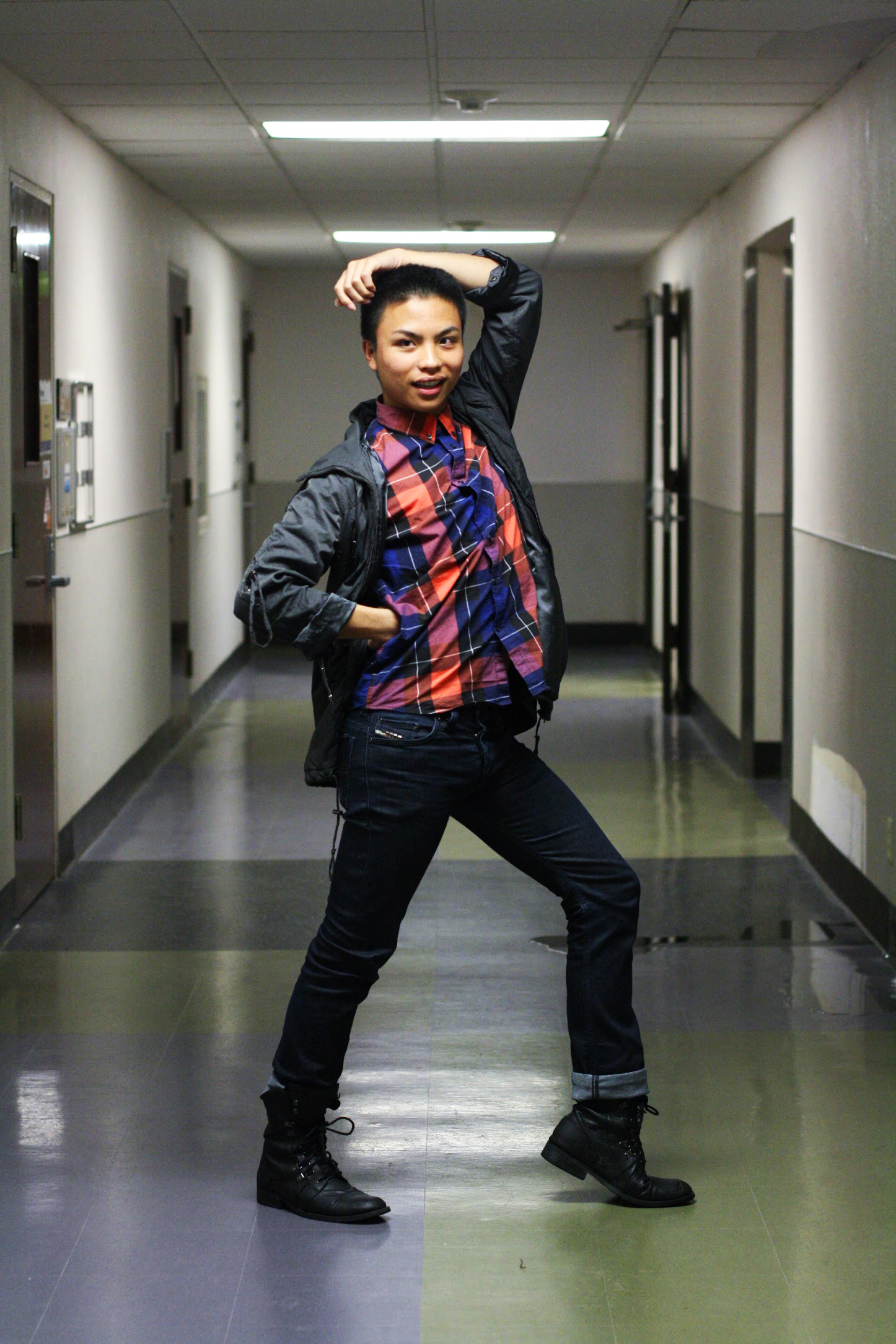
“I may not be the best person to give advice, but I want to make sure that this organization is up and running to provide these services for LGTBQ teens,” De Ocampo said.
De Ocampo has dressed in drag “eight good times” during the last three years of his career, including this year’s sold-out Davis is Burning annual drag show on Jan. 10.
The 25th annual Davis is Burning drag show and competition was organized and performed by members of Davis’ Delta Lambda Phi fraternity for gay, bisexual and progressive men.
“My Big Brother, Lucas, introduced me to drag and reminds me how much potential I have. It’s the best feeling, and I’m very happy to share four years of my life with these strong and diverse individuals,” De Ocampo said.
In addition to competing alongside his fraternity brothers in the Davis is Burning show, De Ocampo was booked to perform for a professional-level show at Faces, a popular gay nightclub in Sacramento, as soon as he turned 21 years old.
De Ocampo performs as Heidi Audacity, who De Ocampo describes as “graceful but also aggressive” on stage.
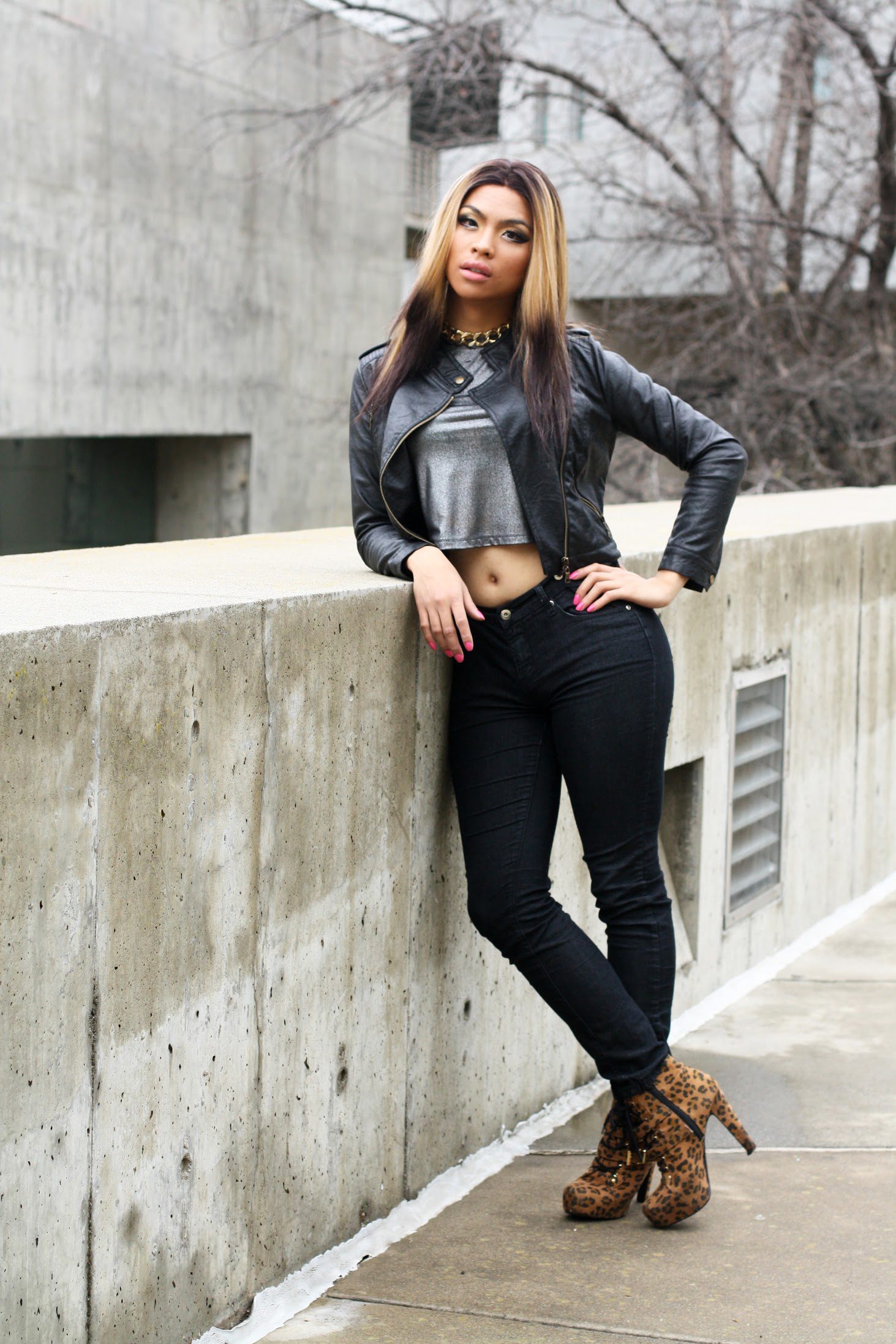
“One moment I’ll be doing ballet and Vogue hand movements, and the other I’m doing hip hop,” De Ocampo said. “Heidi likes to sing. She’s very verbal. Very outspoken. Audacity,” De Ocampo said.
Women’s clothing, makeup and wigs allow him to explore a “multitude of looks and performances.” This gender-bending avenue of self-expression is a fun and fierce form of storytelling, art and entertainment.
Aggie Style Watch would like to thank Jim De Ocampo for taking the time for interviews and photo shoots that help show others just how powerful clothing can be as a tool to transform yourself and showcase whoever you are.
Graphic by CA Aggie Graphic Team
Photos by Julia Kinkela
When you think of storytime, you might think of your parents reading aloud to you before tucking you in for bed. Perhaps the story was accompanied by a glass of warm milk to help you sleep. Stories on Stage in Davis takes the concept of storytime and adds an adult flair to it, replacing that glass of milk with a glass of wine and replacing picture books with stories by acclaimed authors.
Modelled on the successful Stories on Stage in Sacramento series, Stories on Stage in Davis hopes to celebrate the remarkable acting and writing talent in Davis and its surrounding communities. Each performance, which takes place the second Saturday of each month, features two performances, one piece written by an established author and another written by an emerging author.
This month’s Stories on Stage performance, which will take place on Feb. 14 at 7:30 pm at the Pence Gallery, features a talented set of performers and authors.
Patricia Glass, who has most recently performed as Annie Sullivan in The Miracle Worker at the Woodland Opera House, will be reading “Wanderlust” by Laleh Khadivi.
Khadivi, whose debut novel, The Age of Orphans, won the Whiting Award in Fiction, says she is most excited “to see how the story sounds in someone else’s voice.”
“All writing was once storytelling or song, [and] gathering in a room to hear a story is an old, important act that brings worlds to life,” Khadivi said.
Glass agreed that reading stories aloud is an important way to learn about other cultures and experiences. She said that reading this piece helped her experience a side of the world that she would otherwise never have been exposed to.
“You learn to feel what other people are feeling [to see] how different everyone is and still how similar we are on the inside,” Glass said. “I am excited about sharing people’s experiences that are so vastly different than anything we could ever imagine. It’s great to have these types of performances so people can connect with one another.”
Glass prepared extensively for her performance of “Wanderlust,” which is about the collective experience of Russian mail-order brides.
“Because it’s from the perspective of several girls who live in Russia I thought it would be most effective to try to use a Russian accent,” Glass said. “There are a lot of Russian proper nouns and I wanted to be sure I pronounced them correctly, so I consulted with one of the Russian professors here at Davis.”
Kathryn Williams, who taught English at UC Davis, will have her piece, “Three, Four, Knock at the Door,” performed by Phillip Larrea. Larrea, a longtime actor and a writer himself, plans to bring Williams’ piece to life by attempting to channel a Cuban accent. However, he, like Glass, stressed the importance of doing an accent properly and not letting an accent dominate his performance.
“What you try to do is find key words rather than doing 100 percent of an accent; you find more of a rhythm and you give the touches without being a caricature,” Larrea said.
Larrea sees Stories on Stage as a way to connect with the community.
“There is a wonderful feeling if you’ve brought a piece to life,” Larrea said. “And you have that sense of community [when] everybody is really focused on this piece, and it’s a terrific feeling.”
It is this sense of camaraderie that has made Stories on Stage in Davis so popular. Larrea, who has previously performed for the series in 2013, greatly enjoys the positive atmosphere that people bring to the Pence Gallery every second Saturday.
“It’s just a wonderful event,” Larrea said. “And performing gives me a chance to be in the audience for the other reading and to enjoy the cookies,” he said, laughing.
We are, after all, never too old to enjoy some cookies and a good story.
To find out more about Stories on Stage, visit their website. The next Stories on Stage performance will take place on Feb. 14 at 7:30 p.m. at the Pence Gallery. Doors open at 7 p.m. and admission is $5.
Graphic by Stories on Stage
ASUCD Senator Azka Fayyaz’s “Letter to the community” (Feb. 3), purportedly explaining an anti-Israel comment she posted on her Facebook account, is itself offensive, as it trivializes anti-Jewish hate and brutality.
Ms. Fayyaz recently voted in favor of an anti-Israel resolution. The resolution unfairly blamed Israel for the impasse in peace efforts, ignoring the fact that Israel has repeatedly offered the Palestinians a state on virtually all of the territory in dispute, only to see the Palestinians respond with rejection and terrorism. Following the vote, Ms. Fayyaz posted a picture of supporters waving Palestinian flags on her Facebook account and boasted: “Israel will fall. insha’Allah.” and “Hamas & Shariah law have taken over UC Davis.”
Ms. Fayyaz’s letter to the community does not address her statement that “Israel will fall,” which appears to call for the destruction or annihilation of the world’s only predominantly Jewish state. However, she “explains” that her apparent endorsement of Hamas was merely “satirical.” Even if that is true, however, it merely compounds the offense.
Hamas is a terrorist group whose charter calls for the murder of all Jews everywhere. It also expressly calls for Israel to be “eliminated.” Toward that end, Hamas has carried out dozens of terror bombings that have deliberately targeted and killed Israeli children in homes, schools, buses, discos, malls and pizzerias. Hamas terrorists have also shot Israeli babies in their strollers, lynched and physically torn apart Israelis and then showed off their blood-soaked hands to cheering crowds, burned pregnant Israeli women alive, and fired rockets at homes and schools in Israel while hiding behind Palestinian civilians in Gaza. Hamas’ victims include Marla Bennett, a UC Berkeley graduate and peace advocate who was killed in the Hamas bombing of an Israeli university cafeteria.
Endorsing Hamas in jest, as Ms. Fayyaz now claims to have done, trivializes the group’s extreme anti-Semitic hate and incomprehensible brutality. To put this into perspective, imagine that ASUCD had just passed a resolution attacking African-Americans, and then Ms. Fayyaz posted a comment purportedly celebrating the KKK taking over the campus. Even if she later claimed the comment was merely “satirical,” no one would find it funny, nor would anyone think it was any less ignorant or hateful. The same is true of Ms. Fayyaz’s explanation of her Hamas comment.
As Dr. Martin Luther King, Jr., famously observed: “When people criticize Zionists they mean Jews, you are talking anti-Semitism.” These attacks on Israel are fundamentally expressions of hate, pure and simple. They were going on when I was a student at UC Davis more than 20 years ago, and they continue today. It is time for the UC Davis administration, and all students and faculty with the courage to do what is right, to condemn anti-Semitic hate.
Graphic by Jennifer Wu

 Dinner and a movie: the classic beginnings of a budding romance. Even to those who often date, the pairing of these two harmless activities provokes stress, embarrassment and an obsession over your own bad breath. Sitting in a dark room with leftover popcorn on the ground can be quite romantic, believe me, and nothing is more attractive than the smell of your own nervous sweat underneath the jacket you’re too embarrassed to take off. Bringing a date to the movies can be an awkward experience, but unfortunately for most high school and college students, it’s one of the only things we can afford.
This awkward encounter can seriously hurt our movie experience. We are so invested in ourselves that we can miss an entire movie while fidgeting with the ends of our sleeves, only pretending to be focused on the screen in case our partners look over at us. The real question here is this: Why do we put ourselves in a position where we neither enjoy a film nor a person’s company when the point was to enjoy both at the same time?
Let me take you to a time many years ago: a time where Katherine Heigl was still a relevant actress and the United Artists movie theater in Elk Grove was unnaturally empty. The movie was One for the Money (2012) (and not worth the money), the date had asked me to prom the week before, and the only snack I snuck in was a bottle of water. At this time in my life I was part of a community service group where I would review movies every week, and I had asked my prom date to come with me to watch a foolish protagonist run around in some sort of crime-romantic-comedy. My date sat to my left while I wrote notes using my right armrest, and we, together, did not laugh at Heigl’s antics.
The best part of this night was that until halfway through the movie, I had no idea that this could be a date. Until I felt the nervous tension in my partner’s shoulders from a full foot away, I was just writing another review for a movie I did not volunteer to watch. It’s not that I minded the idea of dating this person, but before that moment, I was completely calm and natural, with no other thought in my head except the one that forced me to pay attention to the movie for the sake of my review. Never before had I wanted to walk out of a movie so badly.
This was a turning point, where my movie experience was changed completely by the potential date I was on. From then on, I awaited the arm-across-the-shoulders move, hand touching, or any other sign that a junior in high school might expect. As my partner stared straight at the screen, I even angled my shoulders slightly, to show my obvious interest. Apparently, the best that I could do was not good enough. The movie ended uneventfully, my review was complete, and we went out to the car. Then, finally, my date put an arm around my shoulder. It was one of the most romantic moments of my life.
Only going on half of a dictionary-defined date has definitely improved my movie experiences, but not enjoying a film is sometimes necessary. Especially at a young age, going to the movies can definitely help a pair become more comfortable with each other. But it is true that when your mind wanders due to a bad storyline, your thoughts only go to the two seats your party occupies. A date at the movies is a distraction, but it’s a necessary step in a potential relationship. If you overthink it, going to the movies is just two awkward people sitting next to each other and looking away, but the truth is that this experience releases all the tension, nervousness, and inability to speak coherent words, and puts a movie in front of you to distract everyone involved. This experience is a blessing. Without the option of going to the movies, a date might actually consist of talking and getting to know one another, which is outrageous to expect out of two 16-year-olds. So enjoy your dates, prevent the inevitable, and take the two-hour journey away from reality. It’s a part of life. Just please don’t see One for the Money.
How did your date go this weekend? Did you look at them even once? Let me know on Twitter (@edefaz10) or by email (endefazio@ucdavis.edu)
Graphic by Tiffany Choi
Photo by CA Aggie Photo Team

 How can humans as a whole help the stride toward the greater goal of an ultimate sustainable future? Is there a common philosophy behind the goals of the sustainability movement?
Cradle to Cradle is an informational novel written by William McDonough and Michael Braungart. It is an extremely influential book within the field of green engineering. I feel that the book is highly optimistic with respect to energy and waste reduction and the concept of sustainability in general. Cradle to Cradle proposes certain systems that I believe are impossible to engineer and design; however, the overarching themes of this book do propose stimulating and innovative sustainable concepts. With that being said, what is the purpose of this book? What should engineers, designers, architects and the everyday person take out of this book?
The green engineering industry uses Cradle to Cradle as their bible. It provides an umbrella of positive thought with respect to the fields of green engineering and sustainability.
One key point McDonough and Braungart make in their book is the notion of understanding and optimizing all the elements within a material’s life cycle. The traditional route for designing, packaging, transporting, distributing, using and eventually disposing of products and their materials is outdated and environmentally ineffective.
Another key point proposed in Cradle to Cradle is the notion of energy flows. Each man-made system has inputs and outputs; the idea here is to harness those inputs and outputs in an effective and sustainable fashion. The main proposition here is that we as engineers and designers can intertwine and connect these input and output flows to create an interconnected system of cyclical, reusable energy. This idea of cyclic sustainable energy can be maximized when we design certain products specifically to be part of this entire system. Specific inputs of one system should feed energy into another system (this is merely the concept of “cradle-to-cradle” design).
The challenge we need to solve is how to connect as many systems as possible, with the ultimate goal being entire systems that regulate themselves. Reaching this goal will limit the waste of unused energy and allow us to introduce a cyclic, potentially unending grid of reusable energy. One potential solution would be to design all types of food packaging to biodegrade into a plant aggregate. This sounds far-fetched, but the purpose of Cradle to Cradle is to introduce this type of global, interconnected form of thought.
The third key point McDonough and Braungart make is the idea that we should be modeling our engineering designs after natural systems. Current biology shows that the pre-industrial Earth was a fully sustainable, self-sufficient system (humans included). Post-industrial Earth, however, is suffering ecologically and environmentally due to unintelligent engineering which does not work in the ways natural systems do. Natural systems do produce byproducts, but these byproducts are actively used in the system of interest or other natural systems. This stresses the importance of optimizing a material’s life cycle. Such optimization is extremely important as it implies that all the waste of a certain system will be minimized or used elsewhere. That is what is so beautiful about biological systems, the fact that virtually nothing is waste and there are no negative byproducts. Therefore, by modeling our engineering designs after natural systems, we can guarantee that we are as efficient and resourceful as Mother Nature has intended. The key point stressed in Cradle to Cradle is equity among all living things.
With these three key points in mind, all humans can help the overall progress of reducing energy and waste usage — key goals of the sustainability movement. Although the specifics that Cradle to Cradle proposes can be very hard to design, I believe that the overall concepts proposed within this book are highly optimistic and introduce an interesting green engineering philosophy for all readers.
Graphic by Tiffany Choi
Photo by CA Aggie Photo Team
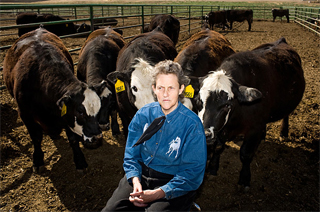 With esteemed professor, best-selling author and well-known autistic activist Temple Grandin coming to the Mondavi Center on Feb. 10, UC Davis is hoping to shed some light on the lives of individuals in the community who identify with the autism spectrum.
“[Autistic students and autism research] is important for a lot of reasons,” said David Amaral, a UC Davis psychiatry professor and research director at the Medical Investigation of Neurodevelopmental Disorders (MIND) Institute. “Many of the students are actually some of the smartest students at a university setting. They have the skills that will allow them to be very creative, particularly in areas such as engineering or mathematics, and it’s the community’s responsibility to try and find settings where they can feel fulfilled [and] use their skills but also not jeopardize their emotional life.”
According to the Autism Speaks website, autism spectrum disorder (ASD) is a general term for a group of complex brain development disorders, specifically causing difficulty in social interaction and communication as well as repetitive behaviors.
UC Davis’ MIND institute conducts groundbreaking research with regards to autism spectrum disorders, fragile X syndrome and other neurodevelopmental disorders. Amaral has been a part of the institute since its start in 1998, and has been instrumental in many projects, particularly the Autism Phenome Project.
“The Autism Phenome Project is trying to gather information on a large number of kids who have autism to divide it up into more homogeneous subtypes,” Amaral said. “Autism is really complex and heterogeneous, and none of the treatments other than behavior therapy seem to work. We’ve already seen 300 families to try and study their children and study their environment to figure out what differentiates the different types of autism.”
Meetings with these 300 families allowed Amaral and his associates to conduct completely benign magnetic resonance imaging on the brains of these children after they had gone to sleep. These images gave researchers at the MIND Institute the opportunity to examine the differences between a child with autism’s brain compared to a typically developing child.
Second-year international relations and psychology double major Riley Sims has been interested in working in the field of special education for many years, and currently works as a special needs aid at the local YMCA.
“I’ve always been interested in [autism] — I feel like I could help make a difference in people’s lives,” Sims said. “Autism is very prominent in society today and the more we know about it, the better we’ll be able to address it. There’s so much we know about it but there’s even more that’s still to be researched and discovered.”
Sims said she is interested in becoming an advocate for those with special needs, and is also looking at careers in the field of occupational therapy. Another form of therapy especially prevalent in treating children with autism is behavior therapy.
“Because of behavior therapy, more and more kids who have a diagnosis of autism early on actually lose the diagnosis as they get older; you might even say they were
‘cured,’” Amaral said. “Now as adolescents and adults, [some of] those kids still have problems, and a lot of the problems [have to do with] social awkwardness. Once an individual has autism and gets into complicated social situations – which often happens in school – they really don’t know how to navigate through them and often misinterpret it. They may do something that looks as if they are being unfriendly or unkind, but it’s just part of their personality.”
Since one percent of the population is diagnosed as being on the autism spectrum, Amaral said that universities are going to have to start to seriously consider establishing social skills training programs within the healthcare system.
“[Autism research] is important because it directly benefits people who have autism — it helps them to know what kinds of treatments or therapies they should pursue,” Sims said. “It also helps researchers know what to expect with certain disorders. The more we know, the better we’re able to implement practices that 1, prevent these disorders or syndromes from occurring and 2, better address them so we can tackle them at an earlier onset, because the earlier we address the issue the better we can beat it.”
For the 2014-15 school year, the Campus Community Book Program (CCBP) chose Temple Grandin’s Thinking in Pictures: My Life with Autism to promote discussion with regards to the topic of autism. Administrator of Diversity Education and Chair of CCBP Mikael Villalobos has been key in developing the dialogue between students and those in the Davis community with regards to Grandin’s book.
“Our office is responsible for coming up with the program related to and supporting the book,” Villalobos said. “The theme this year is disability issues, and that’s what led to the selection of [Grandin’s] book. Given that [Grandin] is someone who identifies as an autistic person, a lot of events have been surrounding the autistic community.”
A meet the author event is scheduled to happen at the Mondavi Center tonight, and is split into two parts: a panel discussion about “the Line Between a Difference and a Disability” at 4 p.m. which is free to the public, and the “Author’s Talk” at 8 p.m.
“I think [Grandin] is a good example of a really positive outcome, but also she is a person who still has quite a few difficulties,” Amaral said. “As wonderful and productive as she’s been, she still suffers from anxiety and other issues. So it speaks to the issue of what’s possible with the diagnosis of autism, but it also speaks to the issue that research is really still very essential to figuring out what’s causing all of her struggles.”
Courtesy www.vetmed.ucdavis.edu.

©2021, ASUCD. Designed by Creative Media.