59.1 F
Davis

Davis, California

Wednesday, December 24, 2025
Home Blog Page 814

UC Davis baseball season opens up with roadtrip

0

The UC Davis Aggie baseball team returns to action on Friday with a three-game series against the Texas State Bobcats in San Marcos, Texas, after finishing the 2014 season at 23-31 overall and a 7-17 conference record.

Senior outfielder Kevin Barker and senior infielder Nick Lynch will lead the UC Davis squad this year after being earning preseason accolades earlier this month. Barker, alongside 15 others, was named into the preseason all-Big West Conference first-team by College Sports Madness and by Perfect Game. College Sports Madness also awarded Lynch with second-team honors in the utility positions.

UC Davis will field an experienced lineup, returning 19 letterwinners and three of its best hit bitters from last season’s campaign: Barker, who hit at a career-high .355 average second on the team, seventh in the conference; Lynch at .308; and junior outfielder Tanner Bily, who hit a team-best average at .372.

In addition, the team added 13 players during the offseason, including a pair of junior transfers. This will help the Aggies’ depth significantly.

On the mound, the Aggies will present a pitching squad that held opponents to a .245 batting average. The rotation will feature senior right-hander Spencer Koopmans. In 2014, Koopmans recorded a 4-3 record, with a 2.84 earned-run average (ERA) while holding opposing hitters at a .258 batting average. Sophomore right-hander Zach Stone also returns after earning all-Big West Conference Honorable Mention and making an appearance on the NCBWA Stopper of the Year watch list. Stone recorded a 3-4 record and 9 saves in 25 appearances, and posted a 3.18 ERA and held opposing hitters at .202.

“It’s going to be those guys continuing to get better, continuing to make improvements” said head coach Matt Vaughn on the pitching staff. “Those three [Stone, Justin Mullins and Orlando Razo] were great coming out of the [bull]pen. Raxo will be our Saturday starter and we will also start Raul Jacobson, who was also very good outside the pen last year.”

Redshirt senior right-handed pitcher Raul Jacobson made 21 appearances last year out of the bullpen. He recorded a 4-1 record with a 3.45 ERA and held opponents to a .210 batting average.

“One of the keys this year is going to be not giving up free bases with walks and hit by pitch. I think the big key for the pitching staff is throwing strikes,” Vaughn said. “It’s a deep and good group, and every is healthy right now”

UC Davis will open the season on the road this year, something that has not been done since 2009.

“I think we’ve never had a road opener before, but we have a lot of seniors on the team and we are just looking at it like just another road series,” Barker said. “We are trying to not treat it any differently.”

The Aggies will have a long season, as they play 32 of 57 games on the road. UC Davis will also play 14 games against five teams who participated in last year’s NCAA Tournament, four of which play in the Big West Conference: Cal Poly, CSU Fullerton, Long Beach State and UC Irvine.

“With the leadership and the young talent we have, we can combine both factors and bring this program to where we want it to be,” Barker said.

Despite placing last in the preseason Big West Conference poll, the Aggies hope that  they can play well against the always competitive Big West Conference. With an experienced team, the coaching staff and the rest of the team is hopeful that this season will be a good one.


Inside the game with Allyson Hansen

0

Allyson Hansen is an essential cog in the machine that is UC Davis women’s water polo, a sport that churns out tough, stellar athletes on a consistent basis. The California Aggie was able to meet up with Hansen to converse about her goals, accomplishments and experiences while playing for the Aggies.

When was the first time you played water polo?

I started playing water polo when I was a freshman in high school.

What did you play before then?

Well, I started swimming when I was six, and then it was very natural, once you went to high school in my area, to just pick up water polo — because a lot of the swimmers would play water polo, a lot of the water polo players would do swimming, so it was just a natural fit.  My older sisters had played it, so I thought I’d try it out once I got to high school.

What made you want to play for UC Davis?

It just felt very natural. I knew my junior year of high school that I wanted to come and play here. Davis seemed like a really good fit. I love the coaches, the team, the environment – just the town of Davis, and the academics and all that good stuff.

Last year you were given a Big West Honorable Mention because of some amazing statistics that you had [she led the team in goals (43), total points (64), shooting percentage (.453), kickouts drawn (63), 5-meter penalties drawn (9) and 6-on-5 goals (18)]. What was that like?

It was really cool. The year before last year I had redshirted because I had torn my ACL, so this was my first year back after my freshman year. So I really had no idea what to expect [and] it was definitely a pleasant surprise. Very honored.

So coming off that, what are your goals for the next few months?

Next few months? Well, we just started season, so we have a bunch of tournaments coming up in the upcoming weekends. This weekend [Feb. 7-8] we’re going to San Diego [for the Triton Invitational in La Jolla] and I think we are just trying to get our team cohesion on point, [because it is the] beginning of the season. [It’s the] first time a lot of us are playing together, [so we’re trying to get] a feel for one another, for each other. Yeah, we’re hoping to win some conference games and the goal of course [is] to win Big West at the end of the year and make it to [the] NCAA’s.

Pretty recently you played China, which is ranked second in the world. What was that like?

Yeah! That was pretty crazy. We actually got to play them twice and we were also able to play Brazil, but playing China — at first, I think a lot of us were kind of freaked out, like ‘Whoa, China, it’s kind of a big deal,’ but actually, as we were approaching the game, we met with a sports psychologist at Davis, Paul Salitsky, who works with a lot of the sports teams, and we [just] realized that this is an incredible opportunity.

How many other teams at UC Davis can say that they played a national team in their sport? So it was a very unique opportunity, very cool. I feel like the Chinese national team might have had more fans than us, just because there were more cheers when China would score, [but] it was cool to be a part of it. We exchanged gifts with them and it was cool to play against that international level. A lot of them were Olympians.

So, what are your plans for the coming years [after you graduate]?

The plan right now is to apply to occupational therapy school this upcoming year, and hopefully go right into that. But if I don’t get in, then I guess from there I’d like to travel. I want to hike the entirety of the John Muir Trail at some point; maybe try playing water polo internationally. We’ll see, I can’t play too far ahead. I still have options! Still trying to figure it out.

What’s been your best memory while playing?

Definitely just being on a team – a collegiate team – is just a very unique experience, just automatically having like 20 best friends. That was really cool… and I guess something really cool was last year we went to Hawai’i for the first time because Hawai’i got moved into our conference, so it was a really neat thing to spend four or five days in Hawai’i playing water polo. On our down time we got to go to the beach and went snorkeling, so that was really cool.  Looking forward to going back [to Hawai’i] this year for conference, and then next year it’s our turn to go back there.  [I’m] pretty stoked [about] the trips to Hawai’i.

What would you say that your biggest strength is in water polo?

Probably the fact that I’m left-handed. That helps me out a lot [because] most people are right-handed, so [it is] kinda advantageous to be left-handed [because] most people are used to guarding right-handed people, so I can trick people that way. It’s helpful to have lefties on your team to shoot from that side of the pool, the lefty side.  And I guess my size – I’m six feet tall – so that size helps.

In my opinion, water polo is one of the most insane sports out there. I can’t even imagine what you guys have to go through every single day. What do you think that says about you, playing such an intense sport with such passion?

What does that say about me… I think it says that I’m really, hm, how do I word it? I guess I’m just really competitive and that I like the contact of water polo and the challenge it presents. Like you said, a lot of people don’t understand the intensity of water polo. I think it gets underrated sometimes or knocked down as not a hard sport, but if you can’t swim you can’t play water polo. I don’t think people realize that you’re treading water the entire game, passing and shooting a ball with one hand while you’re also trying to fight off another person that’s literally clawing you and grabbing at you. I think it says a lot that I like the contact, the physicality, the mental test and the physical test, and the challenge. It’s fun. It’s different. I like that it’s a different sport — not your typical sport. So, that’s me.

Graphic by CA Aggie Graphic Design Team


Former Aggie continues to work towards professional future

0

Standout defender Ramon Martin del Campo was projected to be as high as a top four selection in last month’s MLS Superdraft. However, del Campo’s draft stock took a significant hit after his performance in the MLS Combine and went undrafted through the four rounds of the SuperDraft.

Del Campo claims to have fallen ill to the common cold that evolved into strep throat, just a few days prior to the SuperDraft. However, del Campo wanted to demonstrate to the coaches and scouts that he could play through adversity.

“I wanted to play regardless,” said del Campo. “I didn’t want to sit out because of my cold, so I played. I wanted to prove to the coaches that I could play.”

Del Campo was determined to demonstrate his abilities to the coaches and scouts, while other early signees decided to sit out during combine scrimmages.  Throughout the combine, del Campo did not believe that his performance was going to devalue his draft stock.

“I didn’t know it was going to affect the draft that bad,” said del Campo. “I thought, ‘Well if I’m here at this point, teams have seen me play a million times, they’ve signed already, so they really understand my potential.’”

Del Campo recognizes that his poor performance during the combine led to the drastic damage that his draft stock suffered. The standout defender was projected to be drafted in the the top five by multiple mock drafts and various coaches and scouts spoke highly of del Campo. But del Campo also indicates that his contract became expensive to clubs after the performance he displayed.

“It was a big surprise. I truly thought I was going to be picked. I didn’t think that one bad game was going to [make a difference]. It was a really bad performance,” he admits. “But I wanted to play regardless, because I truly enjoy every moment I am out there.”

Come draft day, del Campo had second thoughts about the effect that his combine performance was going to do to his draft states. After playing in the Premier Development League for the San Jose Earthquakes and earning many accolades, many expected that the Earthquakes would draft del Campo with their fourth selection. San Jose elected Fatai Alashe instead, a midfielder from Michigan State.

“On that day, I had a feeling that things weren’t going to work out,” said del Campo. “When the Quakes didn’t select me, I knew that it was not personal. They picked what they needed.”

Despite not getting drafted in the four rounds of the SuperDraft, del Campo has stayed on his course and is determined to make an MLS team.

After his contract was voided, teams began to contact del Campo as a free agent. The defending champions, Los Angeles Galaxy, invited del Campo to off-season training camps. Del Campo chose to train with the Galaxy because of Los Angeles’s proximity to his family in Chula Vista, San Diego County.

UC Davis soccer head coach, Dwayne Shaffer, complements del Campo very highly. He credits his leadership for the success that del Campo has earned.

“He’s a natural born leader and he commands the respect from his teammates,” said Shaffer. “You notice it when you’re on the field and around him, you notice it right away. His competitiveness and desire is also really big.”

Del Campo has not let any of the obstacles get in the way. Despite the many mishaps, the former Aggie is adamant and dedicated to his dream of becoming a professional player.

“I can make it into this league,” del Campo exclaimed. “I can make a name for myself.”

Celebrating love by the decade

0

Treat yourself to the sweet sounds of love this Valentine’s Day weekend. On Saturday and Sunday, Citizens Who Care for the Elderly (CWC) will be presenting Decades of Love – a concert celebrating love through the ages. The show will take place at the Veterans Memorial Center Theatre at 203 E. 14th Street.

Formed in 1975, CWC is a nonprofit organization devoted to assisting the elderly and their family caregivers. The organization throws benefit concerts yearly as a way to fundraise and provide seniors with the highest quality of service possible. Decades of Love will mark CWC’s 23rd annual benefit concert.

The tenderness-themed concert does not only support CWC as an organization, but also lives up to the CWC mission.

“[Decades of Love] represents what Citizen Who Care stands for because it relates to the love and care we have for our loved ones,” said Walter Sykes, a CWC Board of Directors member.

Revisiting tunes from the 1940s to today, Decades of Love will tell stories of different kinds, from family and friendship love to the hilly journey of romance. The show will be performed by a seven-person cast, which includes Valerie Steward-Williams and Demjuan Julian, who are also both the show’s directors and choreographers.

With a cast full of friends, Steward-Williams noted that she and Julian could easily envision what songs would suit whom, although there were a number of steps in the overall song-selection process.

“There [were] a few requests from the cast as to what they wanted to sing,” Steward-Williams said. “For the other songs, [Julian and I] pulled from old movies that we enjoy and we did a lot of research on the top love songs of the decades.”

Some selections include “As Time Goes By,” “Sweet Nothing,” “Bridge Over Troubled Water,” “Somebody to Love” and more.

Decades of Love, however, is not just a showcase of song. Each number also unfolds in dance, thus visualizing emotions as well as vocalizing them. Steward-Williams explained how combining the two senses can create a powerful performance.

“Adding live voice with a dance, no matter how simple, makes the song whole and finishes the picture,” Steward-Williams said.

Overall, the performance patches together a montage of how love and expressing it has evolved over time. Julian expressed that Decades of Love has a fresh and endearing line-up in store.

“We have a younger generation of people doing the show this year, so [the concert] will be done with a brand new take that I hope everyone will like,” Julian said. “I hope that the show leaves the impression that with the power of love, you can get through the majority of everything.”

Show times for Decades of Love are 7 p.m. on Saturday and 2 p.m. on Sunday. Ticket prices start at $25 for students, $45 for two and $35 for general admission. All proceeds will go to CWC in providing social support programs for seniors and their families.

For further information about Decades of Love and CWC, please visit citizenswhocare.us.

Photo by Valerie Steward-Williams

AggieAngelous

0

“Love Recognizes no Barriers,

Love jumps hurdles, leaps fences,

penetrates walls to arrive

at its destination full of hope”

— Maya Angelou


ThePoetry

“Sestina” by Allegra Jostad Silberstein

Sestina for my Long Lost Sister

I wake this morning to a clear blue sky,

The same color as the eyes of my sister.

With her blue eyes she saw a little mouse

Playing in a field of poppies

Under the essence of lavender

Beneath the flight of seagulls.


Casting shadows, up flew the seagulls

Higher and higher in the azure sky

Far above the garden of lavender

That brings thoughts of my long lost sister

Who loved a field filled with golden poppies

Where we used to play and found a mouse.


Where love nibbled like a soft gray mouse

And circled around us like soaring gulls.

I want to walk again in fields of poppies

With clear thoughts and cloudless skies,

Walk again with my long lost sister

Lulled by her special scent of lavender.


That sweet essence of lavender

Delighted the senses of the little mouse.

No one loved him like my sister.

The air was alive with circling seagulls

Gliding and soaring through the sky,

Far above the golden poppies.


As I walk in the light of poppies,

My nose tickled with purple lavender

Clouds form a face in the sky

Looking down on the little gray mouse

Through a circle of soaring seagulls

And I remember my sister,


My beautiful long lost sister

Who played with me in fields of poppies

Under the wheeling flight of seagulls

Lured by the wild scent of lavender

Rescued from sadness by a small gray mouse

Watched overhead by the face in the sky


Where my sister dances in lavender

With a magical mouse and a flutter of seagulls

As I look to the sky from a field of poppies.

ThePoets&ThePoetesses

Allegra Jostad Silberstein

aggieangeloupoet_150212Allegra Jostad Silberstein, a retired teacher, dancer and philanthropist, was named the first Poetry Laureate of Davis in 2010. She has featured poems in many anthologies, including The Sacramento Anthology: One Hundred Poems, Gatherings, A Woman’s Place and Where Do I Walk, and has also published poems in Poetry Depth Quarterly, The Yolo Crow, Blue Unicorn, Rattlesnake Press, Poetry Now, Iodine Poetry, Poetry of the New West and California Quarterly. You can visit her website at DavisPoet.net or catch her at poetry nights around town, including The Poetry Night Reading Series hosted by Dr. Andy Jones every first and third Thursday at John Natsoulas Gallery.


Be featured in aggieANGELOUS
AggieAngeousLogo

Send your poetry to aggieangelous@gmail.com. Include your name, level of study (undergraduate, alum, graduate, faculty or staff) and field (interest, research, major, discipline), a short, one-to-two paragraph description about yourself and a headshot or personal photo.

Feel free to include your interests and/or hobbies, or maybe even your favorite quote! You can submit as often as you like with as many pieces of creative writing as you would like. Please feel free to email AggieAngelous with any questions, concerns or inquiries.

Graphic by CA Aggie Graphic Design Team

Photo by Courtesy

Can you feel the Aggie love?

valentinescity_ci-1For the week leading up to Valentine’s Day, MUSE went around Davis and surveyed members of the community, as well as a few visitors, and asked them some questions about love, particularly, “Describe a perfect Valentine’s Day Date” and “How do you define love?”

Bube Onyeador, a fourth-year economics/statistics major, believes simplicity makes the best Valentine’s Date:

“[My perfect Valentine’s Day would be to] grab dinner and take a walk and have an in-depth conversation with my Valentine. [I would want to] do something spontaneous while on our walk, like going into a store we’ve never shopped in before.”

On his definition of love:

“I can’t say definitively that I’ve been in love before, but I feel like love isn’t fully quantifiable. You can’t fully express in words how much you love somebody. The most I know about love now is more in the spiritual sense and love of God. [From what I’ve learned so far] It’s a process to understanding what being in love means.”

Alexa Adams, a fourth-year biotechnology major and Caleigh Brown, a fourth-year computer science major, are two friends who were spending some down time together on the hammocks at the quad. They preferred a straightforward Valentine’s Date:

Alexa: “My ideal Valentine’s Day would be spending the day at Barnes & Noble.”

Caleigh: “…with a gift card.”

Their thoughts on love:

Alexa: “Love is a form of service. You’re willing to do things for [loved ones] that you’re not willing to do for others.”

Caleigh: “Love is a strong emotional connection to someone else.”

The Johnson Family – Karen, Bruce and Marjie – and friend of family, Jeannie Kaiser, were visiting Davis, and they spoke collectively on the two questions.

Their perfect Valentine’s Day:

Bruce: “A perfect day of love.”

Marjie: “Climbing Mt. Kilamanjaro.”

Karen: “Going to [my] grandkids’ house. I hang with my wonderful grandkids and we have so much fun. I would be delighted to [spend Valentine’s Day with my grandchildren].”

Jeannie: “Spending the entire day with my Valentine.”

Defining Love:

Karen: “For each person, it’s a different thing. Some people think it’s ‘kissy-kissy’ and others [focus on the more subtle aspects of love]. Either way, I think it’s wonderful.”

Bruce: “On the radio this morning, I heard a quote from Martin Luther King, Jr., that said to ‘love one’s enemy’ and I [interpreted it as saying] love is something that you can have for someone even if you necessarily don’t like them.”

Jeannie: “Thinking about the other person before yourself; that’s the best advice [on love I ever received].”

Marjie: “I follow the platinum rule: Love someone as they want to be loved.”

Lauren Johnston and Ryan O’Neill, first-year undeclared students at UC Davis, have been dating for about four months, and they’re taking the simple approach to Valentine’s Day:

Lauren and Ryan: “[We just plan to] spend all of Valentine’s Day with one another.”

Their definition of love:

Lauren and Ryan: “Commitment on all levels of a person’s being: emotional, physical, etc.”

Leslie Mamouaka, a third-year women studies major, was accompanied by her friends visiting Davis: Christopher Kuoh, Katelyn Dixon and Johnathan Miller.

Defining love:

Christopher: “Kindness, patience, etc. (People in love) have to share these characteristics as well as the obvious physical attraction. Being in a loving relationship is loving each other and working together for the accomplishment of a goal.”

Katelyn: “Before, I thought love was what a person can do for me, how they can make me feel, and getting all of my needs fulfilled by that person. I started realizing that it’s not about what that person can do for you, but how you can love that person. It’s two people who are really broken and have pasts and baggage and they’re trying to find healing together.”

Johnathan: “Love is being willing to sacrifice for the love of another person; being patient, being kind to another person even when they are at fault. Loving even their worst parts – that’s love.”

MUSE would like to thank everyone who participated and wishes a happy Valentine’s Day to all The California Aggie Readers.

Photo by Rashad Hurst

Guest Submission: Response to Divestment Resolution Vote

0

It is time for the UC Davis administration to listen to the students.

On Jan. 29, I, and other faculty members, were invited to attend the meeting at which ASUCD, as elected representatives of the student community, passed a resolution presented to them by Students for Justice in Palestine to urge the UC Board of Regents to divest from four corporations that aid the Israeli occupation of Palestine.

This was the third time in three years that such a meeting was held. Each year the students in support of the resolution spent hours drafting the resolution, making sure that the language was clear, precise and free of any explicit or implicit references that could be construed as anti-Semitic, anti-Jewish or in any other way targeting citizens of the Israeli state. The resolution simply targeted certain corporations that quite openly assist the Israeli government and army in carrying out activities in the West Bank and Gaza, the occupation of which has been in violation of numerous UN resolutions, activities which themselves are in defiance of international law and in certain cases of the rulings of the Israeli Supreme court as well. Each year the students engaged in informative campaigns designed to educate the campus community about the occupation of Palestine, the suffering of the Palestinian residents of the occupied territories and the practices of the Israeli government, which are often nothing short of genocide, as can be seen by a cursory look at the international news from last summer. Each year the students who opposed the resolution also ran their own campaigns urging the student community to rally behind them and oppose the resolution. Each year, the students from both sides packed one of the large auditoria on campus, presented their arguments to the ASUCD until the senate was ready to vote. Each year, the student conduct was exemplary and not in any way infringing upon the university’s Principles of Community.

This year, nothing was different, except that the ASUCD passed the resolution with an 8-2-2 vote. Student governments at UC Berkeley, UC Irvine, UC Riverside, UC San Diego and UC Santa Cruz have passed similar resolutions. When the vote was announced, the attendees in the room, a mix of ethnicities, religions and ideological affiliations were jubilant. Those who were in opposition had already walked out rather demonstrably, accusing SJP of making a mockery of the student government. The foundations for such an incriminatory remark continue to elude me.

The mockery of the student government was yet to come. Less than 12 hours after the vote, Chancellor Katehi sent an email to the UC Davis community essentially dismissing the ASUCD resolution.

The text is fraught with unfounded implications and reflects a deep disregard for the student government, organizations and to the multiplicity of opinions and positions on the UC Davis campus.

In the first comment on the resolution, Chancellor Katehi says that it does not reflect the “position of UC Davis,” thereby implying that the students (and workers, given the UAW vote last fall) as well as a number of faculty members who have spoken in support of the resolution, are not part of UC Davis. If one then wonders who UC Davis is, some clarification comes in the following sentence: “The investment policy… is set by the UC Regents.” Since the ASUCD resolution already reflects that understanding, (you don’t urge someone to change a policy unless you know that they set the policy) the sentence must be construed as a clarification of who/what UC Davis is, according to its chancellor.

Additionally, the chancellor claims that the call upon UC Regents to change their investment policies is “very personal and emotional.” This is a claim that students across the country, whether they are calling for divestment from companies that operate in the Palestinian occupied territories or from companies involved in hydraulic fracturing, have long put to rest. Divestment is one of few widely accepted practices by which civil society can influence corporations and their impact on global politics.

Last but not least the Chancellor’s final paragraph affirms the University’s renowned academic position but I must say I find it less than convincing when she refers to a belief in a goal of “teaching, learning and serving the needs of society in a climate of justice and respect,” since I see her message as testimony to the lack of such a belief and to an utter disregard for the role of the academy as an active agent of social change.

On Tuesday, Feb. 10, students planned a march on campus. They wanted their voices to be heard by the administration and their wishes, as expressed by the vote of their student government to be respected. Their message was quite clear: We are the UC Davis community. We matter, and not only as payers of absurdly increasing tuition. Needless to say, I will be there to support them.

-Noha Radwan

Associate Professor of Arabic and Comparative Literature


Graphic by Jennifer Wu

Guest Submission: Letter to the Editor, on Azka Fayyaz, Stephen Silver

0

To the Editor,

In Stephen Silver’s opinion piece regarding satirical comments made by Azka Fayyaz, Silver gets the facts so wrong and exhibits moral inconsistency so drastic that it is difficult to take his concerns seriously. First, the resolution does not blame “Israel for the impasse in peace efforts,” but rather blames Israel and its corporate partners for violating human rights and international law. These violations are spelled out clearly by the UN Security Council, the International Court of Justice and the 4th Geneva Convention.

Second, Silver attacks Fayyaz for her satirical support of Hamas, claiming that the satire was offensive given Hamas’s past anti-semitic sentiment and their actions. Silver cites Hamas’s 1988 charter, ignoring much more recent diplomatic developments, such as the acceptance of a two-state bargain and a long-term peace agreement offered by Hamas in 2006. Silver also condemns criminal actions perpetrated by Hamas but is silent on the far-more extensive criminal actions perpetrated by Israel. While Hamas has used terrorism to resist the occupation of Palestine, Israel has used far more deadly terrorism to impose it. Even at the height of the second intifada, Hamas’s most violent campaign, for every one Israeli killed by Hamas, Israel killed three Palestinians.

Silver’s arguments are also simply incomprehensible given his non-satirical support for Israel. Israel is currently governed by the Likud Party, whose charter argues for a Jewish “right” to colonize palestinian land and rejects any Palestinian state west of the Jordan river. This summer, Israel initiated a bombing campaign and ground invasion in the Gaza Strip which killed over 2,000 Palestinians, including 500 children.

Silver and his pro-Israel partners do not wave Israeli flags ironically or satirically, they do not wear Israeli military uniforms in their Facebook profile pictures as a joke, they do not support Israeli terrorist campaigns for kicks – they do these things in seriousness. And that is far more offensive than Fayyaz’s comments could ever hope to be.

Evan W. Sandlin

Political Science Graduate Student


Graphic by Jennifer Wu


The UCD Files: What type of studier are you?

0

marxheadshot_opI am as shocked as you, but we must face the facts: week five is over and we’re halfway through another UC Davis quarter. It’s time for another round of midterms. And another round of study habits.

The quarter system has a lot of benefits. Unlike the semester system, we get a full month of May (the best month of college) before finals, spring break comes without study stress and they give us one extra registration time! The main benefit though, in my opinion, is that you aren’t stuck with your classes for too long. This includes my Geology 1 class I took to balance out a hard schedule but ended up writing a 20-page essay for. This includes all upper divisions, and depending on who you are, all classes in general.

The main point is that in the quarter system you aren’t stuck with those classes for half of the school year, and they don’t count toward half of the year’s GPA, like the semester system does. It’s nice to be able to switch classes often, and it comes with gaining more knowledge than you would at a semester school, meeting more people and having more random dinner table facts to prove to your parents that you are learning. It also comes with buying more notebooks, reading more textbooks and taking more midterms and finals. This brings us to the central theme of this column: what type of studier are you and how can you change your stars like Sir Ulrich von Liechtenstein. Watch the linked movie, A Knight’s Tale, treating it as a metaphor for how you used to be a procrastinator and became an amazing, famously good studier. Watching this movie will of course reverse that, but imagination goes a long way.

Here are the main study types:

  1. The Studier: This is a person who actually has studying figured out. They are organized, take great notes in class, but still feel the need to retake the notes the day after the lecture and again when the test is approaching. They spend time in the library and use it wisely. It may be the result of AVID (the class that takes people on college tours in ninth grade and teaches note-taking) in high school or good habits created otherwise. It may also just be a rare breed of people who do the right thing. For that, these people are fine and have no need to change their stars.
  2. The Unproductively Productive Studier: The second type is the first of the bad studiers. This person drinks strong coffee and maybe takes certain prescribed study helpers too. Like The Studier, they always allot a good amount of time for studying. The problem is the coffee always makes them motivated to do good work, but this doesn’t always translate to studying. The bad news: this person often wakes up the day of the test with minimal knowledge for the midterm. The good news: their room is impeccably clean and in a different layout than before, including moving the desk that they finally fixed. Their fantasy lineups are set for the entire year, and they’ve probably reconnected with old friends, worked on their resume and may even have color-coated their notes, but haven’t actually studied them. If you are this type of person, to change your stars, try to keep your room relatively clean leading up to midterm season. After that, make sure to study in the library or somewhere outside of your home. As soon as the coffee and others hit you, start looking at your notes. You will study well if studying was the first priority, but if you start with anything else, you may be doomed.
  3. The Facebook Status Poster: I spent much of my college career in this category. This person’s Facebook, Instagram and overall social media presence increases exponentially during study times. The statuses are usually related to studying and how much it sucks. This is ironic, of course, because immediately after posting, they fall into the trap of hoping for and waiting for likes, and then studying who is liking it, how many likes they got on the last one, how much they’re on pace to get now and more. They often fall into the other trap of full-on Facebooking, learning the news feed, finding that person they secretly admire and all of their best pictures, wasting hour after hour. If you recognize this, to change your stars here, remember that your midterm isn’t on Facebook. Don’t study your likers; study your notes. Get a friend to change your passwords for you. I have used this successfully many times. You can change each other’s passwords and not tell them until after the test, just make sure you don’t end up Facebooking on their account. You can also find sites that block Facebook and Reddit and other distractors until you are done studying, but self-control is still needed here to not undo them or find new bad sites.
  4. The Constant Study-Breaker: Like the name suggests, this person is good at studying while they are studying, but they constantly need to stop for a while to get their mind off of it. Some people study for 30 minutes and take a 10-minute study break, while some study for 20 minutes and take a two-hour break. While study breaks are healthy and recommended, these aforementioned ratios are not. Sounds like you? To change your stars by making a set schedule of when your breaks will happen and what you will do. Don’t start a movie and promise yourself you’ll just watch a little on each break, because you’ll never stop. Don’t go home on your breaks, because you may become The Unproductively Productive Studier. Keep your breaks for getting some food or coffee, checking on the success of your Facebook status and other similar short-time activities.
  5. The Overachiever Who Thinks They’re Underachieving: Though this person may get the best grades, their study plan is still arguably flawed. This person has a white board calendar they update daily. They have perfect handwriting on their perfect notes. They are constantly in the library because they have two midterms coming up next month. They made the entire Google Doc but aren’t sure if they did enough for it. They will always walk out of a test they aced saying “I failed it, I know it.” If this is you, to change your stars, Studier No. 5, study hard but keep time for the rest of your life. If you are this type of studier, look at your grades and look at how much time you’ve spent on them. Remember to have a little fun, but please don’t stop making that Google Doc — Studiers No. 1 to 4 need you!

With the second round of midterms right around the corner, take the time to evaluate yourself. It’s perfectly OK if you find that you are one of the above studiers or maybe a combination of them all. Try to change your stars like Ulrich did (watch that movie before the midterms start). It is possible to become a better studier, and you can thank the UCD Files when you do.

The UCD Files is your weekly in-depth look at our campus and the lifestyle that comes with it, featuring an occasional dropping of knowledge from a senior who has experienced it all.

Feel Free to send questions, comments, hate mail, or anything you would like to see in future articles to ADAM MARX at almarx@ucdavis.edu. I’ll try to answer them before midterms start, but no promises.  

Graphic by CA Aggie Graphic Design Team

Photo by CA Aggie Photo Team

Psyches & Serpents: Tell me what you really think

0

berezovskyheadshot_op
I read a fantastic Radio Parallax interview in the Winter edition of KDViations. It was with Dr. James Fallon, a neuroscientist. In the middle of the interview, and also in the middle of a story that Fallon is telling, Fallon asks some of his psychiatric friends what they really think of them. He has recently found that he, a happily-married neuroscientist with no criminal record, has genetic markers that suggest he is a psychopath. The diagnosis  actually comes from himself. After several years researching the genetic signs of psychopaths, Fallon by chance used himself in a control group and discovered he has these psychopathic indicators.

The psychiatric friends that Fallon asked did not even know about his finding, but told him nonetheless (and unanimously) that he had psychopathic traits. To Fallon it was a huge surprise. He had been successful and, perhaps more importantly, happy in his life. But now came the news that he had achieved this life while simultaneously dealing with psychopathic tendencies. Or, as he puts it: “The basic conclusion was that I [had] the drives, ideations and urges of a full-blown psychopath – it’s just that somehow I control[led] them; I never act[ed] them out.”

Why is Fallon able to control these drives while others aren’t? In other words, what  factors make winners and losers in mental health? I ask these questions because they don’t just apply to Fallon’s condition but to my bipolarism as well. Besides being a psychopath “lite,” Dr. Fallon also has bipolarism to a small degree. According to his research, the two conditions are linked. So, because I have bipolarism, I am also borderline Hannibal Lecter, apparently.

Let me add that, really, controlling your mental health applies to anyone who worries about their future sanity. And who doesn’t?

If I knew what the actual solutions were, I would list them right here. I have some ideas though, and I’d like to explore a couple of those below:

The first has to do with my father.  My dad is a doctor, and though he was never diagnosed, he appears to deal with many of the symptoms of that same condition – bipolar. Like son like father. His indifference in certain situations and willingness to overstep bounds revealed him to me growing up as someone who swung between intense moods. One thing my father had though, was discipline. He excelled in biology in high school, and was willing to leave his parents in Maryland to endure depressing winters as a pre-med at Cornell and the rigor of med school at Stanford. Then he opened his own practice – eventually moving from being a practicing doctor to a full-time business owner. I wasn’t there to see my father do these things, but I have a good sense of the kind of self-control they required. Despite his faults, he’s been able to achieve a lot. Whatever discipline pushed him through life, I hope to find it in myself.

Secondly, in order to control mental health we have to be able to emote. Important within our range of emotions is our ability to empathize. Dr. Fallon’s research sheds a little light in this area, suggesting that there are two kinds of empathy, and we can usually only be good at one. One of those is cognitive, “cognitive empathy,” found in people who care about the world at large but are cold to their friends and family. Nelson Mandela in one example of someone with cognitive empathy. The other is “emotional empathy,” seen in those who don’t care about charity work but are adored in their families and communities.

Why aren’t we usually good at both? Well, the closest I have to an answer is the following scenario (this actually comes from the film The Third Man [1949]). Imagine you’re at the top of a ferris wheel with your friend, looking down at all the dot-sized people. Imagine your friend says to you, “I’ll give you $100,000 for every one of those dots that stops moving.” And, what if that money could save the lives of your loved ones, or do something equally important? If you choose to keep the dots alive, I’d say that you care about the world at large, but maybe you cherish your principles more than those close to you. If you calculate the minimum number of dots it’d take to help your community, then you probably don’t care as much about the world at large. It’s practically impossible to be both kinds of people. Then there’s the psychopath, who perhaps doesn’t empathize at all and would stop all the dots just for the heck of it.

In my own life, instating discipline and managing emotions (including empathy) has always been challenging. The longer I’m alive, though, the easier I’ve found it to come to grips with these two factors of mental health. I talked about these two today, but there are many more, of which I’m sure you’re aware.

Life is a balancing act. Sometimes you have to execute your plans and sometimes you have to embrace the unknown. Somewhere amongst these life choices, big and small, we find the sense of control that we’re ready to live for.

PAUL BEREZOVSKY can be reached at pbberezovsky@ucdavis.edu.

Graphic by Andrew Li

Photo by CA Aggie Photo Team

A look at ASUCD Court

court_ca_Jian_Gelvezon1ASUCD court has had a significantly busy Winter Quarter, however many students are unaware of its role on campus.

“Without us, ASUCD would have no oversight whatsoever,” said second-year science and technology studies major and associate justice Alexis Caligiuri.

ASUCD Court is the judicial branch of the university’s student government.

“We interpret the [ASUCD] constitution,” said fourth-year economics major and Interim Chief Justice Andaru Iman. “We judge whether or not legislation is constitutional and whether or not certain actions are constitutional.”

According to the ASUCD Constitution, the court has “the ultimate authority to interpret the wording of [the] Constitution” and to decide whether legislation, most commonly written by students, is consistent with it.

“We’re a very dedicated group,” Caligiuri said. “We swear an oath to protect the ASUCD governing documents and we are confirmed in front of the senate and we all take that very seriously.”

The ASUCD Vice President, along with the senate, hires students as justices, who must complete an intensive screening process and extensive training. Iman said the court uses a system of apprenticeship in which more experienced justices teach new hires.

Although justices are given their positions for the entirety of their time as undergraduate students, up to four years, they are inevitably cycled in and out of the court. These apprenticeships facilitate a strong institutional memory which, in theory, keeps the court consistent in its decision making.

When the court is not hearing cases, they conduct mock trials and teach new hires about the structure of ASUCD and the responsibilities of the court. Some quarters are busier than other when it comes to the amount of cases requiring deliberation.

“This is going to be a pretty active quarter for the court,” said current ASUCD Vice President Maxwell Kappes. “Sometimes it’s less active. It really depends on what is going on at ASUCD. The more active student government is, the more active the court is going to be, in response.”

One of the most active periods for ASUCD is during elections season, most commonly held in the fall and winter quarters of the academic year. Additionally, last week the ASUCD court heard former ASUCD Controller Rylan Schaeffer’s case and decided in his favor, and on Feb. 18, the court will hold a hearing about divestment related to Senate Resolution #9, which was passed in ASUCD senate on Jan. 29.

Iman mentioned that although issues with elections are generally brought to the ASUCD elections committee, if someone is not happy with their decision, the issue can be brought to the court, which has a more formal process and makes the final decision on the matter.

Any UC Davis student who identifies a possible constitutional issue within ASUCD or legislation can bring it to the ASUCD court.

“The court process is relatively straightforward,” Schaeffer said. “Two sides enter, each side is given an opportunity to make opening statements. Then there’s a period in which they can call witnesses or raise pieces of evidence. Both sides can either, if it’s witnesses, cross examine them, or if it’s evidence, cast either doubt on it or clarification. Then there are closing statements.”

However, bringing an issue to the court would require knowledge of the rules. According to Kappes, the court is not very activist by design.

“If a complaint was brought to them by an everyday student, they would see it,” Kappes said. “That just doesn’t occur, because normally a complaint has to do with internal ASUCD rules and most students who don’t even know what ASUCD does aren’t going to know the rules either.”

Iman pointed out that the court could not bring cases up themselves but relied on students outside the court to bring issues to them so that they can be decided on. Both Iman and Kappes referred to the court as an “island,” as it is separated from the general politics of the other branches. Although they have jurisdiction over the other branches, Kappes and Iman both commented on the courts lack of power to enforce decisions.

“The strongest things they can do is they can overturn elections, they can rule things unconstitutional,” Kappes said. “They can slap your hand, but you can still do what you want. It’s a problem. We’re trying to figure out ways to address it, it’s just very difficult because if you give the court too much power then the court can really become very activist and just radically change the associations without any repercussions, because court members are there until they graduate or resign.”

Schaeffer’s case, seen at court on Feb. 4, reflects both the norms governing the utilization of the court and the perceived issue of enforcement. Schaeffer sued ASUCD in response to what he and the court felt was a lack of consistency in financial policy with regards to compensating students who teach undergraduate courses.

Specifically, Schaeffer mentioned that ASUCD currently has positions within the Campus Center for the Environment for which it pays students who teach courses related to the environment. Schaeffer teaches courses related to computer science, and did not receive equal compensation despite equivalent workload in a class of equivalent legitimacy. The court found this unconstitutional.

Although the court ruled in his favor, Schaeffer believes that not enough was done to correct the problems he brought to them.

“In this case, senate was forced to do nothing,” Schaeffer said. “They were told ‘you shall rectify this situation,’ not specified how. They were given no timeline to do so, so if they decide to postpone the issue five years, they’re more than able. And the court said they have to come up with a future policy, but that doesn’t address the problem that for this past year there’s been a discriminatory practice. So in my eyes, I was really perplexed by their decision.”

Caligiuri emphasized the importance of student awareness when it comes to legislation as ASUCD’s influence can be seen throughout campus in their various units.

“If [students] see a violation of a bylaw or the constitution, they can write a petition and we will consider it as seriously as all our other positions,” Caligiuri said. “It’s up to the ASUCD student body to utilize us as a resource for maintaining the sanctity of the government.”

The ASUCD constitution, bylaws, and past court decisions can be found under Government Documents at asucd.ucdavis.edu.

Photo by Jian Gelvezon

Top 14 things to do on Valentine’s Day

valentinescity_ci-2

Whether you’re spending the day with friends, or your significant other, Davis doesn’t fall short on ways to get into the loving spirit. Follow these tips and this Hallmark holiday is sure to exceed all of your expectations.

  1. It’s not Valentine’s Day without roses! Nothing says ‘I love you’ like a hastily planned Valentine’s Day gift. Davis’s Strelitzia Flowers sells Valentine’s flower arrangements that can be ordered online and shipped to your house. The perfect last minute gift for all you procrastinators, Strelitzia Flowers provides same-day deliveries on orders placed before 2 p.m.
  2. Need to fend off your numerous admirers? Robinson’s Taekwondo is hosting a free 1-hour Valentine’s Single’s Safety and Self Defense Clinic on Feb. 13. Singles will have the opportunity to learn self defense strategies while meeting new people. The event will take place from 6:30-7:30 p.m. at multiple Robinson’s Taekwondo locations in Sacramento.
  3. Don’t have time to make breakfast in bed for your Valentine? No worries! For only $10 a person, you and your Valentine can attend The Davis Veterans of Foreign Wars Post 6949’s (VFW) Valentine’s Day brunch at the Davis Veteran’s Memorial Center on 203 East 14th Street. The brunch is from 8:00 a.m. to 12 p.m. and is free for children under 12.
  4. Burn off the Valentine’s Day chocolate at the 12th annual Race for Justice Run/Walk in Sacramento to benefit Legal Services of Northern California. The event includes a 4 and 3K run as well as three fun-runs for kids. In addition to the competition for first place, participants can compete for best dressed individual or couple. Your dog can even compete for best dressed dog. Registration begins at 6:30 a.m. on Saturday at the Macy’s located in the Sacramento Country Club Plaza Mall.
  5. Stop by the UC Davis Richard L. Nelson Gallery for a cultured Valentine’s evening at the Artists’ Valentine Redux. The Artists’ Valentine was formerly an annual event however, this is the first time it has taken place in 10 years. The evening will include an auction of Valentine-themed artwork that is being exhibited at the Gallery prior to the event. The celebration begins at 7 p.m. and admission is free. The Nelson Gallery is located on Shields Avenue.
  6. Enjoy a romantic dinner for two: Hit up Bistro 33 in Downtown Davis for their Valentine’s Day special menu including strawberry mozzarella salad and herb crusted beef tenderloin. The outdoor seating and firepit will surely add to the romantic atmosphere of the restaurant.
  7. Think being graceful is overrated? Check out Iceland Ice Skating Rink located at 1430 Del Paso Blvd. in Sacramento for a date bound to result in a few falls and crashes. Hold hands with your Valentine as you struggle to make your way across the ice and warm up with a steaming hot-cocoa as you stare into each other’s eyes.
  8. The Arboretum is the perfect place to get romantic with nature. Watching ducks and turtles breed is the perfect way to observe the beauty and wonder of procreation. The tall trees and babbling brook make a great backdrop for a walk or picnic with your sweetheart or even your Galentine.
  9. 50 Shades of Grey? We say 50 Shades of YES: This is the ultimate Galentine’s Day date ladies! Grab a bag of raisinettes, load your mains into the car and get your butt to the theater because you are in for a cinematic masterpiece.
  10. If you’re the active type, try the Davis Bike Loop. It’s a fun way to spend time with someone you love while also increasing your heart rate and pumping up those endorphins. The loop runs 12 miles around the city of Davis and is well marked by Davis Bike Loop symbols painted along the paved road. You may even discover some new favorite spots in this little cow-town of ours.
  11. What’s sweeter than chocolate? Fruit samples of course! Exploring the Davis Farmers Market is a wonderful way to spend your Valentine’s Day morning. Sampling fruit, drinking the famous apple juice and learning about new innovations in flour from the lady at the bread stand. Whether you are spending the day with a significant other or just some very significant friends, the Farmers Market is sure to please.
  12. Feeling fancy? Try Tea List for afternoon tea, or even high tea if your pinkies are feeling extra pointy. Afternoon Tea and High Tea can be had from 11:30 a.m.-5 p.m., seven days a week. Celebrate the majesty of love with a wide variety of tea sandwiches, scones, fruit preserves and of course tea! Tea List is located at 222 D Street in Davis.
  13. Swipe right for love. Look no further than your smartphone because trusty Tinder is here to save the day! Nothing will make your Saturday night pass faster than swiping through countless profiles. Meet up for coffee, or just start into some witty banter with a pretty stranger. With Tinder all you have to do is swipe right for a great night.
  14. Who is always there for you? Who makes you laugh? Who makes you cry? Who always makes great suggestions? Who could you spend countless hours in bed with? Netflix! Now that you’re on the downward slope of the quarter, spend your Saturday with your best buddy Netflix. Watching all ten seasons of Friends is a wonderful day to spend your Valentine’s Day. Get in the spirit of the holiday and add some delicious chocolate into the mix and you are bound to have a wild Saturday night.

Sydney Cohen is the Associate Editor for the City News Desk. She will be spending her Valentine’s Day with her lady friends, a 70 percent cocoa chocolate bar and a face mask.

Kayla Zola is a writer for the City News Desk. Because her dog is at home 300 miles away, she will spend her Valentine’s Day watching chick flicks with friends.

Photo by Jennifer Wu

Police Brief: Week of 2/1-2/8/15

0

policebriefs-page-001

Our little town of Davis never sleeps, and the Davis Police Department is there to keep the peace. The following are the most entertaining bits of the police activity in Davis. It is meant to be light-hearted and all in good fun.

FRIDAY, Feb. 6

Where there’s smoke there’s…a puppy:

4:36 p.m.: Two men seen smoking marijuana and playing with their yellow labrador.

SATURDAY, Feb. 7

So many randoms:

12:11 a.m.: An intoxicated man was reported to have been trying to get into random vehicles and falling on top of people.

Cops love their doughnuts:

4:55 p.m.: Blue Subaru Forester was seen doing “doughnuts” in a plot off  Country Road 32A.

SUNDAY, Feb. 8

Wi-No:

1:11 a.m.: A drunk man was reported to be yelling at a passerby of his property and swinging a wine bottle at the subject.

Monopoly money:

1:49 p.m.: Someone paid with a fake $10 bill at a Third Street business.

The stick, the stick, the stick is on fire:

5:36 p.m.: 50 year-old-man seen holding a stick with the end on fire.

Graphic by CA Aggie Graphic Team


Animal rights activists protest primate abuse at UC Davis Research Center

Animal rights activists are speaking out against animal abuse and negligence at the UC Davis California National Primate Research Center (CNPRC) and are trying to pressure the institution into closing.

On Feb. 5, UC Davis Primates Deserve Better, an animal rights advocacy group founded in 2014, held its third protest at the Memorial Union.

According to Lindsay Rubin, founder of Primates Deserve Better and Davis resident, the community-based group focuses on bringing awareness and attention to the mistreatment of animals that occurs in the Primate Research Center, located on County Road 98 and Hutchinson Drive.

The participants in the demonstration, which lasted about 20 minutes, held signs and passed out flyers with information about UC Davis CNPRC’s alleged animal rights violations and citations.

Three of the group members sat on the ground wearing signs that read “hear no evil, see no evil, speak no evil” and assumed a position with respect to the action on the signs.

“Our main goal doing this demonstration on campus is to allow students to know what is going on and give them the option to join us with the demonstrations,” Rubin said.

The UC Davis CNPRC is an Organized Research Unit of UC Davis and is part of the National Primate Research Centers Program.

According to its website, the research center houses 5,000 pregnant, infant and adult rhesus macaques and titi monkeys and conducts various scientific experiments with the primates bred on-site.

The research center has announced medical and psychological discoveries and attributes them to the research on animals conducted at the institute. These medical discoveries include the development of an anti-HIV drug, Truvada, and the discovery of a link between an infant’s temperament and asthma.

In a statement released on the UC Davis CNPRC’s website, the research institution claims to be a leader in quality animal care and is continually making advancements in the care and well-being of the primates.

The Office of Laboratory Animal Welfare has recognized its animal care program, and the U.S. Department of Agriculture conducts regular, rigorous inspections in order to enforce the federal Animal Welfare Act.

According to Andy Fell, associate director for science and research communications at the research center, researchers and staff were unaware of this particular protest; however, the staff does understand that animal rights activists often leaflet on the Quad.

“Research with animals benefits human health,” Fell said. “Animal research is strictly regulated by federal law, and UC Davis follows the NIH guidelines for care of laboratory animals.”

He added that UC Davis is accredited by AAALAC International — the Association for the Assessment and Accreditation of Laboratory Animal Care.

According to People for the Ethical Treatment of Animals, USDA cited the primate lab in 2005, as well as in 2009 and 2010, for negligence and animal abuse, such as exposing infant primates to extreme heat conditions that lead to their deaths.

“There are tons of animal abuse and negligence citations from the USDA in response to primates found dead and an infant primate strangled in 2012 with a rope toy,” Rubin said.

The animal rights group said they believe that many students and community members are unaware of how citizen tax dollars are being used to fund studies.

“90 million of our federal tax dollars are spent at the UC Davis primate lab annually,” Rubin said.

According to Rubin, new technological advances make outdated and archaic methods of research obsolete.

“There are new technological advances that make these kind of barbaric painful tests outdated and unnecessary,” she said.

The Harvard Medical School primate research center will be closing down in 2015 because of violations of the Animal Welfare Act and financial insecurities. Although many primate research centers are closing, the UC Davis CNPRC announced plans last year to expand the institute with a new smoke inhalation facility.

“They were talking about these new machines that are glass boxes that they put the primates in and pump smoke into to test the effect of cigarette smoke when we already know about the effects of cigarettes,” Rubin said. “It’s outrageous.”

The facility is estimated to cost $14 million.

The activists of the UC Davis Primates Deserve Better hope to ultimately see closure of the primate research center in Davis.

“I think UC Davis students and the community in Davis [are] largely unaware of the primate center,” said Davis community member and protester Avital Van Leeuwen. “I think most people, not just vegans and animal rights activists, would be against this facility if they only knew about it. That’s why our primary goal at the moment is to raise awareness.”

Photo by Anna De Benedictis


Upcoming ASUCD Winter Elections uncontested

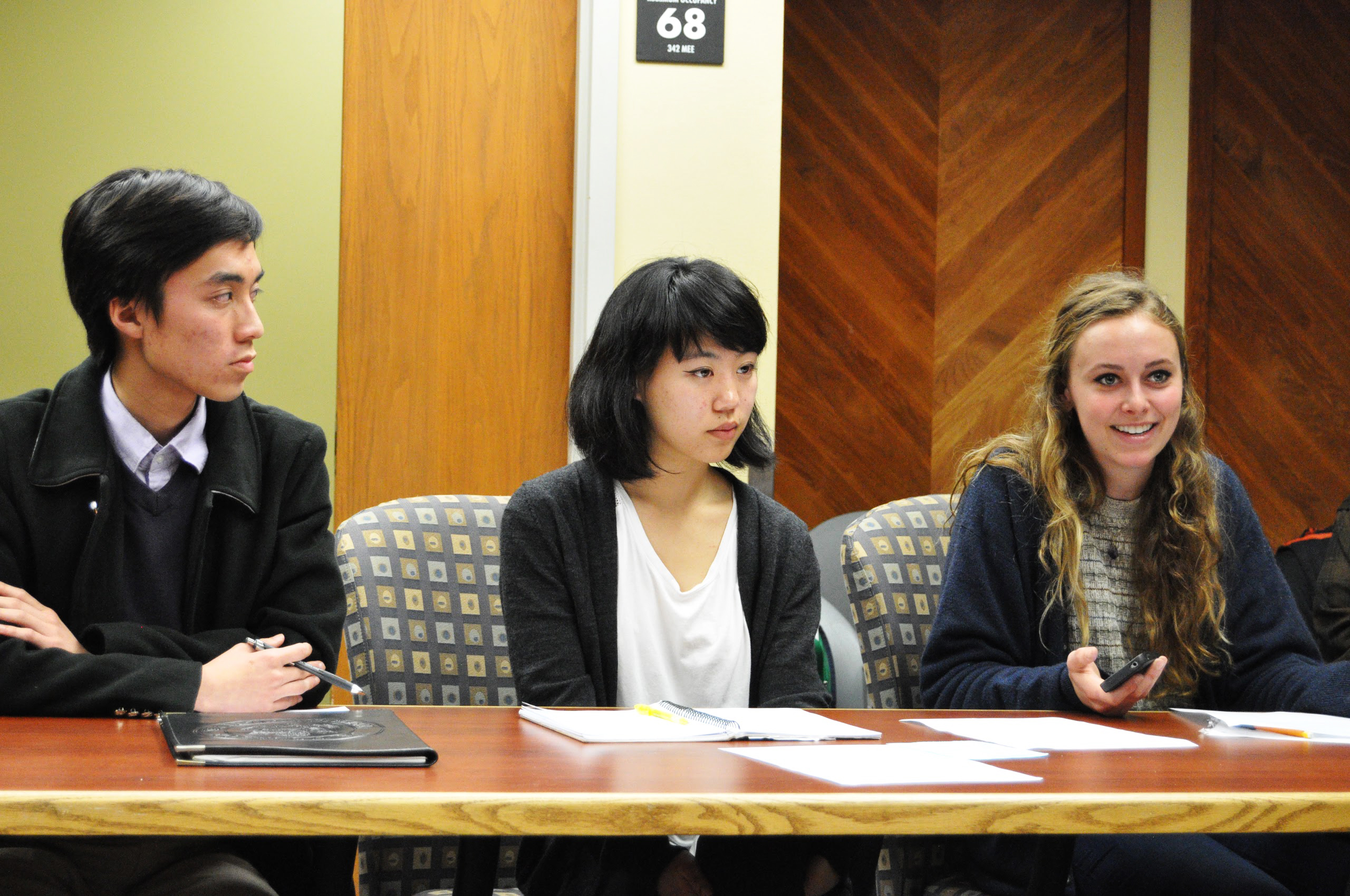
The official list of ASUCD candidates, released the morning of Feb. 3 by Elections Committee Chair John Wu, revealed a shortage of executive and senate candidates.

One executive ticket and six senate candidates compose the list in total. Given that these numbers correspond to the number of available elected spots in the Executive Office and senate table, all candidates have already secured victories.

Five of the six senate candidates to be elected are from the Students Matter: Activism, Retention, Teamwork (SMART) slate. The incoming senators will add to the four SMART senators elected last fall, thus making SMART constitute three-fourths of the senate. According to former senate pro tempore Gareth Smythe, this means that the SMART slate will be able to pass legislation without having to compromise with independent senators, regardless of any expenses that legislation might carry.

“We’re going to have a very one-perspective dominated student government,” Smythe said. “We’re going to have a SMART Executive. We’re going to have a SMART senate. We’re going to have a SMART Controller. And we might even start having a more SMART-oriented judicial branch.”

The senate has final control over the ASUCD budget, funding bills and allocating money to ASUCD’s various programs and units, such as Picnic Day and KDVS. Student fees (and interest collected from those fees) make up the entirety of the budget. ASUCD collected $628,920 in student fees in the 2013-14 academic year.

Beyond concerns of a SMART-dominated government, ASUCD Vice President Maxwell Kappes expressed concerns about whether the incoming senators will be representative of the larger student body.

“To say that they really represent any groups of students would be a dishonest representation, because they don’t have to make a pitch to anyone,” said Kappes, who ran as an independent last year. “This isn’t a battle of ideas.”

Smythe also questioned how receptive the incoming senators will be to student input.

“It’s really, really compelling when someone can come up to you and say, ‘I voted for you because of this reason,’” said Smythe. “That has a psychological effect on the senator.”

According to Smythe, an uncontested election might also impact the work ethic of the incoming senators.

“The reason why senators hit the ground running is because the election process makes them work for it,” Smythe said. “You get the position. You say, ‘OK, I’m fueled by the energy of the campaign. Let’s do this.’”

Kappes shared Smythe’s apprehension regarding candidate diligence.

“If we’re basically looking at just six people being given a ticket to senate, it means that they’re going to do less work to figure out what the job entails,” Kappes said. “So, I think they may be less serious at the table.”

Because the ASUCD Bylaws do not account for an uncontested election, ASUCD will be running elections as planned. However, Wu stated in an email interview that the Election Committee will diverge from its typical formula in preparing for the election.

According to Wu, the committee will not host the annual Coffee House debate this quarter. Candidates will instead receive an invitation for a Q&A Forum on to be held on Feb. 17 from 7 to 10 p.m. in the Mee Room with Aggie TV live-streaming this event to the public.

Wu specified that the public will not be able to be in the same room as the candidates during the Q&A session.

“This is to avoid outbursts, disturbance, interruptions, foreign noise and other anomalies. The public will be asking questions via a chatbox that will be present aside the video when the event is being live streamed,” he said.

Wu also stated that the Elections Committee is working with current senators, the Executive Office, commissioners and the ASUCD Court to revise the ASUCD Bylaws to deal with uncontested elections.

There are a number of explanations for the low candidate turnout, according to Smythe.

“There are a lot of reasons why [winter elections] normally is both the highest vote share getter and the highest candidate producer. And that’s because there are usually multiple presidential tickets….You have two groups of candidates per Executive Office that want to get as many votes as they can by running senators,” Smythe said.

In an email interview, ASUCD presidential candidate Mariah Watson conveyed a mix of excitement and worry about her unopposed run.

“Being the first black female president – if confirmed – of ASUCD is what I’ve wanted from the first moment I heard about ASUCD. It’s an honor,” Watson said. “However, I’m sad that ASUCD is no longer appealing to students.”

Smythe also indicated that students have become unhappy with the Association.

“We’ve seen legislation lately that people are having a hard time justifying why it relates to their student government – or at least their student experience – and I think that is super detrimental too,” he said.

However, Smythe pointed out that this unhappiness is partially the result of students’ selective participation in ASUCD matters.

“My concern is that people are only coming for specific issues, and that gives them a negative appearance of senate,” he said. “I mean — if you only come to senate during the [Coffee House] culturally insensitive fiasco that was last year, then you’re going to get a very negative impression of the Association.”

Watson vouched that her executive team, which includes vice presidential candidate and current senator Robyn Huey, is determined to improve ASUCD’s public image.

“[Huey] and our amazing coalition of students are overjoyed and [are] ready for the big task of making ASUCD something people can be proud of again,” Watson said.

Creative Media Director Alex Park, who has been a career employee of the Association for more than 15 years, proposed that insufficient marketing of elections may have also contributed to the candidate deficiency.

“ASUCD is not very popular, or word is not getting out,” Park said. “So we have to figure out, via the [Creative Media] Marketing Department or via the Elections Committee, how we can increase people wanting to run for elections,”  he said.

The ASUCD Bylaws states that no member of the Elections Committee or Elections staff…or Creative Media student staff shall endorse, make a contribution to, or oppose any candidate, except through voting in the elections.

It is unclear whether this clause prohibits mass promotion of the availability of candidacy petitions. However, Wu proposed that efforts by the Elections Committee to publicize candidacy petitions would be inherently biased, because its resource limitations would make flyering the entire campus impossible.

Low pay may also have contributed to the candidate shortage, Smythe suggested.

“You’re working 30 hours a week. You’re making $45 a week,” Smythe said. “The phrase ‘student representation’ should be very visceral….It should be an expression that we hold in high esteem…What’s admirable about ASUCD will cease to be admirable. And that’s a terrible, terrible thing. I don’t want that to happen.”