57.6 F
Davis

Davis, California

Tuesday, December 23, 2025
Home Blog Page 818

Stanford students’ requests for admission files granted

0

stanford

On Jan. 15, The Fountain Hopper newsletter, a student-run anonymous publication at Stanford University, sent an email to their subscriber base urging them to request access to their admission files, as they had done.

Students have the right to access their academic records under the 1974 Family Educational Rights and Privacy Act (FERPA), a federal law.

The email they sent out to their Stanford subscriber base outlined a five-step guide to putting in a formal request to view their files. Once the students sent their requests, they received their admission files within 45 days.

“We saw what the admission readers write, they were very frank, very honest, it was clearly for internal purposes only which is why we think it is interesting,” said an anonymous Fountain Hopper contributor and Stanford undergraduate student.

FERPA details certain rights students have in regards to their educational records. The first right listed is, “The right to inspect and review the student’s education records within 45 days of the date [the] University receives a request for access.”

This only applies to students who were admitted and currently attend the given university. Rejected students or students that do not attend the given university do not have the right to gain access to their academic files from the university in question.

The full text of the law is displayed on Stanford’s Office of the Registrar’s web page.

“People have the right to know legal information; it’s good when it’s public. We think the federal law should be followed and that is all we’re advocating for,” said the Fountain Hopper contributor.

They estimated that there have been 1,100 requests submitted since the email’s distribution.

UC Davis does make reference to FERPA on the Office of the University Registrar’s web page in a section titled Preserving Student Privacy. However, the full text of the act is not displayed verbatim — as it is on Stanford’s website.

In regards to this issue, UC Davis admissions preferred not to comment at this point in time.

Third-year political science and history double major and former ASUCD senator, Gareth Smythe said he would be interested in seeing his admission files to see how his writing has improved over time and to gain perspective on how to better apply to secondary institutions.

“I could see why universities wouldn’t want to allow that though. You can strategically study for the SATs, so they would be afraid [people would] be applying to colleges more strategically than [they] already do,” Smythe said.

Smythe said he thinks that releasing admission files to already admitted students should have no affect on the university as long as the standards for admission remain consistent. He said he could see it having an effect on admissions if the students who request their files chose to make the commentary on their essays and resumes accessible to future applicants.

“If I had a sibling that wanted to go to UC Davis I could say ‘Well here’s how they judged mine,’” Smythe said.

Smythe said he doesn’t see any reason why admissions would not want to release these files aside from the possibility that it could create problematic patterns in the admission process.

As for The Fountain Hopper, the contributor said that the response has been overwhelmingly positive.

“People have the right to know what the federal law says, [and] we think that information should be public,” the contributor said.

Cow rescued from 30-ft deep mine shaft

cow_ci2_Proudman

On Jan. 22 Dr. John E. Madigan, professor and researcher of Medicine & Epidemiology at the UC Davis School of Veterinary Medicine led a rescue mission to retrieve Molly the Cow, who fell in a 30-ft. deep mine shaft on Jan. 18. The mine shaft was located in her owner’s privately owned land, located in the community of Tuttletown in Tuolumne County, Calif. The cow did not sustain any serious injuries.

The cow was suspected to have fallen in the mineshaft on the night of Jan. 18, when the owner’s neighbors heard mooing and a fall. Molly’s owner, Antoinette Nichols, contacted her veterinarian, who later contacted Tuolumne County Animal Control. However, Tuolumne County Animal Control didn’t have the necessary equipment to rescue the cow from the mineshaft and felt unprepared to properly sedate the 1200 lb. cow.

“This was something that is beyond our scope,” said Jennifer Clarke, animal control manager of Tuolumne County.

Tuolumne County Animal Control then contacted the UC Davis Veterinary Emergency Response Team (VERT) a group of faculty and residents at the UC Davis School of Veterinary Medicine. Members of the response team are required to go through training programs that teach them how to set up equipment, approach emergencies and the organizations involved in rescues, as well as overall emergency rescues.

“Safety is key. Assess the situation before initiating, and just know your strength and limitation and be a service within your abilities,” said Nina Akana, a student at the UC Davis School of Veterinary Medicine and a member of the VERT.

According to Akana, to perform these rescues the team uses a piece of equipment called a “Large Animal Lift,” a specifically designed lift for horses and other large animals typically used after surgery. In this rescue, the lift was attached to a tow truck in order to elevate Molly out from the mineshaft.

Tuolumne County is a heavily mined area due to their history as an old mining ground. According to Akana, it is common for homeowners to have old mine shafts located throughout their property.

This particular mine shaft is located in an area where cows typically graze and is protected by fencing. According to Dr. Madigan, the cow may have lain down or was grazing and slipped into the mineshaft.

The VERT, lead by Dr. Madigan, also requested the assistance of the Yolo County Animal Shelter. According to Sergeant Michael Nevis of the Yolo County Sheriff Department, the Yolo County Animal Shelter has assisted VERT on several past incidents. In this rescue mission, another officer who is trained on low and high angle rescues was also called for assistance.

According to Clarke, the cow was properly fed during the four nights she spent in the 8-by-10 area in the mineshaft. Animal control and the owner threw food and lowered buckets of water into the mineshaft. According to Akana, the cow was exhausted after the rescue, as she did not seem to sleep during her time in the mineshaft.

“She’s a Brahman cow and they’re usually pretty hot tempered for…cow species,” Akana said.

According to Madigan, the cow was properly sedated with dart sedation before the lifting. The rescuers were lowered into the mineshaft in order to put the Large Animal Lift harness on Molly and position her properly to make the rescue possible. After the lift, the veterinarians conducted a post-rescue examination, where they found that Molly had no broken limbs or bones. She did, however, have a few scrapes due to the fall.


Photos by Joe Proudman

News in Brief: UC Davis Wears Red Day to take place Friday

0

UC Davis students who wish to be part of a gigantic heart formation while raising awareness for heart disease can do so at the second annual UC Davis Wears Red Day, which will take place on Friday at Hutchinson Field.

Coinciding with National Heart Awareness Day, the event will begin at 11 a.m. and raises awareness for heart disease as being a leading cause of death of both women and men in the U.S.

Tents and tables will be set up in The Battle Heart Disease Fair and will sell food, provide health information and offer group Zumba sessions. Additionally, there will be a 15-minute Q&A session with Amparo Villablanca, cardiologist, professor and director of the UC Davis Women’s Cardiovascular Medicine Program.

“It will feel very much like a festival atmosphere,” said Dave Jones, associate director of UC Davis’s strategic communications office.

Radio station KSFM 102.5 FM will have a live remote from the fair, which will run from 11 a.m. to 1 p.m. At noon there will be a break to gather all attendees wearing red around the chalk outline of a heart drawn on the field.

Organizers hope to have enough attendees to completely fill in the middle of a human heart formation, which will be photographed at an aerial angle. The current Guinness World Record for the largest human heart formation is 11,116 people.

“Last year we had about 2,500 people for the heart formation, more than enough to make a great outline of a heart,” Jones said. “This year, we are hoping for more, so we can start filling in the middle!”

The organizers will be selling red event T-shirts with a white heart design on them for $7 each. The shirts will be sold at UC Davis bookstores, and $2 from every shirt sale will go to the UC Davis Women’s Cardiovascular Medicine Program.

“These donations are very important because they not only provide medical care for women and their hearts, but they – and events like UC Davis Wears Red Day – raise awareness of women’s heart health,” Jones said.

Participants in the fair include three student-run health clinics, the UC Davis Medical Center, Aggie Heart Association, Alpha Phi and Alpha Sigma Pi sororities and other organizations.

ASUCD Divestment resolution passes through senate

divestment_ca5

At the Jan. 29 ASUCD senate meeting, Senate Resolution (SR) No. 9 passed with an 8-2-2 vote. The text of SR No. 9 calls for the University of California (UC) Board of Regents to divest from “corporations that aid in the Israeli occupation of Palestine and illegal settlements in Palestinian territories, violating both international humanitarian law and international human rights.” ASUCD voted down a similar resolution this past May and in 2013.

With the passing vote, ASUCD formally recommends the UC Regents to divest from American companies Caterpillar Inc., G4S PLC, Veolia Environment and Raytheon.

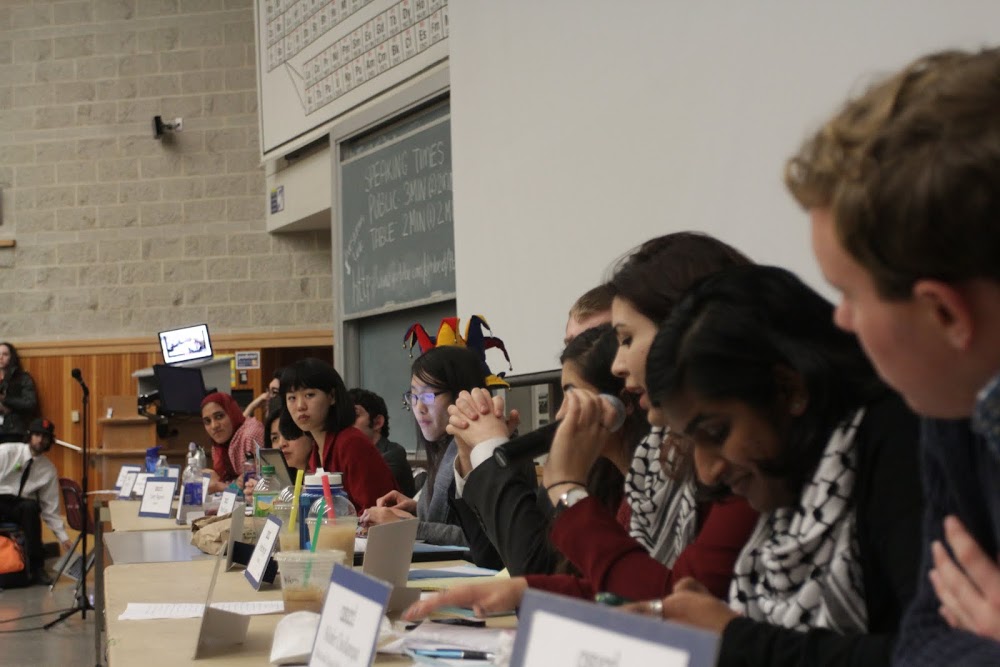
Over 550 UC Davis students, staff and faculty members attended the senate meeting, which was called to order at 8:57 p.m. in 123 Sciences Lecture Hall.

“We support the First Amendment right of freedom of speech,” said Associate Vice Chancellor of Student Affairs Milton Lang. “We want to give the senate and the students the freedom to conduct this meeting in a way they think is productive, but doing so in a way that really supports our Principles of Community.”

Supporters of the bill claim that by not divesting from the specified corporations, the university is failing to acknowledge human rights violations and genocide of the Palestinian people.

“I have been waiting for this for a very long time, because of the suppression of the Palestinian identity on our campus, and I think it’s really cool that students know that their student government is finally going to acknowledge the social movement of the campus,” said ASUCD President Armando Figueroa, who openly supports the resolution. “I think it’s empowering for a lot of students who are used to not being listened to, who are used to being swept under the rug.”

Last year, ASUCD Vice President Maxwell Kappes abstained from a similar divestment resolution, leading to a 5-5-3 failing vote. The polarized opinions of the executive office on the issue have led some to question to functionality of the team.

“We’re representative of the campus,” Figueroa said. “There are two constituencies represented here. We work well together, despite how polarizing the issue is. We are now in our 11th month, going strong, being very successful. Ultimately, our opposing views have benefitted the association more so than any past exec where everyone has agreed. I’m proud of our work.”

On the anti-divestment side of the matter, students voiced concerns about the divisiveness of the bill, claiming that metaphorically tearing down Israel is not the same thing as advocating for Palestine.

“I have been on this campus for four years, and have seen what divestment has done to this campus, to my community and … to ASUCD,” said fourth-year mechanical engineering major and former Aggies For Israel (AFI) President Danny Eliahu. “I have had my voice be neglected for a long time, as has our entire community. We decided as a community that we didn’t want to legitimize the conversation this evening, because we don’t believe in this dialogue. We don’t think it comes from a genuine place. It comes from a place of hate.“

At approximately 9:10 p.m., after introduction speeches from both supporting and opposing sides of the bill, AFI President Julia Reifkind called upon the anti-divestment crowd to participate in a walk-out of the meeting, causing most of those opposed to the bill – about a third of the attendees – to leave.

“Our key message is that we didn’t want to legitimize this process or this resolution or this conversation this evening, and we felt that our presence would legitimize it,” Eliahu said.

As around 200 of those against the resolution exited the building in silence, many supporters of the bill clapped in celebration.

“Personally, I was not expecting [the walk-out] at all,” said third-year human development major and Muslim Student Association President Rangeena Salim. “It was a shocking movement. If that was their way of expressing how they felt, then that’s what they chose to do. We chose to stay, explain our side of the narrative, sit through the vote and see it through.”

Following the walk-out, discussion regarding SR No. 9 continued until the meeting adjourned at 10:07 p.m.

“It’s a beautiful moment, and it’s been a beautiful experience,” Salim said. “I see one amazing side to it — we have all united and will continue to be a united force on campus and force for change. I hope it’s a time for all of our communities to heal. I think there were so many beautiful people in this room, and I only see positive energy coming out of this.”

Senators Nicholas Sanchez, Anabiah Syed, Casey Nguyen, Reem Fatayerji, Azka Fayyaz, Roman Rivilis and Robyn Huey voted in favor of the resolution. Senators Artem Senchev and Eugenia Chung voted against it, and senator Alex Lee abstained. Senator Amelia Helland was not present.

UC Davis joins UC Berkeley, UCLA, UC San Diego and UC Riverside as UC schools passing similar resolutions through their student governments.

“I think it’s really significant because it really does give voice to all these minority groups on campus,” Salim said. “This isn’t a Palestinian issue. This is an issue of human rights and the opportunity for so many marginalized groups on campus to rise together and stand up for something that is happening in our world.”

Reifkind said that the direct outcome of the senate meeting does not change her feelings toward the issue.

“Ultimately the victory is ours, because our community is going to continue to celebrate Israel on campus and support each other,” Reifkind said. “This doesn’t really affect us; we are walking out to continue doing that.”

In addition to the individual UC campus votes, the UC Student Association Board (UCSA), consisting of student representatives from each UC campus, will consider the divestment resolution at a meeting held at UCLA on Feb. 7 and 8.

UCSA previously saw the legislation in November but tabled the discussion due to having inadequate time to properly take the resolution to its respective student associations. If passed next weekend, the measure would further recommended the UC Regents to divest from funds specified in its text.

Photo by Jian Gelvezon


Letter regarding AEPi Defacements

0

Dear UC Davis Community,

As a coalition of students and campus organizations at UC Davis, we condemn the actions taken sometime during the night of January 31st, 2015 by an unknown person(s) who defaced the Alpha Epsilon Pi fraternity house, which is a Jewish interest fraternity, with swastikas.

Just as we condemned the hanging of a noose, the defamation of the Palestinian dove, or calling students ‘terrorists’ based on their physical appearance or beliefs, we equally condemn the display of the swastika. This reminds us that anti-Semitism, along with all other forms of hate, including, but not limited to, Islamophobia, homophobia, transphobia, racism, and misogyny, still exist and are rampant trans-nationally and on our university campuses.

We reject any attempts to blame this on any single student community, including the UC Davis Divestment movement. We hope that the university investigates and exercises due diligence in holding those responsible for this hate crime to the fullest extent of the law.


Sincerely,

The Undersigned:


Students for Justice in Palestine at UC Davis

Muslim Student Association at UC Davis

Arab Student Union at UC Davis

Pakistani Student Association at UC Davis

Afghan Student Association at UC Davis

M.E.Ch.A. de UC Davis

Black Student Union at UC Davis

Sikh Cultural Association at UC Davis

S.M.A.R.T. (Students Matter: Activism, Retention, Teamwork) Coalition

Officers of the Davis Unit, UAW 2865

Hannah Kagen-Moore, Davis Unit UAW 2865

Duane Wright, Davis Unit UAW 2865

Mai Sartawi, National Lawyer’s Guild

Claire White, Student National Vice President, National Lawyer’s Guild

Gonzalo Cortes Moreno, Lawyer and Constitutional Law Professor (King Law School)

Armando Figueroa, ASUCD President


Graphic by Jennifer Wu


Swastikas spray painted on AEPi fraternity house

aepi

Members of the UC Davis chapter of Alpha Epsilon Pi (AEPi), the predominantly-and-historically-Jewish fraternity, woke up the morning of Saturday Jan. 31 to discover two large swastikas spray painted around the fraternity house, which is located across the street from campus.

The graffiti was found on a wall in the back of the building and on the ground near the entrance.

Nathaniel Bernhard, vice president of the UC Davis AEPi, condemned the incident as a hate crime intended to intimidate Jewish students on campus.

“AEPi has never seen an attack like this on our house or our members,” Bernhard said.

The vandalism occurred days after the Associated Students of UC Davis passed a resolution asking the University of California regents to divest from companies with connections to Israel.

“I don’t think that it’s a coincidence that this happened right after divestment,” said Bernhard. “I’m also not making any assumptions or blaming anyone in particular, but I feel like there were a lot of anti-semitism feelings after divestment.”

UC Davis Chancellor Linda P.B. Katehi announced in a statement last week that although ASUCD senate passed the resolution, the resolution does not reflect the position of UC Davis. She called for students and faculty to exercise sensitivity and respect.

Davis police are investigating the incident.


Maria Akhter can be reached at campus@theaggie.org.

Aggies tip-off for second ESPN game of the season

0

sp_ESPNpreview_Pasturel2

Another game on ESPN – just another day in the office for senior guard Corey Hawkins and the rest of the UC Davis men’s basketball team.

The Aggies will face off against rival Cal Poly on Saturday, Jan. 31 on ESPNU, their second nationally televised game of the season. The first, against Long Beach State, turned out to be an overtime thriller that prompted enough attention to bring the camera crews back out to UC Davis.

The Big West Conference is deep this year, but nobody expected UC Davis to be at the top of the list, six games into the year. The team has been buoyed by phenomenal play from Hawkins, who is scoring almost 21 points per game while shooting 51 percent from the floor and from beyond the arc. Hawkins also leads the league in rebounds despite standing at only 6’3”.

Additionally, the team has benefited from the play of their four frontcourt rotation players who either barely played or did not play a season ago. Senior forward Josh Ritchart is second on the team in points while juniors J.T. Adenrele and Josh Fox are second and third in rebounds. Sophomore transfer Neil Monson, the team’s tallest player at 6’10”, has come into his own over the past few games.

Head coach Jim Les is excited about how the team is playing, especially with their recent winning ways in close games.

“I think it’s maturity and experience, it’s confidence and swagger that this team has and a belief in each other,” said Les.

On the other end of the court, the Aggies will see Cal Poly, currently 3-3 in Big West play. The Mustangs have no players standing over 6’9” and the team struggles to grab rebounds. More importantly, Cal Poly has shot the ball poorly throughout the season with 38.2 percent from the field and 27.9 percent from beyond the arc. The Aggies are strong in this respect, consistently holding teams to low shooting percentages.

Cal Poly doesn’t have one player that they lean on offensively, with four players averaging between eight and 13.5 points. The Mustangs, instead, will have to rely on a defense that has held Long Beach State and UC Santa Barbara to 50 and 55 points.

While the Aggies are getting used to their newfound winning ways, the team is also ecstatic about playing on television again.

“It’s a completely different environment, the crowd, the energy. We are all very excited to get back [on ESPN] and hopefully we have a big crowd,” said Monson.

“We want this to be an old hat and ESPN keeps coming back. That’s a credit to our fans’ enthusiasm and the environment that they are creating. It shows well across the country and I think it is a great spotlight on this team and on this university, which is well deserved.”

The game on Jan. 31 against Cal Poly will tip off at 7 p.m. at the Pavilion.


Photo by Ciera Pasturel

Inside the game with Luke Vivolo

0

Senior golfer Luke Vivolo reminds students to believe. Continuing the season with a 72.00 stroke average, one of UC Davis’s most valuable golfers Vivolo sat down with the Aggie to discuss his history, inspirations and plans for going professional.


We’re all wondering: How did you get into golf?

My dad plays golf professionally. He does that for a living. And my brother, who is 4 ½ years older than me, played golf at Cal. Growing up, my dad just threw me in tournaments. I would just go with my brother into tournaments as the youngest kid. So the worst player – that was me! And I was with a couple of other friends who are now playing college golf.We were the youngest kids and we traveled to all of these Northern California tournaments. I started doing that when I was 7. But I started playing golf and going to the range with my dad since I could walk. I’ve been doing it forever. It has always been my thing.


What is your most rewarding memory in golf?

Getting the scholarship here was pretty rewarding. I was playing well as a junior golfer but there’s so much competition and I knew that I wanted to stay in California and go to a top program. I have so many goals….What I’ve accomplished is awesome, but I feel like I haven’t accomplished nearly what I look forward to accomplishing.


What are you looking forward to doing this year?

I want to win this year. I want to be an All American this year – these next two years. Those are two things that are in the back of my mind.


How much do you practice?

During the summer, I’m practicing all day. Whether it’s working out, or doing yoga. I do yoga to stay limber. I’ll do that during the summer when I’m golfing all day, every day. During school, with my schedule, I can practice from 1-4 p.m. or 1-5 p.m. During the weekend it’s anywhere from 4-7 hours.


Who is your biggest inspiration?

My dad and I have a special relationship. He is my biggest fan. He doesn’t push me; it’s more of like encouragement, and we go out to get better. I [also] looked up to my brother a lot, growing up, because he was older and doing a lot of good things. I have a team of people: my dad, my swim coach, just a bunch of people that help advise me.


What’s the plan after college?

I’m going to be playing more golf. Professionally. [After graduation] I’ll have all of Spring to be a golfer – just a golfer – and then I’ll turn pro sometime after that.


Should we expect to see you on TV sometime?

That’s the goal! You gotta believe it. You don’t have to say it to everyone, but you’ve got to believe it. Otherwise, there’s no point in doing it.


Do you have any advice for athletes looking to go pro?

Everyone’s going to say that you have to work hard, that’s a given. But be optimistic and always look at things that happen to you as a chance to get better. You can have a bad game, but you have to find a couple of things that could make you better. Go home, watch a bunch of videos, and find something to practice tomorrow. I’ve always wanted to push for more, and that’s how it is. You have to be optimistic and happy with what you do, while also continuing to strive.

What would you say to those individuals who have yet to regard golf as an actual sport?

It’s not a high impact sport, but you can play golf for your whole life. I think most of the people saying that are playing a sport that they won’t be playing for the rest of their lives. Golf is mentally challenging. It’s a grind. You get the same emotions when playing basketball and football as when you’re playing golf. It’s just a different mentality. You feel nerves on the first tee. You have to be able to calm yourself, slow your heartbeat. It’s the same kind of thing as you see in high intensity sports. I consider golf a sport because you focus on nutrition and fitness so much. You can look at a guy like Rory Mcilroy and Tiger, and they’re athletes. There’s no disputing that they’re athletes. It’s a slower sport, but that’s what brings in the mental aspect of the sport. If it’s not a sport, it’s the toughest game. Whatever it is.

Looking forward to the continuing to play the toughest game, Vivola and UC Davis’s Men’s Golf return to action next week in Waikoloa, Hawaii in the 24th Annual Amer Ari Invitational.


ASUCD Divestment bill passes through senate

IMG_7626At tonight’s (Jan. 29) ASUCD senate meeting, Senate Resolution (SR) #9 passed with an 8-2-2 vote. The text of SR #9 calls for the University of California (UC) Board of Regents to divest from “corporations that aid in the Israeli occupation of Palestine and illegal settlements in Palestinian territories, violating both international humanitarian law and international human rights.” ASUCD voted down a similar resolution this past May.

With the passing vote, ASUCD formally recommends the UC Regents to divest from American companies Caterpillar Inc., G4S PLC, Veolia Environment and Raytheon.

Over 550 UC Davis students, staff and faculty members attended the senate meeting, which was called to order at 8:57 p.m. in the Sciences Lecture Hall 123.

At approximately 9:10 p.m., after introduction speeches from both supporting and opposing sides of the bill, Aggies for Israel President Julia Reifkind called upon the anti-divestment crowd to participate in a walk-out of the meeting, causing most of those opposed to the bill — about a third of the attendees — to leave.

Senators Nicholas Sanchez, Anabiah Syed, Casey Nguyen, Reem Fatayerji, Azka Fayyaz, Roman Rivilis, Robyn Huey and Andrea Velazquez voted in favor of the resolution. Senators Artem Senchev and Eugenia Chung voted against it, and senator Alex Lee abstained. Senator Amelia Helland was not present. The meeting was adjourned at 10:07 p.m.

UC Davis joins UC Berkeley, UCLA, UC San Diego, UC Santa Cruz, UC Irvine and UC Riverside as UC schools to pass similar resolutions through their student governments.

Ritika Iyer can be reached at campus@theaggie.org.

Photo by Jian Gelvezon.

How to enjoy the upcoming weekend as a non-sports fan

1

football 2

Every year, the Super Bowl attracts a large audience, and many of those watching are not football fans. Some are interested in the commercials, while others prefer the halftime show, which amounts to a free (albeit brief) televised concert. A select few are even interested in the game itself and want to see the two best competitors in this NFL season go head-to-head.

As someone not interested in football but intrigued by the Super Bowl phenomenon nonetheless, I’ve been to a fair share of Super Bowl parties and experienced a number of awkward situations which might have been avoided with a little more knowledge on the subject. If you don’t live and breathe football, there are a few things every student should know before the biggest game of the season this Sunday.

  1. The U.S. National Anthem is a difficult song

You might have heard the U.S. National Anthem being sang at other sporting events and thought that someone else might have been a better choice to sing. Although I can’t speak for how singers are chosen, it’s important to recognize that it is actually a difficult song to sing even before they are pushed in front of a microphone in the middle of a packed stadium and being broadcasted around the world. There have been historically criticized performances, and people have even pre-recorded and lipsynched. If you’re watching for enjoyment, don’t start off your experience disappointed if it doesn’t live up to your expectations.

  1. Roman numerals

2015 is the year of Super Bowl XLIX. This does not stand for “Super Bowl Extra Large Nine,” but actually Super Bowl 49. Give yourself a crash course in Roman numerals and impress your friends with technical knowledge appropriate to the occasion. If they don’t think it’s relevant, point to the screen and say “tell them that.” Afterwards, help someone wrap their head around the fact that the next Super Bowl will be Super Bowl L.

  1. Which teams are playing

At any Super Bowl gathering, one of the questions most asked by non-fans is “Who is playing?” It’s a fair question from someone who doesn’t pay attention to the sport, but it tends to annoy people who are asked a dozen times throughout the night as people filter in and out of the party. At the very least, anyone watching should know the names of the teams playing and where they are from. In this case it is the Seattle Seahawks and the New England Patriots. To save you some time, they are on the opposite ends of the US map. If you want to root for a team, ask the fans at the party who they think deserves to win, or root for whoever the person you want to stay friends with roots for.

  1. Why the Pounds per Square Inch (PSI) matters

This might be grounds for interesting debate among science-savvy audience members. Some fans might be concerned with the PSI of the balls used at the Super Bowl following a controversy in the Patriots’ last game involving their use of under-inflated balls. Much of the debate is focused on whether the balls used were intentionally under-inflated to give the Patriots an advantage. Some people are concerned with whether a ball inflated under the regulated PSI range of 12.5 to 13.5 would even give an advantage. Supposedly they are easier to grip and fly differently than regularly inflated balls. If you know nothing else about football, perhaps you can impress your friends with your knowledge of ball physics.

  1. You don’t have to choose between studying and watching

I wouldn’t advise putting your essay or studying off until after the superbowl. Turn your homework or study sessions into entertainment, complete with commercial breaks. You can work through the game coverage, then watch commercials while you wait to resume your work. Just try not to let your consumerism be reflected too much in your writing.

  1. The rules

There are too many to mention here, but the rules of football and their enforcement are the source of a lot of disappointment for people who watch the game. Viewers will scream at the sound of penalty calls they think are unfair. This is where people can put their analysis skills to test. If you understand the rules and look at the replay footage, you can determine for yourself (and possibly for your friends) whether a penalty was unfair or not.

  1. Who will win

My statistics teacher in high school told the class about the power of statistics using sporting events as an example. He said that based on data, you could predict accurately how many fights would break out in a game and at what point the concessions would be busiest. Supposedly, a simulation in Madden video games has correctly predicted the outcome of multiple Super Bowls. If you have experience in statistics, perhaps you could use the available data to predict the winner of Super Bowl XLIX and which team will see a huge spike in t-shirt sales after the game.

  1. It’s a touchdown, not a homerun

I’ll end with a reminder of the stereotypical mistake. I know it might seem ridiculous, but in the heat of the moment when excitement is high, or when you’re speaking casually and not entirely invested, it’s easy to accidentally let the wrong name slip. You don’t want to be caught on the wrong end of this mistake; when in doubt, use neither.

Since the game is happening around midterm season, you might be concerned with what it does to your Sunday study schedule. But perhaps it would be nice to take a break from work and enjoy some entertainment. If you are so inclined, I hope this helps.

Courtesy Creative Commons

Spread knowledge, not disease

0

The happiest place on earth hasn’t been living up to its name in the last few weeks.

As of Jan. 26, the California Department of Public Health has confirmed a total of 73 cases in nine counties throughout California including San Mateo, Santa Clara, San Bernardino, Riverside, Orange, Los Angeles, Alameda and Ventura. Of the total, 50 cases can be epidemiologically linked to Disneyland. Furthermore, the CDPH have linked 19 cases outside of California to Disney.

The outbreak has brought to light the severe public-health consequence of choosing not to get vaccines — especially when it comes to completely preventable diseases like the measles. Out of 42 patients with a known vaccination status, 34 were found to be unvaccinated. The patients were between the ages of 7 months to 70 years.

According to the Center for Disease Control and Prevention (CDC) between 2000-2013 there were between 37 and 220 verified cases of the measles per year. However, in recent years there has been an increase in individuals infected with measles which CDC experts predominantly attribute to “spreading of measles in U.S. communities with pockets of unvaccinated people.”

We believe that it is imperative to consider the huge ramifications of not getting vaccinated, or vaccinating your children, especially as there is no scientific basis for people’s reasons not to vaccinate. According to health care practitioners and officials, the main reasons people choose not to vaccinate are fear that vaccines cause side effects. The most common concern is autism, even though this is scientifically unfounded according to the most recent immunization safety review and that the diseases are rare.

The problem with not getting vaccinated is not so much that you can contract the disease, but that infants who are not old enough for vaccinations have no protection. Likewise, a number of individuals cannot get vaccinations for a variety of reasons and they are not afforded the choice to protect themselves. In getting vaccinated, an individual contributes to what experts call “herd immunity”. This means, if a large enough portion of the population has been vaccinated and is immune, they can protect those individuals who haven’t developed defenses.

Infants can only get the first dose of the measles, mumps and rubella combination vaccine (MMR) at 12 months, the second dose between 4-6 years of age. In those first months of life however, they are incredibly vulnerable and have no defenses to fend off the disease.

For this reason, we stress that everyone check their immunization records  with their local health care provider to ensure that they are up to date — this is especially important for students planning on traveling out of the country.

Let us spread knowledge, not disease.

For more information, visit www.shcs.ucdavis.edu/ ,www.cdc.gov and www.cdph.ca.gov.


Graphic by Jennifer Wu

Men’s tennis continues to improve

Designed by Sandra Bae & Andrew Li


A Team on the Rise

New balls (tennis balls, that is), freshly tightened racquets and warm weather herald the continuation of the men’s tennis season.

When Eric Steidlmayer joined as head coach in 2012, he inherited a team that was recovering from a 5-15 record. Under his tutelage, he led them to an 8-13 finish at the end of his first year, and finally to a 14-11 record for the 2013-14 season – the best record UC Davis has earned since joining Division I tennis.

Steidlmayer aims to keep improving on the team’s record (currently residing at 3-2 overall), even though they have a particularly difficult schedule this year, facing off against the likes of Cal, Stanford and Hawaii, among others.

Sophomore Alec Adamson wants to beat teams that they have been unable to win against before. Still relatively new to Division I play, the Aggies have lofty, yet attainable, goals for the season.

“We really want to have a great year in the Big West, and also try to beat some ranked teams,” said Adamson. “Obviously the main goal is to win the Big West Championship – something we’ve never done since going to Division I.”

The Aggies’ determination will prove to be a deciding factor in coming matches.

“Our biggest strength is our ability to to work and improve,” said Steidlmayer.  “Each guy wants to get better, [and] each guy is working at that goal – individually and collectively.”

A standout pair, junior Adam Leive and sophomore Alec Adamson are 2-3 for the year, though that isn’t an adequate picture of their achievements.  This past week against Grand Canyon in Los Angeles, they won both matches.  They also made the finals for the Battle of the Bay – a competitive tournament that features many exceptional teams – and they got to semi-finals of the ITA Regional – a tournament between all of the teams in the northwest.

“So, they can play,” commented Steidlmayer. “They have had a lot of success beating high quality teams… [and they] complement each other really well with their skill sets.”

Steidlmayer is keeping his eyes open for other players on the team who complement each other in the doubles game like Levie and Adamson.  All of the athletes can play, he says, but doubles play needs a different approach in order to succeed.

A Strong Start to the Season

Seven of the nine players finished the first part of their season with winning records, combined to end Fall season with a record of 64-39 in singles play, and hope to even improve on that as the year goes on.

Sophomore Bryce McKelvie and freshmen Everett Maltby both share a 12-5 record for individual play and sophomore James Wade has a 13-6 record overall.

UC Davis recently lost 6-1 in a valiant fight against Stanford.  Wade was the force behind the sole Aggie point, gained by winning a three-set singles battle against the Cardinals No. 2 player.  Maltby, McKelvie and freshman Lam had good performances that unfortunately did not change the outcome of the match.

Due to his quality of play this early in the season, Wade was honored as Big West Conference Player of the Week along with another athlete from UC Irvine.  Wade is 3-1 so far, with one unfinished match, and this marks the second time he has received this award.

Adamson’s highlights for the fall include playing Cal and Stanford for the first time and the results of their most recent matches.

“They’re both top 30 national teams, so that was a great experience playing at their stadiums,” said Adamson. “And then the LA trip that we just came back from was pretty cool too – winning both matches [has] definitely been exciting.

A Young Team

Four new players have joined the men’s team this year: freshmen Tommy Lam and Everett Maltby, and sophomore transfers Jesse Ross and Eli Whittle.

The difference between high school and college tennis is significant, and the new players are improving and adapting to the rigors of being part of a Division I team.

“They’re basically going from boys to men – it’s kind of a cliché, but it’s really true.  They’re trying to mature as fast as they can and give themselves a chance to play as well as they can.”

As for the returning members, juniors Brett Bacharach and Adam Levie as well as sophomores Alec Adamson, Bryce McKelvie and James Wade, Steidlmayer has high expectations for them. He wants them to be role models for the new players while leading the culture of the team in the right direction.

With no senior athletes on the roster, it provides the players an opportunity to build team chemistry and for the team to improve as a whole. “It’s a good group of guys that we have here, so it’s going to be cool having them here the next couple of years, said Steidlmayer.

With a long season ahead of them, Adamson looks forward to the Big West Conference and the home matches against UC Santa Barbara and Cal Poly in April, as well as the chance to play abroad. He is also excited about leaving the mainland for a match against Hawai’i. “We go to Hawai’i over spring break, so that’s obviously going to be a fun trip,” said Adamson.

Though the future is uncertain, the team’s impressive records and well-fought matches promise an exciting season for the men’s tennis team. They will play on Jan. 31 at Santa Clara, before hosting three consecutive home matches in the following weeks.


Graphic by Sandra Bae & Andrew Li

The UCD Files: Real World Horror Stories: The Lecture Hall

0

marxheadshot_opThe first installment of Real World Horror Stories involves a place we all go to, or at least tell our parents we go to. It does not matter whether you are a science major, art history major, or aspiring double major in College Dropout and Safeway bagger. It doesn’t matter if you don’t have a plan at all, because in the your words at that holiday party to all of the adults, “[You’ve] got time.” Regardless, you are a student at this enormous university, and thus cannot possibly avoid the UC Davis Lecture Halls.

You probably aren’t trying to avoid them, because it is a nice change from the 30 person classes you took all throughout your life. Going into college, you thought the lecture hall would be a great thing. In Algebra 2, or any other class you took in high school, some things are inevitable; you absolutely cannot hide from a teacher, send love notes, skip class, and in my case in the Pleasanton Unified School District, wear a hat, chew gum, pee when you want, enjoy yourself or do just about anything you’d rather be doing then learning about the Cold War or the periodic table. What you’ve heard about college, or seen in the totally candid and not-at-all fake pictures in the UC Davis catalogue, is that you’ll have a lot more freedom in these four (or five, or six) years at college. Here are some of the details you may not have noticed, and how my trial-and-error (and error, and error) has helped me move past them.

Let’s say you stayed up way too late last night following the plan of my first article, watching all of Breaking Bad or stalking attractive people on Facebook. Now you’re absolutely exhausted, and 9 a.m. lecture the next day is out of the question. That’s perfectly fine in college, not high school, because in a 200-person lecture hall, no one will notice. Now let’s say you choose to attend your 9 a.m. lecture, but just aren’t really in the mood to be there. This is OK because again, no one can see you or what you are doing. Go on Tinder and message all of your matches, it’s a numbers game isn’t it? Stalk more people on Facebook, play Flappy Gunrock (yes this just happened), make elaborate snapchat drawings, read The UCD files and more.

Sometimes, however, you actually have a midterm that you just “studied” for at the CoHo. You have a scantron, test booklet, pencil, eraser, possibly a calculator, or a water bottle with answers that look like nutrition facts on it, and all of these things have to fit on a desk that barely fits your own hand. If you leave the test book on your lap, and the scantron on the desk, you will most likely appear to be cheating, so DO NOT do that. Don’t look anywhere at all, because the TAs may think you’re cheating.  I once came to a midterm without a pencil and borrowed one from the girl next to me whom I didn’t know. She finished the test before me because she’s smarter than me. As she left she dropped a note card in my lap that read “Good luck and keep the pencil.” Long story short, I was immediately accused of cheating.

The issues of the Lecture Hall don’t only happen during midterm season. The rooms all look like the architects were planning for a small school and then right before they put the seats in they got a call that it was a big school. Everything is crammed together and the classes always have registration room for 30 more people than the room capacity. Paying that much to sit on the stairs to learn educational stuff should be illegal. And the worst part is, if you’re not on the stairs, getting to your seat isn’t an easy feat either.

In order to get to your seat, you are going to have to cross the legs of all the people sitting between the aisle and your destination. To get there, you have to touch absolutely every pair of legs on the way. Should you face the row you are traversing and risk bumping the next row with your backpack? Or face the other way and hit your neighbors with the backpack, also putting your butt uncomfortably close to your classmates? Now if you are lucky enough to get a seat in the aisle, this appears better, but everyone else will be putting their rear ends in your face. If you get an aisle on the left side, and are a right-handed Tinder-swiper, this is also a dilemma because the desks are left-handed. Don’t waste too much time worrying about the desk though, because even if you are ambidextrous, the desk will not be big enough for you.

Unless you made your own major in the experimental college you are going to have to face these problems. Don’t skip class every day either – my freshman roommate picked Xbox over class every time. Bad news: he dropped out with a 0.0 GPA. Good news: my triple dorm became a double.

You can make it easier on yourself though:

  1. Go to class earlier than normal and get a good seat.
  2. Don’t take notes on your laptop because there are too many distractions on-the-line (again, Mr/s. Right’s Facebook will still be there after class).
  3. Print out the slides so you can pay attention more.
  4. Make friends in your classes so you can take shifts skipping once in a while, and also have friends.
  5. Turn on the recording app in your classes that aren’t podcasted (beware of loud coughers/snifflers near you though).

Take this big lecture hall system for what it is, troubles and all, because at the end of the day we are pretty lucky to call this school home.

The UCD Files is your weekly in depth look at our campus and the lifestyle that comes with it, featuring an occasional dropping of knowledge from a senior who has experienced it all.

Feel Free to send questions, comments, hate mail, or anything you would like to see in future articles to Adam Marx at almarx@ucdavis.edu, I will be responding to them instead of paying attention to lectures.

Graphic by CA Aggie Graphic Design Team


Psyches & Serpents: Elevate Your Mental Pt. 2

0

You’ve got a body, right? You can put something good into that body and expect good results — and vice versa. A carrot can be good for your body. It can provide some positive utility. But it won’t elevate you out of the unhealthy habits that have you seeking refuge in the goodness of a carrot. To rise above these habits requires a change in mindset. You might think there’s a pill for that (there are many). But taking a pill for your mind is no better that taking a carrot for your body.

In my conclusion last week, I said that I’d have to stop being an amateur if I wanted true mental health. This is an idea that’s been recently imparted on me by Stephen Pressfield’s book Turning Pro. What is the opposite of an amateur? A professional. The idea of practice came from that same book as well. If you “need something to change your mind,” as David Byrne tells off of Fear of Music, you have to forget the inputs and focus on the mind itself, the equation. Bad habits change us all the time, but to change for the better requires two main ingredients: time and focus. This can be summed in another word: practice.

What follows is a story illustrating the above idea:

There was once a girl who was considered a great painter. One day, her friend came to visit. She said to the painter, “I’d like to commission you to paint me a picture of a fish.” “I can do that,” replied the painter. Later, the friend came by to ask, “Have you finished the painting I commissioned?” “It will take more time,” replied the painter. So the friend waited, but several months later she got the same answer. The friend would visit, but the response was always the same. It will take more time. The friend felt rejected and upset, but always she would suppress these feelings. It wasn’t worth losing a friendship like this to one painting.

After many years, the painter had finally managed to get a show of her own in the city where they lived. The friend was ecstatic, and she brought over her best bottle of wine to celebrate. Perhaps it was the wine, but the friend felt she had to express her feelings about the fish painting this time. But to her surprise, the painter said, “I’d like to make that painting of the fish for you now.” The friend was a little confused. Why now? the friend thought. The friends continued celebrating, but now the painter sat a few feet back, at her easel, lapsing into an occasional trance for several brush strokes. After a few minutes of this, she turned the easel around to reveal the most beautiful painting of a fish. The friend was speechless. It was a masterpiece. But there was a question on the friend’s lips, as well.

When she calmed down, she asked, “Tell me, if it only took a few minutes, why have you waited all these years?” “I haven’t been waiting,” was the painter’s reply. Then she went to a large closet nearby, opened the door, and out tumbled hundreds, perhaps thousands, of paintings and sketches – all of the same fish.

I’ve added a little to this old story, but the message is the same. Things take time and focus, they require practice. The painter had the patience and focus to put the work in, and eventually created the perfect masterpiece. But it took a long time. To get a little metaphorical, the friend is sort of like the outside world. She’s hurt, upset, unsympathetic even when she sees no result, no answers, nothing but time spent on practice. Thoreau probably had the same reaction from peers for the years he spent in the woods before publishing Walden. What was he doing in those woods? Practicing.

You eat to stop hunger, drink to quench thirst, take Aspirin for a headache, Lithium for Bipolar, Risperdal for Schizophrenia, Pristiq for Depression, Viagra for the bedroom, salvia for a fun night with friends, alcohol for a night out, LSD for a trip, etc. Even on the molecular level, pharmacists are researching inputs and outputs of cells to make new drugs. Unfortunately, this physical way of looking at things often focuses only on the x (Aspirin) and the y (No headache). It assumes the formula to be constant. But the formula changes. We change. Our psyche, our mind, our state-of-being – not just in this moment but each and every day – all change. They don’t stay the same any more than the variables do. They change. How does it change? Practice.

If you find work that you love, you can change the formula of your psyche. If you create new friendships, that can change your formula. If you make things right with your family, that can change your formula. If you love a new lover, that can change your formula. It goes on. Work, friendships, relationships, family, all of these things require practice. Things won’t really change that first day with your new friend or partner, though it can lead to some great emotions. Things won’t change your first day putting in work either, whether it’s with your new band or the IT department.

Practice can’t really be explained, other than to say It will take more focused time. Going from being an amateur to being a pro takes practice. This goes for anything. It goes for mental health. Anyone who has heard Macklemore is at least passingly familiar with Malcolm Gladwell’s theory that it takes 10,000 hours to master something. I haven’t yet put in my 10,000 hours toward an elevated mental state, but that’s the day I’m working toward. When that day comes, I won’t have to worry about pills anymore.

PAUL BEREZOVSKY can be reached at pbberezovsky@ucdavis.edu.


Banner Designed by Andrew Li

Graphic Designed by Sandra Bae

UC Davis faculty aim to increase interactivity in science classes


Courtesy Photo: www.iAMSTEM.ucdavis.edu

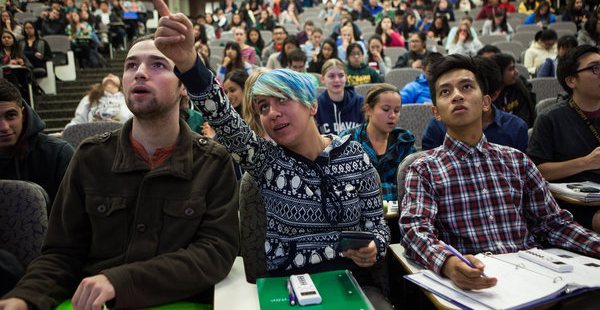
Attention UC Davis science students: expect a drastic shake-up in your lectures and be prepared to get called on at any moment in class.

The UC Davis-based project iAMSTEM HUB (interdisciplinary Agriculture Medicine Science Technology Engineering and Mathematics Hub) has been conducting experiments and studies to measure how the interactions between faculty and students through different teaching styles can affect the outcome of test scores and student continuity within STEM (Science, Technology, Engineering, Math) courses.

Project researchers have noticed an increasing number of high-performing UC Davis students leaving the field of STEM during their second or third year in the major. This apparent trend is not solely confined to UC Davis. The National Center of Education Statistics released a report in 2013 stating that 48 percent of bachelor’s degree students and 69 percent of associate’s degree students who entered STEM fields between 2003 and 2009 had left these fields by spring 2009.

Conceptualized and approved three years ago, iAMSTEM was created by Marco Molinaro based on his work with Biophotonics, a company that focuses on helping high school, undergraduate and community college students get access to internships and career resources in the field of science.

iAMSTEM generates data on which students remain in STEM majors and which students leave by looking at the instructional quality of a class, the feeling of belonging for students, administrative policies and, in general, what the instructional experience is like.

“The most common year for students to leave STEM is during their second year,” said Molinaro. “There is a big transition for students: a new community, new expectations and they may not see the excitement or relevance of large format classes.”

Molinaro stated that the project’s ultimate goal is to optimize the methods and tactics that work for a broader range of students and said that he is pleased to announce that iAMSTEM has conducted various experimental measures to try and detect significant data that can further the project’s staff towards its goal.

iAMSTEM has implemented the C-LASS test, an evaluation taken by students in introductory science courses, such as Chemistry 2A. The tests ask students to fill out an evaluation in the beginning and end of the course and gauges how well they can think like professional chemists. This information is later used to try and measure if students understand the content of the class and if they are engaged in a resourceful way.

iAMSTEM has also hired UCON (Undergraduate Classroom Observation Network) agents, who sit in classes and make diligent observations of what students and the faculty are doing in two-minute observational windows.

“They use an application to track what actually happens in the course,” said Christopher Pagliarulo, iAMSTEM Associate Director of Instruction and Assessment. “The best and only way to get a real perspective on instruction is to watch.”

This mobile application available on Smartsite for those with access contains options for student responses such as asking questions, taking notes or dozing off, as well as options for what the faculty is doing, such as asking group and clicker questions or lecturing.

Molinaro feels that many instructors of STEM classes at UC Davis teach using a polished routine that is not conducive for engaging the students in the field.

“We want to help faculty understand the literature on interactive teaching that is out there,” said Molinaro. “We want to work with faculty and say ‘let’s measure how things are working. Let’s measure an experience and see how it worked and for whom did it work.’”

The founders of iAMSTEM attempt to understand the perspective and environment surrounding students in STEM classes and whether these environments discourage these students from continuing their participation in their respective majors.

“Our hypothesis is that when you have a better experience with your class and feel efficacy, you won’t have such a bad feeling about chemistry and maybe decide to continue in the future,” said Molinaro. “We’re not trying to make more STEM majors. Our goal is to have people make the decision to leave for the right reasons. We don’t want people leaving for the wrong reasons.”

iAMSTEM has studied research done by Elaine Seymour, the director of Ethnography and Evaluation Research at University of Colorado at Boulder, and others that suggest that if students don’t feel like they belong or if the instruction feels irrelevant, they are more likely to change majors.

“We can look at the performance data and see if there is a difference between how women performed or how underrepresented minorities performed,” said Molinaro.

“So we are able to see if there’s potential issues with that and look how an instructor interacts with a specific group of people.”

The first step of iAMSTEM’s approach in improving the overall education experience is to advise the faculty to understand the literature already out there.

“The general principle we’re trying to get now is focused on getting students to practice and give them feedback,” said Pagliarulo. “That’s how brains work. How we are teaching now with pure lecture is not how brains work.”

In general, students do better with more interactive type of approaches, frequent feedback and low stakes testing, according to Molinaro.

Molinaro and his research team sympathize with UC Davis faculty for not having the research on various teaching styles readily accessible to them.

“Faculty care a lot about their students’ learning,” said Molinaro. “However, they haven’t really been trained in the literature and haven’t studied ways of improving student outcomes.”

Pagliarulo added that UC Davis professors must focus on their research, and often they aren’t encouraged to expand, implement or study different, interactive ways of teaching.

“That’s time they’re not investing in their research and the research papers that are required for them to keep their jobs,” he said.

UC Davis biology professor Mitchell Singer works alongside the researchers of iAMSTEM and has taken active measures to implement a more interactive environment in his Biology 2A lectures.

Singer said that he structures his teaching to allow students to integrate the information that they read about for homework and put this information into context to build a bigger picture of the material. He also cites increasing potential in his students but emphasizes the lack of student interest and understanding of what he and his colleagues are trying to do in their lectures.

“One of the hardest things to do is to get students to buy into what we’re doing,” said Singer. “Students really can go beyond what we’re asking of them, but they sort of lack the self-confidence to understand that. As a class overall, they don’t like this approach.”

Chemistry professor Catherine Uvarov also recently restructured the layout of her introductory chemistry course, Chemistry 2A.

“I’ve turned my classroom into a flipped-classroom approach,” said Uvarov. “I ask lots of clicker questions to try and get students to answer questions directly.”

Both Uvarov and Singer use “cold-calling” as a technique to keep students focused in class.

“We do cold-calling on students,” said Singer. “We ask general questions and have students talk in small groups and present their answers to the class, and oftentimes, ask other students to comment on that comment.”

Uvarov has noticed a population of students who aren’t particularly keen with this kind of cold-calling that requires the students to be more attentive and prepared.

“I don’t feel like it’s very conducive,” said first-year biological science major Sucheng Kuo, currently enrolled in Uvarov’s Chemistry 2A course. “Students are just thinking about if they get called on and are not really taking things in.”

Uvarov added that she believes a major problem with the large size classes is that students begin feeling unimportant, like “just another number.”

With a more interactive and intrusive approach to teaching a lecture, Uvarov attempts to give students the ability to understand their relevance relative to their instructor, peers and the material.

Uvarov said that she is motivated by her students’ performance on tests and the questions they bring to office hours, indicating that they are thinking at a higher level than when it was just a traditional lecture setting.

“If students learn the skill sets we are trying to teach them, they will have a much easier time and a much more productive experience in college,” Singer said. “The real issue is helping us find ways to get students to buy in and take a chance. We want them to see that we’re not trying to keep them down, we’re really trying to help them.”

Courtesy Photo: www.iAMSTEM.ucdavis.edu