58.4 F
Davis

Davis, California

Tuesday, December 23, 2025
Home Blog Page 820

The UCD Files

0

marxheadshot_op
Everybody poops. Everybody eats. Where you poop is a given. Where you eat when you’re sick of the Coffee House Paradox is a whole different story. If I had a dollar for every time my friends and I spent an hour deciding where to eat, I’d have a lot of dollars. The process is a hard one and it has nothing to do with not being able to pick a place. It has to do with picking from too many places. The indecisiveness of our particular group, and likely yours too, goes beyond the food. It includes what show to watch, what shirt to wear to a place no one will even see you, who showers first and how to punctuate a text to a girl who certainly won’t even notice. 

But the worst problem of all is the food. Each person has different cravings at different times. Each person has different levels of laziness at different times, making a block-long walk out of the question (we have a strong history of paying each other to pick up our food). I should speak for myself but it seems like a universal problem that a food consensus has never been reached immediately. Debates of these nature can get heated, turning the best of friends into the worst of Mexican vs. Burgers rivals. To counter this, a solution was formed by a good friend of mine. I certainly can’t promise it will fully ameliorate the situation, but it should be implemented into your life because it will at least cut the time down from the usual hour to about 51 minutes. 

Step 1: Make a “food list” in notes on your phone. The issue with our food list is that it is too long. Try to keep yours short when you make it, and try to keep a balance between being hungry enough to think of places, but not so hungry that you include Subway. Don’t do it. 

Step 2: Read the food list out loud when the meal is approaching. Make sure to start early because like mentioned above, this wont be an open and shut case. You and your friends will be able to cross some things off on the first run through and notice some things you are very into at the moment.

Step 3: Go around the room and let everyone state their top choice (or two or three). For your personal top choices make sure to account for distance, transportation method, price, portion size and drink options (if you haven’t used the Freestyle drink machine at Wing Stop and gotten a strawberry vanilla cherry Dr. Pepper, you haven’t lived).

Step 4: Vote. Everyone gets a say in this, and people should be allowed vetoes. The friend that is notorious for craving the same restaurant night after night should get a less weighted vote, because the Burgers and Brew diet isn’t a diet.

Step 5: Look at the menu. This process will also take a substantial amount of time, it may help to stream the menu on a TV or choose a respected delegate to read it out loud.

Step 6: Call in your order. No one likes to stand around at 3rd and U while they do God knows what instead of serving you. Come to the place a few minutes after they say to come because they are usually lying.

Step 7: Enjoy.

If you are still stuck on Step 1, here is a list of the less obvious, equally amazing gems to get you going.

  1.  Zia’s Deli (3rd Street): To explain how good this place is, I will just say that I, a self-proclaimed food connoisseur, have eaten there so much they know my order. Make sure to get a cream soda and a bag of Sriracha chips.
  2. The White Food Truck aka Shah’s Halal (The Silo or Mondavi): Get mix over rice with extra sauces. Be careful registering for classes around the silo though, this place is so good it will drain your bank account. I am living proof.
  3. El burrito (E street): Make sure to go super late at night (sober or not). Get some fries with some meat from some pig. Get a water cup and fill it with the white salsa because you will use it all or you can pay your friend to drink it.
  4. Burgers and Brew (3rd Street): Get anything you want but make the power move of getting specialty fries instead of regular fries. You’re going to need to eat this in two waves but it’s completely worth it.
  5. Thai Canteen (E Street): Ask for the number 12; it’s green curry but instead of being poured over the rice, it’s cooked with it. There’s a ten-dollar card minimum so get some calamari or some beers or tip the nice lady you are annoying at 2 a.m.
  6. Froggy’s (2nd Street): All of the burgers are incredible and I would go so far as to say it’s better than Burgers and Brew. I recommend the cajun and that you cover the fries with their special seasoning. Word of warning though, do not drink their water because it’s notoriously bad.
  7. Taqueria Guadalajara (Anderson and Covell): Probably the closest thing to authentic Mexican food in Davis, Horchata and all.
  8. Wingstop (G Street): Most underrated fries on the planet. Make one of your sauces Mango Habanero and all of your drinks crazy.
  9. 3rd and U Cafe (see creative name): If they answer their phone – I personally recommend the buffalo chicken sandwich but you can do whatever you want. Keep in mind, however, this place is the classic example of the food not being ready when they say it is.
  10. Fish’s Wild (2nd Street): If you’re as poor as I am, this is the place to go. Almost every day is a new five-dollar special and they put their water glasses in the fridge first.

The UCD Files is your weekly in depth look at our campus and the lifestyle that comes with it, featuring an occasional dropping of knowledge from a senior who has experienced it all.

 Feel free to send questions, comments, hate mail, or anything you would like to see in future articles to Adam Marx at almarx@ucdavis.edu.

Graphic by CA Aggie Graphic Design Team

Photo by CA Aggie Photo Team


Column: Educate Me?

0

We come to college to learn. That is our primary reason for being here. And by necessity, when we learn we also teach. Whether we’re telling our roommates something we found out in class or explaining a project to a parent, we teach the things we learn. What is important is that we teach those things in a way that will actually make an impact in others’ minds.

Over winter break, I spent time with a friend I hadn’t seen in a while. While I’ve found that many of my friends from high school have different ideologies after spreading out and making new friends, this specific friend and I still have a lot of the same ideas about social justice inequalities. It was refreshing to be able to talk to her and debate on issues we were educated about. Something else we both agreed on was how difficult it can be to explain these topics to someone who is not informed about them. If someone asked a question like, “Are there really inequalities in our society?” our initial reaction might be to scoff – which is wrong.

The unique thing about being in college is that we get to choose what we learn. So while I know a lot about themes in The Canterbury Tales and social problems in the United States, I know next to nothing about optimal foraging theory (but I can ask my roommate about it!). Other people are in the opposite of my position, so we have the opportunity to teach each other.

But what I’ve learned is that it can be difficult to explain things that come second-nature to you. It might be frustrating that someone else isn’t educated on the same topics as you. I feel like this is especially relevant to issues regarding our social world. The way we respect people based on who they are is something that comes up every day. Some people might have questions that you feel you’ve always known the answer to – What does transgender mean? Do women really face inequalities in the workplace?

And when you hear those questions, instead of getting frustrated, or thinking that they’re stupid, remember that you didn’t know the same things at some point. We aren’t born with this knowledge, and if we don’t take certain classes or attend presentations in college or talk to diverse groups of people, then we might not gain it. But we can help the cause and educate our friends and family! And if we do it in a way that accepts the fact that they aren’t aware of these things and that we’re happy to give them an answer, then they will remember that act of kindness and be more educated for good.

Teach with love and compassion — a rule one of my roommates told me (Gammad 2015). But if you can’t teach with love, at least teach with an open mind. The person who is asking you a question that you think is basic is even more knowledgeable about other topics you’re unclear on. So trade education for education! And be nice about it.

If you have something you want to teach us, email your submissions or questions to Melissa Dittrich, opinion@theaggie.org.

Graphic by Jennifer Wu

The woes of obtaining alcohol in America

0

I am 23 years old, I have a government-issued ID and yet I’m being forced to consider getting a fake ID.

I am from a country where I’ve legally been able to purchase alcohol since I was 16 and I don’t recall ever having had to show an ID. Now, almost eight years later, I feel America is infantilizing me by refusing to sell me alcohol.

The problem is that my ID is a Danish driver’s license. “You need a California ID or a California driver’s license,” cashiers tell me. In order to get this it would require months of fun with the DMV or the delightful process of getting a social security number so I don’t exactly appreciate this policy.

The supermarkets do accept my Danish passport which I refuse to bring with me when I go grocery shopping. I would like to make my case here.

Imagine that you’re in a foreign country, that this country is very different from your own, often in a very frustrating way, and that you have one document that you know can get you out of there as quickly and as painlessly as you could possibly wish for. You’re not necessarily going to leave like that, but it is sure nice knowing that you can.

Now also imagine that besides the practical aspect, this document is of nostalgic value to you. Imagine that it contains visas from Laos, Cambodia and Australia, stamps from Israel and Romania and that it generally documents some of the best experiences in your life since you were 18.

Would you want to bring this document with you grocery shopping? Or bring it with you to a pre-party at a friend’s house?

I am practical person – I go grocery shopping after school or I go to the store to buy alcohol on the way to a party at my friends’ places, and neither do I want to bring my passport with me to school nor to a friend’s house before going out.

Surprisingly enough, bars and restaurants accept my driver’s license and I am very grateful to them for that. Once, I asked a bouncer “how come?” I felt a bit weird asking that because I worried that he might think I was cheating, but I was curious.

His answer was very simple – they had been trained to recognize fake ID’s. What an enlightening idea. Why don’t you consider that, Safeway?

I resent both how it is made so difficult for me to obtain alcohol and the cashier’s assumption that I am cheating.

They are just being careful, some would say. But isn’t there something fundamentally wrong with a country where the blame is put on the person who was cheated? Why are the cashiers the ones who can get in trouble when it really should be either the person producing fake ID’s or the person who is using a fake ID?

I have spoken to women in their 40’s who have been refused to buy alcohol because they didn’t bring their ID. It’s absurd. Why don’t you rebel against this, America? It is not as if anyone believes that people under 21 don’t drink.

I assume people don’t rebel against this because the process of making change in this country would take longer than it would take to turn 21. Besides, everyone has a fake ID or an older brother or sister who looks just like them, right?

If only the supermarkets were consistent in their arguments not to accept my ID I could perhaps understand them a little better, but they’re not. And if you start asking about it, they just say it is store policy which is possibly the most frustratingly stupid reason that you just can’t argue with.

At first, I assumed that the problem might be that the few words on my driver’s license are in Danish, but it has my picture and my name followed in the next line by this number: 1991-11-04. Anyone with an IQ above 80 should be able to figure out that, yes, in fact, that was the day I was born.

Now, I know the language barrier is not the problem, although it has been argued by some cashiers, because the British people here can’t use their driver’s licenses either.

One cashier told me it was too easy to make a fake European driver’s license. Something my fellow Europeans and I would have zero clue about because we never had to look into that.

I could understand if the cashiers were suspicious of a person with a perfect American accent, presenting a European driver’s license, but we all have distinctly different accents. However, it seems like American supermarkets much prefer making life difficult for the not insubstantial amount of foreigners here instead of using common sense.

A word of advice, Savemart, Safeway and Trader Joes and : if we, the foreigners, were to use a fake ID it would probably be an American one. As opposed to here, selling fake ID’s to university students is simply not a thriving business where I am from.

So, a fake ID… I hear a New York one should be good, but I wouldn’t know because never in my life did I imagine that I should even consider getting a fake ID, especially not as a 23-year-old, but I guess that’s what uptight alcohol restriction laws will do to you.

UC Davis students, administration work toward gaining HSI status

0

Video courtesy by AggieTV

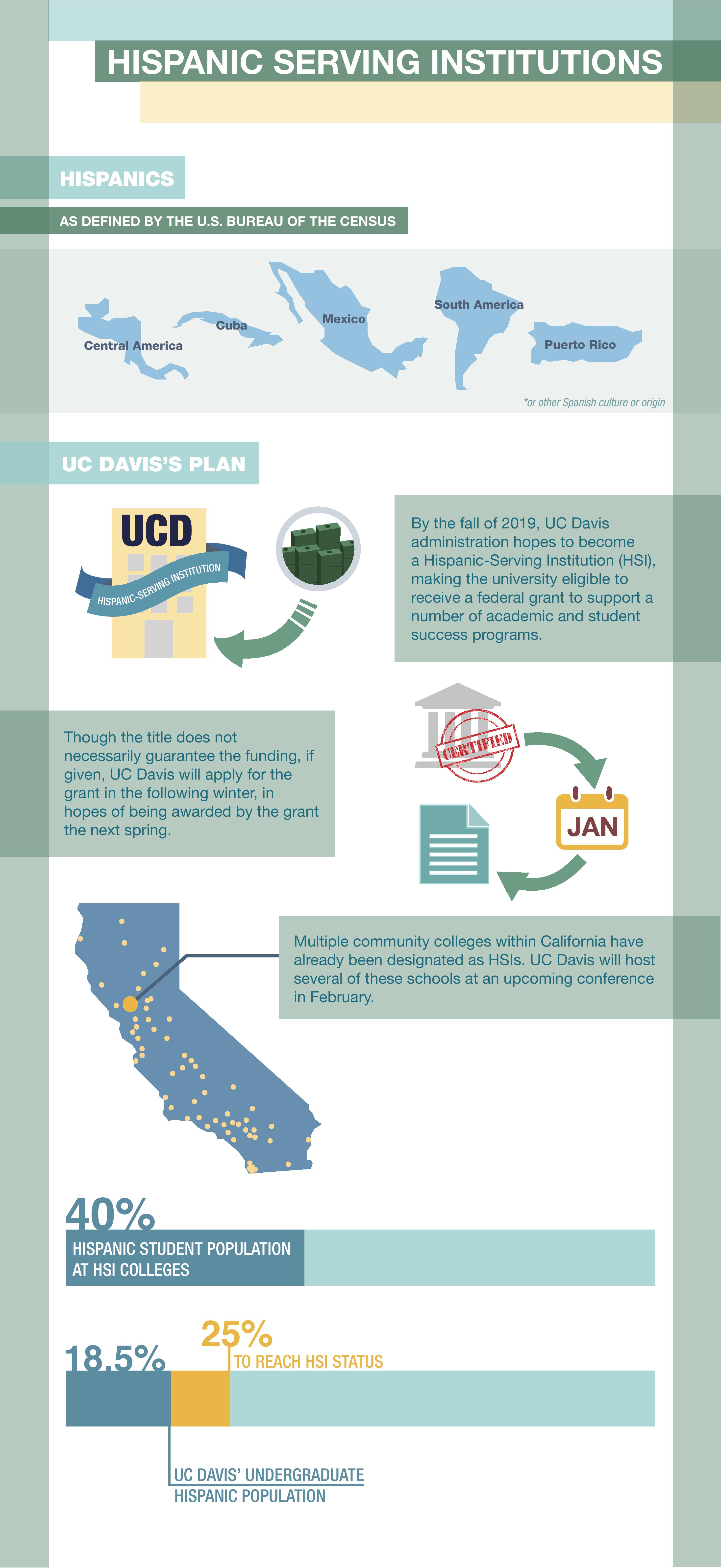
By the fall of 2019, UC Davis administration hopes to become a Hispanic-Serving Institution (HSI), making the university eligible to receive a federal grant to support a number of academic and student success programs. Though the title does not necessarily guarantee the funding, if given, UC Davis will apply for the grant in the following winter, in hopes of being awarded by the grant the next spring.

Multiple community colleges within California have already been designated as HSIs, and UC Davis will host several of these schools at an upcoming conference discussing student success in February.

Hispanics, defined by the U.S. Bureau of the Census as people of Cuban, Mexican, Puerto Rican, South American, Central American or other Spanish culture or origin make up at least 40 percent of the student population at most of these community colleges and 52 percent of the K-12 at California public schools.

“We want to look at how we could possibly accelerate the enrollment growth for this particular demographic at UC Davis,” said Associate Vice Chancellor of Admissions and Enrollment Planning Walter Robinson. “Not for the sake of parody but for the sake of social responsibility.”

UC Davis’ undergraduate Hispanic population is 18.5 percent of the student body and is steadily increasing. To reach HSI status, this number must become at least 25 percent.

All outreach activities to recruit these new students originate out of Robinson’s office, and according to Robinson, the university’s administration has invested significant time and energy into articulating the value of a UC Davis education in rural and other communities with high concentrations of Chicana/Chicano and Latina/Latino students.

Second-year Sabrina Sanchez, a Chicana/Chicano studies and communication double major and the holistic retention coordinator at the Student Recruitment and Retention Center (SRRC), is supportive of the university’s push for Chicana/Chicano and Latina/Latino students to attend college.

“I think this process of becoming an HSI has the potential to open up dialogue about student recruitment,” Sanchez said. “There could be a more open discussion about how administration and students can work together on it.”

However, Sanchez does remain concerned about what the university will do to ensure that these students stay in school.

“Obviously we want more Chicana/Chicano and Latina/Latino students to pursue higher education. That’s needed, especially in California,” Sanchez said. “But unfortunately the Chicana/Chicano and Latina/Latino community has one of the lowest retention rates in the university. Who is assessing our retention needs for us now? That problem won’t be fixed if we add more students. We need an action plan for the students to stay in school.”

While Robinson believes that a retention model is necessary, he also said that the administration is still in the early phases of the process. In Sanchez’s opinion, leaders of other communities on campus have been able to work closely with administration on their retention needs in ways that her community has not been able to.

Fourth-year Maria Salazar, Chicana/Chicano studies and psychology double major and Chicana/Chicano and Latina/Latino community coordinator at the Cross Cultural Center, met with Timo Rico, former associate director of recruitment within undergraduate admissions, to discuss these concerns during last Fall Quarter. Salazar said the meeting was not as fruitful as she had hoped because the HSI process was still being formulated.

In contrast, Robinson adds that the administration is very deliberate about the university’s plan to retain students and that collaboration with other departments on-campus is necessary. Specifically, administrators plans to work with Student Academic Success Center, the Department of Chicana/Chicano studies and the SRRC. According to Robinson, retention efforts are necessary because other California institutions have hit the 25 percent benchmark but then lost funding because of an inability to retain students.

“Of course, losing the funding isn’t the worst thing that could happen,” Robinson said. “But the worst thing that could happen is losing those students.”

In order to solicit information and input from the community regarding their concerns about the HSI initiative, the administration has hosted a number of open forums. These forums have been led by Rico in the past, but will now be administered by Robinson, who plans to take a more direct role in the initiative.

Held every other week this academic year, these community forums were originally set to take place in the Walter A. Buehler Alumni and Visitors Center. However, Luis Corrales, who is a third-year psychology and English double major and community relations intern for the Department of Chicana/Chicano studies, along with Salazar and Sanchez, convinced administration to move the events to the Student Community Center (SCC) in order to make them more accessible to the students they are intended to cater to.

As a liaison between the department and the Chicana/Chicano student community on-campus, Corrales feels that students should be aware of changes that could affect them. The forums are supposed to give all students an opportunity to ask questions about UC Davis’ plan to become a HSI, but he also feels they cannot do so without enough information on the subject.

“I try to relay a lot of the information I get to our community. There is not a lot of transparency from the administration,” Corrales said. “We really have to investigate what they’re saying. Sometimes it can be confusing or kept under wraps. Like when we ask where the money from the grant will be going, the answer we get is that ‘experts are looking into it.’”

The money the university could receive would not be designated solely for Chicana/Chicano and Latina/Latino students, but would be put towards funding resources for the entire campus and its population. Robinson believes there are two possible pathways for resources based on the type of funding the university pursues.

“One type of funding is so we can build capacity and the other is to build stronger infrastructure,” Robinson said. “We would want to go after the funds that allow us to hire more faculty, have more tutorial services, more services for first-generation and low-income students of all persuasions.”

In order to make details about the HSI initiative more transparent to UC Davis students, Corrales, Salazar and Sanchez hosted an open Town Hall meeting on Jan. 12 in the SCC. According to Sanchez, many students have heard of the term, but are unclear about its implications.

“Ultimately, what I’m really hoping for is that we become an HSI,” Corrales said. “But I want it to help students that identify as Chicana/Chicano and Latina/Latino through student success programs and such, instead of having the money that we receive from the grant go into projects or programs that don’t affect students directly,” she said.

Designed by CA Aggie Graphic Design Team

UC Davis police department extends olive branch to student body

0

police_ca_Gleitsman-640x300

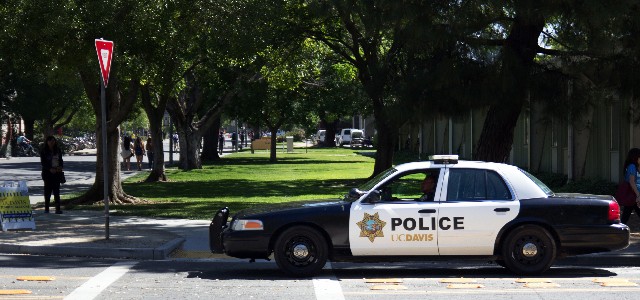
On Jan. 7, the Community Forum Series held its first meeting in the ARC Ballroom, initiated by a group of UC Davis students from a variety of on-campus organizations. The aim of the meeting was to provide a space where the local community and university police department could communicate about recent national police brutality demonstrations.

Approximately 150 people attended the forum, mainly consisting of staff members, student leaders and police officers. Groups of about 10 attendees sat around several round tables, each with one police officer available to answer questions that arose and could partake in the discussions themselves. The forum lasted about two hours, partially going over its scheduled end time of 8 p.m.

“The goal of it was to create a space where people can come back. We know everything can’t be solved in one time in a matter of two hours,” said second-year human development major, Tia Williams, who was also one of the people responsible for running the event. “We wanted this [event] to be…continuous…so we can have long-term action items come out of it.”

The forum is an offshoot of another monthly meeting that the UC Davis Police Department holds on Wednesdays in its conference room called the Student Advisory Council. Along with the forum and Student Advisory Council meetings, the police department also conducts ride-alongs, where students can join police officers as they conduct their daily work duties. All of these programs are a part of the department’s attempt to rebrand itself and increase communication with the surrounding community.

Fourth-year community and regional development major, Star Bacon, was also one of the people who helped organize the event. Last year, Bacon started working with UC Davis Police Chief Matthew Carmichael and began discussions with him about police misconduct on a national level, specifically with Black victims.

According to Bacon, Carmichael understood that the issue was problematic, knowing that many people in the community felt the same way as they did and that there was even a chance of a similar situation happening in Davis.

“The issues of racism and discrimination both within and outside of law enforcement still exists,” Carmichael said in an e-mail interview. “Only through proactive means will we ever be able to address these issues head on and truly make a difference. I am always amazed at the engagement from our student body and the interest to help create a model law enforcement agency.”

Bacon, who represents the UC Davis African Black Coalition, collaborated with Williams and other students to create the forum, with the aim of creating an inclusive environment.

“[Carmichael] understands that there is a need for the students to be involved and the community to be involved in what the [police department’s] goals are,” Bacon said. “The forum is just one step in trying to do that.”

Third-year international relations and philosophy double major and former ASUCD Senator Mariah Kala Watson was asked to assist with the forum because of her background in facilitating talks on “hot topics” while working with the PEACE program in the Cross Cultural Center and Sustained Dialogue in the Office of Dialogue and Deliberation.

According to Watson, many students on-campus fear the police because of their previous bad experiences. Watson also said that many students would avoid calling the cops even when they’re in trouble.

“They don’t even want to take the risk that they might be treated like the aggressor instead of the victim,” Watson said in an e-mail interview.

Watson has also had negative experiences with the police while growing in her hometown and living in Davis now, some of them leaving her traumatized.

“I grew up in Los Angeles, where my peers were always told to fear the police because guilt is already assumed based on my race,” said Watson, an African-American student. “The males in my family have had already had so many negative experiences with the police, while I was growing up, that I had already grew to distrust the police and maintain my distance.”

Watson hopes that the forums prove to be an eye-opening experience, where people are given the opportunity to ask questions that they have always wanted to ask and have their comments hold equal weight to the police officers.

The group of students spearheading the forum series has already begun working to plan the next meeting, the topic of which has not been decided yet.

“I’m grateful to the [police departments] from the area that showed up and helped make this possible and even more honored to be surrounded by such amazing student leaders who have taken this duty … on their plates to discuss and hopefully bring about great change on this campus, in regards to community police relations,” Watson said.

Carmichael agrees with Watson, saying that there is still real work to be done before the relationship between the community and police department is healed. He hopes that the forum will be a way of addressing those issues.

“These are difficult times and sadly in 2015 still difficult conversations,” Carmichael said. “We serve a diverse population and for our department to be effective all [of the] community must trust us and feel represented by our department. Police departments are an integral part of any community as long as the community feels served.”


City Council has yet to act on draft policy banning sugary drinks in kids meals

0

soda

City Council has yet to review a draft policy, submitted by Davis Housing & Human Services in December concerning the addition of healthy beverage options to kids meals. The policy requires Davis restaurants to set default beverages for kids meals from sugary drinks – such as soda – to healthier beverage options.

“The discussion is regarding whether the drink option in a kids meal at local restaurants should default to milk or water. Other options (including soda and juice) could be available upon request, but wouldn’t be default,” said Danielle Foster, city of Davis Housing & Human Services superintendent, in an email interview.

The policy refers to several research studies conducted by health advocates and organizations. One of the main organizations is First 5 Yolo, a local agency whose mission is to improve the lives of young children and their families in Yolo County.

“This draft policy shows the obesity problem in Davis as well as the state of California. It shows the influence that kids meals have toward childhood obesity rates. Most kids meals are very unhealthy, and it’s not only the fat…it’s [also] the sugar. The soda that accompanies most kids’ meals is where we decided to target our effort,” said Julie Gallelo, executive director of First 5 Yolo.

According to First 5 Yolo findings a quarter of Davis children in grades 5, 7 and 9 are obese or overweight. One fifth of Davis’ 122 restaurants offers kids’ meals, however only four of them offer healthier beverage options.

“Part of why we have childhood obesity is the bad diet that they are exposed to, both at home and certainly in restaurants… there is absolutely no doubt that sugary beverages contribute to childhood and adulthood obesity,” said John Troidl, a Davis resident and healthcare management professor at California State University, Sacramento.

The draft policy includes statistics published by the California Center for Public Health Advocacy. According to their findings, drinking sugary beverages on a daily basis increases a child’s odds of becoming overweight or developing obesity by 55 percent. Additionally, sugary drinks are associated with high levels of triglycerides in the blood, which according to the report “increase a child’s risk for heart disease later in life.”

One of the recommendations made by the California Center for Public Health Advocacy for cities with obesity problems were to “offer water, low-fat milk, or 100 percent fruit juice (in age-appropriate quantities) as part of a kids meal” unless a customer specifically requests an alternative beverage.

“It’s a great idea. What’s happened is that beverage companies have bought the menu in a lot of the restaurants. This policy would work with the restaurant and say ‘why don’t we move the menu a little bit back to neutral,’ and make sure that there is a healthy option in the menu,” Troidl said.

Troidl also refers to the effect of such policy on business owners. He asserts that the policy only requires restaurants to give a new option in one of their products, instead of restricting their business activities.

“It’s not taking away a choice, it’s giving people an option….In some ways, [the policy] amplifies the menu rather than constricts it. If anything, it will have a positive financial impact on the restaurants,” Troidl said.

The effectiveness of the policy would only be determined by parents’ response to the establishment of this ordinance.

“It depends on the uptake. If families give a strong and positive response to having this option on the menu, then we’re talking about a couple of years. If they don’t, it could be longer,” Troidl said.

The City Council has shown interest in the policy. According to Foster, the policy will be part of the Mayor’s Healthy Family Initiative, and is supported by the city’s Social Services Commission, which advises the City Council. Additionally, there will be an outreach to the community, specifically to local restaurants, of the policy before it is taken back to the Social Services Commission and City Council for approval.

First 5 Yolo is currently waiting for the city council’s outreach efforts to local restaurants. The organization also volunteered to assist the city council in constructing survey tools to assess impact on the restaurants. The city council has yet to respond to the offer, and has not set an official date or timeline.

“To date, we are waiting to hear back from City staff about our offer of assistance and their timeline.  We are anxious to begin our work with the Social Services Commission to draft the local ordinance, but do not yet have a date to begin that work,” Gallelo said in a follow-up email interview.

The California Endowment gave First 5 Yolo a $20,000 grant to work on this issue in Davis. However, the organization hopes to expand their work to other cities throughout Yolo County.

“We have been on this for a year now, trying to work for the ordinance of Davis. If we’re successful, we hope to work a similar ordinance for Woodland and West Sacramento,” Gallelo said.

Gallelo believes community members that support the ordinance should contribute to the cause by asserting the need of such an ordinance in Davis.

“They [community members] can come to the city council meeting and give comments or support of the change for the kids meal. We are specifically looking for parents who have children in the age who usually buys kids’ meals, [around] two to six years of age,” Gallelo said. “Also, if you have relationships with city council members in other cities, we would love to have the help… to get the message out.”

Photo courtesy of Creative Commons.

Yolo County District Attorney Office settles case with Johnson & Johnson, Neutrogena

0

Screen Shot 2015-02-13 at 11.52.29 PM

On Jan. 18, the Yolo County District Attorney’s (DA) Office announced that they came to a settlement in a case involving Johnson & Johnson and Neutrogena over deceptive packaging, leading California consumers to believe that there was more product in the packaging than there really was.

The case was settled in cooperation with the DA Offices of San Joaquin, Fresno and Shasta Counties. Both companies complied with investigations and in a settlement with the DA Offices that brought the allegations against them to pay $506,000 in civil penalties and investigation costs.

“It is easily arguable [that] it’s misleading to the public. You go and buy the biggest bag of potato chips and there aren’t any, you buy a certain size bar of soap and it’s much smaller once you open the box,” said David Irey, assistant chief deputy district attorney.

The case began in 2012 with each county’s respective Department of Agriculture and Division of Weights & Measures. In general, a Division of Weights & Measures looks for packaging that could be misleading and sometimes gets tipped off by a consumer. It is unclear, according to Irey, how the Johnson & Johnson and Neutrogena packaging case came under investigation.

Once it appeared that the packaging was deceptive to the consumer, the DA’s Offices of Yolo, San Joaquin, Shasta and Fresno Counties brought the violations to the attention of Johnson & Johnson and Neutrogena. The two companies were linked together on this case because of their corporate structure, allowing the DA offices to try them under the same case.

According to Larry Barlly, Yolo County supervising deputy DA, there were 20 to 30 items of over-the-counter beauty products that had deceptive packaging. The DA office was not able to disclose which specific products had deceptive packaging as the case ended in a settlement.

The official complaint from the Yolo County DA’s Office alleges that these products’ packaging were in violation of having non-functional ‘slack fill’ — empty space — which misleads consumers. This specific amount, however, could not be disclosed by the DA offices on the case.

There were no public health allegations made against Johnson & Johnson and Neutrogena – in this case, only allegations of misleading packaging. Barlly said that there was no conflict in this case.

Both companies now have 24 months to comply with federal, state and local laws when it comes to their packaging. They must also phase out their old packaging within the allotted 24 months.

Both companies, in the settlement did not admit any fault.

Johnson & Johnson did release the following statement as follows:

“Johnson & Johnson Consumer Companies has resolved a dispute with several counties in California related to the packaging of various consumer products. Our goal is always to provide a better consumer experience, and we continually evaluate packaging over the course of a product’s life cycle. We have already updated packaging for some products with additional changes to be introduced over the next two years.”

In a press release from the Yolo County DA’s Office, DA Jeff Reisig said that the office will remain vigilant in protecting California consumers.

“No business may mislead the public by packaging its products in containers that have excessive and undisclosed empty space,” Reisig said.

Photo courtesy of yoloda.org.


California Wild Rose excavation along Putah Creek benefits native habitat

0
Putah Creek Council Stewardship Team members and volunteers.  Photos courtesy of Putah Creek Council
Putah Creek Council Stewardship Team members and volunteers.
Photos courtesy of Putah Creek Council


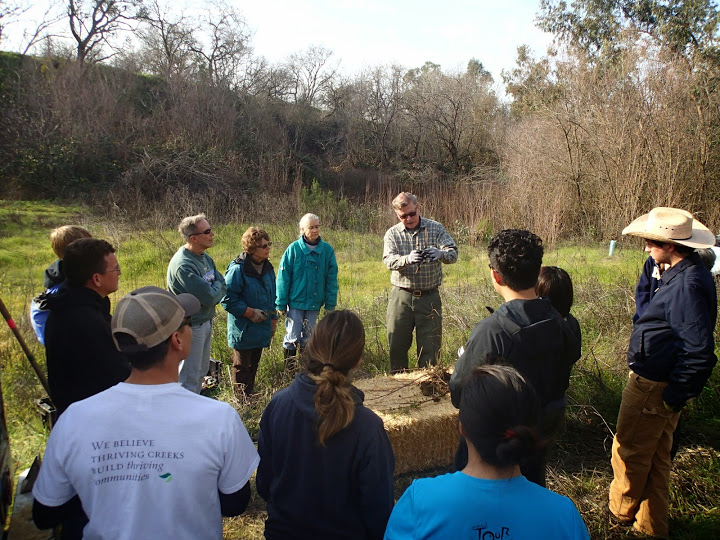
Volunteers from the Putah Creek Council (PCC) planted native California wild roses along Pleasants Creek, located near State Route 128 as an environmental rehabilitation project to prevent erosion, Jan. 16. The PCC along with UC Davis Riparian Reserve (UCDRR) and volunteers excavated the roses a few days prior from Putah creek.

This is the fourth-annual wild rose harvest since it started in 2012. Rich Marovich, Stream Keeper for the Lower Putah Creek Coordinating Committee and UC Davis Alumnus, explained that by relocating the plants in the winter, the dormant plant will have a better chance to survive after it is replanted. The PCC organized the annual harvest after discovering the benefits wild roses have on the creek environment.

“What we were finding was that there were places where roses were occurring in great abundance and many other places where roses were very scarce. So the distribution of roses on Putah Creek and in the entire watershed was very uneven. We wanted to start new colonies of roses because it’s such a functional plant in terms of controlling erosion but it’s also an outstanding habitat plant,” Marovich said.

The PCC’s Putah Creek Community Stewardship Program Manager, Bobby Gonzalez, was involved in both removing and replanting the roses. He explained that the process of removing the roses began by using a large piece of machinery called an excavator to loosen the soil around the plants. The roses were then picked out of the soil and trimmed.

“We would sift through the freshly excavated soil with the roses in it and we would trim down the roses into smaller pieces about six inches of root and six inches of shoot, that’s the ideal size….Afterwards we spread native grass straw all over the site and we planted probably another 30 roses there to rehabilitate the site,” Gonzalez said.

The wild rose crowns, pieces with both the root and shoot, were transported from Putah Creek to Pleasants Creek where they were planted on Jan. 16 to enhance the creek’s natural habitat and stabilize the hillside. For this project, the PCC partnered with the Solano Research Conservation District. Wild roses will benefit Pleasants Creek by protecting against erosion while adding to the wildlife habitat.

“Wild rose grows near the site and for the use at [Pleasants Creek] and it made sense to stabilize the area with something that grows rhizomatously, or grows with underground roots. So imagine something like blackberry, something that creeps and crawls, that’s how it grows. So we’re thinking that if we plant enough of those on this embankment that then, in several years, they will fully cover that embankment and assist retarding erosion along that area,” said Chris Rose, executive director at Solano Resource Conservation District.

Along with protecting the natural habitat of Putah Creek, the PCC and UCDRR provide experience to volunteers who are interested in learning about the field. A third-year Environmental Policy Analysis and Planning major and volunteer at the wild rose harvest, Naftali Moed benefits from the opportunity to volunteer in his field of study.

“I think that one of the great things about the fact that the campus and the council have partnerships like the Annual Rose Harvest is that it gives all of us undergraduates opportunities to experience different types of fieldwork which is something that doesn’t always happen in our classes. To learn more in depth what it looks like to create new animal and plant habitats and answering all of those questions is definitely really helpful as far as thinking about future career goals,” Moed said.

In addition, Moed appreciates that from a social perspective, the PCC is very locally controlled and is focused on enhancing the native habitat.

“Their focus is on Putah Creek which I think is really special because… all of the projects we do are very closely tied to the watershed and the priority, as far as roses go for instance, are very flexible and in the context of the greater creek. I think that the downside to some larger programs that you’ll see out there is that the focus is a little bit more general and there’s less site specific knowledge and planning as far as how different areas will be managed,” Moed said.

The PCC is dedicated to sustainability and maintaining the natural habitat. They use locally sourced materials and increase the abundance of native vegetation.

“We’re trying to do it in a sustainable way so we’re not just going out there and harvesting as much as we can, we’re planting roses,” Gonzalez said. “Every time we go out there and harvest, we plant where we harvested so that the roses will be replenished for the next year.”


Courtesy Photo from Putah Creek Council.


News in Brief: Second Community Public-Safety dialogue to be held

0

The City’s second public safety meeting in response to the a federal military surplus program donating a Mine Resistant, ambush-protected (MRAP) vehicle to the Davis Police Department is to be held at the Veterans’ Memorial Center, 203 E. 14th St. on tonight at 6:30 p.m.

The first meeting was held Nov. 14 due to citizens’ concern of the over militarization of the DPD. The MRAP vehicle was met with apprehension by many of the Davis residents prompting the DPD to reject the donation. The Woodland Police Department is now in possession of the vehicle.

For more information regarding the community public-safety dialogue, contact the DPD at at 530-747-5400.

— Gabriella Hamlett

Ask Katehi

0

Fellow Aggies:


With the New Year upon us, I wanted to say hello and introduce this blog to help us keep in touch and maintain an ongoing conversation about issues and events on campus.  With more than 35,000 students at UC Davis and everyone busy, it can be a challenge to find time to share ideas and thoughts about the university and let one another know what’s on our minds, but it’s important that we do.

As Chancellor, I know students expect to participate in decisions made on campus. I also know you have many good ideas as we strive to make UC Davis the best university it can be now and in the future.  I’d like to use this blog in the Aggie to keep you up to date on some of the issues my administration is working on and also to hear regularly from you. There is much to talk about, including the need to make our voices heard at the state Capitol so UC gets the funding needed to continue its historic level of excellence and access and a soon-to-be-launched campus-wide discussion about how to best prepare students for a future no one can accurately predict.

With the Aggie’s help, I plan to post here twice a month, sometimes briefly sharing news or details about a campus initiative and I will do my best to answer two of your questions e-mailed to me at askkatehi@ucdavis.edu.  I hope to hear from you soon.

About the author: Linda Katehi is the 6th Chancellor at the University of California, Davis.

This week in men’s and women’s sports

0

This Week in Women's Sports

Men’s Basketball (14-3):

UC Davis @ UC Riverside (W, 74-61)

UC Davis @ Cal State Fullerton (W, 79-68)

Hitting the road, the UC Davis men’s basketball team finished with two straight victories thanks to high scoring, efficient performances. Against UC Riverside, the Aggies shot a blistering 58 percent from beyond the arc. Senior guard Corey Hawkins finished with a team high of 26 points, while senior guard Avery Johnson added three from beyond the arc and six rebounds.

Against CSUN, Hawkins once again finished with 26 points while adding 10 rebounds, while junior forward Josh Fox added 20 points. Meanwhile, UC Davis held their opponent to 34.5 percent shooting from the field.

Through their first 17 games, Hawkins has proven to be one of the best offensive players in the nation. He is scoring 20.9 points per game, ninth in the country, while shooting 51.2 percent from the field and 50 percent from beyond the arc.

Women’s Basketball (8-8):

UC Davis vs. UC Riverside (W, 70-61)

UC Davis vs. Cal State Fullerton (W, 64-59)

After a tough pre-Conference schedule, the UC Davis women’s basketball is rolling in Big West play and has moved to 3-1. Against UC Riverside, senior forward Sydnee Fipps was phenomenal, scoring a career high 29 points while adding 10 rebounds. The team dominated UC Riverside defensively, forcing their opponent to shoot 30.9 percent in the game. Still, the game was decided by just nine points due to 24 Aggies turnovers.

For one game, against Cal State Fullerton, Fipps did not shoulder the offensive load for UC Davis. The senior finished with just seven points on 33 percent shooting. Instead, freshmen guards Rachel Nagel and Dani Nafekh took the reigns, scoring 11 and 17 points respectively including six combined threes. The Aggies once again played strong defense, and limited turnovers, but were almost undone by allowing their opponent 14 offensive rebounds.

The Aggies will play at home on Jan. 22 against Hawaii.

Gymnastics:

UC Davis @ Utah (4th place)

After second and first place finishes in their two meets, the Aggies stumbled to a last place finish in a competition against Utah, Southern Utah and Boise State. Junior Dani Judal finished in third place on the Balance Beams, while no other Aggies finished in the top three in an event. All three top finishers in the all-around were from Utah.

The Aggies will face Sacramento State in Sacramento on Jan. 23 before returning home to face George Washington on Feb. 8.

Swimming & Diving:

Bruin Diving Invitational

Facing off against top competition, the UC Davis divers saw six athletes finish in the top 40 of both the 1-Meter and 3-Meter competitions. Junior Lucy LaFranchise finished no. 16 in the 1-Meter Championship final and no. 13 in the 3-Meter finals.

The swimming team will face off against UC Santa Barbara on Jan. 24 before both return to meet University of Pacific on Jan. 31.

Women’s Tennis (1-1):

UC Davis @ Northern Arizona University (W, 5-2)

UC Davis @ Arizona State (L, 0-7)

UC Davis opened up the Spring season against Northern Arizona University, winning 5-2 in Flagstaff. The Aggies jumped out to a quick 3-0 lead before the Lumberjacks were able to score a point. Sophomore Kamila Kecki and senior Layla Sanders were each able to win both of the matches that they played.

Against No. 32 Arizona State, the Aggies were unable to score a point as they fell 7-0. None of the singles matches went past two sets, as the Aggies were unable to win a single one.

UC Davis will return home on Jan. 31 to face University of Pacific.

Women’s Water Polo (1-1):

UC Davis vs. China (Exhibition; L, 16-9 and L, 18-5)

UC Davis @ Brazil (Exhibition; W, 7-6)

UC Davis @ No. 4 California (L, 15-4)

UC Davis @CSU Monterey Bay (W, 10-4)

The Aggie women’s water polo team faced off against the Chinese National Team, losing 16-9, before heading to San Jose for the LouStrong Memorial Tournament.

At the tournament, the Aggies played two scheduled games as well as two exhibition matches against China and Brazil. Against Cal, the Aggies allowed six first quarter points and nine points in the first half while only scoring one. Six different players for the Golden Bears scored at least two goals. Against Brazil, UC Davis outscored their opponents 3-1 in the first quarter and coasted to a one-point victory.

On the second day of action, the Aggies fell to China for the second time in a young season. Against CSU Monterey Bay, UC Davis never trailed and finished with a six point victory. Three Aggies finished with two goals, finishing strong with a 4-1 fourth quarter.

Men’s Tennis (1-1):

UC Davis @ Stanford (L, 6-1)

UC Davis vs. University of Pacific (W, 5-2)

The Aggies kicked off their Spring season with a tough matchup, facing No. 30 Stanford. The Aggies were only able to get one win, with sophomore James Wade scoring a victory in three sets. Two of the other five singles matches went to three sets, with the rest finishing in two.

Despite dropping two of three doubles matches against University of Pacific, the Aggies were able to pull out a home victory thanks to five singles victories. Freshman Everett Maltby finished with his first Division I victory, beating sophomore Eric Spence.

Graphic by Andrew Li

News in Brief: UC Davis Craft Center Presents ‘Impromptu’

0

Every quarter, the UC Davis Craft Center Gallery presents two exhibitions to share the work of instructors and volunteers. At the center, artists have the opportunity to truly reflect their artistic personality and aesthetic to the public.

Kicking off this winter’s run is Impromptu, which features pieces by flamework instructor Kim-Xuan Nguyen. The exhibit will be open from now until Feb. 4, with an opening reception on Jan. 30 from 6 to 8 p.m.

Impromptu is a collection of flamework pieces channeling elements of nature, from redwood burl to sawdust left by insects. Every piece crafted was done so in a way that let the flames take control. Ngyuen attributes her love for improvisation to her roots as a pianist, though her style hasn’t always been so free.

“I’ve started out very controlled in most of the mediums I’ve worked with (and I started out playing classical music), but as I’ve gained control and confidence, it frees me to be more playful,” Nguyen said.

According to Nguyen, improvisation allows her to channel a special connection with her all-time muse: the diversity of nature.

“When working on more ‘improvised’ pieces and with more free-flowing techniques, I feel like I have a different mindset and have to engage with what I’m doing more as I react to unexpected moves of the glass,” Nguyen said.

Craft Center coordinator Jordan Schaub noted nothing but excitement for the outcome of Impromptu.

“Kim has been a long-time flameworking instructor, so it’s no secret that she produces amazing pieces,” Schaub said. “Even in her ‘impromptu’ work, you can see intricacy, grace and her years of experience all complementing each other in the unique blend of different media.”

Schaub noted her personal appreciation for improvisation, describing it as a way to exercise one’s creative potential.

“A lot of times, [people] do things the way they’ve been laid out for us to do and we forget to explore outside of those bounds,” Schaub said. “I like that Kim went outside of the norm and created something spectacular and awe-inspiring.”

To catch Nguyen’s current project, stop by the UC Davis Craft Center Gallery. The gallery is located at the South Silo Building. For more information, visit Impromptu’s event page.


UC Davis Department of Design presents ‘Red Dress: Design Stories for Heart Health’

0

From now until March 13, the UC Davis Department of Design is presenting its latest exhibit, Red Dress: Design Stories For Heart Health, at the UC Davis Design Museum in Cruess Hall. The exhibit is part of the department’s collaboration with the UC Davis Women’s Cardiovascular Medicine Program (UCDWCMP) to raise women’s heart health awareness.

The exhibit showcases 18 red dresses designed by students for various UC Davis Red Dress Collections over the course of five years. The dresses, which differ according to the designer’s interpretation of the theme of heart health, all share a similarity in the color red — the national color for raising awareness of heart disease.

In order to highlight the various emotional stages one goes through when battling cardiovascular disease, Adele Zhang, the museum curator, divided the exhibit into four categories: Awareness and Prevention, Celebration and Appreciation, Freedom and Signifier, and Inspiration and Encouragement.

In addition to the exhibit, the department will also put on its annual February runway show in Sacramento. The event, which is a collaboration between the design department, UCDWCMP and the chancellor, is set to coincide with National Heart Health month in February in order raise further awareness on the importance of heart health.

Susan Huey, a fourth-year design major, designed her dress, “Vesselation,” around the structure of the heart. Huey chose a solid woven fabric for the form of the dress in order to represent the center of the heart. Huey then layered the fabric with a geometric tulle pattern from the hips downwards in order to create a three-dimensional effect that mimics the veins flowing blood to the heart. Although she could have chosen any shade of red for her design, Huey chose a more vibrant shade in order to represent the power of the heart.

“I could’ve chosen a deeper burgundy or a pastel color, but I really thought about the heart being strong and bold, [and] that’s how I chose this red for the dress.”

Betty Chen, a fourth-year design major, and Heaji Richards, a fourth-year design major, worked collaboratively with Barbara Ross, a cardiovascular disease patient from UCDWCMP. Ross will model at this year’s show and also has her dress displayed at the exhibit.

“It’s rare that fashion designers can work with health care patients because… In the fashion industry, a lot of people [are able to get] couture if they have money to make the gowns,” Chen said. “But because of [this exhibit], normal people can have that special feeling of having a couture well-fitted dress too.”

After spending time with Ross, Chen and Richards designed the dress to be one shoulder and asymmetrical in order to clearly display Ross’ scar on the left side of her chest caused from the surgery to insert her heart pacemaker. The pacemaker, which is not functioning properly but is too dangerous for doctors to remove, represents Ross’ powerful journey and emotional surgery.

“She has a pacemaker. Unlike other patients, she wanted to really show that,” Richards said. “She wanted to show what she went through and that she feels strong and confident about that.”

The dress, which is made out of chiffon satin, is adorned at the top with beaded trim to mimic the blood veins. According to Chen, the chiffon, which starts off darker at the dress’ base and lightens through layers, is meant to represent the body’s healing process.

“I feel like a brighter red shows positivity and hope,” Chen said. “The brighter red is colored by the darker red. The positivity will overcome this and your blood will be healthy.”

Because of the ubiquitousness of clothing and its ties to identity, Zhang believes design is a powerful medium to help raise awareness.

“This collection serves the purpose that design is not just for beautiful appearance. Design is also for social issues and improving our life quality,” Zhang said. “The meaning of design can be broadened not only to make beautiful things, but also we can make meaningful things.”


Photo courtesy by Barbara Molloy

Aggie Style Watch

0

Letty Uy, a third-year design major, is very interested in music, television and entertainment, “but fashion has always been [her] number one.” With a summer internship at an upscale New York-based fashion design house and years of experience on the UC Davis Entertainment Council, Uy is well on her way to pursuing an exciting career in a field that she loves.

aswLetty3_ar

ASW: Can you tell me a little about what you’ve chosen to wear today?

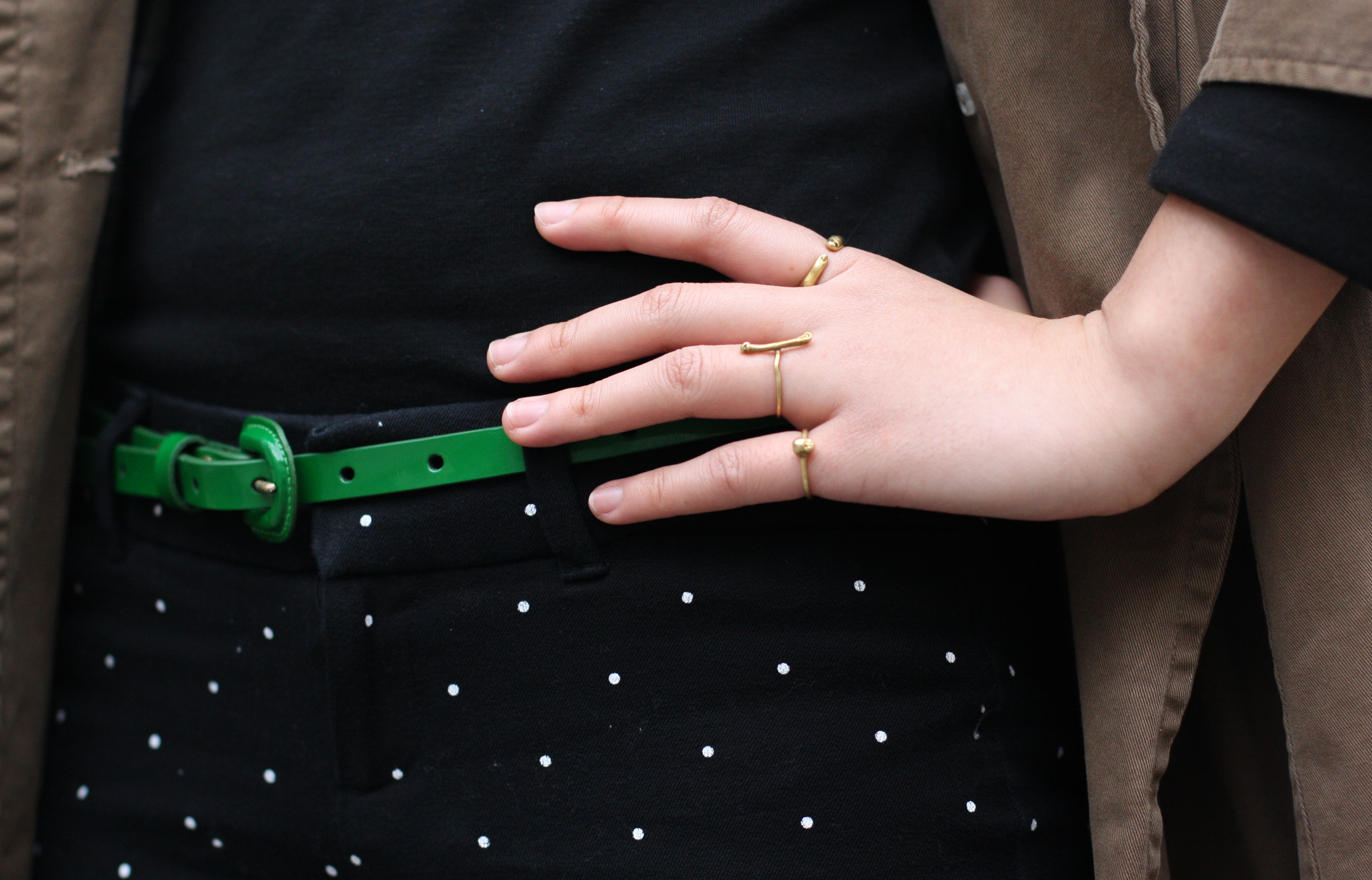
Uy: I wore my black turtleneck. It’s perfect for cold weather. It’s from UNIQLO, and it actually has HEATTECH technology, which is really cool! I’m also wearing black polka dot Old Navy skinny pants. They’re actually really comfortable. I can walk in them and not feel suffocated. Then I’ve got black ankle boots and this trench coat that I’ve had for about eight years. Oh, and I’m wearing a green belt for a little pop of color.

Can you give me three words to describe your style?

Simple, monochrome and comfortable.

Can you tell me a little bit about your internship with Kate Spade New York?

I was a public relations intern. It’s a really great program. I got to deal with editors from major magazines such as Seventeen to People Style Watch — basically [for] anyone who reaches out to us, I help get the [Kate Spade] product out there.

aswLetty1_ar

What is something in your wardrobe that you could never part with, and why?

I have these combat boots that I just can’t throw away; they’re almost falling apart. They’re so comfortable and there are just a lot of memories associated with them.

Do your current career goals revolve around fashion?

I’m thinking about it, but I’m also so interested in other things. It’s a big decision for me right now.

Have you ever made what you might consider a fashion faux-paux? For example, being extremely overdressed or underdressed.

Yeah! I was trying to keep warm here in Davis, so I had on all these sweaters and scarves. And in the end I looked like a big blob of different fabrics. It’s hard to keep warm and balance it with trying to look cute.

How do you articulate your personality in your clothing?

If I’m feeling a little more playful I will wear brighter colors. I also use pattern [to show my personality]. Today, I am wearing polka dots!

Do you have a favorite designer?

Erin Fetherston. She’s really interesting. Her designs are very feminine and fairy tale-like. I get a lot of inspiration from her. She actually graduated from UC Berkeley.

Do you have a style muse? Or a person you look up to for fashion inspiration?

My older sisters are definitely my style muses. I’m the youngest of four. They all dress different, but one of my sisters is very minimalist in her clothing but accessorizes with gold jewelry. And that really inspires me — like today I have on some gold rings.

aswLetty2_ar

Has studying design in Davis influenced your style?

I’ve mainly been taking graphic design classes. Just appreciating certain forms and the way shapes come together to make a certain composition has influenced my fashion sketching. It helps me think of how things work together. I took Design 77 here and that has helped a lot with my sewing skills.

aswLetty4_ar

Aggie Style Watch would like to thank Letty Uy for her cheerful responses and willingness to show her playful side to the camera.


Photos by Julia Kinkela

Flick Chick: You’re making this movie into an assignment and I hate you

0

edefazio headshotEveryone has had to watch films for class. I don’t care how great your TA was that quarter — they definitely showed you a clip of a movie in an attempt to illustrate the content at least once. Watching a movie in class is a rare but welcomed occurrence that we have often prayed for on days with substitute teachers or after reading the book in English classes. I can claim that I like to watch films in class to complete my understanding of a topic and to soak in information from all types of outlets. That may all be true, but I also just want a nap.

In elementary school, the big cart with the television on it was like a second teacher. A few times a week I would see the cart in the classroom and be introduced to new and exciting material by Bill Nye, Ms. Frizzle or the bill from “Schoolhouse Rock.” I was thankful that my teachers would be so generous as to give us an afternoon with my best friend (the TV), and thought that they were really looking into my interests when they showed us these videos.

Of course, my faith was shattered when I was forced to watch Christopher Nolan’s Inception (2010) in my 10th grade English class. With no reason for why we were watching it, the entire class was ecstatic to not have to learn for a day and a half, until our teacher decided to play it again and again and again. For a full two weeks, all we did was watch Leonardo DiCaprio struggle with night terrors as we pondered exactly how our teacher had forged his teaching credential.

Since high school is the place where dreams die, whenever we watched movies in other classes during those two weeks, not only did we dread it, but we had to do classwork as well. “In this Ken Burns documentary, in what year did the Donner Party have their first taste of human flesh? Write a diary entry from the point of view of those being consumed.” We were either watching a movie for no reason, or doing a lot of work. Whether this was an attempt to educate us or to further expose real world disappointments, I will never know.

However, in college, you can actually major in watching movies, which is everyone’s dream if you’re being honest with yourself. To actually take a film studies course, and have film viewings once a week, you might start living your life as if it were a film adaptation of a John Steinbeck classic starring the late James Dean. Most people enjoy this opportunity, and for the movie buff it is a must-take course before you graduate. But, during the two hours a week you spend in the lecture hall (that is somehow much more uncomfortable than your average movie theater), people fall asleep, look up actors on IMDB, or even watch different TV shows on their phones. Few look like they are keeping up with every subtitle of that week’s foreign film, so if you actually enjoy the movie, your professor will see. That is, if they haven’t fallen asleep themselves.

Unfortunately, the movie experience while in a classroom setting can detract from whatever the audience originally thought of the film. In a film studies class, any written assignments given bad grades can dishearten Orson Welles’ biggest fans, if their analysis of Citizen Kane (1941) was too shallow for the professor’s standards. In a middle school science class, answering questions about every detail of a video might not allow the viewer to soak in information, and it will force them to only think of it as an extension of a lecture, rather than a new way of demonstrating how planes fly. Movies should be enjoyed by all, and sometimes academics can take that away from us against our will. That’s why it’s important to remember that, in an in-class film situation, the circumstances that we are in should not dictate how we see a type of media. Only the viewer’s own opinions should influence how a movie is perceived.

Even if you have to take notes, a movie in the middle of class can be a welcomed experience; if anything, you’ll enjoy the distraction. Whether it’s a break in your teacher’s lesson plan, a complete submission to the devilishly handsome work of Joseph Gordon Levitt’s character in Inception, or the non-literary subject of analysis for a humanities class, the movie experience in a classroom setting can be refreshing. If you have been disenchanted by a teacher’s reasons for showing a film, try and get that feeling back, the one you used to get when the teacher would turn off the lights and turn on that “Magic School Bus” episode about the digestive system.

Hey, can I borrow your notes? Bill Nye talks way too fast. Send them to me via Twitter (@emdefaz10) or by email at endefazio@ucdavis.edu.

Graphic by CA Aggie Graphic Design Team

Photo by CA Aggie Photo Team