58.4 F
Davis

Davis, California

Tuesday, December 23, 2025
Home Blog Page 849

News in brief: Research project presents choreographed Isabella’s Dream

In his new choreographed piece, Isabella’s Dream, Granada Artist-in-Residence Dr. Henry Daniel continues his exploration of the intercultural contact and migration that stemmed from Columbus’ voyage.

“The choreography is driven by the stories that the performers bring to the project,” Daniel said. “I posed a very specific question: ‘Can you trace your family history from August 3, 1492, the start of Columbus’ voyage, to today?’ People can rarely do that, but they go through the process of connecting their background to that date.”

According to Daniel, the main content of the piece is presented as a dream of Queen Isabella of Castile, who hired Columbus to go on his initial voyage in which he attempted to reach the east by sailing west. This resulted in the “discovery” of the New World.

Isabella’s Dream is part of a research project known as Project Barca, of which Daniel is the lead investigator. Project Barca combines artistic practice with academic research. This is known as practice as research, and according to Theatre and Dance Department professor Dr. Lynette Hunter, UC Davis ran the first Ph.D. program for practice as research in the U.S.

“This piece is one of a number of works that examines notions of identity, place, history and belonging,” Daniel said. “As the principal investigator, I conceived of the project and got a team with overlapping interests together. I was able to work with scholars in Spain, Vancouver and now in Davis.”

The piece itself is interdisciplinary, which is one of Project Barca’s goals. In addition to choreography, Isabella’s Dream incorporates three short films into the piece.
“These films came from live performance work with actors, dancers, singers, musicians and media artists who also worked on the project with computer scientists and engineers,” Daniel said. “Isabella’s Dream brings a number of different disciplines together to bring a work that is truly interdisciplinary.”

Hunter noted that this kind of interdisciplinary work was good for

all of the departments involved.

“Henry puts his money where his mouth is by actually doing things,” Hunter said. “He’s trying to develop a project with a few UC Davis scientists that will set up an institute that looks at how sciences and arts communicate with each other. He’s really trying to get a conversation going, and that’s where the future is for a lot of the departments — not just having a conversation but actually integrating the disciplines.”

Isabella’s Dream will be performed from Thursday, May 22 to Sunday, May 25 at the Nelson Gallery. Every performance will begin at 8 p.m. The suggested donation is $10.

— John Kesler

UC Davis Film Fest celebrates student filmmakers

On May 21 and May 22, the UC Davis Film Festival returns for its 14th year. Twenty-seven short films will be presented at the Davis Varsity Theatre starting at 10 p.m. The festival is produced by the Department of Cinema and Technocultural Studies (CaTS), the Art Studio, the Department of Theatre and Dance and is co-sponsored by the Department of Design. The two nights are a celebration of student filmmaking at UC Davis.

When it began, the festival averaged 15 to 20 submissions each year. This year, over 50 films have been submitted. Sarah Pia Anderson is one of three faculty producers and helped to found the festival. Anderson is currently a professor in the CaTS department and has been a professional television and theater director for over 20 years.

“I look forward to it every year, every year is different. It’s a unique event [for our] campus because it connects the different arts programs,” Anderson said.

The festival has been held at the Davis Varsity Theatre since 2008 and the capacity of 270 for each night is usually reached. The festival has advanced hugely on the technical side since its inception.

“It’s grown. It’s gone through a lot of different technologies. When we started, the students were using standard video format on video tape and now they’re making HD movies. It encompasses various digital platforms,” Anderson said.

Gene Ang, a fourth-year mechanical engineering major, is this year’s technical director. Ang is tasked with making the festival run smoothly.

“I do workshops to help people submit and to get the right format,” Ang said.

While marketing for the festival is organized during Winter Quarter, the technical work is carried out in spring.

“I’ve gone to the Varsity twice this week with different versions of the Blu-ray to make sure it’s working. Then I go back into the lab and fix things up. It’s a long process but worth it,” Ang said.

David Nessl, a fourth-year technocultural studies major, is this year’s student producer. Last year, Nessl’s film “The Cave” won Best in Show. Students will be competing for various prizes awarded by nine judges.

“For the films that have been submitted, we have a faculty jury from the five different departments; they all get get together and watch the films, then vote on specific prizes,” Nessl said.

The festival has no designated genres for entries, so the awards will dictate the genre of the winning films. Each film has to be eight minutes or less and must conform to copyright infringement laws. The festival allows students to fulfill different roles.

“Lots of the directors will be helping other directors out, acting, or maybe on the crew. You’ll see a lot of that; somebody may have directed something but they’re acting as a zombie in another film,” Nessl said.

The audience is also encouraged to enter to win prizes and get involved in the voting. If you bring your ticket to the door you’ll be able to enter into a free prize raffle.

“The police are going to be there giving away a free bike, Whole Foods are giving away two $100 gift certificates and a bunch of other prizes from the community,” Nessl said. “There’s also an audience choice award so you can vote on which film is your favorite.”

Nessl said he believes the most rewarding part of the festival is giving students the opportunity to have their films shown in the theater.

“The most exciting thing is being at the event and watching the students as as they see their work on the big screen and watching their expressions. It’s kind of magical,” Nessl said.

The production crew is currently accepting applications for people who are interested in becoming an intern next year. You can search for the UC Davis Film Festival page on YouTube to check out the winning films from 2013.

ZOE SHARPLES can be reached at arts@theaggie.org.

Courtesy photo by Ayesha Bhasin.

News in brief: Course catalogs now sold on-demand only

Course catalogs will no longer be sold at the UC Davis Bookstore. Instead, they will be available to order by request only.

In recent years, UC Davis Repro Graphics, the publisher of the course catalogs, acquired new digital equipment that has allowed on-demand ordering. With the intention of sustainability as well as reducing costs, this new method will prevent thousands of catalogs from being wasted, according to Randall Larson-Maynard, senior editor and curriculum coordinator at the Office of the University Registrar. Larson-Maynard initially proposed the idea of making the print catalog available on-demand only.

“As time has gone by, less and less people have been buying the catalogs, so an insane amount gets thrown away each year,” Larson-Maynard said.

Previously, the number of catalogs ordered depended on a rough estimate of how many would be needed to sell. According to Larson-Maynard, estimating was not the most efficient method, as the accessibility of technology has replaced the need for students to purchase hard copies.

To keep the catalogs printing locally, Repro Graphics does the job at a slightly higher cost due to equipment costs and the unpredictability of daily orders. A $15 increase puts the catalog at a new price point of $20.

According to Larson-Maynard, the catalogs are relatively inexpensive in comparison to other campuses, even at the new cost.

Even though the store once sold 4,000 to 5,000 copies per quarter a decade ago, in recent years, sales have plummeted to only about 500 copies each quarter.

Repro Graphics has already started taking pre-orders for the 2014-15 academic year, and distribution begins June 23.

Although the new service is not on-the-spot, the catalog is delivered in an estimated three days once the order is put in, and shipping charges are included in the new catalog fee. The catalog also remains as a free downloadable feature.

“From our standpoint, we’re really happy to be able to provide this service to the registrar and to the community in general,” said Brian Wadell, Repro Graphics director.

— Nicole Yi

Arts Week

MUSIC

Yolo Mambo
May 25, 6 p.m., free
Ketmoree Thai Restaurant, 238 G St.
Yolo Mambo will be playing a blend of world jazz this Sunday evening. The group features Catherine LeBlanc’s multi-lingual vocals complemented with world instruments, including Carla Campbell on percussion, Phil Summers on Spanish guitar and Steve O’Neill on string bass.

KDRT and Davis Music Festival Fundraiser Party
May 22, 4 p.m., $5 suggested donation
Sudwerk’s Dock Store, 2001 Second St.
KDRT and the Davis Music Festival will be holding a fundraiser party that includes live music by The Bottom Dwellers, Owl Paws and others that will be performing at the Davis Music Festival. Included in the donation price is a raffle ticket for a chance to win a single-day pass to the BottleRock Music Festival in Napa, Calif.

THEATER AND DANCE

The Art Theater of Davis Presents: Hedda Gabler
May 22 through June 1, (Thursday, Friday and Saturday at 7 p.m., Sunday at 3:30 p.m.), $15
Third Space, 946 Olive Drive
The Art Theater of Davis will be premiering Adam Siegel’s translation of Norwegian playwright Henrik Ibsen’s late 19th century realist play, Hedda Gabler.

Isabella’s Dream: Granada Artist-in-Residence Henry Daniel
May 22 through May 25, 8 p.m., $10
University Patio, Nelson Gallery
Directed and choreographed by 2014 Granada Artist-in-Residence Henry Daniel, Isabella’s Dream explores the curious, colonial urges of humans from the Columbian Exchange to present day through the perspectives of  a UC Davis student cast diverse in their disciplines of study and personal narratives.


FILM

UC Davis Film Festival
May 21 & 22, 10 p.m., $7 per night or $10 two-night pass
The Davis Varsity Theatre, 616 Second St.
The 14th annual UC Davis Film Festival will be showing short films covering a diverse range of categories submitted by UC Davis undergraduate and graduate students.

Column: Smells Like the Nineties

Jane’s Addiction paved the way for alt-rock.

Twenty-six years ago, Perry Farrell first sang of his desire to be as big and immovable as an ocean. He did so on Jane’s Addiction’s Nothing’s Shocking, an album that possessed the magnitude of that of which he spoke. Released in 1988, the band’s major-label debut is an alt-rock classic, one of the most distinct records of its day, singular in sound and vision, right down to its totemic album cover, a sculpture of naked conjoined twins with heads ablaze.

Let’s count the ways Nothing’s Shocking affected the modern rock landscape:

1. It gave art rock some muscle. There was a time when art rock was synonymous with elevating brains over brawn, as if rocking the eff out was the sole province of dudes who took shop class in place of Calculus II.

But whoever said that you had to choose between the two?

Jane’s Addiction called nonsense on this false dichotomy on Nothing’s Shocking, an album that was plenty adventurous and yet still as loud, overblown and in-your-face as anything by the hair farmers heard on “Headbangers Ball” at the time.

Remember, this was an album boombastic enough to get nominated for the inaugural Grammy for “Best Hard Rock/Metal Performance.”

It all began with Dave Navarro’s guitar playing. He was every bit the shredder as all the glam metal dudes-who-looked-like-a-lady on the Sunset Strip.

Crank “Had A Dad” and try not to bust out some tasty air guitar licks in response to Navarro’s awesomely over-the-top soloing, which sounded as if his wrists were powered by some pneumatic device.

Go ahead, try, I’ll wait…

See! It’s pretty much an involuntary response, right?

Combine Navarro’s ostentatious playing with Eric Avery’s bulldozer basslines, the jazzy swing of Stephen Perkins’ drumming and Farrell’s up-up-and-away vocal histrionics and you have a band capable of summoning thunder like a gathering of storm clouds disguised as four oversexed Los Angelinos.

2. It made it OK for rock dudes to display their feminine side.

The sound of “Nothing’s Shocking” was plenty macho, the rock ’n’ roll equivalent of Burt Reynolds’ mustache circa Gator.

But lyrically, and in the way the band members carried themselves, Jane’s Addiction challenged traditional notions of masculinity, especially when it came to young rock dudes.

For starters, remember the “Soul Kiss” home video, put together when MTV wouldn’t play the video for “Mountain Song” because it had nudity in it?

In the documentary, Avery, Farrell and Navarro could be seen tongue-kissing one another, most likely for no other reason than doing so would have totally grossed out the guys in Skid Row.

From the way he dressed to the words he sang, Farrell, in particular, challenged the conventions of the male rock god, expressing vulnerability and strength simultaneously while clad in a girdle. Context is important here: This was the late ’80s, the height of hornball hair metal, when Tawny Kitaen did somersaults on the hoods of cars in Whitesnake videos and Winger sang of the temptations of 17-year-old girls.

Jane’s Addiction was plenty libidinous in their own way, but not in such louche fashion. There was a sensuality to their music, filling the chasm of yuck dug by David Coverdale’s wagging tongue.

3. It helped set the stage for the alt-rock boom of the ’90s.

Nirvana rightfully gets a lot of credit for lighting the fuse of the ’90s alt-rock explosion with the success of Nevermind in ’91, but Jane’s Addiction was one of the bands that helped set the stage for it all, beginning with Nothing’s Shocking.

Although not a huge hit at the time of its release, the album was a slow-building success, both commercially and critically, and demonstrated that a square peg like Jane’s Addiction could thrive on a major label.

It was one of those gateway albums that was bombastic enough to appeal to fans of hard rock and heavy metal, opening their ears to less conventional sounds in the process.

As such, Jane’s Addiction helped cultivate the audience that bands like Soundgarden, the Smashing Pumpkins and Nirvana would later build upon, some of them through the Lollapalooza tour, which Farrell founded.

And it was Nothing’s Shocking that put all of this in motion. Years later, the movement continues.

ESTEFANY SALAS can be reached at arts@theaggie.org.

Stories on divestment: Mandy Losk

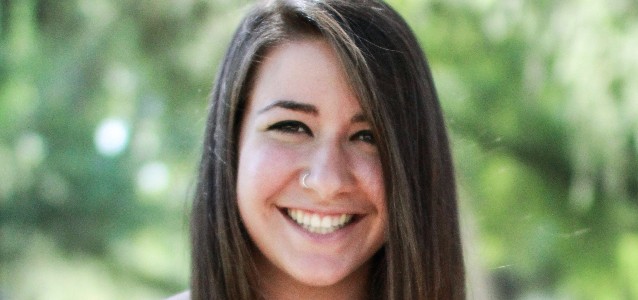
Being both an Israeli-Jewish student and a Middle Eastern and South Asian (ME/SA) major, the past few months have been quite an experience for second-year student and Aggies for Israel member Mandy Losk.

“I kind of signed up for it. I thought it would be a less Israeli-friendly major than others, so I expected a lot of difficulty during divestment time,” Losk said. “There have been days that I have been scared to deal with people who are really unhappy with me.”

Growing up in a Jewish community and visiting Israel as a teenager, Losk said she has been exposed to the Israeli-Palestinian conflict for much of her life. But on her first trip to Israel, Losk said she was surprised at what she witnessed.

“It really surprised me because what we were hearing on the news in America was really different than what was happening there,” Losk said. “I decided I wanted to focus on the area as my major, and wanted to learn as much as I could about the Israeli-Palestinian conflict.”

When the resolution was initially introduced to UC Davis, Losk was a first-year student trying to balance the views of friends in her major with those of friends from Hillel House, the foundation for Jewish campus life.

“A lot of my friends are in my classes, and they are very pro-divestment. But then I would go to Hillel, and my friends were very anti,” Losk said. “It was the first time in my life that I was hearing so many negative things about Israel. I felt very confused, like I was being torn in different directions.”

This year, Losk went back to Israel to see first-hand how the situation abroad has changed. On her visits to controversial places like the West Bank, Losk realized how two-sided the conflict really was.

“It was pretty mind opening, as I had to travel around in a bulletproof bus,” Losk said. “It opened my eyes to how complicated the situation really is.”

Seeing the double-sidedness of the conflict gave Losk a newly defined perspective when the divestment resolution came back to campus this year.

“I would be a fool and a liar to say that bad stuff didn’t happen in those areas. But this resolution only showed one side of the bad stuff,” Losk said. “It was more anti-Israeli than it was pro-Palestinian. I do sympathize with the suffering that is happening. But, it’s not just one people that is suffering, or just one government that is contributing to it either.”

Since the resolution has been introduced on campus and Losk has taken a more active role on the anti-divestment side, she has faced the challenge of having the minority opinion in her classes.

“It’s been really hard to be honest, it’s a giant elephant in the room,” Losk said. “I’ve gotten my own fair share of dirty looks. In the actual classes, there were a few days that I was really scared to go.”

Although Losk made it clear that she was and is not worried about her physical safety, she said she has been experiencing a feeling of ostracization, one of being singled out by a community that was very angry towards another part of her life.

“It’s not the oppressed and the oppressor. Both sides are hurting, not just one,” Losk said. “There was a lot of emotion and conflict and anger, but it doesn’t need to be that way. It’s time to change that, to work together instead of choosing sides. To start making change, we need to start working together.”

After the senate meeting ended, Losk agreed that the failing of the resolution was not a win for the anti-divestment side. Instead, Losk said working on a bill where both communities are involved is the true solution to the campus issue.

“We didn’t choose to be defensive, but we were automatically put in a defensive position. We could feel the hate in that room,” Losk said. “How can you say it was a victory if awful things were said? I was very sad that it had to go this way.”

RITIKA IYER can be reached at features@theaggie.org.

Photo by Abby Alcala.

Photo by Jennifer Wu.
“I knew it wasn’t a religious thing, because I wasn’t raised religiously. All I knew is that I had to be careful about what I was saying, around everyone.”
divestment_fe_Eran_Pasturel
“I was told a couple of times by my commander that ‘what you came here to do is to learn how to kill. I want you to be sure that you learn how to kill the best that you can.”
Photo by Jennifer Wu.
“We have earthquake drills in America, but rocket drills happened in my school. I never thought about how weird that is until I had to talk about it at divestment.”
Photo by Abby Alcala
“It’s directly attacking my beliefs and hurting my friends. As a student, I can’t stand here and watch my peers be attacked.”
divestment_fe_Sohail_Alcala
“For the villages, the incursions disrupt their lives. Whether you’re sleeping or spending time with family, having the military come looking for young men is a disruption, and is in a form, terror.”

Stories on divestment: Eran Zelnik

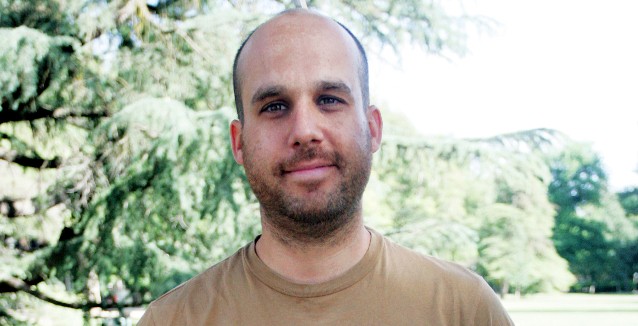
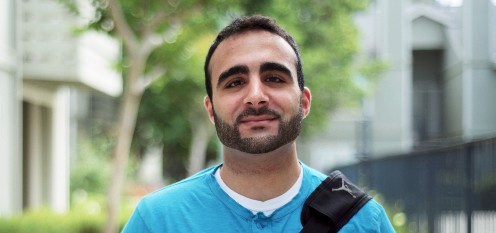
At the May 8 ASUCD senate meeting, UC Davis history Ph.D. student and former Israeli soldier Eran Zelnik is part of the small population of Jewish-Israeli students who affiliate with the pro-divestment side.

“I care about people from that region. That is my place, that is where I come from,” Zelnik said. “I want the place that I come from to exhibit justice, to be a just society.”

Born and brought up in a Jewish household in Haifa, a small town in northern Israel, Zelnik said he grew up receiving a Zionist interpretation of life. Although his family was considered a typical Israeli left group, Zelnik said they were still very devoted to Zionism.

Before coming to Davis, Zelnik served in the Israeli army as a tank commander on check posts and patrols from 1997 to 2000.

“When I grew up, I was very intent on going to the army, I thought it was the best way to serve my country,” Zelnik said. “I really wanted to go to combat unit and to romanticize the army, but little by little it dawned on me that the whole military apparatus, in Israel specifically but also in general, is pretty screwed up.”

From serving in Lebanon to the Gaza Strip to the West Bank, Zelnik recalled times in which he was shocked at the extremity of hate within the Israeli army.

“I was told a couple of times by my commander that ‘what you came here to do is to learn how to kill. I want you to be sure that you learn how to kill the best that you can. That’s what you came here for,’” Zelnik said. “Another moment, my battalion commander told us that he wants us to be the battalion that brings back as many terrorists’ ears as possible to bring back from Lebanon.”

With rhetoric like this thrown around his conversations over the three years, Zelnik slowly came to the realization that being an Israeli soldier was not for him.

“The more I came to think of it, the more I realized how I’ve been bred on a very one-sided view of things, how ideology has blinded me and inhibited me from viewing things for what they were,” Zelnik said. “Then I decided that I really would like to have the ability to look more critically at society, at how ideology works and what happens to people when they become kind of brainwashed with a certain ideology, and I thought that history would be the best way to do that.”

While in the army, Zelnik said he personally saw many human rights violations happening, and attests to the points made by the pro-divestment argument.

“I was in checkposts all over the West Bank, where you are instructed to not allow people in and people out. I had to tell them that they could not get out of their city,” Zelnik said. “[While in the army], you see how serving for a long time as an occupying force gets to you, it eats at you. [Some Israeli soldiers] don’t view the Arabs as full humans.”

According to Zelnik, other violations included Israeli soldiers making hurtful comments and smoking cigarettes over Palestinians. From these individual experiences, Zelnik said voicing his opinion and being an active member of society was important when the resolution was brought to senate.

“As somebody who is from Israel who has been complicit in the occupation, the very least I can do is to voice my opinion,” Zelnik said. “We should do everything in our power to try and effect positive change in the world. That’s what activism is really about.”

RITIKA IYER can be reached at features@theaggie.org.

Photo by Ciera Pasturel.

Photo by Abby Alcala
“It’s directly attacking my beliefs and hurting my friends. As a student, I can’t stand here and watch my peers be attacked.”
Photo by Jennifer Wu.
“I knew it wasn’t a religious thing, because I wasn’t raised religiously. All I knew is that I had to be careful about what I was saying, around everyone.”
divestment_fe_Sohail_Alcala
“For the villages, the incursions disrupt their lives. Whether you’re sleeping or spending time with family, having the military come looking for young men is a disruption, and is in a form, terror.”
divestment_fe_Mandy_Alcala
“It’s not the oppressed and the oppressor. Both sides are hurting, not just one.”
Photo by Jennifer Wu.
“We have earthquake drills in America, but rocket drills happened in my school. I never thought about how weird that is until I had to talk about it at divestment.”

Stories on divestment: Nitzan Bluvstein

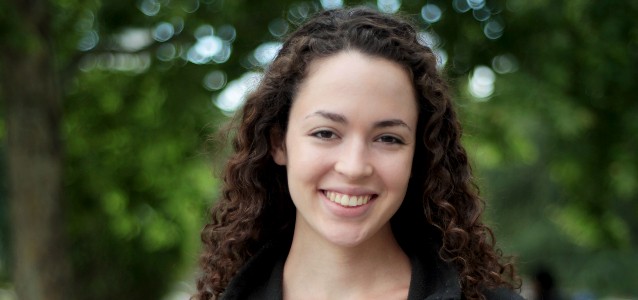
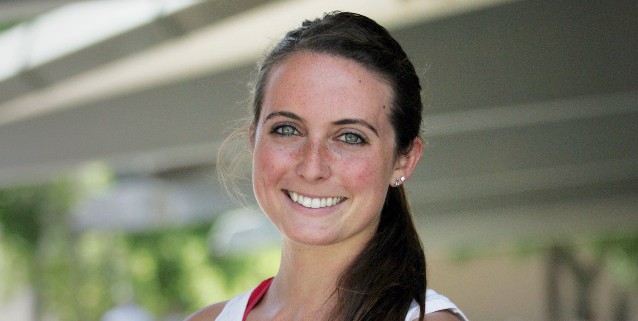
As a born and bred Israeli, third-year psychology major Nitzan Bluvstein delivered heartfelt accounts of her experiences living in Israel.

“I breathe Israeli through and through,” Bluvstein said. “I grew up in an open-minded community.”

Bluvstein and her family moved to America in 2001, mainly in an attempt to distance themselves from the violence happening in their hometown.

“My parents were afraid about the future of the country,” Bluvstein said. “I had a really great childhood, but at the end of the day, you live in a warzone. It’s really frustrating trying to explain that to people that can’t relate.”

Some of the violence Bluvstein experienced targeted toward the Israeli people included the potential of unexpected explosions and suicide bombers. In her personal account at the senate meeting, Bluvstein described the feelings of being a small girl who couldn’t walk a short distance to school on her own due to the high risk of being hurt.

“When I talk about it now in America, it sounds dramatic. But, it’s a crazy reality,” Bluvstein said. “We have earthquake drills in America, but rocket drills happened in my school. I never thought about how weird that is until I had to talk about it at divestment. Normal kids don’t have to go through that.”

Through her upbringing and individual experience living in Israel, Bluvstein understands that both Israelis and Palestinian people are suffering terribly, but said that the situation is much safer now than it has been in the past.

However, despite her move to the United States, Bluvstein continued to be active in Israeli culture in high school and on campus at UC Davis.

“I wanted to be involved because I thought the bill was attacking something it shouldn’t be,” Bluvstein said. “After the first commission speech, it turned into this really heavy involvement. I was speaking a lot and I actually went through line by line of the bill, word by word. I know that bill better than I know what’s going on in most of my classes.”

Although Bluvstein knows that nothing can justify some of the human rights violations that are happening to Palestinians, she believes SR #20 is more targeted at attacking Israel than it is about working towards a noble cause.

“I couldn’t convince myself that it was about human rights. If it’s not about human rights, then what is it about?” Bluvstein said. “The bill completely polarizes the situation. In my opinion, everybody loses. Now, another community is of the opinion that our community just doesn’t care about human rights.”

Everybody losing was a common theme in this year’s anti-divestment case. Although the resolution failed in senate, Bluvstein said the word ‘win’ has been taken out of her language completely.

“Even if the vote was 12-0, we wouldn’t have won,” she said. “Divestment came, divestment hurt all of us, divestment destroyed our community and destroyed our chances of discussion with other communities.”

Prior to the bill even being brought to ASUCD this year, Bluvstein said the issue has been looming over the Israeli and Jewish communities’ heads for months.

“Divestment came whether we wanted it or not. We lost weeks ago, we knew it was coming and we had to cancel events celebrating holidays and fundraisers because we had to defend something we feel so deeply about,” Bluvstein said. “I want them to realize that I would be 100 percent okay divesting from Israel if the bill wasn’t demonizing. If we wrote a bill together to the point where my community felt safe, we would be okay with it.”

After the meeting’s outcome was stated, Bluvstein and many other members of the anti-divestment side were seen crying outside of Freeborn Hall.

“They were not tears of joy. We were glad it was over, but we also understood that while the process might be over, divestment is not over,” Bluvstein said. “It created such a mark on our campus and our lives. We were crying because we had to sit through eight hours of our opinions being demonized.”

In the end, working together as a campus community is Bluvstein’s only wish.

“Getting together and writing a co-resolution would send the greatest message,” she said. “I think movements do start in universities, and I think we should be that university. We should be the University that makes that historical point.”

RITIKA IYER can be reached at features@theaggie.org.

Photo by Jennifer Wu.

divestment_fe_Mandy_Alcala
“It’s not the oppressed and the oppressor. Both sides are hurting, not just one.”
divestment_fe_Sohail_Alcala
“For the villages, the incursions disrupt their lives. Whether you’re sleeping or spending time with family, having the military come looking for young men is a disruption, and is in a form, terror.”
divestment_fe_Eran_Pasturel
“I was told a couple of times by my commander that ‘what you came here to do is to learn how to kill. I want you to be sure that you learn how to kill the best that you can.”
Photo by Jennifer Wu.
“I knew it wasn’t a religious thing, because I wasn’t raised religiously. All I knew is that I had to be careful about what I was saying, around everyone.”
Photo by Abby Alcala
“It’s directly attacking my beliefs and hurting my friends. As a student, I can’t stand here and watch my peers be attacked.”

Stories on divestment: Jessica Reiter

When SR #20 was presented to senate, second-year political science and international relations double major Jessica Reiter sat among her Jewish and Israeli peers, proudly representing herself as anti-divestment. Reiter is a German Irish Catholic student.

Although the majority of the anti-divestment side of the conflict identified as either Jewish or Israeli, Reiter was one of the many students with strong opinions despite not having a cultural or religious connection to the matter.

“The first time I saw divestment was last year, when I just joined [the External Affairs Commission] and I had never sat in any meetings before,” Reiter said. “I was really excited to see both sides of the story. But, when I saw the actual resolution, and how it was singling out one side of the campus, I did not agree.”

Growing up in a U.S. military family, Reiter said her familiarity with the Israeli-Palestinian conflict has been more than the average student.

“Israel would come up a lot at home, so it was something we talked about casually and I was always very familiar with Israel,” Reiter said. “It was always very apparent to me that the relationship between America and Israel was very balanced. I see the resolution as attacking Israel and America.”

Reiter said being a non-Jewish or Israeli student on the anti-divestment side has been a welcoming experience.

“People often ask me why I care, why I want to be involved like this. To me, it’s a no-brainer, as an American, as someone who respects my campus community,” Reiter said. “It’s directly attacking my beliefs and hurting my friends. As a student, I can’t stand here and watch my peers be attacked.”

Although Reiter believes students have the right to bring any resolution they want to bring to the table, she said the bill is difficult to discuss in a civic government setting.

“I think its really unfair. If you are the average human being, you don’t know about the topic,” Reiter said. “I do believe that this conversation needs to happen. But, in civic government and parliamentary procedure? It’s not the place. It’s not the proper form for it.”

Reiter attests to the idea that the bill creates a division on campus, regardless of ethnicity or religion, and this division affects all students, not just Israelis and Palestinians.

“I hate to see something that further divides our campus. I don’t want people to think that anyone on the anti-divest side is against helping humans that need it,” Reiter said. “We are just against targeting a huge community on campus. We are not malicious, horrible people.”

Collaboration within multiple communities to reach a happy middle place is necessary for change, according to Reiter.

“If we collaborate, it would be huge and so monumental,” Reiter said. “If we can make a single resolution that can benefit many communities, then UC Davis will make big strides in a positive direction.”

RITIKA IYER can be reached at features@theaggie.org.

Photo by Abby Alcala.

Photo by Jennifer Wu.
“We have earthquake drills in America, but rocket drills happened in my school. I never thought about how weird that is until I had to talk about it at divestment.”
divestment_fe_Sohail_Alcala
“For the villages, the incursions disrupt their lives. Whether you’re sleeping or spending time with family, having the military come looking for young men is a disruption, and is in a form, terror.”
Photo by Jennifer Wu.
“I knew it wasn’t a religious thing, because I wasn’t raised religiously. All I knew is that I had to be careful about what I was saying, around everyone.”
divestment_fe_Eran_Pasturel
“I was told a couple of times by my commander that ‘what you came here to do is to learn how to kill. I want you to be sure that you learn how to kill the best that you can.”
divestment_fe_Mandy_Alcala
“It’s not the oppressed and the oppressor. Both sides are hurting, not just one.”

Stories on divestment: Sohail Morrar

As the vice president of the UC Davis Students for Justice of Palestine, fourth-year international relations major Sohail Morrar wanted Senate Resolution (SR) #20 to bring awareness about Palestinian human rights violations to campus.

“Although there are the people in the opposition that say it divides the campus, I feel like it created solidarity between many groups,” Morrar said. “I think that solidarity comes from these groups of people constantly interacting with each other on campus. It is a united force.”

Even though Morrar did not author the divestment bill, his personal investment in the matter dates back to his last trip to Palestine in September 2009.

“I thought it was important to have my voice heard, seeing as I have family members who live in the territories and understand what it’s like to live under occupation,” Morrar said. “The bill does connect those companies that do commit human rights to the Palestinian cause and I also feel like the bill helps Israel because it helps Israelis become aware of these human rights violations. Being aware means that you can fix them.”

Morrar’s last trip to Palestine included a long stop in Biet Diqqu, a small town on the outskirts of Jerusalem where his family resides. Over the years, Morrar’s family has been affected by the steady settlement and expansion of Israelis, slowly encroaching onto their land. As a result of this settlement, the town has been disconnected from the main city, and is therefore taken out of Jerusalem’s jurisdiction by law.

On this visit, many of Morrar’s relatives from around the world came to the village. During such gatherings, it is typical to stay up all night enjoying the company of the reunited family. Their celebration was cut short however, when Morrar witnessed an Israeli military incursion in the middle of the night.

After a nearby village warned the people of Biet Diqqu that the jeeps were on their way, Morrar and his family watched Israeli soldiers look for a young man, while shooting sound bombs, throwing smoke grenades and launching tear gas around the town.

“Everyone was coughing and crying,” Morrar said. “For the villages, the incursions disrupt their lives. Whether you’re sleeping or spending time with family, having the military come looking for young men is a disruption, and is in a form, terror.”

While in Palestine, Morrar also had an incident with the Israeli government while attempting to enter Jerusalem at the Qalandia checkpoint. Although Morrar had a United States passport, he was still not allowed into the city.

“It just depends on how the Israeli soldiers feel, and to me, that is a mechanism of control. It has nothing to do with security,” Morrar said. “I’m an American, coming in with a passport. Why won’t you let me in?”

Bringing back these personal experiences to UC Davis, Morrar believes that the bill is an important force on campus, despite its failing vote in senate.

“Whether the bill passes or it doesn’t pass, these violations will still occur. Does it really matter?” Morrar said. “It is important to have your voice heard. It gives a voice to people who do feel like it personally affects them and to people who I think understand the Palestinian peoples’ struggles.”

RITIKA IYER can be reached at features@theaggie.org.

Photo by Abby Alcala.

Photo by Jennifer Wu.
“We have earthquake drills in America, but rocket drills happened in my school. I never thought about how weird that is until I had to talk about it at divestment.”
Photo by Jennifer Wu.
“I knew it wasn’t a religious thing, because I wasn’t raised religiously. All I knew is that I had to be careful about what I was saying, around everyone.”
divestment_fe_Eran_Pasturel
“I was told a couple of times by my commander that ‘what you came here to do is to learn how to kill. I want you to be sure that you learn how to kill the best that you can.”
Photo by Abby Alcala
“It’s directly attacking my beliefs and hurting my friends. As a student, I can’t stand here and watch my peers be attacked.”
divestment_fe_Mandy_Alcala
“It’s not the oppressed and the oppressor. Both sides are hurting, not just one.”

Divestment resolution fails to pass ASUCD senate

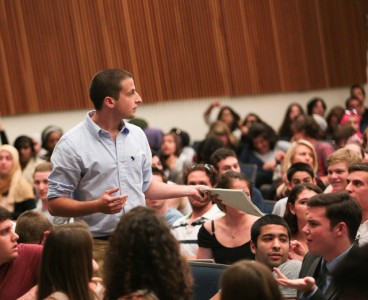
At the ASUCD senate meeting on May 8, Senate Resolution (SR) #20 failed to pass in a 5-5-3 vote. SR #20 called for the UC Regents to divest from “corporations that aid in the Israeli occupation of Palestine and illegal settlements in Palestinian territories, violating both international humanitarian law and international human rights.”

The passage of SR #20 would have served as a formal recommendation to the UC Regents to divest from three companies: Caterpillar, G4S PLC and Veolia Environnement.

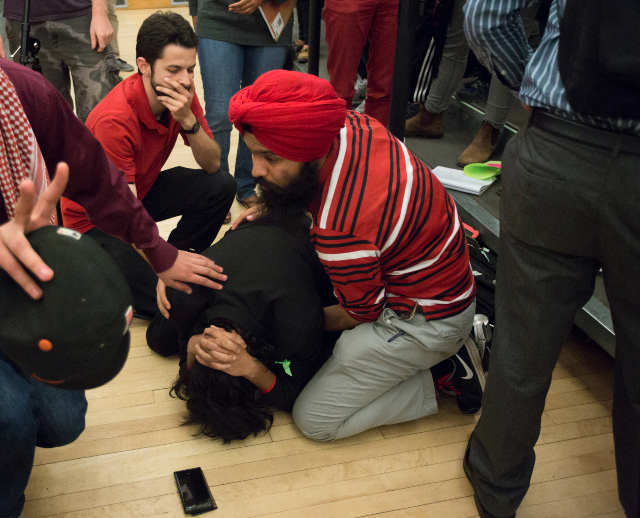
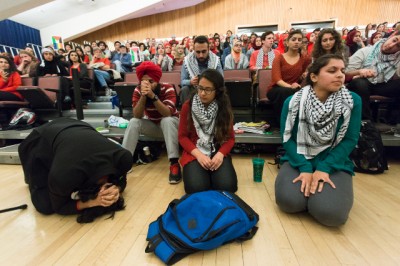
The senate meeting began at 6:10 p.m. and took place at Freeborn Hall to accommodate for the expected large turnout. Students, both undergraduate and graduate, representing both sides voiced their opinions and concerns.

One amendment was made to the resolution to address points made by some students that G4S also aids in discrimination against undocumented immigrants through identification software made by the company.

After eight hours of discussion, the initial vote was 5-5-2. ASUCD senators Mariah Watson, Nicholas Sanchez, Robyn Huey, Azka Fayyaz and Shehzad Lokhandwalla voted yes. ASUCD senators Jonathan Mitchell, Eugenia Chung, Amelia Helland, Katherine Sherman and Artem Senchev voted no. ASUCD senators Gareth Smythe and Janesh Gupta abstained.

Because the initial vote resulted in a tie, ASUCD Vice President Maxwell Kappes had to vote to break the tie, as cited by ASUCD Court Case 13 Hoskinson v. Bloom.

According to the case verdict, the ASUCD Vice President shall act as the presiding officer over all Senate meetings, but shall have no voted [sic], unless the Senate be equally divided [(same number of affirmative votes as any combination of negative votes and/or abstentions).].”

Kappes abstained, resulting in a 5-5-3 vote.

Why divest?
According to the resolution’s author Saleem Shehadeh and co-authors Neda Awwad, Hina Moheyuddin, Abire Sabbagh, Hiba Saeed, Kabir Kapur and Diyala Shihadih, Caterpillar, G4S PLC and Veolia Environnement were chosen because they play a role in establishing the Palestinian occupation. The authors wanted to focus on urging the Regents to “undertake practices of corporate social responsibility.”

The resolution outlined the specific reasons each company was chosen. According to SR #20, Caterpillar provides the Israeli army with bulldozers used to demolish Palestinian property; G4S, a security company, provides equipment, personnel, surveillance and maintenance services that contribute to human rights violations against the Palestinian people; and Veolia Environnement has subsidiaries that hold permits to transfer waste from Israel into occupied Palestinian territories.

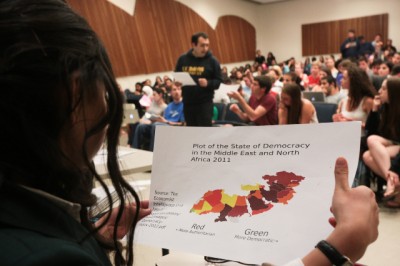
A map circulates the table during the Business & Finance Commission meeting. Photo by Brian Nguyen.

Similar resolutions have been seen on other UC campuses. UC Irvine, UC Riverside, UC San Diego and UC Berkeley passed the resolutions through their student governments. UCLA and UC Santa Barbara saw similar resolutions that ultimately did not pass.

Resolution co-authors Kabir Kapur, a fourth-year political science major and former ASUCD senator, and Diyala Shihadih, a third-year biochemistry and molecular biology double major and president of Students for Justice in Palestine (SJP), said the authors drew upon the bills from other UC campuses to see what would work at UC Davis.

Kapur said he feels that it is a struggle to get things by the UC Regents because they may not directly be in tune with the student experience or student opinions on a lot of issues, but it is still necessary to try.

“Getting stuff by the Regents is problematic in the first place, but I think you have to start at your student government,” Kapur said. “It’s a body for that specific purpose. As social pressure builds up, thats not as easy of a statement to live by.”

Kapur and Shihadih said it is hard to have a discussion regarding the resolution when those not in favor do not feel divesting is the right approach to take.

“It’s hard to have a conversation about the divestment resolution when some people are not even in favor of that approach,” Shihadih said.

Kapur said that there is a history of student activism though resolutions like SR #20 that have been successful in the past. One example was a resolution to divest from apartheid South Africa in the 1970s.

“If it hadn’t worked before, if there hadn’t been successful movements of student activism, I would probably be saying ASUCD should be doing other things,” Kapur said. “But because it has been something ASUCD has done before, it should be on the list of things they keep doing.”

Kapur added that the resolution is also a way to try to take some accountability over the administration and UC Regents.

Legislative process
According to the ASUCD Legislation Guide, “a resolution is used to state the opinion of the Senate” and requires a majority vote from the senate table. Once the legislation has been written, a senator is required to introduce it to the ASUCD vice president. After being introduced at senate, the legislation is referred to the appropriate  commissions. If the legislation passes through the majority of the commissions it is seen at, it goes to senate.

ASUCD senator and third-year landscape architecture major Robyn Huey introduced SR #20 on April 17. It was seen by three commissions: ECAC, External Affairs Commission (EAC) and Business & Finance Commission (B&F) on April 28, 29 and May 6, respectively.

ECAC passed the resolution with a 5-4 vote, and EAC failed it with a 2-4-3 vote.

It was determined at the B&F meeting that Kapur and Eliahu were the respective representatives of the pro-divestment and anti-divestment groups. B&F went into a closed session along with Kapur and Eliahu. The resolution passed with a 4-3-2 vote.

Both ECAC and EAC had a closed vote, meaning that voting members voted anonymously. B&F did not have a closed vote.

ASUCD President and third-year Chicano/a studies and sociology double major Armando Figueroa said the legislative process is very unique in the sense that appointed officials can kill bills, as opposed to elected officials.

“You might hear some students mention that elected officials should see this bill because that’s what they’re elected for,” Figueroa said. “But a lot of students want to call for respect of the commission process, respecting their expertise. When it comes to issues that students vote for, it’s just interesting to see students calling for elected officials to see it and not silence it through the commission process.”

A similar resolution, SR #30, was seen last year, but did not make it to the senate table. It was seen by four commissions: the Internal Affairs Commission (IAC), EAC, B&F and ECAC. IAC, EAC and B&F did not pass the resolution.

According to ASUCD Controller and a third-year computer science and engineering major Rylan Schaeffer, IAC decided not to vote on SR #20 because the commission did not find the resolution to be relevant to students.

SR #30 asked for the UC Regents to divest from Caterpillar, Cement Roadstones Holding, General Electric Company and Raytheon.

“Last year we focused on weaponry companies, this year we are taking a more social responsibility view,” Shihadih said. “All these companies may not be supplying the military weapons, but have a key role in establishing the occupation and upholding that structure.”

IMG_3537
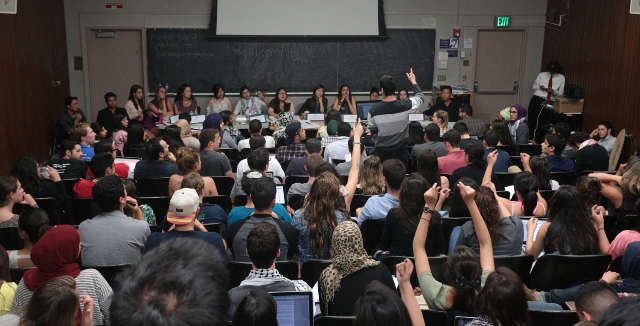
Supporters and detractors of SR #20 fill up Wellman 126 for the External Affairs Commission meeting. Photo by Brian Nguyen.

Kapur and Shihadih said that the author and co-authors learned from last year’s mistakes and went into the process this year with more planning, organization and structure.

Students argue resolution targets Israel, polarizing
The UC Office of the President (UCOP) released a statement in May 2010 addressing the divestment bills that had been discussed at two UC campuses that year.

Former UC President Mark G. Yudof, Regent Russell Gould and Regent Sherry Lansing said in the statement, they “will not bring a recommendation before the Board to divest from companies doing business with the State of Israel” until the United States “government declares that a foreign regime is committing acts of genocide.”

The statement also said, “This isolation of Israel among all countries of the world greatly disturbs us and is of grave concern to members of the Jewish community.”

Groups on campus, such as Aggies for Israel and Aggies Against Divestment, raised similar concerns regarding the resolution.

“One common argument the pro-divestment side said was it [the resolution] doesn’t target Israel,” said Avram Titus, a fourth-year political science major, leader of the Aggies Against Divestment movement on campus and a brother of Alpha Epsilon Pi. “Because the resolution targets companies, if it’s truly targeting human rights violations, then those committed in other countries would be included. This is solely about Israel and Palestine. It’s saying this company commits violations in this country and the resolution doesn’t look at anything else — it’s targeting that country.”

Additionally, representatives from the anti-divestment stance brought up the concern during the senate meeting that the resolution created a divisive environment on campus.

“Any resolution that looks like SR #20 has absolutely no potential to do good on campus,” said Danny Eliahu, a third-year mechanical engineering major and president of Aggies for Israel. “It’s not that the intentions are impure … Regardless of the outcome, nothing good comes out as a result. There’s a problem with the resolution itself and the atmosphere is bad for the campus. There are better options, but they’re neglected.”

Kriti Garg, chair of the Ethnic and Cultural Affairs Commission (ECAC) and a third-year international relations and community and regional development double major, said that she feels that saying the issue is divisive isn’t a reason that it should not be discussed.

“No one is arguing that this issue is not divisive, but that is all the more reason we should be talking about it, and learning about it, and helping educate others,” Garg said.
Former ASUCD senator Ryan Wonders, a third-year international relations and political science double major, said he feels it is irresponsible for student government to take a stance on a massive political issue like this.

“The way that SR #20 presents the issue and the way that its authors have executed their process of promoting it has done nothing but divide students,” Wonders said.

What is the BDS movement?
The term “BDS movement” was brought up frequently throughout the legislation process of SR #20, specifically by the anti-divestment side. According to Eliahu, BDS stands for Boycott, Divestment and Sanctions, and is a movement against Israel. The BDS movement website states “BDS is a strategy that allows people of conscience to play an effective role in the Palestinian struggle for justice.”

Titus said that the BDS movement actively asks for the end of Israel as a Jewish state.

“Minority rights are not protected if you look at the Middle East as a whole,” Titus said. “There’s worry among Jewish citizens that they’d be targeted, there’d be attacks. BDS is thought of as a peaceful tool against Israel and human rights violations. But it’s under the surface that it’s to attack the state of Israel.”

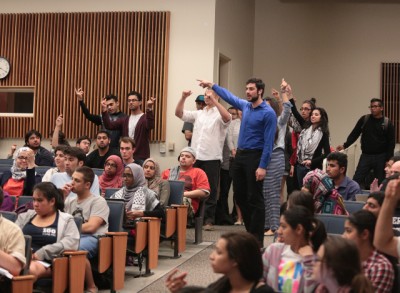
Members of the public react to a statement made by a speaker during the Business and Finance Commission meeting. Photo by Brian Nguyen.

BDS co-founder Omar Barghouti visited UC Davis on Jan. 16 to speak about Palestine and global solidarity movements. According to Titus, Barghouti was invited by SJP, Middle East/South Asia studies (ME/SA), Asian American studies, Native American studies and the Asian American Cultural Politics Research Cluster.

“He [Barghouti] doesn’t support the Jewish state of Israel, which causes a lot of discomfort in the international BDS movement. He’s not the only one in the organization who has those views,” Eliahu said. “The connection he has to the resolution is very apparent. He advised the pro-divestment people in Davis on how to bring the resolution forward.”

Wonders also agreed that SR #20 was guided by the BDS movement.

“The resolution is a part of a larger movement called the BDS movement,” Wonders said. “[The co-authors] received wording, guidance from this movement — [the resolution] was adjusted to fit the political system and climate of the campus.”

Reactions
ASUCD senator and second-year political science major Azka Fayyaz said that she felt more people had the opportunity to speak this year as opposed to last year, and those from the pro-divestment side who felt silenced last year made their voices heard during this year’s process.

“Last year, the anti-divestment community did everything in their power to make sure that they silenced the pro-divestment community,” Fayyaz said. “This year, the pro-divestment community came out stronger. Regardless of whether or not our resolution will pass or fail, they came out and said, ‘We are going to tell our story too.’”

Schaeffer said he was disappointed with the end result in terms of how the bill failed.

“The idea of having a vice president who can break a tie is to prevent ties from happening. And it’s from my understanding that Max[well Kappes] was perfectly within the bylaw, so I take no fault with him,” Schaeffer said. “My objection though is we have a system set up where we want to prevent ties and it yet permits ties to continue to exist.”

Huey was also upset with how the ASUCD legislative process of commissions and senate worked.

“A big issue with the commission meetings was whether to use parliamentary procedure or not,” Huey said.

Schaeffer said he found it interesting that the resolution was seen by three commission bodies, and yet their opinions were never thoroughly discussed at senate.

“The point of the commission bodies [is] to advise the senate on how that particular resolution affects UC Davis’ campus as well as UC Davis’ presentation domestically and abroad,” Schaeffer said. “And to me, that was never part of the discussion at senate. It was almost like the entire thing was a sham; the senators, before they even ran, knew how they were going to vote or they had given it substantial thought.”

A member of the public speaks out against SR #20 during the Business and Finance Commission meeting. Photo by Brian Nguyen.

Additionally, Schaeffer said people claimed last year that there was a lack of dialogue regarding the divestment resolution. However, he said this year’s resolution lacked in dialogue as well.

“There are many who claim that dialogue is not possible because of the gulf between the two sides, but I think what should have happened that would have made the debate much cleaner was the attempt at dialogue,” Schaeffer said. “I also feel that — and this is something I noticed during the debates — there are people who could not agree on things we thought were basic and understood by both sides … It’s like two ships passing in the night. There’s not real debate going on.”

Both sides expressed that this year’s legislative process, through the commissions and senate, was more civil and fair than last year.

Kapur said that he felt that the fact that it was more civil and more strategic this year contributed to it getting to senate.

Eliahu said he was impressed with all the senators with how respectful and open to listening they were, as well as the ASUCD vice president.

“It was a lot more civil this year but that doesn’t mean it was more productive,” Eliahu said. “The resolution itself isn’t productive.”

Figueroa said that he is proud of the commission chairs despite their political leanings. During the commissions process, Figueroa actively engaged in public discussion.

“I’m an ally [of the resolution] and I’ve been to every commission meeting it’s gone and in the process, I’ve been speaking with the administration on campus climate and general things revolving around that, really making sure students know that there’s more to this bill than what’s written,” Figueroa said. “I am open to changing my mind on this issue and hearing dialogue.”

Many from the pro-divestment side expressed disappointment and frustration with the way the final vote came about.

”We were obviously disappointed, especially with the way it happened with an abstention,” Kapur said.

Maheen Ahmed, president of the Muslim Student Association and a third-year community and regional development major, said that although it is frustrating, the pro-divestment side does appreciate the time the senators and commissioners took to listen during the meetings.

“We are still very hopeful, [and] will keep raising awareness about the issue,” Ahmed said.

Kapur added that getting the resolution to senate was an ordeal in itself.

”People were also very inspired and thankful that we put as much time into it,” Kapur said. “The good in the situation was that we got it to senate, but it was very disheartening for it to fail in that particular way.”

Potential ballot measure, compromise
During the senate meeting, the co-authors brought forth that this resolution could be placed before the student body as a ballot measure.

Kapur said that is an option he and others in favor of the divestment resolution would want to explore, but nothing has been decided.

Eliahu said he has some concerns about putting forth a ballot measure.

“I have some qualms with it being on a ballot. The resolution itself isn’t accurate or a holistic representation of the conflict. People would take the words of the resolution for granted,” Eliahu said. “It’s bad for voting and bad for the community.”

According to Schaeffer, an issue he has with a ballot initiative is that there would be a flawed turnout, with majority of voters being proponents or opponents of the resolution.

Supporters of the resolution react after the ASUCD senate voted on the resolution early in the morning on May 9. Photo by Brian Nguyen.

“There is no way of voting on a ballot initiative stating you don’t care or you don’t think it’s relevant to the UC system. So like with a fee initiative, it requires a 20 percent turnout so that ensures we have the sufficient amount of voters who care,” Schaeffer said. “But with a nonfinancial-related fee initiative, that requirement isn’t there. Out of 26,000 undergraduate students, we’re going to have less than 1,000 voting, or less.”

Similarly, Titus said that asking people who are uninformed on an issue to make a judgment call is unfair and biased.

Huey said that a ballot measure could get more of the student body involved and aware of divestment.

“[A ballot measure] is an interesting idea,” Huey said. “If the community does want to and has the ability to carry out a ballot measure campaign, so many more students would be involved.”

Fayyaz said that she feels a ballot measure would be a good idea; however, she thinks that the same issues brought up during the legislative process this time around would be brought up when trying to put something on the ballot.

“The same situation that happened within the legislative process this time around might happen when they are trying to put something on the ballot, because the conversations that will happen are that this is one-sided and this is divisive,” Fayyaz said.

Kapur said that he is not opposed to sitting down with those against divestment to try to work on future resolutions. He and Eliahu had a meeting with each other on May 15, a week after the resolution had been seen in senate, to start a dialogue.

“I feel that both sides have some principles or ideologies that’s not going to be compromised, Kapur said. “Regardless of what bill we put out there, if it says divestment in Israel, there’s going to be a core group of people at this University and outside of this University who are going to go fully against it. I’m willing to compromise and have a conversation.”

CLAIRE TAN and PAAYAL ZAVERI can be reached at managing@theaggie.org.

Photos by Brian Nguyen. 

Critically acclaimed writer Yiyun Li teaches at UC Davis

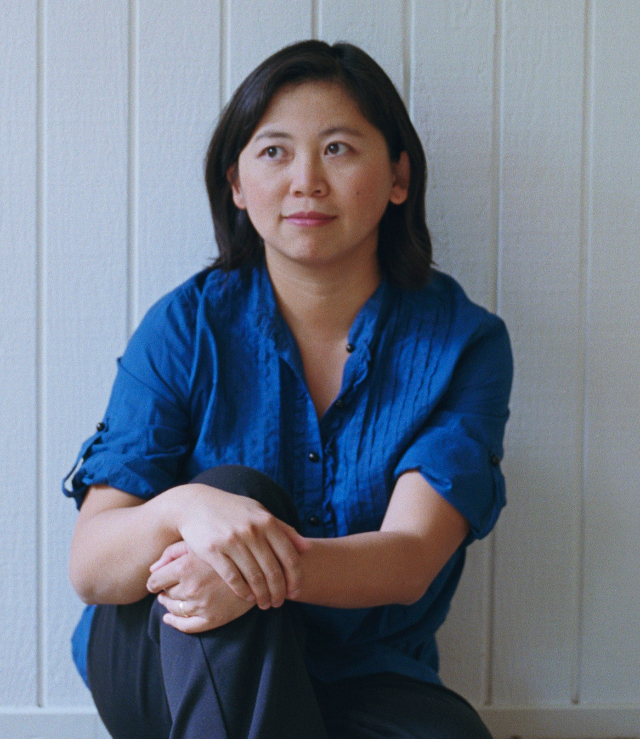
Whether a hobby or an academic pursuit, creative writing calls for inspiration, and award-winning writer and UC Davis English Professor Yiyun Li has been inspiring her students since she began teaching here in 2008.

Among her many achievements, Li has won numerous awards for her writing, including the Whiting Award, the Lannan Foundation Residency fellowship, the 2010 MacArthur Foundation fellowship and most recently the 2014 Benjamin H. Danks Award. She was also named one of the 21 Best Young American Novelists under 35 by Granta, and one of the top 20 writers under 40 by The New Yorker.

“Being awarded is an external confirmation, and it’s good to have confirmation of your work. These awards are external and they don’t change how I look at the world, they don’t change how I write,” Li said.

Li has become a locus of literature, making people more aware of UC Davis and bringing prestige to the creative writing program.

“What I think should be most important to people is the quality of her work and what she brings to the University as a teacher,” said UC Davis Associate Professor of English and Director of Creative Writing Lucy Corin.

Two of Li’s undergraduate students describe what it is like having such a critically acclaimed writer not only as a teacher, but also as a mentor.

“It was a little intimidating, but because she is so friendly and down to earth, you kind of forget, but then you remember,” said fourth-year English major Seychelle Steiner. “I really want to be there because she knows what she is talking about.”

Steiner said that she refers to the things she learned in Li’s English 100F class whenever she writes.

“I think it is incredible to have someone like that be a mentor and pass that kind of knowledge down,” said third-year English major Kate Bollens.

In the last two years, Bollens has taken several classes with Li, whom she claims is one of the best teachers at the University.

“I personally love learning from people who are considered masters in their profession because they know exactly what they are doing,” Bollens said. “This is what I want to be able to do too, and it’s inspiring to see it.”

Li herself looks up to those she considers masters in storytelling, specifically classics of Russian and Irish literature. She also keeps up-to-date with contemporary writers, which is advice she often gives to students.

“They really have to read the books and be patient,” Li said. “Some of the students, especially the young ones, want to be the next, hottest young writer in The New York Times, but writing is not a race.”

In addition, many students should not rush into graduate programs, according to Li.

“I think it’s important to learn about the world,” Li said. “You need to live. Any kind of experience is good for a writer.”

On the other hand, Corin stated that there is the long-standing binary debate about whether a writer needs to experience the world or whether imagination is enough. However, she believes these don’t conflict.

“If you went out and really challenged yourself to put yourself in unfamiliar situations to see what your education has done with you so far, then you know yourself well enough to make a wise decision about graduate education,” Corin said. “It’s a soul-searching kind of a moment.”

Recalling her own soul-searching moment, Li was in a science program to get her Ph.D. when she took her first creative writing course. It took her about five years to decide to leave science for writing.

In Corin’s opinion, the world would be a much better place if people didn’t think they had to choose one discipline over another, but were able to incorporate both into their lives.

“I hear from students all the time who are trying to balance the things about themselves that sometimes are in conflict with the expectations that the people that they love have for them,” Corin said. “For writers, a lot of times, writing is the locus of that discord.”

According to Corin, Li’s success wouldn’t have as lasting an impact if she wasn’t equally committed to both teaching and to the art itself.

“It’s one thing to have someone having a lot of success, but it’s another thing to have someone who is having a lot of success who is dedicated to having that be meaningful to the next generation,” Corin said.

And one thing that is meaningful to the next generation that both Steiner and Bollens attest to is Li’s skill at giving helpful, constructive criticism in a way that does not discourage a young writer.

“All of her comments are very thoughtful, and are only there to make you a better writer and to make your characters richer and your plot more complex,” Steiner said.

It is this process that makes teaching a learning experience for Li as well.

“Writing is one thing that students learn from their professors where professors also learn from the students. Just reading students’ stories I can think about how to write too,” Li said. “I love all my students at Davis.”

EMILY MASUDA can be reached at features@theaggie.org.

Courtesy photo.

The Maturing Moviegoer: Be a Cowboy

0

Eli Flesch

This week, I had the honor to meet Amat Escalante, winner of the Best Director prize at the 2013 Cannes Film Festival, arguably the most renowned festival of its kind in the world. He was there to screen his new film Heli. As it happens, there is a coming-of-age story in this fine piece of work. It’s a tale that recounts the hardships and trials that 17-year-old Heli has to endure as the Mexican Drug War slithers its way into his home and life.

This column will focus on the power of trauma and family in coming of age. It’s a topic I am fearful to venture into — I have had no experience with major trauma in my childhood, and I have made no official inquiries into the matter.

In a Q and A session after the movie, Escalante described the film as “A mix of horror, documentary, [and] western maybe.” Perhaps this reflection and the fact that I do have a family can help give insight into the residual effects of trauma on age. And in turn, by focusing on the extremes, we can gain a better understanding of more commonplace struggles.

The horror aspect of the movie is easy enough to glean. The violence that the drug war brings is demonstrated unflinchingly, graphically and truthfully. The realism that the movie portrays gives it its documentary feel. In a way, the violence degrades Heli until he finds redemption in vengeance. Then, he opens up more to the possibility of life.

It goes without saying that youth provides many challenges. But everyone seems to have the mindset that these adversities just make a person stronger. I would like to argue against this notion. Certain things may very well make us weaker. What is aging if it isn’t losing some of the vitality and innocence taken for granted at our age?

This is getting to be a depressing column. I’m sorry — it was inevitable. Fear not — the smart, chivalrous and valiant Eli Flesch will find a silver lining eventually. For now, let’s look at what might cause a person to grow weak, and how the idea of a Western movie addresses this. Often, a Western will deal with strong themes of individualism and personal struggles against villainy and unforgiving environments. They’re wild.

In any genre where the individual is put to the forefront, the inner thoughts and motives of a character must be challenged. Now, picture yourself standing in the burgundy-rubbed, extraterrestrial landscape of Monument Valley. Bullet in your belly. Miles away from the anaesthetizing qualities of a good whiskey. You’re weak, but you know what, there’s some romance in it. For all the orange dust in your lungs, that valley still looks good as ever. But all you think of are the people and events that brought you to this predicament.

Many people lose family members growing up. When these dearly departed have taken their leave, they take a piece of everyone who has held them in their affections. Strength may not recompensate the living. But instead of strength, how about wisdom?

I may have just defeated my own argument. Because the more wisdom you have, the more knowledge. And the more knowledge, the more power. Power, that thing so often equated with strength.

Here, I take wisdom to be the recognition of weakness, and the way a person subsequently responds. And how do people respond? Growth. Especially for children carving their paths to adulthood.

Growth comes in many forms. Some people grow up, taking responsibility for themselves. Some grow down, falling into despair. I believe the direction a young child takes is largely a product of the people surrounding them. Heli had his sister and wife to overcome the pain and degradation he experienced at the feet of the cruel “narcos.”

My final thoughts? Through trauma or struggle, keep good company. But be a cowboy. Have a vein of individualism that runs steadfastly. This compromise births wisdom, something vital in every age, but especially in youth. You don’t need a gray beard that grows a foot long to be wise.

To just send some general praise to ELI FLESCH you can reach him at ekflesch@ucdavis.edu or tweet him @eliflesch.


Guest Opinion: The View from Orchard Park: On the Coming Demolition

0

Before they announced that our homes would be demolished, before they started posting increasingly frequent notices on my door reminding me to leave, before my neighbors emptied out their apartments one by one, the University was already attacking Orchard Park. Over the last few years, the UC has raised the rent year after year after year. Housing needs to cost no more than 25 percent of residents’ monthly income in order to be considered “affordable,” and today, an Orchard Park apartment costs around 60 percent of a TA’s monthly income. A community is considered to have an affordable housing crisis when rent consumes more than 30 percent of a resident’s income. But rather than solving the crisis, the UC plans to worsen it by evicting residents from Orchard and Solano Parks.

When the UC first officially announced that Orchard and Solano would be demolished, their announcement hinted at the nature of the proposed changes to graduate student housing when they recommended that Parks residents should “take out loans” to pay for their future housing. We discovered that at a City Council meeting, the University had shown plans for “high-density housing, shopping, and entertainment.” The plans for this development (a P3, or Public Private Partnership) on the site of Solano Park had been presented to the City of Davis before the UC thought to tell current residents the plan.

The University has now shown a series of plans for their “replacements” for Orchard Park. They held two town halls with the residents this past Winter Quarter. Those of us there found the town halls were designed more like a one-way communication than a dialogue with the community. In fact, the University planners and Graduate Dean Gibeling seemed surprised that any residents had strong opinions about the demolition of our homes or the need for affordable housing for graduate students — a need which the Chancellor’s Graduate and Professional Advisory Committee has presented to the Chancellor’s office based on their surveys of student housing needs.

The proposed replacements were clearly luxury apartments, including tanning salons and shopping amenities — quite unlike the sturdy, comfortable apartments we have now, surrounded by grass, trees and community areas. Most worryingly, the projected rents were far above what any grad student could possibly pay. Initially, the UC pitched rents of $1,400 for a two-bedroom — a $500 rent hike over my current rent, and almost my entire monthly income. After the town hall meeting, they “brought down” the rent for a small fraction of the units, but at a rate that is still a significant rent hike for residents paying $906 for a two-bedroom.

The UC administration recently quietly announced a “pause on planning” of Orchard Park in the face of organizing by the residents against this redevelopment. This pause was long overdue, after years of residents, GSA reps and Chancellor’s advisory committee members telling UC every step of the way that their unaffordable and inaccessible development plan was not suitable for graduate student or student family housing and would contribute to the serious affordable housing crisis in Davis.

The UC has so far not guaranteed any affordable housing to replace the Parks. The planning pause makes things even less clear, and we now have very little idea what the University has in mind for the place where we now live. However, my fellow residents and I are still being asked to submit notices to vacate as soon as possible.

These communities enable us to live in Davis on TA salaries; provide a place for low-income students; enable parents on campus to stay in school and teach sections even when they have young kids at home; and more. All these benefits should recommend them to the University — even from an administrator’s perspective. These are all things that attract students to Davis and let them successfully complete their degrees.

Yet it has become unpleasantly clear that from the administration’s perspective, our tree-shaded homes are an eyesore at their beloved “gates to campus.” Our housing, because it long ago “paid” for its own construction, is not moving around enough investment capital. Our ability to live on our meager paychecks is blocking our capacity to take out more student loans.

We are among the last affordable, community-oriented housing left on campus. We live in a place that should be the future of this University, but the University treats us like we’re already gone. That’s why we’re gathering for a Party for the Parks from 12 p.m. to 5 p.m. on May 22, including community dialogues and speak-outs on affordable housing, activities for kids, a barbecue, potluck lunch and games. We’ll meet at the MU flagpole at 12 p.m. See you there.

Caroline McKusick
Ph.D. Student, Anthropology, UC Davis
Orchard Park resident

UC Davis holds 45th annual Whole Earth Festival

From May 9 to May 11, UC Davis celebrated its annual 45th Whole Earth Festival. This year’s theme was “Curiosity Connects.”

The festival featured live performances, speeches and a variety of vendors selling artwork, clothing, jewelry and accessories. There were also service and education booths and spaces designated for activities like hula-hooping, workshops and spiritual development. Some booths had artifacts specially designed to make children more conscious of the environment. The festival was an alcohol-free and zero-waste event.

Mike Erickson, UC Davis alumnus and this year’s Food Booth director, has been involved in the festival since his time as an undergraduate. He enjoys seeing students involved and dedicated to making the festival as successful as possible.

“What I really like about the festival isn’t what’s presented to the crowd,” Erickson said. “What I like is that this is entirely student-run. All these students get together and come up with these ideas about what they want to present to the crowd and they make it happen. That’s what the festival means to me.”

Sierra Belden, a fourth-year animal science major, said that the festival is truly a way to bring people together and connect with one another.

“The Whole Earth Festival is an expression of our community,” Belden said. “It’s a really cool way for students to interact.”

According to Chris Hong, a UC Davis alumnus and this year’s publicity director and program designer, both participating in the festival and planning it allowed individuals to explore and appreciate everything the event has to offer.

“When you’re at a Whole Earth Festival, you feel like you can do anything you want,” Hong said. “You can just be yourself and no one will really judge you. There’s a lot of different things going on — music, arts and crafts, workshops — you’re free to explore anything you want. And everyone always has fun at the Whole Earth Festival. You can see it too.”

Hong said that people who attend the event on any of the days will walk away believing that the festival is very diverse and insightful.

“Students can definitely learn from the education aspects,” Hong said. “With everything from diversity to sustainability to cultural competency to anything about the environment. These are all free workshops and seminars and people can learn a lot from them. There is a lot of opportunity to participate with yourself, with others and with the festival.”

Sally Shine, a UC Davis alumnus, attended the first Whole Earth Festival in 1969 and has witnessed the festival’s growth over the years.

Shine admired the students’ efforts to collaborate on ideas, to take care of the environment and to provide entertainment to guests from all over the world.

“There is a tremendous amount of work involved, but everyone comes away with knowing that it is considered to be a nice festival to be at,” Shine said. “These people here are all doing our very best and having the most fun that you can have. It’s an experience that’s hard to talk about because it’s from a place where one’s intention is greater than what any one person can sum up. And things happen that you could never imagine.”

On the night of May 11, Shine brought the three-day festival to a close with words of wisdom and hope.

“I try to keep an authentic ceremony that genuinely intends to express the gratitude for the time that we’ve had together and sow the seeds for a good year and us being able to do it again next year and that people benefit from the festival,” Shine said afterward.

JASMINE MANGABAY can be reached at campus@theaggie.org.

Photos by Rosa Furneaux.