


55.7 F
Davis

Davis, California

Monday, December 22, 2025
Home Blog Page 890

Honorable Mention: Ashley Edwards

0

As one of the UC Davis women’s soccer team’s three captains, senior midfielder Ashley Edwards earned first team accolade and received All-Big West recognition, on her way to concluding her impressive career at UC Davis. Edwards has improved steadily every season and has saved the best for last, posting consistently high stats this season.

Edwards began playing for the Aggies in 2010, starting six of the 17 games that season and tallying three points on a goal and an assist in her first year. In her sophomore season, Edwards scored two game-winning goals and finished fourth on the squad with eight points. The 2012 season was one of the biggest highlights of Edwards’ career at UC Davis, as she was a starter in all 19 games. Her game against San Jose State saw her lead the Aggies with a team-high four points on two goals. She continued her good form and finished the season with a team-high seven goals.

Before the start of the 2013 season, Edwards earned one of the 12 spots on the 2013 Big West Conference Preseason All-Conference Team. With the momentum of earning preseason accolades, Edwards managed to continue her good form in every game this season. Of her four goals scored, three ended up being the game-winners against Cal State Northridge, Pacific and Drake University.

Edwards finished her last season as an Aggie with a team-high nine points, which consisted of four goals and one assist. Besides scoring crucial goals for the Aggies, she also made the most of her chances, as evidenced by her 0.182 shooting percentage, which was tied for first on the team.

Edwards was also very durable throughout the season and managed not to pick up any major injuries along the way, as she only missed one of the Aggies’ 18 games this season. This consistent availability allowed her to continually contribute to UC Davis’ attack.

Victory can only be achieved by constant self-improvement and optimization. Edwards, who kept making progress in her career and posted team-high results in each season, helped the Aggies end their season with their second-highest finish since joining the Big West Conference.

With all of her accomplishments in the last four years, but especially her outstanding play this season, Edwards is worthy of being recognized as an honorable mention.
Female Athlete of the Quarter: Alycia Cridebring

0

Coming into the 2013 cross country season, senior Alycia Cridebring had lofty goals for her final year at UC Davis after scoring an All-Big West Conference team nod in 2012.

Cridebring, despite battling an injury, led the Aggies to a second-place finish at the Big West Championships and a seventh-place finish at the NCAA West Regional meet.

A native of Pleasant Hill, Calif., Cridebring was a three sport athlete in high school, lettering in track and field, cross country and soccer. She made a splash at the CIF state cross country meet as a senior while qualifying for state championships twice in the 1600-meter race for track and field. Cridebring was also named to the second-team All-Diablo Foothill Athletic League.

The 2013 season started off well for Cridebring who led the Aggies to a first place finish at the Aggie Open with a pace-setting 13:50 4K. This marked the second year in a row of Cridebring winning the Aggie Open.

This meet was followed by two straight missed events and a poor finish at the Wisconsin Adidas Invitational which saw Cridebring finish 148th overall and fourth for the UC Davis team.

Like a true leader however, Cridebring rebounded from her poor meet and dominated at both the Big West Championships and NCAA West Regionals.

At Big West Championships, Cridebring led the UC Davis team with a seventh place individual finish, followed closely by teammate senior Sarah Sumpter. While each gave an outstanding effort in the race, the depth of the Cal Poly team proved to be too much as the Aggies fell to second place.

Going into the NCAA West Regionals, Cridebring and the entire UC Davis squad had the National Championships in mind.

Cridebring was sensational, running a season-best 6K time of 20:08. This was good for a 19th place individual placing, which led to a seventh-place finish for the Aggies and revenge against Cal Poly.

Unfortunately, the Aggies were unable to sneak into NCAA Nationals and Cridebring failed to receive one of the at-large individual bids.

While the cross country season is over for Cridebring, Aggie fans will be able to see her dominate once again when track and field season rolls around.

Last season, Cridebring was the Big West Conference Champion in the 1500-meter race and finished second in the 50,000-meter race. She managed to get her name into the UC Davis record books several times, finishing fourth in school history in both the 1,500 meter and the 5K. Cridebring also ran the indoor 3K in 9:26.97, good for second in UC Davis history.

While Cridebring is finishing up her career as an Aggie, she is planning to begin a new career in environmental science. If her time representing UC Davis is any indication, there are only good things to come from senior Alycia Cridebring.


Women’s Team of the Quarter: Golf

0

The women’s golf team began the the 2013 season as four-time defending Big West champions, so expectations and the pressure to succeed were high as soon as the year kicked off.

The team responded impressively and have put together an exceptional fall season. Three top-five team finishes showcased the team’s talent during the quarter, along with a sixth place result sprinkled in. The team never finished worse than 12th in any tournament and won the team event at the Hoosier Fall Invitational in Bloomington, Ind. on Oct. 20 by a combined 16 strokes.

This tournament also brought Betty Chen into the limelight as she won the individual title in Bloomington with a scoreline of 3-under 210 and won the competition by two strokes over the second-place finisher. Chen was awarded October’s Big West women’s golfer of the month in recognition of her tournament victory.

“Betty’s victory was a definite highlight of the fall,” said head coach Anna Temple.

The team finished their fall season at the Stanford Intercollegiate, placing 12th in the team competition. This was a solid finish as the tournament featured nine top-25 teams with three of those inside of the top 10 according to the Golfstat weekly rankings. The Aggies finished the fall season ranked No. 38, a ranking that has steadily increased over the course of the fall season.

Beverly Vatananugulkit finished tied for 23rd individually in Stanford, adding another strong showing to her record. She has finished in the top 30 in individual competitions at five out of the six tournaments played with a third place finish in the Edean Ihlanfeldt Invitational.

With Chen and Vatananugulkit leading the way along with senior Jessica Chulya, the team is poised to add another conference championship once play resumes in February. The sustained success of the team combined with the promise of more to come makes them the fall Women’s Team of the Quarter.


Men’s Team of the Quarter: Soccer

0

The Aggies came up just short of their ultimate goal this season, winning the NCAA Men’s Soccer Championships. However, with multiple highs and lows this year, they persevered and still fought their way into the Big West semifinals, deservedly earning the title of Men’s Team of the Quarter.

The biggest upset for the team this season was not making it to that final coveted championship match. In a well fought battle between the Aggies and UC Irvine, the Anteaters ultimately came out on top in their semifinal victory over UC Davis by the score of 2-0 in Irvine, Calif. This marked the last game of the year for UC Davis and the last game of the seven graduating seniors’ UC Davis careers.

“I thought we played well but the result against Irvine just didn’t go our way,” said senior goalkeeper Omar Zeenni.

Although the Aggies fell short in the end, the athletes played in multiple pivotal games that several players agree were huge highlights of the year. Playing at one of the most intimidating stadiums on the west coast, the Aggies took on nationally-ranked University of New Mexico in Albuquerque, N.M. on Sept. 27.

“From a team aspect, one of our best moments was definitely beating New Mexico at New Mexico and knowing how big that game was on the road for us,” said senior captain forward Alex Aguiar.

Other big wins for the Aggies included their first matchup at home versus UC Irvine, besting the then top-25 team 2-0, along with clinching home-field advantage in the first round of the Big West Tournament thanks to the end of the season wins versus Cal Poly and Sac State. They capped off a fantastic season by winning in their first round Big West Tournament matchup at home against UC Riverside that carried them to that semifinal game in Irvine.

Overall, the Aggies fought hard throughout the year with some big wins on the road and at home. With 23 players returning, there are high hopes for the team’s future success.

“I have the utmost confidence in the returning players to train hard and win the conference tournament next season,” Zeenni said.

For the tremendous work the UC Davis men’s soccer team has put in this season and the success they have earned, they have earned the honor of being called the Men’s Team of the Quarter.


Trying to understand: Everything

0

I’m still trying to understand everything. Well, almost everything. Not sweatpants. I completely understand sweatpants.

My goal in this quarter’s worth of columns was to explore some random and commonly unthought-of things in life and that’s exactly what I did.

However, even though this column marks the end for this quarter, I still find myself contemplating many aspects of humanity in general. Another 20 inches worth of text is nowhere near enough space to investigate and analyze all of the confusing situations that life sometimes presents me with.

So, instead, I shall leave you with some wise words: Go ahead and accept the confusion that most likely consumes you, and then reward yourself with a new pair of sweatpants. It’s a win-win situation.

I’ve realized that when I take the time to think about all of the intriguing circumstances that I am commonly witness to, I feel obligated to rant about them and find an answer as to why something is the way it is.

In my first column, I explored the evolution of flirting and came to the conclusion that men and women are just too confusing for their own good.

In the second, I pondered what distinguishes a joke or story from being “funny” or being flat-out hilarious and ROFL-worthy. Apparently, it just depends on how willing one is to let their laughter flow freely. I’ll admit that I’m still a little confused as to how some people, upon hearing what I consider to be a hilarious joke, can control their laughter so it doesn’t reach levels of embarrassment.

Because certain people are just so freaking funny that I don’t understand how others barely acknowledge their humor. It’s like “Are you actually trying not to laugh right now? Or what? Because that shit was funny.”

My column for the third week featured my observations about what goes on in the opposite sex’s heads when it comes to attraction. That topic defeated me because there’s no clear-cut answer to the way in which genders operate when dealing with flirtation and making the first move. I could go on and on, but I’ll save that for when I want to annoy my roommate.

I talked about the campus’ dining commons (DC) in my next column and about how shocked I was the first few weeks when I observed people eat three meals worth of food in one sitting. The DC is just one of those things that I think I over-analyze, but I wanted to talk about it and shed some light on something I thought most people wouldn’t spend the time to think about.

Week five? Ah yes, my 20 inch exposé on how people waste their words. I don’t think I want to understand why people have such a limited and incorrect vocabulary.

Instead, I’d rather live in a world where everyone’s vernacular flourishes and people don’t use “literally” in such a serious manner. Warning: that word has a different definition than “figuratively.” In my opinion, “literally” should mostly be used for comedic emphasis and not for describing how your mind just literally exploded.

I’ve also visited the subject of parental influences and how, all of a sudden, people realize that the way they conduct themselves may resemble their parents.

Lastly, I explored the Death Star on campus, and I mean that literally. I started off confused about the supposed myths of this building. I quickly realized that, after conducting an experiment, it is indeed extremely simple to get lost and become unable to find your next class in SOCSCI.

With all that was said and done, I had a blast sharing my often sarcastic and exaggerated thoughts with whoever ended up reading these columns and let me assure you of something…

You will hear from me again — whether you see my name in print, my columns online or my physical being screaming from the balcony at Chick-Fil-A, you shall hear from me again…


SAVANNAH HOLMES can be reached at skholmes@ucdavis.com or go read her crazy blogs at savannahkholmes.wordpress.com if you start to miss her sarcasm and random rants about life.

Guest Opinion: The Aggieopoly

1

It’s that time of year. You’re scrambling on gift ideas for your family before finals hit. You’ve settled on buying some nice UC Davis mugs, T-shirts and sweatshirts for the parents and cousins.

Soon, you’ll be getting hosed by one of the best — and worst — strategies this university has cooked up.

Combine terrible selection, high price and a cumbersome process together and you’ve got the prime UC Davis shopping experience. It’s awful and nowhere close to the typical Division I merchandising operation.

You may remember that the role of spirit wear and merchandise is meant to promote the university. Students act as walking billboards every time they step outside the confines of Davis proper.

But those billboards cost anywhere from $20 to $60. And best of luck locating a decent discount or sale for those items. They’re sold by one of the most universally hated institutions on campus (second only to TAPS): the bookstore.

Yes, UC Davis’ bookstore — which also operates a few other outlets on and off-campus — is the guard between you, your money and the latest blue-and-gold gear.

But they also act as a producer, too, under the “Aggie Wear” label. Aggie Wear produces such hits as the signature UCD block letter sweatshirts, along with a variety of T-shirts.

Most schools license their trademark to a variety of companies. Some, like Nike and Under Armour, specialize in high-end gear. Others, like Jansport, Russell or Gear for Sports, make mid-range to low-end merchandise.

Think of UC Davis’ Aggie Wear label as a one-size-fits-all competitor to Nike’s high-end products, while also mass-producing mid-priced T-shirts and other clothing to compete with Gear and Russell. Simultaneously, the markup for Aggie Wear is just as high as the standard markup for companies like Nike or Jansport.

But the lower cost of production and lack of a middle man (Nike, Jansport et al.) equates to a higher profit margin for UC Davis.

But the kicker to UC Davis’ merchandising scheme comes at the point-of-sale. If you want to buy a UC Davis T-shirt, you’re heading to one of three places — the UC Davis bookstore, the bookstore’s website or Amazon’s UC Davis outlet.

All three are, at some level, controlled by the university and only one offers a full selection: the brick-and-mortar bookstore.

That’s what Andrew Carnegie would call vertical integration, or controlling as much of the process from production to sale as possible. So every time you walk in to the bookstore, you’re buying into UC Davis’ Aggieopoly.

The bigger problem for our fine university is that UC Davis has no image among consumers. And no image is almost as bad as having a bad image.

Since UC Davis predominantly admits students from across California, especially the Bay Area, Sacramento and the San Joaquin Valley, you would think there would be plenty of UC Davis promotion (e.g., clothing) on sale for people to buy in those areas.

Think again.

While on a trip to the Bay Area, I stopped at an outlet mall in Livermore and found myself in a Lids store. I decided to take a gander at the college sports section to see which colleges and teams were featured. The names: Stanford, Cal, USC, Fresno State, Cal State Fullerton, and — wait for it — University of the Pacific.

As embarrassing as UC Davis’ lack of inclusion, it’s a problem that is easily fixable.

First, loosen up the approach to licenses.

Give high and low-end merchandisers greater access to UC Davis marks and copyrights. Most people know that greater competition leads to cheaper products for consumers. And, while you’re at it, don’t undercut those licensees (who pay money to use your trademarks) by making your own cheaper clothing.

If I were to buy a week’s worth of UC Davis gear (comprised of seven T-shirts, two sweatshirts and a hat) I’d be spending $250. If I were to buy the same items in Fresno State gear, I’d only spend $170.

Second, get UC Davis gear on shelves year-round.

I’m from Fresno, where the Fresno State Bulldogs are on the same level as a professional team in any big city. This is perpetuated when you can buy Bulldogs gear at Walmart, Target, Costco, Sports Authority and even convenience stores.

This is the same approach UC Davis needs to take with retailers in Sacramento, the Bay Area and the rest of the Central Valley. Get our name out there.

Let’s end the Aggieopoly and get UC Davis students buying better and cheaper merchandise to support Aggie Pride.


ALEX TAVLIAN is a fourth-year political science major. He can be reached at aetavlian@ucdavis.edu.


Cosmic Relevance: New Hippie

0

What is a hippie? A hippie was a member of the 1960s counterculture movement, characterized as a rejection of the 1950s ideals of middle class lifestyle. At its core, the hippie movement was about breaking away from the norms of society and experimenting with ideas to create social change for a better existence. From the hippies, we get flower power, free love and fighting the establishment.

Although the heyday of hippie era is long gone, it appears that its legacy still may linger in the Davis community.

For instance, let’s visit a Davis tradition — the Whole Earth Festival, a three-day free event resembling Woodstock. It’s hardly a surprise that Whole Earth’s origins are directly rooted in the hippie era. The experience was all about inspiring visitors, “in the ultimate goal of learning about activism, wellness and the environment.”

Besides its roots, and being engulfed in tie-dye, how does this festival have hippie elements? Well, the weekend is about bringing a community closer together peacefully, furthering a commitment to sustainability as a nearly zero-waste event, and promoting learning opportunities via documentary screenings and open discussions.

Aside from the Whole Earth Festival, there are the Davis Tri-Cooperatives (co-ops). Although all the current student residents are far too young to be true hippies, it seems that the community still holds some hippie ethos.

In the hippie fashion, the set-up is a social experiment. The students living at the co-ops volunteer to live an affordable lifestyle dedicated to sustainability and practicality, minimizing their waste output and taking advantage of local resources.

In addition to the engagement in eco-friendly living, the co-ops also embody a message of tolerance. The community is organized through consensus, and each member needs to agree to live with every new member. If the hippies were all about living in harmony, the co-ops are a big step.

Finally, there are the Occupy protests, based off of the hippies’ peaceful sit-in anti-war protests, which they in turn borrowed from the Civil Rights Movement. Those involved in Occupy were using peaceful protests to show discontent for our society’s economic disparity. In a way, the economic inequality is its own struggle for human rights, an outcry against the system that creates vast poverty — against “the man.”

So, I get the impression that there are strong connections between the hippie counterculture and the ideals floating around parts of Davis. But it’s no longer the ’60s. This a new generation, we’re different, aren’t we? So what word would better suit this youth subculture?

I propose the term “earthie.” An “earthie” is committed to the sustainability of our species, and the general well being of all humans. In an increasingly globalized society, this new counterculture is dedicated to the environment and world peace. For example, you’d find an “earthie” at our farmers market, bringing their own reusable bag.

So if these “earthies” exist, where are they? I don’t see any radical activism or grand fights to change the system.

But are new hippies really necessary? Theoretical physicist and futurist Michio Kaku believes so. In his Big Think video “Will Mankind Destroy Itself?” he sees two major trends in the world today: movement towards a “Type I civilization,” or the destruction of mankind.

A “Type I civilization” is a “planetary civilization” where humans have united to effectively use all of Earth’s resources. We are currently in a “Type 0 civilization” and this could be dangerous. The transition between Type 0 and Type 1 is crucial, and our survival as a species depends on it. Kaku argues that with advancements like the internet, we have a fighting chance to unite and spread the human race throughout the galaxy.

So it appears that our generation has significant influence over the future. Unless we unite globally, we could be doomed. Therefore the hippie lessons that may be of the highest importance is our ability to question society’s practices, take care of the earth and take care of each other.

I’m not talking about creating utopias here. I’m talking about trying out new ideas to try to create a better existence for everyone.

If you want to receive more Cosmic Relevance from DANIEL HERMAN you can email him at dsherman@ucdavis.edu or add him on Facebook to watch for links and/or possible blog posts.


Stay Tuned: Let’s Get Creative!

0

I tend to romanticize problems. It explains a lot about my childhood. Like most Harry Potter fans I aspired to be an orphan. In first grade I met my best friend by tragically recounting a fantasy in which both my parents had died horribly in a car accident. We hit it off when she exclaimed that her fantasy-world parents had gone the same way.

It is for this reason that I am terrified of being an artist. For me, fiction and art have always been about the romanticizing of adversity. Crying in the rain is pathetic, but top it off with an epic score and it becomes glorious, moving. Suicide is horrific and illogical, but in iambic pentameter it is beautiful, meaningful.

In the past, songwriting was a tool not to solve my problems, but to validate them. If I felt hurt, a melancholy tune would authenticate my feelings until they felt raw and powerful. Sometimes I would revel in feelings of sadness simply because I knew that they could lead to a song.

Inspiration, and the quest to find it, can be a dangerous thing, but it is also a beautiful thing. Everyone has felt it before. It’s like that moment, when you’ve been trying to remember a name or a place and it’s on the tip of your tongue. And then it comes to you. Like it was sitting somewhere up in your brain biding its time until called, and slowly it trickles down your conscious thoughts.

Inspiration is like that. That moment. You reach and reach and instead of looking for something specific like you do when you’re trying to remember, you reach blindly. And you feel silly and your arms hurt but you just keep reaching because something’s there. You can make out its edges but it’s not quite in your grasp. And then suddenly it’s there, and you’re holding it. A perfect little newborn idea.

In that moment you feel so proud and satisfied and excited but the moment is horribly fleeting, and you are left with a sense of intense yearning. There is nothing more elusive and addictive than creation, and the involvement of melancholy in the creative process often seems essential. Does this mean an artist must sacrifice their own happiness in order to create anything of value?

In 2009, Elizabeth Gilbert, author of Eat, Pray, Love, gave a speech on the elusive creative genius. She discusses how the “freakish success” of her memoir has launched her into a reevaluation of her role as an artist now that she must consider the possibility that her most successful work is behind her.

She goes on to talk about how the Greeks and Romans did not believe in the idea of a person being a “genius,” creative or otherwise. They believed that every person had a genius or a muse and in this way the artist or the philosopher could not take full credit for their work because half the credit went to their disembodied genius.

I think the idea is revolutionary. It is not creativity that kills the artist. It is certainly not inspiration or even the lack thereof that has the potential to rip apart my own self-esteem. It is pride. By tethering the artist to the art, the creators are pulled back and forth by their own creations.

When a piece is received well their egos are launched skyward; when it is received poorly the artist is dragged into a state of depression. That is why the connection must be severed if the artist is to survive.

If inspiration is a separate entity, free to come and go, then searching for it desperately no longer has to be a part of the process. If creativity is tethered to a muse and not the artist, then creation can be used not to validate problems and wallow in sad feelings, but instead to set them free.

Norman Mailer, just before he died, said, “Every one of my books has killed me a little more.” As alternately phrased in the Potterverse, Neither can live while the other survives.

This is why the muse is the missing piece in the modern artist’s process. Whether your muse is the stray cat in your neighborhood or Meryl Streep or even a disembodied voice in your head, it is this separate counterpart that keeps you humble and that takes some of the burden away from finding inspiration.

But a good idea is not enough. You aren’t just picking fruit here, you’re making lemonade. And as an artist, your responsibility lies in squeezing the idea for all it’s worth.


To see what ELLY OLTERSDORF is up to after the column, check out her music channel at LYLE1324 on YouTube or contact her at eroltersdorf@ucdavis.edu.


The Philosophy of Education: Stand Up

0

How many of us have the courage to speak our minds at the risk of offending others? For example, if we cannot understand a professor due to a thick accent or mumbling, would we go to the professor after class and say so?

If we lack the courage to stand up for ourselves, others will not address our needs and concerns because they will not know we are troubled. If we do not understand or can not hear what a professor is saying but do not raise our hands to ask out of fear of embarrassment or insulting the professor, the professor will not repeat.

However, that fear is only in our minds. Most professors sincerely want us to learn, but if they do not know that we do not understand, they will move on. In addition, if you thought a professor’s explanation was confusing, chances are many others feel the same way and will thank you for asking, not look down on you as stupid.

Standing up for ourselves for relatively minor things like asking a question in class takes much less courage than standing up for more important issues, but we must face our fear and do so.

For example, if we realize that our current major is not for us during our third or fourth year here, we should take action by telling our parents and switching majors. If we do so, we will have to spend an extra year or more at the university, but we will have the career that is right for us for the next forty years. The extra time here and the associated costs are worth forty years of doing what we love.

On the other hand, we could do nothing out of fears such as that our parents will not support us financially or emotionally. If we do so, everybody around us will think that we like our current path and thus do nothing, leaving us unhappy with our majors and classes, which will become our careers.

The unhappiness will not go away by toughing it out until graduation; rather, it will become harder to escape as we commit ourselves more. We cannot rely on an external miracle; we must take action to create that miracle ourselves.

For example, in recent years, many students stood up for themselves against tuition increases. They did not fear what others might think and accepted the consequences of their actions, good or bad. When other students saw these actions, they found the courage to take action as well. As a result of these fearless actions, tuition has not increased, benefiting all of us.

Similarly, we should stand up for ourselves and make decisions with the attitude of accepting the consequences, no matter what they may be. If we have never had the courage to make important decisions for ourselves and thus always let our parents decide, they will naturally feel that they need to constantly watch and control us. They will assume that we cannot take care of ourselves, which makes us feel powerless and miserable.

However, our parents act that way because they honestly believe we cannot do anything ourselves. We should consider their advice, but make our own decisions. If we have the courage to make important choices ourselves, such as deciding not to be a doctor even though they want us to be, they will see from our actions, not our words, that we can take care of ourselves. Afterwards, they will back off and become less manipulating.

If we never stand up for ourselves, our parents will never see us as independent and thus will try to control us forever, even when we are fifty, likely making us miserable.

At the same time, we must remember that not everything is worth the time and effort to fight for. For example, spending an hour arguing with a professor about one point on a midterm is not a good idea. The point, even if obtained, will almost never affect the final grade and will not increase our understanding of the subject.

If you believe something is worth standing up for, do so fully without reservation. If you believe it is not worth standing up for, accept it as it is without complaint. Do not stand in the middle; commit yourself to a decision and then stick to that decision until something changes.


To share your experiences with standing up for yourself, contact WILLIAM CONNER at wrconner@ucdavis.edu.


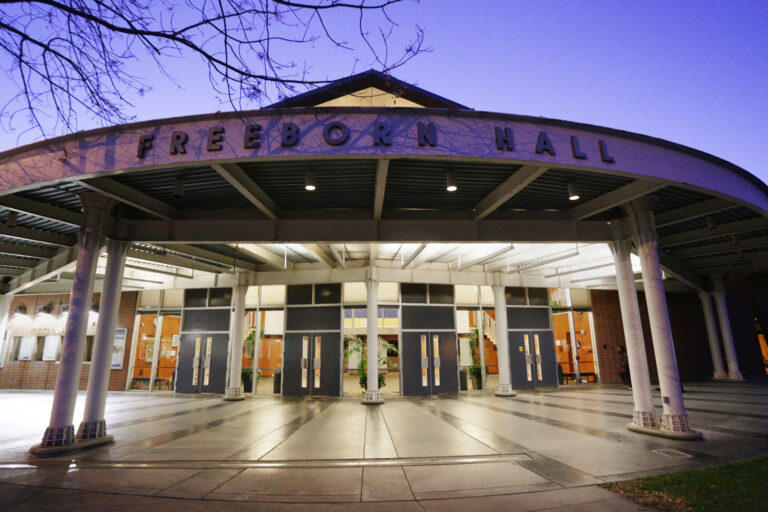
Freeborn Hall to be closed summer 2014

Freeborn Hall, an on-campus lecture hall and event venue, is to be renovated due to necessary seismic updates. The hall is in critical condition and renovations need to be done as soon as possible. It is likely to close down for renovations in summer 2014.

“After being looked at again this summer, it was decided that Freeborn Hall needed to be seismically renovated. It is hardly safe enough for the uses it has now. According to code, it should not be used as a lecture hall. It is barely within legal parameters,” said ASUCD Senator Miles Thomas.

A significant problem with shutting Freeborn down temporarily is the loss of a massive lecture hall on campus. Freeborn Hall can seat 1,800 people and losing this space will cause major issues for professors and students. There are no other spaces on campus that could seat large classes and the new California Lecture Hall is not scheduled to open until fall of 2017.

“Student government is trying to figure out where we would put these lectures. The hall may stay open through the summer because of this issue,” Thomas said.

The future for Freeborn Hall is currently uncertain. Prices for renovation will cost $10 million to $13 million. The renovation would include steel stabilizers and would make the hall earthquake-safe. Demolishing the building and replacing it would cost $20 million to $30 million.

The UC Davis administration is in favor of creating a whole new building that may not have the same function Freeborn Hall currently has. Administration considered turning the building into a space for their offices because they believe it is not utilized enough by students as it is now.

Another use being considered for the new building is to create a space to consolidate various facets of ASUCD. Senator Ryan Wonders said he would like to see the student government sign a contract with Freeborn if it is possible.

“Right now ASUCD is scattered all over campus,” Wonders said. “I would like to see it made into a whole.”

Wonders said that one way to make that happen would be through utilizing Freeborn as a central location for the student government and its many units. However, this is not a priority for ASUCD right now.

“Our units currently on the first floor of the Memorial Union (MU) need to be given space to function appropriately,” Wonders said. “Our focus is on the renovations for the first floor of the MU. Freeborn is on the backburner.”

Another reason for this is an ASUCD acquisition of Freeborn would mean higher student fees, with possible funding coming from the administration. Wonders said that having students pay for the space is not ideal. He also said that if administration paid for the space, they would legally have power over it, which may mean they could use it over students in many situations.

Thomas is in favor of creating a building with a similar function that Freeborn has right now.

“I reject the notion that it is not utilized by students and that students do not need a space like Freeborn. The Conference Center which can also be rented out is not in the middle of campus and costs more,” Thomas said.

One reason Freeborn Hall is not utilized by many student organizations on campus is the strict rules and regulations.

“I believe that the way Freeborn is run should be restructured to make it easier for students to rent and use because it is too expensive and they are not very accommodating to students,” Thomas said.

According to a document of compiled data on events that have been held at Freeborn Hall, there were 25 events run by student organizations from 2011 to 2012, and 23 student-run events during 2012 to 2013. The uses of Freeborn right now include holding lectures, venues for concerts, charity and club events and dances, such as Dormal.

ASUCD units such as KDVS, The Aggie and The Pantry are housed in Lower Freeborn, which sits directly below Freeborn Hall, and will have to move soon after the building is shut down. Any location those units may move to is not currently known, and the move would be especially difficult for the campus radio station KDVS, which will lose its radio license if their broadcast is terminated for a prolonged amount of time.

According to KDVS General Manager Cameron Cairns, the administration has given the radio station until summer 2015 to find a new space. Although Freeborn Hall will be closed this summer, units in Lower Freeborn will still operate for a year afterward.

“Right now we’re just trying to assess how much space is needed,” Cairns said.

Current solutions include a temporary location after Lower Freeborn shuts down until a permanent location can be found, but moving KDVS would not be an easy task.

“It would be difficult to build an entirely new studio in a temporary location, only to have it taken down again,” Cairns said.

ASUCD Senators also showed concern about what will happen to the KDVS studio after Freeborn Hall and Lower Freeborn are shut down.

“We’re currently trying to figure out where KDVS could go. Their record collection, the largest on the west coast, needs a special room at the right temperature and the wiring to the tower in North Davis cannot be put in a portable,” Thomas said.

The renovations for Freeborn Hall are still in very early stages and it is uncertain what the future holds for Freeborn. Clayton Halliday, assistant vice chancellor and campus architect for Design and Construction Management, said the project has not been worked on with Design and Construction Management yet.

“We haven’t been involved directly in helping students and ASUCD to figure out what the programmatic needs are for Freeborn,” Halliday said. “We hope to be doing that sometime in the future.”

Experimental College holds “I Wish I Was Learning” campaign

0

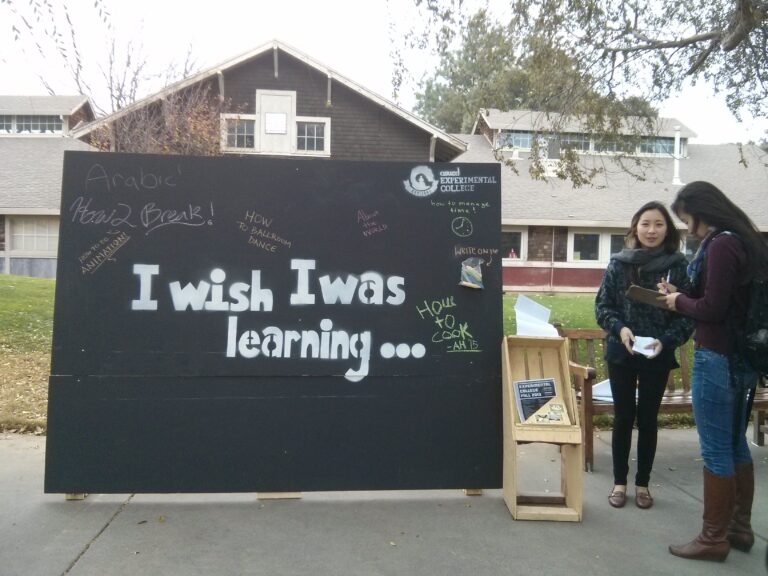
If you have walked past the Silo or Memorial Union (MU) over the past couple days between 10 a.m. and 3 p.m., you may have spotted groups of students writing on a large blackboard.

In an effort to connect with the UC Davis student population, the Experimental College is holding their “I Wish I Was Learning” campaign on campus this week.

“I was inspired by the ‘Before I Graduate’ board on campus last year,” said campaign leader and second-year managerial economics and design double major Tiffany Trieu. “The idea is to have a more creative and hands-on campaign to see what students want to learn.”

The 6 foot by 8 foot blackboard reading “I Wish I Was Learning” was on display in the Silo Yard on Dec. 3. The MU hosted the campaign on both Dec. 4 and Dec. 5.

“This is the project I’ve been most hopeful about. It’s the most thought-provoking and interactive, and anything that is interactive with a target audience is a good thing,” said Experimental College Street Hip Hop and DJ program instructor Mike Cagley. “The students are telling us what they want, so we can see if we already have those classes in place or if we can make the classes for them.”

Initially started as an ASUCD unit by students in 1966, the Experimental College was made to create classes that students wanted to take, but were not offered by the University. Today, with over 200 class members, it offers classes to students and the greater Davis community.

“The Experimental College brings an outlet to actually explore what you really want to do and what you really want to learn,” said Experimental College Director and fifth-year psychology and communication double major Chriselle Vinson. “It shows the contrast to what you feel like you need to do versus what you actually want to do.”

As one of only two Experimental Colleges on the west coast and the only UC unit today, the UC Davis organization offers classes ranging from topics like martial arts and dance to personal finance and juggling.

“Students are given the ability to take a class and not worry about midterms and finals. Anyone can just take a class for the pure joy of wanting to learn,” Cagley said. “At the very base of what the whole thing is about, it’s an activity to build the voice of opinion.”

Keeping up with a changing population and its interests has been a recent challenge for the Experimental College, as demonstrated by a recent budget deficit.

“The reason why we have a budget deficit is because we haven’t been changing with the times,” Vinson said. “The best way to change with the times is to ask the students what void we can fill, to provide them with what their needs are.”

Although Experimental College Hapkido instructor and Experimental College Instructor’s Advisory Board Chair Rick Schubert said that budget circumstances have drastically improved this quarter and the likelihood of shutdown has decreased significantly, he also said a change in marketing strategy to combat the last five years’ budget deficit is necessary.

“In recent years, folks both at UC Davis and in the broader Davis community have lost track of why the Experimental College is there and why it does what it does,” Schubert said. “The Instructor’s Advisory Board is convinced that the Experimental College’s only problem is a marketing problem.”

With a fast-paced quarter system, many Aggies find it easy to get wrapped up in academics without realizing it. Knowing this, the Experimental College hopes that the campaign will help start the conversation about interests outside of scholastic pursuits.

“I think it’s pretty easy as a student these days to lose track of the fact that college provides a unique opportunity to learn things,” Schubert said. “The blackboard campaign provides students with the opportunity to step back and ask themselves what they really do want to learn.”

Trieu came up with the publicity idea earlier in the quarter, and worked with other Experimental College student volunteers and a budget of $120 to bring the project to life.

“We want the chalkboard as a survey and a way for people to learn about what we offer at the Experimental College,” Trieu said. “Students should know that any idea that they have isn’t a bad idea, we offer unconventional classes.”

The responses and discussion brought about by the campaign are expected to give the Experimental College a unique perspective on what exactly students today are interested in learning, so that change can be made within the year.

“We need to push externally to show that the Experimental College is doing something for the public,” Vinson said. “Internally, we wanted to get a better feel for what the Experimental College can do for the public. The campaign brings presence, it serves the community and it brings a sense of community as well.”

The original marketing model for the Experimental College, which was successful for decades, was heavily focused on print media. As the media industry made the transition to an electronic focus, Schubert believes the Experimental College was very slow in responding to this shift, but is on track to balance its budget by the year’s end.

“This effort is really about maintaining and bringing the Experimental College back to how it used to be,”Cagley said. “It’s something that we’re trying to take all of our experiences and knowledge to push it forward. That same energy is going into why we are having this campaign.”

Since the decision on whether the Experimental College will shut down is undetermined, many have reflected on how the Davis campus would be without the unit.

“Without the Experimental College, I believe that we wouldn’t have students representing students. Because this is such a grassroots unit, the students wouldn’t have a voice,” Vinson said. “We bring the community to alternative learning in order to supplement their academic learning at the university.”

Davis City Employees Association rejects proposed health, retirement cuts

0

The Davis City Employees Association (DCEA) hasn’t received a salary raise since 2009, and simultaneously rejected retirement and healthcare cuts proposed by the City of Davis. During the Nov. 19 Davis City Council meeting, the City of Davis voted for the second time in two years to pass on the issue. As a result, the DCEA reports no longer having sufficient incentive to pursue further negotiation.

In 2009, all city bargaining units were due to renew their agreements with the city, with respect to salary raises, healthcare and retiree benefits. The city proposed that city units pay their own CalPERS contribution (seven percent of annual income) and reduce monthly cash out to $500, in exchange for a 12.5 percent salary increase over several years.

Most of the groups agreed, with the exception of DCEA representatives. Arguing that their constituents would still suffer from decreased income following the proceedings, they didn’t agree to the proposal and consequently haven’t received any scheduled raises. This is along with the addition of the CalPERS payment.

The DCEA represents City of Davis employees in jobs such as public works maintenance, water systems, custodial, park and road maintenance, electrician and mechanic.

Dave Owen, president of the DCEA, said that there is nothing left to gain and the DCEA only stands to lose more retirement benefits and health cash out.

“They’ve stripped everything out of our benefits that they wanted. The only thing they didn’t get was the only thing they couldn’t take, which is retiree/medical benefits,” Owen said. “They said they’re constrained financially and that their hands are tied in terms of what they can do for us financially with raises to offset the fees.”

 “Me Too” clauses hinder negotiations

Approximately $1.2 million will be paid to make DCEA whole for the legal proceedings and city’s initial rebuff in 2012. The total reparations made were $2.46 million, with the rest going to other bargaining units included in the Favored Nations clauses. Under the Favored Nations clauses, commonly known as “Me Too” clauses, if a bargaining unit receives a good deal, the other units can upgrade their benefits to the same level.

With the clauses, there is an incentive to piggyback on other unrelated bargaining units. The City of Davis defended the “Me Too” clauses as a way to remain equitable and avoid penalizing groups for cooperating earlier.

Ken Akins, the attorney for DCEA, held a strong position against the “Me Too” clauses.

“I’ve been doing this for 40 years, and I can tell you that … ‘Me Too’ Clauses … are repugnant,” Akins said.

Up to the first imposition in November 2012, city managers were the city negotiators.

“Previously from whoever was the negotiator or city manager, at least you could get a straight answer,” Owen said. “During the second round of negotiations when we asked [city representatives from a private firm] for a figure of how much they were trying to save, we got a ‘Dave, it’s complicated.’”

There was no mention of “Me Too” clauses in the first round of negotiations. When the private law firm Renne, Sloan, Holtzman & Sakai was brought in to represent the city, so came up the “Me Too” clauses.

An administrative law judge determined that the city had acted illegally in 2012, when it attempted to move past negotiations before fact finding was complete. To procure the $1.2 million in funds needed to make reparations, nine Public Works employees were indefinitely laid off.

Strain on DCEA will increase as their workforce is reduced while city infrastructure expands, leading to reliance on contractors. Owens is against contracting out labor.

“The Davis community is going to have to come to a decision soon about what the ‘Davis way’ means. Do you stay the course and be a place that treats your employees decently, or are you going to … do things as cheaply as possible and let the chips fall where they may?” Owens said. “You can already see in the parks which have been serviced by contractors that the service levels have dropped.”

 Healthcare cuts

With respect to healthcare, the City of Davis seeks to decrease the cash out pay for employee health plans from approximately $1,900 to $500 monthly. New DCEA employees would immediately take the cut, while those with seniority would decrease their cash-out in increments over four years.

Essentially, cash-out is money offered to city employees every month to buy health insurance. The issue is that the cash out has been a significant source of income for public works employees, and cutting it could lead up to a 25 percent reduction in income.

The city proposed to raise salaries while cutting back on health benefits and retirement. The city defends its decision as financially responsible, while the DCEA argues that Davis is more financially healthy than most cities and was jumping on the recession bandwagon to make cuts when everybody else was.

During the Nov. 19 council meeting, Councilmember Brett Lee noted the contrast between the current state of affairs and the legislation in place.

“In the boom times … we were able to give raises and increase benefits, staffing and services. Sadly we’re no longer in that situation, so there’s a balancing act because we want to make sure the city is around and financially viable 20, 30 years from now,” Lee said.

Mayor Joe Krovoza emphasized fiscal sustainability at the city  council meeting.

“In general, we’ve been increasing take-home pay to employees while trying to reduce city spending, such as long-term healthcare…to ensure that jobs and benefits are as predictable as possible for as long as possible,” Krovoza said. “While I’m going to vote [to impose], I want to make it clear that the city wants to move forward in negotiations … I do not like being in this situation of having people be on this roller coaster, we want predictable benefits and pay.”

Aggie Public Arts Committee livens up campus

0

The Aggie Public Arts Committee (APAC) was established in 2010 as a subcommittee of ASUCD. Since then, they have been involved in various activities on campus.

“When I joined two years ago, the big project was to repaint the bike circles,” said Rachel Du, a fourth-year international relations and comparative literature double major who also serves as the chair for APAC. “We also commissioned the mural in the study lounge in the ARC in addition to our normal gallery installments in the CoHo.”

The latest gallery that APAC organized for the CoHo is “Paint Your World,” an exhibition of maps painted by UC Davis students from all over the world that will be on display until Jan. 7. The maps were initially painted as part of an event for International Education Week.

Shehzad Lokhandwalla, a third-year computer science major and ASUCD senator-elect, helped organize the event and even took part in it.

“The only part of my map that was close to accurate was India, because I had been drawing it throughout high school,” Lokhandwalla said in an email. “I perhaps drew the other continents as big turds.”

The map by Byron Lainez, a third-year international relations major from El Salvador, was voted as the best and will be gifted to the Provost.

In a statement with the painting, Lainez explained why his map used geometric shapes.

“The world today is no longer natural,” Lainez said in an email. “We have shaped the world into one that is very industrialized and technological.”

APAC’s next project will be to paint a mural in the bike tunnel near the Segundo dormitories. APAC is being assisted by Patrick Sheehan, a Student Assistent to the Chancellor who was also their former ASUCD senate representative.

“The idea is to make it a community project, which will probably open at the beginning of Winter Quarter,” Sheehan said. “It will be an open call for mural designs but we’ll advertise to the freshmen. A group of us will pick the best three or four designs and present them on MyUCDavis for a vote, with the winning design being painted in the tunnel.”

Du wants the project to unify various aspects of the community.

“We’ll get student designers to get together and collaborate on a single vision,” Du said. “We’ll have the community unite to paint the mural and make it very nice. I hope to complete it before Picnic Day so that returning alumni can see it.”

Du described her experience on APAC as a life-changing time.

“Chairing this committee helped me figure out what I wanted to do,” Du said. “I realized I have a talent for art administration and that I want to do museum curation in the future. It’s also nice to notice that I had a positive visual impact on campus as well as people’s reactions to the paintings you commissioned.”

Sheehan believes that, while ASUCD groups vary every year in their ability to get things done, APAC has been relatively successful at achieving its goals.

“They’re as good as the people who chair them that year,” Sheehan said. “APAC is relatively new but they’ve done some fantastic things already, like art bombing downtown this year. I don’t think groups like these are guaranteed to implement successful policies all the time, but they’re occasionally very successful and so having them doesn’t hurt.”

Du believes that APAC’s goal is to highlight art on campus.

“We’re a science school with an art culture, but we don’t shine enough light on our art students,” Du said. “I felt like the presence of public art on campus was not strong, so I was glad I was able to draw attention to it by chairing APAC. It shows that Davis is very diverse.”

Davis City Council votes to preserve Mace 391 farmland

0

On Nov. 19, the Davis City Council discussed the Mace 391 farmland. The property is located on the Westside of County Road 104, east of Mace Boulevard, north of Interstate 80.

Members of the council had to decide whether or not they should maintain the original preservation agreement for this land or if they should make all or part of the property a business park. The council decided to stick with the plan of placing a permanent conservation easement on the 391-acre Mace Curve/Leland Ranch property.

Mayor Joe Krovoza, a member of the City of Davis Council, believes preserving agricultural lands is a unique part of Davis.

“The big picture here is that the City of Davis has a fantastic tradition of taking themselves for something called Measure O and these funds are dedicated for the purchase of lands to make sure that agricultural lands remain in open space,” Krovoza said. “This has built up a multi-million dollar fund to preserve open space. We used these funds to help purchase the Mace property.”

The City Council meeting minutes from Nov. 19 state two of the pros in conserving the land: the land will maximize farmland protection and it will allow agricultural research fields in close proximity to potential innovation of business parks.

Different companies had approached the Davis City Council about opening a branch in Davis on this property.

Some of the cons are that conserving this land narrows potential uses of the property to only traditional agriculture, and that the property is spread out and poorly configured.

Emma Zent, a fourth-year English and history major, believes that the cons outweigh the pros. She appreciates that Davis values its farms, but believes development is needed.

“It would of been a better decision to develop it,” Zent said. “The Davis population is growing and we need to provide resources for that. I believe they are proposing to add 5,000 more students in the next five years, right now there are not enough resources for that. It is a difficult decision because the farmland in Davis is an important part of the heritage but at the same time it is a growing city and it needs a little more development than what it has right now.”

In the Nov. 19 meeting, the Davis City Council members discussed five different options as to how they could use the property. The five different options were: Finalize the Natural Resource Conservation Service (NRCS) conservation easement, status quo — keep property as a city-owned asset, resell Mace 391 without NRCS conservation easement, use portion of Mace 391 for business park, and the last option was to use most of Mace 391 for business park.

Maureen Burns, a third-year economics major, believes that Davis already has an ample amount of farmland and should have perhaps gone with one of the last two options listed above.

“Well honestly, I think both plans have benefits as well as drawbacks,” Burns said. “But because Davis is already surrounded by so much farmland and is heavily agriculturally-based, there is no need for ‘preservation.’ I definitely think Davis could be developed more in other fields than agriculture, and I think Davis residents are lacking in some resources that other major college campuses have. So I don’t think the decision to conserve the Mace Farmland was the best use of the land around Davis.”

The California Agricultural Properties Inc. official document on the preservation of the Leland Ranch states, “The property will be sold with an Agricultural Conservation Easement in place that will be held by the City of Davis and the Yolo Land Trust. The easement will merge the three parcel and restrict the future urban development of the property.”

Ellana Piotter, a second-year international relations major, believes this preservation is necessary.

“Preservation for sure will be beneficial for Davis. I think Davis is an ag town not a tech town. It would be helpful to have it and expand but at the same time we have some of the best ag programs in the world so we should cater to providing opportunities in that field,” Piotter said.

Piotter also stated that she believes letting industries take Mace 391 would harm the Yolo Land Trust. The Yolo Land Trust is an organization that was founded in 1988. It seeks to conserve Yolo County’s numerous natural resources including Mace 391.

When asked what his stance on Mace 391 is, Krovoza explained why he thought the land should be preserved as open space.

“Davis has 400 acres around the city that is designated for business parks,” Krovoza said. “So we already have lands designated for development. My view was that we should develop those areas before we designate another huge piece of land for that.”

In order to preserve this land, the Davis City Council applied for and got a grant for $1.1 million from the federal government.

UC Davis organizations celebrate holidays

0

This time of year is called the holiday season for a reason. For certain groups, the theme this year has been breaking regional and cultural divides to celebrate together and learn new things.

One of the biggest examples of this was the partnering of the Indian Student Association (ISA) and Aggies for Israel (AFI) on Nov. 15 to celebrate Diwali and Hanukkah on the same night.

“Both holidays are most commonly translated as ‘festival of lights’ so we thought it would be fun and creative to do a collaborative event,” said Monica Patel, a fourth-year political science major and co-president of ISA.

Patel and the rest of the group were excited to bring the celebration of Diwali to a larger scale.

“ISA has never celebrated Diwali on the UC Davis campus in such a grand fashion. In the past, we have only reserved smaller classrooms and had about 30 to 40 attendees. This year we tried going all out,” Patel said.

In the spirit of going big, ISA members approached David Marias, a fourth-year entomology major and president of AFI. Marias said he didn’t hesitate to join in the excitement of putting on a large scale event for the holidays.

“The ISA and AFI got together to to do this event, and we invited a bunch of other organizations to work with us,” Marias said.

The South Asian sorority Delta Phi Omega, the Burmese Student Association, Project Rishi, the Hindi-Urdu Program and the Indian Graduate Student Association all tabled at the event, many providing activities such as arts and crafts representing their culture.

Matching the openness of the groups themselves, it was decided that no one would be left out of the festivities.

“It was open to the public, so anyone could show up to it,” Marias said.

The advantage of joining together to put on a free event embracing multiple cultures was understood from the onset of planning.

“It’s educational, it’s fun, and we get both of our groups’ names out there,” Marias said.

The event started off on an educational note, with ISA and AFI giving presentations explaining Diwali and Hanukkah respectively. Afterward, the two groups performed an activity representing their holiday traditions.

“We had cultural presentations: we lit the menorah, they did the ritual for Diwali.

After that we had a bunch of performances by student groups,” Marias said.

The event featured performances by a Bollywood dance team; UC Davis Lashkara, a Bharatanatyam dance team; UC Davis Sunatya, an a capella group; UC Davis Jhankaar, the hip hop dance group Mobility and K-pop dance group SoNE1.

With live entertainment and lots of food to draw people to the event, expectations were met and then some.

“I was anticipating about 250 to 300 people, and we shot well above 400,” Marias said.

Patel estimates that over 500 people actually attended the event. Both of them deemed the celebration a huge success.

“We’re looking to find similar grounds for other cultural events like this because it was such a success,” Marias said.

Patel expressed the ISA’s hope that this will become a new tradition for the groups.

At least one other group has independently embraced the spirit of cultural diversity this season and is celebrating the holidays in style, so to speak.

Intervarsity Christian Fellowship (IVCF) is mixing up the holiday formula by emphasizing the cultural differences in their members.

“In years past we’ve had a gift exchange. This year we’re doing something different, it’s not gonna be gift focused,” said Andrew Kim, a fourth-year economics and communications double major and a member of a ministry group within IVCF Davis.

Kim explained that the group’s approach to the season this year is to de-emphasize material belongings, while at the same time focusing on cultural exchange.

“We’re hoping to bring something back from our Thanksgiving, and then meet up and have a potluck, and try to bring food that’s representative of your culture, or your family or yourself,” Kim said. “We do that in hopes that we’ll get to experience different cultures and the different ways that people celebrate the holidays.”

Although on a smaller scale, the sentiment of Kim’s celebration is similar to that of the ISA-AFI event. Education and celebrating cultural differences are a goal of both, but IVCF’s learning experience is focused on self-realization.

“We’re doing this project called the 21-day project where you pick 21 articles of clothing to wear for 21 days, and that’s all,” Kim said. “We’re studying simplicity, and what Jesus has to say about simplicity, and not being tied to our material things.”

One of the goals of the project is to put into perspective the amount of materials people rely on. When the project is over, Kim hopes to have a clothing drive and donate the clothes members don’t need to organizations that will provide them to those that do.

“We’re trying to live out this idea that if you have two coats, give one to your neighbor,” Kim said.